A Rule-driven Approach for Defining the Behaviour of
Negotiating Software Agents
*Morad Benyoucef 1, Hakim Alj 1, Kim Levy 1 and Rudolf K. Keller 2 1 Département d'informatique et de recherche opérationnelle, Université de
Montréal, C.P. 6128 Succursale Centre-ville, Montréal, Québec, H3C 3J7, Canada {benyouce, aljh, levyk}@iro.umontreal.ca
2 Zuehlke Engineering AG, Wiesenstrasse 10a, CH-8952 Schlieren, Switzerland
Abstract. One problem with existing agent-mediated negotiation systems is that they rely on ad hoc, static, non-adaptive, and hardcoded schemes to represent the behavior of agents. This limitation is probably due to the complexity of the negotiation task itself. Indeed, while negotiating, software (human) agents face tough decisions. These decisions are based not only on the information made available by the negotiation server, but on the behavior of the other participants in the negotiation process as well. The information and the behavior in question are constantly changing and highly uncertain. In this paper, we propose a rule-driven approach to represent, manage and explore negotiation strategies and coordination information. Among the many advantages of this solution, we can cite the high level of abstraction, the closeness to human understanding, the versatility, and the possibility to modify the agents’ behavior during the negotiation. To validate our approach, we ran several agent tournaments, and used a rule-driven mechanism to implement bidding strategies that are common in the English and Dutch auctions. We also implemented simple coordination schemes across several auctions. The ongoing validation work is detailed and discussed in the second part of the paper.
1. Introduction
According to Kephart et al., over the course of the next decade, the global economy and the Internet will merge into an information economy bustling with billions of autonomous software agents that exchange information goods and services with humans and other agents [1]. In addition to exchanging information, software agents can be programmed to search, compare, learn, negotiate, and collaborate [2], making them particularly useful for the information-rich and process-rich environment of electronic commerce (e-commerce) [3]. As e-commerce usually involves information
*The completion of this research was made possible thanks to Bell Canada’s support through its Bell University Laboratories R&D program, funding by the NSERC (Natural Sciences and Engineering Research Council of Canada, CRD-224950-99), and support by the CIRANO.
filtering and retrieval, personalized evaluation, complex coordination, and time-based interaction (among other things), it can greatly benefit from the introduction of software agents. Therefore, we talk of agent-mediated commerce. A simple e-commerce transaction can be seen as a three-phase scenario: (1) finding a partner for the transaction; (2) negotiating the terms of the transaction using a recursive process; (3) and carrying out the transaction. We are interested in the negotiation phase, and particularly in its automation by way of software agents capable of mimicking some of the behavior of human negotiators. We believe that agent-mediated negotiation absorbs many of the costs and inconveniences of manual negotiation [4].
The negotiation process itself is a form of interaction made of protocols and
strategies. The protocols comprise the rules (i.e., the valid actions) of the game, and,
for a given protocol, a participant (human or software) uses a strategy (i.e., a plan of action) to maximize her utility [5]. Based on this, many strategy-enabled agent-mediated negotiation systems have been described in the literature. Unfortunately, most of them use hardcoded, predefined, and non-adaptive negotiation strategies, which is evidently insufficient in regard to the ambitions and growing importance of automated negotiations research. The well-known KASBAH agent marketplace [6] is a good example of such systems. To overcome this shortcoming, we believe that negotiation strategies should be treated as declarative knowledge, and could, for instance, be represented as if-then rules, and exploited using inference engines. The focus of our research is on combined negotiations [7], a case where the consumer combines negotiations for different complementary items that are not negotiated on the same server. For instance, a consumer may want to simultaneously purchase an item and its delivery by engaging in separate negotiations. If software agents are assigned to these negotiations, this poses a coordination problem between them. Many multi-agent negotiation systems found in the literature still rely on ad hoc schemes to solve this problem [8][9]. Again, we believe that a declarative approach can be used to describe and manage agent coordination across several negotiations. To validate our approach, we designed and implemented an automated negotiation system called CONSENSUS [7] that enables a human user to instantiate one or more software agents, provide them with negotiation strategies and coordination know-how, register them on corresponding negotiation servers, and launch them. The agents use the strategies to negotiate according to the protocol dictated by the server, and the coordination know-how to coordinate their actions. An example of a strategy, applicable to an English auction (one of many existing negotiation protocols) is: “if
you notice any form of jump bidding, then quit”. Jump bidding means making a bid
that is far greater than necessary in order to signal one’s interest in the auctioned item (see Section 4). An example of coordination know-how, applicable to two agents bidding as partners in two separate auctions for two complementary items is: “if your
partner looses in its auction, then stop bidding and wait for further instructions” (see
Section 4). We are currently testing various strategies and coordination schemes by way of agent tournaments. A large part of the paper is dedicated to this ongoing work. Section 2 of the paper gives some background on strategy-enabled agent-mediated e-negotiations, and then presents our approach. Section 3 details our view of agent coordination after reviewing some related work. Section 4 is dedicated to the validation tests we are currently conducting. We wrap up the paper with a conclusion in Section 5.
2. Negotiation Strategies
2.1. Agent-mediated E-negotiationElectronic negotiation (e-negotiation) takes place when the negotiating function is performed by (networked) computers. Fully automated e-negotiation requires that all parties involved be software agents, semi-automated e-negotiation involves a human negotiating with a software agent, and manual e-negotiation refers to processes in which all parties are human [10]. Within fully automated e-negotiation, Parkes et al. identify autonomous and semi-autonomous agents. The former require complete preferences in order to represent the user, the latter only bid when they have enough knowledge, and query the user when their best action is ill-defined given the current information [4]. Agents can be involved in competitive negotiations when they have conflicting interests. They can be involved in cooperative negotiations when they all aim at satisfying the same interest [11].
In addition to their use in e-negotiations, agents are actually used in other phases of e-commerce transactions, including shopping, advertising, delivery, marketing and sales analysis [1]. Pricebots, for instance, are software agents that employ price-setting algorithms in an attempt to maximize profits, thus helping sellers to increase flexibility in their pricing strategies. An example taken from [12] points to books.com, which implements real-time dynamic pricing by using pricebots to monitor prices on competitor sites and offer the customer a lower price. Shopbots, to cite another example, are agents that gather information from multiple on-line vendors about the price and quality of goods and services [12]. One such system is mysimon.com.
2.2. Challenges of Strategy-enabled Negotiation Systems
Designing, building, and tuning software agents before letting them loose in widely competitive scenarios like e-negotiations, inhabited by (human and software) expert negotiators, happens to be an arduous task [13]. This is why most strategy-enabled agent-based systems use predefined and non-adaptive negotiation strategies in the generation of offers and counteroffers [14]. Some commercial online auction sites such as eBay.com, offer the possibility of proxy bidding – i.e., an agent with a simple strategy: “bid until you reach your reserve price, by going up each time with a certain
increment.” On the academic front, the buying (selling) agents of the KASBAH
marketplace can choose between three negotiation strategies: anxious, cool-headed
and frugal, corresponding to linear, quadratic, and exponential functions,
respectively, for increasing (or decreasing) their bid (or ask price) over time [6]. Negotiating agents face tough decisions such as whether or not to accept a bid, whether or not to bid, how much to bid, etc. Those decisions must profit from all the information available in the marketplace: description of the good, its expected resale value, price history, participants’ identities and behavior, etc. [13]. This information is constantly changing and highly uncertain – new goods become available, buyers come and leave, prices change, etc. To complicate things further, the participants’ goals, beliefs, intentions are expected to change over time [15].
A successful strategy must take into account the strategies of the opponents [13] as well as their reputation [1]. It must also protect against the opponents trying to extract the agent’s private information. In a bargaining situation for instance, the buyer agent usually knows its owner’s willingness-to-pay for an item [16]. If the seller agent (human or software) discovers this information, it can make a take-it-or-leave-it offer that will extract the buyer’s entire surplus. Finally, we should mention that, with
eBay.com’s proxy bidding, one must reveal the highest price one is willing to pay,
thus giving the site information that could be used to cheat the bidder [9].
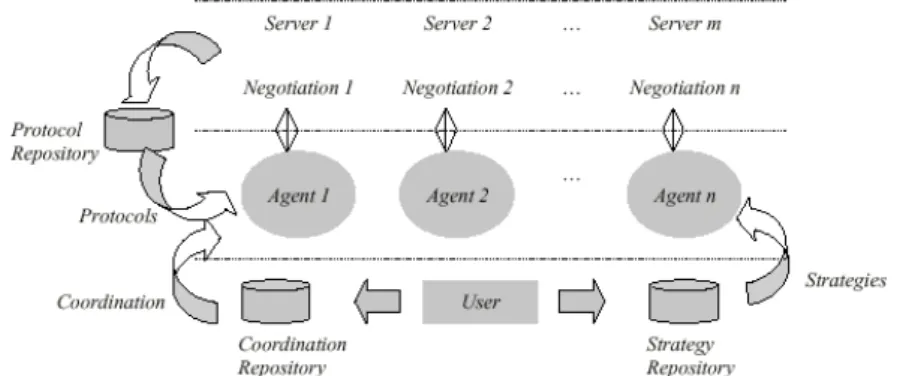
Fig. 1. Protocols, Strategies and Coordination in CONSENSUS
2.3. The CONSENSUS Approach
As mentioned in Section 1, the basic components of automated negotiation systems are the protocol and strategies [17]. The protocol defines the interaction between the agents. The strategies specify the sequence of actions the agent plans to make during the negotiation. In CONSENSUS, the protocol (i.e., the negotiation rules) is communicated to the participants before they engage in the negotiation. A human negotiator would consult the protocol; a software agent would download it in a usable format (XML for instance). However, the strategies are the responsibility of the negotiator. A human negotiator would use her strategies to make offers or to respond to her opponents’ offers; a software agent would do the same, based on the instructions provided by its creator. In addition to protocols and strategies, we introduce a third component: coordination. This is the information that the agents need in order to coordinate their actions while they participate in a combined negotiation (see Section 1). Figure 1 presents our view of the three components. Two approaches inspired our representation for the strategies. Su et al. use a high-level rule specification language and GUI tools to allow human negotiation experts to add and change negotiation strategies at run-time [18]. Each strategy is expressed as an Event-Trigger Rule, which specifies the condition to be checked and the actions to be taken by the negotiation server. Rules are activated upon the occurrence of specific events during the negotiation process. Although not directly related to e-negotiations, the work of Grosof et al. on contract representation takes a similar approach [19]: since contract terms usually involve conditional relationships, they are expressed as rules. Similarly, we see strategies as rules that can be fed to the agents before and/or during the negotiation. Strategies such as “if the bidding gets too intense, then
abandon the negotiation”, and “if you notice any jump-bidding, shielding, or sniping,
then wait for further instructions” can indeed be nicely coded as rules (see Section 4).
Rules drive the activity in the agents by describing the action(s) to take when specified conditions are met [21]. They are at a relatively high level of abstraction, and are closer to human understanding, especially by domain experts who are typically non-programmers. They are relatively easy to modify dynamically [22], and new behavior can be specified by adding rules, without modifying the previous ones. Furthermore, rules can be augmented with procedural attachments so that they have an effect beyond pure-belief inferring [23]. Finally, off-the-shelf rule engines can be used to implement rule-based systems. Figure 2 shows two rules in the ILOG JRules syntax [24], which implement proxy bidding. Rule1 is triggered when the agent is trailing while its reserve price is not met. In this case it places a bid equal to the actual bid plus the increment. Rule2 enables it to quit whenever its reserve price is met.
// If you are not leading and you have not // reached your reserve price, then bid.
Rule Rule1 {
When {?x: TheElement(iLead == false; (highestBid+myIncrement)<= myReservePrice);} Then {modify? x {action = "BID";} } };
// If you are not leading and your bid is // greater than the reserve price, then quit. Rule Rule2
{
When {?x: TheElement(iLead == false; (highestBid + myIncrement) > myReservePrice);} Then {modify ?x {action = "DROP";} } };
Fig. 2. Proxy bidding in the JRules syntax
3. Coordination of Negotiating Agents
3.1. Background and Related WorkThe interaction between agents can vary from simple information interchanges, to requests for particular actions to be performed and on to cooperation (working together to achieve a common objective) and coordination (arranging for related activities to be performed in a coherent manner) [25]. Multiple agents need to be coordinated to prevent anarchy; meet global constraints; distribute expertise, resources or information; deal with dependencies between agents; and ensure efficiency [15]. In CONSENSUS, there is clearly a need to coordinate the software agents (see Section 1). First, in a situation where many agents participate in separate negotiations with the goal of purchasing one item (e.g., they engage in many concert ticket auctions with the goal of purchasing one ticket), we need to make sure that only one agent finalizes its deal, and that only the agent in the cheapest auction (i.e., the one with the smallest asking price) is the one to bid. It is common in online auctions to forbid bidders from breaking their commitments. Thus, if more than one agent end up winning their auctions, they would not be able to retract, or at best they would be, but they would pay a penalty. Second, in a situation where multiple agents negotiate a package of complementary items (i.e., there is no use for one item without the others), we need to make sure that all the items or none are purchased in order to
avoid exposure. Exposure occurs when we need many items, enter negotiations for all items, and end up making a deal on some but failing to make a deal on others. Coordination in CONSENSUS will be discussed further, but first, we review some related work.
The Biddingbot [8] is a Multi-Agent System (MAS) that supports users in monitoring multiple auctions. It consists of one leader agent and several bidder agents, each one being assigned to an auction. Bidder agents gather information, monitor, and bid in the multiple sites simultaneously. The leader agent manages cooperation among them, sends user requests to them, and presents bidding information to the user.
Another system, designed at the HP Labs in Bristol, UK, takes a different approach. Instead of a MAS, it uses one single agent [9]. The agent participates in many auctions for one item, and coordinates bids across them using a two-part algorithm: (1) a coordination component, which ensures it has the lowest leading bids; and (2) a belief-based learning and utility analysis component to determine if it should deliberately lose an auction in the hope of doing better in another one later.
Not directly related to e-negotiation research, but highly relevant in the way it deals with coordination in MAS is the ARCHON project [26]. Software agents are divided into two layers: an ARCHON layer and an application program. The former encapsulates knowledge about cooperation, which is domain independent and encoded in terms of production rules. The latter performs the problem solving process. The separation of cooperation knowledge from application knowledge enables generic cooperation features to be reused for other applications.
3.2. The CONSENSUS approach
Inspired by the ARCHON approach, we treat coordination information as declarative knowledge, and represent it as if-then rules which the agents exploit using an inference engine. Since our agents are already coupled with rule engines (for their strategy component), it is convenient to use the same rule engine to execute the coordination. We distinguish between strategy rules (described in Section 2), used to determine the action to take based on the information about a particular negotiation, and coordination rules, which are used to determine the action to take based on information about other negotiations (possibly combined with information about the negotiation itself). Coordination rules, as well as strategy rules have conditions that are built on the state of the agent, the amount (spent, to spend, committed, remaining, etc.), the remaining time in the negotiation, the frequency of bids, etc.
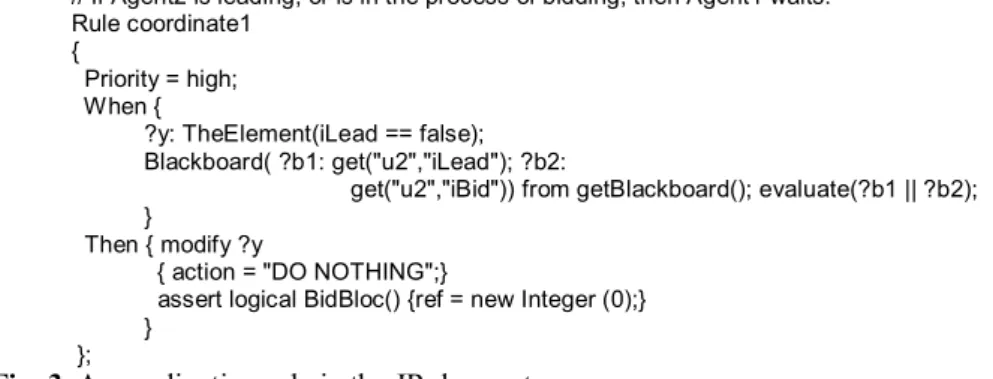
Suppose we have two agents participating in separate negotiations with the goal of purchasing just one item. The following rule ensures that Agent1 does not commit itself if Agent2 is already committed: “if Agent2 is leading or is in the process of
bidding, then Agent1 should wait.” Figure 3 shows the rule in the JRules syntax. Note
that this rule is too restrictive since an agent cannot make a bid if the other one is leading. Evidently, this should not always be the case. If breaking commitments is allowed (perhaps at a certain cost) the rule in question can be relaxed, and we may have the two agents leading at the same time while making sure that one of them drops out of the auction before it is too late.
Suppose now that we have two agents participating in separate negotiations with the goal of purchasing two complementary items. The following rule minimizes the risk of exposure (see Section 3.1): “if Agent2 is trailing, and its chances of making a deal
are slim, then Agent1 should wait for further instructions.”
// If Agent2 is leading, or is in the process of bidding, then Agent1 waits. Rule coordinate1
{
Priority = high; When {
?y: TheElement(iLead == false); Blackboard( ?b1: get("u2","iLead"); ?b2:
get("u2","iBid")) from getBlackboard(); evaluate(?b1 || ?b2); }
Then { modify ?y
{ action = "DO NOTHING";}
assert logical BidBloc() {ref = new Integer (0);} }
};
Fig. 3. A coordination rule in the JRules syntax
Finally, for practical reasons, we adopted a coordination approach where the agents post and read from a general blackboard. Coordination rules are therefore triggered by information that the agents make available in the blackboard (see Figure 3). This approach is suitable only if the tasks are assigned, a priori, to the agents, if the number of agents is small, and if the agents share a common domain understanding. Evidently, all requirements are satisfied in our case, otherwise, the blackboard scheme would result in a severe bottleneck.
4. Validation
In order to validate our choice of representation for strategies and coordination, we used our agent-mediated negotiation system (i.e., CONSENSUS) to conduct bidding tournaments. The agents function in repeated cycles we call pulses. A pulse is made of four steps as described by the following piece of code:
repeat
sleep (p);
getInformation ();
think ();
act ();
until (state = “winning” or state = “loosing” or state = “dropping”)
The pulse’s steps are: (1) sleep (p): the agent goes to sleep for a period p that can be fixed or determined dynamically; (2) getInformation (): the agent queries the server and updates its private information; (3) think (): the agent applies the rules to determine the action to take; and (4) act (): the agent takes the appropriate action. The possible actions are: (1) do nothing: take no action for the time being; (2) bid (v): bid the amount v; and (3) drop: quit permanently. Finally, the agent’s states are: trailing, bidding, leading, winning, loosing, and dropping.
Each agent instantiates a rule engine, enabling it to exploit the rules. There are three categories of rules: (1) basic rules, which determine the agent’s behaviour within the negotiation protocol at hand; (2) strategy rules; and (3) coordination rules. Using this setting, we conducted bidding tournaments within a simulated market, and we present here the results involving the English and Dutch auctions, and some coordination schemes across them.
4.1. English Auction
In an English auction, the participant has to decide whether or not to bid, how much to bid, and whether or not to abandon the auction (see the actions above). Observing the opponents (as in real life auction houses) is essential in taking such decisions, and by doing so, the participant gains two types of information: (1) how many bidders have dropped out of the auction (since they have lower valuations than the current bid); and (2) at what prices they dropped out [27]. The participant may also try to predict its opponents’ behavior, and sometimes that means guessing their private information. Finally, it might be helpful to know if the opponents are symmetric (i.e., they use the same measurements to estimate their valuations), and if they have secret information about the item [28].
Optimal bidding in an English auction means bidding a small amount more than the
current bid until you reach your valuation and then stop. This strategy, described by the rules in Figure 2, has the effect shown in Figure 4. Notice that the time is in seconds, but a real online auction might take a week or more. The winner (Agent in this case) is the one with the highest valuation (i.e., reserve price).
Since online auctions take place over a long period of time, it is hard to monitor them. The reasons are: (1) there is an Internet connectivity cost every time you enter a bid; and (2) there is an opportunity cost associated with logging on and entering the bid. An agent should optimize connections by connecting only when it is relevant to do so, and should be able to determine rapidly whether or not the auction suits its needs. Dropping out early means it can enter another auction early. Figure 5 shows Agent adjust its update rate to the average bidding rate. At the start of the auction, it makes few interventions, and as the activity increases, it participates more often (monitors the auction closely). Note that in this case, the agent makes bids every time it updates its information, but this is not an obligation.
In auctions where no minimum increment is enforced, we talk of spontaneous
bidding. In this case, it might be useful to observe the bidding process and adapt one’s
increment to that of the opponents. Figure 6 shows Agent doing exactly that.
Jump bidding means entering a bid larger than necessary to send a signal to the
opponents. The sender and the recipient of the signal may be better off in a jump bidding equilibrium: the sender saves bidding costs by deterring potential competition; and the recipient saves the costs of bidding against a strong opponent [29]. Figure 7 shows Agent detecting a jump bid made by Player and deciding to quit. Some opponents continue to bid but Player finally wins. In Figure 8, Agent responds with jump bids until Player (and everyone else) quits. In Figure 9, Agent detects a jump bid, and waits until the bidding goes back to normal before bidding again.
Sniping means waiting until the last minute of the auction, and trying to submit a bid, which barely beats the high bid and gives the opponents no time to respond. Obviously, if all bidders follow a sniping strategy, the game would become equivalent to a first-price sealed-bid auction, with all the bids submitted at the end. In Figure 10, Agent snipes and wins, and in Figure 11, three agents engage in a sniping war.
Bid shielding happens when a bidder puts in an early low bid (say $10) on an item,
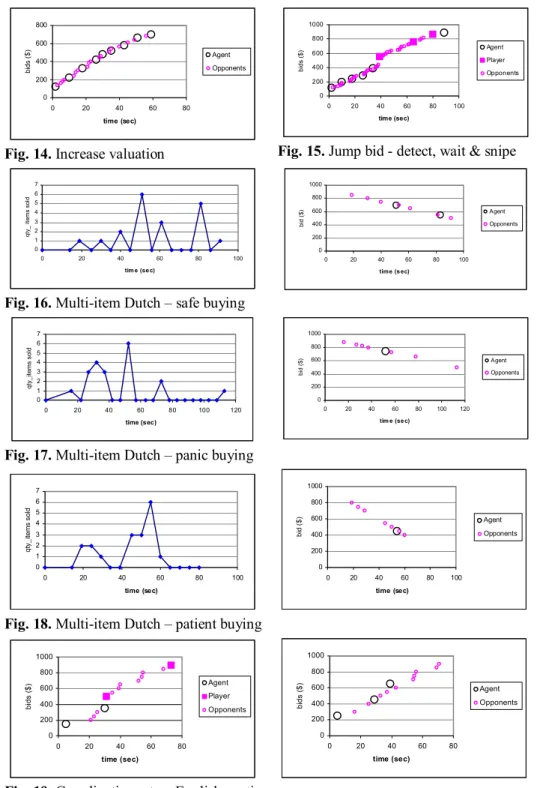
and then gets a friend (or a false identity) to put in an extremely high bid (say $500) on the same item. The high bid acts as a shield for the low bid, keeping anyone else from bidding. Just before the end of the auction, the bidder retracts the $500 bid, leaving the $10 bid as the winning bid on an item that should have gone for a higher price. Figure 12 shows Player1 and Player2 perform a shielding. Agent quits because the shield exceeded its valuation, and Player1 wins after Player2 retracts its bid. In Figure 13, Agent detects the shield and waits for it to be removed to snipe and win. It can happen that a bidder reconsiders an item’s valuation by observing how the opponents behave. Figure 14 shows Agent increase its valuation when its reserve price is met, the auction is about to close, and few participants remain. It changes the reserve price from 600$ to 900$ and stays in the game to win.
Finally, Figure 15 shows a combination of a several tactics. Agent avoids jump bidding by entering a waiting state, and at the end, it snipes and wins. This could be a way to hide your real intentions from your opponents.
4.2. Dutch Auction
When the market price of the auctioned item is a common valuation among bidders (e.g., an auction for personal computers), a bidder who wins the auction is the one with the highest yet possibly overrated valuation. This is called the winner’s curse. In Dutch auctions, where a bidder selects a cut-off price at which to claim the item so long as no one else claims it, all participants try to avoid the winner’s curse by
shading down their bids slightly below their valuations (i.e., bidding less than what
they think the object is worth) [27].
In Dutch auctions, no relevant information is disclosed in the course of the auction, only at the end when it is too late, which makes designing strategies a futile task. This is not the case with multi-item Dutch auctions where bidders watch the transaction prices, the number of remaining items (if available), the remaining time (if available), and decide whether to bid, wait for the price to drop, or quit. We designed a multi-item Dutch auction as follows: (1) identical multi-items are put on sale and the unit price is made public, (2) as time passes, the seller decreases the unit price to generate interest, and (3) a buyer’s bid is the quantity to purchase at the current price. The basic behavior of our agents is not different from that of the English auction. Instead of bidding a price, the agents bid a quantity. When created, an agent is given the quantity to buy, the minimum acceptable quantity, and the user’s valuation.
We define a “safe buying” tactic as: “as the price decreases, when it reaches your valuation, buy the minimum quantity. Keep watching the auction, and before it closes,
buy the remaining items (possibly at a smaller price that your valuation).” The effect
of this tactic is shown in Figure 16, where Agent (right) buys 4 items (minimum), and later, buys 3 more items to reach its maximum quantity of 7.
We define “panic buying” tactic as: “as the price decreases, if you see that a large number of items are sold, and your valuation is not met, then it might mean that your valuation is too low. Adjusting your valuation up will permit you to buy at least the
minimum quantity.” In Figure 17, Agent (right) increases its valuation and buys the
minimum 4 items needed. Notice that the risk of missing the minimum quantity is small, but the risk of the winner’s curse is high.
Finally, Figure 18 shows the effect of a the following “patient buying” tactic: “if the price drops fast, the buying rate is low, and you reach your valuation, then lower
your valuation”. This tactic might save the buyer from the winner’s curse as it helps
get the items at a lower price. There is however a risk that someone else buys all the items before the agent makes its move.
4.3. Coordination
Using the same setting as before, we made several agents participate in separate auctions at the same time, and used the rule-based approach to manage their coordination. Here are some results.
Suppose we want two complementary items A and B, and we engage Agent1 in an English auction for A, and Agent2 in another English auction for B. The two agents negotiate separately, but they coordinate their actions using rules. Figure 19 highlights the following coordination scheme: “if Agent1 (left) detects a jump bid (i.e., the opponent is serious about winning, therefore Agent1 may loose its auction) then
Agent1 must quit. In this case, Agent2 (right) must also quit to avoid exposure.”
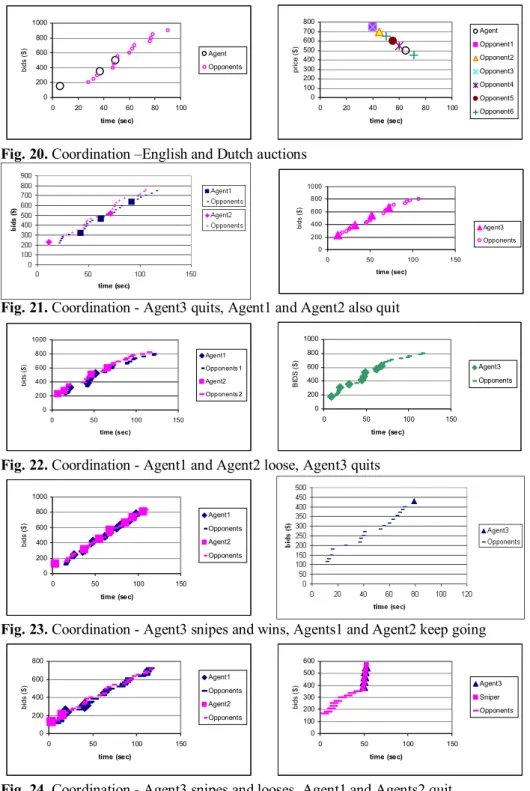
Now, suppose we want item A or item B, and we launch Agent1 in an English auction for A, and Agent2 in a Dutch auction for B. Figure 20 shows the effect of the following two coordination rules: “if the going price in the Dutch auction (right) is less than the current bid in the English auction (left), and our valuation is higher than
the going price, we buy in the Dutch auction”, “if the going price in the Dutch auction
is less than the current bid in the English Auction, we quit the English auction.”
For the following tests, three agents Agent1, Agent2, and Agent3 participate at the same time in separate (and independent) English auctions for items B, C and A respectively. The goal is to win "(B or C) and A", that is “B and A” or “C and A”. Figure 21 shows Agent1 and Agent2 (left) bidding in parallel, and only one is leading at the same time while bids are always made in the cheapest auction. The figure also shows Agent3 (right) quitting (its reserve price is met), causing Agent1 and Agent2 (left) to quit. In Figure 22, both Agent1 and Agent2 (left) loose (their reserve price is met). At the same time, Agent3 (right) quits. Figure 23 shows Agent3 (right) snipe and win, and Agent1 and Agent2 (left) continue until Agent2 wins. In Figure 24, Agent3 (right) engages in a sniping war and looses to another sniper. Agent1 and Agent2 (left) have no choice but to quit.
5. Conclusion
The aim of the paper was to demonstrate that we could capture a wide range of bidding strategies and bid coordination schemes, using a rule-based approach, while
supporting a wide spectrum of negotiation types. The well-known advantages of rule-based systems are the modularity and the uniformity (knowledge is represented using the same format). The possible inefficiency of rules and their eventual slow processing can be overcome by compiling the rules. Graphical tools can also be used to browse the rule base in order to verify its coherence. Bid strategies usually involve fairly complex optimization algorithms and forecasting that could not be expressed directly as rules. We propose to make use of optimization algorithms and forecasting as procedural attachments in the action part of the rules.
Basic behavior of agents, various bidding tactics and coordination schemes across multiple auctions were implemented using our representation. They were tested in agent tournaments within simulated markets. So far, the results are encouraging and other possibilities are yet to be explored. As further points of interest we see the following. (1) The flexibility of this representation should be tested, and the limits of its expressiveness should be sought. (2) It is no secret that rules are a bit restricted in their ability to be adapted automatically, as agents are usually expected to adapt over time to improve their performance. It should therefore be investigated whether our approach can lend itself to machine learning techniques [14][20]. (3) We have been considering negotiations where the only negotiable attribute is the price, but in the case of a plane ticket, for instance, the attributes could be the price, the date of the flight, the airports (departure and destination), etc. Coordination across several multi-attribute negotiations should therefore be studied since it generates more complexity.
References
[1] J. O. Kephart, J. E. Hanson, and A. R. Greenwald. Dynamic pricing by software agents. Computer Networks, 2000. To appear.
[2] K. Jonkheer. Intelligent agents, markets and competition: consumers' interests and functionality of destination sites. Published Electronically on FirstMonday, 1999. [3] A. Moukas, R. Guttman, and P. Maes. Agent-mediated electronic commerce: An MIT media laboratory perspective. In proceeding of ICEC98, April 1998.
[4] D. C. Parkes, L. H. Ungar, and D. P. Forster. Agent Mediated Electronic Commerce, chapter Accounting for Cognitive Costs in On-line Auction Design, pages 25-40. Springer-Verlag, 1999.
[5] R. H. Guttman, A. G. Moukas, and P. Maes. Agent-mediated e-commerce: A survey. Knowledge Engineering 13(3), 1998.
[6] A. Chavez and P. Maes. Kasbah: An agent marketplace for buying and selling goods. In The First International Conference on the Practical Application of Intelligent Agents and Multi-agent Technology, April 1996.
[7] M. Benyoucef, H. Alj, M. Vézeau, and R. K. Keller. Combined Negotiations in E-Commerce: Concepts and Architecture. Electronic Commerce Research Journal, 1(3):277-299, July 2001. Special issue on Theory and Application of Electronic Market Design. Baltzer Science Publishers.
[8] T. Ito, N. Fukuta, T. Shintani, and K. Sycara. Biddingbot: A multi-agent support system for cooperative bidding in multiple auctions. In 4th Intl Conference on Multi-agent Systems (ICMAS-2000), Boston. MA, July 2000.
[9] C. Priest. Algorithm design for agents which participate in multiple simultaneous auctions. Tech. Report HLP-2000-88, Hewlett-Packard, Bristol, England, July 2000. [10] C. Beam, A. Segev, and G. Shanthikumar. Electronic negotiation through internet-based auctions. Tech. Report 96-WP1019, UC Berkeley, December 1996. [11] C. Beam and A. Segev. Automated negotiations: A survey of the state of the art. Technical Report 97-WP-1022, Haas School of Business, UC Berkeley, 1997.
[12] A. R. Greenwald and J. O. Kephart. Shopbots and pricebots. In16th Intl. Joint Conference on AI, volume 1, pages 506-511, Stockholm, Sweden, August 1999. [13] E. Gimenez-Fuentes, L. Godo, and J. A. Rodriguez-Aguillar. Designing bidding strategies for trading agents in electronic commerce. In Third Intl Conference on Multi-Agents Systems (ICMAS-98), Paris, France, July 1998.
[14] W. Y. Wong, D. M. Zhang, and M. Kara-Ali. Negotiating with experience. In KBEM-2001, Austin, TX, 2000.
[15] H. S. Nwana, L. Lee, and N. R. Jennings. Co-ordination in software agent systems. BT Technology Journal, 14(4):79-89, October 1996.
[16] H. R. Varian. Economic mechanism design for computerized agents. In USENIX Workshop on Electronic Commerce, New York, NY, July 1995.
[17] A.R. Lomuscio, M. Wooldridge and N.R. Jennings. A classification Scheme for negotiation in electronic commerce. In Agent-mediated e-commerce: a European AgentLink Perspective, pages 19-33, Springer-Verlag, 2001.
[18] S. Y. Su, C. Huang, and J. Hammer. A replicable web based negotiation server for e-commerce. In 33rd International Conference on System Sciences, Hawaii, 2000. [19] B. N. Grosof. Courteous logic programs: Prioritized conflict handling for rules. Tech. Report RC 20836, IBM Research, T.J. Watson Research Center, May 1997. [20] D. Zeng and K. Sycara. Bayesian learning in negotiation. International Journal of Human-Computer Studies, (48):125-141, 1998.
[21] C. McClintock and C. A. Berlioz. Implementing business rules in java. Java Developers Journal, May 2000.
[22] D. M. Reeves, B. N. Grosof, Michael P. Wellman, and Hoi Y. Chan. Toward a declarative language for negotiating executable contracts. In Workshop on AI in Electronic Commerce, Menlo Park, CA, 1999.
[23] B. N. Grosof, Y. Labrou, and H. Y. Chan. A declarative approach to business rules in contracts: Courteous logic programs in XML. In 1st Conference on Electronic Commerce, Denver, Colorado, November 1999.
[24] ILOG JRules. http://www.ilog.com/products/jrules.
[25] N. R. Jennings, P. Faratin, A. R. Lomuscio, S. Parsons, C. Sierra, and M. Wooldridge. Automated negotiation: Prospects, methods and challenges. International Journal of Group Decision and Negotiation, 10(2), 2001. To appear.
[26] M Berndtsson, S. Chakravarthy, and B. Lings. Coordination among agents using reactive rules. Tech. Report HS-IDA-TR-96-011, Skovde U., Sweden, October 1996. [27] L. J. Mester. Going, Going, Gone: Setting Prices with Auctions. Federal Reserve Bank of Philadelphia Business Review (March/April):3-13 1988
[28] AGORICS. http://www. agorics.com
[29] R. F. Easly and R. Tenorio. Bidding Strategies in Internet Yankee Auctions. Working paper, University of Notre Dame, 1999.
0 200 400 600 800 1000 1200 0 10 20 30 40 50 time (sec) bids ($) Agent Opponents
Fig. 4. Optimal bidding
0 200 400 600 800 0 20 40 60 80 100 time (sec) bi ds ( $ ) Agent Player Opponents
Fig. 5. Adjust update rate
0 200 400 600 800 1000 0 20 40 60 80 100 time (sec) bids ($) Agent Player Opponents
Fig. 6. Adapt increment
0 200 400 600 800 0 20 40 60 80 time (sec) bids ($) Agent Player Opponents
Fig. 7. Jump bid – detect and quit
0 200 400 600 800 1000 1200 0 20 40 60 80 100 time (sec) bi ds ( $ ) Agent Player Opponents
Fig. 8. Jump bid – detect and respond
0 200 400 600 800 0 20 40 60 80 100 time (sec) bi ds ( $ ) Agent Player Opponents
Fig. 9. Jump bid – detect and wait
0 100 200 300 400 500 600 0 20 40 60 80 100 time (sec) bi ds ( $ ) Agent Opponents
Fig. 10. Snipe and win
0 100 200 300 400 500 600 700 800 0 50 100 time (sec) bids ( $ ) Agent1 Agent2 Agent3 Opponents
Fig. 11. Sniping war
0 500 1000 1500 2000 0 10 20 30 40 time (sec) bi ds ( $ ) Player1 Player2 Agent Opponents
Fig. 12. Shielding – detect and drop
0 500 1000 1500 2000 0 20 40 60 80 100 time (sec) bi ds ( $ ) Agent Player1 Player2 Opponents
0 200 400 600 800 0 20 40 60 80 time (sec) bi ds ( $ ) Agent Opponents
Fig. 14. Increase valuation
0 200 400 600 800 1000 0 20 40 60 80 100 time (sec) bids ($) Agent Player Opponents
Fig. 15. Jump bid - detect, wait & snipe
0 1 2 3 4 5 6 7 0 20 40 60 80 100 tim e (sec) qt y_ i tem s sol d
Fig. 16. Multi-item Dutch – safe buying
0 200 400 600 800 1000 0 20 40 60 80 100 time (sec) bi d ( $) Agent Opponents 0 1 2 3 4 5 6 7 0 20 40 60 80 100 120 time (sec) qty_items sold
Fig. 17. Multi-item Dutch – panic buying
0 200 400 600 800 1000 0 20 40 60 80 100 120 tim e (sec) bi d ( $) Agent Opponents 0 1 2 3 4 5 6 7 0 20 40 60 80 100 time (sec) qt y_i tem s sol d 0 200 400 600 800 1000 0 20 40 60 80 100 time (sec) bi d ( $ ) Agent Opponents
Fig. 18. Multi-item Dutch – patient buying
0 200 400 600 800 1000 0 20 40 60 80 time (sec) bids ( $ ) Agent Player Opponents 0 200 400 600 800 1000 0 20 40 60 80 time (sec) bids ( $ ) Agent Opponents
0 200 400 600 800 1000 0 20 40 60 80 100 time (sec) bi ds ( $ ) Agent Opponents 0 100 200 300 400 500 600 700 800 0 20 40 60 80 100 time (sec) pr ic e ( $ ) Agent Opponent1 Opponent2 Opponent3 Opponent4 Opponent5 Opponent6
Fig. 20. Coordination –English and Dutch auctions
0 200 400 600 800 1000 0 50 100 150 time (sec) bids ($) Agent3 Opponents
Fig. 21. Coordination - Agent3 quits, Agent1 and Agent2 also quit
0 200 400 600 800 1000 0 50 100 150 time (sec) bids ($) Agent1 Opponents1 Agent2 Opponents2 0 200 400 600 800 1000 0 50 100 150 time (sec) BI DS ( $ ) Agent3 Opponents
Fig. 22. Coordination - Agent1 and Agent2 loose, Agent3 quits
0 200 400 600 800 1000 0 50 100 150 time (sec) bi ds ( $ ) Agent1 Opponents Agent2 Opponents
Fig. 23. Coordination - Agent3 snipes and wins, Agents1 and Agent2 keep going
0 200 400 600 800 0 50 100 150 time (sec) bi ds ( $ ) Agent1 Opponents Agent2 Opponents 0 100 200 300 400 500 600 0 50 100 150 time (sec) bi ds ( $ ) Agent3 Sniper Opponents