Integrated Crop Management News Extension and Experiment Station Publications
5-17-2018
Black Cutworm Scouting 2018
Adam Sisson
Iowa State University, [email protected]
Erin Hodgson
Iowa State University, [email protected]
Follow this and additional works at:https://lib.dr.iastate.edu/cropnews Part of theAgricultural Science Commons, and theAgriculture Commons
The Iowa State University Digital Repository provides access to Integrated Crop Management News for historical purposes only. Users are hereby notified that the content may be
inaccurate, out of date, incomplete and/or may not meet the needs and requirements of the user. Users should make their own assessment of the information and whether it is suitable for their intended purpose. For current information on integrated crop management from Iowa State University Extension and Outreach, please visithttps://crops.extension.iastate.edu/. Recommended Citation
Sisson, Adam and Hodgson, Erin, "Black Cutworm Scouting 2018" (2018).Integrated Crop Management News. 2497.
Black Cutworm Scouting 2018
AbstractThe black cutworm (BCW) is a migratory pest that cuts and feeds on early vegetative-stage corn. Black cutworm moths arrive in Iowa and other northern states with spring storms each year. These moths lay eggs in and around crop fields and emerging BCW larvae cut seedling corn. This pest is sporadic, making it essential to scout fields to determine if management is needed. Scouting for BCW larvae helps to determine if an insecticide application will be cost effective.
Disciplines
Agricultural Science | Agriculture
2/26/2019 Black Cutworm Scouting 2018 | Integrated Crop Management
https://crops.extension.iastate.edu/cropnews/2018/05/black-cutworm-scouting-2018 1/5
Integrated Crop Management
Black Cutworm Scouting 2018
May 17, 2018The black cutworm (BCW) is a migratory pest that cuts and feeds on early vegetative-stage corn. Black cutworm moths arrive in Iowa and other northern states with spring storms each year. These moths lay eggs in and around crop fields and emerging BCW larvae cut seedling corn. This pest is sporadic, making it essential to scout fields to determine if management is needed. Scouting for BCW larvae helps to determine if an insecticide application will be cost effective.
When to scout for BCW caterpillars is based on the “peak flight” of moths and
accumulating degree days after the peak flight. Degree days are a measure of temperature used to gauge insect development. A peak flight for BCW is defined as capturing eight or more moths over two nights in a wing style trap baited with a pheromone lure.
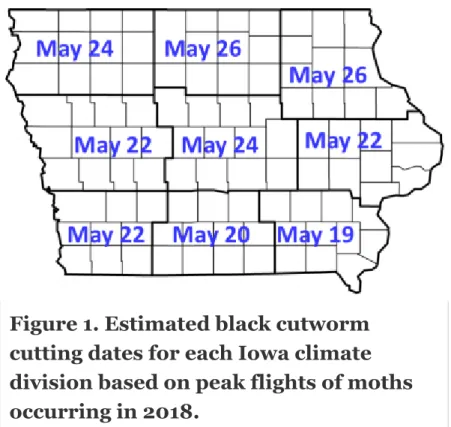
To find out when moths arrive in Iowa, cooperators around the state monitor pheromone traps and report moth captures. Cooperators started checking traps in the beginning of April and captures of BCW moths did not occur until mid-April. Moth captures picked up during the last part of April and early May, with several peak flights recorded. The peak flights observed during this time period were in line with captures in surrounding states. The map (Figure 1) shows predicted BCW cutting dates for the nine Iowa climate divisions, based on actual and historical degree day data and peak flights during late April and early May. We may continue to see peak flights occur in Iowa. Adult moth trap captures do not necessarily mean there will be economically significant BCW infestations in a particular location. Field scouting is essential to determine if an economically damaging infestation exists. Also, as you are out in fields assessing stands, be on the lookout now for early season insect injury in corn – BCW or otherwise.
Figure 1. Estimated black cutworm cutting dates for each Iowa climate division based on peak flights of moths occurring in 2018.
Several states bordering Iowa also track black cutworm flights and make estimates about cutting dates, especially to the north and east. Several of the predictions in these states are in close proximity to the Iowa border, and some are for counties directly adjacent to Iowa. Data from these out-of-state locations may be informative for Iowans living nearby.
Extension resources on black cutworm can be found at the University of Minnesota, Wisconsin Pest Bulletin, and University of Illinois’s The Bulletin.
Scouting
Poorly drained, low lying, or weedy fields, as well as those next to natural vegetation or with reduced tillage, may have higher risk of BCW injury. Those cornfields with poorly terminated cover crops may also be attractive to egg-laying females. Late-planted corn can be smaller and more vulnerable to larval feeding. Some Bt hybrids provide suppression of BCW (e.g., Vip3A, Cry1A.105, Cry2Ab2, and Cry1F proteins), but larvae can still cut young plants.
Scouts are encouraged to start looking for any activity during early season stand
assessment, or at least several days before the estimated cutting dates. Early scouting is important because local larval development may be different due to weather variation within a climate division. Fields should be scouted for larvae weekly until corn reaches V5. Examine 50 corn plants in five areas in each field for wilting, leaf discoloration and
2/26/2019 Black Cutworm Scouting 2018 | Integrated Crop Management
https://crops.extension.iastate.edu/cropnews/2018/05/black-cutworm-scouting-2018 3/5
return later to assess further injury. Larvae can be found by carefully excavating the soil around a damaged plant.
Figure 2. Black cutworm larval injury usually begins above the soil surface. Leaf feeding (left) may be observed. As larvae mature, they can severely damage or kill plants (right). Photo on left copyright Marlin Rice; photo on right courtesy Jon Kiel.
Identification
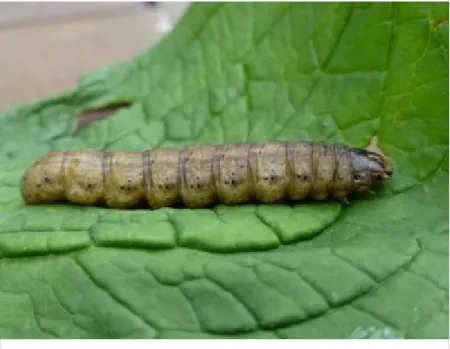
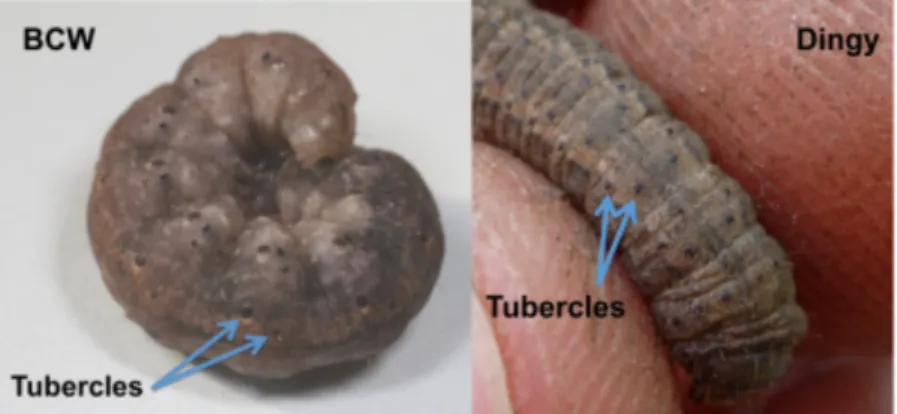
BCW larvae have grainy, light grey to black skin and four pairs of fleshy prolegs on the end of the abdomen (Figure 3). There are pairs of dark tubercles, or bumps, along the side of the body. The pair of tubercles nearest the head is approximately 1/3 to 1/2 the size of the pair closest to the abdomen (Figure 4). BCW larvae can be confused with other cutworms and armyworms.
grainy and light grey to black skin. Photo by Adam Sisson.
Figure 4. Black cutworms (left) can be distinguished from other larvae, like the dingy cutworm (right), by the dark
tubercles on the middle of the back. On each segment, the tubercle closest to the head is about 1/3 the size of the tubercle closest to the rear for black cutworm. Corresponding dingy cutworm tubercles on each segment are roughly the same size. Photos by Adam Sisson.
Thresholds
Common thresholds for seedling, V2, V3, and V4 stage corn plants are 2, 3, 5, and 7 plants cut out of 100, respectively. A dynamic threshold for BCW may be useful with corn price and input fluctuations. An Excel spreadsheet with calculations built in can be downloaded
here and can be used to help with black cutworm management decisions.
Preventive BCW insecticide treatments applied as a tank-mix with herbicides are a questionable practice. BCW is a sporadic pest and every field should be scouted to determine insect presence before spraying insecticides.
If you see any fields with BCW larvae while scouting, please let us know by sending a message to [email protected]. This information could help us to refine future predictions.
2/26/2019 Black Cutworm Scouting 2018 | Integrated Crop Management
https://crops.extension.iastate.edu/cropnews/2018/05/black-cutworm-scouting-2018 5/5
Links to this article are strongly encouraged, and this article may be republished without further permission if published as written and if credit is given to the author, Integrated Crop Management News, and Iowa State University Extension and Outreach. If this article is to be used in any other manner, permission from the author is required. This article was originally published on May 17, 2018. The information contained within may not be the most current and accurate depending on when it is accessed.
Category: Crop Production Insects and Mites Crop:
Corn
Tags: cutworms corn insects pest scouting Authors:
Adam Sisson Extension Program Specialist IV
Adam Sisson is an extension specialist with the Iowa State University
Integrated Pest Management (IPM) program and a Certified Crop Adviser. Sisson focuses on the development of publications and other educational resources for farmers, agribusi...
Erin Hodgson Associate Professor
Dr. Erin Hodgson started working in the Department of Entomology at Iowa State University in 2009. She is an associate professor with extension and research
responsibilities in corn and soybeans. She has a general background in integrated pest management (IPM) for field crops. Dr. Hodgson's curre...