Efficient Parameterized Algorithms for Data Packing
KRISHNENDU CHATTERJEE,
IST Austria (Institute of Science and Technology Austria), AustriaAMIR KAFSHDAR GOHARSHADY,
IST Austria (Institute of Science and Technology Austria), AustriaNASTARAN OKATI,
Ferdowsi University of Mashhad, IranANDREAS PAVLOGIANNIS,
École Polytechnique Fédérale de Lausanne (EPFL), SwitzerlandThere is a huge gap between the speeds of modern caches and main memories, and therefore cache misses account for a considerable loss of efficiency in programs. The predominant technique to address this issue has been Data Packing: data elements that are frequently accessed within time proximity are packed into the same cache block, thereby minimizing accesses to the main memory. We consider the algorithmic problem of Data Packing on a two-level memory system. Given a reference sequenceRof accesses to data elements, the task is to partition the elements into cache blocks such that the number of cache misses onRis minimized. The problem is notoriously difficult: it is NP-hard even when the cache has size 1, and is hard to approximate for any cache size larger than 4. Therefore, all existing techniques for Data Packing are based on heuristics and lack theoretical guarantees.
In this work, we present the first positive theoretical results for Data Packing, along with new and stronger negative results. We consider the problem under the lens of the underlyingaccess hypergraphs, which are hypergraphs of affinities between the data elements, where the order of an access hypergraph corresponds to the size of the affinity group. We study the problem parameterized by the treewidth of access hypergraphs, which is a standard notion in graph theory to measure the closeness of a graph to a tree. Our main results are as follows: we show there is a numberq∗depending on the cache parameters such that (a) if the access hypergraph of orderq∗has constant treewidth, then there is alinear-timealgorithm for Data Packing; (b) the Data Packing problem remains NP-hard even if the access hypergraph of orderq∗−1 has constant treewidth. Thus, we establish a fine-grained dichotomy depending on a single parameter, namely, the highest order among access hypegraphs that have constant treewidth; and establish the optimal valueq∗of this parameter. Finally, we present an experimental evaluation of a prototype implementation of our algorithm. Our results demonstrate that, in practice, access hypergraphs of many commonly-used algorithms have small treewidth. We compare our approach with several state-of-the-art heuristic-based algorithms and show that our algorithm leads to significantly fewer cache-misses.
Additional Key Words and Phrases: compilers, data packing, cache management, parameterized algorithms, data locality
1 INTRODUCTION
We consider the problem of Data Packing over a two-level memory system consisting of a small cache and a large main memory. Given a reference sequence of memory accesses to data elements, the goal is to organize the data elements into blocks in order to minimize cache misses. Intuitively, putting contemporaneously-accessed elements in the same block reduces the number of cache misses, but existing heuristic-based results do not present any theoretical guarantees. In this paper, we consider this problem from a theoretical perspective and establish its complexity by presenting exact algorithms and stronger hardness results. We also complement our theoretical results with an experimental evaluation.
Authors’ addresses: Krishnendu Chatterjee, IST Austria (Institute of Science and Technology Austria), Austria, krishnendu. [email protected]; Amir Kafshdar Goharshady, IST Austria (Institute of Science and Technology Austria), Austria, [email protected]; Nastaran Okati, Ferdowsi University of Mashhad, Iran, [email protected]; Andreas Pavlogiannis, École Polytechnique Fédérale de Lausanne (EPFL), Switzerland, [email protected].
2019. 2475-1421/2019/1-ART1 $15.00
Cache Management.Consider a memory system with an associative cache and a main memory. Data items are stored in the main memory and organized into sets of a small size, which are called
blocks (or pages). All data items have the same size and all blocks can hold the same number of data items. The cache has a small capacity and can hold a few blocks at any given time. Whenever a program needs to access a data element, its corresponding block must be present in the cache before the access can happen. Therefore, if the block is not already in the cache, it will be copied into the cache from the main memory, potentially by evicting another block. This copying process is called acache miss, and given the considerably slower speed of the main memory, cache misses are very
time-consuming and lead to significant overhead [Wulf and McKee 1995]. Therefore, the problem of
cache management, i.e., minimizing the number of cache misses, is of great importance in compilers
and operating systems. Cache management can naturally be divided in two parts [Calder et al.
1998]: (i) deciding on how to replace the blocks in the cache, i.e. which block to evict when the
cache is full and a miss occurs and (ii) deciding on the placement scheme of the data items inside
blocks. These problems are respectively calledPaging (or choosing a replacement policy)[Sleator
and Tarjan 1985] andData Packing[Lavaee 2016;Thabit 1982].
Paging (Replacement Policy).In paging, given a data placement scheme that divides the data
items into blocks and a so-calledreference sequenceof accesses to data elements, the problem is to
choose a block to be evicted each time a cache miss occurs. The goal is to do this in a way that
minimizes the total number of cache misses over the reference sequence [Panagiotou and Souza
2006]. An algorithm that chooses the block to be evicted is called areplacement policy. Common
replacement policies includeFIFO, which evicts the oldest block in the cache, andLRU, which evicts
the least recently used block [Borodin et al. 1995;Lavaee 2016]. Note that both FIFO and LRU can
also be applied in the online setting, i.e., when the algorithm does not know the entire sequence in advance and can only observe accesses as they are made. In the offline case, where the entire reference sequence is given in the beginning, the optimal replacement policy is to evict the block whose first use is furthest in the future [Borodin et al. 1995]. This is called theoptimal offline policy
(OOP). We primarily focus on LRU as the replacement policy, because it is the one that is most
commonly used in practice [Zhong et al. 2004].
Data Packing.The other aspect of cache management, which is the focus of this paper, is Data
Packing [Thabit 1982]. Consider a cache with a capacity ofmblocks, where each block can store
pdata items∗. Given a reference sequenceRof lengthN of accesses tondistinct data items and
a replacement policy, Data Packing asks for the optimal placement of data items into blocks in
order to minimize the number of cache misses. The parametersmandpare considered to be small
constants, and the complexity is studied wrtnandN which are large. Data Packing is an extremely
hard problem and is known to be hard to approximate within any non-trivial factor, i.e., any factor
significantly less thanN, unless P=NP [Lavaee 2016].
Relevance of Data Packing in Programming Languages.Data Packing is an important tech-nique for performance optimization during compilation and has been widely studied by the
pro-gramming languages community (See [Calder et al. 1998;Ding and Kennedy 1999;Lavaee 2016;
Petrank and Rawitz 2002;Zhang et al. 2006;Zhong et al. 2004]). The key relevance is two-fold:
• Limit studies:To test the performance of a compiler for data placement, various inputs can be generated as benchmarks, and the baseline comparison of the performance can be performed
against an optimal algorithm [Petrank and Rawitz 2002]. Hence, an optimal data packing
algorithm is necessary as the baseline.
∗
This necessarily means that there is a limit on the size of data items and a large item should be broken into smaller parts, each of which is considered a distinct data item.
• Profiling:Programs usually have similar memory-access behaviors over different inputs [
Pe-trank and Rawitz 2002]. Hence, an effective approximate approach for the online cache
management problem is to consider several representative inputs, then run an optimal offline algorithm for profiling, and then synthesize an answer to the online problem from optimal
offline solutions [Calder et al. 1998;Petrank and Rawitz 2002].
Previous theoretical results on data packing have all been negative (hardness) results.
Heuristics and Affinity.Given the hardness of cache management and Data Packing, the research in this area has been mostly focused on developing heuristics. The intuition behind many of these heuristics is to exploit the underlying affinities between data elements or blocks by trying to place elements that are commonly accessed together in the same block or evicting the block that is less
frequently accessed in conjunction with the rest of the blocks in the cache [Calder et al. 1998;
Ding and Kennedy 1999;Ding and Kandemir 2014;Han and Tseng 2006;Zhong et al. 2004]. Some
approaches, such as [Zhang et al. 2006], provide more sophisticated heuristics and construct a
hierarchy of affinities. However, none of the existing heuristics provide any theoretical guarantees.
Access Graphs.The concept of access graph [Borodin et al. 1995] has been introduced to model the affinities between data elements or blocks. An access graph is simply a graph in which there is a vertex corresponding to every data item and two vertices are connected by an edge if their respective items appear consecutively in the reference sequence. Access graphs might be weighted to model how many times every pair of elements have appeared consecutively. Similar structures
and extensions of access graphs to access hypergraphs have been introduced in [Lavaee 2016;
Thabit 1982] where they are called proximity (hyper)graphs. Moreover, most of the heuristic-based
approaches also consider variants of the notion of access graphs.
Cache Misses vs Cache Hits.We consider the Data Packing problem, which asks to minimize the cache misses. Its natural dual problem is to maximize cache hits. While the two problems are equivalent in case of exact algorithms, an approximation algorithm for maximum cache hits does
not necessarily lead to an approximation for minimum cache misses [Lavaee 2016]. For example, if in
an access sequence of lengthNwe haveN−
√
Ncache hits and
√
Ncache misses, an approximation
ofN−
√
Nhits can lead to an arbitrarily bad approximation of
√
Ncache misses. In practice, cache
misses occur much less frequently than cache hits, but contribute significantly to the overhead. Thus, approximation of cache misses is more important than approximation of cache hits, and the Data Packing problem is defined in terms of cache misses.
Previous Results on Cache Management.To the best of our knowledge, all theoretical results on minimizing cache misses are negative or hardness results. We summarize some of the main
results in this area. Given a reference sequenceRof lengthN and a cache with a capacity ofm
blocks, the following results have been shown:
(i) In [Petrank and Rawitz 2002], the authors considered the problem of Cache-conscious Data
Placement, which is a somewhat different formulation of cache-miss minimization and is intuitively similar and related to Data Packing. In Cache-conscious Data Placement, a cache
consists ofmlines, each capable of holding up topdata items at any given time. The problem
is to assign each data itemdto a cache lineld. When the program wants to access the data
itemd, it should be present in cache lineld, otherwise a cache miss occurs anddis copied to
ld, potentially by evicting another data item fromld. Given an eviction strategy, the goal is to
assign data items to cache lines in a manner that minimizes cache misses. In [Petrank and
Rawitz 2002] it was shown that the problem is NP-hard and unless P=NP, it cannot even be
(ii) In the same paper, it was shown that any algorithm that does not process the entire sequence, but instead relies on pairwise affinity information on data items, such as the access graph,
cannot find a solution within a factor ofm−3 from the optimal, even with unbounded time.
(iii) In [Lavaee 2016], the author showed that Data Packing is NP-hard for any cache size and hard
to approximate within a factor ofO(N1−ϵ)unless P=NP.
Given these hardness results, Data Packing is usually handled by heuristic-based algorithms that do not provide any theoretical guarantee. The only positive theoretical result deals with approximating maximum cache hits:
(iv) In [Lavaee 2016] it was established that the dual problem of Data Packing with the goal of
maximizing cache hits, instead of minimizing cache misses, is approximable within a constant factor. However, this does not approximate the optimal number of cache misses.
Exploiting Structural Properties.Data Packing is a notoriously difficult computational problem. In dealing with this problem, a direction that has not been pursued is to exploit structural properties of the access graphs. In many cases, structural properties of graphs help in obtaining efficient parametrized algorithms for computationally-hard problems. Specifically, a well-studied structural property in graph theory, which is frequently applied to computationally-hard graph problems, is
the notion oftreewidth. We present this notion below.
Treewidth.Treewidth [Robertson and Seymour 1984] is a well-known and extensively-studied parameter in graph theory. The treewidth of a graph is a measure of how tree-like the graph is. Specifically, trees and forests are the only graphs with a treewidth of 1. The importance of treewidth in algorithm design stems from the fact that many NP-hard graph problems (e.g., Vertex Cover and Hamiltonian Cycle) can be solved in polynomial time if the input graphs have constant treewidth
and moreover, many other graph problems can be solved in a lower complexity [Abboud et al.
2016;Bodlaender 1997;Chatterjee et al. 2018;Cygan et al. 2015;Fomin et al. 2017;Robertson and
Seymour 1986]. The formal definition of treewidth is presented in the next section.
Treewidth in Program Analysis.Many important families of graphs that arise commonly in algorithm design are shown to have constant treewidth, e.g., series-parallel and outer-planar
graphs [Bodlaender 1998]. Perhaps the most important example in program analysis is that the
control-flow graphs of structured goto-free programs in many languages such as Pascal and C++
have constant treewidth [Thorup 1998]. The same result was also shown experimentally for most
Java programs [Gustedt et al. 2002]. This led to algorithmic advances in verification and program
analysis [Chatterjee et al. 2015a]. Moreover, treewidth has also been exploited to obtain faster
algorithms for static analysis of recursive state machines [Chatterjee et al. 2015b] and concurrent
systems [Chatterjee et al. 2016,2017].
Treewidth in Data Packing.In this work we show that Data Packing can be reduced to a graph problem. In many cases when a graph arises from a structured process, the treewidth of the graph
is not very large [Bodlaender 1998]. For Data Packing, the access graphs arise from structured
program accessing data from a well-defined data structure. Thus, it is natural to study the problem of Data Packing in terms of the treewidth property of the arising graphs, as we do in this work. Our Contributions.Our contributions include (a) polynomial algorithms for Data Packing in constant treewidth access (hyper)graphs, (b) stronger hardness results, and (c) experimental results demonstrating that our approach leads to considerably fewer cache misses in comparison with
previously-known heuristic-based approaches. Concretely, consider that the cache has sizem, every
block can holdpdata items and the reference sequence is of lengthN withndistinct items. We
consider the access hypergraph of orderq, where each vertex of the graph is a data item, and an
edge connects a set ofqdistinct data items if they appear contiguously in the reference sequence.
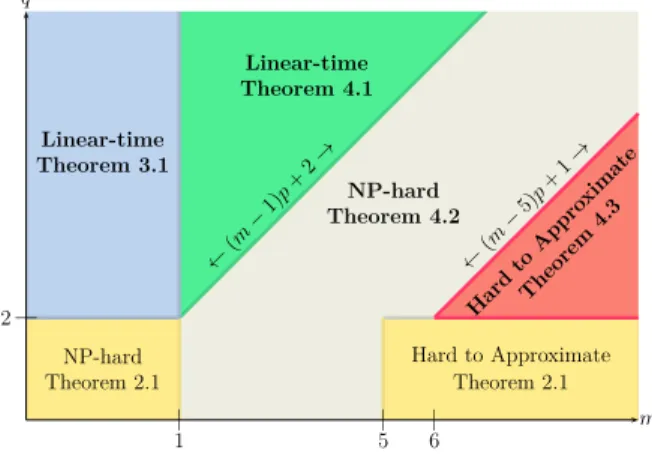
Hard toAppro ximate Theorem 4.3 ←( m− 5)p +1 → NP-hard Theorem 4.2 ←( m− 1)p +2 → Linear-time Theorem 4.1 Hard to Approximate Theorem 2.1 NP-hard Theorem 2.1 Linear-time Theorem 3.1 | 1 5| 6| | 2 m q
Fig. 1. The complexity of Data Packing forp≥3. Heremis the cache size andqis the highest order for which
the access hypergraph has constant treewidth. For a formal definition of order see Section2.1. Theorem2.1
was established in [Lavaee 2016]. The rest of the picture is filled by this paper. Our results are shown in bold.
access (hyper)graph and we study whether the constant treewidth property can be exploited for
polynomial-time algorithms. Our main results, assuming constantmandp, are as follows:
(1)Results on Access Graphs.We first considerq=2. Note that order-2 access hypergraphs are basically access graphs. We establish the following results:
• Linear-time algorithm.We present a linear-time algorithm for Data Packing when the
access graph is of constant treewidth andm=1 (Theorem3.1).
• Hardness of the exact problem.The Data Packing problem remains NP-hard form≥2 and
p ≥3 even if the underlying access graph is a tree (which has treewidth 1) (Theorem3.2).
• Hardness of approximation.Unless P=NP, for anym≥6,p ≥2 and any constantϵ >0,
the Data Packing problem is hard to approximate within a factor ofO(N1−ϵ)even if the
underlying access graph is a tree (Theorem3.2).
(2)Results on Access Hypergraphs.We define access hypergraphs of higher orders and consider
their treewidth. Letq∗=(m−1)p+2. Note thatq∗depends only on the cache parameters, and
not onnorN. We consider the access hypergraph of orderq∗. Intuitively, every edge of this
access hypergraph contains all the necessary historical cache data for determining whether a miss occurs at a corresponding memory access. Formally, we establish the following results:
• Linear-time algorithm.We present a linear-time algorithm for Data Packing when the
access hypergraph of orderq∗has constant treewidth (Theorem4.1).
• Hardness of the exact problem.Form≥2 andp ≥3, the Data Packing problem remains
NP-hard even if the access hypergraph of orderq∗−1 has constant treewidth (Theorem4.2).
• Hardness of approximation.Unless P=NP, form≥6 andp ≥2 and any constantϵ >0, the
Data Packing problem is hard to approximate within a factor ofO(N1−ϵ)even if the access
hypergraph of orderq∗−4p−1 has constant treewidth (Theorem4.3).
Note that while constant treewidth has been exploited to obtain polynomial-time algorithms for NP-complete graph problems such as Vertex Cover and Hamiltonian Cycle, we show that for Data Packing the constant treewidth property does not always help, and the problem
remains hard even when the access hypergraph of orderq∗−1 has constant treewidth.
Our hardness result and linear-time algorithm present a sharp boundary (or fine-grained dichotomy) that shows when the treewidth can be exploited. Concretely, the hardness of
the Data Packing problem can be captured by a single parameter, namely, the highest order
amongst access hypergraphs that have constant treewidth. We establish the optimal valueq∗
of this parameter which is the necessary and sufficient condition for existence of efficient parameterized algorithms that exploit treewidth.
(3)Experimental results.We present an experimental evaluation of a prototype implementation of our algorithm on a variety of benchmarks from linear algebra, sorting algorithms, dy-namic programming, recursive algorithms, string matching, computational geometry and algorithms on tree data-structures. Our results show that the access hypergraphs of most of the benchmarks have small treewidth. We compare our approach with several state-of-the-art heuristic-based algorithms. The experimental results show that on average our optimal algorithms obtain 15-30% imporvement over the previous heuristic-based approaches. Novelty and Significance.In this paper, we define a novel and rich structural property of programs, i.e. access hypergraphs and their treewidth, and show that it can be exploited to obtain faster algorithms for Data Packing. We present the first positive theoretical results for Data Packing, i.e.,
for cache-miss minimization. We also enrich the complexity landscape as shown in Figure1. Only
the results of Theorem2.1were known before, and all other results (which are shown in bold) are
established in the present work.
2 PRELIMINARIES 2.1 Data Packing
In this section, we define the problem of data packing and fix our notation. We also present several
previously-known results. The problem was first studied in [Thabit 1982]. Here, we present an
adaptation of its definition as formalized in [Lavaee 2016].
Notation.We useZto denote the set of integers andNto denote the set of positive integers. Let
G =(V,E)be a (hyper)graph, andX ⊆V, then we denote byG[X], the induced subgraph ofG
overX, i.e.G[X]=(X,{e∈E|e ⊆X}). Given two (hyper)graphsG1=(V1,E1)andG2=(V2,E2),
we define their union and intersection in the natural way, i.e.G1∪G2 =(V1∪V2,E1∪E2)and
G1∩G2=(V1∩V2,E1∩E2). IfF is a family of sets, we write∪F (resp.∩F) to denote∪A∈ FA (resp.
∩A∈ FA). Given two functions f,д :A→Z, equality and summation are defined in a pointwise
manner, i.e.f ≡д ⇔ ∀a ∈A; f(a)=д(a)and for anya ∈A, we have(f +д)(a)= f(a)+д(a).
Given a functionf :A→Band a subsetA′⊆A, we usef|A′to denote the restriction off toA′.
This restriction is a function of the formf|A′:A′→Bthat agrees withf on every point inA′. For
a setX, we writeP(X)to denote the power set ofX, i.e., the set of all subsets ofX.
Data Placement Schemes.Given a setDof sizenof data items and a positive integerp, a data
placement schemeσis a partitioning ofDinto blocks of size at mostp. We callpthepacking factor.
It is often useful to think ofσas an equivalence relation onDwhose equivalence classes are the
blocks. Hence, following the usual notation, we writexσyto denote thatxandyare in the same
block,[x]σ to denote the block ofσthat contains the data elementxandD/σ to denote the set of
blocks or equivalence classes ofσ.
Replacement Policies.Given a setDofndata items, a cache of sizem, a data placement scheme
σ, and a sequenceR ∈DN of accesses to data items, a replacement policy is a function that decides
which block must be evicted from the cache at each time. Formally, a replacement policy is a functionπ:{0,1,2, . . . ,N} →P(D/σ)that assigns to each time pointi, the set of blocks that are
present in the cache right after the accessR[i]. Any such policy must satisfy the following:
• π(0)=∅, i.e. the cache must be empty at the beginning;
• For all 1≤i≤N,|π(i) \π(i−1)| ≤1 and|π(i−1) \π(i)| ≤1, i.e. at most one block can be added to the cache and at most one block can be evicted at each step;
• For all 1≤i ≤N,R[i] ∈ ∪π(i), i.e. the block containing an accessR[i]must be in the cache right after that access.
Remark 2.1. Note that the replacement policy only matters when the cache has a size of at least2.
When the cache has unit size, there is always a unique choice for the block that must be evicted.
Cache Misses.Given a data placement schemeσand a replacement policyπas above, the number
of cache misses caused byσ andπoverRis defined as the number of times a new block is loaded
into the cache. Formally, misses(σ,π)=| {i |1≤i ≤N,π(i) \π(i−1),∅} |.
The LRU Policy.Due to its popularity, we assume throughout this paper that the replacement policy is LRU, i.e. the Least-Recently-Used block is always evicted from the cache. However, most of our results carry over to First-In-First-Out (FIFO) and the Optimal Offline Policy (OOP), as well. Recall that FIFO evicts the oldest block in the cache and OOP evicts the block that is going to be used furthest in the future.
The Data Packing Optimization Problem.Consider a memory subsystem that consists ofn
distinct data elements and a fully-associative cache with a capacity ofmblocks and a packing factor
ofp. Given a sequenceRof lengthN of references to data elements, the Data Packing problem
asks for a data placement schemeσthat minimizes the number of cache misses incurred by the
reference sequenceR, using LRU as the replacement policy. We denote an instance of the Data
Packing problem byI =(n,m,p,R).
Parameters.In the sequel, we consider the parametersmandpto be small constants and try to
find polynomial algorithms in terms ofN andn.
We now define the concepts of access graph and access hypergraph. Various similar notions have been defined in the past, and are sometimes called affinity graphs or proximity graphs. These hypergraphs will later serve as a basis for reducing the Data Packing problem to a graph problem. Access Graph.Given a sequenceR of length N of accesses to data elements from a setD of
sizen, the access graph ofRis a simple graphGR=(V,E)in whichV consists ofnvertices, each
corresponding to one of the data elements inD, and there is an edge between two distinct vertices iff
their corresponding data elements appear consecutively somewhere inR. More formally,{u,v} ∈E
iffu,vand there exists an indexi, such that{R[i],R[i+1]}={u,v}.
Intuitively, one can think of the graphGRas the structure on data elements that is respected by
the access sequenceR, in the sense thatRcan only go from a vertex inGRto one of its neighbors.
Moreover,GRis the sparsest graph over whichRis a (non-simple) path.
Example 2.1. Consider the access sequenceR=<a,b,c,a,b,b,d,b,d,e,c,b,f >. There are 6 data
elements in this sequence and its access graphGRis shown in Figure2. Note thatRis a path on this
graph and every edge appears somewhere alongR, hence no subgraph ofGRhas the same property.
a b c d e f
We now extend the concept of access graphs to higher order affinity relations between data items, resulting in access hypergraphs.
Hypergraphs and Ordered Hypergraphs.A hypergraphG =(V,E)consists of a setVof vertices
and a multisetEof hyperedges. Each hyperedgee∈Eis in turn asubsetof the vertices ofG. An
ordered hypergraphG=(V,E)consists of a setV of vertices and a setEof ordered hyperedges.
Each ordered hyperedgee∈Eis asequenceof distinct vertices ofG, i.e. a hyperedge together with
an order on its vertices. Intuitively, hypergraphs are natural extensions of graphs, where each edge
can connect more than two vertices. Given a hypergraphG, its primal graphGpis a graph on
the same setV of vertices, where two verticesuandvare connected by an edge iff there exists a
hyperedgee ∈Econtaining bothuandv. We shall simply refer to hypergraphs and hyperedges as
graphs and edges when there is no fear of confusion.
Access Hypergraph.Given a natural numberqand an access sequenceR as above, the access
hypergraphGq
R=(V,E)is a hypergraph defined as follows:
• There arenvertices inV, each corresponding to one data element;
• For each data accessR[i], there is a corresponding hyperedgeei inE. The hyperedgeei
consists ofR[i]and theq−1 distinct data elements that are accessed right beforeR[i]. If
there are less thanq−1 such elements,ei will include all of them. Concretely,ei is defined as
follows:ei :={R[j] |j≤i∧ |{R[j],R[j+1], . . . ,R[i]}| ≤q}.
We callqtheorderof the access hypergraph. It is easy to verify that removing repeated edges from
the access hypergraphG2Rleads to the access graphGR.
Example 2.2. Consider the access sequenceR =<a,b,c,a,b,b,d,b,d,e,c,b,f >. Lettingq =3,
the corresponding access hypergraphG3
Rof order3consists of the following hyperedges (sometimes
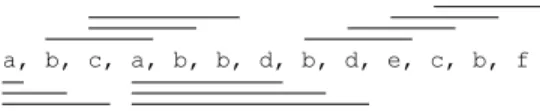
there are multiple copies of the same hyperedge, as shown below. We consider these to be distinct hyperedges):{a},{a,b},{a,b,c} ×4,{a,b,d} ×3,{b,d,e},{c,d,e},{b,c,e},{b,c,f}.Figure3shows
the segments of the sequence that correspond to edges inG3 R.
a, b, c, a, b, b, d, b, d, e, c, b, f
Fig. 3. Segments ofRcorresponding to edges in the hypergraphG3
R
Ordered Access Hypergraphs.Given an access sequenceRas above, the ordered access hyper-graphGˆq
R is defined similarly toGq
R, except that each hyperedge is ordered in the natural way,
i.e. in the order of appearance of its corresponding data elements inR. Formally, for every access
R[i], there is a corresponding ordered hyperedgeei inGˆqR. The ordered hyperedgeei is a sequence
< v1,v2, . . . ,vl >of vertices ofGˆ q
R such thatvl = R[i],vl−1 is the first distinct data element
accessed beforeR[i],vl−2is the second distinct element, etc. Moreover,lis the maximum between
qand the number of distinct elements accessed up untilR[i].
Example 2.3. Consider the access sequenceR =< a,b,c,a,b,b,d,b,d,e,c,b,f >. The access
hypergraphG3
Rwas shown in Example2.2. We now construct the ordered hyperedges ofGˆR3. Intuitively,
we start from any accessR[i]inRand go back until we see3different data elements. These data
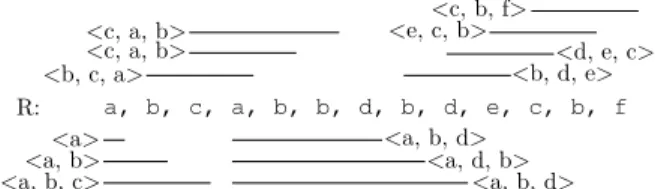
elements will form the ordered hyperedgeei corresponding toR[i]. This is illustrated in Figure4. Note that the elements in an ordered hyperedgeei are ordered by their last access time before or atR[i], e.g. see the hyeperedge<a,d,b>in Figure4.
a, b, c, a, b, b, d, b, d, e, c, b, f <a> <a, b> <a, b, c> <b, c, a><c, a, b> <c, a, b> <a, b, d> <a, d, b> <a, b, d> <b, d, e><d, e, c> <e, c, b><c, b, f> R:
Fig. 4. Ordered Hyperedges ofGand the segments inRto which they correspond
2.2 Tree Decompositions and Treewidth
In parameterized complexity, treewidth is one of the most widely-used parameters for graph problems. It is a measure of how “tree-like” a given graph is. In this section, we provide a quick
overview of tree decompositions and treewidth. For an in-depth treatment see [Cygan et al. 2015].
Tree Decomposition. Given a (hyper)graphG = (V,E), a tree decomposition ofG is a pair
(T,{Xt |t ∈T})whereT is a tree and each nodetofT is associated with a subsetXt ⊆V of
vertices ofG, such that the following conditions are met:
(i) Every vertex appears in someXt, i.e.∪t∈TXt =V;
(ii) Every (hyper)edge appears in someXt, i.e.∀e∈E ∃Xt e⊆Xt;
(iii) For every vertexv ∈V, the setTv={t ∈T|v∈Xt}of all nodes of the treeT that containvin
their correspondingXt, forms a connected subtree ofT.
It is evident from the definition that(T,{Xt})is a tree decomposition of a hypergraphGiff it is
a tree decomposition of its primal graphGp. To avoid confusion, we reserve the word “vertex” for
vertices ofGand use the word “node” for vertices ofT. Moreover, we call eachXt a “bag”.
Treewidth.The width of a tree decomposition (T,{Xt})is the size of its largest bag minus 1,
i.e. mint∈T |Xt|- 1. The treewidth of a graphGis the smallest width among all tree decompositions
ofGand is denotedtw(G).
Example 2.4. Figure5shows the graphGR(as in Figure2) and a tree decomposition ofGR. This tree
decomposition has a width of 2 and is an optimal tree decomposition. Hence, the treewidth ofGRis 2. a b c d e f {a,b,c} {b,c,d} {b,f} {c,d,e}
Fig. 5. A graphGR(left) and one of its optimal tree decompositions(T,{Xt})(right).
To simplify the algorithms that exploit tree decompositions, we now define the notions of labeling and nice tree decomposition.
Nice Tree Decompositions.A nice tree decomposition [Cygan et al. 2015] of a (hyper)graphGis
a tree decomposition(T,{Xt})in which a specific node is designated as the root and every node
t ∈T is “labeled” by a subgraphGt ofG, such that the following rules are obeyed:
(1) Iftis a leaf inT, thenXt =∅andGt =(∅,∅).
(2) Otherwise,tsatisfies one of the following cases:
• Introduce Vertex Node.The nodethas a single childt1andXt =Xt1∪ {v}for some vertex v<Xt1. In this case, we say thattintroducesv. Moreover,Gt =Gt1∪ {v}, i.e.Gtis defined
as the graph resulting from addingvas an isolated vertex toGt
1.
• Introduce Edge Node.Similar to the previous case,thas a single childt1. This time,Xt =Xt1,
butGtis defined as the graph resulting from adding a new edgeetoGt
1. All vertices ofe
must be present inXt. We say thattintroducese.
• Forget Vertex Node.The nodethas a single childt1andXt =Xt1\ {v}for some vertex v ∈Xt1. We say thattforgetsv. Moreover,Gt =Gt1.
(3) Each edge is introduced exactly once.
Intuitively, the label graphGtis the subgraph ofGconsisting of all the vertices and edges that are
introduced in the subtree ofT rooted att.
Remark 2.2. Note that in our (ordered) hypergraphs in this paper, we might have multiple copies
of the same (ordered) hyperedge. We treat these as distinct edges and require that each of them be introduced separately in nice tree decompositions.
Remark 2.3. The notion of label graphsGt is solely defined for theoretical purposes and used in our
proofs of correctness. In practice, our implementation avoids the overhead of constructingGt’s.
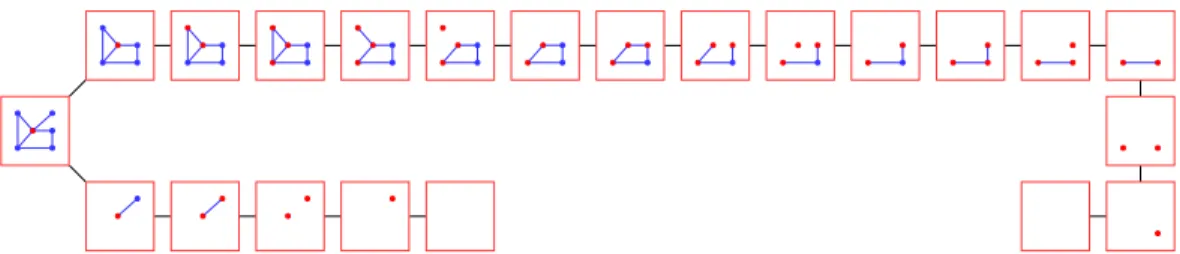
Example 2.5. Figure6shows a nice tree decomposition of the graphGof Figure2. In each nodetof
the tree, its label subgraphGt is illustrated and the vertices of the bagXt are shown in red. Intuitively, a nice tree decomposition constructs the graph in small increments and the bagXtcontains the vertices
that can participate in the incremental change.
Fig. 6. A nice tree decomposition of the graph in Figure2. The leftmost node is the root. The graphGtis
illustrated in each nodet. The vertices of the bagsXt are shown in red.
2.3 Existing Results
We now formally present known results regarding Data Packing and Tree Decompositions that will be used in the sequel.
The Hardness of Data Packing.Note that we are considering the problem of minimizing cache misses, not that of maximizing cache hits. While the two problems are equivalent in terms of exact algorithms, approximating the minimal number of cache misses is much harder than approximating the maximal number of cache hits. The latter problem admits a polynomial-time constant-factor
approximation [Lavaee 2016]. In contrast, the following theorem shows that the former problem is
hard to even approximate.
Theorem 2.1 ([Lavaee 2016]). Assuming either LRU, FIFO or OOP as the replacement policy, we
have the following hardness results:
• For anymand anyp≥3, Data Packing is NP-hard.
• Unless P=NP, for anym≥5,p ≥2and any constantϵ >0, there is no polynomial algorithm
that can approximate the Data Packing problem within a factor ofO(N1−ϵ
We now turn to tree decompositions. What makes tree decompositions a very useful tool is the fact that one can perform bottom-up dynamic programming on them in a manner similar to trees. This is due to an property of tree decompositions, called the separation lemma.
Separators.Given a (hyper)graphG=(V,E), and two sets of verticesA,B ⊆V, we say that the
pair(A,B)is a separation ofGifA∪B=V and no (hyper)edge inEcontains vertices of bothA\B
andB\A. We callA∩Bthe separator corresponding to the separation(A,B)and the order of the
separation(A,B)is the size of its separator|A∩B|.
Lemma 2.1 (Separation Lemma, [Bodlaender 1988;Cygan et al. 2015]). Let(T,{Xt})be a tree
decomposition ofG, whereGis a graph or a hypergraph, and let{a,b}be an edge ofT. By removing the edge{a,b},T breaks into two connected componentsTaandTb, respectively containingaandb.
LetA=Ð
t∈TaXtandB= Ð
t∈TbXt. Then(A,B)is a separation ofGwith separatorXa∩Xb.
In our algorithms in the rest of this paper, we assume that whenever a (hyper)graphG of
constant treewidth appears as an input to an algorithm, the input also contains an optimal nice
tree decomposition(T,{Xt})ofG. This is justified by the following two lemmas that show one can
obtain(T,{Xt})fromGin linear time.
Lemma 2.2 ([Bodlaender 1996] ). There is an algorithm that given a (hyper)graphG=(V,E)
and a constantk, decides in linear time whetherGhas treewidth at mostkand if so, produces a tree decomposition ofGwith optimal width andO(k· |V|)nodes.
Lemma 2.3 ([Cygan et al. 2015]). There is a linear-time algorithm that given a graphG=(V,E)
and a tree decomposition (T,{Xt}) ofG of widthk with O(k · |V|)nodes, produces a nicetree
decomposition(T′,{Xt′})ofGwith the same widthkandO(k· |V|)nodes. This algorithm can also be applied ifGis a hypergraph, in which case the output tree decomposition(T′,{Xt′})will have widthk andO(k· |V|+|E|)nodes.
3 DATA PACKING ON CONSTANT-TREEWIDTH ACCESS GRAPHS
We now consider the problem of Data Packing when parameterized by the treewidth of the
underlying access graph. In Section3.1, we provide a linear-time algorithm whenm=1 and the
access graph has constant treewidth. Note that this problem is NP-hard for general access graphs,
as demonstrated by Theorem2.1. Then, in Section3.2we show that form≥2 the problem remains
NP-hard and hard-to-approximate even when the access graph is a tree, i.e. has treewidth 1.
3.1 Algorithm form=1and Constant-treewidth Access Graph
We are given a Data Packing instanceI =(n,1,p,R), its access graphGRand a nice tree
decomposi-tion(T,Xt)of the access graph with widthkandO(n·k)nodes. We first reduce the problem of
Data Packing to a graph problem overGRand then provide a linear-time fixed-parameter algorithm
for solving the graph problem. We start by defining the minimum-weightp-partitioning problem.
p-partitionings.Given an integerp > 0 and a graphG = (V,E), ap-partitioning ofG is a
partitioningψof the setV of vertices such that each partition set has a size of at mostp. In other
words, ap-partitioning ofG is a data placement scheme where the vertices ofG are the data
elements andpis the packing factor.
Cross Edges.Given ap-partitioningψ of the graphG=(V,E), an edgee ={u,v} ∈Eis called a cross edge if its two endpoints are in different partition sets, i.e. if[u]ψ ,[v]ψ.
Minimum-weightp-partitioning.Given a simple graphG=(V,E), a weight functionw :E→N
and a positive integerp, the minimum-weightp-partitioning problem asks for ap-partitioning ofG
a b c d e f 2 1 3 1 1 2 1
Fig. 7. An optimal2-partitioning
Reduction of Data Packing to Minimum-weightp-partitioning.We now reduce the Data
Packing problem to minimum-weightp-partitioning. Given an instanceI =(n,1,p,R)of Data
Packing, we consider the access graphGR=(V,E)and define the weight functionwR:E→Nas
wR({u,v}):=|{i| {R[i],R[i+1]}={u,v}}|.Informally, the weight of an edge is the number of
times its two endpoints have appeared consecutively inR. The reduction is now complete.
Lemma 3.1. The optimal number of cache misses in a Data Packing instanceI =(n,1,p,R)is 1 plus
the total weight of cross edges in a minimum-weightp-partitioning ofGRwith weight functionwR.
Proof. Everyp-partitioningψ ofGRis a data placement scheme forI and vice versa. Given
thatm=1, the replacement policy does not matter (Remark2.1) and a cache miss occurs each
timeRaccesses a new block. If we considerRas a path onGR, a cache miss occurs at the very
beginning and then each time this path goes from one equivalence class ofψ to another. Therefore,
the number of cache misses ofψis 1 plus the total weight of cross edges inψ. □
Example 3.1. Consider the access sequenceR =<a,b,c,a,b,b,d,b,d,e,c,b,f >of Example2.1
and the Data Packing instanceI =(6,1,2,R), i.e. each block can store up to 2 data elements. Figure7
shows the graphGRin which every edge is weighted by the number of times it is traversed inR. An
optimal2-partitioning ofGRis shown in which vertices of the same color are in the same partition.
The total weight of cross edges in this partitioning is 7. The corresponding data placement scheme is {{a,c},{b,d},{e},{f}}which leads to 8 cache misses onR. The cache misses are underlined.
We will provide an algorithm for solving the Minimum-weightp-partitioning problem on a graph
Gusing an optimal nice tree decomposition ofG. Our algorithm employs a bottom-up dynamic
programming technique. We first need several basic concepts to define the algorithm.
States over a Set of Vertices.Given a graphG=(V,E), a natural numberpand a subsetA⊆V
of vertices, a state overAis a pairs=(φ,sz)such that (i)φis a partitioning ofAin which every
equivalence class has a size of at mostp, and (ii)szis a size enlargement functionsz :A/φ →
{0, . . . ,p −1} that maps each equivalence class[v]φ to a number which is at mostp − |[v]φ|.
Intuitively, the idea is to takeAto be one of the bags in the tree decomposition and later extend a
state overAto ap-partitioning ofGby adding the vertices inV\A. So, a state overApartitions the
vertices ofAinto sets of size at mostpand for each partition[v]φ fixes the exact numbersz([v]φ)
of vertices fromV \Athat should be added to[v]φ. We denote the set of all states overAbySA,p
or simplySAwhenpis clear from the context.
Realization.We say that ap-partitioningψrealizes the states=(φ,sz)overA, if (i) the restriction ofψtoAis equal toφ, i.e.ψ|A=φand (ii) for all verticesv ∈A,sz([v]φ)=|[v]ψ| − |[v]φ|. Intuitively,
ψrealizessif (i)ψpartitions the vertices inAin the same manner asφand (ii) if a partition[v]ψ of
ψintersectsA, then[v]ψ contains as many vertices from outside ofAas fixed bysz.
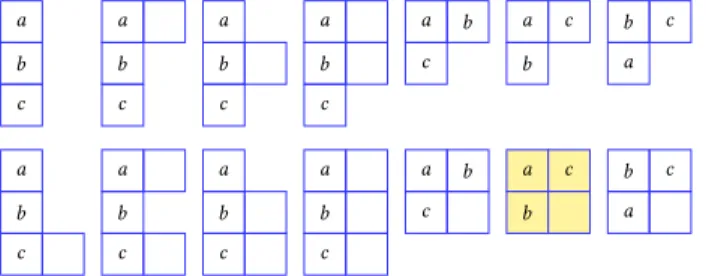
Example 3.2. Figure8shows all 14 possible states over the setA={a,b,c}of vertices withp=2.
In each case, each row denotes one partition set and hence the order of rows and the order of squares in a row does not matter. Empty squares correspond to the possibility of extension of the set, as defined
a b c a b c a b c a b c a b c a b c a b c a b c a b c a b c a c b a c b b c a b c a
Fig. 8. All possible states overA={a,b,c}withp=2
a c b d e f
→
a c b d e fFig. 9. Two compatible states overA={a,b,c}andA′={d,e,f}
bysz. The optimal2-partitioningψ presented in Figure7realizes the highlighted state in Figure8,
becauseψputsaandcin the same partition and putsbin a partition of size2, whose other member,d,
comes from outside the set{a,b,c}.
Compatibility.We say that two statessands′, respectively over the setsAandA′, are compatible
if there exists ap-partitioning that realizes both of them. We writes ⇆s′to show compatibility.
Example 3.3. Intuitively, two states are compatible if they can fit into each other. Figure9shows
the states realized by the2-partitioning of Figure7above over the setsA={a,b,c}andA′={d,e,f}
and how they can be fitted together to create the entire2-partitioning.
Algorithm1.We are now ready to describe our algorithm in detail. Given a graphG, a weight
functionwand an optimal nice tree decompositionT ofG, our algorithm performs a bottom-up
dynamic programming onT. This is broken into three steps.
Step 0: Initialization.We define several variables at each node of our treeT. These variables are
meant to be computed in a bottom-up manner. Concretely, for everyt ∈T and every statesover
the bagXt, we define a variabledp[t,s]and initialize it to+∞.
Invariant.Formally, our algorithm satisfies the following invariant for everydpvariable right after the end of its computation:
dp[t,s]= The minimum total weight of cross edges over allp-partitionings ofGt that realizes.
Intuitively, we are considering the states over the bagXt and extending them by adding vertices
that were introduced in the subtree oftinT.
Step 1: Computation ofdp.The algorithm starts from the bottom of the treeT and computes the
dpvariables bottom up, i.e. with an order such that for every nodet ∈T thedpvariables at its
children are computed before thedpvariables oft. For every nodet ∈T and states=(φ,sz) ∈SX
t,
we show howdp[t,s]is computed based on the type of the nodet:
(1.1) iftis a Leaf:dp[t,s]=0;
(1.2) iftis a Join node with childrent1andt2: dp[t,s]= min
sz1+sz2≡sz
Note that the summation and equality above are pointwise.
(1.3) iftis an Introduce Vertex node, introducingv, with a single childt1:
dp[t,s]=dp[t1,(φ|Xt
1,sz|Xt1)]
;
(1.4) iftis an Introduce Edge node, introducinge, with a single childt1:
dp[t,s]=dp[t1,s]+w(e,φ),
wherew(e,φ)is equal tow(e)ifeis a cross edge inφand zero otherwise; (1.5) iftis a Forget Vertex node, forgettingv, with a single childt1:
dp[t,s]= min s′∈S
Xt1
∧s′⇆sdp[t1,s
′].
Recall that⇆denotes compatibility.
Step 2: Computing the Output.The algorithm computes the output, i.e. the optimal weight of a
p-partitioning, using the values stored atdpvariables. Ifris the root node ofT, then the algorithm
outputs the following value: mins∈S
Xr dp[r,s].
This concludes Algorithm1. We now prove the correctness of our algorithm.
Lemma 3.2. Algorithm1correctly computes the total weight of cross edges in a minimum-weight
p-partitioning.
Proof. We prove this lemma in two steps. First, we show that the invariant defined above
holds after computingdp[t,s]assuming that it was satisfied for alldpvariables in the children oft
(Correctness of Step 1). Then, assuming that the invariant holds fordpvariables at the root, we
show that the output is the total weight of an optimalp-partitioning (Correctness of Step 2).
Intuitively, the invariant says that if we only consider the graphGt, i.e. the part ofGthat was
introduced in the subtree ofT rooted att, and thosep-partitionings ofGt that realize the states,
thendp[t,s]holds the minimum total weight of cross edges among thesep-partitionings.
Correctness of Step 1.As in the algorithm, we break this part into several cases:
(1.1) Computations at Leaves.The nodetis a leaf inT, henceGtis the empty graph andXt is the
empty set. Therefore,SX
t contains a single trivial states∅and we havedp[t,s∅]=0 because
the total weight of cross edges in an empty graph is zero.
(1.2) Computations at Join Nodes.The nodet is a join node with childrent1andt2. We want to
computedp[t,s]wheres =(φ,sz). Therefore, we only consider thosep-partitionings that
realizes. Given thatXt =Xt
1 =Xt2,φimposes itself on bothXt1 andXt2. However, each
partition inφmust be extended by a number of vertices as defined bysz. These vertices
must come from eitherGt
1orGt2and must not already be present inXt. According to the
separation lemma (Lemma2.1), the only vertices that are in bothGt
1andGt2are precisely those
ofXt. Hence, each new vertex comes either fromGt
1orGt2but not from both. Therefore, we
should minimize our total cross edge weights wrtdpvariables of the formdp[t1,(φ,sz1)]and dp[t2,(φ,sz2)]wheresz1+sz2≡sz. The functionsz1defines the number of vertices that should
be added fromGt
1−Xtto each partition ofφandsz2does the same forGt2−Xt. Formally, if
we letw(φ)be the total weight of cross edges caused byφinGt
1∩Gt2 =Gt1[Xt] ∩Gt2[Xt],
then we should let:
dp[t,s]=dp[t,(φ,sz)]= min sz1+sz2≡sz
dp[t1,(φ,sz1)]+dp[t2,(φ,sz2)] −w(φ).
The reason we are subtractingw(φ)at the end is that the weights of its corresponding edges
We now show it is always the case thatw(φ)=0. If an edge contributes tow(φ), then it must
be present in bothGt
1andGt2. However, by property (3) of a nice tree-decomposition, each
edge is introduced exactly once. Hence,Gt
1 andGt2 do not share any edges andw(φ)=0.
Therefore, by settingdp[t,s]=dp[t,(φ,sz)]=minsz
1+sz2≡szdp[t1,(φ,sz1)]+dp[t2,(φ,sz2)],
we satisfy the invariant.
t
t1 t2
Fig. 10. In a join nodet,Gt1andGt2do not share any edges and their shared vertices are inXt.
(1.3) Computations at Introduce Vertex Nodes.The nodetis an introduce vertex node. So, it has
a single childt1andXt =Xt1∪ {v}for somev <Xt1. We know that the vertexv cannot
possibly appear inGt
1because every vertex appears in a connected subtree ofT andv<Xt1.
Hence,Gt is obtained by addingvas an isolated vertex toGt
1. Again, we want to compute
dp[t,s]and should hence only consider thep-partitionings that realizes. Given thatXt
1 ⊂Xt,
simposes a unique compatible state onXt
1. Moreover,Gthas no new edges in comparison
withGt
1, so the total weight of cross edges should only be computed inGt1. Hence, we let
dp[t,s]=dp[t,(φ,sz)]=dp[t1,(φ|Xt
1,sz|Xt1)].
Intuitively, this is equivalent to removingvfrom its partition and then computing thedpint1.
t t1
Fig. 11. In an introduce vertex nodet, the newly introduced vertex is isolated and there are no new edges.
(1.4) Computations at Introduce Edge Nodes.The nodethas a single childt1andXt =Xt1. Moreover,
the only difference betweenGt andGt
1 is in a single edgee. When computingdp[t,s], the
statesforces itself onXt
1 =Xt. Hence we should letdp[t,s]=dp[t1,s]+w(e,s), wherew(e,s)
is the contribution of the edgeeto the total weight of cross edges ins. It is zero if the two
sides ofeare put in the same partition set bysand is equal tow(e)otherwise.
t t1
Fig. 12. A new edge is introduced in the nodet. The states are only dependent on vertices and hence are the
same overXt andXt1. However, we have to account for the weight of the new edge.
(1.5) Computations at Forget Vertex Nodes.In this case the nodethas a single childt1andXt =
to take the minimum among the values ofdp variables of all statess′overXt
1 that are
compatible withs. More precisely, we letdp[t,s]=mins′∈S Xt1
∧s′⇆sdp[t1,s ′].
t t1
Fig. 13. When a vertexvis forgotten byt, we haveGt=Gt1, butXt =Xt1\ {v}.
Correctness of Step 2.Given thatr is the root node ofT, we haveGr = G. Since everyp
-partitioning ofGrealizes some state overXr, it follows that the optimal weight of ap-partitioning
is mins∈S
Xr dp[r,s]. This concludes the proof.
□
Remark 3.1. Algorithm 1 computes the total weight of cross edges in a minimum-weightp
-partitioning. As is common with dynamic programming algorithms, an optimalp-partitioning itself can be obtained by keeping track of the choices made during the computation ofdpvariables, i.e. keeping track of the cases that led to the minimal values in each computation.
We now establish the complexity of our approach and present the main theorem of this section. Number of States.For a fixedp, letCp
k denote the number of different possible states over a set of
sizek, i.e.Cp
k :=|S{1,2, ...,k}|. We writeCkinstead ofC p
k whenpcan be inferred from the context.
AppendixAestablishes bounds on the value ofCk. Note that this value only depends onpandk.
Theorem 3.1. Given a Data Packing instanceI =(n,1,p,R)as input, wherenis the number of
distinct data elements,pis the packing factor,Ris the reference sequence with a length ofN and the cache has unit size, the Data Packing problem, i.e. finding the minimal number of cache misses, can be solved in linear time, i.e. in timeO(N+n·k2
·Ck ·pk), when the underlying access graphGR has treewidthk−1.
Proof. Given a Data Packing instanceI =(n,1,p,R), we first apply the reduction of Lemma3.1
which takesO(N). We then use Algorithm1to solve the resulting minimum-weightp-partitioning
problem. The correctness of this algorithm was established in Lemma3.2. The only remaining
part is to find the runtime of Algorithm1. Note that the time spent for computing a nice tree
decomposition, as in Lemmas2.2and2.3are linear and dominated by the rest of our runtime.
The algorithm needs values ofdpvariables for all nodes of the tree decomposition which are at
mostO(n·k). We obtain upper-bounds for the runtime of our algorithm on each type of node:
• Leaves.There is a single state at each leaf and itsdpis zero. Hence we spendO(1)at each leaf.
• Join Nodes.At a join nodet, there are at mostCkstates and for each states =(φ,sz)we have
to look into the states corresponding to every possible size enlargement functionsz1≤sz. As
in the proof of LemmaA.2, there are at mostpksuch functions. Creating each corresponding
state takesO(k). Hence, we spendO(k·Ck·pk)at each join node.
• Introduce Vertex Nodes.At a nodet, there areCkstates and we spendO(k)computing the
unique corresponding state overXt
1. Thus, each introduce vertex node takesO(k·Ck). • Introduce Edge Nodes.This case is similar to the previous one and takesO(k·Ck).
• Forget Vertex Nodes.At a nodet, there areCkstates and for each of them we have to look into all its compatible states overXt
1. Note that such compatible states can be obtained either by
by adding it to the partition set of another vertex inXt. Hence, there are at mostp+ksuch states and the total processing time of a forget vertex node isO(k· (p+k) ·Ck).
Note that the runtime for join nodes dominates the rest. Given that there areO(n·k)nodes in
total, the whole computation takesO(n·k2·Ck·pk)time. Finally, the algorithm spendsO(Ck)time
computing the final result using thedpvalues at the root. □
Remark 3.2. By exploiting treewidth, we provided alinear-timealgorithm for finding the exact
solution to the Data Packing problem whenm=1. Note that in the general case, i.e. without considering
parameterization by treewidth, this problem is NP-hard as mentioned in Theorem2.1.
Remark 3.3. We assumed LRU as the replacement policy. However, given that the replacement
policy does not matter when the cache has unit size (Remark2.1), our algorithm is applicable to any replacement policy, including FIFO and OOP.
3.2 Hardness of Data Packing on Trees
In this section, we provide a reduction from the general problem of Data Packing to the special case where the access graph is a tree, i.e. has treewidth 1. This reduction leads to hardness results
that enhance those of [Lavaee 2016] by showing that the problem remains hard even on trees. This
indicates that although considering constant treewidth access graphs led to efficient algorithms for
the case ofm=1, constant treewidth access graphs alone are not sufficient form≥2.
Theorem 3.2 (Hardness of Data Packing on Trees). Given a Data Packing instanceI =
(n,m,p,R), we have the following hardness results:
• Hardness of the Exact Problem.For anym≥2and anyp≥3, Data Packing is NP-hard even if
the underlying access graphGRis a tree.
• Hardness of Approximation.Unless P=NP, for anym≥6,p ≥2and any constantϵ >0, there
is no polynomial approximation algorithm for the Data Packing problem with an approximation factor ofO(N1−ϵ)even if the access graphGRis a tree.
Proof. We provide a linear-time reduction that transforms a Data Packing instance I =
(n,m,p,R)to another instanceI′ = (n+(m+1)p,m+1,p,R′)such that the access graphGR′
is a tree. Both hardness results can then be obtained by applying this reduction to the hardness results of Section2.1. GivenI, we introduce(m+1)pnew data elementsd1,d2, . . . ,d(m+1)p. LetX be the sequenced1,d2, . . . ,d(m+1)p,d(m+1)p−1, . . . ,d1.We form the sequenceR
′as follows:
d1,R[1],d1,R[2],d1, . . . ,d1,R[N],d1,X,X, . . . ,X
| {z }
2N+m+2 times
,
i.e. we takeR and addd1 at its beginning, end and between every two elements of it, then we
concatenate the result with 2N +m+2 copies ofX. We letI′=(n+(m+1)p,m+1,p,R′). Note
that the cache inI′has one spot more than the cache ofI.
By construction,GR′is a tree, because it consists of a pathd1, . . . ,d(m+1)pand every other vertex
of the graph is only connected tod1. We now show that the optimal number of cache misses inI
′ is
exactlym+1 plus the optimal number of cache misses inI.
Letσbe an optimal data placement scheme forI′, thenσmust necessarily put thedi’s in exactly
m+1 blocks, otherwise eachX in the sequenceR′will lead to at least one cache miss for a total of
at least 2N+m+2. On the other hand, putting thedi’s inm+1 blocks leads to at most 2N+m+1
cache misses, even if all accesses before theX’s are missed. In particular,σdoes not put any element
ofRin the same block asd1. Therefore,σ first leads to a cache miss on the first access tod1, then
keepsd1in the cache forever. Hence,σfills one spot of the cache with the block ofd1and hasm
Hence, the number of cache misses caused byσis 1 (for the firstd1) plus the optimal number of
misses inI plusm(for theX’s). □
Remark 3.4. As mentioned before, we are considering the LRU replacement policy in this paper.
However, the reduction above works for the OOP replacement policy as well. Hence, the hardness results are established for both policies.
4 DATA PACKING ON CONSTANT-TREEWIDTH ACCESS HYPERGRAPHS
In this section, we exploit constant treewidth of higher-order access hypergraphs for solving Data
Packing. Section4.1extends our linear-time algorithm to everym, when the access hypergraph of
orderq∗:=(m−1)p+2 has constant treewidth. As indicated by Theorem2.1, this problem is hard
to even approximate in the general case. In Section4.2we argue thatq∗is the optimal order for
exploiting treewidth in the sense that the problem remains NP-hard even if the access hypergraph
of orderq∗−1 has constant treewidth. This also leads to a new hardness-of-approximation result.
4.1 Algorithm for Constant-treewidth Access Hypergraph
In this section we extend the algorithm of Section3.1to any cache sizem, provided that the
hypergraphGq
∗
R is of constant treewidth, whereq∗=(m−1)p+2. Note that Theorem3.2implies
such an extension cannot be made if we only consider constant-treewidthGR.
Intuition on Cache Misses.The main intuition behind our algorithm is the following: given an
instanceI =(n,m,p,R)and a data placement schemeσ forI, we can deduce whether an access
R[i]leads to a cache miss by looking at only the(m−1)p+1=q∗−1 previous accesses todistinct data elements. We now formalize this intuition.
Previous Access of a Block.Consider a Data Packing instanceI =(n,m,p,R), a data placement schemeσ forI and an accessR[i]. LetB :=[R[i]]σ be the block ofσcontainingR[i]. We define
prevσ(i)as the index of the previous access toB or 0 if no such access exists, i.e.prevσ(i) :=
max{j<i |j=0∨ [R[j]]σ =[R[i]]σ}.
Lemma 4.1. Given a data placement schemeσ forI, an accessR[i]leads to a cache miss if and
only ifprevσ(i)=0or there are at leastmdistinct blocks ofσwhose elements appear in the range
R[prevσ(i)+1]. . .R[i−1].
Proof. We are assuming LRU as the replacement policy and the cache starts empty. Ifprevσ(i)=
0, thenR[i]is the first access to its block and will definitely lead to a cache miss. We now consider
the case whereprevσ(i),0. Letj:=prevσ(i)and assume thatB:=[R[i]]σ =[R[j]]σ is the block containingR[i]andR[j]. By definition, none of the elementsR[j+1], . . . ,R[i−1]belong toB. If
there are at mostm−1 blocks betweenR[j+1]andR[i−1], thenR[i]cannot lead to a cache
miss. This is because right after the accessR[j], the blockBis present in the cache and is the most
recently used block of the cache. Hence, in order for it to be evicted, at leastmother blocks must
be accessed. On the other hand, if there are at leastmblocks betweenR[j+1]andR[i−1], then
all of these blocks will be loaded into the cache and henceBwill be evicted before the accessR[i]
leading to an eventual cache miss onR[i]. □
Corollary 4.1. Given a data placement schemeσ, an accessR[i]and theq∗−1distinct elements
that were accessed beforeR[i](or all of the previous distinct elements if there is less thanq∗−1of
them) in the order of their last access time, one can deduce whetherR[i]leads to a cache miss.
Proof. IfR[prevσ(i)]is one of these previous elements, then we can simply check whether at
leastmdifferent blocks appear betweenR[prevσ(i)]andR[i]. Otherwise, eitherR[i]is the first access to its block or all theq∗−1 elements are appearing betweenR[prevσ(i)]andR[i]. In the
first caseR[i]leads to a cache miss. In the second case, by pigeonhole principle, there are at leastm blocks between the two elementsR[prevσ(i)]andR[i]and hence there is a cache miss atR[i]. □
Remark 4.1. Note that the previous access to the block containingR[i]might be an access toR[i]
itself. Hence,R[i]might itself appear in theq∗−1distinct elements that were accessed beforeR[i].
As in Section3.1, we are going to reduce Data Packing to a graph problem and then exploit
treewidth to obtain a linear-time algorithm. Corollary4.1suggests that in order to detect cache
misses, one only needs to consider the ordered access hypergraph of orderq∗ =(m−1)p+2,
i.e.Gˆq
∗
R . However, in order to address the corner case mentioned in Remark4.1, we define an ordered
hypergraphGby a slight change to the edges ofGˆq
∗
R and then reduce Data Packing to a graph
problem overG.
The Ordered HypergraphG.We define the ordered hypergraphGas having the same vertices
and edges as the ordered access hypergraphGˆq
∗
R, except in the following case:
• Given an accessR[i]to a data elementd, letR[j]be the last access beforeR[i]to the same data elementd. If there are at mostq∗distinct data elements accessed in the rangeR[j+1]. . .R[i−1], then the edgeei corresponding toR[i], will also containR[j](in its natural position according to the order of vertices inei).
Example 4.1. Consider the access sequenceR=<d,c,a,b,c >and letm=p=2. Hence, we have
q∗=(m−1)p+2=4. In the graphGˆq
∗
R the edge corresponding to the secondcise5=<d,a,b,c >.
However, there are less thanq∗distinct data elements appearing between the two accesses toc, i.e. there
are only two such elements, namely,aandb. Hence, inG, the previous access tocappears in this edge as well. Therefore, inG, the edgee5is of the forme5=<d,c,a,b,c>.
The intuition behind the wayGis defined comes from Corollary4.1and Remark4.1. The idea is
to have the edgeei contain all the data necessary to decide whether a cache-miss will happen at
the accessR[i]. We now formalize this concept.
Missed Edges.Given an ordered hyperedgeei ofGand a data placement schemeσ, we can deduce
whether a cache miss happens atR[i]using Corollary4.1, because the edgeei contains an ordered
list of at least(m−1)p+1=q∗−1 distinct data elements that were accessed right beforeR[i]. We
say that an ordered hyperedgeei is missed inσ, if the correspondingR[i]is a cache miss.
Identifying Missed Edges.Consider the data placement schemeσas ap-partitioning of vertices ofG. Based on Lemma4.1and Corollary4.1, an ordered hyperedgeei =<v1, . . . ,vl >is missed iff the sequence of vertices<vl,vl−1, . . . ,v1 >inGvisits at leastmdistinct partitions before getting
back to the partition[vl]σ or if it never comes back. Note that this determination can be done in
O(m·p)and only depends on thep-partitioning of{v1, . . . ,vl}. We now define our graph problem as follows:
Minimum-missp-partitioning.Given a hypergraphG=(V,E)with ordered hyperedges,
parti-tionV into sets of size at mostpin a manner that minimizes the number of missed edges.
As a direct result of the previous discussion, we have the following lemma:
Lemma 4.2. The optimal number of cache misses in a Data Packing instanceI =(n,m,p,R)is equal
to the optimal number of missed edges in ap-partitioning ofG.
Proof. Any data placement schemeσ forI is also ap-partitioning ofG. As shown above,σ
misses an edgeei inGiff it causes a cache miss atR[i]inI. Hence, the number of cache misses
States over a Set of Vertices.We define states in the exact same manner as in Section3.1, i.e. a
state over a setAof vertices is a pairs =(φ,sz)consisting of an equivalence relationφand a size
enlargement functionsz. The concepts of realization and compatibility are also defined similarly.
Algorithm2.We now provide a linear-time algorithm for solving the Minimum-Missp-partitioning
problem, assuming that the hypergraphGhas constant treewidth. The algorithm is an extension
of the one provided in Section3.1. In the following, we let(T,{Xt|t∈T})be an optimal nice tree
decomposition ofG. Our algorithm performs a bottom-up dynamic programming onT.
Step 0: Initialization.We define several variables at each node of the treeT. Concretely, for every nodet∈T and every statesoverXt, we define a variabledp[s,t], initially holding a value of+∞. Invariant.The most different aspect of our algorithm compared to Section3.1is the invariant.
Formally, we require our algorithm to satisfy the following invariant for everydpvariable right
after the end of its computation:
dp[t,s]:= The minimum number of missed edges over allp-partitionings ofGtthat realizes.
Step 1: Computation ofdp.Thedpvariables are computed in a bottom-up manner. Given a node
t ∈T and a states =(φ,sz) ∈SX
t, we show howdp[s,t]is computed in terms of thedpvariables
at the children oft. This computation depends on the type of the nodet.
(1.1) iftis a Leaf:dp[t,s]=0;
(1.2) iftis a Join node with childrent1andt2: dp[t,s]= min
sz1+sz2≡sz
dp[t1,(φ,sz1)]+dp[t2,(φ,sz2)]; (1.3) iftis an Introduce Vertex node, introducingv, with a single childt1:
dp[t,s]=dp[t1,(φ|Xt
1,sz|Xt1)]
;
(1.4) iftis an Introduce Edge node, introducinge, with a single childt1: dp[t,s]=dp[t1,s]+
1 missed_edge(e,φ)
0 otherwise
;
(1.5) iftis a Forget Vertex node, forgettingv, with a single childt1: dp[t,s]= min
s1∈SXt 1∧s1⇆s
dp[t1,s1].
Recall that⇆denotes compatibility of states.
Step 2: Computing the Output.The algorithm computes the output, i.e. the minimum number
of missed edges in ap-partitioning ofG, using the values ofdpvariables at the root noder ofT.
Formally, the output is mins∈S
Xrdp[r,s].
This concludes Algorithm2. While most of the computations are similar to Algorithm1, the
argument for correctness of Algorithm2and its runtime are rather different. We first prove the
correctness of our approach and then establish its time complexity.
Lemma 4.3. Algorithm2correctly computes the total number of missed edges in a Minimum-Miss
p-partitioning.
Proof. Our proof heavily depends on the invariant defined above. Intuitively, the invariant says
thatdp[t,s]must be filled with the minimum number of edges that are missed in ap-partitiong
realizings, over the subgraphGt ofG, which consists of all the vertices and hyperedges that are
introduced belowtinT. We prove the lemma in two steps. First, we prove that the invariant is