Deep Neural Network Acoustic models for
Multi-dialect Arabic Speech Recognition
Nadia Fathe Hmad
A thesis submitted in partial fulfilment of the requirements of
Nottingham Trent University for the degree of Doctor of
Philosophy
i
Deep Neural Network Acoustic models for Multi-dialect
Arabic Speech Recognition
Nadia Fathe Hmad
Doctor of Philosophy
Graduate Department of School of Science and Technology
Nottingham Trent University
2015
Speech is a desirable communication method between humans and computers. The major concerns of the automatic speech recognition (ASR) are determining a set of classification features and finding a suitable recognition model for these features. Hidden Markov Models (HMMs) have been demonstrated to be powerful models for representing time varying signals. Artificial Neural Networks (ANNs) have also been widely used for representing time varying quasi-stationary signals. Arabic is one of the oldest living languages and one of the oldest Semitic languages in the world, it is also the fifth most generally used language and is the mother tongue for roughly 200 million people. Arabic speech recognition has been a fertile area of reasearch over the previous two decades, as attested by the various papers that have been published on this subject.
This thesis investigates phoneme and acoustic models based on Deep Neural Networks (DNN) and Deep Echo State Networks for multi-dialect Arabic Speech Recognition. Moreover, the TIMIT corpus with a wide variety of American dialects is also aimed to evaluate the proposed models.
The availability of speech data that is time-aligned and labelled at phonemic level is a fundamental requirement for building speech recognition systems. A developed Arabic phoneme database (APD) was manually timed and phonetically labelled. This dataset was constructed from the King Abdul-Aziz Arabic Phonetics Database (KAPD) database for Saudi Arabia dialect and the Centre for Spoken Language Understanding (CSLU2002) database for different Arabic dialects. This dataset covers 8148 Arabic phonemes. In addition, a corpus of 120 speakers (13 hours of Arabic speech) randomly selected from the Levantine Arabic
ii and transcription errors were manually corrected. The selected dataset is labelled automatically using the HTK Hidden Markov Model toolkit. TIMIT corpus is also used for phone recognition and acoustic modelling task. We used 462 speakers (3.14 hours) for training and 24 speakers (0.81 hours) for testing.
For Automatic Speech Recognition (ASR), a Deep Neural Network (DNN) is used to evaluate its adoption in developing a framewise phoneme recognition and an acoustic modelling system for Arabic speech recognition. Restricted Boltzmann Machines (RBMs) DNN models have not been explored for any Arabic corpora previously. This allows us to claim priority for adopting this RBM DNN model for the Levantine Arabic acoustic models. A post-processing enhancement was also applied to the DNN acoustic model outputs in order to improve the recognition accuracy and to obtain the accuracy at a phoneme level instead of the frame level. This post process has significantly improved the recognition performance.
An Echo State Network (ESN) is developed and evaluated for Arabic phoneme recognition with different learning algorithms. This investigated the use of the conventional ESN trained with supervised and forced learning algorithms. A novel combined supervised/forced supervised learning algorithm (unsupervised adaptation) was developed and tested on the proposed optimised Arabic phoneme recognition datasets. This new model is evaluated on the Levantine dataset and empirically compared with the results obtained from the baseline Deep Neural Networks (DNNs).
A significant improvement on the recognition performance was achieved when the ESN model was implemented compared to the baseline RBM DNN model’s result. The results show that the ESN model has a better ability for recognizing phonemes sequences than the DNN model for a small vocabulary size dataset. The adoption of the ESNs model for acoustic modeling is seen to be more valid than the adoption of the DNNs model for acoustic modeling speech recognition, as ESNs are recurrent models and expected to support sequence models better than the RBM DNN models even with the contextual input window.
The TIMIT corpus is also used to investigate deep learning for framewise phoneme classification and acoustic modelling using Deep Neural Networks (DNNs) and Echo State Networks (ESNs) to allow us to make a direct and valid comparison between the proposed systems investigated in this thesis and the published works in equivalent projects based on framewise phoneme recognition used the TIMIT corpus. Our main finding on this corpus is
iii system ESN-based shows 10% lower performance when it was compared to the other systems recently reported in the literature that used the same corpus. This due to the hardware availability and not applying speaker and noise adaption that can improve the results in this thesis as our aim is to investigate the proposed models for speech recognition and to make a direct comparison between these models.
iv
Copyright Statement
This work is the intellectual property of the author. You may copy up to 5% of this work for private study, or personal, non-commercial research. Any re-use of the information contained within this document should be fully referenced, quoting the author, title, university, degree level and pagination. Queries or requests for any other use, or if a more substantial copy is required, should be directed in the first instance to the owner(s) of the Intellectual Property Rights.
v
Acknowledgement
I would like to express my deep gratefulness, admiration, and honour to my supervisor Dr. Tony Allen. With such richness in experience, knowledge and dedication, he supported and provided me with the direction to complete this work; always having time to listen, always prepared to help and always open to discussion. I must present my thanks to Dr. Joanna Hartley, my second supervisor for her advice and support during the research journey. I would also like to thank Professor Thomas Hain and Dr. Jonathan Tepper for their valuable feedback and suggestions.
All of my work would not have been possible without others’ help. Especially, I would like to thank my colleague Tariq Tashan for his support, cooperation and assistance; he was always prepared to help and always open to discussion. Also I would like to thank Abdel-rahman Mohamed from University of Toronto and Sarah Al-Shareef from University of Sheffield for helping me in using the HTK toolkit and labelling the Levantine corpus. Abdulrahman Alalshekmubarak from University of Stirling helped me build the ESN online training using the stochastic gradient descent algorithm and provided the ranked list of information retrieval for the ESN experiments. My colleague Rowida Elforgani supported me with the required resources during my working outside the UK. Finally, I would like to present my thanks to all my colleagues in Nottingham Trent University (NTU) for their encouragement and support for the PhD years.
The support of my soul mate Abdulati and the encouragement that he provided is with no equivalence. I am always grateful to him for being very patient, supportive, dedicated and taking care of me during completing this work.
All the languages of the world cannot produce words that thank my parents for their great support to my education, eventually resulting in successful completion of this work. They were the cause, and the inspiration without which this work would have never been completed. I wish a happy long life for my Mum. I pray for my Dad, he dreamed to see me in this position, I always pray his soul be forgiven and I wish him a peace in paradise.
vi
Dedication
To my parents, my husband and my sons
Abdulwahab, Yakoub and Yahya…
vii
Table of Contents
Abstract……….……….... i Copyright Statement ……….…….………... iv Acknowledgement ……… v Dedication………...……….……… viTable of Contents……….………... vii
List of Tables……….………...……... xii
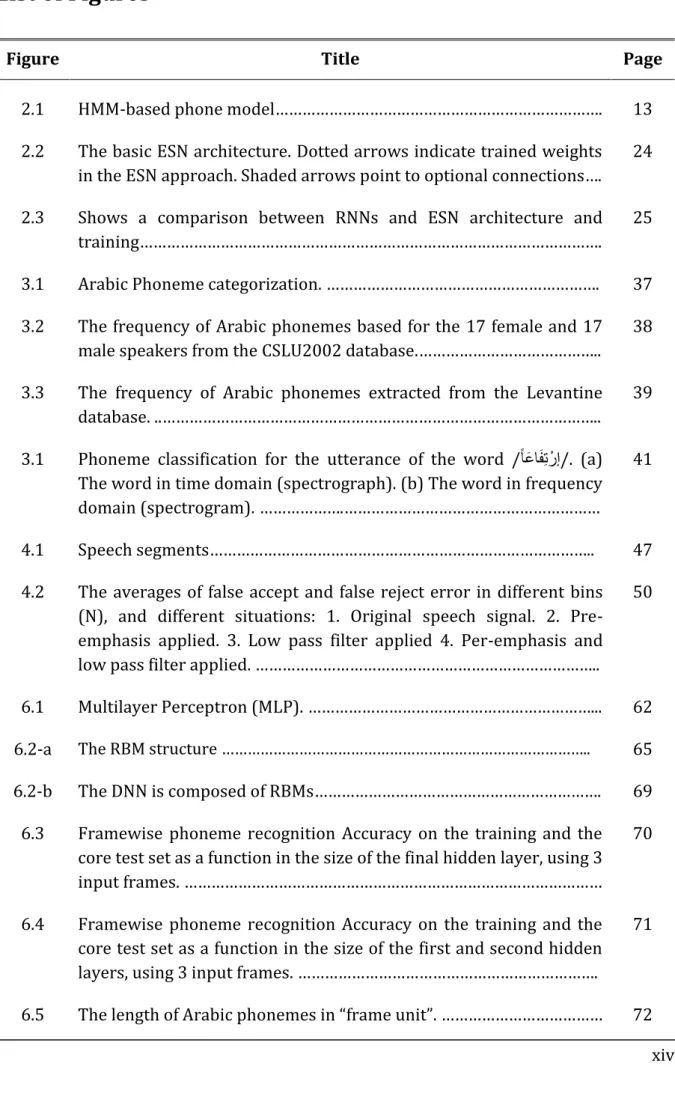
List of Figures ………... xiv
Abbreviations ……….. xvi
Chapter One: Introduction 1
1.1 Overview of speech recognition ………... 2
1.2 Research Motivation………... 5
1.3 Research Aim and Objectives……….. 6
1.4 Thesis Organization ………... 8
1.5 Thesis Contributions ……….……….. 9
Chapter Two: Background and Literature Review 11 2.1 A basic HMM model for ASR ……….………...…... 12
2.2 Methods of automatic alignment systems ……… 15
2.3 Machine learning algorithms……….…………. 17
2.3.1 Static Neural Networks……….…….. 18
2.3.1.1 Feed-forward Neural Networks ………..……….. 18
2.3.1.2 Deep Belief Networks ………..………... 19
2.3.2 Dynamic Neural Networks……… 22
2.3.2.1 Recurrent Neural Networks ….………... 22
2.3.2.2 Echo State Networks ………... 24
2.4 Towards End-to-End ASR with Neural Networks ………... 27
2.5. Hybrid HMMs/ANN for speech recognition systems ………... 28
viii
Arabic corpora
3.1 Arabic language: Orthography and Pronunciation ………..……… 33
3.1.1 Hamza and morpho-phonemic spelling ……..………...……….. 34
3.1.2 Optional Diacritics ………..……… 35
3.2 Arabic transcription systems ……….. 34
3.3 The frequency of Arabic phonemes ………... 37
3.4 The Proposed Arabic databases ………. 39
3.4.1 The King Abdul-Aziz Arabic Phonemics Database (KAPD)……….. 40
3.4.2 The Centre for Spoken Language Understanding (CSLU2002) database ………... 41 3.4.3 The Levantine colloquial Arabic (LCA) database ………... 42
3.4.4 Challenges of The Proposed Arabic Databases ……….. 43
Chapter Four: Front-end speech process (Speech Segmentation and Feature Extraction) 44 4.1 Automatic Speech Segmentation ………... 44
4.1.1 Entropy-based algorithm speech segmentation..……… 45
4.1.2 Normalization of speech………... 48
4.1.3 Experiment results………... 49
4.2 Feature extraction process ………. 50
Chapter Five: Automatic speech alignment system 53
5.1 Methods of automatic alignment systems………... 53
5.2 HMMs for forced alignment ……… 54
5.3 Automatic speech alignment experiment setup ………. 54
5.3.1 Data ………...……… 54
5.3.2 Arabic Transcription ……….………. 55
5.3.3 Text Normalization………... 55
5.3.4 Building the Arabic Pronunciation Dictionary………... 58
5.3.5 Frame work ……… 59
Chapter Six: Deep Neural Networks (DNNs) for phoneme classification and acoustic modelling 60 6.1 Shallow Multilayer Perceptron (MLP)……….…... 61
ix
6.2.2 Shallow MLP Experiments and results ………... 63
6.2. Deep learning for acoustic modelling ……….. 64
6.2.1 Deep Neural Networks Basics ………... 65
6.2.1.1 Restricted Boltzmann Machines (RBMs) and their Generalizations ……… 65 6.2.1.1.1 Binary RBM……..………...………... 66
6.2.1.1.2 Gaussian-Bernoulli RBM………... 67
6.2.1.2 RBM for phoneme recognition ……….. 68
6.2.1.3 Stacking RBMs to construct a Deep Neural Network..………. 68
6.3 RBM Deep Neural Networks Experiments with the KAPD corpus... 69
6.3.1 RBM DNN Hyper-parameters Optimisation ……….…... 69
6.3.2 Optimizing the size of the hidden layers in the RBM DNN …….…………. 70
6.3.3 Optimizing the Range of Context for the RBM DNN ……….…………. 72
6.3.4 A comparison between Shallow and Deep NNs ……….. 75
6.3.5 Post-Processing Experiment……… 76
6.3.6 RBM DNN experiments with the CSLU2002 corpus ………... 77
6.4 The Levantine dataset Experiments ………... 78
6.4.1 RBM DNN Hyper-parameters optimisation with the Levantine corpus ……….. 79 6.4.2 Experiment’s Results ………. 79
6.4.3 A post processing for acoustic modeling investigated on the Levantine corpus ………... 81
6.4.4 External works comparison ……….……….……….. 83
6.5 Conclusion... 84
Chapter Seven: Echo State Networks (ESNs) for phoneme classification and acoustic models 86 7.1 Conventional Echo State Networks (ESN) algorithm …... 87
7.1.1 ESN activations……… 87
7.1.2 Echo state property ………... 88
7.1.3 ESN training algorithms ……….……… 88
7.1.3.1 Offline ESN training algorithm ……….. 88
7.1.3.2 Online an ESN training algorithm ………... 89
x (conventional ESN) .………..
7.2.1.1 Experiments on the KAPD database ………...……….……….. 93 7.2.1.1.1 Experiment results……….. 93 7.2.1.1.2 MFCC’s features verses LPC features using
supervised learning………..
96
7.2.1.2 Experiment on the CSLU2002 database ……….………. 96 7.2.2 An ESN with forced supervised learning algorithm ………. 97 7.2.2.1 Experiment on the CSLU2002 dataset using forced
supervised learning ESN …………...
98
7.2.3 Unsupervised Adaptation (Modified ESN with a novel
combined supervised/forced supervised learning algorithm)……….
99
7.2.3.1 Experiments on the CSLU2002 corpus using the
Modified ESN ………..…...
101
7.2.3.2 A comparison between the performance of the ESN
and other related works on the CSLU2002 dataset………..
104
7.3 ESN acoustic modeling experimental results on the Levantine corpus ……… 106 7.3.1 Hyper-parameters Optimisation ………... 106 7.3.2 A comparison between the ESNs and DNNs acoustic models
performances on the Levantine corpus ………...
106
7.4 Comparison of ESN results with literature equivalents ……… 107 7.5 Conclusion……… 108
Chapter Eight: Evaluation of the Deep Neural Networks (DNNs) and Echo State Networks (ESNs) on TIMIT corpus for acoustic modelling
111
8.1 Experimental Setup……… 112 8.1.1 TIMIT corpus……… 112 8.1.2 Deep Neural Networks (DNNs) for phoneme classification and
acoustic models Experiments………
113
8.1.2.1 RBM DNN Hyper-parameters Optimisation and
experiment’s result………..
113
8.1.3 Echo State Networks (ESNs) for phoneme classification and
acoustic models experiments………
114
8.1.3.1 ESN Hyper-parameters Optimisation and Experiment’s Result……….
114
8.1.4 A comparison between the ESNs and DNNs acoustic models
performances on the TIMIT corpus………
xi related works on the TIMT corpus………..
8.2 Conclusion………. 116
Chapter Nine: Conclusion and Future Work 117
9.1 Summary of Accomplishments……….. 117 9.2 Future work………... 124
References 126
Appendixes 136
Appendix A - (Characters of Arabic Script, Buckwalter Transliteration, and Arabic pronunciation in romans letters)………...
xii
List of Tables
Table Title Page
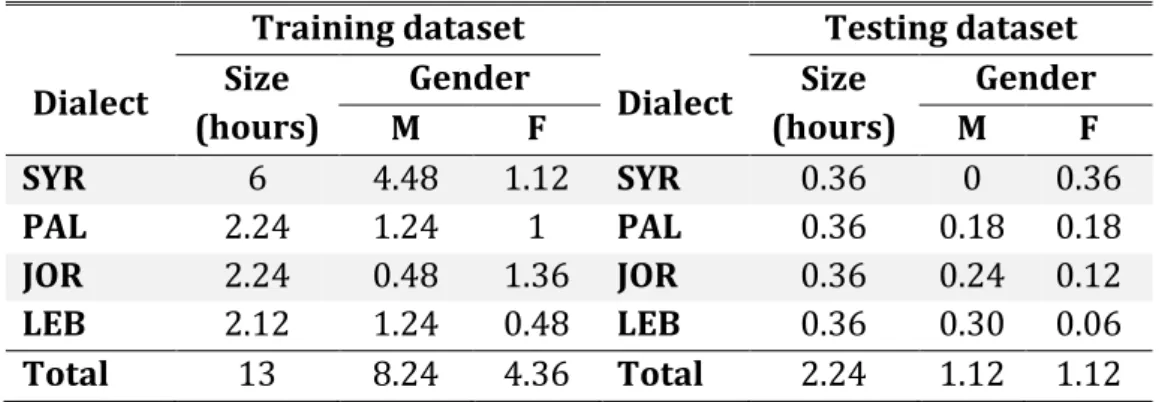
3.1 Amount of training and testing data (hours) for the major Levantine dialects and speaker gender………..
42
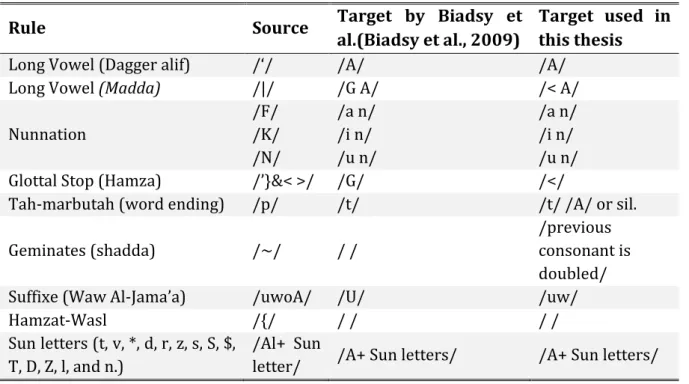
5.1 Summary of rules used in this thesis compared with (Biadsy et al., 2009). ………..………..……….
57
5.2 Shows examples of many words pronounced differently in the Levantine dialects. ………..………
57
6.1 The Framewise Phoneme Recognition for shallow MLP models trained with different dimension of MFCCs feature. The 13 MFCCs is published in ((Hmad and Allen, 2012))…..…..………..………..
64
6.2 The average Framewise phoneme recognition Accuracy on the KAPD core test using various input window sizes. ………..
75
6.3 A comparison between Shallow and deep MLP Neural Networks………… 75 6.4 A small example of chart of phonemes (framewise phoneme
recognition)……… ………
76
6.5 Shows the effect of the post-processing on the Framewise Phoneme Recognition using DNN model and the KAPD dataset. ………
77
6.6 The average Framewise phoneme recognition Accuracy on the Levantine core test using various input frames. ………..
80
6.7 The performance of most published work for conversational telephone speech on the Levantine dialect for various corpora and sizes..…………...
81
7.1 The ESN hyper-parameters………..………. 92 7.2 A comparison between the overall average test dataset performance of
the ESN and of the RBM Deep NN for the KAPD testing dataset………
95
7.3 A comparison between the KAPD testing dataset performance of the ESN with supervised learning algorithm when using 39 MFCC and 12 LPC features. ………..………
96
xiii learning, combined supervised learning with adaption (1
modification) and deep combined supervised/forced supervised learning algorithms with 13 MFCC features and 39 MFCC features………. 7.5 A direct comparison between the overall average test dataset performance of the supervised ESN and other related works on the CSLU2002 testing dataset. ……….
105
7.6 A comparison between the average framewise phoneme recognition accuracies using the ESNs and DNNs acoustic models on the Levantine core test. ………..……….
106
7.7 A comparison between the best performances were achieved for the proposed corpora of this project with relatively comparable projects…..
107
8.1 A comparison between the framewise phoneme recognition accuracies using the ESN and DNN acoustic models on the TIMIT core test…………...
114
8.2 A direct comparison between the best performances achieved by various Neural Networks types found in the literature………...
xiv
List of Figures
Figure Title Page
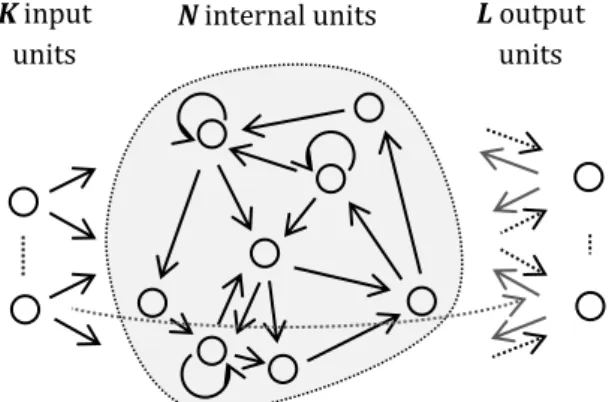
2.1 HMM-based phone model………. 13 2.2 The basic ESN architecture. Dotted arrows indicate trained weights
in the ESN approach. Shaded arrows point to optional connections….
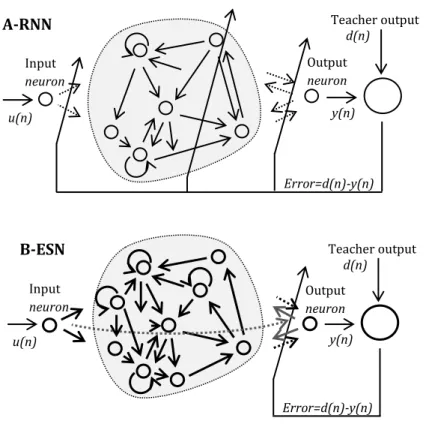
24
2.3 Shows a comparison between RNNs and ESN architecture and training……….
25
3.1 Arabic Phoneme categorization. ………. 37 3.2 The frequency of Arabic phonemes based for the 17 female and 17
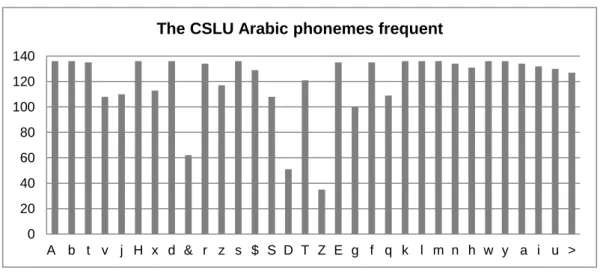
male speakers from the CSLU2002 database.………..
38
3.3 The frequency of Arabic phonemes extracted from the Levantine database. ..………..
39
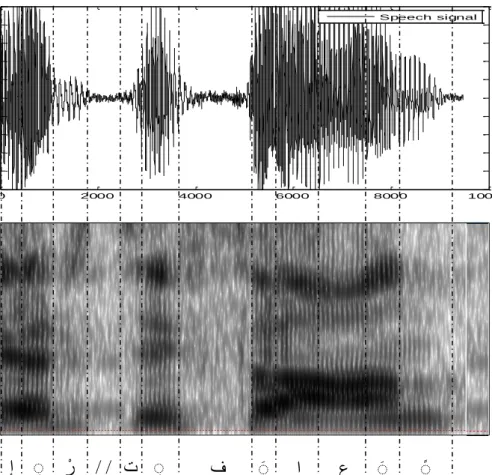
3.1 Phoneme classification for the utterance of the word /ً اَعاَفِت ْرإ/. (a) The word in time domain (spectrograph). (b) The word in frequency domain (spectrogram). ……….………
41
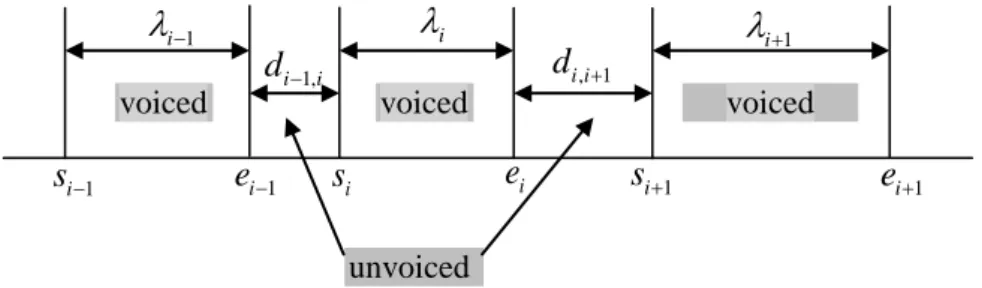
4.1 Speech segments……….. 47
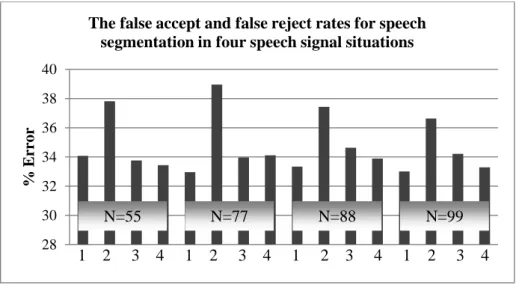
4.2 The averages of false accept and false reject error in different bins (N), and different situations: 1. Original speech signal. 2. Pre-emphasis applied. 3. Low pass filter applied 4. Per-Pre-emphasis and low pass filter applied. ………..
50
6.1 Multilayer Perceptron (MLP). ………... 62 6.2-a The RBM structure ……….. 65 6.2-b The DNN is composed of RBMs………. 69
6.3 Framewise phoneme recognition Accuracy on the training and the core test set as a function in the size of the final hidden layer, using 3 input frames. ………
70
6.4 Framewise phoneme recognition Accuracy on the training and the core test set as a function in the size of the first and second hidden layers, using 3 input frames. ……….
71
xv window and the number of nodes in the final hidden layer on the
KAPD training dataset. ………. 6.7 The effect of varying the number of frames in the context input
window and the number of nodes in the final hidden layer on the KAPD testing dataset. ……….
74
6.8 The effect of varying the number of frames in the context input window on the CSLU2002 training and testing datasets……….
78
6.9 Effect the windowing and cancelling the repeating frames on the accuracy performance. ……….
82
7.1 ESN connections with supervised learning. ……… 91 7.2 Time of saving the network and stop training. ……….. 92 7.3 The performance of the ESN with different reservoir sizes……… 93 7.4 The average train and test datasets results of the normalized KAPD
for training and testing datasets. ………
94
7.5 The histograms for Arabic phonemes recognition performances for training dataset for raw data (a) and normalized data (b), and for testing dataset for raw data (c) and normalized data (d)……….
94
7.6 The average results of phonemes for female speakers’ dataset when it trained and tested on the ESN with supervised learning……….
97
7.7 ESN connections with forced supervised learning algorithm……… 98 7.8 The average train dataset results of 34 speakers of the CSLU2002
database trained and tested on individual ESN with forced supervised learning algorithm………..
98
7.9 (a)- Combined Learning ESN (1st modification). (b)- Deep combined supervised/forced supervised ESN (DESN) (2nd modification)……….
101
7.10 A histogram used for a comparison between the average results of ESN with different learning algorithms for the CSLU2002 training dataset with 13 MFCCs coefficients………
102
7.11 A histogram used for a comparison between the average testing dataset results of ESN with different learning algorithms for CSLU2002 testing dataset and 13 MFCCs coefficient………..
xvi
AM acoustic models
ANN Artificial Neural Network
APD Arabic Phoneme Database
ASR Automatic Speech Recognition
BPNN Back-Propagation Neural Networks
CA Colloquial Arabic
CH CallHome
CHMM Continuous density Hidden Markov Model CNNs Convolutional Neural networks
CSLU2002 Centre for Spoken Language Understanding 2002
CTS conversational telephone speech
CV Consonant-Vowel
DBNs Deep Belief Networks
DCT Discrete Cosine Transform
DESN Deep Echo State Networks
DNN Deep Neural Networks
DR Dynamic Reservoir
DTW Dynamic Time Warping
ECA Egyptian Colloquial Arabic
EM expectation maximization
En Energy
ESN Echo State Network
FAR False Accept Rate
FBIS Foreign Broadcast Information Service
FFT Fast Fourier Transform
FNNs feed-forward Neural Networks
FPER framewise phoneme error
FRR False Reject Rate
FSN finite state network
GMMs Gaussian Mixture Models
HFCC Human Factor Cepstral Coefficients
HMM Hidden Markov models
ICSI International Computer Science Institute
IPA International Phonetic Alphabet
JOR Jordan
KACST Abdulaziz City for Science and Technology KAPD King Abdulalaziz Phonetic Database
KL Karhunen-Loeve
LCA Levantine colloquial Arabic
LDC Linguistic Data Consortium
xvii LPC Linear predictive Coefficient
LPCC MADA
Linear Predictive Coding Cepstral Coefficients
Morphological Analysis and Disambiguation for Arabic LVCSR large vocabulary continuous speech recognition
LVSR large vocabulary speech recognition
MAER Minimum Average Error Rate
MFCC Mel-Frequency Cepstral Coefficient
MLP Multi-Layer Perceptron
MMI maximum mutual information
MPE minimum phone error
MSA Modern Standard Arabic
NFPN Neural Fuzzy Petri Net
NN Neural Network
OOV Out-Of-Vocabulary
PAL Palestine
PCA Principle Component Analysis
PCs Personal Computers
PER Phone Error Rate
PFN Phoneme Filter Neural Network
PLP perceptual linear prediction coefficients
PNN Probabilistic Neural Network
PSD Power Spectral Density
RBF Radial Basis Function
RNN Recurrent Neural Network
ROS Rates Of Speech
Rprop Resilient Back-Propagation
SGD stochastic gradient descent
SMLP Sequence of MLP
SNN Sub-Neural-Network
SNR Signal to Noise Ratio
SoC System-on-Chip
SVM Support Vector Machine
SYR Syria
TDNN Time Delay Neural Network
TIMIT Acoustic-Phonetic Continuous Speech Corpus
VC Vowel-Consonant
WER word error rates
WTA winner-take-all
1
Chapter
One
Introduction
Speech is a natural communication method between humans and is the fastest form of data input between humans and technology. Automatic speech recognition (ASR) is a process that converts an acoustic signal, captured by the device microphone or over a telephone line, to a set of textual words. Over the years, ASR systems have been developed for many via-voice applications. Examples include: speech to speech translation (Lavie et al., 1997, Wahlster, 2000), dictation (Murveit et al., 1993, Lee, 1997, Lee et al., 2009), Computer aided language learning (Witt and Young, 1997, Xu et al., 2009, Peabody, 2011), and voiced based information retrieval (Franz and Milch, 2002, Zue et al., 2000) etc. ASR also plays a significant role in helping handicapped people to interact with society. An additional advantage of speech input systems is that the speech capture devices are already built into a large variety of modern devices (mobile phones, PCs etc.). As a result, capture of the speech input requires no extra peripherals. Consequently, applications with speech interfaces are desirable.
Accurate acoustic models (AM) are a significant requirement of automatic speech recognizers. Acoustic modelling of speech describes the relation between the observed feature vector sequence, derived from the sound wave, and the non-observable sequence of phonetic units uttered by speakers. Hidden Markov Models (HMMs) (Rabiner, 1989) using Gaussian Mixture Models (GMMs) are one of the most common types of acoustic models. Each HMM state typically models a 10 msec frame of the spectral representation of the speech signal. Other natural-based models have also been effectively used to model acoustic sequences. This thesis investigates acoustic models based on Deep Neural Networks (DNN) (Hinton and Salakhutdinov, 2006) and a Deep Echo State Networks (Jaeger, 2005) trained on labelled data. When used together with
2 an HMM system for phonetic boundary detection, the Hybrid HMM/NN system is investigated as a state-of-the-art speech recognition system for multi-dialect Arabic speech recognition.
1.1
Overview of speech recognition
Speech recognition can be basically classified into two modes. The first is isolated word recognition; where the words in this mode are surrounded by clear silence i.e. well known boundaries. The second is continuous speech recognition. This second mode is more difficult than isolated word recognition because the word boundaries are difficult to detect. A word may be uttered differently from one speaker to another due to the differences in dialects, gender and age; words may also be uttered in different ways by the same speaker as a result of emotion and illness. Temporal variability, due to differences in speaking rates, is easier to handle than acoustic variability introduced as a result of different pronunciations, accents, volumes, etc. (Tebelskis, 1995). In addition to speaker variability, all speech recognition systems are also affected by variability between environments. The environment may introduce corruption into the speech signal because of background noise, microphone characteristics, and transmission channels(Yuk, 1999, Jou, 2008).
Speech recognition systems can be further classified as being either a speaker dependent or a speaker independent system. A speaker dependent recognition system can extract uttered information from a specific speaker, or range of speakers, whose acoustic features have been previously installed from a training speech database. This type of system is called a ‘Closed-set’ speech recognition system as the training dataset contains uttered information for all speakers. An ‘Open-set’ speaker independent speech recognition system is one where there is no uttered information for the recognised speaker contained within the training dataset.
Speech recognition can be achieved at a variety of levels of speech (Phone/ Phoneme/ grapheme, syllable, word, phrase, etc.). A phoneme is generally considered as “the smallest meaningful contrastive units in the phonology of a language” (O'Shaughnessy, 1987). They are defined by “minimal pairs” which produce a change of meaning if any one phoneme is changed. Thus, phonemes are specific to a particular language. A phoneme can also be single or a set of phones. While, a phone is a single unit
3 of speech sound, allophones are all possible spoken sounds that are used to pronounce a single phoneme. The human brain is presumed to perceive a given set of allophones as a particular phoneme (Hawkins, 1988). If a phoneme is defined as the smallest unit of sound which can differentiate meaning, then a grapheme can be defined as the smallest unit in the writing system of any language that can differentiate meaning. A grapheme can be a symbol or a letter. Sound–letter correspondence refers to the relationship between sound (or phoneme) and letter (or grapheme). A phonetic transcription system, like the International Phonetic Alphabet (IPA), aims to transcribe the pronunciation of a language in a standard form. While a phonemic transcription system usually disregards all allophonic differences and represents them using the same grapheme; it is also known as a representation of phonemic structure. However, graphemic system uses one-to-one letter to sound (phoneme to grapheme) rules for each word to generate a pronunciation dictionary. In this work, phonemes are the symbols used to produce the Arabic pronunciation dictionary and phones will be used only to describe a particular HMM designed to represent a specific sound.
Phonemes play a major role in most current continuous speech recognition systems, and they can be categorised into two main groups consonants and vowels. A definition of vowels and consonants as stated in (Mosa and Ali, 2009) is: “Vowels are produced without obstructing air flow through the vocal tract, while consonants involve significant obstruction, creating a noisier sound with weaker amplitude.” In the Arabic language, consonants are further categorised into four classes. These are: voiced and unvoiced stops, voiced and unvoiced fricatives, nasal and the trill & lateral classes. Long and short vowels then make up a fifth class (Mosa and Ali, 2009).
Speech phoneme segmentation is a real challenge for continuous speech recognition systems. In limited vocabulary isolated word recognition, the problem can be easily solved by determining the correct boundary of the isolated words and rejecting the artefacts of speech such as noise and intra-word stops. With regard to large vocabulary continuous speech boundary detection, the problem becomes much more difficult because of the intra-word silences and other artefacts. These problems are commonly reduced by applying speech boundary detection algorithms.
Speech activity detection algorithms can be applied on pre-emphasised speech signals to detect silence/speech boundaries. The most common methods used for end
4 point detection are Energy profile and Zero Crossing Rate (ZCR) (Chen, 1988). Typically, in the Energy profile and Zero Crossing Rate algorithms an adaptive threshold is applied, based on the characteristics of the energy profile, in order to differentiate between the background noise and the speech segments. However, this algorithm is very sensitive to the amplitude of the speech signal, such that the energy of the signal affects the classification results. This is especially a problem in noisy environments. Recently, a new end point detection algorithm has been proposed that uses Entropic contrast (Waheed et al., 2002). This algorithm uses features of the entropy profile of the speech signal, rather than the energy profile of the signal, for boundary detection. The calculation of the entropy is applied in the time domain. Crucially, this profile is less sensitivity to changes in amplitude of the speech signal.
Despite the use of the above techniques, current speech segmentation techniques do still introduce errors into the segmentation process. An alternative is to perform the recognition process without prior segmentation. This method includes the ‘silence’ as a phoneme, and the network is trained to recognize it in the same manner as the other patterns.
The phonemic representation of a given word is used in most speech recognizers to identify it. Thus, the availability of speech data that has time-aligned and labelled at phonemic level is a fundamental requirement for building speech recognition systems. Time-aligned phonemic labels can be either manually produced by expert human labellers or automatically produced using automatic methods. Though manually-aligned data is considered more accurate than automatically-aligned data (Cox et al., 1998, Hosom, 2000b), it is very time consuming to use manual aligning for large speech corpora. The most common method for automatic speech alignment is called “ forced-alignment.” The most common method for forced alignment is to build a phonetic recognizer based on a Hidden Markov Model (HMM) (Brugnara et al., 1993, Ljolje et al., 1997, Wightman and Talkin, 1997, Hosom, 2000a, Toledano et al., 2003, Yuan and Liberman, 2008, Yuan et al., 2013).
Irrespective of whether the signal is segmented or not, all speech recognition systems use a feature extraction algorithm as the initial speech processing stage. The most common feature extraction techniques are Mel Frequency Cepstral Coefficients (MFCC) (Davis and Mermelstein, 1980), Fast Fourier Transform (FFT) (Loan, 1992) and
5 perceptual linear prediction coefficients (PLP) (Hermansky, 1990). Typically, ASR system represents the speech signal with the state of the art Mel Frequency Cepstral Coefficients (MFCCs).
The major concerns of the automatic speech recognition are determining a set of classification features and finding a suitable recognition model for these features. HMMs (Rabiner, 1989), which are a special case of regular Markov models, have been demonstrated to be a powerful model for representing time varying signals as a parametric random process (X.D. Huang et al., 2001, Rabiner, 1989). Commonly, Hidden Markov Models (HMMs) are used for modelling the MFCCs observation sequence. These features are computed every 10 ms with an overlapping analysis window of 25 ms. Artificial Neural Networks (ANNs) such as Multi-Layer Perceptron (MLP), Deep Neural Networks (DNN) Recurrent Neural Networks (RNN), and Echo State Network (ESN), have also been widely used for representing time varying quasi-stationary signals.
1.2
Research Motivation
Speech is a desirable communication method between humans and computers and automatic speech recognition (ASR) has been achieved to a large extent for the English language. Arabic is one of the oldest living languages and one of the oldest Semitic languages in the world, it is also the fifth most generally used language and is the mother tongue for roughly 200 million people. Arabic speech recognition has been a fertile area of reasearch over the previous two decades, as attested by the various papers that have been published on this subject. Hence, the Arabic language is selected to be the target language for this research.
A phonemic represented Arabic speech database that is time-aligned and labelled at the phonemic level is a fundamental requirement for building an Arabic speech recognition system. The availability of such data is currently very limited for almost all Arabic corpuses. Thus, forced-alignment, based on a Hidden Markov Model (HMM), is used in this work as an automatic speech alignment method for large vocabulary speech recognition (LVSR).
Motived by the simple and efficient deep learning training algorithms available in different types of neural networks, and their success for modelling acoustic signals for
6 many languages that achieved a higher classification accuracy than HMMs in many comparative speech recognition researches (Skowronski and Harris, 2006, Skowronski and Harris, 2007, Triefenbach et al., 2011, Dahl et al., 2012, Graves et al., 2013, Triefenbach et al., 2013, Mohamed, 2014), Deep neural networks (DNN, and Deep ESN), as well as conventional NN (MLP, ESN), are proposed in this work for creating Arabic acoustic models that can be used for continuous speech unit recognition to classify an input sequence phoneme into specific output classes.
1.3
Research Aim and Objectives
The central aim of this research is to investigate phoneme and acoustic models based on Deep Neural Networks (DNN) and a Deep Echo State Networks for multi-dialect Arabic Speech Recognition. The TIMIT corpus with a wide variety of American dialects is also used to evaluate the proposed models. This aim was achieved through the following objectives:
To segment and label Arabic corpora that is suitable for implementing our aim. In order to investigate this objective, a developed Arabic phoneme database (APD) is manually timed and phonetically labelled. This dataset is constructed from the KAPD database for Saudi Arabia dialect and the Centre for Spoken Language Understanding (CSLU2002) database for different Arabic dialects. This dataset covers 8148 phonemes. In addition, a corpus of 13 hours of Arabic speech randomly selected from the Levantine Arabic dialect database that is used for training and 2.4 hours for testing are revised and transcription errors are manually corrected. The selected dataset is labelled using the HTK Toolkit.
To analyse the extracted features using the state-of-the-art extraction technique, the Mel-frequency Cepstral Coefficients (MFCC), the Linear Predictive Code (LPC) algorithms are also used for comparison purpose.
To develop and evaluate MLP-based NN classifiers (Shallow and Deep models) for Arabic phoneme recognition and acoustic models. Shallow and Deep MLP NN are investigated for Arabic phoneme speech recognition. The systems are trained on the developed King Abdul-Aziz Arabic Phonetics Database (KAPD) Saudi Arabia database
7 and the Centre for Spoken Language Understanding (CSLU2002) database using MFCCs features only to train and test the systems. To evaluate the adoption of the DNN model in developing an acoustic modelling Arabic speech recognition system instead of a phoneme-based system. For large vocabulary Arabic dataset, the Levantine corpus is used to train DNN acoustic models using MFCCs features and online training algorithm (Stochastic gradient decent algorithm).
To apply a post-processing enhancement to the framewise DNN outputs in order to improve the framewise phoneme recognition acoustic model accuracy and to find the accuracy in phoneme level instead of the frame level.
To develop and evaluate an ESN for Arabic phoneme recognition with different learning algorithms. This investigated the use of the conventional ESN trained with supervised and forced learning algorithms. A novel combined supervised/forced supervised learning algorithm was also developed to enhance the performance of the ESN for speech recognition. In addition, deep ESN is implemented for Arabic phoneme recognition. These systems were trained on the developed KAPD Saudi Arabia dialect and the Centre for Spoken Language Understanding (CSLU2002) database using offline training algorithm. Both MFCCs and LPC techniques were used and compared as the input feature extraction technique. For large vocabulary Arabic dataset, the Levantine corpus is used to train ESN acoustic models using MFCCs features and online training algorithm (Stochastic gradient decent algorithm).
To investigate deep learning for framewise phoneme classification and acoustic modelling using Deep Neural Networks (DNNs) and Echo State Networks (ESNs) on TIMIT corpus.
To compare the respective performances of the RBM DNN and the ESN speech recognition systems as well as undertake a fine comparison between the performances of the proposed systems investigated in this thesis and the published works in equivalent projects based on framewise phoneme recognition using the various corpora.
8
1.4
Thesis Organization
This thesis is organized as follows:
Chapter 2 provides a general overview of current methods for automatic speech alignment and recognition systems. A state-of-the-art HMM/GMM system is first presented. Previous ASR modelling efforts using the state of the art HMM and neural network techniques are then presented. Finally, existing Arabic speech recognition works are summarised in this chapter.
Chapter 3 provides an explanation for the linguistic aspects of Modern Standard Arabic (MSA), primarily the orthography and pronunciation rules of Arabic language and Arabic transcription systems. The proposed Arabic databases that used in this dissertation are described and their limitations mentioned.
Chapter 4ً briefly describes the Front-end speech processes such as speech segmentation and feature extraction techniques that are used in this thesis. An Entropy-based algorithm is firstly presented and investigated for speech segmentation experiments, the Mel-frequency Cepstral Coefficients (MFCC) feature extraction techniques are also briefly described.
Chapter 5 provides a description of the frame-based HMM that is considered the foundation for the forced-alignment algorithm which is used in this thesis for timing and labelling the Levantine Arabic dataset. The automatic speech alignment experimental setup including the proposed transcription system, text normalization, building the Arabic pronunciation dictionary and the frame work are presented.
Chapter 6 briefly describes the conventional and deep NNs based models for Arabic phoneme recognition. Experiments and the results of using conventional Shallow and Deep MLP NNs for isolated speech unit recognition are first presented. Deep neural networks that are proposed in this work for creating Arabic acoustic models are then described.
Chapter 7 details the conventional and deep Echo State Networks architectures with their experimentation applied on the proposed databases. Finally, fine comparisons between the performances of the conventional and deep MLP NN and the
9 conventional and deep ESN, as well as between the ESN performance for Arabic speech and the HMM equivalent performance for different languages are presented.
Chapter 9 explored deep learning for framewise phoneme classification and acoustic modelling using Deep Neural Networks (DNNs) and Echo State Networks (ESNs) on TIMIT corpus.
Chapter 8 provides a conclusion of the work undertaken as well as a discussion on the future work required to produce a continuous Arabic speech recognition system.
1.5
Thesis Contributions
The major contributions of this thesis are:
A developed Arabic phoneme database (APD) that is manually timed and phonetically labelled. This dataset is constructed fromthe KAPD database for Saudi Arabia dialect and the Centre for Spoken Language Understanding (CSLU2002) database for different Arabic dialects. This dataset covers 8148 phonemes.
A corpus of 13 hours of Arabic speech randomly selected from the Levantine Arabic dialect database that is used for training and 2.4 hours for testing. The main contribution for the selected dataset is that we revised and corrected the transcription errors manually. In addition we labelled this selected dataset using the HTK Toolkit to be ready for further research.
Deep Echo State Networks (DESN) acoustic models for Automatic Speech Recognition (ASR) are introduced. This new model is evaluated on the Levantine dataset and compared with the results obtained from the baseline Deep Neural Networks (DNNs). Both models we were first to introduce the for Arabic speech recognition system.
A novel adaptation for the ESN is presented that can be used to enhance the performance accuracy for the ESN.
Empirical comparison for the proposed machine learning techniques conducted on the three proposed corpora namely KAPD, CSLU2002 and Levantine Arabic speech are presented as well as to the TIMIT corpus with a wide variety of American dialects
10 is also aimed to evaluate the proposed models and to make a direct comparison them.
A Neural Network toolkit, updated to C++ visual studio 2010. This toolkit includes the MLP, ESN, and DESN algorithms and is made freely available.
11
Chapter Two
Background and Literature Review
State-of-the-art Automatic Speech Recognition (ASR) systems have, for many decades, used Hidden Markov Models (HMMs) for modelling the sequential structure of speech signals using a mixture of Gaussians. Since the early 90’s an alternative approach has been used, with limited success compared to Gaussian Mixture Models (GMMs), that estimates the fit using types of Artificial Neural Networks (ANNs) that takes contextual window of frames as input and produce posterior probabilities for the HMM states as outputs. Recently, there has been a renewed interest in exploiting Artificial Neural Networks (ANNs) since the Deep machine learning field was introduced in 2006 by (Hinton et al., 2006). The ESN can also be utilized as probabilistic models for extracting features that can be used in modelling time series prolems (e.g. speech and image data) whithin hybrid systems (ESN-ANN, ESN-HMMs). The literature review in this Chapter presents a brief survey of relevant literature covering speech recognition technologies for a wide variety of languages and for Arabic language. A general overview of using Hidden Markov Models (HHMs) especially for speech alignment, as well as Artificial Neural Networks (ANNs) and Hybrid approaches for speech recognition tasks are presented. Specific attention is then applied to research that has explored Arabic speech recognition.
The rest of this Section is described as follows: Section 2.1 focuses on providing a background description of the HMMs for speech recognition, specifically speech alignment and labelling. Section 2.2 then describes the shallow and deep neural network architectures that have been effectively exploited for speech recognition, whilst Section 2.3 presents hybrid HMM/NN systems. In Section 2.4 an end-to-end neural network speech recognition system is described. Finally, a general literature review for Arabic speech recognition is presented.
12
2.1
A basic HMM model for ASR
The goal of automatic speech recognition is to produce an accurate transcription of spoken words. The major concerns of modern ASR systems are determining a set of classification features and finding a suitable recognition model for these features. HMMs (Rabiner, 1989) are a special case of regular Markov models that have been demonstrated to be a powerful model to represent time varying signals as a parametric random process (X.D. Huang et al., 2001, Rabiner, 1989). Typically, modern ASR system represent the speech signal using state-of-the-art Mel Frequency Cepstral Coefficients (MFCCs). The Hidden Markov Models (HMMs) are then used to model the MFCCs observation sequence.
These features are computed every 10 ms with an overlapping analysis window of 25 ms. The sequence of the acoustic feature vectors that are extracted from the speech signal can be supposed as the observable data. The hidden state sequence
supposed as the underlying symbol sequence, can then be inferred
from the observation sequence. Each HMM state is modelled using a Gaussian mixture model (GMM) with several diagonal covariance Gaussians. HMMs are trained by maximizing the data likelihood:
∑ (2.1)
The decoder attempts to find ̂ that maximizes the posterior probability
using the Viterbi algorithm:
̂ { } { } (2.2)
is challenging to model directly. However, there are many proposals that have
been made which use discriminative models (Gales, 2007), such as maximum mutual information (MMI) (P.S. Gopalakrishnan et al., 1991, Woodland and Povey, 2002) and minimum phone error (MPE) (Povey and Woodland, 2002, Povey, 2004) to maximize the posterior probability .
13 The likelihood of given , and the prior probability of the word sequence are determined by an acoustic model and a language model respectively. The language model is an N-gram model trained separately on an enormous text in which the probability of each word is conditionally obtained on its N-1 predecessors.
The acoustic model for any given word is produced by concatenating phoneme models of the word as defined by a pronunciation dictionary. Multiple pronunciations for each word can be found in the pronunciation dictionary. The sequence of the base phonemes is defined as for each pronunciation. Therefore, the likelihood can be calculated over these pronunciations using this formula:
∑ (2.3)
where the ∑ denoted by the overall pronunciation sequences for given and is a specific sequence of pronunciations
∏
(2.4)
where is a one possible pronunciation for word .
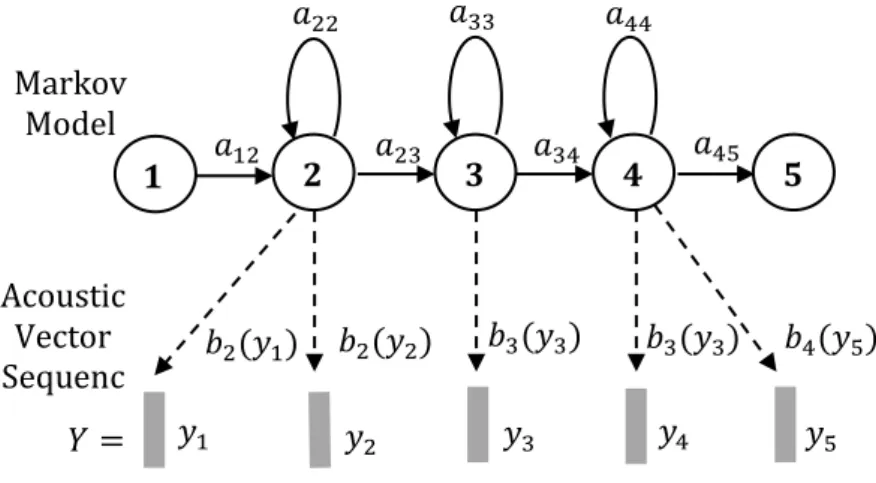
Each HMM associated with a phoneme is called a phone model. Phones are used as the main speech unit to be modelled by HMMs, where each phone is modelled using left-to-right HMMs with three states plus the entry and exit states as shown in Figure 2.1.
Figure 2.1- HMM-based phone model (Gales and Young, 2007).
HMMs make a transition from the current state to one of the neighbour states every time step . A transition probability { } is associated for each arc between two
𝑏4 𝑦5 𝑏3 𝑦3 𝑏3 𝑦3 𝑏2 𝑦2 𝑏2 𝑦 𝑦5 𝑦4 𝑦3 𝑦2 𝑦 𝑌 Acoustic Vector Sequenc e Markov Model 5 4 3 2 1 𝑎33 𝑎44 𝑎45 𝑎34 𝑎23 𝑎22 𝑎 2
14 connected states. On entering a state , a feature vector is generated with the output distribution { } associated with the state being entered. This form of the HMM process makes two unrealistic conditional independence assumptions:
The current state is conditionally independent from all other states given the prior state.
Observation frames are conditionally independent of all other observation frames, in the utterance, given the current state.
For classification of frames, in state-of-the-art ASR, a context window of frames is taken. This context window includes the feature vector of the current frame and may include feature vectors of the surrounding frames. Gaussian Mixture Models (GMMs) are easily trained using the expectation-maximization (EM) algorithm (Dempster et al., 1977) to estimate the phonetic likelihoods. Only one frame is covered in the contextual window, and the delta features, which implicitly contain information about neighbouring frames, are included. With a NN classifier, the input feature vector is often a context window that includes multiple of frames in addition to their delta features. These classifiers estimate the posterior probability distribution over the categories. These posterior probabilities are passed to the Viterbi decoder to search for all the possible word sequences for the utterance using pruning to eliminate the unlikely hypotheses. A description of Viterbi decoding algorithm can be found in (Huang et al., 2001). Finally, the most likely word sequence is considered as output. The Viterbi search is also used to generate the timing of each state for each input utterance using a dictionary and word level transcriptions.
The major reasons for the widespread use of HMM based systems are that the mathematics are well formulated and their performances are often the most superior to other approaches. However, the disadvantages of HMM systems are the amount of data required to train these systems and the fragility of these recognizers when applied under various conditions. In addition, independence between values of the frame cannot be fully justified. Also, since no speech specific knowledge (e.g. data-driven clustering of phonetic categories and perceptually related warping of the spectrogram) is used in the HMMs likelihoods computation at each frame of each phone, these values are estimates of phonetic qualities of the speech as well as the channel and noise conditions of the data.
15
2.2 Methods of automatic alignment systems
Speech recognizers are used to identify the phonemic representation of a given word. Thus, the availability of speech data with time-aligned phonemic labels is a fundamental requirement for building many speech recognition systems.
Time-aligned phonemic labels can be manually transcribed by expert human labellers or automatically produced using an automatic method. Though manually-aligned data is considered more accurate than automatically-aligned data (Cox et al., 1998, Hosom, 2000b, Cosi. et al., 1991, Ljolje et al., 1994), it is very time consumption to use manual methods for aligning large corpora. Hence, a fast and accurate automatic alignment system is needed for time-aligned phonemic labels in large vocabulary speech recognition systems (LVSRS).
A wide variety of approaches has been used for automatic alignment systems. The most common method is called “forced-alignment” several phonemic recognizers based on Hidden Markov Model (HMM) have been created (Brugnara et al., 1993, Ljolje et al., 1997, Wightman and Talkin, 1997, Hosom, 2000a, Toledano et al., 2003, Yuan and Liberman, 2008, Yuan et al., 2013). Dynamic Time Warping (DTW) is another approach that has been used to align sequences. Dynamic Time Warping (DTW) is a dynamic programming approach that is used to align the features of the input utterance against the features of a reference utterance. Many publications have used DTW for phonetic alignment of speech (e.g. (Wagner, 1981, Malfrère and Deroo, 1998, Campbell, 1996)). In addition to HMM and DTW, a wide variety of other approaches have attempted to align and label speech based on different techniques. For instance, van Santen and Sproat in (Santen and Sproat, 1999) tried to align the speech based on detecting phonetic boundaries using edge detectors on the energy information and spectral-domain representations in different frequency bands.
Typically, the same process that is used for speech recognition is used for automatic forced alignment. Recognition of the utterance is, usually, performed using a search procedure, such as Viterbi search, that is constrained to prior known sequences of phones. This search produces the locations and the identities of the phones. The phonetic sequences are often prior determined by a pronunciation dictionary. Using this
16 way, the forced alignment method can produce the phonetic alignment by forcing the recognition result to obtain the utterance phonetics locations and identities.
Many researchers have used this approach to perform the alignment of speech. For example, Brugnara et al. (Brugnara et al., 1992, Brugnara et al., 1993) developed an automatic alignment and labelling speech system using a forced alignment HMM based system using a combination of spectral variation features and the standard cepstral-domain features to compute the state occupation likelihoods. These additional features enhanced the system with a 2% reduction in error. Wightman and Talkin in (Wightman and Talkin, 1997) also developed an automatic alignment system based on HMMs, termed “the Aligner.” The Viterbi search was implemented using the HTK toolkit (Young et al., 2003) and trained on the TIMIT phonetic sequences. Ljolie and Riley (Ljolje et al., 1997) built their HMM alignment system based on the availability of the date; i.e HMMs with different types of phonetic models. A complete triphone model is used if the training data is enough for the left and right contexts of the given phone. Alternatively, a quasi-triphone model (one side-state is dependent on the other side) is tried if sufficient data is not available. If the training data is still not enough, context-independent phone models are applied. Svendsen and Kvale (Svendsen and Kvale, 1990) segmented the speech signal into equal length segments of speech, and then the HMM was used within the segment during the Viterbi search. State transitions are then only allowed at the segments boundaries. A phonetic alignment system based on a hybrid HMM/ANN model was developed by Hosom (Hosom, 2000a) using the CSLU Toolkit.
A wide verity of languages have been segmented and labelled using the HTK Toolkit. Rapp in (Rapp, 1995) trained the forced alignment system for German read speech. Sjölander (Sjölander, 2003) also developed an automatic time-aligned phone transcription system of spoken Swedish. Wightman and Talkin in (Wightman and Talkin, 1997) used the same HTK Toolkit for English language trained on the TIMIT database. The EasyAlign (Goldman, 2011) system, based on the HTK Toolkit, was implemented for aligning English and French speech.
The reported performances for these systems, range from 80%-89% agreement within 20 ms of the standard HMM based forced alignment systems when compared to manual segmentation on the TIMIT corpus (Hosom, 2000a, Hosom, 2009). Many researches have attempted to develop alignment systems with higher performance. For
17 instance, Yuan et al. in (Yuan et al., 2013) investigated the use of phone boundary models within the forced alignment HMMs system. They achieved a 93.92% agreement within 20 ms using the HTK Toolkit.
It is clear from the literature that aligning the speech is a fundamental task for large vocabulary speech recognition systems. Since there is no available aligned and labelled Arabic dataset that can be used for speech recognition area, the Levantine Arabic corpus that is described in Chapter Three has been aligned and labelled in this work using the HTK Toolkit. Details and the experimental results of forced alignment are presented in Chapter Five.
2.3
Machine learning algorithms
In general, machine learning algorithms have been classified into three main fields:
Supervised learning
Supervised learning systems use a training dataset constructed from features of instances with its labels as pairs, represented by
( ,x y1 1),...,(x yn, n)
The aim of thislearning is to predict the output y for any given input feature x. There is an interesting
type of supervised learning technique that replaces the actual output y t( ) by the teacher
output (desired output) d t( ) during the training stage (hmidt et al., 2010, Williams and
Zipser, 1989). This technique is called Teacher-Forced supervised learning.
Unsupervised learning
Unsupervised learning systems use an unlabelled training dataset, represented only by the features of instances
x x1, 2,...,xn
. The main use of this type of learning is forclustering purposes, i.e k-Means (Lloyd, 1982).
Reinforcement learning
Reinforcement learning systems observe an environment x, then implement an
action a, and obtain a reward
r
(Duda et al., 2001). Maximizing the future rewards isthe main goal of this learning and this is achieved by choosing actions that lead to this maximum rewards.
18
2.3.1
Static Neural Networks
2.3.1.1 Feed-forward Neural Networks
The feed-forward Neural Networks (FNNs) are a widely used artificial neural network architecture (ANN). There are several architectures of neural networks (NNs); each with its own unique set of connections, training algorithms, and applications. They are all, however, based on common principles. Neural networks such as Multi-Layer Perceptron (MLP) are constructed from a large number of processing elements (called neurons, nodes or units). Each neuron influences the other’s behaviour via weighted connections; where each neuron output is computed as the sum of the product of nonlinear weights with its inputs. This output is broadcasted to all other units over its outgoing connections.
Initially inspired by neurobiology, MLP connectionist systems have since developed into an interdisciplinary field that classify static features, covering physics, mathematics, linguistics, computer science and electrical engineering. Nowadays, the properties of neural computation are used in a wide range of research (Tebelskis, 1995). These properties are:
• Trainability. Neural network can be trained to learn the relationships between any set of input and output patterns. This can be used to teach a neural network to categorize speech patterns into phoneme classes.
• Generalization. Rather than the network memorizing the training data; the underlying patterns are learnt by the neural network, so the new examples can be generated from the training data. This property is vital in a speech recognition task since the auditory input patterns are never precisely the same.
• Nonlinearity. Nonlinear functions can be computed by neural networks on their input. This enables arbitrarily complex transformations to be performed on the data. This is useful because of the highly nonlinear processing nature of speech.
• Robustness. Noisy training data can help a neural network to perform better generalization (Tebelskis, 1995). Speech patterns are notoriously noisy, so this property is valuable.
19
• Parallelism. Neural networks implement massive parallel computers since they are
inherently parallel in nature. This potentially leads to very fast processing of data.
Until recently, most machine learning techniques have exploited shallow-structured architectures which contain a single layer of nonlinear feature transformation. Examples of these architectures are support vector machines (SVMs), kernel regression, logistic regression, and multi-layer perceptron (MLP) neural networks that consist of a single hidden layer. The main properties of shallow learning models are that they have a simple architecture and are effective in solving simple problems. However, these shallow architectures have limited representational and modeling power that can lead to difficulties when dealing with perceptual problems such as human speech.
2.3.1.2 Deep Belief Networks
Deep Neural Networks (DNNs) are believed to achieve high performance on complicated real applications such as vision and speech by better representing their complex functions. Deep learning is a category of machine learning techniques, where hierarchical architectures are used to process natural signals (e.g. speech signals) using several non-linear information stages such signals often contain features that are inherently in nature. Feed-forward neural networks (FNNs) (e.g., Multi-Layer Perceptron (MLPs)) with many hidden layers are considered a good example of the deep models. Usually MLPs use the Backpropagation (BP) algorithm for learning the network weights. However, this learning algorithm does not work well for learning networks with several hidden layers (Bengio, 2009, Glorot and Bengio, 2010). The BP algorithm often gets trapped in local optima and the severity of this non-optimal learning increase as the depth of the neural networks increases.
DNNs are a feed-forward Neural Networks that has many layers of non-linear hidden units between their inputs and their outputs. Such a network can be trained one layer at a time as a generative model of the input data, (i.e. a window of speech coefficients with one frame delay), using Restricted Boltzmann Machines (Smolensky, 1986). A subsequent discriminative fine-tuning phase using the backpropagation algorithm, then fine-tunes the features in every layer to make them more valuable for discrimination. This type of network is also called Deep Belief Networks (DBNs) in the literature (e.g., (Dahl et al., 2011, Mohamed et al., 2010, Mohamed et al., 2009, Mohamed et al., 2012)). A
20 DBN can be effectively used to initialize the DNN training; such a network is called DBN– DNN (Hinton et al., 2012). The sparse encoding symmetric machine (SESM), developed by Ranzato et al. (Ranzato et al., 2007), has a similar approach to RBMs by way of building blocks of a DBN. SESM can also be used to initialize the DNN training.
There are two key properties for deep learning techniques. A DNN is trained as a generative model1, and then an additional top layer is used to perform the discriminative tasks. An unsupervised pre-training phase, which train multilayer generative neural network one layer at a time, that makes them effective in extracting structures that represent the input features in large unlabelled training data is also employed. Most of the work, that uses deep learning, can be categoraized depending on how the architectures are intended for use into three main classes:
1) Generative deep architecture: this architecture aims to distinguish the high-order
correlation properties of the visible or observed data for pattern synthesis or analysis purposes. Deep generative models are not always required to be probabilistic in nature (i.e., the parametric feature encoding techniques used in DNN auto-encoders, whose targets are the observed data itself, or “bottleneck-layer" that produce low-dimensional codes for the original inputs). In this architecture, DNNs are similar to other dimensionality reduction methods such as Principle Component Analysis (PCA). Generally, the use of generative models played a significant role in the interest in deep learning for feature coding and speech recognition (Hinton et al., 2012, Dahl et al., 2011, Deng et al., 2010).
2) Discriminative deep architecture: this type of architecture is, often used to characterize the posterior distributions of classes, conditioned on the observed data, to provide discriminative power for pattern classification. Discriminative training using the back-propagation algorithms has been used in many Neural Networks (NNs) approaches for acoustic modeling. The discriminative approach was first proposed in (Brown, 1987) where generative training is replaced by discriminative modeling for acoustic modeling.
3) Hybrid deep architecture: the goal of this architecture is discrimination. The outcomes of the generative model that are used in (1) are fed into the discriminative
21 architicture in (2). such an approach is termed DBN-DNN (Mitra et al., 2014). This hybrid system is different from one that uses NN-HMMs such as (Bengio et al., 1991, Bourlard and Morgan, 1993, Morgan, 2012, Mohamed, 2014), for more discussion about NN-HMMs hybrid systems see Section 2.4.
For large vocabulary speech recognition, deep neural networks must be trained with a large number of parameters. Therefore, overfitting is a potentially serious problem. The term overfitting refers to the gap between training error and test error; i.e. the neural net has learned the training examples very well, but has ‘lost’ its ability to generalize to a new situation. There are several techniques used to prevent overfitting that can be (e.g. cross-validation, early stopping, regularization, pruning). These techniques can be used to indicate when more training can lead to worse generalization. More recently, Dropout (Srivastava et al., 2014, Srivastava et al., 2012) is a regularization technique that has been used for addressing overfitting. This technique randomly drops units from the neural net during training to prevent units from co-