Robust Steganographic Techniques for Secure
Biometric-based Remote Authentication
By
RASBER DHAHIR RASHID
Department of Applied Computing
University of Buckingham
United Kingdom
A thesis
Submitted for the Degree of Doctor of Philosophy in Computer
Science to the School of Science and Postgraduate Medicine in
The University of Buckingham
i
ABSTRACT
Biometrics are widely accepted as the most reliable proof of identity, entitlement to services, and for crime-related forensics. Using biometrics for remote authentication is becoming an essential requirement for the development of knowledge-based economy in the digital age. Ensuring security and integrity of the biometric data or templates is critical to the success of deployment especially because once the data compromised the whole authentication system is compromised with serious consequences for identity theft, fraud as well as loss of privacy. Protecting biometric data whether stored in databases or transmitted over an open network channel is a serious challenge and cryptography may not be the answer. The main premise of this thesis is that Digital Steganography can provide an alternative security solutions that can be exploited to deal with the biometric transmission problem.
The main objective of the thesis is to design, develop and test steganographic tools to support remote biometric authentication. We focus on investigating the selection of biometrics feature representations suitable for hiding in natural cover images and designing steganography systems that are specific for hiding such biometric data rather than being suitable for general purpose. The embedding schemes are expected to have high security characteristics resistant to several types of steganalysis tools and maintain accuracy of recognition post embedding. We shall limit our investigations to embedding face biometrics, but the same challenges and approaches should help in developing similar embedding schemes for other biometrics. To achieve this our investigations and proposals are done in different directions which explain in the rest of this section.
Reviewing the literature on the state-of-art in steganography has revealed a rich source of theoretical work and creative approaches that have helped generate a variety of embedding schemes as well as steganalysis tools but almost all focused on embedding random looking secrets. The review greatly helped in identifying the main challenges in the field and the main criteria for success in terms of difficult to reconcile requirements on embedding capacity, efficiency of embedding, robustness against steganalysis attacks, and stego image quality. On the biometrics front the review revealed another rich source of different face biometric feature vectors. The review helped shaping our primary objectives as (1) identifying a binarised face feature factor
ii
with high discriminating power that is susceptible to embedding in images, (2) develop a special purpose content-based steganography schemes that can benefit from the well-defined structure of the face biometric data in the embedding procedure while preserving accuracy without leaking information about the source biometric data, and (3) conduct sufficient sets of experiments to test the performance of the developed schemes, highlight the advantages as well as limitations, if any, of the developed system with regards to the above mentioned criteria.
We argue that the well-known LBP histogram face biometric scheme satisfies the desired properties and we demonstrate that our new more efficient wavelet based versions called LBPH patterns is much more compact and has improved accuracy. In fact the wavelet version schemes reduce the number of features by 22% to 72% of the original version of LBP scheme guaranteeing better invisibility post embedding.
We shall then develop 2 steganographic schemes. The first is the LSB-witness is a general purpose scheme that avoids changing the LSB-plane guaranteeing robustness against targeted steganalysis tools, but establish the viability of using steganography for remote biometric-based recognition. However, it may modify the 2nd LSB of cover pixels as a witness for the presence of the secret bits in the 1st LSB and thereby has some disadvantages with regards to the stego image quality.
Our search for a new scheme that exploits the structure of the secret face LBPH patterns for improved stego image quality has led to the development of the first content-based
steganography scheme. Embedding is guided by searching for similarities between the LBPH patterns and the structure of the cover image LSB bit-planes partitioned into 8-bit or 4-8-bit patterns. We shall demonstrate the excellent benefits of using content-based embedding scheme in terms of improved stego image quality, greatly reduced payload, reduced lower bound on optimal embedding efficiency, robustness against all targeted steganalysis tools. Unfortunately our scheme was not robust against the blind or universal SRM steganalysis tool. However we demonstrated robustness against SRM at low payload when our scheme was modified by restricting embedding to edge and textured pixels. The low payload in this case is sufficient to embed a secret full face LBPH patterns.
Our work opens new exciting opportunities to build successful real applications of content-based steganography and presents plenty of research challenges.
iii
I dedicate my thesis to my Father's soul
And
iv
ACKNOWLEDGMENT
Many thanks go to my supervisor Professor Sabah Jassim for his creative guidance during supervision. I appreciate his advices on both researches as well as on my career which have been priceless. I would like sincerely to thank Dr. Harin Sellahewa for his valuable comments and useful discussions during my study.
My warm thanks to my family, and special thanks go to my wife and love “Taban”, for her continuous support and being with me in every step in my life. I want to say thank you my two beautiful angels, Shanya and Lanya, for your patience and understanding throughout the duration of my study.
Finally, I would like to thank Ministry of Higher Education and Scientific Research in Kurdistan Region and Koya University for sponsoring part of my PhD program.
v
ABBREVIATIONS
AES Advanced Encryption Standard
ANN Artificial Neural Networks
BER Bit Error Rate
BP Bit Plane
bpp Bits Per Pixel
COM Centre of Mass
dB Decibels
DCT Discrete Cosine Transform
DFT Discrete Fourier Transform
DIH Different Image Histogram
DWT Discrete Wavelet Transform
ECC Error Correction Code
EOOB Out-Of-Bag Error
FLDA Fisher Linear Discriminant Analysis GEFR Gradient Energy Flipping Rate HCF Histogram Characteristic Function
HUGO Highly Undetectable SteGo
HUGO BD HUGO With Bounding Distortion
ID Identification Cards
JPEG Joint Photographic Experts Group
LBP Local Binary Pattern
LBPH Local Binary Pattern Histogram LDA Linear Discriminate Analysis
LSB Least Significant Bit
LSBM Least Significant Bit Matching
LSBMR Least Significant Bit Matching Revisited
MSB Most Significant Bit
MSE Mean Squared Error
NC Normalized Correlation
NN Nearest Neighbour
OC-SVM One-Class Support Vector Machine
vi
PCA Principal Components Analysis
PIN Personal Identification Number
PoV Pairs of Value
PRNG Pseudo Random Number Generator
PSNR Peak Signal to Noise Ratio
PVD Pixel Value Differencing
RLE Run Length Encoding
RLSB Random Least Significant Bit
ROI Region of Interest
RQP Raw Quick Pair
RS Regular and Singular
RWS Revisited Weighted Stego
SLSB Sequential Least Significant Bit
SRM Spatial Rich Models
S-UNIWARD Spatial-Universal Wavelet Relative Distortion
SVM Support Vector Machines
SIFT Scale Invariant Feature Transform TLSB Traditional Least Significant Bit UNIWARD Universal Wavelet Relative Distortion
WOW Wavelet Obtained Weights
WS Weighted Stego
vii
CONTENTS
ABSTRACT ... i ACKNOWLEDGMENT ... iv ABBREVIATIONS ... v CONTENTS ... vii LIST OF FIGURES ... xiLIST OF TABLES ... xiv
DECLARATION ... xvi
Chapter 1 Introduction ... 1
1.1 Overview of the Research Problem ... 1
1.2 Challenges in Biometrics based Remote authentication ... 4
1.3 Challenges in Steganography ... 7
1.4 Motivations and Objectives ... 9
1.5 Main Contributions ... 10
1.6 Thesis Outline ... 11
Chapter 2 Background and Literature Survey ... 12
2.1 Biometric Recognition Systems ... 12
2.1.1 Face Recognition System ... 13
2.1.2 Face Feature Extraction... 14
2.1.3 Classification ... 19
2.1.4 Face Biometric databases ... 20
2.2 Steganography and Steganalysis ... 21
2.2.1 Steganography Terminology ... 22
2.2.2 Basic Steganography Schemes ... 23
2.2.3 Fundamental Requirements of Steganographic Systems ... 24
viii
2.2.5 The Least Significant Bit (LSB) Embedding Schemes ... 30
2.2.6 Steganalysis Tools ... 33
2.3 Biometric Hiding ... 38
Chapter 3 Face Biometric Hiding Techniques ... 43
3.1 Extracting Face Feature ... 43
3.1.1 Wavelet-based Features ... 44
3.1.2 LBP-based Features ... 45
3.2 Hiding Techniques ... 47
3.2.1 Traditional LSB-based Steganography ... 48
3.2.2 The Proposed LSB-Witness Hiding Technique ... 50
3.3 Analysis of the Proposed Hiding Technique ... 51
3.3.1 Capacity... 52
3.3.2 Invisibility ... 52
3.3.3 Robustness ... 54
3.4 Embedding Face biometrics using LSB-Witness Scheme ... 60
3.4.1 Payload ... 62
3.4.2 Invisibility ... 63
3.4.3 Robustness ... 64
3.4.4 Recognition Accuracy ... 64
3.5 Conclusions ... 66
Chapter 4 DWT-based LBPH Face Feature for Secure LSB-Witness Hiding... 68
4.1 Multi-scale LBP and Wavelet Decomposition ... 68
4.2 LBPH Schemes in the DWT Domain ... 70
4.3 Experimental Setup ... 73
4.3.1 Databases... 73
ix
4.4 The Performance of DWT-based LBPH Schemes ... 74
4.4.1 LBP with 4 Main Neighbours (N4) ... 75
4.4.2 LBP with 4 Diagonal Neighbours (ND) ... 78
4.4.3 Combining LBP with 4 Main (N4) and 4 Diagonal (ND) Neighbours .. 82
4.4.4 Fusion of LBP8 with LBP4 ... 86
4.4.5 Fusion of LBP8 with Combined LBP4 and LPBD ... 89
4.5 Trade-off between Recognition Rate and Number of Features ... 93
4.6 Invisibility Vs Number of LBPH Features ... 96
4.7 Conclusions ... 97
Chapter 5 Content-Based Steganography ... 99
5.1 Perfect Vs Optimal Steganography ... 99
5.2 A Content-based Steganography Scheme for Face Biometric ... 102
5.2.1 Embedding Process ... 102
5.2.2 Extraction Process ... 107
5.2.3 Block Mapping ... 109
5.3 Experimental Setup and Discussion ... 110
5.3.1 Method 1 ... 112
5.3.2 Method 2 ... 114
5.3.3 Method 3 ... 116
5.4 Why Not Use Other Hiding Scheme for LBPH Patterns? ... 118
5.5 Conclusions ... 120
Chapter 6 Robustness of the Content-Based Steganography ... 123
6.1 Strength of Proposed Content-based Steganographic Scheme ... 123
6.1.1 Robustness against Difference Image Histogram (DIH) ... 124
6.1.2 Robustness against the Revisiting Weighted Steganalysis (RWS) ... 127
x
6.1.4 Robustness against the SRM Steganalysis ... 132
6.2 Enhanced Content-based Steganography Scheme... 135
6.3 Invisibility (Image Quality) ... 140
6.4 Conclusions ... 141
Chapter 7 Conclusions and Future Works ... 143
7.1 Conclusions ... 143
7.2 Future works ... 147
REFERENCES ... 149
LIST OF PUBLICATIONS ... 161
xi
LIST OF FIGURES
Figure 1.1: Possible attack points in a generic biometrics-based system ... 5
Figure 2.1: Biometric Types ... 13
Figure 2.2: LBP Operator Example ... 16
Figure 2.3: Samples of Yale Database images ... 21
Figure 2.4: Samples of ORL Database images ... 21
Figure 2.5: General Steganography Scheme ... 23
Figure 2.6: Categorized steganography based on cover type ... 29
Figure 2.7: Categorized steganography based on used domain ... 29
Figure 2.8: Categorized steganography based on using cover in extraction ... 30
Figure 2.9: Result of visual attack ... 35
Figure 3.1: Two level wavelet decomposition of an image ... 45
Figure 3.2: Basic LBP operator ... 46
Figure 3.3: Sub block histogram concatenating (Ahonen, et al., 2004) ... 47
Figure 3.4: Image before and after embedding using LSB ... 48
Figure 3.5: Stego-Image bit planes ... 49
Figure 3.6: Effect of using more than one bit plane for embedding. ... 49
Figure 3.7: Cover images used ... 53
Figure 3.8: SLSB detection using PoV steganalysis for different payload for Woman blonde image ... 56
Figure 3.9: SLSB-Witness detection using PoV steganalysis for different payload for Woman blonde image ... 56
Figure 3.10: RS-diagram for different payload, Lena image used ... 59
Figure 3.11: Average RS-diagram of using 20 images ... 60
Figure 3.12: General framework of proposed face feature hiding system ... 61
Figure 4.1: The extended LBP operator: the circular (8, 1), (16, 2), and (8, 2) neighbourhoods ... 69
xii
Figure 4.2: LBP code images ... 69
Figure 4.3: 4-Neighbours positions ... 70
Figure 4.4: An example of the 4 neighbours LBP operator ... 70
Figure 4.5: 4-Neighbours Local Binary Patterns ... 71
Figure 4.6: LBP image in different subbands using 8 and 4 neighbours ... 72
Figure 4.7: Wavelet-based LBPH face recognition system ... 73
Figure 4.8: Recognition rates of Yale database for one training protocol and 3×3 blocking strategy ... 92
Figure 4.9: Recognition rates of Yale database for 50% training protocol and 3×3 blocking strategy ... 92
Figure 4.10: Recognition rates of Yale database for leave one out protocol and 3×3 blocking strategy ... 93
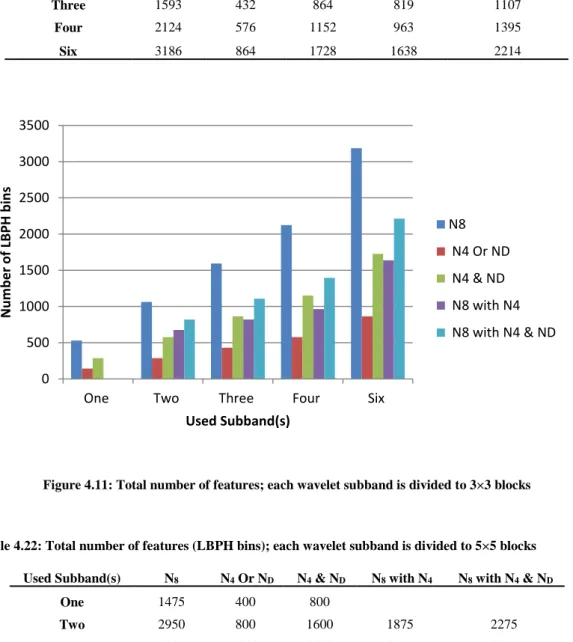
Figure 4.11: Total number of features; each wavelet subband is divided to 3×3 blocks ... 94
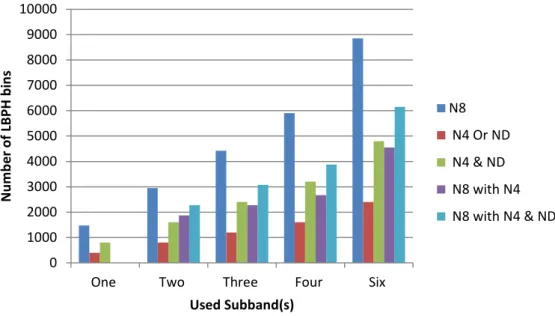
Figure 4.12: Total number of features; each wavelet subband is divided to 5×5 blocks ... 95
Figure 4.13: PSNR between cover and stego-image (3×3 blocking) ... 96
Figure 4.14: PSNR between cover and stego-image ( 5×5 blocking) ... 97
Figure 5.1: 4-bits pattern matching ... 103
Figure 5.2: Embedding process Pseudo code ... 105
Figure 5.3: Embedding Process flow chart ... 106
Figure 5.4: Extraction Process Pseudo code ... 107
Figure 5.5: Extraction Process Flow chart ... 108
Figure 5.6: Block Selection Process (n<m) ... 109
Figure 5.7: Samples of Cover Images Used from BOSSbase Database ... 110
Figure 5.8: M1_8-bits, Number of matched and unmatched patterns... 112
Figure 5.9: M1_4-bits, Number of matched and unmatched patterns... 113
xiii
Figure 5.11: M2_4-bits, Number of matched and unmatched patterns... 115
Figure 5.12: Mapping best blocks pseudocode ... 117
Figure 5.13: M3_8-bits, Number of matched and unmatched patterns... 117
Figure 5.14: M3_4-bits, Number of matched and unmatched patterns... 118
Figure 5.15: Change rate with different payloads ... 120
Figure 6.1: Estimation of embedding ratio using DIH ... 127
Figure 6.2: Estimation of change rate using RWS steganalysis... 129
Figure 6.3: Probability of detection using steganalysis proposed in (Ker, 2005) ... 132
Figure 6.4: Detection error of Out-of-Bag (EOOB) using SRM steganalysis. ... 134
Figure 6.5: Relation between edge numbers and threshold value ... 136
Figure 6.6: Effect of the sigma value to detect edge positions ... 137
Figure 6.7: Edge numbers vs. ‘Sigma’ value ... 138
Figure 6.8: Detection error of Out-of-Bag (EOOB) using SRM steganalysis ... 139
xiv
LIST OF TABLES
Table 3.1: LSB-Witness embedding and extraction ... 51
Table 3.2: PSNR between cover and stego image in different payload size... 52
Table 3.3: Payload for each extracted feature ... 63
Table 3.4: PSNR between original and stego images ... 64
Table 3.5: Face biometric recognition accuracy ... 65
Table 4.1: N4 Recognition rate, Yale database used, each subband divided to 3x3 ... 75
Table 4.2: N4 Recognition rate, Yale database used, each sub-block divided to 5x5 . 75 Table 4.3: N4 Recognition rate, ORL database used, each sub-block divided to 3x3 76 Table 4.4: N4 Recognition rate, ORL database used, each sub-block divided to 5x5 77 Table 4.5: ND Recognition rate, Yale database used, each subband divided to 3x3 ... 78
Table 4.6: ND Recognition rate, Yale database used, each sub-block divided to 5x5 79 Table 4.7: ND Recognition rate, ORL database used, each sub-block divided to 3x3 79 Table 4.8: ND Recognition rate, ORL database used, each sub-block divided to 5x5 80 Table 4.9: N4&ND Recognition rates, Yale database used, each wavelet subband is divided to 3×3 blocks ... 83
Table 4.10: N4&ND Recognition rates, Yale database used, each wavelet subband is divided to 5×5 blocks ... 83
Table 4.11: N4&ND Recognition rates, ORL database used, each wavelet subband is divided to 3×3 blocks ... 84
Table 4.12: N4&ND Recognition rates, ORL database used, each wavelet subband is divided to 5×5 blocks ... 85
Table 4.13: N8&N4 Recognition rate, Yale database used, each wavelet subband divided to 3x3 ... 87
Table 4.14: N8&N4 Recognition rate, Yale database used, each wavelet subband divided to 5x5 ... 87
Table 4.15: N8&N4 Recognition rate, ORL database used, each wavelet subband divided to 3x3 ... 87
xv
Table 4.16: N8&N4 Recognition rate, ORL database used, each wavelet subband
divided to 5x5 ... 88
Table 4.17: N8,N4&ND Recognition rates, Yale database used, each wavelet subband is divided to 3×3 blocks ... 89
Table 4.18: N8,N4&ND Recognition rates, Yale database used, each wavelet subband is divided to 5×5 blocks ... 89
Table 4.19: N8,N4&ND Recognition rates, ORL database used, each wavelet subband is divided to 3×3 blocks ... 90
Table 4.20: N8,N4&ND Recognition rates, ORL database used, each wavelet subband is divided to 5×5 blocks ... 90
Table 4.21: Total number of features (LBPH bins); each wavelet subband is divided to 3×3 blocks ... 94
Table 4.22: Total number of features (LBPH bins); each wavelet subband is divided to 5×5 blocks ... 94
Table 4.23: PSNR between cover and stego-image (3×3 blocking) ... 96
Table 4.24: PSNR between cover and stego-image (5×5 blocking) ... 97
Table 5.1: Change Rate using LSB-Witness ... 101
Table 5.2: Pattern numbers for each payload ... 111
Table 5.3: M1_8-bits, Number of matched and unmatched patterns ... 112
Table 5.4: M1_4-bits, Number of matched and unmatched patterns ... 113
Table 5.5: M2_8-bits, Number of matched and unmatched patterns ... 114
Table 5.6: M2_4-bits, Number of matched and unmatched patterns ... 115
Table 5.7: M3_8-bits, Number of matched and unmatched patterns ... 117
Table 5.8: M3_4-bits, Number of matched and unmatched patterns ... 118
Table 5.9: Change rate with different payloads ... 120
Table 6.1: Mean and standard deviation of content-based with N8 ... 130
xvi
DECLARATION
I, hereby declare that presented work has not previously been submitted towards any qualification degree or diploma in the University of Buckingham or any other university.
I also declare that to the best of my knowledge and belief the thesis contains no material previously published or written by another person except where due reference is made in the thesis itself.
1
Chapter 1
Introduction
Ever since the emergence of global online transmission as a tool for commercial, banking, and crime-fighting activities that involve exchange of financial transactions or sensitive and private information the question of authentication of authorised users or authorised actions have become a major challenging problem. Various remote authentication solutions have been developed but due to frequent changes in the nature of threats to the exchanged data and to the vulnerability of the authentication process this problem remains an active research area. In this thesis we shall focus on securing the exchange of biometric data as a proof of identification for mobile remote authentication for commercial purposes or for use by law enforcing agencies in crime fighting and Forensics.
Two main data protection mechanisms have been developed over the years that are designed to prevent unauthorised access and misuse of sensitive data: Cryptography and Steganography. Each of these two mechanisms has its own requirements, challenges, strengths and weaknesses. In this thesis we will be investigating the use of Digital Steganography to deal with the biometric transmission problem. In section 1.1 we shall give an overview of the research problem.
1.1
Overview of the Research Problem
Biometric-based verification has long been used to secure physical access to sensitive sites and assets. Indeed biometrics has been used for decades to limit access to certain sensitive areas in nuclear power stations and safes. In these applications the list of authorised persons was relatively small and their biometric data were stored in physically secured databases. Whenever a person arrives at the entry point of the sensitive site a fresh biometric recording is made and extracted for matching with the stored biometric templates of the registered authorised persons. Biometrics-based techniques utilize certain physiological or behavioural characteristics of persons such as fingerprints, facial features, iris, hand geometry, voice, signature, etc (Jain, et al., 2005). The popularity gained by this biometrics technology is mainly attributed to its
2
ability to distinguish between an authorized person and a pretender who deceptively acquires the access privilege of an authorized person (Agrawal & Savvides, 2009; Jain & Uludag, 2003).
In recent years, advances in communication technology and the emergence of the Internet as the most popular mean of communication anytime and anywhere together with the availability of inexpensive biometric recording devices have led to the emergence of increasing interest in biometrics-based personal identification or authentication techniques due to their proven substantial superiority over token-based or knowledge based techniques such as identification cards (ID), passwords, etc.
While biometric authentications have inherent advantages over traditional personal identification techniques the problem of ensuring the security and integrity of the biometric data or templates is critical because once the biometric data are compromised, the whole authentication system is compromised. Given the uniqueness of a person’s biometric data it is vital to ensure the security and integrity of these data against a variety of attacks or misuses. For example if a person’s biometric data (e.g. a fingerprint image) is stolen and then attackers may be able to impersonate him or her and gain access to his financial as well as other personal information assets. Moreover, in this case it is not possible to replace the person’s biometric data, while replacing a stolen credit card, ID, or password is an easy though inconvenient task. Moreover, the security of biometric data transmitted on open network communication channels is a major obstacle for remote biometric-based authentication needed for m-commerce and m-banking.
Protecting biometric data stored in databases and secure biometric transmission over open network channels have attracted huge interest from the biometric research community especially in relation to facilitating remote biometric-based authentication to enable secure e-commerce, m-banking and cloud transactions. Possible biometric protection mechanisms include encryption, watermarking, and steganography (Agrawal & Savvides, 2009). The emergence of cancellable or revocable biometrics over the last decade provides another alternative protection mechanism (Al-Assam, 2013).
Encryption works by converting the biometric information into data that are meaningless to attackers. The security effect of encryption fades away once the data are decrypted. Both Steganography and watermarking are related to data hiding, i.e.
3
protecting private information through hiding vital information in seemingly ordinary carrier signal. Steganography involves embedding secret biometric data into host signal in a way that does not raise any suspicion while transmitting the information. This way, the biometric data are being protected. Watermarking helps to identify biometric data that have been tampered with for integrity verification (Na, et al., 2010).
Steganographic techniques, on the other hand, diminish the likelihood of biometric data being intercepted by intruders and thus the chances of unauthorized alteration of the biometric data are reduced (Jain & Uludag, 2003). To increase the security profile when transferring biometric data in unsecure media, the biometric data can be encrypted first then embedded inside a cover, it means combining the principles of cryptography with steganography (Sonsare & Sapkal, 2011; Umamaheswari, et al., 2010).
Cancelable biometrics is the mechanism used for biometric template protection purpose. The concept of cancellable biometrics was introduced to denote biometric templates that can be cancelled and replaced as well as being unique for every application. Cancellable biometrics requires storage of the transformed (not actual) version of the biometric template and hence provides higher privacy levels by allowing multiple templates to be associated with the same biometric data. (Ratha, et al., 2001)
The use of homomorphic ciphers (Gentry, 2009) have been promoted for privacy preserving solution in case that users encrypt the data and then send it to the cloud, the cloud can still perform computations on the data even though it is encrypted. In recent years number of such scheme (Stehlé & Steinfeld, 2010; Gentry & Halevi, 2011; Gentry & Halevi, 2011; Smart & Vercauteren, 2014) are proposed, but efficiency to be practical seem that require more research.
The main premise of this thesis is that Digital Steganography is a security mechanism solution that has been used as an alternative or complementary to encryption can be exploited to deal with the biometric transmission problem. Steganography is derived from the Greek language and meaning secret communication involves hiding critical information in unsuspected carrier data in such a way that is imperceptible to attackers. A common application scenario that highlights the importance of steganography in sensitive governmental communication setting and law enforcing agencies in particular is at border control points. For example if the identity of a person who may be a suspect is to be checked against a law enforcing agency or immigration agency
4
database that is located on a remote server, then face or fingerprint biometric information can be embedded within another medium (cover) to ensure secure and un-tampered arrival at the final destination. This way, the transmission of the biometric information is protected from being attacked or tampered with if the appropriate steganography procedure is implemented.
The aim of this introductory chapter is to explain the challenges in biometric systems and steganography in general. Regarding biometric systems we focus more especially on those biometric systems challenges that related to remote authentication and on biometric protection solutions via steganography while for steganography challenges we focus on the main requirements that need satisfied in any embedding system. Explaining these challenges is the key to understanding the motivation of the thesis. This chapter is ended with given the outline overall structure of the thesis.
1.2
Challenges in Biometrics based Remote authentication
Biometrics are digital representations of physiological or behavioral characteristics of human used for automatic proof of identity in a growing list of applications including crime fighting, forensics, border control, for securing electronic transactions, and checking service entitlements. Biometrics have emerged initially as a results of the need for identification or authentication of employee and vetted person who are granted access to restricted areas of sensitive sites such as military sites, nuclear power plants or Banks safes. At that stage, the main challenge is the accuracy of matching a fresh biometric data to one of the locally stored biometric templates of the approved set of persons. However, the emergence of the Internet has provided new opportunities for deployments of biometric-based authentications and changed or widened the goal post to include other than accuracy of matching.
Recently, biometrics-based person identification systems are increasingly used for access to applications or devices over non-secure channels of the Internet. These changes in use of biometrics together with mobility of users as well as the globalised commerce have led to the need for developing secure remote authentication protocols. The privacy and security issues during the collection, processing, storage and transmission of biometric data are of great concern for most biometric systems. Ratha et al. (Ratha, et al., 2001), categorise attacks on any biometric system to eight basic categories, listed below. Figure 1.1 illustrates the typical block diagram of an
5
authentication system together with indicators of the weak points that could be exploited by each of the eight types of attacks:
- First attack, a fake biometric is presented to the sensor.
- Second attack, by passing sensors and resubmit digitally stored biometric data. - Third attack, the feature detector is fed attacker prepared features instead of the
actual features which are extracted from the original data obtained from the sensor. - Fourth attack, features extracted from the data obtained in the sensor is replaced
with a fake feature set during transmission.
- Fifth attack, matcher component could be attacked to produce attacker’s preferred matching score.
- Sixth attack, templates stored in databases could be attacked by replacing with attackers template.
- Seventh attack, the channel between the database and matcher could be attacked to alter transferred template information.
- Eighth attack, altering the matching result itself by overriding the final decision by attacker.
6
Some attacks occur during transmission from one step to another such as attacks number 2, 4, 7, and 8. These four attacks type in biometric system can be named as replay or man-in-the-middle attacks. Solutions such as encryption are not preventing this kind of attacks. All of these attacks lead to reduced credibility of a biometric system. Therefore, there is a need for other kind of solutions to prevent the above attacks. Watermarking and steganography are possible techniques to achieve this. Here in this thesis we focused on steganography techniques and more especially we focus on preventing or reducing chance of attacks that happen between feature extractor and matcher (i.e. attack number four). This kind of attacks mostly happen in remote authentication biometric systems, in another word this kind of attacks happen when the feature extractor is located in the location while the matcher is located in another location (remote matcher) and the result of matcher used to access the application or devices remotely.
The use of steganography to protect biometric data in storage or in transit poses a number of challenges due to the fact that there are two implicit requirements that both to need to be met. To start with the security of the biometric data needs to be maintained to the highest standard while accuracy level should not be impaired by the embedding or extraction of the biometric data in the carrier. Moreover, it is very important to realise that it is not enough to guarantee that the biometric data could not recovered by attackers, but it is more important that any third party cannot even guess the presence of a secret in the communication. Otherwise a denial of service undermines the overall authentication process.
In general, embedding a secret message in a cover image creates what is called a stego-cover which is expected to be free from any detectable artefacts that resulted from message embedding. Otherwise, the presence of artefacts may become a hint to a third party (Attacker) that a secret message is present; an event that would bring the whole steganographic tool into failure (Shaozhang, et al., 2009; Fridrich, et al., 2000; Fridrich, et al., 2001). Hence the choice of biometric traits or features becomes a challenging task. Note that for some biometric traits there are many different choices for biometric features as well as classifier used for matching. In this thesis we shall be mainly investigating the secure transmission of face biometrics as the mean of remote authentication. This choice is influenced by the nature of our intended use of remote exchanges of biometrics by law enforcing forces in fighting crimes and forensics.
7
However, the same issues and approaches need to be investigated for remote authentication by any other biometric trait.
1.3
Challenges in Steganography
Modern steganography and steganalysis can be defined as a communication strategy between two steganographers, Alice and Bob to exchange secret information without being raising suspicion of a warden, Wendy, who observes all communication between the two and would put them to solitary confinement if she finds or suspects them communicating secrets. Thus, Alice and Bob must communicate in such a manner that Wendy does not get to perceive their secret communication. So they need to hide secret messages inside innocuous objects so that Wendy cannot perceive its very existence. In this context, steganalysis is a set of techniques, visual or statistical, by which it is possible to detect the existence of steganographic content in a cover object. In this scenario the steganographic system is broken when Wendy finds out that Alice and Bob are communicating a secret message. In particular, the warden does not have to decode the message which makes steganalysis fundamentally different from cryptanalysis.
Recently, digital images have become a very popular choice to be used as a cover medium primarily because of its capacity as well as redundancy in representation and pervasiveness in applications in daily life. Known challenges in image steganography techniques relate to dealing with a variety of competing requirements. The following is the most commonly relevant researched steganography techniques to deal with the overall challenge of protecting the secrecy of the transactions:
1-Security vs. Capacity: trade-off between Security and Capacity is an important issue in steganography. It has been observed that increase in the payload capacity leads to sacrificing the security to some extent. Developing algorithms which provide both high security and capacity is one of the main important remaining challenges in image steganography.
2- Secret message & Cover content: looking for relation between secret message and cover content is an issue in steganography. The security of embedding techniques can be improved by finding similarity between secret message and cover contents in order to cause less change to cover pixel values in order to cause least alteration to the statistical properties of the cover images.
8
3-Best positions for embedding: developing adaptive embedding algorithm is another open problem area. The main concept of this kind of embedding is to select areas in the cover image where the embedding will cause minimum distortion of the cover such as embedding in noisy and high frequency areas.
4-Cover structure: the texture and statistical structure of the cover images highly affect the security of embedding techniques. Therefore selecting suitable images for specific embedding techniques and specific secret messages is an open challenge in image steganography field.
Over the years many approaches have been developed to deal with one or more of these challenging issues. For example, embedding in more than the first Least Significant Bit (LSB) or even using extended binary representation of greyscale pixel values by Fibonacci and similar sequences may have been used to increase embedding capacity. However, these approaches are of limited effect and may result in reduced cover image quality in terms of visibility of artefacts as well as increased chance of detectability. On the other hand, attempts to reduce artefact visibility have focused on selecting edge-related pixel areas for hiding secrets. However this results in reduced embedding capacity. Selecting images that include richer texture may help in this case but in a rather marginal way and may raise undesired suspicions. These approaches will be reviewed in the next chapter which highlights benefits and shortcomings. One clear observation is that most existing steganography solutions deal with a general purpose information hiding problem with little or no consideration for the specific characteristics of the secret message. In this thesis, we shall develop a holistic approach to deal with the above problems. Moreover, we shall always keep in mind that we are her interested in hiding biometric data that usually have specific structure and format that could influence the various parameters of concern raised above. In other words, we are investigating a context-aware secret hiding system where knowledge of the secret content may require an optimal special representation of the secret and developing appropriate embedding schemes that meet the main purpose of communicating it. In our case where the secret is a biometric representation of a person, there are often many different feature vector representations of the same biometric trait and the fact that matching is meant to tolerate an acceptable level of variation from stored template reduces the stringent requirement of exact recovery of the secret by the legitimate recipient that could help improved chances for meeting the other
9
requirements. In general, context-aware steganography need to process and analyse the secret representation as well as the cover image characteristics and representation.
The success of any information hiding techniques have been evaluated against a number of steganalysis tools that have been developed over the years for these purposes. Unlike crypto-analysis tools these tools do not reveal the embedded secrets but rather report an estimate of the probability of the cover image being embedded with a secret and often these values are dependent on the percentage of the size of the secret to that of the cover. In chapter 2, we should also review these tools and in subsequent chapters we shall discuss the strength of robustness of our proposed context-aware schemes against these tools.
1.4
Motivations and Objectives
The main focus of this thesis is to develop secure and reliable steganographic tools suitable for biometric feature exchange system between two nodes using steganography. The developed context-aware system should withstand some of the biometric transmission attacks as well as meet some or all challenges in steganography field; mentioned attacks and challenges regarding biometric system and steganography as explained in previous sections. Objectives of this thesis can be summarised as follows:
Investigate biometric-based systems to determine challenges and limitation of such systems and looking for possible and efficient steganography solutions for exchanging sensitive biometric data used for remote authentication.
Develop a biometric recognition system that involves the smallest number of features that achieves recognition accuracy at the same level compared with original features or even higher.
Showing and discussing how reducing the number of biometric features affects the security of steganography embedding systems.
Based on the work of existing steganalysis tools the aim is to developing steganography that are robust and avoid detection while providing practical and secure solutions for the remote biometric authentication problem.
Develop an optimal embedding system that guarantee less change rates of image pixel values during embedding process which make the embedding system more invisible and robust against steganalysis techniques.
10
Prove and analysis how structure of the cover images affect security of embedding system and develop embedding techniques that exploit similarity between secret message (biometric feature) and cover object (image).
1.5
Main Contributions
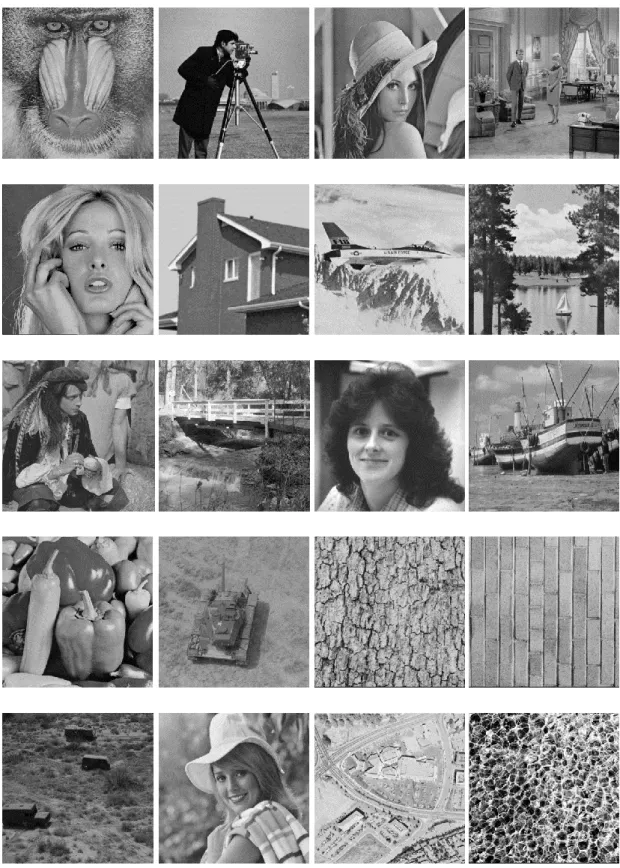
This study investigates the possibility of the above objectives by conducting many experiments on two different publicly available face databases (Yale and ORL) used as a secret message and images from BOSSbase database used as a cover images. Moreover, experiments are testes against different statistical targeted and universal steganalysis tools. These investigations have revealed promising results in terms of steganography requirements as well as face biometric recognition requirements when compared with the well-known schemes in the corresponding fields.
The main contributions of this thesis can be stated as follows:
Instead of traditional methods using cryptography concept, steganography concepts based schemes need to develop for transferring biometric features securely for the purpose of remote authentication.
Develop higher invisible embedding schemes based on developing different face feature extraction schemes that aims to reduce number of features represent a secret face image without affecting the recognition accuracy.
Analyse the work of target steganalysis tools to develop new embedding schemes that more robust against such kind of steganalysis tools.
Develop novel embedding schemes that differentiate between embedding face biometric data and any other secret messages (text, image… etc.) based on finding similar patterns between face secret message patterns and cover cover image patterns.
Develop robust embedding scheme based on fusing the idea of matching patterns and selection the best locations for embedding.
Move the steganography aspect from being used in laboratories to the real world applications such as using as secure solutions for the remote biometric authentication problems in real applications such as law enforcement, forensics, and counter terrorism.
11
1.6
Thesis Outline
The rest of the thesis is organised as follows;
Chapter Two: this chapter provides theoretical background about the main focused two branches (biometric recognition system and steganography); given in detail the requirements and components to design secure biometric embedding system. Also in this chapter literature survey about the biometric feature extraction, biometric embedding techniques, embedding based on positions selection as well as different types of steganalysis tools are given.
Chapter Three: in this chapter used feature extraction methods are described in details, the structure of the statistical steganalysis tools are analyzed to propose new robust face biometric data embedding scheme. The proposed embedding scheme tested and evaluated based on the requirements of the steganography and the recognition system.
Chapter Four is aimed to discuss biometric feature extraction methods; different schemes to reduce number of features that represent any face images are proposed. Moreover this chapter aimed to discuss the relation between number of face feature and the invisibility of the steganography system as well as the relation between number of face feature and the face recognition accuracy.
Chapter Five is aimed at studying the optimality concept of steganographic schemes which is linked to minimizing distortion of the cover image. This chapter also aimed to differentiate between embedding biometric features and embedding any other data, explore the concept of content-based steganographic scheme. A very powerful and novel face biometric embedding technique proposed based on reducing the change rate while maintain the required payload.
Chapter Six: the performance of the proposed schemes in previous chapter is tested. The test is primarily concerned with robustness against steganalysis tools by targeted as well as universal tools. Moreover modified version of the content-based scheme is proposed.
Chapter Seven: include the general conclusions and potential directions for future research work.
12
Chapter 2
Background and Literature Survey
This chapter is primarily designed to explain and discuss the problem of biometric data hiding and highlight the state of the art works in the field. Since our aim is to embed biometric data in a cover object, then this problem differs from general steganography tasks in that it is concerned with embedding domain-dependent secret messages and requires context-aware steganography solutions. Consequently, the sought after solutions depend on the structure of the chosen biometric feature extraction scheme. Section 2.1 includes brief background description of biometric systems to include a review of the literature on biometric feature extraction methods and more specifically on face feature vectors. In section 2.2, we discuss background materials of Steganography and Steganalysis and we review the literature on most commonly used image steganography as well as steganalysis techniques based on Least Significant Bit (LSB). In section 2.3, we review the literature on recent works on hiding biometric data inside cover objects highlighting related applications.
2.1
Biometric Recognition Systems
Biometric recognition is the science of identification of individuals based on their biological or behavioural traits, such kinds of biometrics shown in figure 2.1 (Chan, 2008). It involves verification of certain body characteristics of an individual and thus is inherently more reliable secure authentication technology than existing traditional authentications that are either knowledge based (e.g. remembering password or Personal Identification Number (PIN)) or token based such as Identification Cards (ID card). Unlike the input to traditional authentication schemes, Biometrics cannot be stolen, lost or forgotten (Jain, et al., 2008). At the same time biometric systems free the user from the inconvenience of carrying sensitive tokens or remembering complex and multiple passwords.
Generally there are two main stages in any biometric recognition system: (i) Enrolment and (ii) Recognition. In the enrolment stage sample(s) of the specific biometric trait data are captured from a user and a set of discriminating digital values are extracted
13
from the captured samples to be used as attributes of feature vector representation of the person. These feature vectors are then stored in a database to be used later as labelled templates for comparison at the recognition stage. In the recognition stage, a fresh biometric sample is presented to the system and feature vector extracted using the same scheme used at the enrolment stage. The new feature vector is then compared with those templates in the database that was constructed during the enrolment stage using a specified similarity or distance function to identify or verify the identity of a person.
In the next sub-section details of the physiological face biometric trait is discussed to cover the various steps of the process of face recognition system.
Figure 2.1: Biometric Types
2.1.1 Face Recognition System
The human face is one of the most common examples of biometric traits which represent the public identity of the person. Automatic face image analysis has received much attention by the research community for years and has wide-ranging applications in information security, law enforcement, surveillance, and access control systems. Several face biometric recognition systems together with a variety of feature extraction and matching schemes have been investigated over the past decades. Face recognition has the advantage of ubiquity and of being universal in comparison to other major biometrics, in that everyone has a face, everyone readily displays the face, and humans use it to recognize each other. Face recognition usually involves multi-step processes that include face detection, face normalization, face feature extraction, and finally
14
classification, which could be a one-to-one matching or a one-to-many matching scenario.
In the first step, a face is automatically located and segmented from a freshly captured image. In the second stage, a normalization procedure is applied to the captured image which includes normalising face size, face pose, and illumination. Third stage is extracting features from normalized images to represent the final face image in digital form. Finally the classification process is done to determine the final outcome of a tested face image. In the literature number of different techniques are available that cover each one of the above stages and the accuracy of the final outcome (classification accuracy) depends on the robustness of each individual different stages.
The main focus of this thesis regarding face recognition system is on the feature extraction process due to the fact that this process has an impact of the structure of the output feature vector representation which in turn influences the structure and format of the secret message that we are interested in hiding it in the cover object. Here, we assume that the images presented to our proposed feature extraction processes contain only a segmented face image, but the faces are not necessarily normalized (in terms of illumination or pose). More about feature extraction process can be found in the next sub-section and briefly describe state of the art on the most commonly used face recognition schemes with focus on the schemes that are used throughout this thesis such as wavelet-based schemes and the Local Binary Patterns (LBP) based schemes in the spatial and wavelet domains.
2.1.2 Face Feature Extraction
The strategy of extracting discriminating features of a face image that are robust to varying conditions is crucial to the reliability of face recognition technologies. Feature extraction may include the acquirement of a variety of feature attributes from the image such as visual features, statistical pixel features; transform coefficient features, and algebraic features. In the remaining part of this sub-section we briefly describe the most commonly used face feature extraction methods with focus on the methods suitable for use in this thesis such as the spatial domain LBP and the wavelet-based multi-scale LBP methods.
The most common approaches to extract features from face images consider the whole face image are Principal Components Analysis (PCA) proposed by Turk and Pentland
15
(Turk & Pentland, 1991) and the Linear Discriminate Analysis (LDA) proposed by Belhumeur et al (Belhumeur, et al., 1997). These are based on dimension reduction projections which are obtained from a sufficiently large representative training set of face images using a sufficiently small set of the eigenvectors of the covariance matrix of the training images after subtracting their average image that correspond to the most significant eigenvalues. Although these representations of face images are very compact, they are not suitable for our application because the eigenvectors need to be available on every device used which is not practical. Moreover, the recognition accuracy of these approaches is affected in uncontrolled conditions such as variable lighting conditions (Abboud, 2011; Al-Assam, 2013).
While the above approaches are based on spatial domain, there are a number of direct feature extraction schemes proposed and developed in frequency domain such as using Discrete Wavelet Transform (DWT) (Mallat, 1989; Chien & Wu, 2002; Sellahewa, 2006). Wavelet transforms is one of the example of frequency domain that have been used successfully in image processing and image analysis tasks including face recognition. These kinds of transforms have ability to reduce the original feature dimension size with small or no loss of information. Further feature size reductions can be achieved by applying the principles of PCA over Wavelet subbands such as in (Sellahewa, 2006), in the proposed not only feature vector size are reduced but also in some cases proposed significantly outperformed the traditional approach (without applying PCA) in terms of both verification accuracy and efficiency. In this thesis, discrete wavelet transform (DWT) is our chosen domain for feature extraction from the face images after the coefficient values are binaries. In the next chapter we shall give a brief description of DWTs as a multi resolution feature extractor. But at this stage we only point out that DWTs decomposes any image into a multiple of frequency subbands each representing the image at different scales and frequency ranges, and unlike Fourier transforms it also provide spatial information on the location of these frequencies. This means that we can consider each subbands as an image like data.
Local feature based approaches (Penev & Atick, 1996) aim to extract discriminative features from regions or patches surrounding facial features such as eyes, nose and mouth. These approaches are known to be robust to global changes and lead to better recognition accuracy under varying conditions compared to features extracted from entire face image approaches. These methods rely on the accurate localization of the
16
specified facial feature. Moreover, recently more attention has been given to local window based approaches to extract features (Abboud, 2011; Al-Assam, 2013). In such an approaches the face image is first partitioned into a set of overlapping or non-overlapping regions, second features are extracted from each local region, and finally features are combined into a single feature representation (Ahonen, et al., 2006). Regarding local feature detection, Scale Invariant Feature Transform (SIFT) is a general computer vision scheme to detect local features (Geng & Jiang, 2009). The detection process in this algorithm may affect by illumination conditions and may remove some important facial features (Križaj, et al., 2010). Again these are not suitable for our applications due to the need for storage of large sets of features as well as computational cost.
Interesting types of features in face recognition field are texture features that are usually specified by the statistical distribution of spatial dependencies of grey level information. A more suitable for our purpose and efficient texture feature was introduced by Ojala et al. (Ojala, et al., 1996) named Local binary pattern (LBP) operator that helps to extract texture pattern in an image. LBP operators replace each pixel value by a binary pattern that is dependent on the order relation between the pixel value and that of certain neighbouring pixels. As shown in figure 2.2, if the neighbour value is greater than or equal to the centre pixel value, value 1 assigned to the neighbour position, otherwise 0 assigned for that position.
Figure 2.2: LBP Operator Example
It has shown in the literature that LBP operator to be a powerful texture descriptor yielding excellent results in terms of accuracy in a number of applications such as texture analysis, motion detection, image retrieval, remote sensing, biomedical image analysis, and face recognition. Among these applications, LBP method has shown its potential in recognizing faces (Guo, et al., 2010) under different illumination conditions and it is one of the most popular local feature-based methods. The application of LBP in face recognition was proposed by Ahonen et al. (Ahonen, et al., 2004). For face recognition an equivalence relation is defined on these binary patterns and the
17
equivalence class histogram is used as a texture feature vector representation of the face image. These feature vectors are easy to compute, and are suitable for real time applications.
LBPs of different resolutions can be obtained through changing the sampling radius R (Ojala, et al., 2002) or by down-sampling the original image prior to adopting the LBP operator with a fixed radius (Wang, et al., 2011). Wang et al. (Wang, et al., 2011), proposed a pyramid-based multi-scale LBP approach. To begin with, multi-scale analysis is used to construct the face image pyramid using Gaussian filter into several levels then the LBP operator is applied to each level of the image pyramid to extract facial features under various scales. As a final step, all the extracted features are concatenated into an enhanced feature vector which is used as the face descriptor. A similar face feature extraction method was proposed by Liu et al. (Liu, et al., 2010) using a wavelet multi-resolution analysis. Here, low-frequency wavelet subbands (i.e. LL subbands) of several different scales are extracted as several sub-images of a subject. Then each sub-image is divided into nine non-overlapping blocks from which LBP operator extract the characteristic spectrum and statistic histogram. The methods proposed in (Wang, et al., 2011) and (Liu, et al., 2010) are both use multi-scale approach of only the approximations subband(s) coefficients of the face image and ignore high-frequency wavelet subband(s) coefficients that are known to encapsulate useful information that represent significant face features (e.g. edges and boundaries of mouth, eyes), see (Sellahewa & Jassim, 2010).
To include high frequency subbands to the process of feature extraction, face Recognition based on Haar LBP Histogram was proposed by Hengliang et al. (Tang, et al., 2010), the approach is based on decomposing the face image into four-channel subbands in frequency domain using Haar wavelet transform and applying the LBP operator on each subband to extract the face features. Related to the multi-scale LBP based, Wang et al. (Wang, et al., 2011) proposed a hand vein recognition scheme. First, a hand vein image decomposed into two levels to obtain 8 coefficient matrices: A1, H1,
V1, D1, A2, H2, V2 and D2. Proposed excluded the two diagonal high-frequency
components D1 and D2 from the feature extraction process. Meanwhile, A1, H1, V1, A2,
H2, V2 and the original image are chosen as multi-scale components from which LBP
features are extracted. Finally, LBPH features of all components are concatenated to obtain a final single feature vector representation.
18
In the two approaches proposed in (Wang, et al., 2011) and (Tang, et al., 2010), the LBP operator was applied on LL subbands and non LL subbands with no consideration for the differences in the frequency or feature ranges in these subbands for image features and texture. For example, applying a 2D wavelet transform (WT) on an image produces high-frequency subbands that include horizontal, vertical and diagonal features of the decomposed image respectively. Therefore, using the traditional LBP with radius 1 and 8 neighbours samples on non-LL subbands may capture useful as well as redundant information, while increasing the size of the overall face feature vector when compared to using LBP on the original image. This could be a problem for real-time identification and limit their usefulness for applications that require small feature representations. Our intended use of steganographic techniques by law enforcement agencies to communicate face biometric data hidden in innocuous cover images, is one such example. Note that increased size of secret feature vector has adverse impact on security and on the stego-image quality. However, based on the above mentioned discussions we shall investigate various versions of LBP features extracted in the wavelet domain for secure communication of face biometrics using steganography. In fact, our proposed scheme in (Rashid, et al., 2013) is a first version scheme to extract face features based on wavelets and local binary patterns (LBPs). The proposed method first decomposes a face image into multiple subbands of frequencies using Haar wavelet transform. Each subband in the wavelet domain is divided into non-overlapping sub-regions. LBP codes based on the 4-neighbour sampling points are extracted then LBPH features are extracted from each sub-blocks inside selected wavelet subband(s). Finally, all LBPHs are concatenated into a single face feature vector to effectively represent the face image. Using proposed we reduce number of features that represent face image with some degradation of the face recognition accuracy especially in cases of using wavelet LL subbands. The modified version of scheme proposed in (Rashid, et al., 2013) is shown in (Rashid, et al., 2013), in the proposed, in case of using multiple subbands to represent face image, instead of calculating LBP codes from all wavelet subbands using 4-neighbours, LBP codes based on the traditional 8-neighbour sampling points are calculated from the approximation (LL) subband(s) then uniform LBPH features are extracted, whilst 4-neighbour sampling points are used to find LBP codes from other wavelet subband(s) then LBPH features are extracted. By doing so we not just reduce number of features that represent
19
face images compared with using original 8 neighbour methods, but also we guarantee higher recognition accuracy in most cases. More details will give in chapter 4.
2.1.3 Classification
As a final step of any face recognition systems or any biometric recognition systems in general is classification which is the process of differentiating two or more classes by labelling each similar set of data with one class. The level of randomness of biometric features is an important factor in determining the uniqueness of sample’s biometric identity. In general, biometric systems deal with two types of randomness: random variations among individuals’ (inter-class) and random variations within biometric samples of an individual (intra-class). Typical biometric systems obtain a set of biometric features from biometric data through features extraction techniques. A good features extraction techniques seeks to capture a maximum random variation of the first type and a minimum of the other. For this step there are number of classifiers such as nearest neighbour (NN), Support Vector Machines (SVM), and Artificial Neural Networks (ANN) classifiers. There are two phases in the construction of the classifier. The training phase, where the training set is used to decide how the features should be weighted and combined, in order to separate the different classes, and the testing phase, where the weights determined in the training stage are applied to a set of data that does not have known classes, in order to determine the class. In this thesis we shall use the simplest method to classify images which is the nearest-neighbour approach (Gonzales & Woods, 2002; Guo, et al., 2003). The NN classification measures are normally based on a similarity or distance function defined on pairs (u,v) of feature vectors. Below we present a number of measures that are commonly used for NN classifier.
- CityBlock : 𝐷𝐶𝑖𝑡𝑦𝐵𝑙𝑜𝑐𝑘(𝑢, 𝑣) = ∑|𝑢𝑖− 𝑣𝑖| 𝑖 (2.1) - Euclidean : 𝐷𝐸𝑢𝑐𝑙𝑖𝑑𝑒𝑎𝑛(𝑢, 𝑣) = √∑(𝑢𝑖− 𝑣𝑖)2 𝑖 (2.2)
20 - Correlation: 𝑆𝐶𝑜𝑟𝑟𝑒𝑙𝑎𝑡𝑖𝑜𝑛(𝑢, 𝑣) = ∑ (𝑢𝑖 𝑖 − 𝑢̅)(𝑣𝑖− 𝑣̅) (𝑁 − 1)√∑ (𝑢 − 𝑢̅)𝑖 2 𝑁 − 1 √∑ (𝑣 − 𝑣̅) 2 𝑖 𝑁 − 1 (2.3) 𝐷𝐶𝑜𝑟𝑟𝑒𝑙𝑎𝑡𝑖𝑜𝑛(𝑢, 𝑣) = 1 − 𝑆𝐶𝑜𝑟𝑟𝑒𝑙𝑎𝑡𝑖𝑜𝑛(𝑢, 𝑣) (2.4) - Normalized Correlation (NC): 𝑆𝑁𝑜𝑟𝑚𝑎𝑙𝑖𝑧𝑒𝑑𝐶𝑜𝑟𝑟𝑒𝑙𝑎𝑡𝑖𝑜𝑛(u, v) = ∑ 𝑢𝑖 𝑖𝑣𝑖 √𝑢𝑖2√𝑣𝑖2 (2.5) DNormalizedCorrelation(𝑢, 𝑣) = 1 − SNormalizedCorrelation(𝑢, 𝑣) (2.6) In this thesis we will only use the Euclidean distance with the NN classifier.
2.1.4 Face Biometric databases
To test the performance of any face recognition scheme we need to use a database of multiple face images for a reasonable size population. These tests are conducted according to certain protocols for which a gallery of identity-labelled feature vectors representing all members are used as templates against which the rest of the feature vectors are matched and identification is decided according to the one of the mentioned classifiers in previous sub-section. There are number of benchmark face databases that have been recorded for the purpose of experiments, each meet certain criteria reflecting the application objectives that the database is recorded for. In this thesis we use the two most commonly used face databases that are publicly available for research purposes. The choice of these databases is based on the fact that in our application face images may not be captured under controlled conditions and these databases include sufficient variation in terms of expression, pose and lighting condition.
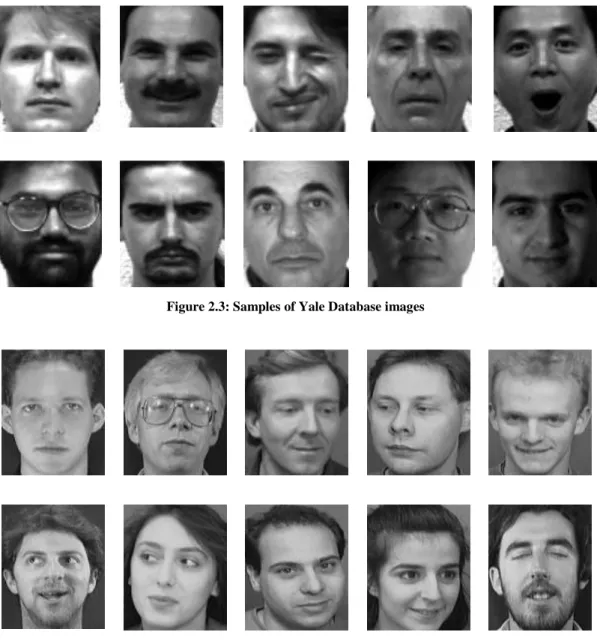
The Yale Database, (Georghiades, et al., 2001), consists of 15 individuals, and for each individual there are 11 face images that originally with size of 320x240 pixels of greyscale images, incorporating variations in illumination (centre-light, left-light and right-light), facial expression (normal, happy, sad, sleepy, surprised and wink), and face details (with glasses and without glasses) all images cropped to 96×80 pixel
21
resolution and then used in the next chapters. Figure 2.3 shows some random selected samples from Yale face database.
The ORL Database, (Samaria & Harter, 1994), contains 40 distinct subjects, each with 10 different images captured in up-right frontal position with tolerance for some tilting and rotation of up to 20 degrees with 112×92 pixel resolution. Figure 2.4 shows different samples from ORL face database.
Figure 2.3: Samples of Yale Database images
Figure 2.4: Samples of ORL Database images
2.2
Steganography and Steganalysis
The term steganography comes from Greek words Steganos meaning roof or covered and graphia which means writing (Shiva Kumar, et al., 2011). It is the art and science of hiding the fact that communication is taking place. Using steganography, you can
22
hide a secret message inside a piece of unsuspicious information and send it without anyone knowing of the existence of the secret message. On the other hand, Steganalysis is the art of identifying stegogrammes that contain a secret message. Steganalysis does not however consider the successful extraction of the message but rather report an estimate of the probability of the cover object being embedded. In this section we shall discuss and review the Steganography and steganalysis concept in details with giving a review of the state of the art techniques in the related fields.
2.2.1 Steganography Terminology
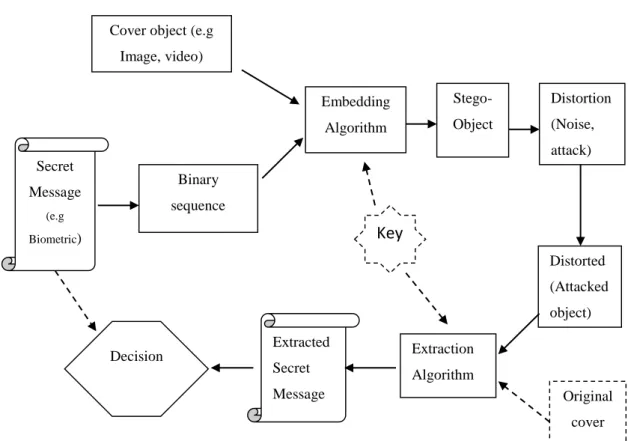
Secret communication between two entities can be achieved through steganography. In general, in the steganography world including our works in this thesis some terminologies are required to be introduced:
Cover-object or cover-medium: Is the carrier of the message. This could be an image, video, audio, text, or some other digital media. In this thesis, images are used as a cover-object. Therefore steganography techniques when images used as cove can be named as ‘Image steganography’.
Secret message or embedded message: This is the message need to be hidden in the cover-medium. The message could be text, image, or biometric data. In this thesis, the focus is placed on hiding the face biometric data.
Stego-key: To make the hiding scheme more robust, a secret key can be used during embedding and extraction process. The key need to be share between sender and receiver before communication begin. Using this key is optional; therefore in some of our proposed hiding techniques we used the key while in some other keys not used.
Stego-object or stego-medium: The object which is obtained after the secret message is hidden in the cover-medium successfully (Lin & Delp, 2001) and it is ready to send named as stego-object.
Embedding process: Refers to the process (algorithm) of hiding secret messages in a cover object.
Extraction process: Refers to the process of retrieving a secret message from a stego-object by the recipient (authorized person).
23 2.2.2 Basic Steganography Schemes
In general, any secret communication system that uses steganography concept is consists of an embedding scheme, an extraction scheme, and decision criteria. Figure 2.5 shows the general scheme of any steganography system (Fridrich & Goljan, 2002).
Figure 2.5: General Steganography Scheme
2.2.2.1 Embedding Sche