Integrating scenario-based usability engineering and
agile software development
By Jason Chong Lee
Proposed research in partial fulfillment of the requirements for the degree of
Doctor of Philosophy in Computer Science and Applications at
Virginia Polytechnic Institute and State University
November 2007
D. Scott McCrickard, Chair James D. Arthur Robert L. Biddle Shawn A. Bohner Manuel A. Pérez-Quiñones
Abstract
In recent years, agile software development methodologies such as extreme programming and SCRUM have emerged as one way to mitigate major risks of software development such as changing requirements, communication breakdowns and cost and scheduling overruns. These methodologies have become increasingly popular within the software development community and have been used in a variety of projects because they have helped in delivering software on-time that meets customer requirements. However, agile development methodologies—which focus on the design, implementation and maintenance of software, have marginalized the role of usability—which focuses on optimizing the interaction and information design of a system. This often results in software systems that meets functional requirements, but are difficult or frustrating to use. There is a need to develop a way to integrate usability into agile development practices without compromising the benefits they bring to software engineering.
I have developed an approach to integrate extreme programming (XP)—a widely practiced agile design method with scenario-based design (SBD)—a well established usability engineering process. Key to this extreme scenario-based design (XSBD) approach is the central design record (CDR), a shared design representation I developed based on my work in rationale-based usability engineering. I hypothesize that this approach will enable the creation of agile development teams that include usability engineers who can work effectively with other stakeholders to develop usable software systems efficiently. This work will address three key issues:
(1) How to satisfy the requirements from different stakeholders (specifically usability and software engineers) when they have different motivations, needs and concerns
(2) How to maintain project velocity and a focus on the delivery of working software with the addition of usability practices and tools to the development process
(3) How to develop & maintain a coherent interface and interaction architecture design in an agile development environment
The successful integration of SBD and XP depends not only on shared design representations, but also on how they are used throughout the development cycle. Proposed efforts will focus on how the CDR can be used effectively in practice and will focus on how usability artifacts and results should be shared with agile developers and how project velocity can be maintained. This work will be validated with a comprehensive case study conducted at Meridium, Inc and results will be disseminated through journal and conference paper submissions and workshops at leading agile and usability venues. Design principles and practices that are developed will be broadly applicable to the agile community and will also contribute to and make connections with the HCI research community.
Contents
ABSTRACT ... I LIST OF FIGURES AND TABLES... V
1 INTRODUCTION...1 1.1 KEY RESEARCH ISSUES...2 1.2 APPROACH...3 1.3 ANTICIPATED IMPACT...4 1.4 PROPOSAL OVERVIEW...4 2 RELATED WORK ...6 2.1 USABILITY ENGINEERING...6
2.1.1 High-level design goals...7
2.1.2 Scenario-based design ...8
2.2 EMERGENCE OF AGILE METHODS...10
2.2.1 The Agile Manifesto ...10
2.2.2 Agile landscape...11
2.2.3 Extreme programming ...12
2.3 ENABLING AGILE USABILITY...14
2.4 CHAPTER SUMMARY...15
3 BACKGROUND WORK ...17
3.1 LEVERAGING A DESIGN REPRESENTATION IN LINK-UP ...17
3.1.1 Introduction ...17
3.1.2 Background...18
3.1.3 Analytic module development ...20
3.1.4 Pilot testing evaluation methods ...22
3.1.5 Summary of study findings ...23
3.2 BRINGING DESIGN REPRESENTATIONS TO THE FOREFRONT...24
3.2.1 Introduction ...24
3.2.2 Background...25
3.2.3 Enhancing LINK-UP...26
3.2.4 User study description ...26
3.2.5 Summary of study findings ...27
3.3 OTHER PRELIMINARY WORK...28
4.1 DEFINING THE CENTRAL DESIGN RECORD IN LINK-UP...30
4.1.1 Introduction ...30
4.1.2 Motivation and related work...31
4.1.3 LINK-UP...32
4.1.4 The claims library ...33
4.1.5 Requirements analysis module...34
4.1.6 Central design record module...35
4.1.7 Case study discussion ...36
4.1.8 Summary of study findings ...38
4.2 DEFINING THE XSBD PROCESS AROUND THE CDR...39
4.2.1 Interface architecture design ...40
4.2.2 Collaboration through the CDR ...41
4.2.3 Usability evaluations through the CDR ...41
4.2.4 Design case studies ...42
4.2.5 Discussion of results ...45
4.2.6 Summary of study findings ...47
4.3 CHAPTER SUMMARY...47
5 PROPOSED WORK: BRINGING XSBD TO THE REAL WORLD...49
5.1 IMPROVING COMMUNICATION AND COLLABORATION THROUGH THE CDR ...50
5.1.1 Defining and streamlining the CDR for better communication ...50
5.1.2 Success measures ...52
5.2 MAINTAINING PROJECT VELOCITY...52
5.2.1 Scheduling usability in an agile project...53
5.2.2 Deriving usability metrics to measure usability velocity ...54
5.2.3 Success measures ...55
5.3 DEVELOPING A COMPREHENSIVE SOLUTION TO AGILE USABILITY...55
6 PROPOSED RESEARCH CASE STUDY...57
6.1 MOTIVATION...57
6.2 METHOD...58
6.2.1 Case study approach...58
6.2.2 Project retrospectives ...60
6.3 EXPECTED RESULTS...60
7 SUMMARY OF PROPOSED WORK ...62
7.1 CONTRIBUTIONS AND IMPACT...62
List of figures and tables
Figure 1. Scenario and associated claim for the notification collage. The claim highlights the tradeoffs of the bulletin board metaphor used in the system. ... 9 Figure 2. Left: early storyboard of the analytic module; Right: Screen from the functional prototype
used in pilot testing... 20 Figure 3. Basic sequence of tasks of the analytic module of LINK-UP... 21 Figure 4. Norman’s conceptualization of the system image. The designer captures system intentions in a prototype, along with supporting documentation, enabling the study of user interaction with the system... 25 Figure 5. LINK-UP's iterative design process and CDR development. Designers start at the center
identifying requirements and a target IRC goal. Design iterations through the CDR include design claims which are tested through evaluations leading to convergence of the design and user models. ... 33 Figure 6. Part of the requirements analysis module. The progress/navigation bar is always visible on
the right side of the screen to show designers where they are in the process... 34 Figure 7. Part of the central design record module. Users create a set of scenarios and corresponding
claims for each supported activity. Areas of the CDR module can be accessed in any order... 35 Table 1. Summary of strengths and weaknesses of LINK-UP derived from three development case
studies... 37 Figure 8. Key steps in XSBD process. Design artifacts are shown in white... 40 Figure 9. Example claims map. The root concept claim (green) is linked to activity claims (blue)
which are linked to implementation claims (yellow). Note the progressive growth through the iterations. (Note that only claim features are included in the diagrams) ... 43 Table 2. Table shows how the XSBD approach addresses tensions between agile methods and
usability. ... 46 Figure 10. Usability engineers present to other stakeholders only the parts of the CDR that help them
to easily understand and reason about the design... 51 Figure 11. Cards can be used to present usability problems to other project stakeholders. They can
then be used to collaboratively work out what issues can and should be resolved. ... 53 Figure 12. Only relevant usability information is presented to different stakeholders to support project
management, development, and acceptance testing. ... 56 Figure 13. Timeline of milestones and proposed work. ... 64
1 Introduction
Software engineering is a relatively new area compared to other engineering disciplines. This fact, combined with the increasingly ubiquity and complexity of software-based systems and how they are integrated into modern society have greatly increased the difficulty of engineering and delivering software that is on-time, on-budget and satisfies the requirements of its users [4][11]. In addition to the technical and business challenges of developing software, the increasing complexity and importance of how users interact with these systems has necessitated the development of usability engineering—which focuses on the interaction design and interface between software systems and users [1][71][25][59][64] . In recent years, agile software development methodologies, such as extreme programming (XP) and SCRUM, have emerged as one way to mitigate some of the risks of software development such as changing requirements, communication breakdowns and scheduling overruns [44]. These methodologies value individuals and interactions over processes and tools, working software over comprehensive documentation, customer collaboration over contract negotiation and responding to change over following a plan [7]. These methodologies have become increasingly popular within the software development community and have been used in a variety of software projects because they have helped in delivering software on-time that meets customer requirements. However, agile development methodologies—which focus on the design, implementation and maintenance of the software, marginalized the role of usability—which focuses on optimizing the interaction design, information presentation and other user interface issues. This often results in software systems that meets functional requirements, but are difficult or frustrating to use [65]. Recently, agile software developers have realized the need to integrate usability into their design practices [20][24][52][65][74]. This work will focus on building on and complementing these efforts by exploring ways to integrate usability practices into the agile framework without compromising its benefits to software development.
This work will specifically explore ways to integrate extreme programming—one of the most widely accepted agile methodologies, with scenario-based design—an established usability engineering process. In some ways, these two methodologies share the same foundations in that they both focus on cyclic development processes with close collaborations between different stakeholders. However, the concerns of the agile software developers focus on meeting the needs of customers and are primarily development centric whereas the concerns of usability engineers are focused on meeting the needs of end-users and are primarily interaction-centric. The divergent needs and concerns of different stakeholder groups illustrate some of the inherent problems of multidisciplinary system
interface design. Extreme programming argues against extensive up front requirements analysis because user needs and requirements often change throughout the development process. Developing an understanding of the users and their tasks is seen as an emergent property of the extreme programming process. On the other hand, scenario-based design, and similar usability methodologies require a comprehensive requirements analysis process to gather information about users, the tasks that will be supported and the context in which the system will be used. Successfully integrating the two approaches requires that this problem be addressed.
The goal of this work is to combine extreme programming and scenario-based design into a single development framework that effectively provides the benefits of both approaches at minimal cost. This extreme scenario-based design (XSBD) approach, centers on a shared design representation known as the central design record (CDR). This design representation will allow agile developers and usability professionals to better communicate design intentions and make design tradeoffs when meeting with each other. Usability engineers will work to maintain the CDR and collaborate with software developers throughout the design process to maintain a consistent interaction architecture within the incremental agile framework. This work is summarized in the following thesis statement:
Integrating agile development processes and usability engineering processes through shared design representations, continuous interaction architecture improvement and targeted, light-weight usability evaluations will enable agile teams to leverage usability design practices without violating the core agile design principles.
1.1 Key research issues
The successful integration of extreme programming and scenario-based design depends on a number of different factors. The agile manifesto, the core principles of agility developed by a group of leading agile practitioners, stresses the importance of individuals and interactions and collaboration among project stakeholders [6]. This focus on communication is also a key part of developing usable software. One focus of this work will be to determine how to enable agile developers and usability engineers to communicate with each other better so they can make informed design tradeoffs that take into account their differing viewpoints, motivations and concerns. The agile manifesto also stresses the importance of continuously delivering working software. This work will also address the problem of how to continuously deliver working software with the addition of usability engineering practices and tools. Finally, this work will explore how to develop usable software while still meeting the functional and business needs of the customers. These three issues, that if addressed will validate the above thesis statement, are summarized below:
(1) How to satisfy the requirements from different stakeholders (specifically usability and software engineers) when they have different motivations, needs and concerns
(2) Howto maintain project velocity and a focus on the delivery of working software with the addition of usability practices and tools to the development process
(3) How to develop & maintain a coherent interface and interaction architecture design in an agile development environment
1.2 Approach
To address the questions above, my general approach will draw on the design artifacts and best practices of scenario-based design and extreme programming. This approach has been divided into two phases. The first phase was to identify key design artifacts of both SBD and XP, exploring how they can be interrelated through a shared design representation. It focused on how this representation could be used to support usability engineering in an incremental development cycle. This work has been completed and is discussed in Chapter 3 and 4. The second phase of this work, which describes the proposed work in this document, will be to determine how the shared design representation can best be integrated into a practical agile development environment to support communication between usability engineers and other stakeholders without affecting project velocity.
The approach depends on a shared design representation known as the Central Design Record (CDR)—originally developed as part of my work in rationale-based usability engineering [38][39][40][41][42]. This design representation draws on artifacts from both SBD and XP. It provides multiple perspectives on a design which are then used by stakeholder groups to communicate design intentions and make design tradeoffs. Design goals expressed in terms of critical parameters [58], and a root concept document provide the highest level view of the design. Scenarios provide the next level of detail by describing usage situations in narrative form [71]. These scenarios are further broken down into features which are prioritized and implemented within the incremental agile development cycle. Features can be expanded into claims, which describe specific design tradeoffs and can be used to analyze project risks. This design representation is described in Chapter 4.
The successful integration of SBD and XP depends not only on shared design representations, but also on how it is used throughout the development cycle. From an agile software development standpoint, this work will explore how SBD can fit within an agile framework with respect to development/planning meetings and through short, incremental development cycles. From a usability
maintained in an agile framework by developing a CDR that is validated through lightweight usability evaluations to form a feedback cycle that can continuously and consistently improve the interaction design.
1.3 Anticipated impact
The overall goal of this project is to provide a framework within which agile software developers and usability engineers can work together to efficiently create usable software systems through common practices and toolsets from both disciplines. This will be achieved through the use of well defined scenario-based usability design practices that are integrated within an agile framework derived from extreme programming and shared design representations among different stakeholder groups. Design principles and practices will be developed that can be applied to agile usability in general, and will build on and reinforce the growing body of work in this area [17][20][24][28][52]. Agile practitioners who use this approach can expect the following benefits:
1. Higher client/end user satisfaction because of a development process that focuses on continuous delivery of value-adding software, is flexible and responds to changing needs—resulting in products that meet users’ functional and usability needs.
2. Improved communication and collaboration between stakeholders
including software engineers, usability specialists, business analysts and customers through shared design representations and tools that prevent wasted development effort and leads to fewer customer problems with the end product.
3. Continuous, measurable improvement to product usability through
design targets and evaluations that is comparable to existing agile development metrics
4. A living record of rationale and design decisions made throughout the design process that can be shared and reused, thereby saving time and effort in later development projects.
1.4 Proposal overview
Chapter 2 – Related Work – This chapter summarizes previous work that provides the groundwork on which this work is based. It covers work related to usability engineering and agile methodologies and provides an overview of other research to integrate agile software development and usability.
Chapter 3 – Background Work – This chapter summarizes my initial work in scenario-based
scenario-based toolset that supports the SBD process. This work led to my initial work on design representations—based on Norman’s work on the system image [63] and Carroll and Rosson’s work in scenario-based usability engineering [12][71]. This work and associated research studies, involving students working on semester-long development projects, provided the foundation from which my current research on integrating usability and software development methodologies is grounded [39][40][49][56].
Chapter 4 – Completed Work: Agile Usability with the CDR – This chapter summarizes how the shared design representation known as the central design record was developed and how it was integrated into the XSBD process. The CDR was initially added to the LINK-UP system as the main design representation of the scenario-based development process [42]. It describes how the CDR was used by student developers in designing systems and the problems and issues that became apparent. It then highlights how the CDR was modified to act as a central design representation that would be shared by different stakeholders in an agile software development project—with a focus on usability engineers and software developers [38][41].
Chapter 5 – Proposed Work: Bringing the XSBD Process to the Real World – This chapter
describes proposed additions and improvements to the XSBD development process and how the CDR is used by the developers. This chapter has two key foci. First, it describes how the CDR will better act as a driver for maintaining common ground among different types of stakeholders and allows developers to analyze the system design from different perspectives. Second, it focuses on how agile teams can maintain project velocity while integrating usability practices in their development process.
Chapter 6 – Proposed Research Case Study – This chapter describes the research case study that will address the second phase of this work—how agile practitioners and usability specialists can work together within an agile framework to develop usable software systems using the CDR. This study, supported by an NSF Small Business Technology Transfer (STTR) Phase I grant, will involve a joint development effort with Meridium, Inc. [51][55].
Chapter 7 – Summary – This chapter summarizes key contributions and broader impacts of this work. This includes a timeline of the proposed work and a description of key deliverables.
2 Related
work
This chapter reviews literature relevant to this proposed work. It first introduces key concepts of usability engineering—detailing the scenario-based design approach and its core theoretical and practical concepts. It then gives an overview of agile methodologies, their guiding principles and describes key concepts from extreme programming. It highlights the need for developing ways to integrate usability into agile methodologies and gives an overview of ongoing work in this area within the agile community.
2.1 Usability engineering
Usability is closely related to Human-Computer Interaction (HCI)—the area of study that focuses on understanding how people use computer devices, and how such devices can be made useful and usable [12]. It bridges the social and behavioral sciences with the engineering of computer-based systems and is thus an inherently multidisciplinary endeavor. Usability engineering is specifically concerned with the practical application of knowledge about how people use systems to develop interfaces that can be used efficiently and effectively. It deals with issues such as system learnability, efficiency, memorability, errors and user satisfaction [26][33][60][71]. Usability engineering can give insights into user motivations, characteristics and work environments to further HCI research.
Broadly speaking, there is a mutually reinforcing relationship between tasks people need to perform and the artifacts that support them [14]. Peoples’ needs and activities drive the development of systems to support them which in turn lead to the discovery of new needs and possible activities. This task-artifact cycle drives the development of computer systems and technology in general. Usability engineering works within this framework and generally follows an iterative process that includes identifying high level design goals, developing an understanding of the users, designing the interface, and evaluating the usability of that interface. There are a number of different usability engineering methodologies and techniques that cover different aspects of the usability engineering lifecycle including requirements analysis, prototyping and empirical evaluation. For example, Constantine and Lockwood’s usage-centered design is a general approach to design that focuses on how users are trying to accomplish their tasks, rather than just understanding users themselves [24]. Cooper advocates the use of personas—a fictitious exemplar user developed from actual user data that describes a user’s background, needs, goals and tasks [26]. Personas can help guide and focus development—especially if designers do not have access to actual end users.
My work, though based mainly on scenario-based design principles, draws on a number of different methods and models. It is a demonstration of how usability methods and agile methods can
be used in concert to develop usable systems efficiently and effectively and could potentially be used with other usability practices such as those highlighted above.
2.1.1 High-level design goals
An important early part of usability engineering is setting appropriate high level design goals to guide subsequent development. These goals are important in that they can help designers prioritize design options and make informed decisions [60]. When combined with well-defined usability metrics that are tied to those goals and measured at regular intervals, developers can get a sense of how closely their design matches up with those high level design goals.
Several researches noted that most new systems do not draw on previous research and development efforts [58][81]. This results in a large body of unrelated HCI development and research efforts with no accumulation of proven knowledge or ability to judge whether one design is actually better than another. As a result, the field of HCI lacks well defined, accepted research foci or set of common problems that other areas such as information retrieval use to advance the state of the art. This also makes it difficult for practitioners to leverage design knowledge from past efforts in developing systems or to quantitatively determine whether their system is usable or not.
Newman introduced the concept of critical parameters to HCI as a way to address this problem. Critical parameters are figures of merit that transcend specific applications and focus on the broader purpose of a particular class of technologies [59]. They can function as benchmarks that provide a direct and manageable measure of how well a design meets its purpose. They apply not to a specific system, but to a particular design problem and allow for the comparison of different designs that attempt to address the same problem. In addition, they are assessed with empirically gathered data and so are easier to monitor and affect throughout the design process. For example, one critical parameter used for vehicle design could be the mileage of the car. Several different car designs could be developed by different teams but the resulting vehicles could both be rated against that same target mileage.
Within the field of HCI, McCrickard has developed critical parameters for notification systems—systems used in dual task situations to supply users with information while minimally interrupting them from some primary task [46][47]. Instant messengers and e-mail alerts are common examples of such systems. The domain can be organized by three critical parameters that define innate aspects of notification systems. Each critical parameter characterizes the prominence of a psychological effect caused by the design. Interruption (I) is the reallocation of attention from the primary task to the notification in the secondary task. A reaction (R) is a response to the stimuli to
the process of understanding the notification and storing the information in long-term memory. Interface developers can define design goals in terms of these critical parameters on a scale of 0 to 1and use them as usability and performance metrics for comparison during evaluations. For example, an alarm might have IRC ratings of I:1 R:1 C:0. This indicates that the alarm should be highly interruptive so it is more likely to attract the users’ attention, support high reaction so users can respond to the notification quickly and support low comprehension since alarms do not require users to understand and remember details about alarm events.
Much of my work in usability engineering leverages the concept of critical parameters— specifically McCrickard’s use of IRC critical parameters for notification system design.
2.1.2 Scenario-based design
One established usability engineering approach is scenario-based design, a design representation-based process that uses scenarios—narratives describing users engaging in some task, in conjunction with design knowledge components called claims, which encapsulate the positive and negative effects of specific design features as a basis for creating interactive systems [14][16][71]. Claims provide compact, designer-digestible packets of knowledge ideal for use in time-critical design activities [77]. Figure 1 shows an example scenario and claim for the notification collage, a virtual notice board to allow users to maintain awareness of people they work with [31].
Scenario-based design specifies four design phases: requirements analysis, activity design, information design, and interaction design. Requirements analysis is where designers first collect information on current practices through interviews, ethnographic studies and other data gathering techniques. This information is used to construct a root concept document, which describes the overall vision for the system and stakeholder descriptions. The designers then craft problem scenarios and claims to describe how tasks are currently done and what key problems and issues exist. In activity design, designers develop scenarios and claims to describe activities and tasks the new system will support based on the previously developed problem scenarios and claims. In information and interaction design, designers determine how the activities will be supported through the information the interface provides and the interactions it supports. These phases, though defined serially, often intermingle in practice as the nature of the task-artifact cycle means that requirements and user needs may change as the system is iteratively developed. For example, information and interaction design may occur in a single iteration, followed by a usability evaluation that uncovers a new requirement and prompts the designers to reconsider the overall activity design. Specific evaluation, prototyping and requirements analysis methods are not defined and are chosen based on the nature of the system being developed and other situational factors.
Pascal, a graduate student, is working on a paper related to his research. While working on the paper, he also wishes to be informed of information that is being shared within his lab. By using the Notification Collage (NC), which runs on his second monitor, Pascal can now glance at the NC every once in a while in order to see the posted items. When looking at the NC, he visually scans the randomly placed items that are on top. As he looks at the various types of information posted, he gains an understanding of the information contained in the items that are completely visible, but does not know if the information is recent. Knowing that he must find out at a later time when the information items were posted, he returns to his research paper.
Information artifacts haphazardly posted in an unorganized fashion onto a public display for relevant information delivery, similar to postings on a bulletin board.
+ allows users to gain an understanding of an item's age/applicability with respect to the number of items that may be covering it
+ the lack of information categorization accommodates a wide range of different types of information to be conveyed through the display
- BUT overlapping items due to the lack of organization can hinder efforts to read/see a particular information item
- BUT the actual age of an item is not apparent
Figure 1. Scenario and associated claim for the notification collage. The claim highlights the tradeoffs of the bulletin board metaphor used in the system.
Carroll asserts that theory-grounded HCI research can drive innovation by expressing, testing, and reusing “falsifiable” hypotheses (or claims) about the psychological effects an artifact has on a user. Scenario-based design (SBD) is an approach to interface development, providing an inquiry method to help designers reason about elements of a usage situation and receive participatory feedback from stakeholders [71]. Using Carroll’s approach, HCI professionals and software developers conduct an explicit claims analysis in formative and summative usability engineering efforts, continuously striving to balance and validate tradeoffs of use. A claims analysis record for a single system, and the accumulation of records from multiple systems, holds valuable design knowledge that, as Carroll has argued, should facilitate component reuse, motivate further empirical research, and inspire high-impact innovative development. Furthermore, combined with the use of critical parameters, the SBD approach can help practitioners by driving the development of demonstrably more useable systems.
My work draws primarily from scenario-based design as an exemplar usability engineer process that embodies many of the key values and practices common among usability engineering processes. SBD is also used as it was developed to bridge the apparent gap between academic research in HCI and usability engineering in practice.
2.2 Emergence of agile methods
In software engineering, prescriptive process models are used to control the unpredictability and fluidity that can surround software development. Traditional software methodologies adopt a ‘divide and conquer’ approach to development with different teams working on different phases of development such as requirements analysis, implementation and testing. For example, the waterfall model of development, one of the oldest software development paradigms, defined the phases that are central to most modern software development processes. Boehm [7] proposed the spiral model of development, an evolutionary risk-driven process that incorporates some of the systematic aspects of waterfall development. The Unified Modeling Language (UML), developed by Rumbaugh, Booch and Jacobson, is a notation used in modeling and developing object-oriented systems and has become an industry standard [69]. Many of these existing processes are based on the premise of the increasing cost of change curve which states that system changes will be more costly the later in the development cycle a system is in [4][29][32][69]. This results in a focus on upfront requirements analysis and design. However, these processes are unable to account for continuous requirements and system changes that are often needed throughout the development process. Agile methodologies have emerged in the last decade as a way to address constantly changing requirements and other key problems including the increasing cost and complexity of software development, communication breakdowns among stakeholders, and missed schedules and budget overruns. Agile methodologies purport to address these software development problems by focusing heavily on quick delivery of working software, incremental releases, team communication, collaboration and the ability to respond to change.
2.2.1 The Agile Manifesto
One unique feature of the area of agile design is that agile practitioners are guided by the same set of high level values codified in The Agile Manifesto [6]. This set of values was developed by a group of leading agile practitioners known as The Agile Alliance to develop common ground among the different emerging agile methodologies and to make concrete the key principles embodied in all agile methods. The manifesto states that agile practitioners value:
Individuals and interactions over processes and tools
Working software over comprehensive documentation
Customer collaboration over contract negotiation
Part of the reason for developing the manifesto was to make clear what the priorities of agile practitioners were and to partly dispel the notion that agile methods were undisciplined and unstructured. The manifesto states that agile practitioners find value in the items on the right, but they value the items on the left more.
This set of values was further expanded into a general set of principles to further detail the core foundations of agile methodologies [6]:
• Our highest priority is to satisfy the customer through early and continuous delivery of valuable software.
• Welcome changing requirements, even late in development. Agile processes harness change for the customer's competitive advantage.
• Deliver working software frequently, from a couple of weeks to a couple of months, with a preference to the shorter timescale.
• Business people and developers must work together daily throughout the project. • Build projects around motivated individuals. Give them the environment and
support they need, and trust them to get the job done.
• The most efficient and effective method of conveying information to and within a development team is face-to-face conversation.
• Working software is the primary measure of progress.
• Agile processes promote sustainable development. The sponsors, developers, and users should be able to maintain a constant pace indefinitely.
• Continuous attention to technical excellence and good design enhances agility. • Simplicity--the art of maximizing the amount of work not done--is essential.
• The best architectures, requirements, and designs emerge from self-organizing teams.
• At regular intervals, the team reflects on how to become more effective, then tunes and adjusts its behavior accordingly.
Generally, all agile methodologies adhere to these principles and they all relate back to the four key values stated in the manifesto. The principles themselves do not provide specific process guidance. For this, one needs to look at the specific agile methodologies that have been developed.
2.2.2 Agile landscape
A number of different agile methodologies have been developed around these principles that focus on different issues including programming practices, project management, business factors and
agile adoption [5][73][68][75]. This section briefly describes several agile methods that focus on different aspects of the software development process.
Adaptive software development (ASD) is based on complex adaptive systems theory and views software project teams as a complex adaptive system—namely it is composed of multiple interconnected agents and can change and learn based on previous experience. The agents consist of developers, clients and other project stakeholders and are operating within the confines of an organization, and development process to develop a product [44]. The ASD development process is centered on a collaborative learning cycle that focuses on continuous progress and a focus on delivering the working product through an iterative development cycle.
Lean software development (LD) is a set of principles and tools that software organizations can use to make software development projects more efficient and is derived from the area of manufacturing [68]. LD is different from other agile methods in that it has more of a focus on the business side of software development. It includes tools such as identifying and eliminating waste practices that do not directly contribute to the final end product and directly mapping all the steps in a development process to the value it contributes to the end product.
Scrum is an agile method that focuses more on the project management side of agile development processes rather than the specifics of software development [73]. As such, it can be used in conjunction with more development-oriented processes such as extreme programming [36]. Each team is managed by a Scrum Master, whose role is to ensure that Scrum practices are followed, act as the liaison between management the Scrum team and the customer, and to remove impediments to progress. Like other agile methods, software is developed in iterations known as ‘sprints’, which are typically several weeks long. Each sprint will involve the development of the highest priority features in the ‘product backlog’, an evolving list of business and technical functionality the system needs to support. Daily meetings, known as ‘scrums’, are brief meetings where the team can communicate and exchange information and identify and issues that arise.
2.2.3 Extreme programming
One of the most widely adopted agile processes is extreme programming (XP), developed by Kent Beck with the help of Ward Cunningham and Ron Jeffries [4][5]. It is derived from a number of existing software development practices such as cyclical development cycles and feature-driven development and is focused on delivering value to the customer through a flexible development process that reduces the cost of change curve [7][34]. Extreme programming largely eschews upfront design processes such as those in traditional software engineering processes and instead proposes an evolutionary design process with tightly integrated designer/customer teams. It is built around a set of
5 key values: effective communication among project stakeholders, simplicity in the design, continuous feedback through test-driven development and through evaluations by customers and other team members, courage through minimal design and a willingness to address changes, and respect for other team members and stakeholders [5]. One can see that these values can be directly tied to the values highlighted in the Agile Manifesto. Extreme programming reduces the cost of change curve through a tightly coupled combination of planning, design, coding and testing practices. Traditionally, this process relies on the entire team—including the customer—to be at the same location, so they are able to work together most effectively.
Planning. Like other agile methods, XP follows an incremental development process that is divided into releases which are in turn divided into iterations [44]. This allows developers to provide demonstrable value to customers in a short amount of time and allows continuous feedback to be obtained. In release planning, project members identify system requirements in the form of stories— which describe specific features that need to be developed. These stories are prioritized by customers. The team them determines which set of stories will be developed in the next release based on customer needs and business value. In each iteration, which typically last several weeks, developers break the highest priority stories into development tasks which are estimated and assigned to the developers. At the end of each iteration, it is expected that a working piece of software is completed and tested. It is possible for stories to change or for new stories to be identified throughout the process as the software is incrementally developed and reviewed.
Design. At project inception, project stakeholders identify high level project goals and identify a metaphor—an overall concept of the system that is being built. This will help the team to make consistent design decisions and aide in collaborations with one another. In addition, one key practice of XP is to use the simplest design possible that fulfills a requirement. This is so development work is not wasted on functionality that ends up not being needed in the future. Developers are encouraged to refactor their code regularly so that the resulting designs are as simple and easy to understand as possible.
Coding. One well-known XP practice is pair programming. In pair programming, two developers work together at a single workstation whenever they are coding. One person is doing the actual coding while the other is in charge of looking at the broader design and coding issues. For example, this person might determine that the code needs to be refactored or may identify a better algorithm for solving a problem. In XP, code is ‘collectively’ owned by the team as a whole. If one programmer sees a change that needs to be made, then he has a responsibility to make it himself. This requires all programmers to be familiar with the code base as a whole.
Testing. A heavy focus on testing makes the development and design practices such as refactoring and collective code ownership possible. XP follows a test-driven development process where programmers first write the test cases for a story, before writing the code itself. These automated test cases are combined into a common test suite that includes all the tests written by all the programmers. The programmers can then integrate any changes they made into the project code base by running it through the entire test suite. This way, there is always a daily build which includes all the latest changes made to the code and that functions without identified errors.
My work leverages extreme programming because it is one of the most widely adopted agile development methodologies. In addition, a number of the practices and artifacts in XP are similar to those in scenario-based design.
2.3 Enabling agile usability
One shortcoming of agile development methodologies, and of many software development processes in general, is their marginalization of usability issues [7][65]. This is especially true of agile methodologies such as XP as they were originally developed to focus on satisfying development and business needs rather than on end user needs. Agile methods and usability practices have much in common. They both follow cyclical development cycles, are human-centered and both emphasize team coordination and communication. However, differences in the foci and goals of the two areas may cause conflicts that can hinder the development process [57]. Agile practitioners have acknowledged the need to develop systems that meet usability requirements in addition to meeting functional and market requirements and have begun to explore ways of incorporating usability into agile methods [7][20][24][28][52][65][68][74].
A combined approach is difficult because agile methods, which are incremental and iterative in nature, do not support any kind of comprehensive overview of the entire interface architecture which is an important part of making consistent and usable interfaces. Constantine advocates a combined usage-centered approach that begins with interface design, continues with existing agile software development processes and relies more on modeling than on user testing [24]. Cooper argues for a similar ’usability-first’ approach where usability professionals first interact with customers to develop the interaction design before working with developers to implement it [57]. One potential problem with this approach is that the interface usability design process becomes a bottleneck in the overall development process. In addition, the reduced emphasis on end-user testing may provide insufficient feedback to drive subsequent development efforts.
One other problem with a combined approach is the communication problem between usability engineers and software engineers. Differing goals, mindsets and backgrounds can lead to
conflict about how best to manage a project. Patton has advocated an approach that works around this problem by having existing agile teams learn about and integrate usability practices into their day to day tasks [65]. One potential problem with this approach is that usability engineering is a separate discipline that is not a simple endeavor for systems with a large UI component. In addition, the additional burden of the usability tasks may be taxing on developers and slow down project velocity.
Ambler advocates a more integrative agile approach to usability engineering where just enough requirements analysis and modeling is done up-front to begin development. Subsequent user interface modeling, design and evaluation occur continuously in parallel with development [1][2][7][20][50]. Similarly, Lynn Miller et al. at Alias, suggest a methodology where software development and usability engineering proceed in parallel tracks [52]. The usability team designs the interface for the next iteration which the developers will then work to implement. Usability specialists also validate the usability of what was developed in the previous iteration. These approaches generally acknowledge software engineering and usability engineering and distinct and separate areas of expertise. In this case, communication and careful coordination are vital as agile developers and usability specialists can have differing motivations, thought processes and goals. One problem with this approach is that there is no well defined process for maintaining a consistent and coherent interaction architecture since there is minimal up-front design [57].
2.4 Chapter summary
This chapter provided an overview of foundational work in the fields of usability and agile methods. Most usability engineering methodologies are built on the same principles of understanding users, their needs and the design context and following an iterative design-evaluate development cycle. Similarly, agile methods generally follow the values and principles laid out in the Agile Manifesto. This dissertation work is focused on combining agile software development and usability engineering and is based on two specific methodologies, scenario-based design and extreme programming. My approach will be to have development and usability teams working in parallel, but to also enable the development of a consistent high level interaction architecture design through a shared design representation that is developed and maintained incrementally. It also differs from other agile usability techniques in that it brings active research in HCI and design methods in areas such as ubiquitous computing, computer-supported cooperative work, and user evaluations and modeling into practice. This will address the common criticism that HCI and usability research does not apply to practical situations—resulting in an apparent ‘theory-practice gap’—by relying on shared design targets, knowledge capture, and practical development concerns that cut across design projects
[13][15][17][37][70][81]. The next chapters will detail my work in scenario-based design, the central design record, and how it is combined with extreme programming to form the XSBD process.
3 Background
work
This chapter summarizes my initial work in scenario-based development, design representations and knowledge reuse [39][40][49][56]. It describes my work on the LINK-UP system, an online scenario-based toolset that supports SBD and knowledge reuse. This work led to my initial work on design representations—based on Norman’s work on the system image [63] and Carroll and Rosson’s work in scenario-based usability engineering [71]. This work and associated research studies, involving students working on semester-long development projects, provided the foundation from which my current research on integrating usability and software development methodologies is based.
3.1 Leveraging a design representation in LINK-UP
The goal of this initial work was to design and develop a tool to enable the learning of usability engineering and HCI concepts while contributing to a growing and evolving development environment called LINK-UP. It focused on teaching students and novices about analytic evaluations, a popular usability evaluation method that can be conducted rapidly and inexpensively. These evaluations were centered on the use of claims as a point of discussion of design features among evaluators and designers [40]. This work further discusses how this system supports design knowledge reuse through claims. This section is adapted from my E-Learn ’04 conference paper: From Chaos to Cooperation: Teaching Analytic Evaluation with LINK-UP [40].
3.1.1 Introduction
The field of human-computer interaction (HCI) is concerned with the development of interfaces that allow people to effectively use computers to meet their goals. This multidisciplinary field of study is difficult to teach in higher education settings and may appear to students as a seemingly random collection of topics, without the structure important to facilitate learning. Our efforts seek to design and develop a tool that will enable students to learn basic concepts of HCI while contributing to a growing and evolving effort. Key in our system are analytic evaluation methods for software interfaces, which enable students or design professionals to cost-effectively conduct a usability test in minimal time with few participants [61]. Like students of other design disciplines, interface designers encounter valuable learning opportunities when they have access to many examples of existing design products and multidisciplinary perspectives. Therefore, information from the evaluation is stored for reuse in other phases of development, and by future system developers.
With this high-level vision, our efforts target development and initial testing of such an analytic evaluation tool within an emerging web-based, integrated design environment—LINK-UP.
3.1.2 Background
Notification systems design with LINK-UP
To develop and validate our prototype design environment and analytic testing tool, we have constrained focus to a specific challenge within the field of HCI—developing notification systems. As a specific type of computer interface, notification systems typically are used for very brief information interactions, unlike most interfaces that are used for extended periods. Users value notification systems for reacting to and comprehending time-sensitive information, without introducing unwanted interruption to ongoing tasks [46][47]. Examples include news tickers, alerts or pop-up windows, automobile displays, system or network monitors, and context-sensitive help agents. We have found that notification system design problems can make very rich assignments for HCI students—requiring thoughtful consideration of multimodal design tradeoffs and information visualization techniques to effectively present interface state transitions to users [22].
LINK-UP, or (Leveraging Integrated Notification Knowledge with Usability Parameters), is an integrated design environment for notification systems that allows designers to proceed through development activities while accessing and creating reusable design knowledge with claims as the basic reusable knowledge unit—an idea first proposed by Carroll in his Task-Artifact Theory [18]. Complementary to a scenario-based design approach, the LINK-UP system provides interactive modules and tools for activities that include requirements analysis (brainstorming) with task-models, participatory negotiation with end-user stakeholders and analytic and empirical evaluation [21]. Through the progressive use of LINK-UP, developers create and reflect upon interface artifacts defined at ever-increasing fidelity. LINK-UP helps developers focus HCI concerns on the critical parameters of notification system design—controlling appropriate levels of user interruption, reaction, and comprehension, or IRC parameters [47]—with its integrated access to detailed notification design tradeoffs (or claims) established through hundreds of previous design efforts, empirical testing results, and concise summaries of psychology and human factors literature. As developers use LINK-UP, these basic research results are applied and put to the test with new design efforts, continuously advancing the state-of-the-art in notification research. To widen the scope of reuse, the knowledge contained within claims and their associated artifacts must be classified and generalized; fortunately, a schema and method for classifying claims is introduced by Sutcliffe and Carroll [77]. LINK-UP is intended to provide a framework for design knowledge reuse, coupling a claims library with a suite of design-support tools [21].
Encouraged by initial acceptance of our broad approach to computer-aided design of software interfaces, recent efforts focus on development and validation of specific modules within LINK-UP. Arguably the most critical module within LINK-UP, the work reported here relates to the Analytic Module.
Analytic Evaluation in LINK-UP
Generally, an analytic evaluation is a process in which evaluators (often experts) identify usability problems in a partially implemented interface by ‘simulating’ the way they think users will perform certain tasks. One of the fundamental ideas in HCI is that usability evaluations should start early in the design process, optimally in the stages of early prototyping. When critical design flaws are detected earlier, the chance increases that they can and will be corrected without requiring costly evaluation with actual users (i.e. empirical evaluation) or major code changes. The analytic evaluation module will ultimately support several different types of evaluations, such as the use of heuristics [61].
However, in this prototype, we employ a critical parameter comparison technique that contrasts the design model (expressing the designer’s interpretation of user requirements) with the user’s model (characterizing the actual user’s experience)—concepts originally introduced by Norman [63]. The Analytic Module within LINK-UP provides a tool that facilitates execution of an analytic evaluation method, records evaluation results, and provides an estimate of what the user’s model IRC parameters might be if the system were fully developed and tested with users (the analytic model). That is, to support the goal of early evaluation and introduce students to this essential practice, designers are able to get a preliminary sense of the levels of interruption, reaction, and comprehension that their system design will cause within users. To obtain the analytic model, designers prepare an overview of the key interface interactions (or a system image, which may include a system prototype description, interaction scenario, and prototype artifacts). Expert evaluators use this overview to walkthrough and analyze the interface with a series of questions established as an IRC analytic calculation method [23]. During the evaluation, experts also consider the designer’s claim statements about psychological effects that the interface will cause in users. Claims can relate to problem spaces (e.g. describing situational characteristics and requirements) and be characterized by a design model IRC, or claims can express proposed design solutions. The module assists designers with matching problem claims with design claims—a process that will assist designers later in pinpointing the underlying causes, if the design model and analytic model IRC values do not match after the expert evaluation.
3.1.3 Analytic module development
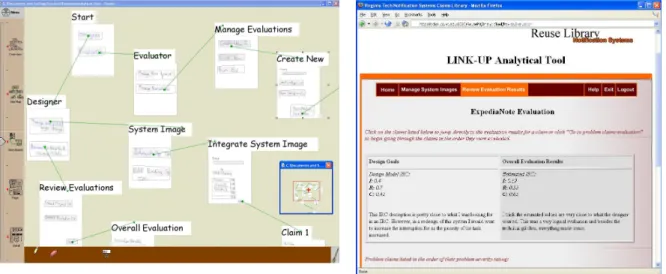
We began brainstorming about the design of the analytic module by considering all of the broad activities that users would need to accomplish as they proceeded through an analytic evaluation. Two important realizations emerged: first, the system would be used by two distinct types of users; second, the module would need to support several activities beyond just the evaluation execution. Each of these ideas is elaborated on below. Most of our early design work was conducted with rapid prototype development software that allowed quick storyboard sketching and linking of steps within the module (Figure 2). In the early process, we were unconcerned with the specifics of information design—we focused solely on ensuring that all essential processes and steps were included. We received frequent feedback on several iterations of our rapid prototypes from members of our larger research group. As our ideas solidified, we emerged with a coherent task analysis and screen-flow for the analytic module.
Figure 2. Left: early storyboard of the analytic module; Right: Screen from the functional prototype used in pilot testing.
There are two types of users that will use the Analytic Module, designers and evaluators. Designers are the individuals who will develop the system to be evaluated using scenario-based design and LINK-UP’s claims library. Evaluators are the individuals who will be assessing the system’s usability. Ideally, they would be experts in HCI and be familiar with scenario-based design claims analysis [71]. According to our needs analysis, we determined that the analytic module should be divided into three sub-modules: Manage System Image, Evaluate System Image and Review Evaluation Results. The three sub-modules correspond to the basic sequence of tasks (Figure 3). The designer’s and evaluator’s tasks will be described respectively below.
Figure 3. Basic sequence of tasks of the analytic module of LINK-UP.
First in the task sequence, supported by the Manage System Image module, designers will either add a new system image into the module or edit an existing system image. To create a new system image, the designer will need to select an ongoing design project. Each design project will be associated with a list of problem claims developed during the requirements gathering and participatory negotiation phases of the LINK-UP system. The designer then links necessary design claims to each problem claim. Each design claim should solve part of or the whole problem addressed in the problem claims. Design claims can either be newly developed by the designer or be reused, drawn from the claims library. Artifact representations are also uploaded to describe the system image. An artifact representation shows some aspect of the system that is being designed. They can be pictures, screenshots or movies of the system interface. Before this process, the designer would have already established a design model IRC, which represents the intended IRC value for the system being designed. Once this process is complete, the system image will be ready to be evaluated. Designers can also edit existing system images after creating them in response to evolving requirements or to account for system redesign decisions.
Second, through the Evaluate System Image module, HCI experts can analytically evaluate system images. The analytic module will step the evaluator through the evaluation method and record the results of the assessment. During the process, the evaluator would first become familiar with a summary of the system image to develop an overall understanding of the notification system design. This is accomplished by browsing through the system description, the interaction scenarios, the design model IRC values, and the prototype artifacts. Then the evaluator steps through each problem-design claim pair and rates how well each design claim addresses the associated problem claim on a four-point scale (major flaw, flaw, minor flaw, or no problem). This rating is based on how well the upsides (positive psychological effects) expressed by the design claim either:
• Support the upsides of the linked problem claim
• Mitigate the downsides of the linked problem claim or other design claims
Evaluators provide comments for each claim pair to explain their ratings. At the end of the evaluation, the evaluator runs the IRC equation algorithm to get the estimated IRC value for the whole
As the final step in the task sequence, in the Review Evaluation Results module,designers will be able to review the results of evaluations that experts have run on their system images. At the start of this interaction session, the designer will see overall evaluation comments and will be able to compare the design model IRC and estimated IRC for their prototype. This gives the designer a sense of how well the system might fulfill its most critical user goals, if fully developed. They can then view the ratings and comments for each claim pair to elaborate on specific, causal design features. The designer can use the ratings and comments to improve their designs. They can also revise the problem-design claim linkages, or even modify their original design claims. Since the claims and their evaluation results are archived in the claims library and accessible beyond the single project, future developers will be able to benefit from this stored knowledge.
3.1.4 Pilot testing evaluation methods
We conducted a three stage formative empirical usability evaluation of the analytic module—a process in which potential users actually used the prototype to accomplish real tasks. This evaluation was conducted after the development of the module prototype to get feedback from actual designers and study how it is used in a realistic situation [71]. The evaluation had two goals, to establish whether:
• Designers can use the module to help identify and resolve design problems
• Through use of the module, could designers learn more about claims-based usability engineering
The first goal arises because an overall objective of the LINK-UP system is to support the usability engineering process for notification systems and enhance HCI education activities [21]. The second goal arises because many initial users, especially those in an academic setting, are unlikely to be experienced with claims and scenario based design. The analytic module addresses the user’s tendency to learn about a new tool through active and informal, exploratory use [19].
In our pilot testing, we were assisted by seven participants who were all undergraduate students in a semester-long undergraduate research seminar, focusing on design and evaluation of notification systems. The students had spent recent weeks individually designing a notification display that helps users monitor and react to constantly changing airplane ticket prices. At the start of our pilot testing, each student had a semi-functional prototype notification system to support this typical notification task. The evaluation was run over a period of three weeks, with one hour-long session held each week. To prepare for the evaluation, participants added to the claims library their problem and design claims. In Session 1, the participants created the system image for their prototypes using the Analytic Module. The participants had the option of linking their own (new)
design claims or reusing existing design claims to their problem claims. After the system images were created, each participant completed a questionnaire containing multiple-choice statements (rated on an eleven-point Likert scale) and general questions that required written answers. This questionnaire assessed the designers’ opinions about how well the system image represented the prototype design. In Session 2, each participant evaluated the system image of a prototype developed by another participant in the last session. This was also followed by a questionnaire that gathered feedback on how effectively the participants were able to evaluate the prototype using the module. In Session 3, the participants reviewed the evaluation results for their system images and completed a form to express comments and reactions to all information resulting from the evaluation (quality of evaluator feedback and utility of the general approach). This session was followed by a questionnaire that focused on whether the evaluation gave them useful design feedback and whether evaluators identified any problems with the claims. A detailed overview discussion of the study results is available here [40].
3.1.5 Summary of study findings
Overall, we can report that the designers and evaluators were able to understand and use the prototype of the Analytic Module as it was envisioned. The pilot testing showed that distributed project work is feasible with the support of at least this module of LINK-UP. We were also pleased to observe a few cases of design knowledge reuse, and we are confident that more cases will be apparent as the tools are more fully integrated in design practice and as the claims library content develops further. To summarize the major findings:
• A prototype representation (system image), expressed in terms of problem and design claims provides enough information for knowledgeable HCI persons to quickly evaluate prototype designs.
• The Analytic Module can help designers identify and resolve problems with their prototype designs in terms of design claims and how they address both the upsides and downsides of problem claims.
• The Analytic Module can help students learn about scenario-based design with claims analysis by giving targeted feedback through evaluations that can uncover misconceptions about claims and relationships between problem and design claims. The results of our online evaluation tool demonstrates its potential for teaching HCI design concepts such as claims analysis and knowledge reuse to students in a distributed and collaborative environment. However, based on participant feedback, the Analytic Module should separate the
represent. Furthermore, supporting multiple evaluations for a single system image would strengthen the believability of the ratings.
3.2 Bringing design representations to the forefront
Our continuing work in developing LINK-UP, an integrated design and reuse environment, addresses the need for proven, dependable engineering processes for interface development [39]. It suggests that a better understanding of the system image is key to the successful evaluation of design prototypes, and an aide in applying knowledge from the repository. This section describes our work to enhance LINK-UP by developing and augmenting the system image to make it the central communication point between different stages of design and between different stakeholders. We report on a study of the modified task flow that demonstrated the value of the system image within a broader design context. Overall, our findings indicate that the effective creation and use of knowledge repositories by novice HCI designers hinges on successful application of existing HCI design concepts within a practical integrated design environment. This section is adapted from my ACMSE ’05 conference paper: Image is Everything: Advancing HCI Knowledge and Interface Design Using the System Image [39].
3.2.1 Introduction
This work is a continuation of our effort to develop a structured, methodical way to both apply and further develop HCI knowledge through LINK-UP, an integrated design environment that supports a scenario-based usability engineering process centered on the use and development of a knowledge repository. The overall goal of LINK-UP is to validate the use of a reusable knowledge repository as a basis for developing a more principled approach to design that can build on past efforts. Key in creating this is adequately capturing the vision of the designer and relating it to the experience of the user to enable reflection and iteration on the design. This will in turn support the use and creation of reusable knowledge.
In our preliminary work, we integrated Norman’s ideas into the analytic module to allow HCI experts to evaluate nonfunctional prototypes using a digital representation of a system image [63]. An initial study confirmed that the system image supported effective analytic evaluation of initial design prototypes, but also suggested that it was instrumental in the application of information from the knowledge repository. We worked to redesign the initial architecture to further develop our own interpretation of Norman’s system image, as well as to apply other concepts derived from HCI so that LINK-UP better supports interface design and the generation of reusable design knowledge. We conducted a study of the new task flow with a group of novice HCI designers that demonstrated the
value of the system image as a central part of the LINK-UP system and its effectiveness at supporting interactive system design. However, participants encountered problems during the design process caused by differing understandings of key HCI concepts that were integrated in LINK-UP.
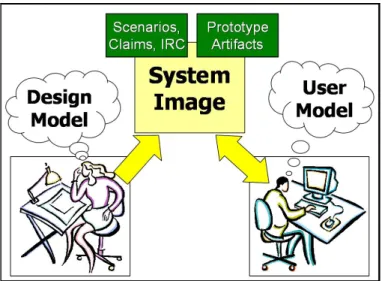
Figure 4. Norman’s conceptualization of the system image. The designer captures system intentions in a prototype, along with supporting documentation, enabling the study of user interaction with the system.
3.2.2 Background
Norman established the idea that governing the usage experience is the consistency of two conceptual models—the design model held by the designer and the user’s model based on the user’s understanding of the system [63]. Each model can be analyzed as stages of action, which describe the cyclical evaluation and execution of tasks across the Gulf of Execution and the Gulf of Evaluation. To facilitate a user’s evaluation and execution of tasks, designers must develop conceptual models as they would develop the scaffolding of a bridge. Several factors contribute to each of these conceptual models