Ladislav Jirsa and Lenka Pavelkov´a
Department of Adaptive SystemsInstitute of Information Theory and Automation, Czech Academy of Sciences Pod Vod´arenskou vˇeˇz´ı 4, Prague, Czech Republic
{jirsa, pavelkov}@utia.cas.cz
Keywords: Sensor Condition, Abrupt Change, Signal Variance, Modelling, Uniform Distribution.
Abstract: A modular framework for monitoring complex systems contains blocks that evaluate condition of single sig-nals, typically of sensors. The signals are modelled and their values must be found within the prescribed bounds. However, an abrupt change of the signal increases the estimated parameters’ variance, which raises uncertainty of the sensor condition although it operates correctly. This increase affects the whole system in evaluation of condition uncertainty. The solution must be fast and simple, because of runtime application requirements. The signal is modelled by a static model with uniform noise, variance increase is tested and if detected, the model memory is cleared. The fast and efficient algorithm is demonstrated on industrial rolling data. The method prevents the parameters’ variance from the artificial increase.
1
INTRODUCTION
Fault detection and condition monitoring is a perma-nently developing area (Isermann, 2011; Toliyat et al., 2012; Marwala, 2012). Currently, a hierarchical con-dition monitoring framework (ProDisMon) is devel-oped (Dedecius and Ettler, 2014) where the system in question is decomposed into a set of mutually logi-cally interconnected basic components. To each com-ponent, a binomial opinion on its particular health is assigned. This opinion includes also uncertainty of users’ judgement. It can be interpreted as a charac-teristics of a condition of the investigated system or unit. The particular opinions on basic components are subsequently combined using rules of subjective logic (Jøsang, 2008) to obtain information on overall system health.
Sensors comprise an important part of the above mentioned basic system components. For the purpose of ProDisMon project, several methods were pro-posed that evaluated a health of the sensor signal (Et-tler and Dedecius, 2014; Pavelkov´a and Jirsa, 2014). These methods take into consideration the inaccuracy of a measured signal with respect to user given bounds and build this inaccuracy in the binomial opinion as an uncertainty. This uncertainty is the higher, the closer the signal values are to user given bounds. Never-theless, a situation may occur during the evaluation
that the signal value changes abruptly within the per-mitted area. Then, a variance of the signal estimate rapidly increases. Consequently, the uncertainty in the opinion unnecessarily increases. To prevent these unwanted uncertainty increases, a method using the change point detection might help.
Change-point problems (Basseville, 1988) arise when different subsequences of a data series have different probability distributions. In (Chib, 1998), the change-point model is described by a latent state variable that indicates the mode from which a par-ticular observation has been drawn. This state vari-able is specified to evolve according to a discrete-time discrete-state Markov process with the transition probabilities constrained so that the state variable can either stay at the current value or jump to the next higher value. The paper (Hawkins, 2001) develops an exact approach for finding maximum likelihood es-timates of the change points and within-segment pa-rameters when the functional form is within the gen-eral exponential family. The paper (Lebarbier, 2005) deals with the problem of detecting change-points in the mean of a signal corrupted by an additive Gaus-sian noise. The number of changes and their position are unknown. From a non-asymptotic point of view, their estimation is proposed using a method based on a penalized least-squares criterion. In (Zhang and Basseville, 2014), a statistical approach to fault
de-tection and isolation for linear time-varying systems subject to additive faults with time-varying profiles is described. The proposed approach combines a gener-alized likelihood ratio test with a recursive filter that cancels out the dynamics of the monitored fault ef-fects.
In this paper, we propose a method that consid-ers an abrupt change in a sensor signal values. The signal is estimated by a static regression model with bounded noise on a sliding window. An unwanted in-creasing of estimate variance, that indicates a change point, is prevented by the window resetting.
The implementation in practice requires fast algo-rithms that can run in real time with a relatively high sampling frequency (200 Hz or higher) for a system composed of tens of units to be observed. Therefore, another criterion is a computational simplicity.
The choice of the method is given by demands of the application being developed. The method must be compatible with the mechanisms already implemented, particularly probabilistic (subjective) logic (Jøsang, 2008) as a tool to build a hierarchical structure of the basic components (blocks).
Because a sensor deterioration can manifest itself, among others, by increase of the signal noise, the sig-nal variance is used as an input quantity to evaluate uncertainty of the sensor condition (Ettler and Dede-cius, 2015). This is one of several sensor tests.
The purpose of this work is to propose an esti-mator of a scalar signal’s variance, resistant to abrupt changes, i. e. to jumps in the data.
2
BASICS OF THE SUBJECTIVE
LOGIC
Subjective logic is a kind of probabilistic logic, intro-duced by (Jøsang, 2008). Except of terms “true” and “false”, used by a traditional binary logic, it operates with a term “not known”. We present basic terms of this field, details can be found e. g. in (Jøsang, 2008). According to analysis or observation, a binomial
opinionωon truth value of a statement x is formu-lated. Formally,ω= (b,d,u,a). The items of the vec-torωare
• b — probability that x is true (belief), • d — probability that x is false (disbelief), • u — probability that state of x is unknown
(uncertainty),
• a — prior belief in x being true (base rate).
It holds b+d+u=1.
The subjective logic defines logical operations on binomial opinions like addition, multiplication, co-multiplication, averaging fusion etc. If a state of each component of a complex system is described by its binomial opinion, these opinions can be composed by the logical operations mentioned above according to the logical composition of the system. In this way, the structure of the system can be described hierar-chically and binomial opinion on the whole system state can be derived.
The binomial opinionω can be mapped e. g. to parameters of beta distribution.
A relation between the signal variance and uncer-tainty of the respective sensor condition has been pro-posed in (Ettler and Dedecius, 2015). Increased un-certainty of modules’ condition would negatively af-fect uncertainty of the whole plant (“false alarm”), al-though values of measured quantities are located in usual intervals and the signal variance without the jump is proper.
3
SENSOR MODEL AND ITS
ESTIMATION
To avoid construction and identification of a complex generic model for particular type of sensor data (e. g. dynamic probabilistic mixture), the model is chosen simple with a mechanism to resits abrupt changes. The purpose of the model is estimation of the signal variance as an input quantity for evaluation of uncer-tainty of the sensor condition.
User given bounds on values of the data given by the sensor motivated us to choose a model with bounded noise, particularly uniformly distributed, which is the simplest case of bounded distributions.
3.1
Uniform Model of Sensor Signal
A sensor signal ytis described by the following model
(t=1,2, ...,T is discrete time)
yt=K+et (1)
where K is an unknown parameter and et is an
uni-formly distributed white noise et, i.e. et∼
U
(−r,r); r>0 is unknown. The equivalent description of yt byprobability density function (pdf) is
f(yt) =
U
(K−r,K+r) =U
(L,U), (2)where L=K−r, U=K+r.
3.2
Bayesian Estimation
To estimate parameters K and r in (2), we use a Bayesian maximum a posteriori (MAP) estimation.
Parameters Θ= [K,r]′ are estimated on a sliding window of the maximal length ∆. According to (Pavelkov´a and K´arn ´y, 2014), the MAP estimation converts to a problem of linear programming which has very simple form in the case of static model (1).
The statistics used for estimation are counterνt
and data vector wt ≡ [yt,yt−1, . . . ,yt−∆Mt], ∆Mt = min(∆,νt−1)The statistics are updated
νt = νt−1+1 (3)
wt′ =
yt,w′t−1(1 :∆Mt) (4) w′t−1(1 :∆Mt)denotes the vector created from the first
∆Mtentries of wt−′ 1. The estimation starts withν1=1,
w1=y1.
Then, forτ∗={τ;τ=t−∆Mt, . . . ,t−1,t}, MAP
estimates are as follows ˆ Lt = min τ∈τ∗(wτ), Utˆ =maxτ∈τ∗(wτ), ˆ Kt = Utˆ +ˆLt 2 (5) ˆrt = ˆ Ut−ˆLt 2 (6) var(K)t = (Uˆt−ˆLt)2 12 = ˆrt2 3 (7)
where max(wτ) and min(wτ) denotes the maximal and minimal entry of wτ, respectively. ˆXt denotes the
estimate of X in time t.
3.3
Considering Abrupt Signal Changes
When the estimation (5) – (7) is performed with the updates of statistics (3) and (4), then the sliding win-dow length ∆Mt continuously grows from 1 up to
the maxima∆after ∆steps. When the signal value abruptly changes, the variance of estimate rapidly in-creases. To prevent these rapid jumps, the estimation procedure is adapted as described below.
We describe variance increase between time in-stants t−1 and t by the ratio
Rvar=
var(K)t
var(K)t−1
(8) where var(K)t means the current value of variance,
var(K)t−1 is the value of variance in previous step. We define B as a limit for variance increase between time instants t−1 and t. The value Rvar>B indicates
undesirable variance change. If this case arises, then the statisticsνand w are reset, i.e. νt=1, wt =yt.
The current estimation step is repeated with the re-vised statistics. Then, the estimation continues in a usual way.
4
EXPERIMENTS
Here, an example is given to illustrate the proposed method. The following real data from rolling mill are used.
• Hydraulic pressure upper front Pu0 [Mpa]. This
is a partial pressure composing the total pressure exerted on a metal strip. Technological (hard) bounds of the signal are y
H=−10 MPa and yH=
31 MPa, expected (soft) range is between y
S= −2 MPa and yS=28 MPa.
• Slide valve actual position front uist 0 [%]. The
valve position determines the pressure change. Technological bounds of the signal are y
H = −101 % and yH =110 %, expected range is be-tween y
S=−100 % and yS=90 %.
The data sets have the origin in the same functional unit of the rolling mill, although they describe differ-ent quantities. The abrupt changes in the data, there-fore, are observed in the same time instants (this is not visible in the figures, where different data blocks are shown).
The memory, represented by a sliding window, was set to the length∆=25 data vectors, which corre-sponds to the forgetting factor 0.96 in analogy of the exponential forgetting (K´arn ´y et al., 2005). This value was chosen as a reasonable compromise between in-formation in the past data and ability to track slow parameter changes (adaptivity) (Pavelkov´a and Jirsa, 2014).
The limit for variance increase B was experimen-tally set a preliminary constant 2. Because of situa-tions, when the model excitation is low (data are al-most constant), the memory reset option is considered if var(K)>0.2 (7), which is another constant found experimentally.
The data were modelled by a static model (1). Ac-cording to (5) and (7), the mean value ˆK and variance
var(K)of the absolute term were computed in each time step. If Rvar=var(K)t/var(K)t−1>B (see (8)), i.e. the data values changed abruptly, the model mem-ory was reset. For illustration, estimation results of the model without resetting are plotted, too. The fig-ures show representative selections of the data to il-lustrate the effect of the method in typical situations.
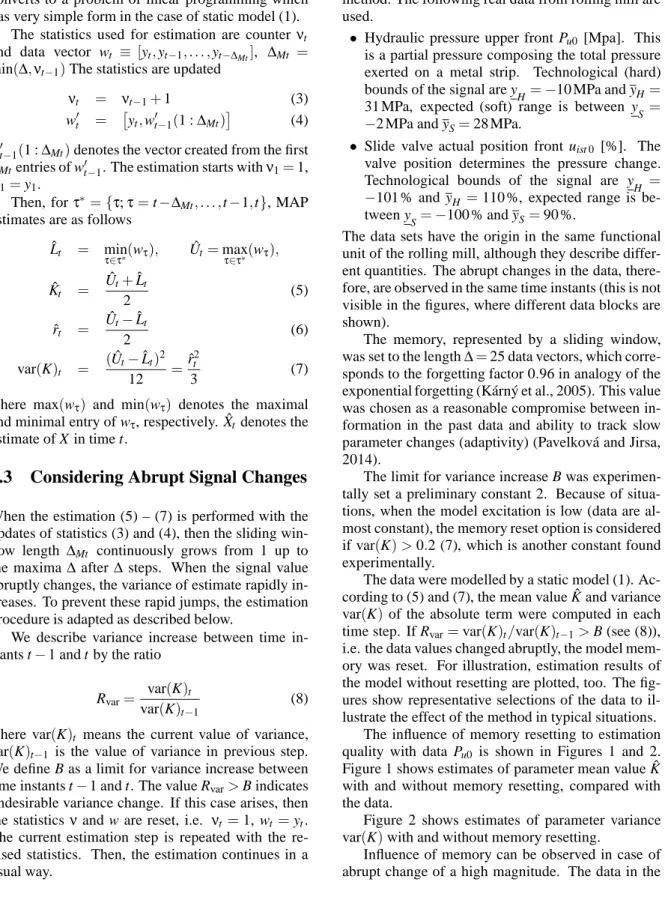
The influence of memory resetting to estimation quality with data Pu0 is shown in Figures 1 and 2.
Figure 1 shows estimates of parameter mean value ˆK
with and without memory resetting, compared with the data.
Figure 2 shows estimates of parameter variance var(K)with and without memory resetting.
Influence of memory can be observed in case of abrupt change of a high magnitude. The data in the
52002 5400 5600 5800 6000 6200 4 6 8 10 12 14 time
estimated mean od K vs. data
without reset with reset data
Figure 1: Hydraulic pressure upper front Pu0: comparison
of estimated mean ˆK for algorithms with memory resettting (solid line) and without memory resetting (dash-dot line). Data are shown as circles
5200 5400 5600 5800 6000 6200 0 5 10 15 time var(K) without reset with reset
Figure 2: Hydraulic pressure upper front Pu0: comparison
of estimated variance var(K)for algorithms with memory resettting (solid line) and without memory resetting (dash-dot line).
memory distort estimates of the first and second mo-ments of the parameter K. The length of the memory,
∆, can be seen in the figures as a feature of the unre-set estimates. Reunre-setting the memory, after the abrupt change is detected, feeds the model with the data without influence of the history when the system was in a different “mode” with respect to the static model. Variance of the parameter is then not increased arti-ficially although the system behaves properly and the values stay within the soft limits. A slight disagree-ment of the reset estimate and data about time 5 900, may be caused by very fast, almost chaotic changes in the signal.
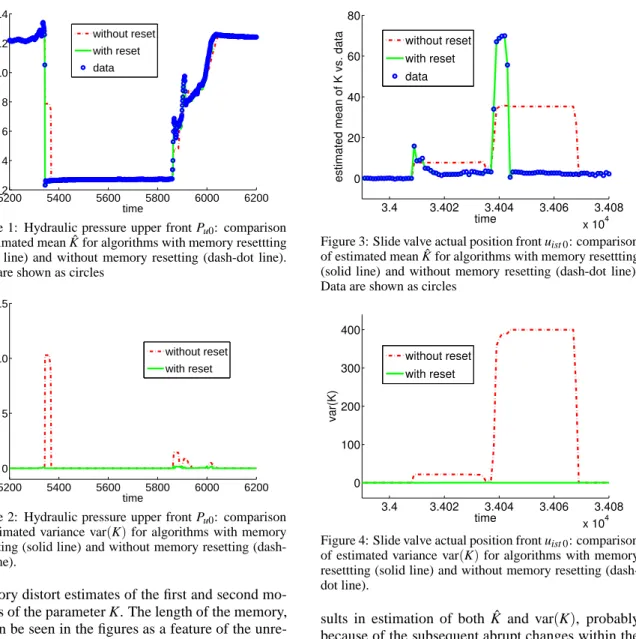
The results for experiments with data uist 0are
pre-sented in Figures 3 and 4. Figure 3 shows estimates of parameter mean value ˆK with and without memory
resetting, compared with the data.
Figure 4 shows estimates of parameter variance var(K)with and without memory resetting.
The effect of memory resetting is even more sig-nificant than in Figures 1 and 2 and it gives better
re-3.4 3.402 3.404 3.406 3.408 x 10⁴ 0 20 40 60 80 time estimated mean of K vs.
data without reset
with reset data
Figure 3: Slide valve actual position front uist 0: comparison
of estimated mean ˆK for algorithms with memory resettting (solid line) and without memory resetting (dash-dot line). Data are shown as circles
3.4 3.402 3.404 3.406 3.408 x 10⁴ 0 100 200 300 400 time var(K) without reset with reset
Figure 4: Slide valve actual position front uist 0: comparison
of estimated variance var(K)for algorithms with memory resettting (solid line) and without memory resetting (dash-dot line).
sults in estimation of both ˆK and var(K), probably because of the subsequent abrupt changes within the interval∆. Again, the estimates without memory re-setting are influenced by the previous values up to∆, which is also visible in Figures 3 and 4.
5
CONCLUSION
The paper proposes a simple, fast and efficient method for estimation of a signal variance, if the sig-nal contains abrupt changes (jumps) in data. The method prevents the estimator from variance increase caused by the change. The variance increase would affect uncertainty of the binomial opinionω.
A simple static model with a bounded uniform noise is identified. The problem of abrupt changes is dealt by detection of the parameter variance step by step and resetting the model memory, if the variance
increase is higher than the requested bound.
The effectivity of the method is illustrated. Fig-ures 3 and 4 demonstrate a case when estimated vari-ance was unaffected by the abrupt change. If the change is faster, as in Figures 1 and 2 after time 5 900), variance increase is substantially reduced.
The future work can be focused on adaptive set-ting of B according to nature of the data (noise, os-cillations, outliers, change of variance) and exploring other methodology of abrupt change detection, e. g., testing of hypotheses etc.
ACKNOWLEDGEMENTS
The research project is supported by the grant M ˇSMT 7D12004 (E!7262 ProDisMon).
REFERENCES
Basseville, M. (1988). Detecting changes in signals and systems a survey. Automatica, 24(3):309–326. Chib, S. (1998). Estimation and comparison of
multi-ple change-point models. Journal of Econometrics, 86(2):221 – 241.
Dedecius, K. and Ettler, P. (2014). Hierarchical modelling of industrial system reliability with probabilistic logic. In Proceedings of the 11th international conference on informatics in control, automation and robotics (ICINCO), Vienna, Austria.
Ettler, P. and Dedecius, K. (2014). Quantification of in-formation uncertainty for the purpose of condition monitoring. In Proceedings of the 11th international conference on informatics in control, automation and robotics (ICINCO), Vienna, Austria.
Ettler, P. and Dedecius, K. (2015). Probabilistic con-dition monitoring counting with information uncer-tainty. In Papadrakakis, M., Papadopoulos, V., and Stefanou, G., editors, UNCECOMP 2015, 1st ECCO-MAS Thematic Conference on Uncertainty Quantifi-cation in Computational Sciences and Engineering, Crete, Greece. Accepted.
Hawkins, D. M. (2001). Fitting multiple change-point mod-els to data. Computational Statistics & Data Analysis, 37(3):323 – 341.
Isermann, R. (2011). Fault-diagnosis applications: model-based condition monitoring: actuators, drives, ma-chinery, plants, sensors, and fault-tolerant systems. Springer Science & Business Media.
Jøsang, A. (2008). Conditional reasoning with subjective logic. Journal of Multiple-Valued Logic and Soft Com-puting, 15(1):5–38.
K´arn´y, M., B¨ohm, J., Guy, T. V., Jirsa, L., Nagy, I., Ne-doma, P., and Tesaˇr, L. (2005). Optimized Bayesian Dynamic Advising: Theory and Algorithms. Springer, London.
Lebarbier, E. (2005). Detecting multiple change-points in the mean of Gaussian process by model selection. Sig-nal Processing, 85(4):717 – 736.
Marwala, T. (2012). Condition monitoring using computa-tional intelligence methods: applications in mechani-cal and electrimechani-cal systems. Springer Science & Busi-ness Media.
Pavelkov´a, L. and Jirsa, L. (2014). Evaluation of sen-sor signal health using model with uniform noise. In Proceedings of the 11th International Conference on Informatics in Control, Automation and Robotics (ICINCO), pages 671–677, Vienna, Austria.
Pavelkov´a, L. and K´arn´y, M. (2014). State and parameter estimation of state-space model with entry-wise corre-lated uniform noise. International Journal of Adaptive Control and Signal Processing, 28(11):1189–1205. Toliyat, H. A., Nandi, S., Choi, S., and Meshgin-Kelk,
H. (2012). Electric Machines: Modeling, Condition Monitoring, and Fault Diagnosis. CRC Press. Zhang, Q. and Basseville, M. (2014). Statistical detection
and isolation of additive faults in linear time-varying systems. AUTOMATICA, 50(10):2527–2538.