The evolution of platform business models: Exploring competitive battles in the world of platforms
Yang Zhao, Stephan Von Delft, Anna Morgan-Thomas, Trevor Buck PII: S0024-6301(18)30636-8
DOI: https://doi.org/10.1016/j.lrp.2019.101892 Article Number: 101892
Reference: LRP 101892
To appear in: Long Range Planning Received Date: 8 December 2018 Revised Date: 5 July 2019 Accepted Date: 11 July 2019
Please cite this article as: Zhao, Y., Von Delft, S., Morgan-Thomas, A., Buck, T., The evolution of platform business models: Exploring competitive battles in the world of platforms, Long Range Planning (2019), doi: https://doi.org/10.1016/j.lrp.2019.101892.
This is a PDF file of an unedited manuscript that has been accepted for publication. As a service to our customers we are providing this early version of the manuscript. The manuscript will undergo copyediting, typesetting, and review of the resulting proof before it is published in its final form. Please note that during the production process errors may be discovered which could affect the content, and all legal disclaimers that apply to the journal pertain.
M
AN
US
CR
IP
T
AC
CE
PT
ED
THE EVOLUTION OF PLATFORM BUSINESS MODELS:
EXPLORING COMPETITIVE BATTLES IN THE WORLD OF
PLATFORMS
YANG ZHAO 1
Loughborough University London Institute for Innovation and Entrepreneurship 3 Lesney Avenue, London E15 2GZ, United Kingdom
Tel: +44 203 805 1343 e-mail: [email protected]
STEPHAN VON DELFT University of Glasgow Adam Smith Business School
Gilbert Scott Building
Glasgow G12 8QQ, United Kingdom e-mail: [email protected]
ANNA MORGAN-THOMAS University of Glasgow Adam Smith Business School
Gilbert Scott Building
Glasgow G12 8QQ, United Kingdom e-mail: [email protected]
TREVOR BUCK University of Glasgow Adam Smith Business School
Gilbert Scott Building
Glasgow G12 8QQ, United Kingdom e-mail: [email protected]
1
corresponding author
Running head: The Evolution of Platform Business Models
M
AN
US
CR
IP
T
AC
CE
PT
ED
THE EVOLUTION OF PLATFORM BUSINESS MODELS:
EXPLORING COMPETITIVE BATTLES IN THE WORLD OF PLATFORMS Abstract: In recent decades, multi-sided platform business models have become an important
avenue for value creation and capture, but the phenomenon itself remains under-theorized. We address this gap and present new, empirically-driven insights into how platform business models evolve in a context of fierce competition. Through a longitudinal, qualitative study of twelve multi-sided platforms that operate under challenging industry conditions, we discover that success in platform battles can plausibly be explained by a combination of complexity in the business model design, and the simultaneous use of innovation and imitation to create highly intricate systems of activities. We further discuss how our findings open several new avenues for future platform research.
INTRODUCTION
The emergence of wireless and Internet technologies has brought opportunities for the creation of new organizational forms (Eckhardt et al., 2018; Iansiti and Lakhani, 2017; McIntyre and Srinivasan, 2017; Parker and Van Alstyne, 2018; Teece, 2018). Firms like Alibaba and Uber have adopted new ways of structuring firm and industry boundaries by shifting organizational design away from selling products towards the facilitation of economic exchanges between two or more (related) user groups (e.g., riders and drivers in case of Uber). Such multi-sided platforms mediate user interactions and therefore differ from firms that control a linear series of activities as well as from manufacturing platforms that orchestrate a network of suppliers to build a family of related products (Gawer and
Cusumano, 2014; Thomas et al., 2014). Moreover, compared to intermediaries outside the digital economy (e.g., insurance brokers, some department stores), these multi-sided platforms can introduce new transaction mechanisms more rapidly and at much lower cost.
A noteworthy factor in the growth of multi-sided platforms in the digital economy is fierce rivalry between platforms that target the same user base. There is the micro-blogging site Pownce, out-performed by Twitter. The social network Orkut, which was very popular in Brazil but (despite being operated by platform star Google) did not survive competition with
M
AN
US
CR
IP
T
AC
CE
PT
ED
Facebook and Myspace. The transportation network Sidecar, which pioneered the peer-to-peer ride-sharing model, lost in competition with Uber and Lyft. Looking at the platform landscape, Van Alstyne and Parker (2017, p. 28) conclude: “For every successful platform, there are many more that struggle or simply don’t make it” – dynamics that may eventually give rise to a winner-take-all outcome (Boudreau and Jeppesen, 2015; Cusumano et al., 2019; Gawer, 2014; Zhu and Iansiti, 2012).
Yet, despite this recognition that competitive dynamics play a critical role in the development and growth of multi-sided platforms, there has been surprisingly little systematic empirical inquiry into this aspect of the platform phenomenon. While a deeper understanding of how to create viable multi-sided platforms in a context of fierce competition is needed, prior platform research has largely neglected competitive interactions in the
process of creating and growing new organizational forms that mediate transactions between user groups, and mostly focused on single design parameters that give users a good reason to join and keep using the platform: notably, the creation of new features and add-ons that attract users (e.g., Gawer and Cusumano, 2008), the adoption of activities that enable
frictionless platform access (e.g., Parker et al., 2016), and the choice of mechanism to match users effectively (e.g., Wei and Lin, 2017). These studies echo the logic of Katz and Shapiro (1985; 1994) and view network effects as a source of competitive advantage in platforms, since “consumers place a higher value on platforms with a larger number of users” (Cennamo and Santaló, 2013: p. 1331). While this stream of platform research has vastly enhanced our understanding of platform characteristics, a focus on individual design parameters is
problematic for both theory and practice for at least two reasons. First, a focus on specific design elements that promote the growth of the user base may explain and predict network effects, but not the underlying mechanisms that lead to the creation of such design elements or interdependence between them. In other words, we know a good deal about the nature of
M
AN
US
CR
IP
T
AC
CE
PT
ED
single pieces in a platform “puzzle”, but how the pieces emerge under conditions of intense rivalry and fit together remains undertheorized. Second, since multi-sided platforms operate “in a setting that calls for highly interdependent decisions” (Helfat and Raubitschek, 2018, p. 1391), the creation of a successful platform may require holistic thinking, i.e., attention to the entire architectural recipe rather than just to single ingredients (Andries et al., 2013;
Casadesus-Masanell and Ricart, 2010; Zott and Amit, 2010). As an example, a multi-sided platform like Airbnb needs to make decisions about whether to include a rating system for guests or not, how precisely to link travelers with hosts, and who provides insurance for listed properties, often simultaneously. Yet, the implications of such interdependent decisions for platform success are unknown.
This article, then, addresses two research questions. First, how can we describe and analyze interconnected and interdependent decisions in the development of multi-sided platform designs? A second question relates to the design of a platform in its competitive context – how do some multi-sided platforms succeed in the competitive battle for market leadership, while many more perish?
To answer the research questions, a level of analysis is needed that allows us to describe the design of a platform firm’s set of boundary-spanning exchanges in toto, and permits the analysis of dynamic changes therein, in response to competition. We argue that this level of analysis is the business model – a “system that is made up of components, linkages between the components, and dynamics” (Afuah and Tucci, 2000, p. 4). On the one hand, the business model identifies transaction partners, establishes the value proposition(s) for each partner, and describes how a focal firm connects to them (Baden-Fuller and
Mangematin, 2013; McGrath and MacMillan, 2000). On the other hand, it defines how value is delivered, monetized, and shared among transaction partners (Johnson et al., 2008; Teece, 2010). The business model, therefore, refers to the overall gestalt of interlinked
boundary-M
AN
US
CR
IP
T
AC
CE
PT
ED
spanning transactions and interdependent activities that enable value creation and capture (Zott and Amit, 2008). We follow prior research and conceptualize a business model as a system of activities that can be described through design elements, namely activity content, structure, and governance (Foss and Saebi, 2018; Snihur and Zott, 2019; Zott and Amit, 2010). We begin our theoretical analysis from this activity system perspective because it allows us to ground our contribution solidly in prior work (Amit and Zott, 2001; Zott and Amit, 2007; 2008; 2010) before going beyond it by considering competitive dynamics in the evolution of multi-sided platform business models.
We develop our argument on the basis of an inductive multiple case study (Eisenhardt, 1989; Yin, 2013) that explores the evolution of twelve multi-sided platform business models in the Chinese Online Group Buying (OGB) industry between 2011 and 2013. The OGB platform business model, pioneered in 2009 by Groupon in the U.S., brings together local merchants and online consumers by offering products or services with deep discounts, should a certain number of fellow consumers buy the same product or service within a limited time period. The Chinese OGB industry is a compelling empirical field in which to address our research question for three reasons. Firstly, when the market emerged in 2010, all entrants chose to copy Groupon’s platform business model, i.e., the starting point for designing the business model was similar for all companies. Using Groupon’s business model as a
reference enabled us to document the whole evolution of each of the business models as they unfolded. Secondly, OGB firms must deal with many of the challenges faced by platform providers working with two or more groups of transaction partners. For example, a design choice in the business model made in relation to one user group may have consequences for another one. Indeed, in our setting, the OGB firms evolved from operating two-sided
platform business models in 2010 towards multi-sided business models in 2013 by integrating complementors such as e-malls, app developers, online travel agents, and cloud computing
M
AN
US
CR
IP
T
AC
CE
PT
ED
providers, which increased architectural challenges, as structural interdependencies in the business model became more complex. Thirdly, this market was characterized by intense competition and volatility: it emerged, grew, was shaken-up, and stabilized in just four years. The number of platform firms operating in the Chinese OGB market grew significantly in a short period of time, reaching a maximum in September 2011 when the market was crowded with 5,058 platforms, falling to only 213 by December 2013, with just two platforms
dominating the market with a combined share of 75%. This resolution of the life-cycle of the industry, 2010-14, provided a clear solution to the eternal problem of choosing an appropriate period over which to evaluate platform performance.
We claim that our results contribute to platform research in several ways. Firstly, by extending Amit and Zott’s (2001) activity system perspective into the platform context we provide a more complete picture of the heuristic logic that connects platform characteristics with the realization of economic value. In particular, a focus on the pattern of transactions that the platform firm mediates between groups of users allows us to argue theoretically, and show empirically, that a focus on the platform business model, as a source of value creation and capture, can help explain why some platform firms outperform others, and can provide a basis for analyzing how platform business models unfold over time. Secondly, while prior research offers several explanations for the success of platforms like Airbnb or Amazon, including critical strategic choices such as where to play (and why) (Cusumano et al., 2019; Eisenmann et al., 2006; Hagiu, 2014) and what competitive strategy to adopt (e.g.,
differentiation vs. cost leadership) (Cennamo and Santaló, 2013; Seamans and Zhu, 2017), prior research leaves unexplored another likely contributor to the success of platforms: that their founders designed an effective business model. By revealing that the design of business models contributes to platform performance, we thus complement prior research that has considered alternative determinants of platform performance. Thirdly, by embracing the
M
AN
US
CR
IP
T
AC
CE
PT
ED
competitive actions of platform firms and the responses elicited, we provide a fine-grained approach to understanding what specific platforms do when they compete with specific rivals. Although the engagement between firms is arguably central to firm survival and competitive advantage (e.g., Bettis and Weeks, 1987;Chen and Miller, 2015; Lamberg et al., 2009; Mansfield et al., 1981; Teece, 1986), the role of competitive action and response in the evolution of multi-sided platform business models remains largely unexplored in the platform literature. Our results extend the discussion about platform success (e.g., Adner and Kapoor, 2010; Boudreau and Jeppesen, 2015; Cennamo and Santaló, 2015; Eisenmann et al., 2006; McIntyre and Srinivasan, 2017; Rietveld and Eggers, 2018), showing that business model innovation and imitation are central components of platform firm behavior in a rivalrous situation. Specifically, we observe that both business model innovation and imitation enable OGB platform firms to grow and adjust their business model, but our longitudinal study also reveals that focused commitment to one of these two mechanisms jeopardizes long-term survival. In contrast, the market leaders that emerged from intensive competitive battles pursued business model innovation and imitation simultaneously. Finally, focusing on changes in the architecture of a platform’s activity system, we show that the number of business model design elements and the level of interdependence between them has a critical influence on platform performance. Successful platform firms create complex business model designs, i.e., highly interdependent activity systems with a large number of design elements, while platforms that created loosely-coupled activity systems, thus concentrating on creating simple business model designs, lost competitiveness. This discovery allows us to draw a new connection between prior organization literature (e.g., Levinthal, 1997; Rivkin, 2000;
Siggelkow, 2002; 2011) and platform research, and it enables us to generate plausible, conjecturable explanations for platform success and failure that can facilitate future theory development and empirical research.
M
AN
US
CR
IP
T
AC
CE
PT
ED
MULTI-SIDED PLATFORM BUSINESS MODELS Multi-sided Platforms
In this section, we define multi-sided platforms, conceptually differentiate multi-sided platforms from other organizational forms that involve two or more transaction partners, and highlight different streams of platform research that are relevant to the proposed activity system perspective.
Prior literature characterizes multi-sided platforms as hubs or intermediaries for value exchanges between two or more markets of users and producers (Gawer, 2014; Hagiu and Wright, 2015; Rochet and Tirole, 2003; Parker and Van Alstyne, 2005). For example, Cennamo and Santaló (2015, p. 12) define multi-sided platforms as “networks that bring together two or more distinct types of users and facilitate transactions among them”, and McIntyre and Srinivasan (2017, p. 143) conceptualize multi-sided platforms as “interfaces that can serve to mediate transactions between two or more sides”. Implicit in these definitions is the notion that value creation through multi-sided platforms is dependent on enabling interactions between different sides of the market, or as Chakravarty et al. (2014, p. 3) note: “a core benefit that each side seeks from the platform is access to participants on the other side.” An example for a multi-sided platform is the e-commerce marketplace eBay that facilitates consumer-to-consumer and business-to-consumer sales.eBay’s role is to attract participants to join, consummate matches between buyers and sellers, and facilitate value-creating exchanges by providing transactional architecture, and setting rules and standards.
Unlike businesses organized in traditional buyer-supplier relationships, i.e., so called “pipeline businesses” that control a linear series of activities along the value chain (Van Alstyne et al., 2016), multi-sided platforms do not take ownership1 of products but rather depend on resources (e.g., skills, ideas, physical assets) and activities controlled and provided
1 This does not preclude a multi-sided platform from, simultaneously, operating as a producer of goods and
services. Amazon, for example, operates a marketplace that connects independent sellers with consumers and, at the same time, offers its own products and services (e.g., Alexa, Kindle).
M
AN
US
CR
IP
T
AC
CE
PT
ED
by agents on different sides of a market (Adner and Kapoor, 2010; Boudreau and Jeppesen, 2015; Thomas et al., 2014). In other words, the role of a multi-sided platform is not to develop, manufacture or (re)sell products and services but to connect different sides of a market (Hagiu and Yoffie, 2009). This is also what differentiates multi-sided platforms from manufacturing or product platforms that firms may use to optimize manufacturing of a product or a family of related products in concert with a network of suppliers (Gawer, 2014; Krishnan and Gupta, 2001). Airbus, for example, operates a manufacturing platform to source around 80% of its activities from more than 12,000 suppliers worldwide. Using its platform, Airbus can leverage exchange relationships to access external competencies, share products and services across different aircraft types, and stimulate product development with and among its supplier base. Yet, although Airbus arguably plays a central, orchestrating role within a network of firms, it is still a product-centric business that focuses on the ownership and sale of products. Moreover, Airbus does not view its suppliers as being required to interact with its customers. Hence, in contrast to multi-sided platforms, interaction here between different sides is not a condition for value creation in manufacturing platforms. Table 1 summarizes the differences between pipeline businesses, manufacturing platforms, and multi-sided platforms.
--- INSERT TABLE 1 HERE ---
Given the interdependent relationship between two or more sides of multi-sided platforms, prior research suggests that such platforms are characterized by the presence of strong network externalities (Evans, 2003; Hagiu, 2007; Katz and Shapiro, 1985; Parker and Van Alstyne, 2005). In the case of a two-sided platform, the logic is that a larger installed base of producers offering products on the platform leads to greater demand for that platform
M
AN
US
CR
IP
T
AC
CE
PT
ED
and, concomitantly, having more consumers leads to a larger supply of products (Boudreau and Jeppesen, 2015; Church et al., 2008; McIntyre and Srinivasan, 2017; Song et al., 2018; Zhu and Iansiti, 2012). The prospect of such cross-platform or indirect network effects2 is reflected in the platform literature’s emphasis on platform parameters that give transaction partners a good reason to join and keep using the platform. The parameters explored to attract and lock-in large numbers of exchange partners include sweetheart deals and exclusive contracting for producers (e.g., Armstrong and Wright, 2007; Hagiu, 2009; Yoffie and Kwak, 2006), policies to govern and influence behaviors of transaction partners (e.g., Maurer and Tiwana 2012; Tiwana et al. 2010), the creation of new features and add-ons that attract users (e.g., Gawer & Cusumano, 2008), offering convenient and reliable ways to close transactions (Hagiu, 2014), and ways of matching users effectively, with corresponding terms at which transactions occur (e.g., Wei & Lin, 2017). Studies have also considered different
monetization models for the different sides of markets, such as sacrificing profits on one side to grow the number of consumers and, in return, making the platform more attractive for producers on the other side (e.g., Clements and Ohashi, 2005; Eisenmann et al., 2006). This focus on selected design parameters offers valuable guidance on how individual choices may relate to the growth of the installed user base and the impact such choices have on the other side of a platform market, but it falls short on fully explaining how a set of growing and interacting design choices impacts platform design over time. While confirming the presence of network effects and analyzing the consequences of individual choices is undoubtedly important to advance the study of multi-sided platforms, existing research has been relatively silent on the theoretically and managerially important question of how the design of a multi-sided platform evolves as a whole, i.e. as a business model.
2
Same-side or direct network effects are also possible (e.g., Boudreau, 2010; Chu and Manchanda, 2016; Evans and Schmalensee, 2010).
M
AN
US
CR
IP
T
AC
CE
PT
ED
Another stream of platform research has examined interdependent value creation in platforms by a multilateral set of partners, especially in the context of platforms like Apple iOS or Mozilla Firefox that provide a standard with a technological core upon which a community of developers build (Adner, 2017; Adner and Kapoor, 2010; Ceccagnoli et al., 2012; Kapoor and Lee, 2013). Studies in this stream of the literature have focused on
structural and evolutionary mechanisms as well as the alignment of partners that enable value co-creation, including the management and coordination of complementors to a platform (e.g., Boudreau and Jeppesen, 2015; Kapoor and Agarwal, 2017; Rietveld and Eggers, 2018). Scholars have also begun to consider the bundling of adjacent platforms (e.g., Facebook’s integration of Instagram) or “envelopment” (Eisenmann et al., 2011) as a market entry strategy and associated demand spillovers in complementary markets (Li and Agarwal, 2017). Hence, this stream recognizes the need to go beyond the platform provider and consider connections and interactions with stakeholders that play a critical role in value creation. However, while current theorizing in this part of the platform literature can be used to explain the role of cooperation and competition with value-creation partners for the success of multi-sided platforms, it falls short of fully explaining how viable multi-sided platforms emerge and evolve when competing platforms target the same user and
complementor base. Although competition between an entrant platform and an incumbent has been explored (Eisenmann et al., 2011; Seamans and Zhu, 2014; Zhu and Iansiti, 2012), prior platform research remains silent on how multi-sided platform firms interact when they all start from the same position and compete head-to-head in a new market where a dominant player is not yet established.
M
AN
US
CR
IP
T
AC
CE
PT
ED
A concept that allows us to study these questions is the business model. Over the last two decades, the business model has proliferated in both theory and practice as a concept central to firms’ survival and growth (Foss and Saebi, 2017; Snihur and Zott, 2019; Sohl et al., 2018; Ritter and Lettl, 2018; Wirtz et al., 2016). A business model elucidates how a firm creates and captures value in concert with transaction partners such as customers and
suppliers (Priem et al., 2018; von Delft et al., 2018; Zott et al., 2011). On the one hand, the business model identifies transaction partners, establishes the value proposition(s) for each partner, and describes how a focal firm connects to them (Baden-Fuller and Mangematin, 2013; McGrath and MacMillan, 2000). On the other hand, the business model defines how value is delivered, monetized and shared among transaction partners (Johnson et al., 2008; Teece, 2010). The business model, therefore, refers to the overall gestalt of interlinked boundary-spanning transactions and activities that enable value creation and capture (Zott and Amit, 2008). Similarly, Chesbrough (2007, p. 12) defines a business model as “a series of activities, from procuring raw materials to satisfying the final consumer”, and Massa and Tucci (2013, p. 9) argue that a business models captures “how an organization orchestrates its system of activities.”
An activity in a firm’s business model refers to the engagement of resources (human, physical, capital etc.) of the focal firm or of any transaction partner to fulfil customers’ needs and create customer benefits while delivering value to the focal firm and its partners (Zott and Amit, 2010). The focus here is on the key activities that create value for transaction partners and the focal firm (every firm also performs generic activities that do not create competitive differentiation). Activities in a focal firm’s business model enable the delivery of the value proposition(s) in a repeatable and scalable way (Johnson et al., 2008), and they can be performed by any party to the business model (Zott and Amit, 2007; 2008). The business model can then be defined as the content, structure, and governance of activities between the
M
AN
US
CR
IP
T
AC
CE
PT
ED
focal firm and its transaction partners (Amit and Zott, 2001). Activity content refers to those activities that need to be performed to enable value creation and appropriation; activity structure captures the order or sequencing in which transactions take place, but also the choice of market mechanism; and activity governance refers to who performs certain activities, thus reflecting what partners make a business model work (Zott and Amit, 2010). To illustrate, consider the example of a peer-to-peer lending platform that matches the supply and demand of funds: when creating the business model, choices need to be made in relation to what activities need to be performed to satisfy lenders’ and borrowers’ needs, how to match demand and supply of funds, and who undertakes activities such as setting interest rates (e.g., lenders vs. intermediary company). Moreover, choices among activity content, structure, and governance can be highly interdependent. A lending platform that chooses an auction mechanism to uncover the price (a structural choice that settled the question of how investors and fundraisers are matched) has also made a governance choice because it shifted the activity of choosing the price to market participants.
This definition of a business model as the architecture or system of interdependent and interconnected activities underlying value creation and capture is “precise, unifying (without being overly inclusive)” (Foss and Saebi, 2018, p. 13). Indeed, defining business models as activity systems is particularly useful to study platform firms since a focus on
interdependencies among activities allows us to account for sets of structural relationships between the platform provider and its users, i.e., what Baden-Fuller and Haefliger (2013, p. 419) refer to as a business model “containing cause and effect relationships”, and it provides insights into the processes that enable the evolution of a platform firm’s business model over time (Zott and Amit, 2010). In particular, studying changes among activity content, structure, and governance allows to explore the design, management, and alteration of interdependent systems under conditions of intense rivalry.
M
AN
US
CR
IP
T
AC
CE
PT
ED
OGB BUSINESS MODELS: CONTENT, STRUCTURE AND GOVERNANCE
Business model designers often borrow from existing firms and, in doing so, use well-honed and legitimate business models as templates (Amit and Zott, 2015; Frankenberger and Stam, 2019). Such templates are a proof-of-concept and can be used by founders of new ventures to reflect on established ways of organizing transactions and activities and to “recycle”
successful design elements prior to market entrance (Snihur and Zott, 2015).
In our study of the Chinese OGB industry, all cases used the business model of the e-commerce marketplace Groupon, pioneered in 2009 in the U.S., as a template from which to copy elements, i.e. Groupon’s business model was accepted as the default solution for OGB platforms that enable interactions between consumers and local merchants. The OGB business model creates value by connecting local commerce, increasing consumer buying power and local merchants’ sales through price and discovery. For example, merchants can benefit from transacting on an OGB platform by reaching new customers and selling slow moving items in their inventory or unutilized services and consumers can discover and save on new products or services. From an activity system perspective, this business model template can be characterized as follows (see Appendix A for the depiction of the activity system):
Activity content: On one side of the OGB business model, the focal platform firm performs activities such as attracting local merchants (e.g., restaurants, bars,spas, and hair salons), negotiating discounts, and crafting offerings into so-called deals. On the other side of the business model, the deals are offered to consumers. Here, the platform performs activities such as promoting deals, attracting consumers, and facilitating online transactions. Once a transaction is completed, the OGB platform
M
AN
US
CR
IP
T
AC
CE
PT
ED
pays the merchant and performs activities to manage customer relationships on both sides of the platform (e.g., subscriptions).
Activity structure: enabling and enriching interactions between online consumers and local merchants is at the heart of the OGB business model. The activity structure defines the sequence of activities and describes the exchange mechanism that enables interactions between consumers and local merchants. For example, a structural choice in Groupon’s original business model is to offer, each day, one deal for local services in a city at a certain discount (“deals of the day”) and the deal is only valid if a certain number of consumers purchase the deal within 24 hours.
Activity governance: in the OGB business model, the platform provides, for example, transactional infrastructure, sets rules and standards (e.g., restrictions on platform access), and controls activities to attract users and consummate matches among users on both sides. Other activities in the business model are not performed by the
platform but by consumers and merchants (e.g., consumers print transaction codes at home and use deals in local stores that supply the product/service offered on the platform).
Designers of such a multi-sided platform business model make decisions on all these parameters, often at the same time. For example, one of the cases we observed, attracted cinemas as platform participants and, after a while, integrated forward by offering digital solutions to cinemas in the form of ticket selling and collection systems. This was a
governance choice (settling the question who performs ticket sales and collection) but at the same time constituted a decision about content. Hence, design elements in OGB platform activity systems can be seen as highly interdependent.
M
AN
US
CR
IP
T
AC
CE
PT
ED
To explain why some platforms succeeded in competitive battles, we adopted an inductive, multiple-case study design (Eisenhardt, 1989), where prior theory provided concepts but not relationships for a deductive study. Multiple cases permit a replication logic (Eisenhardt and Graebner, 2007), and facilitate early and nascent theorization of a phenomenon.
The empirical setting for this study is the Chinese OGB industry. When this industry emerged in 2010, entry barriers were low because of advances in digital technologies. A small team could start an OGB platform by simply looking for merchants in a local area and matching them with consumers. As a result, thousands of OGB platforms (5,058 at their peak) emerged between 2010 and 2011 (see Figure 1). This period was characterized by low
switching cost for both consumers and merchants. Indeed, at this peak, users frequently used multiple OGB platforms at the same time to find cheaper deals and better services. At this early stage of development, the vast majority of OGB platforms, therefore, focused on survival by rapidly getting to scale.
Using Groupon’s business model as a template, all firms started by copying the business model of Groupon, but the Chinese OGB platforms presented great varieties in business model designs over four years (2010-2014). In this process of business model evolution, innovations and imitations in this market were highly transparent to competitors and researchers. Chinese OGB firms frequently communicate with the public about changes to their business models (e.g., to promote new features to users) and systematically monitor competitors’ moves. Moreover, competitive moves by OGB firms are reviewed on a regular basis by tech bloggers, business press, and other online publishers, which provided further insights into platform competition in this market. This multi-sidedness in the platform business model design (see also Appendix A), the transparency of competitive moves, and the impressive market growth rate together with the rapid churn of companies as a result of performance variations over a short period of time (see Figure 1) made the Chinese OGB
M
AN
US
CR
IP
T
AC
CE
PT
ED
market a rich and unique context for the study of platform competition and the evolution of platform business models.
--- INSERT FIGURE 1 HERE ---
Case Sampling
In the Chinese OGB industry, we sampled twelve multisided platforms (see Table 2) that competed intensively based on a great number of business model innovations and imitations. To avoid a selection bias, we purposefully studied both successful and
unsuccessful platform firms based on their sales performance and market share between 2010 and 2013 (see Figure 2). Our sample covers the biggest Chinese OGB firm at the time of study as well as firms that failed and subsequently left the market. The platforms in our sample accounted for 99.6% of OGB sales in 2013. The cases differed in their respective business model evolution processes but were relatively homogeneous in terms of other parameters that affect performance. First, the discount rate (60%-70%) and commission rate (10%-15%) were similar across the platforms, which requires OGB firms to move away from relatively simple price competition and explore the competitive advantages rising from the overall architecture design of the activity system. Second, the cases were all digital start-ups that came into existence at a similar point in time (Table 2). Although two cases had parent companies, the existing businesses of the parent companies (e.g., online security services) were very different from OGB and no parent company had access to merchant resources. Thus, there was no significant migration of user base at start-up and all cases begun
operations with an installed user base of zero. Third, there was no difference in the nature of the founding team in that all founders had prior business experience and expertise in
M
AN
US
CR
IP
T
AC
CE
PT
ED
in terms of parameters provides a level of confidence in explaining the success/failure of the platforms by exploring their business model evolution processes.
--- INSERT FIGURE 2 AND TABLE 2 HERE ---
Data Collection
To capture longitudinal dynamics, we conducted two rounds of data collection in 2013 and 2014. In the first round we recorded changes in the business models of the twelve cases from their founding (mostly in 2010) to 2012, while the second round focused on changes between 2012 and 2013. We performed 23 semi-structured interviews with founders/co-founders as key informants. To triangulate the information received from the founder(s) of large companies (>1,000 employees), we additionally interviewed 8 top managers.
Furthermore, we interviewed 16 industry experts, including the director and associate director of the Chinese OGB Association, journalists, and government officials, to ensure reliability of the data for each case. In total, 47 semi-structured interviews, each lasting one to three hours, were carried out, resulting in 68 hours of recorded data. To triangulate the primary data, we collected extensive volumes of secondary data such as newspaper articles, market reports, and blogs, amounting to between 60 to 600 items per case (see Table 2). The two rounds of data collection generated a total of 5,034 single-spaced pages of data.
In the first stage of primary data collection, each interview opened with questions concerning the chronological narrative of the firm’s business model development since it entered the market. Here, we asked respondents to describe (1) their original platform business model, (2) any changes to the activity content, structure, and governance, (3) how these changes were accomplished (e.g., the existing activity structure was modified to successfully integrate a new activity content), and (4) the linkage and coherence between the
M
AN
US
CR
IP
T
AC
CE
PT
ED
individual changes. In the second stage, we asked about the role of competition in the development of the platform’s business model, exploring whether any change was attributable to an innovation or an imitation. In the third stage, we solicited data on the contribution of innovations or imitations to performance as well as on how the successive combinations of innovations and imitations together enabled the platform firm to increase sales, the most critical indicator used by firms themselves to measure their own performance. When interviewees reported the effects of innovations and imitations on sales explicitly (e.g., an increase in the platform’s user base, repeat purchase rate, or website visits), we
triangulated their assessment with sales data provided by the firms. All questions were open-ended, enabling interviewees to fully reflect on the evolution of their platform business model and competitive dynamics.
Data Analysis
The data analysis started by delineating the business model evolution process case-by-case, mapping changes in activity content, structure, and governance that had the effect of changing the entire business model. The analysis identified 329 single changes in total, which formed the chronological narrative of how the business model of each case evolved over the four years. Following a mainly inductive approach, the 329 individual changes were then coded as business model innovation or imitation. The chronologies were sent back to the interviewees, confirming the validity of the initial coding in terms of the sequence, content, and initiatives of the innovations and imitations. The essence of innovation in a platform business model is the conceptualization and creation of new ways of facilitating value-creating exchanges on the platform, which can be achieved by introducing new activities, new ways of linking activities, and/or new ways of governing activities in the platform business model. For example, Case B extended the business model by integrating app
M
AN
US
CR
IP
T
AC
CE
PT
ED
developers (e.g., digital map, weather forecasting, social media) into the platform and introduced new activities such as data sharing and app co-creation, which also had consequences for the activity governance and structure. More examples for new activity content, structure, and governance are provided in Appendix B. Business model innovation aims at improving the relative competitive position of a platform’s business model through generating new user segments or through expanding the existing user base. Business model imitation, in contrast, matches changes in a rival’s business model in order to defend or enhance the relative competitive position of a focal platform’s business model. Thus, business model imitation is used to achieve legitimacy through mimetic isomorphism.
Next, we used established coding techniques – the case dynamics matrix and causal chains of Miles et al. (2013) – to capture coherence between the innovations and imitations in each case over the years. The data analysis focused on the business model changes as units of analysis, exploring how and why innovations and imitations dynamically occurred or co-occurred as patterns. In our analysis, two axes, business model design and entrepreneurial action (innovation and/or imitation) emerged inductively from the coding, which allowed us to categorize the dynamic combinations of innovations and imitations and their effect on business model design into different types. Two of the authors constantly compared,
discussed, and refined the categorization during this process. The categorization was repeated in each case and compared across cases, until we identified four business model evolution patterns that continuously shaped and developed platforms (see Appendix C for further details).
As the analysis continued, it became clear that there was variation across cases in terms of how they engaged with the four patterns. To capture this variation in a more fine-grained manner, in the final stage of coding, we investigated how the cases employed different business model patterns (i.e., the strategies to compete in platform battles) and whether these
M
AN
US
CR
IP
T
AC
CE
PT
ED
different strategies of business model design were associated with platform survival or death. We grouped the twelve OGB companies into four categories (market leading, surviving, barely surviving, and failed) according to their sales growth and market share by the end of 2013. Taking Case C as an example, once the leader in the market, Case C lost 50% of its market share within just two years, while Case A, a fierce competitor, increased its market share from 8% in 2010 to 42% in 2013. We, therefore, classified Case A as a successful platform and Case C as a failed platform.
Sales growth and market share were adopted as the indicators of platform performance in this study for three reasons. First, the initial market characteristics, e.g., low entry barriers and low switching costs, pushed OGB platforms into considering survival as the most
pressing need at this early stage of the industry cycle. The interviewees revealed that growing the user base and scaling the business model were key to their survival at this stage. Those OGB platforms that were able to grow the user base, and thus increase sales and market share, introduced changes to their activity system but these changes also generated costs, which made it difficult to gain profit at this early stage. As explained by the interviewees:“We didn’t consider profit as the priority” (Co-founder, Case A), and “if we would consider making profit every time we make a [competitive] move, we wouldn’t be moving” (Co-founder, Case C). Second, the OGB platforms considered short-term financial losses to be acceptable because they expected that rivals would eventually exit when they could not scale fast enough. The companies made the assumption that the market would tip in favour of the leading company, and they expected to increase unit price and reduce subsidies after
achieving a leading position in the long-term. Third, the literature on new ventures in general (e.g., Chandler and Hanks, 1993; Schoonhoven, Eisenhardt, and Lyman, 1990; Short,
McKelvie, Ketchen and Chandler, 2009) has suggested sales growth as an acceptable
M
AN
US
CR
IP
T
AC
CE
PT
ED
environments in general (e.g., Wilden et al., 2013), and in the context of high-growth firms in particular (e.g., Demir et al., 2017), often relies on sales growth as a performance measure. Besides sales growth and market share, we further considered the survival and exit of firms from the market. Cases K and L left the OGB industry in 2013 and 2012 respectively. The founder of Case C left in 2013 and it ceased trading by 2014 when the interviews took place, marking its failure in the OGB market.
We then compared the adoptions of business model evolution patterns in each group, analyzing how the market leaders achieved superior performance by applying certain patterns and exploring why the rest of the companies were less successful, either because patterns were absent, or they applied the patterns wrongly. At this stage of the coding process, we not only relied on how often each pattern occurred, but also used the interviewees’ narratives to understand firms’ preferences towards the patterns. Accordingly, we explored what patterns dominated in the process of competition and what patterns were the key reasons for the success/failure of the cases (see Appendix D for illustrative quotes). During this process, two of the authors moved back and forth to review and consolidate the coding and classifications until a strong agreement was achieved. By design, inter-rater agreement at the final stage was 100 percent.
FINDINGS
This section is organized as follows. First, we introduce the four patterns of business model evolution that emerged as being particularly salient across cases. Second, we describe how and why these patterns varied across cases, i.e., exploring the strategies to design multi-sided platform business models in a context of intense rivalry. We further discuss the outcomes of these efforts (measured by sales growth and market share), explaining how the different
M
AN
US
CR
IP
T
AC
CE
PT
ED
strategies for the design of multi-sided platform business models in this market led to the success or failure of platforms.
Patterns of Multi-sided Platform Business Model Evolution
Our data revealed that OGB companies engage in innovations to develop their business models but also frequently respond to rivals’ innovations through imitation. These dynamic interactions between innovation and imitation can be theoretically distinguished, depending on a structural factor in business model design (complexity/simplicity) and the
entrepreneurial actions of a platform firm to develop the business model (imitation/
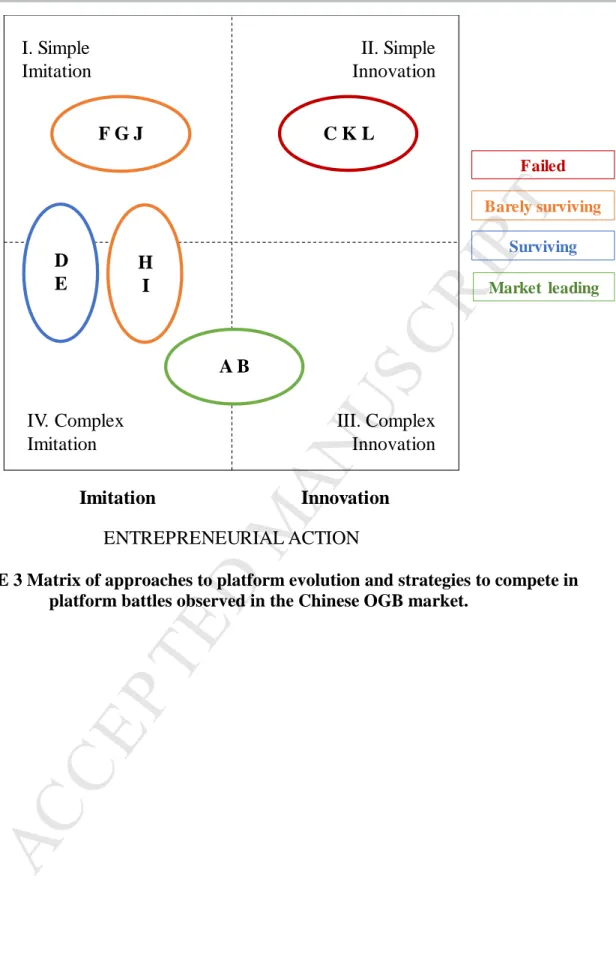
innovation). Complexity in business model design refers to the number of design elements and the interactions among those elements, while entrepreneurial action explains whether a multi-sided platform relies on business model innovation or imitation when changing one or more design elements in the business model. Here, our analysis inductively suggested four patterns of business model evolution: simple innovation, complex innovation, simple imitation, and complex imitation (quadrants I to IV in Figure 3; see also Appendix C for illustrative quotes).
Simple innovation. Simple innovation refers to a pattern whereby a focal platform firm introduces, occasionally or infrequently, innovations that are only loosely coupled to other innovations (and imitations) in its business model. Simple innovations involve creating a small number of novel design elements, e.g., Case C opened several offline stores as a
promotion channel and to manage customer relationships. This choice was easily added to the existing business model design, as it did not require the firm to create complex
interdependencies with existing components.
Multi-sided platforms may also introduce innovations that would have normally required a number of interdependent changes in the existing business model, but they treated
M
AN
US
CR
IP
T
AC
CE
PT
ED
the innovation as a new business that was subsequently spun off from the OGB business. As a consequence of this decision, the spin-offs did not enjoy the necessary support to grow into a sustainable business model component. Taking Case C again as an example, it formed a project team to develop a mobile payment system, hoping to use the system in its own app and lease it to third parties. However, this innovation was abandoned after seven months in favor of scaling its business model through acquiring several small OGB firms. Since the mobile payment system had only a limited relation with Case C’s core business, the company failed to devote substantial resources to the innovation. As the co-founder of Case C
explained:
“There were a lot of uncertainties with the experiment and it was not like we cannot live without it. So, we did not bet all our efforts and resources on it. That is why only a project
team was doing the research and development.”
In other cases, the platform firms introduced a core innovation but did not add highly interactive design elements to develop the innovation further. For example, Case L entered the OGB market by introducing the concept of an OGB aggregator platform. Instead of managing relationships with merchants, this innovation enabled L to select deals across several OGB websites and, thus, increased the variety of deals for consumers. Because of this innovation, L no longer needed to maintain or manage relationships with merchants but rather collected existing deals from OGB websites. Consequently, the business model of L became cost-driven. However, the innovation stayed simple as L added only two design elements over a three-year period.
Complex innovation. Complex innovation refers to a pattern in which a platform creates complex interdependencies between a large number of design elements by engaging in on-going innovations within its own business model. However, a business model
innovation that enables a firm to gain an advantage over its rivals also encourages imitation, so, to stay ahead of the competition, the innovator may decide to continue developing its new
M
AN
US
CR
IP
T
AC
CE
PT
ED
business model through a series of innovations. Thus, by the time rivals have successfully imitated an innovator’s new activity system, the innovator may have made further changes to its business model, thereby shifting its focus from novelty towards reliability.
In other instances, a platform may first engage in a series of changes and, during this process, discover an opportunity to generate new customer segments that it seizes by altering its business model. As an example, through a series of innovations (July 2010 to September 2013), Case B extended its business model and moved from simply offering deals to
generating a large amount of data from consumer reviews. Consumers provided these reviews to comment on deals and services offered by local merchants. For instance, B collected data on the popularity of different merchants in a particular area. Because of this enormous data resource, B was approached by Apple in October 2012 to collaborate in the development of the Chinese version of Siri, a program that enables conversational interaction between users and their smartphones. Collaborating with Apple in the development of Siri, “offered valuable experiences” (co-founder Case B) that resulted in the subsequent development of innovations. Eventually, Case B created a two-way flow of traffic with Internet firms by providing “big data” to the firms and collaborating to create value-added services, which greatly expanded the platform and industry boundaries. During this process, nine innovations were carried out by B over a three-year period, where the new design elements were highly interactive with one another and tightly linked to shape the evolution of its platform business model.
Simple imitation. This refers to a pattern in which a platform observes a rival’s business model and selects and copies the most imitable design elements into its own business model. Such imitations often require only minor changes in the imitator’s business model. There is, therefore, a low level of interaction between the imitated design element and the existing components of the business model. The co-founder of Case G explained that
M
AN
US
CR
IP
T
AC
CE
PT
ED
innovations from first movers often become an industry standard that subsequently attracted imitation. For example, when Case A changed the revenue side of its business model by introducing a refund policy, seven out of the twelve cases in our sample copied this innovation because they “were afraid of being left out”, according to Case G. Besides adopting industry standards, platforms following this pattern primarily imitated rivals’ business model innovations that were relatively easy to understand and did not require a lot of effort to integrate them into the existing business model. When A, for example, introduced a customer relationship management (CRM) system to its business model in February 2011, Case F, G and J copied this innovation as it was relatively easy to understand how activities in this system, e.g., tracking the transaction history of consumers and recommending deals according to their preferences, create value for the customer and the platform firm as well as its role in improving customer experience. According to Case J, “the CRM system was crucial to managing customer relationships. When the deals become more diversified, we need to know what type of deals each customer segment is interested in.”
Complex imitation. The final pattern we identified is complex imitation, which begins with imitating a rival’s innovation, but successively develops the imitation through
innovation. In contrast to simple imitation, this pattern shows a higher demand for integrating a number of design elements into the imitator’s business model because the process of
adaptation created new linkages among activities, introduced new activity governance, or incrementally changed the content of other activities that complemented the adapted
imitation. In this pattern, firms tended to invest heavily in the collection of intelligence about competitors as well as into activities that increased understanding of the interconnections between elements of their own business model. This enabled platforms to copy more complex parts of a rival’s business model. For instance, in November 2011, Case I imitated Case D’s mobile app which facilitated the promotion of deals depending on the location of a consumer.
M
AN
US
CR
IP
T
AC
CE
PT
ED
Combining this with social media services enabled Case I to greatly extend its original functions. This combination offered significant advantages (e.g., for friends in the same area, the app may recommend deals for “cool bars”; for couples, deals from “romantic restaurants” etc.). As Case I explained, because of this adaptive imitation, social networks and location-based services became the “key to the business model”.
Strategies to Compete in Platform Battles
In this section, we explore the contribution of the observed patterns for developing platform business models and discuss how and why the platforms compete through applying the patterns (summarized in Table 3). While we observed that platforms can use several patterns in the business model design process, not all patterns mattered for the growth of the platform businesses. The focus is, therefore, on what pattern(s) dominate actions aiming at creating competitive advantage within and across cases (see Appendix D). Our analysis reveals that the case firms used four strategies some of which combined the patterns identified in the previous section, while others focused on a particular pattern to achieve competitive advantage to compete in the market. Figure 3 shows the position of the four strategies within the matrix of the four evolution patterns.
--- INSERT FIGURE 3 AND TABLE 3 HERE ---
Innovation-centred strategy to create simple business model designs. Case C was highly innovative between 2010 and early 2012 by focusing on simple innovations (fourteen simple innovations). Cases K and L, in contrast, developed business models around a core innovation in their early platform stage but soon stopped developing the business model further. Although Cases C, K, and L all showed a high level of innovativeness, their business
M
AN
US
CR
IP
T
AC
CE
PT
ED
models were relatively simple in the sense that there was a lack of design elements and/or the interdependencies between the design elements were rather fragile. Subsequently, Case C, K, and L all failed and left the OGB market.
C mostly introduced innovations that were essentially experiments, with little or no relation to its existing business model. Their outcomes were unpredictable, and they were relatively easy to abandon, as their strategic relatedness to other components of the business model were rather weak. Case C abandoned nine out of fourteen innovations, which
consumed time and resources in the short-term. Besides these failed innovations, the
frequency with which C introduced these changes to its business model had a negative impact on its competitiveness. For example, while C introduced four innovations between December 2011 and February 2012, Case A took advantage of C’s distraction with these “random” (co-founder of C) experiments and replaced C as the market leader. By this time, C essentially no longer had a vision of its platform evolution and stopped its development for a period of nine months. In that time, C lost market share to B, D, and E (see also Figure 2). Case C
completely shifted its focus to imitation in late 2013, which did not, however, aid recovery. Eventually, Case C stopped developing new deals by 2014, which marked its failure in the Chinese OGB market.
Cases K and L were satisfied with the status quo and stopped further development of their platform business models. Although their core innovations improved short-term competitiveness, the simplicity of their business models made the firms vulnerable when facing competition from rivals with a deep resource base and strong competencies. Eventually, both firms left the OGB market.
These companies typically did not respond to competitors’ business model development during the evolution process, mainly because they were blinded by their temporary competitive advantage as the result of certain innovations. For example, although
M
AN
US
CR
IP
T
AC
CE
PT
ED
L did recognize that its business model innovation was imitated and further developed by others, the founder of the company did not see any need to react to imitators: “We were completely confident about our business model; we felt no changes were required”. Only after Case F (a business unit of a well-known Chinese Internet company) entered the market with an imitation of L’s business model, did L begin to recognize the market process of competition. While L was shocked that competition “suddenly became so aggressive”, F assessed the situation quite differently “[competition] was never something that happened suddenly”.
Similarly, Case C was the first to introduce social, location, and mobile (SOLOMO) related innovations to its OGB business model. However, when Case C ran into problems with creating interdependencies between the elements, it abandoned these social components in favour of focusing on scaling the business model. C did not notice that competitors, such as Case D, had started imitating their business model. However, asked in the interview about this, the co-founder of Case C noted that a look at competitors “might have provided potential solutions to the issues” in developing the SOLOMO innovation. While Case C gave up its business model development, Case D eventually completed its SOLOMO-centred business model and outperformed Case C. The founder of C reflected: “I don’t know why we did not notice Case D. Possibly because we overlooked most competitors at that time; we were the largest, the richest, the most innovative, the leader, you know, all that halo.”
Imitation-centred strategy to create simple business model designs. At the other end of the spectrum, Cases F, G, and J relied mostly on simple imitations in developing their platform business models. Reflected in interviewees’ comments, imitation is not as
straightforward as it may seem. It requires monitoring a rival’s activity system, identifying design elements to copy (often precisely) and integrating them into the imitator’s business model. As elaborated by the founder of Case F:
M
AN
US
CR
IP
T
AC
CE
PT
ED
“I do not understand why people have so many negative feelings about imitation. Being ashamed about imitation is like being ashamed about tracking the development of the industry […] Why is introducing a similar activity as a defence wrong? In fact, innovation is
linked to a firm’s ability to collect information from competitors and learn from existing businesses to a large extent. Competitors can help us to innovate. If you don’t extensively observe, disassemble, and ‘reverse engineer’ a competitor’s business model, you will never
know how the business model can be improved further. I mean, you will never know what works in the business model and what doesn’t.”
Indeed, copying the right element may have an immediate positive impact on
performance as companies often imitate proven or validated elements from a rival’s business model. In other words, copying may save time and deliver quick results. For example, Case G strengthened consumer relationships by copying an activity to provide refunds to consumers.
However, imitators may only be able to evaluate a specific component or part of a competitor’s activity system and may overlook the bigger picture: they often copied only what they could easily understand, instead of imitating an interdependent, more complex, set of design elements. For example, while Cases F, G, and J copied the simplest component (the CRM system), Case A continued to innovate around its CRM system (e.g., by adding
merchant services and deal development systems) to improve the overall efficiency of its business model. Introducing additional activity content generated virtuous cycles, or feedback loops, that strengthened the interconnection between the CRM system and other components of A’s IT infrastructure. Cases F, G and J did not copy subsequent innovations because they were not able to see the value of the interconnections between activity content and structure that A strengthened in several iterations. Even when imitators recognized the value of a complex innovation, they often faced resource constraints and a lack of competencies: some platforms did not, or were not willing to, invest in the integration of complex innovations into their activity system (or develop imitations further). For example, when the founder of Case J was asked why J stopped developing the CRM system further, he explained: “It was not that we didn’t want to. We were afraid of losing customers but we did not have enough money, people, or even time to do that. It was just not an option for us.”
M
AN
US
CR
IP
T
AC
CE
PT
ED
Without continuously developing design elements, the positive effect of the imitations quickly faded in the long-run, which explains why the sales performance of the imitators often fluctuated. For example, the founder of Case F explained:
“When we first copied (the movie ticket-related) services (the simple element in a complex innovation introduced by Case A), sales were great [...] but it did not last long [...] because
while Case A created a multi-flow traffic between its tightly linked segments (restaurants, movies, hotels, and food-delivery) within its business model, we did not have the other
segments to bring traffic to our movie segment”.
Platforms that used this strategy, therefore, barely survived, with sales fluctuating between CN¥10 million (approx. US$1.5 million) and CN¥100 million (approx. US$15 million).
Imitation-centred strategy to create complex business model designs. Cases D and E, as late entrants in the OGB market, overtook Case C through a combination of simple and complex imitations. A typical characteristic of D and E was a strong ability to make sense of how specific design elements in a rival’s business model contributed to sales and a strong ability to decompose and modularize their own business model to embrace the new design elements. While simple imitations delivered quick results, complex imitations, i.e., the subsequent adaptation of an imitation, facilitated the integration of the imitation into an activity system, eventually contributing to long-term sales by providing an opportunity to catch up with competitors. For example, Case D copied C’s abandoned innovation, the SOLOMO activity system, without fully understanding it at first, but mastered the imitation during the adaptation process, eventually achieving what C originally intended to accomplish. An industry expert commented:
“It is interesting. Nowadays, when people talk about the SOLOMO system, they always give credit to Case D. However, it (Case D) initially did not even understand the location-based services it imitated from Case C […] Yet, (while adapting the innovation) Case D did a
much better job and mastered it in this sense.”
Although they survived in this highly competitive market, Cases D and E were not able to catch-up with the market leaders. These platform firms displayed a lack of “forward
M
AN
US
CR
IP
T
AC
CE
PT
ED
thinking” (co-founder, Case E) and innovativeness. For example, the co-founder of Case D explained that D did not understand the SOLOMO business model in the beginning and they “just happened to have the social media platform that allowed us to add check-ins (to a nearby shop)” (the parent company was a social media Internet firm). The co-founders of both D and E showed a deep understanding of their competitors’ business models and the design elements that could be leveraged into their own business models but were not able to proactively introduce innovations to fundamentally challenge the logic of value creation and capture.
Furthermore, the adaptation of design elements is difficult and time consuming and the positive impact of adaptive imitation is subject to the required speed of integrating the
elements into the business model. In contrast to D and E, Cases H and I took a relatively long time to adapt imitations into their business models. While Case D completed its SOLOMO business model in 2012, Case I eventually designed the social media app based on social interactions and location-based services by the end of 2013. By the time Case I had gone through the long process of configuring and reconfiguring its business model, D had already established a strong position in the market. Consequently, Case I struggled to develop its business model further. As the founder of Case I explained:
“We have come such a long way to develop the business model […] as a small company, sometimes we cannot go as fast as the big firms. We must take one step at a time. This is frustrating because we always are at risk of missing the (right) time for introducing
the innovations. And sometimes, speed means everything in this market.”
Hybrid strategy to create complex business model designs. By December 2013, with monthly sales of CN¥2.1 billion (approx. US$324 million) and a market share of 48.8%, Case A was the most successful company in the Chinese OGB market. Case B closely followed with a market share of 26.2%. Cases A and B are, therefore, illustrations of firms that successfully developed multi-sided platform business models in this competitive environment.
M
AN
US
CR
IP
T
AC
CE
PT
ED
Cases A and B combined innovations and imitations to create complex and strong interdependencies between business model elements. This combination is associated with a high level of internal disruption and requires full awareness of components, linkages, and dynamics in business models, i.e., how the design elements come together to reinforce the firm’s unique competitive position. Case A segmented consumer demands and created four business units (movie, hotel, restaurant, and food delivery), e.g., the movie unit integrated new offerings such as ticket deals, seat selection, ticket collection, movie rating, and fan communities in a specialized app. These activities interacted with each other through four digital systems (CRM, deal development and control, merchant services, and online payment systems) that formed the digital infrastructure of Case A. By the end of 2013, Case A was recognized as a “unicorn” start-up in local services, where “A is the only name customers have in mind when they think about these things, whether seeking eating, drinking, traveling, or entertainment” (co-founder, Case A).
From its founding, Case B engaged in innovations and imitations to build its business model around the collection, analysis, and application of “big data”. A series of innovations and imitations enabled B, over time, to create complex interdependencies between activity content, structure, and governance. By 2013, B had an industry-wide reputation for creating and capturing value with the management of “big data”. During this process, B created interdependencies between design elements, and it also formed a complex system of coherent and mutually reinforcing activities. This turned out to be critical when their business model was constantly undergoing change. According to the interviewees, matching and integrating design elements was important to ensure coherenc