Espoo consultation response report
October 2014
Transboundary environmental impact
assessment of the Fehmarnbelt Fixed Link
Contents Summary ... 4 1 Introduction ... 6 1.1 Reading guide ... 8 2 Espoo Consultation ... 10 2.1 Legal framework ... 10
2.1.1 The Espoo Convention ... 10
2.1.2 National Environmental Impact Assessment... 11
2.2 The Espoo documentation ... 11
2.3 The Espoo Process ... 12
2.3.1 Background ... 12
2.3.2 Notification ... 12
2.3.3 Dialogue meetings ... 13
2.3.4 Danish Espoo Consultation ... 13
2.3.5 Final Decision ... 14
2.3.6 Delimitation of Espoo Consultation Scope ... 14
3 Swedish Consultation Comments ... 16
3.1 General Issues ... 17
3.1.1 Monitoring Programme ... 17
3.2 Transboundary Environmental Impact Assessment ... 18
3.2.1 Water Quality ... 19
3.2.2 Fish Ecology ... 19
3.2.3 Air Quality and Climate ... 20
3.2.4 Ship Traffic and Navigation ... 21
4 German Consultation Comments – Authorities ... 22
4.1 The Espoo Process ... 22
4.1.1 The Danish Espoo Process ... 23
4.2 General Issues ... 25
4.2.1 Technical description ... 25
4.2.2 Alternatives ... 26
4.3 Transboundary Environmental Impact Assessment ... 27
4.3.1 Assessment Methodology ... 27
4.3.2 Water Quality ... 28
4.3.3 Sediment and Seabed Forms ... 28
4.3.4 Fish Ecology ... 29
4.3.5 Commercial Fishery ... 30
4.3.6 Birds ... 31
4.3.7 Recreation and Tourism ... 32
4.3.8 Air Quality and Climate ... 32
4.3.9 Ship Traffic and Navigation ... 33
4.3.10 Cumulative Impacts ... 34
4.4 Consultation comments outside the scope of the Espoo Consultation ... 35
Side 3/59
5.1 The Espoo Process ... 36
5.1.1 Strategic Environmental Assessment ... 36
5.1.2 Execution of the Danish Espoo ... 36
5.1.3 Espoo Documentation ... 38
5.2 General Issues ... 39
5.2.1 Technical Description of the Immersed Tunnel ... 39
5.2.2 Alignments and Alternatives Including the 0-Alternative ... 42
5.3 Transboundary Environmental Impact Assessment ... 43
5.3.1 Assessment Methodology ... 43
5.3.2 People and Human Health ... 44
5.3.3 Hydrography ...45
5.3.4 Water Quality ... 46
5.3.5 Sediment and Seabed Forms ... 47
5.3.6 Benthic Fauna ... 49 5.3.7 Fish Ecology ... 49 5.3.8 Commercial Fishery ... 50 5.3.9 Marine Mammals ... 50 5.3.10 Birds ... 51 5.3.11 Migrating Bats ... 52
5.3.12 Recreation and Tourism ... 53
5.3.13 Raw Materials and Waste ...54
5.3.14 Air Quality and Climate ...54
5.3.15 Ship Traffic and Navigation ...56
5.3.16 Cumulative Impacts ... 57
5.4 Consultation comments outside the scope of the Espoo Consultation ... 57
Side 4/59
Summary
This report constitutes and documents the result of the Danish Espoo Consultation Process of the transboundary environmental impact assessment (EIA) for the Fehmarnbelt Fixed Link performed by the Danish Ministry of Transport and the Danish Espoo Point of Contact, the Danish Nature Agency. The Fehmarnbelt Fixed Link is subject to a transboundary EIA according to the Espoo Convention on Environmental Impact Assessment in a Transboundary Context and EU Directive 2011/92/EU on the assessment of the effects of certain public and private projects on the environment.
The Fehmarnbelt Fixed Link is a joint Danish and German transport infrastructure project across the Fehmarnbelt planned as an immersed tunnel. The Danish Espoo Consultation of the Baltic Sea coun-tries including Germany and Norway as potential affected Parties has been performed in accordance with the Espoo Convention during the period from 28 June to 4 October 2013.
Overview of Respondents
During the Danish Espoo Consultation Process comments on the consultation material were received from seven nations, of which Norway, Finland, Lithuania, Poland, and the Russian Federation had no remarks.
Comments to the Danish Espoo Consultation documentation were received from Sweden and Germany. The respondents from Sweden represent public authorities of which a few had comments only related to environmental issues of the transboundary EIA. The respondents from Germany include a few public authorities and organizations whereas the majority are from private stakeholders.
According to Article 6 of the Espoo Convention, comments received during the Danish Espoo Consulta-tion Process will be taken into account in the development of the final decision of the Fehmarnbelt Fixed Link.
Espoo Consultation Subjects
Consultation comments received during the Danish Espoo Consultation from Swedish and German authorities and public bodies as well as from private German stakeholders are related to the following subjects:
Espoo Process
Espoo Documentation
Alignments and Alternatives Technical Description Monitoring Programme
Assessment Methodology People and Human Health Hydrography
Water Quality
Sediment and Seabed Forms Benthic Fauna Fish Ecology Commercial Fishery Marine Mammals Birds Migrating Bats
Recreation and Tourism Raw Materials and Waste Air Quality and Climate
Ship Traffic and Navigation Cumulative Impacts
This Danish Espoo Consultation Response Report presents comments received in the Danish Espoo Consultation Process. Comments are followed by responses given by the Danish Party of origin.
The Danish Ministry of Transport and the state owned Femern A/S has carefully assessed all comments received during the Danish Espoo Consultation and they will, where relevant, be incorporated into the project design and further planning of the project.
According to the Espoo Convention, the consulted affected Parties will be notified of the final decision on the Fehmarnbelt Fixed Link.
Side 6/59
1
Introduction
This report constitutes and documents the outcome of the Danish Consultation Process of the trans-boundary environmental impact assessment (EIA) for the Fehmarnbelt Fixed Link (Danish Espoo Con-sultation Response Report) performed by the Danish Ministry of Transport and the Danish Espoo Point of Contact, the Danish Nature Agency.
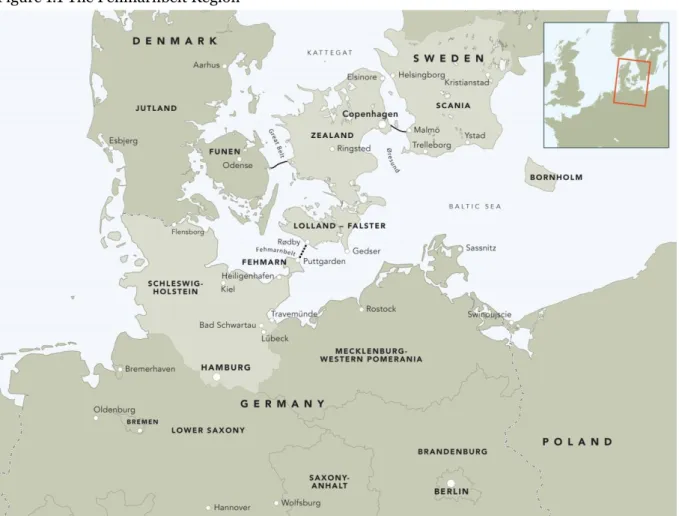
The Fehmarnbelt Fixed Link (hereafter “the Project”) is a joint Danish and German transport infra-structure project across the Fehmarnbelt (Figure 1.1).
Figure 1.1 The Fehmarnbelt Region
The Danish Espoo Consultation Process of the Baltic Sea countries including Germany and Norway as potential affected Parties is performed in accordance with the Espoo Convention on Environmental Impact Assessment in a Transboundary Context (hereafter "the Espoo Convention" or "the Conven-tion") and, as required, without undue delay after completion of the Danish national EIA documenta-tion.
Side 7/59
Comments on the Danish Espoo Consultation documentation were received from Sweden and Germa-ny, while Norway, Finland, Lithuania, Poland and the Russian Federation had no remarks.
A German Espoo Consultation Process will be performed by the relevant German authority as a part of the German national Plan approval process.
The Fehmarnbelt Fixed Link has been planned in accordance with the 2008 Treaty between the King-dom of Denmark and the Federal Republic of Germany for a fixed link across the Fehmarnbelt (hereaf-ter “the State Treaty”).
The Kingdom of Denmark is responsible for the planning, construction, and operation of the Fehmarn-belt Fixed Link. In order to carry out this task the government of Denmark has established the company Femern A/S, which is 100% owned by the Danish State, represented by the Danish Ministry of
Transport.
Femern A/S is on behalf of the Danish Ministry of Transport, conducting the investigations, planning, and design in relation to the establishment of the Fehmarnbelt Fixed Link.
The Danish Nature Agency is the Danish Espoo authority and responsible for giving information about the legal requirements of the Espoo Convention and the EU Directive 2011/92/EU on the assessment of the effects of certain public and private projects on the environment.
The final decision and approval of the Project in Denmark is to be granted as a Construction Act passed by the Danish Parliament.
The Fehmarnbelt Fixed Link has been planned as a consequence of Denmark and Germany recognizing that the transport infrastructure between the two states should be improved in order to promote the European and regional transport of goods and people. A fixed link across the Fehmarnbelt would lead to an appreciable improvement in the transport of goods and people between the two countries and also between continental Europe and Scandinavia.
Furthermore, the two countries wishes to strengthen the transport links between the two states and thereby create the necessary conditions for a more intensive cultural and economic cooperation to the benefit of the European Union, the two states, and the regions bordering the Fehmarnbelt.
A Fehmarnbelt Fixed Link will promote rail traffic between Germany and Denmark and also between continental Europe and Scandinavia and strengthen the integration and vitality in the regions as well as promote competition and development in the regions.
The fixed link across the Fehmarnbelt will extend to stretch across the 18 kilometers wide Fehmarnbelt between the Danish island of Lolland and the German island of Fehmarn in the western part of the Bal-tic Sea. It is planned as an immersed tunnel based on investigations of different technical solutions in terms of e.g. technical construction risks, construction investments and environmental factors. The Fehmarnbelt region is demarcated as the northern part of Germany, the eastern part of Denmark and the southern part of Sweden (Figure 1.1). The region has a population of just under 9 million,
ap-Side 8/59
prox. 1.2 million in the Swedish part, approx. 2.5 million in the Danish part and approx. 5.2 million in the German part.
The Fehmarnbelt Fixed Link covers areas on Lolland (Denmark), Fehmarn (Germany) and a marine area (Denmark and Germany). The project crosses the national border between Denmark and Germany. Construction works will take place within the national jurisdictions of both countries.
1.1
Reading guide
The Danish Espoo Consultation Response Report includes comments received during the Consultation Process as well as responses to those comments from the Danish Party of origin. The report is divided into chapters according to the possible affected Party and, where relevant, further divided into authori-ties and private stakeholders including NGO’s. This structure allows each potentially affected Party to easily obtain an overview of the comments and responses related to their country or institution. In each chapter the comments are organized by topic and follow the structure of the Espoo Report. The specific content of each chapter is described in detail below.
Chapter 2 presents the legal basis for the Espoo Consultation Process and includes a presentation of the documentation and processes performed thus far. An overview of respondents in the Danish Espoo Consultation Process is also provided.
In addition, Chapter 2 describes the scope of the Espoo Consultation Process for the Fehmarnbelt Fixed Link, including the delimitation of transboundary EIA elements and topics.
Chapters 3 to 5 present the issues raised by every specific comment received in the Danish Espoo Con-sultation Process, but is not an accurate word-by-word rendering. Comments are followed by responses given by the Danish Party of origin.
Comments were received from only two countries, Sweden and Germany. Consequently, the chapters are compiled as follows:
Chapter 3: comments from Swedish authorities
Chapter 4: comments from German authorities
Chapter 5: comments from private German stakeholders.
In each chapter, the comments are organized according to topic as described below:
Espoo process
Comments related to the general aspects of the Danish Espoo Consultation Process, including corre-spondence with national EIA processes, correcorre-spondence between the Danish and German parts of the Espoo and EIA processes, and the language of available project reports.
General issues
Side 9/59
aspects of the environmental assessments, such as investigated alternatives and alignments and the monitoring programme.
Transboundary impacts
Comments related to the EIA as well as the assessed environmental components themselves. In the Fehmarnbelt Fixed Link the term “component” is used about the subjects of the assessment as e.g. wa-ter quality or marine mammals. The topics follow the order of the corresponding environmental as-sessment of components in Chapter 7 of the Espoo Report. The present report only includes compo-nents mentioned in the comments received during the Danish Espoo Consultation Process.
In each chapter, individual comments are presented in a box followed by responses provided by the Danish Party of origin. The responses focus on transboundary environmental impacts as well as on the correlation between components. Where relevant, any consequences with regard to further develop-ment of the project as a result of the comdevelop-ments received during the Danish Espoo Consultation Process are described.
Side 10/59
2
Espoo Consultation
This chapter outlines the legal framework for carrying out the Danish Espoo Consultation Process for the Fehmarnbelt Fixed Link including correspondence with national EIA processes in Denmark and Germany. The Danish Espoo Consultation documentation is presented as well as an overview of the Danish Espoo Consultation Process.
At the end of the chapter, an overview of the respondents is presented, along with the principles for delimiting the scope of the Danish Espoo Consultation Response Report.
2.1
Legal framework
2.1.1
The Espoo Convention
The Fehmarnbelt Fixed Link is subject to a transboundary EIA according to the Espoo Convention on Environmental Impact Assessment in a Transboundary Context and EU Directive 2011/92/EU as the Fehmarnbelt Fixed Link can potentially impose transboundary environmental impacts.
The Espoo Convention’s primary aim is to prevent, mitigate and monitor environmental damage by ensuring that explicit consideration is given to transboundary environmental factors before a final na-tional decision is made as to whether to approve a project.
In addition, the objective of the Espoo Convention is the identification and communication of potential transboundary impacts to stakeholders via the application of an impact assessment.
Parties of origin
According to Article 3 of the Espoo Convention, the Parties of origin are responsible for the content and acknowledgement of receipt of notifications, and for the exchange of relevant information to/from the potentially affected countries.
For a transnational project such as the Fehmarnbelt Fixed Link, both Denmark and Germany are Par-ties of origin.
In Denmark, the Danish Ministry of Environment is responsible for the above-mentioned exchange of relevant information to and from the potentially affected countries in connection with the Danish Espoo Consultation Process.
Possible Affected Parties
According to Article 3 of the Espoo Convention, Germany and Denmark must notify possible affected Parties. In relation to the Fehmarnbelt Fixed Link, the possible affected Parties, apart from Denmark and Germany, could be countries around the Baltic Sea, Sweden, Poland, Finland, Estonia, Latvia, Lith-uania, the Russian Federation and Norway.
Furthermore, since the Fehmarnbelt Fixed Link is a transnational project, the Parties of origin (Den-mark and Germany) are also considered possible affected Parties.
Side 11/59
2.1.2
National Environmental Impact Assessment
According to the Treaty from 2008 between the Kingdom of Denmark and the Federal Republic of Germany, the necessary approval procedures for the part of the fixed link across the Fehmarnbelt that is situated on German territory shall be carried out according to German law and according to Danish law for the part of the fixed link across the Fehmarnbelt that is situated on Danish territory.
Because of the legislative and administrative differences in the requirements for the EIA documentation in Denmark and Germany, it has been decided to prepare two individual sets of EIA documentation, one for the Danish EIA procedure and one for the German EIA procedure. Both the Danish and the German EIA’s describe and assess the environmental impacts for the entire project and both are based on the same environmental data.
In Denmark the EIA is presented in one document, the Danish VVM report (Vurdering af Virkninger på Miljøet). The VVM report describes the immersed tunnel and alternative technical solutions, and as-sesses the immersed tunnel, including design optimisation and mitigation and compensation measures. The complete VVM documentation including background reports can be found at
http://vvmdocumentation.femern.com/. The public hearing of the Danish VVM report has been carried out simultaneously with the Danish Espoo Consultation.
In Germany the EIA is presented in two documents, the UVS (Umweltverträglichkeitsstudie) and the LBP (Landschaftspflegerischer Begleitplan). The UVS assesses the immersed tunnel, a bored tunnel solution and a cable-stayed bridge. The LBP focuses solely on the immersed tunnel with a more detailed planning status. On the basis of an impact and compensation balance the LBP defines mitigation and compensatory measures as well as other arrangements for the equalisation of the impacts of the project on the environment. The UVS and LBP can be found at http://pfv.femern.com/.
Due to different laws, guidelines and practices on assessing impacts with and without design optimisa-tion and mitigaoptimisa-tion and compensaoptimisa-tion measures, the assessments in the VVM/UVS/LBP can have dif-ferent nuances. However, the conclusions of the VVM are similar to the conclusions of the UVS and the LBP together.
2.2
The Espoo documentation
The Espoo Report constitutes the Fehmarnbelt Fixed Link documentation for the Danish Espoo Consul-tation Process, focusing on transboundary environmental impacts, including a summary of these (here-after ‘Espoo Report’).
The Espoo Report is prepared to serve the objectives and comply with the requirements of the Espoo Convention.
Focusing on the Espoo Convention, the Espoo Report does not replicate all of the detailed material that is required in the national EIA’s (such as national legislative provisions and detailed country-specific baseline descriptions), and is focused instead on providing sufficient background information, including baseline data, for facilitating the identification of transboundary impacts. The assessment includes de-sign optimisation as well as mitigation and possible compensation measures. As the focus is on the
Side 12/59
transboundary impacts, the conclusions therefore have different nuances compared to the national EIA reports.
According to the Espoo Convention on Environmental Impact Assessment in a Transboundary Context The Party of origin shall provide, an opportunity to the public in the areas likely to be affected to partic-ipate in relevant EIA procedures regarding proposed activities and shall ensure that the opportunity provided to the public of the affected Party is equivalent to that provided to the public of the Party of origin.
The Espoo Report is written in English and as a courtesy its summary (hereafter ‘Summary Report’) is translated into German, Polish, Finnish, and Swedish.
2.3
The Espoo Process
2.3.1
Background
The Fehmarnbelt Fixed Link has a large number of both local and regional stakeholders. As a result, Femern A/S has conducted hearings and consultations, as well as supplied the local communities with information about the project in order to involve all relevant parties and stakeholders in the further development of the project. Femern A/S will continue these information activities (e.g. newsletters) while the Project is being further developed.
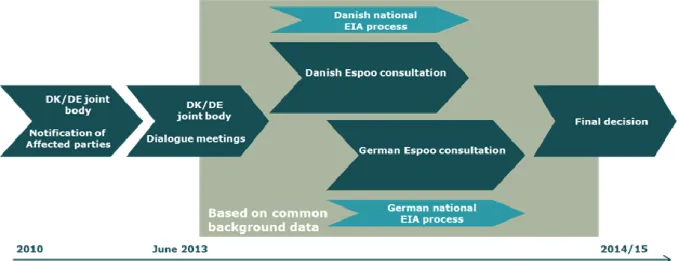
Hearings and consultations are being performed in line with legal requirements and, in addition, other means of information have been used, including web information, local meetings and participation in conferences. An overview of the hearing and consultation process is presented in figure 2.1.
Figure 2.1 Flow diagram showing the Espoo process and parallel national EIA processes
2.3.2
Notification
By letter of 21 June 2010 and according to Article 3 of the Espoo Convention Denmark notified of the Danish project to construct and operate a fixed link across the Fehmarnbelt between Germany and Denmark crossing the Exclusive Economic Zone (EEZ) and the territorial waters of Germany and
Den-Side 13/59
mark, respectively. The notified countries are Sweden, Poland, Finland, Estonia, Latvia, Lithuania, the Russian Federation and Norway.
Denmark received response from Finland, Germany, Norway, Poland, and Sweden, who indicated their wish to participate in the Espoo procedure. Denmark has also received comments on the scope of the EIA from these countries.
Estonia, Latvia and Lithuania have answered that they would like to be informed. The notification comments are published on the Femern A/S website, www.femern.com.
Comments from notified Parties have been evaluated and taken into account, and are addressed in the Espoo Report, where relevant.
2.3.3
Dialogue meetings
In the pre-consultation period, dialogue meetings concerning the Danish Espoo Consultation Process of the Fehmarnbelt Fixed Link were offered to Espoo Points of Contact in countries of potentially affected Parties. Only Poland and Sweden expressed interest for such a meeting. Consequently, dialogue meet-ings were held in these countries on 12 June and 20 June 2013, respectively.
At the meetings the principles of the technical design and construction of the immersed tunnel were presented by Femern A/S, while a representative from the Danish Nature Agency described the formal Espoo consultation process in Denmark.
2.3.4
Danish Espoo Consultation
In June 2013, Femern A/S finished the preparation of an EIA for the Fehmarnbelt Fixed Link to be used in the Danish national hearing procedure consisting of an EIA report (VVM in Danish), a summary re-port and an appendix with visualizations of the project during construction and operation.
Danish Consultation of Espoo Report of the Fehmarnbelt Fixed Link was performed in accordance with articles 4 and 5 of the Espoo Convention on Environmental Impact Assessment in a Transboundary Context and with the EU Directive 2011/92/EU. The Espoo Report containing the transboundary envi-ronmental impacts assessment together with a summary in English was sent to the interested affected Parties identified in the notification 28 June 2013. A summary in Swedish, Polish, Finnish, and German was subsequently sent to the interested affected Parties 12 July 2013.
The material was sent from the Danish Espoo Point of Contact to the national Espoo points of contact or other Party designated as the official Espoo point of contact for the specific project (e.g. in the German federal state Schleswig-Holstein the authority Landesbetrieb Straßenbau und Verkehr, LBV-SH). The designated point of contact conducted the national distribution of the Espoo documentation mate-rial.
Side 14/59
Overview of Respondents
Comments on the Danish Espoo Consultation documentation were received from Sweden and Germa-ny.
The Swedish respondents represent public authorities, of which a few had comments only related to environmental issues. The respondents from Germany include a few public authorities and organisa-tions, but the majority are private stakeholders. In addition a collection of 603 signatures was received from German private stakeholders.
An overview of received comments during the Danish Espoo Consultation Process is presented in Ap-pendix 1. The names of public authorities and bodies are provided, whereas private respondents remain anonymous.
Further Process with Danish Consultation Comments
This Danish Espoo Consultation Response Report is prepared by Danish Ministry of Transport and the state owned company Femern A/S. The Danish Nature Agency has provided information regarding the legal requirement of the Espoo Convention.
According to Article 6 of the Espoo Convention, comments received during the Danish Espoo Consulta-tion Process are to be taken into account in the final decision making process on the Fehmarnbelt Fixed Link, together with the outcome of the national EIAs and the notification process.
All comments received from possible affected Parties during the Danish consultation period are there-fore considered in the present report and will, where relevant, be incorporated into the project design and/or further planning.
2.3.5
Final Decision
According to the State Treaty from 2008 between the Kingdom og Denmark and the Federal Republic of Germany, the necessary approval procedures for the part of the fixed link across the Fehmarnbelt that is situated on German territory shall be carried out according to German law and according to Danish law for the part of the fixed link across Fehmarnbelt that is situated on Danish territory.
In Denmark, approval will be granted as a Construction Act passed by the Danish Parliament.
In Germany, approval will be granted by the German approval authority, the Landesbetrieb für Verkehr und Straßenbau, Schleswig-Holstein, Betriebssitz Kiel (LBV-SH).
According to Article 6 in the Espoo Convention, the consulted affected Parties will be provided with the final decision on the Fehmarnbelt Fixed Link when it is available, together with the reasoning and con-siderations upon which it is based.
2.3.6
Delimitation of Espoo Consultation Scope
The purpose and focus of the Espoo Process is to prevent, reduce and control significant adverse trans-boundary environmental impacts from proposed activities as described in the Espoo Convention.
There-Side 15/59
fore, the content of the Espoo Report as well as the present Danish Espoo Consultation Response Re-port is delimited to consider only environmental impacts with a transboundary effect.
A number of comments to the Danish Espoo Consultation Process from German stakeholders concern issues and impacts that are local in nature (i.e. not transboundary). Project-specific environmental im-pacts originating from local activities on e.g. Fehmarn will be addressed in the national German plan approval process, where more comprehensive documentation provided by Femern A/S will be available on the subjects concerned.
Comments regarding overall legal framework of the Fehmarnbelt Fixed Link are to some extent ad-dressed in Chapter 2 of the present Danish Espoo Consultation Response Report, and further infor-mation can be found on http://www.femern.com/.
To limit the scope of the Danish Espoo Consultation Response Report to a transboundary context, the following principles have been applied:
Comments concerning a technical design feature of the project that does not result in a potential transboundary impact are considered outside the scope of the report.
Comments concerning a potential impact from the project that is local in nature and does not give rise to indirect potential transboundary impacts are considered to be outside the scope of the report.
Comments concerning aspects of the legal framework of the Fehmarnbelt Fixed Link other than the Espoo Process are considered outside the scope of the report.
The responses to the Danish Espoo Consultation Process that have been assessed to be outside the scope of the Espoo Consultation Process are not addressed in the Danish Espoo Consultation Response Report.
However to provide the reader with an overview, these are listed at the end of each chapter when rele-vant.
Side 16/59
3
Swedish Consultation Comments
The Espoo Point of Contact in Sweden, the Swedish Environmental Protection Agency (Naturvårdsver-ket), received comments from 11 Swedish public institutions during the Danish Espoo Consultation Pro-cess.
Of these, the following six institutions had no comments on the consultation documentation:
Sveriges meterologiska och hydrologiska institut (Swedish Meteorological and Hydrological In-stitute)
Riksantikvarieämbetet (the Swedish National Heritage Board)
Myndigheten för samhällsskydd och beredskap (Swedish Civil Contingencies Agency)
Boverket (The Swedish National Board of Housing, Building and Planning)
Sveriges Geologiska undersökning (the Geological Survey of Sweden)
Kustbevakningen (the Swedish Coast Guard)
Specific comments on the Danish Espoo Consultation documentation were provided by the following five Swedish institutions:
Havs och Vattenmyndigheten (the Swedish Agency for Marine and Water Management)
Sjøfartsverket (the Swedish Maritime Administration)
Trafikanalys (Transport Analysis)
Trafikverket (Swedish Transport Administration)
Trelleborgs Kommun (Trelleborg Municipality)
No comments were received from private Swedish stakeholders during the Danish Espoo Consultation Process for the Fehmarnbelt Fixed Link.
The comments received from Sweden during the Danish Espoo Consultation Process can be divided into two topics: general issues in the Espoo documentation and the transboundary environmental impact assessment.
Comments from the above institutions as well as responses from the Danish Party of origin are present-ed in this chapter.
Side 17/59
3.1
General Issues
Comments from Sweden on general issues of the Danish Espoo Consultation Process relates only to the content of the monitoring programme planned by Femern A/S.
3.1.1
Monitoring Programme
Monitoring of Sediment Spill
Comments from Swedish stakeholders
The Swedish Havs och Vattenmyndigheten presuppose that monitoring of sediment deposition caused by the Fehmarnbelt Fixed Link will be carried out in order to ensure that threshold val-ues given in the Espoo Report are not exceeded and that no significant transboundary impacts will occur, as assessed in the Espoo Report.
It is also presupposed that mitigation measures will be applied, if the monitoring indicates ex-ceedence of expected impacts.
Response from the Danish Party of origin
Femern A/S acknowledges the comment given by The Swedish Havs och Vattenmyndigheten, and fully agrees on the importance of monitoring sediment spill during construction of the Fehmarnbelt Fixed Link.
Chapter 8 in the Espoo Report describes the overall objectives of the monitoring programme for the Fehmarnbelt Fixed Link. Femern A/S will further develop the monitoring programme, and the monitor-ing programme will be agreed with relevant Danish and German authorities before the start of construc-tion.
Monitoring of Fish Including Cod
Comments from Swedish stakeholders
The Swedish Havs och Vattenmyndigheten emphasize the importance of monitoring popula-tions of fish, especially cod, in the Baltic Sea in order to ensure that the impact from the Feh-marnbelt Fixed Link is minimised according to the assessments of the Espoo Report.
Response from the Danish Party of origin
Femern A/S acknowledges the comment given by The Swedish Havs och Vattenmyndigheten on the monitoring of populations of fish in Fehmarnbelt during construction of the Fehmarnbelt Fixed Link. As assessed in Chapter 7.6 of the Espoo Report, disturbances as well as visible and measurable tempo-rary increases in suspended sediment loads in the water column are expected only in Fehmarnbelt. Temporary disturbances during the construction period, together with the permanent loss of seabed for land reclamation areas and tunnel portals, are assessed in the Espoo Report to cause insignificant transboundary impacts on fish ecology in the Baltic Sea and adjacent marine areas. It is therefore ex-pected that basic living and recruitment conditions will be intact during the construction and operation of the project.
Side 18/59
Chapter 8 in the Espoo Report describes the overall objectives of the monitoring programme for the Fehmarnbelt Fixed Link. Femern A/S will further develop the monitoring programme, and the monitor-ing programme will be agreed with relevant Danish and German authorities before the start of construc-tion.
EU Marine Strategy Directive
Comments from Swedish stakeholders
The Swedish Havs och Vattenmyndigheten considers that the monitoring programme should be planned to control effects of the Fehmarnbelt Fixed Link in relation to compliance with the EU Marine Strategy Framework Directive. In particular, the following descriptors of the Directive should be monitored: biological diversity, marine food webs, physical damage to sea-floor integ-rity, and changes in hydrographical conditions (no. D1, D4, D6, D7 in the Directive).
Response from the Danish Party of origin
The EU Marine Strategy Directive has been implemented in both German and Danish legislation, estab-lishing goals for good environmental conditions in German and Danish marine waters. First generation marine strategies have been developed in both countries, comprising guidelines on how to monitor the objectives.
The national EIA documentation presented in Denmark and Germany specifically addresses and assess-es the potential impact on the 11 dassess-escriptors of the Directive. On the basis of thassess-ese assassess-essments it can be concluded that none of the temporary impacts in Fehmarnbelt are expected to conflict with, hinder or delay the possibility to reach good environmental conditions in all parts of the Baltic Sea.
The descriptors of marine environmental quality outlined by the Directive are planned to be monitored and documented as part of the general national monitoring programmes in Denmark and Germany.
3.2
Transboundary Environmental Impact Assessment
Comments received from Sweden to the transboundary EIA concerned the following components:
Water quality
Fish ecology
Air quality and climate
Ship traffic and navigation
The following sections outline the comments received and responses given by the Danish Party of origin.
Side 19/59
3.2.1
Water Quality
Comments from Swedish stakeholders
It is stated by Trelleborg Kommun that construction of the Fehmarnbelt Fixed Link may cause changes in the water exchange and sediment dispersion in the Baltic Sea. Trelleborg Kommun stresses that it is therefore important to describe and assess how these changes as well as the dredging activities may affect the water quality in the Baltic Sea.
Response from the Danish Party of origin
In agreement with the comment from Trelleborgs Kommun, it is assessed by Femern A/S that pressures from the Fehmarnbelt Fixed Link with potential impacts on water exchange in the Baltic Sea as well as on water quality and sediment dispersion are of high importance. Therefore, comprehensive baseline investigations of water quality have been carried out and presented along with the national EIAs. In Chapters 7.4 and 7.5 of the Espoo Report on hydrography and water quality, respectively, the impacts from, inter alia, project structures and dredging activities are described and assessed.
The modelling studies showed that the marine structures of the immersed tunnel will not have any sig-nificant impact on the stratification of the waters in the Fehmarnbelt or the Central Baltic Sea which could potentially affect water quality. Furthermore, it was concluded in the Espoo Report that dredging activities will not give rise to impacts on water quality in terms of increased nutrient release or toxic concentrations of heavy metals or persistent organic pollutants.
Impacts from increased turbidity of the water caused by dispersed sediment are assessed in the Espoo Report Chapter 7.6 on sediment and seabed morphology. It is concluded that the plumes from the ma-rine works at the fixed link site are local, and no impacts are expected from Denmark and Germany into the transboundary waters.
In order to document and control the impacts on water quality from the Fehmarnbelt Fixed Link, a monitoring programme will be planned by Femern A/S and carried out in the construction phase as well as during part of the operational phase. The objective of the programme is to ensure that potential impacts from the project will be in adequate compliance with the assessments of the EIA and Espoo Report as well as the requirements in the national and international legal framework, e.g. the European Water Directive.
3.2.2
Fish Ecology
Comments from Swedish stakeholders
The Swedish Havs och Vattenmyndigheten stress that a barrier effect from the construction phase of the tunnel may impact fish migrating to Swedish waters, and increased turbidity of the water may potentially impact recruitment of e.g. cod in Swedish waters.
Furthermore, it is stressed that the footprint of the project itself may also potentially impact the area for spawning and nursery, which may affect fish in Swedish waters.
Side 20/59
Havs och Vattenmyndigheten finds it of particular importance to minimize the impact on cod, and to follow up on the impact in a monitoring programme. It is noted that the construction pe-riod is relatively long and that the existing population of cod is already impaired in the Baltic Sea.
Response from the Danish Party of origin
Femern A/S has carried out comprehensive baseline studies on distribution of fish populations and fish ecology in connection with preparation of the EIA.
In Chapter 7.11 of the Espoo Report the impacts of different project pressures, including land reclama-tions, changes in the hydrographical regime, sediment spill, noise and vibrareclama-tions, have been assessed for the most important fish species. The importance of fish species was based on protection level and ecological importance.
Concerning cod, temporary land reclamation will lead to a medium impairment of spawning, egg-larvae drift and feeding for cod in the near zone (500 m distance from the footprint of the project). The possi-ble direct transboundary effects are mainly caused by sediment plumes and re-suspension of material in the Mecklenburg and Arkona Bights, where a medium level of sedimentation is expected for the first three years of the construction period. During operation, the physical structures in the Danish near zone are expected to cause a medium impairment of cod feeding; and due to land reclamation there is a small, but less severe loss of cod nursery in both the German near zone and the Danish near zone. According to the Espoo Report Femern A/S has assessed that an insignificant impact may occur in Swe-dish waters on the fish species herring, cod and whiting, whereas other species are not expected to expe-rience a transboundary impact from the project.
In order to control and ensure that the potential impact from the construction of the immersed tunnel will be in compliance with the assessments of the Danish Espoo and EIA documentation as well as na-tional and internana-tional legislation, a monitoring programme will be planned and carried out. For fur-ther information see Section 3.2.2.
3.2.3
Air Quality and Climate
Comments from Swedish stakeholders
A comment from the Swedish Trafikanalys relates to the impact of changes in freight traffic caused by the Fehmarnbelt Fixed Link. It is stressed that the project can be expected to impact the mode of transport far away from the project area. Therefore, at least the environmental as-sessment of global impacts should be based on a larger investigation area than the one applied in the assessment of local and regional environmental assessments.
Response from the Danish Party of origin
A larger investigation area was employed in the assessment of the impact of the Fehmarnbelt Fixed Link on greenhouse gas emissions than generally for environmental components. Emissions have been calcu-lated based on an analysis of changes in the traffic within an influence area covering Scandinavia and most of Northern Europe. The full model is described in the report ‘Fehmarn Belt Forecast 2002’.
Side 21/59
The overall assessment of traffic impacts on climate concluded that an immersed tunnel will result in a reduction of greenhouse gas emissions in the operation phase (reference year 2025) with regard to traf-fic. This result thus includes changes in long-distance traffic patterns caused by the Project, mainly due to expected shorter transport routes for freight, transfer of freight transport from lorries to trains and possible closure of the ferries between Rødby and Puttgarden.
3.2.4
Ship Traffic and Navigation
Comments from Swedish stakeholders
The Swedish Sjøfartsverket comments that it is of great importance to secure ship traffic and safety to and from the Baltic Sea through Fehmarnbelt. Disturbance of ship traffic should be minimized, even if it may impact the time schedule or construction cost of the project in a nega-tive way. Sjøfartsverket thereby agrees with the Vessel Traffic Service (VTS) and coordination centre for construction vessels planned by Femern A/S.
The Swedish Trafikverket comments that ship traffic in as well as to and from Swedish waters must not be affected by the construction or the operation of the immersed tunnel.
Response from the Danish Party of origin
As described in the Espoo Report chapter 7.23, the construction of an immersed tunnel involves a num-ber of marine activities, which will affect the ship traffic and navigation in the Fehmarnbelt. All non-construction ship traffic will be maintained throughout the non-construction period; i.e. commercial traffic on the T–route through Fehmarnbelt, ferry traffic across the Fehmarnbelt, commercial traffic on main navigational routes in the western part of Fehmarnbelt, and additional traffic with smaller ships in the area (local commercial ships, fishing boats and pleasure crafts).
In order to uphold and secure navigational safety in the Fehmarnbelt area during construction of an immersed tunnel Femern A/S has in collaboration with German and Danish maritime authorities estab-lished a maritime coordination group. The risk control options include a temporary Vessel Traffic Ser-vice (VTS) system and guard ships in connection with each offshore work area, as well as safety zones around work areas and a work vessel coordination (WVC) centre.
On the basis of these considerations and the plan for construction activities prepared by Femern A/S, disturbance of ship traffic through Fehmarnbelt will be minimized, navigational safety will be secured and passage will be maintained throughout the entire construction period for the immersed tunnel.
Side 22/59
4
German Consultation Comments – Authorities
In Germany the Espoo Point of Contact in relation to the Fehmarnbelt Fixed Link is Landesbetrieb Straßenbau und Verkehr, Schleswig-Holstein, Betriebssitz Kiel (LBV-SH) on behalf of the Bundesminis-terium für Umwelt, Naturschutz, Bau und Reaktorsicherheit, BMUB.
The Danish Espoo Point of Contact has received a total of seven responses from German authorities during the Danish Espoo Consultation Process.
Four of these had no comments on the Espoo Documentation and considered the project and the as-sessment to be sufficient. The respondents were:
Der Ministerpräsident des Landes Schleswig-Holstein, Staatskanzlei (the Minister-President, State Chancellery)
Archäologisches Landesamt (Archaeological State Office of Schleswig-Holstein)
Kreis Ostholstein (the County of Ostholstein)
Wasser- und Schifffahrtsverwaltung des Bundes, WSV (Waterways and Shipping Administra-tion of the Federal Government)
Specific comments on the Espoo documentation were received from the following three German author-ities:
Ministerium für Energiewende, Landwirtschaft, Umwelt, und ländliche Räume, MELUR (Mi-nistry of Energy, Agriculture, the Environment and Rural Areas Schleswig-Holstein)
Stadt Fehmarn
A joint comment from 16 municipalities in Ostholstein
The comments from German authorities on the Danish Espoo Consultation focused on the execution of the Espoo Process, the Espoo Consultation documentation and the language of the reports, aspects of the technical description and other general issues of the Espoo Report as well as a number of compo-nents in the transboundary EIA.
4.1
The Espoo Process
Some of the comments from German authorities received during the Danish Espoo Consultation Pro-cess relate to the Espoo Procedure and the legal requirements of the Espoo Consultation ProPro-cess as well as the content and language of the Espoo documentation. The specific comments given by the Stadt Fehmarn and 16 municipalities in Ostholstein are outlined below.
Side 23/59
4.1.1
The Danish Espoo Process
Comments from German authorities
Stadt Fehmarn comments that the time frame of the Espoo Consultation is not sufficient to make a critical review of the Espoo Report.
Stadt Fehmarn furthermore comments that the results of the Espoo Process should be evaluated before conduction of the national EIA Process in order to take the results of the Espoo consulta-tion into consideraconsulta-tion in the naconsulta-tional Danish approval process.
The municipalities in Ostholstein stress that holding only one public meeting, which was in Denmark, is not in compliance with the principle of reciprocity and equality of the Espoo Pro-cess.
Response from the Danish Party of origin
The Danish Espoo Consultation Process of the potentially affected Parties from construction and opera-tion of the Fehmarnbelt Fixed Link was performed without undue delay after finalisaopera-tion of the Danish national EIA documentation as required by the Espoo Convention (Article 5).
All comments received in the Danish Espoo Consultation Process will be considered by the Ministry of Transport and taken into account where relevant in the further development of the project as required by the Espoo Convention.
The competent Danish Espoo authority, the Danish Nature Agency is of the conviction that the current consultation is in compliance with the Espoo Convention and EU requirements.
Furthermore the Danish Nature Agency is convinced that all affected parties can be considered to have had the opportunity to participate in the Danish Espoo process. Furthermore, a consultation period of more than eight weeks is in compliance with Danish legal practice. The actual consultation period of the Fehmarnbelt Fixed Link was 14 weeks.
The initial Espoo notification process of the Fehmarnbelt Fixed Link, where countries of potentially affected Parties were offered an opportunity to participate in the Espoo Process, was conducted jointly by Germany and Denmark in 2010 (see Chapter 2). Taking the notification comments into account, the Danish Espoo Consultation documentation was sent in June 2013 to the national Espoo Points of Con-tact of potentially affected Parties who expressed interest in participating in the Espoo Consultation Process during the notification period. The Espoo Consultation documentation thereafter was distribut-ed to national stakeholders in accordance with the Espoo Convention.
In the pre-consultation period, dialogue meetings concerning the Espoo Process of the Fehmarnbelt Fixed Link were offered to Espoo Points of Contact in countries of potentially affected Parties. Only Sweden and Poland expressed interest in such a meeting. Consequently, meetings were held in Sweden and Poland on 20 June and 12 June 2013, respectively.
In the Espoo consultation letter sent to national Espoo Points of Contact, it was announced that a public meeting with participation of the Danish Ministry of Transport, Femern A/S and the Danish Ministry of Environment would take place on Lolland on 29 August 2013 in relation to consultation of the Danish
Side 24/59
EIA. The public meeting was conducted in Danish, but interpretation from Danish to German was pro-vided at the meeting.
The Danish Espoo Documentation – Language
Comments from German authorities
Stadt Fehmarn states that in the Summary Report there is only a short outline of the project de-scription, of the planning process and the alternatives, and only the results of the transboundary environmental impacts are displayed. There is no description of the assessment method and evaluation. This is stressed not to be sufficient for a complete opinion on the Espoo Consultation by Stadt Fehmarn, and the reservation is taken that a German translation of the Espoo Report will be provided.
Municipalities in Ostholstein comment that it is not possible for the German public (affected cit-izens, cities and municipalities, environmental organizations, etc.) to participate in the Espoo Consultation Process or to make an equivalent assessment of the EIA report with the present language barriers, because only a 62-page summary is available in German. According to § 9b in the German EIA legislation, the Espoo documents should also be available in German.
Response from the Danish Party of origin
The complete original Espoo Report is available in English. A non-technical summary of the Espoo Re-port is available in English, German, Polish, Swedish, and Finnish.
All background documentation is in English and is presented along with the Danish EIA documentation (see Section 2.1.2).
The Danish Nature Agency has informed that neither the Espoo Convention nor the EIA Directive con-tains any provisions of to what extent the relevant environmental impact documentation for the trans-boundary public participation has to be translated into the official language. The Danish national law does not constitute any translation requirement of the affected Parties either.
The Party of origin is therefore convinced that the documentation provided in the Danish Espoo Consul-tation Process meets the legal requirements.
The national EIAs are prepared in national languages e.g. the Danish EIA is in Danish, and the complete and detailed EIA documents for the German process is, as required by German law, in German lan-guage. The documentation is made available to the public during consultation of the German plan ap-proval documentation.
The Danish Espoo Documentation – Content
Comments from German authorities
It is stated by Stadt Fehmarn that the environmental components investigated are not plausible and do not correspond to the components specified by German EIA legislation.
Side 25/59
Response from the Danish Party of origin
In 2010 Femern A/S presented a Scoping Report for the Fehmarnbelt Fixed Link. The purpose of the Scoping Process was to determine the framework for the content, scope and area of the studies in Den-mark and Germany. The methods and other relevant subjects relating to the Environmental Impact Statement were described and agreed on with the competent authorities.
The content of the Scoping Report and thereby the environmental conditions to be included in the base-line investigations and the subsequent EIA were proposed by Femern A/S and the Schleswig-Holstein State Agency for Road Construction and Transport, Lübeck Office (LBV Lübeck). The content was ap-proved by the competent Danish and German authorities as well as presented to the environmental organizations in Germany and the public in Denmark, who all participated in deciding on the frame-work of the assessment.
It is the opinion of the Party of origin that the investigated environmental components included in the Espoo Report are in compliance with the legal requirements of both Denmark and Germany.
4.2
General Issues
A number of comments received from German authorities during the Danish Espoo Consultation Pro-cess concern the technical description of the immersed tunnel as well as the assessment of alternative technical solutions.
These subjects, which form the basis for the transboundary impact assessments of environmental com-ponents, are addressed in the present section.
4.2.1
Technical description
Two German authorities (Ministerium für Energiewende, Landwirtschaft, Umwelt, und ländliche Räume – MELUR) and Stadt Fehmarn raised comments concerning the technical description of the immersed tunnel. The comments relate to the establishment of the land reclamation areas, the technical solution and the economic basis for the general construction cost estimates as outlined below.
Tunnel protection layer
Comments from German authorities
MELUR states that according to German legislation the protection layer cannot be treated as a mitigation measure if it is part of the technical design of the project which impacts the environ-ment.
Response from the Danish Party of origin
The protection layer on top of the immersed tunnel is a technical installation to protect the tunnel, which is designed with an environmental optimization in order to prevent (mitigate) impacts on the marine environment.
The English expression environmental optimization is translated to the German ‘Ausgleichsmaßnahme’ in the German Espoo summary, which is mitigation measure in English. The implementation of mitiga-tion measures and environmental optimizamitiga-tions in the assessment of the Project varies between
coun-Side 26/59
tries, and therefore a definition of methodology was decided initially for the Fehmarnbelt Fixed Link. In the Project the Danish definition and use is adopted, which means that mitigation measures and envi-ronmental optimizations are included in the technical project and the assessments. Therefore, environ-mental optimization of the design of the protection layer in order to mitigate the impact of the tunnel trench on the marine environment to some degree forms the basis for the assessment.
However, Femern A/S is fully aware that there is a different precedence for the applied methodology of EIAs in Denmark and Germany. This is part of the reason for conducting two parallel plan approval processes in Denmark and Germany respectively. The EIA documentation presented in the German plan approval process will thereby follow the German methodology.
Land reclamation areas
Comments from German authorities
Stadt Fehmarn comments on the deposition of sediment in the land reclamation areas of Den-mark and Germany, respectively, and asks whether there is a contract specifying the amount of sediment to be exchanged between Denmark and Germany.
Response from the Danish Party of origin
Construction of the land reclamation areas is described in the Espoo Report Section 5.5. The land rec-lamation areas use the excess sediment from the dredging of the tunnel trench. Based on the project description and the plan approval processes in Denmark and Germany, respectively, it is presupposed by Femern A/S that the use of the dredged sediment will be specified in the permits given by the Danish and German authorities, respectively.
Construction cost estimate
Comments from German authorities
Stadt Fehmarn states that the estimated construction cost given in 2008 prices should be ad-justed to current price levels.
Response from the Danish Party of origin
The construction cost estimate of the Fehmarnbelt Fixed Link is continuously developed in parallel with the development of the project design. The construction cost estimate is, however, converted to 2008 prices, which is the year when the planning stage budget was given in the Planning Act of the Fehmarn-belt Fixed Link.
4.2.2
Alternatives
Comments from German authorities
Stadt Fehmarn request a presentation of how construction risks, construction costs and envi-ronmental factors are weighted and evaluated in relation to each other in the comparison of the different technical alternatives is requested.
Side 27/59
Response from the Danish Party of origin
The methodology for selecting the preferred technical solution for the Fehmarnbelt Fixed Link is out-lined in Chapter 6 of the Espoo Report.
Initially four technical solutions were compared, e.g. two bridge alternatives and two tunnel alterna-tives. On the basis of these, a preferred bridge solution and a preferred tunnel solution were selected. Subsequently, the selected bridge solution (a cable-stayed bridge) and the selected tunnel solution (an immersed tunnel) were compared with respect to a number of parameters. The immersed tunnel was selected by Femern A/S as the preferred technical solution.
The comparisons of alternatives were carried out based on the following factors: 1) environment, 2) navigational safety, 3) safety and emergency response, 4) technical risks, 5) time schedule and 6) cost. A detailed qualitative evaluation of each factor is presented in the Espoo Report, and arguments for and against each alternative are provided.
According to German formal requirements regarding the assessment of alternatives, a weighted com-parison has been carried out by Femern A/S and is presented in the German plan approval documenta-tion (’Erläuterungsbericht’ and ’Allgemeinverständliche Zusammenfassung).
Despite the different presentation of the evaluation of alternatives in the Danish and German plan ap-proval documentation, the underlying analyses are identical, and the conclusions are the same.
4.3
Transboundary Environmental Impact Assessment
Comments received from German authorities during the Danish Espoo consultation with regard to the methodology of the EIA and the assessment of individual components is presented below.
4.3.1
Assessment Methodology
Comments from German authorities
MELUR states that in the Summary Report the term ‘temporary’ is used with regard to impacts on benthic fauna, which will be re-established after 5 to 22 years. According to German nature conservation policy, an impact lasting for more than five years is long-term or permanent, and thereby in principle significant. Such impacts require compensation measures in the ratio 1:1. Response from the Danish Party of origin
Femern A/S appreciates the constructive dialogue with the German MELUR and acknowledges the dif-ference in assessment methods applied in Denmark and Germany.
The Danish method as applied by Femern A/S is described in Chapter 7.2 of the Espoo Report. The as-sessment of an impact as either temporary or permanent depends on the duration of the impact. In gen-eral, impacts lasting the entire lifespan of the project are defined as permanent.
It is the opinion of Femern A/S that the applied method, which in addition to a systematic approach includes case-by-case expert judgements based on comprehensive baseline data and scientific
Side 28/59
knowledge, results in environmentally sound conclusions, especially in consideration of the high envi-ronmental complexity of the Fehmarnbelt Fixed Link.
For information, the environmental assessments presented in the documentation for the plan approval process in Germany will follow the legal requirements concerning methodology for the German EIA process. On German territory Femern A/S plans to compensate for permanent losses to an extent that will ensure the ecological sustainability of the relevant environmental component in accordance with German Law.
4.3.2
Water Quality
Comments from German authorities
Stadt Fehmarn states that the Summary Report does not describe possible local impacts on wa-ter quality in Fehmarnbelt that may affect bathing wawa-ter quality and tourism on Fehmarn. Response from the Danish Party of origin
As described in Chapter 7.5 of the Espoo Report, a range of sub-components and indicators of water quality are applied in the transboundary EIA of the Fehmarnbelt Fixed Link.
During the construction phase the dredging and land reclamation activities might affect the quality of the transparency of the water along minor parts of the coast, which might affect areas for leisure and tourism.
However, the assessment shows that impairment on water quality on the Danish side will only cause insignificant transboundary impacts on water quality on the German side, and vice versa.
Since most impacts on water quality along the coasts are of local origin, these will be described in more detail in the national EIA processes.
4.3.3
Sediment and Seabed Forms
Comments from German authorities
Stadt Fehmarn states that sediment plumes caused by dredging of the tunnel trench will result in exceedence of threshold values of water turbidity on the German side. Investigation results and mitigation measures are required for impacts on the environment as well as on tourism on Fehmarn.
Response from the Danish Party of origin
As described in the Espoo Report Chapter 7.6, transportation, erosion and deposition of spilled sedi-ment during dredging are determined by the hydrodynamic conditions. In periods with rough weather, large waves and strong currents, the sediment will be kept in suspension and travel with the flow; whereas in periods with calm weather the sediment will settle on the seabed.
The sediment will continue being re-suspended and re-deposited until it reaches a location where the hydrodynamic forces, waves and currents are so weak that the sediment cannot be re-suspended.
Side 29/59
The spreading of spilled sediment for the entire dredging operation has been simulated in a set of nu-merical models developed for the Fehmarnbelt Fixed Link studies including hydrodynamic models, wave models, and models simulating spreading of spilled sediment.
In the Espoo Report the dispersion of visible sediment plumes, exceedence of threshold values and final deposition of sediment is described in detail. The results show, that visible plumes (> 2 mg/l) are lim-ited to areas not far from the dredger itself. Along the coast of Fehmarn the excess concentration only exceeds 2 mg/l for less than 1% of the time at a few monitoring stations.
Except for the period where the dredger is actually dredging in the nearshore zone, the high concentra-tion events will occur when the hydrodynamic condiconcentra-tions are rough and natural re-suspension is high. This means that at least part of the time where the visibility limit is exceeded by excess concentration it is simultaneous with natural re-suspension events. It is therefore concluded that it will be hard to detect a visual difference in the appearance of the water, and thus the impact of dredging is considered insig-nificant for the concentration of suspended sediment along the coast of Fehmarn.
The project design presented in the Espoo Report is based on technically reasonable optimizations of project works including a dredging plan for the Fehmarnbelt Fixed Link minimizing sediment spills to marine waters. Based on this, as well as on the conclusions of the Espoo Report, Femern A/S assesses, that further mitigation measures are not relevant concerning sediment spill. If major changes to the dredging plans occur, it will be necessary to ascertain that the possible impacts have not changed seri-ously, primarily regarding the expected impacts in German and Danish waters.
4.3.4
Fish Ecology
Comments from German authorities
Stadt Fehmarn states that although the Espoo Report assessed that the migration of fish will be insignificantly affected by the project, plausible argumentation regarding the specific impact of the construction and operation of the immersed tunnel on marine fauna (fish) is requested. Response from the Danish Party of origin
A comprehensive baseline study on the ecology of fish species in the Fehmarnbelt and surrounding wa-ters was carried out by Femern A/S consultants. Based on these investigations an EIA concerning transboundary impacts on fish ecology is presented in Chapter 7.11 of the Espoo Report.
In total, 57 different fish species were registered during the mapping of fish communities in the area. The coast along Fehmarn had 43 species and was the most species-diverse area. Many fish species uses the Fehmarnbelt area as a transit area.
Based on an environmental screening a number of species are selected based on ecological importance or protection level and included in the transboundary EIA. In the Espoo Report a detailed assessment of the impact on the selected individual fish species and their ecological stages is given for five identified project pressures:
Side 30/59
Changes in the hydrographical regime
Sediment spill
Noise and vibrations
Changes/impairments of fish habitats (indirect pressures)
The Espoo Report concludes that impacts from the construction and operation of the immersed tunnel only have insignificant transboundary impacts on fish ecology in the Baltic Sea and adjacent marine areas.
During construction of the Fehmarnbelt Fixed link a minor theoretical impairment of the migration of herring, cod and whiting might affect the stocks in Norway, Sweden and Poland due to a temporary barrier effect caused by dredging of the tunnel trench and immersing the tunnel elements as well as sediment plumes and re-suspension of material.
The impact on migrating herring, cod, and whiting are assessed in the Espoo Report to be temporary and most probably very small and therefore insignificant for Swedish, Polish and Norwegian waters as well as in Danish and German waters.
4.3.5
Commercial Fishery
Comments from German authorities
Stadt Fehmarn considers whether the insignificant impact on fish ecology described in the Es-poo Report will affect the local fishermen at Fehmarn.
Response from the Danish Party of origin
The transboundary impacts on commercial fishery are assessed in Chapter 7.12 of the Espoo Report. Of the pressures affecting the commercial fish species, it is anticipated that sediment spill is the pres-sure which will have the most impact. During immersed tunnel construction, excess suspended sedi-ment during the first two years will at times be considerable in small, local areas. This will primarily impact the fisheries by causing the most sensitive fish species (cod, herring, sprat, whiting, horse mackerel, salmon, sea trout and garfish) to either flee from or avoid impacted areas that overlap with the different fisheries.
In the Espoo Report it is concluded that in general, the impacts from the immersed tunnel pressures such as land reclamations, noise and vibrations, and hydrographical changes that cause commercial fish species to flee from or avoid an area used by the fisheries in the Fehmarnbelt are only minor or insignif-icant in all cases on a local scale.
Local impacts will occur mainly on pound net and gill net fishing along the coast of Lolland. These local impacts and possible mitigation measures are described in detail in the national Danish EIA process.
Side 31/59
4.3.6
Birds
Comments from German authorities
Stadt Fehmarn states that although the Espoo Report maintains that the migration of birds will be insignificantly affected by the project plausible argumentation regarding the specific impact of the construction and operation of the immersed tunnel on birds is requested.
Response from the Danish Party of origin
More than 200 bird species have been observed during the baseline investigations in the Fehmarnbelt. The transboundary EIAs of Chapter 7.14 of the Espoo Report focuses on bird species where a local im-pact has been identified, and hence a possible transboundary imim-pact may occur. In the assessments, any significant impact on bird populations from the immersed tunnel is regarded as transboundary, because most of the bird species present in the Fehmarnbelt use the whole area of Fennoscandia and the west-ern part of the Russian Federation during their life-cycle
Three different methods were used to quantify the degree of habitat changes and displacements of birds. For an estimation of the consequences of habitat impacts on Common Eider, an individual-based model (IBM) has been developed. For an estimation of the consequences for other species of water birds, GIS-analyses have been undertaken between the distribution models and the affected relevant components. Finally, impacts for species for which limited data were available were assessed qualita-tively.
The significance of the transboundary impacts on birds has been assessed using the 1% criteria, i.e. an impact is significant if it affects more than 1% of the biogeographical population of a given bird species and thereby a number of birds of international relevance.
The assessments of the impacts on each species and from each project pressure are described in detail in the Espoo Report.
In conclusion, there will be impacts on Common Eider and Red-breasted Merganser for the first two winters of the construction period, within the investigation area, due to sediment spill, which leads to reduced light in the water column. This impact is expected to cause a displacement to other foraging areas. The food availability is not affected significantly.
Furthermore, it is estimated that Eurasian Widgeon, Pochard, Tufted Duck and Common Eider will be displaced due to disturbances from service vessels and marine works during construction. This is less than 1% of the bio-geographical population of all four species, and there are no transboundary impacts outside German and Danish territories on these species.
For the Red-breasted Merganser about 0.5% of the bio-geographical population will be displaced from the project area due to increased water turbidity. This is assessed as being an impairment of minor se-verity.
In the dredging areas of Kriegers Flak and Rønne Banke, given the broad front migration of water birds at the site, collision risks of migrating water birds with the dredging vessel can be expected to be at a low level with no impact on the populations passing the sites.
Side 32/59
In conclusion, there will be no transboundary impacts on migrating birds from the Fehmarnbelt Fixed Link. However, it is assessed that there will be insignificant transboundary impacts on Common Eider and a small number of non-breeding water birds such as Eurasian Wigeon, Pochard and Tufted Duck.
4.3.7
Recreation and Tourism
Comments from German authorities
Stadt Fehmarn states in relation to water quality and sediment spill, that the potential impacts may have a negative effect on bathing water quality and tourism on Fehmarn. Impacts on tour-ism causing economic losses are stressed to require compensation measures.
Response from the Danish Party of origin
The importance of recreational bathing on Fehmarn is recognised in Chapter 7.19 of the Espoo Report. Tourism is an important income-generating activity on Fehmarn and in 2008 the island alone had more than 3.8 million holiday visitors for overnight stays. Fehmarn has 24 beaches, whereof most are located on the southern part of the island.
In the impact assessment sedimentation in the water column is addressed as a project pressure, which impacts the bathing water quality in the construction phase. As described in the present report section 4.3.3, visible plumes (> 2 mg/l) are limited to areas not far from the dredger itself. Along the coast of Fehmarn the excess concentration only exceeds 2 mg/l for less than 1% of the time at a few stations. Periods with limited visibility because of increased sediment concentration will mostly be simultaneous with natural re-suspension events, and it will therefore be hard to detect a visual difference in the ap-pearance of the water. In the Espoo Report the effect of dredging is therefore assessed to be insignifi-cant for bathing water quality.
The overall conclusion of the Espoo Report concerning the transboundary impact on recreation and tourism is that during construction, the project pressures wi