A New Step Size Control Technique
for Blind and Non-Blind Equalization Algorithms
Emin TUĞCU
1, Fatih ÇAKIR
2, Ali OZEN
31Dept. of Electrical and Electronics Eng., Karadeniz Technical University DSP Lab., 61080 Trabzon, Turkey 2Dept. of Electrical and Electronics Eng., Avrasya University, 61010 Trabzon, Turkey
3Dept. of Electrical and Electronics Eng., Nuh Naci Yazgan University, 38010 Kayseri, Turkey [email protected], [email protected], [email protected]
Abstract. A new variable step size (VSS) control technique employing cross correlation between channel output and error signal has been proposed as a solution to the prob-lem of slow convergence of blind and non-blind equaliza-tion algorithms. The new method resolves the conflict be-tween the convergence rate and low steady state error of the fixed step-size conventional blind and non-blind equali-zation algorithms, such as Constant Modulus Algorithm (CMA) and Least Mean Squares (LMS) algorithm. Com-puter simulations have been performed to verify the per-formance of the proposed method in frequency selective Rayleigh fading channels. The proposed technique has been compared with the popular non-blind equalizers, LMS and Recursive Least Squares (RLS) algorithms, and blind equalizers, the conventional CMA, Zhao’s VSS-CMA and Demir’s VSS-CMA as benchmarks. The obtained simulation results have demonstrated that the proposed VSS-CMA and VSS-LMS algorithms have considerably better performance than the conventional CMA, Zhao’s VSS-CMA and Demir’s VSS-CMA blind equalization algo-rithms, and the conventional LMS non-blind equalization algorithm.
Keywords
Cross correlation, VSS-CMA, VSS-LMS, blind equalization, adaptive blind and non-blind training.
1.
Introduction
Inter symbol interference is one of the greatest im-pediments of high data rate digital communication systems. In order to overcome the effects of the impairment, several channel estimation and equalization methods have been developed in the last few decades. One of the best ways to cancel the effects is to use an equalizer filter which elimi-nates the ISI while combining the multi path energy [1]-[3]. In practice, Linear Transversal Equalizers (LTE) and Decision Feedback Equalizers (DFE) are the most common structures used [4], [5]. But, in suppressing the ISI, the LTE inevitably enhances the channel noise. This basic limitation of a LTE’s ability to cope with severe ISI has
motivated a considerable amount of research into subopti-mal nonlinear equalizers with low computational complex-ity such as the DFE.
The decision feedback equalization is a technique widely used for removing ISI in frequency selective multi-path channels. The major problem in DFE is the so called error propagation; a decision error propagating through the feedback filter enhances ISI instead of cancelling it. Thus, a single error may cause a burst of errors in subsequent decisions. As reported in [5], the performance loss due to this phenomenon is approximately 2 dB for some channels. However, the existing blind algorithms, originally designed for transversal equalizers [6], [7], cannot be directly applied with a recursive equalizer, such as a DFE, because of the phenomenon of error propagation that characterizes a decision feedback updating. Namely, the enormous number of errors at the start of equalization restricts the use of blind adaptation to the case of a mild channel. Recently, several authors have presented various approaches to over-come this major defect of decision feedback blind equaliz-ers [7]-[10]. Therefore, the use of soft decisions to mitigate error propagation in a conventional DFE is considered for application to blind equalization in this paper.
In order to achieve high speed reliable communica-tions, channel identification and equalization are necessary to overcome the effects of ISI. Conventionally, channel equalizers are of two types: as blind and non-blind. The non-blind channel equalizers waste bandwidth by their dependence on a training sequence. On the other hand, blind channel equalization is one of the most important process during which an unknown input data sequence is recovered from the output signal of an unknown channel. Unlike the conventional adaptive non-blind channel equalizers, the blind channel equalizers do not require any training sequence. Instead, the statistical properties of the transmitted signals are exploited to carry out the equaliza-tion at the receiver without access to the transmitted sym-bols. Hence, they are capable of saving valuable bandwidth that is wasted by sending training sequence.
The popular constant modulus algorithm (CMA) pro-posed by Sato [11] in 1975 and the famous least mean squares (LMS) algorithm proposed by Widrow [12] in 1966 are widely employed in communications such as
blind and non-blind channel equalization and identification for their low computational complexity and simple struc-ture. However, due to using fixed step size, the CMA and LMS algorithms suffer from a conflict between conver-gence rate and steady-state error. A larger step size can speed up the convergence rate, but at the same time it increases the steady-state error. A smaller step size can decrease the steady-state error, but the convergence rate will be poor.
In order to solve this problem, many variable step size (VSS) algorithms have been proposed [13]-[23]. The prin-ciples of these VSS-CMA and VSS-LMS algorithms are: a larger step size is chosen to speed up the convergence at the beginning of the adaptive process, and the step size will get smaller at the steady state region. Xiong and co-work-ers [13] and Aboulnasr and Mayyas [22] proposed a VSS algorithm based on the lag(1) error autocorrelation function between eˆ(k) and eˆ(k1). Here, eˆ(k)is the output error of the blind and non-blind identification system. However, lag(1) error autocorrelation is a poor index of convergence closeness and poor noise immunity. Liyi and co-workers [14] proposed an alternative scheme that considers a nonlinear function of instantaneous error for adjusting the step-size parameter. Shahzad and co-workers [15] use two adaptive equalizers that work in parallel to increase the speed of convergence while reducing the tradeoff between the convergence speed and steady state error. Zhao and co-workers [16] derive a new VSS constant modulus blind equalization algorithm, which uses the cross-correlation coefficient estimation between the input signal and the error signal to control the step-size of CMA. However, the above algorithms are based on an assumption that the input is statistically independent. In the case of correlated signal, especially highly correlated signal, these VSS algorithms converge slowly. Additionally, most of these approaches involve significant increases in complexity or computa-tional cost.
On the other hand various kind of successful studies have concentrated on adjusting the step-size of the CMA and LMS algorithm obtaining a better convergence and error performance using analytical or fuzzy logic based approaches [17], [18]. As far as authors’ knowledge all these systems were considering an analytic approach to the step size adjustment by doing either considering error variations or obtaining a possible trajectory for the training. However, instead of using an analytic approach, this work, inspired by [16], [20] and [21], aims to design a training trajectory for the simple CMA and LMS algorithm em-ploying cross correlation between channel output and error signal which provides a simple and more deterministic control on the training trajectory. Thus, with the help of proposed technique the performance of the conventional CMA and LMS algorithms have become comparable to other blind adaptive VSS-CMA and non-blind adaptive VSS-LMS training algorithms. Simulation results have shown that the proposed VSS-CMA and VSS-LMS algo-rithms perform better than the conventional CMA, Zhao’s
VSS-CMA [16] and Demir’s VSS-CMA [21] blind training algorithms, and the conventional LMS non-blind training algorithm found in the literature.
The rest of the paper is organized as follows: The following section summarizes the blind and non-blind channel equalizer trainings. Section 3 explains some of the VSS-CMA algorithms. The proposed VSS-CMA algorithm is introduced in detail in Section 4. Section 5 evaluates the obtained MSE and BER performances to verify the feasi-bility and robustness of the proposed technique and finally, the paper is concluded in Section 6.
2.
Channel Equalization
The received signal of a wideband channel v(k) is given by
1 0 ) ( ) ( ) ( ) ( L i k i k x i h k v (1)where x(k)is the transmit data sequence, h(i) is the ith tap coefficients of the tapped-delay-line filter model of a chan-nel, L is the tap number of the channel, (k) is the addi-tive white Gaussian noise (AWGN) component and k is the time index. The channel is assumed quasi-static in (1), for which the fading channel coefficients are constant over duration of one frame and changed independently from one frame to the next frame. The carrier frequency offset effect is also ignored in (1).
2.1
Non-Blind Equalization
The ISI of (1) is cancelled by a time domain equalizer filter. Linear Transversal Equalizer (LTE) and Decision Feedback Equalizer (DFE) filter can be used for this aim. When LTE filter is employed, its output, xˆ(k), is given by [4], [5]
N i i k v i w k x 0 ) ( ) ( ) ( ˆ (2)where N + 1 is the tap number of LTE and w(i) is the ith LTE coefficient. For an ordinary training case, the error function of an equalizer is calculated by
) ( ˆ ) ( ) ( ˆ k xk L xk e offset (3)
where training is supervised which means the training sequence is known by the receiver. The number indicated by Loffset is attained for the adjustment of the center tap of
equalizer filter. The coefficient update equation of the LMS algorithm for an equalizer filter is given by
N i i k v k e k i w i w( 1) ()LMS( )ˆ( ) *( ), 0,1,... .(4) In (4), µLMS(k) is the step size of the LMS algorithm and
v*(k – i) is the complex conjugate of kth incoming sample
2.2
Blind Equalization
If a training sequence is not issued in the transmis-sion, one of the blind algorithms has to be applied. For the adaptive blind training, the CMA algorithm is one of the best training techniques, which uses the cost function [6], [24] } ) ) ( ˆ {( ) (w E x k 22 2 JCMA . (5)
Here E
is the expectation operator, xˆ(k) is the kth esti-mation of the equalizer filter given by (2), and 2 is a realpositive constant calculated by 2E{x(k)4}/E{x(k)2}
using the transmitted data.
The error function to verify CMA criterion is
) ) ( ˆ )( ( ˆ ) ( ˆk x k 2 x k 2 e . (6)
Using a stochastic gradient descent (SGD) algorithm to define the update equation, the coefficient vector is adapted by [6], [24] N i i k v k e k i w i w( 1) ()CMA( )ˆ( ) *( ), 0,1,... (7)
where µCMA(k)is the step size parameter of CMA, eˆ(k)is
the kth estimate of error function using CMA criterion. In order to guarantee a stable operation in all VSS-CMA and VSS-LMS algorithms, a sufficient condition for the step size parameter is [4], [5] ] [ 3 2 ) ( 0 R tr k
(8)where tr[R] is the trace of the input signal x(k) autocorrela-tion matrix R.
3.
VSS-CMA Algorithms
VSS-CMA algorithms have been used extensively in blind adaptive filtering to improve the performance of the fixed step size conventional CMA. Common aspects of several VSS-CMA algorithms are summarized in this sec-tion. The VSS-LMS algorithms are explained in detail in [19], [20].
3.1
VSS-CMA – 1
Xiong’s algorithm [13] uses the autocorrelation be-tween eˆ(k) and eˆ(k1) in order to adjust the step size parameter. In this way, the algorithm can effectively maintain a reasonable immunity to uncorrelated additive noise. To update the variable step size Xiong’s approach [13] considers the square of the error signal autocorrelation estimate obtained through a low-pass filter given by
) 1 ( ˆ ) ( ˆ ) 1 ( ) 1 ( ) (k ck e k ek c (9)
where c(k) is the estimate value of autocorrelation of error
signal and is positive control parameter. The setting of the step size parameter is
) ( ) (k c2 k
(10)
where is a scale factor used for controlling the bounds of the step size (k).
3.2
VSS-CMA – 2
Liyi’s algorithm [14] utilizes a nonlinear function of remainder error to control the step size. The remaining errors should be properly transformed, and then control the step size, that is
1 exp( ˆ( ))
)
(k ek
(11)
where is the proportionality factor and is positive control parameter. It is used to control the value scope of
) (k
. When 01exp[eˆ(k)]1, therefore the value scope of (k)satisfies 0(k).
3.3
VSS-CMA – 3
Zhao et al. proposed a new VSS-CMA based on cross correlation estimation between the input signal x(k) and error signal eˆ(k)to control the step size of CMA [16]. The step size parameter is calculated as in (12) in Zhao’s algo-rithm. ) ( ) (k ACC k (12)
where is the step size factor, to guarantee convergence the value of must make the maximum of (k)is smaller than µmax. ACC(k) is average cross correlation coefficient estimation between the input signal and the error signal, calculated by
1 0 ) ( 1 ) ( N i i k C N k ACC (13)where Ci(k) is the cross correlation coefficient estimation
between x(k1) and eˆ(k). Ci(k) is decided by the
follow-ing formulas ) ( ˆ ) 1 ( ) 1 ( ) (k p k e2 k pe e , (14) ) ( ) 1 ( ) 1 ( ) (k p k x2 k i pi i , (15) ) ( ) ( ˆ ) 1 ( ) 1 ( ) ( , , k p k e k xk i pei ei , (16) 1 ..., , 1 , 0 , ) ( ) ( ) ( ) ( , i N k p k p k p k C i e i e i (17)
where is the positive control parameter. At first the cross correlation of x(k) and eˆ(k) is strong, ACC(k) is large, (k) is large too, the algorithm convergences quickly. After convergence, the cross correlation of x(k)
and eˆ(k) is weak, ACC(k) is small, (k) is small too. Therefore, ACC(k) can meet the need of the algorithm with variable step size.
4.
The Proposed Variable Step Size
Constant Modulus Algorithm
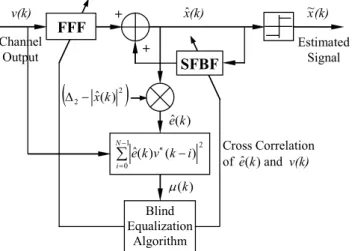
The block diagram of the proposed VSS-CMA algo-rithm based on cross correlation between channel output
) (k
v and error signal eˆ(k) is given in Fig. 1.
1 0 2 ) ( ) ( ˆ N i i k v k e Blind Equalization Algorithm Estimated Signal FFF v(k) xˆ(k) Channel Output + + x~(k)
2
2xˆ(k) ) ( ˆk e Cross Correlation of eˆ(k)and v(k) ) (k SFBFFig. 1. The proposed VSS-CMA algorithm based on cross correlation of channel output and error signal with soft decision feedback equalizer.
The proposed method, inspired by [16], [20] and [21], considers the cross correlation function between the chan-nel output and error signal, improving the convergence speed and performance. The greatest novelty of this study is different from [16] that the channel output signal is used in cross correlation. Zhao’s technique needs the transmitted signal in the receiver. However, since the proposed method employs the channel output signal, it does not require the transmitted signal. Moreover, the proposed VSS method provides both noise and ISI immunity since the channel output signal (1) includes both ISI and noise information. So far there are no any published works on the proposed method, as far as author’s concern. Thus, this contribution, inspired by [16], [20] and [21], investigates the proposed technique in the context of blind and non-blind channel equalizations.
Let us consider Q(k) as a smooth estimation of the cross correlation function between error signal, eˆ(k) and channel output, v(k) given by
1 0 2 ) ( ) ( ˆ ) 1 ( ) ( ) 1 ( L i i k v k e k Q k Q . (18)Thereafter the step-size update equation is calculated by ) ( ) ( ) 1 (k k Q k (19)
where α, and γ are positive control parameters.
In order to illustrate the accuracy of the proposed method Soft Decision Feedback Equalizer (SDFE) filter has been employed for simulated communication channels in this study. The output of SDFE filter, xˆ(k)is calculated by
0 1 ) ( ˆ ) ( ) ( ) ( ) ( ˆ ff sfb L i L i i k x i w i k v i w k x (20)where Lff and Lsfb is the number of feed forward filter (FFF)
and soft feedback filter (SFBF) taps of the SDFE. The update equations of the CMA algorithm for FFF and SFBF components of the SDFE are given by
0 ... , 1 , ), ( ) ( ˆ ) ( ) ( ) 1 (i wi k ek v* ki iLff Lff w , (21) sfb L i i k x k e k i w i w( 1) ()( )ˆ( )ˆ*( ), 1,2,... . (22)
The step size update equations and computational complexities of subjected VSS-CMA algorithms are given by Tab. 1 in simulation studies.
The comparison of the computational complexities of the step size update equations required for per weight up-date is given by Tab. 1. Here, N is the tap number of the SDFE filter. The greatest advantage of the CMA algorithm is the fact that it requires far less computational complexity as for the other blind algorithms.
Algorithms Step Size Update Equations Multip. Add. VSS-CMA [16] 1 0 ) ( 1 ) ( N i i k C N k 5N+12N+2 VSS-CMA [21] 1 0 2 ) ( ˆ ) ( ˆ ) 1 ( ) ( ) 1 ( L i i k e k e k k ) ( ) ( ) 1 (k k k 2N+7 N+2 Proposed VSS-CMA 1 0 2 ) ( ) ( ˆ ) 1 ( ) ( ) 1 ( L i i k v k e k Q k Q ) ( ) ( ) 1 (k k Qk 2N+7 N+2
Tab. 1. The step size update equations and computational complexities of VSS-CMA algorithms.
The total computational complexity of the conven-tional CMA algorithm is 8N + 6 multiplications and 8N
additions at each iteration [18]. The additional computa-tional complexity brought by the proposed VSS-CMA method to the CMA algorithm is 2N + 7 multiplications and 2N + 2 additions. The complexity incurred by the pro-posed technique does not prevent its application. However, the proposed method requires 3N + 5 multiplications and N
additions less computational complexity than whom is using the VSS-CMA [16], proposed by Zhao et al. On the other hand, it can be seen from Tab. 1 that the computa-tional complexity of the proposed method is the same as our prior work [21]. Although these complexities are the same, the proposed technique is more successful than our prior work [21] since the proposed VSS method provides both noise and ISI immunity. Thus, a more robust version of CMA algorithm is developed with a very small com-plexity concern.
5.
Computer Simulation Results
In this section, simulation results are illustrated to verify the performance of the proposed VSS-CMA and
VSS-LMS algorithms in frequency selective Rayleigh fading channels.
The simulation studies have composed of two stages. In the first stage of the studies are performed using the blind channel equalization. In the second stage of the studies are implemented employing the non-blind channel equalization.
5.1
Simulation Results of the Blind Channel
Equalization
The simulation studies of the blind channel equalizers are performed via 1000 Monte Carlo type iterations using the QPSK modulation. In this simulation, a three taps channel profile with average coefficient amplitudes given by (0.407, 0.815, 0.407), which is defined by Proakis and corresponds to an RMS delay spread of approximately 42 ns, is used [5]. A nine taps SDFE filter, composed of a feed forward filter (FFF) of five taps and soft feedback filter (SFBF) of four taps, is used in both blind and non-blind channel equalization. The proposed method is com-pared with Zhao’s VSS-CMA [16], Demir’s VSS-CMA [21] and fixed step size conventional CMA for blind equalization, and conventional LMS algorithm for non-blind equalization. The step size parameter for conven-tional CMA was equal to 0.005. The step size factor was equal to 0.63 and the positive control parameter was equal to 0.75 for Zhao’s VSS-CMA. Positive control pa-rameters, was equal to 0.978, was equal to 0.996 and
was equal to 0.85 for Demir’s VSS-CMA. The step size parameter was equal to 0.045 for conventional LMS algo-rithm. Positive control parameters, was equal to 0.995,
was equal to 0.822 and was equal to 0.984 for the proposed VSS-CMA. Maximum and minimum step size values are limited to 0.01 and 5E-7 respectively for all simulated VSS-CMA algorithms. Equalizer coefficients are initialized to zero value, except the central tap which is set to unit value before blind adaptation.
Two performance criteria were used to assess the convergence rate of blind and non-blind equalizers in simulation studies. The first criterion was a decision-based estimated mean square error (MSE) metric and the second criterion was the bit error rate (BER) metric in this study.
Blind learning curves of the conventional CMA, Zhao’s VSS-CMA [16], Demir’s VSS-CMA [21] and the proposed VSS-CMA equalizers are obtained in the value of Signal to Noise Ratio (SNR) of 20 dB illustrated in Fig. 2 for a stationary environment. The length of iteration is 4096 QPSK symbols for the MSE performance compari-sons in all simulated algorithms.
Fig. 2 shows that Zhao’s VSS-CMA [16] algorithm has faster convergence speed and lower MSE floor than the conventional CMA. It is observed that the performance of the VSS-CMA [21] is exceeding to the performance of the conventional CMA and VSS-CMA [16] and converges to the lower MSE floor. However, the proposed technique
outperforms the performance of all blind equalization algo-rithms and converges to the lowest steady state MSE floor.
0 500 1000 1500 2000 2500 3000 3500 0.4 0.6 0.8 1 1.2 Iteration Number MSE Conventional CMA VSS-CMA Zhao et al.-2010 Proposed VSS-CMA
Simulated channel profile, Proakis, {0.407, 0.815, 0.407}
VSS-CMA Demir et al.-2012
Fig. 2. Comparison of the MSE convergence performances of the blind adaptive channel equalizers for a stationary environment.
Performances of the blind learning curves of the four equalizers, namely, the conventional CMA, VSS-CMA [16], [21] and the proposed VSS-CMA, are compared in Fig. 3 in the value of SNR of 20 dB for a non-stationary environment. In this study, a three taps channel profile with average coefficient amplitudes given by (0.407, 0.815, 0.407), which is defined by Proakis, is used [5] in the first region as can be seen in Fig. 3. When the iteration number is 2000, channel profile abruptly changes to an exponential decay in the second region.
0 500 1000 1500 2000 2500 3000 3500 0.4 0.5 0.6 0.7 0.8 0.9 1 Iteration Number MSE VSS-CMA Zhao et al.-2010 Conventional CMA Proposed VSS-CMA Second Region First Region
Simulated channel profile, Proakis, {0.407, 0.815, 0.407}
Simulated Exponential Decay channel profile
VSS-CMA Demir et al.-2012
Fig. 3. Comparison of the MSE convergence performances of the blind adaptive channel equalizers for a non-station-ary environment.
Fig. 3 shows that Zhao’s VSS-CMA [16] algorithm has faster convergence and tracking speed than the con-ventional CMA in both regions. It can be easily seen that Demir’s VSS-CMA [21] performs better performance than the conventional CMA and VSS-CMA [16] in both re-gions. However, the proposed technique outperforms the performance of the three blind equalization algorithms and converges to the lowest steady state MSE floor in both regions.
The obtained comparative BER performances of non-blind training, the conventional LMS algorithm, and non-blind trainings, the conventional CMA, the VSS-CMA [16], [21] and the proposed VSS-CMA are given in Fig. 4. In this simulation, the same conditions are valid as in Fig. 2 for all blind training algorithms, except the length of the payload data after blind training was 4096 symbols of QPSK modulation. It should be mentioned here that the BER performance samples are obtained after 4096 iterations of blind training and 450 iterations of non-blind training.
0 10 20 30 40 2E-3 5E-3 1E-2 2E-2 5E-2 1E-1 2E-1 5E-1 SNR (dB) BE R Conventional CMA VSS-CMA Zhao et al.-2010 Conventional LMS VSS-CMA Demir et al.-2012 Proposed VSS-CMA Conventional CMA VSS-CMA Zhao et al.-2010 Conventional LMS Proposed VSS-CMA
Simulated channel profile, Proakis, {0.407, 0.815, 0.407}
VSS-CMA Demir et al.-2012
Fig. 4. Comparison of the BER performances of the blind and non-blind adaptive channel equalizers.
The obtained BER performances agree with the MSE performances given in Fig. 2. It is observed that the VSS-CMA [16], proposed by Zhao et al., performs better than the conventional CMA and it also converges to the lower BER floor. On the other hand, the VSS-CMA [21], pro-posed by Demir et al., has more superior performance than the conventional CMA, VSS-CMA [16] and conventional LMS algorithm. However, the BER performance of the proposed VSS-CMA algorithm outperforms the perform-ance of the three blind equalizers, the conventional CMA and the VSS-CMA [16], [21], and conventional LMS non-blind equalizer. While the LMS algorithm converges to 5E-3 BER floor, the proposed method converges to 5E-3E-5E-3 BER floor. Thus, the proposed method improves the perform-ance of the conventional CMA algorithm significantly. The controlled training by the proposed technique has become faster, very accurate and more stable.
5.2
Simulation Results of the Non-Blind
Channel Equalization
The simulation studies of the non-blind channel equalizers are performed via 1000 Monte Carlo type itera-tions using the QPSK modulation. In this simulation, a five taps channel profile with average coefficient amplitudes given by (0.227, 0.46, 0.688, 0.46, 0.227), which is defined by Proakis and corresponds to an RMS delay spread of approximately 42 ns, is used [5]. A thirteen taps SDFE filter, composed of a FFF of nine taps and a SFBF of four taps, is used in non-blind channel equalization. The
pro-posed method is compared with Zhao’s VSS-LMS [16], Demir’s VSS-LMS [21], fixed step size conventional LMS and conventional RLS algorithm for non-blind equaliza-tion. The step size parameter for conventional LMS algo-rithm was equal to 0.045 and the forgetting factor for con-ventional RLS algorithm was equal to 0.999. The step size factor was equal to 0.8 and the positive control parame-ter was equal to 0.968 for Zhao’s VSS-LMS algorithm. Positive control parameters, was equal to 0.896, was equal to 0.955 and was equal to 0.832 for Demir’s VSS-LMS algorithm. Positive control parameters, was equal to 0.988, was equal to 0.725 and was equal to 0.996 for the proposed VSS-LMS algorithm. Maximum and minimum step size values are limited to 0.1 and 5E-5 re-spectively for all simulated VSS-LMS algorithms. Equal-izer coefficients are initialized to zero value before non-blind adaptation.
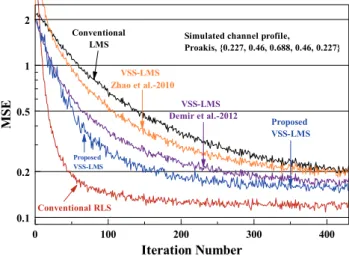
Non-blind learning curves of the conventional LMS, conventional RLS, Zhao’s LMS [16], Demir’s VSS-LMS [21] and the proposed VSS-VSS-LMS equalizers are ob-tained in the value of SNR of 15 dB demonstrated in Fig. 5 for a stationary environment. The length of iteration is 450 QPSK symbols for the MSE performance comparisons in all simulated algorithms.
0 100 200 300 400 0.1 0.2 0.5 1 2 Iteration Number MSE Proposed VSS-LMS VSS-LMS Zhao et al.-2010 Conventional LMS Conventional RLS
Simulated channel profile,
Proakis, {0.227, 0.46, 0.688, 0.46, 0.227}
VSS-LMS Demir et al.-2012
Proposed VSS-LMS
Fig. 5. Comparison of the MSE convergence performances of the non-blind adaptive channel equalizers for a station-ary environment.
It is shown in Fig. 5 that Zhao’s VSS-LMS algorithm little accelerates the LMS, but it converges to the LMS algorithm at the end of the training. It is observed that the performance of the proposed VSS-LMS algorithm outper-forms to the performance of the conventional LMS, VSS-LMS algorithm published by Zhao et al. [16] and Demir’s VSS-LMS [21] algorithm and converges to the lower MSE floor and comes closer to the performance obtained by the conventional RLS algorithm.
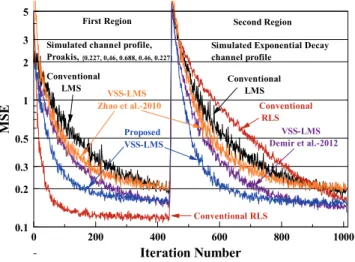
The performances of the non-blind learning curves of the five equalizers, namely, the conventional LMS, con-ventional RLS, VSS-LMS [16], [21] and the proposed VSS-LMS, are compared in Fig. 6 in the value of SNR of 15 dB for a non-stationary environment. In this study,
a five taps channel profile with average coefficient ampli-tudes given by (0.227, 0.46, 0.688, 0.46, 0.227), which is defined by Proakis, is used [5] in the first region as can be seen from Fig. 6. When the iterationnumber is 450, chan-nel profile abruptly changes to an exponential decay in the second region. 0 200 400 600 800 1000 0.1 0.2 0.3 0.5 1 2 3 5 Iteration Number MSE Conventional RLS Conventional LMS VSS-LMS Zhao et al.-2010 Proposed VSS-LMS Conventional RLS Conventional LMS Second Region First Region
Simulated channel profile, Proakis, {0.227, 0,46, 0.688, 0.46, 0.227}
Simulated Exponential Decay channel profile
VSS-LMS Demir et al.-2012
Fig. 6. Comparison of the MSE convergence performances of the blind adaptive channel equalizers for a non-stationary environment.
The performances of the aforementioned algorithms are the same as stationary environment performances (Fig. 5) in the first region as can be seen from Fig. 6. How-ever, the proposed technique outperforms the performance of the four non-blind equalization algorithms and con-verges to the lowest steady state MSE floor in the second regions.
The obtained BER performances of non-blind train-ing, the conventional LMS, conventional RLS, normalized LMS (N-LMS) [25], the VSS-LMS [16], [21] and the pro-posed VSS-LMS are given in Fig. 7. In this simulation, the same conditions are valid as in Fig. 5 for all non-blind training algorithms, except the length of the payload data after non-blind training was 450 symbols of QPSK modu-lation. It should be mentioned here that the BER perform-ance samples are obtained after 450 iterations of non-blind training. -4 0 4 8 12 16 20 24 28 32 36 40 1E-5 1E-4 1E-3 1E-2 1E-1 SNR (dB) BE R Conventional LMS Conventional RLS N-LMS Hayes-1996 VSS-LMS Zhao et al.-2010 VSS-LMS Demir et al.-2012 Proposed VSS-LMS Proposed VSS-LMS VSS-LMS Zhao et al.-2010 Conventional LMS Conventional RLS AWGN Channel N-LMS Hayes -1996 Simulated channel profile,
Proakis, {0.227, 0.46, 0.688, 0.46, 0.227}
VSS-LMS Demir et al.-2012
Fig. 7. Comparison of the BER performances of the non-blind adaptive channel equalizers.
The obtained BER performances agree with the MSE performances given in Fig. . It can be easily seen that the proposed technique outperforms the performances of four non-blind equalization algorithms and comes closer to the performance obtained by the RLS algorithm. The perform-ance of the proposed technique has also reduced approxi-mately till 1 dB performance difference with RLS algo-rithm and also cancelled the error floor. Thus, the proposed method improves the performance of the conventional LMS algorithm significantly.
6.
Conclusions
In this paper, a new VSS-CMA blind and VSS-LMS non-blind equalizer based on cross correlation of channel output and error signal has been proposed as a solution to the problem of slow convergence of the fixed step size conventional CMA blind and LMS non-blind equalizer. Thus, the conflict is removed between the convergence rate and low steady state error of the fixed step-size conven-tional CMA and LMS algorithm. Compared with a state of art low complexity blind and non-blind training schemes, the proposed method has simpler in computational re-quirements, faster convergence and lower steady state error. It has been shown that a combination of conventional CMA and LMS with the proposed VSS technique provides an effective and robust way for adaptive blind and non-blind equalization. So, the simple CMA and LMS has be-come with a high performance blind and non-blind adap-tive channel equalizer technique. The results of this study show that the proposed VSS-CMA and VSS-LMS is also demonstrated to be very suitable for high speed blind and non-blind trainings and channel tracking.
References
[1] QURESHI, S. U. H. Adaptive equalization. In Proceedings of the IEEE, September 1985, vol. 73, no. 9, p. 1349-1387.
[2] BELFIORE, C. A., PARK, J. H. Decision feedback equalization. In Proceedings of the IEEE, August 1979, vol. 67, no. 8, p. 1143 to 1156.
[3] BOYD, R. T., MONDS, F. C. Equalizer for digital communication.
IEE Electronic Letters, January 1971, vol. 7, no. 2, p. 58-60. [4] HAYKIN, S. Communication Systems. Third edition. John Wiley
and Sons, 1994.
[5] PROAKIS, J. G. Digital Communications. Fourth edition. Singapore: McGraw-Hill Co., 2001.
[6] GODARD, D. N. Self-recovering equalization and carrier tracking in two dimensional data communication systems. IEEE Transac-tions on CommunicaTransac-tions, 1980, vol. 28, no. 11, p.1867-1875. [7] SHALVI, O., WEINSTEIN, E. New criteria for blind
deconvolu-tion of non-minimum phase systems (channels). IEEE Transactions on. Information Theory, March 1990, vol. 36, no. 2, p. 312-321.
[8] LABAT, J., MACCHI, O., LAOT, C. Adaptive decision feedback equalization: Can you skip the training period? IEEE Transactions on Communications, July 1998, pp. 921-930.
[9] KIM, Y. H., SHAMSUNDER, S. Adaptive algorithms for channel equalization with soft decision feedback. IEEE Journal on Se-lected Areas in Communications, December 1998, p. 1660-1669. [10] ANANTHASWAMY, G., GOECKEL, D. L. A fast acquiring blind
predictive DFE. IEEE Transactions on Communications, October 2002, vol. 50, no. 10, p. 1557-1560.
[11] SATO, Y. A method of self-recovering equalization for multilevel amplitude modulation. IEEE Transactions on Communications, June 1975, vol. COM-23, p. 679-682.
[12] WIDROW, B. Adaptive filters I: Fundamentals. Stanford Elec-tronic Laboratories Technical Report 6764-6, December 1966. [13] XIONG, Z., LINSHENG, L., DONFENG, Z., ZENGSHOU, D.
A new adaptive step-size blind equalization algorithm based on autocorrelation of error signal. In 7th International Conference on Signal Processing, 2004, vol. 2, p. 1719-1722.
[14] LIYI, Z., LEI, C., YUNSHAN, S. Variable step-size CMA blind equalization based on non-linear function of error signal. In
International Conference on Communications and Mobile Computing, 2009, vol. 1, p. 396-399.
[15] SHAHZAD, K., ASHRAF, M., IQBAL, R. Improved blind equalization scheme using variable step size constant modulus algorithm. In Proceedings of the 7th WSEAS Int. Conf. on Signal Processing, Computational Geometry & Artificial Vision. August 2007, p. 86-90.
[16] BAOFENG, Z., JUMIN, Z., DENGAO, L. A new variable step-size constant modulus blind equalization algorithm. In IEEE Inter-national Conference on Artificial Intelligence and Computational Intelligence, 2010, p. 289-291.
[17] ZHIMIN, D., SHENG, Z., PENG, W., WEILING, W. Novel variable step size constant modulus algorithms for blind multiuser detection. In 54th IEEE Conference on VTS Vehicular Technology Conference, 7-11 October 2001, vol. 2, p. 673–677.
[18] OZEN, A., KAYA, I., SOYSAL B. Variable step-size constant modulus algorithm employing fuzzy logic controller. Wireless Personal Communications, July 2010, vol. 54, no. 2, p. 237-250. [19] ZIPF, J. G. F., TOBIAS, O. J., SEARA R. A VSSLMS algorithm
based on error autocorrelation. In 16th European Signal Process-ing Conference (EUSIPCO 2008). Lausanne (Switzerland), August 2008, p. 25-29.
[20] OZEN, A. A novel variable step size adjustment method based on channel output autocorrelation for the LMS training algorithm.
International Journal of Communication Systems (Wiley-Black-well), 2011, vol. 24, no. 7, p. 938-949.
[21] DEMİR, M. A., OZEN, A. A novel variable step size adjustment method based on autocorrelation of error signal for the constant modulus blind equalization algorithm. Radioengineering, April 2012, vol. 21, no. 1, p. 37-45.
[22] ABOULNASR, T., MAYYAS, K. A robust variable step size LMS type algorithm: Analysis and simulations. IEEE Transactions on Signal Processing, March 1997, vol. 45, no. 3, p. 631-639. [23] KWONG, R. H., JOHNSTON, E. W. A variable step size LMS
algorithm. IEEE Transactions on Signal Processing, July 1992, vol. 40, no. 7, p. 1633-1642.
[24] TREICHLER, J. R., AGEE, B. G. A new approach to multipath correction of constant modulus signals. IEEE Trans. Acoustic Speech, Signal Processing, 1983, vol. ASSP-28, p. 459-472. [25] HAYES, M. H. Statistical Digital Signal Processing and
Modeling. New York: John Wiley & Sons, Inc., 1996.
About Authors
Emin TUĞCU was born in Trabzon, Turkey, on Novem-ber, 1982. He received B. S. and M. Sc. degrees in the Dept. of Electrical and Electronics Engineering from Karadeniz Technical University, in 2004 and 2007, respec-tively. He has been a research assistant at the Dept. of Electrical and Electronics Engineering in Karadeniz Tech-nical University since 2005. His current research interests are wireless communication, channel equalization, coding theory and signal processing.
Fatih ÇAKIR was born in Trabzon, Turkey, on January, 1984. He received B. S. degree in the Dept. of Electrical and Electronics Engineering from Cumhuriyet University, in 2009 and M. Sc. degree in the Dept. of Electrical and Electronics Engineering from Karadeniz Technical Univer-sity, in 2012. He has been a research assistant at the Dept. of Electrical and Electronics Engineering in Avrasya Uni-versity since March 2012. His current research interests are wireless communication, channel equalization, coding theory and signal processing.
Ali OZEN was born in Adana, Turkey, on September, 1967. He received B.S., M.Sc. and Ph.D. degrees in the Dept. of Electrical and Electronics Engineering from Karadeniz Technical University, in 1994, 1999, and 2005, respectively. He has been a research assistant at the Dept. of Electrical and Electronics Engineering in Karadeniz Technical University between February 1996 and May 2004. Later he qualified as a university lecturer at the same department between September 2005 and November 2008. Later, he has been working as a lecturer (Assistant Profes-sor) in the same department between November 2008 and February 2012. Since March 2012 he has been working as an Assistant Professor at the Dept. of Electrical and Elec-tronics Engineering in Nuh Naci Yazgan University. His current research interests are wireless communications, information theory, channel estimation and equalization, statistical signal processing, system identification, blind equalization, channel measurement and equalization, MIMO systems, WiMAX radio, WiMAX-LTE, cognitive radio and cooperative communications. Dr. Ozen is a member of the IEEE and IEICE.
![Fig. 2 shows that Zhao’s VSS-CMA [16] algorithm has faster convergence speed and lower MSE floor than the conventional CMA](https://thumb-us.123doks.com/thumbv2/123dok_us/802641.2601441/5.892.455.803.154.420/shows-zhao-algorithm-faster-convergence-speed-lower-conventional.webp)