CRANFIELD UNIVERSITY
SAMEH EL SAID ABDEL AZIZ ASKAR
S
ymbolic
A
pproaches
A
nd
A
rtificial
I
ntelligence
A
lgorithms
F
or
S
olving
M
ulti-
O
bjective
O
ptimisation
P
roblems
SCHOOL OF APPLIED SCIENCES
PhD
This thesis is submitted in partial fulfilment of the requirements
for the degree of Doctor of Philosophy
Academic: Year 2010-2011
Supervisor: Dr Ashutosh Tiwari
April 2011
SCHOOL OF APPLIED SCIENCES
DEPARTMENT OF MANUFACTURING
PHD
Academic Year 2010-2011
SAMEH EL SAID ABDEL AZIZ ASKAR
S
ymbolic
A
pproaches
A
nd
A
rtificial
I
ntelligence
A
lgorithms
F
or
S
olving
M
ulti-
O
bjective
O
ptimisation
P
roblems
Supervisor: Dr Ashutosh Tiwari
April 2011
This thesis is submitted in partial fulfilment of the requirements
for the degree of Doctor of Philosophy
©CranfieldUniversity2011.Allrightsreserved.Nopartofthispublicationmaybe reproducedwithoutthewrittenpermissionofthecopyrightowner.
Abstract
Problems that have more than one objective function are of great importance in engineering sciences and many other disciplines. This class of problems are known as multi-objective optimisation problems (or multicriteria). The difficulty here lies in the conflict between the various objective functions. Due to this conflict, one cannot find a single ideal solution which simultaneously satisfies all the objectives. But instead one can find the set of Pareto-optimal solutions (Pareto-optimal set) and consequently the Pareto-optimal front is established. Finding these solutions plays an important role in multi-objective optimisation problems and mathematically the problem is considered to be solved when the Pareto-optimal set, i.e. the set of all compromise solutions is found. The Pareto-optimal set may contain information that can help the designer make a decision and thus arrive at better trade-off solutions. The aim of this research is to develop new multi-objective optimisation symbolic algorithms capable of detecting relationship(s) among decision variables that can be used for constructing the analytical formula of Pareto-optimal front based on the extension of the current optimality conditions.
A literature survey of theoretical and evolutionary computation techniques for handling multiple objectives, constraints and variable interaction highlights a lack of techniques to handle variable interaction. This research, therefore, focuses on the development of techniques for detecting the relationships between the decision variables (variable interaction) in the presence of multiple objectives and constraints. It attempts to fill the gap in this research by formally extending the theoretical results (optimality conditions). The research then proposes first-order multi-objective symbolic algorithm or MOSA-I and second-order multi-objective symbolic algorithm or MOSA-II that are capable of detecting the variable interaction. The performance of these algorithms is analysed and compared to a current state-of-the-art optimisation algorithm using popular test problems.
The performance of the MOSA-II algorithm is finally validated using three appropriately chosen problems from literature. In this way, this research proposes a fully tested and validated methodology for dealing with multi-objective optimisation problems.
In conclusion, this research proposes two new symbolic algorithms that are used for identifying the variable interaction responsible for constructing Pareto-optimal front among objectives in multi-objective optimisation problems. This is completed based on a development and relaxation of the first and second-order optimality conditions of Karush-Kuhn-Tucker.
Acknowledgements
I would like to take this opportunity to deeply thank many genuine persons that I inevitably believe they deserve more than these acknowledgements.
Dr Ashutosh Tiwari, my principal supervisor
Thanks Ash for all your time you have bestowed me, non-stop help and précised technical discussion, guidance and motivation in the early stages and throughout this work, trust and confidence you inspire …
Dr Jörn Mehnen, my subject advisor
Thanks Jörn for all your time and help you have dedicated to me. I know I have taken many hours from your private time, discussion, sharing ideas, encouragement, and suggestions. I’m really grateful to you …
Egyptian Government
Many thanks are due to the funding sponsor of this research: Ministry of Higher Education, Mathematics Department, Faculty of Sciences, Mansoura University, Mansoura, Egypt.
My Colleagues
Gokop, John, Fran, Tola, Mac, Salwa, Mariny, Nagwa, and Nancy, I extremely thank each one of you for philosophical discussion, friendly environment, sense of humour…
Manufacturing Department
Many thanks are to the following staff members of the Decision Engineering Centre, School of Applied Sciences. In addition to this, I would like to convey my sincere thanks to the following persons, Prof Rajkumar Roy, Ahmed Al-Ashaab, Essam Shehab, for the fruitful discussions we have had in our weekly DEC4D meetings, not forgetting my heartfelt thanks to Emanuela Pennetta and Teresa Bandee who have been an enormous help for my family and myself in making it a happy environment on personal and professional level.
My daughter Aida and Son Yousef
Aida, I’m extremely grateful to you for teaching me how to pronounce the English words as it should be. My naughty son Yousef, for the continuous supplication you have done for me.
My family
Finally, and in particular, my wife, for being patient and understanding during my studies at Cranfield, you deserve more than I can express in writing here, but at least I can say that, ‘actions speak louder than words’. My parents, brothers, and sisters back home for all their moral support and encouragements.
List of Publications
Askar, S.S., Tiwari, A., Mehnen, J. and Ramsden, J. (2008), ‘Solving real-life multi-objective optimisation problems: A mathematical approach’, Cranfield Multi-Strand Conference: Creating Wealth through Research and Innovation (CMC, 6-7 May 2008), Cranfield Management Research Institute, Cranfield, UK, pp. 7-12.
Askar, S.S. and Tiwari, A. (2009), ‘Multi-objective optimization problems: A symbolic algorithm for performance measurement of evolutionary computing techniques’, In: Matthias Ehrgott, Carlos M. Fonseca, Xavier Gandibleux, Jin-Kao Hao and Marc Sevaux (editors), Evolutionary Multi-Criterion Optimization. The fifth International Conference (EMO 2009), pp. 169-182, Springer. Lecture Notes in Computer Science Vol. 5467, Nantes, France.
Askar, S.S. and Tiwari, A. (2009), ‘Finding exact solutions for multi-objective optimization problems using a symbolic algorithm,” In: Proceedings of IEEE Congress on Evolutionary Computation (CEC 2009), Trondheim, Norway, pp. 24-30.
Askar, S.S. and Tiwari, A. (2009), ‘First-order optimality conditions and duality results for multi-objective optimisation problems’, Annals of Operations Research Journal, Springer, Vol. 172, No. 1, pp. 277-289.
Askar, S.S., Tiwari, A. (2010), ‘Finding Innovative Design Principles for Multi-Objective Optimization Problems’, IEEE Transactions on Systems, Man, and Cybernetics- Part C: Applications and Reviews, DOI. 10.1109/TSMCC.2010.2081666.
Submitted papers
Askar, S.S., Tiwari, A. (2009), ‘Optimality Conditions for Differentiable Multi-Objective Optimisation Problems’, Journal of Applied Mathematics and Computations. Askar, S.S., Tiwari, A. (2009), ‘A Symbolic algorithm for detecting relationship among decision
variables used to construct Pareto-optimal front for multi-objective optimisation problems’, Journal of Computers and Mathematics with Applications.
Askar, S.S., Tiwari, A. (2010), ‘Second-Order Optimality Conditions for Multi-Objective Optimisation Problems’, Annals of Operations Research Journal.
Contents
CHAPTER 1 INTRODUCTION...1
1.1 PROBLEM SETTING AND OPTIMALITY CONDITIONS...2
1.1.1 Problem Setting...2
1.1.2 First-order Optimality Conditions ...5
1.1.3 Second-order Optimality Conditions...6
1.2 INTRODUCTION TO EVOLUTOIONARY COMPUTATION TECHNQUIES...6
1.3 PROBLEM STATEMENT AND MOTIVATION...8
1.4 THESIS LAYOUT...9
1.5 SUMMARY...11
CHAPTER 2 REVIEW OF LITERATURE...13
2.1 CLASSICAL APPROACHES TO MULTI-OBJECTIVE OPTIMISATION...13
2.1.1 Weighted Aggregation Approach...14
2.1.2 ߝ- constraint Method...15
2.1.3 Hybrid Method ...15
2.1.4 Weighted Metrics Method ...16
2.1.5 Benson’s Method ...16
2.2 EVOLUTIONARY COMPUTATION TECHNIQUES FOR MULTI-OBJECTIVE OPTIMISATION ....17
2.2.1 Vector Evaluated Genetic Algorithm (VEGA) ...18
2.2.2 Multi-objective Genetic Algorithms (MOGA)...18
2.2.3 Non-dominated Sorting Genetic Algorithm (NSGA)...19
2.2.4 Niched Pareto Genetic Algorithm (NPGA)...19
2.2.5 Strength Pareto Evolutionary Algorithm (SPEA) ...20
2.2.6 Strength Pareto Evolutionary Algorithm (SPEA2) ...21
2.2.7 Non-dominated Sorting Genetic Algorithm (NSGA-II) ...21
2.2.8 Multi-objective Evolutionary Algorithm Based on Decomposition (MOEA/D) ...22
2.3 CLASSICAL VERSUS EVOLUTIONARY APPROACHES...23
2.4 THEORETICAL APPROACHES FOR MULTI-OBJECTIVE OPTIMISATION ...24
2.5 LITERATURE REVIEW ANALYSIS...29
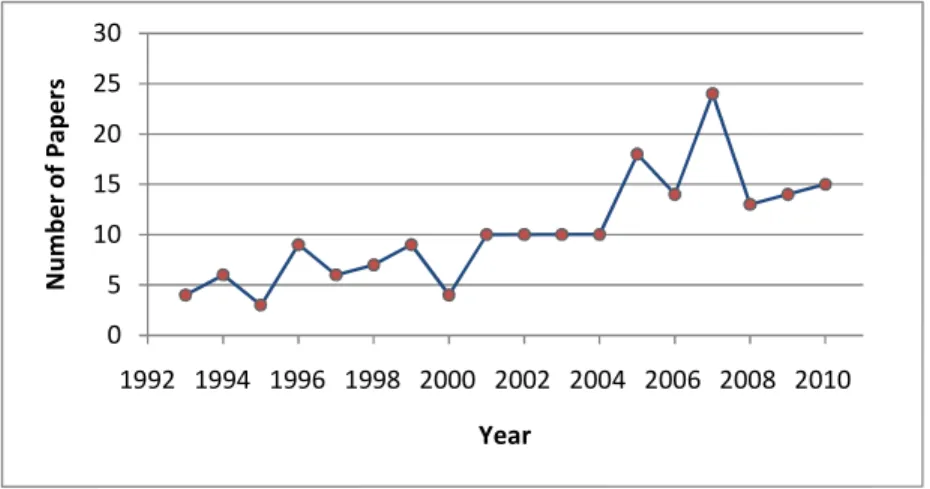
2.5.1 Number of Articles ...30
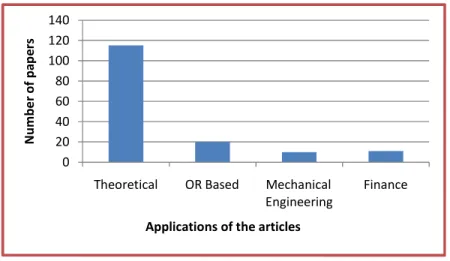
2.5.2 Analysis of Articles by Application Areas ...31
2.5.3 Analysis of Articles by Theoretical Approaches...32
2.5.4 Analysis of Articles by Objective Functions and Constraints...34
2.5.5 Analysis of Articles by Optimisation Approaches...35
2.5.6 Analysis of Articles by Statistical/Numerical Approaches...35
2.6 CURRENT RESEARCH TRENDS...36
2.7 RESEARCH GAP...37
2.8 SUMMARY ...38
CHAPTER 3 RESEARCH AIM, OBJECTIVES AND METHODOLOGY...39
3.1 RESERCH AIM...39 3.2 RESERCH OBJECTIVES ...39 3.3 RESERCH SCOPE...40 3.4 RESERCH METHODOLOGY...41 3.4.1 Problem Identification ...41 3.4.2 Literature Survey ...41
3.4.3 Identification of Research Aim, Objectives and Scope ...42
3.4.4 Development of Optimality Conditions ...43
3.4.5 Development of Symbolic Optimisation Algorithms ...43
3.4.6 Performance Analysis Using Test Problems ...44
3.4.7 Validation Using Real-life Case Studies ...45
3.5 SUMMARY ...46
CHAPTER 4 FIRST AND SECOND-ORDER OPTIMALITY CONDITIONS UNDER GENERALISED TYPE I UNIVEXITY FUNCTIONS...47
4.1 PROPOSED MULTI-OBJECTIVE OPTIMISATION THEOREMS...47
4.2 FIRST-ORDER OPTIMALITY CONDITIONS...51
4.3 DUALITY RESULTS...56
4.4 PROPOSED SECOND-ORDER OPTIMALITY CONDITIONS ...61
4.5 SUMMARY ...66
CHAPTER 5 PROPOSED FIRST-ORDER MULTI-OBJECTIVE OPTIMISATION SYMBOLIC ALGORITHM (MOSA-I)...69
5.1 MULTI-OBJECTIVE SYMBOLIC ALGORITHM (MOSA-I) ...70
5.2 TEST PROBLEMS FORMULATION...72
5.3 COMPARISON OF RESULTS ...76
5.4 PERFORMANCE COMPERSION BETWEEN MOSA-II AND NSGA-II...91
5.5 DISCUSSIONS...94
5.6 SUMMARY ...95
CHAPTER 6 PROPOSED SECOND-ORDER MULTI-OBJECTIVE OPTIMISATION SYMBOLIC ALGORITHM (MOSA-II)...97
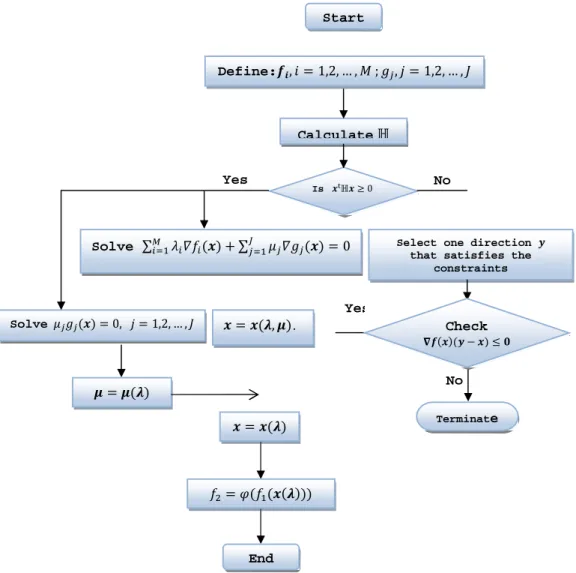
6.1 MULTI-OBJECTIVE SYMBOLIC ALGORITHM (MOSA-II) ...98
6.2 ILLUSTRATION OF EFFECTIVNESS OF SECOND-ORDER OPTIMALITY CONDITIONS...101
6.3 DISSCUSSIONS...109
6.4 SUMMARY ...110
CHAPTER 7 REAL-LIFE CASE STUDEIS...113
7.1 REAL-LIFE CASE STUDIES...113
7.2 DESIGN OF PRESSURE VESSEL...119
7.2.1 Experimental Results ...120
7.2.2 Discussion of Results ...122
7.3 DESIGN OF FOUR-MEMBER TRUSS...123
7.3.1 Experimental Results ...123
7.3.2 Discussion of Results ...124
7.4 DESIGN OF A WELDED BEAM ...125
7.4.1 Experimental Results ...126
7.4.2 Discussion of Results ...129
7.5 VALIDATION OF RESULTS...131
7.5.1 Design of Pressure Vessel ...131
7.5.2 Design of Four-Member Truss...132
7.5.3 Design of Welded Beam...132
7.6 SUMMARY ...133
CHAPTER 8 DISCUSSION AND CONCLUSIONS...135
8.1 DISCUSSION ...135
8.1.1 Key Observations from this Research...135
8.1.1.1 Literature Survey...135
8.1.1.2 Gap Analysis: Theoretical Approaches...137
8.1.1.3 Gap Analysis: Symbolic Algorithms...137
8.1.1.4 Development of the Optimality Conditions ...137
8.1.1.5 Development of the MOSA-I Algorithm...138
8.1.1.6 Development of the MOSA-II Algorithm...138
8.1.1.7 Performance Analysis of MOSA-I and MOSA-II ...139
8.1.3 Research Limitations ...142
8.1.3.1 Limitations of Research Methodology...142
8.1.3.2 Limitations of the MOSA-I Algorithm...143
8.1.3.3 Limitations of the MOSA-II Algorithm ...143
8.2 FUTURE RESEARCH...144
8.3 CONCLUSIONS...146
REFERENCES...149
List of Figures
Figure 1.1: Decision and objective spaces...2
Figure 1.2: Schematic description of GAs...7
Figure 1.3: Thesis Layout...10
Figure 2.1: Article in the period 1993-2010...31
Figure 2.2: Analysis of articles by application areas...32
Figure 2.3: Analysis of articles by theoretical approaches...34
Figure 2.4: Analysis of articles by objective functions...34
Figure 2.5: Analysis of articles by optimisation approaches...35
Figure 3.1: Main steps of the research methodology...42
Figure 5.1: The flow chart of the proposed MOSA-I algorithm...72
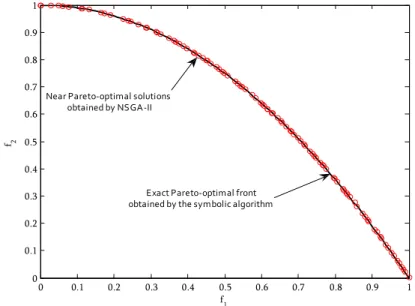
Figure 5.2: The exact and approximated Pareto front for ZDT1 at ൌ ...77
Figure 5.3: The exact and approximated Pareto-optimal front for ZDT1 at ൌ ...78
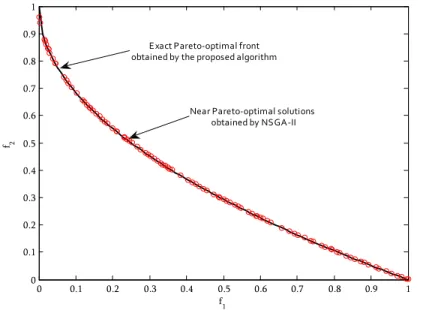
Figure 5.4: Pareto-optimal front obtained by the symbolic algorithm and NSGA-II for ZDT2 at ൌ ...80
Figure 5.5: Pareto-optimal front obtained by the symbolic algorithm and NSGA-II for ZDT4 at ൌ ...81
Figure 5.6: Exact and approximated Pareto-optimal front found by the symbolic and NSGA-II algorithms for problem ZDT 4 at ൌ ...82
Figure 5.7: Objective space of FON problem...83
Figure 5.8: Decision space of FON problem...84
Figure 5.9: Exact and approximated Pareto-optimal front to Deb2 problem...85
Figure 5.10: Exact and approximated Pareto-optimal front for VNT1 problem...86
Figure 5.11: Decision space of the constrained problem...87
Figure 5.12: Objective space of the constrained problem obtained by the MOSA-I algorithm...88
Figure 5.13: The approximated Pareto-optimal front for the constrained problem using NSGA-II . 91 Figure 5.14: The residual plot between the approximated Pareto-optimal front and the exact Pareto-optimal front for FON problem...93
Figure 5.15: The residual plot between the approximated Pareto-optimal front and the exact Pareto-optimal front for FON problem...93
Figure 6.1: A flow chart of the MOSA-II algorithm...101
Figure 6.2: Feasible solutions for the constrained problem in the decision variable space...103
Figure 6.3: Exact and local Pareto front for the constrained problem in the objective space...103
Figure 6.4: Decision Space for ZDT3 at ൌ ...107
Figure 6.5: Pareto-optimal front obtained by the MOSA-II algorithm and NSGA-II for ZDT3... 109
Figure 7.3: Welded Beam Design (Source: Knowles, Corne and Deb, 2008)...116
Figure 7.4: The relationship between the objectives for the pressure vessel design ...122
Figure 7.5: The exact and approximated Pareto front for the four-bar plane truss using MOSA-II and NSGA-II algorithms ...124 Figure 7.6: Results from NSGA-II, SPEA2 and the proposed procedure (Part one) ...126
Figure 7.7: Impact of࢚on the relationship between the Cost and Deflection...128
Figure 7.8: Results from NSGA-II, SPEA2 and the proposed procedure (Part two)...128
List of Tables
Table 2.1: Some selected papers on statistical and numerical approaches from the literature
materials...36
Table 5.1: Features of the test problems...73
Table 7.1: Case Studies from Real-life Engineering Optimisation...118
Table 7.2: Trade-off solutions obtained by the MOSA-II algorithm...121
Table 7.3: Lagrange multipliers corresponding to trade-off solutions in Table 7.2...121
Commonly Used Abbreviations
च∗ Pareto-Optimal Setℝ -Dimensional Euclidean space
FJ Fritz-John
GAs GeneticAlgorithms
GD GenerationalDistance Metric ℍ Hessian Matrix
IDP InnovativeDesignPrinciples KKT Karush-KuhnTucker
LCOF LinearConstrainedObjectiveFunctions
MOEA/D Multi-ObjectiveEvolutionaryAlgorithmBased onDecomposition MOGA Multi-ObjectiveGeneticAlgorithm
MOOP Multi-ObjectiveOptimisationProblem
MOSA-I First-OrderMulti-ObjectiveSymbolicAlgorithm MOSA-II Second-OrderMulti-ObjectiveSymbolicAlgorithm NLCOF Non-LinearConstrainedObjectiveFunctions NPGA NichedParetoGeneticAlgorithm
NSGA Non-dominatedSortingGeneticAlgorithm
NSGA-II FastElitistNon-dominatedSortingGeneticAlgorithm RA RegressionAnalysis
SPEA StrengthParetoEvolutionaryAlgorithm SPEA2 StrengthParetoEvolutionaryAlgorithm VEGA VectorEvaluatedGeneticAlgorithm ZDT Zitzler-Deb-Thiele
च ऐ∗ Pareto-OptimalFront
Chapter 1. Introduction
1
INTRODUCTION
Problems that have more than one objective function are of great importance in engineering sciences and many other disciplines. This class of problems are known as multi-objective optimisation problems (or multicriteria). The difficulty here lies in the conflict between the various objective functions. Due to this conflict, one can not find a single ideal solution which simultaneously satisfies all the objectives. But instead one can find the set of the Pareto-optimal solutions (Pareto-optimal set) and consequently the Pareto-optimal front is established. Finding these solutions plays an important role in multi-objective optimisation problems and mathematically the problem is considered to be solved when the Pareto-optimal set, i.e. the set of all compromise solutions is found. The Pareto-optimal set may contain information that can help the designer make a decision and thus arrive at better trade-off solutions (Hillermeier, 2001). The challenge posed by real-life optimisation problems (such as multiple objectives, constraints and variable interaction) has prompted the engineers to look for rigorous ways of optimising its design (Kirsch, 1981). Computational techniques are more popular in dealing with these demands. Traditional trial-and-error method of optimisation is not capable of meeting these engineering demands.
This research focuses on developing optimisation algorithms based on the extension of the current optimality conditions to address the complexities of multi-objective optimisation problems. This chapter attempts to address the following.
To define the problem tackled in this thesis and present a brief introduction to optimality conditions.
To give a brief introduction to evolutionary computation techniques. To illustrate the problem statement and motivation of this research. To present the thesis layout.
Chapter 1. Introduction
1.1
Problem Setting and Optimality Conditions
This section highlights the multi-objective optimisation problem tackled throughout this thesis. In addition, the first and second-order optimality conditions of Karush-Kuhn-Tucker are illustrated.
1.1.1
Problem Setting
The general description of the multi-objective optimisation problem used in this thesis is written as follows (Miettinen, 1999; Jahn, 2004):
(1.1)
Where, and are all twice continuously
differentiable functions and each decision variable has a lower and upper bounds and respectively.
Figure 1.1: Decision and objective spaces
When dealing with multi-objective optimisation problems, two important spaces attract our attention. The first one is called the decision space and the other is called the objective space (Figure 1.1). The link between the two spaces is the map defined in Equation (1.1). Solving Equation (1.1) means seeking the solution vectors in the decision space which simultaneously satisfy the inequality constraints. These solution vectors provide the best compromised solutions between the conflicting objectives. The characteristics of these solutions are illustrated below. Before going into details on these characteristics, we begin with some basic notations.
Chapter 1. Introduction
Let ℝbe the ݊-dimensional Euclidean space, and let࢞ǡ࢟ א Թbe any two vectors such that ࢞ ൌ(ݔଵǡݔଶǡǥ ǡݔ)்and࢟ ൌ ൫ݕ1ǡݕ2ǡǥ ǡݕ݊൯
ܶ
; here, the superscriptܶrefers to the transpose of࢞. The inner product of࢞and࢟is defined as follows:
்࢞ڄ࢟ ൌ ݔ ݕ ୀଵ
For࢞ǡ࢟ א Թ݊, the following conventions are used throughout the thesis:
࢞ أ ࢟ ݔأ ݕǡ݅ൌ ͳǡʹǡǥ ǡ݊
࢞ ࢟ ݔأ ݕǡ݅ൌ ͳǡʹǡǥ ǡ݊ǡ࢞ ് ࢟ ࢞ ൏ ࢟ ݔ൏ ݕǡ݅ൌ ͳǡʹǡǥ ǡ݊
Definition 1.1: A subsetॿ ك Թis said to be a convex set if for any two points࢞ǡ࢟ א ॿ the
segment:
(ߙ࢞(ͳെ ߙ)࢟)א ॿǡߙ א ሾͲǡͳሿ
Definition 1.2: A function݂ǣॿ ك Թ→ ℝ is convex if for allݔǡݕ א Թis valid that ݂(ߙ࢞ (ͳെ ߙ)࢟) ߙ݂(࢞) + (ͳെ ߙ)݂ሺ࢟ሻǡߙ א ሾͲǡͳሿ
Definition 1.3: A function݂ǣॿ ك Թ→ ℝ is differentiable at࢞ෝ א ॿ if: ݂(࢞ ࢊ)െ ݂(࢞ෝ)ൌ ݂ሺ࢞ෝ)்ࢊ ‖ࢊ‖ߝ(࢞ෝǡࢊ),
ߝ(࢞ෝǡࢊ)՜ ܽݏ‖݀‖՜
Definition 1.4: Let the function ݂ǣॿ ك Թ→ ℝ be differentiable at every࢞ א ॿ. Then it is
pseudo-convex function if for allݔǡݕ א ॿ:
݂(࢞)்ሺ࢟ െ ࢞ሻ ฺ ݂ሺ࢟ሻ ݂ሺ࢞ሻ
Definition 1.5: A function݂ǣॿ ك Թ→ ℝ is said to be quasiconvex if for allݔǡݕ א ॿ: ݂(ߙ࢞(ͳെ ߙ)࢟) ሺ݂(࢞)ǡ݂(࢟)ሻǡߙ א ሾͲǡͳሿ
In addition, if the function݂is differentiable at࢞ א ॿwith convex domain then݂is quasiconvex if and only if the following implication holds:
࢟ א ॿǡ݂ሺ࢟ሻ ݂ሺ࢞ሻฺ ݂(࢞)்ሺ࢟ െ ࢞ሻ
Definition 1.6: Let the constraints݃of problem (1.1) be continuously differentiable at ࢞ොא ॿ.
The problem satisfies the Kuhn-Tucker constraint qualification at ࢞ොif for any direction ࢊ א Թ
such thatߘ݃(࢞ෝ)ࢊ for all݆א ܬ(ݔො) =൛݆א{ͳǡʹǡǥ ǡܬ}ǣ݃(࢞ෝ) = 0ൟ, there does exist a
function߮ǣሾͲǡͳሿื Թwhich is continuously differentiable at0, and some real scalarߚ Ͳ, such
Chapter 1. Introduction
Motzkin’s Theorem 1.1: Letܣandܥbe given matrices, then either the system of inequalitiesܣ࢞ ൏ ǡܥ࢞ has a solution࢞, or the systemܣ்ࣅ ܥ்ࣆ ൌ ,ࣅ ǡࣅ ് ǡࣆ has
a solution(ࣅǡࣆ), but never both (Miettinen, 1999).
Here, we consider the objective functions in problem (1.1) are conflicting. Because of this conflict and possible incommensurability of the objective functions, it is not possible to find a single solution that would be optimal for all the objectives simultaneously. Therefore, for problem (1.1) the solutions are redefined in terms of (weak) Pareto-optimal solutions.
Definition 1.7: A point ࢞ෝ א ॿis said to be a Pareto-optimal (or non-inferior or efficient) solution to problem (1.1) if and only if there is no࢞ א ॿsuch that݂ሺ࢞ሻ ݂ሺ࢞ො).
For simplicity, if this definition is applied to a minimisation bi-objective optimisation problem, then a Pareto-optimal solution for this problem means that there is no vector solution that can cause a decrease in one objective function without causing a simultaneous increase in the other objective function value (Sawaragi et al., 1985; Ehrgott, 2000).
Definition 1.8: A point࢞ෝ א ॿis said to be a weak Pareto optimal solution to problem (1.1) if and only if there is no࢞ א ॿsuch that݂(࢞)൏ ݂ሺ࢞ො).
Definition 1.9 (Pareto-optimal set): For a given vector of objective functions݂ሺݔሻ, the Pareto-optimal setच∗is defined as (Sawaragi et al., 1985; Ehrgott, 2000):
च∗ ≔{࢞ א ॿ ك Թǣ࢞ෝ א ॿ ݂ሺ࢞ෝሻ ݂ሺ࢞ሻ}
Definition 1.10 (Pareto-optimal front):For a given vector of objective functions ݂ሺݔሻand Pareto-optimal setच∗the Pareto-optimal front च ऐ∗is defined as (Coello et al., 2002):
࣪࣠∗ؔ ൛݂(࢞) =൫݂ଵ(࢞)ǡǥ ǡ݂
ெ(࢞)൯ǣ࢞ א च∗ൟ
The following definitions are according to Mishra et al. (2005a, 2005b).
In these definitions,ܾ0ǡܾ1ǣॿ ൈ ॿ ൈ ሾͲǡͳሿื Թ+,ܾ(࢞ǡ࢞ෝ) = limࣅื ܾሺ࢞ǡ࢞ෝǡࣅሻandܾdoes not depend
onࣅ if the corresponding functions are differentiable,߮ǡ߮ଵ: ℝ ⟶ ℝ and ߟǣॿ ൈ ॿ ื Թis
-dimensional vector-valued function. Furthermore,߮ǡ߮ଵsatisfy the following condition: ݑ Ͳ ֜ ߮(ݑ)≤ 0,
ݑ أ Ͳ ֜ ߮ଵ(ݑ)≦ 0, ܾ(࢞ǡ࢞ො)> 0,ܾଵ(࢞ǡ࢞ො)≧ 0
Definition 1.11: The problem (1.1) is said to be weak strictly pseudo type I univex at࢞ොא ॿif there exist real-valued functionsܾǡܾଵ,߮ǡ߮ଵandߟsuch that:
ܾ(࢞ǡ࢞ෝ)߮[݂(࢞)െ ݂ሺ࢞ෝ)] ฺ ݂(࢞ෝ)ࣁ(࢞ǡ࢞ෝ)൏ െܾଵ(࢞ǡ࢞ෝ)߮ଵ݃ሺ࢞ෝሻأ ฺ ݃(࢞ෝ)ࣁ(࢞ǡ࢞ෝ)أ
Chapter 1. Introduction
For all࢞ א ॿand for all݅ൌ ͳǡʹǡǥ ǡ, and݆ൌ ͳǡʹǡǥ ǡ݉.
Definition 1.12: The problem (1.1) is said to be strong pseudoquasi type I univex at ࢞ෝ א ॿ if there exist real-valued functionsܾǡܾଵ,߮ǡ߮ଵandߟsuch that:
ܾ(࢞ǡ࢞ෝ)߮[݂(࢞)െ ݂ሺ࢞ෝ)] ฺ ݂(࢞ෝ)ࣁ(࢞ǡ࢞ෝ) െܾଵ(࢞ǡ࢞ෝ)߮ଵ݃ሺ࢞ෝሻأ ฺ ݃(࢞ෝ)ࣁ(࢞ǡ࢞ෝ)أ
For all࢞ א ॿand for all݅ൌ ͳǡʹǡǥ ǡ, and݆ൌ ͳǡʹǡǥ ǡ݉.
Definition 1.13: The problem (1.1) is said to be weak quasistrictly pseudo type I univex with respect toܾǡܾଵ,߮ǡ߮ଵandߟat ࢞ෝ א ॿ if there exist real-valued functionsܾǡܾଵ,߮ǡ߮ଵandߟsuch
that:
ܾ(࢞ǡ࢞ෝ)߮[݂(࢞)െ ݂ሺ࢞ෝ)] ฺ ݂(࢞ෝ)ࣁ(࢞ǡ࢞ෝ)أ െܾଵ(࢞ǡ࢞ෝ)߮ଵ݃ሺ࢞ෝሻأ ฺ ݃(࢞ෝ)ࣁ(࢞ǡ࢞ෝ)
For all࢞ א ॿand for all݅ൌ ͳǡʹǡǥ ǡ, and݆ൌ ͳǡʹǡǥ ǡ݉.
Definition 1.14: The problem (1.1) is said to be weak strictly pseudo type I univex with respect toܾǡܾଵ,߮ǡ߮ଵandߟat࢞ෝ א ॿif there exist real-valued functionsܾǡܾଵ,߮ǡ߮ଵandߟsuch that:
ܾ(࢞ǡ࢞ෝ)߮[݂(࢞)െ ݂ሺ࢞ෝ)] ฺ ݂(࢞ෝ)ࣁ(࢞ǡ࢞ෝ)൏ െܾଵ(࢞ǡ࢞ෝ)߮ଵ݃(࢞ෝ)أ ฺ ݃(࢞ෝ)ࣁ(࢞ǡ࢞ෝ)൏
For all࢞ א ॿand for all݅ൌ ͳǡʹǡǥ ǡ, and݆ൌ ͳǡʹǡǥ ǡ݉.
1.1.2
First-order Optimality Conditions
Optimality conditions for multi-objective optimisation problems are thoroughly important in optimisation. Here, we highlight the first-order optimality conditions of Karush-Kuhn-Tucker (Miettinen, 1999).
Theorem 1.2 (Karush-Kuhn-Tucker sufficient conditions for Pareto optimality): Let the objective and constraint functions of problem (1.1) are convex and continuously differentiable at a decision vector࢞ෝא ॿ.A sufficient condition for࢞ෝto be a Pareto-optimal solution is that there exist multipliers ൏ ࣅ א Թெand ൏ ࣆ א Թsuch that:
ߣ݂(࢞ෝ) ߤ݃(࢞ෝ)ൌ ୀଵ ெ ୀଵ ߤ݃(࢞ෝ)ൌ Ͳ݆ൌ ͳǡʹǡǥ ǡܬ
Chapter 1. Introduction
In this thesis, a relaxation on the assumptions imposed in this theorem is considered. Furthermore, this relaxation is used to propose symbolic algorithms for handling multi-objective optimisation problems.
1.1.3
Second-order Optimality Conditions
Second-order Optimality conditions (presuming twice continuously differentiable objective and constraint functions) have been examined substantially less than first-order optimality conditions. Second-order optimality conditions provide a means of reducing the set of candidate solutions produced by the first-order optimality conditions but at the same time tighten the assumptions set of the regularity of the problem.
Definition 1.15 (Regularity): A point࢞ෝא ॿis said to be a regular point if the gradients of the active constraints at࢞ෝare linearly independent.
Theorem 1.3 (Second-order sufficient conditions for Pareto optimality): Let the objective and constraint functions of problem (1.1) are twice continuously differentiable at a decision vector࢞ෝא ॿ. A sufficient condition for࢞ෝto be a Pareto-optimal solution is that there exist multipliers ࣅ א Թெand ࣆ א Թfor which(ࣅǡࣆ)≠(ǡ)such that
ߣ݂(࢞ෝ) ߤ݃(࢞ෝ)ൌ ୀଵ ெ ୀଵ ߤ݃(࢞ෝ)ൌ Ͳ݆ൌ ͳǡʹǡǥ ǡܬ ࢊ்ቌ ߣ ∇ଶ݂(࢞ෝ) ߤ∇ଶ݃(࢞ෝ) ୀଵ ெ ୀଵ ቍ ࢊ
for either all ࢊ א ൛Ͳ ് ࢊ א Թǣ݂
(࢞ෝ)்ࢊ Ͳ݅ൌ ͳǡʹǡǥ ǡܯ ǡ݃(࢞ෝ)்ࢊ Ͳ݆א ܬሺ࢞ෝ)ൟor allࢊ א ൛Ͳ ് ࢊ א Թǣ݃ (࢞ෝ)்ࢊ ൌ Ͳ݆א ܬା(࢞ෝ)ǡ݃(࢞ෝ)்ࢊ Ͳ݆א ܬ(࢞ෝ)̳ ܬା(࢞ෝ)ൟ. where, ܬ(࢞ෝ)ൌ ൛݆א ሼͳǡʹǡǥ ǡܬǣ݃(࢞ෝ)ൌ Ͳൟ ܬା(࢞ෝ)ൌ ൛݆א ܬ(࢞ෝ)ǣߤ Ͳൟ
1.2
Introduction to Evolutionary Computation Techniques
In the natural world, evolution has created an unimaginably diverse range of designs, having much greater complexity than mankind could ever hope to achieve. Inspired by this, researchers have started using the evolutionary computation techniques (or EC Techniques) that use the
Chapter 1. Introduction
principles of evolution to guide the optimisation process. There are a number of benefits of evolutionary-based optimisation that justify the effort invested in this area (Gershenfeld, 1999). The evolutionary-based optimisation techniques have many iterations and each iteration generates a population of multiple solutions instead of a single solution. This enables them, in principle, to identify multiple optimal solutions in their final population. These characteristics of the EC techniques also make them a suitable candidate for handling a combination of features of optimisation problems in a single run. These features include the presence of multiple objectives, constraints and interaction among decision variables. This research, therefore, uses a popular evolutionary technique, NSGA-II, for comparison with the thesis approach. It is important to mention here that any other stochastic algorithms can be used for the comparison process, however NSGA-II gives better solutions for the problems tackled in this thesis.
Genetic algorithms or GAs are wise stochastic search techniques widely used in optimisation. They are based on the mechanism of natural genetics and natural selection. The terminology used in the field of genetic algorithms based methods is mimic natural evolution (Giotis and Giannakoglou, 1999). Individuals in a population are called strings or chromosomes which represent alternative solutions to the given optimisation problem. A population of chromosome is modified by the probabilistic application of the genetic operators (selection, crossover and mutation operators) which are applied on the strings. Evaluation of each string that corresponds a solution in the search space is based on a fitness function that is problem dependent. According to the fitness function, the high performing individuals are selected for the mating pool, where they reproduce with other individuals to produce offspring. Figure 1.2 gives a schematic description of the GAs (Goldberg, 1989; Osyczka, 2002).
Figure 1.2: Schematic description of GAs
Initialise Evaluate
Terminate?
Perform selection, crossover and mutation
Evaluate
Output solution Yes
Chapter 1. Introduction
The majority of current implementations of evolutionary algorithms descend from four strongly related but independently developed approaches: Genetic Algorithms (GAs), Evolutionary Programming (EP), Evolution Strategies (ESs) and Genetic Programming (GP) (Back et al., 1997). These approaches are defined below.
The GAs are a type of search and optimisation algorithms that are based on the mechanics of genetics and natural selection.
The EP, which was originally offered as an attempt to create artificial intelligence, relies on transformations depending upon a finite set of states and state transition rules.
The ESs, which were initially designed for solving complex optimisation problems, involve the modification of behavioural traits of solutions.
Finally, the GP is an automated method for creating a working computer program from a high-level problem statement. The GP does this by genetically breeding a population of computer programs using the principles of Darwinian natural selection and biologically inspired operations, (Deb, 2001).
Over the last decade, the GAs has been extensively used as search and optimisation tools in various problem domains, including engineering design. The primary reasons for their success over other EC techniques are their broad applicability, ease of use and global perspective (Goldberg, 1989).
1.3
Problem Statement and Motivation
The problem statement of this research is as follows.
The development of robust optimisation algorithms enables the handling of the features of multi-objective optimisation problems, such as multiple measures of performance (multi-objectives), constraints and interaction among decision variables. This enhances the effectiveness of optimisation algorithms by giving them the capability of dealing with a wide variety of problems. In this way, one of the main inhibitors to their industrial use is addressed, and their popularity and relevance for industry could be enhanced. This is the main motivation for this research. Furthermore, the development of the current theoretical results (optimality conditions) for
multi-Development of symbolic optimisation algorithms that are capable of dealing with the challenges of multi-objective optimisation problems using the extension of the current theoretical results.
Chapter 1. Introduction
objective optimisation problems supports the development of these algorithms and makes a direct contribution to research.
1.4
Thesis Layout
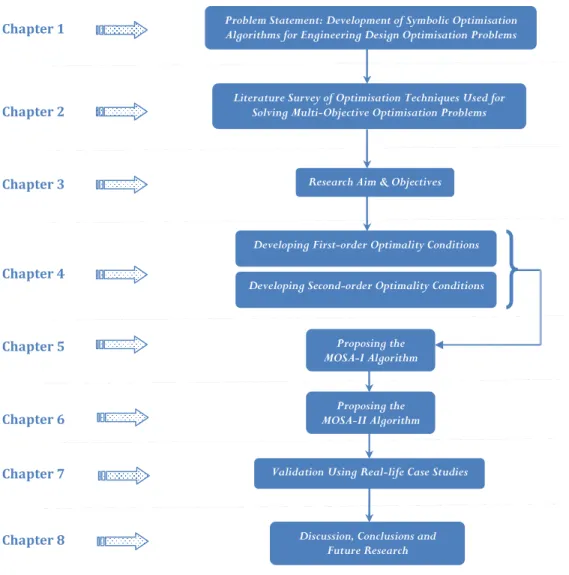
The layout of this thesis is developed based on the story of this research. This story, which is pictorially depicted in Figure 1.3, aids the identification of individual chapters. A brief description of these chapters is given below.
Chapter 1discusses the background of this research, briefly explaining the aim of this research. It presents the problem statement and motivation for this research.
Chapter 2 provides an overview of optimisation techniques used for solving multi-objective optimisation problems, and the test problems used for evaluating these techniques. It presents a critical analysis of the state-of-the-art evolutionary-based optimisation techniques.
Chapter 3gives a brief description of this research, outlining its aim, objectives and scope. It also discusses the methodology that is adopted for ensuring that the aim and objectives of this research are attained.
Chapter 4deals with some different theoretical classes of multi-objective optimisation problems. The first-order optimality conditions for each class are separately proposed and proved. Furthermore, the duality results for each class are suggested and then some first-order duality theorems are illustrated and proved. In addition, this chapter proposes second-order optimality conditions under a generalised type of univexity functions.
Chapter 5presents a multi-objective symbolic algorithm (MOSA-I) for solving multi-objective optimisation problems with particular aspects. These aspects include the class of all the objective functions and inequality constraints that are continuous, differentiable, and convex. The algorithm is checked by solving some multi-objective optimisation problems that have been carefully selected from literature according to the state-of-the art optimisation algorithm, NSGA-II.
Chapter 6 generalises the algorithm presented in the previous chapter. The only difference between this algorithm (MOSA-II) and the one mentioned in the previous chapter is that this one includes second-order optimality conditions that are used to reduce solutions provided by the first-order optimality conditions. This algorithm is a generalisation of the previous algorithm in such a way that it overcomes some of the
Chapter 1. Introduction
drawbacks found in the previous one..This algorithm is checked by solving some multi-objective optimisation problems that are carefully selected from literature.
Figure 1.3: Thesis layout
Chapter 7 validates the research using three real-life case studies: design of pressure vessel, design of four-member truss and design of welded beam. The MOSA-II algorithm is applied to these problems, and the results thus obtained are analysed, compared and discussed.
Chapter 8concludes this thesis with a discussion on the generality of this research, contribution to knowledge, and limitations of the research methodology, proposed algorithms and optimality conditions. It finally discusses the future research directions that could follow from this research.
Chapter 1 Chapter 2 Chapter 3 Chapter 4 Chapter 5 Chapter 6 Chapter 7 Chapter 8
Problem Statement: Development of Symbolic Optimisation Algorithms for Engineering Design Optimisation Problems
Literature Survey of Optimisation Techniques Used for Solving Multi-Objective Optimisation Problems
Research Aim & Objectives
Developing Second-order Optimality Conditions Developing First-order Optimality Conditions
Proposing the MOSA-I Algorithm
Proposing the MOSA-II Algorithm
Validation Using Real-life Case Studies
Discussion, Conclusions and Future Research
Chapter 1. Introduction
1.5
Summary
This chapter has addressed the following.
It has defined the problem setting used throughout the thesis.
It has presented the first and the second-order optimality conditions of KKT.
It has shown a brief introduction on evolutionary computation techniques.
It has illustrated the motivation of this research.
Chapter 2. A Review of Literature
2 A REVIEW OF LITERATURE
In mathematics and computer science, optimisation, or mathematical programming refers to the process of choosing the best alternative from some set of available alternatives. In simple terms, this means solving problems in which one seeks one or more feasible solutions to minimise or maximise one or more objective functions by systematically choosing the solutions from within an allowed set. The need for finding such optimal solutions in a problem comes mostly from an extreme purpose, such as designing a solution for minimum possible cost of fabrication or for maximum possible reliability or others. Because of such extreme properties of optimal solutions, the optimisation algorithms are of great importance in practice, particularly in engineering design. The aim of this chapter is to give an overview of techniques used for solving multi-objective optimisation problems, and the characteristics of problems used for evaluating these techniques. It attempts to achieve the following.
To analyse the classical approaches used for tackling multi-objective optimisation problems
To provide an overview of evolutionary computation techniques used for handling multi-objective optimisation problems and then a comparison between classical and evolutionary approaches.
To provide an overview of theoretical approaches used for tackling multi-objective optimisation problems.
To categorise and classify the articles used in the literature survey. To identify the current trends.
To demonstrate the research gap.
2.1
Classical Approaches to Multi-Objective Optimisation
Looking for Pareto-optimal solutions of multi-objective optimisation problems is a complicated task, particularly when one has nonlinear objectives and constraints. Therefore, finding this sort of solutions plays an important role in multi-objective optimisation and mathematically the problem is considered to be solved when the Pareto-optimal set is obtained. As a result, literature
Chapter 2. A Review of Literature These techniques can be classified into two broad categories: classical and evolutionary. In this section, an outline review of some popular classical optimisation methods used for this purpose is given.
2.1.1 Weighted Aggregation Approach
The weighted sum method is one of the most widely used approaches for solving multi-objective optimisation problems. This method is also called naïve approach (Coello, 1998). The simplest way to apply this technique is to take each objective function, associate a weight with the objective function and then take a weighted sum of the objective functions. Therefore, a new and unique objective function is obtained (Ehrgott, 2000; Miettinen, 1999)
Strengths and Drawbacks
The traditional weighted sum approach was the first one used in the field of multi-objective optimisation after Pareto (1906) introduced the concept of non-inferior solutions in the context of economics (http://cepa.newschool.edu/het/profiles/pareto.htm) and after that it has been very popular in many applications. Due to its wide use, researchers have identified its strengths and weaknesses as follows. From the algorithmic point of view, this technique is very efficient and easy to implement. Beside that, it is easy to understand. The main usefulness of the weighted sum approach appears when the feasible space of objective functions is convex. Nevertheless, there are a number of difficulties with this approach. As discussed in many studies (e.g. Koski, 1985; Messac et al., 2000; Das et al., 1997; Deb, 2001), this method can not discover Pareto-optimal solutions hidden in concavities and it is very sensitive to the weight parameters. Moreover, in handling mixed optimisation problems, such as those with some objectives of maximisation type and some of minimisation type, all objective functions have to be converted into one type. Although different conversion procedures can be adopted, the duality1principle is convenient and does not introduce any complexity. Furthermore, in nonlinear multi-objective optimisation problems, a uniformly distributed set of weights does not guarantee a uniformly distributed set of Pareto-optimal solutions. Albeit the drawbacks aforementioned, this approach is still used in applications and some modified forms of this technique have been studied recently (Kim and De Weck, 2005). For more details about the advantages and disadvantages of the weighted sum technique, see Deb (2001).
1
The dual of the partial order set ܲ ൌ ሺܺǡሻis the partial order setܲௗൌ ሺܺǡሻ. For instance, a minimum element of ܲwill be a maximum element ofܲௗ. Minima and maxima are dual concepts in order theory.
Chapter 2. A Review of Literature 2.1.2 ࢿ-Constraint Method
The ߝ-constraint approach is another well known technique for solving multi-objective optimisation problems. Instead of aggregation of criteria, only one of the objective functions is selected to be optimised, while the other objective functions are transformed to constraints by setting an upper bound to each one of them (Ehrgott, 2000; Miettinen, 1999).
Strengths and Drawbacks
As mentioned before, this technique is designed to discover Pareto-optimal solutions based on optimising one of the objective functions while treating the other objective functions as constraints bound within some allowable range. Like in the traditional weighted sum method, the problem is repeatedly solved for different values of weights until the entire Pareto-optimal set is generated. The main advantage of this technique is that it is able to identify a number of non-inferior solutions on a non-convex boundary curve which are not obtainable using other techniques. Moreover, the entire Pareto-optimal set can be obtained by varying the values (Napitupulu, 1990). Furthermore, in terms of the information needed from the user, this approach requires a vector of values representing, in some sense, the location of the Pareto-optimal solutions. The major disadvantage of this approach is that when it is used to solve multi-objective optimisation problems, it largely depends on this chosen vector. Another drawback of this approach is that it consumes a large amount of computing time, and the programming of the algorithm can be very hard to do if there are many objective functions. Also, as the number of the objectives increases, the number of elements in the vector may require extra information from the user. Inspite of these drawbacks, the relative simplicity of the method has made it popular (Collette et al., 2003; Engau and Wiecek, 2005, 2007).
2.1.3 Hybrid Method
The introduction of hybrid methods comes from the need to deal with complex industrial applications whose handling becomes unpractical with GA optimisation techniques. The best known hybrid method is Corley method. This approach is a combination of weighted sum andߝ -constraint method. It is described in Corley (1980), and Wendell and Lee (1977).
Chapter 2. A Review of Literature Strengths and Drawbacks
The positive features of the weighting method and the constraint method have been combined in the hybrid approach. Explicitly, any Pareto-optimal solutions can be found independently of the convexity of the problem and one does not have to solve several problems or even think about uniqueness to guarantee the Pareto optimality of the solutions (Miettinen, 1999). Consequently, it is efficient for various kinds of optimisation problems, whether convex or not. Nevertheless, the specification of the parameter values may still be difficult since the number of parameters has been multiplied by two (Miettinen, 1999; Collette et al., 2003).
2.1.4 Weighted Metrics Method
The ideal point is the best outcome of a multi-objective optimisation problem. Yet, when the objectives are in conflict the ideal values are impossible to obtain. However, it can be used as a reference point, with the aim being to seek for solutions as close as possible to the ideal point (Ehrgott, 2000; Sawaragi et al., 1985). So, instead of a weighted sum of the objective functions, the weighted metrics such asℓand the distance metrics2ℓஶ are often used.
Strengths and Drawbacks
For this method to work well, a good reference point must be chosen carefully. Otherwise, the solutions obtained depending on this reference point will not be optimal. Nevertheless, this method allows one to discover solutions hidden inside concavities under some conditions as presented in Messac et al. (2000). An interested reader can find more about the robustness and the weaknesses of this approach in Miettinen (1999), Collette et al. (2003) and Deb (2001).
2.1.5 Benson’s Method
This method has been presented by Benson (1978). This approach is to some extent similar to the weighted metrics approach. The main difference between the weighted metrics method and Benson’s method is that in the later the reference solution is taken as a feasible non-Pareto-optimal solution.
2
The weightedℓdistance measure of any solution࢞from another solutionࢠ is ℓ(࢞) =(∑ெ ୀଵ߱|݂(࢞)െ ࢠ|)
భ
Chapter 2. A Review of Literature Strengths and Drawbacks
The major strength of Benson’s approach is that if one has shown an appropriate reference solution, the solutions in the non-convex region can be found (Deb, 2001). The main weakness of this procedure is the additional number of constraints needed to restrict the search in the region dominating the chosen reference solution. Moreover, the objective function is non-differentiable, thereby causing difficulties for gradient-based methods to solve the above problem (Deb, 2001).
2.2
Evolutionary Computation Techniques for Multi-objective
Optimisation
Optimisation algorithms such as evolutionary swarm algorithms are heuristic techniques that have been used to deal with multi-objective optimisation problems (Collette and Siarry, 2003). They have adequately demonstrated their usefulness in finding a well-converged and a well-distributed set of near Pareto-optimal solutions (Fletcher and Powell, 1963; De Jong, 1975; Farkas and Jarmai, 1995; Deb and Kumar, 1995; Coello et al., 2002; Deb, 2001). Because of the extensive studies and the available source codes available both commercially and freely for these algorithms, they have been popularly applied in various problem-solving tasks and have received great attention (Fonseca and Fleming, 1995; Binh and Korn, 1996; Goldberg, 2002; Deb and Sundar, 2006, Dhish, 2008). However, recent studies (Jensen, 2003) have shown that multi-objective optimisation with fitness assignment based on Pareto-domination leads to long processing times for large population sizes. This has motivated a considerable amount of research and a wide variety of approaches have been suggested in the last few years (Musselman and Talavage, 1980; Osyczka and Kundu, 1995; Los and Eilben, 1996; Viennet et al., 1996, Laumanns et al., 1998; Narayanan and Azarm, 1999; Poloni et al., 2000; Tapabrata and Liew, 2002; Li and Palusinski, 2003; Shukla and Deb, 2007). Deb et al. (2007) have suggested a verification procedure based on Kaursh-Kuhn-Tucker (KKT) conditions to build confidence on the optimality of solutions obtained using an evolutionary optimisation procedure.
Most engineering design optimisation problems are multi-objective in nature since they normally have several conflicting objectives, say for example, cost and performance, which must be satisfied at the same time. This has encouraged the growth of research in the field of multi-objective optimisation using evolutionary algorithms (Schwefel, 1995; Rao, 1996; Veldhuizen, 1999; Rogero et al., 2000; Marler and Arora, 2003). This section gives an overview of some
Chapter 2. A Review of Literature popular evolutionary-based multi-objective optimisation techniques in terms of their types and features.
2.2.1 Vector Evaluated Genetic Algorithm (VEGA)
This algorithm has been proposed by Schaffer (1985). In the algorithm, Schaffer has modified the selection operator of a simple genetic algorithm (SGA) so that at each generation a number of sub-populations were generated by performing proportional selection according to each objective function in turn. Schaffer realised that the solutions generated by his method were non-dominated in a local sense.
Strengths and Drawbacks
The weakness of this algorithm is that one may obtain at the final generation (at the end of optimisation process) a population composed of mean individuals with respect to all the objective functions. Such a population does not allow one to obtain a good approximation of the Pareto-optimal front. Instead, the population will be concentrated around a mean “point”. Moreover, it has been shown that this algorithm does not have the ability to produce solutions in the presence of non-convex search spaces (Coello, 1999).
2.2.2 Multi-Objective Genetic Algorithm (MOGA)
This method is well-presented in Collette et al. (2003) and Fonseca et al. (1993). The comparison between individuals in this algorithm is based domination in the Pareto sense. The rank of an individual (an order number which allows one to rank an individual with respect to the others) is given by the number of individuals which dominate an individual. For instance, if one considers an individual ݔat generation ݐwhich is dominated by ܲ௧individuals, the rank of this considered individual is given by ݎܽ݊݇(ݔǡݐ)ൌ ͳ ܲ௧. The rank 1 is assigned to all the non-dominated individuals and dominated ones are penalised according to the population density of the corresponding region of the Pareto front.
Strengths and Drawbacks
The main strength of this algorithm is that it can be implemented with relative easy (Coello, 1997). In some cases, the MOGA algorithm does not allow one to obtain a good diversity of solutions for the approximation of the Pareto front.
Chapter 2. A Review of Literature 2.2.3 Non-Dominated Sorting Genetic Algorithm (NSGA)
The Non-dominated Sorting Genetic Algorithm (NSGA) was proposed by Srinivas et al. (1994). This algorithm is based on a classification using many levels of individuals. In the first step of the algorithm, before proceeding to selection, each individual in the population is ranked on the basis of non-domination (Srinivas et al., 1994). After that, all non-dominated individuals are classified into one category. To this category, a dummy fitness value, which is proportional to the population size, is assigned to provide an equal reproductive potential for these individuals. To Maintain a good approximation of the trade-off surface, or, alternatively, a good diversity of solutions, these classified individuals are shared with dummy fitness values. Then, this group of classified individuals is ignored and another layer of non-dominated candidates are considered. The process continues until all individuals in the population are classified. Since all individuals in the first front have the maximum fitness value, they get more copies than the rest of the population. This allows the algorithm to search for non-dominated regions, and results in quick convergence of the population towards such regions.
Strengths and Drawbacks
The main efficiency of this technique lies in the fact that any number of objective functions can be handled by reducing them to a dummy fitness function using non-dominated sorting procedure. Both minimisation and maximisation problems can be handled. Some researchers have reported a drawback of this method (Coello, 1997). The main weakness of this algorithm is that it is sensitive to the value of the sharing factor. In addition, it is more inefficient computationally and in terms of quality of the Pareto-optimal fronts produced than MOGA. Other authors report that the NSGA algorithm performed well in terms of coverage of the Pareto-optimal front (Zitzler et al., 1998, 1999).
2.2.4 Niched Pareto Genetic Algorithm (NPGA)
This algorithm is based on the NSGA method described in the preceding sub-section. The main difference occurs during the selection process (Horn et al., 1993). In a classical genetic algorithm, the method of selection between two individuals uses a selection wheel, but in this method, the way in which one can select individuals is changed. Instead of comparing two individuals, a group of individuals (typically around 10) is used to help determine dominance. Based on whether the individuals are dominated or non-dominated, a sharing fitness is decided through the tournament selection.
Chapter 2. A Review of Literature Strengths and Drawbacks
As this method does not use the Pareto selection on the whole population, but just on a part at each run, its main strengths are that it is very fast and can produce good non-dominated fronts that can be kept for a large number of generations. Nevertheless, its main weak point is that besides requiring a sharing factor, this approach also requires a good choice of the size of the tournament to perform well.
2.2.5 Strength Pareto Evolutionary Algorithm (SPEA)
SPEA algorithm is well-presented in Zitzler et al. (1999). In brief, Zitzler et al. (1999) have suggested an elitist MOEA with the concept of non-domination. Starting from the initial population, they proposed maintaining an external population at every generation storing a set of non-dominated solutions (Zitzler et al., 2001a). A combined population with the external and the current population is first constructed. All non-dominated solutions in the combined population are assigned a fitness based on the number of solutions they dominate. For maintaining the diversity, Zitzler et al. (1999) assigned more fitness to a non-dominated solution having more dominated solutions in the combined population. Conversely, solutions dominated by more solutions in the combined population are also assigned by less fitness.
Strengths and Drawbacks
The advantage of this algorithm is that the clustering used is parameter-less, thereby making it attractive to use. In the absence of the clustering algorithm, the SPEA has a similar convergence to that of Rudolph’s algorithm which is presented elsewhere (Deb, 2001). The fitness assignment procedure in the SPEA is similar to that of Fonseca and Fleming’s MOGA (Deb, 2001) and is easy to calculate. One of the drawbacks of this algorithm is that the overall complexity needed in each generation of the SPEA isܱሺܯ ܰ2),whereܯ is the number of objectives andܰ is the size of the
population. The SPEA introduces an extra parameter, the size of the external population. It is extremely important for achieving a successful working of the SPEA to balance between the regular population size and the external population size. If the external population size is large comparable to the regular population size, the selection for the elites will be large and the SPEA may not be able to converge to the Pareto-optimal front. Here too, the SPEA shares a common problem with the MOGA. The problem is that the fitness assignment has a bias to not favour all non-dominated solutions of the same rank equally.
Chapter 2. A Review of Literature 2.2.6 Strength Pareto Evolutionary Algorithm (SPEA2)
In 2001, the strength Pareto evolutionary algorithm presented above has been improved by Zitzler et al. (2001b). The main differences in SPEA2 in comparison to SPEA are (Zitzler et al., 2001b): (i) an improved fitness assignment scheme is used, which takes into account (for each individual) how many individuals it dominates and is dominated by, (ii) a nearest neighbour density estimation technique is incorporated which allows a more precise guidance of the search process, and (iii) a new archive truncation method which guarantees the preservation of boundary solutions.
Strengths and Drawbacks
SPEA2 differs from SPEA and NSGA-II (which will be presented in the next sub-section) only in how it does fitness assignment and selection (this makes SPEA2 among the most popular multi-objective optimisation algorithms). The main strength of the SPEA2 method is that it is much better than the original SPEA in all aspects of test problems. The found solutions are closer to the outlying edges of the Pareto-optimal front, making it a weak point of this algorithm.
2.2.7 Non-Dominated Sorting Genetic Algorithm (NSGA-II)
This algorithm is currently one of the most popular multi-objective optimisation algorithms. The author of this algorithm and his students (Deb, 2000a; Deb et al., 2002) suggested an elitist non-dominated sorting GA (termed NSGA-II) in 2000. This algorithm does not have much similarity with the original NSGA, but the authors kept the name NSGA-II to emphasise its genesis and place of origin (Deb, 2001; Deb et al., 2002). The NSGA-II carries out a non-dominated sorting of a combined parent and offspring generation. Thereafter, starting from the best non-dominated solutions, each front is accepted until all population slots are filled. This makes the algorithm an elitist type. For the solutions of the last allowed front, a parameter-less crowded distance-based niching strategy is used to resolve which solutions are carried over to the new population. The algorithm also has a crowded distance metric, which makes it fast and scalable to more than two objectives.
Strengths and Drawbacks
A crowding comparison procedure is used with the tournament selection during the population reduction phase to achieve the diversity among the non-dominated solutions. Also in this
Chapter 2. A Review of Literature algorithm, no niching parameters is required. In the absence of the crowded comparison operator, this algorithm displays a convergence proof to the Pareto-optimal solutions, but the population size would grow with the generation number. Therefore, the overall complexity will beO(MN2), whereMis the number of objectives andNis the size of the population. In addition,
the elitism mechanism does not allow an already found Pareto-optimal solution to be deleted. Recent study has been proposed to reduce the run time complexity of the NSGA-II and other algorithms (Mikkel, 2003). The weak point of this algorithm is that when the crowded comparison is used to restrict the population size, the algorithm loses its convergence property. Only if the size of the non-dominated set is not larger than the population size, the algorithm preserves the convergence property. However, in later generations, when more than N individuals belong to the first non-dominated set in the combined parent-offspring population, some closely packed Pareto-optimal solutions may give their places to other non-dominated but non-Pareto-optimal solutions (Deb, 2001). Additionally, a comparison between NSGA-II and SPEA2 has been presented by Lam et al. (2004). The results derived from this comparison show that the SPEA2 outperforms NSGA-II in the early generations; however NSGA-II is superior during later generations irrespective of the level of noise present in the problem. Recently, a modified version of NSGA-II has been proposed by Babbar et al. (2003). In this paper, a clustering based modification to the NSGA-II ranking scheme, that improves the performance of the algorithm in noisy environment, is presented.
2.2.8 A Multi-objective Evolutionary Algorithm Based on Decomposition (MOEA/D)
The majority of existing MOEAs are based on Pareto dominance (Deb, 2001). In these algorithms, the utility of each individual solution is mainly determined by its Pareto dominance relations with other solutions visited in the previous search. Since using Pareto dominance alone could discourage the diversity of search, some techniques such as fitness sharing and crowding have often been used as compensation in these MOEAs. NSGA-II and SPEA-II are among the most popular Pareto dominance based MOEAs. Arguably, NSGA-II (Deb, 2001) is the most popular Pareto dominance based MOEAs. The characteristic feature of NSGA-II is its fast non-dominated sorting procedure for ranking solutions in its selection.
A Pareto-optimal solution to a multi-objective optimisation problem could be an optimal solution of a scalar optimisation problem in which the objective is an aggregation function of all the individual objectives. Therefore, approximation of the Pareto-optimal front can be decomposed into a number of scalar objective optimisation subproblems. This is a basic idea behind many
Chapter 2. A Review of Literature traditional mathematical programming methods for approximating the Pareto-optimal front. A very small number of MOEAs adopt this idea to some extent, among them the Multi-objective Evolutionary Algorithm Based on Decomposition (MOEA/D) is a very recent one (Zhang and Li, 2007). MOEA/D attempts to optimise these subproblems simultaneously. The neighborhood relations among these subproblems are defined based on the distances between their aggregation coefficient vectors. Each subproblem (i.e., scalar aggregation function) is optimized in MOEA/D by using information only from its neighboring subproblems.
Strengths and Drawbacks
One of the major advantages of MOEA/D over Pareto dominance based MOEAs is that single objective local search techniques can be readily used in MOEA/D. A comparison on some multi-objective optimisation problems has been carried out between MOEA/D and NSGA-II (Li and Zhang, 2010). The results have shown that no solution obtained in NSGA-II dominates any solutions in MOEA/D but most solutions in NSGA-II are dominated by the solutions in MOEA/D
2.3 Classical Versus Evolutionary Approaches
Both classical and evolutionary approaches have their own drawbacks in tackling multi-objective optimisation problems. Most classical methods, such as weighted sum, convert multiple objectives into one objective using different heuristics (Miettinen, 1999). Since multiple objectives are converted into one objective, the resulting solution to the single objective optimisation problem usually depends on the weights. Although this is a weak point of this approach, this approach can handle any number of objectives; say for instance five objective functions. When using evolutionary algorithms to handle multi-objective optimisation with such number of objectives, the performance of most of the evolutionary algorithms gets poor.
Classical and evolutionary approaches also suffer from serious limitations in handling the complexity of multi-objective optimisation problems (Wang and Yan, 1991). The presence of variable interaction (such as linearity and nonlinearity between decision variables) may introduce some additional features in the optimisation problems. Literature reveals that neither classical nor evolutionary approaches can handle this situation except using numerical methods such as regression analysis that can approximate a curve/surface of the Pareto-optimal front. Classical approaches, in some simple cases of multi-objective problems, can provide an exact curve for both the relationship between the decision variables and the curve of the Pareto-optimal front
Chapter 2. A Review of Literature (Collette et al., 2003; Arora, 2004). Despite a wide spread applicability of evolutionary optimisation algorithms over the past few decades, evolutionary researchers still face criticism about the theoretical optimality of the solutions obtained by evolutionary techniques (Deb et al., 2007).
2.4
Theoretical Approaches for Multi-objective Optimisation
Problems with two or more objectives (called multi-objective or multi-criteria) are very common in engineering and many other disciplines (Collette et al., 2003). The solutions of such problems are difficult because their objectives tend to be in conflict. In this situation, one can not find a single ideal solution which simultaneously satisfies all the decision variables across all criteria. So, a solution that is extreme with respect to one objective function requires a compromise in other objectives (Deb, 2001). Because of such properties of these solutions, optimisation methods are of great important in practice, particularly in engineering design, scientific experiments, and business decision-making (Deb, 2001). The general consensus of the engineers and mathematicians working in this area is that the Pareto-optimal set may contain information that can help the designer to make a decision and thus arrive at better trade-off solutions. Also, this information might show the designer an issue that has been ignored such as the ease of manufacture or assembly. The main goal of this section is to give an overview of current optimality conditions along with the existing analytical methods which have been used so far for solving multi-objective optimisation problems.
Optimality conditions for multi-objective optimisation problems have been studied extensively in the literature. Many efforts have been made to derive first-order necessary and/or sufficient conditions for a feasible solution to be an optimal solution. Several studies relating to first-order optimality conditions have been reported and have drawn much attention for a long time, and many beneficial results have been obtained over the past several years since the appearance of the paper by Kuhn and Tucker (1950). Herein, some important results regarding the development and extension applied to first and second-order optimality conditions are reported (Beale, 1958; Box, 1966; Lin, 1976; First et al., Kanniappan, 1983, 1990; Zalmai, 1985a; Singh, 1987; Wang, 1988; Zemin, 1996; Majumdar, 1997; Bigi and Castellani, 2000; Messac et al., 2000; Miettinen and Makela, 2001; Zheng et al., 2007; Ginchev and Ivanov, 2008). However, little work has been concerned with second-order optimality conditions for multi-objective optimisation problems.
Convexity plays a very important role in various branches of engineering in management science and operations research, in mathematical economics, in pure and applied mathematics, in optimisation theory and in statistics. In recent years, there has been an ever-increasing interest in
Chapter 2. A Review of Literature the generalisations of basic convexity concepts with the hope of extending well known properties, characterizations and applications. Many excellent texts and hundreds of articles have appeared in recent years. The optimisation theory of Dubovitskii and Milyutin (1965) has been used by Censor (1977) to produce optimality conditions for differentiable convex vector optimisation. Benson (1978) has examined the existence of efficient and properly efficient solutions for the vector maximisation problem. Kuhn-Tucker necessary conditions (Miettinen, 1999) for a maximum point of a convex function subject to convex constraints have been stated and proved by Batson (1986). Zalmai (1985a,1985b) has adopted a geometric point of view and developed continuous-time analogues of the Fritz-John (Miettinen, 1999) and Kuhn-Tucker (Miettin