HOW TABLETS CAN STEAL A MARCH ON
LAPTOPS
The Next Battleground: Tablet Text Input
KeyPoint Technologies Bringing Devices to Life July 2011
Foreword
An analysis of reviews and analyst reports reveals that tablet computers such as the iPad have been extremely well received. Undoubtedly, tablets have made great inroads over the past year and should be in demand for years to come, achieving over 10% of total computing shipments by 2014 according to a variety of analysts. In addition, by the end of this year (2011), it is expected more than 25 per cent of tablets will be bought by enterprises.
Yet still, for the moment, the existing touch screen typing with auto-correction on tablet computers requires such effort that tablets are used mainly as
passive or „sit back‟ devices, according to new research from Opinion Matters, commissioned by KeyPoint Technologies. Tablets discourage people from engaging in more complex, creative activities beyond simple emailing, and online social media interaction. This will potentially limit their broader utility, particularly in the corporate world.
A poll of US tablet users has found that despite the popularity of the super- portable touch screen tablets, writing lengthy amounts of text with auto-correction is the most common frustration for tablet users with 44 per cent of users selecting it as a problem. Whereas, despite the significant media coverage of the issue, the lack of Flash on iPad was explicitly listed as a frustration by only three per cent of users.
Text input will be the next battlefield in tablet computing, as manufacturers attempt to gain advantage, trying to differentiate the next generation of products. The current poor typing experience on tablets leads people to view the devices as a hybrid – a midpoint between a smartphone and a laptop. Only with improved text input can the tablet become less compromised and a realistic replacement for a laptop.
Manufacturers‟ attempts so far to make typing easier by having the computer predict and correct what the user is typing has gone some way to aid input, but the overwhelming majority of users (81 percent) agree that tablet auto correction functionality as it exists now needs improvement. Online reviews echo a consensus that typing anything more than a few lines or paragraphs becomes a headache, impeding productivity and creative thought.
This report provides a snapshot of tablet usage in the US and was inspired by the popularity surrounding the tablet and a desire to identify its Achilles heel, so to speak. We believe that through this research we have identified the area that is ripe for quick and innovative development and will allow tablets to steal a march on laptops. This we have called the `Input Gap` in the speed and accuracy with which users are able to interact with their tablets. We believe text input is the area to watch closely. I hope you will find this report of interest.
Biggest Tablet Frustrations
Opinion Matters asked users to identify their biggest frustrations with their tablet. Of the over 1000 respondents polled, 44 per cent identified the typing of long or very long documents using autocorrect (500 words or more) as the primary frustration. Battery life was the next most common shared frustration (36 per cent) and thirdly a further 27 per cent thought that the lack of a
conventional keyboard stifled their creativity. From these observations, it is clear that there is an opportunity for manufacturers to improve text entry on the tablet devices.
Despite the heavy media focus on the lack of Flash on iPad, only three per cent of users registered it as a frustration.
As well, anyone contemplating whether to purchase a WiFi-only or a 3G-enabled tablet should observe that 23 per cent of respondents selected `Limited Connectivity` as a frustration. It would seem that almost a quarter of tablet users appreciate always having access to the internet and that they can find it limiting when no WiFi or operator network connection is available. This resonates with the type of „sit back‟ activities users primarily engage in (see next section: Tablets Drive Consumption, Not Creativity).
Table 1
Tablets Drive Consumption, Not Creativity
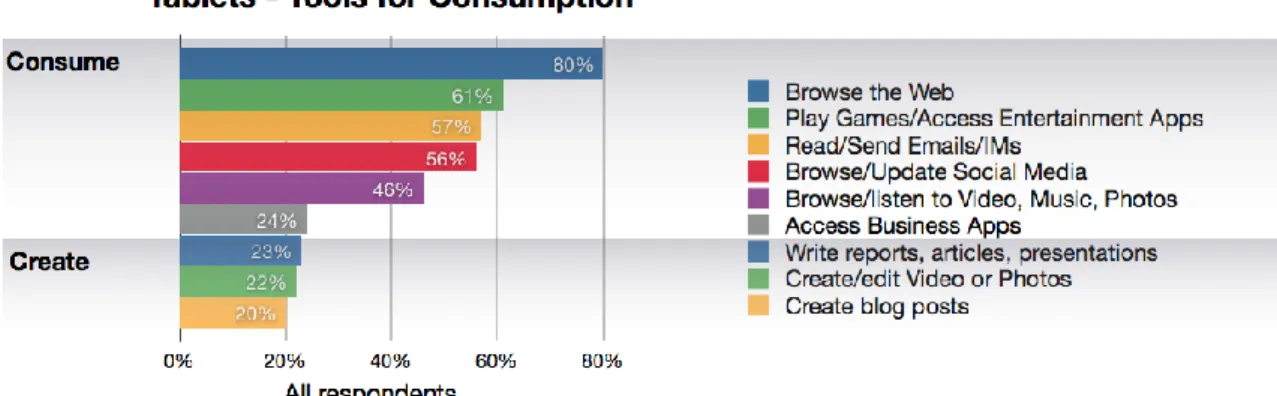
Since the tablet is a relatively new device category in the market, speculation abounds as to how it is used now and will be in the future. The research shows that whether used on the move or at home, users primarily grab their tablets to consume media, rather than to create content. While 80 per cent of users browsed the web with their tablet, 61 per cent used it for games or
consume significantly outweighs the desire to create when picking up the devices.
Table 2 - Consumption Machines
A Preferred Device
Tablets are experiencing rapid market uptake, displacing the netbook and beginning to replace the laptop in some cases, manufacturers are looking for ways to introduce improved functionality to allow users to `cut the cord` with laptops.
Apple announced at its Worldwide Developers Conference in June 2011 that it would add picture editing to iOS 5, for example, amongst other updates. Currently though, research shows that the tablet is used primarily by people to consume media and for short writing activities e.g. Twitter/Facebook posts, with people postponing select tasks until they can get to a conventional computer, including the writing of reports and presentations.
As more people consider whether to replace their laptops with tablets altogether, will they turn away from longer written creative endeavours or simply delay purchasing a tablet? Possibly yes, unless steps are taken in product development to improve the user experience for typing. Whereas 38 per cent of users prefer their tablet to access Twitter or Facebook, only 17 per cent prefer the tablet to write a letter or report.
Given the preferences in Table 3 and the major frustrations noted in Table 1, it seems the business road warriors will need to continue to carry multiple devices to achieve maximum productivity unless the text entry is improved and can become second-nature to users such that writing a long document is no longer a challenge.
Table 3
What is it Like to Type on a Tablet?
Is typing on a tablet more like a smartphone or more like a laptop? Overall, the survey showed that all those who expressed an opinion either way, half compared it to a laptop and half compared it to a smartphone or PDA, placing the tablet experience firmly in the middle ground between the two (see Table 5).
At one end, smartphones are fully mobile and used on the move. Particularly because of their form factor, they have challenging text entry where the user must be very conscious of typing, potentially interrupting flow of thought. Desktops, on the other hand, are used more for creative activities with no mobility and easier text entry. Laptops are used for a mixture of “sit back” activities such as reading, watching or browsing as well as for creative endeavours.
By addressing a major frustration with an inside-out approach – improving text input to offer better auto-correct and predictive text – more creative tasks are feasible on a tablet thus closing the „Input Gap‟. This would pave the way for users to reduce the number of computing devices they own and position tablets more in the laptop market.
Table 5
Of note is that when the age of the respondents is considered, it is clear that majority of older users (45 and over) find the experience to be more like a smartphone (55 per cent), while younger users (under 45) are more likely to equate it to a laptop (53 per cent). This difference was the only significant variance amongst segments in all the data collected.
One might hypothesise that younger users would have higher expectations for the typing experience and would like to achieve much more with their device over time.
Innovation Needed for Auto-Correction
A marked split in responses firmly illustrated the need for improved text input as 81 per cent of users agreed that the auto-correct functionality on their tablet could be improved. This finding underscores one of the most significant challenges manufacturers face in tablet development. It emphasises the „Input Gap‟ between tablets and laptops and the user‟s desire for quick and accurate imput and the device to deliver it; this will exist if improvements are
implemented. Older respondents may feel equally frustrated by the auto-correct, though are less likely to realise or expect that it can be improved (72 per cent 45 and over versus 86 per cent 44 and under). With improved auto-correction and word suggestions, the tablet could better begin to replace the laptop.
Table 6
Where Will Tablet Innovation Lead?
The research clearly shows that tablets are devices for consumption, not content creation except for short status updates and tweets. The research investigated user perceptions on what would be the most effective and practical method for typing on a tablet, in case it was a simple ergonomic solution to the problem.
The device touchscreen was the most popular as 31 per cent prefer the device touchscreen keyboard, while 22 per cent would prefer a pull-out keyboard,13 per cent would like to use a stylus and 12 per cent would like to use a Bluetooth keyboard. Another 12 per cent had no hope for improvement and only nine per cent saw speech as a viable option, highlighting the
continuing challenge presented by the adoption of speech technologies. This finding would suggest that manufacturers have a hit with the touchscreen and should consider continuing to improve that overall experience together with improved text input to better meet user needs.
Table 7
Closing Thoughts
The past year has witnessed rapid growth in the tablet market. People were not sure at first how they would be used. This report provides a snapshot of the current situation and reveals that they are being used as „sit back‟ devices mostly for media consumption. They are rarely used for creative endeavours as is born out by the research indicating that the biggest frustration is the ability to type long documents.
With the tablet sitting in the middle ground of the typing experience, between a smartphone and a laptop in terms of users‟ perceptions, the survey
highlights that while users are happy with their virtual keyboard or manufacturer‟s onscreen keypad, they overwhelmingly see scope for improvement of auto-correction and more generally text input.
There is much talk of tablets replacing laptops, particularly when coupled with access to cloud networks. As more and more users consider `cutting the cord`; will they really be able to do away with laptops or desktops altogether? The research shows that unless text entry is improved on the tablet, people will continue to use multiple devices.
Better autocorrect can help to close the Input Gap and make the tablet a stronger, creative and universal device.
- About KeyPoint Technologies
For developers, OEMS and platform providers worldwide, KeyPoint Technologies is a trusted partner generating dynamism via Open Source. With its unique business model for input technology, combined with world-class linguistics expertise, the company enables partners developing devices including: Smartphones; Feature phones; Tablets; Connected TVs; In-Vehicle Infotainment (IVI) system and Point of Sale (POS) systems, to innovate more effectively. KeyPoint Technologies closes the 'Input Gap' to help partners better solve tomorrow‟s interface challenges. It delivers convenient, consistent and more rewarding user experiences, thus enabling increased speed and accuracy of text-based user input and interaction. KeyPoint Technologies OpenAdaptxt™ is the first commercial-grade, Open Source-based text input platform, supporting 50 languages.
Privately-owned, KeyPoint Technologies was founded in 2004 by Sanjay Patel and is based in Glasgow, UK with offices in India and the USA. The company operates globally serving device manufacturers in key markets such as USA, Europe, Korea, Taiwan and Canada.
For further information on OpenAdaptxt™ and KeyPoint Technologies, please visit: www.openadaptxt.org or www.keypoint-tech.com.
About the Report
Sample Size: The primary research findings are based on responses from 1011 people in the Uni ted States who use tablet computers such as the iPad. The research was commissioned by KeyPoint Technologies and conducted independently by Opinion Matters in June 2011. On some graphs featured in the report, the figures may not total to 100 per cent.