U
KAIRO
: Internet-Scale Bandwidth Detouring
Thom Haddow
Imperial College London
Imperial College London
Sing Wang Ho
Cristian Lumezanu
Georgia Tech
Moez Draief
Imperial College London
Imperial College London
Peter Pietzuch
Abstract
The performance of content distribution on the Internet is crucial for many services. While popular content can be delivered efficiently to users by caching it using content delivery networks, the distribution of less popular con-tent is often constrained by the bandwidth of the Internet path between the content server and the client. Neither can influence the selected path and therefore clients may have to download content along a path that is congested or has limited capacity.
We describe UKAIRO, a system that reduces Internet download times by usingdetour pathswith higher TCP throughput. UKAIROfirst discovers detour paths among an overlay network of potential detour hosts and then transparently diverts HTTP connections via these hosts to improve the throughput of clients downloading from content servers. Our evaluation shows that by perform-ing infrequent bandwidth measurements between 50 ran-domly selected PlanetLab hosts, UKAIRO can identify and exploit potential detour paths that increase the me-dian bandwidth to public Internet web servers by up to 80%.
1 Introduction
Bandwidth is a critical performance metric for many Internet services. Operating system vendors that push large patch files to customers [28], video sharing sites like YouTube, and HD streaming services such as iTunes and Netflix require high-bandwidth Internet paths to send content quickly to users. In addition, as cloud computing applications become popular, access to high-throughput paths between their users and the cloud data centre be-comes crucial for efficient operation [2].
Historically, the “last-mile” network path to the user was the bandwidth bottleneck. However, the recent widespread deployment of faster access technologies such as ADSL+ [34], DOCSIS 3 [8] and fibre-to-the-kerb
means that the bottleneck is shifting away form the edge towards the core of the network [22]. As a consequence, obtained bandwidth depends on the capacity and conges-tion of the traversed Internet path, which is determined by routing protocols such as OSPF [15] and BGP [30]. These protocols select paths based on the financial gain and performance of theInternet service providers(ISPs) rather than directly using user-based performance met-rics such as available bandwidth. This often results in paths for clients with unnecessarily low bandwidth to certain destinations.
Existing solutions to improve content distribution performance include the use of content delivery net-works(CDNs) such as Akamai, Amazon CloudFront [7] and Coral [10]. CDNs replicate content and place it at locations “closer” to the clients to which they have high bandwidth paths. Since they require substantial storage and network resources, their usage is cost-effective only for popular content; content providers must find other solutions to handle the long tail of less popular con-tent [3]. Downloading concon-tent along multiple paths us-ing Bittorrent [4], Bullet [19], SplitStream [5] or mul-tipath TCP [13] also increases download bandwidth but requires modifications to clients and content servers and may be less efficient due to the transfer of redundant data. More radical proposals such as content-centric net-working [16] require changes to the Internet architecture, which are difficult given the existing investment in net-work equipment.
In contrast, we propose to enable users to select In-ternet paths with higher bandwidth by “detouring” traffic via a set of third-party nodes. Researchers have shown thatdetour routing[31] can reduce path latencies [23, 14] or increase availability [1, 11] without requiring changes to Internet routing protocols or content servers. An open challenge, however, is how to discoverdetour pathsthat have higher bandwidth than the direct path while keeping the measurement overhead low [12].
relies on the observation that a small number of good de-tour nodes on the Internet is sufficient to provide substan-tial bandwidth increases to a set of clients for a major-ity of destinations. Based on experiments on the global PlanetLab test-bed, we show that 50 randomly chosen detour nodes can provide 71.4% of the relative band-width improvement obtained by using a larger set of 150 PlanetLab nodes. In addition, a client can get al-most all of the detouring benefit by strategically selecting 5 good detour nodes from this set of 50 detour nodes.
We describe the design and evaluation of UKAIRO1, a system that allows web clients to exploit detour paths with higher TCP throughput on the Internet. UKAIRO maintains an overlay network of detour nodes that act as SOCKS proxies for TCP connections. The system re-lays TCP connections of external clients through a detour node for improved bandwidth.
The UKAIROsystem operates in two separate phases: detour discoveryandclient detouring. In the detour dis-covery phase, the system collects all-pairs bandwidth measurements between a set of overlay nodes that can act as potential detour nodes and finds bandwidth detours among them. It then ranks the overlay nodes according to their average relative bandwidth improvement when act-ing as detour nodes. To combine good detouract-ing perfor-mance with load-balancing of detour nodes, each client is assigned a small client-specific subset of detour nodes from the ranked overlay node list through biased random sampling.
In the second phase, a client finds a detour for a given destination by probing each of its client-specific detour nodes and selecting the path that results in the highest bandwidth when compared to the direct path. This path selection is done by performing a short parallel HTTP download until each path is likely to have reached steady-state bandwidth. Over time, a client can refine its client-specific detour node set by discarding detour nodes that do not perform well and replacing them with fresh ones from the ranked overlay node list.
The results from deployment of UKAIROon PlanetLab show that it can increase the median bandwidth of routes to public webservers by 80%. Its load-balanced detour selection scheme can support simultaneous users, and the bandwidth measurement overhead can be reduced to 40% of all-pairs measurements in the overlay network.
In summary, the contributions of the paper and the out-line of its remainder are:
1. an empirical study of bandwidth detours on Planet-Lab, demonstrating that a small number of detour nodes can provide the bulk of achievable bandwidth improvement (Section 2);
1Japanese romaji for “detour”
2. a practical approach for bandwidth detouring on the Internet by discovering good detours among a set of overlay nodes and using them for third-party clients through path selection (Section 3); and
3. an evaluation of the UKAIROsystem on PlanetLab with external web servers that shows the feasibility of bandwidth detouring system (Section 4).
2 Bandwidth Detouring
In this section, we provide evidence that bandwidth de-touring is botheffectiveandfeasible. First, we study the properties of bandwidth detours and show that they pro-vide significant bandwidth improvement and are stable. Second, we show that only a small number of carefully selected detour nodes is necessary to improve bandwidth significantly to most destinations.
2.1 Detour properties
To study the properties of detours, we measure the band-width of all network paths between 201 nodes on Planet-Lab [35], a global test-bed for networking research, on 26 Oct, 2010. We include only one PlanetLab node per site and ensure that each node participates in at most one concurrent measurement. To measure bandwidth, we use iperf, a standard tool for observing TCP throughput of a path by creating an elastic TCP transfer between two hosts [36]. We use iperf because it is accurate and provides fast measurements [12]. Note that we use the terms bandwidth and TCP throughput interchangeably throughout the paper.
Benefit.We first show the potential benefit of detouring for bandwidth. A path(i, j) between the two nodes i andj benefits from detouring through a nodel ifˆbilj, the minimum of the bandwidth of the two legs of the detourbilandblj, is larger than the bandwidthbijof the direct path, i.e.,
ˆbilj = min (bil, blj)> bij.
In the remainder of the paper, we denote byˆbiljthe band-width of the path betweeniandjwhen detoured vialas given bymin (bil, blj). This assumes that the bandwidth of a detour path is determined by the bottleneck link [12]. We also denote bydl(i, j)the percentage of (or relative) bandwidth increase if the path(i, j)uses nodelas a de-tour, i.e.,
dl(i, j) =
max�ˆbilj−bij,0�
bij , (1)
Based on our bandwidth measurement dataset de-scribed above, we associate with each path(i, j)the best detour node, i.e., the node l with the highest value of dl(i, j). We find that 80.2% of the 35,240 paths mea-sured benefit from an increase of at least 20% and 1 Mbps of their bandwidth with one-hop detours. We restrict our analysis to one-hop detours because adding more hops yields little additional improvement, as observed previ-ously [12].
Longevity.Detour longevity, or the time for which a de-tour persists, is crucial for the feasibility of bandwidth detouring. Measurements to discover detours take a significant amount of time and bandwidth to perform. Long-lasting detours reduce the overhead of the system. We study how detours evolve on PlanetLab. We measure paths between 100 randomly chosen PlanetLab nodes at 4am (GMT) everyday between Dec 9, 2010 and Jan 5, 2011 (except for Dec 18, 2010 due to a fail-ure). For each set of measurements, we exhaustively search for the detours for each path and validate the de-tours’ improvement,dl(i, j), on a later dataset. We find that 79.6% of the discovered detours are still valid af-ter one day, providing a 53.2% median increase in band-width. The improvement provided by a discovered de-tour decreases over time—the median increase reduces to 34.3% by the 14th day. After 28 days, 71.1% of de-tours still exist but the increase has dropped to 31.4%.
We conclude that measurements for detour discovery have to be repeated roughly every 2 weeks in order to avoid substantially stale data. This bodes well for the practical use of detour nodes in a real deployment. In fact, a relatively high measurement overhead to discover detour nodes can be amortised over the lifetime of an ap-plication because detour paths, once discovered, remain effective for a prolonged period of time.
2.2 Finding detours scalably
We showed that bandwidth detours can provide signifi-cant and lasting improvements. However, to operate ef-fectively, a system exploiting these detours must discover them quickly and with as little measurement overhead as possible, in particular, without relying on all-to-all path measurements. Next, we investigate the effectiveness of three techniques to reduce the number of measurements required to discover detours yet preserve their quality. 2.2.1 Using latency detours instead
Existing proposals for detouring to reduce latency use network coordinate embedding [24] or AS path similar-ity [14] to discover latency detours with low measure-ment overhead. Ideally, we could use such approaches to
0 10 20 30 40 50 60 70 80 90 100 0 20 40 60 80 100 120 140
Average percentage of bandwidth increase
Number of detour nodes
Figure 1: Percentage of bandwidth improvement suffers from diminishing returns as the size of the detour node set increases
find latency detours and use them to improve path band-width.
However, as we show in Section 4 and as confirmed by previous results [23], latency detours do not improve bandwidth. We also found that the use of bandwidth de-tours does not necessarily reduce latency, as measured using the ping tool. In our dataset, only 15.6% of paths experience lower latency when detoured via the best detour node, i.e., the detour l that maximises the ratiodl(i, j)for the path(i, j). The median latency in-creased by 10.9 ms or 8.3% when detouring through the best bandwidth detour.
2.2.2 Reducing the number of detour nodes
Another way to lower the number of required bandwidth measurements is to restrict the number of detour nodes in the system. To evaluate whether this preserves good detours, we divide ournPlanetLab nodes into adetour setDcontainingknodes, chosen uniformly at random, and aclient setCcontaining the remainingn−knodes. For each path between a pair of nodesiandjin the client setC, we find the best detour nodelijin the detour setD, i.e., the one with the largest improvement as given by
dlij(i, j) = max
l∈D dl(i, j).
In this setting, we let the bandwidth of a path (i, j), i, j ∈ C, be the maximum between ˆbilijj and bij. In other words, we fall back to using the direct path when no better bandwidth detour exists.
To understand how the size of the detour set affects the qualityof detours, we consider the average percentage of improvement over all paths between nodes in the client
setC, given by 1 |C|(|C| −1) � i,j∈C dlij(i, j). (2) as a function of the size of the detour setD. We repeat the experiment 1000 times, each time selecting a fresh set of detour nodes at random.
Figure 1 shows that increasing the size of the de-tour set D offers diminishing returns beyond a certain point. For example, for a detour set of 50 nodes, we pre-serve 71.4% of the optimal bandwidth improvements ob-tained from the all-to-all measurements described in Sec-tion 2.1. Therefore, a key insight is that even a limited number of randomly chosen nodes that act as potential detour nodes can achieve the bulk of the improvement from bandwidth detouring.
2.2.3 Choice of detour nodes
To reduce the number of path measurements required when searching for a good detour node, clients can first try detour nodes that are more likely to provide good de-tours. We analyse two strategies for ranking the nodes in the detour setD, with the goal of identifying detour nodes that are more likely to lead to high detouring band-width: aclient-obliviousand aclient-specificstrategy. Client-oblivious ranking.In this strategy, the rank of a detour node does not depend on the client that uses it.
Given a set P of measured paths, we define dl(P), the scoreof node l ∈ D, as the average improvement generated if we usedlas the only detour for all paths in
P, i.e., dl= 1 |P| � (i,j)∈P dl(i, j). (3) Here we assume that we have measurements for all the paths between nodes inD, i.e.,P ={(i, j)∈ D×D, i�= j}. The nodes inDare then ranked in decreasing order of their scoredl. We defineDmas the set consisting of the firstmnodes from this ranked list.
Client-specific ranking.In the client-specific ranking strategy, we compute the average improvement of each nodel∈D, for each clienti∈C. In this case, the score of nodel∈ D, given a setPiof measured paths between nodeiand some other client nodes inCis defined by
dl(i) = 1
|Pi| � j:(i,j)∈Pi
dl(i, j). (4) Here we assume that we have measurements for all nodes inD, i.e.,Pi={(i, j), j ∈ D, j�=i}. Similarly to the client-oblivious strategy, each clientiranks the nodes in Din decreasing order of theirdl(i)scores and then uses the firstmnodes from this list as potential detours.
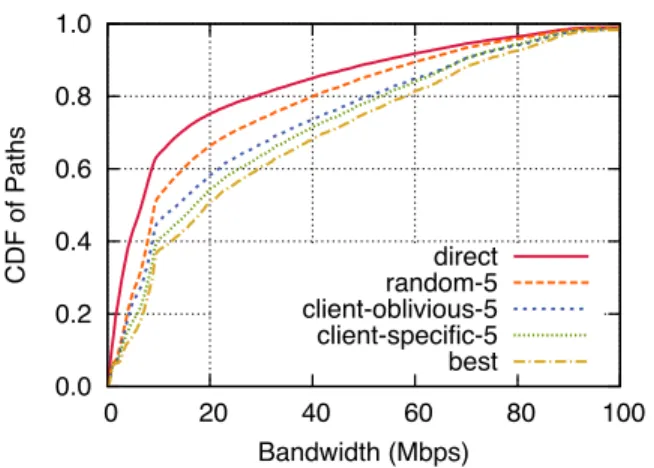
0.0 0.2 0.4 0.6 0.8 1.0 0 20 40 60 80 100 CDF of Paths Bandwidth (Mbps) direct random-5 client-oblivious-5 client-specific-5 best
Figure 2: Comparison of the effectiveness of different ranking strategies to reduce the set of detour nodes to be considered by clients
We now evaluate the strategies by considering their de-touring improvement. For each path(i, j)between nodes inC, we associate the highest bandwidth that can be ob-tained by detouring through one of the detour nodes pro-vided by a given ranking strategy, or set it tobi,jif none beats the direct path.
Figure 2 shows the results in terms of the distribu-tion of bandwidths of obtained detour paths, based on our PlanetLab dataset. We compare this to the band-width distribution of the direct paths (direct), the best out of 5 randomly chosen detour paths (random-5) and the best possible by exhaustively considering all detour nodes inD(best).
The curve labeledclient-oblivious-5represents the dis-tribution of bandwidth between nodes in C using the client oblivious ranking ofD5, as described above. We
observe that a value ofm= 5ensures enough diversity of detour nodes while keeping the size of the set small. Although the detour nodes are ranked based on their per-formance on the setD, according to Equation (3), they offer good detours between the nodes in the setC.
Similarly, the curve labeledclient-specific-5shows the bandwidth for the client-specific strategy withm = 5. Its improvement is close to the one obtained through best. Bandwidth is also higher than forclient-oblivious-5, which illustrates that, by selecting detours based on their suitability for specific client nodes, we get improvements similar to the ones obtained through an exhaustive search for the best detour nodes.
2.3 Summary
We showed, using real world bandwidth measurements on PlanetLab, that bandwidth detours can provide signif-icant and lasting improvements between Internet hosts.
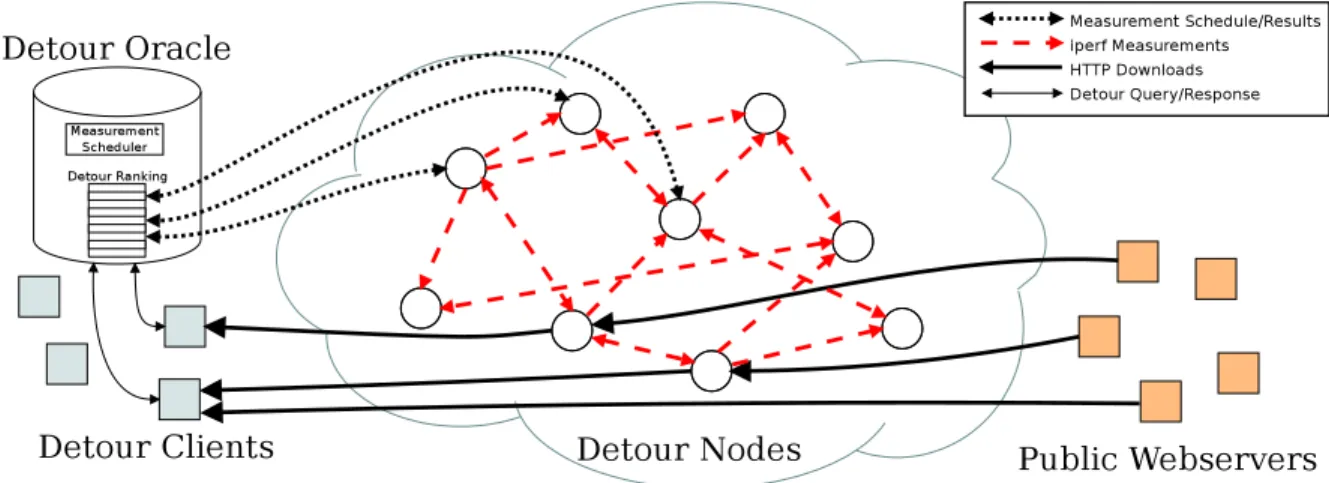
Figure 3: Overview of the UKAIROsystem architecture Discovering such detours does not require all-to-all
mea-surements and most benefit can be recovered by restrict-ing to detours through a small subset of detour nodes se-lected based on their average bandwidth improvement. These findings are crucial for providing a scalable and efficient service for bandwidth detouring on the Internet.
3 Ukairo Architecture
Next we describe UKAIRO, an Internet service for scal-able bandwidth detouring using a set of overlay nodes. UKAIRO provides two main mechanisms: detour dis-coveryandclient detouring. Detour discovery identifies which nodes can act as bandwidth detours (Section 3.1), while client detouring enables clients to relay their traffic through these detour nodes (Section 3.2.1).
Figure 3 presents an overview of our system. UKAIRO consists of an overlay network of detour nodes, D, which provide higher bandwidth paths to clients, and a detour oracle, which is responsible for discovering good detour nodes. The detour oracle collects bandwidth mea-surements between the nodes in the overlay using a mea-surement schedulerand ranks them based on their de-touring potential (i.e., the average percentage of band-width increase that they provide). To take advantage of UKAIRO, users installdetour clientswhich query the or-acle to obtain a set of candidate detours for a given des-tination. Using on-demand measurement, detour clients then choose the best detour out of all candidates.
3.1 Detour discovery
Next we describe the detour discovery part of UKAIRO in detail. It is based on the observation that discovered detours through a smaller set of overlay detour nodes can be used effectively for detouring traffic of external clients
and destinations.
At the heart of the detour discovery process are two components: ameasurement schedulerand adetour or-acle. The measurement scheduler periodically collects bandwidth measurements between the overlay nodes by instructing nodes to measure the bandwidth of paths. The detour oracle then uses the collected measurements to rank the detour nodes based on their estimated potential for bandwidth detouring.
3.1.1 Measurement Scheduler
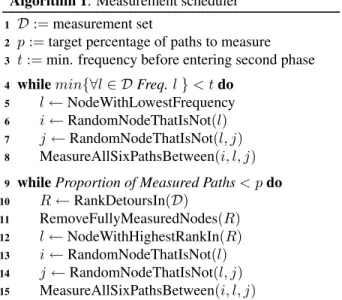
The goal of the measurement scheduler is to col-lect bandwidth measurements among the set of detour nodesD. The measurement scheduler can instruct de-tour nodes to measure bandwidth to other nodes using the iperftool. Nodes report back successfully completed measurements to the scheduler, which records them in a database. Because measuring all-to-all bandwidth in-curs significant overhead, the scheduler uses a two-phase heuristic to reduce the number of measurements. First, it collects the measurements needed to determine the de-touring potential of each node. Once it acquires sufficient data, it continues to perform measurements with prefer-ence for paths that traverse nodes with high detouring potential. We describe the two phases in detail next (Al-gorithm 1).
In the first phase, the scheduler iteratively measures a set of paths to gather partial information about the nodes’ detouring potential (lines 4–8). At each step, it picks the node with the lowest number of measured paths. In other words, it finds the nodelwith the smallest count of mea-sured paths(a, b)where(a, l)and(l, b)are both mea-sured. Next, two other nodesi, j are chosen at random from the detour node setDand the scheduler measures all six paths between them.
Algorithm 1: Measurement scheduler
D:=measurement set
1
p:=target percentage of paths to measure
2
t:=min. frequency before entering second phase
3
whilemin{∀l∈ DFreq.l}< tdo
4 l←NodeWithLowestFrequency 5 i←RandomNodeThatIsNot(l) 6 j ←RandomNodeThatIsNot(l, j) 7 MeasureAllSixPathsBetween(i, l, j) 8
whileProportion of Measured Paths< pdo
9 R←RankDetoursIn(D) 10 RemoveFullyMeasuredNodes(R) 11 l←NodeWithHighestRankIn(R) 12 i←RandomNodeThatIsNot(l) 13 j ←RandomNodeThatIsNot(l, j) 14 MeasureAllSixPathsBetween(i, l, j) 15
collects values of dl(i, j) for t distinct paths (i, j) in the set of measured pathsP. The scheduler then ranks each detour node in decreasing order of their scores given by Equation (3). Subsequently, it selects nodes accord-ing to their rank and, for each node, measures detour paths that traverse the node and have not yet been mea-sured (lines 9–15).
The measurements stop after a fractionpof the paths was measured. The value of p depends on the cost of measuring an overlay path and the benefits of a more accurately measured overlay—we evaluate differ-ent choices ofpin Section 4.3.
3.1.2 Detour Oracle
The detour oracle has access to the bandwidth measure-ments collected by the measurement scheduler. Each client queries the oracle to receive a small set of can-didate detour nodes. The oracle determines these sets by ranking the detour nodes based on the available band-width measurements. It implements two different strate-gies for returning candidate detour node sets to clients. Client-oblivious ranking.The aim of this strategy is to benefit from the properties of detour nodes highlighted in the analysis ofclient-oblivious-5in Section 2.2.3. For each detour nodel ∈ D, the oracle computes its score according to Equation (3) where P corresponds to the proportionpof paths measured by the scheduler. Nodes are then ranked in a list L in decreasing order of this metric.
The listLis then made available to client nodes, which can then choose their detours from it. If some detour nodes are particularly effective for a large number of paths, then they may be exploited by too many paths at
once resulting in a degradation of their detouring capabil-ity. Next, we propose a load balancing strategy to avoid overloading individual detour nodes.
Load-balanced ranking.Our modified strategy sup-ports load-balancing of detour nodes when used concur-rently by many clients to avoid overloading particularly effective detour nodes. The oracle ranks detour nodes as in the client-oblivious strategy. It then only provides clients with a small subset of detour candidates. These candidates are chosen uniformly at random from a trun-cated list containing the first half of detour nodes in the ranked listL.
3.2 Client detouring
The detour oracle supplies clients with a set of candidate detour nodes that are more likely to provide bandwidth improvement toanydestination. The goal of the client detouring mechanism is to decide which of the candidate detour nodes the client should use for aspecific destina-tion. Next we describe how clients choose a detour node and how the overlay carries traffic across the detour path to the destination.
3.2.1 Path selection
Each client host participating in the UKAIROsystem runs a detouring client component. The detouring client inter-cepts HTTP connections from an application, such as a web browser or a file downloader, and transparently de-tours them through an appropriate detour node. After acquiring a list of candidate detour nodes, the detouring client must perform path selection, i.e., choose the best detour node for the given destination, or fall back to the direct path if no better detour is found.
Path selection requires predicting the bandwidth to a destination through a set of detour nodes. To preserve the performance benefits of bandwidth detouring, path selection must be fast, transparent to applications, and have little overhead. However, even when a client is re-stricted to choosing from a small set of detour nodes, it is still difficult to accurately and quickly predict which de-tour node to use for a particular path. Previous work [27] has attempted to use latency or jitter as inexpensive pre-dictors for path bandwidth. However, we have found that these methods tend to be too unpredictable or resource-intensive to be of practical use on PlanetLab nodes.
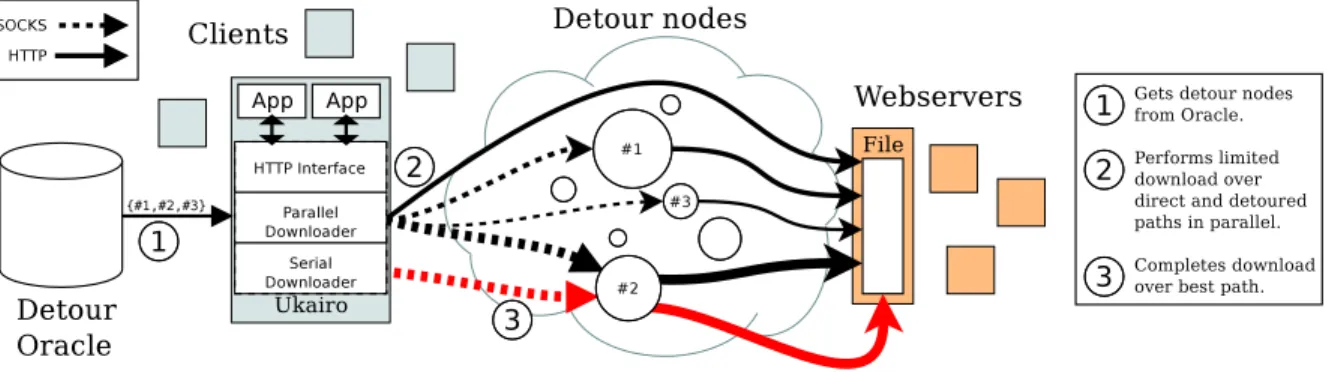
UKAIRO performs path selection by starting parallel HTTP transfers on each candidate path and simultane-ously measuring their bandwidth to select the best path. Figure 4 shows how clients perform path selection on the candidate detour set obtained from the oracle. Path selec-tion has two phases: asamplingphase, in which the best
Figure 4: A client performs a parallel path selection download to choose the best path from the supplied detours. available path is discovered by performing a limited
con-tent download, and acompletion phase, in which the best detour path is used for the rest of the download.
In the sampling phase, givenscandidate detour nodes and a content sizeN, the parallel path-selecting HTTP downloader allocates a chunk of sizeN/(s+ 1)to each potential detour path and the direct path using the HTTP “range” header [9]. HTTP as a protocol is particu-larly suited for this because of its idempotent operation semantics—downloads can be terminated and restarted on different paths as required.
UKAIRO downloads each chunk in parallel until a timeout of 5 seconds is reached or the chunk is com-pleted. This is based on an empirical observation that most paths achieve TCP steady-state behaviour within 5 seconds. The path with the fastest download rate is then used to download the remainders of any incomplete chunks by constructing a multiple-range final HTTP re-quest in the completion phase. If none of the detour paths have higher bandwidth than the direct path, the download completes using the direct path.
To reduce load on the detouring overlay and to avoid an unfair advantage on congestion due to multiple TCP flows, we want to minimise the amount of time that paral-lel downloading occurs. We observe that, due to the short timeout period and the TCP slow startup, the combined parallel rate in the short sampling phase rarely exceeds the serial rate of the completion phase. This suggests that the sampling phase has a limited negative influence over competing flows.
3.2.2 Adaptive detour selection
Clients can improve their choice of detour nodes over time by taking advantage of additional measurements collected during path selection. In this way, the list of client-oblivious nodes provided by the oracle becomes client-specific. We have already shown in Section 2.2.3 that detour nodes specific to clients provide better perfor-mance than client-oblivious ones.
Algorithm 2: Adaptive detour selection
Li:=ranked detour list
1
�i:=candidate detour set
2
li:=test detour
3
run parallel path selection with�i,lias detours
4
Li←RankDetoursUsingAvailableMeasurements
5
�i←get top-sdetours fromLi
6
ifbilij < bijthen
7
li←RandomlySelectNodeUsing(Li)
8
We describe how a client can incrementally improve its choice of detours in Algorithm 2. Initially, each client i downloads the ranked list of detour nodes to-gether with their scores from the oracle; the detour nodes are based on the client-oblivious strategy described in Section 3.1.2. We refer to this list asLi. After each download that clientiperforms, it updates the listLito incorporate the new measurements that it acquired with the goal of customising its choice of candidate detour nodes, as follows.
Given an instance of the listLi, clientidraws a set�i consisting ofsdistinct candidate detour nodes fromLi where each node is chosen with probability proportional to its current score. In addition to the set�i, the client chooses a distincttest detourlifromLiwith a probabil-ity proportional to its score. The idea behind adding a test node is to speed up the convergence of our set�ito the set of client-specific detours (cf. Section 2.2.3).
Before downloading from some nodej, clientiruns the sampling phase of parallel path selection on paths through the candidate detour nodes in �i, the test de-tourli, and the direct path. As a by product, the listLiis updated to incorporate the new measurements acquired by running parallel path selection. More precisely, the score of each detour nodelis recalculated by averaging its current score with the new valuedl(i, j) that it ac-quired. The nodes are then re-ranked in decreasing order of these new scores to obtain a fresh listLi(lines 5–6).
A fresh detour candidate set�i is drawn, and if detour-ing throughli does not beat the direct path, a new test detourliis chosen (lines 7–8).
The random procedure above of drawing the set�iand the nodeliensures that the set of candidate detour nodes quickly converges, as we perform more and more down-loads, to the set of client-specific detours as illustrated in Section 4.1.2.
3.2.3 Detouring
To carry traffic from clients to destinations on detour paths, detour nodes relay TCP connections on demand, which is illustrated in Figure 4. This is done using the standard SOCKS protocol [21], as implemented by the lightweightsrelaySOCKS server [37]. SOCKS is es-sentially an application-layer protocol for proxying the standard “network socket” programming interface via a remote host over TCP. From an application perspective, SOCKS provides a similar interface to that of the stan-dard sockets API and lightweight wrappers are easily de-ployed to make it completely transparent to applications. In our architecture, we utilise thelibcurlHTTP li-brary [32] to interface with the remote SOCKS server. HTTP connection attempts are first relayed to the de-tour node over the TCP-based SOCKS protocol. The detour then establishes a new TCP connection to the in-tended destination server. Since two separate sequential TCP handshakes must be performed to complete this pro-cess, connecting via SOCKS typically doubles the con-nection setup time. From the perspective of the desti-nation server, the connection appears as a regular HTTP connection, except that it comes from the detour node rather than the original client node.
Since detouring results in two TCP connections, the system benefits from thesplit-TCPeffect [18]. The TCP throughput of a long IP path can be improved by split-ting the connection into two independent TCP connec-tions. Each split TCP connection becomes more re-sponsive to packet loss due to its lower round-trip time, and thus has higher throughput. However, split-TCP alone does not account for the improvement due to band-width detouring—many bandband-width detours have inter-mediate leg latencies that are larger than the direct path latency [12].
Another approach for redirecting traffic is IP detour-ing: tunneling IP packets to the detour nodes, which in turn redirect them to the corresponding destination. However, as we showed in our earlier work [12], IP de-touring is not viable when detour nodes are at the edge of the Internet. The longer paths to edge nodes (in terms of IP hops) incur higher loss rates and therefore exhibit lower bandwidth
However, TCP detouring, as opposed to IP detouring,
is less transparent to destinations because TCP connec-tions appear to originate from the wrong source IP ad-dress. As this is a common side effect of many Internet systems such as HTTP proxies or gateway NATs, we be-lieve that it is an acceptable restriction.
4 Evaluation
We evaluate UKAIROusing realistic bandwidth-intensive HTTP workloads on the PlanetLab test-bed. The goal is to demonstrate that UKAIROcan improve download per-formance for bulk HTTP downloads for many destina-tions, while exhibiting acceptable overheads.
First, we evaluate the download performance of a single client in isolation, from both PlanetLab nodes and public Internet web servers, using various detouring strategies (Section 4.1). Second, we present performance results from multiple clients utilising the system con-currently to observe the impact of load balancing (Sec-tion 4.2). Finally, we explore the bandwidth measure-ment overhead of the system (Section 4.3).
Experimental setup.We consider a population of geographically-dispersed 201 PlanetLab nodes, such that there are no two nodes from the same PlanetLab site. We choose 50 nodes at random to act as the UKAIROdetour nodes and configure a machine at our university as the detour oracle.
We select two independent sets of 30 nodes each to act as detour clients and destination web servers. The destination nodes run the lightweight thttpd HTTP server [29] serving pre-generated random binary files. We choose a download file size of 40 MB to obtain sta-tistically significant results on high bandwidth paths. To avoid measuring low bandwidth paths, we limit any sin-gle serial HTTP transfer to 20 seconds.
Since we have observed that we cannot sustain detour connections over 40 Mbps reliably on PlanetLab, we at-tempt to find detours only for direct paths with band-width below this rate. This restricts us to around the 85th
percentile of Internet paths, as shown in Figure 2. The client nodes download a predefined list of URLs as follows. First, clients download each URL via the direct path (i.e., without any detouring). Clients then attempt to download each URL via a detour path with higher bandwidth than the direct path by obtaining a can-didate list from the oracle (Section 3.1.2) and performing path selection (Section 3.2.1).
4.1 Single-client detouring
Our first experiment shows that the bandwidth improve-ment due to detouring using the two oracle ranking strategies, client-oblivious-5 and load-balanced-5, with
0.0 0.2 0.4 0.6 0.8 1.0 0.5 1 1.5 2 CDF of Paths
Relative Bandwidth Improvement (logscale) peerwise
load-balanced-1 load-balanced-5 client-oblivious-1 client-oblivious-5
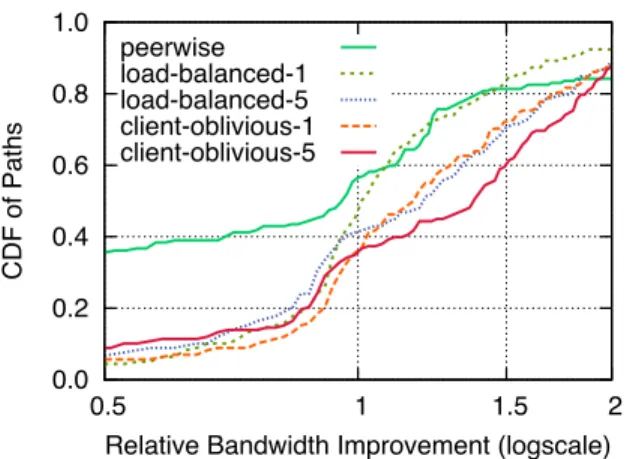
Figure 5: Detouring improves bandwidth on the majority of lower-bandwidth Internet paths
5 candidate detour nodes for each client (cf. Sec-tion 3.1.2). To demonstrate the benefits of having more candidate detours, we also compare to similar strategies that use only one detour node (client-oblivious-1and
load-balanced-1). The 10 client, 25 destination, and 50
de-tour nodes are all located on PlanetLab. We run client benchmarks serially to avoid interactions between mea-surements.
In addition, we compare to an approach, in which bandwidth detours are chosen based on latency. To test this, we use PeerWise [23] to discover latency detours from clients to destinations and return the detour node that provides largest latency reduction. These detours are validated without using the parallel path selection mechanism. We resort to the scalable network coordi-nate based mechanism of PeerWise to find latency de-tours, and not to less scalable all-to-all measurements, because it better matches the overhead constraints of a real deployment.
In Figure 5, we show the distribution of detouring path performance expressed as a fraction of the direct path bandwidth on a logscale. Results to the right of the verti-cal line at 1 indicate an improvement in detoured down-load performance. The points to the left of 1 represent paths that appear to be good detours based on measure-ments, but which in fact have lower throughput than the direct path, due to measurement noise causing mistakes in path selection and the detouring overhead. The re-sults are based on around 200 path measurements, in which around 75% of the direct path bandwidths are un-der 40 Mbps. During the parallel path selection down-load, we observed that the overall rate of the parallel sampling phase was on average only 3% faster than the completion phase, suggesting the parallel aspect of the downloading does not gain an unfair share of the network resources.
When each client uses the same set of 5 highest-ranked detour nodes (client-oblivious-5), the median bandwidth improvement is around 1.4×that of the direct path. 65% of paths see no reduction in bandwidth, while 40% of paths are improved by at least 50%. The load-balanced-5strategy leads to a smaller bandwidth improvement— the median improvement is 1.2×compared to the direct path. However, it still provides at least as much band-width as the direct path on the majority (60%) of detours. The performance of the client-oblivious-1 strategy shows the impact that a single well-chosen detour node can have on general Internet end-to-end bandwidth. It provides a median improvement of around 20% over all paths and has a significant 50% improvement on around 30% of paths. The load-balanced-1 approach demon-strates that any single detour can provide a few signifi-cant gains—e.g., at least some improvement on half of the paths tested. However, its relatively poor perfor-mance in comparison toclient-oblivious-1highlights the importance of a good choice of detour node.
Both path selection strategies with single detour nodes, namely client-oblivious-1 and load-balanced-1, perform reasonably well because the probability of se-lecting the wrong detour path is lower with only two (direct and single detour) paths to choose from. All the path-selection strategies show similar performance when they fail to provide a detour path with higher bandwidth than the direct path. This suggests that any reduction in performance is then independent of the detour node given by path selection, and is more likely due to gen-eral overheads, such as the increased connection set-up time and limitations in the forwarding capacity of detour nodes.
When choosing bandwidth detours based on latency
(peerwise), the overall performance drops, with more
than half of the paths showing a substantial reduction in bandwidth when detoured. That thepeerwise strategy performs worse means that, as described in Section 2.2, using latency to find bandwidth detours without a means of verifying the suggested path is not a viable solution. 4.1.1 Detouring to public web servers
To explore the potential of bandwidth detouring on a more realistic subset of the Internet, we run an exper-iment that uses public Internet web servers as detour-ing destinations. We use around 100 software mirror sites hosting the Linux kernel source archive, which is around 40 MB in size. The majority of mirror servers are hosted at commercial sites. We use 50 detour nodes and 10 client nodes on PlanetLab. To minimise any nega-tive impact of our experiment on the web servers, each client requests the file from a single site and we use only theclient-oblivious-5detouring strategy, which
per-0.0 0.2 0.4 0.6 0.8 1.0 0.5 1 2 4 CDF of Paths
Relative Bandwidth Improvement (logscale) client-oblivious-5
Figure 6: Detouring improves bandwidth even on arbi-trary public Internet paths
formed best in our previous experiments.
Figure 6 shows the bandwidth detouring potential ex-pressed as relative download improvement over the di-rect path. The detouring performance results are signif-icantly better than those for the previous experiment us-ing just PlanetLab destinations: the median bandwidth improvement factor is around 1.8×, and we manage to improve bandwidth successfully on 80% of paths. Sig-nificantly, 30% of paths find their bandwidth doubled or better. A possible explanation is that the performance of bandwidth detouring in the previous experiment is con-strained by the destination web servers running on over-loaded PlanetLab nodes.
4.1.2 Adaptive detour selection
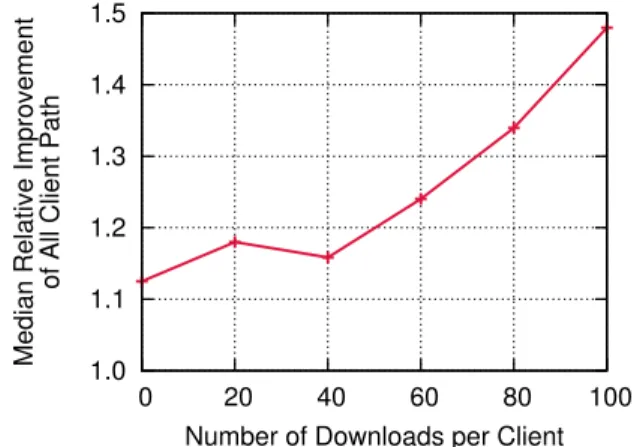
By using adaptive detour selection, clients can improve upon the client-oblivious ranking of detours provided by the oracle to create client-specific sets. We evaluate our adaptive detouring selection process by having clients randomly download from our set of PlanetLab destina-tions using adaptive detouring (cf. Section 3.2.2). Each client performs up to 100 file downloads to customise the rank listLi. To test the improvement that adaptive detouring provides, we randomly choose 5 PlanetLab web servers as destination and observe the detouring im-provement after an increasing number of file downloads per client. We use the top-5 detours fromLito evaluate the performance of our adaptive selection detour mecha-nism in improving the bandwidth between the clients and the web servers.
In Figure 7, we plot the median improvement from the testing phase for10clients. The median relative im-provement observed increases with the number of down-loads performed. It reaches about1.48×the direct path bandwidth after 100 downloads; without adaptive
detour-1.0 1.1 1.2 1.3 1.4 1.5 0 20 40 60 80 100
Median Relative Improvement
of All Client Path
Number of Downloads per Client Figure 7: Adaptive detouring improves the quality of the detour set selection over time
ing the client would expect just a 12% increase. We also find that, eventually, our adaptive detouring strategy con-verges and provides the set of client-specific detours of Section 2.2.3.
4.2 Load balancing
The previous experiments have evaluated the perfor-mance of UKAIRO with a single client at a time. This gives a baseline view of the detouring potential on the Internet but it is not a realistic usage model. Next, we in-vestigate how UKAIRO supports multiple detour clients simultaneously and load-balances between detour nodes. We run between 1 and 20 simultaneous clients, which use 20 PlanetLab nodes as destinations, al-ways testing all possible paths. We evaluate both the client-oblivious (client-oblivious-5) and the load-balanced (load-balanced-5) detour ranking strategies and plot the average relative bandwidth improvement across all paths in Figure 8.
Theclient-oblivious-5approach initially performs
bet-ter than the load-balanced-5 strategy, confirming our first experiment. As we increase the number of paral-lel clients there is, however, a clear downward trend in its performance. With 16 simultaneous clients, it fails to offer any performance improvements through detouring. The performance of load-balanced-5 remains rela-tively stable over the tested range of parallel down-loads, consistently representing a moderate average per-formance improvement. This matches our intuition that any ranking strategy that focuses on a small set of good detour nodes would suffer from limited scalability due to hot-spots, even with a small number of simultaneous clients.
We restricted ourselves to detouring paths of less than 40 Mbps because we found that only few of our
0.6 0.7 0.8 0.9 1 1.1 1.2 1.3 1.4 0 2 4 6 8 10 12 14 16 18 20
Average relative bandwidth
improvement over all client paths
Number of parallel clients client-oblivious-5
load-balanced-5
Figure 8: A diversified detour strategy can be effective for many clients simultaneously
tour nodes are capable of forwarding connections at a faster rate, regardless of the path being measured. This suggests that any given detour node has a maximum throughput, which is likely to be the limiting factor when attempting to service higher numbers of clients simul-taneously. This does imply that it should be possible to support greater numbers of parallel clients by adding more detouring nodes at popular locations, such as Inter-net peering points, subject to Inter-network capacity.
4.3 Measurement overhead
Measurements across the Internet consumes both band-width and time. In Section 3.1.1, we described abiased measurement approach to reduce the number of measure-ments within the overlay. To evaluate the performance of this measurement strategy, we deploy k = 50 de-tour nodes and compare the performance of the measure-ment scheduler witht= 25to the followingrandom ap-proach. Given the setP of paths already measured, we uniformly choose a nodeithat is the end-point of a path inP and randomly choose a new path(i, j)to measure such that(i, j)is not inP.
In both strategies, we calculate, after each measure-ment, the score dl for each detour node to create the client-oblivious ranking. We then pick the top-5 de-tours from the ranked list of detour nodes to form the set of candidate detour nodesD5. We then perform
par-allel path selection on the151client nodes that download from each other. The bandwidth of a given path(i, j)is set to be the maximum ofbij andˆbilj for alll∈ D5.
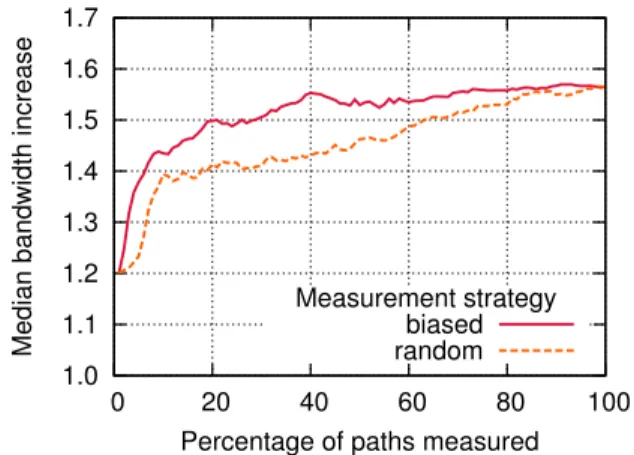
In Figure 9, we show the median relative improvement due to bandwidth detouring as a function of the percent-age of all paths measured between detour nodes. Without any measurement, both strategies begin with an unranked list of detours, thus each client behaves as if randomly
1.0 1.1 1.2 1.3 1.4 1.5 1.6 1.7 0 20 40 60 80 100
Median bandwidth increase
Percentage of paths measured Measurement strategy
biased random
Figure 9: The biased measurement scheduler requires fewer measurements to achieve a given bandwidth in-crease
selecting a detour. This still provides a 20% increase in a client’s median bandwidth. However, reaching a 50% increase requires the measurement of 30% of paths if us-ing our biased strategy and 70% with the random strat-egy. More significantly, the biased strategy provides a measurement set that achieves good bandwidth detour-ing with only approximately 40% of all-to-all measure-ments.
4.4 Discussion
We showed that a bandwidth detouring system can im-prove bandwidth to popular Internet destination. Due to the small number of required detour nodes and the longevity of detours, the bandwidth measurement over-head to discover good detour nodes for any client is ac-ceptable. Parallel path selection among candidate detour nodes allows clients to choose the best detour path as part of an ongoing HTTP download. Our approach for load-balancing across a wider set of good detour nodes shows that it can alleviate hot-spots created by popular detour nodes.
Our system is not without its limitations. First, to achieve fast path selection by parallel downloads, UKAIRO handles exclusively HTTP traffic. We are cur-rently looking into ways of scalably detouring more types of traffic. Second, using PlanetLab for our evalua-tion may raise concerns about the validity of the results. Because clients connect to a commercial site through PlanetLab, they may discover detours that would not be available had the detour node been on the commercial network. However, our measurements show that Planet-Lab paths are not bandwidth optimal: we were able to discover bandwidth detours even between PlanetLab nodes.
Finally, an open question is what impact wide-spread UKAIRO deployment would have on the Internet as a whole. Detour routing disregards network-level routing policies because AS customers provide transit, which is forbidden in inter-domain routing. While this may seem undesirable at first, we already witness applications based on the overlay networks such as peer-to-peer file sharing systems [4] and CDNs [10] that follow a similar philosophy.
In the future, overlay networks are even more likely to make more intelligent path decisions taking path proper-ties such as bandwidth into account. As a consequence, it is important for network operators to understand the implications of such decisions and provide mechanisms to handle their effects. Recent proposals for oracle ser-vices [38] operated by network providers that help peer-to-peer applications make ISP-friendly peer selection de-cisions are a first step towards a practical solution and could also be adopted for bandwidth detouring systems.
5 Related Work
Detouring was first proposed by Savage et al. [31]. They experimentally verify that detour paths with lower la-tency exist on the Internet due to violations of the triangle inequality in Internet routing. They outline an overlay ar-chitecture based on IP tunneling between edge nodes to redirect connections over such lower latency paths.
Another proposal for improving path properties us-ing an overlay network isOverQoS[33]. OverQoS pro-vides quality-of-service guarantees on network paths by changing the trade-off between bandwidth and packet loss. Instead of discovering alternate paths with desired properties, as done in our approach, it modifies the be-haviour of the direct path through packet encoding. Internet path measurement.Substantial effort has gone into the measurement of Internet path metrics. Sev-eral overlay networks aim to inform clients of the cur-rent condition of the Internet. Madhyastha et al. [25] proposeiPlane, an Internet service that uses continuous network measurements from many vantage points to con-struct a global topology map of the Internet. iPlane uses this map to provide clients information about network path metrics such as latency, loss, and bandwidth.iPlane nano[26], a decentralised version of iPlane, partitions the map across multiple clients. Both systems leave it up to clients to decide how to use this information.
Detouring for availability.The Resilient Overlay Net-work(RON) [1] uses detour routing to improve the avail-ability of Internet paths. The authors show that us-ing an overlay network to route around Internet fail-ures is practical for improving reliability. However, they discover detour paths through all-to-all measurements,
which does not scale to larger system sizes. Gummadi et al. [11] make detouring for availability scalable by se-lecting detour nodes at random. However, their approach does not work for other path metrics such as latency or bandwidth.
Detouring for latency.Most successfully, detour rout-ing can reduce Internet path latencies.Peerwise[24] dis-covers latency detours based the path embedding error in a network coordinate system. Users benefit from mu-tually advantages detours in exchange for their partici-pation in the system and becoming detour nodes them-selves. In our earlier work [14], we describe how the similarity of network-level AS paths can be exploited to discover detour paths with reduced latency. None of the latency detouring approaches work well for discovering bandwidth detours [24, 12].
Detouring for bandwidth.Recent work has investi-gated the use of overlay networks for improving path bandwidth. Jain et al. [17] use a technique for avail-able bandwidth estimation to select paths for detouring in a video streaming application. To reduce measurement overheads, they describe a method for implicitly gather-ing measurements from the shape of traffic in a video stream. The Bandwidth-Aware Routing Overlay Net-work(BARON) [20] uses capacity measurements of net-work paths to discover good bandwidth detours. How-ever, the effectiveness of this has not been evaluated ex-perimentally as part of a deployed Internet system.
Su et al. [6] minimise the overhead of detour discovery by taking advantage of on-going measurements of Inter-net CDNs. While this approach works well in practice, it relies on the proprietary decision-making by commer-cial CDN operators without any control over properties of detour paths. In contrast, UKAIRO performs its own measurements and discovery of detour paths, operating transparently to clients.
6 Conclusions
UKAIRO is a bandwidth detouring system that reduces web download times by sending traffic along overlay paths with higher TCP throughput. UKAIRO operates in two phases: it first discovers detour paths among an overlay network of potential detour nodes and then it transparently diverts HTTP connections from its clients to their destinations via these detour nodes. Our evalua-tion on the PlanetLab test-bed shows that UKAIROcan provide paths of increased bandwidth to simultaneous Internet users who download content from popular web servers. UKAIROdiscovers detours quickly and with lit-tle measurement overhead by keeping the set of potential detour nodes small and employing intelligent strategies, such as parallel path selection, for choosing the best
de-tour for each client.
An Internet bandwidth detouring system can help con-tent providers that do not posses the resources to pay for a professional CDN. By shifting content delivery costs to the operators of detour nodes, it is possible to imagine a cooperative deployment of a bandwidth de-touring service—in a similar spirit to the PeerWise sys-tem [23]—in which clients contribute resources by act-ing as detour nodes. In addition, by providact-ing path di-versity, UKAIROmay offer content providers more con-trol in circumventing censorship (e.g., avoiding paths that cross certain geographic regions or autonomous sys-tems), while still providing good download performance.
References
[1] ANDERSEN, D. G., BALAKRISHNAN, H., KAASHOEK, M. F., AND MORRIS, R. Resilient Overlay Networks. In SOSP
(Chateau Lake Louise, Banff, Canada, Oct. 2001).
[2] ARMBRUST, M., FOX, A., GRIFFITH, R., JOSEPH, A. D., KATZ, R. H., KONWINSKI, A., LEE, G., PATTERSON, D. A., RABKIN, A., STOICA, I., AND ZAHARIA, M. Above the Clouds: A Berkeley View of Cloud Computing. Internet draft, EECS University of California at Berkeley, Feb. 2009. [3] BEAVER, D., KUMAR, S., LI, H. C., SOBEL, J.,ANDVAJGEL,
P. Finding a Needle in Haystack: Facebook’s Photo Storage. In
OSDI(Vancouver, BC, Oct. 2010).
[4] BitTorrent.http://www.bittorrent.com/.
[5] CASTRO, M., DRUSCHEL, P., KERMARREC, A.-M., NANDI, A., ROWSTRON, A., AND SINGH, A. SplitStream: high-bandwidth multicast in cooperative environments. InSOSP(New York, NY, USA, 2003), ACM, pp. 298–313.
[6] CHOFFNES, D.,ANDBUSTAMANTE, F. On the Effectiveness of Measurement Reuse for Performance-Based Detouring. In IN-FOCOM(Rio de Janeiro, Brazil, Apr. 2009), pp. 693 –701. [7] Amazon CloudFront. http://aws.amazon.com/
cloudfront/.
[8] DOCSIS 3.0 Interface. http://www.cablelabs.com/ cablemodem/specifications/specifications30. html.
[9] FIELDING, R., IRVINE, U., GETTYS, J., MOGUL, J., FRYSTYK, H., MASINTER, L., LEACH, P., ANDBERNERS -LEE, T. Hypertext Transfer Protocol – HTTP/1.1 (RFC 2616). [10] FREEDMAN, M. J., FREUDENTHAL, E.,ANDMAZIERES` , D.
Democratizing content publication with coral. InNSDI (Berke-ley, CA, USA, Mar. 2004), USENIX Association, pp. 18–18. [11] GUMMADI, K. P., MADHYASTHA, H. V., GRIBBLE, S. D.,
LEVY, H. M.,ANDWETHERALL, D. Improving the Reliability of Internet Paths with One-hop Source Routing. InOSDI(San Francisco, CA, 2004).
[12] HADDOW, T., HO, S. W., LEDLIE, J., LUMEZANU, C., DRAIEF, M.,ANDPIETZUCH, P. On the Feasibility of Band-width Detouring. InPAM(Atlanta, GA, Mar. 2011).
[13] HAN, H., SHAKKOTTAI, S., HOLLOT, C. V., SRIKANT, R., ANDTOWSLEY, D. Multi-path TCP: a joint congestion con-trol and routing scheme to exploit path diversity in the internet.
IEEE/ACM Trans. Netw. 14(Dec. 2006), 1260–1271.
[14] HO, S. W., HADDOW, T., LEDLIE, J., DRAIEF, M.,ANDPIET -ZUCH, P. Deconstructing internet paths: An approach for as-level detour route discovery. InIPTPS(Boston, MA, USA, 04/2009 2009).
[15] J. MOY. OSPF Version 2 (RFC 2328).
[16] JACOBSON, V., SMETTERS, D. K., THORNTON, J. D., PLASS, M. F., BRIGGS, N. H., ANDBRAYNARD, R. L. Networking named content. InCoNEXT(Rome, Italy, 2009), ACM, pp. 1– 12.
[17] JAIN, M.,ANDDOVROLIS, C. Path selection using available bandwidth estimation in overlay-based video streaming.Comput. Netw. 52(Aug. 2008), 2411–2418.
[18] JAN, R.,ANDOTT, T. J. Design and implementation of split TCP in the Linux kernel. InGlobecom(San Franciso, CA, USA, 2006).
[19] KOSTIC´, D., RODRIGUEZ, A., ALBRECHT, J.,ANDVAHDAT, A. Bullet: High Bandwidth Data Dissemination using an Overlay Mesh. InSOSP(Bolton Landing, NY, 2003).
[20] LEE, S.-J., BANERJEE, S., SHARMA, P., YALAGANDULA, P., ANDBASU, S. Bandwidth-Aware Routing in Overlay Networks. InINFOCOM(Phoenix, AZ, 2008).
[21] LEECH, M., GANIS, M., LEE, Y., KURIS, R., KOBLAS, D., ANDJONES, L. SOCKS Protocol Version 5 (RFC 1928). [22] LEIGHTON, T. Improving performance on the internet.Commun.
ACM 52(Feb. 2009), 44–51.
[23] LUMEZANU, C., BADEN, R., LEVIN, D., SPRING, N., AND BHATTACHARJEE, B. Symbiotic Relationships in Internet Rout-ing Overlays. InNSDI(Boston, MA, USA, Apr. 2009). [24] LUMEZANU, C., LEVIN, D.,ANDSPRING, N. PeerWise
Dis-covery and Negotiation of Faster Paths. InHotNets(Atlanta, GA, Nov. 2007).
[25] MADHYASTHA, H. V., ISDAL, T., PIATEK, M., DIXON, C., ANDERSON, T. E., KRISHNAMURTHY, A.,ANDVENKATARA -MANI, A. iPlane: An Information Plane for Distributed Services. InOSDI(Seattle, WA, Nov. 2006).
[26] MADHYASTHA, H. V., KATZ-BASSETT, E., ANDERSON, T., KRISHNAMURTHY, A., AND VENKATARAMANI, A. iPlane Nano: path prediction for peer-to-peer applications. InNSDI
(Boston, MA, Apr. 2009), USENIX Association, pp. 137–152. [27] MATHIS, M., SEMKE, J., MAHDAVI, J.,ANDOTT, T. The
macroscopic behavior of the tcp congestion avoidance algorithm.
SIGCOMM 27(July 1997), 67–82.
[28] Microsoft Security Updates. http://www.microsoft.
com/security/updates/bulletins/.
[29] POSKANZER, J. thttpd-tiny/turbo/throttling HTTP server, Feb. 2000.
[30] REKHTER, Y., LI, T.,ANDHARES, S. Border Gateway Protocol 4 (RFC 4271).
[31] SAVAGE, S., ANDERSON, T., AGGARWAL, A., BECKER, D., CARDWELL, N., COLLINS, A., HOFFMAN, E., SNELL, J., VAHDAT, A., VOELKER, G.,ANDZAHORJAN, J. Detour: In-formed Internet Routing and Transport.IEEE Micro 19, 1 (Jan-uary 1999), 50–59.
[32] STENBERG, D. libcurl - the multiprotocol file transfer library, 1996.
[33] SUBRAMANIAN, L., STOICA, I., BALAKRISHNAN, H., AND KATZ, R. H. OverQoS: An Overlay Based Architecture for En-hancing Internet QoS. InNSDI(San Francisco, CA, Mar. 2004). [34] TELECOMMUNICATIONSTANDARDIZATIONSECTOR. G.992.5
Annex C, Nov. 2010.
[35] THEPLANETLABCONSORTIUM. PlanetLab. http://www. planetlab.org, 2003.
[36] TIRUMALA, A., QIN, F., DUGAN, J., FERGUSON, J., AND GIBBS, K. Iperf: The TCP/UDP bandwidth measurement tool.
[37] TOMO.M. Srelay: A Free SOCKS server for UNIX, 2000. [38] XIE, H., YANG, Y. R., KRISHNAMURTHY, A., LIU, Y. G.,AND
SILBERSCHATZ, A. P4p: provider portal for applications. In