Copyright © 2018 Authors. This is an open access article distributed under the Creative Commons Attribution License, which permits unrestricted use, distribution, and reproduction in any medium, provided the original work is properly cited.
International Journal of Engineering & Technology
Website: www.sciencepubco.com/index.php/IJET
Research paper
Semantic Knowledge Base in Support of Activity Recognition in
Smart Home Environments
Abdul Syafiq Abdull Sukor
1*, Ammar Zakaria
2, Norasmadi Abdul Rahim
3, Rossi Setchi
41 2 3
School of Mechatronics Engineering, University Malaysia Perlis, 02600, Arau, Perlis
4
School of Engineering, Cardiff University, Cardiff, CF24 3AA, United Kingdom *Corresponding author E-mail: [email protected]
Abstract
Activity recognition plays a major role in smart home technologies in providing services to users. One of the approaches to i dentify ac-tivity is through the use of knowledge-driven reasoning. This paper presents a framework of semantic acac-tivity recognition, which is used to support smart home systems to identify users’ activities based on the existing context. The framework consists of two main compo-nents: a semantic knowledge base and an activity recognition module. The knowledge base is represented using ontology and it is used to provide a semantic understanding of the environment in order to classify users’ patterns of activities. Experimental results show that the proposed approach can support the classification process and accurately infer users’ activities with the accuracy of 90.9%.
Keywords: Smart homes; Semantic knowledge base; Activity recognition; Knowledge representation; Ontology
1.
Introduction
The rising number of elderlies in comparison to the total number of citizen in a country has attracted an increasing amount of attention from researchers, particularly in healthcare services. According to the United Nation (UN), the population of elderly people in the world is projected to increase by 56% between 2016 to 2030, from 901 million to more than 1.4 billion [1]. This situation is alarming as these people require greater care and support, especially those who are suffering from age-related diseases such as diabetes and Alzheimer’s disease [2], [3]. Studies show that the diseases deteriorate elderly individuals’ health and disturb their daily routines. With this respect to this issue, the smart home concept has emerged as a viable solution as these environments are able to monitor the daily lives of elderly people, in particular, the ones who are living independently rather than in an institutional setting [4].
Smart homes detect the state of users and their physical surroundings using sensors installed in various locations within the home environments [5]. They have been used to provide services that can improve individuals’ quality of life as well as monitor elderly people’s health status [3]. In addition, smart homes can also help to reduce the workloads and costs currently being placed on the professional caregivers [6].
Furthermore, smart homes provide technologies that sense contextual information from multiple sources. The information includes residents’ identity, location, time and object used. Often, these technologies are used to monitor the environment and ultimately, create a safe and non-invasive environment without causing disturbance, inconvenience and movement restrictions to the user [7]. Their capabilities may vary, from the low-level data acquisition sensors to higher-level of knowledge inference using data-driven and knowledge-driven reasoning [8].
In particular, knowledge-driven reasoning provides approaches that deal with experts’ knowledge to support smart home systems
in reasoning with context of the environment. These approaches can be used to represent knowledge of the environment and provide sensing intelligence that can monitor elderly people’s lives and their daily activities [9]. Although studies in these areas have made significant contributions to the independent living of elderly people, identifying human activities accurately within a specific context in smart homes is still considered a challenging problem [10]. This is due to the fact that activities can be carried out in different sequential orders depending on individuals. Although the activities follow some kind of patterns, there is no strict constraint on the sequences to perform the activities [11]. Thus, an efficient approach is needed as this problem would lead to various types of activity models.
This paper addresses the problem by developing a framework of semantic activity recognition, which can be used to support the reasoning of context in a smart home environment. The framework consists of a semantic knowledge base and an activity recognition module. The semantic knowledge base acts as a source of information which contains semantic concepts and their relationships to each other where these concepts are mostly related to the smart environment. It is represented using ontology and used to support the patterns classification process in order to accurately infer the user’s activities.
The remainder of the paper is structured as follows: Section 2 provides related work in activity modelling and reasoning as well as semantic knowledge representation in smart homes. Section 3 introduces the framework of semantic activity recognition. Section 4 discusses the experiments and evaluations used to validate the proposed approach and finally, Section 5 summarizes the paper with conclusions and future research work.
2.
Related Work
Context modelling and representation play a vital role in the reali-zation of activity recognition in smart environments [12]. In this
paper, context is defined as a collection of information that would help to characterize the situation of a person, place and object [13]. Examples of this information include time, temperature, location and human activities. There are two major approaches used to model and reason with contextual knowledge of the envi-ronment, namely data-driven and knowledge-driven approaches [14].
Firstly, data-driven approaches usually require large dataset to be processed using data mining and machine learning techniques. This approach is often dealt with using statistical and probabilistic modelling such as Hidden Markov Models (HMMs) [15], Bayesi-an Networks (BNs) [16]Bayesi-and Partially Observable Markov Deci-sion Processes (POMDPs) [17]. An overview description of these statistical tools can be found in [18], which gives the explanation in terms of learning-based methods. These tools offer an efficient way to deal with uncertainties by representing them in probabilis-tic values. This enables reasoning systems to reason and infer decisions in ambiguous situations. In addition, they also can han-dle noisy, uncertain and incomplete data in the environment. However, the limits of this approach are that they require a large representative dataset to support the training process and it is dif-ficult to adapt in different environments due to the incompleteness of the training model [19].
The second category is known as knowledge-driven approaches. As an alternative method, it utilizes rich priori knowledge about the world to understand the existing context in the environment, where the knowledge is usually created manually by experts and can be updated from time to time [20]. These approaches can model the context of environments at multiple levels of abstrac-tion to create both generalized and specialized context modelling. However, they suffer from the problem of adaptation since knowledge-driven tools are usually being perceived in a generic and static condition. Furthermore, it also suffers from scalability problem in which it is usually difficult to generate a complete model of knowledge of the environment [14].
Semantic representation is used to represent knowledge of the world to support reasoning particularly in the knowledge-driven approach. Semantic refers to the meaning of concepts, where it is usually used to define a domain of interest in any applications [21]. Furthermore, semantic representation improves the commu-nication between humans and computers as through this represen-tation, each of the concepts is explicitly described in their relations to one another. For example, objects such as sofas and beds can be categorized together in the same class as furniture and both are usually used for sleeping activity.
One of the examples of semantic representation is through ontolo-gy-based approach. It has been extensively explored in the domain of context modelling and reasoning as it has been proven to con-tain many advantages [22]. Ontologies are defined as a tool to represent knowledge explicitly and formally which enable a shared conceptualization among other devices [23]. This technol-ogy is particularly interesting and has been viewed as a recent development in smart homes. In fact, there are a number of studies that use ontologies to model and reason with the context in the environment. For instance, ontologies have been used in recogniz-ing activities of daily livrecogniz-ing in smart homes and assignrecogniz-ing their corresponding actions [22]. The activities are inferred based on the rules that have been introduced to support the reasoning process. In another instance, it is also used in smart home-based personal-ized healthcare for the elderly and disabled people [24]. Through this specific function, it considers not only the users’ current situa-tion but also their social relasitua-tionship. This helps the computing mechanism to gather some information about the context of a situation and its social data in order to recommend a good health assistance service. Finally, this technology helps to monitor the independent living of elderly people by reasoning with their daily situations. The ontology has the ability to recognize any situations that could potentially endanger their lives and propose a suitable action to assist the person. One of the examples is the Telehealth Smart Home (TSH) system which facilitates the task by taking
advantage of the potential of the ontology combined with the sta-tistical approach of the Bayesian Network [25]. The ontology is modelled and implemented using OWL file in Protégé tool. In this paper, a knowledge-driven approach is developed by pro-posing a framework that uses a semantic knowledge base to sup-port the activity classification in a smart home environment. The knowledge base is represented using ontology which provides several semantic concepts about the environment. The smart home sensors are used to collect information about the environment and model the environment. The collected data is then pre-processed in order to be represented in an appropriate state. To accurately infer the activities, the data needs to be clustered based on their similar characteristics. Through the support from the semantic knowledge base, the user’s activities can be classified in the pat-tern classification process.
3.
Semantic Activity Recognition Framework
Figure 1 presents the framework of the proposed system, which comprises of two main components, namely the semantic knowledge base and the activity recognition module. As mentioned earlier, the work aims at a system that can automatically recognise activities of daily living by reasoning with the existing context of the environment at a particular time. Within the scope of this work, the contextual information is described by a few key attributes, including who (person), where (location), when (time) and what (object).
Based on the figure, smart home sensors are used as the input that can sense the contextual information. They are installed in different locations and deployed on a range of objects in the smart home. Then, data processing is performed in order to convert the sensory data to a better representation and represent them in an appropriate format. This can help other processes to perform efficiently as the data can be easily readable for further analysis. Then, the sensory data is clustered together in several groups based on their similar characteristics. This helps the reasoning system to infer the activities and differentiate them according to the existing context of the environment. Finally, the classification process is used to classify each pattern of clusters with semantic information and produce the context activity model.
3.1. Semantic Knowledge Base
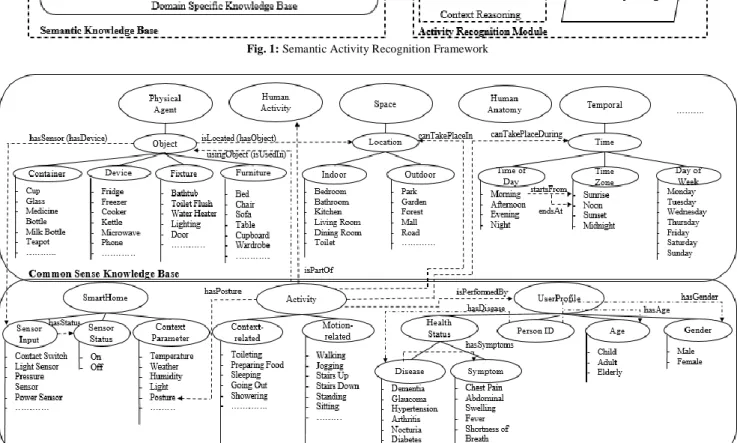
A detailed representation of the semantic knowledge base is shown in Figure 2. It contains several concepts that are defined explicitly and represented in a hierarchical structure based on the common-sense and the domain-specific knowledge. This explicit representation helps the reasoning system to understand the meaning of the concepts and their declarative relationships to each other. The semantic knowledge base contains two sub-components: the common-sense and domain-specific knowledge. Each of these has their own purposes to provide source of information and represent knowledge of the environment in term of semantic concepts and relationships. Furthermore, these concepts contain descriptive knowledge about the world that is used to support the context reasoning process.
Firstly, the common sense knowledge base contains a description of concepts that are related to the basic understanding of the environment. The common sense knowledge usually consists of a collection of simple facts and information that ordinary people normally possessed in their daily lives [26].
As seen in Figure 2, this knowledge base is represented using several concepts and semantic relationships that can relate these concepts together. Examples of these concepts include Space,
Physical Agent, Temporal, Human Activity, and Human Anatomy. These concepts are represented in a hierarchical structure based on
OpenCyc Knowledge Base, which is regarded as the largest existing common sense knowledge base [27]. Furthermore, this common-sense knowledge base is not limited and it can be
expanded to other types of concepts which are not shown in the figure due to the restricted space.
Fig. 1: Semantic Activity Recognition Framework
Fig. 2: Detailed Representation of Semantic Knowledge Base
In the figure, the solid lines represent a subclass relationship (e.g.,
Fridge is a Device or Kitchen is an Indoor Location) while the dashed lines represent an object property. Object property is re-garded as the binary relations between two classes. For example, concepts of Object and Location are connected together using the object property isLocated, and vice-versa with the inverse proper-ty of hasObject. Both properties are used to show the general in-formation about the location and objects contained within the location.
Secondly, the domain-specific knowledge base is used to represent important concepts that are specifically described in order to im-prove the principal understanding of the environment. This knowledge base contains concepts which are based on the knowledge of experts in a certain domain. It provides s description of concepts that have been explicitly defined in a structured way to support the common-sense knowledge. Such concepts include
Smart Home, Activities of Daily Living and User Profile. These concepts are selected based on the need of this study, which is to represent knowledge which involves various sensors in a smart home, the types of activities of daily living and the potential risks that might be harmful to elderly people. Some of these concepts are based on the common-sense knowledge, but they have been
specifically defined in a more structured representation. For ex-ample, Activities of Daily Living is based on the concept of Human Activity in the common-sense knowledge base. Both of these con-cepts are related by the property isPartOf. Other concepts are also related to each other using specific properties.
3.2. Activity Recognition Module
The context recognition module is composed of a series of pro-cesses which essentially capture the user’s patterns of activities over a certain period of time. These activities are monitored using smart home sensors that are installed in various locations and de-ployed on a range of objects in order to know users’ presences in a room and their interaction with objects.
The module contains three main processes in the context reason-ing process as shown in Figure 1. These are: data processreason-ing, data clustering and pattern classification. First, in the data processing, the sensory data is captured and represented in an appropriate format. Raw sensory data needs to be converted to a better repre-sentation in order for further analysis.
Then, this data is grouped in the clustering process based on their similar characteristics. This is necessary as the person might use
several objects in different sequential manner. For example, in the cooking activity, the person might switch on the microwave first while someone else might open the refrigerator first before he or she starts doing anything else. Therefore, in order to easily recog-nize the specific activity, the sensory data needs to be clustered based on their similar features. With this respect, Expectation Maximization (EM) algorithm has been employed as the cluster-ing tool and worked as a probabilistic clustercluster-ing that allows clus-ters to overlap with each other. This algorithm stems from the Gaussian Mixture Models (GMMs), where each cluster is assigned with a probability weight distribution. It is computed based on two iterative steps, where the first step known as Expectation step (E-step), which is used to estimate probability distribution function in each cluster while Maximization step (M-step) is used to update the probability weight of mixture model parameters. The aim is to find mixture model parameters that maximize log-likelihood. The process continues until log-likelihood convergence is achieved. The advantages of this tool are that it does not require a number of clusters in advance as the input parameter and therefore, it pre-serves the topological properties of the input space. This is im-portant as the number of clusters in the patterns of activities is different in each location and this numbers cannot be deduced in advance. Furthermore, it can be used to translate multi-dimensional data into two-multi-dimensional space.
Finally, the last process is to classify these clusters based on the semantic information about the activities performed. In this case, the semantic knowledge base is used to provide the semantic un-derstanding of the specific activity. For example, if the person uses any objects that have semantic relationships with the class of
Cooking and given that the person’s location is in the kitchen and the time is in the morning, the activity will be automatically in-ferred as cooking breakfast.
4. Experiments
This section demonstrates a series of experiments in this paper which are used to verify the proposed approach in Section 3. The experiments are based on the processes carried out in the context recognition module with the support from the semantic knowledge base.
4.1. Experimental Data
Fig.3: Distribution of Sensor Events in Smart Home Dataset
A smart home dataset has been adopted from the study of activity recognition in a smart home by [28]. It uses fourteen digital state-change sensors installed in various locations including doors, cupboard, refrigerator and a toilet flush and has been collected for 28 days, which resulted in 1257 sensor events and 245 activity instances. Seven types of activities are detected in this dataset. These include: Preparing Dinner, Preparing Beverage, Going Out, Showering, Preparing Breakfast, Toileting and Sleeping. Figure 3 shows the distribution of the sensor events based on the activities performed in the smart home dataset.
4.2. Experimental Procedures
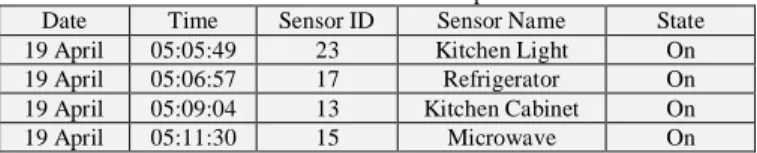
The sensory data are pre-processed to be represented in an appro-priate format for further analysis. The data is converted to repre-sent the date, time, sensor ID, sensor name and the corresponding sensor status respectively. Table 1 shows the representation of this converted data.
Table 1: Pre-Processed Data Representation
Date Time Sensor ID Sensor Name State 19 April 05:05:49 23 Kitchen Light On 19 April 05:06:57 17 Refrigerator On 19 April 05:09:04 13 Kitchen Cabinet On 19 April 05:11:30 15 Microwave On
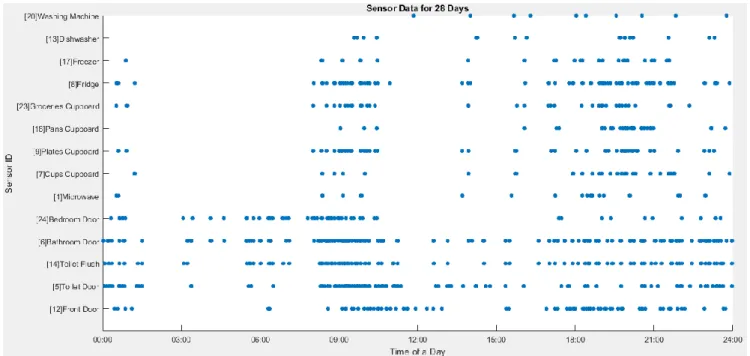
The pre-processed data are then plotted based on a 28-day obser-vation of the user’s daily routine. Figure 4 shows the plotted data and as seen from the figure, there are fourteen types of sensors IDs located in different locations inside the house and the time ranges from 00:00 to 24:00.
Then, the plotted data are clustered into several groups based on two types of features: the sensor IDs and the time when the sensor was activated. The EM algorithm is implemented using WEKA 3.7.11. The algorithm calculates clusters based on probability distributions. These clusters contain their own weight probability distribution shown in Table 2. The probability values represent the weight composed for each cluster. For example, Cluster 1 shows the highest weight probability distribution belongs to the group of
Activity 1 while Activity 2 has the highest probability weightage in Cluster 3. However, these clusters may compose of different types of activities with their own weight probability distribution. For example, Cluster 2 may compose of the same activity instances such as Activity 4 and 5, with their own probability weights of 45.50 and 84.85 respectively. They are sharing the same cluster as some of the activities can be performed in the same location using the same object and therefore, it is difficult to deduce and infer them in different clusters.
This problem can be solved by classifying the clusters based on the knowledge contains in the semantic knowledge base. The classification process is performed in order to infer activities based on the necessary information from the ontology. For example, the ontology contains the concept of Activities of Daily Living, which stores the semantic information about human activities such as Cooking, Sleeping and Toileting. The inferring process is then performed using the query process. It is implemented using the SPARQL query in the Protégé software, which allows the ontology reasoner to infer about the specific activity based on the existing context. Amongst the information contained within a context includes the person, location, time and object used. For example, in a situation in which an elderly person uses a microwave in the morning and the location is identified to be in the kitchen, the ontology reasoner can infer that the person is cooking breakfast.
4.3. Experimental Results
Based on these experiments, Table 3 presents the confusion matrix and correctly inferred activity obtained from the proposed ap-proach. It can be observed that every activity can be recognized by the actual class label. The correctly inferred activities are ranged in between 87% to 94%. The highest recognized class of activities belongs to Preparing Breakfast while Showering has the lowest rate of recognized activities. This is because Preparing Breakfast
is easy to infer as it usually happens in the kitchen during the morning time. This condition gives a direct classification in the SPARQL query process. Meanwhile, Showering has the lowest rate as it is usually executed concurrently with the Toileting activ-ity. In addition, the types of sensors used for both of these activi-ties are exactly the same, making them difficult to be distin-guished and recognised. Finally, the performance of the overall
approach is evaluated. Four standard evaluation metrics are used to measure the performance of the proposed approach: accuracy,
precision, recall and F-measure.
Fig. 4: 28-day Observation of Sensor Data
Table 2: Weight Probability Distribution based on EM Clustering
Activity Types Cluster 1 Cluster 2 Cluster 3 Cluster 4 Cluster 5 Cluster 6
Activity 1 1.02 1.61 1.03 1.01 2.41 77.91 Activity 2 1.02 1.63 1.01 1.02 514.33 1 Activity 3 1 1.05 1.30 198.64 1.01 1 Activity 4 1 45.50 1.15 1.86 1.48 1 Activity 5 1.74 84.85 1.37 1.07 1.29 9.67 Activity 6 2.38 1.97 155.01 1.58 1.05 1 Activity 7 167.98 1.93 1.29 1 1.80 1
Table 3: Confusion Matrix for Activity Recognition
Actual Activity Inferred Activity Correctly
Inferred Activity (%) Sleeping Toileting Preparing
Breakfast
Showering Going Out Preparing Beverage Preparing Dinner Sleeping 73 0 4 2 0 0 0 92.4 Toileting 0 457 0 52 0 5 0 88.9 Preparing Breakfast 0 0 187 0 3 6 2 94.0 Showering 0 4 2 40 0 0 0 87.0 Going Out 0 0 6 0 82 0 6 87.2 Preparing Beverage 0 0 0 0 4 146 7 93.6 Preparing Dinner 4 8 0 0 0 0 157 92.9
Fig.5: Overall Results from Proposed Approach
The results are computed from the produced confusion matrix and calculated using equations provided by [29]. Figure 5 shows the overall results in terms of four measurements: accuracy, precision, recall and F-measure. The proposed approach achieves 90.9% accuracy while the precision, recall and F-measure are calculated at 85.9%, 90.9% and 88.3% respectively.
4.4. Discussion
One of the advantages of this approach is that the same activity can be inferred although the user uses different types of objects. EM algorithm shows good performance in clustering the activities. Although Showering and Toileting are grouped in the same clus-ter, they can still be distinguished and classified with the support from the semantic knowledge base. Apart from that, due to the fact that the semantic knowledge base contains general knowledge of the world, it is therefore possible to implement this approach in any given environment of a smart home. However, this approach has its limit in the sense that it does not group the sensory data based on the specific location. Some of the instances might share the same cluster although the location and the activity are clearly different. This limits the ability of the ontology query process and reduces the recognition rate. This problem may be considered seriously in the future work of this research and it can be ad-dressed by using a large representative of a smart home dataset so that the clustering process can group the sensory data in a more reliable condition.
5. Conclusion and Future Work
This paper introduces a framework of semantic activity recogni-tion in a smart home environment. It consists of two components: the semantic knowledge base and the activity recognition module. The semantic knowledge base is used as the source of information in reasoning with the context and it is represented using the ontol-ogy. It comprises two sub-components: the common sense and the domain-specific knowledge base. Based on the experiments, the semantic knowledge base has proved that it can support the classi-fication process in order to classify the clusters of the activities based on the two-dimensional features. This helps smart home systems to be aware of their environment and enable them to be the means for monitoring users’ behavior as well as their health conditions.
As a suggestion for future work, the knowledge-driven approach can be improved by incorporating it with data-driven reasoning to improve activity recognition rate. This hybrid combination might compensate limitations proposed by both of the approaches.
Acknowledgement
This work is jointly collaborated together by University Malaysia Perlis, Malaysia and Cardiff University, UK. All authors contributed equally in the realization of this paper.
References
[1] United Nations (2000), “Magnitude and Speed of Population Ageing,” World Population Ageing 1950-2050, pp. 11–13. [2] P. Rashidi and A. Mihailidis (2013), “A Survey on
Ambient-assisted Living Tools for Older Adults,” IEEE Journal of Biomedic Health Informatics, vol. 17, no. 3, pp. 579–590.
[3] Q. Ni, A. García Hernando, and I. de la Cruz (2015), “The Elderly’s Independent Living in Smart Homes: A Characterization of Activities and Sensing Infrastructure Survey to Facilitate Services Development,” Journal of Smart Home Sensors, vol. 15, no. 5, pp. 11312–11362.
[4] M. E. Morris et al. (2013), “Smart-home Technologies to Assist Older People to Live Well at Home,” Journal of Aging Science., vol. 1, no. 1, pp. 1–9.
[5] J. Synnott, C. Nugent, and P. Jeffers (2015), “Simulation of Smart Home Activity Datasets,” Journal of Sensors, vol. 15, no. 6, pp. 14162–14179.
[6] A. S. M. Salih and A. Abraham (2013), “A Review of Ambient Intelligence Assisted Healthcare Monitoring,” Mirlabs.Org, vol. 5, pp. 741–750.
[7] S. Chatterjee, K. Dutta, H. Q. Xie, J. Byun, A. Pottathil, and M. Moore (2013), “Persuasive and Pervasive Sensing: A New Frontier to Monitor, Track and Assist Older Adults Suffering from Type-2 Diabetes,” International Conference of System Science, pp. 2636– 2645.
[8] L. Chen, C. D. Nugent, and H. Wang (2012), “A Knowledge-driven Approach to Activity Recognition in Smart Homes,” IEEE Transaction Knowledge Data Engineering, vol. 24, no. 6, pp. 961– 974.
[9] L. Chen, C. Nugent, and G. Okeyo (2014), “An Ontology-based Hybrid approach to Activity Modeling for Smart Homes,” IEEE Transaction Human-Machine System, vol. 44, no. 1, pp. 92–105. [10] J. Wang, Z. Cheng, M. Zhang, Y. Zhou, and L. Jing (2015), “A
Situation-Aware Abnormality Detection System for Elderly Care Using SVDD,” International Journal of Innovative Computing, vol. 11, no. 2.
[11] Q. Ni, A. B. García Hernando, and I. P. De La Cruz (2016), “A Context-Aware System Infrastructure for Monitoring Activities of Daily Living in Smart Home,” Journal Sensors, vol. 2016, pp. 1–9, 2016.
[12] K. Wongpatikaseree, M. Ikeda, M. Buranarach, T. Supnithi, A. O. Lim, and Y. Tan (2012), “Activity Recognition using Context-aware Infrastructure Ontology in Smart Home Domain,”
International Conference of Knowledge Informatic Creation Support System KICSS 2012, pp. 50–57.
[13] J. yi Hong, E. Ho Suh, and S. J. Kim (2009), “Context-aware
Systems: A Literature Review and Classification,” Expert System Application, vol. 36, no. 4, pp. 8509–8522.
[14] L. Chen and C. D. Nugent (2009), “Ontology-based Activity Recognition in Intelligent Pervasive Environments,” International Journal Web Informatic System, vol. 5, no. 4, pp. 410–430. [15] A. S. Crandall and D. J. Cook (2010), “Using a Hidden Markov
Model for Resident Identification,” Intelligent Environment (IE), 2010 Sixth International Conference, pp. 74–79.
[16] E. Nazerfard and D. Cook (2013), “Using Bayesian Networks for Daily Activity Prediction,” Assoc. Advanced Artificial Intelligence, pp. 32–38.
[17] J. Hoey, T. Pltz, D. Jackson, A. Monk, C. Pham, and P. Olivier (2011), “Rapid specification and automated generation of prompting systems to assist people with dementia,” Pervasive Computing., vol. 7, no. 3, pp. 299–318.
[18] J. Ye, S. Dobson, and S. McKeever (2012), “Situation Identification Techniques in Pervasive Computing: A Review,”
Pervasive Mobile Computing, vol. 8, no. 1, pp. 36–66.
[19] I. K. Ihianle (2018), “A Hybrid Approach to Recognising Activities of Daily Living from Object Use in the Home Environment,”
Journal of Informatics, vol. 5, pp. 1–25.
[20] G. Azkune, A. Almeida, and L. Diego (2014), “Extending Knowledge-Driven Activity Models through Data-Driven Learning Techniques,” Expert System. Application.
[21] D. Riboni and C. Bettini (2011), “COSAR: Hybrid Reasoning for Context-aware Activity Recognition,” Pervasive. Ubiquitous Computing., vol. 15, no. 3, pp. 271–289.
[22] I. H. Bae (2014), “An Ontology-based Approach to ADL Recognition in Smart Homes,” Future Generation Computing System., vol. 33, pp. 32–41.
[23] M. A. Mohammad, I. Kaloskampis, Y. Hicks, and R. Setchi (2015), “Ontology-based Framework for Risk Assessment in Road Scenes using Videos,” Procedia Computing Science., vol. 60, no. 1, pp. 1532–1541.
[24] H. Lee and J. Kwon (2013), “Ontology Model-based Situation and Socially-aware Health Care Service in a Smart Home Environment,” International Journal of Smart Home, vol. 7, no. 5, pp. 239–250.
[25] F. Latfi, B. Lefebvre, and C. Descheneaux (2007), “Ontology-based Management of the Telehealth Smart Home Dedicated to Elderly in Loss of Cognitive Autonomy,” CEUR Workshop Proceding., vol. 258.
[26] B. Y. E. Davis, G. Marcus, and W. Taller (2015), “Commonsense Reasoning and Commonsense Knowledge in Artificial Intelligence,” vol. 58
[27] E. Cambria and N. Howard (2014), “Common and Common-Sense Knowledge Integration for Concept-Level Sentiment Analysis,” pp. 170–173.
[28] T. Van Kasteren and A. Noulas (2008), “Accurate Activity Recognition in a Home Setting,” in Tenth International Conference on Ubiquitous Computing (Ubicomp’08), pp. 1–9.
[29] T. L. M. van Kasteren, G. Englebienne, and Ben Krose (2011), “Effective Performance Metrics for Evaluating Activity Recognition Methods,” Activity Recognition in Pervasive Intelligent Environments, Atlantic Press, pp. 1–34.