Last-Mile TLS Interception: Analysis and Observation of the
Non-Public HTTPS Ecosystem
Xavier de Carné de Carnavalet
A Thesis in
The Concordia Institute for
Information Systems Engineering
Presented in Partial Fulfillment of the Requirements For the Degree of
Doctor of Philosophy (Information and Systems Engineering) at Concordia University
Montréal, Québec, Canada
May 2019
c
C
ONCORDIA
U
NIVERSITY
School of Graduate Studies
This is to certify that the thesis prepared
By: Xavier de Carné de Carnavalet
Entitled: Last-Mile TLS Interception: Analysis and Observation of the Non-Public HTTPS Ecosystem
and submitted in partial fulfillment of the requirements for the degree of
Doctor of Philosophy (Information and Systems Engineering)
complies with the regulations of this University and meets the accepted standards with re-spect to originality and quality.
Signed by the final examining committee:
Dr. William Lynch Chair Dr. Carlisle Adams External Examiner Dr. Wahab Hamou-Lhadj External to Program Dr. Amr Youssef Examiner Dr. Jeremy Clark Examiner Dr. Mohammad Mannan Thesis Supervisor Approved by
Dr. Mohammad Mannan, Graduate Program Director
Abstract
Last-Mile TLS Interception: Analysis and Observation of the Non-Public
HTTPS Ecosystem
Xavier de Carné de Carnavalet, Ph.D. Concordia University, 2019
Transport Layer Security (TLS) is one of the most widely deployed cryptographic protocols on the Internet that provides confidentiality, integrity, and a certain degree of authenticity of the communications between clients and servers. Following Snowden’s revelations on US surveillance programs, the adoption of TLS has steadily increased. However, encrypted traffic prevents legitimate inspection. Therefore, security solutions such as personal an-tiviruses and enterprise firewalls may intercept encrypted connections in search for mali-cious or unauthorized content. Therefore, the end-to-end property of TLS is broken by these TLS proxies (a.k.a. middleboxes) for arguably laudable reasons; yet, may pose a se-curity risk. While TLS clients and servers have been analyzed to some extent, such proxies have remained unexplored until recently. We propose a framework for analyzing client-end TLS proxies, and apply it to 14 consumer antivirus and parental control applications as they break end-to-end TLS connections. Overall, the security of TLS connections was systematically worsened compared to the guarantees provided by modern browsers.
Next, we aim at exploring the non-public HTTPS ecosystem, composed of locally-trusted proxy-issued certificates, from the user’s perspective and from several countries in residential and enterprise settings. We focus our analysis on the long tail of interception events. We characterize the customers of network appliances, ranging from small/medium
businesses and institutes to hospitals, hotels, resorts, insurance companies, and govern-ment agencies. We also discover regional cases of traffic interception malware/adware that mostly rely on the same Software Development Kit (i.e., NetFilter). Our scanning and analysis techniques allow us to identify more middleboxes and intercepting apps than pre-viously found from privileged server vantages looking at billions of connections.
We further perform a longitudinal study over six years of the evolution of a prominent traffic-intercepting adware found in our dataset: Wajam. We expose the TLS interception techniques it has used and the weaknesses it has introduced on hundreds of millions of user devices. This study also (re)opens the neglected problem of privacy-invasive adware, by showing how adware evolves sometimes stronger than even advanced malware and poses significant detection and reverse-engineering challenges. Overall, whether beneficial or not, TLS interception often has detrimental impacts on security without the end-user being alerted.
Acknowledgments
I would like to express my deepest gratitude and appreciation to my supervisor Dr. Mo-hammad Mannan, for his continuous support, guidance, and pushing me to surpass myself. His patience and dedication contributed to making this thesis possible.
My journey into the Ph.D. was an adventure, and I am grateful to those I met and who supported me along the way. In particular, my love and appreciation go to Mengyuan Zhang.
I wish to thank all members of the Madiba Security Research Group, especially Liany-ing Zhao (Viau), as well as the rest of my research colleagues of the CIISE department, for their enthusiastic discussions.
I also would like to express my gratitude to my friends and family, who helped me keep on track.
Contents
List of Figures xiii
List of Tables xv
1 Introduction 1
1.1 Motivation . . . 1
1.2 Thesis Statement . . . 3
1.3 Objectives and Contributions . . . 3
1.4 Related Publications . . . 5
1.5 Outline . . . 5
2 Background 6 2.1 SSL/TLS . . . 6
2.2 Terminology . . . 7
2.3 Trusted Root CA Stores . . . 8
2.3.1 System CA Store . . . 8
2.3.2 Third-party CA Stores . . . 8
2.4 OS-provided APIs for Key Storage . . . 9
2.5 Insertions in Trusted Stores: Implications . . . 10
3 Literature Review 13
3.1 Surveys on SSL/TLS and the CA Infrastructure . . . 13
3.2 Certificate Collection and Analyses . . . 14
3.2.1 Internet-wide Active Scans . . . 14
3.2.2 Passive Certificate Collection . . . 18
3.3 TLS Proxy-oriented Analyses and Protocols . . . 19
3.3.1 Network Appliances . . . 20
3.3.2 Software Proxies . . . 20
3.3.3 TLS Proxy Protocols . . . 21
3.4 Implementation Verification . . . 21
3.4.1 Certificate Generation for Testing Purposes . . . 22
3.4.2 Source Code Analysis . . . 23
3.4.3 TLS Implementation Testing . . . 23
3.5 Miscellaneous . . . 23
3.5.1 Related Technologies . . . 24
3.5.2 Mimicking TLS handshakes . . . 24
4 Analyzing Client-end TLS Interception Software 25 4.1 Methodology . . . 25
4.1.1 Analysis Framework . . . 25
4.1.1.1 Root Certificate and Private Key . . . 26
4.1.1.2 Certificate Validation . . . 26 4.1.1.3 Server-end Parameters . . . 26 4.1.1.4 Client-end Transparency . . . 27 4.1.2 Threat Model . . . 27 4.1.3 Product Selection . . . 28 4.2 Contributions . . . 28
4.3 Major Findings . . . 31
4.4 Private Key Extraction . . . 32
4.4.1 Locating Private Keys in Files and Windows Registry . . . 33
4.4.2 Application-protected Private Keys . . . 34
4.4.2.1 Identify the Process Responsible for TLS Filtering . . . . 34
4.4.2.2 Retrieving Passphrases . . . 35
4.4.2.3 Encrypted Containers . . . 36
4.4.3 Security Considerations . . . 36
4.5 Limitations of Existing TLS Test Suites . . . 38
4.5.1 Certificate Verification . . . 39
4.5.2 TLS Security Parameters . . . 41
4.6 Our TLS Proxy Testing Framework . . . 41
4.6.1 Test Environment . . . 41
4.6.2 Certificate Validation Testing . . . 42
4.6.3 Proxy-embedded Trusted Stores . . . 44
4.6.4 TLS Versions and Known Attacks . . . 46
4.7 Results Analysis . . . 47
4.7.1 Root Certificates . . . 47
4.7.1.1 Certificate Generation . . . 48
4.7.1.2 Third-party Trusted Stores . . . 49
4.7.1.3 Self-acceptance . . . 49
4.7.1.4 Filtering Conditions . . . 49
4.7.1.5 Expired Product Licenses . . . 50
4.7.1.6 Uninstallation . . . 50
4.7.2.2 Encrypted Containers . . . 52
4.7.3 Certificate Validation and Trusted Stores . . . 53
4.7.3.1 Invalid Chain of Trust . . . 53
4.7.3.2 Weak and Deprecated Encryption/signing Algorithms . . 55
4.7.3.3 Proxy-embedded Trusted Store . . . 55
4.7.4 TLS Parameters . . . 57
4.7.4.1 SSL/TLS Versions . . . 57
4.7.4.2 Certificate Security Parameters . . . 59
4.7.4.3 Cipher Suites . . . 60
4.7.4.4 Known Attacks . . . 60
4.8 Practical Attacks . . . 61
4.9 Company Notifications and Responses . . . 64
4.10 Recommendations for Safer TLS Proxying . . . 65
4.11 Conclusion . . . 70
5 A Client-side View of the HTTPS Ecosystem 71 5.1 Introduction . . . 71
5.2 First Data Collection: L17 . . . 76
5.2.1 Data Collection Methodology . . . 77
5.2.1.1 Luminati . . . 77
5.2.1.2 Domain Datasets . . . 78
5.2.1.3 Country List . . . 80
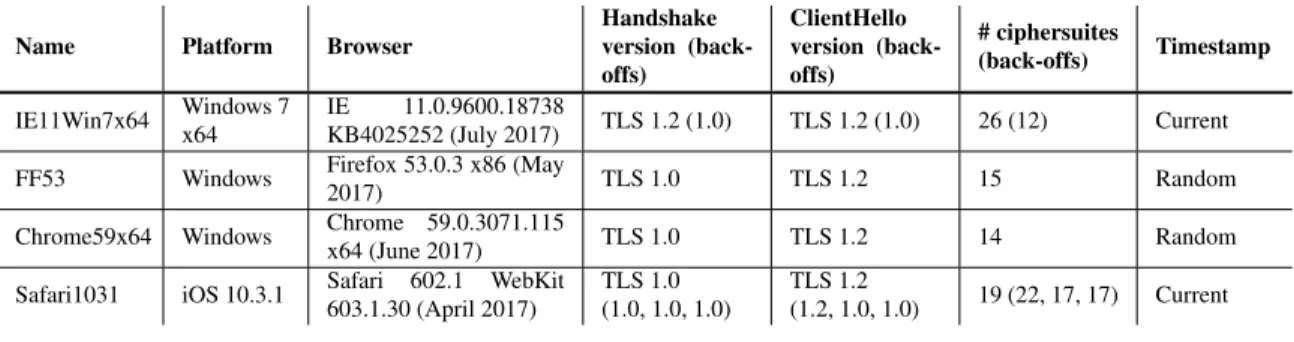
5.2.1.4 Browser-like TLS Handshake Simulation . . . 81
5.2.1.5 Scanning Methodology . . . 84
5.2.1.6 Verifying Certificates . . . 85
5.2.1.7 Analysis Methodology . . . 87
5.2.2.1 Personal Filters & Enterprise Middleboxes Identification 90
5.2.2.2 Middleboxes . . . 92
5.2.2.3 NetFilter-based Interceptions . . . 95
5.2.2.4 New Trends . . . 99
5.2.2.5 Country-wide Censorship and ISP-level Interception . . . 100
5.2.2.6 Likely Malware . . . 103
5.2.2.7 False Positives . . . 103
5.2.2.8 Remaining Unknown Certificates . . . 105
5.2.3 Discussion on Network Errors . . . 106
5.2.4 Trusted Certificates and CT logs . . . 108
5.3 Second Data Collection: L19 . . . 109
5.3.1 Data Collection Methodology . . . 109
5.3.1.1 Domain Datasets . . . 110
5.3.1.2 Country List . . . 112
5.3.1.3 Browser-like TLS Handshake Simulation for TLS 1.3 . . 112
5.3.1.4 Scanning Methodology . . . 114
5.3.1.5 Verifying Certificates . . . 117
5.3.2 Findings . . . 118
5.3.2.1 Enterprise Proxies and Home Filters . . . 119
5.3.2.2 ISP-level Injection . . . 120
5.3.2.3 NetFilter-based Interceptions . . . 121
5.3.2.4 False Positives . . . 121
5.4 Insights . . . 123
5.4.1 Interpretation of the Results . . . 123
5.6 Limitations and Generalization . . . 131
5.6.1 Threats to Internal Validity . . . 131
5.6.2 Threats to External Validity . . . 134
5.7 Concluding Remarks . . . 135
6 Privacy and Security Risks of “Not-a-Virus” Bundled Adware: The Wajam Case 137 6.1 Introduction . . . 137
6.2 Wajam’s History . . . 142
6.3 Related Work . . . 143
6.4 Sample Collection and Overview . . . 146
6.4.1 Sample Collection . . . 147
6.4.2 Categories . . . 149
6.5 Analysis Methodology . . . 151
6.6 Technical Evolution Summary . . . 153
6.7 Prevalence . . . 157
6.7.1 Domains Popularity . . . 158
6.7.2 Worldwide Infections . . . 160
6.8 Private Information Leaks . . . 161
6.9 Anti-analysis and Evasion . . . 163
6.10 Security Threats . . . 173
6.11 Content Injection . . . 178
6.11.1 Targeted Domains . . . 178
6.11.2 Injected Content . . . 179
6.11.3 Browser Hooking Rules . . . 180
6.11.4 Updates and Injections . . . 182
6.12.1 Root Certificate Fingerprints . . . 184
6.12.2 Other Approaches . . . 185
6.13 Wajam Clones . . . 187
6.14 Concluding Remarks . . . 189
7 Conclusion and future work 190 Bibliography 193 Appendix A Glossary 213 Appendix B Recovering private keys from antivirus and parental control appli-cations 215 B.1 BitDefender . . . 215
B.2 Net Nanny . . . 220
B.3 Avast . . . 222
B.4 ESET . . . 223
Appendix C Sample email notification sent to AV/PC companies 225
Appendix D List of Luminati countries 227
Appendix E Certificate fingerprinting rules 229
Appendix F Wajam domains 234
List of Figures
1 Storage location of a sample machine-wide certificate . . . 9
2 Illustration of a man-in-the-middle (MITM) attack . . . 12
3 Optimal handshake for TLS ClientHello and ServerHello when proxying a connection . . . 68
4 Scanning process overview for L17 . . . 77
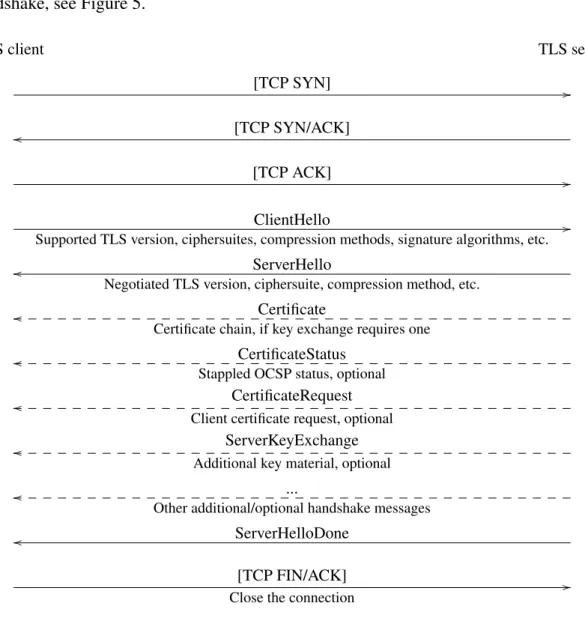
5 Illustration of a dummy TLS handshake between a TLS client and server . . 83
6 Illustration of a dummy TLS 1.3 handshake with a compatible server . . . . 113
7 Illustration of a retry when the server refuses the initial key share (TLS 1.3) 115 8 Scanning process overview for L19 . . . 116
9 Snippet of Javascript injected into webpages by Rimon Internet in Israel . . 121
10 Consent splash screen displayed by the Luminati SDK in an application . . 128
11 Timeline of first appearance of key features . . . 155
12 VirusTotal detection rates of 36 samples starting from their release time . . 157
13 Wajam domains in Umbrella’s top list (2017–2019) . . . 159
14 Icon polymorphism with slight pixel alteration . . . 164
15 Icons used in the Wajam’s installers we collected . . . 165
16 NSIS script to modify Microsoft MRT settings . . . 169
17 Example of traffic injection rule for facebook.com that matches all pages exceptxti.php . . . 176
19 Example of injected content ongoogle.com . . . 179
20 Browser injection rule for Chrome 66.0.3353.2 . . . 183
B.1 CA certificate inserted into Windows’ trust store . . . 215
B.2 Obtain the SHA1 fingerprint of the A certificate . . . 216
B.3 Monitor file activities with Procmon . . . 216
B.4 Explore the program’s folder where a certificate was identified . . . 217
B.5 Find an encrypted private key . . . 217
B.6 Dump all processes . . . 217
B.7 Find the process handling the private key . . . 218
B.8 Find interesting DLL components of that process . . . 218
B.9 Search for key functions in the DLL components . . . 219
B.10 Analyze calls to key functions and locate the passphrase . . . 219
B.11 Original and patcheddb.dllto decrypt the database upon opening, then close and crash . . . 220
B.12 Originaldb.dll, decompiled . . . 220
B.13 Patcheddb.dll, decompiled . . . 220
B.14 Net Nanny’s decryptedframework.dbdatabase . . . 221
B.15 Recovering Avast’s private key with Mimikatz . . . 222
B.16 ESET’s private key is associated with a certificate but unexportable . . . 223
B.17 ESET protects the CNG service . . . 223
B.18 Disabling ESET self-defense feature . . . 224
List of Tables
1 Comparison with scanning techniques used in related work . . . 15
2 List of antiviruses tested . . . 29
3 List of parental control applications tested . . . 30
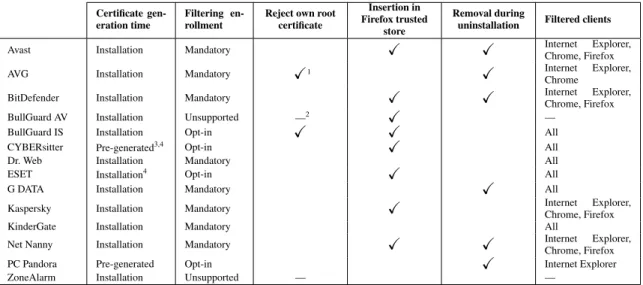
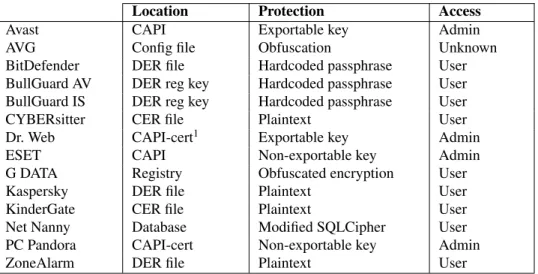
4 Security aspects related to root certificates insertion/removal, and filtering . 48 5 Protections for a root certificate’s private key . . . 51
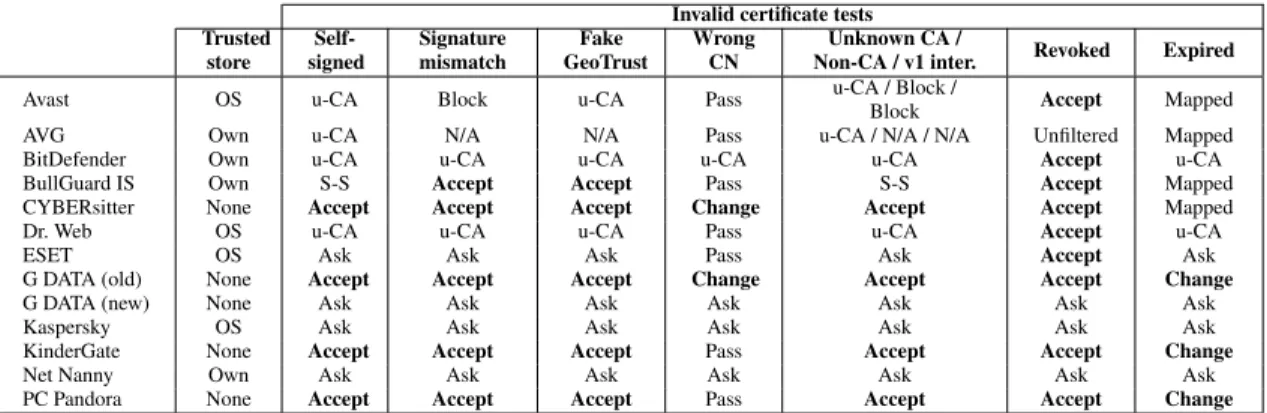
6 Results of the certificate validation process against 9 invalid certificates . . 53
7 Results for TLS parameters, proxy transparency and known attacks . . . 58
8 Browser profiles . . . 81
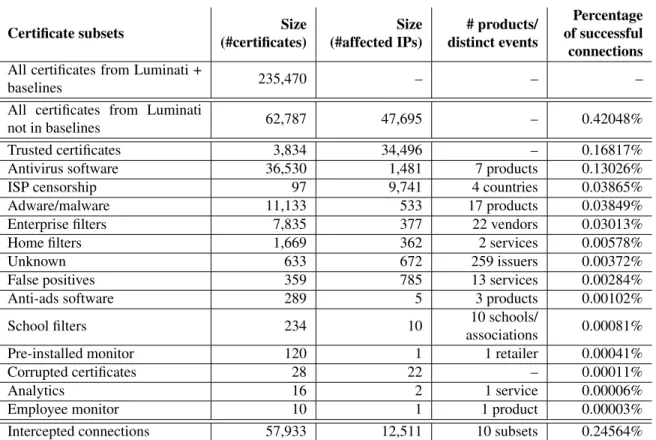
9 Breakdown of certificate categories in L17 . . . 90
10 Antivirus, enterprise middleboxes and home filters found in L17 . . . 96
11 Certificates issued by ProtocolFilters in L17 . . . 98
12 Breakdown of certificate categories in L19 . . . 118
13 Antivirus, enterprise middleboxes and home filters found in L19 . . . 120
14 Certificates issued by ProtocolFilters in L19 . . . 122
15 Wajam samples summary . . . 148
16 Distribution of samples among generations . . . 150
17 Steganographic techniques to hide a nested installer in samples from end-2017 to 2018 . . . 164 18 Decryption keys for the DLL used to retrieve information about the system
19 Decryption keys for the “goblin” DLL injected into browsers in samples from the third generation . . . 167 20 Nested installer’s decryption keys for samples from 2016 to mid-2017 . . . 167 21 Security solutions checked by Wajam in registry . . . 172 22 TLS root certificates in 2nd and 4th generations . . . 174 23 Fingerprints for Wajam-issued leaf certificates . . . 186 D.1 List of countries through which we conducted scans through Luminati . . . 228 F.2 List of 332 domains that appear to belong/have belonged to Wajam . . . 235 F.3 List of 332 domains that appear to belong/have belonged to Wajam (cont’d) 236 G.4 Hashes of the 52 samples we collected . . . 237
Chapter 1
Introduction
1.1
Motivation
Internet communications are increasingly shifting to encrypted channels. In particular, dur-ing the last five years, web pages transported over HTTPS as visited by the Firefox browser globally rose from about 30 to 78% of all pages [13, 157]. This move towards more secure web communications originates from the Snowden revelations in 2013, which revealed the extent of the United States’ spying program and the vulnerability of unencrypted commu-nications [21, 116]. As a result, major players such as Google pushed for the adoption of HTTPS by taking its presence into account for page rankings in 2014 [122], and visibly marking non-encrypted HTTP traffic as “not secure” in 2018 [123]. This increase is also made possible thanks to the launch of Let’s Encrypt, a Certification Authority that allows anyone to easily deploy HTTPS on their web servers by obtaining free certificates. As of September 2018, Let’s Encrypt has issued 380 million such certificates [20], and 100 million are active as of May 28, 2019 [157].
The public HTTPS certificate ecosystem is well studied [23, 131, 24, 113, 111, 109, 238, 57]. Also, initiatives by Google to log all publicly-trusted issued certificates, Cer-tificate Transparency, is now enforced in the Chrome browser [35, 41] and provides near
real-time visibility of newly issued certificates.
However, encrypted traffic is also shielded against legitimate inspection purposes. There is indeed a need for inspection as bad actors also leverage HTTPS for phishing [128] and malware delivery and communications [14, 163, 19]. Therefore, security solutions, e.g., personal antiviruses (AVs) and enterprise firewalls, may intercept encrypted connections in search for malicious or unauthorized content [134, 192, 85]. To this aim, they split and proxy the encrypted connection, breaking the end-to-end property of the underlying TLS protocol, and possibly introducing security weaknesses.
Moreover, most of the effort to study the HTTPS ecosystem discards the actual client perspective. Indeed, while intercepting TLS, the proxy needs to generate on-the-fly site certificates to be received by the browser in place of the original server certificate. These proxy-issued certificates are publicly untrusted by design, and are neither logged by CT nor visible on most (or even any) part of the network. Also, these certificates are often stealthily made trusted on the user device to avoid browser warnings. This phenomenon results in a unique environment in which browsers may never see real server certificates, yet they do not show any error. As they do not trigger warnings, proxy-issued certificates are also invisible from browser telemetry on certificate errors [48] (unless misconfigured).
In addition, a few studies hint that security solutions are not the only entities that in-tercept TLS traffic [134, 192, 85]. Rather, there seems to be a tail of poorly explained interception events, sometimes attributed to malware. However, these studies are restricted by the geographic origin of the clients or the domains monitored, and do not offer a satis-fying view of the landscape.
Finally, a given client perspective might not be totally isolated from others. The Su-perFish case [28] showed that certificates generated by an ad-replacing application on one device can be directly trusted on another one where this application is installed, enabling
anyone to tamper with encrypted communications proxied by SuperFish. Therefore, be-yond individual proxy-issued certificates, the link between them across devices is also rel-evant. Hence, we call this environment, physically bound to or near the end-user’s device, symbolically located in the last mile on the path from the server to the client, as the non-public HTTPS ecosystem. This ecosystem is important to study as it can highlight how insecure encrypted communications are in practice, despite proper observable server con-figurations and up-to-date browsers.
1.2
Thesis Statement
Our research is aimed at studying the non-public HTTPS ecosystem, created as a byproduct of TLS interception. This ecosystem includes TLS proxies/interceptors, and their generated certificates. As part of this goal, we explore the following research questions:
Question 1. Can we identify the actors of client-end TLS interception from a global perspective, and measure the extent of their impact?
Question 2. Do legitimate interceptors introduce any new security threat for end users?
Question 3. Can we characterize bad actors, and in particular, are they simply a nui-sance or are they involved in something more nefarious?
1.3
Objectives and Contributions
This research first aims to provide a framework for analyzing TLS proxies, and to study the non-public HTTPS ecosystem in terms of its certificates, TLS proxies involved, and the security of the underlying TLS interception. Throughout this work, we make the following contributions.
device. Before we investigate actual proxies, we develop a comprehensive frame-work to guide further studies. We then analyze TLS interception as done by antivirus and parental control software. Such security- and safety-enhancing applications are expected to preserve the security of encrypted communications they intercept. We apply our framework to verify this expectation on a number of popular antivirus and parental control applications.
2. We collect the largest dataset of certificates from the non-public HTTPS ecosystem with a client perspective in residential and enterprise settings in various countries. We first leverage a peer-to-peer Virtual Private Network (VPN) provider that enables us to route our network requests through exit nodes located around the globe. Sec-ond, we compile a comprehensive list of domains to be tested that better represents user browsing preferences. Third, we design a scanner that partially mimics browser behaviors.
3. We analyze the collected certificates as exhaustively as possible and shed light on ne-glected, new, lesser-known, or geographically-dependent interception events. From our unique vantage, we are able to observe improbable interception cases. Some of these are worthy of further analysis and discussion, and may highlight previously overlooked problems.
4. We further investigate the case of the most widespread traffic-intercepting adware in our dataset. We perform a longitudinal study of the evolution ofWajamover six years and expose the TLS interception techniques it has used and the weaknesses it has in-troduced on hundreds of millions of users. This study also (re)opens the neglected problem of privacy-invasive adware, by showing how adware evolves sometimes stronger than even advanced malware and poses significant detection and
reverse-1.4
Related Publications
The work discussed in Chapter 4 has been peer-reviewed and published in the following conference article:
Killed by Proxy: Analyzing Client-end TLS Interception Software. X. de Carné de Carnavalet and M. Mannan. Network and Distributed System Security Symposium (NDSS’16), Feb. 21–24, 2016, San Diego, CA, USA.
This work has also been presented at FTC PrivacyCon, Jan. 12, 2017, Washington, D.C., USA. Moreover, it has been used by the TLS Workgroup on the standardization of TLS 1.3 as an argument to reject interception-friendly design proposals [115].
We are preparing the work discussed in Chapter 5 for submission to an academic con-ference. The work discussed in Chapter 6 is available at arXiv:1905.05224.
1.5
Outline
The rest of the thesis is organized as follows. Chapter 2 introduces a short necessary back-ground on SSL/TLS. Chapter 3 reviews the literature related to Chapter 4 and 5. Chapter 4 presents our analysis framework for client-end TLS proxies. Chapter 5 discusses the study of the non-public HTTPS certificate ecosystem. Chapter 6 then focuses on the Wajam traffic-intercepting adware. Due to the nature of this last piece of work, the relevant related work is presented in that chapter. Chapter 7 concludes.
Chapter 2
Background
This chapter introduces some key concepts and technologies.
2.1
SSL/TLS
The Secure Socket Layer (SSL) protocol, later renamed Transport Layer Security (TLS), has evolved since 1995 through major milestones: SSL v2.0, SSL v3.0, TLS v1.0, TLS v1.1, TLS v1.2 [135], up to the recently standardized v1.3 [136]. This cryptographic proto-col is intended to protect communications from passive eavesdropping (privacy) and active modifications (integrity), and to authenticate at least one party in the exchange according to a given Public Key Infrastructure (PKI). By nature, SSL/TLS is an end-to-end encryption protocol.
The SSL/TLS protocol distinguishes a client and a server in the communication. The client starts a handshake by sending a ClientHello message to the server, advertising sup-ported cryptographic primitives, as part of a negotiation phase with the server. The server replies with a ServerHello message, setting the primitives to be used, followed by other op-tional messages that may contain, e.g., the server’s certificate, certificate revocation status,
message. The client then verifies the authenticity of the server’s certificate and checks whether a signature chain leads to a trusted root. The client and server are then able to derive a common secret master key and derive sub-keys for encryption and message au-thentication purposes. The handshake may continue with optional messages and finishes when both the client and the server exchange a Finished message. Then, all further com-munications are encrypted by keys established during the handshake. In the recent version 1.3, this exchange is slightly revised but follows the same logic.
2.2
Terminology
We refer to content-control applications as CCAs, or simply products; these include an-tivirus and parental control applications when they perform some form of traffic filtering. Products that support TLS filtering are termed as TLS proxies, or simply proxies. Each product imports a root certificate in the OS trusted CA store for the proper functioning of their proxy, and possibly other third-party stores (primarily browser CA stores).
A proxy acts between a client application and a remote server. Client applications in-clude web browsers, email clients, OS services, and any other TLS clients. We mostly discuss the consequences of bad TLS proxies from a browser’s perspectives, considering browsers as the most critical TLS client application for users; however, other application-s/services may also be affected. We use the terms browsers and client applications inter-changeably. For browsers, we consider Microsoft Internet Explorer (IE), Mozilla Firefox and Google Chrome.
2.3
Trusted Root CA Stores
2.3.1
System CA Store
All versions of Windows starting from Windows 2000 [174], provide a Trusted Root Certi-fication Authorities certificate store that comes preloaded with a list of trusted CAs, meet-ing the requirements of the Microsoft Root Certificate Program.1 Updates to this list are generally provided by Microsoft, but applications and users can add additional certificates (only via specific Windows APIs or the Windows Certificate Manager). We refer to this store as the OS trusted (CA) store, which can either be user-dependent, service-dependent or machine-wide. The machine-wide trusted store is located in Windows registry as (key, value) pairs [176]: a key (Certificates) hosting each trusted certificate as a subkey, labeled with the certificate’s SHA1 fingerprint; and a value (Blob) hosting the certificate in the ASN.1 DER format. CCAs import their root certificates in the machine-wide store, mak-ing those certificates trusted by the OS and all applications relymak-ing on the OS trusted store. Importing a root certificate into the machine-wide store requires admin privileges, in which case Windows does not warn users about the security implications of such a certificate. Importing a root certificate to the current-user’s trusted store by a userland application however triggers a detailed warning, and requires explicit user acceptance. As CCAs ob-tain admin privileges during installation (e.g., via a UAC prompt), the insertion of a root certificate into the OS trusted store remains transparent to the user.
2.3.2
Third-party CA Stores
TLS applications may choose to use their own CA store, instead of relying on the OS-provided store (possibly due to not fully trusting the validation process as used by Mi-crosoft to accept a root certificate). For example, Firefox uses an independent root CA
HKEY_LOCAL_MACHINE SOFTWARE Microsoft SystemCertificates ROOT Certificates 6973ad1e104db6bf10cc0ceb9b2927e375539ca Blob
Figure 1: Storage location of a sample machine-wide certificate, with SHA1 thumbprint 6973ad1e104db6bf10cc0ceb9b2927e375539ca
list, populated according to the Mozilla CA Certificate Policy [179]. In addition to the OS store, several CCAs also insert their root certificates into the application stores to filter traf-fic to/from those applications. CCAs may check for such applications during installation, and automatically insert their root certificates into selected third-party stores (transparently to users), or simply instruct users to manually add root certificates to application stores.
2.4
OS-provided APIs for Key Storage
The legacy Microsoft CryptoAPI (CAPI) and the new Cryptography API: Next Generation (CNG) provide specialized functions to store, retrieve, and use cryptographic keys [175]. Cryptographic Service Providers (CSP) such as the Strong Cryptographic Provider in the previous CAPI, and the CNG Key Storage Provider (KSP) offer such features. For TLS filtering, CCAs must store their private keys (corresponding to their root certificates) in the host system to sign site certificates for browsers on-the-fly. If a CCA uses CSP/KSP to se-curely store its private key, Windows encrypts the private key using a master key only avail-able to the OS, and stores the ciphertext in%ProgramData%\Microsoft\Crypto\ RSA\MachineKeys in the case of machine-wide RSA private keys. For CCAs using CSP/KSP, we check whether a key is marked as exportable (by the CCA). Machine-wide
not supposed to be exported even with admin privileges. However, tools requiring ad-min/system privileges are available to bypass this restriction, e.g., Jailbreak [143] and Mimikatz [101] as we tested on Windows 7 SP1. Non-exportable keys can be used by the CAPI or CNG to directly encrypt or decrypt data without letting the application access the key. Such a method should be preferred by CCAs; however, our results show other-wise (see Section 4.7). In this thesis, we consider that exporting OS-protected private keys requires admin privileges. Note that, an unprivileged application running under an admin account, can open the Windows Certificate Manager (run with admin privileges), and then instrument the UI to access an exportable private key; such an attempt will not trigger the Windows UAC prompt under default UAC settings (under Windows 7, 8.1 and 10 as we tested), which allow auto-elevating whitelisted Microsoft tools [212].
2.5
Insertions in Trusted Stores: Implications
There are several trusted stores that can be affected by CCAs. Windows provides a trusted store that we refer to as the OS trusted CA store, while third-party applications may main-tain their own store (e.g., Mozilla Firefox, Opera); see Section 2.3. CCAs install a root certificate in a trusted store so that TLS applications relying on that store accept TLS con-nections filtered by the proxy without any warning or error. However, an imported CCA root certificate implies that those TLS applications thereafter automatically trustanyweb content signed by that certificate, not simply the filtered content. When the CCA is man-ually disabled or uninstalled, or the CCA stops filtering due to an expired license, the root certificate may still remain in the trusted store. As a consequence, TLS clients may be vulnerable to impersonation attacks when the private key for the root certificate is not suit-ably protected. Example scenarios include the following: CCAs that simply reuse the same public/private key pair across installations; CCAs that do not remove a root certificate from
RSA-1024 root certificate valid for 10 years leaves plenty of time for a dedicated attacker to factor the key). Compared to installing a new application, inserting a root certificate in a trusted store has more security implications that may span even beyond the product’s lifes-pan. Such insertions are also mostly invisible to users, i.e., no explicit message is displayed by the OS, CCAs, or browsers, beyond granting generic admin privileges to the CCAs.
2.6
Client-side TLS Proxies and Appliances
Several antivirus and parental control software tools analyze client-end traffic, including HTTPS traffic, before it reaches browsers for reasons including eliminating drive-by down-loads, removing unwanted advertisements, protecting children’s online activities by block-ing access to unwanted websites, or simply hidblock-ing swear words. Such tools are possibly used by millions of users (cf. [134]); sometimes they are installed by OEMs on new com-puters (perhaps unbeknownst to the user), often downloaded/purchased by users, and after installation, remain active by default (although may not always perform filtering).
To analyze encrypted traffic, these tools generally insert an active man-in-the-middle (MITM) proxy to split the browser-to-web server encrypted connection into two parts: browser-to-proxy and proxy-to-web server. First, such a tool grants itself signing authority over any TLS certificate by importing its own root certificate into the client’s trusted CA stores. Then, when a TLS connection is initiated by a client application (e.g., browser, email client) to a remote server, the TLS proxy forges a certificate for that server to “im-personate” it in the protocol. Client encryption effectively terminates at the proxy, which dutifully forms a second TLS connection to the remote server. The proxy inspects mes-sages between the two connections, and forwards, blocks or modifies traffic as deemed appropriate. However, the use of such a proxy may weaken TLS security in several ways. Figure 2 illustrates this mechanism.
Figure 2: Illustration of a man-in-the-middle (MITM) attack against a content-control ap-plication performing TLS interception that accepts its own root certificate as the issuer of externally-delivered certificates. In addition, TLS parameters are not transparent to browsers, and may be lowered by the proxy to an unwanted level. All SSL/TLS versions shown are the highest ones that can be negotiated between two parties, assuming the MITM supports at most TLS 1.2.
also split TLS connections. However, such appliances may be less dangerous, as they are configured by IT professionals, and their root certificate and corresponding private key are self-contained within the device.
Chapter 3
Literature Review
This chapter provides a comprehensive view of previous work aiming to analyze the TLS ecosystem, propose alternative TLS proxy mechanisms, audit source code, and generate certificates for testing purposes, along with surveys on the state of HTTPS and a few side components.
3.1
Surveys on SSL/TLS and the CA Infrastructure
Meyer and Schwenk [172] survey theoretical and practical cryptographic attacks against SSL/TLS, along with problems with the PKI infrastructure. They gather lessons learned from these attacks, e.g., the need for reliable cryptographic primitives and awareness for side-channel attack origins.
In parallel, Clark and van Oorschot [90] survey issues related to SSL/TLS from a cryp-tographic point of view in the context of HTTPS, as well as general issues related to current PKI and trust model proposals. Recent proposals, e.g., key pinning and HSTS variants, OCSP stapling and short-lived certificates, have also been evaluated against known issues. Authors note a shift from cryptographic attacks against TLS to attacks on the trust model, where valid certificates can be issued by attackers.
3.2
Certificate Collection and Analyses
In this section, we discuss prominent past studies on TLS certificate monitoring and large-scale network scanning, and compare them (see Table 1 for a summary).
3.2.1
Internet-wide Active Scans
A few notable projects focus on scanning the entire IPv4 address space (∼4 billion IPs), either from a single vantage, several decentralized devices, or selected multiple vantages.
Single vantage.In 2010, the EFF and iSEC Partners conducted a scan of the IPv4 space on port 443 [23] to evaluate the CA ecosystem. It took three months to complete from three hosts. In contrast, ZMap [113] scans the entire IPv4 space in under 45 minutes from a sin-gle machine using a Gigabit network connection. ZMap is similar to masscan [127], which advertises 3 minutes for the IPv4 space using two 10-gigabit Ethernet cards. Both leverage a custom TCP stack to enable asynchronous half-open connections without requiring the OS kernel to allocate any resource or performing lookups and filtering. This mechanism allows them to initiate a massive amount of connections. Destination IP addresses are sam-pled randomly and deterministically to avoid overloading destination subnetworks. ZMap allows modules to be run when a connection is successfully established; e.g., ZGrab acts as a TLS client and records various parameters including the server’s certificate chain and negotiated ciphersuite.
Censys [109] is an efficient search engine based on the data regularly collected by ZMap, coupled with various modules. Censys offers a periodic scan of the IPv4 space of more than 15 ports and protocols, including SSL/TLS (443), IMAP(S) (143/993), POP3(S) (110/995), SSH (22). The data is accessible to researchers, and enables the research com-munity to analyze different ecosystems. Similar to Censys, Rapid7 [24] periodically scans the IPv4 space on multiple ports. Their datasets were analyzed by Chung et al. [86] for
P aper (y ear) Scan type # vantage # countries Vantage type # dir ect IPs scanned # domains scanned SNI used? Pr otocols scanned Br owser -lik e HTTPS? EFF SSL Observ atory [23] (DEFCON’10) A 1 1 (US) Unkno wn IPv4 × × HTTPS × Le villain (2010–14) [158] A 1 1 (FR) Uni v ersity IPv4 × × HTTPS × Holz et al. [131] (IMC’11) A+P 11 7 Uni v ersity , PlanetLab × 1M A: × HTTPS A: × P: X Internet Census [16] (2012) 1 A 420K 45+ V arious IPv4 × N/A 742 TCP & UDP ports N/A ICSI SSL Notary [56] (2012–present) P 10 1 (US) Uni v ersity N/A N/A N/A HTTPS X Rapid7 [24] (2013–present) A 1 1 (US) Datacenter IPv4 × × HTTPS, email, ... × W inter et al. [245] (PETS’14) A 6835 N/A T or/V arious × 1 N/A HTTPS, XMPP , IMAP(S), SSH, FTP × Huang et al. [134] (S&P’14) S 3M 45+ V arious/Unkno wn × 1 V arious HTTPS X ZMap [113] (USENIX Sec. 2013) Censys [109] (CCS’15) A 1 1 (US) Uni v ersity , Datacenter IPv4 1M X HTTPS, email, ... × O’Neill et al. [192] (IMC’16) A 3M 142 V arious/Unkno wn × 1+17 N/A HTTPS X V anderSloot et al. [238] (IMC’16) A 1 1 (US) Uni v ersity × 30M X HTTPS A: × P: X Chung et al. [85] (IMC’16) A 808k 115 Home/V arious × 908 N/A DNS, HTTP , HTTPS × Durumeric et al. [112] (NDSS’17) S 8B N/A Home/V arious × N/A 2 V arious HTTPS X Acer et al. [48] (CCS’17) B N/A N/A V arious 361M error reports X HTTPS X Amann et al. [57] (IMC’17) A+P 5 4 Uni v ersity × 193M X DNS, HTTPS × Oak es et al. [190] (TMA ’19) P 2M N/A 3 Home/V arious × N/A 3 X HTTPS X This work A 5.2M 204 Uni v ersity , Home/V arious × 438k X HTTPS X Le gend. “Scan type”: A → Acti v e, P → P assi v e client-side, B → Bro wser -centric, S → Serv er -centric; “V antage type”: V arious means a v ariety of poorly specified v antages, Unkno wn means that the type is not specified in the study . 1Authors ille gitimately accessed nodes by ab using def ault telnet credentials 2Domains associated with Firefox update serv er , e-commerce websites, Cloudflare CDN, possibly man y. 3The authors w ork ed with a global measurement platform focusing on user -generated traf fic T able 1: Comparison with scanning techniques used in related w ork
private key sharing.
Mayer et al. [169] analyzed TLS certificates in the email ecosystem, and identified more than 2M unique leaf certificates (majority self-signed). While email certificates are out-of-scope for us, the use of Server Name Indication (SNI) with Alexa’s top domains is a notable attribute of this work.
Levillain [158] studied the TLS ecosystem by probing TLS servers on the IPv4 range with various ClientHellos to assess server support for different features.
Decentralized. In 2012, an anonymous group performed a distributed scan of IPv4, called the Internet Census or the Carna botnet [16]. They (illegally) instructed 420,000 third-party devices, accessed through an exposed telnet interface accepting default passwords, to perform a chunk of the whole scan. A total of 742 TCP and UDP ports were tried at least once, but not port 443 (HTTPS). Dainotti et al. [98] published an analysis of a similar type of scan by a different botnet in early 2011, as seen by the UCSD Network Telescope.
Multi-vantage: Tor. Winter et al. [245] proposed Exitmap, a Python tool to run custom modules through all Tor exit nodes. They studied passive sniffing of the IMAP and FTP protocols by sending plaintext credentials to honeypot destinations, as well as active tam-pering of HTTPS, XMPP, IMAPS and SSH. In seven months, they found 40 exit nodes that performed active MITM attacks mainly from Russia and India, but also Hong Kong, USA, Turkey and other countries. When a certificate was replaced, it was always a self-signed certificate. Authors initiated about 27,000 connections over FTP and IMAP each to a honeypot with unique credentials, and observed that 0.24% of them were used later (from 3 minutes to 2 months later). Also, they observed that the Tor network has a significant churn rate as they observed 6835 unique exit nodes, while only about 1000 were active at any given time. Moreover, 2698 were active for less than 50 hours.
Multi-vantage: Ads campaign. O’Neill et al. [192] pushes a Flash application through a Google AdWords campaign to actively collect certificates presented while connecting to their own server. They analyzed reported certificates from about 3M connections from 142 countries and found that 0.4% of connections were proxied. Firewalls, parental filters and malware were the main cause of interception.
Multi-vantage: Residential nodes. Using Luminati, Chung et al. [85] studied HTTPS certificate replacement by active MITM on HTTPS traffic from 808k vantages, to the top 20 sites from each country-specific Alexa top domains (908 domains in total). Antivirus on end-user systems were found to be responsible for a significant number of replaced certifi-cates, along with other content filtering software and a case of malware. While the idea is similar, Chung et al. focused mostly on the existence of certificate replacement and high-lighted the main culprits. Our work significantly differs from this study in the number of domains tested (up to 438k per country vs. up to 33), and the number of nodes (910k+4.3M vs. 808k). To limit the cost of the study, we first focused on 33 selected countries then expanded to 203 (vs. 115). The breadth of our scan allows us to simultaneously observe many more accounts of interception, as detailed in Chapter 5.
More recently, Oakes et al. [190] collected certificates from the traffic of 2M residential client from the user device’s perspective through comScore’s global desktop user panel, and observed 35M unique certificate chains. Among invalid certificates, they found interception done mostly by what we can identify as NetFilter-based products, including Wajam, as evident from the issuer DNs (as we discuss in Chapters 5 and 6).
3.2.2
Passive Certificate Collection
Notaries. In Perspectives [244], a static list of domains is periodically crawled from a trusted network to retrieve TLS certificates. Through a browser add-on, users can automat-ically verify a visited site’s certificate against the notary. Users are warned of any discrep-ancies (see also [194, 8]). The ICSI SSL Notary gathers certificates found in Internet traffic from 10 organizations [139], mostly North American academic/research institutions [56]. One can submit the fingerprint of a certificate to learn if the notary has ever seen the corre-sponding certificate (the dataset is possibly available through an NDA [238]).
While notaries expect users to verify certificates against them, Dong et al. [105] propose to leverage machine learning to automatically detect rogue certificates.
Certificate Transparency. CT [4] is a framework that aims to monitor certificates is-suance by CAs, and enable any interested parties (e.g., website owners) to check for the existence of rogue certificates. CT relies on public logs, maintained by CAs, CDNs and other third parties [5], which keep track of the certificates submitted to them. Monitors can periodically check the logs for mis-issued certificates, while auditors can verify that logs are honest. In practice, monitors are often run by the CAs themselves or web hosts to alert their clients, while auditors are mostly run by independent parties [15]. Only certificates signed by a public CA can be submitted [138], thus excluding any self-signed or otherwise invalid certificates from the CT logs. CAs can submit a pre-certificate to a CT log and include a Signed Certificate Timestamp (SCT) in the final issued certificate as an X.509v3 extension, as a proof of inclusion. The final certificate could be later submitted to CT logs, although this step is not mandatory. Alternatively, a web server can automatically query a CT log and attach an SCT via a special TLS extension or through OCSP stapling; however, these options are scarcely used [57]. To push this system forward, Google Chrome has re-quired CT for all EV certificates since 2015 [25], and for all certificates starting from Apr.
Passive server-side collection.Durumeric et al. [112] analyzed about 8 billion TLS hand-shakes from traffic reaching Firefox update servers, selected popular e-commerce websites, and Cloudflare CDN. They found that about 5–10% of the connections were intercepted depending on the vantage. The underlying detection tool, MITMengine [95], is used by CloudFlare for measuring TLS interception of traffic reaching their CDN [94].
Hybrid approaches. Holz et al. [131] analyzed TLS certificates from the traffic at a large research network in Germany over 1.5 years between 2009 and 2011, along with certifi-cates obtained from active scans of Alexa’s Top-1M websites from vantage points in seven countries through PlanetLab. VanderSloot et al. [238] combine various sources of certifi-cates collection to increase the coverage of TLS certificertifi-cates, including: Censys, their own IPv4 scans, Alexa’s Top-1M, domains found in the .com/.net/.org zone file [240], CT logs, ICSI, and the Common Crawl dataset [96]. They noted that all these sources complement each other, with CT logs contributing the most certificates. Authors found that 77% of over 20 million active domains extracted from CT logs accepted connections without SNI, and only 35% served the same certificate as when contacted with SNI, further highlighting the importance of scanning with SNI. They also reported that the Censys dataset represented only 38% of all the certificates, mostly due to the lack of SNI.
3.3
TLS Proxy-oriented Analyses and Protocols
We summarize below the related work on TLS proxies, including analyses on network appliances and software proxies, and proposals for TLS proxy protocols.
3.3.1
Network Appliances
Dell SecureWorks Counter Threat Unit [100] propose a framework for testing dedicated, network-based TLS interception appliances as used in enterprise environments; several se-curity flaws were also reported. CERT [106] lists a few common vulnerabilities in TLS proxies, and identifies possibly affected products (mostly for enterprises). In the past, such devices used to receive certificate signing authority from an existing client-trusted CA to avoid user configuration; however, many OS/browser vendors disallow this practice, and have removed/sanctioned the issuing CA when discovered, e.g., Trustwave [18], TURK-TRUST [184], ANSSI [183] and CNNIC [9]. Such enterprise proxies require users/admin-istrators to independently install the proxy’s root certificate into their clients. Our work is focused on client-end interception proxies, which pose additional challenges, and are installed and used by everyday users. Also, Dell’s framework is mostly oriented towards certificate validation, while we extend the focus to TLS versions and various recent attacks. Waked et al. [243, 242] applied our framework presented in Chapter 4 to 13 network appliances and found security flaws, including insecure defaults, and a lack of certificate validation in four appliances.
3.3.2
Software Proxies
In a preliminary work, Böck [72] analyses three antiviruses, and reports that they are vul-nerable to CRIME and FREAK attacks, and support only old SSL/TLS versions. Böck also tracks commercial products that leverage the Netfilter SDK1to intercept HTTPS traffic us-ing pre-generated certificates. Our work is more comprehensive in terms of the number of tested products, and tests we perform in our framework.
Huang et al. [134] study TLS traffic filtering by investigating Facebook’s server cer-tificate as seen from browsers. They found that 0.2% of the 3 million TLS connections
they measured were tampered with by interception tools, mostly antiviruses and enterprise CCAs, but also parental control tools and malware. O’Neill et al. [192] also found that firewalls, parental filters and malware were the main cause of interception.
Graham [125] shows how easy it is to retrieve the private key for SuperFish, and con-sequently to eavesdrop communications from clients using SuperFish in specific Lenovo laptops. Recently, Böck [72] listed several observations about three antiviruses, including vulnerability to CRIME and FREAK attacks, and the use of old SSL/TLS versions. Other studies (e.g., [100, 106]) also highlight the possible dangers of filtering by dedicated TLS interception appliances, targeted for enterprise environments.
3.3.3
TLS Proxy Protocols
The TLS Proxy Server Extension and HTTP 2.0 Explicit Trusted Proxy RFCs [171, 162] discusses possible ways for proxies to be more transparent. Various proposals introduce extensions to TLS and new encryption schemes that enable transparent inspection of en-crypted traffic with fine-grained authorization and controls of the middleboxes, see e.g., [216, 188, 187, 156]. They require changes to the browsers, middleboxes and often to the servers, making their adoption challenging.
Liang et al. [159] show the architectural difficulties faced by CDNs to deploy HTTPS, as they are automatically placed in a man-in-the-middle position. CloudFlare [93] proposes a mechanism for CDNs to handle TLS connections without the knowledge of the server’s private key.
3.4
Implementation Verification
We provide a brief description of related work on certificate generation for testing valida-tion implementavalida-tions, and source code analysis.
3.4.1
Certificate Generation for Testing Purposes
Frankencert [78] generates artificial certificates that are composed of a combination of existing extensions and constraints, randomly chosen from a large corpus of input certifi-cates. The generated certificates are then tested against TLS clients. Errors are uncovered through differential testing between at least two implementations. Frankencert has been tested mainly on open-source TLS libraries (not much testing on browsers), and uncov-ered several high-impact validation flaws. The authors use a script to instrument browsers and TLS libraries to generate a web request and log the status of the reply (i.e., to check certificate rejection errors). We provide a simple mechanism to make Frankencert compat-ible with client-end TLS proxies; however, we do not use/modify Frankencert as obvious validation errors are already apparent from simple tests.
While Frankencert randomly generates millions of certificates, mucert [84] generates certificates that are aimed to trigger maximum code coverage in the certificate validation procedure. By starting from a thousand samples, it mutates them while keeping only inter-esting ones, following the Markov Chain Monte Carlo (MCMC) sampling algorithm. Cer-tificate validation issues are identified through differential testing on OpenSSL, PolarSSL, gnuTLS, NSS (in file-mode); CyaSSL and MatrixSSL (in client-server mode); Chrome, Mozilla Firefox, and Microsoft Internet Explorer (by importing certificates in their trusted store). However, no host validation is performed in non-client-server mode, no policy is explicitly asked to be verified, nor is the intended purpose of the certificate verified (e.g., client/server authentication, code signing). Mucerts mostly identify bugs and discrepancies between implementations that do not necessarily lead to security implications. In fact, no tests are performed with incorrect signatures/keys. Unlike in Frankencert, no vulnerability has been clearly uncovered.
TLS libraries to uncover various flaws.
3.4.2
Source Code Analysis
SSLint [129] is a scalable, automated, static analysis system for detecting incorrect use of SSL/TLS APIs. It applies static analysis to C/C++ application source codes to extract Program Dependence Graphs (PDGs), and verifies whether their implementation of the OpenSSL and gnuTLS APIs is correct against reference graph-based signatures. From 485 applications from the Ubuntu repository using either OpenSSL/gnuTLS or both, represent-ing 22 million lines of code, they extracted 381 PDGs and found 27 vulnerabilities.
Project Wycheproof [32] is set of security tests to verify the source code of crypto-graphic libraries for known weaknesses, including 80 test cases. It was used to uncover 40 bugs in well-known libraries.
3.4.3
TLS Implementation Testing
FlexTLS [67] is a tool for testing TLS implementations by crafting handshake scenarios, and was used to discover a number of vulnerabilities in TLS libraries. It builds on miTLS, a formally verified reference implementation of TLS written in F# [68].
Somorovsky proposes TLS-Attacker [220], a fuzzer for TLS implementations targeted for TLS library developers, which also tests for memory-related bugs.
3.5
Miscellaneous
3.5.1
Related Technologies
HTTP Strict Transport Security (HSTS [137]) is a simple mechanism to protect against SSL stripping attacks. Kranch and Bonneau [152] studied how HSTS and key pinning are deployed in practice, and found that even such simple proposals to enhance the HTTPS security are challenging to implement. We note that key pinning is overridden by Chrome 47.0 when the server certificate is signed by an imported root certificate, and is deprecated as of Chrome 68.
Huang et al. [133] study the deployment of forward secrecy (FS) compatible ciphers from the server perspective, and found that despite their wide-scale adoption, weak param-eters (weak keys) are still often negotiated.
3.5.2
Mimicking TLS handshakes
In parallel to our work in Chapter 5, Frolov and Wustrow proposed uTLS [119], a Golang li-brary for mimicking reference ClientHellos and thus bypassing filters targeting censorship-circumvention tools. DummyTLS also mimicks reference handshakes, while also support-ing now-deprecated backoff ClientHellos. uTLS could be substituted in place of Dum-myTLS and would provide more flexibility to adapt to new browser versions. Also, by finishing TLS handshakes, we would not need to fall back on OpenSSL to fetch server pages in L19.
Chapter 4
Analyzing Client-end TLS Interception
Software
In this chapter, we describe our first framework, focused on the analysis of client-end TLS proxies.
4.1
Methodology
We present our general methodology below, including our analysis framework, threat model, and the selection of products to be analyzed.
4.1.1
Analysis Framework
We propose a framework to analyze client-end and network appliance TLS proxies. Our framework follows the structure of a TLS proxy, which is interested in the following four categories: (a) root certificates of proxies, and protections of corresponding private keys; (b) certificate validation; (c) server-end TLS parameters; and (d) client-end transparency.
4.1.1.1 Root Certificate and Private Key
First, if the proxy’s root certificate is pre-generated (i.e., fixed across different installa-tions/devices), users could be vulnerable to impersonation by an active MITM network adversary, having access to the signing key, if the proxy accepts external site certificates issued by its own root certificate; see Fig. 2. In Feb. 2015, the advertisement-inserting tool SuperFish [28] was found to be vulnerable to such an attack due to its use of the Ko-modia SDK, which pre-generates a single root certificate per product. As this SDK is used by other products, independent work tracked their root certificates and associated private keys.1 In Nov. 2015, two Dell laptop models were found to be shipped with the same root certificate along with its private key [108]. The same attack is also possible, if the private signing key of a per-installation root certificate can be accessed by unprivileged malware in a targeted machine. Note that, unlike advertisement-related products, removing antivirus and parental control tools may not be feasible or desirable.
4.1.1.2 Certificate Validation
Second, as the TLS proxy itself connects to the server, it is in charge of the certificate vali-dation process, which may be vulnerable to several known problems, including: accepting
anycertificate (cf. Privdog [29]), failing to verify the certificate chain, relying on an out-dated list of trusted CAs, or failing to check revocation status. Brubaker et al. [78] show that certificate validation is a particularly error-prone task, even for well-known and tested TLS libraries and clients.
4.1.1.3 Server-end Parameters
Third, the TLS proxy introduces a new TLS client (w.r.t. the remote server) in the end-to-end client-server connection. Similar to browsers, these proxies must be kept updated with
the latest patches as developed against newly discovered vulnerabilities (e.g., BEAST [107], CRIME [208], POODLE [177], FREAK [66], and Logjam [50]). Outdated proxies may also lack support for safe protocol versions and cipher suites, undermining the significant effort spent on securing web browsers.
4.1.1.4 Client-end Transparency
Fourth, the proxy may not faithfully reproduce a connection to the browser with the same parameters as the proxy’s connection to the server. For example, the proxy may not match the use of extended validation (EV) certificates, and mislead the browser to believe that the connection uses lower or higher standards than it actually does; hence, the proxy may trigger unnecessary security warnings or suppress the critical ones. We refer to the capacity of a TLS proxy to reflect TLS parameters between both ends as proxy transparency (not to be confused with Certificate Transparency [4]).
4.1.2
Threat Model
To exploit the vulnerabilities identified in our analysis, we primarily consider two types of attacks (see below). In both cases, we assume an attacker can perform an active MITM attack on the target (e.g., an ISP, a public WiFi operator), and the goal is to impersonate a server in a TLS connection, or at least extract authentication cookies from a TLS session. Attackers cannot run privileged malware (e.g., rootkits) in a target system, as such malware can easily defeat any end-to-end encryption. However, attackers can execute privileged code in their own machines to study the target products.
Generic MITM:The attacker may learn (e.g., from network access log) whether a vul-nerable CCA is installed on a target system; otherwise, a generic MITM attack can be launched against all users in the network, with the risk of being detected by users who are not vulnerable. Typically, CCAs that install pre-generated certificates may enable such
a powerful attack, if the corresponding private keys can be retrieved (on an attacker con-trolled machine). No malicious code needs to be executed on the target system.
Targeted MITM: The attacker can run unprivileged code on the target system, prior to the attack (e.g., via drive-by-downloads, social engineering). Such malicious code can extract a dynamic, proxy-generated private key, which can then be used to impersonate any server at that specific target system.
4.1.3
Product Selection
We relied on AV-comparatives.org [62, 63], Wikipedia2and other comparatives [235] to se-lect well-known antivirus and client-end parental control products under Windows. When a vendor offers multiple versions of an antivirus or network firewall, we review the spec-ifications of each product to find the simplest or cheapest one that supports TLS/HTTPS interception; if the specifications are unclear, we try several versions. Our preliminary test-set includes a total of 55 products (see Tables 2-3): 37 antiviruses and 18 parental control applications. Fourteen of these tools import their own root certificates in the OS/browser trusted CA stores, and 12 of them actually proxy TLS traffic. The rest of our analysis fo-cuses on these 14 applications/12 proxies. Several of these proxies have also been identified as a major source of real-world traffic filtering (see e.g., [134, 192]).
4.2
Contributions
1. We design a hybrid TLS testing framework for client-end TLS proxy applications, com-bining our own certificate validation tests with tests that can be reliably performed through existing test suites (see Section 4.6). Using this framework, we analyzed 14
2https://en.wikipedia.org/wiki/Comparison_of_antivirus_software, and /wiki/Comparison_of_content-control_software_and_providers
Company Product Version
Agnitum Outpost Security Suite Pro 9.1
AhnLab V3 Internet Security 8.0
Avast Internet Security 2015 10.2.2218
10.3.2225
AVG Internet Security 2015.0.?
2015.0.6122
Baidu Antivirus 2015 5.0.3
BitDefender Antivirus Plus 2015 v8
BullGuard Antivirus 15.0.297
Internet Security 15.1.302
15.1.307.2
Checkpoint ZoneAlarm Security Suite 2015 13.4.261
Comodo Antivirus Advanced 8.1
Internet Security 8.1
CMC Internet Security 2012
Dr. Web Security Space 10
Emsisoft Anti-Malware 9.0
eScan Internet Security Suite 14.0
ESET Smart Security 8.0.312.0
8.0.319.0
F-Secure SAFE 2.15 build 364
G DATA Antivirus 2015 25.0.0.2
25.1.0.3
K7 Computing K7 Internet Security 14.2.0.249
K7 Total Security Pro 14.2.0.249
Kaspersky Antivirus 15.0.2.361
16.0.0.614
Kingsoft Antivirus 2010
McAfee Internet Security 12.8
Norman Security Suite 11
Output Total Security 1.1.4304.0
Panda Security Antivirus Pro 2015
Internet Security 2015
Qihoo 360 Internet Security 5.0.0.5104
360 Total Security 6.0.0.1140
Quick Heal Internet Security 16.00 (9.0.0.20)
Sophos Endpoint Security 10.3
TGSoft VirIT Lite 7.8.51.0
Total Defense Internet Security Suite 9.0.0.141
TrendMicro Internet Security 8.0
TrustPort Total Security 2014 14.0.5.5273
Internet Security 2015 15.0.3.5432
VIPRE Internet Security 2015 8.2.1.16
Webroot SecureAnywhere 8.0.7.33
Table 2: List of antiviruses tested. Highlightedentries are products that may install a root certificate and proxy TLS connections; we analyzed all such products.
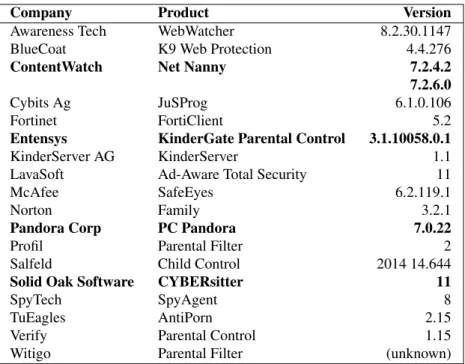
Company Product Version
Awareness Tech WebWatcher 8.2.30.1147
BlueCoat K9 Web Protection 4.4.276
ContentWatch Net Nanny 7.2.4.2
7.2.6.0
Cybits Ag JuSProg 6.1.0.106
Fortinet FortiClient 5.2
Entensys KinderGate Parental Control 3.1.10058.0.1
KinderServer AG KinderServer 1.1
LavaSoft Ad-Aware Total Security 11
McAfee SafeEyes 6.2.119.1
Norton Family 3.2.1
Pandora Corp PC Pandora 7.0.22
Profil Parental Filter 2
Salfeld Child Control 2014 14.644
Solid Oak Software CYBERsitter 11
SpyTech SpyAgent 8
TuEagles AntiPorn 2.15
Verify Parental Control 1.15
Witigo Parental Filter (unknown)
Table 3: List of parental control applications tested. Highlightedentries are products that may install a root certificate and proxy TLS connections; we analyzed all such products.
leading antivirus and parental control products under Windows that offer HTTPS/se-cure email filtering, or at least install a root certificate in the client’s trusted CA stores (OS/browsers) to expose potential TLS-related weaknesses introduced by these tools to their hosting systems.
2. We investigate whether the tools generate product-specific root certificates dynamically, and to what extent they protect the associated private keys. We perform an extensive analysis of certain products to recover their private keys, requiring non-trivial reverse-engineering and deobfuscation efforts (although one-time only, for each product). When the same key is used on all systems using the same product, simple MITM attacks are possible (see Section 4.4).
3. We expose flaws in the certificate validation process of the TLS proxies, given only a small corpus of carefully-crafted invalid certificates, which include expired and re-voked certificates along with chains of trust that are broken for various reasons (see
Sec-generally considered in existing client TLS tests (cf. Qualys [199] and others [71, 234]; see Section 4.5).
4. We analyze the TLS proxies against known attacks, and test their support for the latest and older TLS versions. We also test whether the TLS version negotiated with the server differs from what the browser sees (as supplied by the proxy), along with various other parameters, e.g., certificate key size, signature hashing algorithm, EV certificates. We observe that browsers (and in turn, users) are often misled by these proxies (see Section 4.7).
5. We discuss implications of our findings in terms of efforts required for launching prac-tical attacks (see Section 4.8), and outline a few preliminary suggestions for safer TLS proxying (see Section 4.10).
4.3
Major Findings
We applied the framework on 14 well-known antivirus and parental control tools for Win-dows (including two from the same vendor, and sometimes multiple versions), between March and August 2015.
We found that all the analyzed products in some way weaken TLS security on their host. Three of the four parental control applications we analyzed are vulnerable to server impersonation because they either import a pre-generated certificate into the OS/browser trusted stores during installation, lack any certificate validation, or trust a root certificate “for testing purpose only” with a well-known 512-bit RSA key. The remaining one imports a pre-generated certificate when filtering is enabled for the first time, and never removes it even after uninstalling the product, leaving the host perpetually vulnerable. One antivirus did not validate any certificate in the first version we analyzed, then changed to prompt-ing the user for each and every certificate presented on email ports (secure POP3, IMAP
and SMTP), leaving users unprotected or in charge of critical security decisions. Another antivirus fails to verify the certificate signatures, allowing a trivial MITM attack when fil-tering is enabled. A third antivirus leaves its host vulnerable to server impersonation under a trivial MITM attack after the product license is expired (accepts all certificates, valid or otherwise). Due to the expired license, this product also cannot be automatically updated to a newer version that fixes the vulnerability. We contacted the affected companies and report their responses.
4.4
Private Key Extraction
Most CCAs implement various protection mechanisms to safeguard their private keys on-disk. In this section, we discuss our methodologies to identify the types of protection as used by CCAs, and how we extract plaintext private keys from application-protected storage. OS-protected private key extraction requires admin privileges, excluded in our threat model for targeted attacks (see Section 2.4).
Overview. Our primary goal here is to extract private keys from disk on a user’s machine, using only unprivileged code. Extracting private keys from memory requires admin privi-leges, and we consider such an approach for two cases: to extract private keys associated to pre-generated certificates, and to understand the application process dealing with an in-memory private key to identify how the key is stored/protected on disk. We discuss the protection mechanisms used by our tested CCAs; we circumvented the two main on-disk protection mechanisms without requiring admin privileges on the target system. We then discuss some contextual security aspects.
4.4.1
Locating Private Keys in Files and Windows Registry
Most CCAs (optionally generate and) import their root certificates into OS/browser trusted stores during installation. Using Process Monitor (“procmon” from Microsoft/SysInter-nals), we monitor all the application processes of a CCA during installation. After instal-lation, we manually check for any newly added trusted CA using the Windows Certificate Manager. If a new entry in the Windows store is inserted, searching for the SHA1 fin-gerprint of that certificate in procmon’s log identifies the exact event where the entry was created. We can thus identify the specific application process that inserted the new cer-tificate, and possibly identify other affected files and registry locations, and which may potentially contain the associated private key. Specifically, we perform manual analysis (e.g., searching for keywords such as “certificate”) on file and registry operations (poten-tially hundreds), executed right before and after the root certificate insertion. When a CCA leverages the Windows CAPI/CNG, we find obvious traces in the log; we can then easily identify the correct key in a protected container with a label that is often similar to the CCA’s name.
We also explore a CCA’s installation directory for files that appear to be certificates or keys (with extensions such as .cer, .crt, .cert, .pem, .key; or filenames containing cert or
CA). If a private key is found, we match it to the root certificate for confirmation. We also check whether the key file is accessible by unprivileged code, allowing targeted MITM attacks.
If no root certificate is imported during installation, we explore the application’s settings for the availability of TLS filtering, and enable filtering when found. We then reboot the system (sometimes required to activate filtering), and visit an HTTPS website in a browser to trigger TLS interception, forcing the proxy to access its private key. At this point, if no root certificate is installed and no sample HTTPS connections are filtered, we discard the application from the rest of our analysis. In the end, we fully analyze 14 products that
support filtering and/or import a root certificate in the OS trusted store.
4.4.2
Application-protected Private Keys
Instead of using the OS-protected key storage, some CCAs store their private keys pro-tected by the application itself, using encryption and sometimes additional obfuscation. After locating the on-disk protected private keys (Section 4.4.1), we try to defeat such cus-tom protections to extract the keys. Here, we detail our methodology to bypass two main protection mechanisms we encountered, requiring some reverse-enginee