7th Asian-Australasian Conference on Precision Agriculture
Design and experiment of an embedded multi-function wireless sensor for
multi-service agricultural information acquisition
Kehui Xiao, Zhiguo Du, Lei Yang
(College of Mathematics and Informatics, South China Agricultural University, Guangzhou, 510642, China)
Abstract
Multi-service agricultural information has several data forms including text, audio, image and video. How to rapidly acquire and wirelessly transmit multi-service agricultural information is an essential prerequisite for sustainable development of precision agriculture. Devices for agricultural information acquisition in precision agriculture have different varieties and various input/output interfaces; however, these devices have only one single function and are lack of extensibility. To meet the demand of multi-service agricultural information acquisition in precision agriculture, a multi-service agricultural information acquisition sensor node (MAIAS) with multi-function integration was developed based on Android. A SC7731 chip is used as microcontroller chip of the node. Combined with ADC interface, microphone, image sensor, WiFi and 3G mobile communication module, the node was designed for rapid acquisition and wireless transmission of multi-service agricultural information in form of text, audio, image and video. To verify the performance of agricultural information acquisition and wireless data transmission of the node, experiments were conducted to acquire data of soil moisture content, audio, image and video in laboratory conditions. Audio data were transmitted by 3G mobile communication networks; the average transmission rate was about 21KB/s. Considering of large data volume, image and video data was transmitted using WiFi network, with the average rate of 2.63MB/s. The results show that the node could be connected with sensors for text information acquisition by ADC interface, and could satisfy the requirement on data acquisition of audio, image and video. The results also indicate that the node was feasible for rapid acquisition and wireless transmission of multi-service agricultural information in precision agriculture.
Key words: Agricultural information acquisition, Wireless sensor, Analog and digital converter, Audio signal, Image sensor
Introduction
Agricultural information has several data representation forms, including text (temperature, humidity), audio (voice of agricultural environment), image (picture of crops), and video (video surveillance of agricultural environment) [1, 2]. How to rapidly acquire and wirelessly transmit multi-service agricultural information is an essential prerequisite for sustainable development of precision agriculture [3-5].
Currently existing agricultural information acquisition devices used in precision agriculture have many varieties and various input/output interfaces; however, these data acquisition devices usually have a single function and are lack of the scalability of device interconnection [6-8], so they cannot collect the multi-service agricultural information at the same time. Furthermore, because of diversity of hardware interface and complexity of software structure, agricultural information acquisition devices are of low
7th Asian-Australasian Conference on Precision Agriculture
Audio acquisition devices use microphone module to collect analog audio signal, and output the digital signal after sampling signal and quantization [12-14]. The quality of audio depends on types of microphone module.
Image/video acquisition devices employ microcontrollers or embedded systems with CCD or CMOS image sensor to collect image and video data, and then get the digital output [15-17]. However, imagery data are limited by storage capacity, network bandwidth and energy cost, resolution of image sensor and quality, and are not able to satisfy application requirements.
Most of the operating systems used in agricultural information acquisition devices are embedded systems, such as TinyOS [18], Linux, WinCE based on ARM/Cortex [19, 20]. Multi-service agricultural information can be stored, analyzed and presented by database application system [21, 22], but these devices are short in graphical user interface and application program extension.
To meet the demand of multi-service agricultural information acquisition in precision agriculture, the goal of this research was to design a low-cost, portable and multi-functional sensor node (MAIAS) based on SC7731G chipset (Spectrum Instruments) and Android operating system. Combined with ADC interface, microphone, CMOS image sensor and wireless communication modules, MAIAS could rapidly acquire and wirelessly transmit multi-service agricultural information represented by text, audio, image and video. The work provides data and technical support for periodical/real-time decision in precision agriculture.
1. Hardware structure
Agricultural information acquisition sensors were designed to collect and wirelessly transmit text, audio, image and video data through low-cost hardware. It is important to balance hardware and software cost against quality of service.
1.1 Hardware structure design
The following prerequisites must be taken into account when hardware structure was designed and electronic components were selected for MAIAS:
(1) ADC and UART serial interface to collect text information of analog/digital signal; (2) Microphone module to collect audio signal;
(3) Camera interface to take pictures and record video; (4) Wireless data transmission.
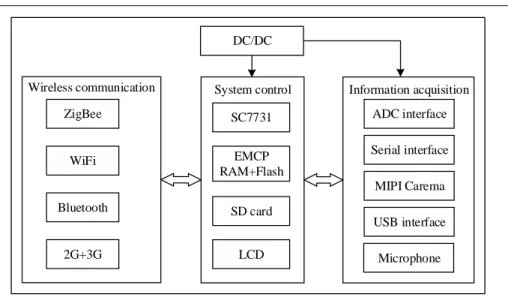
As figure 1 shows, MAIAS consists of several modules, including system control module, wireless communication module, information acquisition module and power supply module.
System control module of MAIAS is based on SC7731G chipset. SC7731G is an integrated application processor with embedded WCDMA/GSM modem. It integrates ZigBee, Bluetooth, WiFi module, and provides MIPI DSI for LCD display, MIPI CSI for image sensor, audio codec for audio record and playback, EMCP for 1GB RAM and 8GB NAND Flash.
MAIAS provides external memory interface to store large volume data locally. Multi-service
agricultural information is acquired by peripheral interfaces such as ADC, serial interface, USB and microphone. MAIAS is powered by 12VDC which can be supplied by storage battery or alternating current power. The supply voltage of SC7731G chipset is 3.6VDC. SC7731G integrates several DC-DC converters, so it can provide power supply for some internal chips and external devices.
7th Asian-Australasian Conference on Precision Agriculture
Figure 1. Hardware structure
1.2 Text information acquisition module
Text information acquisition module of MAIAS is responsible for collecting text-form agricultural information, such as temperature or humidity of soil, by connecting analog or digital sensors usually powered by on-board DC power supply. If sensors output analog signal, SC7731G will get digital signal by ADC; if sensors output digital signal, the signal will be transmitted to UART serial interface via IO ports.
In our tests, we used a soil humidity sensor FY-H2-5V-V (Fuyuanfeike Co., Wuhan, China) as a text agricultural information acquisition device connected to ADC. FY-H2-5V-V is powered by 5VDC with an output range of 0~2.5V voltage, and then the signal is converted to soil humidity by analog/digital conversion. As shown in figure 2, FY-H2-5V-V is connected with MAIAS by three cables, among which red cable is connected with positive pole of power supply, black cable is negative, yellow cable is for output signal.
Figure 2. ADC interface
1.3 Audio acquisition module
Electret condenser microphone (diameter is 2.5mm) is used to record audio data in MAIAS, and the circuit of audio data acquisition is shown in Fig 3. In the circuit, right ports T1, T2 in the circuit are
ZigBee
WiFi
Bluetooth
2G+3G
Wireless communication System control
SC7731 EMCP RAM+Flash SD card Information acquisition Microphone ADC interface MIPI Carema USB interface DC/DC LCD Serial interface DC_DC ADC_IN + + -Yellow Red Black
7th Asian-Australasian Conference on Precision Agriculture
Figure 3. Circuit of audio data acquisition
1.4 Image/video acquisition module
OV2710 CMOS image sensor with MIPI interface (OmniVision Technologies, Inc.) is used to collect image and video data. Resolution of OV2710 is up to 1080P (1920×1080), video frame rate is up to 30 frames per second, working voltage is 3.6V direct current, and dormant current of is 70μA. Pins connection of OV2710 is shown as Fig 4.
In Android operating system, image and video data are processed by class MediaRecorder or carema2, and then written in SD memory card. LCD screen in MAIAS can be used to preview image and video data.
Figure 4. Pins connection of OV2710
2. Software design and implementation
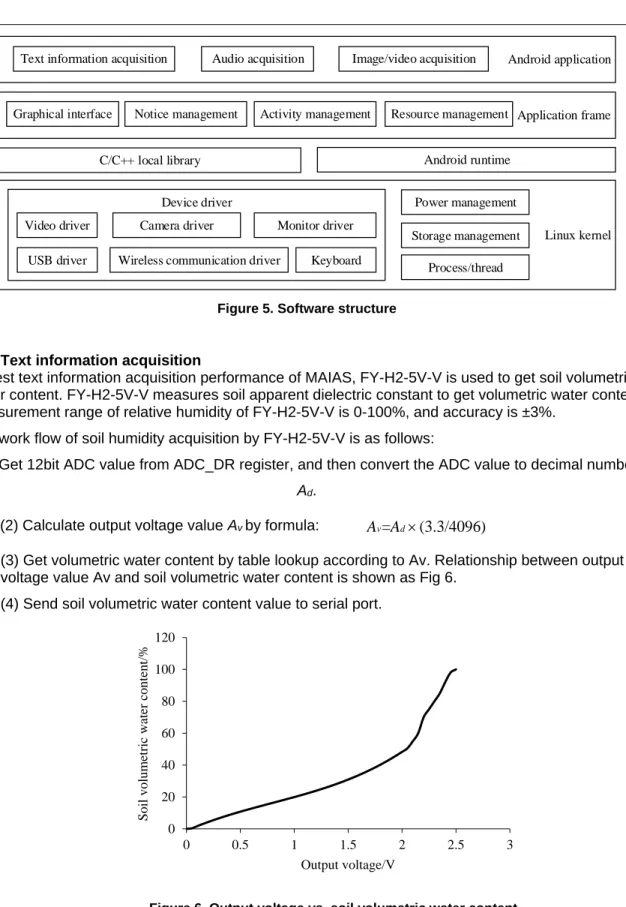
Software system of MAIAS is based on Android 4.4.2 kernel and the architecture is shown in Fig 5. The system was designed to realize rapid acquisition, local storage and wireless transmission of agricultural information. Android is an open source embedded operation system, it has friendly graphical operation interface and good application program extensibility which makes MAIAS easy to control and operate. Agricultural information formatted as text, audio, image and video data can be stored locally in NAND Flash or SD memory card by mechanism of hierarchical storage and storage overlay, and then transmitted in real time or periodically to remote data server by wireless
7th Asian-Australasian Conference on Precision Agriculture
Figure 5. Software structure
2.1 Text information acquisition
To test text information acquisition performance of MAIAS, FY-H2-5V-V is used to get soil volumetric water content. FY-H2-5V-V measures soil apparent dielectric constant to get volumetric water content. Measurement range of relative humidity of FY-H2-5V-V is 0-100%, and accuracy is ±3%.
The work flow of soil humidity acquisition by FY-H2-5V-V is as follows:
(1) Get 12bit ADC value from ADC_DR register, and then convert the ADC value to decimal number Ad.
(2) Calculate output voltage value Av by formula:
(3) Get volumetric water content by table lookup according to Av. Relationship between output voltage value Av and soil volumetric water content is shown as Fig 6.
(4) Send soil volumetric water content value to serial port.
Linux kernel Device driver Power management
Storage management C/C++ local library Android runtime
Application frame Notice management Activity management Resource management
Android application Text information acquisition Audio acquisition Image/video acquisition
Wireless communication driver
Camera driver Monitor driver USB driver Video driver Keyboard Process/thread Graphical interface 0 20 40 60 80 100 120 0 0.5 1 1.5 2 2.5 3 Soil volum et ric wate r cont ent /% = (3.3/4096) v d A A
7th Asian-Australasian Conference on Precision Agriculture
2.2 Audio acquisition
Audio acquisition is implemented by class MediaRecorder of Android, and work steps are as follows: (1) Create a file to save audio,
(2) Create an object of MediaRecorder to record audio, (3) Assign microphone as source of audio to record, (4) Set output format of audio file,
(5) Set other parameters of audio such as coding format, coding bit rate and sampling rate, (6) Specify a directory path to save audio file,
(7) Prepare recoding audio, and then begin recording,
(8) Complete and stop recording, release resource related audio recording.
In above steps, step (4) and (5) must not be reversed, if reversed, program exception will be thrown. Furthermore, the audio coding format must be coincided with audio file output format; otherwise, audio file will not be played correctly.
2.3 Image and video acquisition
Like audio acquisition, image and video acquisition are implemented by class MediaRecorder of Android. Work flow of video acquisition is mostly similar with audio acquisition; the only difference is that both image and audio signal must be collected during video recording. In image acquisition, image source must be assigned after audio source setting, and other settings must be done as follows after setting of video file output format:
(1) Set parameters of video recording such as coding format, coding bit rate and frame rate, these parameters are used to specify quality and size of video file. Usually, the better quality of video is, the bigger size of video is.
(2) Specify video preview.
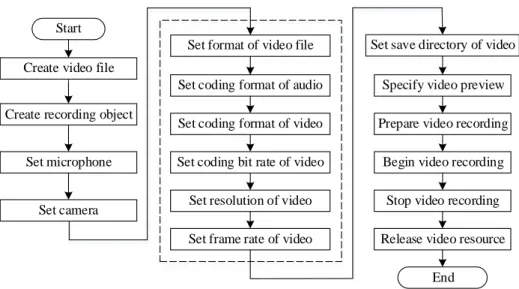
The work flow of video recording is figured as Fig 7 in which operations in dashed line box are used to set parameters and attributes of audio and video recorded.
Figure 7. Flowchart of video recording
Create recording object Start
Set microphone
Prepare video recording Begin video recording
Stop video recording Release video resource
End Set camera
Specify video preview Set save directory of video Create video file
Set format of video file Set coding format of audio Set coding format of video Set coding bit rate of video Set resolution of video Set frame rate of video
7th Asian-Australasian Conference on Precision Agriculture
In practical use, video recording will occupy camera for a long time, so images are usually taken from video frame. As to program implementation, class MediaMetadataRetriever of Android can be used to take images from video frame in time sequence or by a given time cycle, and then write images in JPEG to SD memory card or send images to remote data server by 3G.
3. Experiments and discussion
To verify the information acquisition performance of MAIAS, some experiments are done to acquire soil humidity, audio, image and video data in indoor and outdoor environments. In the experiments, 12V lead-acid storage battery is used as direct current power supply, and wireless data transmission performance by 3G and WiFi local area network are evaluated.
3.1 Soil humidity acquisition experiments
Soil volumetric water content is defined mathematically as:
where Vw is the volume of water, Vs is equal to the total volume of the soil and the water.
The soil for the experiments is taken from Cencun Farm of South China Agricultural University (E113.375679,N23.171029), density of the soil is 1.23g/cm3 measured by drying method. 800cm3 drying soil is taken as experimental sample, water is added to the soil according to theoretical soil
volumetric -H2-5V-V where
own as section 2.1. From Table 1,
FY-H2-5V-availability of text information acquisition function of MAIAS is verified.
Table 1. Result of soil humidity experiments
Ad Av 392 0.31 6.6% 10% 713 0.57 11.73% 20% 1848 1.48 29.93% 30% 2291 1.84 40.96% 40% 2542 2.04 49.41% 50% 2695 2.17 60% 60%
3.2 Audio acquisition experiments
The format of audio file acquired by MAIAS is m4a, with the bit rate of 128kbps. Audio file is sent to remote data server by 3G [23], transmission time is calculated to test the wireless transmission performance of MAIAS. The test results are shown in Table 2, which indicates that the average data transmission rate of audio file is about 21KB/s.
Table 2. Test for audio data acquisition
/ 100%
v V Vw s
v
7th Asian-Australasian Conference on Precision Agriculture
3.3 Image and video acquisition experiments
In consideration of large amounts data, image and video files acquired by MAIAS are sent to remote data server by WiFi local area network [24]. In the experiments, data are sent to server equipped with wireless network adapter via TP-LINK wireless router modeled TL-WR941N, data transmission rate of the router is up to 450Mbps. The wireless network adapter in server is Tenda W311M with data transmission rate of up to 150Mbps.
(1) Image transmission
Resolution of image acquired from MAIAS is 1920×1080 in JPG format. Because of different transformation and encoding scheme of JPEG compression algorithm, JPEG image files with the same resolution and dimension have different storage space size listed as Table 3. In the
experiments, WiFi transmission duration calculated from the average time for transmitting 10 image files was used to evaluate wireless transmission performance. It can be seen from the table, the average image transmission rate is about 0.89MB/s.
Table 3. Test for image data acquisition
Sequence Number Size/MB WiFi transmission duration/s
1 1.50 1.62 2 1.45 1.61 3 1.41 1.53 4 1.40 1.53 5 1.25 1.48 6 1.24 1.46 7 1.23 1.46 (2) Video transmission
Resolution of video acquired from MAIAS is 1920×1080 (1080P) in MP4 format, and video frame rate is 29 frames per second. In the experiments, video files are transmitted using WiFi local area network. WiFi transmission duration is calculated from the average duration of 10 video file transmissions shown in Table 4. As a result, the average video transmission rate is about 2.63MB/s, furthermore, the larger file size is, the higher data transmission rate is.
In above image and video transmission experiments, the average data transmission rate varies slightly, this is related to wireless transmission device and WiFi network environment. Therefore many more experiments should be done to show the true network environment, and then get the stable wireless data transmission rate.
Table 4. Test for video data acquisition
Sequence Number Video Duration/s Size/MB WiFi transmission duration/s
1 9 27.8 10.65 2 15 44.4 16.38 3 18 51.9 19.96 4 19 55.2 21.23 5 20 59.1 22.73 6 29 84.4 32.09
7th Asian-Australasian Conference on Precision Agriculture
Conclusion
MAIAS for precision agriculture applications is designed based on SC7731 chipset and Android operating system. Using different interfaces such as ADC, microphone, image sensor, MAIAS can be used to acquire multi-service agricultural information in the formats of text, audio, image and video, and the information is transmitted by 3G mobile network and WiFi local area network. From the experimental results in indoor and outdoor environments, MAIAS could satisfy the requirement of rapid acquisition and wireless transmission of agricultural information in precision agriculture. Compared with some existing sensors used for agricultural information acquisition, MAIAS is characterized by multi-functional integration, good graphical user interface, small size and low cost, which makes it a promising application perspective in precision agriculture. Although MAIAS has complete agricultural information acquisition functions, it has potential to be improved in wireless communication and networking application.
Acknowledgements
This work was conducted with funds provided by Science and Technology Planning Project of Guangdong Province, China (No.2015A020209129, No.2014B020205004, No.2016A020212020, No.2016B010110005) and Natural Science Foundation of Guangdong Province, China
(No.2016A030313389).
References
Luo Xiwen, Zang Ying, Zhou Zhiyan 2006. Research progress in farming information acquisition technique for precision agriculture [J]. Transactions of the CSAE. 22(1): 167–173.
Luo Wusheng, Zhai Yongping, Lu Qin 2008. Study on Wireless Multimedia Sensor Networks [J]. Journal of Electronics & Information Technology 30(6): 1511–1516.
Zhou Zhiyan, Luo Xiwen, Zang Ying. Research progress on the rapid acquisition and analysis methods of important information for the rice-paddy field’s environment system [J]. Science China: Information Science 2010(40), Sup: 38-53.
Xiao Kehui, Luo Xiwen, Xiao Deqin 2011. Application Research Summary of Wireless Sensor Network in Agricultural Information Acquisition [C] // The Chinese Society of Agricultural Engineering Academic Conference in 2011, Chongqing: Chinese Society of Agricultural Engineering.
Tong Cai, Wu Qiulan, Liu Chen, Zhai Dekun, Wang Bingbing 2015. A Review of Wisdom Agriculture Based on 3S Technologies [J]. Journal of Shandong Agricultural University 46(6): 856–860.
Luo Xiwen, Liao Juan, Zou Xiangjun, Zhang Zhigang, Zhou Zhiyan, Zang Ying, Hu Lian 2016. Enhancing agricultural mechanization level through information technology [J]. Transactions of the CSAE
32(20): 1–14.
He Yong, Nie Pengcheng, Liu Fei 2013. Advancement and Trend of Internet of Things in Agriculture and Sensing Instrument [J]. Transactions of the Chinese Society for Agricultural Machinery 44(10): 216–226.
Aquul-ur-Rehman, Abu Zafar Abbasi, Noman Islam, Zubair Ahmed Shaikh 2011. A review of wireless sensors and networks' applications in agriculture [J]. Computer Standards & Interfaces 36(2): 263–
7th Asian-Australasian Conference on Precision Agriculture
Adamchuk VI, Hummel JW, Morgan MT, Upadhyaya SK 2004. On-the-go soil sensors for precision agriculture[J]. Computers and Electronics in Agriculture 44(1): 71–91.
Gao Wanlin, Zhu Miaomiao, Li Peipei, Song Feifei, Zhao Long, Hu Hui 2016. Agricultural Audio Resource Management System [J]. Journal of Agriculture 6(2):117–121.
GH Meen, MA Schellekens, MHM Slegers, NLG Leenders, E van Erp-van der Kooij, LPJJ Noldus 2015. Sound analysis in dairy cattle vocalisation as a potential welfare monitor [J]. Computers and Electronics in Agriculture 2015(118): 111–115.
Li Xinxing, Liu Chundi, Wen Haojie, Su Ye, Fu Zetian, Zhang Lingxian 2015. Video semantic
annotation and segmentation method of vegetable disease knowledge based on voice recognition [J]. Transactions of the Chinese Society for Agricultural Machinery 46(9): 308–313.
Fu Junqian, Xiao Deqin, Deng Xiaohui 2014. Agricultural field environment high-quality image remote acquisition [J]. IFIP Advances in Information and Communication Technology 2014(420): 50–60. Ma Juncheng, Li Xinxing, Wen Haojie, Chen Yingyi Fu Zetian, Zhang Lingxian 2015. Monitoring video capture system for identification of greenhouse vegetable diseases [J]. Transactions of the Chinese Society for Agricultural Machinery 46(3): 282–287.
Yin Jianjun, Zhang Tiemin, Ke Xinrong, Xiao Kehui, Xiao Deqin 2016. Design of remote acquisition node of low-cost multispectral image for field monitoring [J]. Transactions of the CSAE 32(13): 118– 124.
Wang Man, He Ning, Pei Jun, Feng Gailing, Liu Haitao 2007. A review of embedded operating systems for wireless sensor networks [J]. Computer Application and Software 24(6): 44–48. Li Jing, Wang Fubao, Duan Weijun, Wang Jiangang 2006. Research on Node Operation System of Wireless Sensor Networks [J]. Computer Application and Research 23(8): 28–30.
Xiao Deqin, Huang Shunbin, Yin Jianjun, Fu Junqian, Ke Xinrong 2014. Development of High-resolution Agricultural Image Capture Node Based on Embedded System [J]. Transactions of the Chinese Society for Agricultural Machinery 45(2): 276–281.
Yang Xinting, Wu Tao, Sun Chuanheng, Liu Yande, Zhou Chao 2013. Remote monitoring system of crop environment and growing based on WMSN [J].Transactions of the Chinese Society for
Agricultural Machinery 44(1): 167–173.
Yu Guoxiong, Wang Weixing, Xie Jiaxing, Lu Huazhong, Lin Jinbin, Mo Haofan 2016. Information acquisition and expert decision system in litchi orchard based on internet of things [J]. Transactions of the CSAE 32(20): 144–152.
Chung Sun-Ok, Kang Sin-Woo, Bae Keun-Soo, Ryu Myoung-Jin, Kim Yong-Joo 2015. The potential of remote monitoring and control of protected crop production environment using mobile phone under 3G and Wi-Fi communication conditions [J]. Engineering in Agriculture, Environment and Food 8(4): 251–256.
Miao Zhenxing, Ma Youming, Zhou Mingzheng 2013. Design of WiFi file transmission system based on Android platform [J]. Journal of Yangtze University (Nat Sci Edit) 10(7): 17–20.