Published by: Elsevier
URL:
https://doi.org/10.1016/j.eswa.2017.10.001
<https://doi.org/10.1016/j.eswa.2017.10.001>
This version was downloaded from Northumbria Research Link:
http://nrl.northumbria.ac.uk/33396/
Northumbria University has developed Northumbria Research Link (NRL) to enable users to
access the University’s research output. Copyright
©and moral rights for items on NRL are
retained by the individual author(s) and/or other copyright owners. Single copies of full items
can be reproduced, displayed or performed, and given to third parties in any format or
medium for personal research or study, educational, or not-for-profit purposes without prior
permission or charge, provided the authors, title and full bibliographic details are given, as
well as a hyperlink and/or URL to the original metadata page. The content must not be
changed in any way. Full items must not be sold commercially in any format or medium
without formal permission of the copyright holder. The full policy is available online:
http://nrl.northumbria.ac.uk/policies.html
This document may differ from the final, published version of the research and has been
made available online in accordance with publisher policies. To read and/or cite from the
published version of the research, please visit the publisher’s website (a subscription may be
required.)
Classifier Ensemble Reduction Using a Modified
Firefly Algorithm: An Empirical Evaluation
Li Zhang
1, Worawut Srisukkham
1, Siew Chin Neoh
2, Chee Peng Lim
3and Diptangshu Pandit
11Computational Intelligence Research Group
Department of Computing Science and Digital Technologies Faculty of Engineering and Environment
University of Northumbria Newcastle, NE1 8ST, UK
2Faculty of Engineering, Technology and Built Environment
UCSI University Malaysia
3Institute for Intelligent Systems Research and Innovation
Deakin University Waurn Ponds, VIC 3216, Australia
Email: {li.zhang; srisukkham.worawut; diptangshu.pandit}@northumbria.ac.uk;
[email protected]; [email protected]
Abstract. In this research, we propose a variant of the firefly algorithm (FA) for classifier ensemble reduction. It incorporates both accelerated attractiveness and evading strategies to overcome the premature convergence problem of the original FA model. The attractiveness strategy takes not only the neighbouring but also global best solutions into account, in order to guide the firefly swarm to reach the optimal regions with fast convergence while the evading action employs both neighbouring and global worst solutions to drive the search out of gloomy regions. The proposed algorithm is subsequently used to conduct discriminant base classifier selection for generating optimized ensemble classifiers without compromising classification accuracy. Evaluated with standard, shifted, and composite test functions, as well as the Black-Box Optimization Benchmarking test suite and several high dimensional UCI data sets, the empirical results indicate that, based on statistical tests, the proposed FA model outperforms other state-of-the-art FA variants and classical metaheuristic search methods in solving diverse complex unimodal and multimodal optimization and ensemble reduction problems. Moreover, the resulting ensemble classifiers show superior performance in comparison with those of the original, full-sized ensemble models.
Keywords: Ensemble reduction, classification, and firefly algorithm.
I.
INTRODUCTION
Ensemble methods have been widely used for improving classification performance. There are many well-known ensemble construction techniques, such as bagging and boosting (Han et al., 2011). However, base classifier redundancy is still a challenging research problem, which has received much research attention in the area of computational intelligence. On the other hand, because of the superior search capabilities of evolutionary algorithms, they have been widely used for solving diverse optimization problems. Many state-of-the-art swarm intelligence algorithms are available in the literature for feature optimization and dimensionality reduction, e.g. see Jothi and Inbarani (2016). Motivated by the success of metaheuristic optimization, we aim to employ evolutionary algorithms for discriminant base model selection and to construct optimized classifier ensembles without compromising classification accuracy.
In this research, we propose a modified firefly algorithm (FA) for classifier ensemble reduction. It integrates two new search mechanisms, i.e. an accelerated attractiveness behaviour and an evading action, to mitigate premature convergence of the original FA model. The proposed attractiveness operation employs not only the neighbouring but also global promising solutions to guide the search process, while the evading action is advised by both local and global worst solutions to lead the search out of gloomy regions. These two new search mechanisms work cooperatively to overcome stagnation, and reach global optimality with fast convergence. The proposed algorithm is useful for identifying discriminant base classifiers to realize ensemble reduction, and obtaining the best trade-off between classification accuracy and ensemble complexity. Evaluated with standard, shifted, and composite test functions, Black-Box Optimization Benchmarking (BBOB) testbeds (Hansen et al., 2010a; 2010b; 2012) and high dimensional UCI data sets (Bache and Lichman, 2013), the proposed algorithm outperforms other state-of-the-art FA variants, BBOB optimizers, and several classical search methods, significantly, in solving diverse challenging unimodal and multimodal optimization and ensemble reduction problems. The resulting classifier ensembles also achieve competitive performance in comparison with those of the full-sized, unreduced original ensembles.
The paper is organized as follows. Section 2 discusses diverse ensemble techniques and swarm intelligence-based optimization methods. We introduce the proposed algorithm with the new attractiveness and evading search behaviours in Section 3. Section 4 presents the evaluation of the proposed algorithm and other metaheuristic search methods using standard and complex benchmark functions and high dimensional data sets for classifier ensemble reduction. Section 5 draws the conclusions and suggests a number of areas for further research.
2.
RELATED WORK
In this section, we introduce state-of-the-art ensemble classification techniques and diverse evolutionary metaheuristic search methods.
2.1 Ensemble Classification Techniques
There are many state-of-the-art ensemble methodologies proposed in recent years. Galar et al. (2012) conducted a comprehensive review of ensemble techniques for solving the class imbalance problem. Their studies indicated the efficiency of integrating random under-sampling techniques with bagging and boosting ensembles for classification of imbalanced data sets. Their work emphasized the positive synergy between sampling techniques and bagging ensemble learning. An ordering-based ensemble pruning technique was also proposed in their recent work (Galar et al., 2016) to better tackle imbalanced classification problems. Diao et al. (2014) proposed harmony search based ensemble reduction. They employed bagging and random subspaces for base classifier pool generation. Since bagging uses randomly selected diverse subsets of training instances to build the base models, and the random subspaces method uses randomly selected subsets of attributes for base classifier generation, the base models produced by these two methods showed great diversity. Evaluated with several UCI benchmark data sets, their model achieved impressive accuracy and outperformed ensemble classifiers using the full-sized or any randomly selected base models. Farid et al. (2013) proposed an adaptive ensemble model for data stream classification with concept drifting. They employed three base decision tree classifiers for ensemble construction. The weakest base classifier in the ensemble was updated automatically by a stand-by, newly generated base decision tree learner with the knowledge of the updated class information, in order to represent the most recent concepts in the incoming data streams. Evaluated with UCI benchmark data sets, their model achieved great efficiency for concept-drifting data stream classification. Zhang et al. (2015) developed adaptive ensemble classifiers for facial expression recognition and facial action intensity estimation. After extracting the initial dynamic motion-based facial features, the minimal-redundancy-maximal-relevance criterion (mRMR) was used to identify discriminative facial features for subsequent intensity estimation of facial action units. A set of ensemble classifiers was integrated with a distance-based clustering algorithm to identify six basic emotions as well as new unseen novel emotion classes. The complementary neural network was used as the base learner in their work, which possessed the capability of providing uncertainty measure for classification of each instance. The base classifiers and clustering algorithm worked collaboratively to inform the arrival of novel emotion classes. Evaluated with the Bosphorus facial expression database and with online real user testing, it achieved impressive performance for expression recognition and novel class detection.
Sun et al. (2016) proposed a model known as Class-Based ensemble for Class Evolution (CBCE) to deal with class evolution and concept drifting in data stream mining. Their proposed method generated a base learner for each class. Similarly, it adjusted to the class evolution by constantly updating the base learners to reflect the latest concepts in
the data stream. Moreover, their work addressed a side-effect of class evolution, i.e. the class imbalance problem, by employing an under-sampling method for the base learners. Their model showed superiority over other existing methods for class evolution adaptation. Guan et al. (2015) proposed an ensemble classification method for covariate-invariant gait recognition. They first employed the random subspaces method to generate the base classifiers. They also employed local enhancing and hybrid decision-level fusion to identify more discriminant features and eliminate inefficient base classifiers, respectively. Importantly, their work claimed that feature subsets randomly generated by the random subspaces method were less discriminant, because its feature selection process was conducted in a random manner without using class label information, therefore causing a low recognition accuracy rate with an expensive computational cost. As such, their work employed two local enhancing supervised learning methods, i.e. two-dimensional linear discriminant analysis (LDA) and IDR/QR, to address the above problems and identify more discriminant features. A majority voting strategy was used to generate the final classification result based on the outputs of the base models. Huang et al. (2016) proposed a deep Convolutional Neural Network (CNN) based ensemble classifier for image retrieval. Both AlexNet and Network in Network (NIN) were deployed to extract the initial image features. Subsequently, weighted average feature vectors based on the outputs of both AlexNet and NIN were generated. Evaluated with CIFAR-10 and CIFAR-100 databases, the proposed aggregate ensemble model outperformed single CNN for image classification and retrieval tasks. Liew et al. (2016) constructed an ensemble reduction method by using the Genetic Algorithm (GA) and a Bayesian Information Criterion fitness evaluation mechanism. Fuzzy extreme learning machines were used as the base learners. Evaluated with the database for Emotion Analysis using Physiological Signals, their model achieved the best trade-off between classification accuracy and ensemble complexity. Sołtys et al. (2015) utilized ensemble models such as bagging and random forests for uplift modeling, whereas Pietruczuk et al. (2017) proposed two theorems for determining the optimal ensemble size for data stream classification based on both classification accuracy and memory requirements.
2.2 FA and Modified FA Models
Swarm intelligence-based algorithms have been extensively studied for diverse optimization problems. As one of the more recently proposed swarm intelligence-based metaheuristic search methods, FA shows natural search capability of dealing with multimodal optimization problems as compared with other algorithms such as GA and Particle Swarm Optimization (PSO) (Yang, 2009). FA employs the following principles to perform the search process. Firstly, each firefly has a light intensity which denotes the solution quality. Secondly, fireflies with lower light intensities are attracted to neighbouring fireflies with higher light intensities regardless of their sex. Finally, the attractiveness decreases as the distance between two fireflies increases (Yang, 2009). A Levy-flight Firefly Algorithm (LFA) has also been proposed by Yang (2010). Instead of using Gaussian distribution, LFA implements Levy flights as random walk to overcome local optima traps.
In LFA, the attractiveness behaviour defined in Equation (1) is used to guide a firefly with lower light intensity to move towards the brighter ones in the neighbourhood.
𝑥𝑖= 𝑥𝑖+ 𝛽0𝑒−𝛾𝑟𝑖𝑗
2
(𝑥𝑗− 𝑥𝑖) + 𝛼 sign [rand − 1
2] ⊕ Levy (1)
where 𝑥𝑖 and 𝑥𝑗 denote the positions of fireflies i and j, respectively, and 𝛾 is the fixed light absorption coefficient.
Note that 𝛽0 represents the initial attractiveness measure when 𝑟 = 0. A Levy distribution is used as random walk
with 𝛼 as the randomized step parameter. Here, 𝑟𝑖𝑗 represents the Euclidean distance between fireflies i and j as
defined in Equation (2).
𝑟𝑖𝑗 = ‖𝑥𝑖− 𝑥𝑗‖ = √∑𝑑𝑘=1(𝑥𝑖,𝑘− 𝑥𝑗,𝑘)2 (2)
where 𝑥𝑖,𝑘 represents the k-th dimension of position 𝑥𝑖 for the i-th firefly, and 𝑑 indicates the dimension of a given
problem.
A comprehensive review of FA was presented in Fister et al. (2013), where many modified or hybrid FA models were described. Besides that, an elitist strategy with the generation of m-uniform random vectors was used to improve the random movement of the global best solution in Tilahun and Ong (2012). Gaussian and Levy distributions were used as popular strategies for random walks in modified FA models (Yang, 2009; Fister et al., 2013; Chou and Ngo, 2017). Since the variation of light intensity, and the attraction and randomization parameters play important roles in affecting the performance of FA, chaotic maps are utilized for formulating these parameters
in modified FA models to enhance performance. For instance, the randomization parameter and light absorption coefficient were adjusted by chaotic maps in Coelho et al. (2011), while 12 different chaotic maps were explored for tuning the attraction and light absorption coefficients in Gandomi et al. (2013). The findings in Gandomi et al. (2013) indicated that the modified FA models using Gauss and Sinusoidal maps as the attractiveness and light absorption coefficients, respectively, achieved the best performance for solving unimodal and multimodal benchmark functions. Many meta-heuristic or learning/search mechanisms, such as GA, PSO, DE, Ant-Lion Optimization (ALO), memetic algorithm, cellular learning automata and neural networks, have been hybridized with FA to increase search diversity (Fister et al., 2013). These modified and hybrid FA methods have been used widely to solve continuous, combinatorial, constrained, multi-objective and dynamic optimization problems. Fister Jr. et al. (2015) conducted a comprehensive review of chaos-based FA models. It included theoretical introduction of several popular chaotic maps, including Logistic, Gauss, Kent, Sine and Iterative maps. These maps have been extensively used to enhance and adjust several key parameters of FA, which showed great efficiency in solving global and engineering optimization problems. Yang (2009) explored the effectiveness of FA in dealing with multimodal optimization problems. Evaluated with several popular multimodal benchmarks, FA showed great superiority over PSO and GA.
A number of FA variants have also been proposed in recent years to overcome the local optimum traps of the original FA model. These variants are used for solving dimensionality reduction, optimal parameter selection, combinatorial and dynamic optimization problems. As an example, Baykasoğlu and Ozsoydan (2014) proposed an FA variant, which incorporated partial random restarts and an adaptive move procedure, to deal with dynamic multidimensional knapsack problems. Specifically, besides the original attractiveness factor, a probability-based mechanism was formulated, which was based on the iteration counter of the algorithm and frequency in dynamic environment to control the movement of a firefly. Their proposed FA variant also employed a modified attractiveness parameter for position updating. The model was extended in Baykasoğlu and Ozsoydan (2015) to deal with constrained non-linear design optimization problems. The extended model also employed an adaptive attractiveness coefficient to achieve a higher intensification capability. Both randomization and incumbent local search mechanisms along with corresponding control parameters were used to overcome local optima traps and enhance the global best solution, respectively. A probabilistic combination of three chaotic maps, i.e. Sinusoidal, Logistic and Tent maps, was used to further improve performance. Their model showed great superiority in tackling diverse engineering design problems. Chou and Ngo (2017) developed another modified FA model for solving multidimensional structural design optimization problems. Their model employed the Logistic map and the Gauss/mouse maps for population initialization and fine-tuning of the attractiveness coefficient, respectively. An adaptive inertia weight and Lévy flight were used for the position updating mechanism to increase search diversity. Wang et al. (2017) proposed an FA model with neighbourhood attraction, known as NaFA. In NaFA, each firefly was purely attracted to brighter fireflies in a pre-defined neighbourhood, instead of the whole population, to reduce computational complexity. A hybrid firefly differential evolution (HFDE) model was developed by Dash et al. (2017). HFDE combined improved DE (IDE) with FA to increase global exploration capabilities of IDE. In HFDE, IDE employed an adaptive weighting factor, as opposed to a fixed one in conventional DE, to overcome local optima. The best three individuals identified by IDE were subsequently used to generate offspring using FA movements. These offspring were used to replace the three worst solutions in the swarm if they had better fitness scores. The empirical results indicated that HFDE benefited from both DE and FA search mechanisms, and outperformed other optimal design methods.
Jothi and Inbarani (2016) proposed a hybrid supervised feature selection method, known as Tolerance Rough Set Firefly based Quick Reduct (TRSFFQR), by combining the Tolerance Rough Set (TRS) with FA for brain tumour image classification. The shape, intensity and texture features in real-value were firstly extracted from segmented MRI images. Then, the proposed TRSFFQR model was applied to identify the most significant feature subsets for tumour classification. In comparison with Artificial Bee Colony (ABC), Cuckoo Search (CS), Supervised Tolerance Rough Set-PSO based Relative Reduct (STRSPSO-RR) and Supervised Tolerance Rough Set-PSO based Quick Reduct (STRSPSO-QR), the proposed algorithm showed significant performance improvements. Kazem et al. (2013) proposed a stock market price forecasting model by integrating chaotic maps with FA for Support Vector Regression (SVR) hyper-parameter selection. Their work re-constructed the phase space dynamics using a delay coordinate embedding method. Then, FA integrated with chaos theory, known as the chaotic FA (CFA) model, was used to fine-tune SVR hyper-parameters. The proposed model achieved impressive performance enhancement in comparison with those of chaotic GA-based SVR, FA-based SVR and neural networks (NN), based on several challenging stock market prediction data sets. Su et al. (2017) proposed a hyperspectral image classification system
using FA-based band selection and optimal parameter identification for an extreme learning machine. FA was employed not only to identify an optimal subset of bands and reduce the network complexity, but also to identify the optimal parameter settings such as the regularization coefficient, Gaussian kernel and the hidden number of neurons. Their model outperformed PSO-based and other band selection methods. A hybrid FA model was developed by Zhang et al. (2016a) by integrating FA with Differential Evolution (DE) for solving diverse unimodal and multimodal optimization problems. Their model combined the exploration (i.e. diversification) capability of FA and the exploitation (i.e. intensification) capability of DE to guide the search process. The proposed algorithm divided the overall population into two sub-swarms, and FA and DE were used to lead the search in each sub-swarm, respectively. The sub-swarms were merged subsequently in each iteration with the global best solution identified. Tested with several unimodal and multimodal benchmark functions, their FA variant outperformed FA, DE and PSO. Long et al. (2015) developed rough sets based feature optimization and an interval type-2 fuzzy logic system (IT2FLS) for heart disease detection. In their work, FA and rough sets were used to perform feature optimization in high dimensional disease data. Alweshah and Abdullah (2015) proposed two modified FA models, i.e. SFA and LSFA, where simulated annealing (SA) was used to enhance the global best solutions obtained by FA and LFA, respectively. The two FA variants were used to improve the performance of a probabilistic neural network by adjusting its weights. Evaluated with several real-life benchmark data sets, LSFA outperformed SFA and the original FA model. Krawczyk (2015) proposed an FA-based ensemble reduction technique for one-class classification problems. FA was used as a clustering method to group fireflies into different clusters. The brightest firefly among each cluster was selected as an ensemble member to represent its group, therefore reducing the size of the base models. It also employed the diversity measurement as the distance measurement between the fireflies. Subsequently the weight of each selected representative classifier was generated by averaging the intensities of all fireflies in the corresponding cluster. A weighted majority voting method was used to determine the final classification output. There are three major differences between the work in Krawczyk (2015) and our proposed research, as follows. (1) The model in Krawczyk (2015) focuses on solving one-class problems while our proposed model tackles both binary and multi-class problems; (2) instead of using clustering-based pruning strategies where each firefly represents one base classifier as in Krawczyk (2015), our research is motivated by feature selection methods where each firefly represents all the base models with each element/dimension denoting a classifier; (3) except for a new distance calculation strategy, the model in Krawczyk (2015) employs the original FA attraction operation where the search is purely led by the neighbouring brighter fireflies. When this attraction-based search action stagnates, there is no mechanism in the model proposed by Krawczyk (2015) to drive the search out of local optima. On the contrary, two new search operations, i.e. attraction and evading mechanisms, are introduced in our research. These two search mechanisms not only employ both local and global promising or worst signals to guide the search process, but also work in a collaborative manner to overcome stagnation and mitigate premature convergence of the original FA model.
FA variants have been adopted to solve other real-life optimization problems. A moth-firefly algorithm was developed by Zhang et al. (2016b) for dimensionality reduction in facial expression classification, whereas Srivatsava et al. (2013) employed FA for optimal test path generation in software testing. A discrete FA (DFA) model was proposed by Sayadi et al. (2013) for solving discrete optimization problems. Xu and Liu (2013) proposed a multi-population FA (MFA) model for correlated data routing in underwater wireless sensor networks. Three types of fireflies were introduced, i.e. searching, listening, and updating fireflies, to improve adaptability of building, selecting, and optimizing routing paths. The searching fireflies identified a routing path from the source node to the sink. The listening fireflies collected information of mobile data stored in the searching fireflies to advise the routing path. The updating fireflies updated the light intensity of nodes along the routing path. MFA was also used to remove redundant information when merging the correlated data packets to improve efficiency. It outperformed existing protocols significantly. Ozsoydan and Baykasoglu (2015) proposed another multi-population FA with chaotic maps to solve dynamic optimization problems. An explorer swarm was used for the search of existing peaks, while colony swarms were generated to conduct local exploitation of the detected peaks. An exclusion strategy was proposed to remove non-contributing sub-populations by comparing the distance between a pair of the best solutions from any two sub-swarms with a threshold value. In order to increase swarm diversity, Chebyshev, ICMIC, Tent and Logistic maps were used for generating explorer populations, respectively. Their model showed impressive performance especially when dealing with complex instances for the moving peaks benchmark problem. Zhou et al. (2014) proposed a multi-population discrete FA model incorporated with the k-opt algorithm for solving traveling salesman problem. Variants for other metaheuristic search methods, such as PSO, have also been proposed. As an example, an enhanced leader PSO (ELPSO) was proposed in Jordehi (2015), which employed a series of mutation strategies to improve the global best solution identified by PSO. A micro GA embedded PSO model was developed
in Mistry et al. (2016) for discriminative facial feature selection and expression recognition. It incorporated a micro GA motivated small-population secondary swarm, a modified velocity updating strategy, and a sub-dimension based search mechanism to mitigate premature convergence of the original PSO algorithm.
3.
THE PROPOSED FA VARIANT
In this research, we propose a modified FA model for classifier ensemble reduction. It mitigates the premature convergence problem of the original FA model by embedding two new search strategies, i.e. accelerated attractiveness and evading operations. The attractiveness behaviour is guided by both neighbouring and global promising solutions to reach local and global optimality with fast convergence, while the enemy evading action is advised by the neighbouring and global worst solutions to avoid gloomy search regions. We introduce these two new search mechanisms in detail, as follows.
FA possesses an original attractiveness behaviour, as in Equation (1), which is guided purely by the neighbouring promising solutions to move the current firefly with a lower light intensity towards brighter ones in the neighbourhood. In comparison with this original attractiveness movement, the newly proposed attractiveness operation takes not only brighter fireflies in the neighbourhood but also the current global best solution, 𝑔𝑏𝑒𝑠𝑡, into
account for position updating. This accelerated attractiveness behaviour is defined in Equation (3).
𝑥𝑖= 𝑥𝑖+ 𝛽0𝑒−𝛾𝑟𝑖𝑗 2 (𝑥𝑗− 𝑥𝑖) + 𝛼′𝜀 (𝑔𝑏𝑒𝑠𝑡− 𝑥𝑖) + 𝛼′sign[rand − 1 2] ⊕ Levy = 𝑥𝑖(1 − 𝛽0𝑒−𝛾𝑟𝑖𝑗 2 ) + 𝑥𝑗 𝛽0𝑒−𝛾𝑟𝑖𝑗 2 + 𝛼′𝜀 (𝑔 𝑏𝑒𝑠𝑡− 𝑥𝑖) + 𝛼′sign[rand − 1 2] ⊕ Levy (3)
where 𝛼′is an adaptive parameter defined in Equation (4), and 𝜀 is a randomly generated vector with each element
in the range of [0, 1]. 𝛼′= 𝛼′× (10−4 0.9) 1 𝑛𝐺𝑒𝑛 (4)
where 𝑛𝐺𝑒𝑛 denotes the maximum number of iterations and 𝛼′ is initialized to 0.5 according to Yang (2009). This
strategy is motivated by a MATLAB version of the original FA model by Yang (2009). In this way, 𝛼′ is tuned
throughout generations. It starts with a larger value to increase diversity of the solution vectors, and decreases to a smaller value in subsequent iterations to enable fine-tuning of the solution vectors. This strategy is not included in the original FA model, but employed in our proposed algorithm to accelerate convergence. Owing to the fact that position updating of each firefly is conducted by using both neighbouring and global optimal solutions simultaneously, this new search mechanism enables the fireflies to reach the optimal regions more efficiently with fast convergence.
In addition to the abovementioned attractiveness behaviour, we propose an evading search mechanism defined in Equation (5). This evading movement is activated when the neighbouring fireflies have lower fitness values than that of the current firefly. It leads the current firefly i to move away from both the neighbouring firefly j with a lower light intensity and the current global worst solution, 𝑔𝑤𝑜𝑟𝑠𝑡, simultaneously.
𝑥𝑖= 𝑥𝑖(1 − 𝛽0′𝑒 −𝛾𝑟𝑖𝑗2 ) − 𝑥𝑗𝛽0′𝑒 −𝛾𝑟𝑖𝑗2 − 𝛼′𝜀 (𝑔 𝑤𝑜𝑟𝑠𝑡− 𝑥𝑖) − 𝛼′sign[rand − 1 2] ⊕ Levy (5)
where 𝛼′is the adaptive parameter defined in Equation (4) and 𝛽
0′ represents the evading coefficient, 0 ≤ 𝛽0′≤ 1, to
tune the effects of the evading action from the neighbouring worst solutions. In this research, we assign 𝛽0′=0.2
based on trial and errors in a series of experiments.
As mentioned earlier, the search process of the original FA model is based on the sole dominating attractiveness search action to move the current firefly i towards a brighter neighbouring firefly j. There is no search mechanism to deal with the situation when the current firefly i is brighter than the neighbouring firefly j. In the original FA model, the brightest firefly in the neighbourhood tends to merely take a random walk action. The proposed evading behaviour goes beyond the limitations of the search behaviours of the original FA model, and guides the current promising firefly i to move away from both local and global gloomy search regions, in order to diversify the search
and accelerate convergence.
Furthermore, the proposed attractiveness and evading operations work cooperatively to accelerate the search process and reduce the probability of premature convergence. These two newly proposed search strategies enable the swarm to explore wider and more distinctive search regions in comparison with those of the original FA model owing to the diversified position updating mechanisms. Therefore, the proposed FA model has better capability of finding global optimum solutions and escaping from local optima traps. These proposed search mechanisms also enable each firefly to follow multiple local and global promising solutions to enhance the natural multimodal search capabilities of the original FA model. The empirical results indicate that it shows great efficiency and robustness in dealing with diverse unimodal and multimodal optimization problems. In comparison with other FA variants and classical search methods, it shows superior discriminating capabilities over other methods for discriminant base model selection. The proposed algorithm is illustrated in Algorithm 1.
Algorithm 1: Pseudo-Code of the Proposed FA Model 1. Start
2. Initialize a population of fireflies randomly;
3. Set the light absorption coefficient and other search parameters; 4.
5. While (the stopping criterion is not satisfied)// until it finds the optimal solution or the maximum number of iterations is reached.
6. {
7. Evaluate the population and update the light intensity;
8. Rank the fireflies and find the current global best and worst solutions, i.e. 𝑔𝑏𝑒𝑠𝑡and
and 𝑔𝑤𝑜𝑟𝑠𝑡, respectively;
9. Fori = 1 to ndo //external loop 10. {
11. Forj = 1 to ndo //internal loop 12. {
13. If (𝐼𝑗> 𝐼𝑖)
14. {
15. //Using the attractiveness operation to guide the search
16. Move firefly i towards firefly j and the global best solution, 𝑔𝑏𝑒𝑠𝑡, using
Equation (3); 17. }
18. Else 19. {
20. //Using the evading action to guide the search
21. Move firefly i away from firefly j and the global worst solution, 𝑔𝑤𝑜𝑟𝑠𝑡,
using Equation (5); 22. } 23. End If 24. } End For 25. } End For 26. }End While
27. Output the most optimal solution(s); 28. End
As indicated in Algorithm 1, after initializing the swarm, the fitness of each firefly is evaluated using the objective function. Subsequently, the fireflies are ranked based on their fitness values with the global best and worst solutions identified. For each current firefly i, when the neighbouring firefly j has a better fitness than that of the current firefly i, the newly proposed attractiveness movement defined in Equation (3) is used to guide firefly i to move towards both the promising neighbouring firefly j, and the current global best solution, 𝑔𝑏𝑒𝑠𝑡, simultaneously. On the other hand, when the neighbouring firefly j is less optimal than the current firefly i, the evading behaviour defined in Equation (5) is activated to move the current firefly i away not only from the neighbouring worse solution j, but also from the current global worst solution, 𝑔𝑤𝑜𝑟𝑠𝑡. Both proposed attractiveness and evading behaviours work in a collaborative manner to avoid local optimum traps and move towards the global optima.
The objective function in Equation (6) is used to evaluate the fitness of each solution (i.e. each set of recommended base models) for ensemble generation, which is widely employed for feature selection and dimensionality reduction (Mistry et al., 2016; Zhang et al., 2016b). This fitness evaluation considers two criteria, i.e. classification accuracy and the number of selected base classifiers, as follows.
𝑓𝑖𝑡𝑛𝑒𝑠𝑠𝑥 = 𝑤𝑎∗ 𝑎𝑐𝑐𝑢𝑟𝑎𝑐𝑦𝑥+ 𝑤𝑏∗ (𝑛𝑢𝑚𝑏𝑒𝑟_𝑏𝑎𝑠𝑒_𝑚𝑜𝑑𝑒𝑙𝑠𝑥)−1 (6)
where 𝑤𝑎 and 𝑤𝑏 denote the weights for classification accuracy and the number of selected base models,
respectively, and 𝑤𝑎+ 𝑤𝑏= 1. Since classification accuracy is generally more important than the number of
selected base models, 𝑤𝑎 is higher than 𝑤𝑏. The termination criteria are as follows, i.e. either (1) the maximum
number of iterations is reached, or (2) the optimal solution is found. An evaluation is conducted to assess efficiency of the proposed FA model and other state-of-the-art and classical search methods using diverse benchmark test functions and high dimensional data sets. Detailed evaluation and analysis of the results are provided in Section 4.
4.
EVALUATION
To evaluate the proposed FA variant, we have implemented a number of state-of-the-art FA and PSO variants and conventional search methods for performance comparison. Firstly, we employ mathematical benchmark functions and BBOB testbeds to evaluate the efficiency and robustness of the proposed FA model for solving diverse unimodal and multimodal optimization problems. Secondly, several UCI benchmark and other medical image data sets are used for evaluation of ensemble reduction and aggregation. These test data sets are selected because their samples are large in size and high in dimension. Since the proposed FA model and other search algorithms are stochastic methods, a benchmark of 30 runs has been conducted to evaluate each test function and each test data set.
4.1 Evaluation Using Standard Benchmark Functions
Firstly, we employ 10 standard benchmark functions for evaluation. These test functions have been widely used for the evaluation of swarm intelligence-based algorithms (Jordehi, 2015). They are: Ackley, Dixon-Price, Griewank, Levy, Rastrigin, Rotated Hyper-Ellipsoid, Rosenbrock, Sphere, Sum of Different Powers, and Zakharov. The detailed descriptions of these test functions are available in (Jordehi, 2015). Moreover, these functions represent diverse unimodal and multimodal optimization problems. The Dixon-Price, Rotated Hyper-Ellipsoid, Rosenbrock, Sphere, Sum of Different Powers and Zakharov functions have single global minima, while others such as Ackley, Griewank, Levy, and Rastrigin contain multiple global minima. The optimization task is to find the global minima (i.e. zero) in the landscapes defined by the test functions. The FA variants implemented for performance comparison include Opposition and Dimensional based modified FA (ODFA) (Verma et al., 2016), CFA (Kazem et al., 2013), LSFA (Alweshah and Abdullah, 2015), SFA (Alweshah and Abdullah, 2015), NaFA (Wang et al., 2017), and HFDE (Dash et al., 2017). The classical search methods included for comparison are FA, SA, Bat Swarm Optimization (BSO), CS, PSO, Dragonfly Algorithm (DA) (Mirjalili, 2016a) and ALO (Mirjalili, 2015a).
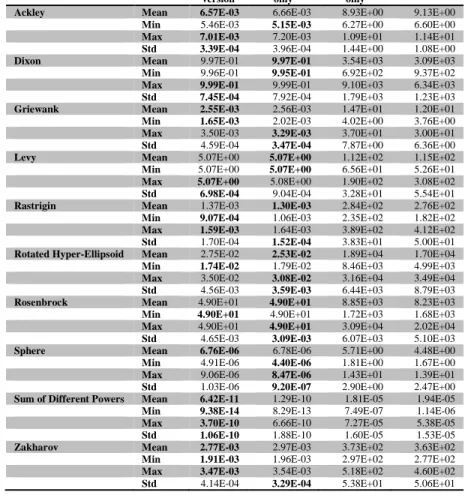
The following settings, i.e. dimension=50 and population size=20, have been used for experimental studies. The classical search methods, CFA, NaFA and the proposed FA model, employ the following number of function evaluations, i.e. 20 (population size) × 100 (maximum number of generations) = 2000. Other FA variants, i.e. LSFA, SFA, ODFA and HFDE, utilize comparatively higher numbers of function evaluations because of their internal search mechanisms. The number of function evaluations for LSFA and SFA is the sum of the cost for both LFA/FA and SA, i.e. 20 (population size) × 100 (maximum number of generations) + 20 (maximum trials of SA) × 100 (maximum number of generations) = 4000. ODFA employs a dimensional approach to retrieve the global best solution and has the following number of function evaluations, i.e. 20 (population size) × 100 (maximum number of generations) × 50 (dimension) = 100000. The number of function evaluations for HFDE is the sum of the cost for both DE (i.e. the fitness evaluation for both parent and offspring populations) and FA, i.e. (2 × 20 (population size) + 3 offspring generated using FA) × 100 (maximum number of generations) = 4300. For each test function, we conduct 30 runs using each method. The mean, minimum, maximum and standard deviation values for each test method are tabulated in Table 1. The results in bold indicate the best performances across all methods.
The parameters of each algorithm for this and subsequent experiments are set as follows. According to Yang (2009; 2010), the FA model employs the following setting to balance between computational efficiency and performance, i.e. initial attractiveness=1.0, randomization parameter=0.5, absorption coefficient=1.0, and Levy’s index=1.5.
According to the empirical studies in Yang (2008), the SA parameters that achieve the best trade-off between local exploitation and global exploration are as follows: cooling factor=0.95, initial temperature=1.0, and finial stopping temperature=1e-10. These parameters of FA and SA have been used for the experimental settings of LSFA and SFA. NaFA and HFDE also employ the abovementioned setting of FA. In addition, NaFA utilizes a neighbourhood size of 3 (as recommended in Wang et al. (2017)) while HFDE uses a new coefficient of 1.8 for weighting factor calculation (as recommended in Dash et al. (2017)). We have also conducted a number of trials to confirm the efficiency of these parameter settings of NaFA and HFDE for diverse optimization tasks. Other FA variants, i.e. ODFA, CFA and the proposed FA model, also utilize the abovementioned settings of FA for subsequent experimental studies with an extra evading coefficient=0.2 for the proposed FA model.
The following optimal settings recommended by theoretical studies and empirical evaluations (Yang, 2008) have been used for the GA, i.e. crossover probability=0.6, and mutation probability=0.05. In accordance with Yang (2008), PSO employs the following parameter settings: maximum velocity=0.6, inertia weight=0.5, and acceleration constants c1=c2=1.5. Note that the same PSO settings have been utilized in ELPSO (Jordehi, 2015). DA employs the following parameter settings: separation factor=0.1, alignment factor=0.1, cohesion factor=0.7, food factor=1, enemy factor=1, and inertia weight=0.9 – m × ((0.9-0.4)/maxi_iterations), where m and maxi_iterations represent the current and maximum iteration numbers, respectively (Mirjalili, 2016a). ALO provided by Mirjalili (2015a) uses adaptive parameters associated with the number of iterations without any additional parameters required. Finally, CS uses the discovery rate of alien eggs/solutions=0.25, while BSO employs 0.5 for both loudness parameter and pulse rate (Yang, 2008).
Table 1 Evaluation results for 10 benchmark functions with dimension=50
Prop. FA NaFA HFDE ODFA SFA LSFA CFA FA SA BSO CS PSO DA ALO Ackley mean 6.57E-03 1.23E+01 1.29E+01 1.68E+01 9.31E+00 1.91E+01 1.86E+01 8.04E+00 1.20E+01 1.84E+01 1.64E+01 1.44E+01 1.95E+01 1.90E+01
min 5.62E-03 1.13E+01 1.12E+01 1.47E+01 6.27E+00 1.75E+01 1.81E+01 5.49E+00 3.57E+00 1.75E+01 1.44E+01 1.24E+01 1.53E+01 1.90E+01 max 7.29E-03 1.45E+01 1.46E+01 1.80E+01 1.18E+01 2.00E+01 1.92E+01 1.03E+01 2.02E+01 1.94E+01 1.73E+01 1.59E+01 1.99E+01 1.90E+01 std 4.33E-04 7.79E-01 9.21E-01 8.91E-01 1.43E+00 8.63E-01 2.24E-01 1.41E+00 7.42E+00 5.72E-01 6.33E-01 9.50E-01 8.52E-01 1.45E-14 Dixon-Price mean 9.97E-01 1.25E+04 2.49E+03 1.84E+06 3.43E+00 3.67E+04 3.82E+06 4.12E+03 4.19E+06 1.13E+06 7.37E+04 5.69E+03 1.71E+04 6.09E+06 min 9.95E-01 5.21E+03 4.06E+02 7.67E+05 6.69E-01 1.10E+04 2.05E+06 1.22E+03 2.92E+06 3.55E+05 2.28E+04 1.39E+03 7.45E+01 4.33E+06 max 9.98E-01 2.38E+04 1.01E+04 3.34E+06 4.55E+01 8.06E+04 4.88E+06 1.38E+04 5.21E+06 4.06E+06 2.28E+05 1.93E+04 1.93E+05 8.19E+06 std 7.41E-04 5.19E+03 2.05E+03 6.35E+05 8.78E+00 1.84E+04 6.39E+05 2.80E+03 5.81E+05 7.07E+05 3.92E+04 3.97E+03 3.99E+04 1.08E+06 Griewank mean 2.61E-03 3.43E+01 2.00E+01 5.76E+02 1.21E+01 1.13E+03 8.25E+02 1.08E+01 9.27E+02 4.21E+02 1.08E+02 2.57E+01 2.93E+01 1.14E+03 min 1.71E-03 1.35E+01 8.52E+00 3.56E+02 3.43E+00 9.00E+02 6.95E+02 3.10E+00 7.62E+02 2.41E+02 6.40E+01 1.20E+01 1.45E+00 9.40E+02 max 4.08E-03 4.88E+01 5.15E+01 7.48E+02 2.64E+01 1.27E+03 9.44E+02 2.17E+01 1.08E+03 6.44E+02 1.41E+02 4.67E+01 8.64E+01 1.32E+03 std 5.85E-04 9.36E+00 9.07E+00 1.11E+02 5.86E+00 9.23E+01 6.04E+01 4.81E+00 6.47E+01 1.18E+02 1.91E+01 7.77E+00 2.58E+01 9.49E+01 Levy mean 5.07E+00 2.12E+02 2.17E+02 5.40E+02 1.04E+02 5.56E+02 1.75E+03 1.16E+02 1.89E+03 1.31E+03 7.40E+02 2.45E+02 8.05E+02 2.68E+03 min 5.07E+00 7.93E+01 1.07E+02 2.73E+02 1.53E+01 3.87E+02 1.37E+03 5.56E+01 1.58E+03 6.35E+02 5.92E+02 1.17E+02 2.70E+02 1.89E+03 max 5.07E+00 4.36E+02 5.79E+02 8.82E+02 2.71E+02 9.67E+02 2.05E+03 3.41E+02 2.14E+03 2.43E+03 9.92E+02 4.71E+02 1.75E+03 3.37E+03 std 6.15E-04 7.04E+01 9.56E+01 1.81E+02 5.02E+01 1.27E+02 1.67E+02 5.49E+01 1.55E+02 3.56E+02 1.08E+02 6.95E+01 3.47E+02 3.99E+02 Rastrigin mean 1.37E-03 2.46E+02 2.47E+02 4.74E+02 2.78E+02 3.68E+02 6.69E+02 2.75E+02 6.87E+02 4.83E+02 4.25E+02 1.83E+02 3.19E+02 7.99E+02 min 9.66E-04 1.75E+02 1.27E+02 3.05E+02 1.92E+02 2.47E+02 5.98E+02 1.98E+02 5.20E+02 3.24E+02 3.73E+02 1.31E+02 1.50E+02 7.41E+02 max 1.67E-03 3.62E+02 4.53E+02 6.00E+02 4.02E+02 4.70E+02 7.14E+02 3.56E+02 7.46E+02 5.99E+02 4.69E+02 2.38E+02 5.09E+02 8.74E+02 std 1.53E-04 3.96E+01 1.20E+02 6.53E+01 5.31E+01 4.40E+01 2.89E+01 3.72E+01 4.14E+01 5.94E+01 1.95E+01 2.84E+01 8.71E+01 3.26E+01 Rotated
Hyper-Ellipsoid
mean 2.55E-02 3.75E+04 1.80E+04 7.63E+05 7.07E+03 9.73E+05 9.10E+05 1.69E+04 1.04E+06 4.98E+05 1.21E+05 2.77E+04 3.56E+04 1.39E+06 min 1.83E-02 1.34E+04 7.72E+03 4.68E+05 7.58E+02 7.96E+05 7.51E+05 7.12E+03 9.39E+05 2.35E+05 7.82E+04 1.26E+04 7.50E+01 1.17E+06 max 3.30E-02 7.37E+04 3.24E+04 1.07E+06 1.58E+04 1.19E+06 1.11E+06 3.43E+04 1.17E+06 1.02E+06 1.88E+05 5.67E+04 1.10E+05 1.62E+06 std 3.80E-03 1.28E+04 7.68E+03 1.24E+05 4.06E+03 8.57E+04 8.73E+04 6.36E+03 6.41E+04 1.79E+05 2.64E+04 1.19E+04 2.80E+04 1.14E+05 Rosenbrock mean 4.90E+01 6.51E+10 1.36E+10 4.54E+05 5.11E+01 1.45E+04 1.16E+06 5.82E+03 2.07E+06 9.47E+05 1.49E+05 1.91E+04 1.81E+05 3.74E+06 min 4.90E+01 7.48E+09 2.23E+09 8.20E+04 7.07E-02 7.28E+02 8.37E+05 1.20E+03 8.89E+02 4.35E+05 7.00E+04 1.72E+03 4.58E+04 2.63E+06 max 4.90E+01 1.91E+11 3.31E+10 1.02E+06 1.48E+02 3.52E+04 1.41E+06 1.53E+04 2.84E+06 1.81E+06 2.82E+05 7.61E+04 5.54E+05 4.41E+06 std 4.90E-03 4.41E+10 9.57E+09 2.04E+05 4.43E+01 9.91E+03 1.33E+05 3.47E+03 6.15E+05 3.79E+05 4.47E+04 2.21E+04 1.31E+05 5.05E+05 Sphere mean 6.59E-06 9.04E+00 4.97E+00 2.03E+02 6.72E-04 6.10E-02 2.43E+02 4.36E+00 2.70E+02 9.98E+01 3.19E+01 7.39E+00 6.60E+00 3.45E+02 min 5.14E-06 3.00E+00 1.60E+00 1.28E+02 3.46E-04 1.40E-03 2.08E+02 1.76E+00 2.49E+02 4.73E+01 2.13E+01 3.27E+00 6.34E-01 2.80E+02 max 8.13E-06 1.72E+01 1.18E+01 2.62E+02 1.09E-03 4.87E-01 2.71E+02 8.90E+00 3.04E+02 1.76E+02 4.11E+01 1.61E+01 1.87E+01 4.06E+02 std 8.31E-07 3.54E+00 2.52E+00 3.69E+01 1.75E-04 1.04E-01 1.64E+01 1.60E+00 1.48E+01 3.56E+01 4.91E+00 2.75E+00 5.28E+00 2.78E+01 Sum of Different
Powers
mean 9.81E-11 5.58E-06 1.25E-05 2.03E+02 6.28E-07 1.37E-06 1.03E+00 1.62E-05 4.76E-06 5.59E-03 7.41E-04 1.40E-04 7.36E-04 1.24E+00 min 3.54E-14 1.00E-07 6.68E-08 1.28E+02 1.33E-07 4.22E-07 1.97E-01 5.94E-07 1.73E-07 1.01E-05 2.24E-05 4.79E-06 2.04E-07 6.71E-01 max 7.06E-10 1.55E-05 1.58E-04 2.62E+02 2.19E-06 3.88E-06 1.56E+00 9.41E-05 1.36E-05 3.18E-02 5.09E-03 6.31E-04 7.99E-03 2.06E+00 std 1.88E-10 4.60E-06 2.83E-05 3.69E+01 4.22E-07 7.44E-07 4.14E-01 2.18E-05 3.32E-06 8.22E-03 9.60E-04 1.38E-04 1.73E-03 3.26E-01 Zakharov mean 2.85E-03 3.90E+02 4.37E+02 6.14E+02 5.00E+02 9.26E+02 9.42E+02 3.68E+02 1.17E+03 8.81E+02 6.43E+02 3.98E+02 6.24E+02 1.25E+03 min 2.37E-03 2.87E+02 2.97E+02 3.86E+02 2.12E+02 6.79E+02 8.59E+02 2.82E+02 1.02E+03 6.56E+02 5.80E+02 2.50E+02 3.45E+02 1.21E+03 max 3.56E-03 5.62E+02 7.10E+02 8.11E+02 6.41E+02 1.12E+03 1.01E+03 4.76E+02 1.28E+03 1.09E+03 7.32E+02 6.10E+02 8.00E+02 1.25E+03 std 2.87E-04 5.40E+01 1.31E+02 1.05E+02 8.09E+01 1.09E+02 3.94E+01 5.33E+01 6.42E+01 1.12E+02 4.09E+01 6.13E+01 1.13E+02 7.82E+00
As illustrated in Table 1, the proposed FA model achieves the best mean global minima (very small values close to zero) and outperforms other state-of-the-art FA variants and conventional search methods, significantly, for all 10 test functions. Overall, the empirical results indicate that the proposed FA variant shows superiority in solving diverse unimodal and multimodal optimization problems over other search methods. We also employ the Wilcoxon
rank sum test (Derrac et al., 2011) to indicate the significance level of the proposed model. This two sided non-parametric statistical test is used to determine if two solutions have equal medians. A p-value is generated by the test to indicate the rejection of the null hypothesis of equal medians, or otherwise, at the default 5% significance level. As such, an algorithm is significantly better than another if the p-value is lower than 0.05. The statistical test results for all 10 standard benchmark functions are provided in Table 2. All the p-values are lower than 0.05, which indicates that the proposed model outperforms other methods, statistically, for all the test functions.
Table 2 The p-values from the Wilcoxon rank sum test for 10 standard test functions with dimension=50
Functions NaFA HFDE ODFA SFA LSFA CFA FA SA BSO CS PSO DA ALO
Ackley 3.02E-11 3.02E-11 3.02E-11 3.02E-11 1.62E-11 3.02E-11 3.02E-11 3.02E-11 3.02E-11 3.02E-11 3.02E-11 3.02E-11 1.21E-12
Dixon-Price 3.02E-11 3.02E-11 3.02E-11 3.99E-04 3.02E-11 3.02E-11 3.02E-11 3.02E-11 3.02E-11 3.02E-11 3.02E-11 3.02E-11 3.02E-11
Griewank 3.02E-11 3.02E-11 3.02E-11 3.02E-11 3.02E-11 3.02E-11 3.02E-11 3.02E-11 3.02E-11 3.02E-11 3.02E-11 8.48E-09 3.02E-11
Levy 3.02E-11 3.02E-11 3.02E-11 3.02E-11 3.02E-11 3.02E-11 3.02E-11 3.02E-11 3.02E-11 3.02E-11 3.02E-11 3.02E-11 3.02E-11
Rastrigin 3.02E-11 3.02E-11 3.02E-11 3.02E-11 3.02E-11 3.02E-11 3.02E-11 3.02E-11 3.02E-11 3.02E-11 3.02E-11 3.02E-11 3.02E-11
Rotated Hyper-Ellipsoid 3.02E-11 3.02E-11 3.02E-11 3.02E-11 3.02E-11 3.02E-11 3.02E-11 3.02E-11 3.02E-11 3.02E-11 3.02E-11 3.02E-11 3.02E-11
Rosenbrock 3.02E-11 3.02E-11 3.02E-11 2.71E-02 3.02E-11 3.02E-11 3.02E-11 3.02E-11 3.02E-11 3.02E-11 3.02E-11 3.02E-11 3.01E-11
Sphere 3.02E-11 3.02E-11 3.02E-11 3.02E-11 3.02E-11 3.02E-11 3.02E-11 3.02E-11 3.02E-11 3.02E-11 3.02E-11 3.02E-11 3.02E-11
Sum of Different Powers 3.02E-11 3.02E-11 3.02E-11 3.02E-11 3.02E-11 3.02E-11 3.02E-11 3.02E-11 3.02E-11 3.02E-11 3.02E-11 4.20E-10 3.02E-11
Zakharov 3.02E-11 3.02E-11 3.02E-11 3.02E-11 3.02E-11 3.02E-11 3.02E-11 3.02E-11 3.02E-11 3.02E-11 3.02E-11 3.02E-11 1.21E-12
4.2 Evaluation Using Shifted and Composite Benchmark Functions
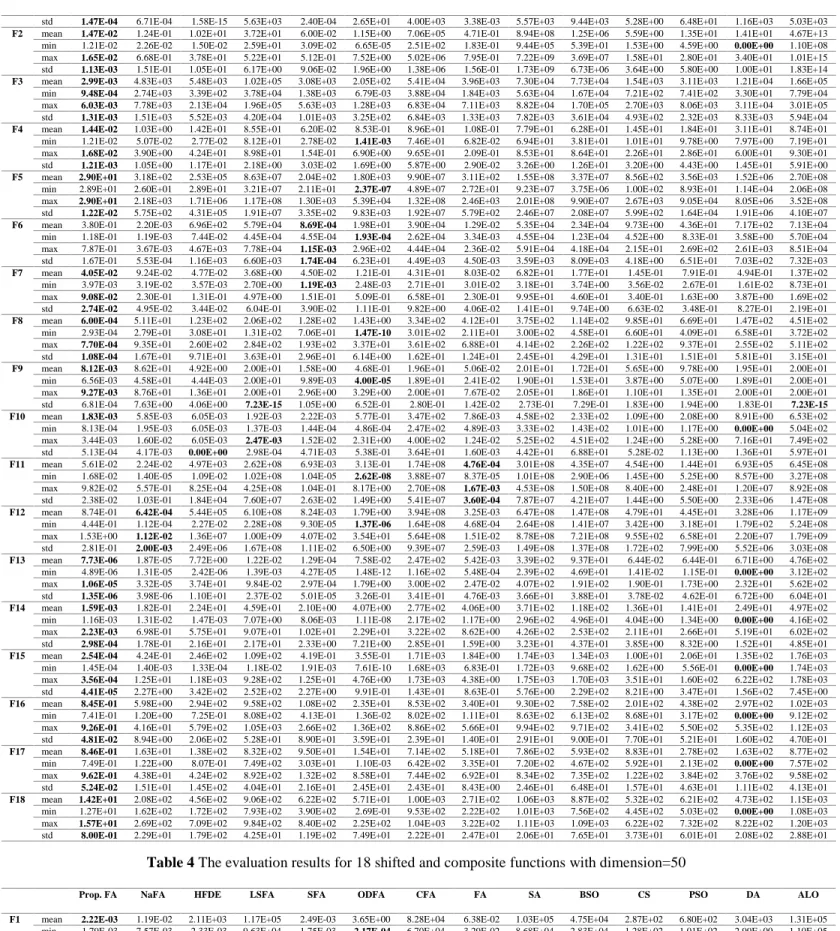
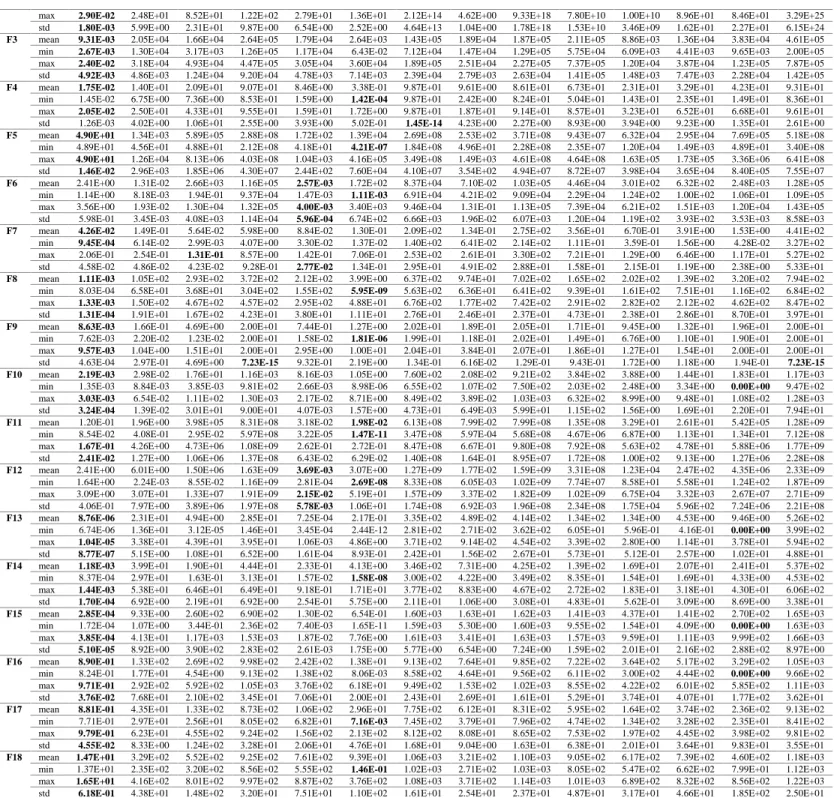
To further ascertain efficiency of the proposed FA model, a set of 18 shifted and composite benchmark functions is employed for evaluation. These benchmark functions are popular testbeds (Mirjalili, 2015a; 2015b) and have been commonly used for evaluation of swarm intelligence-based algorithms, which include Moth-Flame (Mirjalili, 2015b), ALO (Mirjalili, 2015a), Sine Cosine (Mirjalili, 2016b), and Whale Optimization (Mirjalili and Lewis, 2016) algorithms. These benchmark functions include 7 unimodal (F1-F7), 5 multimodal (F8-F12), and 6 complex composite functions (F13-F18) as defined in Tables A.1-A.3 in Appendix. Specifically, the unimodal and multimodal test functions are shifted to increase the difficulty level of these benchmark functions. The composite functions are taken from the CEC 2005 test suite (Mirjalili, 2015a; 2015b; 2016b), which represent the combination of diverse rotated, shifted, and biased unimodal and multimodal test functions. These composite functions contain a large number of local optima with irregularity and represent diverse challenging landscapes, and they are popular testbeds for benchmarking the performance of different optimization methods (Mirjalili, 2015a; 2015b; 2016b).
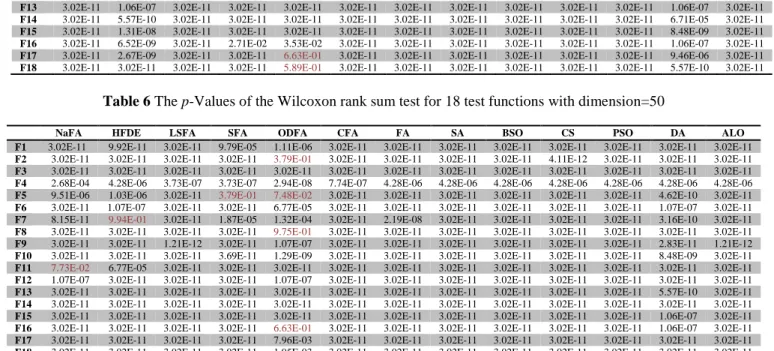
We have utilized the following settings in our experiments, i.e. dimension=30 or 50, and population size=20. The classical search methods, CFA, NaFA and the proposed FA model employ the following number of function evaluations, i.e. 20 (population size) × 500 (maximum number of generations) = 10000. Again, other FA variants, i.e. LSFA, SFA, ODFA and HFDE, utilize comparatively higher numbers of function evaluations. As an example, LSFA and SFA employ the following number of function evaluations, i.e. 20 (population size) × 500 (maximum number of generations) + 20 (maximum trials of SA) × 500 (maximum number of generations) = 20000. The number of function evaluations for ODFA is 20 (population size) × 500 (maximum number of generations) × 30 or 50 (dimension) = 300000 or 500000. The number of function evaluations for HFDE is (2 × 20 (population size) + 3 offspring generated using FA) × 500 (maximum number of generations) = 21500. A total of 30 trials have been conducted for each algorithm for each test function. The detailed results are provided in Tables 3-4. The best results for each function are presented in bold. As indicated in Tables 3-4, our proposed FA model outperforms other FA variants and classical search methods for nearly all test functions for dimensions 30 and 50, except for functions 6, 11 and 12, where our algorithm achieves similar distributions or marginally lower than some of the baseline results. Specifically, SFA, FA and NaFA achieve the best results for functions 6, 11 and 12, respectively, in dimension 30, while SFA performs the best for functions 6 and 12 with ODFA showing the best performance for function 11 in dimension 50. The Wilcoxon rank sum test is conducted to further indicate the significance level of the proposed algorithm. Tables 5-6 show the p-values of the statistical rank sum test for dimensions 30 and 50, respectively. The
p-values lower than 0.05 are marked in red.
Table 3 The evaluation results for 18 shifted and composite functions with dimension=30
Prop. FA NaFA HFDE LSFA SFA ODFA CFA FA SA BSO CS PSO DA ALO F1 mean 1.10E-03 2.26E-03 1.97E+00 5.74E+04 1.32E-03 1.01E+01 3.85E+04 1.20E-02 5.07E+04 2.65E+04 9.99E+00 3.95E+01 7.19E+02 7.21E+04
min 7.73E-04 7.93E-04 1.97E+00 4.51E+04 9.50E-04 1.11E-06 2.84E+04 4.96E-03 3.94E+04 1.45E+04 3.28E+00 7.33E-01 0.00E+00 5.95E+04 max 1.40E-03 3.63E-03 1.97E+00 6.95E+04 2.04E-03 1.38E+02 4.38E+04 1.85E-02 6.19E+04 4.26E+04 2.06E+01 2.61E+02 4.75E+03 7.91E+04
std 1.47E-04 6.71E-04 1.58E-15 5.63E+03 2.40E-04 2.65E+01 4.00E+03 3.38E-03 5.57E+03 9.44E+03 5.28E+00 6.48E+01 1.16E+03 5.03E+03 F2 mean 1.47E-02 1.24E-01 1.02E+01 3.72E+01 6.00E-02 1.15E+00 7.06E+05 4.71E-01 8.94E+08 1.25E+06 5.59E+00 1.35E+01 1.41E+01 4.67E+13 min 1.21E-02 2.26E-02 1.50E-02 2.59E+01 3.09E-02 6.65E-05 2.51E+02 1.83E-01 9.44E+05 5.39E+01 1.53E+00 4.59E+00 0.00E+00 1.10E+08 max 1.65E-02 6.68E-01 3.78E+01 5.22E+01 5.12E-01 7.52E+00 5.02E+06 7.95E-01 7.22E+09 3.69E+07 1.58E+01 2.80E+01 3.40E+01 1.01E+15 std 1.13E-03 1.51E-01 1.05E+01 6.17E+00 9.06E-02 1.96E+00 1.38E+06 1.56E-01 1.73E+09 6.73E+06 3.64E+00 5.80E+00 1.00E+01 1.83E+14 F3 mean 2.99E-03 4.83E+03 5.48E+03 1.02E+05 3.08E+03 2.05E+02 5.41E+04 3.96E+03 7.30E+04 7.73E+04 1.54E+03 3.11E+03 1.21E+04 1.66E+05 min 9.48E-04 2.74E+03 3.39E+02 3.78E+04 1.38E+03 6.79E-03 3.88E+04 1.84E+03 5.63E+04 1.67E+04 7.21E+02 7.41E+02 3.30E+01 7.79E+04 max 6.03E-03 7.78E+03 2.13E+04 1.96E+05 5.63E+03 1.28E+03 6.83E+04 7.11E+03 8.82E+04 1.70E+05 2.70E+03 8.06E+03 3.11E+04 3.01E+05 std 1.31E-03 1.51E+03 5.52E+03 4.20E+04 1.01E+03 3.25E+02 6.84E+03 1.33E+03 7.82E+03 3.61E+04 4.93E+02 2.32E+03 8.33E+03 5.94E+04 F4 mean 1.44E-02 1.03E+00 1.42E+01 8.55E+01 6.20E-02 8.53E-01 8.96E+01 1.08E-01 7.79E+01 6.28E+01 1.45E+01 1.84E+01 3.11E+01 8.74E+01 min 1.21E-02 5.07E-02 2.77E-02 8.12E+01 2.78E-02 1.41E-03 7.46E+01 6.82E-02 6.94E+01 3.81E+01 1.01E+01 9.78E+00 7.97E+00 7.19E+01 max 1.68E-02 3.90E+00 4.24E+01 8.98E+01 1.54E-01 6.90E+00 9.65E+01 2.09E-01 8.53E+01 8.64E+01 2.26E+01 2.86E+01 6.00E+01 9.30E+01 std 1.21E-03 1.05E+00 1.17E+01 2.18E+00 3.03E-02 1.69E+00 5.87E+00 2.90E-02 3.26E+00 1.26E+01 3.20E+00 4.43E+00 1.45E+01 5.91E+00 F5 mean 2.90E+01 3.18E+02 2.53E+05 8.63E+07 2.04E+02 1.80E+03 9.90E+07 3.11E+02 1.55E+08 3.37E+07 8.56E+02 3.56E+03 1.52E+06 2.70E+08 min 2.89E+01 2.60E+01 2.89E+01 3.21E+07 2.11E+01 2.37E-07 4.89E+07 2.72E+01 9.23E+07 3.75E+06 1.00E+02 8.93E+01 1.14E+04 2.06E+08 max 2.90E+01 2.18E+03 1.71E+06 1.17E+08 1.30E+03 5.39E+04 1.32E+08 2.46E+03 2.01E+08 9.90E+07 2.67E+03 9.05E+04 8.05E+06 3.52E+08 std 1.22E-02 5.75E+02 4.31E+05 1.91E+07 3.35E+02 9.83E+03 1.92E+07 5.79E+02 2.46E+07 2.08E+07 5.99E+02 1.64E+04 1.91E+06 4.10E+07 F6 mean 3.80E-01 2.20E-03 6.96E+02 5.79E+04 8.69E-04 1.98E+01 3.90E+04 1.29E-02 5.35E+04 2.34E+04 9.73E+00 4.36E+01 7.17E+02 7.13E+04 min 1.18E-01 1.19E-03 7.44E-02 4.45E+04 4.55E-04 1.93E-04 2.62E+04 3.34E-03 4.55E+04 1.23E+04 4.52E+00 8.33E-01 3.58E+00 5.70E+04 max 7.87E-01 3.67E-03 4.67E+03 7.78E+04 1.15E-03 2.96E+02 4.44E+04 2.36E-02 5.91E+04 4.18E+04 2.15E+01 2.69E+02 2.61E+03 8.51E+04 std 1.67E-01 5.53E-04 1.16E+03 6.60E+03 1.74E-04 6.23E+01 4.49E+03 4.50E-03 3.59E+03 8.09E+03 4.18E+00 6.51E+01 7.03E+02 7.32E+03 F7 mean 4.05E-02 9.24E-02 4.77E-02 3.68E+00 4.50E-02 1.21E-01 4.31E+01 8.03E-02 6.82E+01 1.77E+01 1.45E-01 7.91E-01 4.94E-01 1.37E+02 min 3.97E-03 3.19E-02 3.57E-03 2.70E+00 1.19E-03 2.48E-03 2.71E+01 3.01E-02 3.18E+01 3.74E+00 3.56E-02 2.67E-01 1.61E-02 8.73E+01 max 9.08E-02 2.30E-01 1.31E-01 4.97E+00 1.51E-01 5.09E-01 6.58E+01 2.30E-01 9.95E+01 4.60E+01 3.40E-01 1.63E+00 3.87E+00 1.69E+02 std 2.74E-02 4.95E-02 3.44E-02 6.04E-01 3.90E-02 1.11E-01 9.82E+00 4.06E-02 1.41E+01 9.74E+00 6.63E-02 3.48E-01 8.27E-01 2.19E+01 F8 mean 6.00E-04 5.11E+01 1.23E+02 2.06E+02 1.28E+02 1.43E+00 3.34E+02 4.12E+01 3.75E+02 1.14E+02 9.85E+01 6.69E+01 1.47E+02 4.51E+02 min 2.93E-04 2.79E+01 3.08E+01 1.31E+02 7.06E+01 1.47E-10 3.01E+02 2.11E+01 3.00E+02 4.58E+01 6.60E+01 4.09E+01 6.58E+01 3.72E+02 max 7.70E-04 9.35E+01 2.60E+02 2.84E+02 1.93E+02 3.37E+01 3.61E+02 6.88E+01 4.14E+02 2.26E+02 1.22E+02 9.37E+01 2.55E+02 5.11E+02 std 1.08E-04 1.67E+01 9.71E+01 3.63E+01 2.96E+01 6.14E+00 1.62E+01 1.24E+01 2.45E+01 4.29E+01 1.31E+01 1.51E+01 5.81E+01 3.15E+01 F9 mean 8.12E-03 8.62E+01 4.92E+00 2.00E+01 1.58E+00 4.68E-01 1.96E+01 5.06E-02 2.01E+01 1.72E+01 5.65E+00 9.78E+00 1.95E+01 2.00E+01 min 6.56E-03 4.58E+01 4.44E-03 2.00E+01 9.89E-03 4.00E-05 1.89E+01 2.41E-02 1.90E+01 1.53E+01 3.87E+00 5.07E+00 1.89E+01 2.00E+01 max 9.27E-03 8.76E+01 1.36E+01 2.00E+01 2.96E+00 3.29E+00 2.00E+01 7.67E-02 2.05E+01 1.86E+01 1.10E+01 1.35E+01 2.00E+01 2.00E+01 std 6.81E-04 7.63E+00 4.06E+00 7.23E-15 1.05E+00 6.52E-01 2.80E-01 1.42E-02 2.73E-01 7.29E-01 1.83E+00 1.94E+00 1.83E-01 7.23E-15 F10 mean 1.83E-03 5.85E-03 6.05E-03 1.92E-03 2.22E-03 5.77E-01 3.47E+02 7.86E-03 4.58E+02 2.33E+02 1.09E+00 2.08E+00 8.91E+00 6.53E+02 min 8.13E-04 1.95E-03 6.05E-03 1.37E-03 1.44E-04 4.86E-04 2.47E+02 4.89E-03 3.33E+02 1.43E+02 1.01E+00 1.17E+00 0.00E+00 5.04E+02 max 3.44E-03 1.60E-02 6.05E-03 2.47E-03 1.52E-02 2.31E+00 4.00E+02 1.24E-02 5.25E+02 4.51E+02 1.24E+00 5.28E+00 7.16E+01 7.49E+02 std 5.13E-04 4.17E-03 0.00E+00 2.98E-04 4.71E-03 5.38E-01 3.64E+01 1.60E-03 4.42E+01 6.88E+01 5.28E-02 1.13E+00 1.36E+01 5.97E+01 F11 mean 5.61E-02 2.24E-02 4.97E+03 2.62E+08 6.93E-03 3.13E-01 1.74E+08 4.76E-04 3.01E+08 4.35E+07 4.54E+00 1.44E+01 6.93E+05 6.45E+08 min 1.68E-02 1.40E-05 1.09E-02 1.02E+08 1.04E-05 2.62E-08 3.88E+07 8.37E-05 1.01E+08 2.90E+06 1.45E+00 5.25E+00 8.57E+00 3.27E+08 max 9.82E-02 5.57E-01 8.25E+04 4.25E+08 1.04E-01 8.17E+00 2.70E+08 1.67E-03 4.53E+08 1.50E+08 8.40E+00 2.48E+01 1.20E+07 8.92E+08 std 2.38E-02 1.03E-01 1.84E+04 7.60E+07 2.63E-02 1.49E+00 5.41E+07 3.60E-04 7.87E+07 4.21E+07 1.44E+00 5.50E+00 2.33E+06 1.47E+08 F12 mean 8.74E-01 6.42E-04 5.44E+05 6.10E+08 8.24E-03 1.79E+00 3.94E+08 3.25E-03 6.47E+08 1.47E+08 4.79E+01 4.45E+01 3.28E+06 1.17E+09 min 4.44E-01 1.12E-04 2.27E-02 2.28E+08 9.30E-05 1.37E-06 1.64E+08 4.68E-04 2.64E+08 1.41E+07 3.42E+00 3.18E+01 1.79E+02 5.24E+08 max 1.53E+00 1.12E-02 1.36E+07 1.00E+09 4.07E-02 3.54E+01 5.64E+08 1.51E-02 8.78E+08 7.21E+08 9.55E+02 6.58E+01 2.20E+07 1.79E+09 std 2.81E-01 2.00E-03 2.49E+06 1.67E+08 1.11E-02 6.50E+00 9.39E+07 2.59E-03 1.49E+08 1.37E+08 1.72E+02 7.99E+00 5.52E+06 3.03E+08 F13 mean 7.73E-06 1.87E-05 7.72E+00 1.22E-02 1.29E-04 7.58E-02 2.47E+02 5.42E-03 3.39E+02 9.37E+01 6.44E-02 6.44E-01 6.71E+00 4.76E+02 min 4.89E-06 1.31E-05 2.42E-06 1.39E-03 4.27E-05 1.48E-12 1.16E+02 5.48E-04 2.39E+02 4.69E+01 1.41E-02 1.15E-01 0.00E+00 3.12E+02 max 1.06E-05 3.32E-05 3.74E+01 9.84E-02 2.97E-04 1.79E+00 3.00E+02 2.47E-02 4.07E+02 1.91E+02 1.90E-01 1.73E+00 2.32E+01 5.62E+02 std 1.35E-06 3.98E-06 1.10E+01 2.37E-02 5.01E-05 3.26E-01 3.41E+01 4.76E-03 3.66E+01 3.88E+01 3.78E-02 4.62E-01 6.72E+00 6.04E+01 F14 mean 1.59E-03 1.82E-01 2.24E+01 4.59E+01 2.10E+00 4.07E+00 2.77E+02 4.06E+00 3.71E+02 1.18E+02 1.36E+01 1.41E+01 2.49E+01 4.97E+02 min 1.16E-03 1.31E-02 1.47E-03 7.07E+00 8.06E-03 1.11E-08 2.17E+02 1.17E+00 2.96E+02 4.96E+01 4.04E+00 1.34E+00 0.00E+00 4.16E+02 max 2.23E-03 6.98E-01 5.75E+01 9.07E+01 1.02E+01 2.29E+01 3.22E+02 8.62E+00 4.26E+02 2.53E+02 2.11E+01 2.66E+01 5.19E+01 6.02E+02 std 2.98E-04 1.78E-01 2.16E+01 2.17E+01 2.33E+00 7.21E+00 2.85E+01 1.59E+00 3.23E+01 4.37E+01 3.85E+00 8.32E+00 1.52E+01 4.85E+01 F15 mean 2.54E-04 4.24E-01 2.46E+02 1.09E+02 4.19E-01 3.55E-01 1.71E+03 1.84E+00 1.74E+03 1.34E+03 1.00E+01 2.06E+01 1.35E+02 1.76E+03 min 1.45E-04 1.40E-03 1.33E-04 1.18E-02 1.91E-03 7.61E-10 1.68E+03 6.83E-01 1.72E+03 9.68E+02 1.62E+00 5.56E-01 0.00E+00 1.74E+03 max 3.56E-04 1.25E+01 1.18E+03 9.28E+02 1.25E+01 4.76E+00 1.73E+03 4.38E+00 1.75E+03 1.70E+03 3.51E+01 1.60E+02 6.22E+02 1.78E+03 std 4.41E-05 2.27E+00 3.42E+02 2.52E+02 2.27E+00 9.91E-01 1.43E+01 8.63E-01 5.76E+00 2.29E+02 8.21E+00 3.47E+01 1.56E+02 7.45E+00 F16 mean 8.45E-01 5.98E+00 2.94E+02 9.58E+02 1.08E+02 2.35E+01 8.53E+02 3.40E+01 9.30E+02 7.58E+02 2.01E+02 4.38E+02 2.97E+02 1.02E+03 min 7.41E-01 1.20E+00 7.25E-01 8.08E+02 4.13E-01 1.36E-02 8.02E+02 1.11E+01 8.63E+02 6.13E+02 8.68E+01 3.17E+02 0.00E+00 9.12E+02 max 9.26E-01 4.16E+01 5.79E+02 1.05E+03 2.66E+02 1.36E+02 8.86E+02 5.66E+01 9.94E+02 9.71E+02 3.41E+02 5.50E+02 5.35E+02 1.12E+03 std 4.81E-02 8.94E+00 2.06E+02 5.28E+01 8.90E+01 3.59E+01 2.39E+01 1.40E+01 2.91E+01 9.00E+01 7.70E+01 5.21E+01 1.60E+02 4.70E+01 F17 mean 8.46E-01 1.63E+01 1.38E+02 8.32E+02 9.50E+01 1.54E+01 7.14E+02 5.18E+01 7.86E+02 5.93E+02 8.83E+01 2.78E+02 1.63E+02 8.77E+02 min 7.49E-01 1.22E+00 8.07E-01 7.49E+02 3.03E+01 1.10E-03 6.42E+02 3.35E+01 7.20E+02 4.67E+02 5.92E+01 2.13E+02 0.00E+00 7.57E+02 max 9.62E-01 4.38E+01 4.24E+02 8.92E+02 1.32E+02 8.58E+01 7.44E+02 6.92E+01 8.34E+02 7.35E+02 1.22E+02 3.84E+02 3.76E+02 9.58E+02 std 5.24E-02 1.51E+01 1.45E+02 4.04E+01 2.16E+01 2.45E+01 2.43E+01 8.43E+00 2.46E+01 6.48E+01 1.57E+01 4.63E+01 1.11E+02 4.13E+01 F18 mean 1.42E+01 2.08E+02 4.56E+02 9.06E+02 6.22E+02 5.71E+01 1.00E+03 2.71E+02 1.06E+03 8.87E+02 5.32E+02 6.21E+02 4.73E+02 1.15E+03 min 1.27E+01 1.62E+02 1.72E+02 7.93E+02 3.90E+02 2.69E-01 9.53E+02 2.22E+02 1.01E+03 7.56E+02 4.45E+02 5.03E+02 0.00E+00 1.08E+03 max 1.57E+01 2.69E+02 7.09E+02 9.84E+02 8.40E+02 2.25E+02 1.04E+03 3.22E+02 1.11E+03 1.09E+03 6.22E+02 7.32E+02 8.22E+02 1.20E+03 std 8.00E-01 2.29E+01 1.79E+02 4.25E+01 1.19E+02 7.49E+01 2.22E+01 2.47E+01 2.06E+01 7.65E+01 3.73E+01 6.01E+01 2.08E+02 2.88E+01
Table 4 The evaluation results for 18 shifted and composite functions with dimension=50
Prop. FA NaFA HFDE LSFA SFA ODFA CFA FA SA BSO CS PSO DA ALO
F1 mean 2.22E-03 1.19E-02 2.11E+03 1.17E+05 2.49E-03 3.65E+00 8.28E+04 6.38E-02 1.03E+05 4.75E+04 2.87E+02 6.80E+02 3.04E+03 1.31E+05 min 1.79E-03 7.57E-03 2.33E-03 9.63E+04 1.75E-03 2.17E-04 6.70E+04 3.29E-02 8.68E+04 2.83E+04 1.28E+02 1.01E+02 2.99E+00 1.10E+05 max 2.62E-03 1.76E-02 1.30E+04 1.29E+05 3.54E-03 3.54E+01 9.31E+04 1.05E-01 1.15E+05 8.40E+04 6.00E+02 1.95E+03 1.47E+04 1.49E+05 std 2.16E-04 2.48E-03 3.67E+03 8.18E+03 4.66E-04 7.34E+00 6.82E+03 1.74E-02 7.06E+03 1.37E+04 1.02E+02 4.92E+02 3.56E+03 9.43E+03 F2 mean 2.56E-02 7.14E+00 1.52E+01 1.07E+02 5.69E+00 8.95E-01 2.20E+13 1.91E+00 7.92E+17 3.82E+09 8.67E+09 4.42E+01 3.63E+01 1.61E+24 min 2.19E-02 7.54E-01 2.72E-01 9.08E+01 1.11E-01 7.84E-05 1.24E+08 8.69E-01 1.97E+14 9.07E+01 1.39E+02 2.23E+01 1.13E+00 5.60E+17
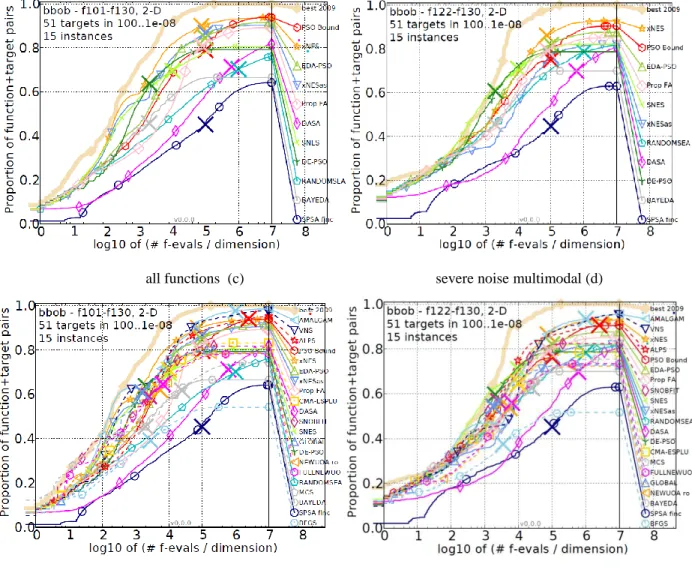
![Figure 2 Bootstrapped empirical cumulative distribution of the number of objective function evaluations divided by dimension (FEvals/DIM) for 51 targets with target precision in 10 [−8..2] for all functions and one subgroup in 3-D](https://thumb-us.123doks.com/thumbv2/123dok_us/741023.2593829/20.918.111.807.365.912/bootstrapped-empirical-cumulative-distribution-objective-evaluations-dimension-precision.webp)
![Figure 3 Bootstrapped empirical cumulative distribution of the number of objective function evaluations divided by dimension (FEvals/DIM) for 51 targets with target precision in 10 [−8..2] for all functions in 5-D, 10-D and 20-D, and one subgroup in 5-D](https://thumb-us.123doks.com/thumbv2/123dok_us/741023.2593829/21.918.113.805.429.966/bootstrapped-empirical-cumulative-distribution-objective-evaluations-dimension-precision.webp)