Abstract
In this paper, we will illustrate the use of modern information technology to provide knowledge support to CRM processes. This knowledge support allows for performance enhancement in customer oriented busi-ness processes. We will base our reasoning on an inte-grated Customer Knowledge Management process model, which identifies six CRM sub-processes and four aspects of Knowledge Management. This inte-grated model aims at achieving knowledge transpar-ency, knowledge dissemination, knowledge develop-ment and knowledge efficiency. The application of the four aspects content, competence, community and composition in specific CRM sub-processes will be demonstrated in several action research cases. These cases were implemented in European companies in the financial services sector and concern the support of customer-facing processes across all channels. They validate the proposed architecture while indicating critical success factors for a successful implementation of Customer Knowledge Management.
1
Introduction
1.1
Challenges for Businesses in the
Informa-tion Age
Ever increasing demands of customers concerning quality and innovativeness of products and services put companies under pressure. In combination with global competition, they change the rules of the market and force companies to adapt swiftly [22]. This challenge and rising pressure to reduce costs require enterprises to redesign their business model. One possible solution is to focus the value chain on the processes of the
cus-tomers. For example, a company could support the customer process “car ownership”, which extends from the purchase and financing of the vehicle and the usage and maintenance all the way to the sale or scraping. This process could be covered entirely with an innova-tive combination of products and services by a single provider. Efficiently collaborating within dynamic networks based on modern information technologies, companies can provide these process oriented offerings [8, p. 20]. The growing importance of customer ori-ented business models is emphasized by numerous publications within the area of Customer Relationship Management (CRM), for example [11], [36], [32]. A comprehensive overview over the literature in the field of CRM with a focus on e-commerce can be found in [29]. CRM aims at leveraging investments in customer relations to strengthen the competitive position and maximize returns.
Focusing on customer processes requires knowl-edge of considerable extent. Customer-focused compa-nies have to provide knowledge that customers de-mand, process the knowledge that customers pass to the company and possess knowledge about customers. As a consequence, knowledge is considered a critical resource in the competition of the 21st century ([5], [3, p. 13]). The cultivation of knowledge to support busi-ness processes is the task of Knowledge Management (KM). Thus the application of KM concepts and tech-nologies in the context of CRM is a relevant field of research (see ([30, p. 239])).
1.2
Research Goals and Structure
Our research focuses on how concepts of KM can be applied within the area of CRM. This approach enables companies to improve knowledge support of their customer oriented business processes, which in
Customer Knowledge Management -
Improving Performance of Customer Relationship
Management with Knowledge Management
Adrian Bueren, Ragnar Schierholz, Lutz Kolbe, Walter Brenner
Institute of Information Management, University of St. Gallen
Mueller-Friedberg-Strasse 8, 9000 St. Gallen, Switzerland
Contact: [email protected] or [email protected]
turn aims at improving the overall performance of the enterprise.
The resulting Customer Knowledge Management (CKM) process model as introduced by [9] aims at integrating the two concepts of CRM and KM. We consider KM to be a toolset which cannot be applied independently of business processes. Thus we focus on the application within the area of CRM. The contribu-tion of this article is to describe cases in which the performance of CRM was improved by applying the CKM process model.
In this paper, we will proceed as follows: Section 2 provides an overview of related research within the areas of CRM and KM which form the foundation of the CKM process model. Subsequently we will intro-duce the CKM process model based on a framework of six CRM sub-processes. In section 3, three action-research cases with companies in the financial services sector will then illustrate the application of the CKM process model. Our cross-case analysis in section 4 will specifically focus on how the illustrated cases managed to improve company performance through the application of KM instruments within CRM. Fi-nally, in section 5 we will conclude this article with an outlook on further research opportunities.
1.3
Research Methodology
To achieve our research goals and derive the CKM process model, we employed the research approach “action research” as defined by Gummesson: “On the basis of their paradigms and pre-understanding and given access to empirical, real-world data through their role as change agent, […] action scientists […] gener-ate a specific (local) theory, which is then tested and modified through action. The interaction between the role of academic researcher and the role of manage-ment consultant, within a single project as well as between projects, can also help the scientist to generate a more general theory, which in turn becomes an in-strument for increased theoretical sensitivity […].” [14, p. 208]. Apart from this foundation, we also used in-depth case studies and desktop research to complement our experiences and validate the conclusions derived from the CKM process model. The CKM process model is based on nearly 6 years of research in a spe-cial corporate-academic partnership. Research partners were major European players in sectors such as finan-cial services and insurance, telecommunications and chemicals.
As a foundation of our research, we use the busi-ness engineering approach developed by [20, pp. 13 et seqq.]. To describe the corporate reality, it separates the three layers strategy, processes and information systems. The strategy layer determines the business
model and proposes the goals that need to be achieved for the success of the company. The process layer creates the output needed to fulfill the goals of the strategy. The information systems support the proc-esses in creating the outputs, sometimes actually ena-bling the processes to fulfill the requirements of cus-tomers. The research described in this paper concen-trates on the process and information systems level of CRM and CKM.
2
A Model for Customer Knowledge
Management
2.1
Customer Relationship Management
The origins of CRM can be traced back to the man-agement concept of Relationship Marketing (RM) [16]. Relationship Marketing is an integrated effort to iden-tify, build up and maintain a network with individual customers for the mutual benefit of both sides [35, p. 34]. RM is of largely strategic character and lacks a holistic view on business processes, although they are regarded as important [23].Advances in information technology (IT) had a sig-nificant influence on CRM, focusing mainly on the information systems layer in the past. The goal was to support the existing isolated approach of dealing with customer relationships. With the CRM philosophy aiming at creating an integrated view of the customer across the enterprise, these systems were connected and today form the building blocks of comprehensive integrated CRM systems.
We consider CRM to view the customer relation-ship as an investment, which is to contribute to the bottom line of the enterprise. The design and manage-ment of the customer relationship is to strengthen the competitive position of an enterprise by increasing the loyalty of customers. While this extends beyond the use of information technology, IT is an important en-abler of modern CRM.
Apart from the strategy oriented concept of RM and systems oriented concepts, there are several CRM approaches with special focus on business processes [33]. However, these approaches are based on the sepa-ration of the functional areas of marketing, sales and service, which by itself does not provide a cross-functional process view.
CRM processes typically require not only transac-tional data, which can be automatically collected and stored in relational databases, but also a significant amount of knowledge. Also, CRM processes are typi-cally complex and only structured to a certain extent. Hence, they can be considered knowledge-intensive
processes [7]. Besides developing an integrated view of CRM processes, it is therefore critical for our frame-work to address the management of knowledge flows from and to the customer across all communication channels as well as to enable the use the knowledge about the customers. This is why we will focus on KM in the next section.
2.2
Knowledge Management
Up to now, there has been an abundance of publica-tions to KM, which fall into two broad categories, epistemological and ontology oriented KM models. Within epistemology mainly the cognitivistic and the autopoietic approaches have been of significance to the area of KM [39]. The cognitivistic approach describes knowledge as stored in distinct knowledge structures which are created through rule based manipulation and can exists independently of an individual. In contrast, the autopoietic approach according to [39, p. 55f.] states that knowledge is context sensitive and embod-ied in the individual.
According to the autopoietic epistemology, indi-viduals acquire knowledge by observing and interpret-ing their environment [38]. They can actively transfer knowledge between themselves through articulation and different types of interaction [40]. The main differ-entiating characteristic of knowledge is the difficulty of its articulation. Knowledge that can be easily articu-lated is labeled “explicit knowledge”. Knowledge, that is difficult to articulate and therefore difficult to trans-fer is labeled “tacit knowledge” [25, pp. 3-25] which was superseded by the term “implicit knowledge”. With their SECI KM model Nonaka and Takeuchi have formulated an encompassing epistemological autopoietic KM model [19, p.45]. Boisot [2] and McLoughlin & Thorpe [18] also provide examples of this approach.
Ontological KM models on the other hand view knowledge as a “black box”. The characteristics of knowledge are defined through its relationships with a constructed universe of discourse. Modeling dimen-sions frequently used by ontological KM models in-clude a process dimension and an agent dimension (individual vs. group).
Process oriented KM models focus on the charac-teristics of knowledge during its lifecycle. They ana-lyze the relationships and environmental variables that influence the processes of knowledge development, dissemination, modification and use. Examples for process oriented KM models include Probst [27] and Wiig [42]. Agent oriented KM models focus on the characteristics of knowledge during the flow between individuals. They analyze the variables that expedite or hinder the flow of knowledge in social networks.
Ex-amples for agent oriented KM models include Wenger [41] and Enkel [6].
Most KM models developed within the last decade include characteristics of both views. Nonaka has inte-grated an agent ontology dimension in 1994 [15] and he tries to fully bond both views in his concept of “ba” [19]. The process oriented KM models of Demarest [4] or Blessing [1] by definition focus on the processing of explicated knowledge. However, a fully balanced model is yet to be created [17].
In the next section, we will introduce a CKM proc-ess model which, based on the findings in this section, will connect the concepts of CRM and KM. It will also integrate the different aspects of knowledge by com-bining elements of the epistemological and the onto-logical view of Knowledge Management.
2.3
Deriving an Integrated Customer
Knowl-edge Management Process Model
2.3.1 CRM Process Model
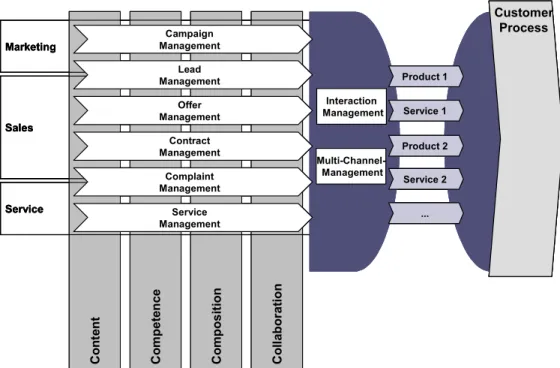
Marketing, sales, and service are primary business functions [26] with the characteristics of a high degree of direct customer interaction and knowledge intensity. We derive our process model by detailing these func-tions into relevant business processes, which may be cross-functional. A CRM business process involves the processing of customer knowledge to pursue the goals of relationship marketing. Usually it also involves direct customer contact and the exchange of informa-tion or services between enterprise and customer. Such processes are either triggered by the customer with the aim of receiving information or services or by the enterprise with the aim of delivering information or services to customers. Each process handles a specific business object which distinguishes it from other proc-esses. Based on [31, pp. 57 et seqq.] and our own ac-tion research experience we identified campaign man-agement, lead management, offer management, con-tract management,complaint management, and service management as the six relevant CRM business proc-esses (cf. figure 1).
Campaign management is the core marketing proc-ess which fulfills the idea of interactive, individualized contacts in contrast to traditional transaction marketing [13, p.11]. It deals with the planning, realization, con-trol and monitoring of marketing activities towards known recipients. Marketing campaigns are individual-ized (one-to-one marketing [24]) or segment specific and offer communication channels for feedback. The objective of campaign management is to generate valu-able opportunities or “leads” as the basis for lead man-agement.
Lead management is the consolidation, qualifica-tion, and prioritization of contacts with prospective customers. The objective is to provide sales staff with a qualified and prioritized list of presumably valuable prospects to be precisely addressed within the offer management process.
Offer management is the core sales process. Its ob-jective is the corporation-wide consistent creation and delivery of individualized, binding offers. An offer management process may be triggered by a customer inquiry, a qualified lead, or a discovered opportunity.
Contract management is the creation and mainte-nance of contracts for the supply of products and ser-vices. As such, it supports offer management or service management processes. Contract management com-prises the maintenance and adjustment of long-term contracts, e.g. for outsourcing agreements or insur-ances.
Service management is the planning, realization and control of measures for the provision of services. A service is an intangible output of an enterprise gener-ated with direct involvement of customers. Examples include maintenance, repair, and support activities in the after-sales phase as well as the provision of finan-cial or telecommunication services after the conclusion of contracts.
Within the scope of complaint management, articu-lated dissatisfaction of customers is received, proc-essed, and communicated into the enterprise [37]. The objectives are to improve customer satisfaction in the short-run by directly addressing problems that led to complaints and to design a continuous improvement process in the long-run.
Operative CRM system components directly sup-port the six CRM sub-processes described above. Ana-lytical components primarily emphasize on the proc-esses campaign management, lead management, and offer management. To cover the collaborative aspects on the process level, CRM requires activities to design interfaces to customers at customer interaction points. Interaction management is the design and selection of media-based communication channels like interactive voice response (IVR) or the world-wide-web (WWW) to achieve an optimal channel mix [34]. The objective is to increase the quality and value of interactions while at the same time decreasing the cost of interac-tions by shifting customers to less costly channels, e.g. web-self-service.
Closely connected to interaction management is channel management which addresses the challenge of configuration and synchronization of different commu-nication channels [12, pp. 18-19]. Key objectives are to define organizational responsibilities for each channel, to avoid conflicts between channels, and to ensure consistent knowledge flows across different channels.
2.3.2 Integrating Customer Relationship Man-agement and Knowledge ManMan-agement
To achieve their goal of providing a solution for the process of the customers, enterprises need to focus on three sorts of knowledge in CRM processes [21]. They make up what we consider to be customer knowledge. • They need to understand the requirements of
cus-tomers in order to address them. This is referred to as “knowledge about customers”.
• The information needs of the customers in their interaction with the enterprise require “knowledge for customers”.
• Finally, customers possess knowledge about the products and services they use as well as about how they perceive the offerings they purchased. This “knowledge from customers” is valuable as it feeds into measures to improve products and ser-vices. Efforts need to be made to channel this knowledge back into the enterprise.
We therefore consider CKM to include more than just knowledge from the customers (in contrast to [10]) and perceive it as a comprehensive approach for cus-tomer knowledge. The CKM process model as intro-duced by Gebert et al. 2002 [9] was the result of a collaborative research process in which the authors were involved as well. It offers a process perspective to illustrate which KM tools can be applied to the CRM sub-processes to achieve effective CKM. It introduces the four KM aspects content, competence, collabora-tion and composicollabora-tion. These aspects were derived by analyzing existing KM models as well as numerous case studies (for details, cf. [28], which is also based on our collaborative research). They will be further reinforced by the action research examples we intro-duce in the next section.
To comprehensively cover the Customer Knowl-edge Management approach, the model would also have to encompass the layers of strategy and informa-tion system. We chose to omit these layers in the graphical representation to avoid excessive complexity but will explain them in this section.
On a strategy level, companies need to determine how Customer Knowledge Management can support business goals and processes and use these as guide-lines for designing the Customer Knowledge Manage-ment processes and performance indicators. The proc-ess level, our main focus in this paper, is derived as follows:Like the SECI model of Nonaka/Takeuchi [19], the CKM process model is based on the fact that there are two types of knowledge, implicit (or tacit) and explicit. According to Polanyi, who introduced the concept of tacit knowledge in 1968 [25], each
indi-Figure 1: Customer Knowledge Management process model
vidual possesses an amount of implicit knowledge which influences the ability to articulate and therefore explicate and create knowledge. Implicit knowledge includes past experiences and influences the perception of the environment. However, explicit and implicit knowledge as such are not separable from the particu-lar individual possessing it. Therefore, we term it the knowledge aspect “competence”. As a consequence, the organization can only directly manage explicated knowledge in the form of media such as text or images which we term the knowledge aspect “content”. Con-tent is part of the business processes and exists inde-pendently of individuals.
Similar to the revised SECI model of Nonaka and Hedlund [15], the CKM process model also introduces two aspects that take into account how knowledge is created, disseminated and used within an organization. As a consequence, the model contains elements of both the epistemological view and the ontological view with an agent dimension. The ontological view is repre-sented by the two aspects of “collaboration” and “composition”. Collaboration deals with the creation and dissemination of knowledge among few individu-als, e.g. in project teams. The knowledge aspect com-position, on the other hand, deals with the dissemina-tion and usage of knowledge among a large number of individuals. Composition deals mainly with helping people find explicated knowledge, for example in en-terprise portals.
The four knowledge aspects deliver services that support the CRM sub-processes. That sometimes re-quires support processes such as managing content or
competency information from creation to application in a lifecycle. The aspects of collaboration and composi-tion provide an infrastructure that supports the provi-sion of knowledge to business processes while not being a process itself. Nevertheless, as proposed by the business engineering approach (see section 1.3) all knowledge aspects need to be supported by informa-tion systems that deliver specific funcinforma-tions for each aspect. The aspect content typically requires the use of content management or document management sys-tems. The aspect competence makes use of expertise directories as well as skill management or e-learning systems. Email, group information tools, and instant messaging systems are typical functions that support the aspect of collaboration. Finally, the aspect of com-position which primarily deals with search and naviga-tion uses systems such as knowledge mining systems, personalization, taxonomy management systems, and knowledge maps. While it is beyond the scope of this paper to illustrate the use of all these systems to sup-port CRM sub-processes, we will focus on three cases which are part of our action research work and provide insights on how to improve performance by employing the four aspects of knowledge and supporting informa-tion systems. C ont en t C o mpet e n ce C o mp os it ion C o ll a b or a tio n Customer Process Marketing Sales Service Offer Management Campaign Management Lead Management Service Management Contract Management Complaint Management Service 1 Service 2 ... Product 1 Interaction Management Multi-Channel-Management Product 2 C ont en t C o mpet e n ce C o mp os it ion C o ll a b or a tio n Customer Process Marketing Sales Service Offer Management Campaign Management Lead Management Service Management Contract Management Complaint Management Service 1 Service 2 ... Product 1 Interaction Management Multi-Channel-Management C ont en t C o mpet e n ce C o mp os it ion C o ll a b or a tio n Customer Process Marketing Sales Service Offer Management Campaign Management Lead Management Service Management Contract Management Complaint Management Service 1 Service 2 ... Product 1 Interaction Management Multi-Channel-Management Product 2
3
Action Research Cases of Customer
Knowledge Management
3.1
Case One – Knowledge Support for the
Customer Communication Center of a
Mutual Fund Company
The following action research case of a large mu-tual fund company in central Europe shows the impor-tance of explicated knowledge for the CRM sub-process service management and the KM aspects of content and composition. The case focuses on a major element within modern service management, the cus-tomer communication center (CCC), which integrates the communication channels phone, fax and (e)mail to serve customers via multiple channels.
In this case, the CCC serves bank employees and retail customers alike. It consists of 120 employees who offer support on two levels, depending on exper-tise required to resolve inquiries about a wide array of topics connected to complex financial products.
3.1.1 CKM Challenges
In order to address the needs of their customers, CCC agents utilize different information sources pro-vided by an internal unit named Information Support. The content was mostly disseminated via email. While this was possible without further investments in the technical infrastructure, each CCC employee had to organize his or her content individually and new em-ployees did not have access to older information. Therefore, a knowledge platform was created using basic web technology which offered the same informa-tion as email with a certain time delay. Yet, with an increasing amount of content, the navigational struc-ture eventually became more and more cluttered. Since no search function was available, the CCC agents tended to still primarily use email for information re-trieval and not the central knowledge platform.
The existing solution also caused significant costs for creating, formatting and publishing content. The complicated process with only very basic support in converting documents to a web-based format also delayed timely publication, which is critical to support-ing the CCC agents.
3.1.2 Relevant Knowledge Aspects
The relevant knowledge aspects in this case were content as well as composition. The focus of the pro-ject was to provide the CCC employee with knowledge for the customer, thereby concentrating on explicated knowledge that can be rather easily transferred. One
major shortcoming was in the current design of knowl-edge composition. The navigational structure was unwieldy and searching for content was not possible. This also applied to Information Support since the editors had no adequate tool to help them structure the knowledge and get an overview of existing documents.
The major content challenge, requiring up to 50% percent of the time to supply information to the CCC was the conversion of documents from office applica-tion formats delivered by other departments into con-tent displayable in a web browser. Up to the project, editors had to convert content manually with special-ized HTML-editors.
To overcome the challenges, a new content man-agement system was selected. It includes a conversion tool which is based on newly created templates in office applications and creates content in HTML for-mat autofor-matically. The application for the editors en-ables them to publish new content directly from the Office application and provides an overview of exist-ing documents. They can be directly accessed and edited from within the tool. On the part of the CCC agents, the content management system offers a search function in addition to a redesigned consistent naviga-tional structure.
3.1.3 Results
Based on a detailed analysis of the processes of CCC agents and editors, knowledge dissemination was significantly improved. The new structure and im-proved timeliness of information available on the knowledge platform is an important factor in support-ing CCC agents. It enables them to provide faster an-swers with higher quality. By saving time, customers are served faster. An individual agent can serve more customers, thereby increasing service levels and reduc-ing waitreduc-ing time.
For the Information Support department, the costs and time needed to maintain the new platform was greatly reduced by mostly eliminating efforts to con-vert existing content. The structure is now maintained much more easily. The focus on just one information source makes it easier for agents to find what they need, reduces operational costs of publication for edi-tors and strain on the network infrastructure caused by large email attachments.
3.2
Case Two – Skill Management as a
Cus-tomer oriented Human Resource
Man-agement Instrument at a Health
Insur-ance Company
The following action research case of a European health insurance provider shows the business impact of
the knowledge aspect of competence for all CRM sub-processes. The case focuses on strategic skill manage-ment as a means to support complex customer proc-esses, improve the corporate ability to react quickly to changing market requirements and to manage and improve the corporate skill set.
3.2.1 CKM Challenges
Customers typically demand individual, affordable insurance services. This requires employees in the customer oriented units that are organized along mar-keting, sales, and services to have complex, compre-hensive and flexible knowledge for and about the cus-tomers. Without a management tool for managing and making visible the required knowledge and skills on a corporate level, the organization could suffer compe-tency shortages with a negative impact on business performance.
3.2.2 Relevant Knowledge Aspects
This case focuses on the knowledge aspect of com-petency and therefore concentrates on the management of implicit knowledge which cannot be transferred between persons solely by using information technol-ogy. The project aimed at establishing an IT solution to support corporate skill management which would cre-ate transparency as to where in the organization what knowledge resides. The main services to be delivered by the new system were derived from the requirements by the business units. These were competency profiles of employees combined with search functionality to locate employees with certain skills. Also, the system was to create competency maps of the organization based on individual competency profiles. In addition, Human resources (HR) demanded that the competency profiles can be used for individual goal definition, human resource planning, and to derive training meas-ures.
To develop the competency profile, a “skill tree” was used, which included professional competence as well as information about education, language skills, and experience. The identification of competencies critical for the success of the company was based on criteria such as relevance to strategic goals, relative steadiness (i.e. how much effort it takes to acquire a skill that lasts), and relative scarceness.
The project team used these criteria to develop a hi-erarchical ordering with relative steadiness being the top hierarchy level. This ensured that the skill tree could be aggregated into a skill map reflecting the skill development costs in an appropriate manner. For each qualification in the skill tree the competency profile states whether it is present or not. A multi-level
grad-ing scheme is used for measurgrad-ing professional compe-tency and soft skills.
3.2.3 Results
The prototype for the skill management system was developed based on standard software. The skill pro-files and the skill history enable managers and HR personnel to efficiently plan training measures for each individual employee. On a corporate level, the aggre-gation of data within the skill profiles allows for analy-sis of the existing skill set and for deduction of re-quired strategically relevant skills. With this informa-tion, a gap between the required skill set and the exist-ing skill set can be identified and addressed via corpo-rate training measures or new hiring policies.
Also, the skill profiles allow for quick and easy lo-cation of required expertise within the company during any step of any process. Thus the resource allocation can be optimized since long searches for an expert are avoided. Additionally, project team members with the required skills can be located and recruited more eas-ily.
The prototype has been field tested and the results were very good. All participants assessed the system’s potential on their daily work as essential and ranked the systems benefit as “good” or “very good”. There-fore, it will be rolled out to further parts of the organi-zation in the near future.
3.3
Case Three – Global Collaboration at an
Insurance Company
The third case concerns an insurance company which is one of the major players in Europe and worldwide. The company had experienced strong growth, especially with acquisitions. As a result, in the area of life insurance products, there was an abundance of information systems in use to manage contracts. To enable a more efficient contract management espe-cially for closed blocks (contracts that were still run-ning but no longer offered to new customers), the company decided to standardize processes and systems in this area on a global scale as far as possible. Thus this case focuses on the CRM sub-process contract management and the KM aspects of collaboration, composition and content.
3.3.1 CKM Challenges
In order to standardize the management of closed blocks, projects were initiated worldwide on a country-level. The teams consisted of members of the global core team as well as of local experts who reengineered the processes, calculation models and information
systems involved in the management of closed blocks. As a consequence, there were a number of globally dispersed teams working on similar problems. To com-municate within and between the teams and with head-quarters, email was the primary medium. In some countries, access to a fileserver, which stored relevant content, was also available. However, communication and knowledge exchange, which were based primarily on documents, were not entirely satisfactory. As a result of the use of email, team members could never be sure to have the most up-to-date version of a docu-ment. As in the first case, new members had to start from scratch since they had missed past communica-tion. The file server was not globally accessible. Email communication also made it virtually impossible for the core team to get an overview of the progress and lessons learned of the different projects.
3.3.2 Relevant Knowledge Aspects
To improve the knowledge dissemination across the different projects, the insurance company implemented a new knowledge portal based on a standard software product. The portal was to be globally available and enhance the dissemination of knowledge across all projects within the management of closed blocks. Be-cause the transfer is based on documents, this case deals with explicated knowledge similar to case one.
The portal includes elements of three aspects with composition being the most prominent. It now provides a standardized process oriented navigational structure to be used by all projects. This goes hand in hand with the introduction of a common terminology which de-fines the most relevant terms. Besides the navigational structure, a comprehensive search function also allows the retrieval of relevant documents. With the new ac-cess rights management, individual team members only see content relevant for them.
Concerning content, documents are now available on a web-based platform. The system includes version control, making sure that documents are only available in their most recent version. It also provides templates to standardize content creation processes and therefore facilitate a review of relevant documentation across multiple projects. The templates also provide means to record feedback and lessons learned from the project teams.
The aspect of collaboration is based on the features already described and primarily concerns the organiza-tional setting in which the portal is used. It enables the dispersed project teams to store and retrieve documents from virtually anywhere and work together on common documents. By linking to other projects, it is possible to easier work on common problems across projects. On the other hand, version control helps team members
recognize if they are using the most recent version in their work.
3.3.3 Results
The new portal improved the efficiency of the pro-jects in a variety of ways, thus enabling the standardi-zation of contract management for closed blocks.
The primary goal was to facilitate knowledge dis-semination for collaboration. Since all projects will place their documentation into the portal, the status of the different projects can now easily be analyzed and compared. A special reporting function further extends this aspect. When a certain step in a project is con-cluded, lessons learned are reviewed and can now immediately be incorporated into the process oriented structure and the templates. This makes them available to every project that has not reached the relevant step yet. As a result, many potential problems are elimi-nated before they actually come up.
On the individual project level, documents are now kept centrally. In contrast to email, all project members now have access to all documents. It is not possible anymore to be faced with outdated versions and per-sonalization reduces information overload. For the infrastructure, the portal brought significant relief as not every document needs to be sent to every project member anymore. After one year of use, the portal includes over 10,000 documents and is employed in 21 projects in nine countries worldwide.
4
Cross-Case Analysis - Performance
with Customer Knowledge
Manage-ment
The contribution of this paper lies in illustrating the successful application of the CKM process model in different companies in an operational setting. In each case critical customer processes were identified, KM instruments suitable for those processes selected ac-cording to the CKM process model and then imple-mented. This resulted in significant performance im-provements in those processes eventually enabling higher revenues and/or lower costs.
Case one identified content creation and knowledge navigation as crucial elements within the CCC and service management. The CKM process model sug-gests content management systems with an easily maintainable content structure and search functionality as appropriate KM instruments for these elements.
With the implemented system the duration of ser-vice calls and the quality of the provided serser-vice could be improved, enhancing knowledge transfer to the customer, resulting in higher customer satisfaction,
higher loyalty and thus, higher revenue. Also, more efficient content creation was facilitated, resulting in lower costs.
Case two identified skill management and staffing and planning as crucial elements. The CKM process model suggests skill management systems and exper-tise directories to be suitable KM instruments for these elements.
Case two demonstrated how a skill management system allows to record skills of employees according to a corporate skill tree. This lead to increased trans-parency of existing and required skills and competen-cies. Hence location of expertise was accelerated, re-sulting in better and faster service to customers, and a more efficient staffing and planning of individual and corporate training measures. This causes higher cus-tomer satisfaction as well as more efficient resource allocation, eventually enabling higher revenue.
Case three focused on communication support, community management, knowledge navigation and knowledge discovery as elements of CKM. The CKM process model suggests portals, personalization and discussion boards as suitable KM instruments for these elements.
The insurance company implemented a portal fa-cilitating global collaboration across members of mul-tiple project teams. This made project management more efficient and lowered the costs of implementation for the standardized contract management. The con-tract management in turn became more efficient due to this standardization, enabling the insurance company to save significant cost in managing customers and their contracts.
5
Suggestions for further Research
Even though the application of KM instruments in customer processes can lead to increased process per-formance, as experienced in the cases we described, there still is no comprehensive, proven system of measuring process performance in knowledge intensive processes. No generally applicable metrics along with key performance indicators (KPI) have been defined. No common tools exist to provide the aggregated data necessary for measuring those KPI or allow for auto-matic measuring.The definition of such metrics and KPIs for the dif-ferent processes mentioned in the CKM architecture is a research goal currently targeted by our research.
Furthermore, although the projects described could have been extended to include all knowledge aspects, it hasn’t been done yet in practice. Further research is required to determine how all knowledge aspects to-gether affect the performance of enterprises and what
challenges come up with the integration of all four knowledge aspects.
Literature
[1] Blessing, D., Content Management für das Business Engineering - Fallbeispiele, Modelle und Anwendungen für
das Wissensmanagement bei Beratungsunternehmen,
Dissertation, Universität St. Gallen, St. Gallen, 2001. [2] Boisot, M., Information and Organizations: The Manager
as Anthropologist, Fontana / Collins, London, 1987.
[3] Davenport, T. H. and Prusak, L., Working Knowledge:
How Organizations Manage What They Know, 1st ed.,
Har-vard Business School Press, Boston, 1998.
[4] Demarest, M., Knowledge Management - An Introduc-tion, http://www.hevanet.com/demarest/ _marc/km1.pdf, 27.9.2001.
[5] Drucker, P. F., "Knowledge Worker Productivity - The Biggest Challenge", California Management Review, Vol. 41, No. 2, 1999, pp. 79-94.
[6] Enkel, E., Raimann, J., Seufert, A., Vassiliadis, S., Wicki, Y., Back, A. and von Krogh, G., MERLIN - Materializing,
Experience, Refining and Learning in Knowledge Networks,
2000.
[7] Eppler, M., Seifried, P. and Röpnack, A., "Improving Knowledge Intensive Processes through an Enterprise Knowledge Medium", ACM SIGCPR Conference on
Com-puter Personnel Research, New Orleans, USA, 1999, pp.
222-230.
[8] Fleisch, E., Das Netzwerkunternehmen. Strategien und Prozesse zur Steigerung der Wettbewerbsfähigkeit in der
"Networked Economy", Springer, Berlin et al., 2001.
[9] Gebert, H., Geib, M., Kolbe, L. M. and Riempp, G., "Towards Customer Knowledge Management – Integrating Customer Relationship Management and Knowledge Man-agement concepts", The Second International Conference on
Electronic Business (ICEB 2002), Taipei, Taiwan, 2002, pp.
296-298.
[10] Gibbert, M., Leibold, M. and Probst, G., "Five Styles of Customer Knowledge Management, and How Smart Compa-nies Use Them To Create Value", European Management
Journal, Vol. 20, No. 5, 2002, pp. 459 - 469.
[11] Greenberg, P., CRM at the speed of light, Oborne /McGrawHill, Berkeley, 2001.
[12] Gronover, S., Multi-Channel-Management - Konzepte, Techniken und Fallbeispiele aus dem Retailbereich der
Finanzdienstleistungsbranche, Dissertation, University of St.
Gallen, St. Gallen, 2003.
[13] Grönroos, C., "From Marketing Mix to Relationship Marketing: Towards a Paradigm Shift in Marketing",
Man-agement Decision, Vol. 32, No. 2, 1994, pp. 4-20.
[14] Gummesson, E., Qualitative methods in management
research, 2nd ed., Sage Publications India, London, 2000.
[15] Hedlund, G. and Nonaka, I., "Models of Knowledge Management in the West and Japan", in: Lorange, B., Chak-ravarthy, B., Roos, J. and Van de Ven, H. (Eds.),
Implement-ing Strategic Processes, Change, LearnImplement-ing and Cooperation,
Macmillan, London, 1993, pp. 117-144.
[16] Levitt, T., "After the Sale is Over", Harvard Business
[17] McAdam, R. and McCreedy, S., "A critical review of knowledge management models", The Learning Organiza-tion, Vol. 6, No. 3, 1999, pp. 91-100.
[18] McLoughlin, H. and Thorpe, R., "Action learning - a paradigm in emergence: the problems facing a challenge to traditional management education and development", British
Journal of Management, No. 4, 1993, pp. 19-27.
[19] Nonaka, I. and Konno, N., "The concept of "Ba": Build-ing a Foundation for Knowledge Creation", California
Man-agement Review, Vol. 40, No. 3, 1998, pp. 40-55.
[20] Österle, H., Business in the Information Age: Heading
for new Processes, Springer, Berlin et al., 1995.
[21] Österle, H., "Enterprise in the Information Age", in: Österle, H., Fleisch, E. and Alt, R. (Eds.), Business
Network-ing: Shaping Collaboration Between Enterprises, Springer,
Berlin et al., 2001, pp. 17-54.
[22] Österle, H. and Winter, R., "Business Engineering", in: Österle, H. and Winter, R. (Eds.), Business Engineering: Auf
dem Weg zum Unternehmen des Informationszeitalters,
Springer, Berlin et al., 2000, pp. 3-20.
[23] Parvatiyar, A. and Sheth, J. N., "The Domain and Con-ceptual Foundations of Relationship Marketing", in: Sheth, J. N. and Parvatiyar, A. (Eds.), Handbook of Relationship
Marketing, Sage Publications, London, 2000,
[24] Peppers, D. and Rogers, M., The one to one future -
Building relationships one customer at one time, 1st ed.,
Currency Doubleday, New York, 1993.
[25] Polanyi, M., The Tacit Dimension, Doubleday, New York, 1966.
[26] Porter, M. E. and Millar, V. E., "How Information Gives You Competitive Advantage", Harvard Business Review, No. 4, 1985, pp. 149-160.
[27] Probst, G. J. B., Raub, S. and Romhardt, K., Wissen managen - Wie Unternehmen ihre wertvollste Ressource
optimal nutzen, 3. ed., Gabler, Wiesbaden, 1999.
[28] Riempp, G., "Von den Grundlagen zu einer Architektur für Customer Knowledge Management", in: Kolbe, L. M., Brenner, W. and Österle, H. (Eds.), Customer Knowledge
Management, Springer, Berlin, 2003, pp. 23-57.
[29] Romano, N. C. and Fjermestad, J., "Electronic Com-merce Customer Relationship Management: An Assessment of Research", International Journal of Electronic Commerce, Vol. 6, No. 2, 2002, pp. 61-113.
[30] Romano, N. C. and Fjermestad, J., "Electronic Com-merce Customer Relationship Management: A Research Agenda", Information Technology and Management, Vol. 4, 2003, pp. 233-258.
[31] Schmid, R. E., Eine Architektur für Customer
Relation-ship Management und Prozessportale bei Banken,
Disserta-tion, University of St. Gallen, St. Gallen, 2001.
[32] Schulze, J., Prozessorientierte Einführungsmethode für
das Customer Relationship Management, Dissertation,
Uni-versity of St. Gallen, St. Gallen, 2000.
[33] Schulze, J., Thiesse, F., Bach, V. and Österle, H., "Knowledge Enabled Customer Relationship Management", in: Österle, H., Fleisch, E. and Alt, R. (Eds.), Business
Net-working: Shaping Enterprise Relationships on the Internet,
Springer, Berlin et al., 2000, pp. 143-160.
[34] Senger, E., Gronover, S. and Riempp, G., "Customer Web Interaction: Fundamentals and Decision Tree", Eighth
Americas Conference on Information Systems (AMCIS),
Dallas, 2002, pp. 1966-1976.
[35] Shani, D. and Chalasani, S., "Exploiting niches using relationship marketing", The Journal of Consumer Market-ing, Vol. 9, No. 3, 1992, pp. 33-42.
[36] Shaw, R., Measuring and Valuing Customer
Relation-ships, Business Intelligence, London, 1999.
[37] Stauss, B. and Seidel, W., Beschwerdemanagement:
Fehler vermeiden - Leistung verbessern - Kunden binden, 3.
ed., Hanser, München, 2002.
[38] von Foerster, H., "Principles of self-organization in socio-managerial context", in: Ulrich, H. and Probst, G. J. B. (Eds.), Self-organization and Management of Social Systems, Springer-Verlag, Berlin, 1984, pp. 2-24.
[39] von Krogh, G., Roos, J. and Slocum, K., "An Essay on Corporate Epistemology", Strategic Management Journal, Vol. 15, No. Special Issue: Strategy: Search for New Para-digms, Summer, 1994, 1994, pp. 53-71.
[40] Watzlawik, P., Beavin, J. H. and Jackson, D. D., Prag-matics of Human Communication: A Study of Interactional
Patterns, Pathologies, and Paradoxes, W. W. Norton &
Company, New York, London, 1967.
[41] Wenger, E., Communities of Practice: Learning,
Mean-ing, and Identity, Cambridge University Press, Cambridge,
1997.
[42] Wiig, K. M., Knowledge Management A Trilogy - Vol-ume 3. Knowledge Management Methods: Practical
Ap-proaches to Managing Knowledge, Schema Press, Arlington,