1
Network Structure & Information Advantage
Sinan Aral,
Stern School of Business, NYU & Sloan School of Management, MIT. [email protected]
Marshall Van Alstyne,
Boston University School of Management & Sloan School of Management, MIT. [email protected]
We investigate the long held but empirically untested assumption that diverse networks drive performance by providing access to novel information. We build and validate an analytical model of information diversity, develop theory linking network structure to the distribution of novel information among actors and their performance, and test our theory using a unique ten month panel of email communication patterns, message content and performance data from a medium sized executive recruiting firm. While our theory and results demonstrate that network structures predict performance due to their impact on access to information, we also find important theoretically driven non-linearities in these rela-tionships. Novel and diverse information are increasing in network size and network diversity, but with diminishing marginal returns. There are also diminishing marginal productivity returns to novel information, consistent with theo-ries of cognitive capacity, bounded rationality, and information overload. Network diversity contributes to performance even when controlling for the performance effects of novel information, suggesting additional benefits to diverse net-works beyond those conferred through information advantage. Our theory and results suggest subtle nuances in rela-tionships between networks, information and economic performance, and the methods and tools developed are replic-able, opening a new line of inquiry into these relationships.
Keywords: Social Networks, Information Economics, Information Content, Information Diversity, Network Size, Net-work Diversity, Performance, Productivity, Information Work.
______________________________________________________________________________
We are grateful to Erik Brynjolfsson, Emilio Castilla, Ezra Zuckerman, Arun Sundararajan, Erol Pekoz, and seminar participants at the Workshop on Information Systems Economics, the Sunbelt Social Networks Conference, the International Conference on Network Science, the Academy of Management, NYU and MIT for valuable comments, and to the National Science Foundation (Career Award IIS-9876233 and grant IIS-0085725), Cisco Systems, France Telecom and the MIT Center for Digital Business for generous funding. We thank Tim Choe, Petch Manoharn and Jun Zhang for their tireless research assistance.
1
1. Introduction
A growing body of evidence links the structural properties of individuals’ and groups’ networked relationships to various dimensions of economic performance. However, the mechanisms driving this linkage, thought to be related to the value of the information flowing between connected actors, are typi-cally inferred, and rarely empiritypi-cally demonstrated. As a consequence, our understanding of how and why social structure explains economic outcomes remains underdeveloped, and competing explanations of the causal mechanisms underlying structural advantage proliferate. For instance, we know little about the relative importance of information and control benefits to social structure, and numerous puzzles remain concerning the situational importance of network cohesion and brokerage (Burt 1992, Coleman 1988), and the tradeoffs between the knowledge and power benefits derived from network structures (Reagans & Zuckerman 2006). At the heart of these puzzles lie foundational questions about the degree to which so-cial structure creates intermediate information benefits, and how different network topologies enable these benefits. Comprehensive theories of the structure-performance relationship require a more thorough examination of the intermediate mechanisms through which social structure affects economic advantage. The strategy of this paper is to narrowly examine one of these mechanisms – the relationship between network structure and information benefits – in detail.
One of the most prominent mechanisms theorized to drive the relationship between social struc-ture and performance is the existence of ‘information benefits’ to network strucstruc-ture. According to this argument, actors in favorable structural positions enjoy social and economic advantages based on their access to specific types of information. Burt (1992) convincingly shows that individuals with structurally diverse networks (networks low in (a) cohesion, and (b) structural equivalence) are more successful in terms of wages, promotion, job placement, and creativity (Burt 2004a). He argues that these performance differentials can be explained in part by actors’ access to diverse pools of knowledge, and their ability to efficiently gather non-redundant information.1 Aral, Brynjolfsson and Van Alstyne (2006) demonstrate
1 Coleman’s (1988) argument, that focused information from cohesive networks provides more precise signals of actors’
2 that structural diversity is associated with higher levels of economic productivity for task-based informa-tion workers. These studies, and numerous others, infer that network diversity is associated with perform-ance in part because diverse contacts provide access to novel information. Novel information is thought to be valuable due to its local scarcity. Actors with scarce, novel information in a given network neighbor-hood are better positioned to broker opportunities, use information as a commodity, or apply information to problems that are intractable given local knowledge.
While this argument is intuitively appealing, there are important theoretical and empirical reasons to be skeptical about whether structural diversity drives performance by providing access to diverse, novel information. Simultaneous consideration of within channel novelty (the novelty of information re-ceived from the same alter over time) and across channel novelty (the relative novelty of information re-ceived from different alters over time) may lead to indeterminate or nonlinear predictions about the rela-tionship between structural diversity and access to novel information. If the information actors receive through diverse networks tends to have high topic variety across channels but low topic variety within channels, it could be that diverse networks provide less total novel information on average or that there are diminishing marginal contributions to novelty from increasing structural diversity. In addition, the greater structural awareness of actors in constrained networks (Coleman 1988) may enable alters to dif-ferentiate their information flows from one another, allowing them to avoid transmitting redundant infor-mation. There may also be non-information based benefits driving the relationship between network di-versity and performance, or limits to the benefits of novel information itself.
Although theories of the value of information and empirical evidence on the relationship between network structure and performance exist, little theory, and almost no empirical evidence addresses how network structure influences the nature of the information distributed across a network - the network’s ‘information structure.’2 To build theory relating network structure to information structure we investigate how topological properties of individuals’ network positions (network size and network diversity) impact
2 The term “information structure” is used in the economics literature to denote the mapping of states of nature to signals i.e.
the abundance and diversity of the information they receive and distribute, and whether this in turn ex-plains productivity. We test the implications of our theory using empirical evidence from a ten month panel of email communication patterns and message content among information workers in a medium sized executive recruiting firm.
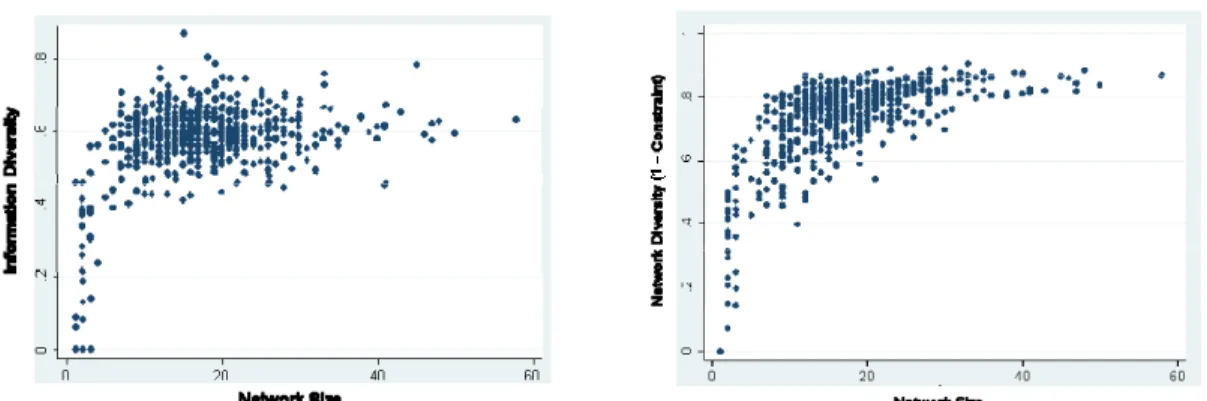
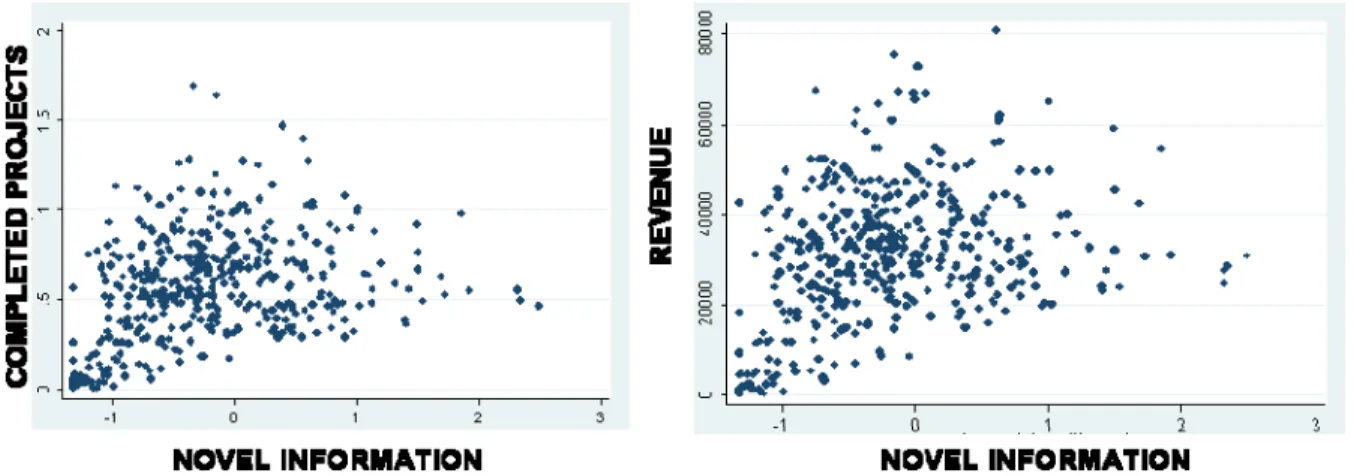
Our findings indicate that (1) the total amount of novel information and the diversity of informa-tion flowing to actors are increasing in actors’ network size and network diversity, but (2) diminishing marginal returns set in at two levels. Network size is a concave predictor of information diversity, and there are diminishing marginal productivity returns to novel information. Part of the explanation for the decreasing marginal contribution of network size to information diversity is that (3) network diversity is increasing in network size, but with diminishing marginal returns. As actors establish relationships with a finite set of possible contacts in an organization, the probability that a marginal relationship will be non-redundant, and provide access to novel information, decreases as possible alters in the network are ex-hausted. We also find that (4) network diversity contributes to performance even when controlling for the positive performance effects of access to novel information, suggesting additional benefits to network diversity beyond those conferred through information advantage, Surprisingly, (5) traditional demo-graphic and human capital variables (e.g. age, gender, industry experience, education) have little effect on access to diverse information, highlighting the importance of network structure for information advan-tage. These results represent some of the first evidence on the relationship between network structure and information content and reveal subtle nuances and non-linearities in their relationships. Our findings ad-vance our understanding of the economic value of information and the intermediate mechanisms driving the relationship between social structure and productivity. Our methods for analyzing network structure and information content in email data are replicable, opening a new line of inquiry into the relationship between networks, information and performance.
2. Theory
The assumption that network structure influences the distribution of information and knowledge in social groups (and thus characteristics of the information to which individuals have access) underpins a significant amount of theory linking social structure to economic outcomes. Granovetter (1973) argues that topological properties of friendship networks, constrained by basic norms of social interaction, em-power weak ties to deliver information about socially distant opportunities more effectively than strong ties. He posits that contacts maintained through weak ties typically “move in circles different from our own and thus have access to information different from that which we receive… [and are therefore]… the channels through which ideas, influence, or information socially distant from ego may reach him”
(Granovetter 1973: 1371). Burt (1992) argues that networks rich in structural diversity confer “informa-tion benefits” by providing access to diverse perspectives, ideas and informa“informa-tion. As informa“informa-tion in local network neighborhoods tends to be redundant, structurally diverse contacts provide channels through which novel information flows to individuals from distinct pools of social activity. Redundant informa-tion is less valuable because many actors are aware of it at the same time, reducing opportunities associ-ated with its use. Structural redundancy is also inefficient because actors incur costs to maintain redun-dant contacts while receiving no new information from them (Burt 1992).
In contrast, exposure to diverse ideas, perspectives, and solutions is thought to enable information arbitrage, the creation of new innovations, and access to economic opportunities. Hargadon and Sutton (1997) describe how engineers use their structural positions between diverse engineering and scientific disciplines to broker the flow of information and knowledge from unconnected industrial sectors, creating novel design solutions. As Burt (2004b) puts it, “creativity is an import-export game,… not a creation game.” The economic value of information in a network stems from its uneven distribution across actors and resides in pockets of distinct and diverse pools of information and expertise in local network
neighborhoods. Actors with access to these diverse pools “benefit from disparities in the level and value of particular knowledge held by different groups…” (Hargadon & Sutton 1997: 717), and one of the key mechanisms through which network structures are theorized to improve performance is through access to novel, non-redundant information (Burt 1992).
While the argument that network structures influence performance through their effect on the dis-tribution of information is intuitive and appealing, the vast majority of empirical work on networks and information advantage remains ‘content agnostic’ (Hansen 1999: 83), and infers the relationship between network structure and information structure from evidence of a link between networks and performance (e.g. Sparrowe et al. 2001, Cummings & Cross 2003). Reagans & Zuckerman (2001) infer that productiv-ity gains from the external networks of corporate R&D teams are due in part to “information benefits,” “a broader array of ideas and opportunities,” and access to “different skills, information and experience.” Burt (1992, 2004a) also makes this empirical leap, inferring that the observed co-variation of wages, pro-motion, job placement, and creativity with network diversity is due in part to access to diverse and novel information. Others equate network content with the social function of relationships. For example, Burt (2000: 45) refers to “network content” as “the substance of relationships, qualities defined by distinctions such as friendship versus business versus authority.” In one of the first studies to explore this type of work content, Podolny & Baron (1997) showed that while cohesive ties are beneficial in ‘buy-in’ net-works and for those contacts that have control over the fate of employees, structural holes are important for collecting advice and information. We take a different view of network content, focused on the subject matter of communication rather than the social function of relationships.
The limited research that does empirically examine networks and information content has either focused on identifying tie and network characteristics that facilitate effective knowledge transfers; or on types of information (e.g. complex or simple; tacit or explicit) most effectively transferred through differ-ent types of ties. As a result, the fundamdiffer-ental assumption that structurally diverse network contacts pro-vide access to diverse and novel information remains unexplored. For example, several studies examine how characteristics of dyadic relationships, like the strength of ties, impact the effectiveness of knowl-edge transfer, and how knowlknowl-edge transfer processes in turn affect performance (Granovetter 1973, Uzzi 1996, 1997, Hansen 1999). These studies infer the impact of network structure on the effectiveness of knowledge sharing from the strength of individual dyadic relationships. Reagans & McEvily (2003) ex-tend this work by simultaneously examining the effects of tie strength and network structure on the ease
of transferring knowledge between individuals. These studies either examine the strength of dyadic ties or the impact of network structure on discrete dyadic information transfer events, instead of on the informa-tion actors receive from all their network contacts in concert. Others examine characteristics of the infor-mation transferred across different types of ties. For example, Hansen (1999, 2002) and Uzzi (1996, 1997) explore the degree to which knowledge being transferred is tacit or codifiable, simple or complex, and related or unrelated to a focal actor’s knowledge.
To complement this research, we ask a related, yet fundamentally different question: Do networks affect the acquisition of diverse and novel information and to what extent does this intermediate mecha-nism predict performance? In pursuing this question, we undertake two fundamental departures from the current literature. First, by exploring the relative information content differences among different network contacts, we explore an actor’s information diversity in relation to the body of information available in the entire network. Second, we focus on subject matter. Rather than characterizing the simplicity or com-plexity of information, or the degree to which knowledge is codifiable or tacit, we explore the topical con-tent being discussed. Both simple and complex information can be either focused or diverse in terms of subject matter. Complexity and codifiability do not describe whether information is topically similar or dissimilar, or novel relative to a larger body of knowledge. As the theoretical mechanism linking structure to performance through information rests on the relative novelty of the information to which actors have access, these two departures from previous research are critical to effectively exploring the dimensions of information theorized to drive value in networks.
2.2. A Need for Skepticism
More detailed theoretical and empirical examinations of information advantage are warranted because it is not obvious that network diversity necessarily delivers more novel information or that novel information contributes to performance. Four arguments highlight the need for skepticism – the first two examine whether diverse networks provide access to more novel information; the second two show that even with new information, productivity need not rise.
First, consider the distinction between novelty across channels and novelty within channels. A simple model demonstrates that although a diverse network of weak ties (“diverse-weak”) can provide access to more novel information than a constrained network of strong ties (“constrained-strong”), the converse is also possible. This indeterminacy arises from a basic tradeoff: While constrained ties favor redundant information, they are also typically stronger (Granovetter 1973, Burt 1992), implying greater bandwidth. Weak ties are by their nature lower bandwidth conduits for information (Granovetter 1973, Burt 1992). Information flows less frequently (Granovetter 1973), with lower complexity (Hansen 1999) and detail (Uzzi 1999), and along fewer topical dimensions (see Granovetter 1973: p 1361) through weak ties. This implies that the total amount of novel information flowing within each channel in a diverse net-work could be lower than the amount of novel information flowing within each channel in a constrained network, where stronger ties enable thicker communication between actors.3 An ego might therefore re-ceive greater novelty from either strong yet constrained ties or weak yet diverse ties depending on the relative importance of bandwidth and bias in determining the type of content received.
To illustrate, let E represent the event that an ego encounters new information through a new link. If n is a subset of all possible topics T (n<T ), then an actor receives “biased” content if she is more likely to receive news on one set of topics than another(p1>p2), where p1 and p2 are the probabilities of receiv-ing information from topics n1 and n2. More precisely, a person with biased content has an asymmetric distribution over the likelihood of seeing different topics. Note that basic laws of probability require n p1 + (T-n) p2=1. Since the likelihood of encountering new information depends on what ego has learned from existing links, let L represent current contacts.4 Then P[Ec], the probability of encountering novel information from a new constrained link, can be described as:5
(
)
L(
)
Lc
p
n
p
p
T
n
p
E
P
[
]
=
11
−
1+
2(
−
)
1
−
2 [1]3 Theoretical arguments concerning network diversity and novel information have thus far focused almost exclusively on the
relative diversity of the information received across alters in a network.
4 More precisely, l represents an information exchange with an existing link. In probabilistic terms it is a sample on link l such
that ego receives information on a given topic ni with probability pi from each sample, making the likelihood of receiving new
Unbiased content implies p1= p2, so that Equation 1 reduces to P[ED] = pT(1-p)L, where Ecand ED represent the events of forging a constrained and a diverse link and getting new information.6 To model the more frequent communication of the higher bandwidth tie, let B represent additional chances to cover new material over the constrained link during any given interval. Simplifying with n2=T-n1 gives:
(
)
L(
)
L(
)
L B(
)
L B B L L l c CP
E
p
n
p
p
n
p
p
n
p
p
n
p
E
P
+ + + =−
+
−
+
−
+
−
=
=
∑
[
]
1 11
1 2 21
2...
1 11
1 2 21
2]
[
[2] To see that a constrained-strong tie could offer more novel information, let bias be negligible with p1= p2 + ε so that P[Ec] ≈P[ED]. Then choose any B large enough such that the following inequality is strict:]
[
]
[
...
]
[
]
[
]
[
...
]
[
]
[
1 1 D L D B L D L D L c B L c L c LP
E
P
E
P
E
P
E
P
E
P
E
E
P
+
++
+≈
+
++
+>
[3]This demonstrates the original claim. When the advantage of bandwidth swamps the disadvantage of bias, an ego always prefers the constrained-strong tie to the diverse-weak tie to increase the chances of encoun-tering novel information.
To see when an diverse-weak tie could be preferred, let a “group think” network spread its band-width only over the subset of n topics with probability p1=B/T (such bias necessarily constrains p2≈ε). For ease of simplification, let n = T/B. Then algebra reduces the relative probabilities to:
]
[
1
1
1
]
[
D L L L c LP
E
T
L
B
E
P
⎟
=
⎠
⎞
⎜
⎝
⎛ −
<
⎟
⎠
⎞
⎜
⎝
⎛ −
=
[4]This alternative case demonstrates the counterclaim. Although
[
]
[
]
...
[
Lc B]
c L C LP
E
P
E
E
P
=
+
+ andincreas-ing B adds more terms to
[
C]
LE
P
and none to[
D]
LE
P
, it also causes each term to approach 0 faster. No matter how large the bandwidth on constrained ties, there always exists a fixed number of links L such that link L+1 should be an unconstrained tie. When the disadvantage of bias swamps the advantage of bandwidth, an ego always prefers the diverse-weak tie to the constrained-strong tie to increase chances of encountering novel information. While an enormous range of intermediate cases span these two extremes,5 Since our purpose is illustrative rather than proof theoretic, we refrain from presenting non-essential primatives and
conditions exist when a person could always prefer one or the other type of link depending on bias, bandwidth, and the number of links already present.
Second, greater structural awareness of actors in constrained networks may enable them to differ-entiate their information flows and avoid transmitting redundant information. Prior research suggests that actors in constrained networks are more aware of other actors, what they know and whom they know. Coleman’s (1988) argument about the value of network closure relies in part on actors’ awareness of the knowledge of others in their immediate network. Information exchange in constrained networks may therefore exhibit greater specialization as actors are more aware of the information flowing to and from other actors in the network. Actors may avoid transmitting repetitive information knowing that such in-formation is flowing to their contacts from others in the network. For example, two immediate subordi-nates working on a portfolio of projects for a manager may divide their information flows across subjects to maximize the value of their limited communication time with the manager. Such optimization may be more likely in organizational settings where time is scarce and information is critical to work.
Third, other mechanisms can explain the observed relationship between network diversity and performance. Network contacts could provide resources other than information (e.g. Podolny & Barron 1997), there could be power or control benefits to network structure independent of information flows (e.g. Burt 1992), and structural diversity could reduce dependence, place individuals in favorable trading relationships (e.g. Emerson 1962) or entitle them to benefits from informal reciprocity (e.g. Cook, Emer-son & Gilmore 1983). These alternate mechanisms could also explain the link between structural diversity and performance without any prediction concerning actors’ information access. Indeed, our empirical results in §4.3 suggest that non-information benefits to network structure also affect productivity.
Finally, several fundamental results from information economics show that complex non-linearities in the value of information affect the quality of decision making. Arrow (1985) demonstrates that the expected payoffs from decisions about uncertain events are concave in the amount of information
6 The likelihood of encountering novel information (for both constrained and unconstrained ties) decreases strictly and
the decision maker obtains, implying diminishing marginal returns to more information. As measured by decision relevance, value only increases when new information leads to different and better decisions (Ar-row 1985, Hirshleifer 1973). Information is novel if it provides an alternate perspective on a known topic or knowledge of an altogether new topic. As new information on known topics accumulates, beliefs tend to converge on a particular view of the world, making further confirmation unnecessary. Expected con-vergence under Bayes' Rule, for example, exhibits clear diminishing returns such that, beyond some threshold, more news has no more value. As new information on new topics accumulates, value is likely to exhibit diminishing marginal returns due to decision irrelevance. As actors’ information space becomes disparate, ideas are less likely to connect in complementary ways and each bit of information is less likely to be relevant to the space of decisions and actions the actor is interested in. We find evidence of dimin-ishing marginal returns to novel information in our own theoretical model above, and in our empirical analysis below. Collectively, these arguments suggest that non-linearities may exist in relationships be-tween networks, information and performance, and they help explain the current lack of empirical evi-dence relating novel information to performance – evievi-dence we seek to provide.
2.3. Network Determinants of Information Advantage
Two network characteristics in particular are theorized to drive access to diverse, novel informa-tion: network size and network diversity. These characteristics are fundamental because they represent the two dimensions of structure most directly related to information acquisition. As Burt (1992: 16) argues “everything else constant, a large, diverse network is the best guarantee of having a contact present where useful information is aired…”
NetworkSize. The size of i’snetwork (Si) is simply the number of contacts with whom i ex-changes at least one message. Size is the most familiar network characteristic related to information bene-fits and is a good proxy for a variety of characteristics, like degree centrality, betweenness centrality and network reach, which describe the breadth and range of actors’ networks (see Burt 1992: 12). In our data, network size is significantly correlated with degree centrality (ρ = .70; p < .001), betweeness centrality (ρ = .77; p < .001), and reach (ρ = .56; p < .001), demonstrating its value as a proxy for network breadth.
The greater the size of an actor’s network, the more likely she is to have access to more information and to multiple social circles increasing the diversity of her information. However, size may not matter if each additional contact is embedded in the same social circles, biasing the information she receives. Network diversity may therefore be more important in providing access to diverse information.
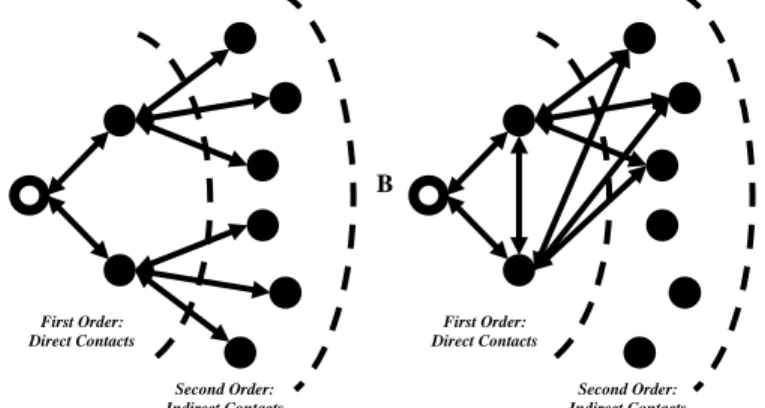
Network Diversity. Network diversity determines the number of non-redundant pools of informa-tion to which an actor is connected and therefore the channels through which new, diverse informainforma-tion might flow. Network diversity describes the degree to which contacts are structurally ‘non-redundant,’ and there are both first order and second order dimensions of redundancy as shown in Figure 1. In the first order, direct contacts can be connected to each other. Individuals who are in contact are likely to share information and be aware of the same opportunities, ideas and expertise. Formally, networks in which contacts are highly connected are termed ‘cohesive.’ In the second order, contacts in a network can them-selves be connected to the same people, connecting the focal actor indirectly to redundant sources of in-formation. Contacts that are themselves connected to the same people are termed ‘structurally equivalent.’
Figure 1. Structurally diverse networks are low in a) cohesion and b) structural equivalence.
Actor A has two unconnected contacts which display no structural equivalence, while B has two redundant contacts that are connected and maximally structurally equivalent.
We measure redundancy in the first order of direct contacts by the lack of constraint in actors’ networks, and in the second order by the average structural equivalence of actors’ contacts. We define the constraint
C
i(Burt 1992: 55)7 of an actor’s network as the degree to which an individual’s contacts are7 Where p
ij +∑piqpqj measures the proportion of i’s network contacts that directly or indirectly involve j and Ci sums this across
all of i’s contacts. First Order: Direct Contacts Second Order: Indirect Contacts First Order: Direct Contacts Second Order: Indirect Contacts A B
connected to each other, such that , 2
∑
∑
⎟⎟ ⎠ ⎞ ⎜⎜ ⎝ ⎛ + = j q qj iq ij i p p pC q≠i,j; and the structural diversity
D
iof anactor’s network as
1
−
C
i. We use the standard definition of the structural equivalence of two actors, measured as the Euclidean distance of their contact vectors.8 In our setting, we expect the disadvantage of bias to swamp the advantage of bandwidth. Interviews indicate that the dimensionality of information content in executive recruiting is limited (in the parlance of our model T, the space of topics, is small) meaning thicker channels are not as necessary to communicate information on more topics. Therefore, as individuals communicate with more contacts, and as individuals’ networks connect them to actors that are themselves unconnected and structurally non-equivalent, we expect the information they receive to be more diverse and we expect them to receive more total novel information:H1: Network size and network diversity are positively associated with receiving more diverse in-formation and less redundant inin-formation.
While a greater number of contacts are likely to provide access to more diverse, non-redundant information, the probability that an additional contact will have novel information is likely decreasing in the size of an individual’s network. This expectation is a direct result of our model and is also supported by prior empirical evidence on network formation. Social networks tend to cluster into homophilous cliques (for a review see McPherson, Smith-Loving, & Cook 2001). Since individuals usually make con-nections through contacts they already have, in bounded networks the likelihood that a marginal contact will be redundant should increase in the number of people already known.9 As actors establish relation-ships with a finite set of alters, the probability that a marginal relationship will be structurally non-redundant should decrease as possible alters in the network are exhausted. We therefore expect marginal increases in information diversity and network diversity are decreasing in network size:
H2a: The marginal increase in information diversity is decreasing in network size.
8 Euclidean distance measures the square root of the sum of squared distances between two contact vectors, or the degree to
which contacts are connected to the same people. We measure the average structural equivalence of actors’ direct contacts.
9 We focus on internal networks due to difficulties in collecting reliable data outside the firm and in estimating accurate network
structures without access to whole network data (see Barnes 1979, Marsden 1990). As Burt (1992: 172) demonstrates however “little evidence of hole effects [are] lost... when sociometric choices [are] restricted to relations within the firm.”
H2b: The marginal increase in structural network diversity is decreasing in network size. 2.4. Non-Network Determinants of Information Advantage
Several other factors could affect access to diverse information and individual performance. We therefore examine five possible alternative explanations as controls: demography, human capital, total communication volume, unobservable individual characteristics, and temporal shocks to the flow of in-formation in the firm. Demography can influence performance, learning capabilities and the variety of ideas to which individuals have access (e.g. Ancona & Caldwell 1992, Reagans & Zuckerman 2001). Older employees may have prior knowledge on a wider variety of topics or be more aware of experts. Employment discrimination and interpersonal difference could also impact the relative performance and information seeking habits of men and women. We therefore control for the age and gender of employees. Greater industry experience, education or individuals’ organizational position could also create variation in access to diverse and novel information and performance. As individuals gain experience, they may collect expertise across several domains, or specialize and focus their work and communication on a lim-ited number of topics. We therefore control for education, industry experience and organizational posi-tion.10 As previous studies have demonstrated the importance of controlling for communication volume to isolate structural effects (e.g. Cummings & Cross 2003), we include controls for total email communica-tion. At the same time, some employees may simply be more social or more ambitious, creating variation in information seeking habits and performance. To control for unobservable individual characteristics we test fixed effects specifications of each hypothesis. Finally, temporal shocks could affect demand for the firm’s services and information seeking activities associated with more work.11 These exogenous shocks to demand could drive simultaneous increases in project workload, information seeking, and revenue gen-eration creating a spurious correlation between information flows and output. We therefore control for temporal variation with dummy variables for each month and year.
2.5. The Setting – Executive Recruiting
10 Employees are partners, consultants or researchers – we include dummy variables for each of these positions.
11 In our data, business exhibits seasonal variation, with demand for the firm’s services picking up sharply in January and
We studied a medium-sized executive recruiting firm with fourteen offices in the U.S. Interviews revealed that the core of executive recruiters’ work involves matching job candidates to clients’ require-ments. This matching process is information-intensive and requires activities geared toward assembling, analyzing, and making decisions based on information gathered from team members, other firm employ-ees, and contacts outside the firm. Qualitative studies show that executive recruiters fill “brokerage posi-tions” between clients and candidates and rely heavily on information flows to complete their work effec-tively (Finlay & Coverdill 2000). In our context, more precise or accurate information about the candidate pool reduces time wasted interviewing unsuitable candidates and increases the quality of placement deci-sions (Bulkley & Van Alstyne 2004). In addition, the sharing of procedural information can improve effi-ciency and effectiveness (Szulanski 1996) and executive recruiters report learning to deal with difficult situations through communication with peers.
Recruiters generate revenue by filling vacancies rather than billing hourly. Therefore, the speed with which vacancies are filled is an important intermediate measure of workers’ productivity. Contract completion implies that recruiters have met a client’s minimum thresholds of candidate fit and quality. Project duration can therefore be interpreted as a quality controlled measure of productivity. In assessing individual recruiters’ performance, we measure revenues generated per month, projects completed per month and average project duration per month. Effective recruiters rely on being “in the know” and deliv-ering candidates that display specific professional and personal attributes. To accomplish this, recruiters must be aware of several different information channels to match different candidates with different client requirements. We therefore expect recruiters with diverse and non-redundant information to complete more projects, to complete projects faster, and to generate more revenue for the firm per unit time.
H3: Access to non-redundant and diverse information is positively associated with more project completions, faster project completions and more revenue generated per unit time.
While we expect network structure to impact performance through its effects on access to diverse and novel information, there could be other intermediate mechanisms tying structure to performance as
outlined in § 2.2. We therefore hypothesize that network diversity is positively associated with perform-ance even controlling for access to novel information.
H4: Network diversity is positively associated with more project completions, faster project com-pletions and more revenue generated per unit time, controlling for access to novel information. Finally, as argued in § 2.2, there is reason to suspect that there are diminishing marginal returns to novel information. In particular, our formal model showed that the likelihood of novel information decreases with each additional link. Further, information economic arguments show that, regardless of source, in-cremental news has no benefit past the point of decision relevance. Therefore:
H5: The marginal increase in performance associated with access to novel information is de-creasing in the amount of novel information to which actors have access.
3. Methods
By analyzing email communication patterns and message content, we are able to match informa-tion channels to the subject matter of the content flowing through them. Our empirical approach also ad-dresses another methodological puzzle that has historically troubled network research. In traditional net-work studies, a fundamental tradeoff exists between comprehensive observation of whole netnet-works and the accuracy of respondents’ recall. Most research elicits network data from respondents who have diffi-culty recalling their networks (e.g. Bernard et. al 1981), especially among individuals socially distant to themselves (Krackhardt & Kilduff 1999). The inaccuracy of respondent recall and the bias associated with recall at social distance creates inaccurate estimates of network variables (Kumbasar, Romney & Batchelder 1994), forcing most empirical studies to artificially limit the boundary of estimated networks to local areas around respondents (e.g. Reagans & McEvily 2003). Such empirical strategies create esti-mation challenges due to the sensitivity of network metrics to the completeness of data (Marsden 1990). If important areas of the network are not captured, estimates of network positions can be biased. Further-more, as our content measures consider the similarity of topics across the entire network, poor coverage of the firm could bias our estimates of the relative novelty or diversity of topics discussed via email. We therefore take several steps to ensure a high level of participation (described below). As 87% of eligible recruiters agreed to participate, and given that our inability to observe the remaining 13% is limited to
messages between two employees who both opted out of the study, we collect email network and individ-ual content data with nearly full coverage of the firm.12
3.1. Data
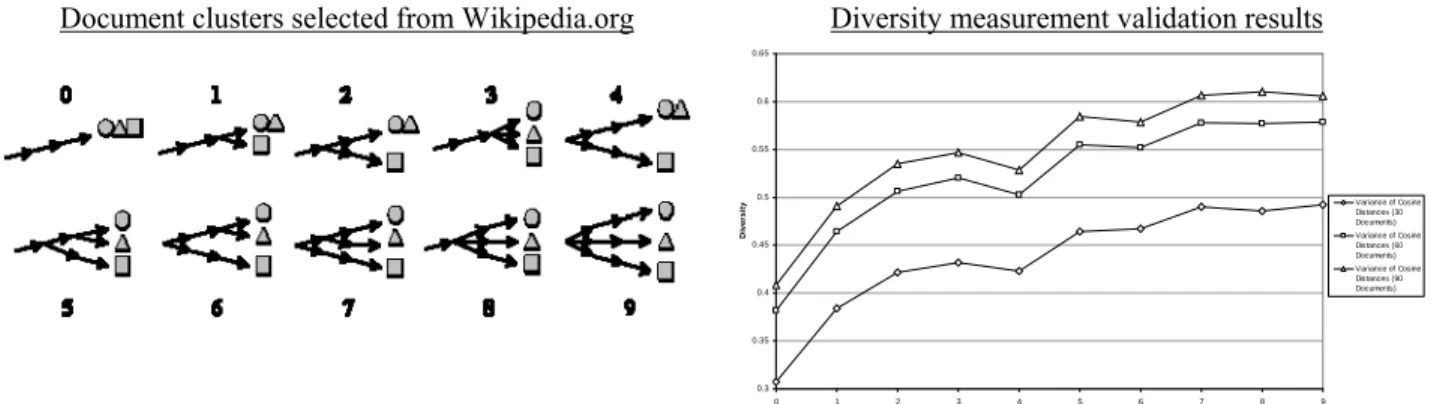
Our data come from four sources: (i) detailed accounting records of individual project assign-ments and performance, (ii) email data from the corporate server, (iii) survey data on demographic char-acteristics, human capital and information seeking behaviors, and (iv) data from the web site Wikipe-dia.org used to validate our analytical models of information diversity. Internal accounting data describe: revenues generated by individual recruiters, contract start and stop dates, projects handled simultaneously by each recruiter, project team composition, and job levels of recruiters and placed candidates. These pro-vide excellent performance measures that can be normalized for quality. Email data cover 10 months of complete email history at the firm. The data were captured from the corporate mail server during two equal periods from October 1, 2002 to March 1, 2003 and from October 1, 2003 to March 1, 2004. Par-ticipants received $100 in exchange for permitting use of their data, resulting in 87% coverage of eligible recruiters and more than 125,000 email messages captured. Details of email data collection are described by Aral, Brynjolfsson & Van Alstyne (2006). The third data set contains survey responses on demo-graphic and human capital variables such as age, education, industry experience, and information-seeking behaviors. Survey questions were generated from a review of relevant literature and interviews with re-cruiters. Experts in survey methods at the Inter-University Consortium for Political and Social Science Research vetted the survey instrument, which was then pre-tested for comprehension and ease-of-use. Individual participants received $25 for completed surveys and participation exceeded 85%. The fourth dataset is a set of 291 entries collected from Wikipedia.org, which we describe in detail in the section per-taining to the validity of our information diversity metrics (see Appendix C).
12F-tests comparing performance levels of those who opted out with those who remained did not show statistically significant
Table 1: Descriptive Statistics
Variable Obs. Mean SD Min Max
Age 522 42.36 10.94 24 67
Gender (1=male) 657 .56 .50 0 1
Industry Experience 522 12.52 9.52 1 39
Years Education 522 17.66 1.33 15 21
Total Incoming Emails 563 80.31 59.67 0 342
Information Diversity 563 .57 .14 0 .87
Total Non-Redundant Information 563 47.94 35.97 0 223.30
Network Size 563 16.81 8.79 1 58
Structural Holes 563 .71 .17 0 .91
Structural Equivalence 563 77.25 16.32 27.35 175.86
Revenue 630 20962.03 18843.16 0 80808.41
Completed Projects 630 .39 .36 0 1.69
Average Project Duration (Days) 630 225.23 165.77 0 921.04
Table 2: Pair Wise Correlations Between Independent Variables
Measure 1 2 3 4 5 6 7 8 9 10 11 12 13
1. Age 1.00
2. Gender .11* 1.00
3. Industry Experience .73* .20* 1.00
4. Years Education .38* .06 .15* 1.00
5. Total Incoming Email -.33* -.10* -.28* -.15* 1.00
6. Information Diversity .09 .05 .16* .05 .29* 1.00 7. Non-redundant Information -.32* -.09* -.27* -.12* .98* .36* 1.00 8. Network Size -.07 .02 -.01 .09 .63* .45* .64* 1.00 9. Network Diversity .12* .02 .25* .01 .34* .71* .35* .62* 1.00 10. Structural Equivalence -.19* -.06 -.24* -.06 .23* -.08 .23* -.05 -.16* 1.00 11. Revenue .44* -.02 .33* .15* -.09* .23* -.12* -.12* .27* -..16* 1.00 12. Completed Projects .41* -.01 .29* .11* -.09* .23* -.11* -.09* .25* -.14* .92* 1.00
13. Average Project Duration .50* .12* .49* .21* -.30* .14* -.31* -.07 .18* -.21* .54* .47* 1.00 * p < .05
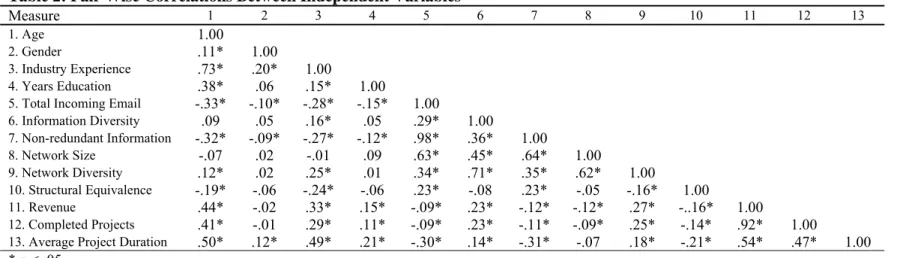
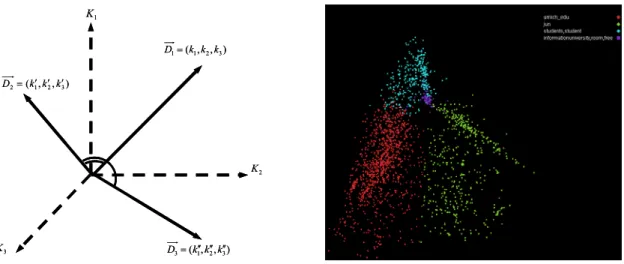
Descriptive statistics and correlations are provided in Tables 1 & 2. An observation is a person-month. 13 3.2.1. Modeling & Measuring Topics in Email: A Vector Space Model of Communication Content We model and measure the diversity of information in individuals’ email using a Vector Space Model of the topics present in email content (e.g. Salton et. al. 1975).14 Vector Space Models are widely used in information retrieval and search query optimization algorithms to identify documents that are similar to each other or pertain to topics identified by search terms. They represent textual content as vec-tors of topics in multidimensional space based on the relative prevalence of topic keywords. In our model, each email is represented as a multidimensional ‘topic vector’ whose elements are the frequencies of key-words in the email. The prevalence of certain keykey-words indicates that a topic that corresponds to those keywords is being discussed. For example, an email about pets might include frequent mentions of the words “dog,” “cat,” and “veterinarian;” while an email about econometrics might mention the words “variance,” “specification,” and “heteroskedasticity.” The relative topic similarity of two emails can then be assessed by topic vector convergence or divergence – the degree to which the vectors point in the same or orthogonal directions.15 To measure content diversity, we characterize all emails as topic vectors and measure the variance or spread of topic vectors in individuals’ inboxes and outboxes. Emails about simi-lar topics contain simisimi-lar language on average, and vectors used to represent them are therefore closer in multidimensional space, reducing their collective variance or spread.
3.2.2. Construction of Topic Vectors & Keyword Selection
13 We wrote and developed email capture software specific to this project and took multiple steps to maximize data integrity.
New code was tested at Microsoft Research Labs for server load, accuracy and completeness of message capture, and security exposure. To account for differences in user deletion patterns, we set administrative controls to prevent data expunging for 24 hours. The project went through nine months of human subjects review and content was masked using cryptographic techniques to preserve privacy (see Van Alstyne & Zhang 2003). Spam messages were excluded by eliminating external contacts who did not receive at least one message from someone inside the firm.
14 While email is not the only source of employees’ communication, it is one of the most pervasive media that preserves content.
It is also a good proxy for other social sources of information in organizations where email is widely used. In our data, the aver-age number of contacts by phone (ρ= .30, p < .01) and instant messenger (ρ = .15, p < .01) are positively and significantly corre-lated with email contacts. Our interviews indicate that in our firm, email is a primary communication media.
15 Each email may pertain to multiple topics based on keyword prevalence, and topic vectors representing emails can emphasize
one topic more than another based on the relative frequencies of keywords associated with different topics. In this way, our framework captures nuances of emails that may pertain to several topics of differing emphasis.
Vector Space Models characterize documents
D
i by keywordsk
jweighted according to their fre-quency of use (or with 0 weights for words excluded from the analysis – called “stop words”). Each docu-ment is represented as an n-dimensional vector of keywords in topic space,)
,...,
,
(
i1 i2 in ik
k
k
D
=
,where
k
ij represents the weight of the jth keyword.) , , (1 2 3 1 k k k D= ) , , ( 1 2 3 2 k k k D = ′ ′ ′ ) , , (1 2 3 3 k k k D = ′′ ′′ ′′ 1 K 2 K 3 K ) , , (1 2 3 1 k k k D= ) , , ( 1 2 3 2 k k k D = ′ ′ ′ ) , , (1 2 3 3 k k k D = ′′ ′′ ′′ 1 K 2 K 3 K
Figure 2. A three dimensional Vector Space Model of three documents is shown on the left. A Vector Space
Model containing a test inbox with emails clustered along three dimensions is shown on the right.
Weights define the degree to which a particular keyword impacts the vector characterization of a docu-ment. Words that discriminate topics are weighted more heavily than words less useful in distinguishing topics. As terms that appear frequently in a document are typically thematic and relate to the document’s subject matter, we use the ‘term frequency’ of keywords in email as weights to construct topic vectors and refine our keyword selection with criteria designed to select words that distinguish and represent topics.16
In order to minimize their impact on the clustering process, we initialized our data by removing common “stop words,” such as “a, “an,” “the,” “and,” and other common words with high frequency across all emails that are likely to create noise in content measures. We then implemented an iterative, k-means clustering algorithm to group emails into clusters that use the same words, similar words or words
16 Another common weighting scheme is the ‘term-frequency/inverse-document frequency.’ However, we use a more
that frequently appeared together.17 The result of iterative k-means clustering is a series of assignments of emails to clusters based on their language similarity. Rather than imposing exogenous keywords on the topic space, we extract topic keywords likely to characterize topics by using a series of algorithms guided by three basic principles.
First, in order to identify distinct topics in our corpus, keywords should distinguish topics from one another. We therefore chose keywords that maximize the variance of their mean frequencies across k-means clusters. This refinement favors words with widely differing mean frequencies across clusters, suggesting an ability to distinguish between topics. In our data, we find the coefficient of variation of the mean frequencies across topics to be a good indicator of this dispersion.18
(
)
M
M
m
n
C
i i v∑
−
=
21
Second, keywords should represent the topics they are intended to identify. In other words, key-words identifying a given topic should frequently appear in emails about that topic. To achieve this goal we chose keywords that minimize the mean frequency variance within clusters, favoring words that are consistently used across emails discussing a particular topic:19
(
)
c c i c i iM
M
f
ITF
2∑∑
−
=
Third, keywords should not occur too infrequently. Infrequent keywords will not represent or dis-tinguish topics and will create sparse topic vectors that are difficult to compare. We therefore select high frequency words (not eliminated by the “stop word” list of common words) that maximize the inter-topic
17 K-means clustering generates clusters by locally optimizing the mean squared distance of all documents in a corpus. The
algo-rithm first creates an initial set of clusters based on language similarities, computes the ‘centriod’ of each cluster, and then reas-signs documents to clusters whose centriod is the closest to that document in topic space. The algorithm stops iterating when no reassignment is performed or when the objective function falls below a pre-specified threshold.
18 The coefficient of variation is particularly useful due to its scale invariance, enabling comparisons of datasets, like ours, with
heterogeneous mean values (Ancona & Caldwell 1992). To ease computation we use the square of the coefficient of variation, which produces a monotonic transformation of the coefficient without affecting our keyword selection.
coefficient of variation and minimize intra-topic mean frequency variation. This process generated topical keywords from usage characteristics of the email communication of employees at our research site.20 3.2.3. Measuring Email Content Diversity
Using the keywords generated by our usage analysis, we populated topic vectors representing the subject matter of the emails in our data. We then measured the degree to which the emails in an individual employee’s inbox or outbox were focused or diverse by measuring the spread or variance of their topic vectors. We created five separate diversity measurement specifications based on techniques from the in-formation retrieval, document similarity and inin-formation theory literatures. The approach of all five measures is to compare individuals’ emails to each other, and to characterize the degree to which emails are about a set of focused topics, or rather about a wider set of diverse topics. We used two common document similarity measures (Cosine similarity and Dice’s coefficient) and three measures enhanced by an information theoretic weighting of emails based on their “information content.”21 We performed exten-sive validation tests of our diversity measures and their correlations, including application to an inde-pendent dataset from Wikipedia. A detailed description of the validation process and results appears in Appendix C. As all diversity measures are highly correlated (~ corr = .98; see Appendix B), our specifica-tions use the average cosine distance of employees’ incoming email topic vectors dijIfrom the mean
vec-tor of their topic space
M
iI to represent incoming information diversity (ID
iI):(
)
(
)
N M d Cos ID N j I i I ij I i∑
= = 1 2 , , where:∑
∑
∑
× = • = 2 2 ) , ( Mj ij j ij Mj i i i i ij w w w w M d M d M dCos , such that
0
≤
I≤
1
i
ID
.This measure aggregates the cosine distance of email vectors in an inbox from the mean topic vector of that inbox, approximating the spread or variance of topics in incoming email for a given individual. We measure the total amount of i’s incoming email communication as a count of incoming email messages,
20 We conducted sensitivity analysis of our keyword selection process by choosing different thresholds at which to select words
based on our criteria and found results were robust to all specifications and generated keyword sets more precise than those used in traditional term frequency/inverse document frequency weighted vector space models that do not refine keyword selection.
∑
=
j ji I
i
m
E
, where mji represents a message sent from j to i; and the total amount of non-redundantinformation flowing to each actor i
(
I)
iNRI
as diversity times total incoming email:(
*
I)
i I i I iE
ID
NRI
=
. 3.3. Statistical SpecificationsWe began by examining the structural determinants of access to diverse and novel information. We first estimated an equation relating network structure to the diversity of information flowing into ac-tors’ email inboxes using pooled OLS specifications controlling for individual characteristics and fixed effects models on monthly panels of individuals’ networks and information diversity.22 The estimating equation is specified as follows:
it m m ji j j it it it it I it i I it
E
NS
NS
ND
SE
B
HC
B
Month
ID
=
γ
+
β
+
β
+
β
2+
β
3+
β
4+
∑
+
∑
+
ε
3 2 1 [5],where
ID
itI represents the diversity of the information in a given individual’s inbox,E
itI represents thetotal number of incoming messages received by i,
NS
it represents the size of i’s network, 2 itNS
repre-sents network size squared,
ND
it represents structural diversity (measured by one minus constraint),it
SE
represents average structural equivalence, ji jj
HC
∑
β
represents controls for human capital and demographic variables (Age, Gender, Education, Industry Experience, and Managerial Level), andMonth
mm
∑
β
represents temporal controls for each month/year.We then examined the relationship between network structure and the total amount of novel in-formation flowing into actors’ email inboxes (
NRI
itI ), again testing pooled OLS and fixed effects specifi-cations using the following model:it m m ji j j it it it it i I it
NS
NS
ND
SE
B
HC
B
Month
NRI
=
γ
+
β
+
β
2+
β
3+
β
4+
∑
+
∑
+
ε
2 1 [6].21 Information Content is used to describe how informative a word or phrase is based on its level of abstraction. Formally, the
information content of a concept c is quantified as its negative log likelihood –log p(c).
22 We focus in this paper on incoming information for two reasons. First, we expect network structure to influence incoming
information more than outgoing information. Second, the theory we intend to test is about the information to which individuals have access as a result of their network structure, not the information individuals send. These dimensions are highly correlated.
To explore the mechanisms driving the non-linear relationship between network size and infor-mation diversity, we tested the hypothesis (2b) that while structural diversity is increasing in size, there are diminishing marginal diversity returns to size in bounded networks. If this is the case, we should see a non-linear positive relationship between network size and structural diversity, such that the marginal in-crease in structural diversity is decreasing in size in the following model:
it m m ji j j it it i it
NS
NS
B
HC
B
Month
ND
=
γ
+
β
+
β
2+
∑
+
∑
+
ε
2 1 [7].Finally, we tested the relationship between non-redundant information (
NRI
itI) and performance (P
it), and included our measure of structural network diversity (ND
it) in the specification.it m m ji j j it it I it i it
NRI
ND
NS
B
HC
B
Month
P
=
γ
+
β
1+
β
2+
β
3+
∑
+
∑
+
ε
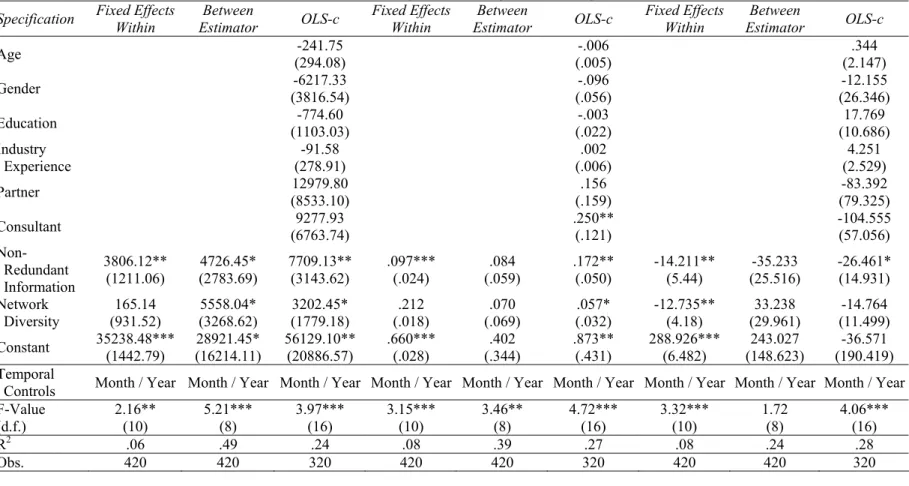
[8]. If information benefits to network diversity exist, network diversity should be positively associated with access to diverse and non-redundant information, and non-redundant information should be positively associated with performance. If network diversity confers additional benefits beyond information advan-tage (such as power or favorable trading conditions) network diversity should contribute to performance beyond its contribution through information diversity.23 Finally, if there are diminishing marginal returns to novel information, we should see a non-linear relationship between novel information and productivity.4. Results
4.1. Network Structure & Access to Diverse, Non-Redundant Information
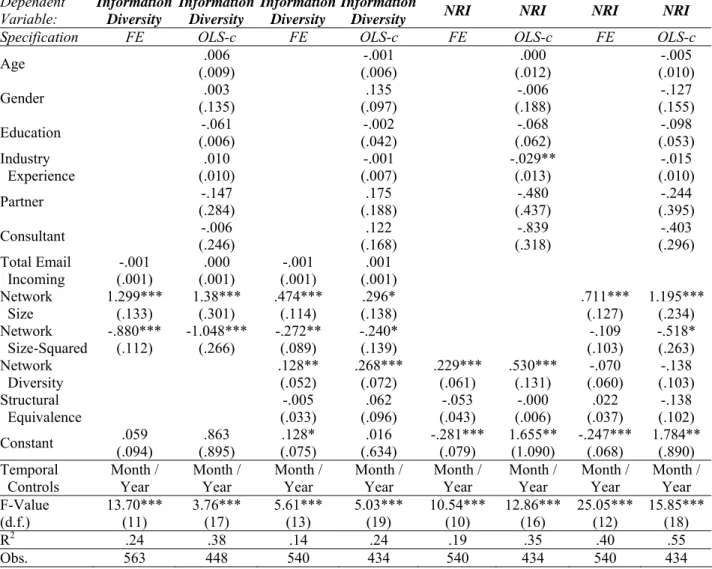
We first estimated the relationships between network size, network diversity and access to diverse information controlling for demographic factors, human capital, unobservable individual characteristics, temporal shocks and the total volume of communication. Our results, shown in Table 3 Models 1-4, dem-onstrate that the diversity of information flowing to an actor is increasing in the actor’s network size and
23 We were unable to reject the hypothesis of no heteroskedasticity and report standard errors according to the White correction
(White 1980). White’s approach is conservative. Estimated coefficients are unbiased but not efficient. In small samples, we may observe low t-statistics even when variables exert a real influence. As there may be idiosyncratic error at the level of individuals, for OLS analyses we report robust standard errors clustered by individual. Clustered robust standard errors are robust to correla-tions within observacorrela-tions of each individual, but are never fully efficient. They are conservative estimates of standard errors.
network diversity, while the marginal increase in information diversity is decreasing in network size, sup-porting hypotheses 1 and 2a. A one standard deviation increase in the size of recruiters’ networks (ap-proximately 8 additional contacts) is associated with a 1.2 standard deviation increase in information di-versity; while the coefficient on network size squared is negative and significant indicating diminishing marginal diversity returns to network size.24 As actors add network contacts, the contribution to informa-tion diversity lessens, implying that informainforma-tion benefits to network size are constrained. Network diver-sity is also positively and significantly associated with greater information diverdiver-sity in incoming email. The first order diversity variable which measures the lack of constraint in the an actor’s network is highly significant in all specifications, while the average structural equivalence of actors’ contacts does not in-fluence access to diverse information controlling for network size and first order structural diversity. These results demonstrate that large diverse networks provide access to diverse, novel sets of information.
We then tested relationships between network size, network diversity and the total amount of novel information that accrues to recruiters in incoming email. Our results, shown in Table 3 Models 5-8, demonstrate that the amount of novel information flowing to an actor is increasing in the actor’s network size and network diversity. Network diversity has a strong positive relationship with the total amount of novel information flowing into actors’ inboxes (Models 5 & 6), but is not significant when controlling for network size (Models 7 & 8). The impact of size on total novel information dominates that of structural diversity because of the strong relationship between size and total incoming email, a critical driver of the total amount of novel information (pair wise correlation: ρ = .98, p < .01). This result highlights the im-portance of information flows over time. The amount of novel information flowing in networks of similar structural diversity is greater in larger networks. We would also expect network diversity to drive greater access to total non-redundant information, controlling for network size. However, our model and results imply that while structural diversity has a strong impact on characteristics of the information actors re-ceive (greater information diversity per unit of information), variation in the total amount of novel
mation received is determined mostly by network size, a key determinant (along with tie strength) of total communication bandwidth.
Table 3. Network Structure & Access to Diverse, Novel Information
Model 1 Model 2 Model 3 Model 4 Model 5 Model 6 Model 7 Model 8
Dependent
Variable: Information Diversity
Information Diversity
Information Diversity
Information
Diversity NRI NRI NRI NRI
Specification FE OLS-c FE OLS-c FE OLS-c FE OLS-c
Age (.009) .006 (.006) -.001 (.012) .000 (.010) -.005 Gender (.135) .003 (.097) .135 (.188) -.006 (.155) -.127 Education (.006) -.061 (.042) -.002 (.062) -.068 (.053) -.098 Industry Experience .010 (.010) -.001 (.007) -.029** (.013) -.015 (.010) Partner (.284) -.147 (.188) .175 (.437) -.480 (.395) -.244 Consultant (.246) -.006 (.168) .122 (.318) -.839 (.296) -.403 Total Email Incoming (.001) -.001 (.001) .000 (.001) -.001 (.001) .001 Network Size 1.299*** (.133) 1.38*** (.301) .474*** (.114) .296* (.138) .711*** (.127) 1.195*** (.234) Network Size-Squared -.880*** (.112) -1.048*** (.266) -.272** (.089) -.240* (.139) (.103) -.109 -.518* (.263) Network Diversity .128** (.052) .268*** (.072) .229*** (.061) .530*** (.131) -.070 (.060) -.138 (.103) Structural Equivalence (.033) -.005 (.096) .062 (.043) -.053 (.006) -.000 (.037) .022 (.102) -.138 Constant (.094) .059 (.895) .863 (.075) .128* (.634) .016 -.281*** (.079) 1.655** (1.090) -.247*** (.068) 1.784** (.890) Temporal
Controls Month / Year Month / Year Month / Year Month / Year Month / Year Month / Year Month / Year Month / Year F-Value
(d.f.) 13.70*** (11) 3.76*** (17) 5.61*** (13) 5.03*** (19) 10.54*** (10) 12.86*** (16) 25.05*** (12) 15.85*** (18)
R2 .24 .38 .14 .24 .19 .35 .40 .55
Obs. 563 448 540 434 540 434 540 434
These results also suggest a nuanced relationship between size and diversity, which we explore next. 4.2. Tradeoffs between Network Size & Network Diversity
There is a strong, positive, but non-linear relationship between network size and network diver-sity in our data: structural diverdiver-sity is increasing in network size, but with diminishing marginal returns (see Table 4). This result supports hypothesis 2b, and demonstrates why information benefits to larger networks may be constrained in bounded organizational networks. As recruiters contact more colleagues, the contribution of a marginal contact to the structural diversity of a focal actor’s network is increasing,