Contents lists available atSciVerse ScienceDirect
Journal of Multivariate Analysis
journal homepage:www.elsevier.com/locate/jmvaAsymptotic normality of support vector machine variants and other
regularized kernel methods
Robert Hable
Department of Mathematics, University of Bayreuth, D-95440 Bayreuth, Germany
a r t i c l e i n f o Article history:
Received 12 April 2011
Available online 18 November 2011
AMS 2000 subject classifications:
62G08 62G20 62M10
Keywords:
Nonparametric regression Support vector machine Regularized kernel method Asymptotic normality Hadamard-differentiability Functional delta-method
a b s t r a c t
In nonparametric classification and regression problems, regularized kernel methods, in particular support vector machines, attract much attention in theoretical and in applied statistics. In an abstract sense, regularized kernel methods (simply called SVMs here) can be seen as regularized M-estimators for a parameter in a (typically infinite dimensional) reproducing kernel Hilbert space. For smooth loss functionsL, it is shown that the difference between the estimator, i.e. the empirical SVMfL,Dn,λDn, and the theoretical SVMfL,P,λ0is asymptotically normal with rate√n. That is,√n(fL,Dn,λDn−fL,P,λ0)converges weakly to a Gaussian process in the reproducing kernel Hilbert space. As common in real applications, the choice of the regularization parameterDninfL,Dn,λDn may depend on the data. The proof is done by an application of the functional delta-method and by showing that the SVM-functionalP→fL,P,λis suitably Hadamard-differentiable.
©2011 Elsevier Inc. All rights reserved.
1. Introduction
One of the most important tasks in statistics is the estimation of the influence of an input variableXon an output variable
Y. On the basis of a finite data set
(
x1,
y1), . . . , (
xn,yn)∈
X×
Y, the goal is to find an ‘‘optimal’’ predictorf:
X→
Ywhich makes a predictionf
(
x)
for an unobservedy. In case of a finite spaceY, this is called classification and, in case of an infinite spaceY⊂
R, this is called regression. Often, a signal plus noise relationshipy=
f0(
x)
+
ε
is assumed and the taskis to estimate the unknown regression functionf0. In parametric statistics, it is assumed thatf0is contained in a known
finite-dimensional function space. This assumption is dropped or, at least, considerably weakened in nonparametric statistics. Recently in nonparametric classification and regression problems, regularized kernel methods, in particular support vector machines, attract much attention in theoretical and in applied statistics; see e.g. the comprehensive books [36,28,29] and the references cited therein. For convenience, a large class of regularized kernel methods for classification and regression (based on any loss function) is called ‘‘support vector machine’’ (SVM) in the following, e.g. as in [29]. That is, the term ‘‘support vector machine’’ (SVM) is used in a broad sense here whereas, originally, the term ‘‘support vector machine’’ was coined for the special case whereY
= {−
1,
1}
(binary classification) and where the loss functionLis the so-calledhinge-loss.Typically, the weaker assumptions in nonparametric statistics have to be compensated by an increase of observations in order to obtain the same precision of the estimation. Nevertheless, it is well-known that some nonparametric estimators still are asymptotically normal for the same rate
√
nas many parametric estimators. In this article, it is shown that also support vector machines based on smooth loss functions enjoy an asymptotic normality property for the rate√
n. For anE-mail address:[email protected].
URL:http://www.stoch.uni-bayreuth.de.
0047-259X/$ – see front matter©2011 Elsevier Inc. All rights reserved. doi:10.1016/j.jmva.2011.11.004
i.i.d. sampleDn
=
(
x1,
y1), . . . , (
x1,
yn)
from a distributionP, theempirical SVMis a functionfL,Dn,λDn which solves the
minimization problem min f∈H 1 n n
i=1 L
xi,yi,f(
xi)
+
λD
n∥
f∥
2H,
(1)whereLis a loss function andHis a certain space of functionsf
:
X→
R, namely a so-calledreproducing kernel Hilbert space. The first term in(1)is the empirical mean of the losses caused by the predictionsf(
xi)and the second term penalizes the complexity off in order to avoid overfitting; the regularization parameterλD
nis a positive real number which is typicallychosen in a data-driven way, e.g., by cross-validation.
Depending on the size of the spaceH, SVMs can be used as a parametric or a non-parametric method. Choosing a finite-dimensionalHleads to a parametric setting, choosing an infinite-dimensionalHleads to a non-parametric setting. In the parametric setting, asymptotic normality of support vector machines in the original sense (binary classification using the hinge loss) has already been investigated: [20] derive asymptotic normality of the estimated prediction error of SVMs with finite-dimensionalH. Under some regularity conditions on the distribution of the data, [21] show asymptotic normality of the coefficients of the linear SVM (i.e.,Honly contains linear functions). In the following, a general non-parametric setting (covering classification and regression) is considered but, by going over from parametrics to non-parametrics, we have to impose a bound on the complexity of the predictor. This is because the problem of estimating a solutionf∗
L,Pof the minimization problem min f∈H
L
x,
y,
f(
x)
P
d(
x,
y)
,
(2)is ill-posed because a solution does not necessarily exist, if it exists, it is not necessarily unique, and small changes inP
may have large effects on the solution(s). Instead, we estimate a smoother approximation, namely the solutionfL,P,λ0of the
minimization problem
min
f∈H
L
x,
y,
f(
x)
P
d(
x,
y)
+
λ
0∥
f∥
2H (3)for a fixed regularization parameter
λ
0∈
(
0,
∞
)
. The minimizerfL,P,λ0 of (3) is calledtheoretical SVM. By adding aregularization term in(3), the problem becomes well-posed in Hadamard’s sense [18] (under suitable assumptions onP,
L, andH). That is, a solutionfL,P,λ0uniquely exists and is stable in the sense that small changes inPonly have small effects
onfL,P,λ0; see [29, Lemma 5.1 and Theorem 5.2] for unique existence offL,P,λ0and [17, Theorem 3.3] for stability. This so-called
Tikhonov regularization is equivalent to solving a minimization problem
min f∈Fr0
L
x,
y,
f(
x)
P
d(
x,
y)
,
Fr0:=
f∈
H| ∥
f∥
H≤
r0
,
wherer0can be interpreted as an upper bound on the complexity of the functionf; a smaller
λ
0>
0 corresponds to a larger r0>
0. It will be shown that the sequence of SVM-estimators(
X×
Y)
n→
H,
Dn→
fL,Dn,λDnis asymptotically normal for the rate
√
nif the empirical SVMfL,Dn,λDn is shifted by the theoretical SVMfL,P,λ0. That is,√
n
fL,Dn,λDn
−
fL,P,λ0
converges weakly to a (zero-mean) Gaussian process in the function spaceH. This also implies asymptotic normality of the risk
√
n
RL,P
fL,Dn,λDn
−
RL,P
fL,P,λ0
❀σ
N(
0,
1),
whereRL,P(f
)
=
L(
x,
y,
f(
x))
P
d(
x,
y)
denotes the risk of a predictorf andσ
∈ [
0,
∞
)
. The regularization parameterλD
nfor the empirical SVM may depend on the data. We only need that√
n
(λD
n−
λ
0)
converges to 0 in probability. This willbe proven by an advanced application of a functional delta-method. Accordingly, it will be shown that the mapP
→
fL,P,λis suitably Hadamard-differentiable. These results are not only of theoretical interest but may also be a starting point for statistical inferences such as confidence intervals and hypothesis testing for SVMs. In parametric classification problems, results about asymptotic normality of parametric SVM classifiers have already been successfully used in order to estimate confidence intervals for prediction errors [20]. According to(1)and(3), SVMs can be seen as (regularized) M-estimators for a parameter in a typically infinite dimensional Hilbert space. Asymptotic normality of M-estimators for finite-dimensional parameters and rates of convergence of M-estimators for parameters in metric spaces are considered in [33].
Of course, it would be desirable to dispense with the complexity bound and to have asymptotic normality of
√
n(
fL,Dn,λDn−
f ∗ L,P) instead of√
n(
fL,Dn,λDn−
fL,P,λ0)
— iffL∗,Pexists at all. However, in the non-parametric setting whereHis a large infinite-dimensional function space, this is not possible. Such a result would violate the no-free-lunch theorem [12] which, roughly speaking, yields that there is no uniform rate of convergence without such a bound on the complexity. It is only possible to get uniform rates of convergence within special classes of distributions. The investigation of rates of convergence for special cases – e.g. classification under assumptions on the unknown true probability measure such as Tsybakov’s noise assumption [32, p. 138] – is one of the most important topics of recent research about support vector machines and related learning methods; see e.g. [31,6,4,30,24]. It is a matter of further research if similar assumptions on the unknown true probability measures allow asymptotic normality of
√
n(
fL,Dn,λDn−
f∗
L,P).
The article is organized as follows: Section2briefly recalls the definition of support vector machines in a broad sense and fixes the notation. Section3.1contains the main results concerning asymptotic normality of support vector machines and their risks. Since the proof is quite involved, it is deferred to the appendix but Section3.3provides a short outline. In order to illustrate the results, Section3.2presents a simulated example. Finally, Section4contains some concluding remarks.
2. Support vector machines
Let
(Ω
,
A,
Q)
be a probability space, letXbe a closed and bounded subset ofRd, and letYbe a closed subset of RwithBorel-
σ
-algebraB(
Y)
. The Borel-σ
-algebra ofX×
Yis denoted byB(
X×
Y)
. LetX1
, . . . ,
Xn:
(Ω
,
A,
Q)
−→
X,
B(
X)
,
Y1, . . . ,
Yn:
(Ω
,
A,
Q)
−→
Y,
B(
Y)
be random variables such that
(
X1,
Y1), . . . , (
Xn,Yn)are independent and identically distributed according to some unknownprobability measurePon
X×
Y,
B(
X×
Y)
. DefineDn
:=
(
X1,
Y1), . . . , (
Xn,Yn)
∀
n∈
N.
A measurable mapL
:
X×
Y×
R→ [
0,
∞
)
is calledloss function. A loss functionLis calledconvexloss function if it is convex in its third argument, i.e.t→
L(
x,
y,
t)
is convex for every(
x,
y)
∈
X×
Y. Furthermore, a loss functionLis calledP-integrable Nemitski loss function of orderp
∈ [
1,
∞
)
if there is aP-integrable functionb:
X×
Y→
Rsuch that|
L(
x,
y,
t)
| ≤
b(
x,
y)
+ |
t|
p∀
(
x,
y,
t)
∈
X×
Y×
R.
Ifbis evenP-square-integrable,Lis calledP-square-integrable Nemitski loss function of orderp
∈ [
1,
∞
)
. Theriskof a measurable functionf:
X→
Ris defined byRL,P
(
f)
=
X×Y L
x,
y,
f(
x)
P
d(
x,
y)
.
The goal is to estimate a functionf
:
X→
Rwhich minimizes this risk. The estimates obtained from the method of support vector machines are elements of so-called reproducing kernel Hilbert spaces (RKHS)H. A RKHSHis a certain Hilbert space of functionsf:
X→
Rwhich is generated by akernel k:
X×
X→
R. See e.g. [28] or [29] for details about these concepts.LetHbe such a RKHS. Then, theregularized riskof an elementf
∈
His defined to beRL,P,λ
(
f)
=
RL,P(f)
+
λ
∥
f∥
2H,
whereλ
∈
(
0,
∞
).
An elementf
∈
His called asupport vector machineand denoted byfL,P,λif it minimizes the regularized risk inH. That is, RL,P(
fL,P,λ)
+
λ
∥
fL,P,λ∥
2H=
inff∈HRL,P(f
)
+
λ
∥
f∥
2H.TheSVM-estimatoris defined by
Sn
:
(
X×
Y)
n→
H,
Dn→
fL,Dn,λDn,
wherefL,Dn,λDn is that functionf
∈
Hwhich minimizes1 n n
i=1 L
xi,yi,f(
xi)
+
λD
n∥
f∥
2H (4)inHforDn
=
((
x1,
x2), . . . , (
xn,yn))∈
(
X×
Y)
n. The empirical support vector machinefL,Dn,λDn uniquely exists for everyλD
n∈
(
0,
∞
)
and every data-setDn∈
(X
×
Y)nift→
L(
x,
y,
t)
is convex for every(
x,
y)
∈
X×
Y.3. Asymptotic normality 3.1. Main results
The following theorems provide the main results. For random sequences of regularization parameters
(λ
Dn)n
∈N⊂
(
0,
∞
)
which converges in probability with rate
√
nto someλ
0∈
(
0,
∞
)
,Theorem 3.1says that the√
n-standardized difference between the empirical support vector machinefL,Dn,λDnand the theoretical support vector machinefL,P,λ0is asymptotically
normal under some relatively mild conditions. That is, theH-valued random variable
Ω
→
H,
ω
→
√
n(
fL,Dn(ω),λDn(ω)−
fL,P,λ0)
converges weakly to a random variable
H
:
Ω→
H,
ω
→
H(ω)
which is a Gaussian process inH. Accordingly, for every finite collection of functions
{
f1, . . . ,
fm} ⊂
H, the random variableΩ
→
Rm,
ω
→
(
⟨
f1,
H(ω)
⟩
H, . . . ,
⟨
fm,H(ω)
⟩
H)
has a multivariate normal distribution. In particular, the reproducing property ofkimplies that, for everyx1
, . . . ,
xm∈
X,√
n
fL,Dn,λDn(
x1)
−
fL,P,λ0(
x1)
...
fL,Dn,λDn(
xm)−
fL,P,λ0(
xm)
❀Nm(0,
Σ),
whereΣis a covariance matrix. In addition,Theorem 3.2provides
√
n-consistency of the risk.Theorem 3.1. LetX
⊂
Rdbe closed and bounded and letY⊂
Rbe closed. Assume that k:
X×
X→
Ris the restriction of an m-times continuously differentiable kernelk˜
:
Rd×
Rd→
Rsuch that m>
d/
2and k̸=
0. Let H be the RKHS of k and let P be a probability measure on(
X×
Y,
B(
X×
Y))
. LetL
:
X×
Y×
R→ [
0,
∞
),
(
x,
y,
t)
→
L(
x,
y,
t)
be a convex, P-square-integrable Nemitski loss function of order p
∈ [
1,
∞
)
such that the partial derivatives L′(
x,
y,
t)
:=
∂
L∂
t(
x,
y,
t)
and L ′′(
x,
y,
t)
:=
∂
2L∂
2t(
x,
y,
t)
exist for every(
x,
y,
t)
∈
X×
Y×
R. Assume that the maps(
x,
y,
t)
→
L′(
x,
y,
t)
and(
x,
y,
t)
→
L′′(
x,
y,
t)
are continuous. Furthermore, assume that for every a
∈
(
0,
∞
)
, there is a b′a
∈
L2(
P)
and a constant b′′a∈ [
0,
∞
)
such that, forevery
(
x,
y)
∈
X×
Y, sup t∈[−a,a]|
L′(
x,
y,
t)
| ≤
b′a(x,
y)
and sup t∈[−a,a]|
L′′(
x,
y,
t)
| ≤
b′′a. (5)Then, for every
λ
0∈
(
0,
∞
)
, there is a tight, Borel-measurable Gaussian process H:
Ω→
H,
ω
→
H(ω)
such that√
n
fL,Dn,λDn−
fL,P,λ0
❀H in H (6)for every Borel-measurable sequence of random regularization parameters
λ
Dnwith√
n
λ
Dn−
λ
0
−
−−
→
n→∞ 0 in probability.
The Gaussian processHis zero-mean; i.e., E
⟨
f,
H⟩
H=
0for every f∈
H.By use of this theorem, the following asymptotic result on the risks is obtained.
Theorem 3.2. Under the assumptions ofTheorem3.1, there is, for every
λ
0∈
(
0,
∞
)
, a constantσ
∈ [
0,
∞
)
such that√
n
RL,P(fL,Dn,λDn)
−
RL,P(fL,P,λ0)
❀
σ
N(
0,
1)
for every Borel-measurable sequence of random regularization parameters
λ
Dnwith√
n
λ
Dn−
λ
0
−
−−
→
According to the above theorems, the Gaussian processHand the constant
σ
do not depend on the sequenceλ
Dn,n∈
N,but only on
λ
0. Though it is possible thatHdegenerates to 0, this only happens in trivial cases, e.g., ifPis equal to a Diracdistribution, or
|
Y| ≤
ε
while using a smoothed version of the epsilon-insensitive loss; seeRemark 3.6. The constantσ
can also be equal to 0 inTheorem 3.2so that the limit degenerates to 0.As stated above, the results are true under some relatively mild assumptions. In particular, the assumptions onkare fulfilled for all of the most common kernels (e.g. Gaussian RBF kernel, polynomial kernel, exponential kernel, linear kernel). It is assumed that the loss function is two times continuously differentiable in the third argument. On the one hand, this is an obvious restriction because some of the most common loss functions are not differentiable: the epsilon-insensitive loss for regression and the hinge loss for classification. On the other hand, this assumption is not based on any unknown entity such as the model distributionP. In particular, a practitioner can a priori meet this requirement by a suitable choice of the loss function; e.g. the least-squares loss for regression and the logistic loss for classification. This is contrary to the noise assumptions common in order to establish rates of convergence to the Bayes risk because such assumptions depend on the unknownPso that they can hardly be checked in applications. In addition,Remark 3.5describes how a Lipschitz-continuous loss function (such as the epsilon-insensitive loss and the hinge loss) can always be turned into a differentiable
ε
-version of the loss function. That is, though the theorem does not cover support vector machines in the original terminology, it covers variants based on a slightly smoothed hinge loss.In order to ensure mere existence of the theoretical SVMfL,P,λ0, it is necessary to assume aP-integrability condition.
For example, it is common to assume thatLis a P-integrable Nemitski loss function [7]. In order to obtain asymptotic normality in the above theorems, we assume thatLis aP-square-integrable Nemitski loss function, which seems to be a natural assumption in view of the square-integrability assumptions for usual central limit theorems. In addition, a similar
P-integrability condition is assumed for the derivative of the loss function. IfYis bounded (as, e.g., in case of a classification problem) andL,L′andL′′are continuous, all of the integrability assumptions are fulfilled.
In order to fulfill
√
n
λ
Dn−
λ
0
−
−−
→
n→∞ 0 in probability,
(which is the only assumption on the random sequence of regularization parameters), it is possible to use any data-driven method for choosing the regularization parameter. The only thing one has to do is to choose a (possibly large) constant
c
∈
(
0,
∞
)
and to make sure that the method (e.g. cross validation) picks a value from
λ
0, λ
0+
c/
√
nln
(
n)
. Note that, as the notation suggests, it is indeed possible to use the same data for choosing the regularization parameter as for building the final SVM — just as usually done by practitioners, e.g., when applying cross validation. So far, we have assumed that the fixedλ
0is already given but it has to be chosen in practice. LetRL∗,Pdenote the infimum ofRL,P(f)
over all measurablefunctionsf
:
X→
R. Generally, the smallerλ
0>
0 is, the smaller the difference of the risksRL,P(fL,P,λ0)
−
R∗L,P≥
0 is —this difference of the risks is the price we have to pay for regularization. Accordingly, it would be desirable to have a bound 0
≤
RL,P(
fL,P,λ0)
−
RL∗,P≤
C(λ
0)
−→
0 forλ
0→
0,
so that
λ
0can be chosen according to this bound. However, it follows from the no-free-lunch theorem [12] that such abound depends on the unknownP. Even the rate of convergence ofC
(λ
0)
depends onP(andLandk) and is only knownunder substantial assumptions which tend to be technical and cannot always be easily explained to practitioners. Instead, an approach is favored which is more accessible to practitioners and does not involve assumption of which practitioners can hardly decide whether they are reasonable or not in their statistical problem at hand. The parameter
λ
0can be chosenaccording to the gain we get from regularization, namely stability or robustness. In addition to our assumptions, it is assumed thatL′is bounded here. Then, it follows from our assumptions and [29, Corollary 5.10] that
fL,P,λ0−
fL,P˜,λ0
H≤
λ
−01∥
L′∥
∞· ∥
k∥
∞· ∥
P− ˜
P∥
TV,
where
∥ · ∥
TVdenotes the total variation distance. That is, the maxbias with respect to the total variation neighborhood with radiusε >
0 is bounded above byλ
−01∥
L′∥
∞· ∥
k∥
∞ε
. See e.g. [25] for the concept of the maxbias in robust statistics and[29, Section 10] for the maxbias in case of SVMs. The smaller
λ
0is, the smaller the amount of regularization is and the largerthe maxbias is.
The following examples list some general situations in whichTheorems 3.1and3.2are applicable.
Example 3.3 (Classification). Theorems 3.1and3.2are applicable in the following setting for a classification problem:
•
Xbounded and closed,Y= {−
1;
1}
•
ka Gaussian RBF kernel, a polynomial kernel, an exponential kernel or a linear kernel•
Lthe least-squares loss or the logistic loss.Example 3.4 (Regression). Theorems 3.1and3.2are applicable in the following setting for a regression problem:
•
Xbounded and closed,Yclosed•
ka Gaussian RBF kernel, a polynomial kernel, an exponential kernel or a linear kernel•
Lthe least-squares loss and P such that
y4P
d(
x,
y)
<
∞
; or, alternatively, Lthe logistic loss andP such that
y2P
d
(
x,
y)
As it is assumed that the loss function is twice differentiable,Theorems 3.1and3.2do not apply to the hinge loss (in classification), to the epsilon-insensitive loss (in regression), and to the pinball loss (in quantile regression). However, the followingRemark 3.5describes how any Lipschitz-continuous loss function can always be turned into a differentiable
ε
-version of the loss function such that all of the assumptions on the partial derivativesL′andL′′are automatically ful-filled. In particular, the proposed construction works for the hinge loss, the epsilon-insensitive loss, and the pinball loss. In this way,Theorems 3.1and3.2guarantee asymptotic normality for loss functions which are arbitrarily close to these non-differentiable loss functions. However, it is still an unsolved problem whether asymptotic normality also holds for the non-smoothed hinge, epsilon-insensitive, or pinball loss function.Remark 3.5 (Smoothing Loss Functions by Use of Mollifiers).LetL
:
X×
Y×
R→ [
0,
∞
)
be a convexP-square-integrable Nemitski loss function of orderp∈ [
1,
∞
)
. Assume thatLis also a Lipschitz-continuous loss function. That is, there is a constantb′∈
(
0,
∞
)
such thatsup
(x,y)∈X×Y
|
L(
x,
y,
t1)
−
L(
x,
y,
t2)
| ≤
b′|
t1−
t2|
∀
t1,
t2∈
R.
Then, for every
ε >
0, it is possible to construct a loss functionLεsuch that|
L(
x,
y,
t)
−
Lε(
x,
y,
t)
| ≤
ε
∀
(
x,
y,
t)
∈
X×
Y×
R (7)and all of the assumptions ofTheorems 3.1and3.2are fulfilled forLε.
This can be done in the following way: Take a so-called mollifier function
ϕ
:
R→
R; e.g.,ϕ
:
R→
R,
t→
γ
−1e−1
1−t2I(−1,1)
(
t),
where
γ
∈
(
0,
∞
)
is chosen so that
ϕ
dλ
=
1. (See e.g. [11, p. 341ff] for the concept of mollifiers and their basic properties.) Defineϕ
ε(
s)
=
ϕ(
sb′/ε)
for everys∈
Rand Lε
(
x,
y,
t)
=
b ′ε
ϕ
ε(
s)
L(
x,
y,
t−
s)λ(
ds)
∀
(
x,
y,
t).
(8)Then,(7)follows from an easy calculation using Lipschitz-continuity ofL. The
ε
-versionLεis again a convexP -square-integrable Nemitski loss function of orderp∈ [
1,
∞
)
. For every(
x,
y,
t)
∈
X×
Y×
R, the functiont→
Lε(
x,
y,
t)
is infinitely differentiable and the derivatives are given by∂
m∂
mtLε(
x,
y,
t)
=
b′ε
∂
mϕ
ε∂
ms(
s)
L(
x,
y,
t−
s)λ(
ds).
(9)Furthermore, for every
(
x,
y,
t)
∈
X×
Y×
R,|
L′ε(
x,
y,
t)
| =
∂
∂
tLε(
x,
y,
t)
≤
b′,
(10)|
L′′ε(
x,
y,
t)
| =
∂
2∂
2tLε(
x,
y,
t)
≤
b′·
b ′ε
∂ϕ
ε∂
s(
s)λ(
ds)
=:
b ′′.
(11)Inequality(10)follows from the definition of derivatives by means of difference quotients,(8), and Lipschitz-continuity of
L. Inequality(11)follows from the definition of derivatives by means of difference quotients,(9)form
=
1, and Lipschitz-continuity ofL.In particular, the construction of such an
ε
-version ofLworks for the hinge loss (classification) and, if
y2P(
d(
x,
y)) <
∞
, for the epsilon-insensitive loss (regression). Another approach in order to obtain smooth approximations of loss functions is proposed in [10].The followingRemark 3.6shows that the limit distribution inTheorem 3.1is only degenerated in trivial cases.
Remark 3.6 (Degenerated Limit Distribution).As shown inProposition A.11in the appendix, the Gaussian processHin
√
n
fL,Dn,λDn
−
fL,P,λ0
❀H
(Theorem 3.1) is degenerated to 0 if and only if, for everyh
∈
H, there is a constantch∈
Rsuch that L′
x,
y,
fL,P,λ0(
x)
h
(
x)
=
ch forP−
a.
e. (
x,
y)
∈
X×
Y.
(12)This only happens in trivial cases in which statistical evaluations are superfluous. Typically,(12)means that
L′
x,
y,
fL,P,λ0(
x)
Table 1
The sample mean and the sample standard deviation of the numbersrn,j,j∈ {1, . . . ,5000}, and the Kolmogorov–Smirnov distance (KS-distance) between the empirical distribution function of the numbersrn,j,j∈ {1, . . . ,5000}, and the normal distribution with mean equal to the sample mean and standard deviation equal to the sample standard deviation of the numbersrn,j,j∈ {1, . . . ,5000}— for everyn∈ {25,100,1000}respectively.
n mean standard deviation KS-distance
25 0.67 1.47 0.05
100 0.50 1.44 0.02
1000 0.22 1.62 0.01
and, therefore, the representer theorem [29, Theorem 5.9] impliesfL,P,λ0
(
x)
=
0 almost surely so that(13)impliesL′
(
x,
y,
0)
=
0 forP−
a.
e. (
x,
y)
∈
X×
Y.
(14)For example,(12)implies(13)and(14)ifHis an RKHS which contains constants and at least one function which is not almost surely constant, or ifHis a universal kernel (as in case of the Gaussian Kernel) andXiis not almost surely a constant.
Finally, let us summarize the implications of(13)and(14)in case of different loss functions. Classification withYi
∈
{−
1,
1}
: In case of the logistic loss, the squared loss and a slightly smoothed hinge loss,(14)is impossible. Regression: In case of the Huber loss and the squared loss,(14)implies thatYi=
0 almost surely. In case of a slightly smoothedε
-insensitiveloss,(14)impliesYi
∈ [−
ε, ε
]
almost surely.3.2. A simulated example
This subsection illustrates the asymptotic normality of
√
n
fL,Dn,λDn−
fL,P,λ0
by a simulated example.
The model.Let us consider the model
Yi
=
f0(
Xi)+
εi
whereεi
∼
i.i.d.Unif(
−
1,
1),
Xi∼
i.i.d.Unif(
0,
5),
fori
∈ {
1, . . . ,
n}
andf0
(
x)
=
cos(
x),
x∈
R.
The simulation consists of 5000 runs of this model where, in each run, data sets of sizen
=
25,n=
100, andn=
1000 were simulated.Estimation.For the estimation, the SVM with the Gaussian RBF kernelk
(
x,
x′)
=
exp(
−
(
x−
x′)
2)
and the (rescaled) logisticloss function L
(
x,
y,
t)
= −
1 2·
log
4 exp(
−
2(
y−
t))
1+
exp(
−
2(
y−
t))
2
,
x,
y,
t∈
R,
were used. Furthermore,
λ
0=
0.
0001 was fixed and, for each data set, the empirical regularization parameterλ
Dn waschosen in a data-driven way by a 5-fold cross-validation within the values 0
.
0001,
0.
0005,
0.
001,
0.
005,
0.
01,
0.
05,
0.
1.
The theoretical SVMfL,P,λ0nearly coincides with the true regression functionf0; the absolute difference
|
fL,P,λ0(
x)
−
f0(
x)
|
issmaller than 0.03 for everyx
∈ [
0,
5]
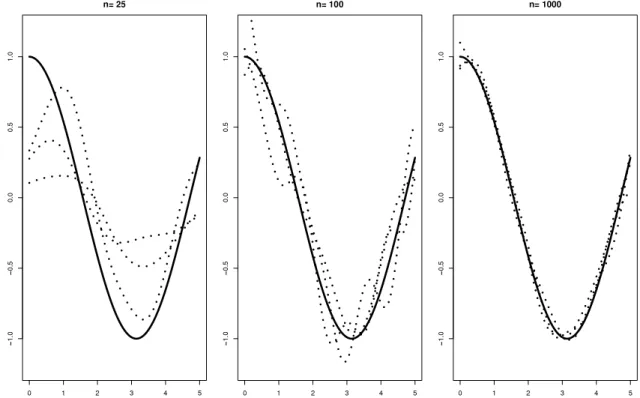
and theL1-distance betweenfL,P,λ0andf0is approximately equal to 0.002.Results.As an example,Fig. 1shows the estimated functionfL,Dn,λDnof the first three runs for everyn
∈ {
25,
100,
1000}
respectively. Note that SVMs using Gaussian kernels are a non-parametric method and, accordingly, larger sample sizes (such as e.g.n
=
1000) are needed in order to get fairly accurate estimates. Nevertheless, it turns out that approximate normality of√
n
fL,Dn,λDn−
fL,P,λ0
is present even for small sample sizes in this example. By fixingx0
=
2.
5, for everyn∈ {
25,
100,
1000}
,we obtain 5000 real numbersrn,j
:=
√
n
fL,Dn,j,λDn,j(
x0)
−
fL,P,λ0(
x0)
— wherej
∈ {
1, . . . ,
5000}
denotes the number of the run — in the 5000 runs. According toTheorem 3.1, the real numbersrn,j,j∈ {
1, . . . ,
5000}
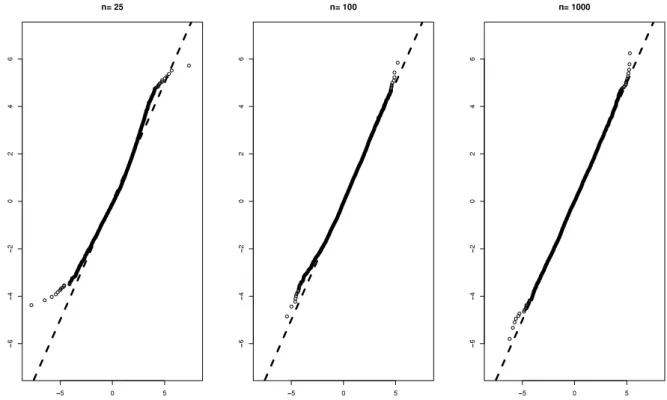
, are from an approximate normaldistribution if the sample sizenis sufficiently large.Fig. 2shows a histogram of the numbersrn,j,j
∈ {
1, . . . ,
5000}
, foreveryn
∈ {
25,
100,
1000}
. In addition,Fig. 3shows, for everyn∈ {
25,
100,
1000}
, a Q–Q plot in which the empirical distribution of the numbersrn,j,j∈ {
1, . . . ,
5000}
, is compared to the normal distribution with mean equal to the samplemean 50001
5000j=1 rn,jand standard deviation equal to the sample standard deviation ofrn,j,j
∈ {
1, . . . ,
5000}
. Particularly Fig. 3illustrates that the numbersrn,j,j∈ {
1, . . . ,
5000}
are approximately normal even for small sample sizes. Finally, Table 1shows the sample mean and the sample standard deviation ofrn,j,j∈ {
1, . . . ,
5000}
, for everyn∈ {
25,
100,
1000}
.In addition,Table 1shows the values of the Kolmogorov–Smirnov distance (KS-distance) between the empirical distribution function and the respective normal distribution function.
Fig. 1. The true regression functionf0 : x→ cos(x)(solid line) and the estimated functionsfL,Dn,λDnof the first three runs (dotted lines) for every n∈ {25,100,1000}respectively.
Fig. 2. For everyn∈ {25,100,1000}, a histogram of the numbersrn,j:=
√
n
fL,Dn,j,λDn,j(x0)−fL,P,λ0(x0)
,j∈ {1, . . . ,5000}.
3.3. Supplements and sketch of the proof
The proof ofTheorems 3.1and3.2is an involved application of the functional delta-method. In order to describe this in some more detail, let us first fix a constant sequence of regularization parameters. That is,
λ
Dn≡
λ
0∈
(
0,
∞
)
foreveryn
∈
N. Then, support vector machines may be represented by a functionalSon a set of probability measures on
X
×
Y,
B(
X×
Y)
. This functionalFig. 3. For everyn∈ {25,100,1000}, a Q–Q plot in which the empirical distribution of the numbersrn,j,j∈ {1, . . . ,5000}, is compared to the normal distribution with mean equal to the sample mean and standard deviation equal to the sample standard deviation ofrn,j,j∈ {1, . . . ,5000}.
is calledSVM-functionalin the following. It represents the SVM-estimator because the empirical support vector machine is equal tofL,Dn,λ0
=
S(
PDn)
for every data setDn∈
(
X×
Y)
nwherePDndenotes the empirical measure corresponding toDn.In order to use the functional delta-method, it is crucial that this is true for every sample sizenand thatSdoes not depend onn. (InRemark 3.7, it will be explained how it is nevertheless possible to deal with random sequences
λ
Dn.)Theorem 3.1can be shown in the following way:
1. Show that
√
n(
PDn−
P)
converges weakly to a Gaussian process.2. Show thatSis Hadamard-differentiable: (a) Show thatSis Gâteaux-differentiable.
(b) Show that the Gâteaux-derivative fulfills a continuity property. (c) Show that (a) and (b) imply Hadamard-differentiability. 3. Then, it follows from the functional delta-method that
√
n
(
fL,Dn,λ0−
fL,P,λ0)
=
√
n
S(
PDn)
−
S(
P)
converges weakly to a Gaussian process.Theorem 3.2follows fromTheorem 3.1by another application of the functional delta-method.
Step 1 involves the study of Donsker classes. Among other things, this is based on a bound(62)on the uniform entropy number of balls in the reproducing kernel Hilbert spaceH. A proof of this bound is given in the proof ofLemma A.9. In similar settings, such bounds have already been proven, e.g., in [37, Section V] and [29, Section 6.4]. In general,
√
n(
PDn−
P)
isnotameasurable random variable so that the proof involves the theory of weak convergence of unmeasurable random variables; see [35]. However, this does not affect the statements ofTheorems 3.1and3.2because
ω
→
fL,Dn(ω),λDn(ω) is a measurablerandom variable as shown in the beginning of the proof ofTheorem 3.1inAppendix A.4.
Essentially, it has already been known thatSis Gâteaux-differentiable because [8,7] derive the influence function ofS
which is a (special) Gâteaux-derivative. Therefore, essential steps of the proof of Step 2(a) can be adopted from [8,7] and [29, Section 10.4] but some care is needed as we also have to deal with signed measures here. In addition, we also have to deal with a sequence of random regularization parameters
λ
Dninstead of a fixedλ
0; seeRemark 3.7. In Step 2(c) it will be shownthatSis even Hadamard-differentiable (in a specific sense described inAppendix A.3). This is done because the application of the delta-method requires Hadamard-differentiability. However, this might also be useful for other purposes since, e.g., the chain rule is valid for Hadamard-differentiability but not for Gâteaux-differentiability. [9] shows Bouligand-differentiability of the SVM-functional which also allows the chain rule.
Remark 3.7 (Sequences of Random Regularization Parameters
λ
Dn).For a fixed regularization parameterλ
0, support vectormachines can be represented by a functionalS
:
P→
fL,P,λ0and the delta-method can be applied forS. However, if we havea sequence of (random) regularization parameters
λ
Dn, we get a (random) sequence of functionals. SDn:
P→
fL,P,λDnfor which the delta-method cannot be applied offhand. This problem can be solved in the following way: As described in
Appendix A.1, SDn
(
P)
=
fL,P,λDn=
fL,λ0 λDnP,λ0=
S
λ
0λ
Dn P
∀
P.
so that everything can be traced back toS. In this way, the explicit use ofSDncan be avoided and the delta-method turns out
to be applicable also in this case. The price we have to pay is that we have to deal with general finite measures in the proofs because, in general,λDλ0
n(ω)Pis not a probability measure any more.
4. Conclusions
In the article, asymptotic properties of support vector machines are investigated. For sequences of random regularization parameters
λ
Dn,n∈
N, such that√
n
λ
Dn−
λ
0
−→
0 in probability, it is shown that the difference between the empirical and the theoretical SVM is asymptotically normal with rate√
n; that is,√
n(
fL,Dn,λDn−
fL,P,λ0)
converges to a Gaussian processin the function spaceH. The value
λ
0>
0 corresponds to a bound on the complexity of the estimate for the regressionfunction; a smaller
λ
0allows for more complex functions. Therefore, the theoretical SVMfL,P,λ0 serves as a ‘‘smoother’’approximation of more complex regression functions. The results of this article show that, in non-parametric classification and regression problems, the estimation of this smoother approximation by use of empirical SVMs in an infinite dimensional function space is asymptotically normal with rate
√
n— just as if it was a parametric problem. The proof is done by showing that the mapP→
fL,P,λis suitably Hadamard-differentiable and by an application of a functional delta-method. These resultsare not only of theoretical interest but may also be a starting point for statistical inferences such as confidence intervals and hypothesis testing.
Estimating a smoother approximation of the regression function is a comprise between a parametric model and a fully non-parametric model without any assumptions on the regression function or the distribution. Without any of such assumptions, similar results are not possible as follows from the no-free-lunch theorem.
Acknowledgments
I would like to thank Andreas Christmann for bringing the problem to my attention and for valuable suggestions.
Appendix. Proof of the main results
The assumptions ofTheorem 3.1are valid in the whole appendix.
A.1. Preparations
The mapΦ
:
X→
Halways denotes the canonical feature map corresponding to the kernelkand the RKHSH. It will frequently be used in the proofs that the reproducing property implies⟨
Φ(x),
f⟩
H=
f(
x)
∀
x∈
X,∀
f∈
H (15)or, in shorter notation,
⟨
Φ,f⟩
H=
f∀
f∈
H.
(16) In particular, we write Eµ⟨
Φ,f⟩
H=
⟨
Φ,f⟩
Hdµ
=
⟨
Φ(x),
f⟩
Hµ(dx)
=
f(
x)µ(
dx).
(17)According to [29, p. 124], boundedness ofkimplies:
∥
k∥
∞:=
sup x∈X
k(
x,
x)
=
sup x∈X∥
Φ(x)
∥
H<
∞
(18)∥
f∥
∞≤ ∥
k∥
∞· ∥
f∥
H∀
f∈
H.
(19)In order to shorten notation, define
Lf
:
X×
Y→
R, (
x,
y)
→
Lf(
x,
y)
=
L
x
,
y,
f(
x)
for every functionf
:
X→
R. Accordingly, defineL′f
(
x,
y)
=
L′
x
,
y,
f(
x)
and L′′f
(
x,
y)
=
L′′
x
,
y,
f(
x)
for every
(
x,
y)
∈
X×
Y. AsLis aP-square-integrable Nemitski loss function of orderp∈ [
1,
∞
)
, there is ab∈
L2(
P)
suchthat
|
L(
x,
y,
t)
| ≤
b(
x,
y)
+ |
t|
p∀
(
x,
y,
t)
∈
X×
Y×
R.
(20) Let G1:=
g:
X×
Y→
R| ∃
z∈
Rd+1such thatg=
I(−∞,z]
be the set of all indicator functionsI(−∞,z]. Then, it is well-known that
√
n
Fn−
F
❀G1 in
ℓ
∞(
G1),
whereFndenotes the empirical process,F denotes the distribution function ofP,G1 is a Gaussian process, and
ℓ
∞(
G1)
denotes the set of all bounded functionsG
:
G1→
R. Provided that the SVM-functionalSis Hadamard-differentiable inℓ
∞(G
1)
, an application of the functional delta-method would yield asymptotic normality of√
n
S(
Fn)−
S(
F)
. Unfortunately,the norm-topology of
ℓ
∞(
G1)
is too weak in order to ensure Hadamard-differentiability. Therefore, the set of indicatorfunctionsG1has to be enlarged to a setG
⊃
G1which leads to the following somewhat technical definition of the domain BSof the SVM-functionalS. Definec0
:=
1λ
0
b dP+
1,
(21) G2:=
g:
X×
Y→
R
∃
f0∈
H,
∃
f∈
Hsuch that∥
f0∥
H≤
c0,
∥
f∥
H≤
1 and g=
L′f 0f
,
and G:=
G1∪
G2∪ {
b}
.
Let
ℓ
∞(
G)
be the set of all bounded functionsF
:
G→
Rwith norm
∥
F∥
∞=
supg∈G|
F(
g)
|
. DefineBS
:=
F:
G→
R
∃
µ
̸=
0 a finite measure onX×
Ysuch thatF
(
g)
=
gdµ
∀
g∈
G,
b∈
L2(µ),
b′a∈
L2(µ)
∀
a∈
(
0,
∞
)
andB0:=
cl
lin(
BS)
the closed linear span ofBSin
ℓ
∞(G)
. That is,BS is a subset ofℓ
∞(G)
whose elements correspond tofinite measures. The elements ofBScan be seen as some kind of generalized distribution functions. Note that the assumptions
onLandPimply thatG
→
R,
g→
gdPis a well-defined element ofBS.For everyF
∈
BS, letι(
F)
denote the corresponding finite measureµ
on
X
×
Y,
B(
X×
Y)
such thatF
(
g)
=
gd
µ
∀
g∈
G.
Note that, by definition ofBS,
ι(
F)
uniquely exists for everyF∈
BSso thatι
:
BS→
ca+(
X×
Y,
B(
X×
Y)),
F→
ι(
F)
is well-defined where ca+
(
X×
Y,
B(
X×
Y))
denotes the set of all finite measures on(
X×
Y,
B(
X×
Y))
. The set of all finite signedmeasures on(
X×
Y,
B(
X×
Y))
is denoted by ca(
X×
Y,
B(
X×
Y))
. The set of all continuous functionsf:
X→
Ris denoted byC(X). SinceXis compact by assumption, the elements ofC(X)are bounded andC(X)is endowed with the sup-norm
∥
f∥
∞=
supx∈X|
f(
x)
|
.By now, support vector machines are only defined for probability measuresP
˜
. However, in order to deal with sequences of random regularization parametersλ
Dn, we will also have to deal with ‘‘support vector machines’’ for general finitemeasures
µ
. For everyF∈
BS, definefL,ι(F),λ
:=
arg inf f∈H
Though
µ
:=
ι(
F)
∈
ca+(
X×
Y,
B(
X×
Y))
is not necessarily a probability measure, we have, in effect, not defined any new object. In order to see this, note that dividing the objective function byM:=
µ(
X×
Y)
does not change the minimizer so that we get fL,µ,λ=
arg inf f∈H
L
x,
y,
f(
x)
1 Mµ
d(
x,
y)
+
λ
M∥
f∥
2 H=
fL,M1µ,Mλ andfL,1Mµ,Mλ is an ‘‘ordinary’’ support vector machine as 1
M
µ
is a probability measure. This also shows thatfL,µ,λuniquelyexists becausefL,1
Mµ,Mλ uniquely exists for the probability measure 1
M
µ
according to [29, Lemma 5.1 and Theorem 5.2].The idea is that considering support vector machines for general finite measures
µ
makes it possible to takeλ
0as a‘‘standard regularization parameter’’. Define
S
:
BS→
H,
F→
S(
F)
=
fι(F),
where fι(F):=
fL,ι(F),λ0=
arg inf f∈H
L
x,
y,
f(
x)
ι(
F)
d(
x,
y)
+
λ
0∥
f∥
2H.Then, we can deal with other regularization parameters
λ >
0 by use offL,ι(F),λ
=
S
λ
0λ
F
∀
F∈
BS.
(22)This is important in order to apply the functional delta-method in case of a sequence of random regularization parameters
λ
Dn; see alsoRemark 3.7.It follows from [29, Eq. (5.4) and Lemma 4.23] that
fι(F)
H≤
1λ
0 F(
b)
∀
F∈
BS,
(23)
fι(F)
∞≤ ∥
k∥
∞
1λ
0 F(
b)
∀
F∈
BS.
(24)SinceXis separable andkis a continuous kernel, the RKHSHis aseparableHilbert space; see [29, Lemma 4.33]. Separability ofHis used several times in the proofs; this is important particularly with regard to the Bochner-integral ofH-valued functionsΨ
:
Z→
H. The Bochner-integral
Ψdµ
=
Ψdµ
+−
Ψdµ
−of such aH-valued functionΨ with respect to a finite signed measureµ
=
µ
+−
µ
−is again an element ofH. IfΨ is suitably measurable, then existence of theBochner-integral follows from
∥
Ψ∥
Hd|
µ
|
<
∞
where|
µ
| =
µ
++
µ
−denotes the total variation ofµ
. We will also frequently usethe fact that, for every Banach spaceEand every continuous linear operatorA
:
H→
E, the existence of the Bochner-integral
Ψd
µ
implies the existence of the Bochner-integral
A
(Ψ
)
dµ
and
A(Ψ
)
dµ
=
A
Ψdµ
;
(25)see, e.g. [11, Theorem 3.10.16 and Remark 3.10.17].
This subsection closes with three lemmas which are used several times. Thereafter, Gâteaux-differentiability of the SVM-functionalS
:
BS→
Hwill be shown inAppendix A.2. This is strengthened to Hadamard-differentiability inAppendix A.3.Finally, it will be shown inAppendix A.4that
√
n(
PDn−
P)
converges weakly to a Gaussian process inℓ
∞(
G)
and that thisimplies asymptotic normality of
√
n
fL,Dn,λDn−
fL,P,λ0
and√
n
RL,P(
fL,Dn,λDn)
−
RL,P(
fL,P,λ0)
by applying a functional delta-method.
Lemma A.1.Let
(
Fn)n∈N⊂
BSbe a sequence which converges to some F0∈
BS. Then,limn→∞ι(
Fn)(X×
Y)
=
ι(
F0)(
X×
Y)
and the sequence of finite measures
ι(
Fn), n∈
N, converges weakly toι(
F0)
.Proof. DefineMn
:=
ι(
Fn)(X×
Y)
andan=
(
n, . . . ,
n)
∈
Rd+1for everyn∈
N∪ {
0}
. Then,0
≤ |
Mn−
M0| =
lim l→∞
Fn
I(−∞,al]
−
F0
I(−∞,al]
≤ ∥
Fn−
F0∥
∞−→
0.
Therefore, the normalized sequenceF
˜
n=
Mn−1Fn,n∈
N∪ {
0}
, corresponds to a sequence of probability measuresι(
F˜
n)suchthat lim n→∞