• No results found

Exploring machine learning techniques in epileptic seizure detection and prediction

N/A
N/A
Protected

Academic year: 2021

Share "Exploring machine learning techniques in epileptic seizure detection and prediction"

Copied!
223
0
0

Loading.... (view fulltext now)

Full text

(1)

Exploring Machine Learning Techniques in Epileptic Seizure

Detection and Prediction

Negin Moghim

Submitted for the degree of Doctor of Philosophy

Heriot-Watt University

School of Mathematical and Computer Sciences

May 2014

The copyright in this thesis is owned by the author. Any quotation from the

thesis or use of any of the information contained in it must acknowledge

this thesis as the source of the quotation or information.

(2)

Epilepsy is the most common neurological disorder, affecting between 0.6% and 0.8% of the global population. Among those affected by epilepsy whose primary method of seizure management is Anti Epileptic Drug therapy (AED), 30% go on to develop resistance to drugs which ultimately leads to poor seizure management. Currently, alternative therapeutic methods with successful outcome and wide applicability to various types of epilepsy are limited. During an epileptic seizure, the onset of which tends to be sudden and without prior warning, sufferers are highly vulnerable to injury, and methods that might accurately predict seizure episodes in advance are clearly of value, particularly to those who are resistant to other forms of therapy.

In this thesis, we draw from the body of work behind automatic seizure prediction obtained from digitised Electroencephalography (EEG) data and use a selection of machine learning and data mining algorithms and techniques in an attempt to explore potential directions of improvement for automatic prediction of epileptic seizures. We

start by adopting a set of EEG features from previous work in the field (Costa et al.

2008) and exploring these via seizure classification and feature selection studies on a large dataset. Guided by the results of these feature selection studies, we then build on Costa et al's work by presenting an expanded feature-set for EEG studies in this area.

Next, we study the predictability of epileptic seizures several minutes (up to 25 minutes) in advance of the physiological onset. Furthermore, we look at the role of the various feature compositions on predicting epileptic seizures well in advance of their occurring. We focus on how predictability varies as a function of how far in advance we are trying to predict the seizure episode and whether the predictive patterns are translated across the entire dataset.

Finally, we study epileptic seizure detection from a multiple-patient perspective. This entails conducting a comprehensive analysis of machine learning models trained on multiple patients and then observing how generalisation is affected by the number of patients and the underlying learning algorithm. Moreover, we improve multiple-patient performance by applying two state of the art machine learning algorithms.

(3)

To my father, Farhad, whose life-long struggle with epilepsy was the true inspiration behind this work.

(4)

First and foremost, I wish to thank my family and Pendar, for their endless support. Without their love and encouragement, I would not have the strength to see this work through.

I would also like to thank my supervisor Prof. David W. Corne for his excellent support and advice in the past few years. I am grateful to him for giving me the freedom and encouragement to follow my personal research interest.

I would like to thank Dr. Susan Duncan, who provided me with much needed insight into the medical practice of epilepsy management. She gave me excellent feedback on the applicability of this research and pointed out other epilepsy related issues which could benefit from machine learning and data mining techniques.

I also thank SICSA for financially supporting me for the duration of this PhD.

I am very grateful to EPILAB for sharing their code with me and I thank Freiburg EEG Database, for making their data available to the public.

I would also like to thank Dr. Albert Burger, Prof. Richard Baldock and the staff and students at the Human Genetics Unit of the MRC, who provided me with help and support at the start of my PhD.

I am very grateful to my examiners, Prof. Mike C. Chantler and Dr. Tony Bagnall for their helpful comments and feedback.

And last but not least, I wish to thank the friendly and helpful staff of MACS, who provided me with the necessary resources to undertake this study.

(5)

Name: NEGIN MOGHIM

School/PGI: MATHEMATICL AND COMPUTER SCIENCES Version: (i.e. First,

Resubmission, Final)

FINAL Degree Sought

(Award and Subject area)

PHD IN COMPUTER SCIENCE

Declaration

In accordance with the appropriate regulations I hereby submit my thesis and I declare that: 1) the thesis embodies the results of my own work and has been composed by myself 2) where appropriate, I have made acknowledgement of the work of others and have made

reference to work carried out in collaboration with other persons

3) the thesis is the correct version of the thesis for submission and is the same version as any electronic versions submitted*.

4) my thesis for the award referred to, deposited in the Heriot-Watt University Library, should be made available for loan or photocopying and be available via the Institutional Repository, subject to such conditions as the Librarian may require

5) I understand that as a student of the University I am required to abide by the Regulations of the University and to conform to its discipline.

* Please note that it is the responsibility of the candidate to ensure that the correct version

of the thesis is submitted.

Signature of Candidate:

Date: 14/05/2014

Submission

Submitted By (name in capitals): NEGIN MOGHIM

Signature of Individual Submitting:

Date Submitted: 14/05/2014

For Completion in the Student Service Centre (SSC) Received in the SSC by (name in

capitals):

Method of Submission

(Handed in to SSC; posted through internal/external mail):

E-thesis Submitted (mandatory for final theses)

Signature: Date:

(6)

INTRODUCTION  ...  1  

1.1   MOTIVATION  ...  1  

1.1.1   WHY  EPILEPSY  ...  1  

1.1.2   WHY  SEIZURE  PREDICTION  ...  2  

1.1.3   EEG  DATASETS  ...  3  

1.1.4   MACHINE  LEARNING  AS  A  METHOD  ...  3  

1.1.5   VALIDATION  OF  SEIZURE  PREDICTION  STUDIES  ...  4  

1.2   CENTRAL  CONTRIBUTIONS  ...  5  

1.3   OVERVIEW  OF  THE  THESIS  ...  6  

MACHINE  LEARNING  AND  SIGNAL  PROCESSING  ...  9  

2.1   MACHINE  LEARNING  TERMINOLOGY  AND  NOTATION  ...  9  

2.2   FEATURE  ENGINEERING  ...  10  

2.3   FEATURE  SELECTION  AND  DIMENSIONALITY  REDUCTION  ...  16  

2.4   FEATURE  SELECTION  ...  16  

2.4.1   WRAPPER  METHODS  ...  17  

2.4.2   FILTER  METHOD  ...  17  

2.5   SUPERVISED  MACHINE  LEARNING  ...  20  

2.6   SEMI-­‐SUPERVISED  LEARNING  ...  23  

2.6.1   MULTI-­‐TASK  LEARNING  ...  23  

2.6.2   DEEP  LEARNING  ...  26  

2.7   MODEL  SELECTION  AND  EVALUATION  ...  28  

2.7.1   TRAINING  SET  VS.  TEST  SET  ERROR  ...  28  

2.7.2   LEAVE-­‐ONE-­‐OUT  CROSS-­‐VALIDATION  (LOOCV)  ...  28  

2.7.3   K-­‐FOLD  CROSS-­‐VALIDATION  ...  28  

2.7.4   EVALUATION  MEASURES  ...  29  

2.8   SUMMARY  ...  31  

EPILEPSY,  SEIZURE  DETECTION  AND  PREDICTION  ...  32  

3.1   EPILEPSY  ...  32  

3.1.1   CATEGORISATION  OF  EPILEPTIC  SYNDROMES  ...  32  

3.1.2   DIAGNOSES  ...  33  

3.1.3   TREATMENT  ...  34  

3.1.4   DRUG-­‐RESISTANT  EPILEPSY  ...  36  

3.2   EEG  ...  37  

3.2.1   DIAGNOSTIC  ...  38  

3.2.2   INVASIVE  EEG  RECORDING  ...  39  

3.3   SEIZURE  DETECTION  AND  PREDICTION  ...  41  

3.3.1   PROMINENT  SEIZURE  PREDICTION  AND  DETECTION  CASE  STUDIES  ...  46  

3.3.2   SEIZURE  PREDICTION:  MORE  ON  FEATURE  ENGINEERING  ...  51  

3.3.3   COMMON  TECHNIQUES  IN  SEIZURE  PREDICTION  ...  56  

3.3.4   SEIZURE  PREDICTION  AND  RELATED  ISSUES  AND  CHALLENGES  ...  57  

3.4   SUMMARY  ...  59  

THE  FREIBURG  EEG  DATABASE  AND  EEG  FEATURE  EXTRACTION  ...  60  

4.1   THE  FREIBURG  EEG  DATABASE  ...  60  

(7)

4.2.3   ICTAL  FILE  EXTRACTION  ...  65  

4.2.4   DATA  LABELS  ...  69  

4.3   SUMMARY  ...  70  

PRELIMINARY  STUDIES  ...  71  

5.1   MOTIVATION  ...  71  

5.2   BACKGROUND  AND  RELATED  WORK  ...  73  

5.3   EXPERIMENTS:  SVM,  EANN  AND  FEATURE  SELECTION  METHODS  ...  75  

5.3.1   DATASET,  CLASSES  AND  FEATURES  ...  75  

5.3.2   ALGORITHMS  AND  INITIAL  TESTS  ...  76  

5.4   EXPERIMENTS:  FEATURE  SELECTION  ...  77  

5.5   EXPERIMENTS:  ADVANCE  SEIZURE  PREDICTION  ...  81  

5.5.1   IMPLEMENTATION  ...  81  

5.5.2   RESULTS  ...  82  

5.6   FURTHER  DISCUSSION  ...  84  

5.7   SUMMARY  ...  85  

FEATURE  SELECTION  AND  DIMENSIONALITY  REDUCTION  ...  86  

6.1   MOTIVATION  ...  87  

6.2   EXPERIMENT  I:  DIMENSIONALITY  REDUCTION  ON  SINGLE  EEG  CHANNEL  ...  88  

6.2.1   METHODS  FOR  SINGLE-­‐CHANNEL  DIMENSIONALITY  REDUCTION  ...  88  

6.2.2   RESULTS  OF  SINGLE-­‐CHANNEL  DIMENSIONALITY  REDUCTION  ...  94  

6.2.3   FEATURE  RANKING  TABLE  ...  98  

6.2.4   DISCUSSION  ON  SINGLE-­‐CHANNEL  DIMENSIONALITY  REDUCTION  ...  100  

6.3   EXPERIMENT  II:  DIMENSIONALITY  REDUCTION  ON  ALL  EEG  CHANNELS  ...  101  

6.3.1   METHODS  FOR  MULTI-­‐CHANNEL  DIMENSIONALITY  REDUCTION  ...  101  

6.3.2   RESULT  OF  MULTI-­‐CHANNEL  DIMENSIONALITY  REDUCTION  ...  102  

6.3.3   MULTI-­‐CHANNEL  FEATURE  SELECTION  AND  RANKINGS  OF  FEATURES  ...  106  

6.3.4   DISCUSSION  ON  MULTI-­‐CHANNEL  DIMENSIONALITY  REDUCTION  ...  108  

6.4   EXPERIMENT  III:  EXTENSION  TO  FEATURE-­‐SET  AND  DIMENSIONALITY  REDUCTION  ...  108  

6.4.1   EXTENDING  THE  FEATURE-­‐SET  ...  109  

6.4.2   METHODS  OF  DIMENSIONALITY  REDUCTION  ON  THE  EXTENDED  FEATURE-­‐SET  ...  112  

6.4.3   RESULTS  OF  DIMENSIONALITY  REDUCTION  ON  EXTENDED  FEATURE-­‐SET  ...  112  

6.4.4   RANKINGS  FOR  FEATURES  OF  THE  EXTENDED  FEATURE-­‐SET  ...  117  

6.4.5   DISCUSSION  ON  FEATURE  EXTENSION  AND  DIMENSIONALITY  REDUCTION  ...  119  

6.5   GENERAL  DISCUSSION  ON  FEATURE  SELECTION  AND  DIMENSIONALITY  REDUCTION  ...  120  

6.6   CONCLUSION  ...  122  

PREDICTING  EPILEPTIC  SEIZURES  IN  ADVANCE  ...  123  

7.1   MOTIVATION  ...  123  

7.2   EXPERIMENT  I:  ADVANCE  SEIZURE  PREDICTION  ON  SINGLE-­‐CHANNEL  EEG  ...  124  

7.2.1   METHODS  FOR  SINGLE-­‐CHANNEL  ADVANCE  SEIZURE  PREDICTION  ...  125  

7.2.2   RESULTS  OF  SINGLE-­‐CHANNEL  ADVANCE  SEIZURE  PREDICTION  ...  130  

7.2.3   DISCUSSION  ON  SINGLE-­‐CHANNEL  ADVANCE  SEIZURE  PREDICTION  ...  134  

7.3   EXPERIMENT  II:  ADVANCE  SEIZURE  PREDICTION  -­‐  ALL  EEG  CHANNELS  ...  134  

7.3.1   METHODS  FOR  MULTI-­‐CHANNEL  ADVANCE  SEIZURE  PREDICTION  ...  134  

7.3.2   RESULTS  OF  MULTI-­‐CHANNEL  ADVANCE  SEIZURE  PREDICTION  ...  135  

7.3.3   DISCUSSION  ON  MULTI-­‐CHANNEL  ADVANCE  SEIZURE  PREDICTION  ...  138  

7.4   EXPERIMENT  III:  ADVANCE  SEIZURE  PREDICTION  -­‐  EXTENDED  FEATURE-­‐SET  ...  138  

(8)

7.5   EXPERIMENT  IV:  ADVANCE  SEIZURE  PREDICTION  ON  SUBSET  OF  EXTENDED  FEATURE-­‐SET   143  

7.5.1   METHODS  FOR  ADVANCE  PREDICTION  ON  SUBSETS  OF  EXTENDED  FEATURE-­‐SET  ...  143  

7.5.2   RESULTS  FOR  ADVANCE  PREDICTION  ON  SUBSETS  OF  EXTENDED  FEATURE-­‐SET  ...  144  

7.5.3   DISCUSSION  ON  ADVANCE  PREDICTION  ON  SUBSETS  OF  EXTENDED  FEATURE-­‐SET  ...  147  

7.6   GENERAL  DISCUSSION  ON  PREDICTING  EPILEPTIC  SEIZURES  IN  ADVANCE  ...  148  

7.7   CONCLUSION  ...  149  

MULTI-­‐PATIENT  SEIZURE  CLASSIFICATION  ...  150  

7.8   MOTIVATION  ...  150  

7.9   MULTI-­‐PATIENT  CLASSIFICATION  ...  153  

7.9.1   DATA  AND  IMPLEMENTATION  ...  153  

7.9.2   RESULTS  FOR  MULTI-­‐PATIENT  CLASSIFICATION  ...  154  

7.9.3   DISCUSSION  OF  RESULTS  OF  MULTI-­‐PATIENT  CLASSIFICATION  ...  158  

7.10   PATIENT-­‐SPECIFIC  PERFORMANCE  ...  159  

7.10.1   IMPACT  OF  FEATURE-­‐SET  ON  MULTI-­‐PATIENT  ANALYSIS  OF  G  =  2  ...  162  

7.10.2   MULTIPLE-­‐PATIENT  CLASSIFICATION  ON  TRAINING-­‐SET  WITH  20  PATIENTS  ...  163  

7.10.3   DISCUSSION  ON  PATIENT-­‐SPECIFIC  PERFORMANCE  ...  165  

7.11   IMPROVING  MULTI-­‐PATIENT  ANALYSIS  ...  166  

7.11.1   TRANSFORMING  THE  LEARNING  PROBLEM:  BINARY  VS.  MULTI-­‐CLASS  ...  166  

7.11.2   HANDLING  SKEWNESS  IN  THE  BINARY  DATASET  ...  167  

7.11.3   EXPERIMENTAL  SETUP  ...  168  

7.11.4   DISCUSSION  ON  IMPROVING  MULTI-­‐PATIENT  CLASSIFICATION  ...  179  

7.12   GENERAL  DISCUSSION  ...  181  

7.13   CONCLUSION  ...  184  

CONCLUSIONS  AND  FUTURE  WORK  ...  185  

8.1   MAIN  CONTRIBUTIONS  ...  186  

8.2   DIRECTIONS  FOR  FURTHER  RESEARCH  ...  190  

8.2.1   MINING  THE  RESULTS  FROM  MULTIPLE  PATIENT  SEIZURE  DETECTION  ...  190  

8.2.2   ACCOUNTING  FOR  PATIENT  SIMILARITY  IN  MULTI-­‐PATIENT  SEIZURE  PREDICTION  ...  190  

8.2.3   EXPAND  THE  DEEP  BELIEF  NETS:  ...  191  

8.2.4   ON-­‐LINE  SEIZURE  DETECTION:  ...  191  

8.2.5   OTHER  MACHINE  LEARNING  ALGORITHMS  ...  191  

8.2.6   FURTHER  EXPLORATION  OF  FEATURES  ...  191  

8.2.7   MULTI-­‐MODAL  TRAINING  SET  ...  192  

8.2.8   PREDICTING  SEIZURES  FURTHER  IN  ADVANCE  ...  192  

8.2.9   REAL-­‐LIFE  APPLICATION  ...  193  

APPENDIX  A  ...  194  

APPENDIX  B  ...  198  

APPENDIX  C  ...  202  

BIBLIOGRAPHY  ...  204  

(9)

Introduction

This thesis explores the problem of the automatic detection and prediction of epileptic seizures from invasive Electroencephalography (EEG) data. It discusses the body of work behind this field of research and presents the state of the art. It also presents a data-driven road map for improving various aspects of this domain. In this chapter, the central contributions of this thesis are briefly presented. This chapter also motivates the principal theme of the thesis, as well as the work conducted throughout this study toward epileptic seizure prediction from invasive EEG records, as a potential direction for improved seizure management.

1.1 Motivation

In this section the motivation behind epileptic seizure prediction and the methods used in this thesis, is presented.

1.1.1 Why Epilepsy

Epilepsy is a neurological disorder, which affects 50 million people worldwide. The disorder can be managed in some patients using prescription drugs; The remaining 20-30% however, are likely to have a relapse after the initial remission, some of whom may develop drug resistant epilepsy (Mormann et al. 2007). Patients with uncontrolled epilepsy can be affected by accidents caused by unforeseen seizures and are at risk of Sudden Unexpected Death in Epilepsy (SUDEP), as well as a multitude of other unwanted side effects such as memory loss, depression and other psychological disorders (Reynolds et al. 1983).

Despite the design of new anti-epileptic drugs by the pharmaceutical industry, drug resistant epilepsy still lacks an ultimate solution (Mormann et al. 2007). Resective surgery, where the part of the brain that causes the seizures is removed (Elger & Schmidt 2008), can only be applied to a small fraction of drug-resistant patients, the outcome of which is highly unpredictable. Additionally, the cause of drug-resistance is unknown. According to (French 2007) a patient who has been prescribed more than one

(10)

type of Anti Epileptic Drug (AED) prior to seizure management is highly likely to develop drug-resistance epilepsy in the future. Resistance to AEDs in addition to the lack of effective seizure management treatments for this large population of patients demands for newer, more effective ways of seizure control therapies.

1.1.2 Why Seizure Prediction

With the wide use of digital EEG recording tools, this kind of data is becoming evermore accessible for electronic manipulation. While EEGs were used as a diagnosis and treatment specification tool for patients, access to the digitised form of this information has granted new fields of research from neonatal seizure detection to understanding how the seizure unfolds in the epileptic brain. EEGs have also widely been used in Brain Computer Interaction where a large number of sophisticated EEG handling techniques have been applied, creating an extensive non-seizure related body of work using EEG signal as the primary data type (Blankertz et al. 2004; Fazli et al. 2009; Fabiani et al. 2004).

The fundamental question researchers have addressed in the field of seizure prediction is to find characteristic features of EEG drawing from signal processing principles, which successfully correlate with the time of the seizure occurrence. This has given rise to a rich body of work, mainly single feature analysis studies, in recognizing and introducing features that can best capture the occurrence of seizures (Mormann et al. 2005).

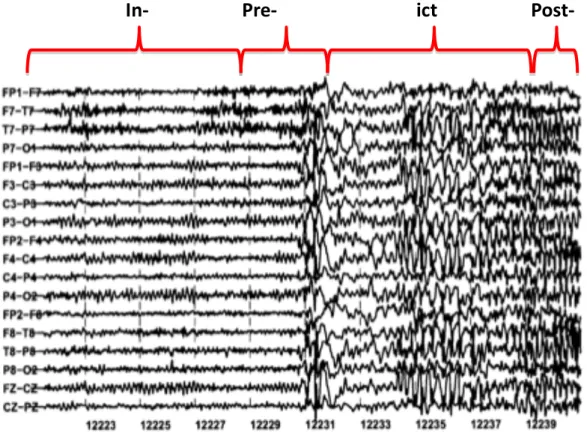
Another main focus in the field of seizure prediction has been the tracking of seizure activity in the EEG signals leading up to the seizure onset in order to develop a better understanding of how seizures occur as well as studying the possibility of predicting seizures before their physiological onset (Le Van Quyen et al. 2001; Martinerie et al. 1998; Chávez et al. 2003). The various length of the prediction window has given rise to two distinctive prediction problems namely seizure detection and seizure prediction; seizure detection entails the prediction of seizure occurrence a few seconds or minutes prior to the seizure onset while seizure prediction entails the prediction of seizures several minutes/hours before the actual onset. Since there are no standard definitions of seizure detection in the literature, we have re-defined detection and prediction in the scope of this thesis: prediction is defined as the correct classification of a determined pre-ictal (pre-seizure) window which is longer than 30

(11)

seconds; detection refers to the correct classification of ictal (seizure) data or pre-ictal data when the length of the pre-ictal window is less than 30 seconds.

The prospect of developing new therapeutic strategies drawing from the advancements in epileptic seizure prediction from EEG records is immensely promising. The automatic prediction of seizure onsets could be used to warn the patient of the occurrence of seizures and therefore allowing them to take action to prevent risks associated with their seizures. Therapeutic plans could also move from long term strategies to fast acting and on demand strategies where the seizure could be prevented prior to full physiological manifestation (Theodore & Fisher 2004; Stein et al. 2000).

1.1.3 EEG Datasets

The public domain hosts several sources of digitised EEG data, but not all of these datasets are deemed useful for a seizure prediction study. Out of the publicly available datasets, a large proportion (~83%) were gathered from non-epileptic subjects, which are of no apparent use to this study. Those gathered from epileptic subjects fall in to two main categories: surface and invasive; surface EEG is placed on the scalp of a patient and captures brain signals from several pre-determined locations of the brain. This type of EEG is non-invasive, poses minimum risk to the subject and is mainly used for the diagnosis and treatment of epilepsy. Invasive EEG on the other hand has a higher signal to noise ratio as is mainly placed on a few focal points on the brain. Due to the invasive nature of this type of EEG, it is mainly used after several scalp EEGs are recorded from the subject, in order to find the exact foci of seizures (more on this in chapter 3). Due to the higher signal to noise ratio of the invasive EEG, this form of recording provides a far more accurate representation of the epileptic brain for the seizure prediction studies. In addition, the application of seizure prediction tools is envisaged to be of closed-loop deep brain form, for which the invasive EEG is a more suitable dataset. For this reason, out of the several online EEG datasets, we only consider the invasive EEG dataset of epileptic subjects.

1.1.4 Machine Learning as a method

Conventionally, statistical methods were used in epileptic seizure prediction studies (Mormann et al. 2007). The statistical methods provide a retrospective analysis where extracted features of EEG are compared for seizure and non-seizure states of the brain.

(12)

This method while widely used in this field of research, provides little applicable seizure detection strategies and is mainly used for the analysis of signal characteristics with respect to the seizure and non-seizure states of the brain. The machine learning approach, which is relatively new in this field of research, provides the ability to detect seizure state at any given timepoint and supports a more applicable model of seizure prediction.

Machine learning algorithms and techniques have been used in several fields of healthcare; originally used for diagnosis purposes, have now moved towards utilisation in disease prognosis and prediction (Kononenko 2001). Numerous studies have been carried out in order to improve our understanding of disease using machine learning, but the majority of these studies have not produced suitable outcome for real life application by clinicians.

The machine learning algorithms used in the field of seizure prediction comprise mainly of variations of Artificial Neural Networks (ANN). Some of the more recent algorithm have reportedly been tested solely on raw EEG data and do not take full use of the rich body of work behind feature extraction from EEG data. Some have only been tested on a small dataset comprising a single patient, while some others have not been correctly validated with respect to both Sensitivity and Specificity of detection. A small number of machine learning algorthims have been applied to multi-patient or advance prediction of seizures, and those reported have produced unsatisfatory results.

With the advancements in machine learning both in terms of more sophisticated algorithms as well as featuure selection techniques and fine-tuning of learning algorithms, and with correct statistical validation, better and more improved techniques of seizure prediction could evolve, further moving towards developing algorithms with real-life applicability.

1.1.5 Validation of Seizure Prediction Studies

The results produced for seizure prediction algorithms, should be highly accurate in order to be applicable in live systems. Several studies have reported high levels of Accuracy (low levels of error) on data. Although in some earlier studies the results were not validated in terms of Specificity or false positives (Le Van Quyen et al. 1999; Martinerie et al. 1998; Le Van Quyen et al. 2001), and some optimistic findings, which were obtained from selected small datasets, could not be reproduced for larger and more

(13)

diverse EEG files (M. Harrison et al. 2005a; Lai et al. 2004; De Clercq, Lemmerling, Van Huffel & Van Paesschen 2003a). In order for the reported outcome of a study to be valid, it should hold for a larger set of test data.

In health care systems including seizure prediction studies, in addition to high measures of Accuracy, Sensitivity and Specificity must also be high. Sensitivity and Specificity, define respectively, how many of the seizure states did the learner correctly classify as seizures and how many of the states classified as seizures were truly seizures. For real life applications, high Accuracy with low Sensitivity or Specificity is not desirable. The trade-off between Sensitivity and Specificity will be considered at the time of application depending on which is favored over the other, although in lab experiments, efforts should be made to maximise all three measures when possible. A large proportion of seizure prediction studies report results in terms of Accuracy, which is commonly high, and disregard the two measures of Sensitivity and Specificity. In order for a seizure prediction method to be truly validated, it must produce high values of Sensitivity and Specificity in addition to Accuracy.

1.2 Central Contributions

The principal research questions of the extensive body of work behind the field of epileptic seizure prediction from invasive Electroencephalography (EEG) records, revolves either around the evaluation of a single new feature which best characterises seizure data or a single machine learning algorithm that accurately detects seizure data. There is little evidence of successful studies where both these principles are considered. In this thesis, we aim to use a generally good machine learning algorithm that is suitable for seizure prediction with multiple established features in a combination of experimental settings on a large set of patient data in order to establish a road map to improved, individualised, seizure prediction.

The seizure prediction literature presents little evidence of seizure prediction in advance of the seizure onset, validated on a large population of patients. In this thesis we further explore the area of advance prediction of seizures in an aim to reveal whether statistically valid outcomes can be obtained across a diverse range of patients.

The advancements in machine learning algorithms have led to improved prediction results particularly among toy datasets, although very few of these novel

(14)

methods have been applied to the field of seizure prediction. In addition to exploring potential improvements in individualised seizure prediction, we aim to apply some of these powerful machine learning algorithms to the complex problem of multi-patient seizure prediction of unseen patients in order to evaluate the possible benefits of using these methods in this respect.

The first contribution is the implementation of extensive many-patient experiments on feature selection and machine learning in seizure detection and prediction, showing that robust and statistically validated performance can be achieved with appropriate feature selection strategies.

The second contribution is that by using feature selection methods and drawing from previous studies and empirical results, we can produce a new set of features that lead to a better performance than the previous set. The statistical significance of our findings is verified across the entire spectrum of patients from our dataset.

The third contribution shows that epileptic seizures can be predicted up to 25 minutes prior the physiological onset with high levels of Accuracy, Sensitivity and Specificity. The advance prediction of seizures can yield higher performance than the onset detection in special cases.

The fourth contribution in this thesis indicates that by using machine learning algorithms suitable for multi-source learning that are trained on the invasive EEG of multiple patients with epilepsy, the generalisation of the epileptic state for unseen patients can be improved with acceptable levels of Sensitivity and Specificity.

1.3 Overview of the Thesis

Chapter 2 provides a summary of machine learning and signal processing concepts and algorithms used in this thesis, with particular emphasis on supervised and semi-supervised machine learning algorithms and the main data features used in this study. The features presented in this chapter are derived from the work of Costa et al. (Costa et al. 2008). The chapter also provides a summary of the curse of dimensionality and ways of dealing with it, focusing on feature selection algorithms used in this thesis. There is a rich body of work associated with each topic presented in this chapter and it is out of the scope of this thesis to discuss every concept in great length. Therefore, this

(15)

chapter should mainly be regarded as a guided summary and full details of concepts should be sought from the relevant references.

Chapter 3 presents a summary on the main problems addressed in this thesis as well as relevant literature to provide sufficient background on the body of work, along with the state of the art. Similar to chapter 2, this chapter merely outlines concepts about epilepsy and seizure prediction that provide a sufficient basis to understanding the core questions of this thesis and for an in depth understanding of the particular topic, relevant references should be visited.

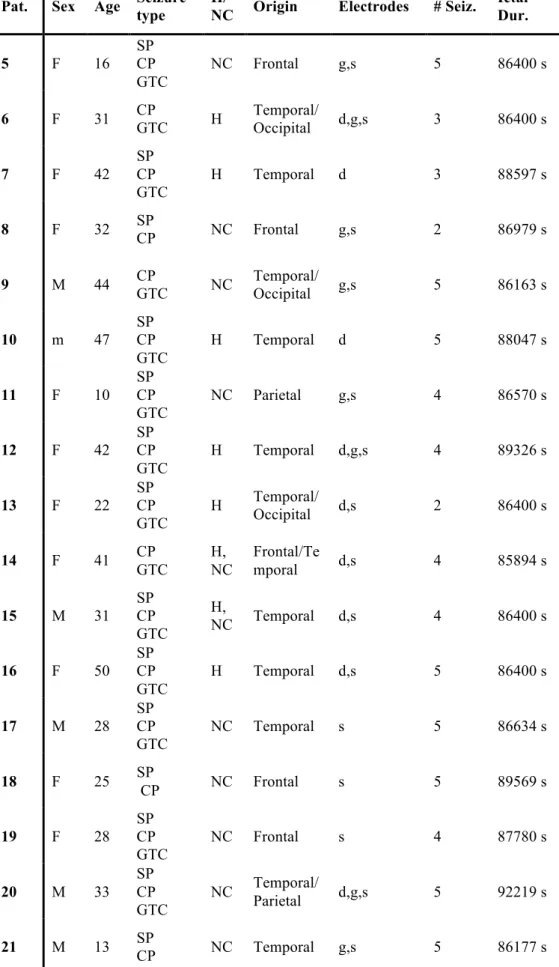
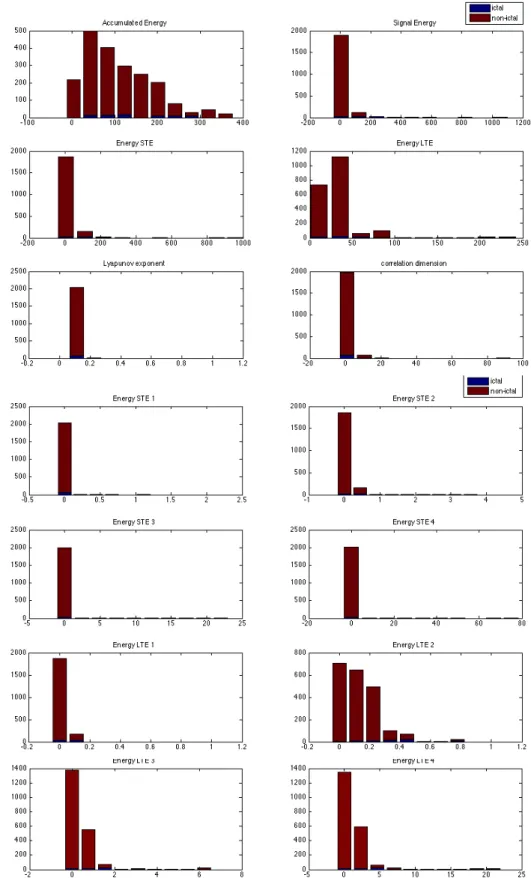
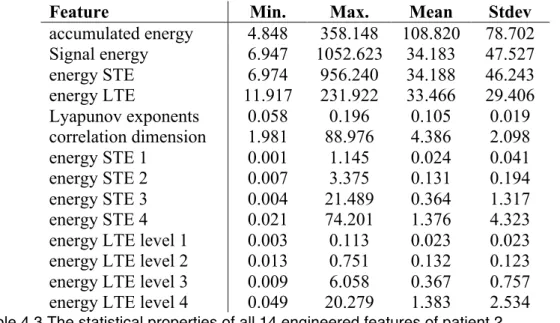
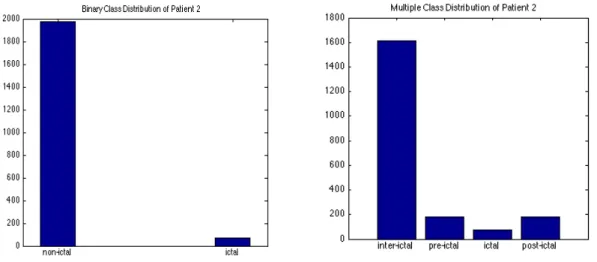
Chapter 4 presents the dataset used in this thesis and noteworthy characteristics of it. Some of the outlined characteristics are the number of patients, attributes of patients, data acquisition techniques and length and format of data. This chapter also includes general data preparation steps and the class distribution of features presented in chapter 2.

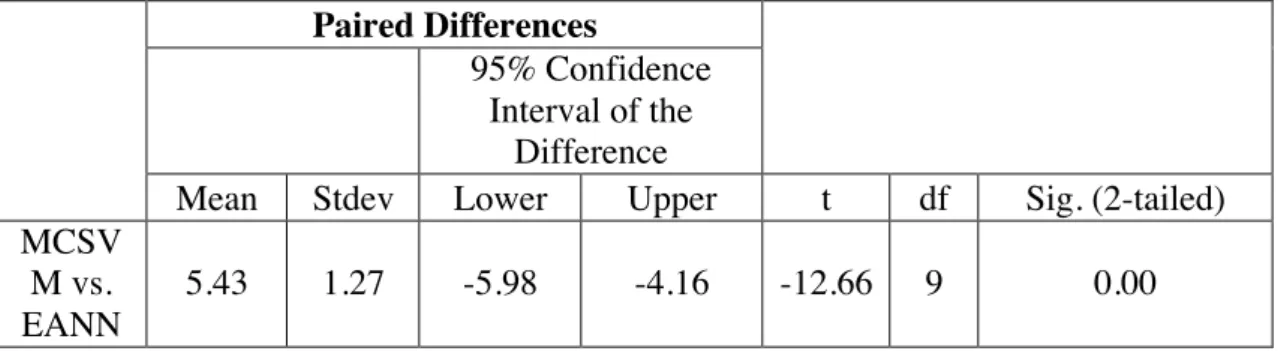
Chapter 5 is the first results chapter and provides insight into the preliminary study of seizure prediction, which determines the principal themes for the rest of the thesis. This chapter is part of a research paper published in the proceedings of the Third World Congress on Nature and Biologically Inspired Computing (Moghim & Corne 2011). While this work does not contain any of the contributions listed in section 1.2, all contributions of this thesis stem from the preliminary empirical findings of this chapter.

Chapter 6 presents the second set of seizure prediction experiments. It is largely based on the principles of feature selection. The chapter provides an exhaustive evaluation of features under several experimental conditions, such as various channel recording and dataset setting and further statistically verifies the findings on more patients from the dataset. The empirical results from parts of this chapter ultimately result in the derivation of a new and further improved feature-set which yields a relatively higher performance on held-out test-sets compared to our benchmark. This chapter largely supports the first and second acclaimed contributions of this thesis.

Chapter 7 presents the third set of seizure prediction experiments. This chapter is largely based on the advance prediction of seizures under several experimental conditions in an effort to explore high performance prediction of seizures prior to the physiological manifestation. The findings of this chapter were statistically validated on

(16)

all patients from the Freiburg EEG Database (Epilepsy.uni-freiburg.de 2007) where possible, and support the third contribution (see 1.2) of this research.

Chapter 8 presents automatic seizure detection in a multiple patient environment where classification models are trained on a set of patients whilst being evaluated on another set of unseen patients and, also on the unseen test-set of the same patients. Studies presented in chapters 5, 6 and 7 were solely based on individualised seizure prediction methods, while this chapter explores several aspects and potential improvement of multi-patient prediction. The chapter also highlights the role of diversity of the training-set on various forms of classification generalisation. Additionally, the chapter introduces other classification algorithms that are better suited for the task of multi-patient seizure prediction, with the aim to showcase the power of a well-selected machine leaning algorithm on improved multi-patient generalisation of seizure states. The work in this chapter supports the fourth contribution item of this thesis (see 1.2).

In Chapter 9 we revisit the contributions made at the start of the thesis under the light of evidence and information presented in the chapters 2 - 8. The main contributions are further broken down to elaborate auxiliary findings of this thesis. The chapter also gives an outlook on potential future work.

(17)

Machine Learning and Signal Processing

In this chapter we present the machine learning, signal processing methods and evaluation techniques used throughout this document. This is, however, not an extensive review of such methods, but rather, a mere introduction to what they are. Throughout this thesis, we apply these methods in an attempt to aid our data-driven exploration of epileptic seizure predictability. Good recent books covering these methods include (Duda et al. 2012; Barber 2012; Bishop 2006; Hastie et al. 2009).

In the first section of this chapter we introduce terminology and mathematical notations that will be used throughout this document in an effort to avoid ambiguity. In section 2.2, we present the feature engineering process and in 2.3 we briefly review the intuition behind feature selection. In section 2.4 we review supervised learning methods used in this thesis and section 2.5 introduces some examples of semi-supervised learning methods. In section 2.6 we present data and model selection techniques and we conclude with a summary in section 2.7.

2.1 Machine Learning Terminology and notation

The term Machine Learning denotes algorithms that learn from data. The discipline intertwines with pattern recognition, the process of searching for patterns within data, historically used in physics.

The input to a machine learning algorithm is a training-set, which is a collection of labeled or unlabeled data. In the case of supervised learning, the training-set comprises data with labels. The machine learning algorithm uses a large set of data to find a model of mappings between training data and training labels. This dynamic model then predicts the label of the unseen data (or test data) and outputs the target vector; each unseen data point has a specific target vector.

Machine learning algorithms use a large collection of data points, namely training data to tune the parameters of a dynamic model. The algorithms used in machine learning are predominantly based on statistical methods; however, biologically inspired and graphical methods are also used in many cases. Generalisation in machine

(18)

learning is the ability of the constructed model to correctly categorise the unseen data. The training-set and test-set are sometimes pre-processed in order to simplify the pattern recognition or enhance the performance of the machine learning algorithm. M : number of training examples

X : input variable/features Y : output variable/target

(x, y) one training example, (x(i),y(i)) ith training example, x1,x2,…,xn

(

)

is the feature vector , where n is the number of the features. H is a function that maps from X Y

The collection of m training example for a training-set with n number of features, is the feature matrix X.

2.2 Feature Engineering

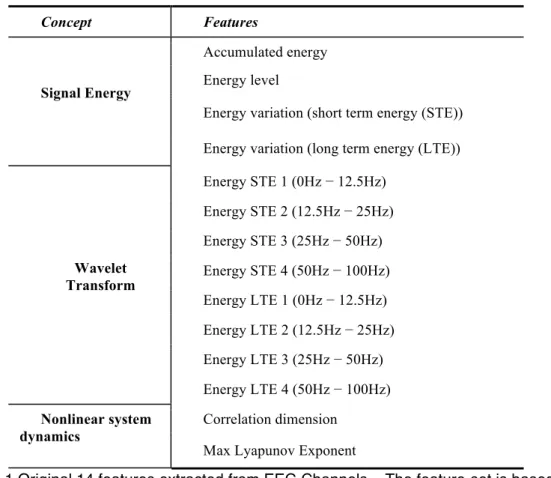
The particular composition of features presented in this chapter was grouped together in a multi-feature study conducted by (Costa et al. 2008). The selected features are amongst some of the most powerful and well-studied features presented in the literature, which are commonly used in single-feature classification case studies (discussed further on in chapter 3). These features are all uni-variate, meaning that they are derived from a single channel.

The features are divided into three general categories: signal energy, wavelet transform and non-linear dynamics.

Signal Energy and Power

The EEG files are digitally recorded, where continuous data are discretised through digitisation in order to be digitally processed. Drawing from concepts of signal processing, we define the digital EEG as a sequence of complex numbers. Amongst the signal properties of discrete-time signals, signal energy and accumulated power are some of the common yet powerful features used in EEG feature engineering.

The energy of a discrete time signal (Prandoni & Vetterli 2008) is define as:

(1) Ex= x 2 2 = x n

[ ]

2 n=−∞ ∞

(19)

The value of the signal is squared in order to produce a positive measure of the area under the signal curve, which could either be negative or positive. As presented in chapter 3, the changes in the transitions from pre-seizure to seizure states are tractable in signal energy values (Mormann et al. 2007). We define the power of the signal as:

(2)

This limit however is undetermined due to the periodic nature of infinite energy signals and is instead defined by the average energy over a time period:

(3)

Figure 2.1 displays the Signal Energy of patient 2 from the Freiburg EEG Database, captured from all 6 channels. From Figure 2.1, we observe that the signal energy produced by each channel varies particularly during the seizure.

Figure 2.1 Signal Energy over 6 EEG channels for patient 2 of the Freiburg EEG Database – There is ictal activity from second 5 through 35.

Px= lim N→∞ 1 2N x n

[ ]

2 −N N−1

Px = 1 N x n

[ ]

2 n=0 N−1

(20)

The accumulated energy is another powerful means of finding abnormal behaviour in the brain. The accumulated energy is the sum of successive values of signal energy in a moving window analysis. Here, the signal power is integrated over a sequence of time windows:

(4)

gives us the accumulated energy at time t, by the accumulation of the signal energy variance in time window k, starting from 1 to t. Figure 2.2 displays the changes in accumulated energy of patient 2, calculated for each of the 6 EEG channels. The image displays similar trends of accumulated energy through different seizure-states for most channels. Channel 3 however displays a noticeably different trend of accumulated energy and signal energy (as seen in Figure 2.1).

Figure 2.2 Accumulated Energy over 6 EEG channels for patient 2 – There is ictal activity from second 5 through 35. AE(t)= σk 2 k=1 t

AE(t) σk 2

(21)

Both of these features were calculated over an overlapping moving window analysis. The length of the window is 7 seconds with sampling rate of 256 Hz, and the overlap between each window is 50%.

Signal energy is further calculated over variable size windows to construct two additional features. We consider using two different lengths of sliding windows. The short-term energy and the long-term energy encoded respectively as STE and LTE. The length of the STE window is 9 seconds and the length of the LTE window is 180 seconds. This produced two features at each 5-second timepoint.

Wavelet Transform Accumulated Energy

Discrete Wavelet Transform is a space-time form of signal analysis, which decomposes the signal at different frequency bands and samples wavelets in a discrete way. It considers both spatial and temporal properties of the signal and can therefore capture characteristics that may have been missed by single-modal features (Gigola et al. 2004). The signal energy of each decomposition level is determined by:

(5)

Where j is the decomposition level and d(i) corresponds to the decomposition co-efficient. The wavelet decomposition coefficients are used to determine the accumulated energy of each frequency band using a short term and long-term energy, moving-window analysis:

(6)

where k is the current time-segment, b is the length of the window and b-a is the overlap between adjacent windows.

Wavelet decomposition was carried out over the Daubechies mother wavelet with decomposition level 4 using EEGLAB, an open source EEG analysis and

visualisation tool (Sccn.ucsd.edu 2011). Daubechies discrete wavelet transformation

(Daubechies & Sweldens 1998) constructs orthogonal wavelets and through scaling, multi-resolution wavelets can be attained. The wavelet accumulated energy was

Ej = dj 2 (i) i=1 Nj

AEj(k)= dj 2 (i) i=a(k+1)+1 a(k+1)+b

+AEj(k−1)

(22)

calculated over a Long-Term-Energy window (LTE) of 180 seconds and a Short-Term-Energy window (STE) of 9 seconds long.

Non-linear dynamics

Non-linear features have had a mixed review in the EEG signal-processing community. In some studies they have been suggested to be superior in performance in comparison to the linear features due to the aperiodic and unpredictable behaviour of seizures (Iasemidis et al. 1990; Le Van Quyen et al. 1999), while other studies suggest that linear attributes perform as well, if not better than non-linear dynamics (Mormann et al. 2005). Non-linear features are drawn from the theory of dynamical systems (Schuster & Just 2006; Kantz & Schreiber 2004; Ott 2002) in contrast to the direct derivation of linear methods from the time-series signal. Non-linear dynamical systems can represent chaos, a perceivably unpredictable behaviour that is fundamentally deterministic. Dynamical systems capture the behaviour of a system in different states in time through fixed deterministic rules, and the states at any given time are derived from a state space. The following are two dynamical system attributes used in this thesis:

Maximum Lyapunov Exponent

In deterministic systems, Lyapunov exponent (Rosenstein et al. 1993; Kantz 1994) is the rate of separation of infinitesimally, close trajectories in the phase space (i.e. the space where all possible states of the system are represented) and is defined as:

(7) Where is the Lyapunov exponent and C is the measure of the initial separation. The maximum (also referred to as largest or maximal) Lyapunov exponent is the largest Lyapunov exponent among the spectrum of Lyapunov exponents which encompasses various divergence rates for different orientations of the initial separation and is derived from the following approximation:

(8)

dj(i)≈CjeLmaxiΔt

Lmax

(23)

and is calculated using a least square over

(9)

where y(i) is a line averaged over j. Correlation dimension

The correlation dimension (Grassberger & Schreiber 1991) is an estimation of the number of active degrees of freedom of random points within a state space. It is denoted with v and is calculated using the correlation integral (Grassberger & Procaccia 1983). The correlation integral (or sum) is the estimate local probability density of the points in a state space:

(10)

where N is the number of states, is a norm, is the so-called Heaviside step function. The integral is calculated on the number of pairs of vectors in a radius .

The correlation dimension is defined as:

Subject to

(11)

The correlation dimension is very quickly calculated and is robust to noise, making it one of the more suitable measures for dimensionality estimation.

Non-linear dynamics, namely Maximum Lyapunov Exponent and Correlation Dimension were calculated over a 7 second window size with 50% overlap between adjacent windows. y(i)= 1 Δt lndj(i) C(ε)= lim N→∞ 1 N2 Θ i,j=1 ij N

(

ε − xi−xj

)

i Θ ε D2 = lim N→∞limε→0d(ε) d(ε)=dlnC(ε) dlnε

(24)

2.3 Feature Selection and Dimensionality Reduction

In machine learning studies, high-dimensional datasets may result in what is known as the curse of dimensionality (Bishop 2006). The existence of redundant or irrelevant data in the dataset, can lead to higher classification error while yielding low training error. This is also known as over-fitting. The redundant features provide no further information and irrelevant features are irrelevant to the learning task at hand. Methods exist which reduce the number of features in a dataset and have proven to be useful particularly in datasets, where the number of learning examples is low compared to the number of features. There are two general ways for reducing dimensionality: feature selection, which assembles a smaller subset of optimal features, and feature extraction, which projects the high-dimensional feature space to a low-dimensional feature space. We only consider feature selection methods in line with our research, due to the inherent ambiguity prevalent in feature extraction outcomes such as Principal Component Analysis, which make them unsuitable for this study.

2.4 Feature selection

Feature selection methods extract a subset of features from the full feature-set. This can improve the interpretability of the learning model, and can decrease computation time of learning and also avoid over-fitting.

Feature selection methods can produce feature-rankings as an auxiliary outcome of improving prediction. In some cases, these rankings are not only used in prediction, but are also used for better interpretation of complex features, examples of which are seen in microarray analysis, when rankings are used to discover drug leads. Ranking criteria vary among feature selection methods, with each having a particular feature-reduction goal. Some feature selection methods emphasise on improving computation time while others are more suited for interpretability and visualisation purposes.

Feature selection methods generally fall in two categories (Guyon & Elisseeff 2006):

(25)

2.4.1 Wrapper Methods

The Wrapper method is a black box feature selection method, which uses the learning algorithm as an evaluation tool. It uses the learning performance of a leaning algorithm to assess the suitability of the feature subset. This makes it highly dependent on the learner in use. Wrapper methods may perform well with a particular learning algorithm, while they may perform poorly with another. They are usually computationally expensive, as they require several runs of the learning algorithm prior to finding the optimal feature-set that yields the highest performance, although with suitable search strategies, the computation cost can be somewhat reduced.  

2.4.2 Filter Method

Filter methods are a general type of pre-processing feature selection methods, often resulting in a ranking table. They are pre-processing methods, as they are used prior to classification and are therefore independent from the learning algorithm. The filter method ranks features according to a given criteria, some of the notable ones are minimum Redundancy-Maximum Relevance (mRMR) (Peng, Long & Ding 2005b) which, as the name suggests, finds features with the highest relevance and lowest redundancy in a two-step process, and ReliefF (Moore & White 2007) which ranks those features with the higher discrimination power with regards to the target label. In studies where features and their composition is of high importance, filter methods are mostly used, but are also, at times, used as a pre-processing step to other dimensionality-reduction techniques, such as wrapper methods or feature extraction. This form of feature selection algorithm is also preferred over some wrapper methods due to the low computational time and high scalability power.

For the purposes of this study, we have selected a filter feature selection method, which is widely used in the Information Theory and Bio-informatics community, particularly because of their ability to perform well on very large feature-sets. Although wrapper methods seem to be a better choice for directly improving the classification Accuracy, there are a number of reasons for choosing filter methods over the alternative wrapper methods for the purposes of our study (Guyon & Elisseeff 2006; Saeys et al. 2007); Some of these are explained below:

(26)

1- Computation time: Wrapper methods are wrapped around the learning model, repeatedly testing feature subsets in the cross-validation set. The implementation of wrapper methods may result in a decreased validation error rate; however, it demands a great deal of computation time for learning the model. Diversely, the filter feature selection methods are separate from the classification entity, reducing the overall computation time by allowing one-off calculation of the rankings prior to learning, followed by model learning on the now reduced feature-set. This is considerably faster than the repeated evaluation of features at each stage of cross-validation, when using wrappers. We will see that this is particularly important as the size of the feature-set and dataset increases in certain experiments, where the learning process becomes lengthier in time. Therefore, deploying a wrapper feature selection method, in addition to the overheads of slow learning process will negatively impact the computational time, without the additional benefits of a filter method.

2- Evaluation consistency: In order to be able to plausibly compare and contrast experiments in this chapter and chapter 7, we need to use homogenous methods and settings across all studies; feature selection is one of such methods. Although it would be computationally justifiable to use wrapper methods on smaller datasets/feature-sets and use filter methods once the dimensionality increases, this however poses inconsistency in our methods which makes evaluation of the results of these separate experiments erroneous. Therefore, in view of evaluation consistency, we have used consistent feature selection methods for all the experiments.

3- Interpretability: Wrappers are black box methods, providing little

information about the selected features, and their corresponding impact on the classifier. They also impose further difficulty in terms of consistent and smooth feature selection in the face of varying cross-validation and training-sets. If the wrapper starts at 14 features and re-orders these features in accordance to the classification error of the validation-set, and then carries another round of feature selection, the ordering of the features could be different in each round of cross-validation, revealing little information about the intrinsic characteristic of the features and their direct impact on the validation-error rate. With filter methods, however, feature selection is carried out in one step, prior to

(27)

classification, where a solid and informative table of feature rankings is created. This use of ranking tables, along with full control over ranking updates are of the most important criteria in our choice of feature selection algorithm, which justify the use of filter methods for our series of experiments.

4- Generalisation: The wrapper methods are highly coupled with the

learning algorithm, meaning they may perform differently under alternate learning models, whereas the filter methods are learner independent, allowing for a better generalisation across various forms of learning. This is particularly of importance for the purposes of our seizure detection study as i) the algorithm in use is not the focus of the research; we have followed a ‘dirty’ approach to learning, by selecting and further fine-tuning a well-known classifier, which has reportedly been applied to similar problems, according to our review of the literature ii) we aim to analyse the intrinsic properties of the features, independent of the classifier in use. The goal here is not to solely improve prediction, more so to improve prediction on a simple classifier. By manipulating the feature-set according to their inherent characteristic and relevance to the class labels (seizure states), in the effort to identify optimal features, regardless of the underlying learning algorithm.

ReliefF

Relief is an attribute estimator filter algorithm used for feature selection. In the earlier version of Relief (Moore & White 2007), the conditional dependency of features is estimated using a nearest neighbor algorithm, where the quality of the features are assessed by the discriminant power of them, and of values that are near each other. In this method, for each randomly selected data point, the nearest instance from the same class and the same data point from a different class are selected. The features that highly discriminate between the two different classes are given a higher ‘quality estimation’. This re-evaluation of features is carried out for number of random instances, on an length dataset. This algorithm performs particularly well on large datasets, with as little as 4 minutes on average to rank the features, with computation complexity of  where a is the number of features. The algorithm has widely been used for feature selection on large datasets, as well as in guiding the

m n

(28)

induction phases of regression decision trees and various other settings, due to their intuitive interpretability. ReliefF is a variation of the original Relief algorithm, which can deal with multiclass learning (Kononenko 1994).

2.5 Supervised Machine Learning

In supervised learning, examples of correctly labeled test data is used to predict the label of unseen data. One type of supervised learning is classification, in which the

classifier is trained based on samples of collected data (known as training data), where a

suitable model which closely represents the known training data is constructed and algorithmic parameters are estimated. The trained model is then optimised through validation techniques in order to produce an accurate prediction on unseen data. The primary outcome of this process is finding a model that generalises the data based on a particular training-set, and using the constructed model to make predictions on the target value of unseen data. We first present Artificial Neural Networks (ANN) and will follow by introducing the Support Vector Machine (SVM).

Artificial Neural Networks

Artificial Neural Networks (ANN) are perceptron based learning systems, originally attempted to model the information processing in the brain, which can deal with linearly inseparable and high dimentional data (Kotsiantis et al. 2007). Multi layer ANNs are created from three classes of connected neurons (Figure 2.3): input, hidden and output; where the neurons in the network are connected by weighted edges, input units receive training information, output units store the result of the classification, and hidden units are the neurons in between these two units. Feed-forward is the simplest form of ANNs, where signals only travel in one way.

One of the main decisions when designing neural networks is to determine the number of hidden layers, as low number of neurons could result in poor generalisation and too many neurons could result in the model over-fitting the data. Another important feature is the choice of the weights of each input connection; the value of weights are initially set to random values and change at each step of the training, as the result of the output is compared with the desired output.

(29)


Figure 2.3 Feed Forward Artificial Neural Network (Kotsiantis et al. 2007)

Back propagation is a well-known learning algorithm used for training ANNs where input neurons send signals all the way to the output neurons, passing activation values and weights through the hidden layers. Evolved Neural Networks (EANN) are the standard neural network trained by an evolutionary algorithm.

Feed-forward neural networks most commonly use back propagation, as a result, the training algorithms are usually very slow, but estimating optimal initial weights as opposed to picking random weights can speed up the performance. Genetic algorithms work particularly well for training optimal ANN weights and architecture. Bayesian methods are also reported as being useful for training ANNs. Pruning, where useless nodes are removed, and constructive algorithms where extra nodes are added are also techniques used for improving ANN training algorithms.

The main drawback of ANNs is their black box approach towards problem solving, which does not provide reason or meaningful insight into how the learning problem was solved. Symbolic rules may be extracted from trained ANNs but this is nowhere near the comprehensiveness provided by other alternatives, such as decision trees. Among other problems, are long training times and tendency to converge to the local optima due to poor feature selection.

Support Vector Machine

A support vector Machine is a classification model in which an optimum separating hyperplane divides the instance-label pairs (Hsu et al. 2003; Chang & Lin 2011; Cortes & Vapnik 1995). The SVM specifies a margin between the separating hyperplane and the data points at either side of the plane (the support vectors). The linear combination of the support vectors on either side of the margin represents the

xi,yi

(30)

feature-mapping model, ignoring other features. This makes the SVM suitable for learning tasks with a high number of features.

A support vector machine solves the following optimisation problem: Given a training-set of instance-label pairs

                  1 2w T w+C ξi i=1 l

(12) Subject to

Where C is the regularisation parameter, is a non-negative slack variable used with soft margin SVMs to measure the degree of misclassification, and is known as the kernel function. When data are linearly inseparable, the SVM simplifies this optimisation by mapping the training feature-vector to a higher dimensional space, through a kernel function φ,

K(xi,xj)≡φ(xi) Tφ

(xj) (13)

The kernel function decreases the computational power required for calculating the mappings of data to a higher dimensional space, as it enables making fast classifications without the need to essentially map each data point to a higher dimension. The Kernel used in this study is the Radial Basis Function (RBF) kernel:

K(xi,xj)=exp(−γ xixj

2

),γ >0. (14)

Figure 2.4 visualises the SVM-RBF classification. In order to find the best kernel function parameter, SVM can be used along Cross-Validation.

Multiclass SVM is used for multi-label classification problems. Multiclass

SVM is constructed from one SVM for each class label. When presented with new data, the classifier makes a prediction with each SVM and chooses the class label associated with the SVM that placed the prediction furthest into the positive region.

(xi, yi), i = 1, . . . , l min w,byi(w T φ(xi)+b)≥1−ξi, ξ ≥0,i=1,,l, ξi, φ(xi)

(31)


Figure 2.4 An example of binary SVM with RBF Kernel

2.6 Semi-supervised Learning

In machine learning, a learning task can have a combination of labeled and unlabeled data. The semi-supervised learners can be used to learn from both types of data. Two of the notable types of semi-supervised learning are Multi-Task Learning and Deep Learning.

2.6.1 Multi-Task Learning

Multi-Task learning (MTL) (Ando & Zhang 2005; Caruana 1997) is a form of semi-supervised learning, also a subset of inductive transfer learning (Baxter 2000), which enables learning of similar problems at the same time, by using the communally shared between the learning tasks. The diagram in Figure 2.5 depicts the difference between the architecture of Single-Task Learning and Multi-Task Learning. Single-Task learning trains a model on the training-set of a single task and applies it to the test-set, resulting in several learning models for similar tasks.

(32)

Figure 2.5 Single-Task Learning vs. Multi-Task Learning (Zhou et al. 2012)  

MTL uses the common knowledge shared between tasks through a shared representation to generalise over the various related tasks. The assumption behind this form of learning is that what’s learned from each task can aid the learning of other tasks. Multi-Task Learning, although a semi-supervised learning algorithm, can also be used in solely supervised learning tasks, instances of which are applied in multi-modal learning studies such as multi-source learning for multi-modality neuro-Imaging data (Yuan et al. 2012) where data may be extracted in various modalities.

Multi-Task Learning using Alternating Structural Optimisation

Multi-Task Learning using Alternating Structural Optimisation (ASO) (Ando & Zhang 2005) uses alternating structure optimisation to discover a shared feature mapping between the tasks. ASO is based on the assumption that a common predictive structure exists among related tasks where parallel learning can find the shared low dimensional predictive structure. This principle is displayed in Figure 2.6, where Θ is the shared

low dimensional feature map and Um is the weight vector learnt from task mand Vm is the weight vector learnt from the shared low dimensional feature space of task m.

(33)

Figure 2.6 Multi-Task Learning using Alternating Structural Optimisation (Zhou et al. 2012)

The model of each task is divided into two main components, which are task-specific feature mappings and task-shared feature mappings. The learning goal in the ASO Multi-Task Learning algorithm is: -

min {vt,wt},Θ ( 1 nt L(wt)+α wt 2 ) t=1 T

Subject to ΘΘT =I, wt =utTvt, (15)

Where nt is the number of samples of the t-th task, L is the loss function, α is a

predefined regularisation parameter and wt is the weight vector of the high-dimensional

model. The predictor of task t is determined by

ft(x)=wt T x=ut T x+vt T Θx (16)

(34)

This formulation, however, is non-convex. A relaxed, convex alternative, which is also scalable to large datasets is, the convex Alternating Structural Optimisation (cASO) (Chen et al. 2009) and is determined by:

min {wt},M ( 1 nt L(wt)) i=1 nt

+αη(1+η)tr(WTI+M)−1 W) t=1 T

Subject to tr(M)=h, MI, MS+ d (17)

Note that M is ΘTΘ , and η=βα >0 , where α and β are pre-determined

regularisation parameters. The performance of cASO has been suggested to be as good as ASO on benchmark data, but with reduced computation costs.

2.6.2 Deep Learning

Deep learning refers to a category of semi-supervised machine learning algorithms in which layered models of input data are learned (Bengio 2009). This form of learning is closely related to the development of the human brain in cognitive neuroscience and distributed representation. The assumption behind the learning algorithm, is that different factors of data, which may be known or unknown at time of training, result in several representations of the data, from which generalisation about similar factors in the unseen data is possible. This representation is layered, where each layer represents different levels of data abstraction. The layers in the model form different representations of the input, with the more abstract higher levels drawing from the lower levels.

Deep learning is commonly applied to Neural Networks and can be used in unsupervised and semi-supervised learning. It has been widely applied to studies in speech recognition and signal processing, object recognition, transfer learning and Natural Language Processing.

Deep Belief Networks

Deep Belief Networks (DBN) (Arel et al. 2010; Bengio et al. 2013) are a form of deep learning constructed of multi-layered stacks of Restricted Boltzman Machines (RBM).

(35)

Restricted Boltzman Machines are simplified neural networks, which are restricted to have a single hidden unit and a single visible unit. They are suitable as building blocks of more complex models, due to their simple architecture. Deep Belief Networks differ from traditional neural networks, in that they are generative models, which can capture the joint distribution over observed data, and labels from which new data can be generated. Neural networks on the other hand, are discriminative models and are limited to produce the probability distribution of class-labels given observations. More so, DBNs solve a number of problems associated with neural networks such as i) slow learning ii) converging to local optima due to poor parameter selection.

Figure 2.7 The Architecture of Deep Belief Networks (Arel et al. 2010)

The generative DBNs are constructed through a pre-training step where unsupervised, greedy learning, is conducted on a layer-by-layer basis. Visible units pass a vector v down to the hidden units, after which, the hidden units reconstruct the visible input according to the vector v. The traversal between hidden units and visible units is called Gibbs sampling. The weights are updated based on correlation between hidden layer activations and visible input.

DBN can be used in classification after fine-tuning the outcome of the pre-training step. In order to achieve this, labeled data are used in back propagation where a

Figure

Figure 2.2 Accumulated Energy over 6 EEG channels for patient 2 – There is ictal activity from  second 5 through 35
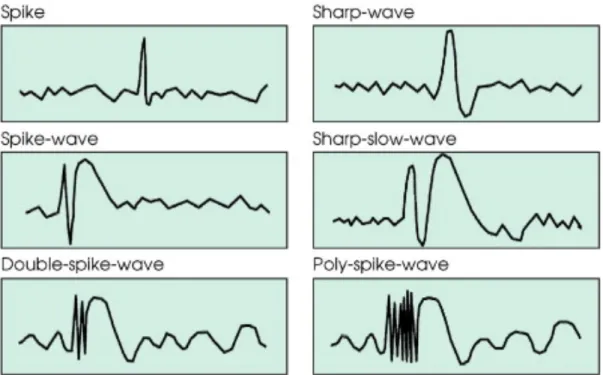
Figure 3.1 Various Forms of Inter-ictal discharges observed in EEG recordings (Elger &
Table 4.1 Characteristics of Patients of The Freiburg Invasive EEG Database (Epilepsy.uni-
Figure 4.3 The accumulated energy of Patient-File 2 which contains three 1hour segments  of ictal data
+7

References

Related documents

The current study has tested two previously-published RILD models M1 and M2 (2, 3) on the independent validation sets V1 and V2 of the SCOPE1 trial data (18, 19), which

The main contribution of this study is to decrease income inequality in risk sharing network such as informal insurance through an analytical method, this study

the Siberian stonechats, whereas the growth rate towards adult wing length is higher in the European stonechats (note, however, that in the European birds the wing

Before your scan begins, you’ll be asked to provide information about your medical history and any previous experience with X-ray contrast (“dye”).. Preparation for a CT scan

It then discusses the impact of the market crisis beginning in 2007 on short sale regulation, the current debate over the Securities and Exchange Commission’s (“SEC”) revisions

Optimal control strategies, both in the case of hospitalization (with and without quarantine) and vaccination are used to predict the possible future outcome in terms of

Resumo – O objetivo deste trabalho foi avaliar a patogenicidade de Beauveria bassiana a ninfas de Diaphorina citri (Hemiptera: Psyllidae) e verificar a compatibilidade do