Saving forests to mitigate climate change: What can microfinance
contribute to the REDD+ policy process in Ghana?
Ernestina Fredua Antoh, PhD
Senior Fellow, Bureau of Integrated Rural Development (BIRD), Kwame Nkrumah University of Science and Technology (KNUST), PMB UPO Kumasi, Ghana
E-mail: [email protected]
Albert A Arhin, MSc (Corresponding author) Department of Geography, University of Cambridge,
Cambridge, CB2 3EN, United Kingdom E-mail: [email protected];
Kwaku Obeng-Okrah, M.Phil
Research Fellow, Bureau of Integrated Rural Development (BIRD), Kwame Nkrumah University of Science and Technology (KNUST), PMB UPO Kumasi, Ghana
[email protected] Abstract
Deforestation is estimated to contribute to one-fifth of climate change. The idea of Reducing Emissions from Deforestation and forest Degradation (REDD+) has been promoted by UN Framework Convention on Climate Change (UNFCCC) to save tropical forest and mitigate climate change. In Ghana, deforestation is thought to have been driven largely by expansive cocoa production system. In view of this, the policy strategy of the Government has focused on improving cocoa productivity to reduce the expansive forms of agriculture into forest areas. This paper discusses the roles that microfinance can play in this effort. It draws on long-term research on microfinance and semi-structured interviews from hundred households in seven communities around the Kakum National Park in the Twifo Hemang Lower Denkyira District, Ghana. The paper finds that microfinance can enable smallholder farming communities to reduce deforestation in Ghana through at least three roles. These are (a) agricultural investment (b) technological adoption and (c) agribusiness skills development. Based on these findings, it is recommended that the project implementers stand a better chance of achieving the project objective if they include microfinance elements into the programme. Given the centrality of REDD+ in the international effort of climate change mitigation, this research adds important insights into one of the ways through which the vision of halting, slowing and reversing trends of deforestation could be achieved in Ghana and elsewhere.
Keywords: microfinance, REDD+, climate change, Ghana, agriculture
1. Introduction
Climate change is regarded as one of the most significant long term development risks of the 21st century (World Bank, 2010). Scientists warn that millions of people, especially the poor could be exposed to an increased incidence of droughts, famine, and floods; unreliable rainfall patterns; rising sea levels; food and freshwater shortages and the loss of their livelihoods if climate change is not mitigated Bernstein et al (2008). Deforestation and forest degradation contributes to about 12–20% of the anthropogenic carbon (CO2) emissions causing
climate change (Van Der werf, 2009; Stocker et al., 2013). In view of this, the policy of REDD+ has been adopted by the United Nations Framework Convention on Climate Change (UNFCCC) to reduce global forest sector emissions to mitigate climate change. The REDD+ refers to a policy mechanism for Reducing Emissions from Deforestation and Degradation (REDD) and the ‘+’ referring to conservation, sustainable management of forests and enhancement of carbon stocks. The prime objective of REDD+ is to reduce forest loss and reverse carbon emissions from the forestry sector (UNFCCC, 2011). REDD+ has continued to inspire global climate policy optimism. It remains an essential component of the recently launched Sustainable Development Goals (SDGs) and the 2015 Paris climate change agreement that seeks to limit global temperature to below 1.5 OC
(UNFCCC, 2015).
In Ghana, REDD+ has been adopted to reverse the country’s declining forest cover estimated at 1.8% per annum (Forestry Commission, 2010; Forestry Commission, 2016). Following series of reviews and analyses, expansion of cocoa farms has been identified as the main cause of deforestation in the country. Accordingly, the Government of Ghana is seeking to reduce forest sector carbon emissions through a cocoa intensification approach (Forestry Commission, 2016). The core intention of the policy approach is to increase cocoa yields and income levels of farmers without significant expansion of total land available for agriculture. Income levels are expected to reduce the need for expansion of farms and forest encroachment, and ultimately reduced deforestation. In the context of this ongoing process, this paper asks: what roles can microfinance schemes play to help achieve the objectives of REDD+? Asking this question is important for at least two reasons. First, access to credit has been documented in extensive research as a critical factor that shape uptake and participation in agricultural innovations and policies (Nosiru, 2010). Understanding the roles, it can play in the ongoing REDD+ could inform the design of policies that effectively reduce deforestation. Second, there is increasing calls for research to explore the roles that microfinance could play in climate change mitigation broadly (Fenton et al., 2015). Bringing together REDD+ and the burgeoning literature on microfinance represent an important first step.
The aim of this article then, is to explore the potential roles microfinance can play to achieve forest loss reduction, while avoiding common pitfalls for farmers, in the context of the unfolding REDD+ process. In doing so, we hope to make contributions to both the global and national efforts of mitigating climate change through REDD+. Following this introduction, the paper proceeds as follows. Section 2 provides a literature review on the concepts of microfinance and situates the research in the climate change literature. Section 3 introduces the methodology before presenting the results and discussion of the findings in section 4. Section 5 draws conclusion and policy recommendations for the research.
2. Literature Review
2.1 Microfinance, climate change and sustainable development
Microfinance is diverse in form. Microfinance schemes also differ in many ways including type of financial services they provide (financial and non-financial services), legal status of and ownership (private, cooperative, hybrid), scale of operations (local, national, international) sources of funds (member contributions or not etc) among others (Matin, Hulme, & Rutherford, 1999). Microfinance schemes have conventionally focused on provision of credit to low income groups in diverse settings (Antoh et al, 2014). Diverse financial and non-financial services have been designed by microfinance institutions for raising human capital development and promoting sustainable development over the years (Antoh et al, 2014). The literature on microfinance is rich and extensive. In the context of sustainable development, two forms of literature can be distinguished. The first focus has been on the problems that poor people face in accessing financial intermediation services as a result of factors such as collateral securities (Afrane, 2002; Antoh et al, 2015a; Antoh et al, 2015b). This growing body of literature has directed attention to the important roles that microfinance play in overcoming such challenges. Through this growing body of works, the strategic roles that microfinance schemes play in reducing poverty, empowerment for marginalised groups and attaining other environmental outcomes have been emphasised. This type of literature has empirically documented how microfinance schemes have improved access of beneficiaries to myriad of socio-economic facilities such as health, nutrition and education (Afrane, 2002; Khavul, 2010; Odell, 2010). For example, Asiama and Osei (2007) have noted that microfinance helps poor households in Ghana to improve their household income and meet their basic needs. Similarly, Pronyk et al. (2007) contend that microcredit benefits poor households by making income, food, shelter, education and health available to them. For Littlefield (2005), microfinance creates opportunities for poor people to to invest in their businesses, improve their well-being and educate their children—which leads to human capital development (also see Antoh et al, 2015). Other studies have also emphasised the positive role of microfinance on agricultural productivity (Nosiru, 2010; Gariba and Mwakeje, 2010; Adams and Bartholomew, 2012). Several gender activists have equally made a case in favour of microfinance about its role of empowerment through supporting women’s economic participation. Boyle (2009) has further demonstrated how support for women’s economic participation through microfinance has generally led to improved household well-being.
The second body of work has assessed impact of microfinance on enterprises, households and individuals (Vaessen et al., 2014; Duvendack, et al, 2011) and emphasised how microfinance schemes fail to achieve their sustainable development goals (Khandker, 2005; Karlan and Zinman, 2010). In particular, this type of literature has emphasised repayment difficulties which have often made low income groups worse off (Husain, Mukherjee & Dutta, 2010; Rooyen, Stewart & De Wet, 2012). For Roodman (2009), microfinance schemes have the potential of leaving people worse off, similarly to the ways through which credit cards and mortgages have made people poorer in developed countries. Karnani (2007) has made a similar observation and argued that the poverty reduction claims of microfinance have been over-emphasised. In a recent review, Yeboah et al (2015) cautioned that the extent of impact of microfinance on gender empowerment is much more complex than what the popular rhetoric preaches. From these literature, the role and effect of microfinance on sustainable development is therefore hotly contested.
In recent times, this debate has been rekindled in the context of climate change, deemed as the most pressing environment, social and political risk of the 21st century (World Bank, 2009; Fenton et al, 2015; Fenton et al, 2017). The attention to microfinance emerged from the concern that climate change may stall or even reverse the positive gains made towards sustainable development, including poverty reduction and environmental protection (ADB et al. 2003). Microfinance has consequently been presented as an important policy tool for reducing vulnerability through enhancement of coping capacity (Heltberg, Siegel, & Jorgensen, 2009); and adaptive capacity (Agrawala & Carraro, 2010; Hammill, Matthew, & McCarter, 2008). While the literature in this area is growing, far less attention has been giving to the potential role that microfinance could play in the various efforts being advocated to mitigate climate change. This is particularly true for the REDD+ policy.
REDD+ was adopted by the United Nations Framework Convention on Climate Change (UNFCCC) in 2005 as a global policy to reduce forest loss and reverse carbon emissions from the forestry sector (UNFCCC, 2011). In its most basic sense, the idea of REDD+ seeks to provide economic incentives to tropical developing countries to reduce deforestation rates or enhance carbon stock stored in their forests. Countries that are able to reduce their deforestation and verified carbon emissions would be rewarded through market-based or non-market financial schemes (Angelsen, 2008; Pistorius, 2012). Available literature suggests that at least 29 out of the 54 African countries have embraced it as a cardinal means to reduce their forest sector emissions. In Latin America, at least 18 of the 26 countries are at various stages of implementation while about 19 countries in Asia-Pacific are also involved with REDD+ (UNREDD, 2016; FCPF, 2015). REDD+ also remains an essential delivery mechanism for the seventeen Sustainable Development Goals (SDGs) recently agreed by the 193 countries of the United Nations General Assembly to among other things end poverty and hunger and improve global prosperity (Lima et al., 2017; Turnhout et al., 2016). The role of REDD+ is particularly pertinent to the goals to ‘protect, restore and promote sustainable use of terrestrial ecosystems, sustainably manage forests, combat desertification, and halt and reverse land degradation and halt biodiversity loss’ and those relating to taking ‘urgent action to combat climate change and its impacts’ (United Nations, 2015: 14/35). This paper looks at the implementation of REDD+ in Ghana and explore the extent to which inclusion of microfinance schemes in the package of strategies being implemented could enable or hinder the policy objectives. The next section briefly describes the REDD+ policy process in Ghana.
2.2 REDD+ Processes in Ghana
Ghana, located in West Africa, has a land area of approximately 23.9 million hectares and an estimated population of 27 million (Ghana Statistical Service, 2010). Ghana is endowed with array of land-based natural resources such as Gold, Timber, Cocoa, Oil palm, and Shea and has a strong commitment to democratic governance. Gross National Income per capita was around US$ 1,283 in 2010, Over 50 % of the population depend on natural resources for their basic food, water, and energy requirements. The REDD+ process began in Ghana in 2008 (See Arhin, 2015a; 2015b for progress of REDD+ in Ghana). The Forestry Commission is the lead agency coordinating the process. Other actors involved are the Ministry of Lands and Natural Resource Management, Ghana COCOBOD, some private timber firms and civil society organisations such as the Forest Watch Ghana. The policy processes followed the UNFCCCs recommended three-phased approach to REDD+ implementation (UNFCCC, 2010). These were readiness and strategy development (Phase 1), early implementation and piloting (Phase 2), and performance-based actions (Phase 3). Between 2008 and 2012, the Government focused on policy strategy development and reviews of policies. In 2012, the country transitioned to phase 2 activities of the three-phase approach (i.e. demonstration and early implementation). In view of this,
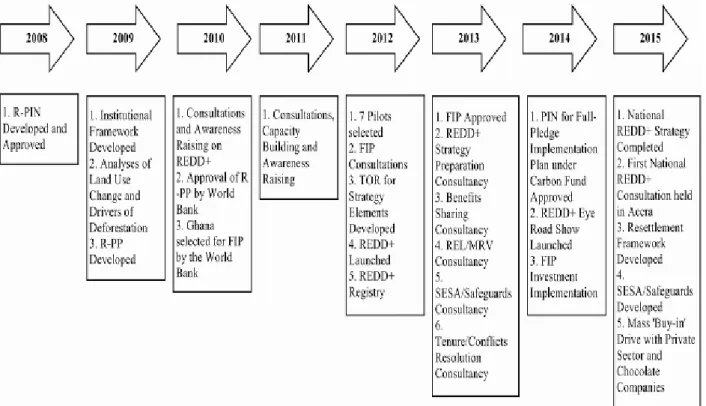
seven national pilot projects were launched. These were (i) Kakum REDD+ Demonstration Project (ii) Portal REDD+ Projects (Bedum and Ankasa) (iii) VicDoris REDD+ Pilot (iv) Permian REDD+ Project (v) IUCN Pro -poor REDD+ project (vi) KA Poku Farms REDD+ project and (vii) Cocoa Research Institute of Ghana’s REDD+ Pilot Project. This paper is focused on the Kakum REDD+ Demonstration Project being implemented in partnership with the Conservation Alliance, a Non-Governmental Organisation. Some of the key milestones achieved by Ghana in the REDD+ process have been outlined in fig. 1.
Fig. 1 Progress of REDD+ (2008-2015) Source: Authors’construct
The Kakum REDD+ Demonstration Project builds on series of efforts implemented by Conservation Alliance, an NGO, to improve cocoa production and poverty reduction in the Kakum landscape in the Twifo-Heman Lower Denkyira District. Some of the projects the organisation has carried out in the past include sustainable agriculture and cocoa agroforestry; integration of biodiversity conservation in farmers’ economic activities; climate change mitigation; a human-wildlife conflict programme and a cocoa certification programme where it supports and trains farmers on good agricultural practices and environmentally-friendly methods of cocoa cultivation. As part of its activities, Conservation Alliance has also established the Conservation Cocoa Associations (CCAs) in nearly all the communities fringing Kakum National Park. CCA is an association of farmers who seek to adopt good agricultural practices that minimise environmental degradation resulting from agricultural activities. Under the REDD+ project, there is an understanding that cocoa farmers’ lack of knowledge in appropriate farming techniques’ leads to poor cocoa productivity and low income levels. Productivity is used to imply the extent to which cocoa crops are produced more economically and efficiently (Mohammad, 1992). Poor cocoa productivity and poverty are thought in turn to lead farmers to expand their farms into forested areas and to result in high rates of deforestation. Once the problem is understood this way, the solution advocated by the Conservation Alliance is to improve and intensify cocoa production of farmers. Through training and introduction of new technologies, the project expects to increase cocoa productivity and raise income levels of the farmers. The project further expects to reduce the pressures for expanding farms into forest areas. By reducing the pressures on cocoa farm expansion, it is the expectation that deforestation and degradation, and hence carbon emissions will be reduced to mitigate climate change. This exploratory research examines the role of microfinance in achieving the project goals using seven of the communities where limited progress of implementation has been made.
3. Materials and Methods 3.1 Description of the Study Area
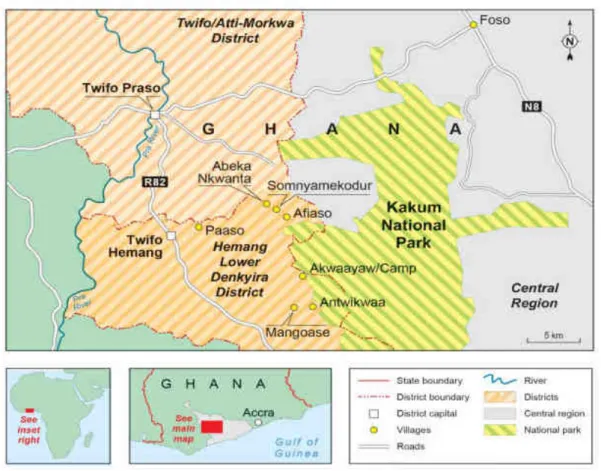
The Kakum REDD+ Demonstration Project (KRDP) is located in the Twifo-Hemang-Lower Denkyira District (THLDD) in the Central Region of Ghana. The District shares boundaries with five other Districts (see fig. 1): the Twifo Atti-Morkwa District (north), Cape Coast Metropolis (South), Wassa Amenfi and Wassa Mpohor Districts (West) and Assin South District (East). Ghana’s recent Population and Housing Census (PHC) in 2010 estimated a total population of the District as 55,132. This comprises 49.6% males and 50.4% females. The geographical characteristics of the district includeclimate, drainage, geology and vegetation that combine to provide very good conditions for agricultural production, particularly the cultivation of cocoa and palm oil. The District is drained by five major streams: Pra, Neuini, Surowi, Subri and Afia Rivers. The area also has an undulating topographical landscape with altitude ranging between 60m-200m above sea level. In terms of climate, the District lies in the semi-equatorial climate zone characterised by double maxima rainfall (1, 750mm- 2000mm). The driest months run from December to March. Temperatures are fairly high in the District and range between 26 ̊C and 30̊ C. The coolest period occurs around August while the hottest is in March. Humidity is generally high throughout the year, ranging between 75-80% during the wet season.
Fig. 2: A map showing the study communities
In terms of infrastructure, all the communities had no access to electricity at the time of the study except for Paaso. There were basic educational facilities in Paaso, Afiaso, Abeka-Nkwanta and Antwikwaa. Somnyamekodur had a Primary School but no Junior Secondary School (JSS) facility, forcing post-primary students to walk daily to Afiaso for the remaining three years of their basic education. Make-shift schools were being constructed in Mangoase and Akwaayaw/Camp at the time of the study. Agriculture has been the main economic activity for all the communities. Small-scale cottage agricultural processing industries including palm oil extraction and soap making were also common in the communities studied. As has been argued in chapter 1, the cocoa industry is a critically important component of the agricultural sector in Ghana. In the project communities, cocoa cultivation (alongside palm oil and citrus), was practised by the majority of the research participants (90%). In addition to cocoa, most famers grew food items including maize, legumes, plantain, cassava and vegetables.
The Kakum National Park (KNP), whose protection remains a priority for the project, is located about 130km from Accra, the national capital. It is managed by the Wildlife Division of the Ghana Forestry Commission, although the Ghana Heritage Conservation Trust and the Central Regional Development Commission (CEDECOM) have been assisting with its management. The park has a canopy walkway which has series of hanging bridges stretching 350 metres (1,150 ft) long that connects seven tree tops, reaches as high as 40 meters above the ground. It has become an important national tourist attraction site, generating significant revenue for the central government. Tourist visits to the park have increased steadily from 609 visitors per year in 1992 to over 170,000 in 2012. The park is endowed with flora and fauna diversity including about 40 species of larger mammals, including elephants, bongo, red river hog, seven primates and four squirrels; several globally-endangered species, including the forest elephant; reptiles such as dwarf crocodile; about 405 species of butterflies and a total of 266 bird species (International Union for Conservation of Nature [IUCN], 2010). Thus, KNP holds and iconic position in Ghana
2.2 Data Type, Sources and Methods of Collection
This exploratory article draws on two separate researches on REDD+ and microfinance in Ghana. The first set of data forms part of a doctoral study carried out in one of the national REDD+ pilot areas in the Twifo-Hemang Lower Denkyira District. The study focused on six communities that were important part of the REDD+ project. The communities were Afiaso, Antwikwaa, Somnyamekodur, Paaso, Mangoase and Akwaayaw Camp. Five more communities were being considered as project areas as part of the project, but were not added to this research. One hundred respondents participated in the research. The participants of the study comprised community leaders in each community, staff of the NGO implementing the project and farmers participating in the REDD+. A combination of purposive and snowballing sampling techniques was employed. In purposive sampling, participants are intentionally selected to represent predefined categories or conditions (Miles and Huberman 1994; Luborsky and Rubinstein; Cresswell, 2007). In this case, the study purposively selected community elders and farmers participating in the project who were available for interviews. The study also employed snowballing techniques where the identified participants further recommended others they know who may be eligible to participate in the research. The research instrument had two main parts: a structured section open-ended sections. The structured section contained a likert-scale type of questions where respondents agreed to a number of statements drawn from the project’s document and literature. Part of the structured questions is what has been reported in this paper. The open-ended section contained a check-list of questions about the project which guided conversations with the respondents.
The ethnographic study was supplemented by a further long-term research on microfinance institutions and human capital development in Ghana. This latter study has involved extensive research on areas such as nature of microfinance, operations of microfinance, characteristics of beneficiaries and workable design features of microfinance operations (See Antoh et al, 2014; Antoh, 2014). In particular, this research has shown that microfinance operations offered financial and non-financial services to beneficiaries. The financial services entailed issuing loans and offering management services on the loans to generate cash income to recipients. Group-based loans and individual-based loans were the two main categories of loans offered. Most (60.4%) of the beneficiaries were found in the group-based loans. The paper draws on and brings these two researches together to explore whether microfinance could play any meaningful role in the ongoing REDD+ process. Semi-structured data collection method was employed as it allowed us to explore various themes in greater depth than would have been achieved with structured questionnaires alone. The quantitative aspect of the data was analysed as descriptive statistics such as, tables, frequencies and percentages. The qualitative component was, however, analysed through a grounded theory approach (Corbin and Strauss, 1990) and Charmaz (2014). First, open coding was carried out. In this case, codes were assigned to specific materials extracted from transcribed and audio-visual files taken during the data collection. Second, axial coding was carried out. This involved grouping together various codes to form categories based on which specific themes were explored. The next section turns attention to the results of the project.
3. Results and Discussion
3.1 Socio-Economic and Demographic Characteristics of Respondents
More than half of the research participants (63%) were males while the rest were females (37%). This was expected as the heads of the households that offered to conduct the interviews were mostly men. In the broader study design, the limited number of women was compensated through series of focus group discussions that
exclusively focused on women. Table 1: Gender of respondents
Category Frequency Percent
Male 63 63.0 Female 37 37.0 Total 100 100.0
Source: Field study, 2014
In terms of age, the majority (51%) of the research participants were between the ages of 41 and 60. This is followed by those between the ages of 21-40 (34%) and those over 60 years (15%). This is suggestive that cocoa farming is being grown largely by farmers in their middle-ages rather than by a youthful population.
Table 2: Age of respondents
Category Frequency Percent
Less than 20 years
2 2.0
21-40 years
32 32.0
41-60 years
51 51.0
More than 60 years
15 15.0
Total
100 100.0
Source: Field study, 2014
The dominant ethnic group in the District was the Akans (comprising mainly of the Twifo and the Denkyira sub-groups). Most of the Akans interviewed said that they had migrated to the area from Gomoa, Efutu, Agona and Guan. Others in the project area were of Akuapim, Ewe and Ga-Adangbe (Krobo) ethnicity. Of the hundred research respondents, 76% reported having lived in their communities for more than 10 years, 11% for between 6 to 9 years and 4% had lived in the communities for less than 2 years.
Table 3: Residential Status of Respondents
Frequency Percent
Migrant 82 82.0
Indigene 18 18.0
Total 100 100.0
Source: Field study, 2014
(Twifo ethnic group). Most of the respondents who described themselves as migrants/or settlers had lived in the respective communities for several years, some going beyond 60 years. In terms of education, 67% of the respondents had basic education but had not progressed to secondary and/or technical schools; 5% possessed secondary education while 4% had tertiary education. About 24% of the respondents had no formal education Table 4: Highest level of formal education
Frequency Percent
Basic education
67 67.0
Secondary and technical education
5 5.0 tertiary education 4 4.0 No formal education 24 24.0 Total 100 100.0
Source: Field study, 2014
4.2. The role of microfinance in enhancing cocoa productivity and the REDD+ project
Households were asked about the roles through which microfinance can help them increase their cocoa productivity. Both the qualitative and the structured interviews revealed three important roles for microfinance to ensure the success of the REDD+ project. These are (i) investment role (ii) technological adoption role and (iii) agribusiness skills development role.
(a) Agricultural Investment role
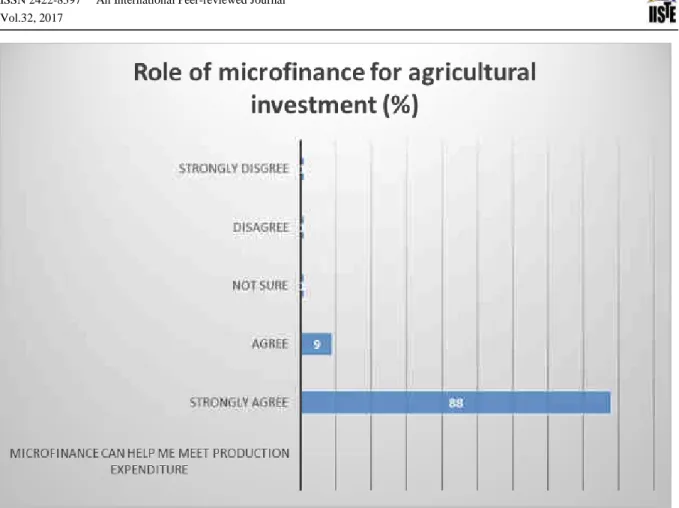
A growing body of research has shown that microfinance helps poor households meet basic needs and offers protection against risks. Osotimehin, Jegede and Akinlabi (2011) have observed that relatively small loan sizes improve productive capital and help beneficiaries improve household economic welfare. Similarly, Priya (2006) has found a significant positive relationship between microfinance and improved income, which are invested in agriculture and other businesses of recipients. Further studies by Antoh et al (2015) in Ghana has also added insights into how microfinance schemes create opportunities for low-income people to access capital that are invested into their businesses. Antoh et al (2015) further shows that although beneficiaries in the manufacturing sector achieved the highest return on their investment from credits obtained through microfinance schemes (GH¢501.84, an equivalence of $170), it helped beneficiaries in the agriculture/food sector to earn at least GH¢432.21 (equivalence of $120) a month (Antoh et al., 2016). Results from this study showed that, that 97% of the respondents held faith in microfinance to facilitate financial investments into agricultural inputs which will facilitate the achievement of the goal of the REDD+ project. From this figure, 88% strongly agreed to microfinance helping them to meet the cost of their inputs while 9% agreed.
Fig. 1: Responses on the role of microfinance on agricultural investment Source: Field Survey, 2014
From the interviews, respondents contended that investments into inputs remain a significant determinant should the goal of the project to increase cocoa productivity was to be realised. These inputs include seeds, fertilisers, pesticides, weedicides, and other agro-chemicals which influence cocoa production. Farmers claimed that cost of acquiring these inputs are less affordable at the time when access to credit facilities remains an essential challenge. The inadequate access to credit facilities emerged as a significant challenge that affects low productivity of cocoa farms. It is on the basis of this challenge that the farmers called for microfinance schemes to enable them to meet the cost of inputs which play an essential role in ensuring increased cocoa yield. Thus, the finding of the study compares favourably with the observations made by other researchers such as Osotimehin, Jegede and Akinlabi (2011) about the potential of microfinance schemes to improve agricultural investments. It is also consistent with those reported by Nosiru (2010) where the beneficiaries of microcredits were more productive with the use of agricultural inputs than those that had no access to the same facilities.
(b) Technological Adoption Role
As part of the implementation of the project, the farmers have been introduced to conservation agriculture and cocoa intensification practices particularly in areas of shade management, mulching, fertiliser application, pests and diseases management and also income and expenditure management. Other activities being introduced to the farmers included technologies for protection of native ecosystems and on- farm biodiversity, maintenance of healthy soils and sustenance of water resources. The anticipation is that the introduction of these forms of technologies to farmers will transfer ‘new’ knowledge and skills which will be implemented to increase cocoa yields, income and reduce the pressure for expansion of farms which creates deforestation.
Despite the positive views held by the communities on these technologies, the rate of adoption and application was found to be low. For example, just about 49% of the respondents were emphatic of applying the training, technologies and other skills being introduced to them by the project. Reasons for the low adoption included farmer characteristics such as age, technologies not locally appropriate and cost. As shown in table 5, cost emerged as the dominant reason why farmers were unable to adopt the technologies being introduced by the NGO.
Table 5: Reasons for the low adoption of technologies
Reasons for not adopting technology Frequency Percentages
Age/farm related factors 8 14.29
Cost and economic factors 71 48.21
Technologies not locally appropriate 11 19.65
Others 10 17.85
No difficulty adopting technologies 42 N/A
Total 100 100
Source: Field survey, 2014
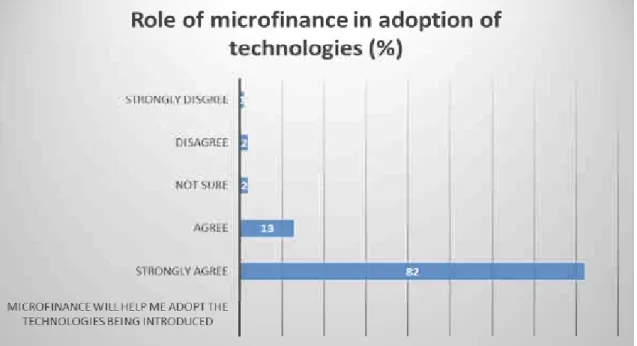
Further results showed that inclusion of microfinance into the packages being employed to achieve the project objective could help improve the rate of adoption for the technologies being introduced to achieve the forest loss reduction goal. For instance, 95% of the respondents were of the view that microfinance could facilitate the project’s objective of increasing cocoa production (i.e. strongly agree, 82 and agree, 13). The findings of the study, therefore, compares favourably with those made by Girabi and Mwakaje (2013) in Tanzania about the role of microfinance to facilitate access to agricultural technologies that improve productivity.
Fig. 2: Responses on the role of microfinance on adoption of technologies Source: Field Survey, 2014
(c) Agribusiness skills development role
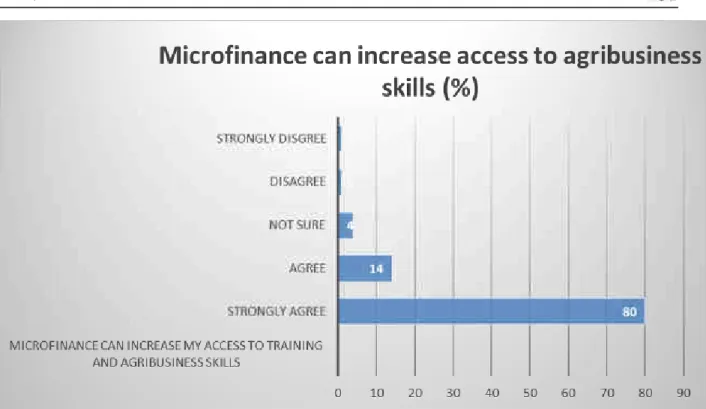
Microfinance schemes have evolved from the traditional focus on provision of micro loans towards the provision of several other non-financial services (Antoh et al, 2015b; Ledgerwood, 1999; Robinson, 2001). Antoh et al (2015b) has, for instance, documented how the Sinapi Aba Trust (SAT) in Ghana has expanded its focus and added business training, compulsory savings and micro insurance into their packages. Findings of the study showed that 94% of respondents asserted that promoting microfinance schemes as part of the project will increase their access to several agribusiness skills which will enhance their cocoa production. Some of these skills include record keeping, farm management and negotiation skills. Thus, as observed by Swain et al (2008),trainingand education to microfinance scheme could hold potentials for increasing cocoa productivity, which is very central to the REDD+ project.
Fig. 3: Responses on the role of microfinance on agribusiness skills development Source: Field Survey, 2014
5. Conclusion, policy implications and recommendations
In recent years, the role of microfinance scheme has become topical in the environment and climate change literature (Fenton et al, 2015; Heltberg, Siegel, & Jorgensen, 2009; Agrawala and Carraro, 2010; Hammill, Matthew, & McCarter, 2008) even though its empirical impacts on poverty reduction and environmental protection is debatable. In the ongoing REDD+ processes in Ghana, increased cocoa production has been made central towards the overall achievement of reduced carbon emissions from deforestation and degradation. The focus of this paper was to explore the role of microfinance in the ongoing climate change policy process in Ghana that seeks to raise cocoa productivity to reduce expansion of farms into forest. As the preceding sections have shown, microfinance can play three main roles. First, it can provide opportunities for farmers to meet the production expenditure and other financial investments required for production of cocoa including seeds, fertiliser and chemicals that are crucial should the goal to increase cocoa yields is to be achieved. Second, the study has also shown that microfinance could help improve the rate of adoption for the technologies being introduced to the farmers to achieve the forest loss reduction goal. Third, microfinance also holds potential to increase access of farmers to several agribusiness skills which will enhance their cocoa production. The findings compare favourably on a number of studies that that have examined impacts of microfinance on improved income for business investments (); agricultural technology and productivity (Nosiru, 2010).), access to agribusiness and non-financial services that improve livelihoods (Antoh et al, 2015). This leads to the conclusion that inclusion of microfinance schemes to the package of strategies being implemented can be helpful for the attainment of the objectives set for the REDD+ project.
The implication of this study is that the Conservation Alliance and the actors implementing the REDD+ project stand a better chance of achieving the project objective if they include microfinance elements into the programme. It is therefore recommended for the project implementers to collaborate with some microfinance institutions in the District to work with the farmers as part of the project. Our long-term research has also shown, however, that the microfinance schemes are more likely to maximise their impact when it prioritises and incorporates human capital development. In view of this, it is further recommended that human capital development in forms such as formal and non-formal education, health and nutrition, business skills should be given attention in any attempt of including microfinance schemes into the project’s strategy. Insights from our long-term research on microfinance further points to the need for such an introduction of microfinance schemes to undertake a careful analysis of the long-term nature of cocoa production as well as the capacities and socio -cultural characteristics of both individuals and group-based loans. This, it is believed, will help to minimise the negative effects of non-payments of loans that are often reported in the literature (Adams and Bartholomew, 2010).
The main limitation of the study relates to the geographical scope as it was limited to only one of the seven pilot projects. Also, the sample of 100 participants could be considered small given the number of communities involved in the project. This may affect the representativeness and generalisation of the study results. However, as an exploratory research, the study provides valuable insights into the potential role of microfinance schemes in the REDD+ process in Ghana, and elsewhere. Future research could pick on these limitations and expand the scope of research to cover more pilot sites. Other consideration for future research could be a mapping of microfinance institutions in the REDD+ pilot areas and the extent to which these institutions are willing to support cocoa farmers participating in the REDD+ project. Many developing countries are implementing with different types of REDD+ interventions. Future research could therefore, also look at the social impacts from REDD+ initiatives and its synergies with social vulnerabilities.
References
1. Adams, S., & Bartholomew, T. A. (2010). The impact of microfinance on maize farmers in Nkoranza (Brong Ahafo Region of Ghana). Journal of Management Research, 2(2), 1.
2. Afrane, S. (2002). Impact assessment of microfinance interventions in Ghana and South Africa. Journal of Microfinance, 4(1), 37-58.
3. Agrawala, S. and Carraro, M. (2010) Assessing the Role of Microfinance in Fostering Adaptation to Climate Change, Paris: OECD. C
4. Angelsen, A. (ed.) 2008. Moving ahead with REDD: Issues, options and implications, Bogor,
Indonesia.: Centre for International Forestry Research
5. Antoh, E. F., Enu-Kwesi, F., & Addison, M. (2015). Socio-economic characteristics of microfinance beneficiaries in Ghana–evidence from Sinapi Aba Trust microfinance institution. Archives of Business Research, 3(6).
6. Antoh, E. F., Mensah, J. V., & Edusah, S. E. The Effect Of Microfinance On Human Capital Development In Ghana: The Case Of Sinapi Aba Trust Microfinance Beneficiaries In Ashanti Region. The International Journal of Social Sciences and Humanities Invention, 2 (08)
7. Antoh, E. F., Mensah, J. V., Edusah, S. E., & Enu-Kwesi, F. (2015a) Analysis of the features and operations of microfinance institutions in ghana. International Journal of Economics, Commerce and Management 3 (11)
8. Antoh, E. F., Mensah, J. V., Enu-Kwesi, and F. and Addo, E.O (2016). Examining the Effects of Microfinance Services on Incomes and Business Capital in Ghana: The Case of Sinapi Aba Trust Beneficiaries, European Journal of Business and Management, 8(35)
9. Arhin, A. A. (2015). Improving sustainability of the environment in a changing climate: Can REDD+
rise to the challenge? In, D. Soumyananda (Ed.), Handbook of Research on Climate Change Impact on Health and Environmental Sustainability. IGI Global: India.
10. Arhin, A. A. (2015). Halting Deforestation to Advance Sustainable Development: Progress, Prospects and Challenges of REDD+ Readiness in Ghana. In D. Reyes (Ed.), Sustainable Development: Processes, Challenges and Prospects
11. Asiama, J.P. and Osei, V. (2007). Micro finance in Ghana: An Overview, Research Department Working
Paper Bank Of Ghana 07/01. Accra.
12. Bernstein, L., Bosch, P., Canziani, O., Chen, Z., Christ, R., & Riahi, K. (2008). IPCC, 2007: climate change 2007: synthesis report. IPCC.
13. Boyle, G. (2009). Be the Change: Empowering Women Through Microfinance. [online]
http://www.brazencareerist.com (accessed on 24 April 2017).
14. Charmaz, K. (2003). Grounded theory: Objectivist and constructivist methods. In N. K. Denzin & Y. S. Lincoln (Eds.), Strategies for qualitative inquiry (2nd ed.), Thousand Oaks, CA: Sage, 249–291. 15. Corbin, J. & Strauss, A. (2008). Basics of qualitative research: Techniques and procedures for
developing grounded theory (3rd ed.). Thousand Oaks, CA: Sage.
16. Creswell, J.W. (2007). Qualitative inquiry and research design: Choosing among Five approaches (2nd
ed.). Thousand Oaks, CA: Sage
17. Development. Resolution adopted by the General Assembly on 25 September 2015. United Nations,
New York
18. Duvendack, M., Palmer-Jones, R., Copestake, J. G., Hooper, L., Loke, Y., & Rao, N. (2011). What is the evidence of the impact of microfinance on the well-being of poor people? [online] http://www.ndr.mw:8080/xmlui/handle/123456789/1124 (accessed on 10 April 2017).
19. Fenton, A., Paavola, J., & Tallontire, A. (2015). Microfinance and climate change adaptation: an overview of the current literature. Enterprise Development and Microfinance, 26(3), 262-273.
Adaptation in Satkhira District, Southwest Bangladesh. World Development, 92, 192-202
21. Forestry Commission (2016). Ghana National REDD+ Strategy [online]
http://www.fcghana.org/userfiles/files/REDD%2B/Ghana%20REDD%2B%20Strategy.pdf (accessed on 10 April 2017).
22. Forestry Commission (2010). Forestry Commission (2010). Revised Ghana Readiness Preparation
Proposal (Final). [online]
https://www.forestcarbonpartnership.org/sites/forestcarbonpartnership.org/files/Documents/PDF/Jan201 1/Revised_Ghana_R-PP_2_Dec-2010.pdf (accessed on 8 April 2017).
23. Ghana Statistical Service. (2012). 2010 Population and housing census: Summary report of final results. Accra: GSS.
24. Girabi, F., & Mwakaje, A. E. G. (2013). Impact of microfinance on smallholder farm productivity in Tanzania: The case of Iramba district. Asian Economic and Financial Review, 3(2), 227.
25. Hammill, A., Matthew, R. and McCarter, E. (2008) ‘Microfinance and climate change adaptation’, IDS
Bulletin, 39: 113–22 <http://dx.doi.org/10.1111/j.1759-5436.2008.tb00484.x>.
26. Heltberg, R., Siegel, P.B. and Jorgensen, S.L. (2009) ‘Addressing human vulnerability to climate change: Toward a “no-regrets” approach’, Global Environmental Change, 19: 89–99
27. Husain, Z., Mukherjee, D., and Dutta, M. (2010). help groups and empowerment of women:
Self-selection or actual benefits? [online] http://mpra.ub.unimuenchen.de. (accessed 20 June 2011).
28. Karlan, D., and Zinman, J. (2010). Expanding credit access: Using randomised supply decisions to estimate the impacts. Review of Financial Studies,23(1), 433-464
29. Karnani, A. (2007). Microfinance Misses its Mark. Stanford Social Innovation Review Summer 2007.
30. Khandker, R. S. (2005). Microfinance and poverty: Evidence using panel data from Bangladesh. The World Bank Economic Review, 19 (2), 263-286.
31. Khavul, S. (2010). Microfinance: Creating Opportunities for the Poor? Academy of Management, 24, 3
58-72
32. Ledgerwood, J. (1999). Sustainable banking with the poor microfinance handbook.Lima, M. G. B.,
Kissinger, G., Visseren-Hamakers, I. J., Braña-Varela, J., & Gupta, A. The Sustainable Development Goals and REDD+: assessing institutional interactions and the pursuit of synergies (2017) International Environmental Agreements: Politics, Law and Economics, 1-18.
33. Littlefield, E. (2005). Microfinance - Where We Are Now and Where We Are Headed,” Microfinance
speech given at the International Year of Microcredit and Georgetown University Conference on, Washington DC
34. Luborsky, M. R., & Rubinstein, R. L. (1995). Sampling in qualitative research rationale, issues, and methods. Research on aging, 17(1), 89-113.
35. Matin, I., Hulme, D., & Rutherford, S. (2002). Finance for the poor: from microcredit to microfinancial services. Journal of International Development, 14(2), 273-294.
36. Mohammad, N., 1992. Anthropogenic dimensions in agriculture. Ashok kumar & concept. New Delhi:
publishing company.
37. Nosiru, M. O. (2010). Microcredits and agricultural productivity in Ogun State, Nigeria. World Journal of Agricultural Sciences, 6(3), 290-296.
38. Odell, K. (2010). Measuring the impact of microfinance: Taking another look. Washington, DC: Grameen Foundation
39. Osotimehin, K. O., Jegede, C. A., & Akinlabi, B. H. (2011). Determinants of microfinance outreach in South-Western Nigeria: An empirical analysis. Interdisciplinary Journal of Contemporary Research in Business, 3(8), 780-797.
40. Pistorius, T., 2012. From RED to REDD+: the evolution of a forest-based mitigation approach for developing countries. Curr. Opin. Environ. Sustain. 4, 638–645.
41. Pronyk, P., Hargreaves, J., and Murdoch J. (2007). Microfinance Programmes and Better Health: Prospects for Sub Saharan Africa. Journal of American Medical Association, 29(16): 1925-1927 42. Robinson, M. (2001). The microfinance revolution: Sustainable finance for the poor. World Bank
Publications.
43. Roodman, D. (2009). What do we Really Know about Microfinance? [online]
https://www.microfinancegateway.org/library/what-do-we-really-know-about-microfinance%C2%92-impact (accessed on 24 April 2017).
44. Rooyen, C. V., Stewart, R and De Wet, T (2012). The impact of microfinance in Sub-Saharan Africa: A
systematic review of the evidence. World Development, 40(11), 2249-2262.
45. Stocker, T.F., Qin, D., Plattner, G.K., Tignor, M., Allen, S.K., Boschung, J., Nauels, A., Xia, Y., Bex, V. and Midgley, P.M., (2013): summary for policymakers in climate change 2013: the physical science basis, contribution of working group I to the fifth assessment report of the intergovernmental panel on
climate change.
46. Swain, R. B., Sanh, N. V., & Tuan, V. V. (2008). Microfinance and poverty reduction in the Mekong Delta in Vietnam. African and Asian Studies, 7(2-3), 191-215.
47. Turnhout, E., Gupta, A., Weatherley‐Singh, J., Vijge, M. J., De Koning, J., Visseren‐Hamakers, I. J., ... & Lederer, M. (2017). Envisioning REDD+ in a post‐Paris era: between evolving expectations and current practice. Wiley Interdisciplinary Reviews: Climate Change, 8(1).
48. UNFCCC, 2011. Report of the conference of the parties on its sixteenth session, held in Cancun from
29 November to 10 December 2010. [online]
https://unfccc.int/resource/docs/2010/cop16/eng/07a01.pdf (20 April 2017)
49. United Nations (2015). Transforming our world: the 2030 Agenda for Sustainable
50. United Nations Framework Convention on Climate Change (2015). Report of the Conference of the Parties on its twenty-first session, held in Paris from 30 November to 13 December 2015. [online] http://unfccc.int/resource/docs/2015/cop21/eng/10.pdf (accessed on 10 April 2017).
51. Vaessen, J., Rivas, A., Duvendack, M., Palmer-Jones, R., Leeuw, F.L., van Gils, G., Lukach, R., Holvoet, N., Bastiaensen, J., Hombrados, J.G. and Waddington, H., (2014). The effect of microcredit on women's control over household spending in developing countries: a systematic review. Campbell Systematic Reviews, 10(8).
52. Van der Werf, G.R., Morton, D.C., DeFries, R.S., Olivier, J.G., Kasibhatla, P.S., Jackson, R.B., Collatz, G.J. and Randerson, J.T., (2009). CO2 emissions from forest loss. Nature geoscience, 2(11), .737-738.
53. World Bank (2010). World Development Report, 2010: Development and Climate Change [Online]
Available:
http://siteresources.worldbank.org/INTWDR2010/Resources/5287678-1226014527953/WDR10-Full-Text.pdf (20 April 2017)
54. Yeboah, T., Arhin, A., Kumi, E., & Owusu, L. (2015). Empowering and shaping gender relations? Contesting the microfinance–gender empowerment discourse. Development in Practice, 25(6), 895-908. 55. Lawrence, S. et al. (2001). Persistence of Web References in Scientific Research. Computer. 34, 26-31.
doi:10.1109/2.901164, http://dx.doi.org/10.1109/2.901164
56. Smith, Joe, (1999), One of Volvo's core values. [Online] Available:
http://www.volvo.com/environment/index.htm (July 7, 1999)
57. Strunk, W., Jr., & White, E. B. (1979). The elements of style. (3rd ed.). New York: Macmillan, (Chapter 4).
58. Van der Geer, J., Hanraads, J. A. J., & Lupton R. A. (2000). The art of writing a scientific article. Journal of Scientific Communications, 163, 51-59
Acknowledgements: The authors’ wish to thank two anonymous reviewers for their constructive comments on earlier drafts of the paper. We also thank the Gates Cambridge Trust, University of Cambridge and the Bureau of Integrated Rural Development (BIRD), KNUST for financial support to aspects of the research through which this article emerged.