Access to Electronic Thesis
Author: Jun Chen
Thesis title: Biologically Inspired Optimisation Algorithms for Transparent Knowledge Extraction Allied to Engineering Materials Processing
Qualification: PhD
Date awarded: 08 February 2010
This electronic thesis is protected by the Copyright, Designs and Patents Act 1988. No reproduction is permitted without consent of the author. It is also protected by the Creative Commons Licence allowing Attributions-Non-commercial-No
Biologically Inspired Optimisation Algorithms for
Transparent Knowledge Extraction
Allied to Engineering Materials Processing
Jun Chen
Thesis submitted in partial fulfillment of the requirements for the degree of Doctor of Philosophy in
the Department of Automatic Control and Systems Engineering of the University of Sheffield
i
Abstract
Traditionally, modelling tasks involve the building of mathematical equations which can best describe the underlying process. Such a modelling practice normally requires a deep understanding of the systems under investigation, hence the reason why it is often referred to as knowledge-driven modelling. On the contrary, knowledge extraction from data (or data-driven modelling), inspired principally from artificial intelligence techniques, is based on limited knowledge of the modelling process and relies on the data describing the input and output mappings. Such a process is able to make abstractions and generalisations of the process and plays often a complementary role to knowledge-driven modelling.
The Fuzzy Rule-Based System (FRBS) has been found more appealing for such a knowledge extraction process, compared to other ‘black-box’ modelling techniques, due to its ability of providing human understandable knowledge. However, such interpretability is only semi-inherent in the FRBS. Without a special caution one can easily end up with a FRBS with equally good predictions as those given by the ‘black-box’ modelling methods, while on the other hand with equally bad interpretability. Hence, extracting a transparent (interpretative) FRBS is reckoned to be of a multi-objective nature with often conflicting outcomes, which gives the rationale of using bio-inspired optimisation paradigms, more specifically, Artificial Immune Systems, in this research project. In a bid to further improve the overall predictive performance, especially for the scatter and uncertain data set, an error correction scheme is proposed so that one can compensate the original predictive model via the predicted error. The proposed immune optimisation framework was tested extensively using several benchmark problems and was compared with other salient techniques. Consistent better performances were obtained. The immune based modelling approach was tested using a set of benchmark problems, and was further applied to different real data sets, viz. Tensile Strength (TS), Elongation and Reduction of Area (ROA), taken from the steel industry, which are all featured by high dimensional, nonlinear and sparse data spaces. Results show that the
ii
proposed modelling approach is capable of eliciting not only accurate but also transparent FRBSs. Such a transparent FRBS establishes the required predictions of the mechanical properties of materials, which on the one hand can help metallurgists to further understand the underlying mechanisms of alloys processing, and on the other hand will automate and simplify their design. Charpy toughness (impact energy) as a special data set featured by scatters and uncertainties was used to validate the proposed error correction mechanism and proved its validity.
The project is part of the research activities which are currently conducted in the Institute for Microstructural and Mechanical Process Engineering: The University of Sheffield (IMMPETUS).
iii
Acknowledgements
I would like to thank the following people for their assistance in the completion of this thesis: First of all, my gratitude goes to Professor Mahdi Mahfouf, not only for his help and advice throughout this project but also for his encouragement (and pressure!) that I bore in mind all the time and guided me through the duration of my Ph.D. study. Without his help, I could never imagine completing my doctorate .
I would like to thank my parents in China. Although thousands of miles away, my father’s support and caring, my mother’s loving watch and blessing from heaven are always with me. Their love gives me hope and courage in times of hardship and solitude.
I want to thank my wife Jiajia, her support in every possible way during the past four years made our lives in the UK a much less stressful and much more fruitful one. However, I have to say that we have agreed that we will never study for a degree at the same time again. My thanks also go to the Department of Automatic Control and Systems Engineering for the academic and financial support that I received.
Last but not least, this thesis is for the memory of my grandfather who passed away during my 3rd year of the programme. He has been an idol of my life time and has inspired me to face difficulties in a positive way.
Jun Chen
iv
Related Publications
During the course of Ph. D. study, a number of papers represented my research are produced. The followings are the list of them.
Book Chapter/Conference Papers:
Chen, J., Mahfouf, M. (2009): An Artificial Immune Systems based Predictive Modelling Approach for the Multi-objective Elicitation of Mamdani Fuzzy Rules-A Special Application to Modelling Alloys. IEEE International Conference on Systems, Mans, and Cybernetics, 2009.
Chen, J., Mahfouf, M. (2008): Artificial Immune Systems as a Bio-inspired Optimisation Technique and Its Engineering Applications. in Hongwei Mo (Eds.): Artificial Immune Systems and Natural Computing: Applying complex Adaptive Technologies, College of Automation, Harbin Engineering University, Harbin, China.
Chen, J., Mahfouf, M. (2008): An Immune Algorithm Based Fuzzy Predictive Modelling Mechanism using Variable Length Coding and Multi-objective Optimisation Allied to Engineering Materials Processing. In proceedings of the 2008 IEEE International Conference on Granule Computation (GrC 2008), pp. 26-28, August 2008, China.
Chen, J., Mahfouf, M. (2006): A Population Adaptive Based Immune Algorithm for Solving Multi-objective Optimisation Problems. In H. Bersini and J. Carneiro (ed.): ICARIS 2006, LNCS 4163, pp. 280-293, Springer Berlin/Heidelberg.
Colloquium Presentations:
Chen, J., Mahfouf, M. (2009): An artificial immune systems based predictive modelling approach for the multi-objective elicitation of Mamdani Fuzzy Rules. In IMMPETUS Colloquium 2009. Sheffield.
Chen, J., Mahfouf, M. (2009):Improving the prediction accuracy of fuzzy rule-based systems via error corrections. In IMMPETUS Colloquium 2009. Sheffield.
v
Chen, J., Mahfouf, M. (2008): An Immune Algorithm Based Fuzzy Predictive Modelling Mechanism using Variable Length Coding and Multi-objective Optimisation Allied to Engineering Materials Processing. In IMMPETUS Colloquium 2008. Sheffield.
vi
Contents
1 Introduction 1.1 General Background ... 1 1.2 Project Description ... 1 1.3 Original Contributions ... 71.4 Outline of the Thesis ... 8
2 Bio-Inspired Computing 2.1 Evolutionary Based Computing (EC) ... 11
2.1.1 Genetic Algorithms ... 11
2.1.2 Evolution Strategies... 12
2.2 Artificial Immune Systems (AIS) ... 12
2.2.1 Model 1: Clonal Selection Principle... 14
2.2.2 Model 2: Immune Network Theory ... 15
2.2.3 Phenomenon 1: Adaptive Antibody’s Concentration ... 15
2.2.4 Phenomenon 2: Vaccination and Secondary Immune Response ... 15
2.3 Particle Swarm Optimisation ... 16
2.4 Bio-Inspired Optimisation ... 17
2.4.1 Single-Objective Optimisation (SOP) ... 17
2.4.2 Multi-Objective Optimisation (MOP) ... 19
2.5 Artificial Neural Networks (ANNs) ... 21
2.6 Fuzzy Logic Theory and Fuzzy Rule-Based Systems (FRBS) ... 23
2.6.1 Fuzzy Logic Theory ... 23
2.6.2 Fuzzy Inference Systems and FRBS ... 26
2.6.3 Neuro-Fuzzy Systems (NFS) ... 28
2.7 Summary ... 29
3
A Population Adaptive Based Immune Algorithm
3.1 AIS Based Optimisation ... 313.1.1 Current State ... 31
3.1.2 Call for Solutions ... 32
vii
3.2.1 Description of the PAIA ... 34
3.2.2 Performance Metrics ... 36
3.2.3 Preliminary Results on ZDT Series Problems ... 36
3.2.4 Drawbacks of the PAIA... 41
3.3 An Improved Version of PAIA (PAIA2) ... 42
3.3.1 Basic Ideas Behind the Improvements ... 42
3.3.2 Simulation Studies Using ZDT and DTLZ Series Problems ... 43
3.3.3 Conclusions ... 52
3.4 Effects of the User Specified Parameters ... 53
3.4.1 Effect of the Initial Population Size ... 53
3.4.2 Effect of the Clonal Selection Threshold ... 54
3.4.3 Effect of the Network Suppression Threshold ... 55
3.4.4 Effect of the Maximum Clone Size ... 56
3.4.5 Adaptive Clone Size and Adaptive Population Size ... 57
3.5 A Multi-Stage Optimisation Procedure (M-PAIA2) ... 58
3.5.1 Connection between ‘Multi-Stage’ and Immunology ... 58
3.5.2 Why ‘Multi-Stage’? ... 59
3.5.3 Comparisons between PAIA2 and M-PAIA2 ... 61
3.6 General Framework of AIS-Based Multi-Objective Optimisation (MO) Algorithms . 62 3.6.1 The Framework ... 62
3.6.2 Comparisons with other Bio-Inspired Methods ... 63
3.7 Summary ... 65
4
An Evolutionary Based Clustering Algorithm
4.1 Introduction to Data Clustering ... 674.1.1 Similarity and Dissimilarity Measures ... 69
4.1.2 Classification of Clustering Algorithm ... 71
4.1.3 Cluster Validation ... 75
4.1.4 Type of Clustering Used in This Project ... 76
4.2 Hybridisation of G3PCX and K-means (G3Kmeans) ... 77
4.2.1 Introduction to G3PCX ... 77
4.2.2 Description of G3Kmeans ... 79
4.2.3 Rationale of the Hybridisation ... 80
4.3 Experimental Studies ... 82
viii
4.3.2 Real World Problems ... 88
4.3.3 Discussions ... 92
4.4 The Relationship between Clustering and FRBS ... 93
4.4.1 Identification of the Relationship ... 93
4.4.2 Elicitation of Initial Singleton FRBSs Using G3Kmeans ... 97
4.4.3 An Example of Application ... 100
4.5 Summary ... 104
5
An Immune Inspired Multi-Objective Fuzzy Modelling (IMOFM)
5.1 Introduction ... 1065.1.1 Data-Driven Modelling (DDM) ... 106
5.1.2 Relationship between FRBS and DDM ... 108
5.1.3 Accuracy vs. Interpretability ... 109
5.1.4 The Dilemma of Building FRBS ... 110
5.1.5 Literature Review of Previous Works ... 112
5.2 The Framework of the Proposed Modelling Method ... 115
5.3 First Stage: Elicitation of Initial FRBSs ... 116
5.3.1 Elicitation of the Initial Mamdani FRBS ... 116
5.3.2 An Example of Application ... 118
5.4 Second Stage: Refinement of Initial FRBSs ... 120
5.4.1 Back-Error-Propagation Algorithm for Singleton FRBS ... 120
5.4.2 Back-Error-Propagation Algorithm for Mamdani FRBS ... 121
5.4.3 Constraint Back-Error-Propagation Algorithm ... 123
5.4.4 An Example of Application ... 123
5.5 Third Stage: Immune Algorithms-based Multi-Objective Fuzzy Modelling ... 127
5.5.1 Formulation of the Objective Functions ... 128
5.5.2 Formation of Initial Population Pool ... 129
5.5.3 A Variable Length Coding Scheme ... 130
5.5.4 Improvement of Interpretability ... 134
5.5.4.1 Removing Unimportant Rules ... 134
5.5.4.2 Removing Singleton Rules ... 135
5.5.4.3 Merging Similar Rules ... 135
5.5.4.4 Removing Universal Fuzzy Sets ... 136
5.5.4.5 Merging Similar Fuzzy Sets ... 137
ix
5.5.6 An Example of Application ... 142
5.6 Analysis of the Proposed Modelling Method ... 150
5.6.1 Influence of the Modelling Stages on Performance ... 150
5.6.2 Influence of the User-Specified Parameters on Performance... 152
5.6.3 Influence of Variable Length Coding Scheme on Performance ... 165
5.7 Summary ... 167
6 Transparent Knowledge Extractions Using an Immune Inspired Multi-Objective Fuzzy Modelling (IMOFM) 6.1 Performance Indices ... 169
6.1.1 Root Mean Square Error ... 170
6.1.2 R-Square ... 170
6.1.3 Confidence Band ... 171
6.1.4 Error Band ... 171
6.2 Benchmark Problems ... 172
6.2.1 Nonlinear Function Approximation ... 172
6.2.2 Dynamic System Identification ... 186
6.3 Predictions of Mechanical Properties of Heat Treated Steel ... 199
6.3.1 An Overview of the Steel-Making Process ... 200
6.3.2 Heat Treatment ... 200
6.3.3 Introduction to Mechanical Properties and Their Testing ... 202
6.3.4 Predictions of Ultimate Tensile Strength (UTS) ... 203
6.3.5 Predictions of Reduction of Area (ROA) ... 225
6.3.6 Predictions of Elongation ... 235
6.4 Comparison between Singleton FRBS and Mamdani FRBS ... 245
6.5 Summary ... 246
7 Improving the Prediction Accuracy of FRBSs 7.1 Introduction to Stacked Generalisation ... 247
7.2 Basic Ideas for Prediction Improvements ... 250
7.2.1 Error Correction Scheme ... 250
7.2.2 Theoretical Justification ... 251
7.3 Experimental Studies on Impact Energy ... 252
7.4 Model Confidence Bands ... 258
7.5 Summary ... 259
x
8.1 Conclusions ... 260 8.2 Future Research Direction ... 263
Bibliography ... 266 Appendix A – The Back-Error-Propagation Algorithm for Mamdani FRBS . 274 Appendix B – Modelling Results of Impact Energy Data Using IMOFM_S .... 278
xi
List of Figures
Figure Page 2.1 The Clonal Selection Principle: 1-Selection; 2-Proliferation; 3-Affinity
maturation; 4-Reselection ... 14
2.2 Vaccination and immune response. ... 16
2.3 A simple artificial neuron. ... 21
2.4 (a) representation of a classical set; (2) representation of a fuzzy set. ... 24
2.5 (a) the shape of a Gaussian membership function; (b) the illustration of the crossover points. ... 25
2.6 Fuzzy Inference Systems (FRBS) (Jang, 1993). ... 28
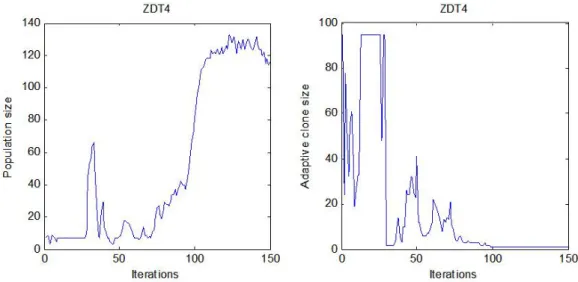
3.1 (a) Pareto solutions obtained by PAIA on ZDT1~ZDT4; (b) Adaptive population size vs. iteration; (c) Adaptive clone size (the assigned maximum clone size among all Abs) vs. iteration. ... 38
3.2 Pareto solutions of PAIA on ZDT1~ZDT4. ... 40
3.3 Pareto solutions of the modified PAIA2 on ZDT1~ZDT4 and ZDT6. ... 45
3.4 Pareto solution of the original PAIA (left) and PAIA2 (right) on ZDT4. ... 47
3.5 The results of PAIA2 ( =0.03) and SPEA2 on DTLZ1. ... 48
3.6 The results of PAIA2 ( =0.03) and SPEA2 on DTLZ2. ... 49
3.7 The results of PAIA2 ( =0.03) and SPEA2 on DTLZ3. ... 49
3.8 The results of PAIA2 ( =0.03) and SPEA2 on DTLZ4. ... 49
3.9 The results of PAIA2 ( =0.004) and SPEA2 on DTLZ5. ... 50
3.10 The results of PAIA2 ( =0.004) and SPEA2 on DTLZ6. ... 50
3.11 The results of PAIA2 ( =0.01) and SPEA2 on DTLZ7. ... 50
3.12 The results of PAIA2 on DTLZ6 using 5000 evaluations. ... 51
3.13 Decreasing rate r vs. iterations. ... 53
3.14 PAIA2 with 1 as the initial population size. ... 54
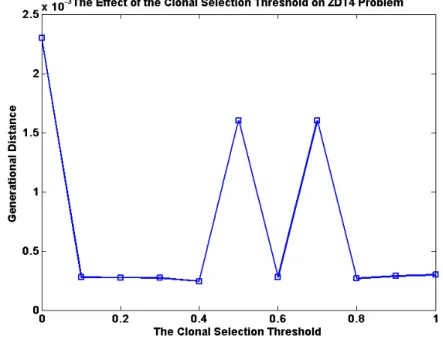
3.15 The effect of the Clonal Selection Threshold on ZDT4 problem. ... 55
xii
3.17 The effect of the maximum clone size on ZDT4 problem: (a) how the convergence index GD is affected by the varying Ncmax; (b) the least number of
required evaluation times for PAIA2 with varying Ncmax to fully converge. ... 57
3.18 Adaptive population size and adaptive clone size (the assigned maximum clone size among all Abs) vs. iteration. ... 58
3.19 (a) Single objective optimisation: (b) two-objective optimisation with candidate solution far from the true Pareto front; (c) two-objective optimisation with solutions close to the Pareto front. ... 60
3.20 Results from multi-stage optimisation procedure on DTLZ1; (a) solution found by the first stage (b) adaptive population size vs. iterations using PAIA2; (c) non-dominated solution found by the second stage; (d) adaptive population size vs. iterations using multi-stage optimisation procedure (the second stage) ... 62
3.21 Generic AIS framework for MOP solving (NCR: the number of current non-dominated Abs; the number of non-non-dominated Abs in the last iteration; IN: the initial Abs size; Stop: at least one iteration step is executed). ... 63
4.1 General Steps Involved in Data Clustering. ... 69
4.2 Illustration of different prototypes in ‘inter-cluster distance’: A. nearest-neighbour technique; B. farthest-neighbour technique; C median technique. ... 70
4.3 An illustrative example of a two-dimension data set: (a) single linkage tends to find chain-like clusters; (b) complete linkage tends to find compact clusters. ... 72
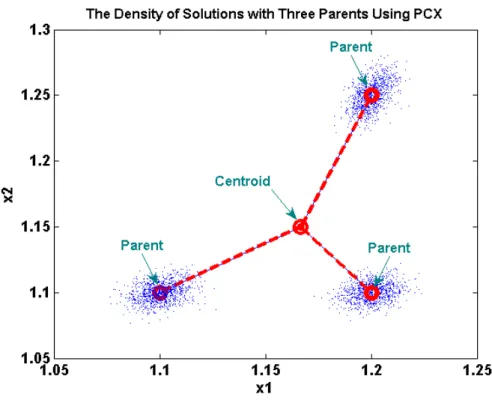
4.4 The density of solutions with three parents using PCX. ... 78
4.5 Gaussian clusters with 100 data points per cluster. ... 83
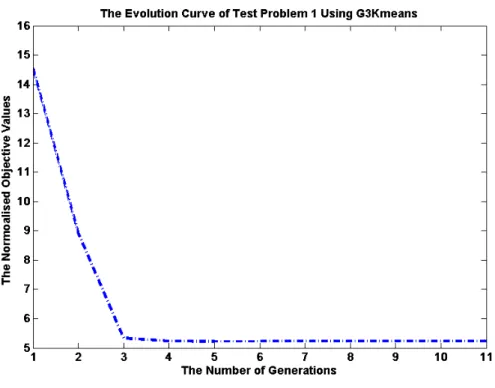
4.6 The evolution curve of the first test problem using G3Kmeans. ... 83
4.7 The identified 4 clusters of the first test problem using G3Kmeans. ... 84
4.8 The distribution of identified cluster centres for test problem 1. ... 85
4.9 4 Gaussian clusters contaminated by 200 noise data points. ... 86
4.10 The evolution curve of the second test problem using G3Kmeans. ... 86
4.11 The identified 4 clusters of the second test problem using G3Kmeans. ... 87
4.12 The distribution of the identified cluster centres for test problem 2. ... 88
4.13 The evolution curve of the Iris data using G3Kmeans. ... 89
4.14 The identified 3 Iris classes using G3Kmeans. ... 90
4.15 The evolution curve of the UTS data using G3Kmeans ... 91
4.16 Creating FRBS through clustering: (1) upper FRBS is built by the direct use of clusters; (2) lower FRBS is built by projection of clusters. ... 95
xiii
4.17 A 2-dimensional overall Gaussian membership function and its projected
membership functions on x1 and x2 dimensions. ... 99
4.18 The evolution curve of the nonlinear static system using G3Kmeans. ... 101
4.19 The surface of the nonlinear static systems and the identified clusters. ... 101
4.20 The overall Gaussian membership functions and their corresponding clusters. ... 102
4.21 (a) individual rules in the fuzzy rule base; (b) projected membership functions on each input dimension. ... 103
5.1 The linear regression. ... 107
5.2 Pareto front in a bi-objective fuzzy modelling case. ... 110
5.3 The proposed IMOFM framework. ... 116
5.4 (a) individual rules in a Mamdani FRBS; (b) membership functions of each dimension. ... 119
5.5 Violated solutions are dragged back to the boundaries. ... 123
5.6 (a) the refined Singleton FRBS; (b) its associates membership functions. ... 124
5.7 (a) the refined Mamdani FRBS; (b) its associated membership functions. ... 125
5.8 (a) the predictive performances of the initial and the refined Singleton FRBS; (b) the predictive performances of the initial and the refined Mandani FRBS. ... 126
5.9 (a) If the initial population is formed using the 1st option, IMOFM is responsible for evolving the population towards the Pareto front; (b) if the initial population is formed using the 2nd option, IMOFM is responsible for the gaps between the limited knowledge. ... 130
5.10 (a) Ineffective optimisation caused by the interaction of inactive gene(grey ones) and active gene(black ones); (b) and(c) variable length coding scheme for a three-rule Singleton/Mandani FRBS and a six-three-rule Singleton/Mandani FRBS. ... 132
5.11 The problems associated with the FRBS having different rule lengths and unconstrained optimisation. ... 133
5.12 The example used in Section 4.3.1.1 with two inputs: (1) R1 and R5 are similar rules; (2) R6 is the singleton rule; (3) R7 is the insignificant rule. ... 136
5.13 A fuzzy set with its spread more than two times wider than the universe of discourse is regarded as the universal fuzzy set. ... 137
5.14 An example of merging similar fuzzy sets. ... 138
5.15 If no links are set up for the rule base and its coding representation, a missed mutation point may be induced. ... 140
5.16 If a link is set up, no missed mutation points are induced; inactive rules are not actually deleted but marked so that it will not participate in any computations afterwards. ... 141
xiv
5.17 The Pareto fronts obtained using IMOFM_S from the third modelling procedure for the example: (a) Objectivel vs. Objective2; (b) Objective1 vs. Nset; (c)
Objective1 vs. Nrule; (d) Objective1 vs. RL. ... 145
5.18 The Pareto fronts obtained using IMOFM_M from the third modelling procedure for the example: (a) Objective1 vs. Objective2; (b) Objective1 vs. Nset; (c) Objective1 vs. Nrule; (d) Objective1 vs. RL. ... 146
5.19 (a) membership function distribution of the 4-rule Singleton FRBS; (b) membership function distribution of the 4-rule simplified Mamdani FRBS. ... 147
5.20 (a) 4-rule simplified Mamdani FRBS; (b) 4-rule simplified Singleton FRBS. ... 147
5.21 The predictive performances of the simplified Mamdani and Singleton FRBSs. ... 148
5.22 3-D surfaces of the simplified Mamdani and Singleton FRBSs... 149
5.23 The Pareto fronts obtained using IMOFM_M over 30 runs. ... 149
5.24 The Pareto fronts obtained using IMOFM_S over 30 runs. ... 150
5.25 The averaged objectives’ values of the non-dominated solutions found in 10 independent runs with their initial population size varied from 1 to 10. ... 153
5.26 The averaged predictive performances of different Pareto FRBSs found in the 10 runs; (a) rule FRBS with 10 fuzzy sets; (b) rule FRBS with 9 fuzzy sets; (c) 5-rule FRBS with 8 fuzzy sets; (d) 4-5-rule FRBS with 8 fuzzy sets; (e) 4-5-rule FRBS with 7 fuzzy sets; (f) 4-rule FRBS with 6 fuzzy sets; (g) 3-rule FRBS with 6 fuzzy sets; (h) 3-rule FRBS with 5 fuzzy sets; (i) rule FRBS with 4 fuzzy sets; (j) 2-rule FRBS with 3 fuzzy sets; (k) 2-2-rule FRBS with 2 fuzzy sets; (l) 2-2-rule FRBS with 1 fuzzy sets; (m) 1-rule FRBS with 1 fuzzy sets. ... 154
5.27 The number of Pareto FRBSs obtained using 0.1 (right) and 0.0008 (left) as the network suppression threshold. ... 155
5.28 Pareto FRBS obtained using different network suppression thresholds from one of 10 runs. ... 156
5.29 The effect of on the least number of rules that IMOFM can obtain. ... 157
5.30 The Pareto front obtained using IMOFM_S with =0.5, rdr=0, mr=1, ufs=1, and sfs=1. ... 158
5.31 The predictive performances of different Pareto FRBSs elicited with different rdr values; (a) 5-rule FRBS with 10 fuzzy sets; (b) 4-rule FRBS with 8 fuzzy sets; (c) 3-rule FRBS with 6 fuzzy sets; (d) 2-rule FRBS with 4 fuzzy sets; (e) 2-rule FRBS with 3 fuzzy sets; (f) 2-rule FRBS with 2 fuzzy sets; (g) 1-rule FRBS with 1 fuzzy sets. ... 159
5.32 The effects of mr: (a) on the number of Pareto FRBS in the final population; (b) on the least number of rules that IMOFM can obtain. ... 160
5.33 The predictive performances of different Pareto FRBS elicited with different mr values: (a) 5-rule FRBS with 10 fuzzy sets; (b) 4-rule FRBS with 8 fuzzy sets; (c) 3-rule FRBS with 6 fuzzy sets; (d) 2-rule FRBS with 4 fuzzy sets. ... 161
xv
5.34 The effects of ufs: (a) on the number of Pareto FRBS in the final population; (b)
on the least number of rules that IMOFM can obtain. ... 162 5.35 The predictive performances of different Pareto FRBSs elicited with different ufs
values: (a) 5-rule FRBS with 10 fuzzy sets; (b) 4-rule FRBS with 8 fuzzy sets; (c)
3-rule FRBS with 6 fuzzy sets;(d) 2-rule FRBS with 4 fuzzy sets. ... 163 5.36 The effects of sfs: (a) on the number of Pareto FRBS in the final population; (b)
on the least number of rules that IMOFM can obtain. ... 164 5.37 The predictive performances of different Pareto FRBSs found in the 10 runs with
different sfs values: (a) 5-rule FRBS with 10 fuzzy sets; (b) 5-rule FRBS with 9 fuzzy sets; (c) 5-rule FRBS with 8 fuzzy sets; (d) 4-rule FRBS with 8 fuzzy sets; (e) 4-rule FRBS with 7 fuzzy sets; (f) 4-rule FRBS with 6 fuzzy sets; (g) 4-rule FRBS with 5 fuzzy sets; (h) 3-rule FRBS with 6 fuzzy sets; (i) 3-rule FRBS with 5 fuzzy sets; (j) 3-rule FRBS with 4 fuzzy sets; (k) 3-rule FRBS with 5 fuzzy sets (objective2: 18); (l) 3-rule FRBS with 3 fuzzy sets; (m) 2-rule FRBS with 4 fuzzy sets; (n) rule FRBS with 3 fuzzy sets; (o) rule FRBS with 2 fuzzy sets; (p)
2-rule FRBS with 2 fuzzy sets (objective2: 10); (q) 1-2-rule FRBS with 1 fuzzy sets. ... 165 5.38 The snapshot of the Pareto FRBS at 10, 100, 500, 800, 1000, 1200 iterations. ... 167 6.1 ±10% error bands over the interval [1, 10]. ... 172 6.2 The training and testing process of the IMOFM_S on the nonlinear function
approximation problem. ... 174 6.3 The training and testing process of the IMOFM_M on the nonlinear function
approximation problem. ... 174 6.4 The predictive performances of the first modelling stage of IMOFM_S on the
nonlinear function approximation problem. ... 175 6.5 The predictive performances of the second modelling stage of IMOFM_S on the
nonlinear function approximation problem. ... 175 6.6 The predictive performances of the first modelling stage of IMOFM_M on the
nonlinear function approximation problem. ... 176 6.7 The predictive performances of the second modelling stage of IMOFM_M on the
nonlinear function approximation problem. ... 176 6.8 Nonlinear system approximation using IMOFM: (a) the actual nonlinear system
surface; (b) and (c) the approximated surface obtained from the first modelling stage using IMOFM_S and IMOFM_M; (d) and (e) the approximated surface obtained from the second modelling stage using IMOFM_S and IMOFM_M; (f) and (g) the approximated surface obtained from the third modelling stage using
IMOFM_S and IMOFM_M. ... 177 6.9 The Pareto fronts obtained using IMOFM_S from the third modelling procedure
for the nonlinear function approximation problem: (a) Objective1 vs. Objective2;
xvi
6.10 The Pareto fronts obtained using IMOFM_M from the third modelling procedure for the nonlinear function approximation problem: (a) Objective1 vs. Objective2;
(b) Objective1 vs. Nset; (c) Objective1 vs. RL. ... 182 6.11 The nonlinear function approximation problem: (a) membership function
distribution of the 9-rule Singleton FRBS from the first modelling stage; (b) membership function distribution of the 9-rule Mamdani FRBS from the first
modelling stage. ... 182 6.12 The nonlinear function approximation problem: (a) membership function
distribution of the 9-rule Singleton FRBS from the second modelling stage; (b) membership function distribution of the 9-rule Mamdani FRBS from the second
modelling stage. ... 183 6.13 The nonlinear function approximation problem: (a) membership function
distribution of the 5-rule simplified Singleton FRBS from the third modelling stage; (b) membership function distribution of the 4-rule simplified Mamdani
FRBS from the third modelling stage. ... 183 6.14 (a) 5-rule simplified Singleton FRBS; (b) 4-rule simplified Mamdani FRBS. ... 184 6.15 The predictive performances of the simplified Singleton (upper part) and
Mamdani (lower part) FBRSs obtained from the third modelling stage. ... 185 6.16 5%-range confidence band of a 5-rule simplified Singleton FRBS (left) and a
4-rule simplified Mamdani FRBS (right) on the training data set. ... 185 6.17 Input , unforced system , and output of the plant in Eq. 6.6. ... 186 6.18 The training and testing process of the IMOFM_S on the second-order nonlinear
plant. ... 187 6.19 The training and testing process of the IMOFM_M on the second-order nonlinear
plant. ... 187 6.20 The predictive performances of the first modelling stage of IMOFM_S on the
second-order nonlinear function approximation problem. ... 188 6.21 The predictive performances of the first modelling stage of IMOFM_M on the
second-order nonlinear function approximation problem. ... 188 6.22 The predictive performances of the second modelling stage of IMOFM_S on the
second-order nonlinear function approximation problem. ... 189 6.23 The predictive performances of the second modelling stage of IMOFM_M on the
second-order nonlinear function approximation problem. ... 189 6.24 The second-order nonlinear system approximation using IMOFM: (a) the actual
nonlinear system surface; (b) and (c) the approximated surface obtained from the first modelling stage using IMOFM_S and IMOFM_M; (d) and (e) the approximated surface obtained from the second modelling stage using IMOFM_S and IMOFM_M; (f) and (g) the approximated surface obtained from the third
xvii
6.25 The Pareto fronts obtained using IMOFM_S from the third modelling procedure for the nonlinear function approximation problem; (a) Objective1 vs. Objective2;
(b) Objective1 vs. Nset; (c) Objective1 vs. Nrule; (d) Objective1 vs. RL. ... 193
6.26 The Pareto fronts obtained using IMOFM_M from the third modelling procedure for the nonlinear function approximation problem; (a) Objective1 vs. Objective2; (b) Objective1 vs. Nset; (c) Objective1 vs. Nrule; (d) Objective1 vs. RL. ... 194
6.27 The dynamic system identification problem: (a) membership function distribution of the 5-rule Singleton FRBS from the first modelling stage; (b) membership function distribution of the 8-rule Mamdani FRBS from the first modelling stage. ... 194
6.28 The dynamic system identification problem: (a) membership function distribution of the 5-rule Singleton FRBS from the second modelling stage; (b) membership function distribution of the 8-rule Mamdani FRBS from the second modelling stage. ... 195
6.29 The dynamic system identification problem: (a) membership function distribution of the 3-rule simplified Singleton FRBS from the first modelling stage; (b) membership function distribution of the 4-rule simplified Mamdani FRBS from the first modelling stage. ... 195
6.30 The dynamic system identification problem: (a) the 5-rule FRBS extracted from the first two modelling stages using IMOFM_S; (b) the 3-rule simplified Singleton FRBS after the third modelling stage using IMOFM_S. ... 196
6.31 The dynamic system identification problem: (a) the 5-rule FRBS extracted from the first two modelling stages using IMOFM_M; (b) the 3-rule simplified Mamdani FRBS after the third modelling stage using IMOM_M. ... 197
6.32 The predictive performances of the simplified Singleton (upper part) and Mamdani (lower part) FRBSs obtained from the third modelling stage. ... 198
6.33 5% range confidence bands of a 3-rule simplified Singleton FRBS (left) and a 4-rule simplified Mamdani FRBS on the training data set. ... 198
6.34 Date distributions on chosen dimensions of UTS data. ... 204
6.35 The training and testing process of the IMOFM_S on the UTS data. ... 205
6.36 The training and testing process of the IMOFM_M on the UTS data. ... 205
6.37 The prediction performances of the three stages for the training and testing data using IMOFM_S. ... 209
6.38 The prediction performances of the three stages for the training and testing data using IMOFM_M. ... 209
6.39 The Pareto fronts obtained using IMOFM_S from the third modelling procedure for the UTS modelling problem; (a) Objective1 vs. Objective2; (b) objective1 vs. Nset; (c) Objective1 vs. Nrule; (d) Objective1 vs. RL. ... 210
6.40 The Pareto fronts obtained using IMOFM_M from the third modelling procedure for the UTS modelling problem; (a) Objective1 vs. Objective2; (b) objective1 vs. Nset; (c) Objective1 vs. Nrule; (d) Objective1 vs. RL. ... 210
xviii
6.41 The distribution of membership functions of the 12-rule initial Singleton FRBS (from the first modelling stage) for UTS modelling. ... 211 6.42 The distribution of membership functions of the 12-rule initial Mamdani FRBS
(from the first modelling stage) for UTS modelling. ... 212 6.43 The distribution of membership functions of the 12-rule refined Singleton FRBS
(from the second modelling stage) for UTS modelling. ... 213 6.44 The distribution of membership functions of the 12-rule refined Mamdani FRBS
(from the second modelling stage) for UTS modelling. ... 214 6.45 The distribution of membership functions of the 8-rule simplified Singleton FRBS
(from the third modelling stage) for UTS modelling. ... 215 6.46 The distribution of membership functions of the 7-rule simplified Mamdani FRBS
(from the third modelling stage) for UTS modelling. ... 216 6.47 The selected rules from the 8-rule simplified Singleton FRBS: (a) rule2; (b) rule
3; (c) rule 5; (d) rule 7. ... 217 6.48 The selected rules from the 7-rule simplified Mamdani FRBS: (a) rule2; (b) rule 3;
(c) rule 5. ... 218 6.49 Response surfaces of the 8-rule simplified Singleton UTS model. ... 220 6.50 Response surfaces of the 7-rule simplified Mamdani UTS model. ... 220 6.51 The prediction performances of the 12-rule refined FRBSs from the second
modelling stage and the 8-rule and 7-rule simplified FRBSs from third modelling
stage. ... 222 6.52 5%-range confidence bands of an 8-rule simplified Singleton FRBS (left) and a
7-rule simplified Mamdani FRBS (right) on the training data set. ... 222 6.53 The snapshot of the Pareto FRBSs at 10, 100, 500, 800, 1000 and 1200 iterations. ... 223 6.54 The Pareto front obtained using IMOFM_S with and without variable length
coding and the new distance index for the UTS problem. ... 224 6.55 The training and testing process of the IMOFM_S on the ROA data. ... 225 6.56 The training and testing process of the IMOFM_M on the ROA data. ... 226 6.57 The prediction performance of the three stages for the ROA training and testing
data using IMOFM_S. ... 228 6.58 The prediction performance of the three stages for the ROA training and testing
data using IMOFM_M. ... 228 6.59 The Pareto fronts obtained using IMOFM_S from the third modelling procedure
for the ROA modelling problem: (a) Objective1 vs. Objective2; (b) Objective1 vs.
xix
6.60 The Pareto fronts obtained using IMOFM_M from the third modelling procedure for the ROA modelling problem: (a) Objective1 vs. Objective2; (b) Objective1 vs.
Nset; (c) Objective1 vs. Nrule; (d) Objective1 vs. RL. ... 229 6.61 The distribution of membership functions of the 12-rule initial Singleton FRBS
(from the first modelling stage) for ROA modelling. ... 230 6.62 The distribution of membership functions of the 12-rule refined Singleton FRBS
(from the second modelling stage) for ROA modelling. ... 230 6.63 The distribution of membership functions of the 6-rule simplified Singleton FRBS
(from the third modelling stage) for ROA modelling. ... 231 6.64 The distribution of membership function of the 12-rule initial Mamdani FRBS
(from the first modelling stage) for ROA modelling. ... 231 6.65 The distribution of membership function of the 12-rule refined Mamdani FRBS
(from the second modelling stage) for ROA modelling. ... 232 6.66 The distribution of membership function of the 6-rule simplified Mamdani FRBS
(from the third modelling stage) for ROA modelling. ... 232 6.67 Response surfaces of the 6-rule simplified Singleton ROA model. ... 233 6.68 Response surfaces of the 6-rule simplified Mamdani ROA model. ... 234 6.69 Data distributions on chosen dimensions of ROA data. ... 235 6.70 5%-rage confidence band of the 6-rule simplified Singleton FRBS on the ROA
data. ... 235 6.71 The histogram of the output of the elongation data. ... 236 6.72 The training and testing process of the IMOFM_S on the elongation data. ... 237 6.73 The training and testing process of the IMOFM_M on the elongation data. ... 237 6.74 The prediction performances of the three stages for the elongation training and
testing data using IMOFM_S. ... 239 6.75 The prediction performances of the three stages for the elongation training and
testing data using IMOFM_M. ... 239 6.76 The Pareto fronts obtained using IMOFM_S from the third modelling procedure
for the elongation modelling problem: (a) Objective1 vs. Objective2; (b)
Objective1 vs. Nset; (c) Objective1 vs. Nrule; (d) Objective1 vs. RL. ... 240 6.77 The Pareto fronts obtained using IMOFM_M from the third modelling procedure
for the elongation modelling problem: (a) Objective1 vs. Objective2; (b)
Objective1 vs. Nset; (c) Objective1 vs. Nrule; (d) Objective1 vs. RL. ... 240 6.78 The distribution of some membership functions of the 12-rule initial Singleton
FRBS (from the first modelling stage) for elongation modelling. ... 241 6.79 The distribution of some membership functions of the 12-rule refined Singleton
xx
6.80 The distribution of some membership functions of the 6-rule simplified Singleton
FRBS (from the third modelling stage) for elongation modelling ... 242 6.81 The distribution of some membership functions of the 12-rule initial Mamdani
FRBS (from the first modelling stage) for elongation modelling ... 242 6.82 The distribution of some membership functions of the 12-rule refined Mamdani
FRBS (from the second modelling stage) for elongation modelling ... 243 6.83 The distribution of some membership functions of the 6-rule simplified Mamdani
FRBS (from the third modelling stage) for elongation modelling ... 243 6.84 Response surfaces of the 6-rule simplified Singleton elongation model ... 244 6.85 Response surfaces of the 6-rule simplified Mamdani elongation model ... 244 6.86 5%-range confidence band of the 6-rule simplified Singleton FRBS on the
elongation data... 245 7.1 The conventional feedback-based supervised learning (CRSL) ... 248 7.2 ‘Stacked Generalisation’ based on the error correction scheme (ECS) ... 250 7.3 Sample of Impact Energy data space ... 253 7.4 The predictive performance of the initial EPF ... 256 7.5 The predictive performance of the refined EPF ... 256 7.6 The training process of the EPF ... 257 7.7 The predictive performance of the OPF ... 257 7.8 The predictive performance of the ECS ... 258
xxi
List of Tables
Table Page 3.1 ZDT series problems ... 37 3.2 Mean and variance values of the convergence measure GD for ZDT series
problems ... 39 3.3 Mean and variance values of the diversity measure ∆ for ZDT series problems ... 39 3.4 Final population size and evaluation times of PAIA ... 39 3.5 Mean and variance values of GD and for PAIA and VIS on ZDT series
problems ... 41 3.6 Final population size and evaluation times of PAIA and VIS on ZDT test
problems ... 41 3.7 DTLZ test problems ... 44 3.8 Mean and variance values of the convergence measure GD for ZDT series
problems ... 46 3.9 Mean and variance values of the diversity measure ∆ for ZDT series problems ... 46 3.10 Evaluation times of PAIA2, PAIA, VIS and SPEA2 when they are fully
converged ... 47 3.11 The maximum function evaluations and the number of decision variables ... 48 3.12 The maximum function evaluations and the number of decision variables ... 54 4.1 Comparisons of the objective values between different clustering algorithms on
test problem 1 ... 84 4.2 Comparisons the objective values between different clustering algorithms on test
problem 2 ... 87 4.3 Comparisons of the objective values between different clustering algorithms on
the Iris data set ... 89 4.4 Comparisons of the objective values between different clustering algorithms on
the UTS data set... 92 4.5 Comparisons the objective values and the performances between fuzzy modelling
methods based on different clustering algorithms on a nonlinear static system with
xxii
5.1 The predictive performances of the first modelling stage of IMOFM_S and
IMOFM_M on a nonlinear static system with five rules ... 119 5.2 The predictive performances of the second modelling stage of IMOFM_S and
IMOFM_M on a nonlinear static system with five rules ... 126 5.3 Comparisons of the predictive performance of the different modelling methods for
the example ... 143 5.4 Comparisons of the predictive performance of the different modelling stages the
example... 151 5.5 The predictive performances of IMOFM_S with pm=0.5, rdr=0, mr=1, ufs=1 and
sfs=1 ... 158 5.6 The comparison of the modelling approaches with and without the variable length
coding scheme ... 166 6.1 Comparison of the predictive performances for the different modelling methods
using the nonlinear function approximation problem ... 179 6.2 Comparison of the predictive performances for the different modelling methods
using the second-order nonlinear function approximation problem ... 191 6.3 The inputs and output of the Tensile Strength data set ... 203 6.4 Comparison of the predictive performances for the different modelling methods
Using the UTS data set ... 206 6.5 The ‘median’ model input representing the 1% CrMo steel grade ... 219 6.6 The validation performances of IMOFM on the 12 unseen data samples ... 221 6.7 The comparison of the modelling approaches with and without the variable length
coding scheme ... 224 6.8 Comparison of the predictive performances for the different modelling methods
using the ROA data set ... 227 6.9 The inputs and output of the elongation data set ... 236 6.10 Comparison of the predictive performance for the different modelling methods
using the elongation data set... 238 7.1 The inputs and output of the impact energy data set ... 253 7.2 Comparisons of the predictive performances for the different modelling methods
using the impact energy data set ... 255 7.3 Training and testing results from OPF, ECS and EPF ... 256 7.4 Training and testing results from OPF, ECS and EPF using confidence band as the
xxiii
Abbreviations
Abs Antibodies
AFRBS AIS Fuzzy Rule Based Systems Ags Antigens
AIS Artificial Immune Systems ANN Artificial Neural Networks BEP Back-Error Propagation BF Blast Furnace
BOF Basic Oxygen Furnace
CFSL Conventional Feedback-based Supervised Learning DDM Data-Driven Modelling
EAF Electric Arc Furnace EAs Evolutionary Algorithms EC Evolutionary Computing ECS Error Correction Scheme EPF Error Predictive FRBS ES Evolution Strategies FCM Fuzzy C-Means
FM-HCMO Fuzzy Modelling approach with a Hierarchical Clustering algorithm
and a Multi- objective Optimisation mechanism FRBS Fuzzy Rule Based Systems
GA Genetic Algorithm GD Generational Distance
G3PCX Generalised Generation Gap model and the PCX G3Kmeans Hybridisation of G3PCX and K-means
IMOFM_S/M An Immune inspired Multi-Objective Fuzzy Modelling
mechanism for Singleton/Mamdani FRBS KB Knowledge Base
MCP McCulloch-Pitts
MCR Mean-Centric Recombination MLP Multi-layer Perceptron MO Multi-objective Optimisation
xxiv
MOP MOProblems
M-PAIA2 A Multi-stage optimisation procedure based on PAIA2 MSE Mean Squared Error
NFS Neuro-Fuzzy Systems
NSGA-II Non-dominated Sorting Genetic Algorithm II OPF Original Predictive FRBS
PAES Pareto Archived Evolutionary Strategy
PAIA A Population Adaptive based Immune Algorithms PAIA2 An improved version of PAIA
PCX Parent-Centric recombination
PNIA Pareto-optimal Neighbour Immune Algorithm PSO Particle Swarm Optimisation
RBF Radial Basis Function RMSE Root MeanSquared Error ROA Reduction of Area
SBX Simulated Binary Crossover
SOP Single-objective Optimisation Problems SPEA2 Strength Pareto Evolutionary Algorithm SPR Similarity of Rule Premise
TSK Takagi-Sugeno-Kan UTS Ultimate Tensile Strength VIS Vector Immune Algorithm VLC Variable Length Coding
- 1 -
Chapter 1
Introduction
“All men by nature desire knowledge".
Aristotle, Metaphysics, 384BC‐322BC
1.1 General Background
In this research project, the main emphasis will be on how to allow Artificial Immune Systems (AIS) to cooperate with fuzzy rule based systems (FRBS), artificial neural networks and clustering methods in order to solve engineering problems, especially those associated with optimisation, knowledge extraction, modelling and control. With the characteristics of recognition of foreign agents, reinforcement learning, associative memory, distributed or parallel processing capability, self-adaptive and self-organization inherent in the human immune systems it is believed that AIS, as a metaphor, can accomplish the aforementioned tasks in a more efficient and transparent way. Unlike other evolutionary computing paradigms, which can be thought of as natural optimisers, AIS has been applied to broad application areas ranging from data analysis, computer security to optimisation. Hence, AIS provides a more extendable platform on which AIS Fuzzy Rule-Based System (AFRBS), for instance, can be built. The whole project can be divided into two subsequent stages, viz. optimisation and modelling.
1.2 Project Description
In the first phase of this project, AIS will be extended to the area of multi-objective optimisation problems (MOP) by realising that real-world problems are inherently of a
multi-- 2 multi--
objective nature with often conflicting issues. Hence, the best way to deal with such problems is to provide a set of trade-off solutions. The rationality of adopting AIS, or broadly speaking, Evolutionary Algorithms (EAs), as the search engine is based on its ability to exploit the accumulated information about an initially unknown search space in order to bias subsequent searches into useful subspaces (Bodenhofer et al., 1997). The advantages of AIS over classical search methods which are based on derivative information or random search methods are manifold: on the one hand, it is a derivative-free and global search method and thus offers a valid approach to tackle the problems which are not differentiable and have many local optima; on the other hand, it effectively uses previous search experiences to guide the following search rather than random search, which is recognised as the main scheme responsible for its efficiency, particularly in large, complex, and poorly understood search spaces; thirdly, its ability of simultaneously manipulating an adaptive antibody population makes it a very suitable way to handle MOP.
There have been several attempts to address the applications of AIS to MOP in the literature (Yoo et al., 1999; Cruz Cortes et al., 2003; Coello Coello et al., 2005; Wang and Mahfouf, 2005; Jiao et al., 2005; Freschi, 2006) but none of these presented a formal systematic framework for doing so. Further, all of the previous attempts are based on just a small part of the mechanism within the whole immune system. We intend to propose a more formal framework combining more immune metaphors, e.g. combining immune network theory with a clonal selection principle, and to identify the main differences between AIS and other EAs in terms of their structures, robustness, parameter settings and efficiency. Some hybridisations with other Evolutionary Algorithms (EAs), e.g. Genetic Algorithm (GA), will also be considered in this phase to improve the existing accuracy and efficiency of AIS. In the broad sense, knowledge extraction can also be viewed as an optimisation process. The task of extracting an appropriate knowledge base (KB) is equivalent to parameterizing this KB, and to finding a set of optimal parameter values with respect to some design criteria (Cordon et al., 2004). With a good and reliable optimisation algorithm developed via the first stage, the project can proceed to the second stage, which will consider a ‘hybrid’ form of AIS and fuzzy rule-based systems together in order to extract transparent knowledge purely from data for complex systems’ modelling. Some other soft computing techniques, such as clustering and neural networks will also be considered for inclusion at this stage in order to facilitate this process of knowledge extraction.
- 3 -
From the system identification viewpoint, KBs can also be viewed as identified models of the systems under investigation. There are mainly three methodologies to solve identification tasks, viz. white-box modelling, black-box modelling and grey-box modelling. In the line of the white box modelling everything is considered to be known as a priori from physics and the produced model (knowledge) is normally in the form of a mathematical equation following related physical laws without the need for any other measurements. However, in a real-world modelling situation, one can never have complete process knowledge, and uncertain factors always affect the system, which only have chance to be revealed (or partially revealed) through experiments. Black-box modelling responds to these requirements and is designed entirely from measured data without assumption of knowing any physical or verbal insight at all. The drawbacks of black-box modelling are twofold: first, once the model has been built one can only obtain a projection from inputs to outputs and nothing more, which means that no deep understanding about the process itself can be obtained through the modelling procedure; second, the thrust of the principle in the modelling field is to only estimate what is still unknown, however, black-box modelling breaks this law to some extent by employing a sufficiently flexible model family (Hellendoorn et al., 1997). To overcome these problems, the need for grey-box modelling is pressing, which combines both human knowledge and black box estimation to account for complex systems’ knowledge acquisition. Fuzzy rule-based system is the one that falls into the third category with an additional ability to integrate human expert knowledge in the form of vague or imprecise statements rather than crisp mathematics, for many real-world systems’ knowledge can only be described by experts using natural language. Previous research on fuzzy rule-based system has been mainly concerned with how to synthesis a rule-base with domain dependent knowledge from human experts, such as operators, and render the task of optimising the parameters associated with the antecedent and consequent parts to some estimation methods, e.g. recursive least squares or gradient based methods (Takagi et al., 1985). However, this paradigm gives rise to three limitations:
1) More often than not, expert knowledge is lacking or is limited due to the newly discovered unknown complex system, or the narrow and partial knowledge gathered from a single expert.
2) It is very hard to handle problems with considerable amount of data to be processed and analysed (Cordon et al., 2004).
- 4 -
3) The way to design such a fuzzy system is not domain-independent and thus no systematic design procedure can be followed.
In all these cases, a sole knowledge extraction from would-be experts will undoubtedly fail to provide a satisfactory solution, while it must be stressed that discovering knowledge from data can help in overcoming aforementioned limitations by augmenting a fuzzy rule-based system with an additional learning ability provided by some machine learning approaches. In the past two decades, many successes have been witnessed in the hybridisation of neural networks and fuzzy systems. A well-known representative is Adaptive Network-based Fuzzy Inference Systems (ANFIS) (Jang, 1993). Although neuro-fuzzy systems may contribute successfully in overcoming the lack of the linguistic representation and transparency associated with the neural networks, the designer will still need to decide on major design parameters such as universe granulation, rule antecedent aggregation operators, rule semantics, rule base aggregation operators and defuzzification methods (Cordon et al., 2004). Almost at the same time, attempts of hybridising clustering methods with fuzzy systems were carried out and gave very promising results (Gomez-Skameta et al., 1999). The aim of this type of hybridisation is to automatically infer rules from large collections of learning data. However, designers following this line of research still face the problem of setting an appropriate cluster number as a priori, and the clustering depends highly on the chosen starting point.
As pointed out by Cordon et al. (2004), contrary to neural networks and clustering, GAs provide a means to encode and evolve everything involved in the design of the rule base. Despite the prospective promising future, hitherto, no systematic design procedure has been put forward regarding this new line of research, although many successful attempts have been made in the past. Clearly, the main difficulty is that if everything is encoded and evolved using GAs the search space becomes prohibitively large. Hence, one has to reach a compromise on what level GAs are to be involved to learn to cover, e.g. data base tuning, rule base learning or the whole knowledge base extraction. For this reason, many possibilities exist, which hinder the formation of a generic systematic design procedure. Having said this, AIS architectures have shown great capabilities in dealing with high dimensional optimisation problems and exhibited great flexibility. It is believed that with their global search capability and their encoding schemes being similar to those of GA, and with their learning and data analysis capabilities being similar to those of neural networks, AIS can
- 5 -
offer a better and a more integrated route to solving complex knowledge extraction problems. At this stage of this project, the emphasis is on how to automatically generate fuzzy rule-bases from numerical data only and on how to select rules in the generated rule-base to remove or merge redundant and similar rules to obtain a compact and transparent knowledge base. Clustering and neural networks will be considered to either be incorporated into or compared with AFRBS.
The most attractive property of fuzzy systems lies in its capability of processing linguistic expression and providing human understandable knowledge. However, sometimes this property is only compromised in order to produce more accurate results, which can be achieved through either a mathematical function of the consequent part, or an increased number of complex rules, both routes deviating from the original intention of FRBS. Thus, in this project, more attention will be focused on the Singleton FRBS (Takagi et al., 1985) and the Mamdani FRBS (Mamdani et al., 1975) rather than the Takagi-Sugeno-Kang (TSK) FRBS with linear functions as its consequents (Takagi et al., 1985). To improve the interpretability of the fuzzy model, MOP will be incorporated as a substitute for the traditional estimation methods by accepting the fact that the increased interpretability is often a contradictory goal against the objective of the accuracy. Using MOP algorithm developed in the first phase of this project, one can simultaneously deal with several, usually cofilicting, objectives in a consistent fashion.
Although FRBS can deal with imprecise data and incomplete knowledge, collected data, especially in ‘dirty’ environments, such as the steel industry, may often consist of severe stochastic activity which cannot be modelled easily. In order to further improve the generalisation ability of the model elicited via a data-driven modelling method in such a scenario, a special case of ‘Stacked Generalisation’ (Wolpert, 1992) is investigated, which relates to the case of when the first layer contains only one generaliser. In such a case, ‘Stacked Generalisation’ is reduced to a scheme for estimating the error of the model in the first layer. An error correction scheme (ECS) is thus proposed based on such a special case. The basic idea of ECS is to build an Error Predictive FRBS (EPF) apart from the Original Predictive FRBS (OPF) so that one can predict the errors associated with the OPF, given the inputs of OPF. When a new scenario is encountered, the EPF will be able to predict the potential error and thus the predicted error can be used to compensate for the predicted output produced by the OPF. An improved predictive accuracy in terms of not only the learning but also in terms of the generalisation is expected via the ECS.
- 6 -
All the proposed methods are tested with benchmark problems and with a ‘real world’ engineering application associated with the mechanical property prediction for hot-rolled steels. Specialist heat treatments are used to develop the required mechanical properties in a range of alloy steels. The mechanical properties of the alloy steels depend on several factors of which the followings are believed to be the major ones: tempering temperature, quench type, chemical compositions of the steel, geometry of the bar, test sample location on the bar, batch distribution in the furnace, measurement tolerances and variations in the process equipment and operators (Tenner, 1999). Traditionally, a heat treatment metallurgist would attempt to balance these factors using their metallurgical knowledge and experience in a bid to obtain the desired mechanical properties. However, due to the increasing complexity of the underlying system, this may still prove difficult even for the metallurgists to tune these parameters. Given the lack of mathematical models which can account for these complex systems and a large amount of available industrial process data associated with the systems, data-driven modelling becomes more and more vital for assisting the metallurgist to predict the mechanical test results without actually doing it. Based on these models, further optimisations of the heat treatment process can also be developed, which is envisaged to be able to automate the steel design process and reduce the experimental costs.
All in all, this research aims at proposing a systematic and integrated knowledge extraction framework with considerable transparency using AFRBS to automate and simplify the design of the alloy steels. This particular application work is currently being carried-out as part of a project within the EPSRC sponsored Institue for Microstructural and Mechanical Process Engineering: The University of Sheffield (IMMPETUS) project. IMMPETUS is a multi-disciplinary research centre dedicated to integrating metallurgical, mechanical and thermal considerations in developing soundly based models for process planning and control to achieve target microstructures and product properties with increasingly fine tolerances and greater efficiency. The core of the approach is the concept of black, grey and white box modelling, and this requires a wide range of techniques and interdisciplinary knowledge. As control engineers involved in this project, the concerns are more related to AIS, fuzzy logic and hybrid modelling methodology, i.e. using an intelligent optimisation approach to design metals in a ‘right-first-time’ fashion.
- 7 -
1.3 Original Contributions
The original contributions of this thesis are of the followings:
A population adaptive based immune algorithm (PAIA) has been proposed for solving MOP.
A Multi-stage optimisation procedure is proposed, where a single-objective optimisation method is utilised in the first stage to obtain any global optimum resting on the Pareto front, and PAIA is then invoked in the second stage as the post-processing algorithm to approximate the rest solutions along the Pareto front.
The differences and the extra strength of immune based optimisation algorithms, as compared to other EAs, have been identified and summarised.
An evolutionary algorithm based clustering method has been proposed, which is the product of hybridisation of a real-coded GA and K-means algorithm. The proposed algorithm can avoid local optima during the search of proper cluster centres and, therefore, can find cluster centres as close to the real ones as possible.
A systematic Immune inspired Multi-objective Fuzzy Modelling (IMOFM) is proposed which can be regarded as a three-stage modelling procedure. The first stage is used to extract the prior knowledge from the available data using an evolutionary clustering algorithm. The second stage is used to refine such an initial model using a modified back-error propagation algorithm which can deal with both Singleton and Mamdani FRBSs. In the third and final modelling stage, and in order to tackle the problem of simultaneously optimising the rule-base structure and parameters, a variable length coding scheme (VLC) is adopted, and a new distance index is proposed to cope with the variable-length individuals.
The proposed modelling mechanism has been tested with benchmark problems and has been applied to the prediction of mechanical properties of alloy steels, such as Ultimate Tensile Strength (UTS), Reduction of Area (ROA), elongation and impact energy. The results are promising.
In order to further improve the generalisation ability of the models elicited via a data-driven method, a special case of ‘Stacked Generalisation’, namely the error correction scheme (ECS), is proposed. An improved predictive accuracy in terms of not only the learning but also the generalisation is observed.
- 8 -
1.4 Outline of the Thesis
The thesis is organized as follows:
Chapter 2 gives a basic introduction to the relevant aspects of bio-inspired computing, such
as evolutionary computing, Artificial Immune Systems (AIS), particle swarm optimisation (PSO), artificial neural networks (ANNs) and fuzzy rule based systems (FRBS). The emphasis is then given to the general aspects of bio-inspired optimisation, which is not restricted to a particular computing paradigm. The common features embedded in the modern heuristic based optimisation algorithms are also explored.
Chapter 3 presents the development of the proposed PAIA and its improved version, viz.
PAIA2. A multi-stage optimisation procedure (M-PAIA2) is also proposed, which aims as speeding up the optimisation process. All these algorithms are tested via benchmark problems, such as the known ZDT and DTLZ test suites, and compared with other well-known algorithms, such as the Non-dominated Sorting Genetic Algorithm II (NSGA-II), the Strength Pareto Evolutionary Algorithm (SPEA2) and the Vector Immune algorithm (VIS). The differences and the extra strength of the immune based optimisation algorithms, compared to other EAs, are also elucidated.
Chapter 4 provides the details which describe the proposed evolutionary based clustering
algorithm. Experimental studies on the proposed clustering algorithm are carried out in order to justify such hybridisation. The relationship between unsupervised learning and supervised learning is further expanded so that one can easily generalise it to the relationship between data clustering and the elicitation of FRBS.
Chapter 5 discusses the implementation of an immune inspired multi-objective fuzzy
modelling (IMOFM) mechanism, which can be used to elicit not only Singleton FRBS but also Mamdani FRBS. To this end, a modified Mamdani fuzzy inference system is proposed with a carefully chosen output membership functions, the inference and the defuzzification methods. Such modifications ensure the efficiency and the differentiability of the developed Mamdani FRBS, which also leads to a set of new back-error propagation (BEP) updating formulas for refining Mamdani FRBS. Some important factors, such as the variable length coding scheme and the rule alignment, are also discussed.
Chapter 6 presents the results of using IMOFM method for the modelling of two benchmark
- 9 -
ROA and elongation. Such results are also compared with other already established modelling methods, such as the Fuzzy Modelling Approach with a Hierarchical Clustering Algorithm and a Multi-objective Optimisation Mechanism (FM-HCMO). The empirical differences between Singleton FRBS and Mamdani FRBS are also discussed.
Chapter 7 describes an Error Correction Scheme (ECS) which improves predictive accuracy
in terms of not only the learning but also the generalisation. Experimental results on the impact energy are presented.
Finally, concluding remarks, new perspectives and future research directions are given in
- 10 -
Chapter 2
Bio-Inspired Computing
“The designs found in nature are nothing short of brilliant, but the process of design that generatesthem is utterly lacking in intelligence of its own".
Daniel Dennett, NY Times, 2005
Bio-Inspired Computing lies within the realm of Natural Computing, a field of research that is concerned with both the use of biology as an inspiration for solving computational problems and the use of the natural world experiences to solve ‘real world’ problems. On the one hand, the increasing interest in this field lies in the fact that nowadays the world is facing more and more complex, large, distributed and ill-structured systems, while on the other hand, people notice that the apparently simple structures and organizations in nature are capable of dealing with most complex systems and tasks with relative ease.
The most successful and visible work belongs to the realm of Evolutionary Computing (EC) through the simulation of biological evolution. Within this realm, three independently developed methodologies exist, viz. Genetic Algorithms (GA) (Holland, 1975), Evolution Strategies (ES) ( Back, 1996) and Genetic Programming (GP) (Koza, 1999). Apart from EC, Artificial Immune Systems (AIS) (Farmer et al., 1986) and Particle Swarm Optimisation (PSO) (Eberhart & Kennedy 1995; Kennedy & Eberhart 1995) represent alternative lines of this type of research through the simulation of vertebrate immune mechanisms and of the migration of the bird flock. In the following Sections, GA and ES, as two most widely used methods in the EC field, and AIS, as the core of this project, will be briefly reviewed. PSO, as an alternative line of this type of research will also be reviewed. Special concerns will then be given to the so called bio-inspired optimisation which includes solving Single-Objective Optimisation Problems (SOP) and Multi-Objective Optimisation Problems (MOP) with the aforementioned three methods. Artificial Neural Networks (ANN) and Fuzzy Rule Based
- 11 -
Systems (FRBS), as the relevant subjects and techniques that will be used in Chapter 5~ 7, will also be introduced. The review in this chapter is meant to be comprehensive but non-exclusive.
2.1 Evolutionary Based Computing (EC)
2.1.1 Genetic Algorithms
GAs are general purpose search algorithms which use principles inspired by natural genetics to evolve solutions to problems. The basic idea is to maintain a pool of chromosomes that evolves over time through a process of competition elitism and controlled variation (Cordon et al., 2004; Goldberg, 1989). GAs were initially designed using binary coding scheme to solve many problems, such as gene alignment, combination optimisation and continuous optimisation. Due to GA’s binary coding scheme and population-based search concept, it is very easy to be adapted to different application scenarios. Although there are many variants of GAs, it is widely accepted that a GA should have the following five components:
• A genetic representation of the solutions to the problem;
• A way to generate the initial population;
• A way to evaluate fitness of each solution (chromosome);
• Two genetic operators, viz. crossover and mutation, to alter the genetic composition of offspring during reproduction;
• A selection mechanism to introduce competition and pressure to individuals.
Standard GAs use a binary coding scheme to represent the genetics of solutions. The crossover operator under the binary coding scheme is designed by randomly picking two strings and exchanging some portion of the strings. Among all possible implementations of this kind of crossover operators, single-point and two-point crossover (Goldberg, 1989) are the most used ones. However, the feasibility of such a simple crossover scheme, which is valid in the binary case, does not hold in the real-valued case. The stagnation of finding a feasible crossover operator in the real-valued situation is the main reason for the limitation of GAs, such as slow convergence, low accuracy etc., when they are applied to continuous optimisation problems. In recent years, research on real-valued GAs made a great