• • •
Projects and Young Children
I love project work because it enables my children to go in depth with their learning. They really like to investigate and really like to explore. Project work allows me to meaningfully bring real artifacts into the classroom for them to get down, get their hands into their learning . . . just a real in-depth exploration of the topic. I like project work too because it covers all areas of curriculum and does not just focus on one thing such as literacy. A project can help me integrate all areas of the curriculum in an engaging way.
—Lora Taylor, prekindergarten teacher LORA TAYLOR has been doing project work for more than 10 years. Over the course of those years, circumstances have changed for Ms. Taylor and other teachers in the early childhood fi eld. Concerns about students not doing well in school and increasing accountability issues have inten-sifi ed the emphasis on standards and required curricula, both of which impact what occurs in classrooms, even those of 3- and 4-year-olds. A decade ago teachers were consid-ered “good” if their classrooms were lively and offconsid-ered an assortment of meaningful and developmentally appropri-ate learning experiences for young children. Good kinder-gartens and fi rst grades were those that encouraged play and socialization and brought literacy to life through active engagement with books. Many children did well in such classrooms and went on to become successful students in the upper grades. However, some children did not. Those children faced specifi c challenges that can affect learning, such as poverty and learning a second language (Berliner, 2009). Today’s early childhood and school environment is changing rapidly, as the numbers of children facing these challenges have increased. In 2008, 14.1 million children, or 19.0%, were poor (U.S. Bureau of the Census, 2008). The number of English language learners has also increased. A survey of state education agencies in 2000–2001 found that almost 10% of the total prekindergarten through
12th-grade public school enrollment had limited profi ciency in English (Kindler, 2002). Because of these changes in the student population, there has been increased concern with accountability, which has also brought about an increased focus on discrete knowledge and skills that are testable (Ravitch, 2010).
At the same time, we are realizing that children in our schools today will exist in a world that we can only imagine (Darling-Hammond, 2010). Technological change and the development of a global economy require that our children develop 21st-century skills (Partnership for 21st Century Skills, 2010). To be successful students, our children will need to be technologically literate and to feel comfortable communicating electronically. They will need to be critical and creative thinkers and be able to work on teams collabo-rating within organizations with a diverse membership. They will need to be able to take initiative and integrate what they are learning from different disciplines. Most of all they will need to be fl exible and eager to learn new skills and adapt to rapidly changing challenges.
Although we know that projects fi t into those active, engaging classrooms of Ms. Taylor’s past, do they also fi t into the classrooms of today with the increased emphasis on standards, and, more importantly, do they prepare chil-dren for their lives in the 21st century? The answer on both counts is yes. Because many other educators agree with this assessment, interest in project work is increasing, and proj-ect work is now included in most recommendations for educational reform. For example, the George Lucas Foun-dation, an organization dedicated to creating a vision for this new world of learning through leading-edge interactive tools and resources (Edutopia.org), endorses project work as one of its Core Concepts. Teachers like Ms. Taylor—as well as kindergarten and fi rst-grade teachers who now do much of their planning around standards—are discovering that project work enables them to integrate knowledge and skills in meaningful ways.
THE PROJECT APPROACH
Many teachers of young children have been challenged by the work of Lilian Katz and Sylvia Chard (2000; Chard, 1994) on the project approach to introduce opportunities for children to engage in investigation as part of the studies undertaken in their classrooms. The early years are impor-tant years for all aspects of development. Children’s natural dispositions to be intellectually curious and to investigate their environments emerge (Katz, 1995). They learn about tools such as reading and writing and become motivated to develop and use a wide variety of related skills. It is impor-tant that they have an opportunity to experience active, engaged learning.
However, research and investigations are easier to incor-porate in a curriculum for older students, who have mas-tered reading and writing, than in early childhood programs. This book presents the teaching strategies and project sto-ries of Lora Taylor and other teachers who are successfully using the project approach with 3-, 4-, and 5-year-olds and with fi rst-graders who are beginning to read and write. Even toddlers are doing project work. In this volume we sum-marize the knowledge gained as projects have been under-taken in schools, childcare centers, and early intervention programs in rural and urban areas and in small towns. These projects are described with step-by-step explanations of how young children’s projects are guided by teachers and caregivers. Also included are strategies and project stories of teachers doing project work with toddlers.
Defi ning Project Work
The project approach is not a new way to teach children. It was a central part of the Progressive Education movement and was used extensively in the British Infant Schools in the 1960s and 1970s (Smith, 1997). Interest in the potential value of project work was renewed with the publication in 1989 of the fi rst edition of Engaging Children’s Minds: The Project Approach (Katz & Chard). Even greater interest in the project approach was stimulated by the impressive reports and displays of group projects conducted by chil-dren in the pre-primary schools of Reggio Emilia (Edwards, Gandini, & Forman, 1993, 1998; Gandini, 1993; New, 1990, 1991; Rankin, 1992). According to Gandini (1997):
Projects provide the backbone of the children’s and teachers’ learning experiences. They are based on the strong conviction that learning by doing is of great importance and that to discuss in group and to revisit ideas and experiences is the premier way of gaining better understanding and learning. (p. 7)
Although the word project has many meanings, when used in the “project approach,” it has a specifi c meaning:
A project is an in-depth investigation of a topic worth learning more about. The investigation is usually undertaken by a small group of children within a class, sometimes by a whole class, and occasionally by an individual child. The key feature of a project is that it is a research effort deliberately focused on fi nding answers to questions about a topic posed either by the children, the teacher, or the teacher working with the children. (Katz, 1994, p. 1)
There are other approaches to curriculum that are simi-lar to the project approach. These also involve deep inves-tigation and student initiation and guidance of learning; some are more content-based or have additional goals. These approaches are often used in classrooms with older children. They include project-based learning (Polman, 2000) and problem-based learning, often called PBL (Bar-rell, 2006). Project-based learning, like the project approach, is centered on the learner and affords learners the opportu-nity for in-depth investigations of worthy topics. Another project method that centers project work on the neighbor-hood and community near the school is place-based educa-tion (Smith, 2002; Sobel, 2005). In all of these approaches to project work, learners are more autonomous as they con-struct personally meaningful artifacts that are representa-tions of their learning (Grant, 2002).
Projects, Units, Th emes, and Learning Centers
Many teachers use units or themes for organizing the activ-ities they provide. A theme is a broad concept or topic, such as “seasons” or “animals.” When using a theme, teachers assemble books, photographs, and other materials related to the theme. Experiences in most content areas or domains of development (such as language, math, or science) are then related or connected to the theme.
Units usually consist of preplanned lessons and activities on a specifi c topic that the teacher considers important for the children to know about, such as “magnets” (Harlan, 1984). When providing information in units, the teacher typically has a clear plan about what concepts and knowl-edge he or she wants the children to learn.
Many teachers also use learning centers as a way to orga-nize their teaching. Areas of the room are designated for the investigation or development of certain knowledge and skills, such as “block area” or “music and movement area” (Dodge, Colker, & Heroman, 2002). Materials and equip-ment for each area are selected to teach concepts and pro-vide practice in skills that the teacher wishes the children to develop.
In all of these methods, however, the focus is not to help children pose questions to be answered or take the initiative for investigation. Many of these methods have an
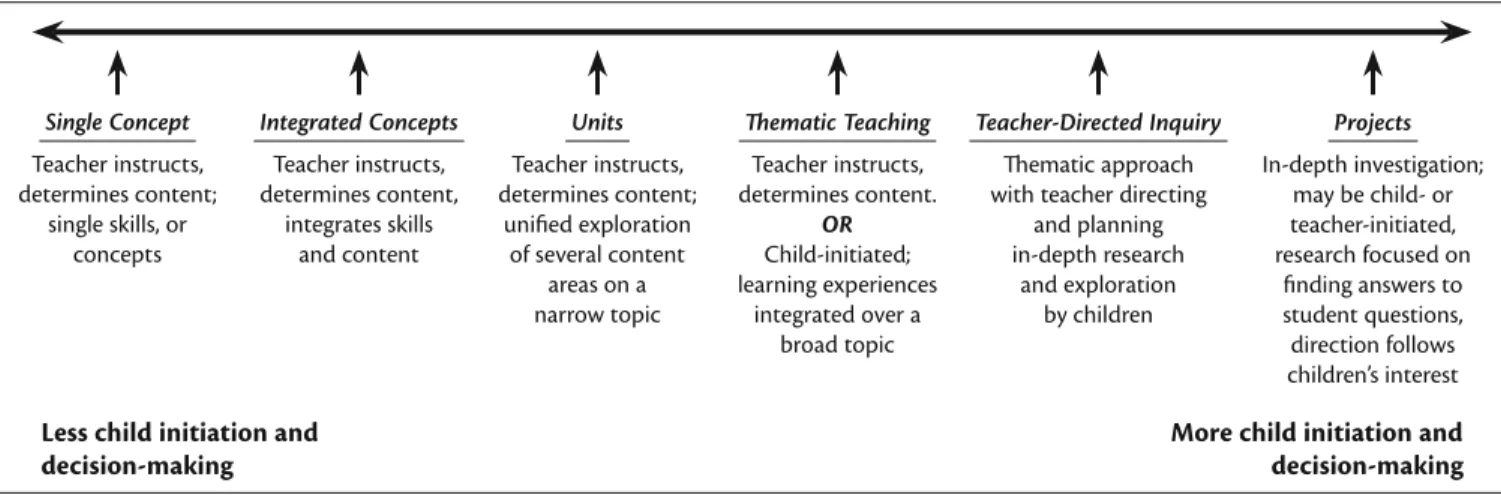
impor-tant place in the early childhood curriculum. However, there are additional opportunities for growth of knowledge, skills, and dispositions when children ask their own ques-tions, conduct their own investigaques-tions, and make decisions about their activities. Projects provide contexts in which children’s curiosity can be expressed purposefully, and that enable them to experience the joy of self-motivated learn-ing. Teachers do not always know what direction a project will take or what aspects of a topic will interest a particu-lar group. Well-developed projects engage children’s minds and emotions and become adventures that teachers and children embark on together. The continuum in Figure 1.1 represents the degree of child initiation and decision-making in the learning process with different approaches to teaching. Projects are on the far right of the continuum because a child or children in a classroom often initiate the project topics. Projects also involve the child in making decisions about topic selection, investigation, and how to culminate the project. There are many valuable learning experiences that can and do occur at all points along the continuum. Teachers who use the project approach often also teach single concepts and employ units, themes, and directed inquiry. A classroom may have project work as well as thematic and single-concept teaching happening in the same day. Some topics, by their nature, do not make good project topics and are more effectively taught as single con-cepts, units, or themes.
We believe, however, that projects provide experiences that involve students intellectually to a greater degree than the experiences that come from teacher-prepared units or themes. It is the children’s initiative, involvement, and rela-tive control over their own activities and participation in what is accomplished that distinguish projects from units or themes. Additional differences between projects and units or thematic teaching include the length of time devoted to
the topic, the teacher’s role, the timing of fi eld trips, and the use of a variety of resources. These differences are summa-rized in Figure 1.2.
Academic Tasks and Intellectual Goals
In understanding the role that projects play in an early childhood and primary curriculum, it may be helpful to look at the difference between academic tasks and intellec-tual goals. Academic tasks are typically carefully structured, sequenced, and decontextualized small bits of information and discrete skills that often require some small-group or individual instruction by a knowledgeable adult. The aca-demic tasks in the early childhood curriculum usually address facts and skills that the majority of children are unlikely to learn spontaneously or by discovery, though, under favorable conditions, many children do so. For exam-ple, under the right environmental conditions, many young children can “pick up” the names of colors and shapes and need little in the way of didactic or systematic formal instruction to learn them. These items of knowledge may be spontaneously “constructed” by some children, as can be seen in invented spelling. However, in such cases these bits of knowledge are often misconstructed and require assis-tance to reconstruct correctly.
Similarly, the alphabet, an arbitrary sequence of symbols developed over a long period of human history, has no inherent discoverable logic. It simply has to be mastered with the help of knowledgeable others who encourage fre-quent repetition and who correct errors until mastery is achieved. In the case of most young children, it would be wasteful and ineffi cient for them to have to “discover” such things as the alphabet, punctuation rules, the pledge of alle-giance, the national anthem, or other conventional knowl-edge by self-initiated discovery processes.
FIGURE 1.1 • Degree of child initiation and decision-making in diff erent approaches to teaching
Single Concept Teacher instructs, determines content; single skills, or concepts Integrated Concepts Teacher instructs, determines content, integrates skills and content Units Teacher instructs, determines content; unifi ed exploration of several content areas on a narrow topic Th ematic Teaching Teacher instructs, determines content. OR Child-initiated; learning experiences integrated over a broad topic Teacher-Directed Inquiry Th ematic approach with teacher directing
and planning in-depth research and exploration by children Projects In-depth investigation; may be child- or teacher-initiated, research focused on fi nding answers to student questions, direction follows children’s interest
Less child initiation and decision-making
More child initiation and decision-making
While academic goals address small units of knowledge and skills, intellectual goals address dispositions—that is, habits of mind that include a variety of tendencies to inter-pret experience (Katz, 1993). Some habits of mind that re-late to intellectual goals include the disposition to
• Make sense of experience
• Theorize, analyze, hypothesize, and synthesize • Predict and check predictions
• Find things out • Strive for accuracy
• Be empirical
• Grasp the consequences of actions • Persist in seeking solutions to problems • Speculate about cause–effect relationships • Predict others’ wishes and feelings
Along with many others not mentioned, these dispositions are all intellectual rather than academic in focus. It is rea-sonable to assume that the most important intellectual dis-positions are inborn in all humans and are likely to be fairly robust in very young children. For example, the
disposi-FIGURE 1.2 • Diff erences between teacher-planned experiences and the project approach
In teacher-planned experiences such as units
you are more likely to see In projects you are more likely to see
Length of learning experience predetermined; shorter time periods, such as 1 or 2 weeks.
Length of learning experience determined by project progression; usually several weeks, sometimes months. Topics determined by curriculum and teacher, may or may
not be of interest to students.
Topics negotiated between students and teacher with integrated curriculum goals; children’s interest a major criterion for topic selection.
Teacher plans in advance, presents topics, designs and prepares learning experiences.
Teacher observes children’s investigation, uses student interest to determine next step of the project. Teacher decides on objectives based on curriculum goals.
Teacher may or may not include inquiry experiences and student research to achieve objectives.
Teacher webs to assess prior knowledge, then organizes project so students learn what they do not know; integrates curriculum objectives as project progresses; always involves child investigation.
Knowledge gained through teacher-planned experiences, resources brought into the classroom, small- and large-group activities, and events.
Knowledge gained by fi nding answers to questions or investigation; children involved in determining the activities and events and in how to fi nd answers.
Resources are provided by the teacher, but students may also bring in resources.
Resources are brought in by students, the teacher, and experts who visit the classroom or are gathered on fi eld-site visits.
A fi eld trip may or may not be included. If included, fi eld trips may occur at any time but often near the end of the unit to culminate the study.
Field-site visits are an important part of the project process. Students may do several site visits for one project. Field-site visits usually occur early in project.
Topic often taught at specifi c teacher-determined times of the day, or it may be integrated into many content areas and permeate the day.
Project permeates the day and the classroom, involving many diff erent curriculum areas and skills.
Activities (such as making a craft, doing a science activity) are planned by the teacher to teach specifi c concepts.
Activities focus on investigation, fi nding answers to
questions, and using resources. Teacher supports integration of concepts during debriefi ng and discussion.
Representation relates to specifi c activities—drawing to show observations in a science experiment, creating maps, drawing a picture, or writing a play, for example.
Representation activities are not usually repeated.
Representation (drawing, writing, building, constructing) challenges children to integrate concepts. Representation documents what children are learning. Activities are repeated to show growth in knowledge and skills as the project progresses.
tions to make sense of experience, to be curious, and to be empirical can be observed in virtually all very young chil-dren, regardless of family income and environment.
Intellectual dispositions deserve explicit attention in curriculum planning and teaching methods so they can be manifested, appreciated, and thereby further strengthened and developed. Unless the curriculum provides contexts in which the intellectual dispositions can be strengthened by being used and applied meaningfully, they may be weak-ened or even lost. Once lost, they may be very diffi cult to reinstate. Margaret Donaldson (1978) noted that all chil-dren seem to begin their school experiences with eagerness to fi nd things out and to pose questions, and to do what is asked of them in school. She also notes that “the problem then is to understand how something that begins so well can often end so badly” (p. 14).
Unfortunately, what happens in some classrooms pro-motes neither academic nor intellectual goals. Some chil-dren spend much time on relatively mindless activities (such as cutting and pasting pre-cut Valentine hearts) and in group discussions from which the majority of the par-ticipants withdraw psychologically within minutes. Such pursuits involve limited academic skills and do not provide for the development of intellectual dispositions. These activities do not suffi ciently challenge children to identify and solve problems but instead emphasize passive following of instructions or being entertained. These experiences are often justifi ed on the basis of their being “fun.” While such activities may not harm anyone and may be benefi cial in a few ways, they lack suffi cient intellectual vitality to support or strengthen the intellectual dispositions.
Th e Project Approach and the Larger Curriculum Involving young children in project work is unlikely to offer all of the learning experiences that should be included in their curriculum. There are many other learning activities that are benefi cial for the young child.
However, classrooms where children are actively engaged in projects are also classrooms where children sing, listen to stories, build block structures, paint, participate in dramatic play, and learn and practice emerging skills. Projects are compatible with many different curriculum approaches and classroom structures and environments. Units, the-matic teaching, and direct instruction can provide good learning experiences for some skills and some topics. In many of the classrooms described in this book, units and projects were progressing at the same time. Projects are unlikely to constitute the whole childcare, preschool, kin-dergarten, or fi rst-grade curriculum.
Teachers who are comfortable with the project approach often very effectively incorporate features of the project process (such as construction, observational drawing, and
documentation) into other types of learning experiences. Because of this, some units or thematic learning experiences look like projects. However, unless the elements of child initiation, child decision-making, and child engagement are present in a learning experience, it is not a project, and it is less likely to provide the unique benefi ts of project work.
It is only when children are curious, absorbed, and inter-ested in a topic that the benefi ts of projects are realized. Children benefi t from the added opportunity to initiate, investigate, and follow through on their interests.
BENEFITS OF PROJECTS IN
THE EARLY YEARS
Projects and Academic AchievementWith 65% of mothers of children under 6 in the labor force (Children’s Defense Fund, 2005), a signifi cant proportion of children’s growing and learning time is spent outside the home. Many of these children are in group-care settings in which a large portion of the day is devoted to teacher-directed learning experiences. These experiences often do not provide opportunities to take initiative and responsibil-ity for the work undertaken, as in the experiences of project work. A number of studies have documented the benefi ts of opportunities for children to direct their work and to fol-low their interests by self-selection of activities and explo-ration of materials (Schweinhart, 1997):
The relevant evidence from these studies suggests that preschool programs based on child-initiated learning activities contribute to children’s short- and long-term academic and social development, while preschool programs based on teacher-directed les-sons obtain a short-term advantage in children’s aca-demic development by sacrifi cing a long-term contri-bution to their social and emotional development. On this basis, research supports the use by preschool programs of a curriculum approach based on child-initiated learning activities rather than one based on teacher-directed lessons. (p. 2)
The benefi ts of children’s having substantial control over the work undertaken extend beyond the early years. Mar-con (1992, 1995, 2002) found that children from preschool classes that offered ample opportunity for child-initiated, as opposed to teacher-directed, activity showed the greatest mastery of basic reading, language, and mathematics skills. At fourth grade, children who had experienced self-initiated learning also had higher overall grade-point averages and higher grade-point averages in most individual subject matter areas. Boys especially may fare better in school in the long run when they have experienced a preschool that emphasizes self-initiated learning (Marcon, 1992; Miller
& Bizzell, 1983). By the end of their fi fth year in school, there were signifi cant differences in academic performance among children who had experienced three different pre-school models. Even into their sixth year of pre-school, the effect of the academic-oriented preschool experiences could be seen, as those children had signifi cantly lower grades compared with those who had attended the child-initiated preschool classes. This is a strong argument for the value of more active, child-initiated early learning experiences (Mar-con, 2002).
Too often, schools and childcare centers, especially those with high concentrations of children from low-income families, compound the problem by limiting experiences to large-group instruction in isolated subskills and extensive drill and practice (Knapp, 1995). An opportunity to follow their interests, to acquire new interests, and to investigate a topic in depth can be highly benefi cial for the academic achievement of children in these environments. It can also assist social and emotional development.
Projects and Social and Emotional Development Children of all socioeconomic backgrounds can benefi t from emotional involvement in and commitment to fi nd-ing thnd-ings out and masternd-ing new knowledge and skills. Missed opportunities to become meaningfully engaged in a topic of interest may affect the development of dispositions to achieve and learn. If a school or a childcare center fails to provide opportunities for emotional involvement in learn-ing experiences, children’s inborn curiosity and desire to learn may not be suffi ciently strengthened. Parents who have ample time and fi nancial resources may provide these experiences for their own children within the family set-ting. They may watch for their children’s emerging interests and then encourage them by buying books, taking trips, and providing resources for acquiring further knowledge about the topic. These parents model emotional involve-ment in learning for the child. Children who spend extended periods of time in group care may not have suffi cient expe-rience of this type of support for their individual interests. Research suggests that there is a relationship between the role that children have in determining their own learning experiences and the development of social skills. A study of kindergarten classes that used three different teaching ap-proaches (direct instruction, a constructivist approach based on child-initiated activities, and an eclectic approach) found that the children from the constructivist class were more interpersonally interactive. They exhibited a greater num-ber and variety of negotiation strategies and shared more experiences (DeVries, Reese-Learned, & Morgan, 1991).
Considerable interest continues to be focused on the concept of engaged learning. Engaged-learning experiences are defi ned by Jones, Valdez, Norakowski, and Rasmussen
(1994) as learning experiences in which learners take respon-sibility for their own work, are self-regulated, and are able to defi ne their own goals and evaluate their own accomplish-ments. When students are energized by their own work, their disposition to solve problems and to seek deeper under-standing can be developed and strengthened. Learning expe-riences that engage children are especially important dur-ing the early years, when children’s approaches to learndur-ing (motivations, attitudes, and behaviors) are developing. According to Hyson (2008), challenges of poverty, violence, and instability in families, combined with high-stakes test-ing that emphasizes extrinsic rewards and sanctions, make it especially important to use approaches that emphasize children’s engagement in the learning experience.
It is this engaged learning that occurs in the project approach when children have the opportunity to initiate, investigate, and follow through on their interests. Because these activities are so similar to the investigative process of adults, we began to call young children doing these activi-ties “young investigators.” In this book, we use the term young investigators to refer to children toddler through age 6 who are engaged in active investigation of a topic through the project approach, although they have not yet achieved verbal fl uency or mastery of basic literacy skills. Projects and Parent Involvement
Another potential benefi t of the project approach for young children is the readiness and ease with which parents be-come involved and interested in the children’s work. Parents’ involvement in their children’s education is signifi -cantly related to children’s success in school (Henderson & Berla, 1994).
There are many ways in which parents can become involved in projects. Epstein (1995) has specifi ed six types of parent involvement that are valuable and can have an impact on student success. Four of these six key types can occur through parent involvement in projects. These include vol-unteering, learning at home, communicating with the home, and collaborating with the community. Teachers who implement the project approach in preschool, kinder-garten, and fi rst grade frequently report how interested and involved parents become in the projects. When young investigators talk extensively and enthusiastically at home about the projects and what they are learning, communica-tion about school in general increases.
When teachers carefully document the young investiga-tors’ experiences and share what children are learning through their investigations, parents are often amazed and delighted to see the level of thinking revealed. It is common for parents to become so interested that they take children to fi eld-sites outside of school hours, purchase books or materials that relate to the topic, or bring resources and
materials from home into the classroom. Parents often serve as visiting experts and enjoy answering young investigators’ questions or assisting in the teaching of relevant skills dur-ing a project. Sometimes parents participate in the investi-gation and accompany young investigators to community sites, where they learn about the topic alongside their chil-dren. Most projects end with a culminating event that includes a display of children’s work, which also involves parents. During these events parents frequently comment on their surprise at how much learning has occurred.
As parents observe projects develop, they see engaged learning experiences and observe techniques for fostering engaged learning in the home. For example, a parent accom-panying a class on a fi eld-site visit may observe how the teacher encourages young investigators to ask questions and how he or she draws the children’s attention to observing and recording. The parent may see very young investigators draw, write, and photograph. These are skills that many par-ents may not even be aware that young children can acquire. The parent will also see how the teacher listens carefully to children’s comments and questions and responds to them respectfully.
The project approach can also be taught directly to par-ents through a series of parent workshops in which parpar-ents complete “home projects” following a format similar to that outlined in this book (see Helm, Berg, & Scranton, 2004; Helm, Berg, Scranton, & Wilson, 2005).
OPPORTUNITIES AND CONSTRAINTS OF
THE EARLY YEARS
Developmental Milestones
Projects are especially valuable for children in the early years because this is a period of rapid intellectual growth that can have important long-term consequences. Berk (2008) dis-cusses the competencies of intellectual development that emerge in the age range 2 through 4 years. These include:
• Representational activity (development of language, make-believe play, meaningful drawings, and under-standing of spatial symbols such as photographs, sim-ple maps, and models)
• Taking the perspective of others in simplifi ed, familiar situations and in everyday communication
• Distinguishing animate beings from inanimate beings • Categorizing objects on the basis of common function
and kind of thing, not just perceptual features • Classifying familiar objects hierarchically. (p. 237) These competencies continue to develop during kindergar-ten and fi rst grade. Compekindergar-tencies such as those above have been identifi ed through observation and children’s perfor-mance on cognitive tasks.
BUILDING MIND/BRAIN CAPACITY
Another way to look at project work is to consider research from the fi eld of neuroscience. A common understanding emerging from this research is that the brain and the ability to think are shaped by experiences (Zull, 2002). The capac-ity of the brain to think in different ways—the abilcapac-ity to problem solve, refl ect, and be open to new ideas—is built over time and exposure, with the greatest plasticity and potential in the beginning years of life (Wexler, 2008). Additional insight into intellectual development is now coming from recent experimental developments in the study of early cognition, such as observing the activity of the brain during cognitive activity and growth, and from computer-assisted models of the brain’s development of networks of information during early learning (Blakemore & Frith, 2005). Although it is too early to draw many con-clusions from this new research, Catherwood (2000), in a review of these new views of the young child’s growth and development, came to the conclusion
that experiences that support the child in making con-nections amongst domains of knowledge (e.g. as in ‘event-based’ programmes in which children develop activities around conceptual themes) are likely to impact on and enhance the richness of neural net-works in the child’s brain. (p. 33)
There are many experiences in project work that are consis-tent with Catherwood’s conclusion. These include the focus of projects on topics in which the child has some back-ground knowledge and interest, the integration of many domains of learning, the opportunity and purpose for ver-bal communication that emerges in project work, the “events” of fi eld-site visits and visits by experts, and the development of activities by children.
In addition to the rapid general cognitive growth, a vari-ety of skills related to competence in literacy begin to emerge, as well as an understanding of the importance and usefulness of numerical concepts and skills. Children begin to learn about scientifi c inquiry. In a classroom that pro-vides opportunities for project work, these intellectual dis-positions and academic skills can be applied in ways that are clearly useful in the eyes of young investigators.
Projects and Literacy Development
The prekindergarten, kindergarten, and fi rst-grade years are recognized as key years for the development of commu-nicative competence, including language and understand-ing of symbol systems (Machado, 1995). While in the past teachers were sometimes discouraged from introducing reading and paper-and-pencil activities into the prekinder-garten, teachers are now strongly encouraged to a provide a
A C
LOSER LOOK
• HOW PROJECTS CAN CONNECT CHILDREN WITH NATURE •
Recognizing the ProblemChildren’s connection with nature is diminishing even as we are beginning to realize its eff ect on their intellectual, emotional, social, and physical development (Kellert, 2005). In one study, although 70% of mothers reported playing outdoors every day as a child, only 31% of their children did (Clements, 2004). Children’s contact with the out-of-doors and with living things has an impact on their well-being, and more and more educators and parents are becoming aware of the resulting problems of diminished contact with nature (American Academy of Pediatrics, 2006; Louv, 2008; Taylor & Kuo, 2006). A movement to reconnect children with their natural world, which has mush-roomed since 2005, has been documented by the Children and Nature Network (Charles, Louv, Bodner, Guns, & Stahl, 2009). Some of the benefi ts of outdoor play include concentration and impulse control, emotional coping and stress reduction, more creative play, increased fi tness and reduction in childhood obesity, and resiliency. Not all out-of-doors experiences result in contact with nature. Although we may provide playground space and play equipment, both are often devoid of contact with living or natural things. Many of these outdoor spaces—with their plastic and metal climbing equipment, rubber cushioning surface, and concrete wheeled-toy areas—are more like outdoor workout gyms than play areas.
How Project Work Can Help
Opportunities for contact with nature and discussions about nature topics have been relegated to instructional time. We may read books about nature, show videos, or have large posters in the classroom. Th ese, however, have limited impact on children’s understanding of nature and the benefi ts that come from experiencing nature. All experiences with nature are not alike. Kellert (2005) discusses the diff erences in children’s experiences. Abstract or Vicarious Expe-riences occur when we are limited to videos, photos, and books to introduce nature to children. Th ese vicarious experiences do not involve contact with actual living organisms or the natural environment but instead with images or representations of them created by others. In this way they are less engaging, but they also provide opportunities for developing misconceptions. For example, seeing an elephant on a computer screen usually does not produce an understanding of how big an elephant really is. Indirect Experiences provide structured interaction in carefully pre-pared spaces such as zoos, playgrounds, or groomed parks. Th ese experiences are dependent on human management and intervention. Indirect experiences can occur at a school with the addition of a garden or nature walk area. Direct Contact with nature provides experiences for children with living things and parts of the environment that are self-sustaining. Th ese experiences connect children to plants, animals, and habitats that function independently of human activity. Children are free to climb, poke, build, take apart, and experiment. We have found Kellert’s frame-work helpful in understanding the importance of children’s own investigations and have summarized these ideas in a chart.
Although providing all three types of experiences that connect children with nature is benefi cial, it is the direct contact experiences that are critical because these experiences are disappearing from children’s lives. One solution is to provide rich outdoor play areas within our programs. Th e Arbor Day Foundation has established guidelines for nature exploration areas for young children. Th e recommendations include providing messy areas, gardening spaces, building areas for construction, and presentation areas (Rosenow, Wike, & Cuppens, 2007). Th ese outdoor classroom spaces can provide indirect experience in a controlled area and in some cases actual direct contact experience.
Another way to increase children’s direct contact with nature is to focus some of our projects on nature. Th e activi-ties and events in project work can make a unique contribution to connecting children with nature. As children do project work, they collect artifacts, study them closely, and represent what they learn by drawing, painting, construct-ing, writconstruct-ing, or even through play. Nature is highly stimulating and engagconstruct-ing, and invites study and deep thinking. In doing projects with nature, children form basic understandings of facts and terms, they learn the importance of dif-ferentiating terms and develop rudimentary classifi cations, and they begin to develop a sense of cause and eff ect. Nature provides many opportunities to learn the names of things, extend and elaborate knowledge, defi ne precisely,
literacy-rich environment in kindergarten as well as pre-school classes (Dickinson, 2002). Although whole-group, formal instruction in reading and writing is still diffi cult for children from 3 to 5 years of age, they begin to represent concepts and ideas through drawing and early writing.
Our experience of working with many teachers who implement the project approach suggests strongly that among its many advantages is how it appears to strengthen young children’s motivation to master a wide variety of skills, including reading and writing. This response to proj-ect work seems to be related to the children’s sense of pur-pose for the work undertaken. For example, the purpur-pose for their early efforts to read signs, pamphlets, or books is to fi nd answers to the questions generated in Phase I of the project. The purpose of writing may be to send messages, or to record observations made during fi eldwork, rather than just to please the teacher, complete an assignment, or fi nish a chore whose purpose may be obscure to them.
Young investigators are often highly motivated to show others what they have learned about a topic. Young investi-gators create play environments, block structures, build-ings, and other products related to the project. Often chil-dren want to show what they know about a topic by writing
and categorize. For example, children studying a meadow will learn about the birds and about the fl owers and other plants that grow there—and about how they are alike and diff erent. Instead of just learning the meaning of “tree,” they may also learn the diff erences between evergreens and deciduous trees. Th ey may learn that crows are diff erent from songbirds. Th ey will have an opportunity to develop deep understanding—not just knowledge of isolated facts and identifi cation but a sense of why things happen. For example, birds peck on trees to eat insects that live there. Snow falls from the sky only at certain temperatures. Butterfl ies fl y but caterpillars do not. Project work on nature also sup-ports problem-solving and creative thinking. How can we capture that dragonfl y without hurting it? How can we make sure our plants get enough water? Just interacting with nature can provide challenges. As children focus their investiga-tion on nature topics, they also learn that nature and a natural environment are interesting and valuable. Th ey learn to be protective and supportive of the natural environment.
Kellert provides a framework for examining the characteristics of children’s experiences with nature. Direct experience is waning.
Children’s Connection with Nature
Vicarious Experiences Indirect Experiences Direct Experiences Abstract
Learning about nature Books, videos, media
Going to prepared spaces Interaction with groomed and controlled nature in places such as zoos and parks
Unstructured, imaginative play Explorative contact
Children manipulate, arrange, and plan their own experiences
Kellert, S. R. (2005). Nature and childhood development. In Building for life: Designing and understanding the human–nature connection (p. 65). Washington, DC: Island Press.
about it. As children build block structures related to a topic (e.g., a barn, during an investigation of a local farm), they often write signs to identify the parts of their structure (e.g., hay loft). When they make a dramatic play environment such as a restaurant, they may create signs or other literacy items to make their play environment more realistic (e.g., menus or notices of opening hours).
During the fi rst phase of a project, when the teacher engages the children in developing a web of ideas surround-ing the topic (see Chapter 2), the children give teachers their thoughts to record on the web, and many strive to read what has been written. As they create child-size ver-sions of adult environments for dramatic play (such as a hospital), they also role-play the reading and writing. Young investigators often copy and save words about things in which they are interested. Even for preschool children, the posting of lists of project words encourages the child to learn the words and to use reading and writing as tools. In a study of fi rst-grade children doing projects and units, the children were more involved in reading and research in the project than in the teacher-directed unit (Bryson, 1994). Teachers whose projects are described in this book have made similar reports.
Projects provide a purpose for representation. Pam Scran-ton describes the experience of one 3-year-old who was drawn into representation through interest in a project:
For example, Jordan had no interest in the Fire Truck project, but on the Vet Project he became involved. I have a picture [see Figure 1.3] of Jordan bending down to talk to Ashley. Ashley is describing what she is doing. Jordan marched over to me and said, “Can I have a clipboard, teacher?” Then he drew a horse. He had never written or drawn anything before. That would never have happened if I told him to do it. I just love to see children do that, to be motivated and to learn from each other. He was so proud of it. It wasn’t a wonderful drawing; but it was a wonderful drawing by a 3-year-old. It was the fi rst time Jordan had ever even wanted to pick up a pencil.
This is what project work often does. It causes many children to want to represent their ideas and observations by putting them down on paper in writing and through drawing. Projects and Problem Solving
Most projects involve a wide variety of types of problem solving. In teacher-directed instruction, opportunities to solve problems are often limited. When the problems to be solved are set mainly by the teacher, the children are not necessarily motivated to search for solutions. However, problem solving develops naturally in the project process. Young children are consistently challenged in project work to solve mathematical problems and to do scientifi c think-ing. They become aware of the function of number and
FIGURE 1.3 • Jordan (3 years old) observes Ashley (4 years old) drawing. Encouraged by her modeling, he then requests a clipboard to do his own drawing. Learning from peers is characteristic of project work.
quantity concepts. Projects create a reason to quantify in-formation as they gather it and to represent quantities with numerals. Projects also provide reasons to classify and sort, to develop categories for things so that they can think about them. Children learn to use tools for investigation, to experiment and observe the results, and to make com-parisons among objects. Projects provide a natural provo-cation for learning and using mathematical and scientifi c thinking.
In the fi rst phase of a project, the children generate a list of questions. They then discuss possible strategies by which to seek answers to those questions. This generation of a list of questions to focus the project is a key indicator that the learning experience is a project and not a thematic unit. Even fi guring out how to fi nd the answers to these ques-tions becomes a problem as they search for resources and experts. Teachers encourage children’s problem solving by asking additional questions such as “Who could answer that question for you?” and “Where could you fi nd out about that?” Sometimes young investigators solve problems by direct, fi rst-hand investigation. For example, question “What’s inside a radio?” led to the problem of how to get the radio open so that the children could see inside it.
Project work with young children often results in con-structing models, drawing diagrams and charts, and creat-ing playcreat-ing environments. These activities are often rich with opportunity for young children to solve problems by using measurement, counting, and graphing. In the course of this problem solving, children become aware of many mathematical concepts, such as shapes, area, distance, and volume. For example, designing a model hospital with a limited number of blocks or building a grocery store in the classroom while still leaving space for other activities are problems that require serious group consideration and consultation. Individual young investigators may also have their own problem-solving experiences within a project. For example, a child may investigate many ways to make a cardboard tree stand up in a display before fi nding the best way. Problem solving changes as a project progresses and new problems arise.
GUIDING PROJECTS WITH
YOUNG CHILDREN
Structure of the Project ApproachTeachers of young children who have not had an opportu-nity to observe others guide project work are often at a loss as to how to get a project started and then follow it through. The structure of the project approach, however, provides guidelines for the process. It may be helpful for teachers who have not observed a project in action to read the summary of the Vet Project, a project by 3-, 4-, and 5-year-old
chil-dren conducted with Pam Scranton (see Figure 1.4). This summary provides an overview of one project’s progress.
Teachers are frequently awed and incredulous at the sto-ries of problem solving and the examples of observational drawing and early literacy skills that are collected by teach-ers who document the progress of a project. They are afraid that they will not know how to recognize and take advan-tage of the opportunities for problem solving, literacy development, and social–emotional experiences that are so benefi cial to the young child’s development. Some teachers also fear that doing projects with children means relin-quishing control of the educational program to the children or that their classrooms will become chaotic.
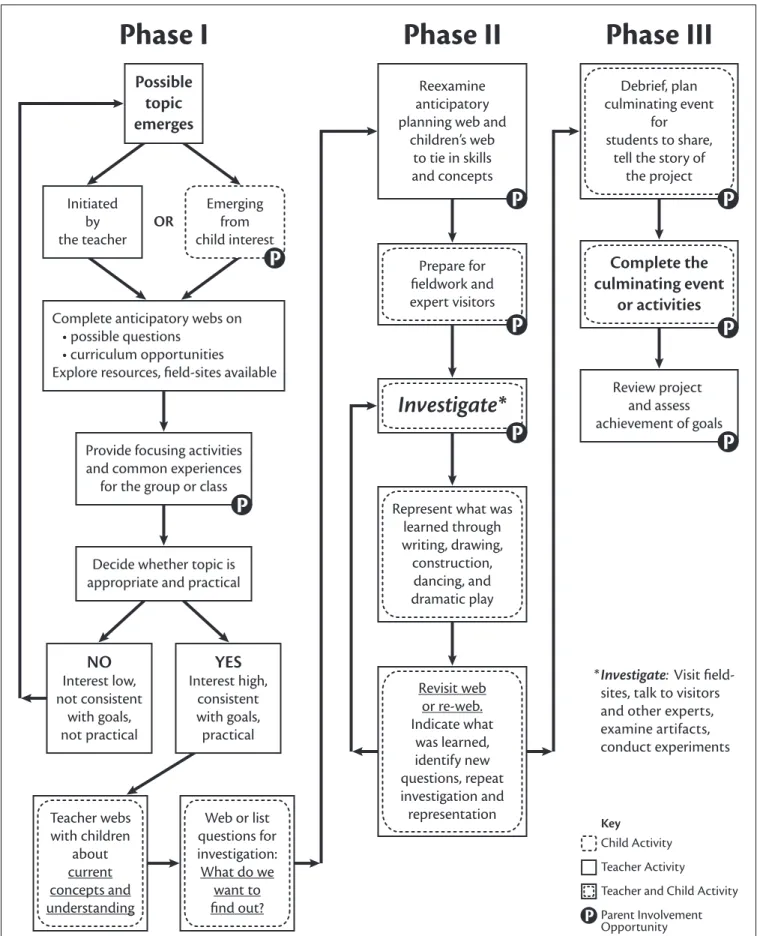
The structure of the project approach, as defi ned by Katz and Chard (2000), can be used to guide the process and to reduce many of these teacher concerns. The structure con-sists of three distinct phases (see Figure 1.5). During these phases the teacher evaluates the suitability of a topic, antici-pates needed resources, plans fi eld experiences, and identi-fi es experts who can be brought into the classroom for interviews and demonstrations. Documentation through-out the project helps the teacher recognize opportunities for problem solving and the application of concepts and skills so that good learning opportunities are not missed.
The project approach provides a structure but not a pre-scription for learning experiences. There is a fi ne line
FIGURE 1.4 • Th e Vet Project
A Project by 3-, 4-, and 5-Year-Old Children
Bright Beginnings, Woodford County Special Education Association, Eureka, Illinois
Length of Project: 8 weeks Teachers: Pam Scranton, Brenda Wiles
P
h
a
se I
Beginning the Project
Th e Vet Project began when one of the children, during morning group time, cried because he had to leave his kitty at the vet’s offi ce to be neutered. After talking through the experience as a group, the rest of the children couldn’t not let go of the subject and continued to talk about David’s kitty the rest of the morning. Th e next day we talked about the possibility of going to a vet clinic, and the children began asking questions and predicting what we would see. Kati shouted: “You better start writing, Teacher!” We started making a list of what they knew about a vet clinic. I discovered that they the children had a limited “vet vocabulary.” We decided to go to the library to choose some research materials.
Ph
a
se
I
I
Developing the Project
After the trip to the library, the children began reading the vet books and had some discussions about what kinds of animals we would see at the vet’s offi ce. Some of the children thought that we would see monkeys, zebras, cows, and pigs. We made our beginning web and prepared interview questions for the vet. On During the actual fi eld experi-ence, the children were divided into two groups. Th ose children most interested and involved in the project were responsible for graphing certain aspects of the clinic, recording answers to their questions, and sketching parts of the clinic. Th e expert, Dr. Marge, took the children through a typical exam and the children manipulated lots many of the vet tools. After we returned to the classroom, the children began to make plans to construct their own vet clinic. Th ey used their fi eld sketches and photographs taken on the fi eld experience to construct it, using boxes and the various scrounge items that parents brought into the classroom. Th e small group of children building the clinic were very concerned with making the clinic look as close to the one they had visited as possible, and they had to solve problems in the construction of key pieces of the clinic. Th is same group also visited the high school art class, where the art students encouraged them to model with clay and represent the animals they saw at the vet clinic.
P
h
ase III
Concluding the Project
As the month of May approached, the dramatic play that had been so intense a few weeks earlier began to wane. I gathered the project group together, and they decided to take down the vet clinic. We made another web and found that they knew a lot more “vet words” now and could tell anyone the important parts in a vet clinic and why they were needed. We made a list of their ideas about sharing their learning with their parents and the ECE class next door. Th e group decided to make a book,. Th ey and then made a list of important things they wanted included in the book. Th ey collected the displayed drawings and graphs from the walls for processing into the vet book.
FIGURE 1.5 • Phases of a project
Phase I
Phase II
Phase III
Possible
topic
emerges
Initiated by the teacher Emerging from child interest ORComplete anticipatory webs on • possible questions
• curriculum opportunities
Explore resources, field-sites available
Provide focusing activities and common experiences
for the group or class
Decide whether topic is appropriate and practical
NO
Interest low, not consistent with goals, not practicalYES
Interest high, consistent with goals, practical Teacher webs with children about current concepts and understanding Web or list questions for investigation: What do we want to find out? Reexamine anticipatory planning web andchildren’s web to tie in skills and concepts Prepare for fieldwork and expert visitors
Investigate*
Represent what was learned through writing, drawing, construction, dancing, and dramatic play Revisit web or re-web. Indicate what was learned, identify new questions, repeat investigation and representation Debrief, plan culminating event for students to share,
tell the story of the project
Complete the
culminating event
or activities
Review project and assess achievement of goals*Investigate: Visit sites, talk to visitors and other experts, examine artifacts, conduct experiments
Key
Child Activity Teacher Activity
Teacher and Child Activity Parent Involvement Opportunity
between supporting children’s investigation and teacher-directed inquiry—between supporting children’s learning and taking over the learning experience. One of the most challenging tasks in teaching young children is to learn how to recognize that line and avoid crossing it. The structure of the project approach can help teachers learn to do this. In learning how to implement the project approach, the teacher learns how to support and not crush children’s curiosity and natural dispositions to learn, and yet still achieve curriculum goals. “Approach” can be defi ned as “a way or means of reaching something,” “an entry” (The American Heritage Dictionary, 1992). The project approach can be an entry, a way for teachers to reach their goal of supporting active, engaged, meaningful learning and intel-lectual development. For some teachers, it can be an entrance into teaching in a more effective, child-responsive way. It is important to remember, however, that an entry-way is never the end destination and that the structure of the project approach is a guide to supporting children’s learning, not the end result.
Organization of Th is Book
As the structure of the project approach provides a guide for supporting children’s projects, this book provides a guide for teachers to learn how to do projects. Chapters 2 through 5 explain the phases of the project approach in detail, focusing particularly on how these phases look in childcare and education programs for young children from toddlers through fi rst-graders. Step-by-step explanations of the phases are accompanied by illustrations and children’s work from actual projects. Chapter 5 also presents a variety of methods of documentation and a framework for evalu-ating the project and extending and expanding the approach in future projects.
Chapter 6 is a detailed description of the Camera Proj-ect, which was carried out in a prekindergarten classroom, and Chapter 7 presents the Fire Hydrant Project from a toddler classroom.
Chapter 8 addresses the issue of using the project ap-proach to meet required curriculum goals or academic stan-dards. It also addresses how early literacy experiences and other academic skills can be strengthened during project work. A number of other issues that teachers often want to discuss are also presented. These include involving parents, employing technology, and using the project approach with specifi c populations, including children with special needs and second-language learners. The chapter also presents ways in which administrators can support project work.
At the end of the book is the Project Planning Journal, which teachers may copy and use in guiding young inves-tigators. Originally designed to support teachers doing their fi rst project with young children, the journal became a preferred way to plan and organize for project work by many experienced teachers. It became, in subsequent proj-ects, a journal in which the teachers could record the prog-ress of the project and their thoughts, as well as note docu-mentation that had been collected. This journal was used by teachers in a number of the projects described in this book. Readers will fi nd references to specifi c parts of the journal as they read about the project approach in Chap-ters 2 through 7.
Using the journal, however, is not a requirement for undertaking the project approach. There is no workbook for doing a project with young children. The journal and the projects described in this book are offered to support teachers as they learn to follow the interests of their chil-dren in implementing the project approach. Although dif-ferent groups of young children may be interested in simi-lar topics and may engage in simisimi-lar project activities, the course of projects is never the same. Authentic projects such as these cannot and should not be duplicated.
Learning to do projects is a journey, one that we have been privileged to share with the teachers represented in this book. The journey appears to be never-ending, and teachers of young investigators appear never to stop learn-ing from children how they can do it better. The sharlearn-ing of the journey begins in Chapter 2: Getting Started.