Glasgow Theses Service
http://theses.gla.ac.uk/
Gyimah, Daniel (2016) Empirical studies on share issuance and
repurchase decisions. PhD thesis.
http://theses.gla.ac.uk/7483/
Copyright and moral rights for this thesis are retained by the author
A copy can be downloaded for personal non-commercial research or study This thesis cannot be reproduced or quoted extensively from without first obtaining permission in writing from the Author
The content must not be changed in any way or sold commercially in any format or medium without the formal permission of the Author
When referring to this work, full bibliographic details including the author, title, awarding institution and date of the thesis must be given
Gyimah, Daniel (2016)
Empirical studies on share issuance and repurchase
2
EMPIRICAL STUDIES ON SHARE ISSUANCE AND REPURCHASE
DECISIONS
Daniel Gyimah
B. Com, MSc
Submitted in Fulfilment of the Requirements for the Degree of Doctor of
Philosophy in Accounting and Finance
Adam Smith Business School
College of Social Sciences
University of Glasgow
i
ABSTRACT
Financial constraints influence corporate policies of firms, including both investment decisions and external financing policies. The relevance of this phenomenon has become more pronounced during and after the recent financial crisis in 2007/2008. In addition to raising costs of external financing, the effects of financial crisis limited the availability of external financing which had implications for employment, investment, sale of assets, and tech spending. This thesis provides a comprehensive analysis of the effects of financial constraints on share issuance and repurchases decisions. Financial constraints comprise both internal constraints reflecting the demand for external financing and external financial constraints that relate to the supply of external financing. The study also examines both operating performance and stock market reactions associated with equity issuance methods.
The first empirical chapter explores the simultaneous effects of financial constraints and market timing on share issuance decisions. Internal financing
constraints limit firms‟ ability to issue overvalued equity. On the other hand, financial crisis and low market liquidity (external financial constraints) restrict availability of equity financing and consequently increase the costs of external financing. Therefore, the study explores the extent to which internal and external financing constraints limit market timing of equity issues. This study finds that financial constraints play a significant role in whether firms time their equity issues when the shares are overvalued. The conclusion is that financially constrained firms issue overvalued equity when the external equity market or the general economic conditions are favourable. During recessionary periods, costs of external finance increase such that financially constrained firms are less likely to issue overvalued equity. Only unconstrained firms are more likely to issue overvalued equity even during crisis. Similarly, small firms that need cash flows to finance growth projects are less likely to access external equity financing during period of significant economic recessions. Moreover, constrained firms have low average stock returns compared to unconstrained firms, especially when they issue overvalued equity.
ii
The second chapter examines the operating performance and stock returns associated with equity issuance methods. Firms in the UK can issue equity through rights issues, open offers, and private placement. This study argues that alternative equity issuance methods are associated with a different level of operating performance and long-term stock returns. Firms using private placement are associated with poor operating performance. However, rights issues are found empirically to be associated with higher operating performance and less negative long-term stock returns after issuance in comparison to counterpart firms that issue private placements and open offers. Thus, rights issuing firms perform better than open offers and private placement because the favourable operating performance at the time of issuance generates subsequent positive long-run stock price response. Right issuing firms are of better quality and outperform firms that adopt open offers and private placement.
In the third empirical chapter, the study explores the levered share repurchase of internally financially unconstrained firms. Unconstrained firms are expected to repurchase their shares using internal funds rather than through external borrowings. However, evidence shows that levered share repurchases are common among unconstrained firms. These firms display this repurchase behaviour when they have bond ratings or investment grade ratings that allow them to obtain cheap external debt financing. It is found that internally financially unconstrained firms borrow to finance their share repurchase when they invest more. Levered repurchase firms are associated with less positive abnormal returns than unlevered repurchase firms. For the levered repurchase sample, high investing firms are associated with more positive long-run abnormal stock returns than low investing firms. It appears the market underreact to the levered repurchase in the short-run regardless of the level of investments. These findings indicate that market reactions reflect both undervaluation and signaling hypotheses of positive information associated with share repurchase. As the firms undertake capital investments, they generate future cash flows, limit the effects of leverage on financial distress and ultimately reduce the risk of the equity capital.
iii
TABLE OF CONTENTS
ABSTRACT I
TABLE OF CONTENTS III
LIST OF TABLES IX
ACKNOWLEDGEMENTS XII
AUTHOR’S DECLARATION XIII
CHAPTER 1 1
INTRODUCTION 1
1.1.INTRODUCTION 1
1.2.BACKGROUND AND MOTIVATION 2
1.3.THE CHOICE OF DATASETS 8
1.4.RESEARCH QUESTIONS AND KEY FINDINGS 10
1.5.CONTRIBUTIONS OF THE STUDY 14
1.6.ORGANISATION OF THE STUDY 18
CHAPTER 2 21
LITERATURE REVIEW: SHARE ISSUANCE DECISIONS 21
2.1.INTRODUCTION 21
2.2.REVIEW OF THEORIES OF SHARE ISSUANCE 21
2.2.1. Pecking Order and Asymmetric Information Hypotheses 22
2.2.2. Market Timing 25
2.2.3. Trade off Theory 27
2.2.4. Agency Theory 28
2.2.5. Managerial Ownership 29
2.2.6. Managerial Entrenchment 30
2.2.7. Earnings Management 30
2.3.MISPRICING AND THE EFFECTS OF INTERNAL FINANCIAL CONSTRAINTS 32
2.3.1. Valuation and Financing Decisions 32 2.3.2. Internal Financial Constraints and Corporate Financial Policy 34
iv
2.3.3. Share Issuance and Internal Financial Constraints 37 2.3.4. Share Issuance and External Financial Constraints 39
2.4.SHARE ISSUANCE AND STOCK RETURNS 41
2.4.1. Underreaction Hypothesis 42 2.4.2. Rational Discount Rate 43 2.4.3. Investment-Based Explanation 43
2.4.4. Economic Perspective 44
2.5.TESTABLE HYPOTHESES 45
2.5.1. Share Issuance and Internal Financial Constraints 45 2.5.2. Share Issuance and External Financial Constraints 47 2.5.3. Share Issuance and Stock Returns 49
2.6.CONCLUSION 50
CHAPTER 3 52
LITERATURE REVIEW: SHARE ISSUANCE METHODS 52
3.1.INTRODUCTION 52
3.2.OVERVIEW OF SHARE ISSUANCE METHODS 52
3.2.1. Flotation Methods 53
3.2.2. UK issues 54
3.2.3. Costs of Issue Approach 54 3.2.4. Demise of Rights Issues 55
3.3.THEORIES OF SHARE ISSUANCE CHOICE 57
3.3.1. Quality Signalling 57
3.3.2. Monitoring and Certification Hypothesis 58 3.3.3. Managerial Entrenchment 59 3.3.4. Private Placement and Investor Relationship 61 3.4.STOCK PRICE REACTIONS TO SHARE ISSUANCE CHOICE 62
3.4.1. Initial Abnormal Stock Returns 62 3.4.2. Long Run Stock Returns 64
3.4.3. Operating Performance 69
3.5.TESTABLE HYPOTHESES 72
3.5.1. Equity Issues and Operating Performance 72 3.5.2. Long-run Stock Returns and Equity Issuance Methods 74
v
3.6.CONCLUSION 74
CHAPTER 4 76
LITERATURE REVIEW: SHARE REPURCHASE PROGRAMS 76
4.1.INTRODUCTION 76
4.2.OVERVIEW OF SHARE REPURCHASE 76
4.2.1. Methods of Share Repurchase 77 4.2.2. US Share Repurchases Regulations 79
4.3.THEORIES OF SHARE REPURCHASE 81
4.3.1. Undervaluation Hypothesis 81 4.3.2. Information Signalling Theory 83 4.3.3. Free Cash Flow Hypothesis 86
4.3.4. Market Timing 88
4.4.EMPIRICAL EVIDENCE OF SHARE REPURCHASES 89
4.4.1. Levered Share Repurchase 89 4.4.2. Share Repurchase and Investment Expenditure 91 4.4.3. Share Repurchase and Stock Returns 93
4.5.TESTABLE HYPOTHESES 95
4.5.1. Internal Financial Constraints and Levered Share Repurchase 95 4.5.2. Internal Financial Constraints, Levered Share Repurchase and Stock
Returns 97
4.6.CONCLUSION 98
CHAPTER 5 100
DATA AND METHODOLOGY 100
5.1.INTRODUCTION 100
5.2.DATA 100
5.2.1. Sample Period 100
5.2.2. Data for Equity Issues 102 5.2.4. Selection of matching firms/control firms 104 5.2.3. Data for Share Issuance Methods 105 5.2.4. Data Share Repurchase 107
vi
5.3.1. The Effects of Mispricing and Financial Constraints on Equity Issuance
Decisions 110
5.3.1.1. Dependent Variables 110 5.3.1.2. Explanatory Variables 112
5.3.1.3. Control Variables 116
5.3.2. Share Issuance Methods: Operating Performance and Stock Returns 123 5.3.2.1. Dependent Variable: 123 5.3.2.2. Explanatory Variable 127 5.3.3. Share Repurchase and Internal Financial Constraints 133
5.3.3.1. Dependent Variable 133
5.3.3.2. Explanatory Variables 136
5.3.3.3. Control Variables 138
5.3.3.4. Model Specification 140
CHAPTER 6 144
SHARE ISSUANCE AND FINANCIAL CONSTRAINTS 144
6.1.INTRODUCTION 144
6.2.SAMPLE STATISTICS 146
6.2.1. Descriptive Statistics of Variables 146 6.2.1.1. Descriptive Statistics of Sample 146 6.2.1.2. Yearly Average of Equity Issues 149
6.2.1.3. Pearson‟s Correlation Matrix of Variables 150 6.3.TESTING THE EFFECTS OF FINANCIAL CONSTRAINTS ON SHARE ISSUANCE
152 6.3.1. Internal Financial Constraints and Share Issuance 152 6.3.2. The Effects of External Financial Constraints 155 6.3.3. Share Issuance, Financial Constraints and Stock Returns 160 6.3.3.1. Univariate Results for Stock Returns 161 6.3.3.2. Cross-Sectional Regression Results for Stock Returns 164
6.4.ROBUSTNESS CHECKS AND ADDITIONAL RESULTS 166
6.4.3. Tobit Regression Estimation of Equity Issues 169 6.4.4. Random and Fixed Effects Logit Regression Estimation 170
vii
CHAPTER 7 176
SHARE ISSUANCE METHODS AND OPERATING PERFORMANCE 176
7.1.INTRODUCTION 176
7.2.SAMPLE STATISTICS AND DIAGNOSTICS 179
7.2.1. Descriptive Statistics of Independent and Control Variables 179 7.2.1.1. Equity Issues by Issuance Method during the Sample Period 179 7.2.1.2. Descriptive Statistics of Variables 180
7.2.1.3. Pearson‟s Correlation Matrix of Equity Issue Characteristics 183 7.3.TESTING THE EFFECTS OF OPERATING PERFORMANCE ON THE CHOICE OF
EQUITY ISSUANCE METHODS 187
7.3.1. Multinomial Logit Regression Analysis of Equity Issuance Methods 187 7.3.2. Long-term Stock returns 192 7.3.3. Long-term Operating Performance 197
7.4.ROBUSTNESS AND SENSITIVITY ANALYSIS 198
7.4.1. Logit Regression Results for Abnormal Returns on Assets (aROA) and
Returns on Equity (ROE) 198
7.4.2. Multinomial Logit Regression Results for Multiple Equity Issuance
Method during the Period 203
7.4.3. Tobit Regression Estimation of Main Results 206
7.5.CONCLUSION 208
CHAPTER 8 210
LEVERED SHARE REPURCHASE AND INTERNAL FINANCIAL
CONSTRAINTS 210
8.1.INTRODUCTION 210
8.2.SAMPLE STATISTICS 212
8.2.1. Descriptive Statistics of Independent and Control Variables 212 8.2.1.1. Share Repurchase during the Sample Period 212 8.2.1.2. Descriptive Statistics of Variables 214
8.2.1.3. Pearson‟s Correlation Matrix of Variables 217 8.3.TESTING THE EFFECTS OF INTERNAL FINANCIAL CONSTRAINTS ON LEVERED
viii
8.3.1. Logistic Regression Results for Levered Share Repurchase of
Unconstrained Firms 219
8.3.2. Share Repurchase and Stock Returns 226 8.3.2.1. Share Repurchase and Announcement Date Abnormal Returns 227 8.3.2.2. Share Repurchase and Long Run Abnormal Returns 231
8.4.ROBUSTNESS AND SENSITIVITY ANALYSIS 234
8.4.1. Unconstrained firms defined using alternative cut-off point of KZ 234 8.4.2. Levered Share Repurchase and WW index Internal Financial Constraints
236 8.4.3. Levered Share Repurchase and Bond Ratings 237 8.4.4. Levered Share Repurchase and Financial Distress 239 8.4.5. Tobit Regression Estimation of Main Results 241 8.4.6. Random and Fixed Effects Logit Regression Estimation of Main Results
243
8.5.CONCLUSION 245
CHAPTER 9 247
CONCLUSION 247
9.1.INTRODUCTION 247
9.2.MAIN FINDINGS OF THE THESIS 247
9.2.1. Share Issuance and Financial Constraints 247 9.2.2. Share Issuance Methods and Operating Performance 249 9.2.3. Share Repurchase and Internal Financial Constraints 251
9.3.RESEARCH IMPLICATIONS AND RECOMMENDATIONS 254
9.3.1. Implications for Academics 254 9.3.2. Implications for Practitioners and Policymakers 255
9.4.LIMITATIONS OF THE STUDY 257
9.5.SUGGESTIONS FOR FUTURE RESEARCH 258
APPRENDICES 261
ix
LIST OF TABLES
Table 3.1: Summary of Empirical Evidence of US Long Run Abnormal
Returns Post Equity Issues 67
Table 3.2: Summary of Empirical Evidence of UK Long Run Abnormal
Returns Post Equity Issues 68
Table 4.1: Summary of Empirical Evidence of US Announcement Date
Abnormal Returns following Share Repurchase 95 Table 4.2: Summary of Empirical Evidence of Long Run Abnormal Returns
following Share Repurchases 95 Table 5.1: Annual Equit Issues 104 Table 5.2: Construction of Equity Issues by Method and the Distribution across
the Sample Period 106
Table 5.3: Construction of Final Sample of Share Repurchase Announcements 108 Table 5.4: Number of Annual Share Repurchase Announcements 109 Table 6.1: Comparison of Issuing and Non-issuing Firms 147 Table 6.2: Yearly Average Amounts and Ratio of Equity Issues 149
Table 6.3: Pearson‟s Correlation Matrix of Variables 151 Table 6.4: Logit Regression Estimates of Internal Financial Constraints (KZ
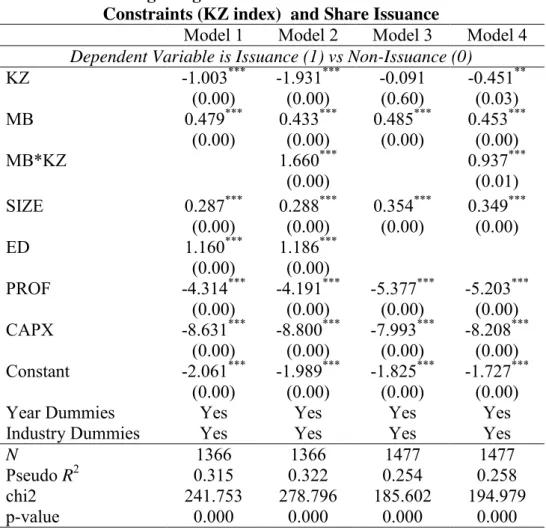
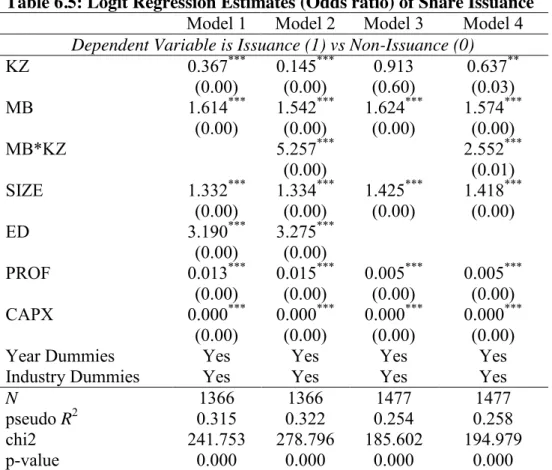
index) and Share Issuance 154 Table 6.5: Logit Regression Estimates (Odds ratio) of Share Issuance 155 Table 6.6: The Effects of External Financial Constraints (Financial Crisis) on
Share Issuance 157
Table 6.7: The Effects of External Financial Constraints (Market Liquidity) on
Share Issuance 159
Table 6.8: Univariate Results of Abnormal Stock Returns 163 Table 6.9: Cross-sectional Regression Analysis of Share Issuance and Short
Run Stock Returns 165
Table 6.10: Logit Regression Estimates of Internal Financial Constraints (WW
index) and Share Issuance 167
Table 6.11: The Effects of Financial Distress on Share Issuance 169 Table 6.12: Tobit Regression Analysis of Internal Financial Constraints and
x
Table 6.13: Random and Fixed Effects Logit Regression Estimation (Financial Constraints and Share Issuance) 172 Table 6.14: Random and Fixed Effects Logit Regression Estimation Financial
Constraints and Share Issuance (Crisis and Non-crisis) 173 Table 7.1: Yearly Average Amounts and Ratio of Equity Issues 180 Table 7.2: Summary Statistics of Firm Characteristics 182
Table 7.3: Pearson‟s Correlation Matrix of Equity Issue Characteristics (Rights
Issues) 184
Table 7.4: Pearson‟s Correlation Matrix of Equity Issue Characteristics (Open
Offers) 185
Table 7.5: Pearson‟s Correlation Matrix of Equity Issue Characteristics (Private
Placement) 186
Table 7.6: Multinomial Logit Regression Estimates of Choice of Equity
Issuance Method 189
Table 7.7: Long Run Buy and Hold Abnormal Returns and Equity Issuance
Method 193
Table 7.8: Long Run Stock Returns and Operating Performance (Positive and
Negative) 194
Table 7.9: Long Run Stock Returns and Operating Performance (High and
Low) 195
Table 7.10: Cross-sectional Regression Analysis of Long Run Stock Returns 196 Table 7.11: Post-issue Changes in Operating Performance 197 Table 7.12: Multinomial Logit Regression Estimates of Equity Issuance
Method (abnormal ROA) 199
Table 7.13: Multinomial Logit Regression Estimates of Equity Issuance
Method (ROE) 201
Table 7.14: Multinomial Logit Regression Estimates of Changes in Firm's Issuance Method During the Sample Period 204 Table 7.15: Tobit Regression Analysis of Equity Issuance Method 207 Table 8.1: Yearly Average Proceeds and Ratio of Share Repurchase Proceeds
xi
Table 8.2: Summary Statistics: Comparison of Unconstrained and Constrained
Firms 215
Table 8.3: Summary Statistics: Comparison of Unlevered and Levered
Repurchase 216
Table 8.4: Pearson‟s Correlation Matrix of Variables 218 Table 8.5: Logit Regression Estimates (Raw Coefficient Estimates) of Levered
Repurchase and Internal Financial Constraints 221 Table 8.6: Logit Regression Estimates (Raw Coefficient Estimates) of Levered
Repurchase and Internal Financial Constraints 222 Table 8.7: Logit Regression Estimates (Odds Ratio) of Levered Repurchase
and Internal Financial Constraints 223 Table 8.8: Logit Regression Estimates (Odds Ratio) of Levered Repurchase
and Internal Financial Constraints 224 Table 8.9: Univariate Analysis of 3-day Announcement Date Abnormal
Returns (CAR(-1,1)) following Share Repurchase 228
Table 8.10: Cross-sectional Regression Analysis of Announcement Date
Abnormal Returns 230
Table 8.11: Univariate Analysis of 36-month Buy and Hold Abnormal Returns
(BHAR36-month) following Share Repurchase 232
Table 8.12: Cross-sectional Regression Analysis of Long Run Buy and Hold
Abnormal Returns 233
Table 8.13: Logit Regression Estimates of Main Results (alternative cut-off
points) 235
Table 8.14: Logit Regression Estimates of Levered Repurchase and Internal Financial Constraints (WW index) 236 Table 8.15: Logit Regression Estimates of Levered Repurchase and Bond
Ratings 238
Table 8.16: Logit Regression Estimates of Levered Repurchase and Financial
Distress 240
Table 8.17: Tobit Regression Analysis of Levered Share Repurchase 242 Table 8.18: Random and Fixed Effects Logit Regression of Levered
xii
ACKNOWLEDGEMENTS
I wish to extend my gratitude to persons who assisted me in diverse ways, either consciously or unconsciously, towards the completion of this thesis. Foremost, I thank God for His immense wisdom and guidance throughout the period of this work. My supervisors, Prof. Chris Veld and Dr. Antonios Siganos, deserve special mention for their patience, encouragement and tremendous assistance that culminated into the successful completion of this work. I especially thank them for the amount of time they spent in reading the various drafts of the thesis and for the comments and suggestions they offered to improve the standard of this work. I am also grateful to have Prof. Seth Armitage and Dr. Betty Wu as my PhD examiners and for their useful comments.
I also wish to recognize the support of the entire faculty at the University of Glasgow for their critiques and valuable comments during the annual doctoral review. I enjoyed tremendous warmth during the course of this doctoral studies and I owe to all the doctoral students I have come across over the years. The spiritual and emotional support I received from my church, The Church of Pentecost-Glasgow, cannot be ignored and I say God richly bless all the brethren.
Finally, I thank my family for their constant love and affection that has seen me thus far in my academic pursuit.
xiii
AUTHOR
’
S DECLARATION
“I declare that, except where explicit reference is made to the contribution of others, that this thesis is the result of my own work and has not been submitted for any other degree at the University of Glasgow or any other institution. Signature _______________________________
1
Chapter 1
INTRODUCTION
1.1. Introduction
Corporate financing policy is an integral part of the operations of companies. Its importance underpins several decisions and affects both investing and financing decisions of the firm. Policies relating to investments in capital projects including research and development, cash distribution to shareholders in the form of dividend payments, and share repurchase decisions among others, have overarching effects on both the short term and long-term prospects of the company. On the basis of these decisions, investors determine whether or not to provide money to the company. The recent financial crisis of 2007/2008 highlighted the significant effects of financial constraints on corporate financial decisions including employment, tech spending, and capital spending (Campello et al. 2010). This thesis explores the effects of financial constraints on share issuance decisions and share repurchase programmes of firms. Specifically, the thesis explores the choice between share issuance and non-issuance when firms are financially constrained. Further analysis of share issuance examines the differential long-term stock returns associated with share issuance methods.
The first empirical chapter explores the effects of financial constraints (both internal and external) on share issuance decisions. Specifically, this chapter examines the simultaneous effects of mispricing and financial constraints on share issuance. Thus, it describes whether firms time their share issues even when they face extreme internal and external financial constraints. Further, it focuses on the type of firms, in terms of size and the time period when market timing of share issues is more plausible to limit the adverse stock price reactions. In the second empirical chapter, the thesis investigates whether the different long-term stock returns associated with equity issuance methods is driven by the level of firm operating performance. The literature on equity issuance methods asserts that stock returns differ according to the issuance method used. This chapter uses long-term operating performance to explain the
2
choice of equity issuance methods and the associated long-term stock returns. The third empirical chapter explores the motivation for unconstrained firms to borrow to repurchase their shares.
The aim of this chapter is to introduce the thesis. Section 1.2 presents the background and motivation for the study. Section 1.3 discusses the study dataset and the reasons for the choice of both UK and US sample firms. Section 1.4 sets out the research questions and provides the key findings of the thesis. Section 1.5 discusses the contribution of the study. Finally, section 1.6 provides the organisation of the thesis and briefly presents the content within each chapter.
1.2. Background and Motivation
There is an extant literature on securities issuance and repurchase and the effects on other corporate decisions have been extensively explored (for example Baker and Wurgler, 2002; Campello et al, 2010; Dong et al, 2012). In particular, corporate share issues are related to investments where firms with significant growth opportunities need external financing to undertake them. Moreover, share issues and repurchase alter the capital structure of the firm. The effects of corporate financing on capital structure began with the seminal paper by Modigliani and Miller (1958) where they argued, among others, that whether or not firm is made up of equity or debt does not matter, under the assumptions of perfect information, homogenous firms, no discriminating taxes and transaction costs of financing. However, several subsequent studies have challenged these assumptions and proved that in fact the source of financing has significant effects on capital structure, including the value of the firm and the costs of financing. Again, the effects on the firm of share issues and repurchase are reflected in the stock prices of the issuing or repurchasing firms. These stock price reactions are consistent across several jurisdictions and have informed corporate financing and investing policies.
Several theories have been postulated to explain equity issues and the stock price effects including information asymmetry (Akerlof, 1970; Myers and Majluf, 1984; Bayless and Chaplinsky, 1991), pecking order (Helwege and
3
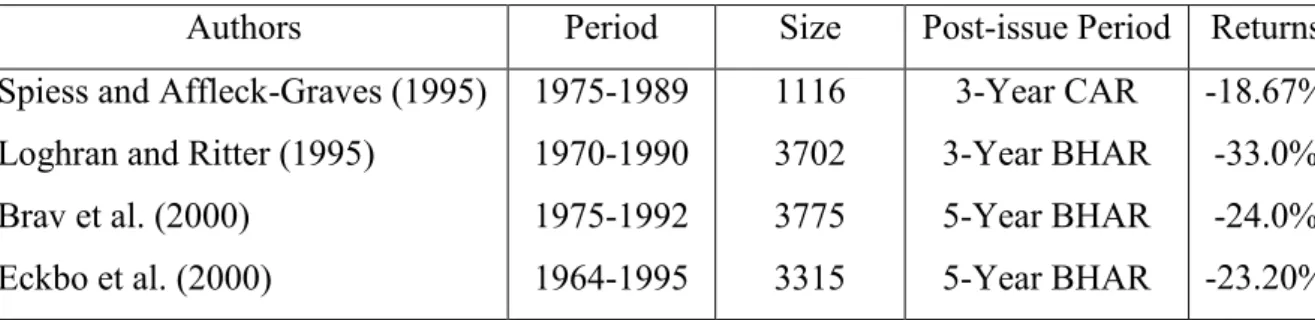
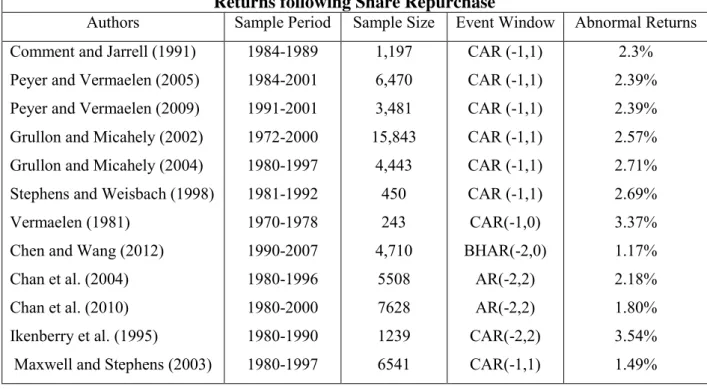
Liang, 1996; Frank and Goyal, 2003), market timing (Baker and Wurgler, 2002; DeAngelo, DeAngelo, and Stulz, 2010; Dong, Loncarski, ter Horst, and Veld, 2012), agency (Jensen and Meckling, 1976; Jensen, 1986), and static trade-off (Shyam-Sunder and Myers, 1999). Equity issues are generally associated with negative abnormal stock returns that has commonly attributed to market underreaction to the information (Spiess and Affleck-Graves, 1995; Loughran and Ritter, 1997). Firms also repurchase their shares in response to undervaluation (Ikenberry and Vermaelen, 1996; Stephens and Weisbach, 1998), information signalling effects (Vermaelen, 1981; Comment and Jarrell, 1991), and free cash flow (Jensen, 1986; Dittmar, 2000; Grullon and Michaely, 2004), among others. These motivations are consistent with divulging positive information about the prospects of the firms and hence stock returns associated with share repurchase announcements are positive.
The first empirical chapter explores the effects of financial constraints on share issuance decisions. Since the work by Modigliani and Miller, corporate financing decisions have evolved over the years, even though the theoretical explanations for stock returns still remain consistent. An important factor related to equity issues is transactions costs in the form of investment banking fees that depends on both the characteristics of the issuing firms and the overall capital market conditions. For example, Butler et al. (2005) find that firms reduce the costs of equity financing by improving the market liquidity of their stock. In other words, more liquid stocks are associated with lower investment banking fees. This cost of raising equity is important because it impacts market timing tendencies. Stated differently, internal (related to available cash and the friction to obtain external cash) and external financial constraints (mostly related to macroeconomic conditions and the overall capital market conditions) play a vital role in equity issuance decisions. Hence, this study explores the influence of financial constraints on share issuance decisions. Financial constraints involve both internal cash availability and the speed at which firms obtain equity financing in the equity capital market. It also captures market liquidity and the effects of financial crisis at the time of issuing equity to highlight the external financial constraints associated with equity issues.
4
This chapter, therefore, extends the literature on market timing by examining the effects of financial constraints on share issuance decisions. If firms time their equity issues and also incur costs of issuing equity, then I argue that internally financially unconstrained firms should be more likely to issue overvalued equity than constrained firms. Less internally financially constrained firms are more likely to time their equity issues (Dong et al, 2012) to coincide with periods of favourable macroeconomic conditions (Korajczyk and Levy, 2003). Taken together, firms that are internally financially constrained face high finance costs when there are simultaneously unfavourable market conditions. During financial crisis, with low market liquidity, issuance costs increase. Therefore, consistent with the financial constraints hypothesis, prospects of equity market timing by issuing firms are limited. These firms generate more free cash flow that would allow them to take advantage of issuing overpriced equity.
The second empirical chapter examines the different method of equity issuance in the UK. Firms in the UK issue equity through three dominant methods namely rights issues, open offers, and private placement. Since the deregulation in 1986, the preference for rights issue method has reduced and the recent evidence shows that firms use more private placements than rights issues (Armitage, 2007). The issuance methods are also associated with different stock price returns (Slovin et al. 2000; Barnes and Walker, 2006). Therefore, theories such as the information asymmetry (Myers and Majluf, 1984), window of opportunity hypothesis (Choe et al. 1993; Bayless and Chaplinsky, 1996), investor over-optimism (Loughran and Ritter, 1997; Hertzel et al. 2002) explain the choice of issuance method and the stock price reactions. For example, Hertzel et al. (2002) find that public firms that place their shares privately are associated with positive announcement returns suggesting that investors are over-optimistic about the future prospects of the issuing firms. Thus, firms deliberately choose the method based on the firm characteristics and the market responds according to the information that the issue provides to the market.
5
Furthermore, the research also explains the long-term stock returns associated with equity issuance methods. Prior studies attribute the different stock returns associated with each equity issuance method on the basis of both firm and issues characteristics that relate to market-to-book ratio, prior stock returns, firm size, and issue discount. Overall, these characteristics measure the degree of information asymmetry associated with the issuance method. For example, since rights issues are made to existing shareholders, it is less likely that firm will exploit any asymmetric information effects. Thus, issues involving external investors, such as private placement, allow the firm to exploit asymmetric information effects. This study asserts that operating performance determined by firms‟ operations have more long-term effects on long-term stock returns than alternative measures of information asymmetry. Therefore, the research explores the effects of long-term operating performance on the choice of issuance method and the subsequent long-term stock returns. Unlike Levis (2005), Abhyankar and Ho (2007), Capstaff and Fletcher (2011), who provide evidence about long term stock returns, this study focuses on how operating performance determines the choice of equity issuance method and explain the long term stock returns associated with equity issuance methods. The third empirical chapter focuses on share repurchases policies of firms. Share repurchase programs form an integral part of firm payout policy. US firms continue to repurchase their shares and actually repurchase transactions have increased beyond the pre-crisis levels in 2007. According to an article in The Economist, companies in the S&P 500 index repurchased a record $500 billion in 2013 financed by 33 cents of every dollar of cash flow.1 Prior research and empirical evidence is consistent with firm cash distribution in the form of share repurchase or in excess of dividend payments to avoid investment in value-destroying projects (Jensen, 1986; Bhargava, 2010). It follows that share repurchase are more likely to be conducted by firms with substantial amount of free cash and which have limited growth opportunities. Moreover, the undervaluation hypothesis contends that firms repurchase in order to buy their own cheap shares and also signal to the market about the favourable future prospects (Ikenberry and Vermaelen, 1996; Stephens and
6
Weisbach, 1998; Dittmar, 2000). In sum, firms that are less internally financially constrained and have cash slack will repurchase their shares. Chen and Wang (2012) find evidence that financially constrained firms repurchase their shares due to managerial hubris. Other studies find that firms borrow at the time of share repurchase announcements (Minnick and Zhao, 2007; de Jong, Dutordoir, and Verwijmeren, 2011).
Recent corporate financing policies reveal that it has become a commonplace for firms to simultaneously issue new convertible bond and repurchase their shares (see de Jong et al., 2011). These firms utilise the cash from debt issuance to finance their share repurchase transactions. During the last decades, share repurchases have become very popular as a means to return cash to shareholders. In 2007, share repurchases peaked at more than $700 billion near the market top.2 A large number of these repurchases were funded with debt issues. In 2009 alone, 37 companies announced plans to spend $39 billion on these levered repurchases.3 It may be understandable for internally financially constrained firms to repurchase their shares by borrowing due to limited financial resources available, but it seems puzzling for internally financially unconstrained firms to borrow money in order to repurchase shares. A recent example is Apple that announced in April 2013 that they would return $100 billion to shareholders in the form of a repurchase by the end of 2013. Apple borrowed part of the money for this repurchase, despite having a huge cash stockpile.4 This repurchase trend evokes the following question: why would internally financially unconstrained firms borrow to finance share repurchase? This debt-financed share repurchase could be determined by the extent of investment undertaken by these firms. The study further explores the stock price implications for these debt-financed repurchase firms.
2See Michael Milken: “Why capital structure matters”, The Wall Street Journal, April 21, 2009.
3Source: research by JP Morgan cited by Herb Greenbert in: “Debt to buy back stock”, CNBC, November 8, 2011. See: http://www.cnbc.com/id/45209702 (retrieved on March 30, 2015). 4See Katy Burne and Mike Cherney: “Apple‟s record plunge into debt pool”, The Wall Street Journal, April 30, 2013. Apple‟s case may be different from other companies, because much of its money is overseas; raising cash in the bond markets helps the company to reduce its large tax bill that would hit the company if it would bring back the cash to the U.S.
7
Unlike Chen and Wang (2012), this chapter of the thesis examines the share repurchase financing of unconstrained firms. For constrained firms, the incentive of buying back cheap or undervalued shares will motivate them to borrow to repurchase. However, Chen and Wang (2012) explicitly assert that managers of constrained firms repurchase due to overconfidence about the future prospects of the firms and managerial hubris. In respect of debt-financed repurchase, studies, such as Minnick and Zhao (2007) find that firms borrow to finance their share repurchase programs. Due to the effect of share repurchase on distress risk, these debt-financed repurchase firms report less positive announcement date abnormal returns. Bond returns associated with debt-financed repurchases are also negative or less than an otherwise cash-debt-financed share repurchase. Thus, share repurchase generates wealth transfer from bondholders to stockholders (Maxwell and Stephens, 2003). Also, another wealth transfer occurs between debt-financed share repurchase and cash-financed share repurchase (Minnick and Zhao, 2007). However, de Jong et al. (2011) do not find that convertible debt issues are necessarily used to finance share repurchase. They contend that convertible arbitrage strategies explain the size and speed of share repurchase transactions. These previous studies highlight the share repurchase programs of constrained firms and the general evidence that firms systematically issue new debt during share repurchase announcements. Therefore, the present research revisits this phenomenon and examines the share repurchase financing of internally financially unconstrained firms.
The third empirical chapter, therefore, investigates the factors that drive unconstrained firms to conduct levered share repurchase. The intuition for this phenomenon, as argued in current study, is that even though unconstrained firms can use internal cash flows to buy-back their shares, these firms can take advantage of low interest rates to raise debt financing and together with the internal cash flows undertake investments when they also repurchase their shares. Internally financially unconstrained firms are more likely to conduct levered share repurchase when they also invest in capital projects. In addition, it examines the initial stock returns subsequent to share repurchase announcements. It also highlights the stock returns for debt-financed and
cash-8
financed share repurchase of both internally financially unconstrained and constrained firms.
1.3. The choice of datasets
The thesis uses dataset from both UK and US for important reasons. The first empirical chapter focuses on the effects of financial constraints on share issuance of UK listed firms and the second chapter notes the marked stock returns differences associated with different equity issuance methods. There is a limited empirical literature on UK equity market timing and especially the study about the effects of financial constraints on UK equity issues is unexplored. Indeed, most of the internal financial constraints studies use US dataset (For example, Fazzari, Hubbard, and Petersen, 1988; Kaplan and Zingales, 1997; Whited and Wu, 2006; Korajczyk and Levy, 2003). Dong et al. (2012) investigate financial constraints effects on equity issues for Canadian listed firms. Equity mispricing studies that focus on the UK include Marsh (1982), and Mahajan and Tartaroglu (2008). Unlike the previous studies, I explore the simultaneous effects of internal financial constraints and the financial crisis on share issuance decisions of UK firms. Therefore, UK presents an ideal setting to contribute to the general empirical literature on equity issuance decisions and delineates how financial constraints impact such corporate financing policies.
Another important reason to study UK equity issues is the presence of different equity issuance method as explored in the Chapter two of the thesis. UK deregulation of 1986 allowed firms to issue equity through means other than rights offerings. Since the deregulation, several changes have occurred from gradual recession of the rights issues dominance to near demise of rights issues. Armitage (2007) finds that the demise of rights issues is more pronounced that reflects the notion that placing better facilitates block selling than rights issues (Armitage, 1998; 2010).5 Again, placement saves time and money compared with rights issue and open offers and cost less than rights
5 Placing is an equity issuance method by which firms place new share issues by private negotiation or through accelerated bookbuilding in which investing institutions are publicly invited to bid for shares. Extensive discussion of methods of equity issuance is provided in Section 3.1.1of Chapter 3.
9
issues (Wu, 2004). Using UK data, the study then captures the periodic changes in the choice of issuance method and the implications for stock return reactions. Stated differently, UK provides an ideal setting to explore how investor, firm, and regulatory changes have altered preference for private placement over rights offerings. The findings shed more light on equity issuance methods and provide new insights into equity issuance decisions. Note that this unique feature of equity issues is uncommon in international markets. Only one or two dominant issuance approaches exist such as firm commitment in the US (Eckbo and Masulis, 1992)6, rights issues in the Netherlands (Kabir and Roosenboom, 2003), rights offering by family controlled businesses in Sweden (Cronqvist and Nilsson, 2005), rights offerings and private placement in Australia (Brown and Chan, 2004) and rights issues in most European countries (Tsangarakis, 1996; Bohren, Eckbo, and Michalsen, 1997; Gajewski and Ginglinger, 2002; Pastor-Llorca and Martin-Ugedo, 2004). In an environment where choice of equity issuance prevails, firms are able to tailor their issues to specific motivations. For example, in an attempt to restrict ownership dilution, firms will prefer to issue shares to existing shareholders through rights offerings (Cronqvist and Nilsson, 2005). On the other hand, private placements, while diluting ownership by allowing new investors to subscribe to the shares, encourage monitoring (Wruck, 1989) and promote credible certification of the issue (Hertzel and Smith, 1993).
With regard to the third empirical chapter, the dataset on U.S. share repurchase is used. Despite the extensive research on share repurchase announcements in the US, the evolution of corporate actions and events reflects the changing dynamics in corporate financing policy. During the last few decades, share repurchases have become popular as a means to return cash to shareholders. In 2007 alone, US share repurchases peaked at more than $700 billion near the market top (Milken, 2009). A large number of these repurchases were funded
6 Eckbo and Masulis (1995) report that U.S. companies have switched from uninsured rights to standbys and to firm commitment underwriting method. The firm commitment flotation method accounts for 99% of all issues. Under firm commitment, an underwriter commits to buy the entire equity issue and tries to resell it to investors.
10
with debt issues. In 2009 for instance, 37 US companies announced plans to spend $39 billion on these levered repurchases.7 Unlike most European countries, share repurchase programs in the US are authorized by the board of directors and hence do not need shareholder approval. The apparent flexibility associated with share repurchase differs markedly from those of other jurisdictions. Until 1998, share repurchases were illegal in some European countries such as France and Germany (Rau and Vermaelen, 2002; Andriosopoulos and Lasfer, 2015). Also in the UK, share repurchase programs are limited due to regulatory restrictions and undermine companies‟ ability to take advantage of undervaluation (Rau and Vermaelen, 2002; Oswald and Young, 2004). For example, UK companies are not allowed to buy back their shares in periods when managers are most likely to have superior information about future earnings. Whereas the regulatory limitations provide sufficient grounds to study UK share repurchase, the new trend of debt-financed repurchase motivates the use of US data. The regulatory environment in the US allows firms to exploit undervaluation and pursue other motivations that apparently benefit the firm. The study therefore uses US data to explore the reasons why US firms that are less financially constrained issue debt during share repurchase programs.
1.4. Research questions and key findings
The main research questions of the thesis are as follows:
1. How do internal and external financial constraints affect equity issuance decisions?
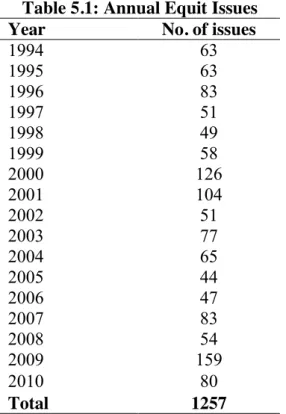
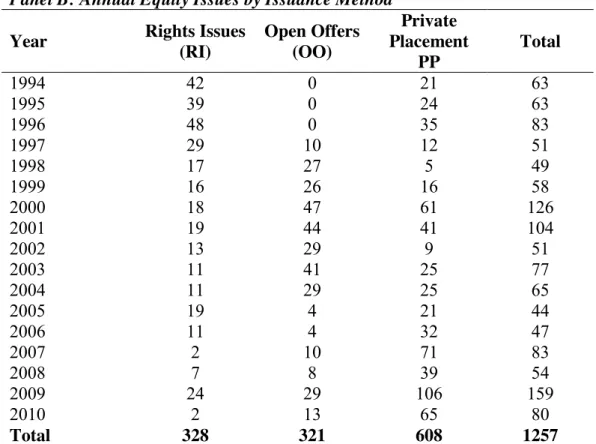
The extant literature provides evidence for equity market timing and posits that subsequent stock returns associated with equity issues are significantly negative. This study extends the market timing theory by incorporating the effects of both internal and external financial constraints on equity issuance decisions. The study uses a sample of 1257 equity issues by UK listed firms to test the simultaneous of effects of mispricing and internal financial constraints on share issuance decisions. The total sample spans over a period of 17 years
11
between 1994 and 2010. The study uses both univariate and multivariate analysis to establish the effects of financial constraints on share issuance decision. It uses logit regression analysis to show the probability of equity issuance based on both internal and external financial constraints. Moreover, it highlights the stock returns associated with equity issues conditional on financial constraints.
Consistent with the literature (Baker and Wurgler, 2002; DeAngelo et al., 2010; Dong et al., 2012), the results provide strong support for the market timing theory, showing that UK firms time their equity issues. The second proposition of the thesis contends that internally financially constrained firms could still issue overvalued equity provided the equity market and/or the general economic conditions are favourable. Similar to related evidence, the findings show that internally financially constrained firms are more likely to issue overvalued equity similar to unconstrained firms during non-crisis period. However, as costs of external financing become high during economic downturn, internally financially constrained firms are less likely to issue equity even if the equity is highly overvalued. The study further finds that during period of financial crisis or when there is low market liquidity, small firms are less likely to issue overvalued equity. It also shows that large firms with limited growth opportunities and substantial amount of free cash flow can afford transaction costs of issuing overvalued equity even during significant financial crisis.
2. Does the long-term operating performance reflect the choice of equity issuance methods?
The deregulation in 19868 introduced alternative issuance methods in the UK - rights issues, open offers and private placements – and subsequent equity issues reflect certain firm characteristics. Firms are expected to select issuance method for which they have more prospects for timing their overvalued issues. Rights issuing firms have less incentive to sell equity with poor prospects,
8 In October 1986, the event known as the “BigBang” took place, marking significant changes to the structure of UK financial markets. Among other consequences, an electronic trading system was introduced.
12
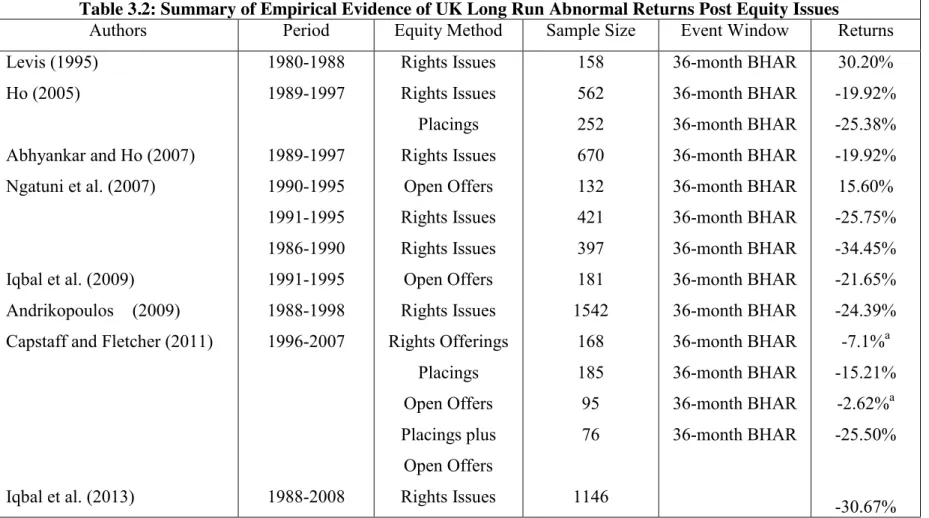
since existing shareholders sell shares to themselves in comparison to counterpart private placements and open offers. Equity issuance methods account for different short-term stock returns (Slovin et al., 2000; Barnes and Walker, 2006) and long-term stock returns (Ho, 2005; Andrikopoulos, 2009; Capstaff and Fletcher, 2011). However, most of these studies attribute the different stock returns to firm and issue characteristics that have short-term effects on stock returns. This study argues that differential information asymmetry allows firms to use the inside information to select the issuance method.9 Since operating performance may vary after the issuance of alternative methods, the long-term stock returns would vary accordingly. In testing the hypothesis, the research uses UK equity issuance data from 1996 to 2010 to explore stock returns and contemporaneous operating firm performance for each of the subsequent three years after equity issuance. Consistent with the developed hypothesis, the empirical results show that firms with better operating performance are more likely to conduct rights issues and are associated with the less negative long-term stock returns after rights issues than private placements and open offers. These results hold within a number of robustness tests, indicating that managers select an issuance method in line with their expectations of a firm‟s future operating performance. Moreover, firms are more likely to select private placement because less favourable contemporaneous operating performance information is not available to the market at the time of the equity issues. Stated differently, firms are less likely to issue overvalued equity to existing shareholders through rights issues. Long-term stock returns associated with equity issuance method are consistent with the long-term operating performance. These results suggest that over the long term, operating performance explains long-term stock returns beyond firm and issue characteristics such as market-to-book ratio, firm size, issue discount, prior stock returns, and institutional share ownership, among others.
3. Why do internally financially unconstrained firms borrow to repurchase their shares?
9 Cronqvist and Nilsson (2005) theoretically and empirically support the hypothesis that information asymmetry influences managers‟ decisions of whether to select rights issues or private placements within Swedish firms.
13
Since the effects of internal financial constraints transcend all corporate decisions, the study also focuses on the share repurchase implications. Specifically, the study investigates the factors that drive unconstrained firms to conduct levered share repurchase. The intuition for this phenomenon is that unconstrained firms, which have sufficient internal cash flows, would not need external financing to repurchase their shares. However, these firms can take advantage of low interest rates to raise debt financing and together with the internal cash flows undertake investments when they also repurchase their shares. Denis and Sibilkov (2010) assert that low cash holdings of internally financially constrained firms does not allow them to build cash reserves when they spend all available cash on investments. The study, therefore, hypothesises that unconstrained firms with bond ratings obtain debt financing at relatively low transaction costs in terms of interest payments. Consequently, internally financially unconstrained firms are more likely to conduct levered share repurchase when they also invest in capital projects.
Share repurchases are defined as levered or unlevered on whether there is an increase in debt capital a year prior to and after the date of repurchase. Unconstrained firms are defined using the KZ index.10 First analysis estimates logit regressions to investigate the probability of levered share repurchase based on internal financial constraints and the interaction between internal financial constraints and investments. The results are consistent with the hypothesis that internally financially unconstrained firms borrow to finance their share repurchase. But more importantly, they are more likely to conduct levered share repurchase when they also undertake investments. These findings imply that unconstrained firms even though they can repurchase with internal cash flows, the additional cash from the debt issuance allows the firms to undertake more investments. Using bond ratings as a proxy for internal financial constraints, the study finds that levered share repurchase is related to firms with bond ratings and/or investment-grade firms.
10 Kaplan and Zingales (1997) constructed the KZ index in their study of the financial constraints characteristics of 49 low-dividend paying manufacturing firms. Using observable characteristics, Kaplan Zingales run an ordered logit to rank the firms. A firm with high KZ index is considered more financially constrained.
14
Additional analysis shows that the initial stock returns associated with share repurchase depend on the level of internal financial constraints and the financing of the share repurchase. Levered repurchase firms are associated with less positive abnormal returns than unlevered repurchase firms. In relation to unconstrained firms, high investing firms are associated with more positive abnormal stock returns than low investing firms. The implications of these findings are that market reactions reflect both undervaluation and signaling hypotheses of positive information associated with share repurchase. As the firms undertake capital investments, they generate future cash flows, limit the effects of leverage on financial distress and ultimately reduce the risk of the equity capital.
1.5. Contributions of the study
This thesis extends and complements the extant literature on share issuance and share repurchase announcements.
First, this study complements the existing literature on share issuance decisions. Studies such as Kaplan and Zingales (1997), Almeida et al. (2004) and Whited and Wu (2006) provide extensive explanations for the effects of financial constraints on corporate decisions, enumerating important characteristics that distinguish financially constrained firms from unconstrained ones. This study emphasises the extent to which the level of financial constraints affects the decision to time the issuance of shares. Financial constraints have significant impact on corporate decisions relating to employment, cuts in tech spending and capital spending (Campello, et al., 2010) and the costs of equity issues (Korajczyk and Levy, 2003; Dong et al., 2012; McLean and Zhao, 2014). This thesis argues that both internal and external financial constraints determine the equity market timing of firms. This financial constraints variable relates both to the internal cash flow limitations and the costs of external equity issues when there is low market liquidity and/or during periods of financial crisis. In other words, the issue of overvalued equity in the equity marketplace reflects both the degree of internal cash flows and external costs associated with such issues.
15
For example, during the financial crisis or periods of low market liquidity, financially unconstrained firms could issue overvalued equity due to both the ability to finance the issues and lower adverse selection costs associated with unconstrained firms compared to constrained firms. Given low market liquidity and/or during financial crisis – high costs of issuing equity – financially constrained firms are less likely to issue equity even if they are significantly overvalued (Korajczyk and Levy, 2003; Dong et al., 2012). Financially constrained firms, not only are find equity issues costly compared to unconstrained firms, but they also potentially are associated with higher adverse selection costs. Only unconstrained firms would have the financial resources to conduct equity issues and are therefore more likely to issue overvalued equity. Unlike previous studies, this thesis performs analysis of equity issues for simultaneous effects of internal and external financial constraints. Finally, stock price underperformance subsequent to equity issues is more severe for constrained than unconstrained firms, especially for issuance during financial crisis or low market liquidity. Overall, this study demonstrates that the effects of internal financial constraints on equity market timing is more pronounced when there is a concurrent external financing constraints, especially during periods of the financial crisis and/or low market liquidity. Simultaneous effects of internal and external financial constraints also determine subsequent stock price reactions following equity issues.
Second, the thesis provides evidence about the effects of operating performance on the choice of equity issuance method and the subsequent long run stock returns associated with equity issues in the United Kingdom. For the UK in particular, several equity issuance methods are available to firms and each method is associated with different level of asymmetric information effects. Different equity issuance methods induce different types and degree of market reactions. Theoretical models developed in the literature attribute these different market reactions to quality signalling that are associated with each issuance method (Eckbo and Masulis, 1992; Balachandran et al., 2008). Factors that signal firm quality include the issue price discount, volatility of returns and earnings management (Dissanaike et al., 2014). The extant literature shows that stock returns, especially short-term returns, are a function of both firm and
16
issue characteristics (Slovin et al., 2000; Barnes and Walker, 2006; Armitage, 2010). While these characteristics are transient and relate to the short term, operating performance will have more explanatory power in the long run than other firm characteristics that existing research used to explain the stock price performance following equity issues. Since operating performance is a long term performance metric it is better aligned to the changes in stock price performance than alternative factors that explain stock returns following equity issues. This thesis asserts that long run operating performance provide more explanatory power for the long run stock price performance following equity issues. Moreover, long run price performance also differs markedly among equity issues through rights issues, open offers and private placement. Operating performance explain firms inside information about their performance beyond the equity issuance period.
The study departs from most previous studies that look at the choice of equity issuance method on the basis of the post-issue stock returns. This study asserts that operating performance not only determines the choice of issuance methods but it also explains the post-issue long run stock returns associated with each equity issuance method. Operating performance explains better the firm quality theory over the long term. Subsequent to equity issues, firms conducting rights issues report better operating performance than open offers and private placement. Thus, firms associated with better operating performance seem more likely to conduct rights issues rather than open offers and private placements. Consistent with Capstaff and Fletcher (2011), the study further finds that rights issuing firms outperform open offers and private placement in the long run. Unlike Slovin et al. (2000) and Barnes and Walker (2006), rights issuing firms are associated with quality information signalling since it is unlikely that firms would issue overvalued equity to exploit existing shareholders. The study also finds that long run operating performance explains stock price underperformance associated with equity issues (Loughran and Ritter, 1997; Kabir and Roosenboom, 2003). This research argues that operating performance better explains the choice of equity issuance than firm and issue characteristics such as market-to-book ratio, stock returns volatility, issue discount, among others. In effect, the study asserts and finds strong
17
support for the effects of long-term operating performance on both the choice of equity issuance and long-term stock returns associated with UK equity issues.
Third, this study provides empirical evidence about levered share repurchase. According to conventional wisdom, firms repurchase their shares when they are undervalued (Ikenberry and Vermaelen, 1996; Stephens and Weisbach, 1998), have free cash flows (Jensen, 1986; Grullon and Michaely, 2004; Bozanic, 2010) and produce quality information signaling (Vermaelen, 1981, 1984; Grullon and Michaely, 2004; Baker et al. (2003)). Consistent with the free cash flow theory, it is less likely for internally financially constrained firms to conduct share repurchases unless they obtain external financing to support this program (Chen and Wang, 2012). It is equally puzzling for firms with high free cash flows or excess cash flows to borrow during share repurchase programs. The study provides evidence that internally financially unconstrained firms borrow to finance share repurchase programs. Payout policies make the implicit assumption that firms with significant financial resources do not necessarily require external financing in order to distribute cash to existing shareholders. Share repurchasing firms invest less in capital projects as more cash is distributed to shareholders (Jensen, 1986; Hahn and Lee, 2009). However, the study argues that the additional external financing acts as cash buffer for investments. Given that payout limits subsequent investments, I explore whether unconstrained firms issue debt capital at the time of share repurchase announcements and find evidence that unconstrained firms issue debt at the time of share repurchase announcements. The findings also support the hypothesis that internally financially unconstrained firms undertake more capital investments.
The study contributes to the share repurchase literature and in particular the financing of share repurchases by internally financially unconstrained firms. Firms do not only utilise internal cash flows to finance share repurchase but also a significant number of firms borrow to finance share repurchase (Chen and Wang, 2012; Lei and Zhang, 2015; Farre-Mensa et al., 2015). Whereas Chen and Wang (2012) assert that internally financially constrained firms
18
conduct share repurchases due to managerial overconfidence and hubris, this study highlights that internally financially unconstrained firms also borrow during share repurchase programs. For instance, unconstrained firms are more likely to be rated firms with investment grade ratings which allows them to obtain debt financing at low interest rates compared to an otherwise financially constrained firms. Stated differently, the degree of internal financial constraints influences the costs of debt financing and the ensuing effects of additional leverage on the costs of financial distress magnifies the overall costs of equity capital for constrained firms. Finally, Farre-Mensa et al. (2015) report that firms finance their payouts through debt and equity to both manage their capital structure and cash holdings. Their evidence shows that these firms could not have funded the payout without external financing. This result implies some of the firms are potentially financially constrained such that they could only finance their payouts using external financing. I find evidence similar to Farre-Mensa et al. (2015). Firms undertaking share repurchases obtain external debt-financing. In particular, I find that unconstrained firms borrow during share repurchase announcements and potentially utilize the additional cash buffers to finance investment expenditure. Overall, this study provides empirical evidence about levered share repurchases and show that investment expenditure explains levered share repurchase programs.
1.6. Organisation of the study
The thesis is organised into nine chapters.
Chapter 2 reviews the literature related to the effects of financial constraints on equity market timing. The chapter begins with the review of market timing theory and the other alternative theories that explain equity issuance decisions. It discusses the stock returns associated with equity issues and presents the theories that explain such stock price effects. Further, the chapter presents literature on internal and external financial constraints and discusses the impact on share issuance decisions. Finally, the chapter presents the testable hypotheses based on the theoretical and empirical evidence.
19
Chapter 3 provides literature review of equity issuance methods in UK. The chapter presents an overview of equity issuance methods in the UK and discusses the three main issuance methods available to UK firms. It then reviews the literature on short and long-term stock returns associated with equity issues and examines the theories that explain the returns. Finally, the chapter presents the testable hypotheses based on the literature.
Chapter 4 reviews the literature on share repurchase programs in the US. The chapter discusses the share repurchase regulations in the US and presents the types of share repurchasing programs. It further reviews the factors that drive share repurchase and the theories that explain the stock returns associated with share repurchase announcements. The chapter discusses the empirical evidence of internal financial constraints effects on share repurchase and highlights debt-financed share repurchase programs. Finally, the chapter presents the testable hypotheses based on the theoretical and empirical evidence.
Chapter 5 discusses the data and methodology used to test the hypotheses and answer the research questions. It, specifically, presents the dataset and how it was collected, the econometric estimations and the variables for the empirical chapters. In addition, it discusses the justifications for the proxies used in the models.
Chapter 6 investigates the simultaneous effects of market timing and financial constraints on share issuance decisions. The chapter presents the descriptive statistics of the variables and the regression analysis of the models explained in chapter 5. It also discusses the robustness tests conducted to corroborate the results of the main model.
Chapter 7 provides the empirical testing of the asymmetric information effects on long-term stock returns associated with equity issuance methods. It provides the descriptive statistics of the variables, the univariate analysis and the multivariate analysis of the choice of equity issuance methods. In addition, the chapter presents the regression analysis of the long-run stock returns associated with equity issuance methods and presents the robustness tests of the main model.
20
Chapter 8 examines the share repurchase financing of unconstrained firms and explores the factors that drive unconstrained firms to borrow during the share repurchase announcements date. This chapter presents the descriptive statistics of the repurchase sample, the regression analysis of the models explained in chapter 5, and outlines the robustness tests for the results of the main model. Chapter 9 concludes the thesis by summarising the key findings, discussing the limitations of the study and proposing recommendations for future research.
21
Chapter 2
LITERATURE REVIEW: SHARE ISSUANCE DECISIONS
2.1. Introduction
Share issuance decisions have implications for changes in capital structure and firm value. These decisions also determine availability of financing for investment projects and can affect the overall risk exposure of the firm. However, the level of internal financial constraints could affect issue of external equity. The effect of the financial crisis in 2007/2008 highlights the importance of external financial constraints in equity issues. This chapter reviews the theories that underlie share issuance decisions. It further examines the literature on the effects of both internal and external financial constraints on shares issuance and discusses the stock returns associated with equity issues. The chapter also develops testable hypotheses that set out the focus of the empirical chapter 6 of the thesis.
The chapter has four sections. Section 2.2 reviews theories of share issuance. It discusses theories such as asymmetric information/pecking order theory, market timing, agency theory, and trade-off theory, among others. Section 2.3 focuses on the effects of mispricing and internal financial constraints on equity issues. The section examines the effects valuation and financing decisions, share issuance and internal as well external financial constraints. Section 2.4 explains the empirical evidence of stock returns associated with equity issues and the theories that explain the stock returns‟ behaviour. Section 2.5 develops the testable hypotheses and section 2.6 concludes the chapter.
2.2. Review of Theories of Share Issuance
Through corporate financing policies, firms obtain funds in the external capital market for varied reasons. For example, firms need financing to undertake new investments, to pay dividends, to maintain capital structure, among others. The most popular financing sources include debt and equity, as well as convertible debt. Several theories have been developed to explain in part the reasoning behind financing decisions and the subsequent security issuance. Several