NBER WORKING PAPER SERIES
WHEN ARE ANALYST RECOMMENDATION CHANGES INFLUENTIAL?
Roger K. Loh
René M. Stulz
Working Paper 14971
http://www.nber.org/papers/w14971
NATIONAL BUREAU OF ECONOMIC RESEARCH
1050 Massachusetts Avenue
Cambridge, MA 02138
May 2009
We thank Gilbert Ho for research assistance and the Office of Research at Singapore Management
University for financial support. The views expressed herein are those of the author(s) and do not necessarily
reflect the views of the National Bureau of Economic Research.
NBER working papers are circulated for discussion and comment purposes. They have not been
peer-reviewed or been subject to the review by the NBER Board of Directors that accompanies official
NBER publications.
© 2009 by Roger K. Loh and René M. Stulz. All rights reserved. Short sections of text, not to exceed
two paragraphs, may be quoted without explicit permission provided that full credit, including © notice,
When are Analyst Recommendation Changes Influential?
Roger K. Loh and René M. Stulz
NBER Working Paper No. 14971
May 2009
JEL No. G14,G20,G24
ABSTRACT
Not all stock recommendation changes are equal. In a sample constructed to minimize the impact of
confounding news, relatively few analyst recommendation changes are influential in the sense that
they impact investors’ beliefs about a firm in a way that could be noticed in that firm’s stock returns.
More than one-third of the stock-price reactions to analyst recommendation changes have the wrong
sign and only approximately 10% have significant stock-price reactions at the 5% level using an extended
market model. We find that the probability of an influential recommendation is higher for leader analysts,
star analysts, away-from-consensus revisions, revisions issued contemporaneously with earnings forecasts,
analysts with greater relative experience, and those with more accurate earnings estimates. Growth
firms, small firms, high institutional ownership firms, and high prior turnover firms are also more
likely to have influential stock recommendations. Strikingly, analyst recommendations are more likely
to be influential after Reg FD and the settlement. Finally, influential recommendations are associated
with increases in stock volatility and large absolute changes in consensus earnings forecasts.
Roger K. Loh
Singapore Management University
Lee Kong Chian School of Business
50 Stamford Rd, #04-01
Singapore 178899
Singapore
[email protected]
René M. Stulz
The Ohio State University
Fisher College of Business
806A Fisher Hall
2100 Neil Avenue
Columbus, OH 43210-1144
and NBER
1.
Introduction
Market observers at times attribute large stock price changes to analyst recommendation changes. For instance, according to the Wall Street Journal’s description, Kenneth Bruce from Merrill Lynch issued a recommendation downgrade on Countrywide Financial on August 15, 2007 questioning the giant mortgage lender's ability to cope with a worsening credit crunch. The report sparked a sell-off in Countrywide’s shares, which fell 13% on that day. In another example, when Meredith Whitney (CIBC World Markets) downgraded Citigroup on November 1, 2007, the stock price dropped 6.9%, the CEO quit two days later, and she apparently received death threats.4 Though the finance literature finds that significant average abnormal returns are associated with recommendation changes, the typical estimate associated with a recommendation change is too small to be considered a significant abnormal return for the stock of a firm when an analyst recommendation change is made. Consequently, with the typical recommendation change, investors following a firm could not distinguish the impact of the recommendation change from noise. However, at times a recommendation change, such as the Bruce call on Countrywide, is viewed by observers as having a large identifiable impact on the stock price. In this paper, we try to understand better when and why analyst recommendation changes at times appear to have a large stock price impact.
The question we address is different from the question typically answered in the analyst literature that tries to assess the impact of analyst recommendation changes. This literature focuses on average effects in large samples and generally investigates whether some type of analyst recommendation change has a significant average abnormal return. By averaging across a large number of announcements, the researcher hopes to eliminate the influence of confounding effects on the study and therefore to obtain an estimate of the “pure” recommendation change effect. At the same time, however, such an approach is of little use to evaluate claims about the
4 The above examples are from the following articles: “Countrywide's woes multiply” by James R. Hagerty
and Ruth Simon, The Wall Street Journal, August 17, 2007, and “CIBC analyst got death threats on Citigroup”, by Jonathan Stempel, Reuters, November 4, 2007.
ability of analysts to impact stock prices of individual firms significantly. To wit, in our sample, the median abnormal return associated with a downgrade is roughly 1%. For the typical firm, a -1% abnormal return is noise. However, an abnormal return of the magnitude associated with the recommendation change of Bruce for Countrywide is a highly significant abnormal return for the typical firm.
The existing literature does not tell us whether analysts frequently make recommendation changes whose impact can be identified at the firm level rather than in large-scale samples. We identify recommendation changes that are impactful using a simple measure of significance at the firm level, namely the standard deviation of market model residuals, and we call such recommendation changes influential. To investigate whether recommendation changes are influential, it is important to focus on recommendation changes that occur on days without firm-specific news. Analysts often write reports on days of firm-firm-specific news and recommendation changes on such days are more likely to be favorable if the firm has positive news. Though the traditional event study method reduces or even eliminates the impact of confounding news on the average abnormal return, it does so only when news and the probability of occurrence of the event are uncorrelated. In the case of analysts, there is no reason to believe that this condition holds. It is therefore important to construct a sample of recommendation changes where the impact of confounding firm-specific news is minimized. Eliminating firm-specific news days reduces the stock-price reaction to analyst recommendation changes, but the average stock-price reaction remains statistically significant. We find that roughly 10% of recommendation changes in our sample (that minimizes the impact of firm-specific news) are significant at the firm level and hence influential. However, one analyst in four never has an influential recommendation change. Conditional on an analyst having an influential recommendation change, one in five of the analyst’s recommendation changes are influential.
Why is it that an analyst at times can make recommendations that are associated with a significant firm-level abnormal return? We believe that at times analysts can change how a
corporation is viewed and that such “paradigm shifts” are responsible for the large impact of some recommendation changes. This perspective builds on Hong, Stein, and Yu (2007). Hong et al. study the implications of learning in an environment in which the true model of the world is a multivariate one, but agents update only over the class of simple univariate models. When sufficient evidence accumulates against the incumbent simple model, agents switch to another simple model, and prices in the underlying stock moves to reflect this paradigm shift. In this paper, we investigate whether influential analyst recommendation changes precipitate such paradigm shifts.
Meredith Whitney’s Citigroup downgrade on Nov. 1, 2007 was associated with a drop in Citigroup’s stock price of 6.1%. Yet, as a Wall Street Journal recently reported, other analysts in the weeks before downgraded the stock with reports that had similar content.5 Consequently, a
recommendation change is not influential simply because of its content—other factors must affect whether the recommendation change is influential. We use a probit model to investigate the factors that make it more likely that a recommendation change will be influential. In support of our “paradigm shift” hypothesis, we find that recommendations away from the consensus are more likely to be influential. The analysts who are likely to make influential recommendations are highly ranked analysts who have a history of being ahead of the crowd. It is harder for an analyst to have an influential recommendation when more analysts follow a firm and when the firm is larger. However, greater diversity of opinion about a firm makes it more likely that a recommendation change will be influential. This result is also consistent with the “paradigm shift” view, in that it is harder to change a paradigm when it is well-established.
When analyst recommendation changes are influential because they are associated with paradigm shifts, we should see them lead to much analyst activity and trading in the stock as investors adjust their holdings to the new paradigm. We find this is to be the case. Share turnover
5 “When Meredith Whitney calls, should you listen?” by David Weidner, The Wall Street Journal, April 9,
is much larger in the three months following an influential analyst change than in the three months before. So is stock volatility. Analysts make more forecasts after an influential analyst recommendation change than before. Finally, forecast revisions by analysts following such a change are much larger than forecast revisions before such a change.
We are not the first study to examine the differential impact of stock recommendation changes. For instance, Stickel (1995) shows that recommendation changes of star analysts have more impact and Fang and Yasuda (2008) show that they are more profitable. Irvine (2004) provides evidence that the market reacts more strongly to initiations than to other recommendations. Ivkovic and Jegadeesh (2004) show that the timing of recommendation changes in relation to earnings announcements affects their impact. Asquith, Mikhail, and Au (2005) provide evidence that the impact of recommendation changes is affected by the content of analyst reports. Frankel, Kothari, and Weber (2006) examine whether firm characteristics affect the impact of earnings forecast revisions but they do not consider analyst characteristics or stock recommendations. Chen, Francis, and Schipper (2005) find that the average analyst recommendation or earnings forecast produces a price impact that is no different from the average stock price movement on non-recommendation days. Most recently, Altinkilic and Hansen (2008) report evidence that the average recommendation revision does not produce a statistically significant intra-day reaction after removing recommendations that piggyback on firm news such as earnings announcements. Both Altinkilic and Hansen and Chen et al. provide evidence to the effect that the average recommendation is not influential while our focus is to study which recommendations are influential and what makes them influential.
The rest of the study is organized as follows: Section 2 details the data and sample, Section 3 describes the average recommendation event abnormal return. Section 4 identifies which recommendations are influential and their characteristics and consequences, Section 5 investigates predictive variables for influential recommendations, Section 6 considers alternative definitions of influential, and Section 7 concludes.
2.
Data and Sample2.1.
Recommendations dataThe stock recommendations sample is from Thomson Financial’s Institutional Brokers Estimate (I/B/E/S) U.S. Detail File, which contains stock recommendation ratings issued by individual analysts from 1993-2006. I/B/E/S reports ratings ranging from 1 (strong buy) to 5 (sell). To make the ratings more intuitive, we reverse the ratings (5 for strong buy and 1 for sell, etc.) so that higher ratings correspond to more favorable recommendations. The focus is on recommendation revisions and not levels since prior research confirms that recommendation changes are more informative than mere levels (e.g., Boni and Womack (2006) and Jegadeesh and Kim (2006)). The recommendation change RECCHG is computed as the current rating minus the prior rating by the same analyst. By construction,
RECCHG
∈
[
−
4
,
4
]
. We exclude the recommendation if there is no outstanding prior rating from the same analyst (i.e., analyst initiations are excluded). A rating is always assumed to be outstanding if it is less than one year old and never if it is more than two years old; if the rating is between one and two years old, it is treated as outstanding only if there is an analyst forecast from the analyst in the one year window prior to the recommendation date (matching to the I/B/E/S Detail Earnings Forecast File).6We also remove analysts coded as anonymous by I/B/E/S since it is not possible to track their recommendation revisions. Ljungqvist, Malloy, and Marston (2008) report that matched records in the I/B/E/S recommendations data were altered between downloads from 2000 to 2007. They also document that Thomson Financial, in response to their paper, has recently reinstated the
6 The results are robust to using a stale criterion of one year. Most studies consider recommendations
stale if they are more than one year old. This criterion is too stringent because in I/B/E/S, the average time it takes for an analyst to revise a recommendation is 274 days and 25% of the time it takes more than 360 days (Malmendier and Shanthikumar (2007) provide similar statistics). By refining the stale
recommendation criterion, we avoid excluding outstanding recommendations that would be considered stale by other studies. The fact that the analyst issued a recent earnings forecast for the firm is consistent with continuing active coverage.
missing analyst names in the recommendation history file as of February 12, 2007. The dataset we use is dated March 15, 2007 and likely reflects these recent corrections by Thomson.
A portion of the sample period is affected by the introduction of Rule 2711 by the National Association of Securities Dealers (NASD). Part of the NASD 2711 rule required brokerages to report the distribution of stock ratings across its coverage universe. This rule was approved on May 8, 2002 with an implementation period ending September 9, 2002. Many brokers reissued stock recommendations in the implementation period. As a result, 2002 contains the most number of recommendations in I/B/E/S compared to any other sample year (see Barber, Lehavy, McNichols, and Trueman (2006)). To account for this structural break, we remove recommendation changes where the current recommendation is issued between May 8, 2002 and September 9, 2002 (inclusive) and the prior recommendation was issued before May 8, 2002. Such recommendation changes are likely to be motivated by adherence to the NASD 2711 rule rather than by stock selection.
Since we cannot determine the exact time of day of recommendation changes, we adopt a three-day event window to make sure that we incorporate the daily return reflecting the recommendation change. To compute the three-day (i.e., three trading days) cumulative buy-and-hold abnormal return (CAR) for a recommendation change i, we define
. (1)
( )
∏
(
∏
− = − =−
=
1 1 1 1 t DGTW it t it iR
R
CAR
)
Rit is the raw return of the stock on day t and is the return on a benchmark portfolio with the same size, book-to-market (B/M), and momentum characteristics as the stock (Daniel, Grinblatt, Titman, and Wermers (1997), thereafter DGTW).
DGTW it
R
7 Day 0 is the I/B/E/S reported
recommendation date or the next trading day if the recommendation date is a non-trading day (for example, a Saturday). The DGTW portfolios are computed as follows. Every July, firms are first
7 The results are similar when we use the sum of abnormal returns rather the buy-and-hold abnormal
sorted into quintiles based on their market cap on June 30 of each year using break-points determined from NYSE stocks. Second, firms are then sorted within each size quintile into quintiles based on their B/M ratios. B/M ratios are computed as in Fama and French (2006). Third, firms within each size-B/M group are sorted into momentum quintiles every month based on the buy-and-hold return over the prior 12 months skipping the most recent month. Therefore the size and B/M rankings are updated every 12 months while the momentum rankings are updated monthly. Finally, the stocks within each characteristic portfolio are equally-weighted at the beginning of each month and the buy-and-hold average daily returns are computed.
2.2.
Importance of removing recommendations made in response to firm newsIf a stock recommendation has an immediate impact on a firm’s stock price, it does so because it reveals information about the firm.In determining whether the analyst produced any material information, one should be careful to remove recommendations that merely repeat the information contained in firm-specific news releases. As already discussed, Altinkilic and Hansen (2008) go so far as to argue that once the impact of other news is removed, analyst recommendation changes do not have an impact. Malmendier and Shanthikumar (2007) and Loh (2007) report that 12-13% of stock recommendations occur in the three days around quarterly earnings announcements. Since there are 252 trading days in a year, one would expect only 4.8% of all recommendations to be issued around earnings announcements if the likelihood of a recommendation is uniformly distributed throughout the year. Therefore, not removing such earnings announcements recommendations falsely gives credit to the analyst recommendation for producing the earnings announcement price impact (see also, Frankel et al. (2006)). To apply this screen, we obtain quarterly earnings announcement dates from I/B/E/S.
Another type of firm-specific news release is earnings guidance issued by firms. Chen et al. (2005) suggest that such days should also be taken out when determining the price impact of stock recommendations. We obtain earnings guidance dates from the First Call Guidelines database. Finally, Bradley, Jordan, and Ritter (2007) contend that clustering in recommendation
changes usually occur because of firm-specific news. Therefore we also identify days on which multiple analysts issue recommendations for the firm as potential firm-specific news events.
3.
The average CAR of recommendations changesIn this section, we estimate the average CAR of recommendation changes to provide a benchmark for our later analysis and to show how minimizing the impact of firm-specific news affects the estimate of the average CAR of recommendation changes.
3.1.
Descriptive statistics of recommendation changesOur main sample contains 196,854 recommendation changes. Panel A of Table 1 shows the transition probabilities of recommendation changes. We see that recommendation levels are predominantly optimistic with sell and underperform ratings making up only a small percentage of all recommendations. Looking at rating changes where the prior rating was a hold (third column), we see that a hold is more likely to migrate to a buy recommendation (36% of the time). For rating changes where the prior rating was a buy, a downgrade to hold is very likely (49% of the time). Figure 1 plots the transition probabilities in Panel A of Table 1.
Next, Panel B summarizes the number of recommendations according to the sign and magnitude of the rating change. The two rating change groups that have the largest number of recommendations are one-point upgrades (+1) and one-point downgrades (–1). The +1 group contains 47,006 recommendations (23.9% of the sample) and the –1 group contains the 57,290 recommendations. Reiterations (rating change of 0) make up 21.7% of all recommendation changes. Looking at the diagonal cells in Panel A of Table 1, we observe that hold recommendations are the most likely to be reiterated, followed by buys and strong buys.
3.2.
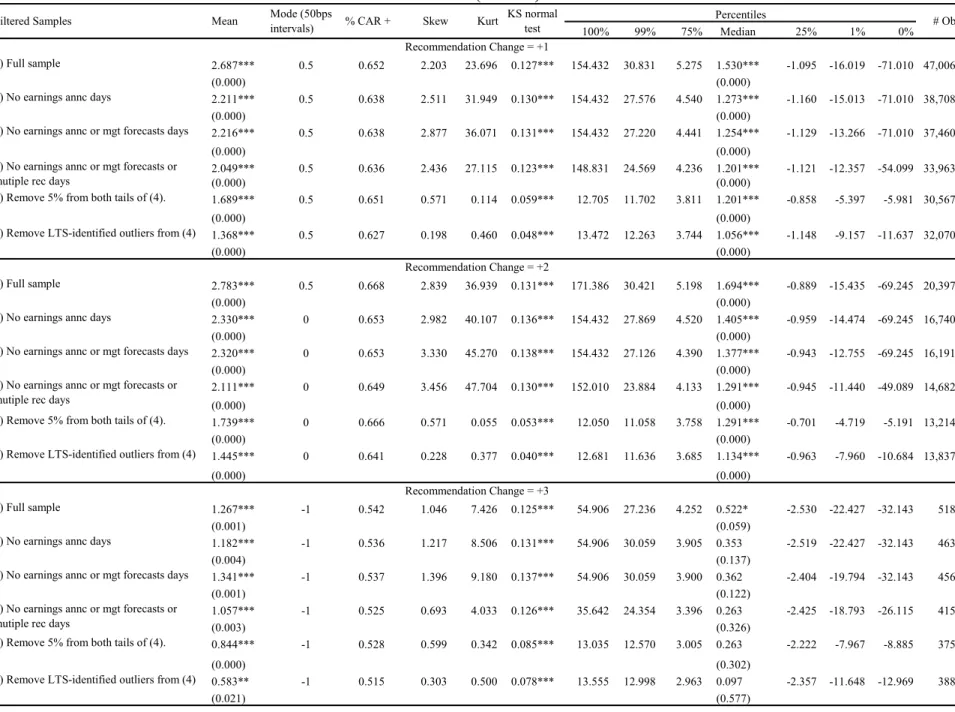
Histogram of recommendation CARFigure 2 plots the histogram of three-day CARs of recommendation changes for one- and two-point magnitude rating changes. The first two charts show the distribution of CARs for one- and two point upgrades. The mean CAR for a one-point upgrade is 2.687% and that for a
two-point upgrade is 2.783%. The medians are much lower at 1.530% and 1.694% respectively. This reveals that the magnitude of the mean CARs are strongly influenced by outliers. Another piece of suggestive evidence that only a minority of recommendations are influential is that a sizable number of CARs fall into the zero bin. Note that each interval in the histogram is one percent so that the zero bin represents CARs between -0.5% and 0.5%. The distributions also do not appear to resemble a normal distribution given that there are more right tail observations than there are left tail observations for positive recommendation changes, implying positive skewness in the distribution. The opposite result holds for negative recommendation changes.
The last two charts in Figure 2 show the one- and two-point rating changes for downgrades. The charts here tell a similar story. The median CARs are much more attenuated compared to the mean CAR and there is evidence that tail observations have a large influence so that the typical downgrade CAR may be very different from the mean downgrade CAR.
3.3.
Impact of firm news events and influential observations on mean CARThe next analysis reports how the average CAR of recommendation changes is affected when recommendations issued together with firm news events are removed and when outlier recommendations are removed.
The nine panels of Table 2 show the distribution statistics of recommendation change categories by subsamples sequentially from -4 to +4. We begin by examining downgrades and focus on the fourth panel, the rating change of -1, which has the largest number of observations among all downgrade categories. Sample 1 is the full set of -1 downgrades. The average CAR is -3.786% with a trivially small associated p-value (reported as 0.000) based on standard errors clustered by calendar day. Although the average CAR is large, we see evidence that it could be driven by outliers because the median CAR is only -1.775% (p-value of 0.000 from a signed test). As we saw in the histogram earlier, the distribution of CARs does not appear normal and this is now confirmed with the negative skewness (many left tail outlier observations) and the large positive kurtosis (tails fatter than predicted by a normal distribution). We also report the
Kolmogorov-Smirnov D-statistic as a test of normality with the p-value in parentheses below the D-statistics. The null hypothesis is normality and we see that normality is soundly rejected.8
Further evidence that the mean gives a misleading view of the typical CAR can be seen in the mode of the various groups. Using 50 basis points (bps) intervals, we find that the modal CAR is -1%, which means that the interval containing the most values of CAR is [-1.25%, -0.75%]. Another interesting statistic (third column) is the percentage of positive-signed CARs. A positive CAR in this case shows that a -1 rating change was associated with a stock price movement in the opposite direction from the rating change. 33.48% of -1 rating changes actually had CARs with the wrong sign.
Next, we examine the impact of removing recommendations that are contaminated by firm news releases. First, we remove observations that fall in the three-day window around quarterly earnings announcements dates reported by I/B/E/S.9 The impact of this removal is to reduce the
average CAR to -3.246% (see sample 2). Next, we also remove from sample 2 the recommendations that fall in the three day window around management earnings guidance days and find that the average CAR drops dramatically to -2.030%. Finally, we remove days with multiple recommendations since these days could correspond to firm news releases that led multiple analysts to revise their ratings. The average CAR now becomes -1.623%. Although the average CAR is still statistically significant in sample 4, we see that moving from sample 1 to sample 4, the economic magnitude of the average CAR drops by more than half from -3.786% to -1.623%. The median CAR also falls from -1.775% to -1.074%. These results stress that a large fraction of the average recommendation CAR should be attributed to contemporaneous firm news
8 It could be that stock returns are not normal so that the recommendation CARs are also not normal.
However, all the results in remain even when log abnormal returns (ln of 1+Eq. 1) are used in place of regular CARs. Table 2
9 Quarterly earnings announcement dates can be obtained from either I/B/E/S or Compustat. DellaVigna
and Pollet (2009) show that after 1994, earnings announcement dates provided both databases are equally accurate.
releases rather than to the recommendation itself and this is consistent with the findings in Chen et al. (2005) and Altinkilic and Hansen (2008).
Next, we consider the impact of removing outlier observations from this reduced sample of 38,515 recommendations. We consider two ways of removing outliers in sample 4. We note that sample 4 still has fat tails and negative skewness. The first method is to trim 5% from both tails of the sample distribution and we find that the average CAR reduces to -1.420% (see sample 5 row). The skewness and kurtosis drops significantly as a result of this filter. The second method is to identify outliers in an objective manner by using least trimmed squares (LTS) method (see for example, Knez and Ready (1997)). Specifically, we estimated a regression using LTS with the recommendation change CAR against a constant. This regression allows us to identify the observations that have the most influence on the coefficient estimate. We then compute the mean CAR by excluding the LTS-identified outliers and report the descriptive statistics from this new sample 6. The average CAR is now -1.194% and the median is -0.977%. Although the magnitudes are reduced dramatically from sample 1, we note that they are still statistically different from zero.
Other panels in Table 2 show similar patterns. First, the median CAR is roughly half of the mean CAR in absolute value, showing that outlier recommendations have a large influence on the mean. Second, removing all firm-news contaminated recommendations shaves off a sizable proportion (sometimes more than half) of the absolute value mean and median CARs, evidence that many recommendations do not add additional value but merely repeat information contained in firm news releases. Third, removing outliers from both tails further reduces the magnitude of the typical recommendation absolute value average CAR. Altogether, the results in this table show that the distributions of CARs are not normal. The CAR distributions are usually skewed and have fat tails, and outliers have an important impact on the mean CAR. Also, controlling for firm-specific news sharply reduces the average impact that a stock recommendation has on a firm’s stock price.
Table 3 shows the sensitivity of the magnitude and statistical significance of the mean recommendation CAR when part of the influential tail is removed. The first row of the table shows the size and significance (with one, two, and three asterisks representing 10%, 5% and 1% statistical significance respectively) of the mean CAR when confounding firm-news events are removed. This is essentially the sample 4 from the panels of Table 2. The second row of the table “1%” reports the average CAR when 1% of the influential tail is removed. This means removing 1% of the left tail of a downgrade category or removing the 1% of the right tail of an upgrade category. When the average CAR becomes statistically insignificant after the removal of x% of the influential tail, the rows below are intentionally left blank. For example, rating changes of -4 have an average CAR of -1.803% but once we remove 3% of the left tail, the average CAR becomes a statistically insignificant -0.385%. Therefore in this rating change group, we label 3% of the observations of the left tail as influential and the other observations as non-influential.
The rest of Table 3 shows us that all four downgrade categories, removing up to 10% of the left tail removes the statistical significance of the mean CAR. The rating change group of -4 only requires removal of 3% of the tail and the rating change group of -3 already has an insignificant mean CAR without the removal of any tail observations. For the positive rating change groups, more of the positive tail needs to be removed before the mean CARs become insignificant. For the +2 group for example, 20% of the right tail needed to be removed before the mean CAR became insignificant. This table illustrates the importance of influential observations in the average price reaction to recommendations.
4.
Influential versus non-influential recommendation changes4.1.
Methods for classifying recommendation changesIn this section, we identify recommendation changes that are influential and compare them with non-influential recommendation changes. We report results for two definitions of influential. We consider only rating changes in our analysis and exclude reiterations.
The first method classifies a recommendation change as an influential recommendation change if the CAR is greater than 1.96 times the standard deviation of the firm’s prior three-month idiosyncratic return. We focus most of our discussion on this method and use the second method as a robustness test. This method is intuitive: it treats as influential recommendation changes accompanied by an abnormal return that is significant using the market model. Specifically, a recommendation change is influential if CAR>1.96× 3×
σ
ε, whereσ
ε is the standard deviation of firm residual returns in the prior three months ([-63,-2] days) from the recommendation change. We multiply by3
since the CAR is a three-day CAR while theσ
ε is the standard deviation of residuals from a daily time-series regression of firm returns against market returns and the two Fama-French factors. This measure roughly captures recommendation changes that observers would judge to be influential, namely those recommendation changes that are associated with noticeable abnormal returns that may be attributable to the recommendation changes.The second approach classifies a recommendation change as influential when its normalized CAR is more than 1.96 standard deviations better than the mean prior 12-month normalized CAR of the similar rating change category across all firms. A normalized CAR is simply the CAR scaled by the firm’s prior idiosyncratic volatility. Recommendation changes are considered influential using this second approach based on historical recommendation change CARs rather than merely based on the prior idiosyncratic volatility of the firm. This second method identifies as influential recommendation changes that have an unusual impact relative to other similar recommendation changes. This definition may also capture what observers mean when they notice specific recommendation changes in that it selects recommendation changes with possibly large effects relative to typical recommendation changes. However, the stock-price reaction for these recommendation changes need not be significant at the firm level. We also use other definitions of influential (see Section 6) but our main tests focus on these two methods.
The first row of Table 4 reports the number of recommendations that are categorized into each dimension of success. We see that 10.0% (3.2%) of all recommendation changes are defined as influential using the first (second) definition.
4.2.
Analyst and firm characteristics of influential recommendations changesWe now compare the average characteristics of influential recommendation changes versus non-influential changes for each rating change category. We examine the following analyst-related characteristics:
1) Forecast accuracy: Loh and Mian (2006) show that analysts who possess more accurate earnings forecasts issue more profitable contemporaneous stock recommendations. It is possible that such analysts have recommendations that also have a larger market impact since their recommendation changes are accompanied by more accurate concurrent earnings forecasts. We compute the forecast accuracy quintile of an analyst by sorting analysts within a firm year into quintiles using the last unrevised forecast of the analyst on the I/B/E/S Detail U.S. File. Only firms with at least five analysts are included. The forecast accuracy rank (1 being the most accurate) is assigned to the analyst for the recommendations that the analyst issues during the 12 month window that overlaps three months into the next fiscal year (following Loh and Mian). Overlapping the 12 month period into the next fiscal year allows the accuracy rank to be applied during the months when fiscal year’s actual earnings are announced. Note that this accuracy rank is a perfect foresight rank and is not known at the time of the recommendation since actual earnings have not yet been announced.
2) Direction of recommendation relative to the consensus: Jegadeesh and Kim (2006) formulate a test for herding and contend that if analysts herd, recommendations that go toward the consensus would have a smaller price impact than those that go away from the consensus. Following their paper, we define recommendations that go away from the consensus as those where the absolute deviation of the new recommendation from the
consensus is larger than the absolute deviation of the prior recommendation from the consensus. The consensus recommendation is defined as the mean recommendation level that includes the most recent non-stale recommendation issued by all analysts covering the firm (see Section 2.1 for the definition of stale).
3) Star analyst: This is an indicator variable that equals one if the analyst is ranked as an All-American (first, second, third, or runner-up teams) in the annual polls in the
Institutional Investor Magazine. Analyst names in I/B/E/S are matched to Institutional Investor polls (published in the October issue) and an analyst maintains the star status for 12 months beginning the November after the polls. The star analyst indicator variable proxies for the reputation of the analyst and the market’s attentiveness to the stock recommendation (the market could pay more attention to calls from star analysts).
4) Analyst experience: Mikhail, Walther, and Willis (1997) show that analysts improve their earnings forecast accuracy with experience. Hence, it is possible that experience could be related to the market impact of stock recommendation changes. Analyst experience is measured as the number of quarters since the analyst issued the first earnings forecasts or stock recommendation on I/B/E/S. If an analyst appears in both the earnings forecasts and the recommendation file, the earlier of the two dates is used. Two measures of experience are computed. The first is the analyst’s overall experience, which is the number of quarters that he appeared on I/B/E/S. The second is the relative experience which is the number of quarters the analyst has covered that specific firm minus the average experience for all analysts covering the firm.
5) Concurrent earnings forecast: Michaely and Womack (2006) report that stock recommendations accompanied by forecast revisions are more profitable and have larger price reactions. Therefore, we include a concurrent earnings forecast indicator variable indicating whether the same analyst issued any type of earnings forecast in the three-day window around the recommendation change.
We compute the average of these analyst-specific variables for the different rating change groups. Table 4 reports the averages for observations where these variables can be computed. The first subsample analysis separates recommendation changes into influential and non-influential using the ratio of the CAR to the firm’s prior idiosyncratic volatility. The average analyst forecast accuracy quintile of influential recommendation changes is 2.802 versus 2.769 for non-influential recommendations. The difference is statistically significant, but its economic importance seems limited. 58.2% of influential recommendation changes move away from the consensus while only 52.5% of non-influential recommendation changes move away from the consensus—the difference is significant. Also, a larger proportion of influential recommendation changes are issued by star analysts and analysts with higher overall experience and relative firm-specific experience. A larger proportion of influential recommendation changes have concurrent earnings forecasts issued together with the recommendation change. These differences are as predicted from the prior literature. Using the second definition of influential (based on prior distribution of recommendation CARs) yields similar patterns of differences. Influential recommendation changes are associated with higher analyst forecast accuracy, are issued away from the consensus, from star analysts, and have concurrently issued earnings forecasts. The benefit of having more relative firm-experience appears mixed across the two definitions of influential.
Next, in Panel B, we also consider firm characteristics because firm characteristics could create conditions that make it more likely that analysts could make significant recommendation changes. For example, analysts may add more value when the value of the firm depends more on growth options which are harder to value than assets-in-place. We examine the following firm characteristics.
1) Book-to-market ratio (B/M ratio) computed as in Fama and French (2006). 2) Size of the firm (lagged month market cap).
3) Institutional ownership (percent of shares owned by institutions as reported in Thomson 13f in the most recent quarter end).
4) Dispersion is the standard deviation of the I/B/E/S Summary unadjusted file reported mean FY1 forecast divided by the absolute value of the mean forecast (following Diether, Malloy, and Scherbina (2002)).
5) # of forecasts is the number of forecasts (all horizons) issued by all analysts for the firm in the last three months ([-63,-2]).
6) Turnover is based on the last three-month average daily percentage of shares traded divided by total shares outstanding.
7) Idiosyncratic volatility is the standard deviation of the residuals from a time-series regression of past three-months’ daily returns against the Fama-French three factors. 8) Total volatility is the standard deviation of prior three-month daily returns.
The results are reported in Panel B of Table 4. We first look at the first definition of influential. Influential recommendation changes tend to be issued on firms that are smaller, have higher institutional ownership, lower total and idiosyncratic volatility, lower turnover, and lower number of prior earnings forecasts. The second definition of influential yields similar results. These results are consistent with the paradigm change view of influential analyst recommendation changes. Analysts can more easily affect investors’ beliefs about a firm when they are speaking in a smaller crowd. However, institutional investors are the main consumers of analyst reports, so that analysts are more likely to have a significant impact if a firm has more institutional ownership.
4.3.
The effect of influential recommendation changesNext, we consider changes in the firm environment. With the paradigm shift view, we would expect influential recommendation changes to be associated with important changes in the firm’s expected performance and trading. Hong et al. (2007) propose that a paradigm shift is followed by increases in volatility. It is also possible that analyst activity and trading activity increase following a paradigm shift. We investigate changes in some firm-specific variables around the rating change event. The variables considered are:
1) The leader-follower ratio (LFR) is computed following Cooper, Day, and Lewis (2001) so as to gauge the extent to which the influential recommendation change leads other analysts to change their recommendations. The gaps between the current recommendation and the previous two recommendations from other brokers are computed and summed. The same is done for the next two recommendations. The leader-follower ratio is the gap sum of the prior two recommendations divided by the gap sum of the next two recommendations. Ratios larger than one show that other brokers issue new ratings quickly in response to the current analyst’s recommendation. The schematic below illustrates the LFR of recommendation i: LFRi=(80+40)/(20+10)=4, which is greater than one and hence the analyst
associated with recommendation i is a leader analyst. Recommendation i
10 days
20 days 40 days
80 days
2) Change in volatility from the prior three months ([-63,-2] days) to the next three months ([2,63] days). The same horizon is used for the variables below.
3) Change in idiosyncratic volatility. 4) Change in analyst forecast dispersion. 5) Change in average daily turnover.
6) Change in number of earnings forecasts issued.
7) Change in the magnitude of monthly consensus FY1 and FY2 forecast revisions scaled by price, and long-term growth percentage forecasts.
Panel C of Table 4 reports the change in the above characteristics for the influential versus non-influential recommendation changes. The evidence strongly suggests a more significant change in the firm’s information environment after influential recommendation changes. The LFR of influential recommendation changes is larger than the LFR of non-influential recommendation changes. Changes in idiosyncratic and total volatility are also larger for influential recommendation changes compared to non-influential recommendation changes. However, there is no difference in the change in dispersion. Finally, analyst and trading activity increase more following influential recommendation changes than non-influential recommendation changes.
An influential recommendation change would presumably change the way that investors view the future cash flows of the firm and this could show up in analyst forecast revisions. The change in the absolute value of FY1 and FY2 forecast revisions is significantly positive for influential recommendation changes. For example, the change in magnitude of FY2 forecast revisions for influential recommendation changes is 1.088% of price but only 0.075% of price for non-influential recommendation changes (first definition of non-influential). The difference of 1.012% is statistically significant. In contrast, there is little corroborating evidence for the magnitude of change in LTG forecasts.
4.4.
Do influential recommendation changes come from only a subset of analysts?Next, we investigate whether influential recommendation changes come only from a subset of analysts. Figure 3 plots the histogram of the proportion of an analyst’s recommendation changes that are influential. We limit this analysis to analysts who made at least five recommendation changes in the sample period. If all analysts were equally capable of making influential recommendation changes, we would expect the distribution to peak around the average proportion of influential recommendation changes in the entire sample. The figure shows otherwise. The first chart uses the first definition of influential. Although the unconditional proportion of influential recommendation changes is 10% in the sample, about 25% of all
analysts never issue a single influential recommendation change in their lifetimes. For the other definition of influential (based on past recommendation CARs), about 56% of analysts never issue an influential recommendation change. This skewed distribution indicates that only some analysts are influential and that there is a sizable proportion of analysts whose recommendation changes never have a noticeable stock-price impact.
Table 5 compares the characteristics of analysts who issue at least one influential recommendation change in the sample versus the other analysts. One would expect the “Ever influential” group to dominate the “Never influential” group in terms of skill, experience, star status, etc. Indeed this is the case. Analysts who issue at least one influential recommendation change in the sample have better average analyst earnings forecast accuracy ranks. They are also more likely to issue recommendations away from the consensus, have once been a star analyst, and have greater absolute and relative experience compared to “Never influential” analysts.
5.
Predicting which recommendation changes will be influentialSection 4 provides evidence that influential recommendation changes are associated with specific analyst and firm attributes. Since many of these attributes are correlated, we use in this section a probit regression to assess the impact of these attributes on the likelihood that a recommendation will be influential. To make our approach predictive, we require the attributes to be known at the time of the recommendation change. All the variables used in the previous section are already based on past information except for forecast accuracy and the LFR. To make these two variables rely on past information, the forecast accuracy quintile is now the average quintile rank of the analyst for all the firms that he covers in the prior fiscal year and the LFR is now the average of the analyst’s prior LFRs for the past 12 months. The definitions of the other attributes are the same as before. The probit regression is estimated for observations where all the required variables are available and the standard errors are clustered by analyst. We also add controls for the level of the recommendation, the absolute value of the recommendation change,
an upgrade indicator variable, and indicator variables for the sample period after Reg FD (equals one from September 2000 onwards) and after the Global Analyst Settlement (equals one in 2003 and onwards).10
The dependent variable of the probit regression is equal to one if the recommendation change is influential. We report both coefficient estimates and marginal effects. 11 The results confirm the
conclusions reached in the previous section. A recommendation change is more likely to be influential if it represents a move away from the consensus, it is from a star analyst,12 from an
analyst with more relative experience, has a contemporaneous earnings forecast, and from an analyst with high prior LFR. Firms that are more likely to receive impactful recommendation changes are growth firms, small firms, high institutional ownership firms, high prior turnover firms, less volatile firms, and low prior number of earnings forecasts firms.
The control variables also include indicator variables for Reg FD and the analyst settlement. After Reg FD was passed in August 2000, analysts were no longer allowed to get access to private information from firm executives. If such private information is one main source of influential recommendation changes, we would expect influential recommendation changes to abate after the passage of the law. For example, Gintschel and Markov (2004) show evidence that selective disclosure was curtailed after Reg FD and the absolute price impact of analyst output was reduced. We find, however, that the Reg FD dummy is significantly positive, implying that influential recommendation changes are even more likely after Reg FD.
10 In order to allow structural breaks to be identified, we compute the second definition of influential in
a different manner compared to the earlier table. For the probit regression only, we compare the recommendation CAR against the distribution of similar rating change category CARs for the entire sample period instead of just using the prior 12 months.
11 The marginal effect of a continuous variable x is the partial derivative with respect to x of the
prediction function, evaluated at the mean value of y. If the independent variable is ln(x), the partial derivative will be δy/δln(x), which is the partial derivative of y with respect to a 1% change in x. If x is a dummy variable, the marginal effect is the discrete change in y as the dummy variable changes from 0 to 1.
12 The star analyst variable is a four point variable which we utilize their actual all American rank with
higher numbers signifying a superior rank. We assign star=1 for runner-up ranks, up to star=4 for first place ranks.
For the settlement, Kadan, Madureira, Wang, and Zach (2009) find that after the settlement (their sample goes up to 2004 only), the overall informativeness of recommendations was reduced. Boni (2006) also finds similar evidence. Although, the overall informativeness of recommendations decreased, Kadan et al. also find that the falling number of optimistic recommendations could have caused optimistic recommendations to be become more informative. Our probit estimations find some evidence that a recommendation change is more likely to be influential after the settlement, especially for the first definition of influential. When we add an interaction variable upgrade×settlement to the estimations (unreported), we find that this interaction term is significant for the second definition of influential)—meaning that influential upgrades were more likely after the settlement. Altogether, our results suggest that although the overall impact of Reg FD and the settlement could have reduced the mean price impact of recommendations, the probability that a recommendation change is influential actually increased.
6.
Alternative definitions of influentialWe also use other methods of classifying recommendation changes as influential with generally similar results. One method is the one illustrated in Table 3 where influential tail observations are identified as those observations which, when removed, render the average recommendation change CAR insignificant. This method has a look-ahead bias since it relies on all future CARs in the entire sample period. Another method we also consider is whether recommendations returns beat twice the average CAR of same category rating changes that occurred in the last 12 months. We find that about 29.5% of them do.
Finally, we simply rely on the sign of the recommendation change CAR. One can view this as the lowest hurdle for the definition of influential since it only requires that the CAR has a correct sign. A correct recommendation change is one associated with a CAR that has the same sign as the direction of the recommendation change. Considering the sign of the recommendation change
CAR improves upon the methodology in some studies that evaluate recommendation changes based on only the absolute unsigned reaction magnitudes (example, Chen et al. (2005) and Frankel et al. (2006)).
7.
ConclusionRecommendation changes are sometimes associated with extremely large abnormal returns and these changes are typically the ones that the press focuses on. Such changes are associated with stock-price reactions that are quite different from the stock-price reaction of the typical recommendation change. The existing literature on analyst recommendation changes focuses on the average stock-price reaction. We show that the average stock-price reaction is small enough when proper care is taken to account for confounding news that for an individual stock it would not be identifiable with a firm-level event study. We call analyst recommendation changes with an identifiable impact at the firm level influential recommendation changes.
It is not surprising that some analyst recommendation changes will have a large impact. We argue that some analyst recommendation changes lead to a paradigm shift in how a firm is assessed by investors. We investigate the frequency of such recommendation changes, when a recommendation change is likely to be influential, and how the firm’s information environment changes around influential recommendation changes. Using as our criterion for influential recommendation changes significance of the abnormal return in a firm-level event study, we find that roughly 10% of the recommendation changes in I/B/E/S after eliminating changes associated with confounding information are influential. Strikingly, a quarter of the analysts never have an influential recommendation change. We find that influential recommendations are more likely to be from analysts with larger leader-follower ratios, large brokers, away-from-consensus revisions, issued contemporaneously with earnings forecasts, and more experienced analysts. Further, growth firms, small firms, high institutional ownership firms, high prior turnover firms, and low prior number of earnings forecasts firms are more likely to be associated with influential
recommendations. We also find evidence consistent with a paradigm shift for firms that experience influential recommendation changes: we find that if a firm has an influential recommendation change, its stock’s turnover increases, its volatility increases, and analysts make more and bigger forecast changes. Overall our evidence is supportive of the view that influential analyst forecasts arise when analysts succeed in creating a paradigm shift, i.e., a significant change in how investors perceive a firm. However, analysts are like writers. Sometimes they have best-sellers, but the odds of writing a best-seller are low and whether a book is a best-seller depends on many factors that are not under the control of the writer.
References
Altinkilic, Oya and Robert S. Hansen, 2008, On the information role of stock recommendation revisions, Working paper, Tulane University.
Asquith, Paul, Michael B. Mikhail, and Andrea Au, 2005, Information content of equity analyst reports, Journal of Financial Economics 75, 245-282.
Barber, Brad M., Reuven Lehavy, Maureen McNichols, and Brett Trueman, 2006, Buys, holds, and sells: The distribution of investment banks’ stock ratings and the implications for the profitability of analysts’ recommendations, Journal of Accounting & Economics 41, 87-117.
Boni, Leslie, 2006, Analyzing the analysts after the Global Settlement, in Y. Fuchita, Litan, R. E., ed.: Financial Gatekeepers: Can They Protect Investors? (Brookings Institution Press and the Nomura Institute of Capital Markets Research).
Boni, Leslie and Kent L. Womack, 2006, Analysts, industries, and price momentum, Journal of Financial & Quantitative Analysis 41, 85-109.
Bradley, Daniel J., Bradford D. Jordan, and Jay R. Ritter, 2007, Analyst behavior following IPOs: The 'bubble period' evidence, Review of Financial Studies, forthcoming.
Chen, Qi, Jennifer Francis, and Katherine Schipper, 2005, The applicability of the fraud on the market presumption to analysts’ forecasts, Working paper, Duke University.
Cooper, Rick A., Theodore E. Day, and Craig M. Lewis, 2001, Following the leader: A study of individual analysts' earnings forecasts, Journal of Financial Economics 61, 383-416. Daniel, Kent, Mark Grinblatt, Sheridan Titman, and Russ Wermers, 1997, Measuring mutual fund
performance with characteristic-based benchmarks, Journal of Finance 52, 1035-1058. DellaVigna, Stefano and Joshua Pollet, 2009, Investor inattention and Friday earnings
announcements, Journal of Finance 64, 709-749.
Diether, Karl B., Christopher J. Malloy, and Anna Scherbina, 2002, Differences of opinion and the cross-section of stock returns, Journal of Finance 57, 2113-2141.
Fama, Eugene F. and Kenneth R. French, 2006, The value premium and the CAPM, Journal of Finance 61, 2163-2185.
Fang, Lily and Ayako Yasuda, 2008, Are stars' opinions worth more? The relation between analyst reputation and recommendation values, Working paper, University of Pennsylvania.
Frankel, Richard, S.P. Kothari, and Joseph Weber, 2006, Determinants of the informativeness of analyst research, Journal of Accounting and Economics 41, 29-54.
Gintschel, Andreas and Stanimir Markov, 2004, The effectiveness of Regulation FD, Journal of Accounting and Economics 37, 293-314.
Hong, Harrison, Jeremy C. Stein, and Jialin Yu, 2007, Simple Forecasts and Paradigm Shifts,
Journal of Finance 62, 1207-1242.
Irvine, Paul J., 2004, Analysts' forecasts and brokerage-firm trading, Accounting Review 79, 125-149.
Ivkovic, Zoran and Narasimhan Jegadeesh, 2004, The timing and value of forecast and recommendation revisions, Journal of Financial Economics 73, 433-463.
Jegadeesh, Narasimhan and Woojin Kim, 2006, Imitation or information-driven herding? An analysis of analysts’ recommendations and market reactions, Working paper, Emory University.
Kadan, Ohad, Leonardo Madureira, Rong Wang, and Tzachi Zach, 2009, Conflicts of interest and stock recommendations - The effects of the Global Settlement and related regulations,
Review of Financial Studies, forthcoming.
Knez, Peter J. and Mark J. Ready, 1997, On the robustness of size and book-to-market in cross-sectional regressions, Journal of Finance 52, 1355-1382.
Ljungqvist, Alexander, Christopher J. Malloy, and Felicia C. Marston, 2008, Rewriting history,
Journal of Finance, forthcoming.
Loh, Roger K., 2007, Investor inattention and the underreaction to stock recommendations, Working paper, Ohio State University.
Loh, Roger K. and G. Mujtaba Mian, 2006, Do accurate earnings forecasts facilitate superior investment recommendations?, Journal of Financial Economics 80, 455-483.
Malmendier, Ulrike and Devin Shanthikumar, 2007, Are investors naïve about incentives?,
Journal of Financial Economics 85, 457-489.
Michaely, Roni and Kent L. Womack, 2006, What are analysts really good at?, Working paper, Darthmouth College.
Mikhail, Michael B., Beverly R. Walther, and Richard H. Willis, 1997, Do security analysts improve their performance with experience?, Journal of Accounting Research 35, 131-157.
Stickel, Scott E., 1995, The anatomy of buy and sell recommendations, Financial Analysts Journal 51, 25-39.
Table 1
Descriptive statistics of recommendation changes
The sample of recommendation (rec) changes are from I/B/E/S Detail U.S. File 1993 to 2006. Each rec change (or rating change) is an analyst’s current rating minus his prior rating. Analyst initiations are excluded. Ratings are coded as 1 (sell) to strong buy (5), and rating changes lie between -4 and 4. Firms with less than 3 analysts making up the consensus are excluded. Panel reports the transition probabilities of rec changes. For example in column 1, when the prior rec is a sell, it has a 4.6% probability of transiting an underperform. Panel B reports the frequencies of each rec change type.
Panel A: Transition probabilities of recommendation changes
Current Rec 1 2 3 4 5
Prior Rec Sell Underperform Hold Buy Strong Buy
1 (Sell) 336 193 3,026 305 333 4,193 8.0% 4.6% 72.2% 7.3% 7.9% 100% 2 (Underperform) 287 1,519 4,891 863 213 7,773 3.7% 19.5% 62.9% 11.1% 2.7% 100% 3 (Hold) 3,243 5,834 17,246 24,067 16,508 66,898 4.8% 8.7% 25.8% 36.0% 24.7% 100% 4 (Buy) 431 1,223 31,781 14,043 17,855 65,333 0.7% 1.9% 48.6% 21.5% 27.3% 100% 5 (Strong Buy) 572 427 22,609 19,388 9,661 52,657 1.1% 0.8% 42.9% 36.8% 18.3% 100% Total 4,869 9,196 79,553 58,666 44,570 196,854 Total
Panel B: Recommendation change categories
Rec Change Frequency Percentage
–4 572 0.3% –3 858 0.4% –2 27,075 13.8% –1 57,290 29.1% 0 42,805 21.7% +1 47,006 23.9% +2 20,397 10.4% +3 518 0.3% +4 333 0.2% Total 196,854 100%
Table 2
The impact of various filters on recommendation event percentage CAR
The sample of recommendation (rec) changes are from I/B/E/S Detail U.S. File. Each rec-change is an analyst’s current rating minus his prior rating. Analyst initiations are excluded. Ratings are coded as 1 (sell) to strong buy (5), and rating changes lie between -4 and 4. Firms with less than 3 analysts making up the consensus are excluded. Each panel reports summary statistics for the three-day buy-and-hold event CAR (in percent) of a rec-change group. P-values based on standard errors clustered by calendar day are reported in parentheses below the mean. Daily abnormal return is the raw return less the return on a size-B/M-momentum matched portfolio with CAR observations where the lagged price on day 0 is <$1 excluded. The mode column reports the midpoint of the 50bps interval modal group. P-value of the median is computed from a signed test. Kurt is excess kurtosis so that a normal distribution would have Kurt=0. KS is the Kolmogorov-Smirnov D statistic testing for the normality of the sample distribution where *, **, and *** represent that the null of normality is rejected at the 10%, 5%, and 1% levels respectively. No earnings annc refer to excluding rec-changes that occur in the three-day window around the firm’s I/B/E/S reported quarterly earnings announcement dates. No mgt forecast refer to excluding rec-changes that occur in the three-day window around the firm’s management earnings guidance dates provided by First Call Guidelines. No multiple rec days refer to excluding days where more than one analyst issues recs on the firm. Least trimmed squares outliers (LTS) are identified by estimating a LTS regression of CAR against a constant.
100% 99% 75% Median 25% 1% 0% -4.716*** -0.5 0.332 -1.101 7.708 0.214*** 92.841 38.825 1.123 -1.844*** -6.673 -70.277 -79.662 572 (0.000) (0.000) -4.336*** -0.5 0.342 -1.229 8.348 0.233*** 92.841 38.825 1.157 -1.525*** -5.634 -70.277 -79.662 491 (0.000) (0.000) -2.643*** -0.5 0.366 -1.178 12.703 0.229*** 92.841 38.825 1.441 -1.181*** -4.644 -70.277 -79.662 451 (0.001) (0.000) -1.747*** -0.5 0.371 -2.285 17.953 0.197*** 51.830 18.981 1.247 -0.991*** -3.760 -46.832 -79.662 377 (0.001) (0.000) -1.157*** -0.5 0.358 0.096 0.684 0.066*** 10.736 9.694 0.923 -0.991*** -3.327 -11.128 -11.570 341 (0.000) (0.000) -1.253*** -0.5 0.355 -0.023 0.745 0.067*** 10.736 9.694 0.898 -1.016*** -3.429 -11.570 -12.885 344 (0.000) (0.000) -3.312*** -1 0.382 -0.840 5.993 0.182*** 71.759 32.750 1.734 -1.231*** -5.773 -50.156 -73.070 858 (0.000) (0.000) -2.463*** -1 0.394 -0.840 7.482 0.191*** 71.759 34.337 1.912 -1.047*** -5.011 -50.156 -73.070 748 (0.000) (0.000) -1.322*** -1 0.414 -0.783 10.530 0.187*** 71.759 34.337 2.086 -0.802*** -4.104 -49.102 -73.070 701 (0.006) (0.000) -0.577 -1 0.415 0.056 11.002 0.169*** 61.748 29.952 2.133 -0.718*** -3.672 -33.195 -63.861 629 (0.146) (0.000) -0.646*** -1 0.406 0.268 1.052 0.061*** 13.616 12.712 1.683 -0.718*** -3.136 -11.707 -13.755 567 (0.001) (0.000) -0.842*** -1 0.397 -0.033 0.658 0.053*** 11.647 10.406 1.446 -0.756*** -3.242 -11.707 -13.755 559 (0.000) (0.000)
2) No earnings annc days
3) No earnings annc or mgt forecasts days 4) No earnings annc or mgt forecasts or mutiple rec days
Recommendation Change = –4 1) Full sample
2) No earnings annc days
5) Remove 5% from both tails of (4). 6) Remove LTS-identified outliers from (4)
5) Remove 5% from both tails of (4). 6) Remove LTS-identified outliers from (4)
Recommendation Change = –3 1) Full sample
Skew Kurt KS normal # Obs
test
3) No earnings annc or mgt forecasts days 4) No earnings annc or mgt forecasts or mutiple rec days
Percentiles Filtered Samples Mean Mode (50bps
Table 2 (Cont’d)
100% 99% 75% Median 25% 1% 0% -4.374*** -1 0.315 -0.993 9.265 0.171*** 128.090 23.324 0.782 -2.003*** -6.841 -48.737 -82.120 27,075 (0.000) (0.000) -3.642*** -1 0.333 -0.938 11.110 0.185*** 128.090 24.435 0.910 -1.622*** -5.572 -47.753 -82.120 22,475 (0.000) (0.000) -2.176*** -1 0.356 -0.394 18.096 0.170*** 128.090 25.371 1.111 -1.282*** -4.352 -38.346 -82.120 20,368 (0.000) (0.000) -1.706*** -1 0.357 0.470 28.308 0.145*** 128.090 19.672 1.052 -1.190*** -3.921 -27.228 -82.120 17,676 (0.000) (0.000) -1.554*** -1 0.341 -0.496 0.280 0.055*** 6.746 5.956 0.787 -1.190*** -3.527 -11.347 -12.557 15,910 (0.000) (0.000) -1.301*** -1 0.358 -0.140 0.562 0.048*** 10.736 8.926 0.974 -1.095*** -3.442 -11.523 -12.817 16,377 (0.000) (0.000) -3.786*** -1 0.335 -1.149 10.108 0.159*** 156.225 19.616 1.015 -1.775*** -6.267 -43.349 -86.701 57,290 (0.000) (0.000) -3.246*** -1 0.349 -1.269 11.816 0.170*** 156.225 19.455 1.109 -1.481*** -5.318 -42.379 -86.701 47,724 (0.000) (0.000) -2.030*** -1 0.371 -0.767 19.422 0.150*** 156.225 19.792 1.296 -1.168*** -4.301 -33.288 -86.701 43,643 (0.000) (0.000) -1.623*** -1 0.375 -0.151 25.088 0.127*** 156.225 17.059 1.286 -1.074*** -3.933 -25.626 -86.701 38,515 (0.000) (0.000) -1.420*** -1 0.361 -0.410 0.129 0.048*** 7.099 6.350 0.987 -1.074*** -3.560 -11.239 -12.384 34,665 (0.000) (0.000) -1.194*** -1 0.378 -0.127 0.513 0.045*** 11.570 9.356 1.217 -0.977*** -3.534 -12.119 -13.384 36,058 (0.000) (0.000) -0.076** 0 0.494 0.360 37.133 0.127*** 196.327 18.864 2.299 -0.041** -2.300 -21.156 -76.972 42,805 (0.044) (0.023) -0.075** 0 0.492 0.543 46.935 0.123*** 196.327 17.401 2.170 -0.065*** -2.197 -18.744 -70.902 38,038 (0.041) (0.001) 0.074** 0 0.495 1.451 57.905 0.114*** 196.327 17.094 2.165 -0.034* -2.120 -15.643 -70.902 37,015 (0.035) (0.055) 0.112*** 0 0.495 2.156 70.290 0.111*** 196.327 16.426 2.138 -0.034* -2.083 -14.362 -69.226 33,861 (0.001) (0.053) 0.033 0 0.494 0.108 -0.143 0.021*** 7.633 6.955 1.847 -0.034** -1.821 -6.455 -7.048 30,475 (0.122) (0.041) -0.016 0 0.491 0.040 0.457 0.034*** 10.048 8.706 1.937 -0.062*** -1.970 -8.636 -10.145 32,062 (0.521) (0.001)Skew Kurt Percentiles # Obs
4) No earnings annc or mgt forecasts or mutiple rec days
6) Remove LTS-identified outliers from (4) 5) Remove 5% from both tails of (4). Filtered Samples
3) No earnings annc or mgt forecasts days
1) Full sample
2) No earnings annc days
3) No earnings annc or mgt forecasts days Mean
Recommendation Change = –2 1) Full sample
2) No earnings annc days
KS normal test % CAR +
Mode (50bps intervals)
6) Remove LTS-identified outliers from (4)
Recommendation Change = –1
4) No earnings annc or mgt forecasts or mutiple rec days
5) Remove 5% from both tails of (4). 6) Remove LTS-identified outliers from (4)
Recommendation Change = 0
5) Remove 5% from both tails of (4). 1) Full sample
2) No earnings annc days
3) No earnings annc or mgt forecasts days 4) No earnings annc or mgt forecasts or mutiple rec days
Table 2 (Cont’d)
100% 99% 75% Median 25% 1% 0% 2.687*** 0.5 0.652 2.203 23.696 0.127*** 154.432 30.831 5.275 1.530*** -1.095 -16.019 -71.010 47,006 (0.000) (0.000) 2.211*** 0.5 0.638 2.511 31.949 0.130*** 154.432 27.576 4.540 1.273*** -1.160 -15.013 -71.010 38,708 (0.000) (0.000) 2.216*** 0.5 0.638 2.877 36.071 0.131*** 154.432 27.220 4.441 1.254*** -1.129 -13.266 -71.010 37,460 (0.000) (0.000) 2.049*** 0.5 0.636 2.436 27.115 0.123*** 148.831 24.569 4.236 1.201*** -1.121 -12.357 -54.099 33,963 (0.000) (0.000) 1.689*** 0.5 0.651 0.571 0.114 0.059*** 12.705 11.702 3.811 1.201*** -0.858 -5.397 -5.981 30,567 (0.000) (0.000) 1.368*** 0.5 0.627 0.198 0.460 0.048*** 13.472 12.263 3.744 1.056*** -1.148 -9.157 -11.637 32,070 (0.000) (0.000) 2.783*** 0.5 0.668 2.839 36.939 0.131*** 171.386 30.421 5.198 1.694*** -0.889 -15.435 -69.245 20,397 (0.000) (0.000) 2.330*** 0 0.653 2.982 40.107 0.136*** 154.432 27.869 4.520 1.405*** -0.959 -14.474 -69.245 16,740 (0.000) (0.000) 2.320*** 0 0.653 3.330 45.270 0.138*** 154.432 27.126 4.390 1.377*** -0.943 -12.755 -69.245 16,191 (0.000) (0.000) 2.111*** 0 0.649 3.456 47.704 0.130*** 152.010 23.884 4.133 1.291*** -0.945 -11.440 -49.089 14,682 (0.000) (0.000) 1.739*** 0 0.666 0.571 0.055 0.053*** 12.050 11.058 3.758 1.291*** -0.701 -4.719 -5.191 13,214 (0.000) (0.000) 1.445*** 0 0.641 0.228 0.377 0.040*** 12.681 11.636 3.685 1.134*** -0.963 -7.960 -10.684 13,837 (0.000) (0.000) 1.267*** -1 0.542 1.046 7.426 0.125*** 54.906 27.236 4.252 0.522* -2.530 -22.427 -32.143 518 (0.001) (0.059) 1.182*** -1 0.536 1.217 8.506 0.131*** 54.906 30.059 3.905 0.353 -2.519 -22.427 -32.143 463 (0.004) (0.137) 1.341*** -1 0.537 1.396 9.180 0.137*** 54.906 30.059 3.900 0.362 -2.404 -19.794 -32.143 456 (0.001) (0.122) 1.057*** -1 0.525 0.693 4.033 0.126*** 35.642 24.354 3.396 0.263 -2.425 -18.793 -26.115 415 (0.003) (0.326) 0.844*** -1 0.528 0.599 0.342 0.085*** 13.035 12.570 3.005 0.263 -2.222 -7.967 -8.885 375 (0.000) (0.302) 0.583** -1 0.515 0.303 0.500 0.078*** 13.555 12.998 2.963 0.097 -2.357 -11.648 -12.969 388 (0.021) (0.577) Recommendation Change = +3 # Obs KS normal test Mode (50bpsintervals) % CAR + Skew
4) No earnings annc or mgt forecasts or mutiple rec days
5) Remove 5% from both tails of (4). 6) Remove LTS-identified outliers from (4) 1) Full sample
2) No earnings annc days
3) No earnings annc or mgt forecasts days 6) Remove LTS-identified outliers from (4) 5) Remove 5% from both tails of (4). 6) Remove LTS-identified outliers from (4)
Recommendation Change = +2
2) No earnings annc days
3) No earnings annc or mgt forecasts days 4) No earnings annc or mgt forecasts or mutiple rec days
5) Remove 5% from both tails of (4). 1) Full sample
1) Full sample
2) No earnings annc days
3) No earnings annc or mgt forecasts days 4) No earnings annc or mgt forecasts or mutiple rec days
Recommendation Change = +1
100% 99% 75% Median 25% 1% 0% 1.919*** -1 0.613 1.080 9.072 0.124*** 46.785 26.140 4.651 1.113*** -1.319 -14.121 -30.655 333 (0.000) (0.000) 1.649*** 1 0.606 1.254 12.579 0.130*** 46.785 26.140 4.204 1.082*** -1.302 -13.232 -30.655 287 (0.000) (0.000) 1.906*** 1 0.612 2.340 13.865 0.125*** 46.785 26.140 4.341 1.084*** -1.260 -11.439 -12.303 276 (0.000) (0.000) 1.678*** -1 0.602 2.764 19.026 0.128*** 46.785 17.965 3.574 0.996*** -1.247 -10.383 -12.303 241 (0.000) (0.002) 1.354*** -1 0.613 0.555 -0.310 0.090*** 9.997 8.878 3.062 0.996*** -1.101 -4.248 -4.625 217 (0.000) (0.001) 1.119*** -1 0.593 0.233 0.137 0.068** 10.451 9.380 3.049 0.932*** -1.247 -7.516 -9.700 226 (0.000) (0.006) Recommendation Change = +4
Filtered Samples Kurt KS normal Percentiles # Obs
test Mean Mode (50bps
intervals) % CAR + Skew
5) Remove 5% from both tails of (4). 6) Remove LTS-identified outliers from (4) 1) Full sample
2) No earnings annc days
3) No earnings annc or mgt forecasts days 4) No earnings annc or mgt forecasts or mutiple rec days