Optimizing Mobile Backhaul Using Machine Learning Abdulkadir Mohammedadem
School of Electrical Engineering
Thesis submitted for examination for the degree of Master of Science in Technology.
Espoo 30.05.2019
Thesis supervisor:
Prof. Raimo Kantola Thesis advisor:
AALTO UNIVERSITY ABSTRACT OF THE SCHOOL OF ELECTRICAL ENGINEERING MASTER’S THESIS
Author: Abdulkadir Mohammedadem
Title of the Thesis: Optimizing Mobile Backhaul Using Machine Learning
Date: Language: English Number of pages:8+56
Department of Communications and Networking
Professorship: ELEC3029 - Communications Engineering Supervisor: Prof. Raimo Kantola
Instructor: Dr. Jose Costa-Requena
The thesis focuses on the analysis of current limitations of the mobile backhaul solu-tions technology when applied to 5G technology. The fast growth in connected devices along with the introduction of 5G technology is expected to cause a challenge for effi-cient and reliable network resource allocation. Moreover, massive deployment of In-ternet of Things and connected devices to the InIn-ternet may cause a serious risk to the network security if they are not handled properly. To solve those challenges, the Mo-bile Back haul (MB) infrastructure must increase capacity, improve reliability, avail-ability and security.
Software Defined Networks (SDN) and Machine Learning (ML) techniques were used on top of the basic IP routing to measure and estimate the available resources in the network and apply Traffic Engineering (TE) logic to reallocate available resources to newly added slices. The experiment was performed in a virtual environment using Mininet simulator tool and other opensource software and ML algorithms.
In this thesis, a system was developed to measure the existing resources in the mobile backhaul and redistribute dynamically to different network slices either existing or new slices to make sure that each slice requirements are met.
The thesis includes an early prototype of the Mobile Backhaul Orchestrator (MBO) that will be simulated to confirm it can effectively allocate resources to new slices while maintaining existing slices, and that it can contain the traffic within a slice dur-ing peaks without affectdur-ing traffic in other slices.
Preface
I would like to thank Allah, the almighty for finishing my thesis successfully. My first appreciation and thanks go to my professor Raimo Kantola for his continuous support and guidance throughout my thesis work. I would like to express my special thanks to my advisor Dr. Jose Costa-Requena, for your constructive comments and suggestions. I could not have imagined to finish my tesis without your support. You are simply a true mentor.
Last but not least, I would like to send my special thanks to my family. Your encouragement and support have been huge.
Contents Preface...iii List of Figures...vi List of Tables...vii Abbreviations...viii 1 Introduction...1
1.1 Background and Motivation...2
1.2 Objective and Scope...3
1.3 Structure...4
2 Background...6
2.1 Mobile Backhaul...6
2.1.1 Mobile access network...7
2.1.2 Mobile backhaul networks...8
2.1 Packet routing in mobile backhaul...10
2.2.1 IP/MPLS routing...11
2.2.2 MPLS Traffic Engineering...14
2.3 SDN usage in mobile backhaul...15
2.4 SDN based network measurement...18
2.5 Traffic engineering using machine learning...19
2.5.1 Supervised learning...19
2.5.2 Unsupervised learning...21
2.5.3 Reinforcement learning...21
3 Network slicing and 5G features...22
3.1 Network slicing...23
3.2 Slicing in network transport...24
3.3 Network slicing architecture...25
3.4 Network slicing use cases...26
3.5 Implementing QoS policy using DSCP...27
3.6 Mobile backhaul Quality of Service...27
3. RAN sharing...28
3.8 Radio Link Quality of Service...29
4.1 Machine learning mobile backhaul...31
4.2 Validation of ML in MBH...32
4.2.1 Mobile backhaul emulation...32
4.2.2 MBO validation...34
5 Discussions and limitations...47
6 Conclusion...48
List of Figures
Figure 1 Radio Access Network (RAN) architecture of different generations...7
Figure 2 EPC network architecture...10
Figure 3 Mobile Network slice architecture...11
Figure 4 Dijkstra algorithm...13
Figure 5 SDN Network architecture [33]...16
Figure 6 Structure of artificial neural network. [34]...20
Figure 7 Network slicing architecture (adapted from [35])...22
Figure 8 Network slicing architecture...25
Figure 9 MBO modules...31
Figure 10 Simple test case topology...34
Figure 11 Classifying traffic using DiffServ...36
Figure 12 AF41 Network performance for variable data size...37
Figure 13 AF31 traffic...38
Figure 14 Best-effort traffic...38
Figure 15 4G slices with large network topology...39
Figure 16 Minimum achievable throughput...41
Figure 17 URLL traffic behavior...42
Figure 18 Sample screen shot of network parameters...44
Figure 19 Bandwidth utilization measurement...45
List of Tables
Table 1. Mobile network technologies...8
Table 2 Characteristics of LTE standardized QCIs...29
Table 3 Comparison of SDN controllers...33
Table 4 DSCP values for different slices for simple topology...35
Abbreviations
API Application Programming Interface
BGP Boarder Gateway Protocol
CS Circuit Switching
CIoT Cellular IoT
CP Control Plane
DHCP Dynamic Host Configuration Protocol
DNS Domain Name System
ECMP Equal Cost Multipath
EPS Evolved Packet System
EPC Evolved Packet Core
ETSI European Telecommunication Standard Institute
GPRS General Packet Radio Service
GSM Global System for Mobile communications
GTP GPRS Tunneling Protocol
HLR Home Location Register
HSS Home Subscriber Server
HTTP Hypertext Transport Protocol
IEEE Institute of Electrical and Electronics Engineers
IMS IP Multimedia Subsystem
IMSI International Mobile Subscriber Identity
IoT Internet of Things
ITU International Telecommunication Union
LDAP Lightweight Directory Access Protocol
LLDP Link Layer Discovery Protocol
LTE Long-Term Evolution
LTE-M LTE Cat-M1
MBO Mobile Backhaul Orchestrator
MME Mobility Management Entity
MPLS Multiprotocol label Switching
MSC Mobile Switching Center
NB-IoT Narrow Band IoT
ODL controller Open Daylight Controller
OPEX Operational Expenses
OSPF Open Shortest Path First
PCRF Policy Charging Rules Functions
PDN Packet Data Network
PDN-GW Packet Data Network Gateway
PS Packet Switching
QoS Quality of Service
RAN Radio Access Networks
RIP Routing Information Protocol
SDN Software Defined Networking
S-GW Serving Gateway
SLA Service Level Agreement
TE Traffic Engineering
TEID Tunnel End point ID
UDC User Data Convergence
UE User Equipment
URL Unified Resource Locator
USIM Universal Subscriber Identity Module
1 Introduction
This thesis studies the current limitations of networking technologies when applied to 5G mobile backhaul. 5G architecture needs to address new requirements to enable network slicing, Ultra Reliable Low Latency (URLLC) and Multi-access Edge Com-puting (MEC). The existing networking technologies used in mobile backhaul are suitable for fixed IP networks where fully distributed routing algorithms provide op-timal paths based on link costs and react efficiently upon link breaks. IP networking delivers a best effort network in which each packet is treated in the same way. How-ever, 5G mobile networks aim at new features such as network slicing where the same network provides multiple network overlays each with different traffic requirements. A network slice in 5G is a set of packet transport links and nodes, set of computing elements and software for the network functions to run a network using the assigned resources. A slice is set up for a particular use case of the 5G network and they can be provisioned in advance to guarantee the QoS requirements for URLLC, Massive Internet of Things (MIoT) or enhanced Mobile Broadband (eMBB) communications. The mobile backhaul networks have fulfilled the traffic requirements based on over-dimensioning and pre-provisioning that ensure enough capacity for best-effort IP based networks. However, pre-provisioning will be inefficient in 5G networks since the set of assigned resources can be increased and decreased in size based on user needs and policies that change over time. The slices might be created, updated and terminated dynamically based on end-user requirements.
An example of one slice is the one that only carries the human consumer traffic between the device and public Internet. This slice will route the traffic from the device to the point of attachment to the Internet and back to the user. Another example of a slice would carry only machine to machine URLLC traffic that needs low delay, high reliability and very high security.
The mobile operator can over-dimension and pre-provision the network with the required slices for URLLC and the required network resources can be reserved to isolate the URLLC traffic to its own slice. Thus, pre-provisioning allows to tailor the network resources to meet the traffic requirements in the best possible way knowing user needs in advance. However, the network needs to dynamically re-allocate the available resources to include new slices without disrupting existing ones. Thus, in case of un-predictable emergency situations, the network should dynamically re-allocate available resources to support new ad-hoc URLLC or other types of slices. Moreover, in case the machine to machine (M2M) traffic increases drastically due to
their schedule based transmission patterns, the M2M slice has to be isolated from others.
Therefore, the network must re-allocate available resources dynamically to guarantee URLLC requirements for the new slice without disrupting existing slices. Also, network slices would be used to isolate unpredictable peaks of traffic e.g. M2M from URLLC or best effort traffic. Moreover, the slice management has to be done seamlessly to ensure high reliability of existing network slices as they might be in use for smart grids protection or other mission critical industrial applications, which cannot afford any disruption due to network updates.
1.1 Background and Motivation
The exponential growth in connected devices along with the introduction of 5G technology is expected to cause a challenge for efficient and reliable network resource allocation. Moreover, massive deployment of Internet of Things and connected devices to the Internet may cause a serious risk to the network security if they are not handled properly. During the 5G era, network operators will have a chance to dynamically create and deploy different use cases or services such as massive IoT, URLLC, Mobile broadband etc., in the existing network infrastructure. Therefore, service providers should come up with a solution to ensure the security, reliability and allocation of the necessary resources to customers that require URLLC services while optimizing the usage of remaining available resources for new customers and satisfy their demand.
5G brings network slicing which allows operators to share a single mobile network between several use cases with different requirements. The operator can reserve some of the available resources for pre-configured network slices in order to guarantee URLLC type of communications to selected customers. They can be over-dimensioned to provide sufficient resources for URLLC communications and the remaining resources can be allocated to additional network slices without strict reliability requirements.
However, additional URLLC slices with short lifespan which have not been pre-provisioned in the network can be requested at any time e.g. for emergency situations. This means the operator must reallocate residual network resources that have to be optimized for short lived network slices. Such changes when handled by the same routing algorithm that is used for all the network slices in the network infrastructure might lead to instability or misuse of available resources. The operators are claiming that their network will support billions of connected machines. However, the M2M type of communications follow a pattern based on scheduled transmissions (e.g. NB-IOT devices attach periodically for sending data and detach immediately to save
battery). This traffic might create peaks of traffic that will disturb other URLLC or best effort traffic and in some cases, it can bring the network down if not contained. In order to fulfil specific traffic requirements for Industrial Internet and low latency requirements 3GPP has designed the architecture for 5G networks based on slices to address these requirements.
The current mobile networks have not encountered similar situations previously, where low latency highly reliable communications would be sharing the network in-frastructure with massive M2M, emergency communications and best effort end user traffic.
Dynamic routing in the Internet has been a huge success – it allows to run very large networks with minimum management effort. The challenge it is facing is that, dy-namic routing as we know it today treats all traffic either with best effort or voice traffic based on Differentiated Services (DiffServ). It cannot support the concept of slicing where some type of traffic needs to be isolated from other traffic.
Some of the changes must take place dynamically as they might be needed for net-work slices with short lifespan assigned to ad hoc services. Thus, the operator might pre-provision the network with few slices to deliver URLLC services to selected cus-tomers. However, adding ad-hoc short-lived slices for URLLC, MIoT or eMBB using existing routing protocol will disrupt the existing slices and operator might not be able to maintain the required resources for pre-provisioned URLLC slices.
Moreover, the network slices are required to constrain unexpected high peaks of traffic e.g. M2M under pre-defined set of resources such that other traffic is not af-fected and can keep its allocated resources.
1.2 Objective and Scope
5G networks are setting strict requirements in terms of reliability, bandwidth and delay that must be provided for different network slices. This is the most challenging issue network operators are facing right now. It is challenging to meet those different requirements for different traffic allocated to separate slices but using single network infrastructure. Operators need to develop a system which helps monitor and manage the resources allocated for each slice to meet their requirements.
The research in this thesis is mainly focusing on the following objectives:
1. Provide resources for different types of slices and ensure that each slice qual-ity requirements are met.
3. How to provide resources dynamically to new slices with relatively short lifespan with phases of setup, use and decommissioning.
4. Resource reallocation from an existing slice to another existing slice or newly created slice without disturbing or with minimum disturbance to the operation of other slices.
The thesis will also analyse whether technologies such as SDN and Machine Learning can be used on top of basic IP routing to efficiently manage network slices.
The system evaluates the existing resources and delivers new routing rules or TE lo-gic that takes resources from existing network slices with best effort (BE) traffic and reallocates them to accommodate the new URLLC slice or ensure slices utilize only the given resources.
In this research we will consider Machine Learning (ML) techniques to estimate the available resources in each link based on different network features and calculations made in the network so that it would be used as an input for the routing algorithms to decide the best route. Those features include link bandwidth usage, end to end latency, hop count, packet loss etc. The thesis looks at centralized SDN based management of resources combined with ML to effectively allocate network resources based on new requirements for existing or new network slices.
The thesis includes an early prototype of the Mobile Backhaul Orchestrator (MBO) that will be simulated to confirm it can effectively allocate new URLLC slices while maintaining existing slices, or that can contain the traffic within slice during peaks without affecting traffic in other slices.
1.3 Structure
The thesis is structured in 6 chapters. This Chapter 1 includes the Introduction with the motivation and objectives of the thesis.
Chapter 2 deals with the theoretical background of the research and provides an over-view of current transport technologies in mobile networks. This chapter includes the literature review of Software Defined Networking (SDN) in the mobile backhaul net-work. In this chapter we also discuss different types of machine learning techniques and their integration with SDN.
Chapter 3 explains the network slicing and next generation 5G mobile network fea-tures. This chapter presents different types of network services in 5G such as Ultra Reliable Low Latency Communication (URLLC), Enhanced Mobile Broadband(eMBB), massive Internet of Things (MIoT), etc. It also presents how TE works in current mobile backhaul based on DSCP and Quality of Service parameters
assigned to radio link based on QoS Class Identifier which could be used to deploy end to end network slicing.
Chapter 4 presents the design and implementation of the Mobile Backhaul Orches-trator (MBO) that integrates network monitoring system with SDN functionality and ML to deliver optimal network resource reallocation. This chapter includes the valida-tion results of the system when adding new URLLC slices using the proposed MBO. This chapter includes the results showing whether the proposed solution can support the management of network slices and whether allocated resources are maintained to the slices without the slices being affected by external factors such as congestion in the network.
Chapter 5 provides the discussions and limitation of the research. Finally, Chapter 6 provides the conclusion and pros and cons of the research and suggests how the re-search can be extended for feature works.
2 Background
This chapter provides an overview of the mobile networking technologies. The literat-ure review of machine learning technologies and the usage of Software defined net-working (SDN) in the mobile backhaul network are also introduced in this chapter. Tremendous increase in connected devices is the reason for the growth in the data traffic in recent years and this increase does not seem to slow down any time soon [4], [5]. The introduction of 5G technology along with the growth of the Internet of Things (IoT) is another reason for the increase in data traffic. The connected devices are expected to grow to 50 billion by the end of this decade [6]. The legacy mobile networks, 2G, 2.5G, 3G which are still in use, are not designed to support such huge data traffic. 2G and 2.5G networks use time division multiple access (TDMA) and dif-ferent protocol standards unlike the new generation networks 4G and 5G which use all IP packet-based technology [6] [7]. Therefore, those networks cannot provide the necessary features which satisfy the user experience and quality of service in an effi-cient and cost effective-way [4].
Communication and accessing remote data through mobile networks are becoming mandatory features. However, transferring data through an air interface is only half of the story. The mobile backhaul system is the other half which moves the data from the cell site to the external packet data networks (PDN) such as public Internet and other points along the way [9].
2.1 Mobile Backhaul
Mobile network operators are having a big challenge to balance the fast-growing trends of smart phone users which require high bandwidth and provide the necessary resource to meet those demands. Therefore, to catch up with the user demand the Mo-bile Backhaul (MB) infrastructure must increase capacity, improve reliability, avail-ability and security and at the same time the operators need to keep the operational (OPEX) costs as low as possible to stay in the market and profitable.
The mobile networks are structured to scale and support different types of deploy-ments based on the restrictions in different areas.
Thus, mobile networks are separated into Radio Access Network (RAN), Mobile Backhaul (MB) and Core network (CN) each of them with different transport techno-logies.
2.1.1 Mobile access network
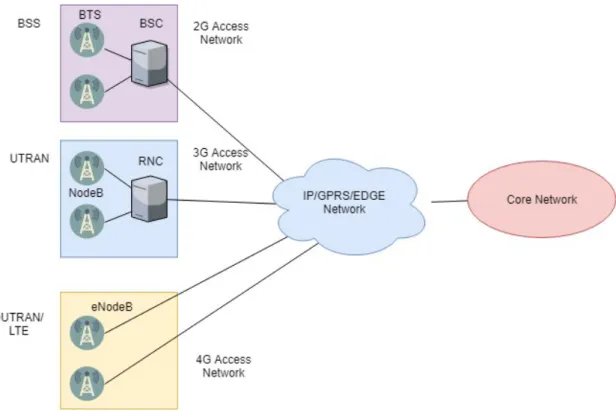
The mobile Radio Access Network (RAN) which is connected to the core network via the back-haul network, contains the radio technology that ensures the user traffic modulation. It provides radio access and coordinates management of radio resources across different cell sites. The access network of different generations of mobile net-works contain different cells. Such cells contain the necessary hardware and software technologies which are used for communication with user equipment. The technolo-gies are different for different mobile generations as shown in Figure 1. For example, the 2G access network, which is called BSS (Base Station Sub System) is different than the 3G access network which is the UTRAN (UMTS Terrestrial Radio Access Network). [10] The LTE (Long Term Evolution of 3G) or eUTRAN (evolved UT-RAN), the access network for 4G, contains eNodeBs and it has flat architecture as it does not have centralized controller unlike its predecessors.
Figure 1 Radio Access Network (RAN) architecture of different generations The 4G architecture significantly differs from its predecessors. Some of the changes are removal of circuit switching capabilities and carrying all traffic in packets includ-ing voice traffic. Therefore, backward compatibility is maintained by segmentinclud-ing voice data into packets and routing them using VOIP (Voice Over IP) technology. The other difference is the integration of wireless LAN technology in to 4G. [11]
2.1.2 Mobile backhaul networks
The mobile backhaul is the network infrastructure that provides the connectivity between the cell site air interface (RAN) to the wireline core network which sub-sequently is connected to the data centre or the Internet [10]. The MB is part of the end to end mobile network system which serves as a link between the Radio Access Network (RAN) and the Internet. It transfers the mobile data from the radio base sta-tion to the PDN and to other tradista-tional mobile networks [44]. This connectivity can be of different types such as optical fibre, microwave radio, copper DSL, satellite etc. The mobile communication technology has been evolving through time starting from the first generation (analogue systems) to the currently expected fifth generation (5G) and the features of these different technologies are listed in Table 1. Geographical loc-ation of the cells, bandwidth (BW) requirements, policy rules and regulloc-ations are some of the factors which affect the connectivity of the Mobile Backhaul system [9] [11].
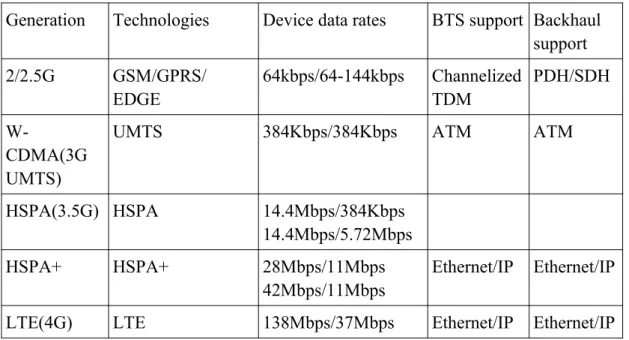
Table 1 shows different technologies used for various mobile generations. It also shows, the capacity and the support for different backhaul technologies, which is changing every time and increasing visibly.
Table 1. Mobile network technologies
Generation Technologies Device data rates BTS support Backhaul support 2/2.5G GSM/GPRS/ EDGE 64kbps/64-144kbps Channelized TDM PDH/SDH W-CDMA(3G UMTS)
UMTS 384Kbps/384Kbps ATM ATM
HSPA(3.5G) HSPA 14.4Mbps/384Kbps
14.4Mbps/5.72Mbps
HSPA+ HSPA+ 28Mbps/11Mbps
42Mbps/11Mbps
Ethernet/IP Ethernet/IP
LTE(4G) LTE 138Mbps/37Mbps Ethernet/IP Ethernet/IP
After the evolution of the second generation of mobile networks the MB has under-gone a lot of changes both in terms of technological advancement and capacity.
The main reasons for those changes are, mobile devices require different quality of service and demand higher bitrates. The issue is that, traditional networks cannot af-ford to meet those demands [13]. Based on the current traffic growth, it is expected that the bandwidth usage will exceed 1Gbps from each macro base station towards the MB. The traffic will grow based on current trends of video streaming, longer content of viewing times, increasing interest in high resolution video etc. [3] [13] [14] More-over, virtual reality and other bandwidth intensive and jitter sensitive services are pos-ing a new challenge to MB. On the other hand, these services are also creatpos-ing new business opportunities and encourage innovations.
The driving force for the introduction of all IP based architecture in mobile networks was increasing BW demand and user’s requirement for quality of service. This architecture reduces the operational cost of mobile operators [4]. The new generation of the mobile networks such as Long-Term Evolution (LTE) and High-Speed Packet Access (HSPA) are examples of all IP based mobile networks unlike its predecessor-ATM based 3G and PDH and SDH based 2G, which are still existing but cannot fit the demand of the increasing network traffic [16].
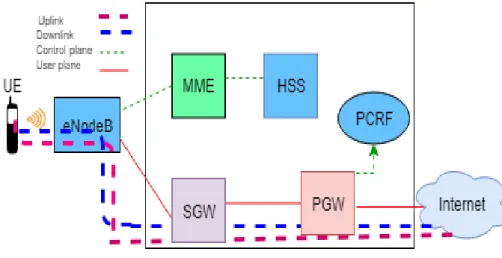
The Long-Term Evolution (LTE) network consists of two parts: the backhaul network which connects the access network to the core network containing different logical components or so-called network nodes. Those network nodes are:
Mobility Management Entity (MME) -is the main component of the mobile core network which provides session management and control plane functions. It is re-sponsible for handovers between eNodeBs as well as selecting the serving gateway, roaming, paging and user status.
Home Subscribers Server (HSS) -is in charge of storing and updating user or sub-scriber information in the database. The database contains IP address of the user, the subscriber’s profile, user status (active/idle, attach/detach) and other important QoS information of the subscriber.
Serving Gateway (SGW) -is an interface between the radio part of the network and core network. It is used to forward user data between the PDN gateway and the access network.
Packet Data Network Gateway (PGW) – is a gateway between the EPC and the ex-ternal IP networks. It provides IP address, routing and other functionalities and en-forces data flow policies.
Policy Charging Rules Function Server -is another component of the Core network which ensures the Quality of Service (QoS) charging bills and manages data flow policies.
Figure 2 shows the different components and architecture of the Evolved packet core which is connected to the access network and the internet.
Figure 2 EPC network architecture
If the LTE is to meet user demands, it has to provide high quality of real time and non-real-time mobile broadband access in a reliable and efficient way. To achieve this, the backhaul network is very important as the whole traffic load that comes from the access network to the Internet and from the Internet to the devices passes through this network [7].
Today users are accessing rich multi-media contents and they want to access the con-tent at anytime, anywhere on any device without any delay. The current 4G network is not enough to support the huge data traffic that results. Therefore, to meet the chal-lenge, network operators have two options:
The first one is increasing the capacity and coverage of the existing LTE networks by deploying a number of 4G radio resources and scaling up the backhaul accordingly. This approach is both costly and not feasible in the long run as customers do not show any interest to increase their payment for the service [14].
The second option is to add some intelligence and make the mobile backhaul agile and self-adapted when scaling the network to support future services.
Software defined networks (SDN) is the proposed technology to dynamically react to the changing data traffic demand to provide enough capacity when needed. This tech-nique seems the better solution in terms of cost and resource optimization [14].
2.1 Packet routing in mobile backhaul
Legacy mobile backhaul networks before the introduction of 3G were initially de-signed to carry only voice traffic using TDM. After the introduction of 3G technology,
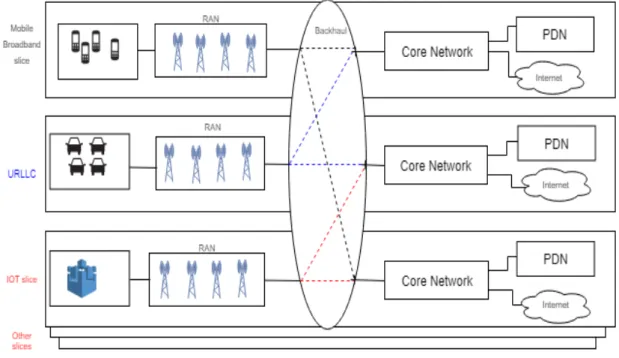
which initially used ATM and turned to Ethernet later, data traffic starts to grow and the shortcomings of TDM in the backhaul start to appear due to cost and bandwidth limitations. Ethernet starts to emerge to replace TDM as a backhaul technology to avoid the drawbacks followed by the All IP which is used in most recent wireless technologies such as WiMAX, HSPA + and LTE. However, current MB network ar-chitecture cannot meet the demands of customers given the continuous growth of the IoT devices coupling with the introduction of 5G technology.
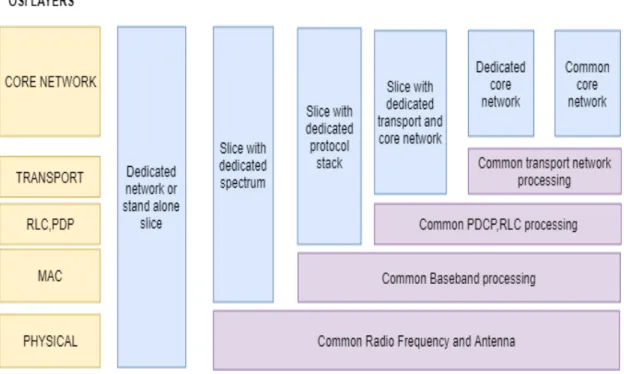
Therefore, research is going on to develop a system which is flexible enough to ac-commodate the exponential growth of devices and consequently data traffic can be al-located to different slices of the network as shown in Figure 3.
Figure 3 Mobile Network slice architecture
2.2.1 IP/MPLS routing
Routing is a process of finding a feasible path to send a packet from source to its des-tination using different rules or protocols, steps(algorithms) and different tables or maps.
Basically, there are many types of routing systems depending on different factors such as: 1) Source routing where the source (router) has full information about the route on how to send the packet to its destination and 2) hop-to-hop routing, where the node only cares about the next node to send the packet, i.e. it sends the packet to its neighbour(hop) and the next hop forwards the packet to its next hop and network keeps on doing this until the packet reaches its destination.[17]
As stated above, there are different rules (protocols), routing tables(maps) and steps (algorithms) which govern the routing process so that each network device will follow those rules to forward packets to their destination. Routing tables are information stored in the router- an intermediate device responsible for routing packets. An entry in the routing table is identified by a destination address prefix of variable length. Routers have the Forwarding Engine (FE) and the Routing Engine (RE). FE has the forwarding table that is used to forward packets. RE calculates and stores the routing table, that is used to create the forwarding table. RE runs routing protocols (OSPF, BGP etc) while the FE forwards the packet after longest match prefix search (LMPS) in the FT to find the entry that will be used. LMPS input is the destination address ex-tracted from the packet at hand. Therefore, when the router gets a new packet, it looks at its routing table and forwards it to its destination address based on the routing in-formation stored on the table. Routing tables could be static, where they are updated manually or dynamic tables which are updated automatically. [18]
Routing protocols: are configured on routers for the purpose of sharing routing in-formation. It is used to update the routing tables and generate them. A protocol is a kind of standard or an agreement format which network devices agree to send packets among each other based on this standard. Protocols differ from one another depending on the functionality, security, reliability. Routing protocols are divided in to two: In-tradomain and interdomain routing protocols. InIn-tradomain routing protocols are proto-cols which work in an autonomous system i.e. within a domain network. Examples of the intradomain routing protocols are Distance vector protocols such as Routing In-formation Protocol (RIP), Enhanced Interior Gateway Routing Protocol (EIGRP) and Link state protocols such as Intermediate System to Intermediate System and Open Shortest Path First (OSPF). Interdomain protocols are protocols which connect devices on different autonomous systems or different networks. Path vector routing protocols are examples of inter domain routing protocols. [18] [19]
In a distance vector routing protocol, the router announces its topology changes every certain interval of time or when there is a change in the topology in some cases as in the case of EIGRP. A route is advertised as a vector of distance and direction to their immediate neighbours. Distance means hop count or metric distance and direction re-ferred to as next hop address and exit interface of the next router. [19]
Routing tables of routers are updated and created using some algorithm. One of the known algorithms is Bellman-Ford algorithm. Distance vector routing protocol uses Bellman-Ford routing algorithm to calculate routing paths. In this algorithm routers can advertise their information at the same time and could create routing loops espe-cially in RIPv1. However, this can be avoided using different techniques such as split horizon with Poisonous Reverse technique, addition of hold time which prevents rout-ing loops, etc. The algorithm is also iterative, that means routers advertise until all have the same routing information. Once the router updates its routing table, the routers find the shortest path between two nodes using Bellman-ford equation. [19]
Dx(y)=minv{c(x,v)+dv(y)} Eq(1) Where Dx is the least cost path from node x to node y. c (x, v) is the cost and dv(y) is the distance.
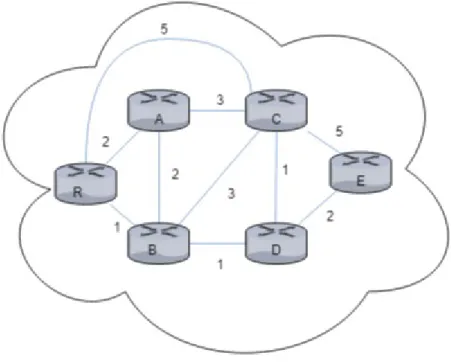
Figure 4 Dijkstra algorithm
Link state routing protocol: an intradomain routing protocol used in a single autonom-ous system. Unlike distance vector routing protocol where routers advertise every cer-tain interval of time, link state protocols like OSPF etc have both triggered updates and periodic updates. Periodic updates are every 30 minutes by default. Due to Hello protocol, periodic updates can be much less frequent than distance vector (RIP) that does not have Hellos. Link state database contain node id, list of links, sequence num-ber and age.
Figure 4 shows R is for the root node and all other nodes can be reached using Dijk-stra algorithm. The numbers in the graph show the cost of the edges. Initially or in case of routing information changes, each node generates a link state advertisement and sends all its information to its closest neighbours and nodes which receive link-state information store a copy on their link-link-state database and propagate updates to other nodes. Once every node has updated its link-state database, routers start to cal-culate the shortest path to the destinations using Dijkstra algorithm.
The MPLS label switching has been in use for quite some time. Unlike IP routing technology which uses destination IP address to forward packets to its destination, MPLS uses tags to forward IP packets. Label switching paths are built using Label
Distribution Protocol (LDP) based on IP routing table or using RSVP (Resource Re-servation Protocol) protocol. Tagged packets are forwarded once label switching paths are established. The first (ingress) router pushes the label on packets and for-wards them. Subsequent label switching routers look at the attached tags, not the IP header to forward packets towards the egress router. The egress router then removes the tags and forwards the packets to their destination. [20] In IP routing packets are forwarded by looking at the destination IP address and matching the best path in the routing table. However, IP packets lookup table can be complex or not complex but the LMPS has been optimized to find the right entry with one or two memory refer-ences. MPLS label tabels can be read in one memory reference (max million rows, so the label can directly reference the entry or be an index to the entry. Since 1 memory read takes something like 10ns (or in static memory even less?), the difference be-tween the two methods is not significant in terms of performance
2.2.2 MPLS Traffic Engineering
Traffic engineering is the ability to monitor the traffic through the network and apply not only shortest path but instead use the resources that happen to be available. The need for IP routing is to get the traffic across the network as quickly as possible. Every IP routing protocol has a cost associated with the links in the network. The ac-cumulation of different metrics such as hop count, delay, the cost of every link of a path is used to calculate the best path to route the traffic through. [20]
The forwarding paradigm of IP is based on the shortest path forwarding. IP packets are forwarded to their destination based on destination IP addresses. However, avail-able instantaneous bandwidth capacity of a link is not taken in to consideration on the IP forwarding paradigm.
Therefore, the router keeps forwarding packets even though the link starts dropping packets due to congestion or low available bandwidth on the link, as a result some links are over utilized where as others are underutilized. It is possible to monitor the links and add bandwidth in case of heavy traffic load. However, adding bandwidth to the links cannot be done instantly, it needs planning to upgrade the link capacity. Moreover, the traffic patterns are changing over time from site to site and they are not permanent, TE can bring a solution to avoid congestion on the links which are loaded. [19]
Traffic Engineering is important for analysing measuring and predicting network traffic and suggests optimized traffic paths to improve resource utilization and QoS. In traditional network architecture TE was based on two techniques, IP-based TE and MPLS-based TE. [21] [22]
IP based-TE uses shortest path first for load balancing the traffic to prevent congestion. However, it uses link weight to control the routing paths of the network and traffic cannot split arbitrarily. Therefore, this approach limits full utilization of resources. Another drawback of this approach is when for some reason a link fails, the algorithm needs time to distribute new weights and recalculate optimal paths and distribute it in full convergence. This convergence delay leads to congestion and packet loss. Moreover, the dynamic creation of network slices with own requirements will lead to continual delays in reaching optimal path. To avoid those two challenges, MPLS-based TE includes labelling which allows packets to be forwarded using tags or labels instead of IP headers. There are two variants of MPLS: (1) IP/MPLS where setting up the label switched paths depends on the IP routing protocols and (2) MPLS-TP (for “transport profile) where label paths are set up with network management. MPLS-TP is “carrier grade” while IP/MPLS is not. MPLS-TP does not define how the management is implemented, it just defines what are the resources available in the network nodes and on the “wire”.
However, this approach is very complex and creates network overheads and cannot meet the above demands [20]. It is difficult to control and manage traffic which needs flexibility and with efficient utilization of resources using traditional TE-approach. Therefore, there is a need to introduce a new approach to solve those challenges, thus SDN is proposed as the technical solution [23].
2.3 SDN usage in mobile backhaul
SDN is a new technology introduced to solve the challenges faced by traditional net-works by separating the control and data plane of the network device to ensure QoS of the network traffic in an efficient way. SDN provides network programmability, flex-ibility and agility. [10] SDN has the following three features:
Control: the SDN controller stores the whole networking information such as net-work topology and netnet-work status.
Programmability: the main advantage of SDN is to give a chance to network admin-istrators to program the network in such a way that it utilizes the available resources efficiently.
Openness: forwarding devices have interfaces which can communicate with the con-troller which is not vendor specific and through those interfaces the concon-troller gets status updates and makes routing decisions.
Although SDN is suitable for TE, there are still issues of compatibility with the exist-ing technology and its ability to co-exist for longer time with the existexist-ing traditional networks [24]. SDN network architecture is divided into three parts as shown in Fig-ure 5 below.
The Controller is considered as the brain of the network. It manages the network flow and resource allocation. It is the core of the network and runs based on Open Flow protocol [25] to communicate with the hardware devices and uses an interface called north bound interface to communicate with the application layer of the net-work.
The application layer contains different software programmes designed and executed to perform certain tasks in the network environment using the controller to interact with the hardware devices.
Infrastructure layer is also called the physical layer which consists of the physical devices in the network. These devices receive instructions from the controller via the Open Flow protocol. The instructions are triggered by the programmes in the applica-tion layer.
The OpenFlow controller has the global view of the network topology and monitors the network flow using open flow messages. Technology companies such as Google use OpenFlow to interconnect their data centres and balance network capacity utiliza-tion among them based on applicautiliza-tion demands.
OpenFlow can be used for TE to improve utilization of resources and reduce packet loss and delay. An example of SDN based approach for TE is Adaptive Routing Video Streaming (ARVS) with QoS. [24] [25]
Figure 5 SDN Network architecture [33].
In the existing routing technologies, if congestion happens on the links, it delays the delivery of the packets until the link costs are changed while they are unchanged
rout-ing stays the same and the problem persists. In SDN, the controller can dynamically change the state of the network to adapt to the changes in the topology. Hence, it tries to reduce congestion and increase QoS [27]. However, every time the path of an on-going flow changes, the flow experiences disturbance in terms of delay and packet loss. Therefore, disturbances caused by such changes need to be minimized as much as possible.
TE techniques introduced in SDN:
Google’s B4 is a technique designed to solve the reliability, performance and failure problems in wide area networks. It assigns resources dynamically to the competing applications and services. In this case TE is deployed on top of the routing protocols. This means that if TE logic faces problems when calculating the optimal routes, the normal routing algorithms like Shortest Path First (SPF) will take over and forward packets to their destination.
Deep packet inspection technique (DPI), inspects payload packets and searches for known patterns, keywords or regular expressions. The aim of this technique is to monitor, control and secure the network infrastructure and manage network resources. SDN can play an important role as it provides an overall view of the network topo-logy and can enforce better traffic policy over the network. DPI technique is used to provide more comprehensive characteristics of the packet flow and share information with decision makers. [27] However, DPI technique has some considerations to be taken into account to implement using SDN. First, SDN uses Open Flow which is a stateless protocol whereas DPI is a state full analysis tool and the other reason is while Open Flow offers a chance to reconfigure network elements dynamically which helps to monitor and control network traffic flows in a real time whereas DPI provides solid traffic classification and control. [10][27]
Machine learning (ML): can be used to develop a control logic on the network behav-ior It uses several flow level features such as end-to-end latency, packet count, link capacity, network delay, hop count, flow count etc., to classify the traffic. [25]
ATLAS framework classifies traffic based on applications. Users need to have soft-ware agents installed on their devices. The controller gets statistical information such as active network sockets and net stat logs, are collected using software agents. The controller runs machine learning trainer tool called C5.0 based on application types. The controller collects flow features such as packet size of the flow and these are used to train the ML tool. [27]
MSDN-TE (Multipath SDN), is a multi-path traffic forwarding engineering module that is used to forward traffic in such a way that it avoids congestion on any link from where it collects network information. This TE mechanism gathers information on the state of the network and considers the actual path’s load to forward the flows on mul-tiple paths. The MSDN-TE is a module which extends Open Daylight (ODL) con-troller. ODL is an open source platform used to implement SDN and Network func-tion virtualizafunc-tion. It consists of three components:
A monitoring function- used for gathering information about network states and flows in the network; for example, status of flows, link utilization, network topology, usage of resources such as bandwidth, end-to-end latency etc. The path matrices are re-freshed every 10–15 s;
TE algorithm, which calculates the number of paths, which have the lowest traffic load, between the source and destination node.
Actuating function, which supports TE algorithm module. It takes certain actions and dynamically allots flows to the selected paths.[27]
2.4 SDN based network measurement
Network measurement parameters are a set of values which represent the current network status. The SDN network measurement includes the following three parameters:
Network topology parameter- includes number of network nodes, link bandwidth, port status (i.e. up or down) etc. SDN discovers the network topology using Link Layer Discovery Protocol (LLDP). SDN controller sends an LLDP packet to the switch as packet-out message. A switch which receives the LLDP packet from the controller sends it to all neighbouring switches. The switches that receive the LLDP packet from other switches send packet-in message to the controller to handle the packet since the switch does not know where to route the packet. When the controller gets packet-in-messages from the switch it analyses and identifies which switch this switch is con-nected to and construct the global view of the network topology. The controller can also be configured to be a silent OSPF or IS-IS listener [25] to discover the network topology.
Network traffic parameter- refers to the traffic volume that pass-through network equipment or a network port. This parameter collects the total number of packets and the speed (bytes per second) in each port. Network traffic parameters are considered as the basis for detection of the status of the current network and for predicting user behavior in the network. [25]. Basically, there are two types of network traffic in SDN network, the control and data traffic. The control traffic contains data flows that are transmitted between the SDN controller and the network equipment. Data traffic con-sists of data flows that originate and terminate at hosts and are transmitted between network nodes
. To determine flow characteristics, Statistical information must be collected from each port of the switch. The information collected includes end-to-end traffic matrix of the entire network, the number of packets, size of packets etc. This information in the traffic matrix represents the volume of network flows between any two network nodes.
Network performance parameter- is used to evaluate the state of the network, to check whether the network flow is in a healthy state or not. Performance parameters such as network throughput, bandwidth utilization, latency, packet loss, and jitter are used to measure and monitor the network status.
2.5 Traffic engineering using machine learning
The main advantage of SDN is the programmability and flexibility that allows the net-work administrators to program and manage their netnet-work resources efficiently. SDN plays an important role in traffic engineering and it can be used for dynamic load bal-ancing. Dynamic load balancing (DLB) reroutes traffic using statistics collected from each device in the network. DLB is a mechanism that takes statistical parameters from each network device and evaluates the network traffic to modify the flow accordingly. [6] [29] [30].
Optimizing the usage of network resources using DLB is far better than static round robin routing algorithm. Round Robin Algorithm (RRA) is the default load balancing strategy which treats all available paths equally. The drawback in large networks is the performance cost and overhead for collecting statistics from each device in the net-work and computing the best route. Moreover, DLB needs high computing power to calculate the best path [31]. Therefore, there is a need to find some other mechanism to measure and optimize the usage of resources given the complexity of the network and traffic growth. Thus, studying the trends of traffic to identify which time of the day traffic load is quite high in some areas and low in other areas is important to de-sign optimal TE logic. For example, in areas where there is a high number of office buildings, the traffic load is high during day time and week days, but it is quite low on weekends. This kind of trends are similar every working day around those buildings or shopping malls.
In this case, machine learning (ML) can be used to develop a control logic on the net-work behavior and train the system so that traffic can be rerouted with no need to cal-culate and compute new optimal paths [32]. Machine learning is basically divided in three parts: Supervised learning, unsupervised learning and reinforced learning each of them described in following sections.
2.5.1 Supervised learning
Supervised learning consists of machine learning where there is training data that can predict the typical outcome in a similar situation. Rather than writing algorithms to do the load balancing of the network, the supervised learning takes several samples of la-beled data and trains the devices. Therefore, if similar data is encountered the device can recognize it and take actions based on the training [33]. In supervised learning the
device is trained for some known output. The idea behind supervised learning is that for some inputs we want to have certain value as an output. The machine learning al-gorithms run based on the inputs until getting output values close enough to the target value we already set. Supervised learning can be further divided in to two categories: classification and regression problems.
Classification problems- is the category that classifies the output as yes or no or posi-tive or negaposi-tive. For example, classifying flows as elephant flow or non-elephant flow, congested or non-congested etc.
Regression problems- is the category where the trend of a certain variable/output is continuous.
y=f(x) + ε Eq (2)
In equation 2:
x is input, y is the output and ε stands for the error. Using supervised learning the sys-tem tries to learn ‘f’ through training by example. Someone observes both the input and output of the system and collects a set of observations (xi, yi), i= 1……N where N is a positive integer number. The input values of xi are put into the learning algo-rithm to produce f(x). The artificial system tries to modify the input (xi) and output f(x) relationship based on the difference between the original (yi) and generated out-put f(x) i.e. evaluate yi-f(x) until the result is close enough to the targeted outout-put. So that the system can fit for real input values [33].
Figure 6 Structure of artificial neural network. [34]
An artificial neural network is one example of supervised learning algorithm which resembles more like the human brain setup. It has non-linear and self-learning behav-iors. Unlike other machine learning algorithms such as logistic regression and
proba-bility statistic, artificial neural network does not have limit on input vector [6]. Basi-cally, Supervised learning has three sections: the input layer, the hidden layer and the output layer as shown in Figure 6 below. The hidden layer can be one or more layers depending on the suitability of the selected model. Every node in one layer is con-nected to every node on the other layer. [34]
2.5.2 Unsupervised learning
Unlike supervised learning, in unsupervised learning the outcome of the input values is not known. The main goal of the unsupervised learning is to observe the relation-ship and pattern among the input variables. That means it tries to visualize if similar items are placed in one position and dissimilar items are placed in another position. One good example of unsupervised learning is the email spam detector or network in-trusion detector. In the email spam detector emails are classified whether they are spam or normal email using relative frequencies of keywords, punctuation marks and other similar techniques. However, this type of machine learning is not studied very well and sometimes is confused with supervised learning. [33].
2.5.3 Reinforcement learning
Reinforcement learning is also called semi-supervised learning. It allows a machine to automatically learn from the feedback that it receives from its environment. Once it starts learning, it adapts as time goes by. It resembles human learning style and learns from past-experience. If it encounters a similar problem, it acts based on what it has learned. One example of reinforced learning is the large collection of pictures, some are labeled as cat, cow or dog, and the majority are not labeled. In contrast to super-vised learning where a teacher is needed to supervise the outcome, reinforcement learning does not need a teacher. Rather the student tries to learn by himself and gets a reward for what he did good and penalized for the error. The main task of this learn-ing is that the agent must read the environment and act accordlearn-ingly. [14]
3 Network slicing and 5G features
This chapter discusses various features of next generation 5G mobile networks. It also presents different 5G use cases such as Ultra Reliable Low Latency Communication (URLLC), Enhanced Mobile Broadband (eMBB), Massive Internet of Things (MIoT), etc.
The ever-increasing demand of network capacity along with the introduction of Inter-net of Things (IoT) is becoming a challenging task for Inter-network operators. Network slicing is proposed as a solution to meet the requirements of the growing demand while meeting bandwidth and delay requirements to selected traffic. The term slicing has been in use for quite some time in the networking world, however this term is now associated with network virtualization: different logical networks are functioning under a single network infrastructure. Traditional network architecture follows the one size fits-all style, that means there is no separation in infrastructure. In the traditional mobile network both network and service provider are functioning as one. It limits the flexibility and network management, which does not encourage new business innova-tion and customizainnova-tion of network infrastructure. The terms network slicing and vir-tualization allow having multiple network service providers also known as tenants op-erating under a single physical network infrastructure using Software Defined Net-working (SDN) as shown in Figure 5. [35].
Figure 7 Network slicing architecture (adapted from [35])
Figure 7 demonstrates how multiple network services are running on a single network infrastructure in the 5G network.
The intention is to take a single network infrastructure, spectrum resources, network equipment, devices, etc. and create multiple subnetworks or slices with different re-quirements. Each slice shares the same physical network with other slices but with its own specific requirements such as bandwidth, security, reliability, latency, charging etc. [36]
Next generation mobile network, 5G, will provide diversified services. Those services include enhanced Mobile Broad Band (eMBB), ultra-Reliable Low Latency Commu-nications (uRLLC), massive IoT (mIoT), etc. Different services require different con-trol functions which the existing mobile networks cannot handle. The existing mobile networks instead provides a single logical control function for diversified services. [37] Next generation mobile networks, 5G, follow service-oriented network architec-ture where logical control functions can be abstracted as an independent function components. This form of architecture helps provide diversified services in mobile networks.
Next generation mobile networks are expected to be more agile where network slicing services are dynamically generated, maintained or terminated according to their re-quirements which greatly benefit service providers to increase their revenue.
3.1 Network slicing
It is difficult to achieve the required quality of service and performance for different use cases associated with the introduction of 5G technology. Network slicing in mo-bile networks is referred as dividing the momo-bile broadband networks into multiple end to end virtual networks. This allows that each service or use case has its own separate network architecture with different specific requirements and network functions to meet those requirements. Each slice or network tenant shares the same physical net-work infrastructure with other tenants and different slices. Netnet-work slicing technology encourages innovation of new business application, services etc. It provides custom-ized network operations for third parties who lack physical network infrastructure to run their services and applications.
Resource allocation for a specific slice depends on the type of service and application associated with that slice. For example, some applications/services require low band-width and tolerate latency while others require high bandband-width, are very sensitive to jitter and latency such as autonomous driving vehicles which require low latency communications.
The flexibility of Software Defined Networking (SDN) to dynamically allocate work resources plays an important role in network slicing and virtualization of net-work functions. It helps creating and managing end-to-end slices, isolation of ser-vices, dynamic and flexible allocation of resources. [38]. The dynamic allocation of
resources helps managing network resources efficiently and equitably for the network slices.
3.2 Slicing in network transport
Software Defined Networks (SDN) and Network Function Virtualization (NFV) are supposed to be potential enablers to create and manage end to end slices or use cases which have their own specific requirements. There are three important players which need to be clear while discussing about end-to-end network slicing. These are the in-frastructure provider, tenant and the end user.
Network infrastructure provider refers to the owner of the network physical infra-structure and its resources such as data centers, physical switches and packet transport links. Such resources are virtualized and provided to tenants through Application Pro-gramming Interface (API).
Tenants- are service providers who lease virtual resources from a single or multiple infrastructure provider and provide their service to their end users.
End users-are individuals or groups of people who are using the services provided by tenants. [39]
Isolation of end-to-end network slices is one of the requirements that need to be met while running slices on top of a common infrastructure. Some of the advantages of isolation of network slices are:
Performance- as discussed earlier, each slice is designed to meet specific require-ments. Hence regardless network congestion, performance levels of other slices, it has to meet those requirements.
Security and Privacy- with massive deployment of Internet of Things (IoT) slices, security and privacy could be the biggest challenge. Attacks and faults should be properly managed and those attacks and faults happening on other slices should not affect its operation. If access to slices is controlled by subscription, devices that have same subscription are able to attack anyone on this slice. Regular internet hosts do not see those devices as they may not have suitable subscription. Each slice should have separate security functions to deny read and write access on the slice configurations for nonauthorized forces. Therefore, in transport network resource allocation and se-curity isolation is very important in end-to-end network slicing. [39]
Management- Each network slice should be treated as a separate and independent network. A Network slice need to have appropriate rules and policies on how to man-age and maintain the resources and mechanisms to operate. [40]
Customizable and elastic- network slices could be added or removed dynamically based on the available resources. In case of un-predictable emergency situations, the network should dynamically re-allocate available resources to support new ad-hoc URLLC or other types of slices.
3.3 Network slicing architecture
The control plane of the SDN architecture dynamically configures and abstracts the underlying forwarding plane resources to provide tailored services to the clients on the application layer. [41] The open API in SDN allows dynamic control and automa-tion of slice creaautoma-tion and operaautoma-tion. SDN has two major components- resource and a controller which controls the resource. A resource is something which can be utilized to provide services given to clients upon request. Resources include infrastructure, network devices etc. A controller is a logical entity instantiated in the control plane which manages resources at run time for the efficient use of resources. One of the key concepts of slicing is isolation of resources´.
Figure 8 Network slicing architecture
Isolation of resources can be viewed from two perspective. The first one is operational level isolation where vertical customers have full control on the operation of a work slice. Customers can have separate control, monitor and configuration of a net-work slice. For example, netnet-work operators can provide operational isolation with or without network isolation by assigning different identification mechanisms to separate customers which belong to different slices who share the infrastructure. For instance, multiple IOT tenants can share a Narrow Band IoT network which can be assumed as preconfigured network slice.
The second one is network level isolation where vertical customers can have separate network resources which are not shared with other customers.
This level of isolation has different scenarios such as both the RAN network and the core network can be isolated or the RAN can be shared but the core network is isol-ated etc. [43]
Figure 8 shows designs of network slices in such a way that they can be standalone slices where they could have their own dedicated hardware and spectrum or they could have shared physical layer and spectrum but dedicated transport and core net-work.
3.4 Network slicing use cases
The idea behind network slicing is that, each slice in the network will have its own functionality and operation which satisfies the requirements of the business customer. Network operators will have a chance to customize their resources, i.e customization enables to create, provide and change network resources based on service demands. [43]
Here are some of the examples of network slicing use cases:
Ultra-Reliable Low Latency Communications (URLLC)- Customers may require operators to provide a URLLC slice for their industrial production to control and monitor their robots in the production line. Customers require low latency or near real time latency, stable and reliable network. Such scenarios require very good quality communications and could not tolerate data loss and it must be assured that a shared infrastructure should not cause any adverse effects on their operation. One good ex-ample is, in smart grid we have periodic measurements every few milliseconds sent from 5G device to another. If some of them are lost, there is a risk of a short circuit or shutting the grid down (possibly with half a city going dark). Such type of slice only accepts service specific traffic to avoid negative impact such as congestion on the op-eration. Service provider has to provide locations of access nodes for terminals to the transport network as well as to the location of the controller. The URLLC service may be limited to a specific area either indoor or out-door area. Therefore, the network op-erator has to make sure that resources are allocated across different access types and network domains. Monitoring of resources in this service is very important and is measured in the context of performance. Any decline in the performance would re-quire resource adjustment so that the URLLC service will function properly.
Massive IoT- Sensor networks are nowadays very important in collecting data. Such networks are deployed in various areas such as agriculture, manufacturing, weather monitoring etc. Sensor embedded devices (IoT) can be more intelligent and make more frequent interactions with the network and this could be a challenge for the
mo-bile network. Deploying massive number of IoT terminals in the generic network can be complex to manage. One example of this type of network is machine to machine communication which is expected to dominate in industries, healthcare, transportation areas, smart cities. Hence, traditional mobile networks need to be upgraded to the level of creating connectivity fabric for such networks as the nature of different IoT slices may have different control and charging functions so that network operators can manage and deploy them easily and quickly in the next generation mobile networks. [44]
Some of the challenges raised for massive IoT networks are, scalability issues- it is expected that by the 2020, there will be billions of smart devices connected to the net-work which the 5G netnet-work has to deal with. [43] Security and reliability issues are also a big concern as those devices are connected to every household equipment, med-ical instruments, public facilities etc.
Enhanced Mobile Broadband (eMBB)- eMBB provides better data rates, capacity and coverage relative to Mobile Broadband (MBB). It requires high bandwidth up to 1Gbps and 10 to 40ms latency at the same time. One example of this type of slice is that Augmented Reality/ Virtual Reality (AR/VR) live broadcast. Live sports events, musical concerts, news etc could be broadcasted to users. [43]
3.5 Implementing QoS policy using DSCP
Network traffic is treated with relative priorities based on Type of Service (ToS) field. The network traffic classifier checks every incoming packet for different parameters in the IP header such as source IP address, destination IP address, type of traffic, etc. and assigns it to a specific queuing based of DSCP class value. Most commonly used DSCP values are:
Expedited Forwarding (EF): Packets marked with EF values are assumed as higher priority packets. Those packets require low latency, loss, jitter and guaranteed bandwidth traffic.
Assured Forwarding (AF): packets marked with AF values require reliable delivery for applications which require low packet drop. Those packets have higher priority than default packets.
Default forwarding (DF): packets which do not have the above markings are assigned as default forwarding packets.
3.6 Mobile backhaul Quality of Service
Generally, IP based networks operate on a best-effort bases, which means that all traffic has equal priority and probability of being delivered. Similarly, with best effort when a network becomes congested, all traffic has an equal probability of being
delayed or dropped in the worst case. Quality of Service (QoS) is one way of managing network resources such as bandwidth by selecting network traffic and giving priorities to a specific traffic according to its relative importance. It is possible to limit usage of resources such as bandwidth by a network and make network performance more predictable and resource utilization more effective.
The QoS can be enforced in the packets at link, layer 2 or transport layer 3. The port/ node level QoS classification at layer 2 is based on VLAN priority (PRI) field. This means that all tagged traffic is classified based on a VLAN PRI and untagged traffic classified as best effort (BE). The QoS classification at layer 3 can be done using Type of Service (ToS) if IP transport is used or packet tagging if MPLS is used.
According to Internet Engineering Task Force (IETF) there are two most commonly used quality of service architectures. In practice both architectures work within an ad-ministrative domain. ISPs do not trust each other sufficiently to accept to give any preferential treatment to some packets over some other packets.
Integrated Service (IntServ)- uses resource reservation for each flow individually. [38] Every application has to reserve the necessary end-to-end resource in order to en-sure the QoS. However, applications do not exactly know how much resource they need and it is difficult to implement and used in small networks.
Differentiated Service (DiffServ)- It is an architecture which specifies a simple and scalable mechanism to classify network traffic using different classes to provide the necessary QoS in modern IP networks. DiffServ is mainly concerned with classifying incoming packets as they enter in to the network using different DSCP values. This classification applies to the flow which is defined by 5 tuples, source and destination IP addresses, source and destination ports and transport protocol. Therefore, a flow classified or marked will be treated according its DSCP value. Currently, before 5G architecture is fully specified and implement, we create network slices using RAN and Transport sharing features supported in 4G networks.
This is not truly network slicing but provides the baseline to analyze the network slicing that will be supported in 5G networks.
3. 7 RAN sharing
RAN sharing consists in having the base stations broadcasting more than one PLMN ID at the same time and each PLMN would be associated to a network slice. Transport sharing means sharing the backhaul connection. The eNB has a single slot for a backhaul connection, so connections to different cores must be multiplexed over the same physical cable through VLAN tagging. Each slice is then a combination of
![Figure 5 SDN Network architecture [33].](https://thumb-us.123doks.com/thumbv2/123dok_us/9918293.2484852/25.892.249.629.615.1000/figure-sdn-network-architecture.webp)
![Figure 6 Structure of artificial neural network. [34]](https://thumb-us.123doks.com/thumbv2/123dok_us/9918293.2484852/29.892.154.716.637.1022/figure-structure-artificial-neural-network.webp)
![Figure 7 Network slicing architecture (adapted from [35])](https://thumb-us.123doks.com/thumbv2/123dok_us/9918293.2484852/31.892.147.701.692.1018/figure-network-slicing-architecture-adapted-from.webp)