49
INTRODUCTION
In the global arena, the accreditation and assessment process of engineering courses has become a manda-tory and dynamic in the quality assurance of higher engineering education. This is due to several factors, such as the increasing trend of the internationalisation and globalisation of higher and technical education, the increasing number of courses and student enrolments, the expansion of distance and e-learning education, the emergence of a multicultural workplace environment, etc.
Important Issues of the Accreditation and Quality
Assurance and a Strategy in the Development of an
Accreditation Framework for Engineering Courses*
Arun S. Patil
Zenon J. Pudlowski
UNESCO International Centre for Engineering Education (UICEE)
Faculty of Engineering, Monash University, Clayton, Melbourne, VIC 3800, Australia
Accreditation and assessment are two very important processes that are carried out in order to maintain the quality of engineering education. Literature searches on accreditation and quality assurance of engineering education show that there is no uniform system of the assessment of engineering programmes worldwide. Although several accrediting bodies have been formed and are functioning across the world in order to accredit and recognise engineering courses, there is no common agreement or criteria that can be utilised in the accreditation and assessment of engineering education. The rapid growth of engineering and technology education globally require the proper maintenance of academic quality in educational institutions in order to withstand competition in the global market. As a result, there is a strong need for an open-ended, well-structured accreditation model to assess engineering courses for the quality assurance. In this article, the authors endeavour to identify the important issues of accreditation and quality assurance in engineering education worldwide. Such issues must be considered when devising and developing a standard accreditation framework or a model. Also, a brief outline of a research project on the design and development of a scientific accreditation model that can be implemented to assess engineering and technology courses is given. The authors also include the strategy of a multiple study case design in order to investigate important issues of accreditation and assessment.
Relevant literature searches show that there is no common agreement or criterion that can be used in the accreditation and assessment of engineering education. There is a strong need for open-ended, well-structured assessment programmes in order to accredit engineering courses. However, designing and formulating a standard and uniform accreditation process is a complex and difficult task. In the article, the authors elaborate on several important issues regarding the accreditation and quality assurance of engineering education. A brief outline of a research project on the design and development of a scientific accreditation model for the assessment of engineering and technology courses has also given in the article.
QUALITY ASSURANCE AND EDUCATION
The concept of quality assurance is very common in industrial production, where the quality of output *A revised and expanded version of a paper presentedat the 8th Baltic Region Seminar on Engineering
Educa-tion, held in Kaunas, Lithuania, from 2 to 4 September 2004.
This paper was awarded the UICEE gold award (joint third grade with two other papers) by popular vote of Seminar participants for the most significant contribution to the field of engineering education.
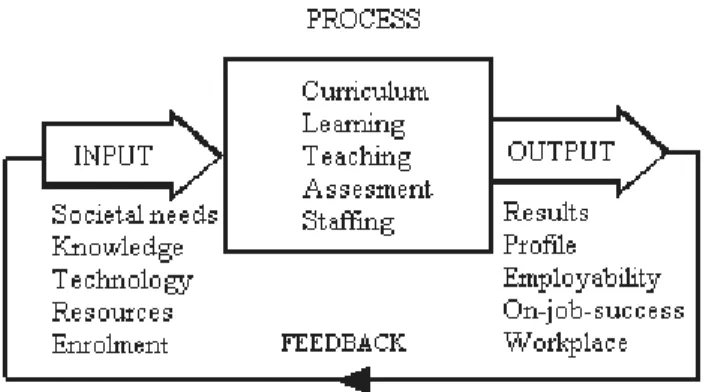
products is tested or measured. The concept of quality measurement was introduced in education in the late 1980s when the phenomenal growth of higher educa-tion began and the structure of the higher educaeduca-tion sector became more complex. Due to the internation-alisation process of higher education and the introduction of free trade economy, the quality of higher education has become mandatory for educa-tion providers in order to withstand the competitive-ness of the world market. The quality of engineering and technology education is complex and challenging due to various reasons, and can be analogous to industry, as illustrated in Figure 1. Any standard industrial activity includes three different stages, such as the input, the process and the output, where feed-back closes the loop [1]. In this process, feedfeed-back gained from the output can be utilised to improve the quality of the process. This model has also been adopted for the quality assessment of education structures. The three stages of an educational process cycle are further elaborated on below.
Figure 1: The block diagram of an educational cycle.
Educational Input
The Input parameters relate to various components, including the student’s intake or student’s enrolment into an engineering educational process, etc, and may be comprised of the following aspects:
• Societal needs;
• New knowledge;
• Advancing technologies;
• Human and material resources;
• Student enrolment process;
• Student fees structure;
• Student eligibility criteria, etc.
Educational Process
The educational process lies in between the input and the output, and this is where teaching/learning is facili-tated. It may consist of the following important factors:
• Curriculum design; • Learning styles; • Learning methods; • Teaching/learning facilities; • Assessment methods; • Staffing, etc.
Learning Outcomes
The Output component is associated with the student output after finishing the course curricula. It consists of the following elements:
• Academic results;
• Professional profile;
• Employability;
• On-the-job success rate;
• Social and workplace activities, etc.
In order to measure the quality of engineering education, the most traditional process involves the measurement of the output part of this cycle, that is the quality of engineering graduates in terms of educational values, such as academic results and work-place recruitments. A literature review also shows that several techniques have been suggested and devel-oped to improve the quality of engineering education, but all these methods have focused on the output part of the process [2].
ACCREDITATION IN THE USA AND
EUROPE
The accreditation and quality assurance process in engineering and technology education programmes began voluntarily with the help of the Accreditation Board for Engineering and Technology (ABET) in the USA and later in several other nations. Presently, the two important systems of the accreditation of higher engineering education are the Washington Accord and the Bologna Process. In the USA, several engineering and technology institutions have been reaccredited under the assessment standards of ABET’s Engineering Criteria 2000 (EC2000). Also, many other institutes will devise and implement assessment models based on the revised assessment standards of the ABET’s Criteria for Accrediting Engineering Programs (effec-tive for evaluations during the 2004-2005 Accreditation Cycle) [3].
It has been found that several interesting develop-ments towards accreditation are also taking place in Europe. However, most of these initiatives operate within the boundaries of national settings [4]. Accreditation and quality assessment processes in Europe have their roots in the 1950s, when several initiatives at the regional
and national levels were taken in the form of educational audits in order to assess pedagogical skills in higher education [5]. However, an authentic need for quality assurance in higher education was identified in the early 1990s due to the impact of the globalisation of education and relevant changes in the university education system. After the Bologna Declaration signed by European nations in 1999, the process of inter-national accreditation commenced in 2004 in several countries, such as Germany, Norway, Switzerland, Spain, Austria, Ireland and Poland [6]. Some examples of accreditation bodies in Europe are as below:
• The Engineering Council of the UK;
• The Institute of Engineers, Ireland (IEI);
• The State Accreditation Commission (SAC) and the Accreditation Commission for Technical Universities (ACTU), Poland.
ACCREDITATION IN THE ASIA-PACIFIC
REGION
Various regional and national accrediting bodies have been established and are active in order to maintain and improve the quality of engineering education in the Asia-Pacific region. For instance, several Asian countries signed a statement of cooperation so as to facilitate the accreditation of academic programmes through the recognition of respective processes in the regional inaugural meeting of the Asian Accreditation Accord (AAA). This agreement also committed signatories to pursue the mobility of human resources in order to enable cooperation and collaboration between Asian higher educational institutions on a bilateral or multilateral basis for mutual economic and technological growth [7]. However, the AAA is not especially active at this stage.
The Asia Pacific Laboratory Accreditation Coop-eration (APLAC) has also been established in order to recognise laboratory accreditation schemes throughout the Asia-Pacific region. The APLAC is recognised by the Asia-Pacific Economic Cooperation (APEC) as a Specialist Regional Body (SRB). The APLAC fosters the development of competent laboratories, as well as facilitates the mutual recogni-tion of accredited tests, measurements and results [8]. Unfortunately, not all countries in the Asia-Pacific region are members of this body.
Some interesting examples include the National Board of Accreditation (NBA) in India, which is respon-sible for the assessment and accreditation of technical education including engineering and technology, man-agement, architecture, pharmacy, town and country planning, applied arts and crafts, etc. The NBA is an
autonomous body constituted the All India Council for Technical Education (AICTE) [9]. Another example is the Engineers Australia (formerly known as Institution of Engineers, IEAust), which is responsible for the accreditation of undergraduate engineering courses in Australia. Unlike most Asian universities, Australian universities are all self-accrediting, devise their own courses and award their own degrees without any special approval [1].
In New Zealand, the accreditation organisation, called the International Accreditation New Zealand (IANZ), provides accreditation to standards that are internationally recognised. This accrediting body is responsible for the accreditation of laboratory testing, laboratory calibration, radiology services and inspection services. The IANZ was a founder member of the International Laboratory Accredita-tion CooperaAccredita-tion (ILAC) and its regional equivalent, Asia Pacific Laboratory Accreditation Cooperation (APLAC) [10].
In addition to these, there is also a Joint Accredita-tion System for Australia and New Zealand (JAS-ANZ), which is a non-profit, self funding international organisation established under a treaty between the Governments of Australia and New Zealand on 30 October 1991 in order to act as the joint accredita-tion body for Australia and New Zealand for the certification of management systems, products and personnel [11]. The Institute of Professional Engineers New Zealand (IPENZ), a professional body repre-senting professional engineers from all disciplines in New Zealand, is a founding signatory of the Washington Accord in 1989 [12].
Apart from the these examples, various organisations at the national level are also developing and carrying out the process of accreditation, these include the following:
• The Canadian Engineering Accreditation Board;
• The Engineering Council of South Africa;
• The Hong Kong Institute of Engineers, etc.
THE NEED FOR ACCREDITATION
PROCESSES
Accreditation and assessment is very important in order to maintain the quality of engineering education in any nation, which, in turn, can directly affect the status and quality of engineering graduates, and hence the technical workforce. The benefits of the educa-tional assessment and accreditation process for engineering and technology can be divided into two parts; namely academic (student) and administrative (institutional).
The academic benefits for students may be listed as follows:
• Design and implement advanced curricula, courses and laboratory works;
• Measure learning outcomes of students and identify strengths and weaknesses;
• Foster industrial interactions and the placement of students;
• Identify and develop the professional develop-ments of students;
• Design quality educational programmes in engineering and technology, etc.
The administrative benefits for institutions can include the following:
• Improve classroom and laboratory facilities;
• Develop and implement faculty resources;
• Identify reliable communication tools and facilities;
• Identify and attract funding resources and agencies;
• Strengthen national and international networking, etc.
METHODS OF ACCREDITATION AND
ASSESSMENT
In order to assure the quality of engineering education, various factors can be analysed and assessed in an engineering institution. It has been found that several efforts have been made to devise and develop assess-ment programmes for the accreditation of engineering courses [13][14]. However, most of these develop-ments focus on the accreditation requiredevelop-ments of the ABET for engineering programmes in the USA and the Bologna Declaration in the European Union (EU). The three most common actions of the accredita-tion models include the following:
1. Self-assessment of an institution; 2. Peer review and visits;
3. Evaluation and reports.
The guidelines given in the ABET Accreditation Policy and Procedure Manual also recommend that these three steps be carried out for an evaluation during the 2004-2005 accreditation cycle, and they seem to be predominantly outcome-oriented [15]. However, it has been found that most assessment models concentrate on the Process part of the educational system, with less attention being given to both the Input and Output parts of the engineering education system.
IMPORTANT ISSUES
Results of a survey of the relevant literature and observations indicate that various assessment models have been developed regionally, as well as inter-nationally, in order to accredit engineering courses. However, most of these models seem to be non-uniform, too complex, non-transparent and, moreover, non-scientific! The economic globalisation and inter-nationalisation of engineering education, the increasing number of student intake, the development of new courses and the increasing trend of distance or online education are the main concerns associated with the accreditation process worldwide. These issues are discussed in detail below.
Accreditation Agencies
Apart from the fixed situation, where there is choice, the major concern in the accreditation of engineering education for an institution is to select an appropriate accreditation body. Since there are several accredita-tion agencies and systems established at the naaccredita-tional, regional and international levels, the institution has to approach an appropriate authority for assessment.
In order to avoid this confusion, there is a strong need to establish a dedicated accreditation and quality assurance forum for engineering and technology education in different regions. For example, an Asia-Pacific Board of Accreditation and Quality Assurance in Engineering and Technology Education (APBAET) can be formed in order to cater for the qualitative and quantitative assessment of engineering and technology education in the Asia-Pacific region [16].
Student Intake and Eligibility Criteria
Due to rapid industrialisation and fast economic growth, engineering education is also developing at an accel-erated rate. There has been a sizeable expansion in student enrolments over the last two decades. As a result, the enrolment criteria of students must be assessed properly.
Assessment of Engineering Curricula and
Courses
Traditional assessment with written examinations is still a preferred method of assessing students; however, new technology can be implemented to assess students’ performance, such as online surveys, peer reviews, mock interviews, etc. Designing and imple-menting assessment models in engineering courses are complex tasks, since engineering programmes include
laboratory and project work along with theory. Several attempts have been made to develop a method for the assessment of engineering students. For instance, an authentic assessment strategy has been used in the Multi-Disciplinary Industry Project (MDIP) at Monash University, Melbourne, Australia, over several years [17].
Faculty Issues and Staff Assessment
Academic staff is an important part of any engineer-ing education system and it is important to judge the competences and faculty resources available in an engineering institution. The ABET has developed various faculty workshops in order to understand and explore accreditation programmes in engineering edu-cation in the USA.
However, there is no evidence of such workshops being developed elsewhere. It would be beneficial to devise various regional periodic workshops for the fac-ulty (including non-teaching) in a similar manner in other regions.
Financial Structure and Auditing
Financing higher and technical education is the main problem in most developing and underdeveloped countries. Every nation seeks to globalise its local and national standards of engineering and technology education so as to make it competitive in an inter-national market. It is essential to assess the financial resources in order to ensure the quality of engineering education. To devise appropriate framework, the accreditation model must include a thorough assess-ment and auditing of the all available financial sources and budget of the institution.
Several countries in the Asia-Pacific region, like Australia, New Zealand, Singapore, to name a few, have already developed education as a sizable industry, becoming an important source of national income. These countries have already redesigned their fee structure for higher education, and most of the universities are being, in a sense, privately funded.
Other Asian countries, for instance India, where student enrolments are very high and most universities are government-funded, are also adopting the finan-cial autonomy for the higher and technical education. OECD data on educational expenditure shows that Australia has the largest private funding education system after South Korea, the USA and Japan [18]. This clearly indicates that there must be stricter measures included in the accreditation model designed for the Asia-Pacific region.
Learning Outcomes
A survey of relevant literature on students’ learning outcomes shows that graduates from university courses are lacking in important skills, such as communication, decision-making, problem solving, leadership, emotional intelligence, social ethics, etc. Also, these students cannot have the required ability to work with people from different backgrounds [17]. Indeed, the workplace performances of engineer-ing graduates have been a constant subject of criticism. One study carried out on successful engineering graduates in their first few years of full-time work identified the capabilities essential for the most successful engineering practice [19]. Unfortunately, there are only few instances of such studies at the workplace. It is essential to use feedback gained in the process of accreditation from the workplace and graduate students in order to improve the course.
There is increasing evidence of a mismatch between graduate students’ skills during their studies and those needed in the workplace. Various assess-ment models devised in engineering education have not revealed the qualitative assessment of the neces-sary attributes associated with graduate students. It is essential to include these criteria of assessment in the accreditation framework, especially since engineering graduates need to work within multicultural and multi-national workplace environments.
Globalisation of Engineering and Technical
Education
It has also been observed that the process of the internationalisation of engineering and technology education is directly affected by the increased liberalisation of trade and professional services. As a result, the application of a proper accreditation model, which will be internationally recognised, is urgently required for the mobility of engineering and technology instructors and students around the world.
Assessment of R&D Activities
Comprehensive literature searches show that the total R&D expenditure by industry and government in many Asian countries stands at very low percentage when compared to Europe and the USA. Also, the number of scientists, engineers and technicians en-gaged in R&D activities is also not satisfactory in the Asia-Pacific region [20].
The literature search also showed very little evidence of the assessment of R&D activities and facilities
available in an engineering institution. Therefore, it is essential to include the criteria of R&D assessment in the accreditation framework, which, in turn, may foster the development of joint research and develop-ment activities in this region. This may also enable access to modern facilities and infrastructure in R&D activities at engineering institutions.
RESEARCH PROJECT ON THE DESIGN
OF A SCIENTIFIC ACCREDITATION
MODEL
The process of the accreditation and assessment of higher education in general, and engineering educa-tion in particular, has become a dynamic process in the quality assurance of higher education. It has been observed that designing and formulating a standard and uniform accreditation process is a complex and difficult task. Recent literature on the accreditation process shows that few studies have been carried out in order to test developed accreditation frameworks and models in engineering courses. For instance, a study undertaken to identify a simplified accreditation model for the undergraduate engineering courses through the accreditation process of the National Board of Accreditation (NBA) in India [21]. However, these studies are limited and applicable to particular regions for the particular courses.
A brief outline of a research project on the design and development of a scientific accreditation model that can be implemented to assess engineering and technology courses is given here. The research meth-odology also includes the strategy of a multiple study case design in order to investigate important issues of accreditation and assessment process in engineering and technology courses that have been carried out in various academic institutions in different parts of the world.
HYPOTHESIS AND RESEARCH
OBJECTIVES
A literature search on the accreditation and assess-ment of higher education shows that there is no common agreement or criteria that can be used in the accreditation and assessment of engineering education. A survey of literature and relevant obser-vations made indicate that various assessment models have been developed regionally and internationally in order to accredit engineering courses. Yet they lack the standard scientific requirements of the accredita-tion process.
The research hypotheses derived in this project can be summarised as follows:
• Most of the existing accreditation models are non-uniform, too complex, non-transparent and do not fulfil all the scientific requirements of an accreditation and assessment process in engineering education;
• The existing accreditation models concentrate mostly on one component of the educational system, with little or no attention being given to the whole of the cycle in the engineering education system;
• There is a strong need for open-ended, well-structured assessment programmes to accredit engineering courses.
The main objectives of this research project can be defined as:
• To investigate important issues of accreditation and assessment process of engineering education worldwide;
• To design and develop a uniform, transparent and scientific accreditation model for engineering courses that will comprise of all three parts of the educational cycle, namely the input, the process and the output;
• To design and develop a scientific methodology for the standard professional profile of engineering graduates.
RESEARCH METHODOLOGY
The research methodology for the design of a scientific accreditation model in engineering education is outlined by the following step-by-step (1 to 10) procedure. 1. Comprehensive Literature Review
A comprehensive literature survey of accreditation process in higher education in general, and engineering education in particular, will be carried out. This may include a thorough literature review of the following topics:
• Various accreditation and assessment models in engineering education, and the weaknesses and strengths of these models;
• Several important issues of the accreditation process and quality assurance in engineering and technology education;
• Internet search for accreditation processes and their implementation in engineering courses;
• Search for various existing systems of accredita-tion worldwide in engineering and technology courses;
• Search for an effective scientific model of accredi-tation in engineering and technology education.
2.
Review of Existing Accreditation Bodies
Several quality assurance policies have been estab-lished and implemented worldwide through various international, regional and national agencies. A litera-ture search will be carried out on various existing accreditation methods in order to investigate their strengths and weaknesses. A few examples include:
• International Network for Quality Assurance Agencies in Higher Education (INQAAHE);
• European Cooperation for Accreditation (EA);
• Accreditation Board for Engineering and Technology (ABET);
• European Network for Quality Assurance in Higher Education (ENQA);
• Engineering Council, UK;
• International Laboratory Accreditation Cooperation (ILAC);
• Asian Accreditation Accord (AAA);
• Asia Pacific Laboratory Accreditation Cooperation (APLAC).
3.
Investigation of Important Issues of
Accreditation
This section will consist of several case studies to investigate important issues in the accreditation of engineering courses. The following case studies will be used in order to investigate important issues of accreditation and assessment in various parts of the globe. The institutions selected for the multiple study cases are from the global network of the UNESCO International Centre for Engineering Education (UICEE) and are associates of the UICEE.
3.1. Investigation of Important Issues of the Accredi-tation of Engineering Courses in the USA Several important issues of the accreditation process of engineering education in the USA will be investi-gated using available literature resources.
3.2. Investigation of Important Issues in the Accredi-tation of Engineering Courses in European Institutions
The following case studies will be used in order to investigate important issues of accreditation and assessment in Europe:
• Case study 1: Hochschule Wismar – University of Technology, Business and Design, Wismar,
Germany;
• Case Study 2: Gdynia Maritime University, Gdynia, and the Technical University of Częstochowa,
Częstochowa, Poland;
• Case Study 3: Glasgow Caledonia University, Glasgow, Scotland, UK.
3.3. Investigation of Important Issues in the Accredi-tation of Engineering Courses in Russia
Issues in the Russian higher education accreditation process will be investigated using the following case study.
• Case Study 4: Tomsk Polytechnic University, Tomsk, Russia.
3.4. Investigation of Important Issues in the Accredi-tation of Engineering Courses in the Asia-Pacific The process of accreditation of engineering courses in the Asia-Pacific Region will be studied using several study cases from Australia, Taiwan and India. The details of these proposed study cases are as below.
• Case Study 5: Monash University, Melbourne, Australia;
• Case Study 6: National Changhua University of Education, Changhua, Taiwan;
• Case Study 7: The Maharashtra Institute of Tech-nology, University of Pune, Pune, India.
4. Testing of the Hypothesis
The hypothesis will be tested using a literature search, search of existing systems of accreditation and utilising the data collected from the above study cases. 5. Issues of Accreditation
The results of a survey of the relevant literature and observations indicate that various assessment models have been developed regionally, as well as inter-nationally, in order to accredit engineering courses. However, most of these models seem to be non-uniform, too complex, non-transparent and, moreover, non-scientific! The data collected in the above surveys and investigation will be tested for the following important issues of accreditation and assessment of engineering programmes:
• Lack of a scientific, user-friendly model of accreditation and assessment in engineering courses;
• The changing context of engineering professionals with global perspectives;
• The globalisation of engineering and technology education;
• Recent growth in student intakes and the changing context of learning styles;
• The assessment methods of engineering courses;
• Faculty issues and issues related to staff assessment;
• Higher education financial structure and the financial auditing of higher education;
• The lack of the assessment of students’ learning outcomes;
• The need for the assessment of R&D activities in the higher education sector.
6. Design and Development of a Scientific Accreditation Model
The design of an effective and scientific model of accreditation for engineering courses is the most important and crucial part. The proposed accredita-tion model will include a strategy for the assessment of a comprehensive educational process in three different parts. The outline of the model is detailed below.
6.1. An Effective Assessment of the Input Process (Part 1)
The assessment of the input process of the educa-tional cycle contains a review and assessment of the important parameters related to student intake or student enrolments into an engineering educational process, etc. This can be further comprised of the aspects described below.
• Design and development of an effective assessment of the infrastructure standards;
• Design and development of an effective assessment of an institution’s infrastructure;
• Assessment of the student intake strategy and the enrolment process.
6.2. An Effective Assessment of Educational Processes (Part 2)
It is envisaged to include a strategy for an assessment of the educational process that lies in between the input and the output, where teaching/learning is facilitated. It has been claimed by several research results on the educational evaluation process that the study of student and staff evaluations for the quality of learning and teaching performances is very much essential in the educa-tional process.
This part of the model will include an assessment
strategy for both learning (student evaluation) and teaching (staff or instructor evaluation) performances in the educational process. It will consist of the following elements:
• An effective assessment of engineering curricula;
• An assessment of learning styles and learning methods;
• An assessment of staffing and teaching qualities. 6.3. An Effective Assessment of Learning Outcomes
(Part 3)
The assessment of learning outcomes, or the output component of the educational cycle, is associated with students’ output after finishing the course curricula. This part of the accreditation model will include the essential elements listed below:
• An assessment of academic results and employability;
• The design and development of an effective tool for the assessment of engineering professional skills;
• The design and development of a methodology for the standard professional profile of engineering graduates;
• The assessment of important learning attributes and skills.
7. Evaluation of the Accreditation Model, Review and Corrections
An evaluation and review of the proposed accredita-tion model for effectiveness and consistency will be conducted and the necessary corrections in the model for better performance will be made.
CONCLUDING REMARKS
The design and development of a scientific accreditation model for engineering programmes is an urgent need for the quality assessment of engineering education. However, the task is complicated and not easy. A survey of literature and relevant observations made indicate that various assessment models have been developed regionally, as well as internationally, in order to accredit engineering courses. However, most of these models are uniform, too complex, non-transparent and, in the authors’ view, do not fulfil all the scientific requirements of an accreditation and assessment process in engineering education.
Several important issues associated with the design and development of the accreditation and assessment framework for engineering education have been described in this article. These important issues can be considered while devising the standard accreditation framework for engineering institutions.
The methodology of the design of a flexible, transparent and user-friendly model of accreditation for engineering and technology courses has been outlined and described in this article. The implemen-tation of such scientific model of accrediimplemen-tation will be very much helpful in the quality improvement and globalisation of engineering education.
REFERENCES
1. Anderson, D., Johnson, R. and Milligan, B. (Eds), Quality Assurance and Accreditation in Australian Higher Education: an Assessment of Australian and International Practice. Canberra: Department of Education, Training and Youth Affairs (DETYA) (2000).
2. Jagadeesh, R., Improvement of quality of higher education in engineering sciences with emphasis on international aspects. The Indian J. of Tech. Educ., 23, 3, 43-47 (2000).
3. Engineering Accreditation Commission, 2004-05 Engineering Criteria: Criteria for accrediting engineering programmes (effective for evaluation during the 2004-2005 accreditation cycle). Baltimore: Accreditation Board for Engineering and Technology (ABET) (2003), http: www.abet.org
4. Van Damme, D., Trends and models in inter-national quality assurance and accreditation in higher education in relation to trade in education services. OECD/US Forum on Trade in Educational Services, Washington, DC, USA, 1-51 (2002),
http://www.oecd.org/dataoecd/51/29/2088479.pdf 5. Irandoust, S., Nicklasson, C. and Sjöberg, J., Do national quality audits enhance quality at the institutional level? Experience from Chalmers University of Technology. Proc. 2nd Global
Congress on Engng. Educ., Wismar, Germany, 261-263 (2000).
6. Markusik, S., Sajdak, C. and Pudlowski, Z.J., Reflections on the accreditation process in Polish technical universities. Proc. 8th Baltic Region
Seminar on Engng. Educ., Kaunas, Lithuania, 39-43 (2004).
7. Asian Accreditation Accord (AAA), http://www.nba-aicte.ernet.in/nba-aicte/aaa.htm
8. Asia Pacific Laboratory Accreditation Co-opera-tion (APLAC), http://www.aplac.org
9. National Board of Accreditation (NBA), http://www.nba-aicte.ernet.in
10. International Accreditation New Zealand (IANZ), http://www.ianz.govt.nz/index.htm
11. Joint Accreditation System for Australia and New Zealand (JAS-ANZ), http://www.jas-anz.com.au/ showpage.php
12. The Institute of Professional Engineers New Zea-land, http://www.ipenz.org.nz/ipenz/who_we_are/ default.cfm
13. Besterfield-Sacre, M., Shuman, L.J. and Wolfe, H., Modelling undergraduate engineering outcomes. Inter. J. of Engng. Educ., 18, 2, 128-139 (2002).
14. Medrano, C.T., Ube, M., Plaza, I. and Blesa, A., The tools of quality in electronic engineering education. European J. of Engng. Educ., 27, 4, 325-337 (2002).
15. Accreditation Board for Engineering and Technology (ABET), Accreditation Policy and Procedure Manual. Baltimore: Accreditation Board for Engineering and Technology (ABET) (2003), http://www.abet.org
16. Patil, A.S. and Pudlowski, Z.J, Strategies for international accreditation and recognition of engineering and technology education in the Asia-Pacific region. Proc. 4th Global Congress
on Engng. Educ., Bangkok, Thailand, 301-304 (2004).
17. Wellington, P., Thomas, I., Powell, I. and Clarke, B., Authentic assessment applied to engineering and business undergraduate consulting teams. Inter. J. of Engng. Educ., 18, 2, 168-179 (2002).
18. Duggins, R., Financial support for technology education. World Trans. on Engng. and Technology Educ, 1, 1, 61-64 (2002).
19. Scott, G. and Yates, K.W., Using successful graduate to improve the quality of undergraduate engineering programmes. European J. of Engng. Educ., 27, 4, 363-378 (2002).
20. Patil, A.S. and Pudlowski, Z.J., The globalisation of the Indian economy: a need for the interna-tionalisation of higher technical education. World Trans. on Engng. and Technology Educ., 2, 3, 367-372 (2003).
21. Viswanadhan, K.G., Rao, N.J. and Mukhopadhyay, C., A prediction of the accredi-tation status of engineering programmes in India: a logistic regression approach. World Trans. on Engng. and Technology Educ., 3, 2, 195-198 (2004).
BIOGRAPHIES
Arun S. Patil graduated in physics in 1987, followed by a Masters in Physics in the specialisation of applied elec-tronics in 1990, from Shivaji University, Kolhapur, in the state of Maharashtra, India. For the academic year 1987-1988, he was associ-ated with secondary school teaching in science and mathematics. He was also a lecturer in electronics technology for +2 stage vocational course subjects. From 1992 to 2001, Arun Patil was a lecturer in ap-plied physics for first-year engineering diploma stu-dents at Walchand College of Engineering, Sangli, in Maharashtra, India.
He is an active member of the UICEE and has published many articles on education in Indian news-papers and commemorative magazines. He has also had numerous papers published in international conference proceedings and academic journals. He has attended a number of training programmes conducted at the national level in various parts of India.
In mid-February 2001, Arun Patil became a research student and part-time Project Officer at the UICEE, successfully completing a Master of Engi-neering Science degree in 2004. He is now engaged in research and development activities as a full-time staff member of the UICEE, and is presently a PhD candidate at Monash University.
In February 2004, he received the UICEE’s pres-tigious Silver Badge of Honour for his significant contribution to global engineering education and to the achievements of the UICEE, in particular. He was presented with this award at the 7th UICEE
Annual Conference on Engineering Education, held in Mumbai, India.
Zenon Jan Pudlowski gradu-ated Master of Electrical Engineering from the Acad-emy of Mining and Metal-lurgy (Kraków, Poland), and Doctor of Philosophy from Jagiellonian University (Kraków), in 1968 and 1979 respectively. From 1969 to 1976, he was a lecturer in the Institute of Technology within the University of Pedagogy (Kraków). Between 1976 and 1979, he was a researcher at the Institute of Vocational Education (Warsaw), and from 1979 to
1981, was an Adjunct Professor at the Institute of Pedogogy within Jagiellonian University. From 1981 to 1993, he was with the Department of Electrical Engineering at The University of Sydney where, in recent years, he was a Senior Lecturer.
He is presently Professor and Director of the UNESCO International Centre for Engineering Education (UICEE) in the Faculty of Engineering at Monash University, Clayton, Melbourne, Australia. He was Associate Dean (Engineering Education) of the Faculty of Engineering between 1994 and 1998. His achievements to date have been published in more than 300 works, including books, manuals and scientific papers in refereed journals and conference proceedings.
In 1992, he was instrumental in establishing an International Faculty of Engineering at the Technical University of Lodz, Poland, of which he was the Foundation Dean and Professor (in absentia) (1992-1999). He was also appointed Honorary Dean of the English Engineering Faculty at the Donetsk National Technical University (DonNTU) in the Ukraine in 1995.
Professor Pudlowski is a Fellow of the Institution of Engineers, Australia, and of the World Innovation Foundation (WIF). He is a member of the editorial advisory boards of many international journals. He was the 1st Vice-President and Executive Director of the AAEE and the Editor-in-Chief of the AJEE since its inception in 1989 until 1997. Currently he is the Editor-in-Chief of the Global Journal of Engineer-ing Education, and is the Foundation Secretary of the International Liaison Group for Engineering Education (ILG-EE).
Professor Pudlowski has chaired and organised many international conferences and meetings. He received the inaugural AAEE Medal for Distinguished Contributions to Engineering Education (Australasia) in 1991 and was awarded the Order of the Egyptian Syndicate of Engineers for Contributions to the Development of Engineering Education on both National and International Levels in 1994.
In June 1996, Professor Pudlowski received an honorary doctorate from the Donetsk National Technical University in the Ukraine in recognition of his contributions to international engineering educa-tion, and in July 1998 he was awarded an honorary Doctorate of Technology from Glasgow Caledonian University, Glasgow, Scotland, UK. In 1997, he was elected a member of the Ukrainian Academy of Engineering Sciences. In 2002, he was awarded the title of an Honorary Professor of the Tomsk Polytechnic University, Tomsk, Russia, and was appointed an External Professor at Aalborg University, Aalborg, Denmark.