Cover
Cover
Developed as a Project of the Northwest Product Stewardship Council
Funded by the King CountySolid Waste Division, Washington
March 2010
Preliminary Analysis of
E-Cycle Programs in
Washington and Oregon
Funded by the King County Solid Waste Division, Washington
NWPSC Electronics Subcommittee Members
Lisa Sepanski, King County Solid Waste Division, Project Manager
Sego Jackson, Snohomish County Solid Waste Division
Kathy Kiwala, Oregon Department of Environmental Quality
Scott Klag, Metro Solid Waste and Recycling Department
Miles Kuntz, Washington Department of Ecology
Suellen Mele, Washington Citizens for Resource Conservation
Margaret Shield, Local Hazardous Waste Management Program in King County
Prepared by
• Alcorn Consulting
• Eco Stewardship Strategies
• PRR
• Full Circle Environmental
Developed as a Project of the Northwest Product Stewardship Council
March 2010
Preliminary Analysis of
E-Cycle Programs in
Washington and Oregon
Executive Summary
The Northwest Product Stewardship Council (NWPSC) commissioned this report to assess the first ten months of two pioneering product stewardship programs which recover used electronic products in Washington and Oregon. The programs are called E-Cycle Washington and Oregon E-Cycles.
The specific goals of this report are:
• To provide an overview of the E-Cycle programs’ requirements and provide a descriptive summary of how the programs have been implemented from January to October, 2009 in Washington and Oregon.
• To identify and analyze the statutory and policy differences between the Oregon and Washington programs that have resulted in unique program outcomes.
• To determine lessons learned from the respective experiences in Washington and Oregon drawing from analysis of quantified results (e.g., the number of tons collected and recycled, number of collection locations) and observations of key stakeholders involved in program implementation.
Thirty eight stakeholders involved in the implementation of the E-Cycle Washington and Oregon E-Cycle program were interviewed in November and early December, 2009. These stakeholders were asked to comment and provide insight on a range of issues relevant to the development and first ten months of implementation of the E-Cycle programs including program operations, environmental impacts, policy issues and economics. Interviewees included plan/program managers implementing the E-Cycle programs, electronics manufacturers, private solid waste companies, collectors, transporters, state and local government, processors/recyclers, environmental non-governmental organizations, and refurbishment/reuse organizations. Because of the small number of stakeholders interviewed in each category, these findings are not statistically significant. However, they do provide a useful temperature check after the first year of program operation and provide information to consider as the programs evolve.
E-Cycle Program Description
Many similarities exist between the legislation that provides the backdrop for the E-Cycle programs in Washington and Oregon. The Oregon law which was passed in 2007, just one year after Washington’s law, included many of the same components as the Washington law in an attempt to make the program easier for the manufacturers and service providers to implement.
The laws in both states require manufacturers of TVs, computers and monitors to pay for and implement recycling programs for TVs, computers and monitors from specific consumers. All manufacturers must register with the state environmental agency and participate in a plan (in Oregon, once the plan is approved it is called a “program.” In Washington, it continues to be called a “plan”).
In both states, officials assign each manufacturer a percentage of the amount of collected electronics that have been returned for recycling called a “return share.” Each manufacturer is responsible for this portion of the program. The laws in both states require mandatory sampling of returned electronics by brand name in order to provide the basis for the manufacturer-specific return shares. The return share represents the obligation of each manufacturer in terms of the amount that must be collected by the plans.
The manufacturers have the option to participate in a “default” plan. Alternatively, a manufacturer or group of manufacturers can petition the state to implement their own plan. Their plan must be submitted to their state environmental agencies and must include a description of how their collection, transportation and recycling programs will function. Once approved, the plans can be implemented.
In 2009, the initial program year, Oregon DEQ approved three recycling plans in addition to the “default” State Contractor Program (SCP) which was run by a contractor. Washington had a single approved recycling plan in 2009, the “default” program operated by the Washington Materials Management and Financing Authority (WMMFA). The programs in Oregon and Washington have many similarities and differences which are summarized below.
Similarities between Oregon and Washington Programs:
• Manufacturers role: The electronics manufacturers are required to finance and implement the recycling program including the collection, transportation, recycling/processing, system operations and some promotion.
• Scope of products: The scope of products covered by both states include computers, monitors and televisions. Peripherals such as mice and keyboards are not included.
• Government role: The state environmental protection agencies provide program oversight, enforcement, ensure environmentally sound recycling and help advertise the program. Local governments promote the program within their jurisdictions.
• Collection services: Collection services are required to be publically accessible in all cities with populations of 10,000 or more and in all counties.
• Manufacturer registration: Manufacturers are required to register with their respective state’s environmental agency and pay an annual fee to support program administration, oversight and enforcement by these agencies.
• Default programs: “Default” programs that electronics manufacturers can participate in to comply with the requirements of the law have been established in both states. Both state laws allow the manufacturers or groups of manufacturers to run their own programs independently of the default programs.
• Environmental management standards: Both states have established environmental management standards for collectors, transporters and processors/recyclers.
Differences between the Oregon and Washington Programs:
• Entities covered by the program: Washington provides access to the recycling system to “consumers” defined as any household, charity, school district, small business (defined as less than 50 employees), or small government. Oregon covers any household, small business (defined as 10 or fewer employees), 501(c)3 non-profit charities employing 10 or fewer employees, or any person giving seven or fewer covered electronic devices to a collector at any one time. • Default programs: Washington’s default program is a state-created organization called the Washington Materials
Management and Financing Authority (WMMFA) that has a board of directors made up of electronics manufacturers who oversee the program. Oregon’s default program, the State Contractor Program (SCP), is run by a contractor selected by the Oregon Department of Environmental Quality (DEQ) and has no direct manufacturer oversight.
• Service provider registration: In Washington all collectors, recyclers and transporters must register with the state. No such service provider registration requirement exists in Oregon.
• Manufacturer Plan requirements: In Oregon all plans are free to choose any service provider to comply with various requirements (e.g., hiring collectors in every city of 10,000 or more). In Washington the default WMMFA must work with any collector registered with the state and must “fairly compensate” those service providers. In both states, service providers must meet environmental management standards which are established in each state.
• Performance targets: Oregon DEQ set a minimum 3.3 lbs. per capita collection target for the Oregon E-Cycle program for covered electronics. No such minimum target was established in Washington. Both states also have a convenience requirement to provide collection services in each county and at least one ongoing collection site in all cities with a population of 10,000 or more to ensure that the service is accessible and convenient.
• Return share obligations: In Oregon programs must collect and recycle, at a minimum, their share of electronics articulated by DEQ in pounds of covered electronics (not a percentage). In Oregon programs must operate throughout the
year (even if they have met their minimum), and would be penalized if they did not achieve their target except for the State Contractor Program (SCP). In Washington, when or if there are independent plans, the plans would compete with each other to collect and recycle their percentage return share of electronics established by the state. Plans that fail to meet their share must pay plans that have collected more than their share a set amount per pound for the material that was collected by the other plans.
• Administrative rules: Oregon has implemented the first year of its program without rules, relying on the statute and several guidance documents. Washington enacted regulations in 2007.
• Disposal ban on computers, monitors, TVs: Oregon has a disposal ban prohibiting computers, monitors and TVs from disposal in the trash which became effective on January 1, 2010 (one year after the collection programs began operating). Washington state has no ban although several counties have banned these materials from their local garbage systems.
• Apportionment of default program costs: In Washington the WMMFA Board establishes the financing policy for all the WMMFA members. In Oregon the law specifies that TV manufacturers participating in the SCP pay according to their respective market share of all TV manufacturers in the SCP, while manufacturers of desktops, laptops and monitors in the SCP pay according to their return share. Independent plan apportionment of costs is determined by participants in the independent plans.
Summary of Program Findings
The following findings are distilled from an analysis of quantified results (e.g., the number of tons of electronic products that were collected and recycled, number of collection locations) and observations of key stakeholders involved in program implementation.
Program Operations
• Operational startup was smooth and collection amounts exceeded expectations. Programs in both states are showing very high collection rates of covered electronics with Washington collecting 38.5 million pounds and Oregon collecting approximately 19 million pounds in 2009. Both states collected over 5 lbs per capita in their first year of operation.
• Collection service is available in all cities with a population of 10,000 or more and in each county. The convenience requirement in both states appears to be effective for ensuring that collection service is available in each county and all cities with a population of 10,000 or more. There are now 240 collection sites in Washington and 230 in Oregon – a significant increase from pre-program collection activities.
• Processing capacity has increased in the
Northwest. Two of the eight WMMFA processors/recyclers were established in Washington because of the new law and one major processor/recycler established a facility in Portland, Oregon because of the E-Cycle programs. • The programmatic model of establishing a “default”
stewardship program with an option for multiple manufacturer-run programs has proven to be viable to date. In Oregon this model has resulted in three approved manufacturer-run programs in addition to the “default” state-managed contractor program. In Washington, all manufacturers opted in 2009 to participate in the “default” Standard Plan run by the manufacturer-managed WMMFA.
• Interviewees supported flexibility with regard to
the collection of electronics. In both states there is IMS Recycling located a new facility in Vancouver, Wa in part due to the E-Cycle programs in Washington and Oregon
widespread use of the existing infrastructure for collecting electronics. In both Oregon and Washington, some programs developed collection systems using existing networks of charitable organizations. Some Oregon programs made arrangements with transfer stations operated by public entities and private solid waste companies to collect electronics. Most programs used a combination of private businesses, charitable organizations, and public sector locations. • Some organizations that specialize in reuse and refurbishment of electronic equipment have thrived
under the new system while others have struggled. Those who have thrived have either continued to refurbish old electronics and have become qualified to provide service as a recycler/processor under the new system, or have discontinued their refurbishment activities. A more detailed analysis of the dynamics of reuse in electronics recycling programs beyond the Pacific Northwest would be helpful to confirm this conclusion as the analysis in this study is based on limited experiential data.
• Charitable thrift organizations are satisfied with the program. By serving as collectors for the E-Cycle programs, charitable thrift organizations are now getting paid to collect the equipment rather than often having to pay out of pocket to recycle donated broken equipment. In Washington there are 141 locations operated by charities, including 96 Goodwill sites and these locations have become some of the most popular drop off sites. In Oregon charities have maintained their prominence as a dominant collector of used electronics in that state with more than 100 locations.
• Program education and promotion efforts need to be coordinated by a single entity. Program promotion and outreach is typically a cooperative effort across approved plans/programs, the state (using administrative fee proceeds) and local governments. When only a single plan/program exists it is easier to place more responsibility on that entity (e.g., the WMMFA) for overall system promotion and outreach. However, when multiple programs are approved as in Oregon, several stakeholders opined that in the interest of developing a coherent message to the public and to ensure a level playing field the regulatory agency should take the lead on system promotion and education.
Economics
• The E-Cycle programs generated new jobs in Washington and Oregon. According to interviews of processors/ recyclers, approximately 140 net new jobs were created across Washington and Oregon for program start-up: 79 in Washington and 61 in Oregon. Approximately 360 ongoing jobs at these facilities are reported attributable to the Washington and/or Oregon E-Cycle programs.
• Most collectors interviewed felt that the level of financial compensation for providing collection service is adequate. Most collectors interviewed that were participating in the program were satisfied with the compensation. The two entities interviewed that were not participating in the system said that the compensation was too low. Those participating in the program operate facilities that were well suited to providing collection services including adequate storage space and easy public access. Those that weren’t participating stated they had logistical challenges. This may have contributed to higher operating costs and the perception that the compensation was too low to cover their costs. • The state-wide systems created program efficiencies and drove pricing for services lower. The consolidation
of electronics recycling activities into state-wide systems has created program efficiencies relative to the cost of collection, transportation and recycling before January 1, 2009. For example the WMMFA cited operating costs in 2009 as $0.24/ lb and the Oregon SCP cited a similar rate – a cost well below prices charged to scattered local governments and private programs before E-Cycle implementation, according to several local government officials. Some of this pricing reduction is likely due to increased program efficiencies (e.g., a consolidated administrative structure) and some is likely due to the stronger pricing power that comes with larger, consolidated purchases of recycling and related services.
• Cooperation and joint activities across states has created efficiencies. Officials and stakeholders in Washington and Oregon developed a joint E-Cycle name, logo and educational materials which saved money and provided a
consistent message to consumers across states. This example of cross-state cooperation was possible because the programs are so similar operationally. Additional opportunities to develop cross-state efficiencies and avoid confusion in border communities may also exist.
• The long-term ability of service providers to thrive under a producer responsibility system is untested. Overall the short-term results are mixed: while some processors and other stakeholders expressed concern that the new system has resulted in a negative financial impact on processors, other processors with newly established facilities in the region expressed satisfaction with current arrangements.
• Managers of the “default” programs in both states expressed concern about the long-term sustainability of both programs under certain conditions. Concerns included impacts upon their programs if the financing policy that uses a combination of market share and return share to allocate costs among manufacturers could inadvertently cause manufacturers to leave the “default” program, potentially putting its viability at risk. In both states, certain manufacturers with higher market shares than return shares would pay more than their return shares under the “default program”, and if they leave the default programs the costs to all manufacturers remaining in the default program would increase.
Environmental Impacts
• Most covered electronics are now being managed in audited recycling channels rather than disposed in landfills or managed in unaudited recycling channels. The consensus among most interviewed stakeholders was that the system provided greater accountability for the final destination of the covered electronics due to annual audits of direct recyclers/processors, recordkeeping requirements and review by state regulators. Prior to the E-Cycle programs, there was no mechanism to determine if computers, monitors and TVs were being handled in a manner protective of the environment and human health. An environmental NGO said the audit process should go further – for example, leakage from collectors who are not audited is a concern.
• Collection and recycling of covered electronics has increased. Washington collected 38.5 million pounds of electronics for recycling and Oregon is collected approximately 19 million pounds in 2009 for a total of more than 5 pounds per capita. As a comparison in 2008, the Department of Ecology reported that 34.5 million pounds of electronics were recycled statewide - this figure includes all types of electronics (including printers, scanners, fax machines and other products not accepted by E-Cycle programs) from all sectors including large businesses.
• Approximately 5 million pounds of lead have been recycled as a result of the Washington and Oregon E-Cycles Program. • More than 25,000 units
have been reused in Oregon during the initial nine months of the Oregon E-Cycles program. The Washington program allows collectors to resell or donate equipment for reuse, but does not track reuse activities.
Policy
• Most stakeholders expressed support for the producer responsibility concept. This includes support from several manufacturers
although some manufacturers and plan/program managers took exception to specific elements in the approach used in Washington and Oregon, specifically the prescriptive collection requirements. Some service providers questioned their own long-term sustainability in a system where global manufacturers finance and drive the system towards lower costs. Local governments in particular are very supportive of the E-Cycle programs.
• Allowing collectors to work for multiple plans is very popular among manufacturers. While manufacturers like this arrangement, questions about certain “shared collector” practices were raised by some government officials and plan/program managers. Manufacturers noted that the ability to share collectors was critical in meeting collection service requirements, particularly in more rural areas where the number of potential staffed collection sites is limited. Critics of
E-Cycle programs track the fate of all products so fewer computers, monitors, and TVs are dumped or sent to unaudited recyclers.
collector sharing arrangements point to concerns about data reporting integrity, a reduced ability of programs to spot leakage (e.g., a change in product mix could be due to the collector sending some collected electronics to another plan/ program), and the public benefit of more collection opportunities if collector sharing were restricted.
• Projecting a minimum number of pounds that each program must collect presents challenges and can create a disincentive to collect more than the target. Oregon established a minimum number of pounds of covered electronics that each program must collect that year (3.3 lbs./capita) and underperforming programs must pay a penalty for not collecting their minimum pounds. Actual collections for 2009 were recorded at 5.13 lbs./capita. While DEQ required all programs to continue to provide collection service through all of 2009, it appears that some programs may have undertaken efforts to reduce flows of covered electronics from their collectors, including encouraging shared collectors to send electronics to other programs. The Washington program establishes plan-specific percentages where under-performing plans pay over-performing plans. The Washington approach has yet to be tested as there was only one plan operating in Washington in 2009.
• Few stakeholders had comments about the overall financing mechanism in the respective programs. However, specific issues were raised, including support for the financing structure where the Washington Department of Ecology establishes individual manufacturer return share obligations but the WMMFA board is allowed to set financing policy for all WMMFA members.
• Stakeholders voiced little concern with manufacturer registration requirements. Registration with a state agency is a common requirement across many states with producer responsibility programs. In Washington and Oregon an administrative fee is levied in conjunction with manufacturer registration and is based on a
sliding scale based on the market share of all manufacturers of covered electronics. The only complaint raised about the manufacturer registration process had to do with the relatively high fees levied on manufacturers, particularly in Washington.
• Stakeholders had insightful comments about expanding the programs to include other products – and any new producer responsibility programs. One manufacturer said any new electronic products should be added to the existing system, while another manufacturer serving on the WMMFA board noted that it was challenging to work on a system with two disparate product groups (TVs and computers) and if you added new products to the Authority [WMMFA] it could quickly become unwieldy.
• A clear legal status and startup funding are both critical in any new program. As for the creation of any other similar system with WMMFA-type operational responsibilities, another manufacturer active at the creation of the program strongly recommended that the legal issues need to be resolved before the program is created. Specifically the legal status of entity needs to be determined (is it a public or private entity or a combination) and the legal requirements that pertain to that entity need to be identified. Also there should be funding for start up operations included in any new such program for other products.
Approximately 140 net new recycling jobs were created across Washington and Oregon for program start-up.
Cover ...i
Executive Summary ...iii
Table of Contents ...1
1.0 Purpose and Scope ...2
2.0 Washington and Oregon E-Cycling Programs ...2
2.1 Common Elements Within Oregon and Washington ...4
2.2 Notable Differences Between Oregon and Washington ...5
2.3 Description of Entities Responsible for Implementing Recycling Plans ...6
2.4 Processing (Recycling) Infrastructure ...7
2.5 Collection Infrastructure ...8
3.0 Summary of Program Data...9
4.0 Summary of Stakeholder Interviews ... 12
4.1 Feedback on Program Operations ... 12
4.1.1 Perceived Satisfaction of the Program Amongst Key Stakeholders ... 13
4.1.2 Other Overall Operational Issues ... 13
4.1.3 Specific Operations Issue: Management of Materials from Covered Entities vs. Non-Covered Entities ... 14
4.1.4 Specific Operations Issue: Management of Covered Electronics vs. Non-Covered Electronics ... 15
4.1.5 Specific Operations Issue: Reuse and Refurbishment ... 15
4.1.6 Collector Participation and Compensation ... 16
4.1.7 Economic Impacts on Processors/Recyclers ... 19
4.1.8 System Promotion and Advertising ...20
4.2 Environmental Impacts ... 21
4.2.1 Changes in Covered Electronics Flows ... 21
4.2.2 Design for Environmental Improvements ...21
4.2.3 Backhauling Benefits ...22
4.3 Policy ...22
4.3.1 Overall Producer Responsibility Approach ...22
4.3.2 Connection Between Producer Responsibility and Curbside Collection ...23
4.3.3 Impact of Allocation of Responsibility Across Producers ...24
4.3.4 Cost vs. Benefit of a Statistically Viable Sampling Program ...24
4.3.5 Single Plan vs. Multiple Plans ...24
4.3.6 Performance Targets ...25
4.3.7 Manufacturer Registration Process ...25
4.4 Economics ...26 5.0 Summary of Findings ...27 5.1 Program Operations ...27 5.2 Economics ...28 5.3 Environmental Impacts ...29 5.4 Policy ...29
Appendix 1 - Active Oregon Collection Locations ...31
Approximately 230 total ...31
Appendix 2 - Active Washington Collection Locations ...38
Appendix 3 – Questions Asked of Stakeholders ...46
Appendix 4 – Distribution of Stakeholders Interviewed ...49
1.0 Purpose and Scope
The Northwest Product Stewardship Council (NWPSC) commissioned this report to assess the first ten months of two pioneering product stewardship programs to recover used electronics in Washington and Oregon. Specific goals of this report are:
• To provide an overview of the E-Cycle programs’ requirements and provide a descriptive summary of how the programs have been implemented from January to October, 2009 in Washington and Oregon.
• To identify and analyze the statutory and policy differences between the Oregon and Washington programs that have resulted in unique program outcomes.
• To determine lessons learned from the respective experiences in Washington and Oregon drawing from analysis of quantified results (e.g., the number of tons collected and recycled, number of collection locations) and observations of key stakeholders involved in program implementation.
2.0 Washington and Oregon E-Cycling Programs
In 2006 the State of Washington enacted landmark legislation to establish an extensive, statewide system for the collection of used televisions and computers for recycling. In 2007 Oregon enacted similar legislation.
Figure 1 presents a high level overview of the relationship between state regulators, recycling plans/programs, recyclers, collectors and consumers.
In general, the legislation requires manufacturers of TVs, computers and monitors to pay for and implement recycling programs for TVs, computers and monitors from specific consumers. All manufacturers must register with the state environmental agency and participate in a plan – also called a “program” in Oregon. They must submit a plan to their state environmental agencies which describes how their collection, transportation and recycling programs will function. Once approved, the plans can be implemented. If manufacturers don’t participate in a plan, they are not allowed to sell product into the state.
The manufacturers can participate in a “default” plan established by the state or a manufacturer or group of manufacturers can petition the state to implement their own plans. In both states, officials assign each manufacturer a percentage of the amount of collected electronics that have been returned for recycling called a “return share.” Each manufacturer is responsible for this portion of the program. The laws in both states require mandatory sampling of returned electronics by brand name in order to provide the basis for the manufacturer-specific return shares. The return share represents the obligation of each manufacturer in terms of the amount that must be collected by the plans.
In 2009, Washington had only one plan, the “default” plan, so that plan is responsible for 100% of the return share. If in the future, manufacturers successfully petition the state to operate their own “independent” plans in Washington, they would be responsible for the return shares of all the manufacturers who are part of that plan. In Oregon, there are three programs run by the manufacturer called “manufacturer programs” in addition to the default program. Each manufacturer plan or program decides how they will apportion the costs of their program to the manufacturers that are participating in their plan.
State Regulatory Agency
Ecology or DEQ
Recycling Plans/Programs
Financed/Run by Manufacturers
(The exception is the Oregon State Contractor
Program which is run by a DEQ contractor).
Processors/Recyclers
"Processor" is term used in Washington
Recycler " is term used in Oregon
Transporters
Provide logistics, move covered electronics
from collectors to processors/ recyclers
Collectors
Includes non-profit donation organizations,
retailers, transfer stations, reuse organizations
Covered Entities
Stakeholders who may use the recycling system
include households, small businesses, and
others as specified in respective state law
Manufacturer Financing no visible fee Manufacturer Financing no visible fee
Schematic Overview of OR and WA E-Cycle Programs
Figure 1
The manufacturer plans contract with various organizations and businesses to provide collection sites where people can drop off their unwanted equipment. The plans are required to have collection locations in all cities and counties with more than 10,000 people. The plans also contract with transporters and recyclers/processors to haul the equipment from collectors to recyclers/processors and to recycle the equipment to prepare the materials for reclaiming or reuse in new products in accordance with processing standards established by each state.
The state agencies provide program oversight and enforcement. Local governments assist with publicizing the program and consumers required bring their unwanted equipment to the collection sites.
2.1 Common Elements Within Oregon and Washington
Common program elements include:
• Manufacturer role: Both state programs require manufacturers of computers, monitors and televisions to finance collection, transportation, recycling, system operations and some promotion. • Government role: The state environmental protection agencies
provide program oversight, enforcement, ensure environmentally sound recycling and help advertise the program and local governments promote the program within their jursidictions.
• Scope of products: Both states require the recycling of the following “covered products:” televisions, computer monitors, desktop
computers and laptop computers. Peripherals such as mice and keyboards are not included.
• Entities covered by the program: Both states require the
manufacturers to provide recycling services to household consumers
and small business although there are differences in the definition of “covered entities” below.
• Collection services: Both states require publically accessible collection locations in all cities of 10,000 or more, and that collection service be provided in all rural counties without cities of this size as well.
• Registration: Both states require manufacturers to register with their respective state’s environmental agency (the Oregon Department of Environmental Quality and the Washington Department of Ecology) and pay a fee to support program administration, oversight and enforcement by these agencies.
• Independent plans/Manufacturer programs: The laws in both states establish a “default” program that electronics manufacturers can participate in to comply with the requirements of the law. In addition, both state’s laws allow the manufacturers or groups of manufacturers to run their own programs independently of the default programs. These programs are subject to specific requirements in the law and the approval of state officials. In Washington, these manufacturer-run programs are called “independent plans” and in Oregon they are called “manufacturer programs”. • Financing. In both states, the manufacturers are required to pay all program costs including administration, collection,
transportation and recycling. Each manufacturer selling into the states is assessed a percentage of the overall E-Cycle program electronics that they are responsible for – this amount is called the “return share”. The return share is based on the amount, in pounds, of their brand of products that is brought in to the program to be recycled. Return shares are calculated each year by conducting a sampling of products, by brand, that come in to the processing/recycling facilities. If a manufacturer or group of manufacturers elects to operate their own independent program, they are responsible for collecting, recycling and paying for their collective percentage of products as determined by the return share. These plans are required to be self-funding and each plan assesses their members for the costs of implementing the recycling program according to their own internal arrangements.
- In Oregon the DEQ also establishes a minimum per capita collection target for the entire Oregon E-Cycle program for covered electronics. Using this per capita minimum, each approved program’s return share is translated into a minimum pounds goal for the upcoming program (see “Performance targets” in the next section for more detail). - The financing obligation in the respective state default plans is different and is described in the next section under
• Enforcement: All manufacturers that sell their products into Washington and Oregon are required to register with the state and participate in a plan. Those that are not participating cannot sell their products in either state. Retailers are required to check the registration lists to determine if their product manufacturers are registered and complying with the law. If retailers sell products from manufacturers that are not participating in a program, they are in violation and can be fined. • Environmental management standards: Both states have set environmental management standards for service
providers such as collectors, transporters and processors/recyclers – although these standards are not identical. Overall these differences are technical in nature. Washington has implemented its recycling requirements as regulations while Oregon has published Environmental Management Practices which all approved E-Cycle programs must meet. • Sampling for return share: Both states require a sampling program of covered electronics entering their respective
recycling systems as the basis for establishing manufacturer-specific return shares. Sampling events are generally conducted at recycler/processor facilities and include recording and tallying of product brands. Washington implemented its sampling program in 2009, Oregon began in 2010.
• Definitions: In Washington a “processor” means an entity engaged in disassembling, dismantling, or shredding electronic products to recover materials contained in the electronic products and prepare those materials for reclaiming or reuse in new products in accordance with processing standards established by this chapter and by the department. A processor may also salvage parts to be used in new products. Oregon uses the term “recycler”.
2.2 Notable Differences Between Oregon and Washington
• “Default” programs: Washington’s default program is a state-created WMMFA which is governed by a board of directors comprised of a total of eleven computer and TV manufacturers appointed by the Department of Ecology. Oregon’s default program, the State Contractor Program (SCP), is run by a contractor selected by the Oregon Department of Environmental Quality (DEQ) and has no direct manufacturer oversight.
• Independent plans/manufacturer programs: Both programs allow manufacturers to run their own plans/ programs. In Washington in 2009 there were no independent plans and all manufacturers participated in the default standard plan. In late 2009, two groups of manufacturers submitted independent plans to the Washington Department of Ecology to begin operation in 2010. The plans were not approved and the standard plan will continue to be the sole plan operating in 2010. In Oregon, there were three manufacturer-run programs in addition to the default program run by the contractor.
• Return share obligations: In Oregon plans must
collect and recycle, at a minimum, their share articulated by DEQ in pounds of covered electronics (not a percentage). In Oregon plans must operate throughout the year (even if they have met their minimum), and would be penalized if they did not achieve their target except for the State Contractor Program (SCP). In Washington, when or if there are independent plans, the plans would compete with each other to collect and recycle their percentage return share of electronics established by the state. Plans that fail to meet their share must pay plans that have collected more than their share a set amount per pound for the material that was collected by the other plans.
• Covered entities: Washington defines “covered entities” slightly differently from Oregon. Specifically, Washington provides access to the recycling system to “consumers” defined as any household, charity, school district, small business (defined as less than 50 employees), or small government. Oregon covers any household, small business (defined as 10 or fewer employees), 501(c)3 non-profit charities employing 10 or fewer employees, or any person giving seven or fewer covered electronic devices to a collector at any one time.
Oregon State Senators Jackie Dingfelder and Frank Morse at the Oregon E-Cycles’ kick-off event in February 2009.
• Reuse and Refurbishment: In Washington, reuse and refurbishment can be done at the processor/recycler facility or at the collector facility. The refurbishment activity by collectors is now allowed due to a 2009 amendment to the law. In Oregon reuse and refurbishment may only be done by collectors. The number of units diverted for reuse is reported by the programs to DEQ quarterly. There is no reporting requirement for reuse in Washington.
• Registration: In Washington all collectors, recyclers and transporters must register with the state. No such service provider registration requirement exists in Oregon.
• Manufacturer Plan requirements: In Oregon all plans are free to choose any service provider to comply with various requirements (e.g., hiring collectors in every city of 10,000 or more). In Washington the default WMMFA must work with any collector registered with the state and must “fairly compensate” those service providers. In both states, service providers must meet environmental management practices which are established in each state.
• Administrative rules: Oregon has implemented the first year of its program without rules, relying on the statute and several guidance documents which had been developed through a consensus process in an advisory committee of stakeholders. Documents include the following guides: Guide for Manufacturer Recycling Plans; Environmental Management Practices; and Collection System Standards (see www.oregonecycles.com). Washington enacted regulations in 2007 that can be found at http://www.ecy.wa.gov/pubs/0707042.pdf.
• Disposal ban on computers, monitors, TVs: Oregon has a disposal ban which became effective on January 1, 2010 (one year after the collection programs began operating).
• Performance targets: In late 2008 and after discussions and negotiations with manufacturers about a number of issues, Oregon DEQ set a minimum 3.3 lbs. per capita collection target for the entire Oregon E-Cycle program for covered electronics. This minimum per capita collection target translated to more than 12 million pounds to be collected statewide in 2009 across all programs. No such minimum target was established in Washington, but even without setting any such quantitative target per capita collection results during the first year of operation are very similar across both states: actual collections in Oregon in 2009 were at 5.13 lbs. per capita, and were 5.88 lbs. in Washington. Both states also have a convenience requirement to provide collection services in each county and at least one ongoing collection site in all cities with a population of 10,000 to ensure that the service is accessible and convenient.
• Apportionment of default program costs: In Washington the WMMFA Board establishes financing policy for all WMMFA members and has established a financing policy based on a combination of market share and return share. In 2009, there is a 50-50 split between market and return share which shifts to full market share over time. As there are no independent plans in Washington to date, this financing policy is effectively the statewide financing approach. In Oregon the law specifies that TV manufacturers participating in the State Contractor Program (SCP) pay according to their respective market share of all TV manufacturers in the SCP, while manufacturers of desktops, laptops and monitors in the SCP pay according to their return share. In Washington the WMMFA bills WMMFA members quarterly to cover its operating costs while Oregon DEQ bills manufacturers participating in the SCP with an initial estimated bill and then a true up bill after the year closes. Both organizations must account for paying manufacturers due to bankruptcy or non-compliance. Because it bills quarterly, WMMFA can adjust for non-paying manufacturers more quickly than Oregon DEQ.
2.3 Description of Entities Responsible for Implementing
Recycling Plans
For the initial E-Cycling program year Oregon DEQ approved four recycling plans: the Electronic Manufacturers Recycling Management Company LLC (MRM) plan, the Independent Producer Responsibility (IPR) plan, Dell and the “default” State Contractor Program (SCP). DEQ hired a contractor – the National Center for Electronics Recycling (NCER) – to run the SCP, which is Oregon’s default program. Washington had a single approved recycling plan in 2009, the default program operated by the WMMFA.
2.4 Processing (Recycling) Infrastructure
The default plans in both states use multiple processors/recyclers. Consistent with the legal requirements the WMMFA contracts with any qualifying processor meeting the voluntary Preferred Standards published by the Washington State Department of Ecology (see document #07-07-046) and referenced in Washington regulations published at WAC 173-900, see http://www.ecy.wa.gov/
biblio/0707042.html. This requirement was a policy decision of
the WMMFA Board of Directors. Currently the WMMFA has eight approved processors/recyclers with facilities in Washington, Oregon and California.
In Oregon the SCP issued open Requests for Proposals in 2008 and in 2009 stipulating requirements, including conformance with Environmental Management Practices (EMPs) published by DEQ, see http://www.deq.state.or.us/lq/pubs/docs/
ORECyclesEnvironmentalManagementPractices.pdf. As of this
writing the SCP has contracts with four recyclers with facilities in Oregon, Washington and California.
Independent manufacturer programs in Oregon contract with recyclers privately; some programs contract exclusively with one recycler, others use two or three. In all cases, the recyclers are required to meet the Oregon EMPs or a different standard which is equivalent or better, as approved by the DEQ.
Graphics depicting the respective Washington and Oregon recycling plans/programs are shown in Figures 2 and 3.
Figure 2
Washington Materials Management and
Financing Authority (default program)
Governance Structure December 2009
Approximately 210 manufacturers participating
Erik Stromquist, CTL Susan Wright, Osram Sylvania WMMFA John Friedrick , Executive Director
From the statute: "Five board positions are reserved for representatives of the top ten brand owners by return share of covered electronic products....including at least one board position reserved for a manufacturer who is
also a retailer selling their own private label."
Mike Watson, Dell (Vice Chair) Talal El-Husseini, PC Systems and Services Mary Jacquest, Lenovo (Secretary) Mark Dabek, Re-PC Gregg Chason, P&F USA Nick Amman, Apple (At-Large Exec Cmte) Stacey Ward, Wal-Mart Megan Ehret , Thomson (Treasurer)
Figure 2
Total Reclaim recycles electronic equipment for both the Oregon and Washington programs.
Figure 3
2.5 Collection Infrastructure
The plans in both states have contracted directly with collectors, or through their recyclers, who operate the staffed collection locations required by law. Collection sites must be located in cities over 10,000 in population and in all counties and operate according to environmental management standards.
In Washington, collectors must first register with the Department of Ecology and then develop arrangements with the WMMFA on a fair price and logistical
arrangements. There are no restrictions on the number of collectors working for the WMMFA in any local jurisdiction and all registered collectors are entitled to provide service to the WMMFA, subject to agreement on fair compensation and operational arrangements. The logistics strategy employed by the WMMFA and contracted transporters is designed to take advantage of existing shipping activities operating below capacity (e.g., backhauling) to lower costs and, as a side benefit, avoid generation of new greenhouse gas emissions.1
1 A transporter interviewed for this study noted that nearly all shipments in both Washington and Oregon are “backhauls” so they are not moving empty trucks to collect covered electronics.
Approved 2009 Oregon Programs
Operational Structure in Each Program
MRM Program Management: Environmental Practices 41% RSBW Panasonic, Sharp, Toshiba 16 additional TV mfrs State Contractor Program Program Management: NCER , ZWA 33% RSBW 173 participating mfrs IPR Program Management: Waste Management Recycle America 19% RSBW Acer/ Gateway LG Sony Dell 7% RSBW Dell
Figure 3
RSW = Return Share By Weight
Customers bring their computer equipment to Ace Metal Company in Snohomish County Washington.
In Oregon there is no registration requirement. The SCP contracts directly with collectors but on a more selective basis – there is no obligation for the SCP to hire additional collectors in jurisdictions where the minimum collection requirement has been met. The Oregon SCP also negotiates compensation rates consistent with the market for collection services.
Some independent manufacturer programs in Oregon have made arrangements with collectors in a variety of ways, either contracting directly with collectors, requiring their contracted recyclers to hold agreements with collectors, and/or have agreements between manufacturer programs to share sites. Transportation services under the programs vary widely, from services provided by the program, by the recyclers or by the collector “self-ship” arrangements to use of common carriers. In Oregon many collectors have contracted with more than one program and are free to choose which program receives covered electronics collected at their facility (note that several transporters and recyclers also work for multiple programs). Other collectors are shared via program-to-program agreements. In this case, a collector has an arrangement with only one program but that program’s “pounds” are shared with another program via arrangements between programs. So from the collector’s perspective it is sending covered electronics to only one program, but the collection/recycling cost and weight are shared with the another program.
These arrangements have developed for the convenience of the program in finding collection sites across all required jurisdictions, particularly when collecting sufficient amounts of covered electronics to meet the minimum target is not a concern to programs. As programs reached and exceeded their per capita collection target in 2009 shared collectors were encouraged to use other programs. The dynamics of a lower per capita collection target in 2009 as it relates to shared collectors is expected to change in 2010 when a higher per capita collection target goes into effect.
3.0 Summary of Program Data
Both programs started strong during the first three quarters of 2009, both in terms of collection amounts and the number of collection locations. Members of the public and other covered entities could access more than 450 collection locations across Washington and Oregon (see Appendix 1 and 2 for a list of collectors active during Q1 through Q3 2009 in Oregon and Washington, respectively). Collection amounts for the first month exceeded per capita results during start-up periods in other states such as California in 2005 and Maine in 2006, and were at a rate similar to amounts collected in Minnesota (2007/2008).
Tables 1 through 5 provide key program data from each state.
Table 1: Total Pounds of Covered Electronics Collected and Recycled in 2009
Quarter 1 Quarter 2 Quarter 3 Quarter 4 TOTAL 2009
Pounds Pounds Pounds Pounds Pounds Pounds/Capita
Washington 9,118,843 9,655,152 10,856,640 8,918,039 38,548,674 5.89
Oregon 4,938,541 4,604,814 4,808,600 4,471,182 18,971,795 5.13
Table 2: Type of Covered Electronics Collected and Recycled
2009 TotalTelevisions Monitors Computers
Washington 58% 32% 10%
Table 3: Oregon-Specific, Program-Specific Recycling Results (lbs)
% Responsibility of 3.3 lbs/capita program minimum Q1 Q2 Q3 Q4 Total 2009 (lbs. and % of total) Dell 7% 897,490 819,420 809,771 827,323 3,354,004 18% IPR 19% 743,374 623,711 577,994 633,159 2,578,238 14% MRM 41% 2,281,327 1,832,198 1,827,915 1,478,504 7,419,944 39% SCP 33% 802,368 1,539,000 1,746,045 1,532,196 5,619,609 30%Table 4: Oregon-Specific Reuse Amounts in 2009 (in units)
Q1 Q2 Q3 Q4* TOTAL 2009*
Units Diverted for Reuse 8,983 7,811 8,449 668 25,866
*Totals from the last quarter are not complete.
Table 5: Washington-Specific Details (lbs) through 2009
2009 Totals TELEVISIONS Household TV 22,157,784 School District TV 64,740 Small Business TV 128,088 Total TELEVISIONS 22,350,612 MONITORS Household Monitors 11,536,361
School District Monitors 619,220
Small Business Monitors 105,375
Small Government Monitors 22,778
Total MONITORS 12,287,734
COMPUTERS (includes laptops)
Household Computers 3,593,279
School District Computers 296,463
Small Business Computers 15,899
Small Government Computers 4,687
Total COMPUTERS 3,190,328
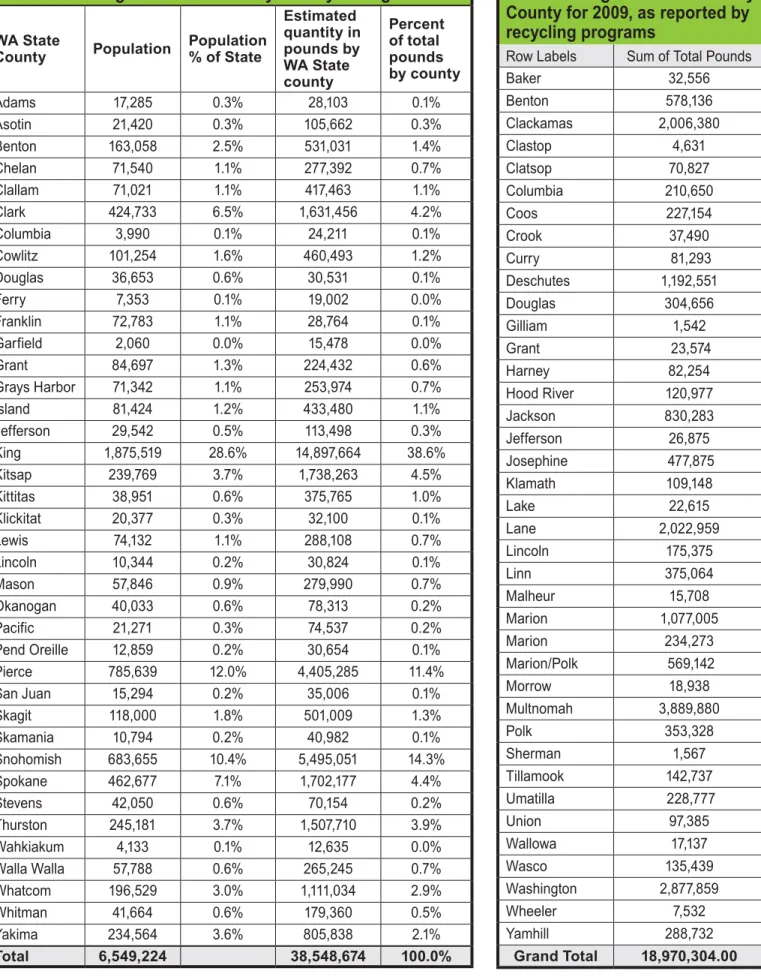
Table 6: Washington CEP Pounds by County through 2009
WA StateCounty Population Population % of State
Estimated quantity in pounds by WA State county Percent of total pounds by county Adams 17,285 0.3% 28,103 0.1% Asotin 21,420 0.3% 105,662 0.3% Benton 163,058 2.5% 531,031 1.4% Chelan 71,540 1.1% 277,392 0.7% Clallam 71,021 1.1% 417,463 1.1% Clark 424,733 6.5% 1,631,456 4.2% Columbia 3,990 0.1% 24,211 0.1% Cowlitz 101,254 1.6% 460,493 1.2% Douglas 36,653 0.6% 30,531 0.1% Ferry 7,353 0.1% 19,002 0.0% Franklin 72,783 1.1% 28,764 0.1% Garfield 2,060 0.0% 15,478 0.0% Grant 84,697 1.3% 224,432 0.6% Grays Harbor 71,342 1.1% 253,974 0.7% Island 81,424 1.2% 433,480 1.1% Jefferson 29,542 0.5% 113,498 0.3% King 1,875,519 28.6% 14,897,664 38.6% Kitsap 239,769 3.7% 1,738,263 4.5% Kittitas 38,951 0.6% 375,765 1.0% Klickitat 20,377 0.3% 32,100 0.1% Lewis 74,132 1.1% 288,108 0.7% Lincoln 10,344 0.2% 30,824 0.1% Mason 57,846 0.9% 279,990 0.7% Okanogan 40,033 0.6% 78,313 0.2% Pacific 21,271 0.3% 74,537 0.2% Pend Oreille 12,859 0.2% 30,654 0.1% Pierce 785,639 12.0% 4,405,285 11.4% San Juan 15,294 0.2% 35,006 0.1% Skagit 118,000 1.8% 501,009 1.3% Skamania 10,794 0.2% 40,982 0.1% Snohomish 683,655 10.4% 5,495,051 14.3% Spokane 462,677 7.1% 1,702,177 4.4% Stevens 42,050 0.6% 70,154 0.2% Thurston 245,181 3.7% 1,507,710 3.9% Wahkiakum 4,133 0.1% 12,635 0.0% Walla Walla 57,788 0.6% 265,245 0.7% Whatcom 196,529 3.0% 1,111,034 2.9% Whitman 41,664 0.6% 179,360 0.5% Yakima 234,564 3.6% 805,838 2.1% Total 6,549,224 38,548,674 100.0%
Table 7. Oregon CED Pounds by
County for 2009, as reported by
recycling programs
Row Labels Sum of Total Pounds
Baker 32,556 Benton 578,136 Clackamas 2,006,380 Clastop 4,631 Clatsop 70,827 Columbia 210,650 Coos 227,154 Crook 37,490 Curry 81,293 Deschutes 1,192,551 Douglas 304,656 Gilliam 1,542 Grant 23,574 Harney 82,254 Hood River 120,977 Jackson 830,283 Jefferson 26,875 Josephine 477,875 Klamath 109,148 Lake 22,615 Lane 2,022,959 Lincoln 175,375 Linn 375,064 Malheur 15,708 Marion 1,077,005 Marion 234,273 Marion/Polk 569,142 Morrow 18,938 Multnomah 3,889,880 Polk 353,328 Sherman 1,567 Tillamook 142,737 Umatilla 228,777 Union 97,385 Wallowa 17,137 Wasco 135,439 Washington 2,877,859 Wheeler 7,532 Yamhill 288,732 Grand Total 18,970,304.00
4.0 Summary of Stakeholder Interviews
The consulting team interviewed 38 stakeholders involved in the implementation of the Washington and Oregon E-Cycle program in November and early December, 2009. Stakeholders interviewed included:
• Regulators (public officials) of the respective state systems
• Plan/program managers implementing collection/recycling programs
• Manufacturers involved in financing and/or overseeing program implementation • Private solid waste companies in and out of the program
• Local government solid waste officials
• Processors/recyclers in and out of the program
• Environmental Non-Governmental Organizations (NGOs) • Refurbishment/reuse Organizations
• Transporters
These stakeholders were asked to comment and provide insight on a range of issues relevant to the development and first ten months of implementation of the E-Cycle programs. Because of the small number of stakeholders interviewed in each category, these findings are not statistically significant. However, they do provide a useful temperature check after the first year of program operation and provide information to consider as the programs evolve.
As expected, consensus across all respondents was rare on any issue. But there are also clear trends articulated by
respondents on some specific issues – sometimes across a stakeholder category, sometimes geographic – and those trends are discussed below.
On many issues responses from stakeholders did not vary considerably across states. Where responses did vary it is noted in the text.
Noteworthy comments are summarized below under the following topic headings: • Program Operations
• Environmental Program Impacts • Policy Issues
• Economics
Although 38 stakeholders were interviewed for this study, not every stakeholder interviewed was asked every question (e.g., collectors were not asked about the manufacturer financing allocation process). Appendix 3 provides a list of the questions asked of the stakeholder groups. Observed trends within or across stakeholder groups, and summaries of findings are also provided in the following sections. Appendix 4 summarizes the number of stakeholders interviewed by stakeholder grouping.
4.1 Feedback on Program Operations
All stakeholders were asked to comment on what was working well and what was not under the programs. The vast majority of respondents indicated the overall initial operational success was a notable achievement of the E-Cycle programs. Many respondents cited the number of active collectors and the quantity of covered electronics recycled as evidence of overall program success.
Respondents were positive about both Washington and Oregon. Many Washington respondents were especially complementary of the operational achievements accomplished by the WMMFA and its Executive Director.
4.1.1 Perceived Satisfaction of the Program Amongst Key Stakeholders
The majority of respondents expressed satisfaction with the programs as implemented to date. When asked to articulate what is working well and what is not, and whether the programs have met or
exceeded expectations, respondents in both states cited evidence of success including:
• The quantity of covered electronics collected has exceeded nearly all expectations.
• The number of “glitches” experienced is fewer than expected for a program as new and comprehensive as E-Cycle.
• Extensive use of local collection infrastructure, particularly the use of larger charitable organizations who stated their overall satisfaction with the program. • The system is operated and managed by the private sector and not the
government (also cited as a negative by a few stakeholders).
• All government officials at the state and local level interviewed lauded the new system.
Within stakeholder categories, some program satisfaction trends noted by interviewees were mixed, including: • Collectors participating in both programs expressed satisfaction with the
program. Some collectors in both states that are not participating cited concerns about program direction (see below).
• Processor/recycler sentiment varied. Some described the program as “a great thing” and gave it high marks, while a few others expressed concern about the harsh competitive climate brought about by the E-Cycle programs. Of the eight processors/recyclers interviewed, those working in Oregon gave a slightly more favorable assessment than in Washington.
• Reuse and refurbishment organizations were particularly divided, ranging from “surprised at how well we are able to work with the system” to “the whole program stinks for refurbishment/reuse organizations.” Note that this division did not fall along state lines, rather other factors seem to be involved (see section 4.1.5 below for details)
• Manufacturers noted the successful collection amounts but most complained about several program requirements in both states as overly prescriptive. A typical manufacturer opinion in Washington was “Most of the problems in Washington are inherent in the legislation and implementation therefore requires a lot of overhead and it’s extremely complicated… management of the board and the overhead [at a state-specific level] are overkill.” Collection service requirements in both states (i.e., staffed collection in every city of 10,000) were also a frequent target for criticism as overly prescriptive and burdensome.
4.1.2 Other Overall Operational Issues
When asked whether there were noteworthy challenges at start-up, or whether the E-Cycle programs had resulted in significant operational changes, several service providers in both states noted the increased importance of training collector staff, having adequate collection equipment (e.g., shrink wrap and/or gaylords) and adequate storage space.
Very few stakeholders interviewed reported significant operational changes in either state other than accommodation of larger amounts of electronics. Some service providers in both states noted increased tracking and scrutiny of covered electronics than before system start-up. However, as described in 4.1.5 below, some refurbishment/reuse organizations in both states did report significant operational challenges with the transition to E-Cycle program participation.
“The biggest surprise for me was that we were right – we did have to lay out a lot of detail in the law and rules, because many players would have otherwise tried to short-cut, diminish or undo the system. We saw attempts even with the detail that was established. Hopefully this will change in the future as EPR systems are more commonplace.” (local solid waste official)
“Nice people we would not have met without the program. Also this has helped reduce our provincialism. A very positive thing.” (Oregon collector)
Historical Issues from Washington Program Startup in 2007
Specific to Washington, at a management level one stakeholder noted some key challenges at the very beginning of the program. In January, 2007 the Department of Ecology appointed the initial members of the WMMFA Board of Directors. The WMMFA Board organized itself and began execution of key tasks: hiring legal counsel, budgeting and scoping out possible operational strategies.
Resources for executing these tasks were scarce and came primarily from in-kind staff support provided by the Department of Ecology, and the National Center for Electronics Recycling (NCER) as a follow-on to a study of a possible joint
Washington/Oregon “third party organization” conducted for the Northwest Product Stewardship Council in 2005. The Department of Ecology’s in-kind support was accounted for as a loan to the WMMFA and NCER support was provided using external grant funds obtained by the NCER from U.S. EPA and the Consumer Electronics Association.
At the time the legislative battle in Washington was still fresh and some opponents continued to question the viability and legality of the WMMFA. Questions about the WMMFA legal standing raised by one of these opponents during the spring of 2007 resulted in the WMMFA Board “re-doing” all of its actions from previous meetings, including the election of officers and hiring of legal counsel.
Drawing from these experiences one stakeholder had these concrete suggestions:
• “For a default plan like the WMMFA it’s critical to know the legal status of the entity – what are you subject to as a private entity or a public agency? Does the open meeting law apply? That should all be clear at the beginning to avoid the legal costs and questions. During the first few months of the WMMFA certain industry lobbyists forced re-election of officers and for the WMMFA to completely start over, and these folks really wanted it to blow up at first but that didn’t happen.” By August, 2007 most of these legal questions had been resolved and a $500,000 loan had been appropriated by the Washington legislature upon a special request of the WMMFA to cover pre-implementation expenses, including drafting of the initial Standard Plan and the WMMFA Operating Plan by the statutory deadlines. This stakeholder further noted that “any new system should learn from our experiences – startup was shaky and we went through a lot to sort out our legal status and scrape together funds to get started, and hopefully any new system can start on firm footing.”
4.1.3 Specific Operations Issue: Management of Materials from
Covered Entities vs. Non-Covered Entities
Responses to the question of how collectors were managing the distinction between covered and non-covered entities varied. As noted above, Washington provides recycling system access to the following covered entities: “consumers” defined as any household, charity, school district, small business (defined as less than 50 employees), or small government. Oregon covers any household, small business (defined as 10 or fewer employees), 501(c)3 non-profit charities employing 10 or fewer employees, or any person giving seven or fewer covered electronic devices to a collector at any one time.
• Several respondents across stakeholder types and states suggested that the program would be easier to administer if the program only covered household sources of equipment.
• Some respondents in both states cited this issue as a more complex challenge when there are multiple plans. With only a single plan it is easier to spot anomalies in collection amounts/splits from a single collector than when the collector can ship to multiple programs.
• Specific to Oregon, several respondents cited the use by collectors of the “seven or fewer” units screening criteria option for anyone dropping off covered electronics as an easy alternative to determining generator status. While this opinion about the “seven or fewer” approach was popular it was not unanimous. A single Oregon collector who operates both inside the program and outside of the program (and charges a fee to accept those electronics) described the situation as “terrible” and “almost impossible to do” citing the additional burden in communicating the rules to customers and the changes now required in handling incoming electronics to differentiate covered from non-covered.
4.1.4 Specific Operations Issue: Management of Covered Electronics vs.
Non-Covered Electronics
The scope of electronic products covered by the programs is the same in both states: televisions, computer monitors, desktop computers and laptop computers. A large majority of respondents expressed a desire to include peripheral
computer products of all sizes in the program. Although several service providers reported that they had developed systems to keep peripherals out of the program and that was working well, more common were responses expressing a desire to include keyboards, mouse devices, printers and other peripherals as covered electronics.
• An Environmental NGO respondent was strongly in favor of adding peripherals and “anything with a circuit board” to E-Cycle program because 1) manufacturers are pushing recyclers to take these for free and further squeezing recycler margins, 2) metal recyclers are collecting non-covered electronics and managing them without consideration to responsible management, 3) public brings in other items and collectors feel they must provide an option to handle it for their customers, and 4) other products have same or similar materials of concern, toxicity or resource value.
• Similarly several other respondents suggested that the program should be gradually expanded, and a local solid waste official suggested the ultimate product scope should be “similar to the Waste Electrical and Electronic Equipment (WEEE) Directive in Europe and emerging programs in Canada.”
4.1.5 Specific Operations Issue: Reuse and Refurbishment
As noted above, in Washington reuse and refurbishment activities can be conducted by the collector or the processor/ recycler, including refurbishment activity by collectors following an amendment to the law. The amended law allows collectors to repair computers using whole parts gleaned from collected computers or new parts for making repairs as long as there is a part-for-part exchange with nonfunctioning computers submitted to a plan (http://apps.leg.wa.gov/documents/
billdocs/2009-10/Pdf/Bills/Session%20Law%202009/1522-S2.SL.pdf).
In Oregon reuse may only be done by collectors and the number of units diverted for reuse is reported by the programs to DEQ quarterly (see Table 4 in Section 3). There is no reporting requirement for reuse in Washington.
Refurbishment/reuse organizations across both states expressed widely diverging views on the E-Cycle programs and how they have been implemented in both states. One area of consensus across refurbishment/ reuse organizations (and other stakeholders who volunteered similar suggestions) is that the E-Cycle programs should enhance public awareness of reuse opportunities by identifying reputable collectors.
Reuse Experience in Oregon
A refurbishment/reuse organization in Oregon that is now qualified to do limited recycling (i.e., desktop dismantling for units donated to them by covered entities) for one of the programs provides a successful case study. In their experience, becoming qualified to recycle was difficult and expensive due to the relatively high recycling performance requirements such as on-site