15th AAPA International Flexible Pavements Conference, Brisbane, Australia,2013
1
UPDATE TO THE AUSTRALIAN STANDARD FOR
BITUMEN (AS 2008—1997)
Mr Kym Neaylon, ARRB Group, Australia
ABSTRACT
Bitumen is recognised as a key component in the maintenance of Australia’s road transport network, which plays a significant role in Australia’s economy.
For many years most bitumen used in Australia was manufactured at Australian oil refineries. This allowed a unique Australian bitumen specification (AS2008) to be developed which was suited to local climatic conditions and road construction practices. Over the past few years, bitumen suppliers have begun to source bitumen from overseas refineries (predominantly in Asia). It is expected that in the next few years that local production of bitumen will diminish and most Australian bitumen will be manufactured overseas. In such environment, there was a debate as to whether the future Australian bitumen specification should be based on the current specification or whether an overseas specification should be adopted. This debate has now been resolved.
AS 2008-1997 Residual bitumen for pavements is 16 years old and is well overdue for revision. Over recent years new grades of bitumen have been introduced to the Australian market (multigrade and Class AR 450 bitumen), and another grade of bitumen has also been considered (Class240), which are not covered by the current standard. The supporting test methods to this standard (the AS2341 suite of tests) are so out-dated that they are difficult to adhere to.
This paper discusses work being done by the stakeholders on the Standards committee to address these issues.
Keywords: Bitumen; AS 2008; Viscosity grading
INTRODUCTION
Bitumen is recognised as a key component in the maintenance of Australia’s road transport network, which plays a significant role in Australia’s economy. The current annual use of bitumen in Australia is around 750 - 800 kt/annum (BREE 2012). Approximately half of this bitumen is used in hot mix asphalt, and half is used in sprayed sealing (Austroads 2008a).
AUSTRALIAN REFINERIES
Most oil refineries in Australia were built at the end of the Second World War, when ‘security of supply’ was foremost in the public consciousness. The Canberra times of 13 November 1945 reported that:
An Australian-controlled company with a capital of £1,250 000, will soon be floated to produce all Australia's bitumen requirements and a considerable proportion of its lubricating oil and petrol needs
A site is being selected for a refinery along the coast of New South Wales, to be built at the cost of £600,000. A second refinery will later be set up in another State.
The company will import a million barrels of crude oil annually from the Persian Gulf, and the refining in Australia will enable bitumen to be produced at one-third of the cost at present to import.
15th AAPA International Flexible Pavements Conference, Brisbane, Australia,2013
2 In May 1946 the Canberra times reported:
A bitumen refinery, the largest of its kind in Australia, will be built on Crown land at Bunnerong at a cost of more than £600,000 and should be in production by June,1947.
It will be controlled by Bitumen and Oil Refineries, Australia, Ltd.,’ (today known as Boral), ‘whose manager, Mr. A. Craig, said today that three American engineers had arrived to take charge.
The world has changed significantly in the subsequent 50 years, these Australian refineries have aged, and economies of scale are now very important. In a press release to the Australian stock exchange, Caltex said
Relatively small refineries, in their current configuration, are disadvantaged compared to the modern, larger scale and more efficient refineries in the Asia region. This disadvantage has been exacerbated by the impact of the ongoing strength of the Australian dollar, lower refinery margins and increasing costs of the as-is refining business. (Caltex Australia Ltd, 2012). The trend of Australian refinery closures is likely to continue, and most of Australia’s bitumen is or will be refined overseas.
AUSTRALIAN BITUMEN CONSUMPTION AND SUPPLY
The Australian Bureau of Resources and Energy Economics has published a report entitled Energy in Australia 2012 (BREE 2012), and published accompanying data (BREE 2013) which has now released information on bitumen production and importation into the public arena.
Consumption
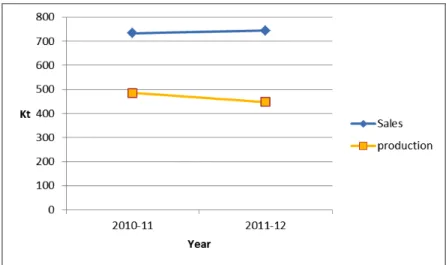
Figure 1 shows that Australian consumption in 2011/12 was about 750 kt, with 40% of that being imported.
Source: BREE (2012)
15th AAPA International Flexible Pavements Conference, Brisbane, Australia,2013
3
Local production
Figure 2 shows that the Australian manufacture of bitumen has reduced by 70% since 2007/08. Since 2011/12 Caltex have ceased bitumen production at Kurnell in Sydney, and the Shell refinery in Clyde in Sydney has ceased production.
Source: BREE (2012)
Figure 2: Australian Production of Bitumen
Importation
Of the 40% of bitumen being imported, roughly half comes from Singapore and slightly less than half comes from Thailand (Figure 3).
Source: BREE (2012)
15th AAPA International Flexible Pavements Conference, Brisbane, Australia,2013
4
Distribution
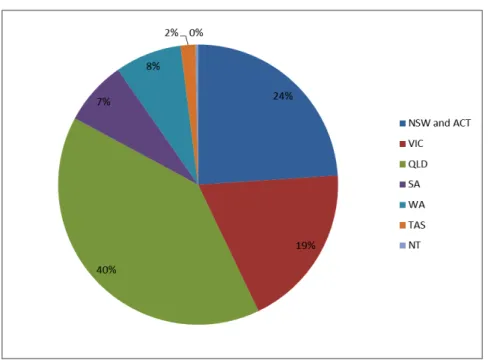
The biggest market for bitumen in Australia is Queensland, followed by New South Wales and Victoria, as shown in figure 4.
Source: BREE (2012)
Figure 4: Bitumen sales by State (2011-‐12)
AUSTRALIAN BITUMEN SPECIFICATION HISTORY
The first Australian bitumen specification, Residual bitumen and fluxed native asphalt for road making purposes, was designated as A.10 – 1938 and published by the Standards Association of Australia in 1938. This standard covered both native asphalts and bitumen, but the
specification limits for native bitumen applied only to Trinidad Lake Asphalt. As was common at the time, bitumens were graded using the penetration test result at 25 °C. The most common grades of bitumen were R90 (pen 85-100) and R200 (pen 180-210). R90 was commonly used for both sprayed seals and asphalt.
A second edition of A.10 was published in 1956.
The third edition (Standards Association of Australia, 1967) introduced a thin film oven test for the first time and also measurement of viscosity at 70 °C and 135 °C. Originally it was proposed that limits for these properties should be included but investigations showed that, while the proposed limits suited bitumens in New South Wales and Victoria, their general adoption would have meant that bitumens which were performing satisfactorily in other States would not comply with the standard (Austroads 2007).
Australia's specification for paving grade bitumen underwent change in the early 1970s from the system of grading by penetration at 25 °C to one primarily graded by Viscosity at 60 °C, based on what was considered to be best US practice at the time (Austroads 2006).
The standard was revised substantially, redesignated, and published in 1977 as Residual bitumen for pavements AS 2008-1977. Major changes (Austroads 2008b) included:
an optional durability test requirement was introduced to indicate the resistance of bitumens to long term hardening in the field due to oxidation
bitumen classification (grading) was based on viscosity at 60 °C instead of penetration
15th AAPA International Flexible Pavements Conference, Brisbane, Australia,2013
5
a range of viscosity was imposed at 135 °C to confine bitumens to an acceptable range
of temperature susceptibility
a maximum limit was placed on penetration at 15 °C to exclude bitumens which might be brittle at low temperature
a 200 g load was applied for 60 s to make the penetration test more sensitive
bitumens in the Class 160 range, whose colloidal stability was unduly susceptible to the
effects of heat and air were excluded by a requirement to meet a minimum ductility at 15 °C after the rolling thin film oven test.
In addition to the changes specified above, the test methods also underwent considerable change to take into account the latest editions of American and British methods from which they were derived. By this time a harder grade of bitumen (Class 320), was starting to be specified for asphalt applications.
A second edition was published in 1980, where minor alterations were made mainly to the specified viscosity ranges at 60 °C and 135 °C.
A third edition was published in 1997, with the main change being to revert to the international convention of measuring penetration at 25 °C using a 100 g load applied for 5 s. These were the conditions specified in Australian Standard A10 – 1967. The ductility requirement after RTFO treatment was also dropped.
The specification underwent a revision again in 2013, and a third edition will be issued in probably 2014 as Bitumen for Pavements, AS 2008-2014. The following describes the rationale behind this newest revision.
2009 SURVEY OF INTERESTED PARTIES
In 2009 a questionnaire was sent by the then putative CH-025 committee to key stakeholders, identified as the Institute of Public Works Engineering Australasia (IPWEA), the Airport Association of Australia (AAA) Technical Committee, the Australian Asphalt Pavement Association (AAPA), the New Zealand Transport Agency (NZTA), Roading NZ, all Australian state road jurisdictions, the Federal Department of Infrastructure, and the Australian Institute of Petroleum (AIP).
Questions asked included;
Where could the current standard (AS 2008 - 1997) be enhanced? Does the current standard satisfy your current and future needs?
Do you currently specify any of the optional properties (long term effect of heat and air; density). If so, should these options continue to be available?
Do you currently specify any property not included in AS 2008 - 1997 (e.g. penetration
index, asphaltene content)? Why?
Do the current bitumen grades in AS 2008 - 1997 meet your needs?
If not, please describe how the current grading system could be improved?
Are you purchasing bitumen made to a standard other than AS 2008 - 1997? If so,
what standard is it made to and do you do this because of cost, availability, or performance?
15th AAPA International Flexible Pavements Conference, Brisbane, Australia,2013
6
What additional classes should be introduced into a revised specification? How should the properties of the RTFO treated binder be used?
What new or revised properties should be considered in a revised specification?
What problems with current test methods and equipment have you been experiencing? The response to this questionnaire was limited - there seemed to be little stakeholder interest. However, from the responses that were received, it was unanimous that the current grading system based primarily on viscosity at 60 °C (pre-aging) should not be changed. Also, those states that currently specify durability will continue to specify it.
Responses also included the introduction of new C450 and C240 grades to provide a gapless grading system, and inclusion of multigrade bitumens in AS 2008
ADOPT AN EXISTING SPECIFICATION?
In 2011 a question was asked at the Austroads level – rather than go its own way, could Australia adopt an existing international specification? A special meeting of the committee convened to discuss this question, and the following was noted.
A Penetration based specification
Advantages
increases availability as product can be purchased ‘off the shelf’,
could be used as a base grade bitumen for PMB manufacture if the properties of the bitumen were suitable,
representative of weighted mean pavement temperature (WMPT, as used in asphalt
pavement design).
Disadvantages
there is no single uniform Asian penetration specification for bitumen,
greatly increased range of variable quality and properties, would need to add additional
controls, e.g. wax content,
penetration (or any overseas) grades do not include testing which determines the long
term performance of bitumen used in sprayed seals. Bitumen durability would be impossible to guarantee,
a specification based on bitumen viscosity at 60 °C (i.e. AS 2008) is more appropriate for the Australian environment than a penetration test conducted at 25 °C,
one Penetration grade can cover several AS 2008 viscosity grades (Dack 2012). It
would therefore be possible to end up with the wrong grade on the road which would cause performance issues such as rutting or fatigue in asphalt, or stripping and bleeding of sprayed seals,
penetration grades have two points of viscosity control at different temperatures
(Penetration at 25°C and Softening Point). AS 2008 has three points of viscosity control (Viscosity at 60°C, Viscosity at 135°C and Penetration at 25°C),
15th AAPA International Flexible Pavements Conference, Brisbane, Australia,2013
7
Australia uses harder grades for asphalt than any available Asian penetration grades.
Available Asian penetration grades do not include a C600 bitumen equivalent,
the general trend in Australia is towards using harder bitumens. Standard south east Asian grades do not provide this,
use of penetration (or any overseas grades) will require reformulation of PMB and
emulsion products. There is no certainty that reformulated products would meet Australian specifications for these products,
penetration is an empirical test which does not directly reflect road performance.
A performance grade (PG) specification (e.g. USA)
Advantages
climate based grading,
tries to apply a performance based rationale to the selection of binders, a post RTFO specification (applicable to hot mix asphalt),
high tech tests,
PMBs can be included in the same specifications.
Disadvantages
potentially can lead to grade proliferation,
developed for asphalt. No sprayed seal grades. It has been noted that ‘Direct
application of the PG binder specification to binders used in surface treatments is not appropriate due to differences between surface treatments and HMAC in terms of distress types, construction methods, and exposure to environmental conditions’ (Epps A, Glover C, Barcena R 2001),
different/new test equipment required nationally,
road authorities and bitumen producers in Australia have limited understanding of the PG grading system,
lack of discrimination between PMBs and bitumens in the PG specifications could lead
to difficulties in using the correct practices during road construction,
Asian refineries do not currently certify to PG grades,
the low temperature test in the PG grading system is only applicable to very cold environments (~ -10°C) where road failure is due to thermal cracking. This type of test is irrelevant to road failure modes in Australia.
A Viscosity based specification
Advantages
15th AAPA International Flexible Pavements Conference, Brisbane, Australia,2013
8
other countries are considering moving to Viscosity based grades: India committed in
2005 (Kandhal 2006); it is understood that China and Brazil were considering moving to a viscosity based specification.
viscosity grading is not unique, being adopted elsewhere,
better controls rutting of asphalt and bleeding of sprayed seals,
all emulsion, PMB, and cutback specifications are based on the current viscosity based
grading system.
Disadvantages
AS2008 provides extra constraints on the viscosity-temperature relationship of bitumen
through specifying parameters at 60°C, 135°C and 25°C. These constraints are unique to Australia and were originally copied from Californian bitumen specifications in the 1950s,
limits the range of crudes that can be used to make bitumen.
It was concluded the idea of adopting an international specification would not work, because there isn’t one. Although Australian bitumen will come from Asian refineries, there is no single Asian penetration grade specification, but rather many individual specifications for individual countries and clients. Also, about 90% of the length of Australia’s sealed road network utilises sprayed seals, not asphalt.
STANDARDS AUSTRALIA - PROJECT COMMENCEMENT
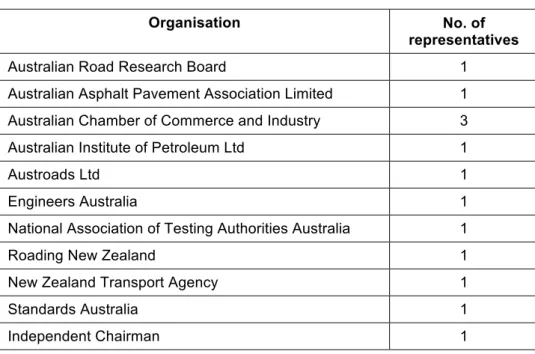
In 2012 Standards Australia supported the formal re-establishment of the committee CH-025 Bitumen and related products for road making purposes, comprising representation from the organisations shown in table 1. Standards Australia also then financially supported the revision of AS 2008 – 1997.
Table 1: Standards Australia committee CH-025 Organisation No. of
representatives
Australian Road Research Board 1 Australian Asphalt Pavement Association Limited 1 Australian Chamber of Commerce and Industry 3 Australian Institute of Petroleum Ltd 1
Austroads Ltd 1
Engineers Australia 1
National Association of Testing Authorities Australia 1
Roading New Zealand 1
New Zealand Transport Agency 1
Standards Australia 1
15th AAPA International Flexible Pavements Conference, Brisbane, Australia,2013
9
AS 2008 -201X
In this new revision:
Bitumen grades are predominately specified in terms of their viscosities at 60 °C and 135 °C and penetration results at 25 °C. These parameters are included in the Standard to ensure that bitumens show appropriate viscosity-temperature behaviour for effective use in the construction and maintenance of pavements. Test properties are also determined after bitumen samples have been subjected to the Rolling Thin Film Oven (RTFO) treatment to indicate the bitumen properties that may be expected when bitumens are incorporated into asphalt pavement mixes. This edition also allows the use of the international ASTM D2872 Standard Test Method for Effect of Heat and Air on a Moving Film of Asphalt (Rolling Thin Film Oven Test) for RTFO treatment of bitumen samples and ASTM D92 Standard test Method for Flash and Fire Points by Cleveland Open Cup Tester for measurement of bitumen flashpoint. (Standards Australia 2013).
Significant changes in the new edition include:
removal of Class 50, addition of Class 240,
addition of Class 450,
simplification of the Multigrade nomenclature,
transfer of multigrade classes M500 and M1000 from an Austroads Specification into
the Australian Standard,
the addition of some ASTM test methods for use in bitumen characterisation, to assist
with the growing importation of bitumen from Asian refineries.
Class 50 bitumen has not been sold in the Australian market for many years, and producers and bitumen users agreed to remove it from the standard.
Class 240 is intended to be a spray grade that is more viscous than a Class 170, but not as viscous as the existing Class 320. It is also a step towards a possible climate-based sprayed-sealing binder selection (Cunningham 2010), where C170 may be selected for southern parts of Australia, C240 for sub-tropical climates, and C320 available in the hotter northern and tropical parts of Australia.
Class 450 is a new asphalt grade binder, which has been supplied as AR 450 by two manufacturers in NSW, to a Roads and Maritime Services specification (RMS 2009) for a number of years now.
Multigrade has been specified and supplied for many years under an Austroads specification (currently AG:PT/T190, Austroads 2010). The naming of multigrade will be simplified to M500 (a sprayed sealing grade) and M1000 (an asphalt grade), but their specification characteristics will remain unchanged.
CONCLUSION
DR AS 2008, the draft Bitumen for Pavements, closed for public comment in July 2013. Public comment has been addressed, and the third edition of this standard is expected to be published early 2014. It remains a viscosity based specification.
Work is well underway in updating the many test methods contained in AS 2341, commencing with those directly referenced by AS 2008.
15th AAPA International Flexible Pavements Conference, Brisbane, Australia,2013
10
REFERENCES
Austroads 2006, Review of AS2008 from an Emulsion and PMB Manufacturing Perspective, by PF Tredrea, Austroads Technical Report, AP-T51-06, Austroads, Sydney.
Austroads 2007, The physical properties of Australian bitumens 1956-2004. by JWH Oliver & KY Khoo, Austroads Technical report, AP-T74-07, Sydney.
Austroads 2008a, Guide to pavement technology part 4F: bituminous binders, by J Rebbechi, AGPT04F/08, Austroads, Sydney.
Austroads 2008b, Australian and International Bituminous Binder Specifications, byC. Chin Austroads Technical Report, AP-T113-08, Sydney
Austroads 2010, Specification framework for polymer modified binders and multigrade bitumens, Austroads test method AG:PT/T190, Austroads, Sydney, NSW.
Bureau of Resources and Energy Economics 2012, Energy in Australia 2012, Australian Government, Canberra.
Bureau of Resources and Energy Economics 2013, Australian Petroleum Statistics, Issue 198, Jan 2013, Australian Government, Canberra.
Caltex Australia 2012, Caltex writes down refinery assets, ASX announcement, Caltex Australia, 16th February.
The Canberra Times 1945, ‘Plant to refine crude oil in Australia’, The Canberra Times, 13th November, 1945, p. 4.
The Canberra Times 1946, ‘Bitumen plant at Bunnerong, The Canberra Times, 9th May 1946, p. 2.
Cunningham, J 2010, ‘How climate based sealing binder selection would work’, unpublished internal submission to BSRRG binders group, ARRB, Vermont South Vic.
Dack, S 2012, Bitumen into the future, Australian road engineering and maintenance conference, 7th, Melbourne, Hallmark Editions Pty Ltd, Melbourne, Vic.
Epps A, Glover C, Barcena R, 2001, A performance-graded binder specification for surface treatments. Texas Transportation Institute & Texas A&M University System, report 77843-3135, Austin Texas.
Kandhal, P 2006, ‘Asian bitumen specifications: case for changing from penetration to viscosity grading’, Asian bitumen conference, 2nd, Singapore. Argus Media Ltd, Singapore.
Roads and Maritime Services, 2009, Bitumen for pavements, QA specification 3253, Roads and Maritime Services, Sydney.
Standards Association of Australia, 1938, Residual bitumen and fluxed native asphalt for road making purposes, A.10 – 1938, first edition, Sydney.
Standards Association of Australia, 1956, Residual bitumen and fluxed native asphalt for road making purposes, A.10 – 1956, second edition, Sydney
Standards Association of Australia, 1967, Residual bitumen and fluxed native asphalt for road making purposes, AS A10 – 1967, third edition, Sydney
Standards Australia, 1977, Residual bitumen for pavements, AS 2008 – 1977, First edition, Sydney.
Standards Australia, 1980, Residual bitumen for pavements, AS 2008 – 1980, Second edition. Sydney
15th AAPA International Flexible Pavements Conference, Brisbane, Australia,2013
11 Standards Australia, 1997, Residual bitumen for pavements, Third edition, Sydney. AS 2008-1997.
Standards Australia, 2002, Part 0: General introduction and list of Standards, Methods of testing bitumen and related roadmaking products, AS/NZS 2341.0:2002: Sydney.
Standards Australia, 2013, Bitumen for pavements (revision of AS 2008 - 1997), DR AS 2008, Draft for public comment, Sydney.
AUTHOR BIOGRAPHY
Kym consults in bituminous road surfacings for road jurisdictions throughout Australia and overseas; and project leads specific Austroads research programs in sprayed sealing and skid resistance. He is also the Chairman of the Australian Standards committee for ‘bitumen and related materials for road making purposes’, and is currently leading the revision of the Australian Standard for bitumen. As part of his part-time PhD candidature, Kym is researching the effects of heavy vehicles on sprayed seal design.
His current roles at ARRB are National Technical Leader, Bituminous Surfacings; and Team Leader, Materials Technology. The team consists of researchers in the bitumen, polymer modified bitumen, asphalt, sprayed seal and skid resistance areas.
Recently he founded the 'sprayed sealing alliance' group to facilitate the exchange of knowledge between Australia, South Africa and New Zealand.