First Edition — 2009
Doc 9906
AN/472
International Civil Aviation Organization
Approved by the Secretary General and published under his authority
Quality Assurance Manual
for Flight Procedure Design
Volume 2
Flight Procedure Designer Training
(Development of a Flight Procedure
Designer Training Programme)
Doc 9906
AN/472
Approved by the Secretary General and published under his authority
First Edition — 2009
International Civil Aviation Organization
Quality Assurance Manual
for Flight Procedure
Design
________________________________
Volume 2
Flight Procedure Designer Training
(Development of a Flight Procedure
Designer Training Programme)
Published in separate English, French, Spanish, Russian, Arabic and Chinese editions by the
INTERNATIONAL CIVIL AVIATION ORGANIZATION 999 University Street, Montréal, Quebec, Canada H3C 5H7
For ordering information and for a complete listing of sales agents and booksellers, please go to the ICAO website at www.icao.int
First edition 2009
ICAO Doc 9906, Quality Assurance Manual for Flight Procedure Design Volume 2 — Flight Procedure Designer Training
(Development of a Flight Procedure Designer Training Programme)
Order Number: 9906-2 ISBN 978-92-9231-352-4
© ICAO 2009
All rights reserved. No part of this publication may be reproduced, stored in a retrieval system or transmitted in any form or by any means, without prior permission in writing from the International Civil Aviation Organization.
(iii)
AMENDMENTS
Amendments are announced in the supplements to the
Catalogue of ICAO
Publications;
the Catalogue and its supplements are available on the ICAO
website at www.icao.int. The space below is provided to keep a record of
such amendments.
RECORD OF AMENDMENTS AND CORRIGENDA
AMENDMENTS CORRIGENDA
(v)
PREFACE
The Quality Assurance Manual for Flight Procedure Design (Doc 9906) consists of four volumes:
Volume 1 — Flight Procedure Design Quality Assurance System;
Volume 2 — Flight Procedure Designer Training;
Volume 3 — Flight Procedure Design Software Validation; and
Volume 4 — Flight Procedures Design Construction.
Instrument flight procedures based on conventional ground-based navigational aids have always demanded a high level of quality control. The implementation of area navigation and associated airborne database navigation systems, however, means that even small errors in data can lead to catastrophic results. This significant change in data quality requirements (accuracy, resolution and integrity) has led to the need for a systemic quality assurance process (often part of a State Safety Management System). The Procedures for Air Navigation Services — Aircraft Operations (PANS-OPS, Doc 8168) Volume II, Part I, Section 2, Chapter 4, Quality Assurance, refers to this manual and requires that a State take measures to “control” the quality of the processes associated with the construction of instrument flight procedures. To this end, this manual has been assembled to provide guidance in attaining these stringent requirements for quality assurance in the procedure design process. All four volumes address crucial areas related to the attainment, maintenance and continual improvement of procedure design quality. Data quality management, procedure designer training, and validation of software are all integral elements of a quality assurance programme.
Volume 1 — Flight Procedure Design Quality Assurance System provides guidance for quality assurance in the elements of procedure design, such as procedure design documentation, verification and validation methods, and guidelines about the acquisition/processing of source information/data. It also provides a generic process flow diagram for the design and implementation of flight procedures.
Volume 2 — Flight Procedure Designer Training provides guidance for the establishment of flight procedure designer training. Training is the starting point for any quality assurance programme. This volume provides guidance for the establishment of a training programme.
Volume 3 — Flight Procedure Design Software Validation provides guidance for the validation (not certification) of procedure design tools, notably with regard to criteria.
Volume 4 — Flight Procedures Design Construction (to be incorporated later).
Note.— In the independent volumes, when a reference is made to the term “manual” in the context of this document, without any further specification, it is presumed to refer to this volume of the Quality Assurance Manual for Flight Procedure Design.
(vii)
TABLE OF CONTENTS
Page
PREFACE ... (v)
TABLE OF CONTENTS ... (vii)
ABBREVIATIONS... (ix)
DEFINITIONS... (xi)
FOREWORD ... (xv)
Chapter 1. Introduction ... 1-1
1.1 General ... 1-1 1.2 Target audience of the manual ... 1-1 1.3 Goal of the manual ... 1-3 1.4 Structure of the manual... 1-3 1.5 How to use the manual ... 1-4 1.6 Use of automation... 1-5
Chapter 2. General provisions for competency-based training and assessment... 2-1
2.1 Introduction ... 2-1 2.2 Competency-based approach to training and assessment ... 2-1 2.3 The competency framework... 2-3 2.4 Skills, knowledge and attitudes ... 2-21
Attachment A to Chapter 2. Sample evidence and assessment guide ... 2-23 Attachment B to Chapter 2. Procedure design process flow diagram ... 2-29 Chapter 3. Designing curriculum ... 3-1
3.1 Introduction ... 3-1 3.2 Training phases ... 3-2
3.3 Determining the prerequisite skills, knowledge and attitude ... 3-3 3.4 Process to derive training objectives from the competency framework... 3-5 3.5 Process of sequencing objectives and organizing modules of training ... 3-8 3.6 Developing mastery tests... 3-10 3.7 Considerations in designing modules and course materials ... 3-13
Attachment A to Chapter 3. Example of a flight procedure designer training programme ... 3-16 Attachment B to Chapter 3. Test selection criteria... 3-24
(viii) The Quality Assurance Manual for Flight Procedure Design — Volume 2 Page
Chapter 4. Instructor competencies ... 4-1
4.1 Flight procedure design instructor competencies... 4-1
Chapter 5. Validation and post-training evaluation of flight procedure designer training... 5-1
5.1 Introduction ... 5-1 5.2 Purpose of evaluation ... 5-1 5.3 Evaluation approach ... 5-1 5.4 Level 1: Evaluation of trainee reaction ... 5-2 5.5 Level 2: Evaluation of trainee mastery learning ... 5-3 5.6 Level 3: Evaluation of on-the-job performance ... 5-3 5.7 Level 4: Evaluation of results/impact ... 5-4
Attachment A to Chapter 5. Course module opinion sample survey... 5-6 Attachment B to Chapter 5. Course validation sample survey... 5-7
(ix)
ABBREVIATIONS
ABAS Aircraft-based augmentation system AIP Aeronautical Information Publication
AIRAC Aeronautical information regulation and control AIS Aeronautical Information Service
ANSP Air Navigation Service Provider
APV Approach procedure with vertical guidance ARP Aerodrome reference point
ATC Air traffic control ATM Air traffic management ATS Air traffic services
Baro-VNAV Barometric vertical navigation CAA Civil Aviation Authority CAT I/II/III Category of approach CDA Continuous descent approach CRM Collision risk model
DEM Digital elevation model DF Direction finding
DME Distance measuring equipment DTM Digital terrain model
EUROCAE European Organization for Civil Aviation Equipment FAF Final approach fix
FAS Final approach segment FMS Flight management system FPD Flight procedure design
GBAS Ground-based augmentation system GNSS Global navigation satellite system GP Glide path
HRP Heliport reference point IAC Instrument approach chart
ICAO International Civil Aviation Organization IELTS International English language testing system IF Intermediate fix
IFR Instrument flight rules ILS Instrument landing system IR Instrument rating ISD Instructional system design LOC Localizer MLS Microwave landing system MOC Minimum obstacle clearance MSA Minimum sector altitude NDB Non-directional radio beacon NM Nautical mile NOTAM Notice to airmen
(x) The Quality Assurance Manual for Flight Procedure Design — Volume 2 NPA Non-precision approach
OAS Obstacle assessment surface OCA(H) Obstacle clearance altitude/height OJT On-the-job training PA Precision approach PAR Precision approach radar
PDSP Procedure design service provider RASS Remote altimeter setting source
RNAV Area navigation (also, random area navigation) RNP Required navigation performance
RNP AR Required navigation performance authorization required RTCA RTCA (formerly Radio Technical Commission for Aeronautics) SBAS Satellite-based augmentation system
SID Standard instrument departure SKA Skills, knowledge, attitudes SMS Safety management system SRE Surveillance radar equipment STAR Standard terminal arrival TAA Terminal arrival altitude
TOEFL Test of English as a foreign language VNAV Vertical navigation
VOR Very high frequency omnidirectional radio range VORTAC Combination VOR and TACAN
VSS Visual segment surface WGS-84 World Geodetic System 1984
(xi)
DEFINITIONS
When the following terms are used in this document, they have the following meanings.
Accuracy. The degree of conformance between the estimated or measured value and its true value.
Aerodrome. A defined area on land or water (including any buildings, installations and equipment) intended to be used either wholly or in part for the arrival, departure and surface movement of aircraft.
Aerodrome data. Data relating to an aerodrome including the dimensions, co-ordinates, elevations and other pertinent details of runways, taxiways, buildings, installations, equipment, facilities and local procedures.
Aeronautical data. Data relating to aeronautical facts, such as, inter alia, airspace structure, airspace classifications (controlled, uncontrolled, Class A, B, C... F, G), name of controlling agency, communication frequencies, airways/air routes, altimeter transition altitudes/flight levels, colocated instrument procedure (and its airspace as assessed by design criteria), area of magnetic unreliability, magnetic variation.
AIRAC. An acronym for aeronautical information regulation and control, signifying a system aimed at advance notification based on common effective dates of circumstances that necessitate significant changes in operating practices.
Air traffic management (ATM). A generic term relating to the management of air traffic services (ATS).
Air traffic services (ATS). A generic term meaning, variously, flight information service, alerting service, air traffic advisory service and air traffic control service (area control service, approach control service or aerodrome control service).
Cartographic map. A representation of a portion of the Earth, its culture and relief, with properly referencedterrain, hydrographic, hypsometric and cultural data depicted on a sheet of paper.
Civil Aviation Authority (CAA). The relevant aviation authority designated by the State responsible for providing air traffic services in the airspace concerned; sometimes referred to as the “State Authority”.
Competency. A combination of skills, knowledge and attitudes required to perform a task to the prescribed standard.
Competency-based training and assessment. Training and assessment that are characterized by a performance orientation, emphasis on standards of performance and their measurement, and the development of training to the specified performance standards.
Competency element. An action that constitutes a task that has a triggering event and a terminating event that clearly defines its limits, and has an observable outcome.
Competency framework. A competency framework consists of competency units, competency elements, performance criteria, evidence and assessment guide and range of variables. Competency units, competency elements and performance criteria are derived from job and tasks analyses of procedure designers and describe observable outcomes.
(xii) The Quality Assurance Manual for Flight Procedure Design — Volume 2 Datum. Any quantity or set of quantities that may serve as a reference or basis for the calculation of other quantities
(ISO 19104).
Digital elevation model (DEM). The representation of a portion of the Earth’s surface by continuous elevation values at all intersections of a defined grid, referenced to common datum.
Note.— Digital terrain model (DTM) is sometimes referred to as DEM.
Enabling objective. A training objective derived from performance criteria in the competency framework. In order to achieve enabling objectives, a trainee requires skills, knowledge and attitudes.
Error. An action or inaction by the designer that leads to deviations from criteria.
Error management. The process of detecting and responding to errors with countermeasures that reduce or eliminate the errors or the consequence of errors.
Evidence and assessment guide. A guide that provides detailed information (e.g. tolerances) in the form of evidence that an instructor or an evaluator can use to determine if a candidate meets the requirements of the competency standard.
Integrity. A degree of assurance that an aeronautical data and its value has not been lost or altered since the data origination or authorized amendment.
Maintenance (continuous). The continuous maintenance of an instrument procedure is an ongoing process triggered by the State aeronautical information services (AIS) through notification of any critical changes to the instrument procedure environment that would necessitate timely revision of the instrument procedure design. Examples of critical changes would be the erection of an obstacle within a determined radius of an Aerodrome Reference Point (ARP); the planned decommissioning of an associated secondary navigation aid; or the planned extension/ reduction of a runway. It is assumed that the State AIS would respond by NOTAM to any unplanned critical change to the instrument procedure environment. The State AIS would notify the procedure designer of the NOTAM action and would then expect the procedure designer to take maintenance/corrective action as required.
Maintenance (cyclical). The cyclical maintenance of an instrument procedure is a planned systemic review at a predetermined interval of the procedure design.
Mastery test. A test that evaluates a trainee’s ability to perform a terminal objective. A mastery test should match as closely as possible the conditions, behaviours and standards of terminal objectives.
Material-dependent training.A well-documented and repeatable training package that has been tested and proven to be effective.
Navaid data. Data relating to both ground-based and space-based navigational aids including service volume, frequency, identification, transmission power and limitations of operation.
Obstacle data. Any man-made fixed or temporary object which has vertical significance in relation to adjacent and surrounding features and which is considered as a potential hazard to the safe passage of aircraft, or man-made fixed or temporary objects that extend above a defined surface intended to protect aircraft in flight.
Obstacle/terrain data collection surface. A defined surface intended for the purpose of collecting obstacle/terrain data.
Performance criteria. A simple, evaluative statement on a required outcome of the competency element and a description of the criteria used to judge if the required level of performance has been achieved. Several performance criteria can be associated to a competency element.
Definitions (xiii) Procedure design service provider (PDSP). A body that provides procedure design services. It may also be a training
provider providing procedure designer training.
Progress test.A test that measures a trainee’s ability to meet key enabling objectives.
Range of variables (conditions). The conditions under which the competency units must be performed.
Raster map. An electronic representation of a cartographic map with properly referenced terrain, hydrographic, hypsometric and cultural data.
Recognized source. A source of data that is either recognized by the State or a source that has professional credentials to provide a specific type of data.
Reference geodetic datum. The numerical or geometrical quantity or set of such quantities (mathematical model) which serves as a reference for computing other quantities in a specific geographic region such as the latitude and longitude of a point. A minimum set of parameters required to define location and orientation of the local reference system with respect to the global reference system/frame.
Resolution. The number of units or digits to which a measured or calculated value is expressed and used. The smallest difference between two adjacent values that can be represented in a data storage, display or transfer system.
Skills, knowledge, attitudes (SKA). The skills/knowledge/attitudes are what an individual requires to perform an enabling objective derived from performance criteria. A skill is the ability to perform an activity that contributes to the effective completion of a task. Knowledge is specific information required for the trainee to develop the skills and attitudes for the effective accomplishment of tasks. Attitude is the mental state of a person that influences behaviour, choices and expressed opinions.
Stakeholder.An individual or party with vested interests in an instrument procedure design.
Standard instrument departure (SID). A designated instrument flight rule (IFR) departure route linking the aerodrome or a specified runway of the aerodrome with a specified significant point, normally on a designated ATS route, at which the en-route phase of flight can be commenced.
Standard terminal arrival (STAR). A designated instrument flight rule (IFR) arrival route linking a significant point, normally on an ATS route, with a point from which a published instrument approach procedure can be commenced.
Terminal arrival altitude (TAA). The lowest altitude that will provide a minimum clearance of 300 m (1 000 ft) above all objects located in an arc of a circle defined by a 46 km (25 NM) radius centred on the initial approach fix (IAF), or where there is no IAF on the intermediate approach fix (IF), delimited by straight lines joining the extremity of the arc to the IF. The combined TAAs associated with an approach procedure shall account for an area of 360 degrees around the IF.
Terminal objective. A training objective derived from a competency element in the competency framework which a trainee will achieve when successfully completing instruction.
Terminating event. Acue or indicator that a task has been completed.
Terrain data. Data pertaining to the natural surface of the Earth excluding man-made obstacles, and can be represented as a cartographic map, an electronic raster map, an electronic vector data map or an electronic Digital Elevation Model (DEM).
(xiv) The Quality Assurance Manual for Flight Procedure Design — Volume 2 Traceability. The degree that a system or a data product can provide a record of the changes made to that product and
thereby enable an audit trail to be followed from the end-user to the data originator.
Training objective. A clear statement that is comprised of three parts, i.e. the desired performance or what the trainee is expected to be able to do at the end of particular stages of training, the performance standard that must be attained to confirm the trainee’s level of competence and the conditions under which the trainee will demonstrate competence.
Training provider. In the context of this manual, a body that provides procedure designer training.
Triggering event. A cue or indicator that a task should be initiated.
Validation. Confirmation, through the provision of objective evidence, that the requirements for a specific intended use or application have been fulfilled (see Annex 15 — Aeronautical Information Services).The activity whereby a data element is checked as having a value that is fully applicable to the identity given to the data element, or a set of data elements that is checked as being acceptable for their purpose.
Vector data. The digitized version of graphic or rasterized data, usually having three-dimensional attributes.
Verification. Confirmation, through the provision of objective evidence, that specified requirements have been fulfilled (see Annex 15).The activity whereby the current value of a data element is checked against the value originally supplied.
(xv)
FOREWORD
1. OVERVIEW
The flight procedure development process involves input from a variety of personnel. Surveyors, AIS personnel, ground validation personnel, flight validation pilots and designers all play a key role in the development of a quality flight procedure. To ensure quality it is essential to provide competency-based training and assessment to all contributors to the flight procedure development process, as indicated in the Procedures for Air Navigation Services (PANS-OPS, Doc 8168), Volume II, Part I, Section 2, Chapter 4, 4.7, Procedure designer qualifications and training. While this training manual focuses on the competency requirements that a flight procedure designer should achieve, it should be understood that the designer’s work depends on other personnel also meeting competency standards.
The activities of flight procedure designers are considered critical to the safety of aviation. The provision of erroneous, incomplete or badly designed flight procedures and associated minima has direct consequences for the users.
Recently, procedure design work has become more critical due to:
– increasing complexity;
– increased importance of data integrity, especially for modern area navigation (RNAV) and satellite-based navigation; and
– introduction of new avionics.
2. COMPETENCY-BASED APPROACH TO PROCEDURE DESIGNER TRAINING
It was decided to adopt a “based approach” for training and assessment. The development of competency-based training and assessment is competency-based on a systematic approach whereby competencies and their standards are defined; training is based on the competencies identified; and assessment tools for these competencies are developed to determine whether these competencies have been achieved. This method had already been introduced in other fields of aviation activities such as flight crew training and licensing.
A “job and task analysis” for flight procedure designers was conducted. The outcome of this analysis was a “competency framework” for flight procedure designers, on which this manual is based.
While this manual provides guidance on how to develop a competency-based training curriculum specifically for flight procedure designers, it should not be used or considered as a textbook on course development. It is assumed that experienced and qualified course developers will participate in the development of flight procedure designer training.
3. FEEDBACK
Comments on this manual, particularly with respect to its application, usefulness and scope of coverage, would be appreciated from States and ICAO Technical Cooperation field missions. These will be taken into consideration in the preparation of subsequent editions. Comments concerning this manual should be addressed to:
(xvi) The Quality Assurance Manual for Flight Procedure Design — Volume 2 The Secretary General
International Civil Aviation Organization 999 University Street
Montréal, Quebec, Canada
H3C 5H7
1-1
Chapter 1
INTRODUCTION
1.1 GENERAL
1.1.1 The State is responsible for the safety of all instrument flight procedures in its airspace. Safety is accomplished by application of the technical criteria in PANS-OPS and associated ICAO provisions and requires measures that control the quality of the process used to apply the criteria, which may include regulation, air traffic monitoring, ground validation and flight validation.
1.1.2 PANS-OPS, Volume II, Part I, Section 2, Chapter 4, Quality Assurance, provides procedures which each State must comply with for quality assurance in flight procedure design. Guidance material for quality assurance supplementing provisions in PANS-OPS is provided in each volume of the Quality Assurance Manual for Flight Procedure Design (Doc 9906).
1.1.3 Training is one of the most important elements of quality assurance. Each State must establish standards for the required competency level for flight procedure design. Each State must ensure that flight procedure designers have acquired and maintain this competency level through training, supervised on-the-job training (OJT), recurrent and refresher training.
1.1.4 This manual is a guideline for States and other stakeholders who are to meet these requirements.
1.2 TARGET AUDIENCE OF THE MANUAL
1.2.1 This manual will be useful to:
– State authorities that approve training courses/programmes conducted by procedure design service providers (PDSP), training providers, etc., where applicable(see Note 1);
– PDSPs that design flight proceduresand/or promulgate them as appropriate (see Note 2); and
– organizations/institutes that provide a training course/programme for flight procedure design (training providers).
Note 1.— This statement in the manual does not imply that the State authority must approve/certify the training course/programme.
Note 2.— A PDSP may be a State authority, an air navigation service provider (ANSP) or an independent third party.
1-2 The Quality Assurance Manual for Flight Procedure Design — Volume 2
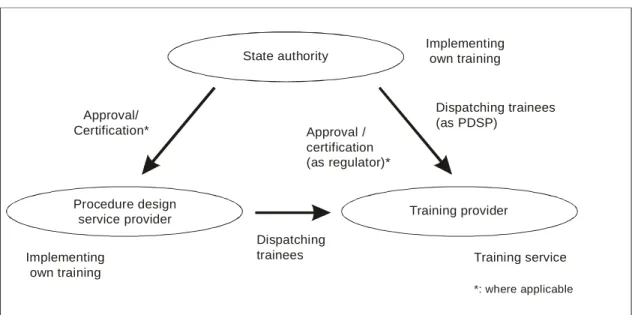
Figure 1-1. Relationships among State authority, procedure design service provider (PDSP) and training provider
1.2.2 State authority
1.2.2.1 As a regulator, a State authority can utilize the manual as a guideline to establish approval/certification criteria of a training course/programme conducted by PDSPs and training providers, where such systems are implemented.
1.2.2.2 The authority, if it designs procedures by itself, can use this manual as a guideline to establish its own training course/programme. Furthermore, if it dispatches its flight procedure designers to a training provider, it can use the manual as a guideline to evaluate potential courses. Refer to 1.3.2 and/or 1.3.3, as appropriate.
1.2.2.3 The authority can use the manual as a guideline to develop its own training course/programme if it provides training by itself. Refer to 1.5.
1.2.2.4 The manual can provide useful information for approval/certification/licensing criteria of flight procedure designers where such systems are implemented. However, ICAO regulations do not include provisions for such systems at present. Therefore it is beyond the scope of this manual to provide guidance for these systems.
1.2.3 Procedure Design Service Providers (PDSPs)
1.2.3.1 PDSPs who dispatch personnel to a training provider can utilize the manual as a guideline to evaluate potential courses.
1.2.3.2 PDSPs can also use the manual as a guideline to develop their own training courses/programmes. Refer to 1.5.
1.2.3.3 Note that any organization that designs flight procedures is considered a PDSP. For example, an airport operator that designs flight procedures for its own airport is a PDSP.
NB RA Approval/ Certification* Implementing own training Implementing own training State authority Training service *: where applicable Dispatching trainees Approval / certification (as regulator)* Dispatching trainees (as PDSP) Training provider Procedure design service provider
Chapter 1. Introduction 1-3
1.2.4 Training providers
Flight procedure design training providers can use the manual as a guideline to develop their training courses and programmes.
1.3 GOALS OF THE MANUAL
1.3.1 The primary and main goal of the manual is to provide guidance to organizations that are providing flight procedure designers training, particularly on developing, implementing and validating training.
1.3.2 A secondary goal of the manual is to provide guidance to regulators who certify and/or approve training courses and programmes, as well as organizations that dispatch trainees to training providers and who have to evaluate training courses and programmes.
1.3.3 Section 1.5 describes how to use the manual based on the goals described above.
1.4 STRUCTURE OF THE MANUAL
1.4.1 The manual consists of five chapters as described below:
1.4.1.1 Chapter 1, Introduction, provides introductory information on the manual: target audiences, goals, structure, and how to use the manual. It also includes a note on the use of automated tools in flight procedure design and its relation to training.
1.4.1.2 Chapter 2, General Provisions for Competency-based Training and Assessment, describes general concepts of a competency-based approach including how to conduct a job and task analysis so as to derive a competency framework, which is used as a basis to design a curriculum as described in Chapter 3. Chapter 2 also includes the competency framework for flight procedure designers. Also included is a sample evidence and assessment guide for one selected competency element.
1.4.1.3 Chapter 3, DesigningCurriculum, describes how to derive a curriculum from the competency framework. It should be noted that this method is applicable to all phases of training: ab initio training, initial training, recurrent training, refresher training, OJT advanced training, etc. This chapter also includes information on:
– how to determine prerequisites;
– how to develop tests applicable to the interim and/or final stage of training; and
– other considerations in designing modules and course materials.
1.4.1.4 Chapter 4, Instructor Competencies, describes competencies required for instructors of flight procedure designer training.
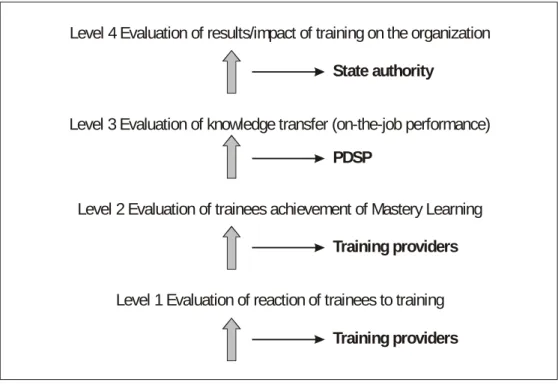
1.4.1.5 Chapter 5, Validating and Post-Training Evaluation of Flight Procedure Designer Training, describes how to implement training and how to evaluate training at the following levels:
– Level 1: evaluation of trainee reaction
1-4 The Quality Assurance Manual for Flight Procedure Design — Volume 2 – Level 3: evaluation of on-the-job performance
– Level 4: evaluation of results/impact on the organization.
1.4.2 Throughout the manual, examples are provided based on the VOR/NDB with a final approach fix (FAF) procedure. This particular procedure was selected as an example because it is commonly used and stable.
1.5 HOW TO USE THE MANUAL
1.5.1 This section outlines how different target audiences can use the manual depending on whether their purpose is in line with the primary or secondary goal outlined in 1.3.
1.5.2 Organizations providing flight procedure designer training (training providers)
1.5.2.1 Organizations providing flight procedure designer training, such as independent training providers and State authorities/PDSPs that provide training for their own procedure designers, can use the manual to:
– complete the job and task analysis with the competency framework as a starting point;
– develop training courses/programmes; and
– evaluate training courses/programmes.
1.5.2.2 Once job and task analysis is completed, training providers can apply the method described in Chapter 2. It should be noted that competency requirements for flight procedure designers can vary among States.
1.5.2.3 Developing a training course/programme includes several steps such as:
– determining prerequisites;
– determining training objectives (terminal objectives, enabling objectives, OJT objectives);
– organizing modules; and
– developing tests.
1.5.3 Regulators
1.5.3.1 Regulators that intend to approve/certify a training course or programme can use this manual as a part of their approval/certification of the training process. For instance, they can establish standards which state that: “The proposed training shall be developed, implemented and evaluated in accordance with a competency-based approach. Application of such an approach is described in the Flight Procedure Designer Training Manual (Doc 9906)”.
1.5.3.2 However, it should be noted that this use of the manual is not its primary goal.
1.5.4 Organizations that dispatch procedure designers to training providers
1.5.4.1 Organizations that dispatch procedure designers to training providers can evaluate the training course or programme by checking if the course/training has been developed using a competency-based approach as described in
Chapter 1. Introduction 1-5 this manual. The curriculum and material of well-developed training must adequately cover the competency elements in the procedure designer competency framework.
1.5.4.2 However, it should be noted that this use of the manual is not its primary goal.
1.6 USE OF AUTOMATION
1.6.1 Procedure design automated tools have the potential to greatly reduce errors, save time and provide for standardized application of criteria. For this reason, States are encouraged to use software packages to design instrument flight procedures.
1.6.2 It should be emphasized, however, that the use of automated tools (whether a hand calculator, a spreadsheet or fully automated software) does not waive the requirement for the designer to meet the competency standards as set out in the competency framework. Procedure design tools can sometimes have spurious results, especially after revisions in code, database updates or simply the proverbial “garbage in – garbage out” scenario. It must be emphasized that automated design tools provide assistance to the designer but that the designer must at all times be vigilant of the automated results. It is the designer who is ultimately responsible for the validity of the procedure design regardless whether it is produced manually or by software. Moreover, it is the designer’s responsibility to ensure that all stakeholder requirements are met within the design. For these reasons, procedure designers must maintain high competency in criteria application and an awareness of the “big picture” results of any design.
2-1
Chapter 2
GENERAL PROVISIONS FOR COMPETENCY-BASED TRAINING
AND ASSESSMENT
2.1 INTRODUCTION
This chapter outlines, in a general manner, the principles and procedures to be followed in the design and implementation of a competency-based approach to training and assessment. It outlines its key features and briefly describes how the competency-based approach is to be used by course developers, instructors and examiners, where applicable. This chapter provides the requirements with which training providers and licensing authorities should comply in order to implement competency-based training and assessment.
2.2 COMPETENCY-BASED APPROACH TO TRAINING AND ASSESSMENT
2.2.1 The development of competency-based training and assessment must be based on a systematic approach whereby competencies and their standards are defined; training is based on the competencies identified and assessments are developed to determine whether these competencies have been achieved. Competency-based approaches include mastery learning, performance-based training, criterion-referenced training and instructional systems design.
2.2.2 Competency-based approaches to training and assessment must include at least the following features:
a) the justification of a training need through a systematic analysis and the identification of indicators for evaluation;
b) the use of a job and task analysis to determine performance standards, the conditions under which the job is carried out, the criticality of tasks, and the inventory of skills, knowledge and attitudes;
c) the identification of the characteristics of the trainee population;
d) the derivation of training objectives from the task analysis and their formulation in an observable and measurable fashion;
e) the development of criterion-referenced, valid, reliable and performance-oriented tests;
f) the development of a curriculum based on adult learning principles, with a view to achieving an optimal path to the attainment of competencies;
g) the development of material-dependent training; and
h) the use of a continuous evaluation process to ensure the effectiveness of training and its relevance to line operations.
2-2 The Quality Assurance Manual for Flight Procedure Design — Volume 2 Note.— A detailed description of the ICAO course development methodology, a competency-based approach to training and assessment, and an example of an instructional system design (ISD) methodology can be found in the Procedures for Air Navigation — Training (PANS-TRG, Doc 9868), Attachment to Chapter 2.
According to PANS-TRG, the course development methodology comprises nine phases which can be subdivided in three broad categories of analysis, design and production, and evaluation.
Analysisis covered through: Phase 1 – Preliminary study Phase 2 – Job analysis Phase 3 – Population analysis
Design and Production is covered in: Phase 4 – Design of curriculum Phase 5 – Design of modules Phase 6 – Production
Evaluation is covered by:
Phase 7 – Validation and revision Phase 8 – Implementation
Phase 9 – Post-training evaluation.
A brief description of the specific outputs of the nine phases is summarized in the following table.
Category Phases Outputs
Phase 1 – Preliminary study Training proposals, their justification and proposed course of action.
Phase 2 – Job analysis Task description and performance standards. Analysis
Phase 3 – Population analysis Trainees’ characteristics and their existing skills and knowledge.
Phase 4 – Design of curriculum Training objectives, mastery tests and sequence of modules.
Phase 5 – Design of modules Mode of delivery, training techniques and media, draft training material.
Design and Production
Phase 6 – Production Production of all trainee materials. Phase 7 – Validation and
revision
Try-out of course and revision as required.
Phase 8 – Implementation Human resources trained. Evaluation
Phase 9 – Post-training evaluation
Evaluation of training effectiveness; plans for remedial action.
2.2.3 Aviation authorities should develop general requirements concerning the management of their examiners and provide guidance on:
a) the selection of examiners and description of competency-based assessment training;
Chapter 2. General provisions for competency-based training and assessment 2-3 c) the tolerances applicable to all competency-based tests.
2.3 THE COMPETENCY FRAMEWORK
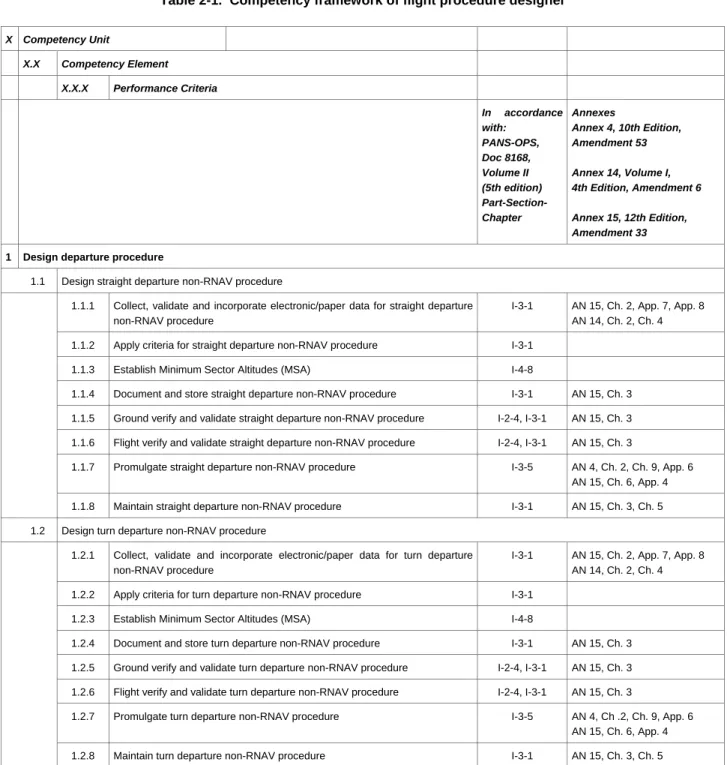
2.3.1 The competency framework consists of competency units, competency elements, performance criteria, evidence and assessment guide, and range of variables. The competency framework for procedure designers must be based on the following competency units:
1. Design departure procedure
2. Design en-route procedure
3. Design arrival route procedure
4. Design approach procedure
5. Design reversal and holding procedures
6. Review instrument flight procedures.
2.3.2 Competency units, competency elements and performance criteria must be derived from job and task analyses of procedure designers and describe observable outcomes.
Note.— Definitions of competency units, competency elements and performance criteria are provided in the Definitions section.
2.3.3 The competency framework is as indicated in Table 2-1. A Sample Evidence and Assessment Guide for Competency Element 4.1 “Design a VOR or NDB FAF Procedure” is also indicated in Attachment A to this chapter.
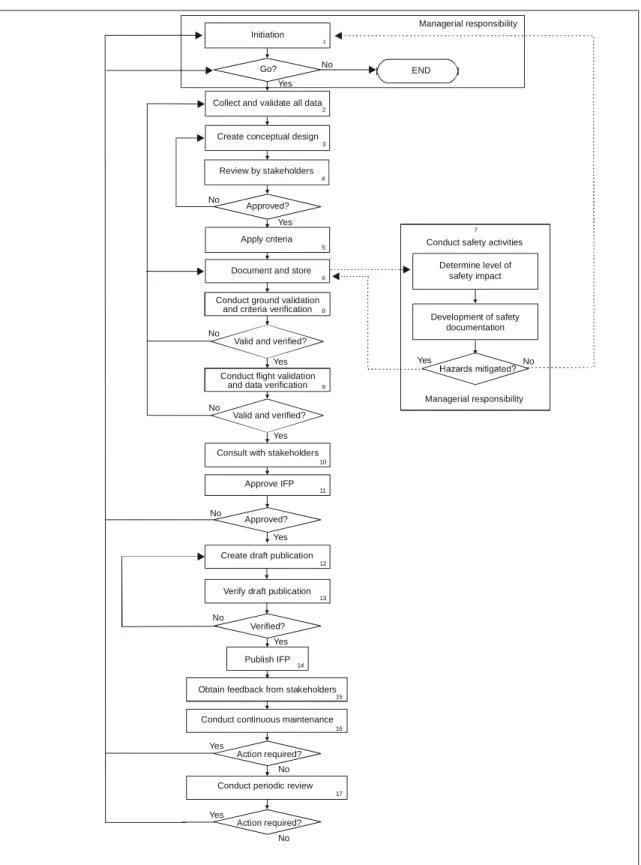
2.3.4 The procedure design process flow diagram indicating work flow and items by the procedure designer is also provided in Attachment B to this chapter. In general, work items in the diagram correspond to some competency elements in the competency framework. However, they are not identical. For instance, one single competency element is applicable to multiple work steps.
2.3.5 The performance criteria make use of action verbs. Below are additional explanations concerning these:
Apply criteria.Applying criteria is the action of defining and assessing areas of airspace intended for use as an aircraft flight path, length of segment, angle of turn, etc., in accordance with State-approved instrument procedure design criteria.
Collect. The action of bringing together, collating, assembling, editing and formatting from recognized sources data required for the development of an instrument procedure design.
Incorporate. As in to incorporate electronic and/or paper data into a procedure design file, to create congruency with other design data.
Plot. The action of determining, positioning and drawing over top of terrain, aeronautical, aerodrome and obstacle data the optimal flight path of a procedure design, its associated fixes, assessment airspace, assessment surfaces and minimum safe altitudes.
2-4 The Quality Assurance Manual for Flight Procedure Design — Volume 2 Promulgate. The action of submitting to a State authority, an instrument procedure design package for
distribution to the international aviation community via the State-published Aeronautical Information Regulation and Control (AIRAC) document.
Originate. The process of creating a data element or amending the value of an existing data element.
Table 2-1. Competency framework of flight procedure designer
X Competency Unit X.X Competency Element X.X.X Performance Criteria In accordance with: PANS-OPS, Doc 8168, Volume II (5th edition) Part-Section-Chapter Annexes Annex 4, 10th Edition, Amendment 53 Annex 14, Volume I, 4th Edition, Amendment 6 Annex 15, 12th Edition, Amendment 33
1 Design departure procedure
1.1 Design straight departure non-RNAV procedure
1.1.1 Collect, validate and incorporate electronic/paper data for straight departure non-RNAV procedure
I-3-1 AN 15, Ch. 2, App. 7, App. 8 AN 14, Ch. 2, Ch. 4 1.1.2 Apply criteria for straight departure non-RNAV procedure I-3-1
1.1.3 Establish Minimum Sector Altitudes (MSA) I-4-8
1.1.4 Document and store straight departure non-RNAV procedure I-3-1 AN 15, Ch. 3 1.1.5 Ground verify and validate straight departure non-RNAV procedure I-2-4, I-3-1 AN 15, Ch. 3 1.1.6 Flight verify and validate straight departure non-RNAV procedure I-2-4, I-3-1 AN 15, Ch. 3
1.1.7 Promulgate straight departure non-RNAV procedure I-3-5 AN 4, Ch. 2, Ch. 9, App. 6 AN 15, Ch. 6, App. 4 1.1.8 Maintain straight departure non-RNAV procedure I-3-1 AN 15, Ch. 3, Ch. 5 1.2 Design turn departure non-RNAV procedure
1.2.1 Collect, validate and incorporate electronic/paper data for turn departure non-RNAV procedure
I-3-1 AN 15, Ch. 2, App. 7, App. 8 AN 14, Ch. 2, Ch. 4 1.2.2 Apply criteria for turn departure non-RNAV procedure I-3-1
1.2.3 Establish Minimum Sector Altitudes (MSA) I-4-8
1.2.4 Document and store turn departure non-RNAV procedure I-3-1 AN 15, Ch. 3 1.2.5 Ground verify and validate turn departure non-RNAV procedure I-2-4, I-3-1 AN 15, Ch. 3 1.2.6 Flight verify and validate turn departure non-RNAV procedure I-2-4, I-3-1 AN 15, Ch. 3
1.2.7 Promulgate turn departure non-RNAV procedure I-3-5 AN 4, Ch .2, Ch. 9, App. 6 AN 15, Ch. 6, App. 4 1.2.8 Maintain turn departure non-RNAV procedure I-3-1 AN 15, Ch. 3, Ch. 5
Chapter 2. General provisions for competency-based training and assessment 2-5 X Competency Unit X.X Competency Element X.X.X Performance Criteria In accordance with: PANS-OPS, Doc 8168, Volume II (5th edition) Part-Section-Chapter Annexes Annex 4, 10th Edition, Amendment 53 Annex 14, Volume I, 4th Edition, Amendment 6 Annex 15, 12th Edition, Amendment 33
1.3 Design omnidirectional departure non-RNAV procedure
1.3.1 Collect, validate and incorporate electronic/paper data for omnidirectional departure non-RNAV procedure
I-3-4 AN 15, Ch. 2, App. 7, App. 8 AN 14, Ch. 2, Ch. 4 1.3.2 Apply criteria for omnidirectional departure non-RNAV procedure I-3-4
1.3.3 Establish Minimum Sector Altitudes (MSA) I-4-8
1.3.4 Document and store omnidirectional departure non-RNAV procedure I-3-4 AN 15, Ch. 3 1.3.5 Ground verify and validate omnidirectional departure non-RNAV procedure I-2-4, I-3-4 AN 15, Ch. 3 1.3.6 Flight verify and validate omnidirectional departure non-RNAV procedure I-2-4, I-3-4 AN 15, Ch. 3
1.3.7 Promulgate omnidirectional departure non-RNAV procedure I-3-5 AN 4, Ch .2, Ch. 9, App. 6 AN 15, Ch. 6, App. 4 1.3.8 Maintain omnidirectional departure non-RNAV procedure I-3-4 AN 15, Ch. 3, Ch. 5 1.4 Design straight departure RNAV/RNP procedure
1.4.1 Collect, validate and incorporate electronic/paper data for straight departure RNAV/RNP procedure
III-3-1 AN 15, Ch. 2, App. 7, App. 8 AN 14, Ch. 2, Ch. 4 1.4.2 Apply criteria for straight departure RNAV/RNP procedure III-3-1
1.4.3 Establish Minimum Sector Altitudes (MSA) I-4-8
1.4.4 Document and store straight departure RNAV/RNP procedure III-3-1 AN 15, Ch. 3 1.4.5 Ground verify and validate straight departure RNAV/RNP procedure I-2-4, III-3-1 AN 15, Ch. 3 1.4.6 Flight verify and validate straight departure RNAV/RNP procedure I-2-4, III-3-1 AN 15, Ch. 3 1.4.7 Promulgate straight departure RNAV/RNP procedure I-3-5,
III-5-1
AN 4, Ch .2, Ch. 9, App. 6 AN 15, Ch. 6, App. 4 1.4.8 Maintain straight departure RNAV/RNP procedure III-3-1 AN 15, Ch. 3, Ch. 5 1.5 Design turn departure RNAV/RNP procedure
1.5.1 Collect, validate and incorporate electronic/paper data for turn departure RNAV/RNP procedure
III-3-1 AN 15, Ch. 2, App. 7, App. 8 AN 14, Ch. 2, Ch. 4 1.5.2 Apply criteria for turn departure RNAV/RNP procedure III-3-1
1.5.3 Establish Minimum Sector Altitudes (MSA) I-4-8
1.5.4 Document and store turn departure RNAV/RNP procedure III-3-1 AN 15, Ch. 3 1.5.5 Ground verify and validate turn departure RNAV/RNP procedure I-2-4, III-3-1 AN 15, Ch. 3 1.5.6 Flight verify and validate turn departure RNAV/RNP procedure I-2-4, III-3-1 AN 15, Ch. 3 1.5.7 Promulgate turn departure RNAV/RNP procedure III-3-5,
III-5-1
AN 4, Ch .2, Ch. 9, App. 6 AN 15, Ch. 6, App. 4
2-6 The Quality Assurance Manual for Flight Procedure Design — Volume 2 X Competency Unit X.X Competency Element X.X.X Performance Criteria In accordance with: PANS-OPS, Doc 8168, Volume II (5th edition) Part-Section-Chapter Annexes Annex 4, 10th Edition, Amendment 53 Annex 14, Volume I, 4th Edition, Amendment 6 Annex 15, 12th Edition, Amendment 33
1.5.8 Maintain turn departure RNAV/RNP procedure III-3-1 AN 15, Ch. 3, Ch. 5 1.6 Design omnidirectional departure RNAV procedure
1.6.1 Collect, validate and incorporate electronic/paper data for omnidirectional departure RNAV procedure
I-3-4 AN 15, Ch. 2, App.7 App.8 AN 14, Ch. 2, Ch. 4 1.6.2 Apply criteria for omnidirectional departure RNAV procedure I-3-4
1.6.3 Establish Minimum Sector Altitudes (MSA) I-4-8
1.6.4 Document and store omnidirectional departure RNAV procedure I-3-4 AN 15, Ch. 3 1.6.5 Ground verify and validate omnidirectional departure RNAV procedure I-2-4, I-3-4 AN 15, Ch. 3 1.6.6 Flight verify and validate omnidirectional departure RNAV procedure I-2-4, I-3-4 AN 15, Ch. 3 1.6.7 Promulgate omnidirectional departure RNAV procedure I-3-4,
III-5-1
AN 4, Ch. 2, Ch. 9, App. 6 AN 15, Ch. 6, App. 4 1.6.8 Maintain omnidirectional departure RNAV procedure I-3-4 AN 15, Ch. 3, Ch. 5 1.7 Design simultaneous operations on parallel instrument runways departure procedure
1.7.1 Collect, validate and incorporate electronic/paper data for simultaneous operations on parallel instrument runways departure procedure
I-3-3,6 AN 15, Ch. 2, App. 7, App. 8 AN 14, Ch. 2, Ch. 4 1.7.2 Apply criteria for simultaneous operations on parallel instrument runways
departure procedure
I-3-3,6
1.7.3 Establish Minimum Sector Altitudes (MSA) I-4-8
1.7.4 Document and store simultaneous operations on parallel instrument runways departure procedure
I-3-3,6 AN 15, Ch. 3 1.7.5 Ground verify and validate simultaneous operations on parallel instrument
runways departure procedure
I-2-4 I-3-3,6
AN 15, Ch. 3 1.7.6 Flight verify and validate simultaneous operations on parallel instrument
runways departure procedure
I-2-4 I-3-3,6
AN 15, Ch. 3 1.7.7 Promulgate simultaneous operations on parallel instrument runways
departure procedure
I-3-5 AN 4, Ch. 2, Ch. 9, App. 6 AN 15, Ch. 6, App. 4 1.7.8 Maintain simultaneous operations on parallel instrument runways departure
procedure
I-3-3,6 AN 15, Ch. 3, Ch. 5 1.8 Design simultaneous operations on near parallel instrument runways departure procedure
1.8.1 Collect, validate and incorporate electronic/paper data for simultaneous operations on near parallel instrument runways departure procedure
I-3-3,6 AN 15, Ch. 2, App. 7, App. 8 AN 14, Ch. 2, Ch. 4 1.8.2 Apply criteria for simultaneous operations on near parallel instrument
runways departure procedure
I-3-3,6
Chapter 2. General provisions for competency-based training and assessment 2-7 X Competency Unit X.X Competency Element X.X.X Performance Criteria In accordance with: PANS-OPS, Doc 8168, Volume II (5th edition) Part-Section-Chapter Annexes Annex 4, 10th Edition, Amendment 53 Annex 14, Volume I, 4th Edition, Amendment 6 Annex 15, 12th Edition, Amendment 33
1.8.4 Document and store simultaneous operations on near parallel instrument runways departure procedure
I-3-3,6 AN 15, Ch. 3 1.8.5 Ground verify and validate simultaneous operations on near parallel
instrument runways departure procedure
I-2-4 I-3-3,6
AN 15, Ch. 3 1.8.6 Flight verify and validate simultaneous operations on near parallel instrument
runways departure procedure
I-2-4 I-3-3,6
AN 15, Ch. 3 1.8.7 Promulgate simultaneous operations on near parallel instrument runways
departure procedure
I-3-5 AN 4, Ch. 2, Ch. 9, App. 6 AN 15, Ch. 6, App. 4 1.8.8 Maintain simultaneous operations on near parallel instrument runways
departure procedure
I-3-3,6 AN 15, Ch. 3, Ch. 5
2 Design en route procedure
2.1 Design en route RNAV/RNP procedure
2.1.1 Collect, validate and incorporate electronic/paper data for en route RNAV/RNP procedure
II-3-1 AN 15, Ch. 2, App. 7, App. 8 AN 14, Ch. 2, Ch. 4 2.1.2 Apply criteria for en route RNAV/RNP procedure II-3-1
2.1.3 Document and store en route RNAV/RNP procedure II-3-1 AN 15, Ch. 3 2.1.4 Ground verify and validate en route RNAV/RNP procedure I-2-4, II-3-1 AN 15, Ch. 3 2.1.5 Flight verify and validate en route RNAV/RNP procedure I-2-4, II-3-1 AN 15, Ch. 3
2.1.6 Promulgate en route RNAV/RNP procedure II-3-1 AN 4, Ch. 2, Ch. 7, App. 6 AN 15, Ch. 6, App.4 2.1.7 Conduct continuous maintenance of en route RNAV/RNP procedure II-3-1 AN 15, Ch. 3, Ch. 5 2.2 Design en route non-RNAV/RNP procedure
2.2.1 Collect, validate and incorporate electronic/paper data for en route non-RNAV/RNP procedure
III-3-8 AN 15, Ch. 2, App. 7, App. 8 AN 14, Ch. 2, Ch. 4 2.2.2 Apply criteria for en route non-RNAV/RNP procedure III-3-8
2.2.3 Document and store en route non-RNAV/RNP procedure III-3-8 AN 15, Ch. 3 2.2.4 Ground verify and validate en route non-RNAV/RNP procedure I-2-4, III-3-8 AN 15, Ch. 3 2.2.5 Flight verify and validate en route non-RNAV/RNP procedure I-2-4, III-3-8 AN 15, Ch. 3
2.2.6 Promulgate en route non-RNAV/RNP procedure III-3-8 AN 4, Ch. 2, Ch. 7, App. 6 2.2.7 Maintain en route non-RNAV/RNP procedure III-3-8 AN 15, Ch. 3, Ch. 5
2-8 The Quality Assurance Manual for Flight Procedure Design — Volume 2 X Competency Unit X.X Competency Element X.X.X Performance Criteria In accordance with: PANS-OPS, Doc 8168, Volume II (5th edition) Part-Section-Chapter Annexes Annex 4, 10th Edition, Amendment 53 Annex 14, Volume I, 4th Edition, Amendment 6 Annex 15, 12th Edition, Amendment 33
3 Design arrival route
3.1 Design non-RNAV standard instrument arrival procedure
3.1.1 Collect, validate and incorporate electronic/paper data for non-RNAV standard instrument arrival procedure
I-4-1 AN 15, Ch. 2, App. 7, App. 8 AN 14, Ch. 2, Ch. 4 3.1.2 Apply criteria for non-RNAV standard instrument arrival procedure I-4-1
3.1.3 Establish Minimum Sector Altitudes (MSA) I-4-8
3.1.4 Document and store non-RNAV standard instrument arrival procedure I-4-1 AN 15, Ch. 3 3.1.5 Ground verify and validate non-RNAV standard instrument arrival procedure I-2-4, I-4-1 AN 15, Ch. 3 3.1.6 Flight verify and validate non-RNAV standard instrument arrival procedure I-2-4, I-4-1 AN 15, Ch. 3
3.1.7 Promulgate non-RNAV standard instrument arrival procedure I-4-9 AN 4, Ch. 2, Ch. 10, App. 6 AN 15, Ch. 6, App. 4 3.1.8 Maintain non-RNAV standard instrument arrival procedure I-4-1 AN 15, Ch. 3, Ch. 5 3.2 Design RNAV/RNP standard instrument arrival procedure
3.2.1 Collect, validate and incorporate electronic/paper data for RNAV/RNP standard instrument arrival procedure
III-3-2 AN 15, Ch. 2, App. 7, App. 8 AN 14, Ch. 2, Ch. 4 3.2.2 Apply criteria for RNAV/RNP standard instrument arrival procedure III-3-2
3.2.3 Establish Minimum Sector Altitudes (MSA) I-4-8
3.2.4 Document and store RNAV/RNP standard instrument arrival procedure III-3-2 AN 15, Ch. 3 3.2.5 Ground verify and validate RNAV/RNP standard instrument arrival procedure I-2-4, III-3-2 AN 15, Ch. 3 3.2.6 Flight verify and validate RNAV/RNP standard instrument arrival procedure I-2-4, III-3-2 AN 15, Ch. 3 3.2.7 Promulgate RNAV/RNP standard instrument arrival procedure I-4-9,
III-2-4, III-5-1
AN 4, Ch. 2, Ch. 10, App. 6 AN 15, Ch. 6, App. 4 3.2.8 Maintain RNAV/RNP standard instrument arrival procedure III-3-2 AN 15, Ch. 3, Ch. 5 3.3 Design non-RNAV omnidirectional arrival procedure
3.3.1 Collect, validate and incorporate electronic/paper data for non-RNAV omnidirectional arrival procedure
I-4-3 AN 15, Ch. 2, App. 7, App. 8 AN 14, Ch. 2, Ch. 4 3.3.2 Apply criteria for non-RNAV omnidirectional arrival procedure I-4-3
3.3.3 Establish Minimum Sector Altitudes (MSA) I-4-8
3.3.4 Document and store non-RNAV omnidirectional arrival procedure I-4-3 AN 15, Ch. 3 3.3.5 Ground verify and validate non-RNAV omnidirectional arrival procedure I-2-4, I-4-3 AN 15, Ch. 3 3.3.6 Flight verify and validate non-RNAV omnidirectional arrival procedure I-2-4, I-4-3 AN 15, Ch. 3
Chapter 2. General provisions for competency-based training and assessment 2-9 X Competency Unit X.X Competency Element X.X.X Performance Criteria In accordance with: PANS-OPS, Doc 8168, Volume II (5th edition) Part-Section-Chapter Annexes Annex 4, 10th Edition, Amendment 53 Annex 14, Volume I, 4th Edition, Amendment 6 Annex 15, 12th Edition, Amendment 33
3.3.7 Promulgate non-RNAV omnidirectional arrival procedure I-4-9 AN 4, Ch. 2, Ch. 10, App. 6 AN 15, Ch. 6, App. 4 3.3.8 Maintain non-RNAV omnidirectional arrival procedure I-4-3 AN 15, Ch. 3, Ch. 5 3.4 Design RNAV/RNP omnidirectional arrival procedure
3.4.1 Collect, validate and incorporate electronic/paper data for RNAV/RNP omnidirectional arrival procedure
I-4-3 AN 15, Ch. 2, App. 7, App. 8 AN 14, Ch. 2, Ch. 4 3.4.2 Apply criteria for RNAV/RNP omnidirectional arrival procedure I-4-3
3.4.3 Establish Minimum Sector Altitudes (MSA) I-4-8
3.4.4 Document and store RNAV/RNP omnidirectional arrival procedure I-4-3 AN 15, Ch. 3 3.4.5 Ground verify and validate RNAV/RNP omnidirectional arrival procedure I-2-4, I-4-3 AN 15, Ch. 3 3.4.6 Flight verify and validate RNAV/RNP omnidirectional arrival procedure I-2-4, I-4-3 AN 15, Ch. 3 3.4.7 Promulgate RNAV/RNP omnidirectional arrival procedure I-4-9
III-2-4 III-5-1
AN 4, Ch. 2, Ch. 10, App. 6 AN 15, Ch. 6, App. 4 3.4.8 Maintain RNAV/RNP omnidirectional arrival procedure I-4-3 AN 15, Ch. 3, Ch. 5
4 Design approach procedure
4.1 Design VOR or NDB FAF procedure
4.1.1 Collect, validate and incorporate electronic/paper data for VOR or NDB FAF procedure
II-2-4 AN 15, Ch. 2, App. 7, App. 8 AN 14, Ch. 2, Ch. 4 4.1.2 Apply criteria for VOR or NDB FAF procedure II-2-4
4.1.3 Establish Minimum Sector Altitudes (MSA) I-4-8
4.1.4 Document and store VOR or NDB FAF procedure II-2-4 AN 15, Ch. 3 4.1.5 Ground verify and validate VOR or NDB FAF procedure I-2-4, II-2-4 AN 15, Ch. 3 4.1.6 Flight verify and validate VOR or NDB FAF procedure I-2-4, II-2-4 AN 15, Ch. 3
4.1.7 Promulgate VOR or NDB FAF procedure II-2-4 AN 4, Ch. 2, Ch. 11, App. 6 AN 15, Ch. 6, App. 4
4.1.8 Maintain VOR or NDB FAF procedure II-2-4 AN 15, Ch. 3, Ch. 5
4.2 Design VOR/NDB no-FAF procedure
4.2.1 Collect, validate and incorporate electronic/paper data for VOR/NDB no-FAF procedure
II-2-3 AN 15, Ch. 2, App. 7, App. 8 AN 14, Ch. 2, Ch. 4 4.2.2 Apply criteria for VOR/NDB no-FAF procedure II-2-3
2-10 The Quality Assurance Manual for Flight Procedure Design — Volume 2 X Competency Unit X.X Competency Element X.X.X Performance Criteria In accordance with: PANS-OPS, Doc 8168, Volume II (5th edition) Part-Section-Chapter Annexes Annex 4, 10th Edition, Amendment 53 Annex 14, Volume I, 4th Edition, Amendment 6 Annex 15, 12th Edition, Amendment 33
4.2.4 Document and store VOR/NDB no-FAF procedure II-2-3 AN 15, Ch. 3 4.2.5 Ground verify and validate VOR/NDB no-FAF procedure I-2-4, II-2-3 AN 15, Ch. 3 4.2.6 Flight verify and validate VOR/NDB no-FAF procedure I-2-4, II-2-3 AN 15, Ch. 3
4.2.7 Promulgate VOR/NDB no-FAF procedure II-2-3 AN 4, Ch. 2, Ch. 11, App. 6 AN 15, Ch. 6, App. 4
4.2.8 Maintain VOR/NDB no-FAF procedure II-2-3 AN 15, Ch. 3, Ch. 5
4.3 Design SRE procedure
4.3.1 Collect, validate and incorporate electronic/paper data SRE procedure II-2-6 AN 15, Ch. 2, App. 7, App. 8 AN 14, Ch. 2, Ch. 4
4.3.2 Apply criteria for SRE procedure II-2-6
4.3.3 Establish Minimum Sector Altitudes (MSA) I-4-8
4.3.4 Document and store SRE procedure II-2-6 AN 15, Ch. 3
4.3.5 Ground verify and validate SRE procedure I-2-4, II-2-6 AN 15, Ch. 3 4.3.6 Flight verify and validate SRE procedure I-2-4, II-2-6 AN 15, Ch. 3
4.3.7 Promulgate SRE procedure AN 4, Ch. 2, Ch. 11, App. 6
4.3.8 Maintain SRE procedure II-2-6 AN 15, Ch. 3, Ch. 5
4.4 Design DF procedure
4.4.1 Collect, validate and incorporate electronic/paper data DF procedure II-2-5 AN 15, Ch. 2, App. 7, App. 8 AN 14, Ch. 2, Ch. 4
4.4.2 Apply criteria for DF procedure II-2-5
4.4.3 Establish Minimum Sector Altitudes (MSA) I-4-8
4.4.4 Document and store DF procedure II-2-5 AN 15, Ch. 3
4.4.5 Ground verify and validate DF procedure I-2-4, II-2-5 AN 15, Ch. 3 4.4.6 Flight verify and validate DF procedure I-2-4, II-2-5 AN 15, Ch. 3
4.4.7 Promulgate DF procedure II-2-5 AN 4, Ch. 2, Ch. 11, App. 6
AN 15, Ch. 6, App. 4
4.4.8 Maintain DF procedure II-2-5 AN 15, Ch. 3, Ch. 5
4.5 Design visual manoeuvring
4.5.1 Collect and validate electronic/paper data visual manoeuvring I-4-7 AN 15, Ch. 2, App. 7, App. 8 AN 14, Ch. 2, Ch. 4
4.5.2 Apply criteria for visual manoeuvring I-4-7
Chapter 2. General provisions for competency-based training and assessment 2-11 X Competency Unit X.X Competency Element X.X.X Performance Criteria In accordance with: PANS-OPS, Doc 8168, Volume II (5th edition) Part-Section-Chapter Annexes Annex 4, 10th Edition, Amendment 53 Annex 14, Volume I, 4th Edition, Amendment 6 Annex 15, 12th Edition, Amendment 33
4.5.4 Ground verify and validate visual manoeuvring I-2-4, I-4-7 AN 15, Ch. 3 4.5.5 Flight verify and validate visual manoeuvring I-2-4, I-4-7 AN 15, Ch. 3
4.5.6 Promulgate visual manoeuvring I-4-7 Appendix AN 4, Ch. 2, Ch. 11, App. 6 AN 15, Ch. 6, App. 4
4.5.7 Maintain visual manoeuvring I-4-7 AN 15, Ch. 3, Ch. 5
4.6 Design visual manoeuvring with prescribed track
4.6.1 Collect and validate electronic/paper data for visual manoeuvring with prescribed track
I-4-7 Appendix AN 15, Ch. 2, App. 7, App. 8 AN 14, Ch. 2, Ch. 4 4.6.2 Apply criteria for visual manoeuvring with prescribed track I-4-7 Appendix
4.6.3 Establish Minimum Sector Altitudes (MSA) I-4-8
4.6.4 Document and store visual manoeuvring with prescribed track I-4-7 Appendix AN 15, Ch. 3 4.6.5 Ground verify and validate visual manoeuvring with prescribed track I-2-4
I-4-7 Appendix
AN 15, Ch. 3 4.6.6 Flight verify and validate visual manoeuvring with prescribed track I-2-4
I-4-7 Appendix
AN 15, Ch. 3
4.6.7 Promulgate visual manoeuvring with prescribed track I-4-7 Appendix AN 4, Ch. 2, Ch. 11, App. 6 AN 15, Ch. 6, App. 4 4.6.8 Maintain visual manoeuvring with prescribed track I-4-7 Appendix AN 15, Ch. 3, Ch. 5 4.7 Design RNAV DME/DME procedure (stations prior 1 January 1989)
4.7.1 Collect and validate electronic/paper data for RNAV DME/DME procedure III-1-3 AN 15, Ch. 2, App. 7, App. 8 AN 14, Ch. 2, Ch. 4 4.7.2 Apply criteria for RNAV DME/DME procedure III-1-3
III-3-2 and 3 4.7.3 Establish Minimum Sector Altitudes (MSA, if applicable) I-4-8 4.7.4 Apply the T/Y-Bar concept (if applicable) III-2-3 4.7.5 Establish Terminal Arrival Altitudes (TAA, if applicable) III-2-4 4.7.6 Document and store RNAV DME/DME procedure III-1-3
III-3-2 and 3
AN 15, Ch. 3 4.7.7 Ground verify and validate RNAV DME/DME procedure I-2-4
III-1-3 III-3-2 and 3
AN 15, Ch. 3
4.7.8 Flight verify and validate RNAV DME/DME procedure I-2-4 III-1-3 III-3-2 and 3
2-12 The Quality Assurance Manual for Flight Procedure Design — Volume 2 X Competency Unit X.X Competency Element X.X.X Performance Criteria In accordance with: PANS-OPS, Doc 8168, Volume II (5th edition) Part-Section-Chapter Annexes Annex 4, 10th Edition, Amendment 53 Annex 14, Volume I, 4th Edition, Amendment 6 Annex 15, 12th Edition, Amendment 33
4.7.9 Promulgate RNAV DME/DME procedure III-1-3
III-5-1
AN 4, Ch. 2, Ch. 11, App. 6 AN 15, Ch. 6, App. 4 4.7.10 Maintain RNAV DME/DME procedure (stations prior 1 January 1989) III-1-3
III-3-2 and 4
AN 15, Ch. 3, Ch. 5 4.8 Design RNAV DME/DME procedure (stations post 1 January 1989)
4.8.1 Collect and validate electronic/paper data for RNAV DME/DME procedure III-1-3 AN 15, Ch. 2, App.7 App.8 AN 14, Ch. 2, Ch. 4 4.8.2 Apply criteria for RNAV DME/DME procedure III-1-3
III-3-2 and 3 4.8.3 Establish Minimum Sector Altitudes (MSA, if applicable) I-4-8 4.8.4 Apply the T/Y-Bar concept (if applicable) III-2-3 4.8.5 Establish Terminal Arrival Altitudes (TAA, if applicable) III-2-4 4.8.6 Document and store RNAV DME/DME procedure III-1-3
III-3-2 and 3
AN 15, Ch. 3 4.8.7 Ground verify and validate RNAV DME/DME procedure I-2-4
III-1-3 III-3-2 and 3
AN 15, Ch. 3
4.8.8 Flight verify and validate RNAV DME/DME procedure I-2-4 III-1-3 III-3-2 and 3
AN 15, Ch. 3
4.8.9 Promulgate RNAV DME/DME procedure III-1-3
III-5-1
AN 4, Ch. 2, Ch. 11, App. 6 AN 15, Ch. 6, App. 4 4.8.10 Maintain RNAV DME/DME procedure (stations post 1 January 1989) III-1-3
III-3-2 and 4
AN 15, Ch. 3, Ch. 5 4.9 Design RNP approach (RNP APCH) procedure
4.9.1 Collect and validate electronic/paper data for RNP approach (RNP APCH) procedure
III-1-2 AN 15, Ch. 2, App. 7, App. 8 AN 14, Ch. 2, Ch. 4 4.9.2 Apply criteria for RNP approach (RNP APCH) procedure III-1-2
III-3-2 and 3 4.9.3 Establish Minimum Sector Altitudes (MSA, if applicable) I-4-8 4.9.4 Apply the T/Y-Bar concept (if applicable) III-2-3 4.9.5 Establish Terminal Arrival Altitudes (TAA, if applicable) III-2-4 4.9.6 Document and store RNP approach (RNP APCH) procedure III-1-2
III-3-2 and 3
Chapter 2. General provisions for competency-based training and assessment 2-13 X Competency Unit X.X Competency Element X.X.X Performance Criteria In accordance with: PANS-OPS, Doc 8168, Volume II (5th edition) Part-Section-Chapter Annexes Annex 4, 10th Edition, Amendment 53 Annex 14, Volume I, 4th Edition, Amendment 6 Annex 15, 12th Edition, Amendment 33
4.9.7 Ground verify and validate RNP approach (RNP APCH) procedure I-2-4 III-1-2 III-3-2 and 3
AN 15, Ch. 3
4.9.8 Flight verify and validate RNP approach (RNP APCH) procedure I-2-4 III-1-2 III-3-2 and 3
AN 15, Ch. 3
4.9.9 Promulgate RNP approach (RNP APCH) procedure III-1-2 III-5-1
AN 4, Ch. 2, Ch. 11, App. 6 AN 15, Ch. 6, App. 4 4.9.10 Maintain RNP approach (RNP APCH) procedure III-1-2
III-3-2 and 4
AN 15, Ch. 3, Ch. 5 4.10 Design RNP procedure
4.10.1 Collect and validate electronic/paper data for RNP procedure III-1-7 AN 15, Ch. 2, App. 7, App. 8 AN 14, Ch. 2, Ch. 4
4.10.2 Apply criteria for RNP procedure III-1-7
III-3-2 and 3 4.10.3 Establish Minimum Sector Altitudes (MSA, if applicable) I-4-8 4.10.4 Apply the T/Y-Bar concept (if applicable) III-2-3 4.10.5 Establish Terminal Arrival Altitudes (TAA, if applicable) III-2-4
4.10.6 Document and store RNP procedure III-1-7
III-3-2 and 3
AN 15, Ch. 3
4.10.7 Ground verify and validate RNP procedure I-2-4
III-1-7 III-3-2 and 3
AN 15, Ch. 3
4.10.8 Flight verify and validate RNP procedure I-2-4
III-1-7 III-3-2 and 3
AN 15, Ch. 3
4.10.9 Promulgate RNP procedure III-1-7
III-3-2 and 3
AN 4, Ch. 2, Ch. 11, App. 6 AN 15, Ch. 6, App. 4
4.10.10 Maintain RNP procedure III-1-7
III-3-2 and 3
AN 15, Ch. 3,Ch. 5 4.11 Design ILS approach
4.11.1 Collect and validate electronic/paper data for ILS approach II-1-1 AN 15, Ch. 2, App. 7, App. 8 AN 14, Ch. 2, Ch. 4
4.11.2 Apply criteria for ILS approach II-1-1
4.11.3 Apply criteria for steep approach angle (if applicable)