Creating
IT
Career Opportunities
INFIN E
Career Guide – IT Services
Custom Application Development (CAD)
Custom Application Development (CAD)
Hardware Deployment and Support
Hardware Deployment and Support Software Deployment Software Deployment and Supportand Support
Custom Application Development (CAD) Custom Application Development (CAD)
Hardware Deployment and Support
Hardware Deployment and Support Software Deployment Software Deployment and Supportand Support
IT Consulting IT Consulting System IntegrationSystem Integration Information SystemsInformation Systems (IS) Outsourcing(IS) Outsourcing
Creating INFINITE
Career Opportunities
4E-Vandana Building (4th Floor) 11, Tolstoy Marg, Connaught Place New Delhi 110 001, India
T +91 11 4151 9230; F +91 11 4151 9240 E [email protected]
W www.nasscom.in Published by
NASSCOM, New Delhi Disclaimer
The information contained herein has been obtained from sources reliable to NASSCOM. NASSCOM disclaims all warranties as to the accuracy, completeness or adequacy of such information. NASSCOM shall have no liability for errors, omissions, or inadequacies, in the information contained herein, or for interpretations thereof. Every effort has been made to trace the owners of the copyright material included in this book. The publishers would be grateful for any omissions brought to their notice for acknowledgement in future editions of the book.
No entity in NASSCOM shall be responsible for any loss whatsoever sustained by any person who relies on this material. The material in this publication is copyrighted. No part of this report can be reproduced either on paper or on electronic media unless authorised by NASSCOM.
Foreword
Dear Reader,
The IT industry in India has been growing at a tremendous pace and has been fuelling India's growth story. The industry has placed India on the world map with an image of a technologically advanced and a knowledge-based economy. The industry has provided great careers to young aspirants and currently employs nearly 3 million people.
Today, the IT-BPM industry is standing at a watershed moment in history. In FY2012, the industry achieved a stellar landmark of crossing USD 100 billion in revenues and contribution from IT Services stood at USD 52 billion, accounting for more than 50 per cent of the total. Currently, the IT Services sub-sector directly employs around 1.4 million people in the country and as the Industry grows, this number is expected to grow.
The past decade has seen frequent changes in the movement of the economy and companies are becoming increasingly conscious that in the globally connected world, the “new normal” will be characterised by business volatility. Growth in the IT-BPM industry is based on your performance, skills and hard work. The benefits such as international assignments, flexible work arrangements, being part of the strong 'young' India make IT Services a sought-after career option.
What attracts these million plus people to this industry? Why should you consider the IT-BPM industry as a serious career option? This guide answers these and many other questions about a career in this industry.
Choosing a career is one of the most important decisions of your life and this guide will help you make an informed choice. It tells you about the industry, the verticals it operates in, how to get a job in this industry and what you need to do to build a successful career.
We hope you will be part of our industry pursuing a career of your choice. Best wishes,
Som Mittal President
Acknowledgements
We would like to thank Mr. Som Mittal, Former President, NASSCOM; Mr. Lakshmi Narayanan, Chairman, IT-ITeS Sector Skills Council NASSCOM and CEO Cognizant and the entire NASSCOM and SSC NASSCOM team, for their strategic leadership and support to this important project.
We are grateful to the officers of the Ministry of Communications and Information Technology, Ministry of Labour and Employment (MoLE), Prime Minister's Office (PMO) and the National Skills Development Corporation (NSDC), who provided us with relevant information and support required for this report.
We are grateful to the members of the Project Board, namely, Mr Srikantan Moorthy, Infosys; Mr Kothandaraman Karunagaran, CSC; Mr Sameer Kohli, CSC; Mr Manjunatha Hebbar, HCL; Mr. Vidyut Navelkar, TCS; Mr. Arjun R, HCL and Mr. Anil Menon, IBM, for their continued support. We would also like to thank all other NASSCOM member organisations that provided inputs for the preparation of this Guide.
Last but not the least, we would like to thank the Accenture Project team, consisting of Nilaya Varma, Shammak Banerjee, Deepti Gogia, Ritesh Arora and Aman Kaur for conducting the research and putting this guide together.
Table of Contents
This Career Guide answers the following key questions with respect to a career in the ITS Industry
What is the Overview of the IT-BPM Industry?
What is the ITS Sub-Sector?
4-9
What are the Requirements for Being an ITS Professional?
10-13
What are the Roles in the ITS Sub-Sector?
14-49
Some Success Stories in the ITS Sub-Sector
50-53
1-3
Career Guide-IT Services
Career Guide-IT Services
What is the Overview of the
IT-BPM Industry?
Career Guide
IT Services
The IT-BPM industry has been fuelling India's growth story. In addition to contributing to the country's Gross Domestic Product (GDP) and exports, the industry has played a big role in influencing the socio-economic parameters across the country. The industry has helped provide employment and a good standard of living to millions. It has placed India on the world map with an image of a technologically advanced and a knowledge-based economy. Growth of the IT-BPM industry has provided India with a wide range of economic and social benefits which includes creating employment, raising income levels, promoting exports and significantly contributing to the GDP of the country. This sector attracts amongst the largest investments by venture capitalists and has been credited with enabling the entrepreneurial ventures of many, in the country The IT-BPM industry has almost doubled in terms of revenue and contribution to India's GDP over the last six years (2008-2013).
The organisations within the IT-BPM Industry are categorised along the following parameters:
Sector the organisation is serving
Type as well as range of offering the organisation provides Geographic spread of operations and
Revenues and size of operations
A broad structure of the Industry based on the parameters identified in the Indian
1
context is represented below :
MNC organisations have their headquarters outside India but operate in multiple locations worldwide, including those in India. They cater to external clients (both domestic and/or global).
ISPs are organisations that have started with their operations in India. Most of these organisations would have their headquarters in India, while having offices at many international locations .
While most have a client base which is global as well as domestic, there are some that have focussed on serving only the Indian clients.
.
Structure of the IT-BPM Industry
l l l l
Multi-national Companies (MNCs):
Indian Service Providers (ISPs):
Source: NASSCOM Research2
Source: NASSCOM Research
IT-BPM Industry
IT Services (ITS)
Custom Application Development (CAD) Hardware Deployment and Support Software Deployment and Support IT Consulting
System Integration
Information Systems(IS) Outsourcing Software Testing
Network Consultation and Integration Education and Training
Business Process Management (BPM)
Customer Interaction and Support (CIS) Finance and Accounting (F&A) Human Resource Management (HRM) Knowledge Services
Procurement and Logistics
Engineering and R&D (ER&D)
Embedded Services Engineering Services
Software Products (SPD)
Offshore Product Development Onshore Product Development
Career Guide-IT Services
Career Guide - IT Services
Global In-house Centres (GIC):
Sub-Sectors within the IT-BPM Industry
GIC organisations cater to the needs of their parent company only and do not serve external clients. This model allows the organisation the option to keep IT Operations in-house and at the same time, take advantage of expanding their global footprint and offering opportunities for innovation in a cost-effective manner.
The IT-BPM industry has four sub-sectors. The subsequent sections provide information and insights for a career in the IT Services sub-sector.
Career Guide-IT Services
Career Guide - IT Services
Career Guide
IT Services
What is the
Introduction to the IT Services Sub-Sector
IT-BPM market, a USD 108 billion market in India in FY2013, is a leading contributor to the services industry in India with respect to employment and revenue. It accounts for 23-25 per cent of the country's total exports and contributes to nearly 8 per cent
2
of India’s GDP . The IT Services sub-sector is a major contributor to the overall IT-BPM Industry.
IT Services (ITS) sub-sector offers services to create and manage information for business functions through host of activities that include consulting, systems integration, IT outsourcing/managed services/hosting services, training and support/ maintenance.
The sub-sector has evolved as a major contributor to India's GDP and plays a vital role in driving economic growth in terms of employment, export promotion and revenue generation.
Source: NASSCOM Research2
The IT-BPM sector in India Strategic Review 2013, NASSCOM
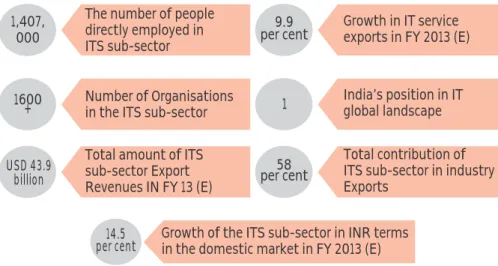
2 India’s position in IT global landscape 1 Growth in IT service exports in FY 2013 (E) 9.9 per cent 1,40 000
7, The number of people
directly employed in ITS sub-sector
1600
+ Number of Organisationsin the ITS sub-sector
Total contribution of ITS sub-sector in industry Exports
58 per cent USD 43.9
billion
Total amount of ITS sub-sector Export Revenues IN FY 13 (E)
Growth of the ITS sub-sector in INR terms in the domestic market in FY 2013 (E) 14.5
per cent
Career Guide-IT Services
Career Guide - IT Services
The worldwide IT Services market stood at USD 648 billion in 2012. The Indian IT Services exports form the largest and fastest growing segment of the IT services with a growth rate of 9.9 per cent in FY 2013. IT Services export constituted over half of the entire export of the IT Industry. Even within the domestic market, IT services is the fastest growing segment in the Indian domestic market, growing by 14.5 per cent to reach INR 674 billion, driven by IS outsourcing, cloud services and increasing adoption from all customer segments – government, enterprise, consumers and small and medium businesses. There are over 1600 companies providing IT services in the country with the top 5 comprising around 60 per cent of the total revenue from the industry.
The sub-sector has established a record as a major contributor to the country's GDP as well as penetrated into many large sectors - established as well as upcoming like healthcare, media, education and retail. This has ensured that the sub-sector is a field in demand, both in the present and the future. With an increased focus on optimising efficiencies, companies in all the sectors see value in leveraging IT to manage their business better and are increasing their IT investments.
The wide scope of the services this sub-sector creates a requirement for a large variety of skills. This reflects on the range of opportunities available for building a career in IT Services to a varied group of people and the industry continues to be amongst the most sought, after for many young and aspiring individuals.
Profile of the IT Services Sub-Sector
Vertical Profile:Horizontal Profile:
Customer Profile:
BFSI is the largest driver in this space claiming half of the entire IT S e r v i c e s e x p o r t . O t h e r i n d u s t r y v e r t i c a l s l i k e Healthcare, Retail and Media have started making big investments in IT services and are turning into key verticals for the IT Services sub-sector. An illustrative
view of the vertical and horizontal profiles is shown below.
The IT Services sub-sector started off in India with a focus on basic application development and maintenance. The sub-sector has now grown and includes significant footprints in traditional segments which include custom application development, application management, IS outsourcing and software testing. With time, the sector has expanded to provide end-to-end IT solutions and includes consulting, testing services, infrastructure services and system integration
3
in the offering .
After starting off, the IT Services sub-sector, served mostly the North American market until the 1990s.
While North America continues to be a major importer of Indian IT services, the sub-sector has witnessed entry into
other markets, in order to mitigate risk as well as to expand markets thus servicing clients in a greater number of geographical areas like Latin America, the Asia Pacific and Europe.
The client base in these markets is a h e a l t h y m i x b e t w e e n B F S I , Manufacturing, Retail, Telecom and all key Industry verticals.
Source: NASSCOM Research2
3 The IT –BPM Sector in India – Strategic Review 2013, NASSCOM
Figure 3: Contribution of Areas in the IT-BPM Industry (FY 2013) Outsourcing Support and Training Project-Oriented 42% 7% 51%
Career Guide-IT Services
Career Guide - IT Services
Key Trends in the IT Services Sub-Sector
The IT-BPM industry is standing at a watershed moment in history. In FY 2013, the industry achieved a stellar landmark of crossing US 108 billion in revenues. However, with the industry slowly reaching a stage of maturity and with a business model closely aligned to exports, it faces the brunt of the economic shake-up like the one observed in 2008, which redefined the economic order amongst nations.
While the recovery has gathered pace in the last few months, companies are becoming increasingly conscious that in the globally connected world, the “new normal” will be characterised by business volatility. The ups and downs will be more frequent and companies need to learn how best to manage this volatility.
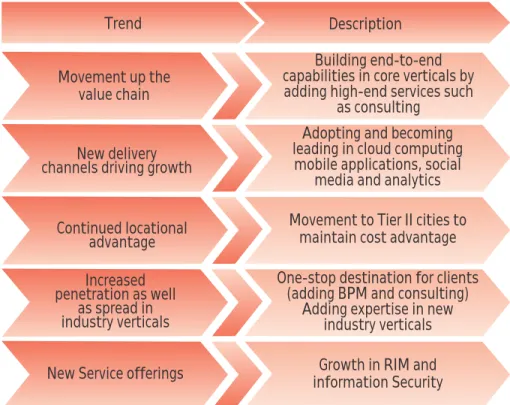
Trend Description
Movement up the value chain
Building end-to-end capabilities in core verticals by adding high-end services such
as consulting Adopting and becoming leading in cloud computing
mobile applications, social media and analytics Movement to Tier II cities to
maintain cost advantage One-stop destination for clients
(adding BPM and consulting) Adding expertise in new
industry verticals Growth in RIM and information Security New delivery
channels driving growth
Continued locational advantage Increased penetration as well as spread in industry verticals New Service offerings
Some of the key trends which are leading the growth in the sub-sector include: Growth of the different delivery channels like cloud computing, mobile applications, social media and data analytics have provided the industry with new opportunities and expanded the market, particularly for the small and medium scale businesses.
India leads the table as the most lucrative location for IT Services, performing well on various parameters like financial attractiveness,
4
skill availability and business environment . While traditionally, 70 per cent of the Industry is located in Tier I cities, focus on controlling costs has created a gradual move to have centres in Tier II cities as well, thus widening the talent pool and spread. The BFSI sector has been the key business driver for the industry. Increasing penetration of new industry verticals like Healthcare, Utilities, and Retail in addition to growing ones like Media, Government, and Manufacturing is expected to happen, increasing the total market share. Indian IT service offerings have evolved from application development and maintenance, to emerge as full-service players providing testing services, infrastructure services, consulting and system integration. Within that, IT outsourcing exhibited strong growth, in line with global trends, driven by increased spending in remote infrastructure management, application management, testing and SOA segments. Cloud computing and mobile computing gained credence this year as it offered clients access to best-in-class process management at reduced
5
capital expenditure levels .
Growth in new areas of operations like IS Outsourcing (ISO)/Remote Infrastructure Management (RIM) and Information Security is being touted as the next growth driver for IT Services. IMS professionals manage an enterprise's networks, servers, storage, etc. Advancements in technology have led to these services being increasingly off-shored – a trend that is being welcomed by all major IT-BPM organisations in the Industry.
In FY2013, ISO grew by 15 per cent and it is being touted as the one of the growth
5
engines for IT Services sub-sector
New Delivery Channels Driving Growth:
Continued Locational Advantage:
Increased Penetration as well as Spread in Industry Verticals:
New Services:
Source: NASSCOM Research2
4 A. T. Kearney Global Services Location Index, 2011
Career Guide-IT Services
Career Guide
IT Services
Career Guide - IT Services
What are the Requirements
for Being an
Skills
Key Generic Skill Requirements: l
l l l
Key Functional Skill Requirements: l l l l l l
IT Services sub-sector requires a wide range of skills that may vary with the organisation - value stream the organisation is servicing, and at the individual level - role and the position. Both soft skills and functional skills are crucial in the industry and organisations put a lot of effort in building these capabilities. Major hiring at the entry level is done on the basis of communication/soft skills and analytical aptitude.
Communication Skills Analytical skills Problem Solving Ability
Working with influence
Industry/Domain skills SDLC concepts Programming skills Platform knowledge Automated testing ERP
Career Guide - IT Services
Learning Opportunities
l l l lIT Services sub-sector is a knowledge-intensive industry and fresh graduates often have a steep learning curve, which they need to cover before becoming productive. The constant innovation of technology requires the employees to regularly update their knowledge for them to remain productive. Change in role or projects could also see the employee needing to learn new skills.
IT Services thus encourages and provides learning opportunities through different sources like certifications, training materials (online/classroom), focussed learning programmes and on-the-job learning opportunities.
Increasing sector focus is leading to many IT services organisations looking to acquaint the employees with domain specific (retail, manufacturing, insurance, etc.) knowledge. Similarly, tie-ups with institutes or external vendors is used to provide training to employees for specific technical or platform skills.
The Industry spends significant amount of resources on providing learning opportunities. This not only provides for up-skilling of employees to meet business needs, but also helps to position the organisation as a preferred employer.
Learning opportunities are offered within and outside of the organisation. Some of these options include:
Advanced technical degree courses like MCA, M Tech, M E, M Sc etc. Advanced business courses like MBA/PGDBM
Domain-related certifications in the areas of Software languages, Infrastructure Management, Information Security, etc.
Industry-related certifications in various verticals like BFSI, Telecom, and Retail, etc.
One of the key objectives of the IT-ITeS SSC NASSCOM is to develop avenues for learning and skill development in the IT-BPM Industry. In pursuit of this, the SSC is planning to set up accreditation process for training providers and tailoring courses on Occupational Standards that are currently being developed for the Industry.
Qualifications, Knowledge and Understanding
l
l
l
Sourcing strategy may vary for different companies, but barring a few that provide niche/specialised services, majority hire both laterally and at entry level with the latter making up the bulk.
Nearly 70 per cent of the total hiring happens at fresh graduate level, mostly from engineering colleges and universities.
Increasingly, a large number of companies are also hiring candidates with non-engineering degrees. For IT Services, majority of the recruitment happens through technical graduates - Engineering Institutes, BCA/MCA and technical diploma holder candidates.
Graduates with relevant certifications like CCNA, CCNP and MCSE are preferred for infrastructure related occupations within the sub-sector.
There is usually an advanced requirement for occupations like IT Consulting, Sales and Pre-sales where candidates with management degrees are usually preferred.
Increasingly, the focus is shifting away from 'formal education' related qualifications to having the right skills to successfully deliver the job responsibilities.
Career Guide-IT Services
Career Guide
IT Services
Career Guide - IT Services
What are the Roles in the
The job roles in the in the sub-sector have been classified and detailed as follow:
Unique 'Occupations'
Unique 'Tracks'
Unique ‘Job roles’ at the Entry Level
Unique ‘Job roles’ at the Middle Level
Unique ‘Job roles’ at the Leadership Level
13
39
17
91
25
Occupation is a set of job roles, which perform similar/related set of functions in an industry.
Track is an independent unique activity under an occupation
Unique Job-roles define a set of functions that together form a unique employment opportunity in an organisation.
Entry Level: 0-2 yrs.
Middle Level: 2-10 yrs.
Leadership Level: >10 yrs.
Career Guide - IT Services
Occupations and tracks within the IT Services Sub-Sector
l l l l l l Software Development Functional Development Technical Documentation Web Development UI Development Media Development Application Development lApplication Maintenance Application Maintenance lApplication Deployment Application Deployment l Data Scientist Data Scientists l IT Services Management IT Services Management l Technical IT Consulting l IT Support Services/Helpdesk IT Support Services / l l l l l l l IT Forensics Application Security Risk Management, Audit and Compliance Incident Management BCP/DR Network Security management Security Testing Privacy Information Security l l l l l l l l l l Storage Management Network Management Server Management Messaging and Collaboration Security Management End-user devices Management Infrastructure Applications Management Infrastructure Tools Management Database Management Field Support InfrastructureOccupation : Application Development
l l l l l l l l l lApplication Development involves
Developing and delivering customised software applications and interfaces Enhancing existing packaged applications or pre-engineered templates
Support and provision of custom applications
Application Developers develop software codes using a range of platforms (operating systems) and programming /scripting languages.
The application development professionals work closely with other software professionals like Testing and Support services. The responsibilities vary widely with the years of experience and the type of application platform.
Software Development roles are responsible for creating software applications by coding using programming/scripting languages like C, C++, Java, HTML, .Net, PHP, and VB etc.
Functional Development roles are responsible for providing function-specific inputs towards application development. These roles provide a domain perspective in the areas of CRM, Financial Management and ERP, etc.
Media Development roles are responsible for designing and improving the look and feel, functionality and graphic appeal of the developed application.
Web Development roles are responsible for designing and maintaining web-based applications that include static and dynamic content.
User Interface (UI) Development roles are responsible for designing rich UI for the developed applications, such as computer programmes, databases and websites.
Technical Writing/Documentation serves the core purpose of transferring knowledge between the application development teams and the user teams. These documents can also be used as learning and troubleshooting aid by the users at a later stage.
Language/Translation roles are responsible for translating software into different languages that end-users may be well-versed with.
Career Guide - IT Services
Role of Application Development Professional Application/Functional Developer l l l Media Developer l l Web Developer l l UI Developer l l Language Translator l Technical Writer l
Captures data and translates and transforms it into a processing language Develops codes from relevant information, schedules, processes and monitors them
Contributes to development of test scripts and test scenarios Develops visual, audio/video media content
Uses software tools to develop media content for applications with smart graphics and enhanced look and feel and usability features
Develops programming code for web-based applications/websites Uploads the site onto a server and registers it with different search engines
Designs UI applications using HTML, Javascript, XML, JSP, JAVA, CSS, among others
Designs and implements front-end business applications while working closely with application/functional developers to help generate requirements for back-end system development
Works to translate codes in multiple end languages. For example, translating a Microsoft Windows into local Indian languages. With the advent of Uni-code compliant applications, this role is slowly becoming obsolete
Works using documentation software to create job aids and other technical manuals/documents highlighting specifications and usability features of the applications developed
Qualifications and Skills
Software Developers, Functional Developers : l l l l UI Developers: l l l l
Media and Web Developers: l l l l Technical Writing/Documentation: l l l l Translation: l l l l
BCA/MCA or Engineer with certification in relevant areas Problem solving and strong analytical capability
Knowledge of programming logic and SDLC is essential
Functional skills like software languages (Java, C/C++, dot net) are highly essential for professionals in the Software/Functional Development tracks
BCA/MCA or Engineer with certification in relevant areas Graduates/Diploma holders with relevant skills are also eligible Knowledge of programming logic and SDLC is essential
Strong HTML and JavaScript (AJAX, DOM, JSON) and Java skills
Any graduate/diploma course with a specialist training programme in media designing
For a relevant skill even under-graduate candidates are eligible Knowledge of programming logic and SDLC is desirable
Creative thinking and attention to detail are the key skills for these roles Any graduate/diploma course.
For a relevant skill even under-graduate candidates are eligible Knowledge of programming logic and SDLC is desirable.
Attention to detail and accuracy are the key skills for these Job roles Any graduate/diploma course.
For a relevant skill even under-graduate candidates are eligible Knowledge of programming logic and SDLC is desirable Certified Language courses
Application Development
Headof Company/CEO
Offering Lead/Domain Lead
Delivery Lead
Movement to other Occupations such
as Project Management
Team Leader/Application Architect/Web Solution Developer
Senior UI Developer
Senior
Language Translator Senior Technical Document Writer
Senior
Web Developer
Senior Media Developer
Media Developer (SSC/Q 0504) Web Developer (SSC/Q 0503) Technical Writer (SSC/Q 0505) Language Translator (SSC/Q 0506) UI Developer (SSC/Q 0502) Engineer Trainee (SSC/Q 0507) UI Development Language/ Translation Technical Documentation Web Development Media Development
Leadership Level Middle Level Entry Level Tracks
Qualifications and Skills l
l l l
BCA / MCA or Engineer with certification in relevant areas
Experience of implementing IT projects – deployment or maintenance Knowledge and experience with SDLC and different methodologies Strong communication skills
Occupation : Application Deployment
Application Deployment involves expertise and systems providing the customer with proper installation and configuration of all packaged and customised software products.
Application Deployment professionals are responsible for ensuring that software systems are fully deployed, implemented and functioning and are configured with hardware requirements.
Role of Application Deployment Professional l
l l l
Plans the roll-out process and sequence of new systems and platforms Deploys, configures, manages, and trouble-shoots the software solution Provides technical support and perform quality assurance of new software updates
Career Guide - IT Services
Career Map for
Application Deployment
Leadership Level
Middle Level
Entry Level
Head of Company/CEO
Offering Lead/Domain Lead
Head of Application Deployment Engineer Trainee (SSC/Q 0507) Deployment Lead Team Lead- Deployment Sr. Deployment Engineer Deployment Engineer (SSC/Q 0301)
Occupation : Application Maintenance
Application Maintenance covers a range of services which involve providing on-going/ad-hoc support to software products or customised applications. These services are aimed towards correction of faults/bugs or performance improvement. The primary responsibility of the Application maintenance roles is to ensure the availability of an application or product for end users.
Application Maintenance professionals are all-round experts who understand the aspects of application development, maintenance, support and deployment.
Qualifications and Skills l
l l l l
BCA/MCA or Engineer with certification in relevant areas
Graduates/under-graduates/diploma holders with relevant skills and experience are also eligible
Experience of working on Software projects – deployment or maintenance Knowledge and experience with SDLC and different methodologies Strong communication skills
Role of Application Maintenance Professional l l l l l l l
Interacts with senior client personnel to understand the application issues
Provides technical support and resolves issues for current business applications
Monitors system security, application and system event log files. Communicate and works with users as necessary to resolve application errors
Establishes, monitors and evaluates system metrics to identify vulnerabilities and identify problem trends.
Monitors disk status, system processes, and user process activity
Provides operational support, ensuring production systems and devices are online and available
Career Guide - IT Services
Career Map for
Application Maintenance
Leadership Level
Track
Middle Level
Entry Level
Head of Company/CEO
Offering Lead/ Domain Lead
Head of Application Maintenance Application Maintenance Engineer (SSC/Q 0201) Project Lead -Application Maintenance Team Lead- Application Maintenance Sr. Maintenance Engineer Application Maintenance
Occupation :
Data Scientist
Data Scientists are responsible for designing and implementing processes and layouts for complex, large-scale data sets used for modelling, data-mining and research purposes.
Data Scientists evaluate strategic uses of data and how data use interacts with data design. Responsibilities also include designing and implementing statistical data quality procedures around new data sources.
Qualifications and Skills l l l l l l
Bachelor’s or Master’s Degree in Computer Science, Statistics or Mathematics
Engineers with exposure and/or experience to large scale database and processes are also eligible
Proficiency in specific data analysis packages (SPSS, SAS, STATA and/or Excel)
Strong mathematics and statistics skills
Coursework or practical experience with data mining Coursework or practical experience building algorithms Role of Data Scientist
l l l l l l
Thinks strategically about uses of data and how data use interacts with data design
Designs and implements statistical data quality procedures around new data sources
Performs data studies and data discovery around new data sources or new uses for existing data sources
Implements any software required for accessing and handling data appropriately
Visualises and reports data findings creatively in a variety of formats Designs and builds large and complex data sets
Career Guide - IT Services
Career Map for
Data Scientist
Leadership Level Track Middle Level En try Le ve l Head of Company/CEO
Offering Lead/Domain Lead
Lead–Data Scientist
Junior Data Associate (SSC/Q 0401) Sr. Data Scientist Ass. Data Scientist Data Scientist
Occupation : IT Consulting
Technology Consulting:
Functional/Business Consulting:
IT Consulting includes IS strategy, IT and network planning, architectural assessments, IS operational analysis, technical system and network designs, product-specific consulting, supplier assessment and maintenance planning
IT consulting professionals identify and analyse user requirements and recommend appropriate applications or modifications for an organisation, which is typically the client. It is their responsibility to develop, install, maintain and modify system application programmes and business application programmes.
Technology consulting roles provide technology solutions to the clients based on functional/business requirements gathered by the Business Analysts. These include designing various solutions, such as ERP, Web and IT Strategy etc., which are then delivered by Application Developers.
Functional/Business consulting involves understanding the clients' business requirements and translating them into technology requirements. These professionals work closely with the business teams and have a basic understanding of the tenets of technology consulting.
Role of IT Consulting Professional l
l l l l
based solutions to fulfil the needs
Advises clients on IT Strategy, Architecture and governance needs
Identifies user problems and needs, their sources and determine possible solutions
Participates in the development, implementation, installations and testing of application software
Investigates recommends and manage installation of new applications Understands a client’s business needs and recommends technology
Qualifications and Skills l
l l l
BCA/MCA or Engineer with certification in relevant areas and 5-6 years of relevant work experience as an entry level
MBA candidates are preferred owing to high degree of interaction with senior client representatives and strong business orientation
Strong skill/knowledge of various technology trends and processes Thorough understanding of the technology environment, Industry best
Career Guide - IT Services
Career Map for
IT Consulting
Leadership Level Tracks Middle Level Entry Level Head of Company/CEO Practice Lead Partner/Sr. Executive/ Managing Director Analyst (SSC/Q 0701) Manager- Technical Domain Consultant Technical Manager- Business Domain Business Consultant Sr. Manager/ Director Functional
Occupation : IT Services Management
IT Services Management involves the delivery of ITIL service operations processes of Problem, Change, Configuration, Incident and Release Management. These roles provide cross-functional IT Services Management and work closely with multiple domains on the development, maintenance and reporting of service catalogues, processes/procedures and new technology/tools.
IT Services Management professionals require a proactive approach to managing events such as an incident or a change and support a continuous improvement strategy in providing accurate recording of information and the related analysis of the events.
Role of IT Services Management Professional l l l l l l l l l l
client satisfaction and management of risk to services including: Change Management
Release Management Problem Management
Incident Management/Major Incident Management Configuration Management
Identifies, logs, monitors and escalates issues/outages and ensures timely assignment and resolution of incidents to meet SLAs
Proactively prevents the occurrence of incidents, problems and errors, via the identification, investigation and resolution of client and/or organisational Service Management issues
D e l i v e r s a p p r o p r i a t e a n d e f f e c t i v e c o m m u n i c a t i o n s t o client/management and/or third party vendor on issue escalation and resolution at all stages
Proactively prevents problems via trend analysis, targeting support action and communication
Responsible for the lifecycle of Service Management processes ensuring
Qualifications and Skills l l l l l l
BCA / MCA or Engineer with certification in relevant areas
Graduates/diploma holders with relevant skills set are also eligible Knowledge of ITIL and Infrastructure standards
Certifications in the areas of networks/storage/servers etc. is highly desirable
Knowledge of systems management software and networking Problem solving and technical capability
Career Guide - IT Services
Career Map for
IT Services Management
Leadership Level Middle Level En tr y Le ve l Head of Company/CEO
Offering Lead/Domain Lead
Infrastructure Services Lead
Lead-IT Service Management
There are no entry level job-roles for this occupation. Entry is usually through,
IMS, IT Support Services etc. Sr. Expert IT Service Management IT Service Management Expert IT Services Management Track
Occupation : IT Support Services/Helpdesk
l l
IT Support Services/Helpdesk encompasses services that relate to monitoring, managing and enhancing performance of a client's IT infrastructure backbone. These include level 1 helpdesk services offering simpler solutions to clients- Internal or External to the organisation.
Primary purposes of an IT Support Services/service desk include: Incident control: Lifecycle management of all service requests
Communication: Keeping a customer informed of progress and advising on workarounds
Key responsibilities of IT Support Services professionals are to manage, co-ordinate and resolve incidents as quickly as possible at primary support level.
Role of IT Support Services/Helpdesk Professional l l l l l l l
systems, through trouble-shooting and implementing known fixes
Conducts trend analysis with a focus on proactive identification of events/issues that threaten performance and a consistent & timely resolution and documentation strategies
Develops long-term and short-term plans for IT support/Helpdesk Develops IT support systems, policies and processes
Defines and agrees on service levels and metrics
Consults and advises on IT support requirements and initiatives Troubleshoots and resolves all IT issues within the organisation
Resolves Level1/2 incidents affecting the operation/availability of production
Qualifications and Skills l
l l
Diploma in Computer/Network/Communication BCA/Engineer with certification in relevant areas
Strong skill/knowledge of various technology trends and processes as well as updated knowledge about IT initiatives
Career Guide - IT Services
Career Map for
IT Support Services/Helpdesk
Leadership Level Middle Level En tr y Le ve l Head of Company/CEO CIO IT Operations Manager Engineer–Technical Support (Level 1) (SSC/Q 0101) Team Lead – Technical Support (Level 1) Sr Engineer– Technical Support (Level 1) Track IT Support Services/HelpdeskOccupation : Infrastructure Management Services (IMS)
l l Storage Management: Network Management: Server Management:Messaging and Collaboration:
Infrastructure Management Services (IMS) includes designing and maintaining infrastructure required to support hardware and software for own/client organisations. This also includes both remote management and onsite management of application infrastructure like servers, storage, data and networks.
IMS professionals provide services that include technical assistance in the installation, configuration, administration, support and maintenance of systems, storage or back-up services of databases, traffic diversion, network support and maintenance, etc.
IMS covers two broad areas:
Infrastructure Operations/Maintenance - Refers to maintenance roles that ensure 'Business as usual' (BAU) state for all infrastructure devices - software and hardware. Infrastructure Operations is a highly critical stream as the downside of a system breakdown can be catastrophic for an organisation. Typical roles are Administrators/Team Leads.
Infrastructure Engineering/Transformation - Refers to engineering roles responsible for installation/improvement/upgradation of Infrastructure devices for own/client's organisation. Typical roles are Engineers/Technology Leads.
While the responsibilities and the skill sets may vary with the area of operation, both Infrastructure Operations and Infrastructure Engineering can be categorised into the following tracks.
Storage management roles are responsible for managing storage equipment deployed in an organisation. This includes a range of activities from installation, records management, log keeping, evaluation, constant supervision and improvement of storage systems like EMC Symmetrix VMAX, Flash, cloud, etc.
Network Management roles are responsible for the deployment, configuration, maintenance and monitoring of active network equipment such as switches, routers, firewalls, etc. The scope also includes network design and security particularly trouble-shooting and/or debugging network-related problems. This is most relevant for off-shore clients (RIM).
Server Management roles are responsible for maintaining client server applications and hardware deployed in an organisation. This includes the range of activities involved in installation, administration, maintenance, and improvement of company and/or client/server like UNIX, Windows, and Citrix, etc.
Messaging and collaboration roles are responsible for maintaining messaging applications for end-user systems and servers in an organisation. This includes the range of activities from cryptic messages to Instant Messaging (IM), server messages, etc. within the same/across multiple organisations.
Career Guide - IT Services
Security Management:
End-user Devices Management:
Services/Facility Management:
Infrastructure Applications Management:
Infrastructure Tools Management:
Database Management:
Security management roles are responsible for maintaining security of, application, and network equipment within an organisation. This includes the range of activities from devising security policy, managing firewalls, granting access rights, and ensuring end-to-end security of all IT equipment and applications for the organisation/client.
End-user devices management roles are responsible for maintaining end-user devices like desktops/laptops/mobile devices within an organisation. This includes the range of activities from providing first level troubleshooting, maintaining software and hardware upgrades, MS Office applications and the necessary security and safety features necessary as per the security policy.
Services/facility management roles are responsible for maintaining facilities and services that support the infrastructure services for an organisation. This includes the range of activities from ensuring continuous power to servers, storage and other infrastructure related IT equipment to maintaining the physical space for storage of this critical equipment.
Infrastructure application management roles are responsible for the administration, support, maintenance, life-cycle planning and optimisation of infrastructure applications including: mobile device management, unified communications and IT management software. This includes undertaking necessary activities to resolve hardware and software with respect to Infrastructure Applications, in a timely and accurate fashion.
Infrastructure Tools Management roles are a specialised set of roles responsible for management of infrastructure tools in an organisation. The main objectives of the roles are to increase operational efficiency, reduce cost and support fluctuations in service levels to ensure service delivery for all IT applications supported by infrastructure. These tools plug into the operating system, hardware controllers and critical applications to ensure effective and efficient IT operations.
Database management roles are responsible for the installation, testing, configuration and maintenance of database systems. The scope extends to monitoring, optimising, analysing systems performance and set user privileges within the database environment. In most cases, this group of job roles also includes database design.
Role of IMS Professional l l l l l problems
Provides planning, design, implementation and technical support of computer hardware, software and network components
Develops specifications of new enhancements or systems required Maintains daily logs and track systems performance on a day-t- day basis Prepares detailed management standards and procedures and enforcement of processes, including procedures for systems security and recovery
Provides diagnosis and resolution of computer hardware and software
Qualifications and Skills l
l l l l
BCA / MCA or Engineer with certification in relevant areas
Graduates/diploma holders with relevant skills set are also eligible Certifications in the areas of networks/storage/servers etc. is highly
desired
Knowledge of systems management software and networking Problem solving and technical capability
Career Guide - IT Services
d/ y Te am Le ad / Te ch no lo gy Le ad - M es sa gi ng A dm in is tr at or Te am L ea d/ Te ch n ol og y Le ad - S ec u rit y Te am L ea d/ Te ch n ol og y Le ad - E n d-u se r de vi ce s/ D es kt op Te am L ea d/ Te ch no lo gy Le ad - Se rv ic es M an ag em en t Te am L ea d/ Te ch no lo gy Le ad - In fr as tr uc tu re A pp lic at io ns A dm in is tr at or Te am L ea d/ Te ch no lo gy Le ad - In fr as tr uc tu re T oo ls Te am L ea d/ Te ch no lo gy L ea d-DB Te am Le ad - Fi el d S u pp or tInfrastructure Management Services (IMS)
Head
of Company/CEO
Offering Lead/ Domain Lead
Infrastructure Lead Delivery Manager Operations Manager
Infrastructure Engineer (SSC/Q 0801)
Systems Engineer/Engineer Trainee (SSC/Q 0507)
Leadership Level Middle Level Entry Level Tracks
Se rv ic es M an ag em en t En gi ne er / A dm in is tr at or In fr as tr uc tu re To ol s En gi ne er / A dm in is tr at or / or M es sa gi ng En gi ne er / Ad m in is tr at or Se cu rit y En gi ne er / Ad m in is tr at or En d-us er de vi ce s/ De sk to p En gi ne er / Ad m in is tr at or In fr as tr uc tu re A pp lic at io ns En gi ne er / A dm in is tr at or DB En gi ne er / A dm in is tr at or Fi el d Su pp or t En gi ne er / A dm in is tr at or S er vi ce s M an ag em en t In fr as tr u ct u re To ol s M an ag em en t en t M es sa gi n g an d Co lla bo ra ti on S ec u rit y M an ag em en t E n d-u se r D ev ic es M an ag em en t In fr as tr u ct u re A pp lic at io n s M an ag em en t D at ab as e M an ag em en t Fi el d S u pp or t
Occupation : Project/Program Management
l l l
Project/Program Management includes the set of activities to plan, implement, monitor and control projects. It includes managing project financials, overseeing delivery, reporting and stakeholder management.
Project/Program Management will have subtle differences depending upon the scope of the project. The variances will vary depending upon whether the project is:
A Pure play Application Development Project An Infrastructure/Architecture Project;
Professionals usually enter in the Project/Program Management occupation after developing key expertise in a delivery focussed occupations like Application Development, Testing, Application Deployment, or Outsourcing.
Project/Program Management professionals can also grow from other key occupations like Infrastructure Management Services (IMS) and Information Security.
An IT Consulting Project; or an Integrated Project that includes some or all of the above
Role of a Project /Program Management Professional l
l l
Manages project budget and resource allocation
Manages internal and external stakeholders to ensure smooth completion of project
Leads the planning and implementation of projects/program
Qualifications and Skills l
l l l
Graduate/Post-graduate in any subject
Experience in managing software development projects Excellent communication and presentation skills Strong leadership and stakeholder management skills
Career Guide - IT Services
Career Map for
Project/Program Management
Leadership Level
Middle Level
Head of Company/CEO
Domain Lead/Offering Lead
Delivery Lead
Client Account Lead
Client Relationship Manager
Program Manager
Project Manager
Module Leader
PMO-Associate (Admin Role Only)- this does not indicate a natural
Occupation : Sales and Pre-sales
Relationship Management/Alliance Management:
Business Development:
Sales and Pre-sales generate and develop business for the organisation. This involves developing business relationships, marketing, managing brand and driving sales for the organisation.
These professionals develop a go-to-market strategy with entity Leadership and OU/industry leads for assigned territories and the strategic accounts within it. This could include build-outs for inside sales, field marketing and alliance activities.
Relationship management involves developing and maintaining relationships with key clients to ensure development and implementation of plans, resources and processes to ensure the effective delivery of services. Relationship Management extends across entire Pre-sales including working closely with Solution Architecting teams to ensure completion of bids and proposals.
Relationship management also covers change management, contract management and customer loyalty in a pursuit to maximise business opportunities. The Alliance Management part covers managing these relationships with key alliance partners like ERP vendors and product organisations to co-develop sales relationships.
Business Development involves a closer association with driving sales numbers for an organisation. Professionals in this area are accountable to drive sales within a territory/region/state or country/global regions.
Specifically in IT Services, senior roles are given responsibilities to lead sales efforts in global zones like APAC, Euro-zone, Africa, and the Americas.
Role of a Project /Program Management Professional l
l l l l
Model & Strategy and Technology Integration and summarises as per client requirements
Manages alliances and relationships with sales partners like ERP product organisations
Develops demonstrations of the technical and functional capabilities of the organisation to drive sales
Supports key accounts by conducting demonstrations and defining special agreements with the clients
Provides inputs about client requirements to product development teams Gathers information about new/changed technical offerings from Business
Qualifications and Skills l
l l l
Post-graduate in Technology/Management related areas with graduation in Technology areas
Graduates can move laterally into pre-sales and sales after developing experience and requisite skills set
Good command over English language
Action orientation and a go-getter spirit are the key skills needed in a pre-sales and sales profile
Career Guide - IT Services
Career Map for
Sales and Pre-sales
Leadership Level
Tracks
Middle Level
Entry Level
Head of Company/CEO
Head Sales and Pre-sales
Sales and Pre-Sales Analyst (SSC/Q 1101) Senior Relationship Manager Relationship Manager Relationship Management Senior Business Development Manager Business Development Manager Zonal Head-Sales and Pre-sales Client Relationship Manager/Chief Alliance Manager Business Development
Occupation : Solution Architecting
Solution Architecting involves defining and detailing the technology solutions for a business/technology problem. Solution Architects work closely with Sales/Pre-sales teams and delivery teams to develop the solution.
A Solution Architect is expected to provide expertise in technology, methodology, business, application, and product in terms of technical and solution architecture. These roles generally require more experience and a strong technology background.
Role of Solution Architecting Professional l
l l
Creates high as well as low-level design components and designs their working with each other, as well as independently
Provides architectural, user interface (UI) and functional design specifications to the development team
Defines roadmap for capability, shared assets, training plan Qualifications and Skills
l l l l
BCA/MCA or Engineer with certification in relevant areas
4-6 years of experience of having worked intensively on the architecture, design and implementation of projects
Knowledge of architecture principles, design methodologies, best practices and problem troubleshooting techniques
Solution Architects have advanced skills in the area of Problem Solving and thinking out-of-the-box. Professionals need to be able to have an overall solution and break it to smaller modules for the development/delivery teams to develop and deliver
Career Guide - IT Services
Career Map for
Solution Architecting
Leadership Level
Track
Middle Level
Entry Level
Head of Company/CEO
Offering Lead/Domain Lead
Chief Solutions Architect
No Entry-level role. Entry to this occupation is typically through experienced professionals
from Application Development, Sales and Pre-sales, Testing and QA and so on.
Enterprise Architect Technical Architect (Solution/DB/ Application) Solution Designer Solution Architecting
Occupation : Testing and QA
Manual Testing:
Automated Testing:
Quality Assurance (QA):
Testing and QA includes conducting scheduled and unscheduled tests in the areas of integration, performance and application, etc. Testing and QA professionals act as the final check between the solution developed by the Application Developers and go-live.
Depending upon the structure of the organisation, QA professionals may be responsible only for laying out quality assurance processes and programmes like TQM, ISO, etc. QA teams conduct periodic audits and drive compliance to the defined quality norms and processes.
Manual Testing roles are responsible for running planned/ad-hoc tests on the developed application and reporting results and variances. Manual Testing usually involves executing test scenarios manually without the use of automated software and analysing the test results. These roles may not require understanding of the code/language but only an understanding of the test plan, common bugs, and the 'success' and 'failure' scenarios for the application.
Automated Testing roles are responsible for creating and running test scripts for the developed application. Automated testing is undertaken over testing software like Microsoft Visual Studio, Time Partition Testing (TPT) and HP Quick Test Professional (QTP) etc. to execute test scenarios by controlling the environment variables as desired. These roles require extensive knowledge of coding/programming language as automated testing often requires the testers to undertake first-hand debugging for minor bugs/defects.
QA roles are responsible for setting quality standards for products, systems, and processes within the organisation. These roles implement quality norms that are based on industry accepted standards, such as Total Quality Management (TQM), International Standards Organisation (ISO) and conduct audits and compliance, related activities. Depending upon the organisation, they may be responsible for conducting a final quality check on every application that is delivered to the client.
Role of Testing and QA Professional l
l l l
Develops and coordinates test plans
Documents, reports and tracks software defects - manually using testing software
Conducts software compatibility tests with programmes, hardware, operating systems, or network environments
QA professionals design and implement Quality Assurance, norms, standards and guidelines to be followed across the organisation
Qualifications and Skills l
l l
BCA/MCA or Engineer with certification in relevant areas Strong communication skills – written and verbal
Attention to detail and perseverance are the key skills to success at Testing roles
Career Guide - IT Services
Career Map for
Testing and QA
Head of Company/CEO
Offering Lead/Domain Lead
Delivery Lead
Head of Quality Assurance
Head of Testing Testing Manager Engineer Trainee (SSC/Q 0507) Team Lead- Manual Testing Senior Test Engineer- Manual Testing Team Lead Automated Testing Sr. Test Engineer Automated Testing Senior QA Engineer QA Engineer (SSC/Q 1302) Test Engineer (SSC/Q 1301) Leadership Level Middle Level Entry Level QA Manager QA Lead
Occupation : Information Security
l l l
Risk, Audit and Complain:
Security Testing:
Incident Management:
Information Security includes the activities relating to protecting information and information systems from unauthorised access, use, disclosure, disruption, modification, perusal, inspection, recording, or destruction. The core function of this occupation is to ensure the confidentiality, integrity and availability of data to the 'right' users within/outside of the organisation.
Application Security: Application Security roles are responsible for ensuring stable and secure functioning of the applications.
Application Security professionals perform the following functions in an organisation: Knowing threats
Securing the network, host and application
Incorporating security into the software development process
Risk Management roles are responsible for assessing, measuring, and managing the security risks to information security of an organisation. These conduct assessments for security threats and vulnerabilities, determine deviations from acceptable pre-defined configurations, enterprise or local policy, assess the level of risk, develop and/or recommend appropriate mitigation countermeasures in operational and non-operational situations.
Key responsibilities also include measuring the maturity of an organisation to ensure that proper security controls are incorporated when developing and running Information-security systems. These also perform scheduled/un-scheduled audits on the organisation's security systems and processes and ensure compliance.
Security Testing involves devising testing standards and cases of confidentiality, integrity, authentication, availability, authorisation and non-repudiation of information. Security Testing professionals perform scheduled and ad-hoc tests to assess vulnerability and/or safety of an organisation's information systems.
Incident Management roles work towards restoring normal service operations in an organisation to minimise the adverse effect on business operations, thus ensuring that the best possible level of service quality and availability is maintained.
Incident management professionals manage and protect computer assets, networks and information systems to answer the key question “what to do, when things go wrong.
Business Continuity Management/Disaster Recovery (BCP/DR): BCP/DR roles are responsible for improving system availability and integration of IT operational risk management strategies for an organisation.
Career Guide - IT Services
l l l l l lDevelopment, implementation, testing, and maintenance of the business continuity management plan
Recommendation and proof of concept for recovery options Assessments and audits for BCP/DR
Network Security: Network Security roles are responsible for defining and implementing overall network security that includes baseline configuration, change control, security standards and process implementation.
Privacy: Privacy roles are responsible for defining and managing data/information/IP policies etc. for an organisation. These roles require knowledge of information security norms and data privacy norms and regulations.
Privacy professionals help define and implement privacy standards, build privacy awareness to protect an organisation's information assets.
IT Forensics: IT Forensics roles collect, process, preserve, analyse and present computer-related evidence in support of network vulnerability mitigation, and/or criminal, fraud, counter-intelligence or law-enforcement investigations.
Note on Information Security occupation:
Information Security related job roles may be performed in any of the following set-ups:
Consulting Managed Services
Internal function within the organisation
In each of these set-ups, the essential functions and the highlighted tracks remain the same, however, the delivery style and hence skills vary slightly, depending upon the set-up.
Role of Information Security Professional l
l l l l
Evaluates risks and develops approach to Information Security solutions Installs ,configures, monitors and responds to security system requirements Performs daily log keeping, status reporting, analytics on set metrics to report security SLAs on a day-to-day basis
Supports administration of various firewalls and security systems
Career Map for
Information Security
Head
of Company/CEO
CIO/Offering Lead/Domain Lead
Information Security Expert/Location Information Security In-charge
M an ag er -R is k, A u di t a n d Co m pl ia n ce Te am L ea d- R is k, A u di t a n d Co m pl ia n ce Engineer/ Specialist-Risk, Audit and Compliance
Manager- Application Security Team Lead- Application Security Engineer/ Specialist - Application Security Manager- Security Testing Team Lead- Security Testing Engi
n ee r/ S pe ci al is t-S ec u rit y Te st in g Manager- Incident
Management Team Lead-
Incident
Management
Manager- BCP/DR Team Lead- BCP/DR Engineer/ Specialist- BCP/DR Manager- Network Security Team Lead- Network Security Engineer/ Specialist- Network Security
Manager- Privacy Team Lead- Privacy Engineer/ Specialist- Privacy
Security Analyst (SSC/Q 0901) Engineer Trainee (SSC/Q 0507)
Manager- IT Forensics Team Lead- IT Forensics Engineer/ Specialist- Forensics
E n gi n ee r/ S pe ci al is t-In ci de n t M an ag em en t R is k, A u di t a n d C om pl ia n ce A pp lic at io n S ec u rit y S ec u rit y T es ti n g In ci de n t M an ag em en t B CP /D R N et w or k S ec u rit y M an ag em en t P riv ac y IT F or en si cs
Career Guide - IT Services
Movement to Other Occupations, Sub-Sectors and Industries
IT Services and the occupations within provide ample opportunities for the individuals for movement outside their core occupation.
Individuals can move freely in 'related' occupations within the sub-sector at a similar level by displaying the relevant skills. The level of joining varies highly with the organisation. While some organisations ensure parity in terms of providing similar vertical level role others have defined Entry Level criteria for specific occupations. For example, an individual from a Team Lead - Application Development willing to move to IT Consulting may join at Analyst or Consultant level depending upon the organisation's norms and policies.
The horizontal career movements from one occupation to another occupation within the sub-sector, to another sub-sector or to another industry occurs typically at Middle or Leadership levels after a professional has acquired expertise in one particular occupation or more than one related occupations at Entry Level.
A detailed map indicating possible career movement to related occupations sub-sectors and industries have been highlighted on the following page: