Issues in the Privatization of Postal Life Insurance
—A Practical Proposal for Equal Footing
by Hiroshi Aketa
Insurance Research Group
1. Introduction
Debate on the privatization of Japan Post—which the Koizumi administration has designated as a cornerstone of its structural reform program—is being forwarded by the Council on Economic and Fiscal Policy.
While the debate on privatization has extended across a variety of issues, three key issues have recently emerged: (1) revision of the Fiscal Investment and Loan Program from the funding side, (2) criticism of unfair competition with private-sector banks and life insurers, and (3) whether a public corporation or private enterprise can best perform postal services.1
Focusing strictly on the Postal Life Insurance (Kampo) operation, this paper assesses the privatization debate entirely from the second perspective. We first describe present conditions, and then analyze whether privatization can achieve an equal footing with private life insurers based on the recommendations in the Council’s interim report on the privatization of postal services, released in April. Finally, we propose a practical solution for achieving an equal footing in the overall context of the privatization of Japan Post.
2. Present Status and Issues of Kampo Insurance
1. Comparison of Kampo Insurance with Private Life Insurers
Major performance indicators for Kampo insurance and private life insurers are compared in Figure 1. Kampo’s income from premiums is 76% the size of private insurers, while assets under management are 89%. Thus by any measure, Kampo is a colossal entity (both comparisons are based on individual insurance policies).
On the other hand, while private insurers emphasize protection products such as fixed-term
Kampo maximum coverage
Average life insurance coverage
Basic policy \ 10 mil. \ 23.22 mil.
Individual annuity \ 900,000 \ 800,000
Daily hospitalization benefit \ 15,000 \ 9,800 (0.15% of insured amt.)
whole life insurance, Kampo’s products are more savings-based, such as its mainstay endowment insurance. Thus some would argue that Kampo and private insurers thrive in different niches, noting that Kampo’s sum insured is only ¥200 trillion, or 16% that of private insurers. However, in illness hospitalization riders (daily hospitalization benefit), Kampo is 70% the size of private insurers, indicating that intense competition exists in this segment.2
Figure 1 Comparison of Kampo and Private Life Insurers
Notes: * indicates that individual annuities are included.
Sources: Japan Post, Postal Life Insurance Service In Japan, 2003; Insurance Research Institute, Insurance: Statistics of Life Insurance in Japan 2002; Life Insurance Association of Japan, On the Future of the Postal Life Insurance Service, February 2004.
2. Original Purpose of Kampo
Postal life insurance was originally created to provide the general public with affordable and modest insurance coverage.3 Modest coverage means that the maximum insurance coverage per person is limited so as to avoid direct competition with private insurers. Currently the coverage limits are set as shown in Figure 2. Kampo’s maximum coverage can be characterized as modest, being less than half the average insured amount of all life insurance policies. However, Kampo’s maximum daily hospitalization benefit, which exceeds the overall average by more than 1.5 times, clearly is not. This situation reflects Kampo’s large presence in hospitalization riders.
Figure 2 Comparison of Kampo Maximum Coverage and Average Policy Coverage
Note: Average life insurance coverage includes householders’ policies issued by private insurers, Kampo, and JA Kyosai, according to Japan Institute of Life Insurance, Fiscal 2003 National Survey of Life Insurance.
2 The disparity decreases slightly if we include products offered by private insurers that are limited to hospitalization for
cancer and other major illnesses.
3 Article 1 of the Postal Life Insurance Law stipulates that “The purpose of this law is to provide the public with life
insurance that is easy to use, managed with certainty, and whose premiums are as low as possible, so as to stabilize their economic activity and enhance their welfare.”
① Kampo ② Private life
insurance ①/②
Premium income (individual insurance) * \14.3 tril. \18.7 tril. 76%
Assets under management (individual insurance) * \125.7 tril. \142.1 tril. 89%
Business in force (individual insurance) \194 tril. \1,210 tril. 16%
Insurance coverage Kampo (with dividend) Private insurer A (no dividend) Private insurer C dividend from 5-yr
interest gain Private insurer B (no dividend) JA Kyosai (no dividend) \ 3 million \ 26,580 \ 25,476 \ 26,403 \ 26,620 \ 25,662
Regarding the goal of affordability, we compared the premium for Kampo’s best-selling product, 10-year maturity endowment insurance, to that of private insurers in Figure 3.4 While exact comparisons are hindered by differences in dividend methods, Kampo’s premium is obviously not inexpensive.5
Figure 3 Monthly Premiums for Endowment Insurance with 10-Year Maturity (for 50-year-old male)
Notes: The insured amount is set at ¥3 million because Kampo’s new business average is ¥2.9 million (fiscal 2002). We included all private insurers who offer constant premium endowment insurance on their website, and whose premiums for insured amounts below ¥5 million are disclosed in All About Major Insurance Products in Fiscal 2003 (Shin Nihon Hoken Shimbunsha). For Kampo insurance, we deducted premiums corresponding to the payment of benefits in double amount when the insured dies more than 18 months after the date of entry. Sources: Shin Nihon Hoken Shimbunsha, Kampo Insurance and JA Kyosai in Fiscal 2003, and All About Major Life Insurance Products in Fiscal
2003.
3. Lessons for Private Insurers
Private insurers can learn several lessons from Kampo insurance. First is the high efficiency of Kampo’s sales force. In fiscal 2002, Kampo issued 5.2 million new policies, which averages out to over ten policies per month per salesperson.6 By comparison, salespersons at major private insurers average less than two new policies per month. Even considering product differences described earlier, Kampo has a clear superiority.
Kampo also excels in its low policy surrender and lapse rate (value of surrendered or lapsed policies during the year, divided by value of policies at start of year). Kampo’s rate in fiscal 2002 was only 3.6%, or approximately one-third the 11.0% rate of private insurers. While a certain amount of surrenders and lapses is inevitably caused by external factors, other factors can aggravate the situation, such as policy terms that do not meet customers’ needs, and premiums that exceed customers’ ability to pay. Of course, the fact that Kampo’s policies are guaranteed by the government obviously helps, especially in light of recent spectacular business failures among private insurers. Also, savings-based products, which are the mainstay of Kampo’s business, characteristically have a lower surrender and lapse rate than products that feature protection. Nonetheless, customers still seem more satisfied overall with Kampo’s products than with those
4 Kampo’s endowment insurance with 10-year maturity comprised over 30% of new policies (almost 50% in insured
amount) for many years. In July 2002, endowment insurance policies were changed to express maturity not by number of years but by age of policyholder. Nonetheless, actual maturities still remain at approximately ten years.
5 For comparison purposes, policies with dividends must have the dividend subtracted from the real premium. However,
according to Kampo’s fiscal 2002 financial statements, dividends have apparently been zero for recent new policies. And even if dividends are paid in the future, the impact is expected to be relatively small.
6 An estimated 80% of new policies are sold through Kampo’s sales force of 27,000 persons. Thus 5.2 million policies per
of private insurers.
Many customer surveys indicate strong public support for Kampo.7 People overwhelmingly express an intention to use Kampo ahead of all major private life insurers, and Kampo’s brand image also excels in reliability, familiarity, and ease of consultation.
4. Solid Business Foundation
Kampo also boasts an extremely solid business foundation. When Japan Post was created, it adopted the same corporate accounting rules used by private insurers to compile its first balance sheet (April 1, 2003). On the balance sheet, Kampo operations was shown to have a capital of only ¥42.6 billion, which seems quite small at first glance. However, Kampo also has a contingency reserve of¥8.4 billion. Above all else, Kampo exceeds the capital adequacy requirement for private life insurers by holding an additional policy reserve of approximately ¥9 trillion yen (as a result of recalculating all policies with a guaranteed yield above 2.65% at 2.65%). Thus based on the solvency standard for private insurers, Kampo has an on-balance-sheet solvency margin of approximately¥10 trillion. Professor Mitsuhiro Fukao of Keio University points out that Kampo’s solvency margin ratio, if calculated, would probably outstrip all major private life insurers.
3. Possibility of Equal Footing in the Interim Report
Thus far we have described how Kampo has grown massive by diverging somewhat from its original purpose and encroaching heavily into the domain of private life insurers, while building a solid business foundation and providing customer satisfaction. These achievements have occurred against the backdrop of numerous competitive advantages that Kampo has enjoyed over private insurers, as illustrated below.
1. Advantages as a Government Enterprise
The first advantage is the government’s payment guarantee. Article 3 of the Postal Life Insurance Law states that the government will “guarantee liabilities of the public corporation related to the payment of insurance benefits, annuities, etc. arising from postal life insurance policies.” While postal savings are also protected by the government, the significance of the Kampo guarantee is so great as to defy comparison. This becomes obvious if we consider that while bank deposits have been fully protected in all past failures of financial institutions,8 insurance and annuity policies
7 See the special annual surveys of the Nikkei NEEDS-RADAR Financial Behavior Survey.
8 Even after the payoff system is reinstituted in April 2005, bank deposits will be protected up to ¥10 million. For
issued by the seven failed life insurers were slashed by 30% to 50% in some cases. Kampo’s payment guarantee is thus a significant edge.
Moreover, private life insurers have had to finance part of the losses of failed life insurers. This burden, which amounted to ¥760 billion for private life insurers as a whole, was not borne at all by Kampo.
Second, Kampo does not pay corporate or enterprise taxes. The Life Insurance Association of Japan estimates that in the decade from fiscal 1993 to 2002, Kampo was exempted from paying over ¥2 trillion yen in taxes.9 Kampo’s tax-exempt status is precisely why it has been able to accumulate the additional policy reserve of ¥9 trillion mentioned above; private insurers would have had to pay over ¥3 trillion in corporate taxes to do the same.
Third, unlike private insurers, Kampo is not supervised by the Financial Services Agency, but by the Postal Services Policy and Planning Bureau of the Ministry of Internal Affairs and Communications (MIC). We seriously doubt whether adequate supervision is possible under this cozy arrangement.
Finally, the fourth advantage stems from the unified management of the three postal operations. While the “big bang” financial reforms in the private sector have allowed financial holding companies to integrate diverse financial businesses, many restrictions still remain. By comparison, Japan Post manages three very diverse businesses of insurance, savings, and mail delivery (in fact, at small post offices, employees perform all three functions).10 This unified management produces cost and operating advantages such as from sharing customer data.
If allowed to stand, these advantages will preclude fair competition with private insurers. Thus in the event that Kampo continues to enjoy these advantages in the future, it must immediately be made to stop issuing new policies.
The problem arises when privatization can be ensure an equal footing with the private sector. The Life Insurance Association of Japan contends that privatization should not occur until competitive conditions have been made the same as for private insurers; otherwise, Kampo would enter the market unfettered by operating restrictions, capture an even greater market share, and possibly attain a monopolistic status. The association fears the enormous risk of damage to consumers’ interests unless fair competition is ensured.11
9 See Life Insurance Association of Japan, On the Future of the Postal Life Insurance Service, February 2004.
10 According to materials submitted by Japan Post to the Council on Economic and Fiscal Policy on February 17, 2004, the
Kampo-related workload at designated post offices is less than that of one full-time worker (0.1 worker for post offices without mail delivery and collection employing three workers, and 0.8 worker for post offices with mail delivery and collection employing ten workers).
On this point, the Council’s interim report states that “while ensuring an equal footing through privatization, and at the same time increasing operational freedom … we should strive to improve profitability.” The report also says, “the extent of operational freedom and equal footing are two sides of the same issue.” Below we examine the interim report more closely to see whether an equal footing is actually possible through privatization.
2.
Equal Footing in the Interim Report
First, the report explicitly calls for abolishing the government guarantee: “With regard to guaranteeing new savings deposits and insurance policies after privatization, the same treatment will be applied as in the private sector.” However, this alone will not ensure that competitive conditions will become completely fair. Since the government guarantee will understandably remain in effect for old policies (policies issued prior to privatization), Kampo can exploit the profit from old policies to reduce premiums on new policies and thereby expand business after privatization (the report overlooks such cross-subsidization effects). Another point not mentioned in the report is that the new entity will enjoy another form of government backing, since the government is expected to invest most of the startup capital.
Regarding taxation, in the section on the significance of privatization, the report only states the aims “to minimize the invisible burden on the public,” and “to pursue efficiency by operating like a private-sector company, and become a tax-paying entity.” No mention is made of the supervisory framework after privatization.
Finally, regarding the consolidated management of the three postal operations, the report appears to have already decided on setting up the post office network services as an independent function, to which the other three operations would be affiliated so as to capture synergies. However, this conflicts with the essential requirements for an equal footing: separating location (i.e., not performing Kampo business at post offices), separating personnel (i.e., restricting Kampo business to full-time agents), and prohibiting customer data sharing among the three operations.12
Thus while the report remains unclear on certain points, it unfortunately does not go far enough in ensuring an equal footing with private insurers.
12 Surveys indicate that the public wants post offices to continue managing postal savings and insurance operations. And
4. A Practical Remedy
If privatization fails to produce an equal footing, the next logical step is to stop Kampo from issuing new policies. However, this would be no easy feat, since the public has a favorable image of Kampo and will undoubtedly oppose such action. Moreover, from the perspective of overall privatization, it would lead to problems in maintaining the post office network and ensuring the smooth absorption of government bonds (reducing volatility).
Thus we propose a practical remedy in two parts: reduce competitive disparities as far as possible, and address any remaining disparities by applying an operating framework for the new Kampo business.
1. Reduce Competitive Disparities
The most fundamental requirement for reducing competitive disparities is to achieve a separate corporate status and financial independence for the three postal operations. In addition, to eliminate cross-subsidization from government-guaranteed old policies, these policies and the corresponding assets need to be managed separately in the form of a settlement account. Since many Kampo policies such as whole life insurance and individual annuities extend for decades, the need to separate them out is greater than for postal savings time deposits, whose maturity is no more than ten years. Obviously, all income and expenses related to old policies and corresponding assets must revert to the settlement account. The settlement account would outsource the administration of old policies (premium collection, modification, benefit payment, etc.) and asset management to the new Kampo company, and pay prevailing market rates for such services.
From its inception, the new Kampo company must be supervised by the Financial Services Agency, pay all taxes, and become a dues-paying member of the Life Insurance Policyholders Protection Corporation of Japan. The government, which inevitably will invest a 100% stake in the new company, must reduce its investment to near zero as soon as feasible.
Even after these measures are taken, competitive disparities will likely remain due to the continued use of the post office network as an operating base, and to the sharing of personnel and customer data by the three postal operations. In addition, since the national post office network has enjoyed the public’s confidence dating back to the Meiji era, the strong brand image of Kampo insurance is likely to persist after privatization.
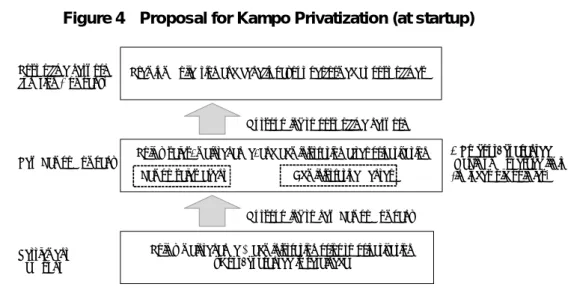
2. Proposal for a New Operating Framework for Kampo Insurance
* No govt. guarantee Maximum coverage limit (includes old policies) Post office network
function (company)
New Kampo company
Settlement account
Outsourcing to post office network
Outsourcing to new Kampo company Premium collection and benefit payout performed at post offices
Policy maintenance & administration prior to privatization (Govt. guarantee is retained)
Policy sales, maintenance, and administration after privatization Administrative center Kampo sales agent
Kampo business (Figure 4).
①
Maintain but reduce maximum coverage limit 13In light of the competitive disparities, maximum coverage must be reduced below the industry-wide coverage levels shown in Figure 2. In particular, the daily hospitalization benefit must be at least halved from the current level. While some would argue against reducing the maximum coverage, the present levels are simply excessive. The negative impact on sales efficiency can be mitigated by shifting Kampo salespersons to the preservation of old policies, and emphasizing government bond sales to individuals.14
②
Separate old from new accounts, and outsource services15As mentioned earlier, old policies issued prior to privatization would be managed by a settlement account, which would in turn outsource policy administration and asset management to the new Kampo company. The new Kampo company would issue and administer new policies (while observing the maximum coverage limit), perform services outsourced by the settlement account, and in turn outsource certain Kampo business functions (including over-the-counter sales) to the post office network (company).
The new Kampo company promises to be a viable concern from the start if it receives fee income from the settlement account, and follows the recent examples of new life insurance companies in policy reserve accumulation.
Figure 4 Proposal for Kampo Privatization (at startup)
13 The maximum amount would count existing policies prior to privatization.
14 The emphasis on government bond sales to individuals also implies a shift from indirect ownership of bonds through
postal savings and postal insurance, to direct ownership.
③
Expand operating freedom as government’s equity stake decreasesAs the government’s equity stake decreases and the new company increasingly resembles private insurers, Kampo should be allowed to expand its product lineup. However, this presumes that an adequate infrastructure exists for underwriting.
5. Conclusion
In preparing the interim report in April, the Council on Economic and Fiscal Policy apparently debated whether to extend the government guarantee on postal savings and postal insurance funds after privatization. That such an obvious matter was debated is quite astonishing.
We have no qualms about the fact that postal savings and postal insurance enjoy strong public support and play an intimate role in daily community life. However, if privatization pursues public convenience at the expense of promoting competition, the public interest will inevitably suffer. Thus it is also vital that appropriate competitive conditions are established.
Meanwhile, as the marketplace evolves, private insurers also must strive to improve their competitiveness, particularly by enhancing sales efficiency and customer satisfaction.