Rule 021
Settlement System Code Rules
This rule as amended was approved by the Alberta Utilities Commission on August 18, 2014, and is effective on August 19, 2014.
Update: version 2.5
This document can be referred to as version 2.5 of AUC Rule 021: Settlement System Code Rules
(Rule 021). Rule 021 is an operational document that defines the business processes and mechanics of how electrical energy settlement is to be carried out at the retail electricity market level in Alberta.
Consequently, a consultative process is used to identify improvements and revisions that are to be made to Rule 021 to keep the rule relevant and reflective of the requirements of the retail electricity market. A working group made up of industry representatives meets regularly to identify changes that are required to be made to Rule 021 and to assign priority rankings to the changes. Subgroups are formed to address the high-priority changes and to make recommendations to AUC staff. AUC staff incorporates any
recommended changes into a draft version of a revised Rule 021. Stakeholders are then provided the opportunity to comment on the draft version to ensure the proposed wording and changes reflect the requirements of the industry. Commission approval is obtained for the revised rule once the industry comments are received and reviewed. Commission approval is sought by the end of the calendar year with implementation during the following year.
This lag between the approval date and the implementation date is to recognize that the approved revisions to Rule 021 will require industry stakeholders to make changes to their business processes and information technology systems in order to be compliant. The lag provides these entities the time to develop, implement and test their internal changes so that there is no disruption in the business processes once the revised changes are to take effect.
Contents
1 Definitions ... 8
1.1 Key terms ... 8
1.2 Common abbreviations ... 12
1.3 List of acts and regulations cited ... 13
2 Responsibilities ... 14
2.1 Application ... 14
2.2 Load settlement responsibility ... 14
2.3 Profile generation ... 14
2.4 Site identification number catalogue ... 14
2.5 Receipt of energize/de-energize requests ... 14
2.6 Estimating missing meter readings and consumption amounts ... 14
2.7 Losses ... 15
2.8 Disclosure and protection ... 15
2.9 Retailer of record... 15
2.10 Estimation and liability for load settlement ... 15
2.11 Provincial reconciliation ... 15
2.12 Request for site ID numbers ... 15
2.13 Review of load settlement processes ... 15
2.14 Timing of meter reads ... 16
2.15 Provision of copies of transactions to the ISO ... 16
2.16 Provision of load settlement–related data to the ISO ... 16
2.17 Compliance monitoring by the ISO ... 16
3 Load profiling methods ... 18
3.1 Profile generation methods ... 18
3.2 Segmentation ... 19
3.3 Profiling cap ... 19
3.4 Customers with interval meters but below the profiling cap... 19
3.5 Micro-generation customers with interval meters ... 19
4 Load settlement calculations ... 20
4.1 Loss calculations ... 20
4.2 Unaccounted-for energy (UFE) ... 20
4.2.1 UFE allocation ... 20
4.2.2 UFE monitoring ... 20
4.3 Load settlement interval ... 22
4.4 Load settlement timing ... 22
4.4.1 General comments ... 22 4.4.2 Daily settlement ... 22 4.4.3 Monthly settlement ... 23 4.4.4 Interim settlement ... 23 4.4.5 Final settlement ... 23 4.4.6 Data revisions ... 23
4.5 Load settlement responsibility for WSPs ... 23
4.6 Load settlement mechanics for special cases ... 24
4.6.1 Distributed generation ... 24
4.6.2 Direct sales agreements ... 24
4.6.3 Retailer decertification ... 25
4.6.4 Micro-generation ... 25
5 Settlement error correction ... 27
5.1 General ... 27
5.2 Pre-final error correction (PFEC) ... 27
5.2.1 Scope ... 27
5.2.2 PFEC process ... 27
5.3 Post-final adjustment mechanism (PFAM) ... 29
5.3.2 Communications ... 29
5.3.3 Materiality threshold and process ... 30
5.3.4 Dispute resolution ... 32
5.3.5 Processing of PFAM adjustments ... 32
5.3.6 Transaction mechanism and file format ... 35
5.3.7 Financial adjustments ... 35
6 Functional requirements of the core load settlement calculation ... 36
6.1 Data versions and revisions ... 36
6.2 Assumptions ... 36
6.3 Load settlement inputs and outputs ... 37
6.4 Required load settlement reports ... 37
6.4.1 Elements required for reporting ... 37
6.4.2 Definition of required elements ... 38
6.4.3 Site specific load settlement reporting ... 42
6.5 Diagnostics ... 43
6.5.1 Required UFE statistics ... 43
6.5.2 Required zero balance check ... 43
6.5.3 System performance diagnostics ... 43
7 Information exchange ... 48
7.1 Business transactions ... 48
7.2 Transaction transport method ... 49
7.3 Electronic transaction content ... 49
7.4 Enrolment mechanics ... 50
7.5 Changes in profiling class ... 51
7.6 Site ID removal from site catalogue ... 51
7.7 Remove load limiter and leave power on ... 51
7.8 Remove load limiter and disconnect power ... 52
7.9 Install load limiter ... 52
7.10 Streetlights ... 52
7.10.1 Streetlight grouping process ... 52
7.10.2 Streetlight information exchange ... 53
8 Standards for load profiles based on load research samples ... 54
8.1 Introduction ... 54
8.2 Estimation accuracy ... 54
8.2.1 Test parameter... 54
8.2.2 Measuring estimation accuracy... 54
8.2.3 Required accuracy level ... 57
8.3 Frame adequacy ... 58
8.3.1 Maximum allowable difference between the sampling frame and target population ... 58
8.3.2 Minimum number of years of historical data ... 58
8.3.3 Maximum age of historical data ... 58
8.4 Sample design and implementation ... 58
8.4.1 Sample design and analysis principles ... 58
8.4.2 Sample implementation principles ... 59
9 Information exchange standards... 60
9.1 Purpose ... 60
9.2 Scope ... 60
9.3 Revisions ... 60
9.4 Universal standards ... 60
9.4.1 Directory structure ... 60
9.4.2 File naming convention ... 60
9.4.5.2 Varchar(x) ... 61
9.4.5.3 Number(p,s) ... 61
9.4.6 Standard fields ... 61
9.4.6.1 Date and date time format ... 62
9.4.6.2 Telephone number format ... 62
9.4.6.3 Time conventions ... 62
9.4.6.4 ID assignments ... 64
9.4.6.5 Retailer and business function IDs ... 64
9.4.6.6 Wire services provider (WSP) ID ... 64
9.4.6.7 Load settlement agent (LSA) ID ... 64
9.4.6.8 Meter data manager (MDM) ID ... 64
9.4.6.9 ISO ID for financial settlement purposes ... 64
9.4.6.10 ISO ID for operational purposes ... 65
9.4.6.11 Settlement zone ID ... 65
9.4.6.12 Site ID ... 65
9.4.6.13 Socket ID ... 66
9.4.6.14 Site ID catalogue transaction (SID) – process rules and content ... 66
9.5 Transaction principles ... 68
9.5.1 Rejected by transaction not by file... 68
9.5.2 No header information ... 68
9.5.3 Transaction will not contain additional fields for custom use ... 68
9.5.4 Transactions will not contain descriptive fields ... 68
9.5.5 Transaction file contents ... 69
9.6 Provincial standard transactions ... 69
9.6.1 Provide current consumption data from MDM ... 69
9.6.1.1 Daily interval meter readings to retailers and LSA transaction (DIM) – process rules and content ... 69
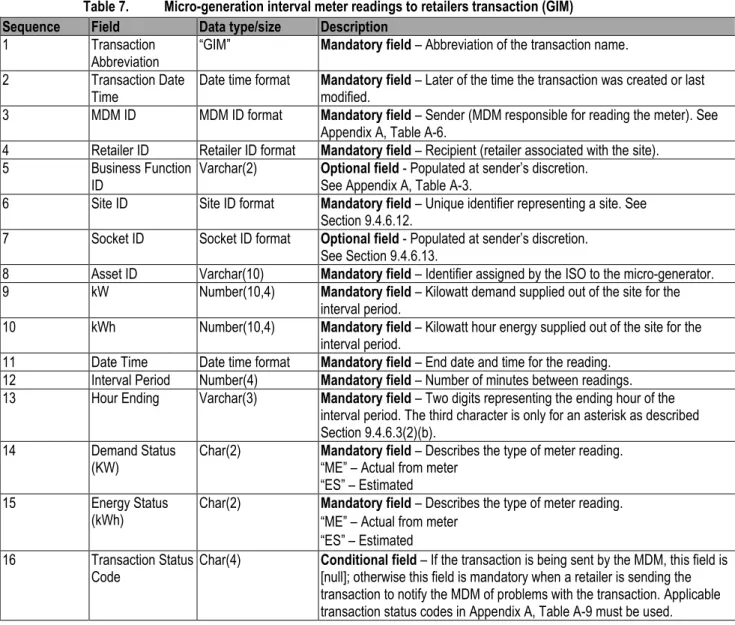
9.6.1.2 Micro-generation interval meter readings to retailers transaction (GIM) – process rules and content ... 70
9.6.1.3 Daily cumulative meter consumption to retailers and LSA transaction (DCM) – process rules and content ... 71
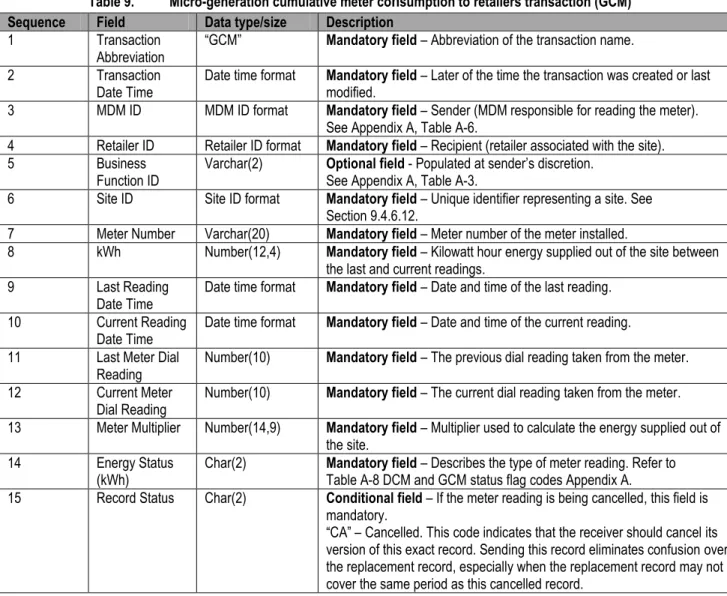
9.6.1.4 Micro-generation cumulative meter consumption to retailers transaction (GCM) – process rules and content ... 74
9.6.2 Wholesale settlement data transfers ... 76
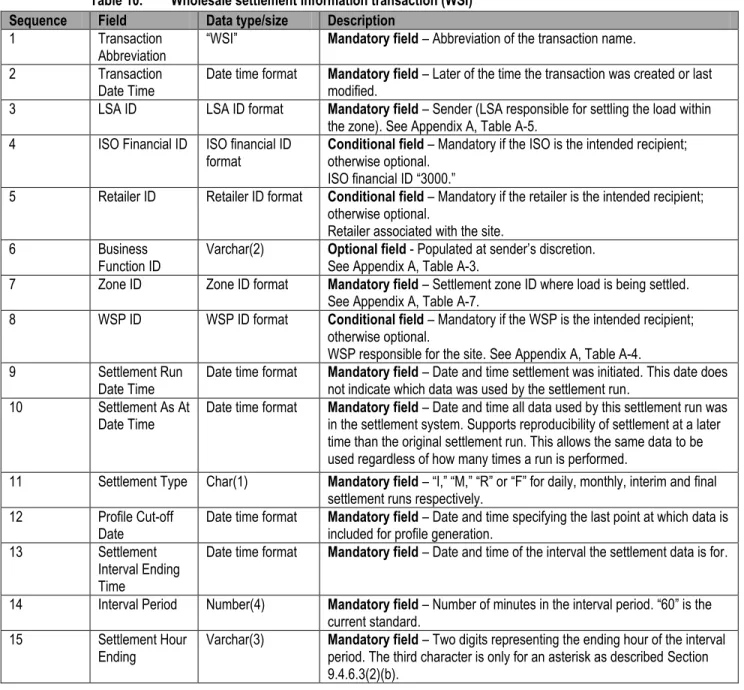
9.6.2.1 Wholesale settlement information transaction (WSI) – process rules and content . 76 9.6.2.2 Settlement summary information transaction (SSI) – process rules and content .... 77
9.6.2.3 Settlement profile information transaction (SPI) – process rules and content ... 78
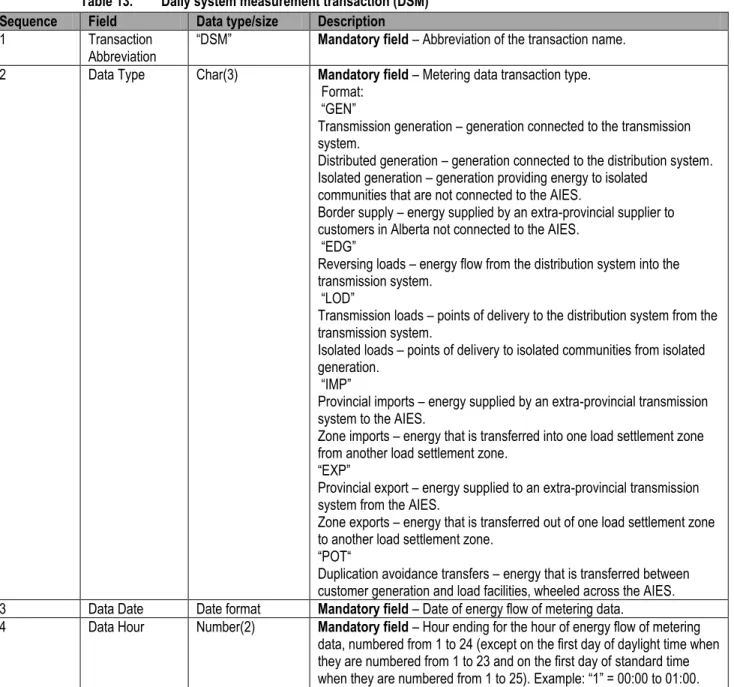
9.6.2.4 System-level measurement data provision ... 79
9.6.2.5 Wholesale settlement summary transaction (WSS) – process rules and content .... 80
9.6.2.6 Wholesale settlement details for retailers own sites transaction (WSD) – process rules and content ... 81
9.6.2.7 Wholesale class information transaction (WCI) – process rules and content ... 82
9.6.3 Select retailer transaction set ... 83
9.6.3.1 Select retailer request transaction (SRR) – process rules and content ... 83
9.6.3.2 Select retailer notification transaction (SRN) – content ... 84
9.6.3.3 Notify old retailer transaction (SRO) – process rules and content ... 84
9.6.3.4 LSA notify wires and MDM transaction (SRW) – content ... 85
9.6.3.5 Micro-generation retailer notification transaction (GRN) – process rules and content ... 85
9.6.4 Update customer information transaction set ... 86
9.6.4.1 Update customer information transaction (UCI) – process rules and content ... 86
9.6.4.2 Request update to customer information transaction (RUC) – process rules and content ... 93
9.6.5 Update site information transaction set ... 94
9.6.5.1 Site metering characteristics transaction (SMC) – process rules and content ... 94
9.6.6 Post-final adjustment mechanism (PFAM) transaction set ... 98
9.6.6.1 Retailer specific adjustment transaction (RSA) – process rules and content ... 98
9.6.6.2 Retailer adjustment to market transaction (RAM) – content ... 99
9.6.6.3 Transmission administrator adjustment transaction (TAA) – process rules and content ... 99
9.6.6.4 Micro-generation retailer summary transaction (GRS) – process rules and content ... 100
9.6.7 Energize/de-energize site ... 101
9.6.7.1 Energize request transaction (ENR) – process rules and content ... 101
9.6.7.2 Energize failure transaction (ENF) – content ... 102
9.6.7.3 Energize completion to retailers and LSA transaction (ENC) – content ... 103
9.6.7.4 De-energize request transaction (DER) – content ... 103
9.6.7.5 De-energize failure transaction (DEF) – content ... 104
9.6.7.6 De-energize completion to retailers and LSA transaction (DEC) – content ... 104
9.6.8 De-select retailer transaction set ... 104
9.6.8.1 De-select request transaction (DSR) – process rules and content ... 105
9.6.8.2 De-select notification transaction (DSN) – process rules and content ... 106
9.6.8.3 Revoke de-select request transaction (RDS) – process rules and content ... 106
9.6.8.4 Revoke de-select notification transaction (RDN) – process rules and content ... 107
9.6.9 Request off-cycle meter read transaction set ... 107
9.6.9.1 Request off-cycle meter read transaction (ROR) – content ... 108
9.6.9.2 Request off-cycle meter read completion transaction (ROC) – content ... 108
9.7 Transaction sets with standard content... 108
9.7.1.1 Revoke de-energize request transaction (RDR) – process rules and content ... 108
9.8 Transaction status codes ... 109
10 Performance standards for meter data managers operating in the province of Alberta ... 110
10.1 Roles and responsibilities ... 110
10.2 Interval meter data performance standards ... 110
10.2.1 Data collection ... 110
10.2.2 Validation, estimation and editing (VEE) ... 110
10.2.2.1 Process overview ... 110
10.2.2.2 Validation of data ... 112
10.2.2.3 Verification of data ... 112
10.2.2.4 Estimation of data ... 112
10.2.2.5 Investigation ... 114
10.2.2.6 Editing of data (data replacement) ... 114
10.2.3 Data storage ... 114
10.2.4 System-level data provision ... 114
10.2.4.1 Daily settlement data provision ... 114
10.2.4.2 Monthly settlement data provision ... 114
10.2.4.3 Interim settlement data provision ... 115
10.2.4.4 Final settlement data provision ... 115
10.2.5 Site-level data provision ... 115
10.2.5.1 Daily settlement data provision ... 115
10.2.5.2 Monthly settlement data provision ... 115
10.2.5.3 Final settlement data provision ... 115
10.2.6 Data performance metrics ... 116
10.2.6.1 System-level data performance metrics... 116
10.2.6.2 Site-level data performance metrics ... 117
10.3 Cumulative meter data performance standards ... 118
10.3.1 Data collection ... 118
10.3.1.1 Data collection cycle ... 118
10.3.2.2 Verification, editing and estimation of data ... 119
10.3.2.3 Investigation and notification ... 120
10.3.3 Data storage ... 120
10.3.4 Data provision ... 120
11 Compliance monitoring standards ... 122
11.1 Overview ... 122
11.1.1 Statements of disclosure ... 122
11.2 Reporting requirements ... 122
11.2.1 Interval metering data reporting requirements ... 122
11.2.2 System performance diagnostic report... 123
11.2.3 Load settlement process reporting requirements ... 123
11.3 Enforcement for non-compliance ... 123
11.3.1 Complaint submission... 123
11.3.2 Complaint submission process ... 124
11.3.3 Compliance investigations ... 124 11.3.4 Enforcement process ... 124 11.3.5 Enforcement assessment ... 126 11.3.5.1 Contravention levels ... 126 11.3.5.2 General principles ... 126 11.3.6 Enforcement action ... 126
11.3.6.1 Level one enforcement actions ... 126
11.3.6.2 Level two enforcement actions ... 127
11.3.6.3 Level three enforcement actions ... 127
11.3.6.4 Level four enforcement actions ... 127
11.3.7 Enforcement escalation ... 127
11.3.8 Withdrawal from enforcement ... 128
11.3.8.1 Withdrawal from levels one through three ... 128
11.3.8.2 Withdrawal from level four ... 128
Appendix A – Supplementary tables ... 130
PFEC application form ... 130
Table A-1 PFAM application form ... 132
Table A-2 Business function ID ... 133
Table A-3 Wire services provider (WSP) ID ... 133
Table A-4 Load settlement agent (LSA) ID ... 134
Table A-5 Meter data manger (MDM) ID ... 134
Table A-6 Settlement zone ID ... 135
Table A-7 DCM and GCM status flags ... 135
Table A-8 Transaction status codes ... 135
Table A-9 MDM reporting metrics template ... 143
Table A-10 System performance diagnostic report ... 144
Table A-11 Transactions timing table ... 144
Table A-12 ENR priority codes ... 146
Table A-13 DER priority codes ... 146
Table A-14 ROR priority codes ... 146
Table A-15 Profile class reference table ... 146
Table A-16 Loss class reference table ... 147
Table A-17 PFAM adjustment reason code table ... 149
Table A-18 Appendix B – Transaction transport mechanism – VLTrader ... 151
B-1 VLTrader software upgrades ... 151
Figures
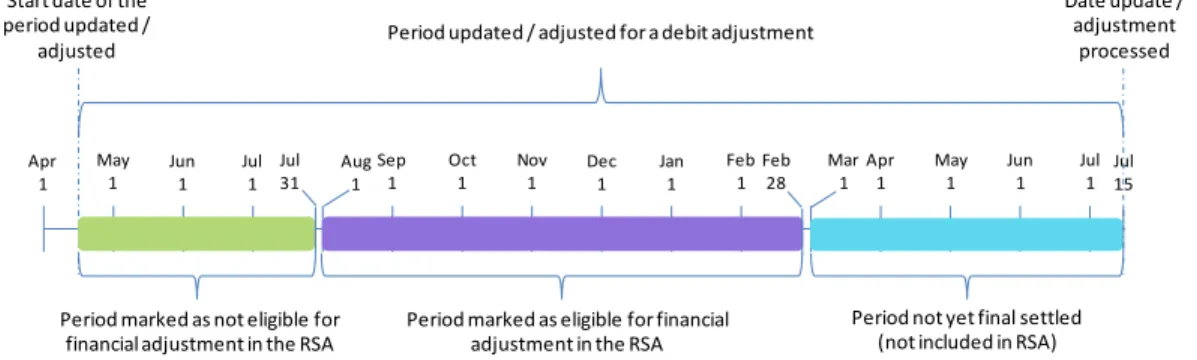
Figure 1. Example of debit PFAM adjustment ... 34
Figure 2. Timelines for de-select retailer transaction set ... 104
Figure 3. VEE overview ... 111
Tables
Table 1. General UFE tolerances ... 21Table 2. Settlement zone-specific UFE tolerances ... 21
Table 3. UFE reasonableness report ... 22
Table 4. Business process flows and transaction sets required for load settlement... 48
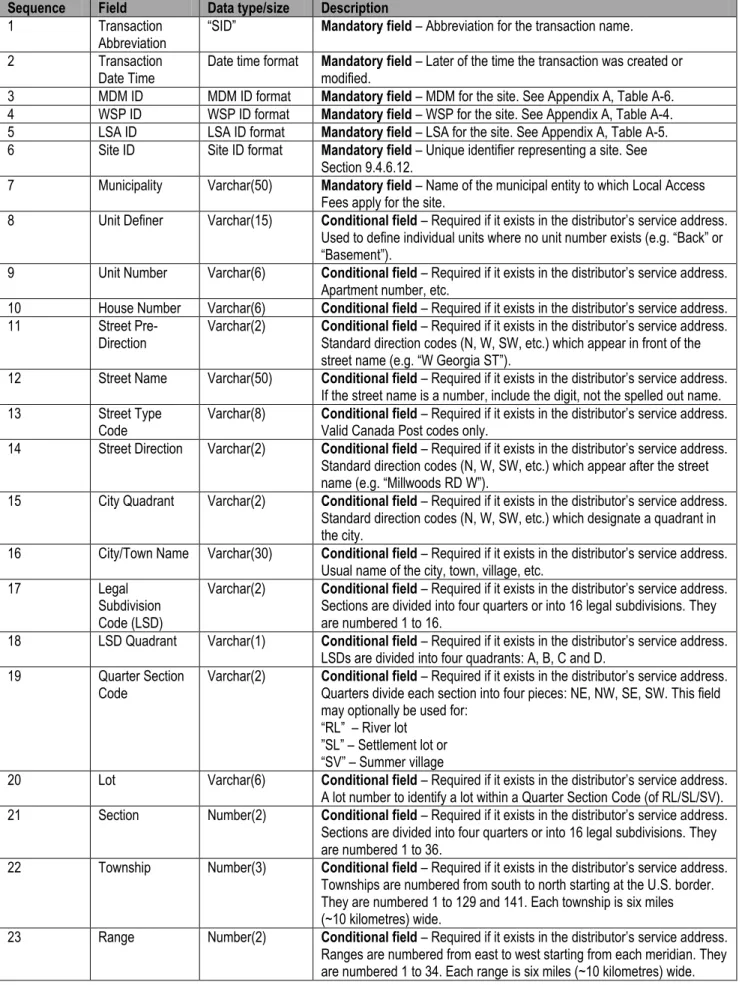
Table 5. Site ID catalogue transaction (SID) ... 67
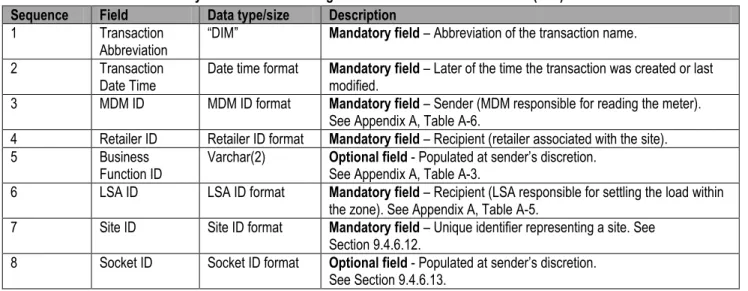
Table 6. Daily interval meter readings to retailers and LSA transaction (DIM) ... 69
Table 7. Micro-generation interval meter readings to retailers transaction (GIM) ... 71
Table 8. Daily cumulative meter consumption to retailers and LSA transaction (DCM) ... 73
Table 9. Micro-generation cumulative meter consumption to retailers transaction (GCM) ... 75
Table 10. Wholesale settlement information transaction (WSI) ... 76
Table 11. Settlement summary information transaction (SSI) ... 77
Table 12. Settlement profile information transaction (SPI)... 78
Table 13. Daily system measurement transaction (DSM) ... 79
Table 14. Wholesale settlement summary transaction (WSS)... 80
Table 15. Wholesale settlement details for retailers own sites transaction (WSD) ... 81
Table 16. Wholesale class information transaction (WCI) ... 82
Table 17. Select retailer request transaction (SRR) ... 83
Table 18. Select retailer notification transaction (SRN) ... 84
Table 19. Notify old retailer transaction (SRO) ... 84
Table 20. LSA notify wires and MDM transaction (SRW) ... 85
Table 21. Micro-generation retailer notification transaction (GRN) ... 86
Table 22. Update customer information transaction (UCI) ... 86
Table 23. Request update to customer information transaction (RUC) ... 93
Table 24. Site metering characteristics transaction (SMC) ... 95
Table 25. Update site address transaction (USA) ... 96
Table 26. Retailer specific adjustment transaction (RSA)... 98
Table 27. Retailer adjustment to market transaction (RAM) ... 99
Table 28. Transmission administrator adjustment transaction (TAA) ... 99
Table 29. Micro-generation retailer summary transaction (GRS) ... 100
Table 30. Energize request transaction (ENR) ... 102
Table 31. Energize failure transaction (ENF) ... 102
Table 32. Energize completion to retailers and LSA transaction (ENC) ... 103
Table 33. De-energize request transaction (DER) ... 103
Table 34. De-energize failure transaction (DEF) ... 104
Table 35. De-energize completion to retailers and LSA transaction (DEC) ... 104
Table 36. De-select request transaction (DSR) ... 106
Table 37. De-select notification transaction (DSN) ... 106
Table 38. Revoke de-select request transaction (RDS) ... 106
Table 39. Revoke de-select notification transaction (RDN) ... 107
Table 40. Request off-cycle meter read transaction (ROR) ... 108
Table 41. Request off-cycle meter read completion transaction (ROC) ... 108
Table 42. Revoke de-energize request transaction (RDR) ... 109
Table 43. Interval metering validation procedures ... 112
1 Definitions 1.1 Key terms
aggregation Aggregation is a collection of particulars into a whole mass or sum; total; combined.
business day A business day has the meaning ascribed to the term “business day” as defined in the ISO Rules and as shown on the Independent System Operator’s (ISO) stakeholder calendar posted on the ISO’s website (www.aeso.ca).
code Code means this Settlement System Code (SSC) rules.
Commission Commission means the Alberta Utilities Commission. commissioned The wire owner declaration of readiness of all relevant site
equipment to perform all required wire owner functions.
customer A customer has the meaning ascribed to the term “customer” in the Electric Utilities Act.
decommissioned Revocation of commission status by the wire owner.
deemed profiles Deemed profiles are pre-specified load shapes agreed to in advance. Commonly, this method has been used for loads, such as street lighting, with predictable, essentially flat shapes. However, a deemed shape could be developed for other applications based on engineering analysis and/or load shapes from other territories. default supplier Default supplier has the meaning ascribed to the term “default
supplier” in the Roles, Relationships and Responsibilities Regulation, 2003.
direct-connect site Direct-connect site is a transmission-connected site that meets the criteria described in Section 4.2.1(3).
distributed generation
Distributed generation has the meaning ascribed to the term “distributed generation” in the Electric Utilities Act.
dynamic estimation Dynamic estimation is a profiling method using load research data from the day of interest.
grouped streetlight Virtual grouping of streetlights (which may be physically disparate) that is represented as a single site ID for billing and settlement purposes.
ISO ISO means the Independent System Operator as defined in the Electric Utilities Act.
large
micro-generation
Large micro-generation has the meaning ascribed to the term “large micro-generation” in the Micro-Generation Regulation. load profile A load profile is a series of load or consumption amounts for each
interval over a particular time period. In this document, the intervals are one hour, so that the profile may be considered either as an average load (kW) or total consumption (kWh) for each interval. The profile may be expressed either as the average per customer or as the total load for each interval.
load profile shape A load profile shape is a normalized load profile. Specifically, the energy consumption in each interval (hour) is expressed as a fraction of the total energy consumption for the time span of the profile. load settlement
agent (LSA)
LSA means the party conducting load settlement calculations for a particular settlement zone.
market participant Market participant has the meaning given the term in the Electric Utilities Act.
measurement data Measurement data is data that has been collected from meters, compensated and aggregated in accordance with the appropriate measurement point definition record (MPDR) and has been subjected to the required validation, estimation and editing (VEE) checks.
measurement point Measurement point has the meaning ascribed to the term “measurement point” as defined by ISO in its Alberta Electric System Operator Measurement System Standard.
measurement point definition record (MPDR)
Measurement point definition record has the meaning ascribed to the term “measurement point definition record” as defined by ISO in its Alberta System Operator Measurement System Standard.
meter Meter has the same meaning as given the term “meter” in the Electric Utilities Act.
metering point Metering point has the meaning ascribed to the term “metering point” as defined by the ISO in its Alberta Electric System Operator Measurement System Standard.
meter data manager (MDM)
An MDM is the entity responsible for collecting metering data, correcting and validating interval metering data, storing historic data, and reporting load and consumption data together with corresponding time periods to appropriate parties.
metering data Metering data is the data associated with a metering point.
metering system A metering system includes all the metering equipment required for the measurement and, if applicable, remote storage of the active energy and reactive energy interval data for a single metering point. micro-generator Micro-generator has the meaning ascribed to the term
“micro-generator” in the Micro-Generation Regulation. month-at-a-time
(MAAT) settlement
MAAT settlement is a process of conducting load settlement for all days of a calendar month at once.
Market Surveillance Administrator (MSA)
Market Surveillance Administrator has the meaning ascribed to the term in the Electric Utilities Act.
net system load shape (NSLS)
NSLS is the shape of a total load of a settlement zone, minus interval metered loads, deemed loads, loads based on specific load-research-based profiling classes and known losses. point-of-delivery A POD is a conceptual point of delivery from the transmission
point-of-supply (POS)
POS is a conceptual point of supply onto the transmission system. A POS is the point at which energy is deemed to be supplied to the transmission system.
profile cut-off date Profile cut-off date is the date past which cumulative meter data received from the MDM cannot be used for calculating a settlement run.
profiling cap A profiling cap or threshold is the size level above which a site is required to have interval-metering data.
profiling class A profiling class is a group of sites that will be settled using a common load profile.
reactive power Reactive power is the portion of electricity that establishes and sustains the electric and magnetic fields of alternating current equipment, usually expressed in kiloVArs (kVAr) or megaVArs (MVAr).
regulated rate provider
Regulated rate provider has the meaning given to the term “regulated rate provider” in the Electric Utilities Act.
retailer Retailer either has the meaning given to the term “retailer” or the term “regulated rate provider” in the Electric Utilities Act, except in those cases where the “regulated rate provider” and the LSA, MDM or wire services provider (WSP) are different parts of the same organization and are not required to exchange transactions as per Section 7.1 of this code, in which case the term “retailer” in the Electric Utilities Act is the only one that applies.
retailer of record Retailer of record is the single retailer (as defined above) that the load settlement system recognizes as serving a given site for a given day.
settlement ready data
Settlement ready data is data that is complete and ready for use in load settlement. Data shall be validated, estimated and edited as outlined in the standards and aggregated or totalized to measurement point data as per the MPDR.
settlement system A settlement system is a computer system and associated operations and interfaces used to determine the load responsibility at each unit of the load settlement interval in accordance with Section 4.3, for each retailer operating within the settlement zone.
settlement timing Settlement timing is the frequency at which load settlement is calculated and reported to the ISO and to retailers by the LSA. settlement zone The settlement zone is the collection of sites that are jointly settled
by a settlement system. small
micro-generation
Small micro-generation has the meaning ascribed to the term “small micro-generation” in the Micro-Generation Regulation. site A site is a unique end-use service delivery point. This is the finest
level at which load settlement recognizes retailer assignments and receives consumption data.
socket A socket is normally a point at which a physical meter is installed, or a point at which a site load is calculated.
streetlight An unmetered light source along a public highway (as defined in the Hydro and Electric Energy Act) that is controlled by a photo sensor and which may constitute one of a series.
system level System level is measurement values needed to describe the total energy flow on the Alberta Interconnected Electric System (AIES) at the transmission level and the inputs and outputs to each and every distribution settlement zone for each hour. It includes
measurements between the transmission system and the distribution system, distribution interchange, distributed generation and amounts delivered to or from border customers, but it does not include generation supplied by small micro-generation.
transmission-connected site
A transmission-connected site is a site that receives electric energy directly from the transmission system but that is not subject to an arrangement with the ISO to obtain system access service directly from the ISO under Section 101(2) of the Electric Utilities Act. unaccounted-for
energy (UFE)
UFE for each hour is the difference between (a) the system total load for the hour and (b) the sum of the allocated hourly loads at the customer meters, plus their allocated losses. All references to UFE in this code refer to UFE on electric distribution systems.
wire owner (WO) Wire owner means the owner of an “electric distribution system” as that term is defined in the Electric Utilities Act.
wire services provider (WSP)
A WSP is a person authorized by an owner of an electric distribution system to act on behalf of that owner.
1.2 Common abbreviations
AIES Alberta Interconnected Electric System AUC Alberta Utilities Commission
CT current transformer
DCM daily cumulative meter consumption to retailers and LSA transaction DEC de-energize completion to retailers and LSA transaction
DEF de-energize failure transaction DER de-energize request transaction DFO distribution facility owner
DG distributed generation – includes micro-generation DI distribution interchange
DIM daily interval meter readings to retailers and LSA transaction DSM daily system measurement transaction
DSN de-select notification transaction DSR de-select request transaction EDG excess distribution generation
ENC energize completion to retailers and LSA transaction ENF energize failure transaction
ENR energize request transaction
GCM micro-generation cumulative meter consumption to retailers transaction GIM micro-generation interval meter readings to retailers transaction
GRN micro-generation retailer notification transaction GRS micro-generation retailer summary transaction HE hour-ending label
ID identifier
LSA load settlement agent MAAT month-at-a-time MDM meter data manager MDP meter data provider MP measurement point
MPDR measurement point definition record MSP meter service provider
MSS measurement system standard NSLS net system load shape
PFAM post-final adjustment mechanism PFEC pre-final error correction
POD point-of-delivery POS point-of-supply POT point-of-transfer PT potential transformer
RAM retailer adjustment to market transaction RDS revoke de-select request transaction RDN revoke de-select notification transaction RDR revoke de-energize request transaction REA rural electrification association
ROC request off-cycle meter read completion transaction ROR request off-cycle meter read transaction
RRP regulated rate provider
RSA retailer specific adjustment transaction
RUC request update to customer information transaction SMC site metering characteristics transaction
SPI settlement profile information transaction SRN select retailer notification transaction SRO notify old retailer transaction
SRR select retailer request transaction SRW LSA notify wires and MDM transaction
SSC AUC Rule 021: Settlement System Code Rules SSI settlement summary information transaction TA transmission administrator
TAA transmission administrator adjustment transaction TBC tariff bill code
TFO transmission facility owner TX transmission
UCI update customer information transaction USA update site address transaction
UFE unaccounted-for energy
UTC Coordinated Universal Time, Temps Universel Coordonné – the international time standard (formerly Greenwich Mean Time, or GMT). Zero hours UTC is midnight at 0 degrees longitude.
VEE validation, estimation and editing
WO wire owner
WSD wholesale settlement detail for retailers own sites transaction WSI wholesale settlement information transaction
WSP wire services provider
WSS wholesale settlement summary transaction 1.3 List of acts and regulations cited
Alberta Utilities Commission Act, SA 2007, c. A-37.2, as amended Electric Utilities Act, SA 2003, c. E-5.1, as amended
Micro-Generation Regulation, AR 27/2008, as amended Regulated Rate Option Regulation, AR 262/2005, as amended
Roles, Relationships and Responsibilities Regulation, 2003, AR 169/2003, as amended Transmission Regulation, AR 86/2007, as amended
Electricity and Gas Inspection Act, RSC 1985, c. E-4, as amended Electricity and Gas Inspection Regulations, SOR/86-131, as amended
2 Responsibilities 2.1 Application
All market participants are required to comply with this AUC Rule 021: Settlement System Code Rules (code).
The following responsibilities are identified for load settlement agents (LSAs), wire services providers (WSPs) and meter data managers (MDMs). These functional distinctions, or others indicated in subsequent sections, identify separate roles, responsibilities and protections in cases where these functions are performed by separate entities. However, in cases where all these functions are performed within the same business entity, these terms are descriptive only and are not prescriptive of implementation flows within the bundled WSP acting as LSA for its own customers.
2.2 Load settlement responsibility
Generally, this code refers to load settlement as being a function of the WSP not the wire owner (WO). In most cases, the WO and WSP are the same. In cases where the WO does not select a WSP, this code considers the WO to be the WSP. In cases where the WO is not the WSP for its customers, this code assigns load settlement responsibility to the WSP. That is, the WSP not the WO will be the LSA in such cases.
2.3 Profile generation
Development of load profiles is an LSA function. This function includes:
(1) Calculation of the net system load shape (NSLS) profiles.
(2) Calculation of deemed profiles.
(3) Load research sample design and implementation.
(4) Generation of class profiles based on load research data using methods that satisfy the profile generation standards.
2.4 Site identification number catalogue
Maintaining the catalogue of site identification numbers (site IDs), LSA identification numbers (LSA IDs) and the addresses where electricity service is provided (service addresses) are WSP responsibilities. The WSP will provide market participants 30 days’ notice of a change in location of the catalogue on its website.
2.5 Receipt of energize/de-energize requests
Energize and de-energize requests initiated by the customer or the retailer go from the retailer to the WSP. A WSP may energize or de-energize a site without a request from the retailer for reasons that include equipment testing, safety and requests from public protective services. 2.6 Estimating missing meter readings and consumption amounts
(1) Responsibility for filling in estimates for missing values in interval data series rests with the MDM as set out in Section 10.2.2.
(2) If MDM standards for no gaps in interval and POD level data are not met (see Section 9.6.1.1 and Section 2.6(1) above), LSAs can estimate missing intervals for interval and POD level data.
(3) The LSA shall estimate consumption amounts for cumulative meters where these are needed according to the following:
(a) Daily energy consumption of daily settlement (as described in Section 4.4).
(b) When an actual meter read is absent when any MAAT settlement is calculated.
(4) For a site for which there is no prior consumption history, the WSP is responsible for creating the initial estimate of energy consumption as per the WSP process.
(5) The MDM is responsible for estimating consumption amounts for cumulative meters according to the specific circumstances in Section 10.3.2.2.
2.7 Losses
(1) The LSA is responsible for calculating distribution losses, establishing the formulas for allocating those losses to sites and implementing those formulas as part of the load settlement process.
(2) Allocated losses are included in the hourly load calculated for each retailer by load settlement.
2.8 Disclosure and protection
The LSA shall make publicly available (on its website) the procedures and methods used to conduct load settlement, including formulas, common parameter values and system-level data. The LSA must also make available to individual parties data specific to those parties. The LSA shall not make publicly available data specific to individual parties.
2.9 Retailer of record
The LSA recognizes only one retailer of record for a particular site on a particular day and the LSA will only allocate energy to the retailer of record.
2.10 Estimation and liability for load settlement
Responsibility for conducting daily, monthly, interim and final settlements (as described in Section 4.4) is part of the WSP’s mandated responsibility as the LSA. WSPs are not liable for the financial consequences of errors in estimates developed and provided to interested parties as part of their good-faith performance of these tasks.
2.11 Provincial reconciliation
The Independent System Operator (ISO) is responsible for reconciling the total provincial supply and load. To ensure the ISO can carry out this task, each stakeholder and market participant must provide any generation and load data to the ISO that the ISO requests. 2.12 Request for site ID numbers
(1) Retailers must provide a list of the customer’s site IDs with the customer’s bill or provide the site IDs in an electronic format to the customer at the time of the customer bill.
(2) Customer requests for the site ID must be responded to within two business days. 2.13 Review of load settlement processes
of an LSA’s load settlement processes or load settlement engine. For both the annual review and independent external review, the auditor’s findings and management responses must be made available to the Commission and to the ISO. Subject to the AUC Rule 001: Rules of Practice, as applicable, the auditor’s findings and management responses will be considered by the Commission and by the ISO to be confidential information.
2.14 Timing of meter reads
Times refer to times on the prevailing local clock, standard or daylight time depending on the season, using a 24-hour clock. The hours, minutes and seconds 23:59:59 refer to the second before midnight, and the next second is 00:00:00 of the next day.
Each WSP has the option of reporting the time of day for meter readings as the actual meter read time or as a consistently deemed meter read time between 00:00:00 and 23:59:59 on the date that the meter was read. The same deemed timing will apply to energize and de-energize. 2.15 Provision of copies of transactions to the ISO
(1) Each market participant that provides a transaction identified in Section 9 of this code (excluding Section 9.6.2.4) to another market participant shall securely transmit a copy of that transaction to the compliance group of the ISO as per Appendix B.
(2) Each transaction copy must be provided to the ISO on the same day the market participant provides the original transaction to the intended market participant recipient.
(3) Each market participant shall work with the ISO to ensure that the foregoing data transfer communication is set up and tested to the ISO’s satisfaction in order to achieve the objectives specified in Section 2.15(1) above.
2.16 Provision of load settlement–related data to the ISO
The ISO may request a market participant to provide it with any data related to load settlement. A market participant receiving such a request is required to deliver this data to the ISO within a reasonable period.
All data requests made by the ISO under these rules of any market participant shall also be copied to the Commission at the same time as the request is made
.
2.17 Compliance monitoring by the ISO
The ISO is responsible for monitoring the following:
(a) Reports produced by MDMs and LSAs in accordance with the Section 11.
(b) All other market participants’ self-reporting relevant to the code, including cumulative meter reading performance metrics reported in the AUC Rule 002: Service Quality and Reliability Performance Monitoring and Reporting for Owners of Electric Distribution Systems and for Gas Distributors.
(c) Compliance of market participants with the requirements of the code in general and particularly focusing on any areas of the code that the Commission may identify as a priority to the ISO.
If the ISO identifies non-trivial discrepancies between
(i) information contained in any reports prepared under sections 2.17(a) and (b) above and
the ISO must refer the matter to the Commission. For all other instances when the ISO suspects that an infraction has occurred, the ISO will follow the compliance investigation procedures as defined in Section 11.
3 Load profiling methods
3.1 Profile generation methods (1) Acceptable methods
(a) Net system load profile.
(b) Dynamic estimation from load research samples.
(c) Any load-research-based method that meets the accuracy standards defined in Section 8.
(d) Deemed profiles, limited to loads described under Section 3.1(3) below.
The accuracy requirements specified in Section 8 apply to profiling classes based on load research samples used for final settlement. The same profiling methods shall be used for monthly and interim settlement runs.
(2) Calculation of net system load shape (NSLS)
(a) Net system load (NSL)
Load settlement systems must have the capability to accommodate profiling classes split from NSLS, based on load research or deemed methods. The NSL shall be calculated for each hour as:
NSL = (Total system load) – [(Sum of interval metered customers) + (Sum of deemed loads) + (Sum of loads for load-research-based profiled classes) + (Sum of known losses)]
(b) NSLS
NSLS for a period is calculated by dividing the hourly NSL by the sum over hours in the period of the NSL.
(c) Known losses
The calculation of known losses for subtraction from the NSLS depends on the loss calculation procedures. As specified in Section 4.1, the procedures for calculating and allocating losses are to be determined by each LSA. One possible approach involves the calculation of the total system loss, with subsequent allocation of this total to customer groups based on the known or estimated loads of those groups. With this approach, the total system loss is known before the NSLS is calculated, but the losses associated with the individual load components subtracted to calculate the residual may not be. In this case, the total system loss is subtracted from the system load in calculating the residual. Another common approach is to develop a set of loss multipliers for different groups of customers and time periods. With this approach, the total system loss is not known prior to calculation and application of the residual profile, but losses for the load components subtracted from the system total are known. In this case, these known losses are subtracted from the residual.
(d) Total loads for load research-based profiling classes
For purposes of calculating NSL, the total load research-based profiling classes will be calculated by applying appropriate sample expansion factors (such as the ratio of population count to sample size) to the load research sample.
(a) Regardless of what general load profiling method is used, the unmetered loads should be handled by a deemed shape and estimated consumption.
(b) The deemed shapes and magnitudes will be calculated by each LSA using its existing methods.
(c) Both metered and unmetered irrigation, gas and oilfield pumping accounts will be profiled using a deemed profile. For all other metered accounts, the energy amount will be based on meter readings.
3.2 Segmentation
(1) LSAs may not create new profiling classes. Each LSA will specify publicly the existing rate classes for which separate load research-based profiles may be provided.
(2) Procedures for creating new profiling classes may be developed in consultation with stakeholders, including WSPs, retailers and consumers.
(3) Retailers (or other market participants) will pay for the costs of creating those profiling classes they request.
3.3 Profiling cap
(1) The profiling cap is two megawatts (MW) or the WSP’s current policy, whichever is lower. WSPs must specify their current policy publicly (on their websites).
(2) The WSP has an obligation to provide interval meters to customers who request them for as long as metering remains a WSP responsibility. Costs recovery terms are specified by each WSP’s terms and conditions of service.
3.4 Customers with interval meters but below the profiling cap
The following rules apply to customers who have interval meters but are below the cap at which interval metering is required:
(1) If the customer is part of its profiling class load research sample, the customer is always settled according to the class profile, not according to its own interval data.
(2) If the customer is not part of its profiling class load research sample, the customer is always settled according to its own interval data, not according to the class profile. 3.5 Micro-generation customers with interval meters
(1) If the wire owner complies with the request of a small micro-generation customer to install a bi-directional interval meter, or if the customer’s load is above the WSP’s current profiling cap policy, the customer’s micro-generation is deemed to be large
micro-generation, and the customer’s load is settled according to its own interval data.
(2) If the wire owner installs a bi-directional interval meter on a small micro-generation site for some reason other than the customer’s request, it is deemed to be small
micro-generation and the generation is excluded from load settlement calculations. The MDM is responsible for the micro-generation cumulative meter consumption to retailers transaction (GCM) provision. In addition, notwithstanding Section 3.4(2), the customer’s load is settled according to the class profile, not according to its own interval data. The MDM will provide cumulative site consumption using daily cumulative meter
4 Load settlement calculations 4.1 Loss calculations
(1) WSPs calculate losses and develop loss allocation formulas to be used in load settlement. Those who have been doing such calculations and developing loss allocation formulas as part of cost-of-service studies should continue to use similar methods to those they have been using. Those WSPs who have not conducted such calculations in the past
(mainly smaller municipal WSPs) will calculate losses empirically from the difference between energy flow at the points of distribution and at the points of end use.
(2) Loss calculation procedures and specific factors used in the calculations will be clearly reported to retailers and to client WSPs at all times. Any changes to these procedures will be announced 90 days in advance to allow retailers reasonable time to adjust their supply and sales contracts.
(3) In cases where one WSP conducts load settlement on behalf of another WSP under the terms of Section 4.5, the loss calculation is the responsibility of the LSA. In particular, the WSP that conducts load settlement for a rural electrification association’s (REA)
customers, served by the WSP’s PODs, is responsible for developing the loss allocation formulas that will apply to those customers. The loss calculation and allocation
procedures in such cases must be transparent and must be applied consistently for all customers in the settlement zone. Consistency does not require that the same loss allocation parameters must apply to all customers, but that the form of the allocation and the basis for determining its parameters must be the same for all customers.
(4) When load settlement is performed by the LSA on behalf of another WSP, the loss calculation is subject to regulatory oversight. This oversight governs the confidentiality of data from the WSP used by the LSA and the fairness of the loss formulas developed by the LSA.
4.2 Unaccounted-for energy (UFE) 4.2.1 UFE allocation
(1) The calculated UFE for each hour will be allocated across all sites of all retailers in proportion to their settlement calculation of load, excluding UFE, but including allocated losses.
(2) Despite Section 4.2.1(1) above, sites that meet the following criteria will not be allocated UFE effective January 1, 2002 provided that:
(a) The energy flow to the site is calculated from the measurements of one or more interval meters.
(b) The same measurements and calculations, referred to in Section 4.2.1(2)(a) above, are used by the ISO to determine energy flow at a POD for transmission system access service.
(3) Sites that meet the criteria in Section 4.2.1(2) above are defined as direct-connect sites. 4.2.2 UFE monitoring
(1) UFE monitoring rules
(a) Testing for UFE reasonableness is to be done on daily averaged UFE data for all settlement runs in accordance with Section 4.4 for LSAs using the NSLS profiling methodology.
(b) For LSAs not utilizing the NSLS profiling methodology, testing and reporting will be on monthly average UFE data, and thereby excluding the daily reporting and testing requirement.
(c) When UFE is outside the tolerances described in Section 4.2.2(2), the LSA will investigate the variance and will report to the market on its website.
(d) LSAs shall report as described in Section 4.2.2(1)(c) above, within three business days of the provision of load settlement results.
(e) Errors identified as part of the investigation, shall be corrected prior to the next settlement run, or in accordance with other error-correction standards outlined in this code.
(2) UFE tolerances
(a) For UFE to be considered reasonable, and thus not requiring action by the LSA as described in Section 4.2.2(1)(c), daily or monthly average UFE for all settlement runs in accordance with Section 4.4, within each settlement zone, must fall within both the general UFE and settlement zone-specific UFE tolerances outlined below.
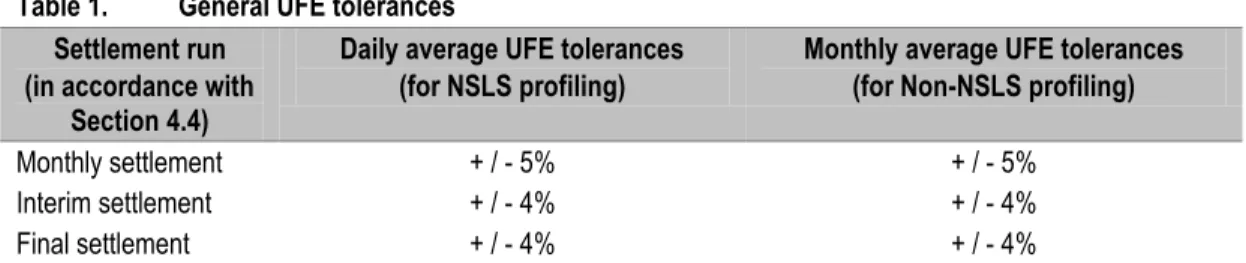
(b) General UFE tolerances: average daily or monthly UFE for all settlement runs and settlement zones must fall within the following tolerances to be considered reasonable:
Table 1. General UFE tolerances Settlement run
(in accordance with Section 4.4)
Daily average UFE tolerances (for NSLS profiling)
Monthly average UFE tolerances (for Non-NSLS profiling)
Monthly settlement + / - 5% + / - 5%
Interim settlement + / - 4% + / - 4%
Final settlement + / - 4% + / - 4%
(c) Settlement zone-specific UFE tolerances: average daily or monthly UFE must fall within the following tolerances around the average zone UFE for each settlement zone to be considered reasonable:
Table 2. Settlement zone-specific UFE tolerances Settlement run
(in accordance with Section 4.4)
Daily average UFE tolerances (for NSLS profiling)
Average Monthly UFE tolerances (for Non-NSLS profiling)
Monthly settlement + / - 4% + / - 4%
Interim settlement + / - 3% + / - 3%
Final settlement + / - 2% + / - 2%
(d) The average zone UFE for each settlement zone for a particular year will be determined every January of that year by the ISO utilizing the settlement data for such zone from the previous year and will then be made available to all market participants.
(3) Reporting requirements
(a) The UFE exception report, described in Section 4.2.2(5), shall be posted on the LSA’s website in Adobe Acrobat format.
(c) The reports are to contain 12 months of rolling data for daily, monthly, interim and final settlement runs in accordance with Section 4.4.
(4) File naming convention
File names shall use the following naming convention: LSA ID_ZoneID_UFEReporting.pdf
(5) UFE reasonableness exception report
The LSA shall provide the following information when UFE is found to be outside of the tolerances described in Section 4.2.2(2):
Table 3. UFE reasonableness report
UFE reasonableness reporting Last revision date:
Period (Day / Month)
Date
Identified TEST 1 General
TEST 2 LSA Average Settlement Run (in accordance with Section 4.4)
Type of Error Status Date
Resolved Comments Date Identified by the LSA Outside of Overall Bound (mark with 'x') Outside of LSA-specific bound (mark with 'x') I=Daily M=Monthly R=Interim F=Final S=System-level I=Interval C=Cumulative D=Deemed O=LSA Operational U=Unidentified (1) Open – LSA (2) Open – Other (3) -Resolved
Date when LSA or other responsible party has resolved the issue
4.3 Load settlement interval
Load settlement is required at one-hour intervals. New components of load settlement systems should be designed to accommodate quarter-hourly settlement data. An update of old
components may be deferred until quarter-hourly results are required. 4.4 Load settlement timing
4.4.1 General comments
(1) There are four settlement runs for each day of flow. The specific timing and data requirements for daily, monthly, interim and final load settlements are described below. For each day settled, the load settlement system will provide each of these four
calculations of load settlement.
(2) LSAs shall publish load settlement results only once for each mandated settlement run.
(3) The ISO may order rerunning of monthly, interim or final settlement runs. 4.4.2 Daily settlement
(1) Daily settlement will be calculated utilizing the latest measurement data received as of 23:59 on the third business day following the day of flow. The LSA may choose to use cumulative meter reads in daily settlement.
(2) LSAs will provide daily settlement results to the ISO and retailers by 23:59 on the fifth business day after the day of flow.
4.4.3 Monthly settlement
(1) Monthly settlement will be calculated utilizing the latest measurement data received as of 23:59 on the seventh business day following the last day of the month to be settled.
(2) LSAs will provide monthly settlement results to the ISO and retailers by 23:59 on the 10th business day after the end of the month being settled.
4.4.4 Interim settlement
(1) Interim settlement will make use of consumption amounts for all completed meter reading periods as of 23:59 of the 12th business day of the second month following the month being settled, subject to the restrictions on profile cut-off dates and profile freezing described in Section 6. For customers for which a meter reading is not available covering all days to be settled, the energy consumption amounts will be estimated by the LSA as described in Section 2.6.
(2) The LSA will provide interim settlement results to the ISO and retailers by 23:59 on the 15th business day of the second month following the month being settled.
4.4.5 Final settlement
(1) Final settlement will make use of consumption amounts for all completed meter reading periods as of 23:59 of the fifth-last business day of the fourth month following the month being settled, subject to the restrictions on profile cut-off dates and profile freezing described in Section 6. For customers for which a meter reading is not available covering all days to be settled, the energy consumption amounts will be estimated by the LSA as described in Section 2.6.
(2) The LSA will provide final settlement results to the ISO and retailers by 23:59 on the second-last business day of the fourth calendar month following the month being settled. 4.4.6 Data revisions
Data revisions to date are incorporated at the monthly, interim and final settlement. No further data changes are incorporated after final settlement. LSAs are not responsible for tracking and storing data versions between monthly and interim settlement. LSAs store or maintain
reproducibility for all the data used for each load settlement run: daily, monthly, interim and final.
4.5 Load settlement responsibility for WSPs
(1) Load settlement responsibility is assigned to the LSA which is a monopoly function of a WSP. A WSP is the LSA for all sites to whom its wires tariff applies that are eligible for enrolment with a retailer. In the case where a non-REA WSP’s wires tariff applies to a site in addition to a REA’s wires tariff, the non-REA WSP is the LSA for that site. The REA will provide consumption data and other site information to the LSA for load settlement and the LSA will provide aggregated load settlement information for the REA sites.
(2) Each WSP will assign all the sites for which it is the LSA to one or more settlement zones in accordance with its disclosures described in Section 11.1.1(4). A site can be assigned to one and only one settlement zone.
outside Alberta. For the purpose of assigning a WSP’s service territory to settlement zones, these areas will be deemed to be part of the WSP’s service territory.
(4) WSPs require regulatory approval to change the rules by which their service territory and the sites for which they are the LSA are assigned to settlement zones.
(5) The monopoly right and responsibility of one WSP to conduct load settlement for another WSP is subject to regulatory controls related to system transparency and information access and pricing of the load settlement service. Transparency of methods and procedures is a general requirement of the load settlement procedures. In particular, a client WSP must have access to load settlement-related information on its own customers.
(6) Data provided to the LSA by the client WSP for purposes of load settlement must be used by the LSA for settlement purposes only, unless the client WSP authorizes other uses. 4.6 Load settlement mechanics for special cases
4.6.1 Distributed generation
(1) Distributed generation includes all generation facilities connected to the distribution system capable of supplying energy onto the distribution system and includes but is not limited to wind power and small hydro and flare gas generation. Micro-generation is exempt from Section 4.6.1(2). Small micro-generation is also exempt from
Section 4.6.1(3).
(2) All distributed generation sites must have interval metering to measure the energy supplied onto the distribution system, unless specifically excluded by the ISO. All distributed generation sites capable of consuming energy must have a site ID and a cumulative or interval meter. Specific metering configurations are at the discretion of each WSP. If the WSP does not own the metering systems, arrangements must be made by the distributed generation owner to deliver all data requirements defined by the WSP.
(3) The load settlement procedure for distributed generation is the following:
(a) For each quarter-hour interval, the MDM must determine if the site as a whole is consuming energy from the distribution system or generating energy onto the distribution system. When the site is consuming energy it is a net positive load. When the site is generating energy, it is net positive generation.
(b) For each hour, net positive loads and net positive generation are each summed over the four quarter-hour intervals to give hourly net positive load (kWh) and net positive generation (kWh). These are the data provided to load settlement for the site.
(c) The hourly net positive generation is added to the POD totals as part of the zone load (ZPOD).
(d) The hourly net positive load is settled in the same way as for any other site. 4.6.2 Direct sales agreements
The LSA allocates the energy consumed at a site using the same methods as for any other site, whether or not the site has a registered direct sales agreement. Each site must have a retailer. The LSA will treat direct-seller sites connected to the distribution system as distribution generation sites.
4.6.3 Retailer decertification
(1) In the event that a retailer is decertified, the person responsible for the decertification will notify all WSPs promptly.
(2) The load settlement process is not affected by the decertification. The hourly loads will still be calculated for the decertified retailer. The settlement data for the decertified retailer will go to the retailer’s receiver or designate.
(3) Customers who switch from the decertified retailer will be handled like any other switched customers.
4.6.4 Micro-generation
This section addresses load settlement for micro-generation sites.
(1) Micro-generation overview
(a) For all micro-generation sites:
(i) The site ID used to identify a unique end-use service delivery point will also be used to identify a micro-generation site.
(ii) Micro-generation sites are subject to retailer enrolment based on existing code procedures and transactions that reference site ID. (Micro-generation is not enrolled and de-enrolled separately from the site.)
(iii) Micro-generation sites are subject to energization and de-energization based on existing code procedures and transactions that reference site ID. (Micro-generation is not energized and de-energized separately from the site.) (iv) In the event the retailer receives written confirmation from the micro-generation
customer, the retailer will make a micro-generation retirement request to the WO. The WO will follow up according to its practices, issue a micro-generation retailer notification transaction (GRN) indicating the micro-generator’s site is decommissioned and change the micro-generation indicator for the site in the site ID catalogue transaction (SID).
(v) The WO will indicate which sites are commissioned micro-generation sites using the SID.
(b) For large micro-generation sites:
(i) There is a one-to-one relationship between site ID (load) and asset ID
(generation) for micro-generation. Neither changes are allowed once assigned to the site.
(ii) The MDM will provide interval data to the LSA and ISO using daily system measurement transactions (DSMs).
(iii) The MDM will provide interval data to retailers using micro-generation interval meter readings to retailers transactions (GIMs).
(iv) There is no requirement for retailers to provide information to the ISO to enable the ISO to credit retailers for large micro-generation.
(v) Large micro-generation is subject to the same pre-final error correction (PFEC) and post-final adjustment mechanism (PFAM) rules applicable to system-level
(c) For small micro-generation sites:
(i) The MDM will provide cumulative data to retailers using GCM transactions. (ii) Small micro-generation is not subject to PFEC and PFAM rules as it is not
included in load settlement. For small micro-generation errors identified by the MDM or the LSA, the MDM must cancel and replace the data provided
previously per sections 9.6.1.4 and 9.6.6.4; for errors identified by other parties, the PFEC and PFAM application forms shown in Appendix A can be completed and submitted to the LSA to initiate the correction process.
(iii) For a site that switches retailers between two meter readings, each retailer will determine the energy supplied out of the site while the site was enrolled to them by pro-rating the energy supplied out of the site in the meter reading period in proportion to the number of days the site was enrolled to them in accordance with the MDM’s published deemed time rules.
(iv) Cumulative meter reads are not required on monthly boundaries. Although there is no requirement for both sites’ load and generation meter registers to be read on the same day, WOs must make reasonable effort to take reads from all cumulative micro-generation sites at least once in each calendar month. (v) The MDM shall provide data in GCM records as specified in Section 9.6.1.4 to
retailers no later than the eighth business day from the date of the meter read.
(2) Micro-generation setup processes
(a) For all micro-generation sites:
(i) The micro-generation customer fills out an application form (with site ID) and provides it to the WO. The WO returns the application to the micro-generator who can use the approved application form to notify their retailer.
(b) For large micro-generation sites:
(i) Micro-generation applications are sent by the WO to the ISO who returns it to the WO with the assigned asset ID.
(ii) The ISO will develop MPDRs for large micro-generation.
5 Settlement error correction 5.1 General
Procedures for the identification and correction of errors pursuant to the code are set out below. No party may opt out of specific requirements and procedures herein pertaining to code-related disputes.
5.2 Pre-final error correction (PFEC) 5.2.1 Scope
(1) The purpose of the PFEC process is to establish a formal mechanism to correct eligible errors before final settlement and ultimately to improve load settlement results before final settlement.
(2) Errors which are eligible for correction through the PFEC process are settlement-related errors and meter-related errors.
(3) Settlement-related errors include but are not limited to energize/de-energize, enrolment, calculation (e.g. WSD not equal to DIM) and site characteristics (e.g. loss class, profiling class, direct-connect status) errors.
(4) Meter-related errors include and are limited to system-level and site-level meter errors.
(5) The lack of a meter read shall not be the basis for a PFEC application.
(6) The LSA will make an effort to ensure a PFEC application is investigated and any error is corrected prior to final settlement.
5.2.2 PFEC process
(1) A PFEC may be commenced by a retailer, the ISO or the LSA upon identification of an error and is initiated by the filing of a PFEC application form (see Appendix A, PFEC application form).
(2) A party other than the LSA who files a PFEC application form is referred to as an applicant.
(3) Where the applicant identifies an alleged error, the applicant may submit a PFEC application form, with Part 1 completed, to the LSA responsible for the relevant load settlement area. The PFEC application form shall be submitted via email, in prescribed format, with all required information. Additional information may be included or attached as deemed necessary by the applicant.
(4) Where the LSA identifies an alleged error, the LSA may complete Part 1 of the PFEC application form and may include or attach additional information as it deems necessary.
(5) Upon receiving or completing Part 1 of a PFEC application form, the LSA shall assign a unique PFEC reference number to the PFEC application form for tracking and processing purposes.
(6) Within two business days of receiving or completing Part 1 of the PFEC application form, the LSA shall send a notice of receipt or issuance of the PFEC via email to the retailer and, where the ISO is the applicant, to the ISO.
(b) advise whether the LSA, MDM or WSP will be conducting the investigation
(c) contain the PFEC application form where the retailer is not the applicant
(8) In the case of meter-related errors, the LSA shall forward for investigation the PFEC application form to the MDM or WSP, as applicable, at the same time as it sends the notice as per Section 5.2.2(7).
(9) Where the MDM or WSP receives a PFEC application form and disagrees with the LSA’s classification of an error as a meter-related error, the MDM or WSP shall return the PFEC application form to the LSA explaining its reasons for disagreement within two business days of receiving it. The LSA shall then conduct an investigation and may request information from the MDM or WSP. The MDM or WSP shall provide the requested information to the LSA within two business days of receiving a request.
(10) In the case of settlement-related errors, the LSA shall undertake an investigation.
(11) Where the LSA finds that Part 1 of the PFEC application form contains deficiencies, such as errors, omissions or incomplete information, and therefore is unable to complete an investigation of the alleged error, the LSA shall advise the retailer and, where the ISO is the applicant, the ISO, via email, of the deficiencies within two business days of sending the notice as per Section 5.2.2(7). The investigation may be suspended until the LSA is in receipt of an amended PFEC application form addressing all deficiencies to allow the LSA to perform the investigation.
(12) The retailer and, where the ISO is the applicant, the ISO shall, upon being notified of the deficiencies, resubmit the PFEC application form within two business days to the LSA. All deficiencies shall be addressed in the amended PFEC application form which shall include the PFEC reference number originally assigned to it by the LSA as per Section 5.2.2(5).
(13) Part one of the PFEC application form is deemed complete on the date when the LSA receives, to its satisfaction, a PFEC application form with any and all deficiencies addressed.
(14) The LSA, MDM or WSP, as applicable, shall review the PFEC application form and determine if an error exists and how it should be corrected. Comments regarding its determination shall be provided in Part 2 of the PFEC application form and sent via email to the retailer, to the ISO and to the LSA (if the MDM is performing the investigation).
(15) Determinations on settlement-related errors shall be issued and all applicable errors shall be corrected within five business days after Part 1 of the PFEC application form is deemed complete by the LSA.
(16) Determinations on metering-related errors shall be issued and all applicable errors shall be corrected within 20 business days after Part 1 of the PFEC application form is deemed complete by the LSA.
(17) If the LSA, MDM or WSP, as applicable, is unable to meet the deadlines specified in sections 5.2.2(15) and (16), the investigating party must communicate to the retailer and the ISO the date by which the retailer can expect the corrections to be made. An extension to the deadlines specified in sections 5.2.2(15) and (16) shall not exceed 20 business days.
(18) Where the MDM or WSP is the investigating party and requires an extension of time pursuant to Section 5.2.2(17), it shall also notify the LSA of the date by which the retailer can expect the corrections to be made.