Buyu Liu
A thesis submitted for the degree of
Doctor of Philosophy
The Australian National University
November 2016
c
Buyu Liu
but Xuming has been extremely patient with me. He spent numerous hours teaching me mathematical fundamentals, guided me through multiple projects, advised me to take useful optimization and writing online courses. Xuming is a creative thinker and a role model for me in many aspects. His deep understanding on graphical model and unique perspective on scene understanding alway provided me new insights on my research. His critical thinking also inspired me to conduct highly original and influential research. During many of our scientific discussion, Xuming has taught me many important aspects on time management, communication, writing, and most of all, enjoy research.
My deep gratitude also goes to my other supervision panel members: Stephen Gould and Nick Barnes. I have learned a tremendous amount from them, and I am eternally grateful and in debt for their guidance and support along the way.
I would also like to thank all members of NICTA and ANU vision community for teaching me about their research and sharing their diverse perspectives and expertise with me. I want to especially thank Miaomiao Liu, Hanxi Li and Mathieu Salzmann for the excellent discussions and enlightenment in our weekly reading groups.
I feel lucky to have my lovely lab mates during the past three and half years. Miaomiao Liu has been my big sister. She always cared about me and cheered me up when I was done. Fang Wang, Jin Cui and Boonping Lim are fun friends to talk with. I will miss those coffee breaks/discussions we had in Canberra. I also thank Weipeng Xu, Haoyang Zhang, Hao Zhou, Wei Zhuo, Zeeshan Hayder, Lin Gu, Lachlan Horne, Samunda Perera, Kyoungup Park... for sharing those good days in the same lab.
Finally, I thank my family members, for their tremendous love and unconditional support.
from monocular videos, which jointly reason about semantic and geometric scene properties from multiple levels, including pixelwise annotation of video frames, ob-ject instance segmentation in spatio-temporal domain, and/or scene-level description in terms of scene categories and layouts. We focus on four main issues in the holis-tic video understanding: 1) what is the representation for consistent semanholis-tic and geometric parsing of videos? 2) how do we integrate high-level reasoning (e.g., ob-jects) with pixel-wise video parsing? 3) how can we do efficient inference for multi-level video understanding? and 4) what is the representation learning strategy for efficient/cost-aware scene parsing?
We discuss three multi-level video scene segmentation scenarios based on differ-ent aspects of scene properties and efficiency requiremdiffer-ents. The first case addresses the problem of consistent geometric and semantic video segmentation for outdoor scenes. We propose a geometric scene layout representation, or a stage scene model, to efficiently capture the dependency between the semantic and geometric labels. We build a unified conditional random field for joint modeling of the semantic class, geometric label and the stage representation, and design an alternating inference algorithm to minimize the resulting energy function. The second case focuses on the problem of simultaneous pixel-level and object-level segmentation in videos. We propose to incorporate foreground object information into pixel labeling by jointly reasoning semantic labels of supervoxels, object instance tracks and geometric re-lations between objects. In order to model objects, we take an exemplar approach based on a small set of object annotations to generate a set of object proposals. We then design a conditional random field framework that jointly models the supervoxel labels and object instance segments. To scale up our method, we develop an active inference strategy to improve the efficiency of multi-level video parsing, which adap-tively selects an informative subset of object proposals and performs inference on the resulting compact model. The last case explores the problem of learning a flexible representation for efficient scene labeling. We propose a dynamic hierarchical model that allows us to achieve flexible trade-offs between efficiency and accuracy. Our approach incorporates the cost of feature computation and model inference, and optimizes the model performance for any given test-time budget. We evaluate all our methods on several publicly available video and image semantic segmentation datasets, and demonstrate superior performance in efficiency and accuracy.
1 Introduction 1
1.1 Challenges . . . 3
1.2 Our Research Problems . . . 5
1.2.1 Joint semantic and geometric segmentation of videos . . . 6
1.2.2 Multi-label scene segmentation with exemplar-based object rea-soning in videos . . . 7
1.2.3 Efficient multi-label video segmentation with object-level active inference . . . 9
1.2.4 Learning dynamic hierarchical models for anytime semantic segmentation . . . 10
1.3 Roadmap . . . 11
1.4 Major Contributions . . . 13
2 Literature Review 15 2.1 Undirected Probabilistic Graphical Models . . . 15
2.1.1 Model formulation . . . 15
2.1.2 Inference . . . 19
2.1.3 Learning . . . 21
2.2 Scene Understanding in Static Images . . . 21
2.2.1 Understanding semantics in static images . . . 22
2.2.2 Geometric understanding in static images . . . 25
2.2.3 Holistic static scene understanding . . . 27
2.2.4 Deep learning in static scene understanding . . . 28
2.3 Scene Understanding in Video Sequences . . . 29
2.3.1 Video representation . . . 29
2.3.2 Understanding multiple scene properties in videos . . . 30
2.4 Cost-aware Learning and Inference . . . 34
2.4.1 Cost-aware inference . . . 34
2.4.2 Learning cost-aware representation . . . 35
2.5 Datasets and Evaluation . . . 36
2.5.1 Datasets . . . 36
2.5.2 Evaluation matrix . . . 38
3 Joint Semantic and Geometric Segmentation of Videos with a Stage Scene
Model 41
3.1 Introduction . . . 41
3.2 Model Formulation . . . 43
3.2.1 Supervoxel trees . . . 43
3.2.2 Stage scene model . . . 44
3.3 Joint CRF for Consistent Labeling . . . 45
3.3.1 Pairwise CRF model . . . 46
3.3.2 Smoothing with a multilayer model . . . 47
3.4 Model Inference . . . 48
3.4.1 Model initialization . . . 48
3.4.2 Alternating inference for joint label prediction . . . 49
3.5 Model Learning . . . 50
3.6 Experiment . . . 51
3.6.1 Dataset and experiment setup . . . 51
3.6.2 Overall result . . . 52
3.6.3 Experimental analysis . . . 53
3.7 Summary . . . 60
4 Multi-label Semantic Video Segmentation with Exemplar-based Object Rea-soning 63 4.1 Introduction . . . 63
4.2 Model Formulation . . . 65
4.2.1 Dynamic object hypothesis generation . . . 66
4.2.2 Spatio-temporal CRF with object reasoning . . . 67
4.3 Model Inference and Learning . . . 71
4.4 Experiments . . . 71
4.4.1 Implementation details . . . 71
4.4.2 Results on CamVid Dataset . . . 74
4.4.3 Extension to other datasets . . . 80
4.5 Summary . . . 82
5 Multiclass Semantic Video Segmentation with Object-level Active Infer-ence 85 5.1 Introduction . . . 85
5.2 Object-augmented Spatio-temporal CRF . . . 87
5.2.1 Model setup and notations . . . 87
5.2.2 Supervoxel pairwise CRFEv . . . 88
5.2.3 Singleton object potentialsEs . . . 89
5.2.4 Object-pair relation potentialsEr . . . 90
5.3 Model Inference and Learning . . . 91
5.3.1 Model inference . . . 91
5.3.2 Parameter learning . . . 92
5.5.3 Experiment results . . . 95
5.6 Summary . . . 102
6 Learning dynamic hierarchical models for anytime semantic segmentation 103 6.1 Introduction . . . 103
6.2 A Hierarchical Model for Scene Labeling . . . 105
6.2.1 Coarse-to-fine scene parsing with a segmentation hierarchy . . . 105
6.2.2 Anytime scene labeling by cost-sensitive DHM generation . . . . 107
6.2.3 Defining reward function . . . 108
6.3 Learning Anytime Scene Labeling . . . 110
6.3.1 Action proposal generation . . . 110
6.3.2 Least-square policy iteration for solving MDP . . . 111
6.4 Experiments . . . 112
6.4.1 Implementation details . . . 112
6.4.2 Baseline methods . . . 115
6.4.3 Results . . . 115
6.5 Summary . . . 121
7 Conclusion and Future Direction 123 7.1 Main Contributions . . . 123
7.2 Future Directions . . . 125
7.2.1 Holistic parsing in videos with unified deep networks . . . 125
7.2.2 Anytime multi-label video parsing . . . 126
jectories and their spatial relations, or detailed pixel-level annotations. Existing methods focus on each individual task while our goal is to reason about the dynamic scene as a whole. . . 2 1.2 Overview of our approach for joint geometric and semantic labeling in
videos. Our model is based on hierarchical video segmentations and we jointly predict the semantic and geometric labels based on a simple stage scene model. . . 7 1.3 Overview of our holistic video representation. We jointly predict the
semantic, geometric labels with respect to object detection, tracking and their relative ordering. The frontal-most object is highlighted in pink. . . 8 1.4 Overview of our approach. Example of the object-augmented dense
CRF model. Our active inference adaptively selects subgraphs thus improves the inference efficiency. . . 9 1.5 Overview of anytime representation learning. We propose to
incre-mentally increase model complexity in terms of used image features and model structure. Our approach generates high-quality prediction at any cost. . . 10 2.1 Illustration of graphical model described in Eq.2.1. We omit the
de-pendency on the inputXfor clarity. . . 16 2.2 Examples of four different levels of semantic scene representation.
From left to right: scene/object recognition, object detection, semantic segmentation and instance-level object segmentation. . . 22 2.3 The highlighted image patches [44, 57] are difficult to label based on
local information only. Contextual information, such as the surround-ing environment, provides more cues on what the patches are. . . 23 2.4 Examples of four different types of scene geometric representation.
From left to right: full 3-D reconstruction [19], depth estimation [108], geometric layout [62] and stage-like scene model [119]. . . 25 2.5 Examples of deep learning based methods for scene understanding [110]
2.6 Examples of video understanding with object-level cues. Generic ob-ject segmentation [162] is on the left and obob-ject-based video pars-ing [174] is on the right. . . 31 2.7 Examples for image, ground-truth annotation and class distribution in
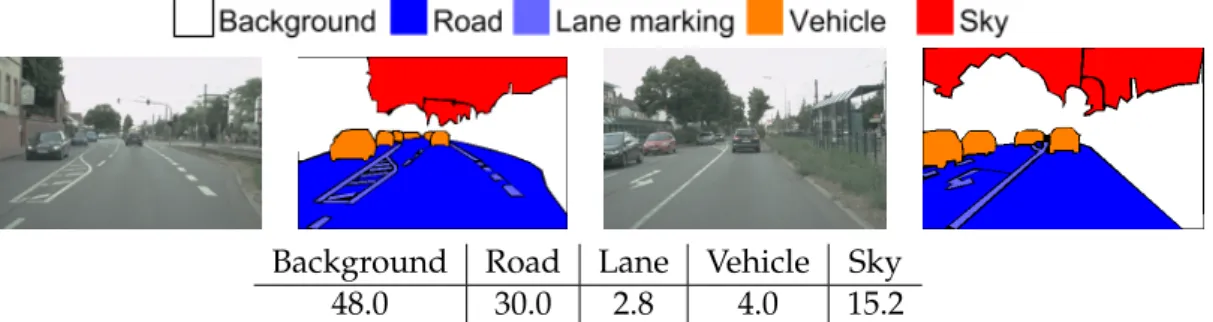
CamVid dataset. . . 37 2.8 Examples for image, ground-truth annotation and class distribution in
MPI dataset. . . 37 2.9 Examples for image, ground-truth annotation and class distribution in
Stanford Background dataset. . . 38 2.10 Examples for image, ground-truth annotation and class distribution in
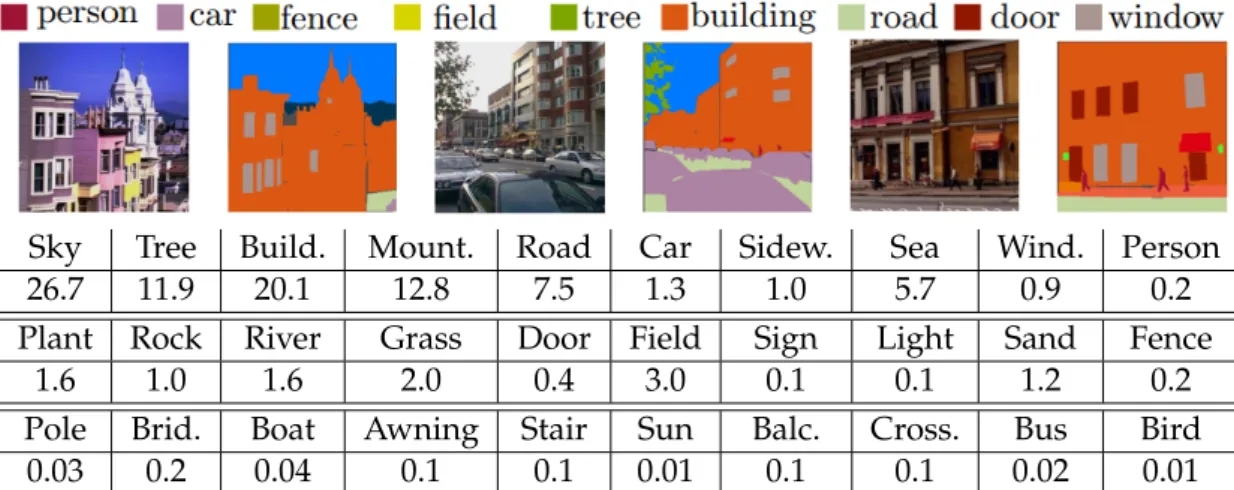
Siftflow dataset. . . 38 3.1 Overview of our approach. A hierarchical supervoxel representation
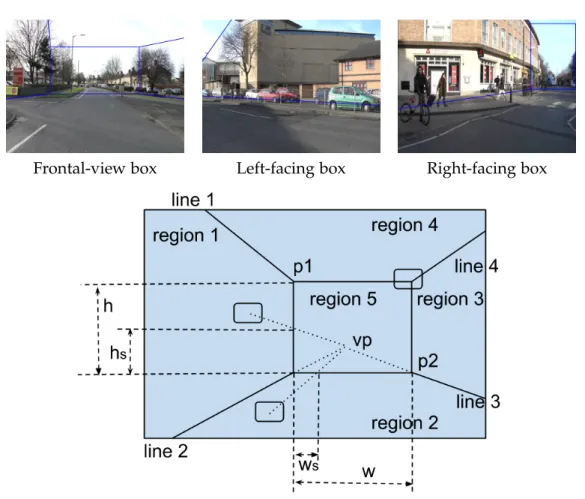
is used for video sequences and we jointly predict the semantic and geometric labels based on a simple stage scene model. . . 42 3.2 Top: three different box-like stage scene models. The last two cases
consist of two subcases in terms of facing direction of box. Bottom: supervoxel features that reflect its geometric relationship with the box. For segment in region 1, 3 or 5, we compute the hs
h as its normalized
height. For segment in region 2, 4 or 5, distance ws
w is obtained as the
normalized width from road side. Vp is the estimated vanishing point. 45 3.3 Left: Pairwise graphical model. Middle: Multi-layered graphical model.
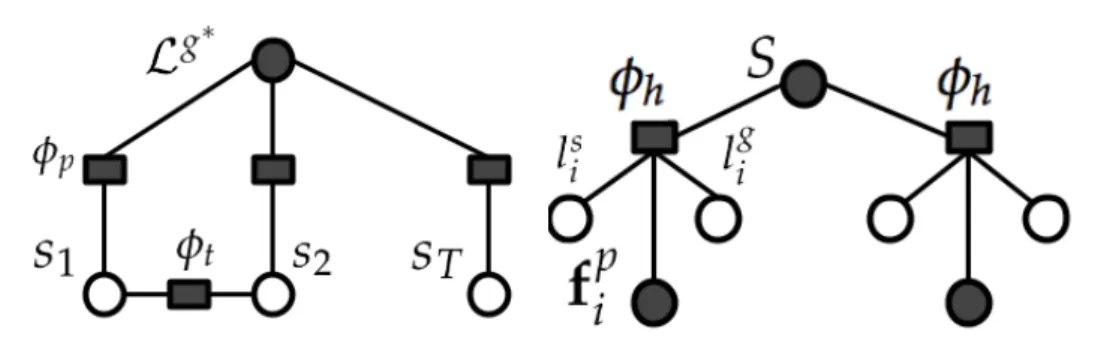
Right: Illustration for generating multilayer features in hierarchies. More details can be viewed in text. . . 47 3.4 Alternating inference between scene model and joint labeling model. . . 48 3.5 Left: optimisation in scene parameter. Right: optimisation in
super-voxel labeling. More details can be viewed in text. . . 49 3.6 Examples of stage model estimation in 5 consecutive frames in videos.
Our proposal can enforce temporal consistency in scene model estima-tion. . . 50 3.7 Examples of hierarchical segmentation in CamVid test set. . . 51 3.8 Examples of final prediction results from different settings. First
col-umn: input image frame with estimated stage models; Second colcol-umn: joint labeling with supervoxel only; Third column: joint labeling with supervoxel plus stage features; Fourth column: full model prediction with multilayer smoothing. . . 56 3.9 Examples of semantic labeling with static image features and
addi-tional stage model features. By incorporating geometric layout con-straints, we can improve predictions on more structured classes. See the performance changes in BuildingandSidewalkin our examples. . . 57 3.10 Failure cases of semantic labeling with static image features and
addi-tional stage model features. See the performance in Pedestrianin our examples. . . 57
range temporal consistency by ’Multilayer’ can recover some short-range over-smoothed results obtained in ’Pairwise’. See thePedestrain, BicyclistsandCar, BicyclistsandColumn-Pole from top to bottom re-spectively. . . 59 3.13 Multilayer predictions in key frames. The Car in the first row and
Bicyclists in the second row show that we can recover more details in hierarchical representation. Moreover, we are able to refine/correct prediction with multilayer model. . . 60 4.1 Overview of our representation. We jointly predict the semantic,
geo-metric labels with respect to object detection, tracking and their rela-tive ordering. The frontal-most object is in pink. . . 64 4.2 Overview of our approach. We jointly predict the semantic,
geomet-ric labels with respect to object detection, tracking and their relative ordering. The frontal-most object is in pink. . . 65 4.3 Examples of proposals from detectors (top) and from propagation
(bot-tom) in CamVid. Occluded objects are failed to be detected by detec-tors but can be successfully proposed from propagation. . . 66 4.4 Graphical representation of our CRF. Note that all unary terms and
supervoxel pairwise terms are not shown for clarity. Two proposals are occluded pairs and one is exclusive pair (two Cars). Supervoxel regions are shown in red. . . 68 4.5 Supervoxel segmentation results in 8 consecutive frames. (Left to
Right, Top to Bottom.) . . . 71 4.6 Detector training examples of three object classes. Top: cropped
im-ages. Bottom: binary masks of object. . . 73 4.7 Pixel-level tracking examples. We track two pixels in these frame and
highlight them in Red and Cyan. We can see that long-range consis-tency is well kept in figures. . . 73 4.8 Detection propagation examples. We highlight the mask in red in all
frames. We can see that our propagation can follow the object rea-sonably well for both Pedestrian and Car and allow shape transform (second row). . . 74 4.9 This figure compares the semantic segmentation results between unary
and pairwiseCRF in [12]. We can observe the smoothness effect of the spatio-temporal pairwise term. . . 76 4.10 Semantic segmentation results from PCRF and ICRF and the activated
detections in ICRF in the CamVid. Active detections impose strong labeling consistency in our model. . . 78
4.11 Semantic segmentation results of ICRF and full model in CamVid. Geo.F represents the geometric labeling results of the full model. . . 79 4.12 Examples of all detector proposals, active detections from ICRF and
full model in CamVid. Full model can successfully infer the rela-tive depth of overlapped objects and suppress the false posirela-tives. The frontal-most proposal is colored in red. . . 81 4.13 Comparison of the semantic segmentation results of PCRF and full
model on MPIScene dataset. . . 83 5.1 Overview of our approach. Example of the object-augmented dense
CRF model. Our active inference adaptively selects subgraphs thus improves the inference efficiency. . . 86 5.2 Example of subgraphs for singleton and object pair potentials.
Differ-ent colors denote differDiffer-ent subgraphs. . . 88 5.3 Traded-off performance on the CamVid dataset. The curve shows the
increase in accuracy over the selective inference model as a function of subgraph number. The cross shows the termination point for inference. Best viewed in color. . . 97 5.4 Examples of our selective inference on CamVid. We can always
se-lect the most informative subgraphs with high priority. The third row shows the early stop in subgraph selection that only choose one sub-graph. . . 98 5.5 Top row: Scalability with number of object classes (C: ’Car’; P:’Pedestrian’;
B:’Bicyclist’); Bottom row: Scalability with different length of videos. Both the average accuracy and number of selected subgraphs are shown. See text for details. . . 99 5.6 Scalibility with more hypotheses from a single class. We presentBicyclists
,PedestrianandCarfrom top to bottom rows. And represent Class ac-curacy and Model complexity from left to right column. . . 100 5.7 Active inference on other video segmentation datasets. Left:
Dynam-icScene. Right: MPIScene. The cross signs show when the algorithm stops. . . 102 6.1 Overview of our approach. We propose to incrementally increase
model complexity in terms of used image features and model struc-ture. Our approach generates high-quality prediction at any cost. . . 104 6.2 Example of operators at stept. We choose either to add weak learners
or split a subset of leaf nodes, which leads to gradually increasing model complexity. . . 107 6.3 Illustration of our reward function for anytime performance. . . 109 6.4 Algorithm during test-time. Scene labeling is predicted by maximizing
performance w.r.t. non-anytime state-of-the-art. . . 116 6.6 Examples of action selections on CamVid. We show some active
re-gions(AR) highlighted by white lines, and predictions after applying weak learner(WL). Our model can select mixed regions to split (col-umn 3 and 4) and improve the prediction on regions (col(col-umn 5 and 6) over time (from left to right). . . 117 6.7 Anytime performance corresponding to different discount factor γon
the CamVid dataset. . . 117 6.8 Loss function trend (Left) and average IOU score (Right) as a
func-tion of cost on CamVid. Our D-NM achieves better trade-offs between efficiency and accuracy/labeling loss. . . 118 6.9 Left: Image feature ablation study on CamVid, showing overall pixel
accuracies with different number of feature types.Right: Convergence of Q-learning on CamVid. . . 119 6.10 Average pixel accuracy as a function of cost (Left) and the percentage
performance v.s. percentage of cost (Right) in SBG (Top) and Siftflow (Bottom). D-NM achieves similar performance with less cost. Cost of related work is from [137]. . . 120
3.3 Geometric class distribution in five regions that defined by scene model on CamVid training dataset. . . 52 3.4 Semantic class distribution in five regions that defined by scene model
on CamVid training dataset. . . 52 3.5 Per-class average, Per-pixel, Intersection-Over-Union (IOU) and F1 score
of semantic segmentation result on CamVid. We show the perfor-mance of our approach with different configurations, as well as the-state-of-the-art accuracy. Note that [89, 142] applied SfM or object information and [151] is the only one has the same setting with us.
. . . 54 3.6 Main geometric class accuracy and IOU result on CamVid dataset.
’Multilayer’ outperforms state-of-the-art and other configurations in pixel-level, average class accuracy and IOU score. . . 55 3.7 IOU score of geometric class on CamVid dataset. ’Multilayer’
out-performs other configurations in terms of average IOU score of all geometric class. . . 55 4.1 Statistics computed to represent supervoxels. . . 72 4.2 Averaged semantic recall, intersection-over-union (IOU) and F1 score
of existing methods in CamVid. Note that supervision in our model is much weaker than the baselines. in terms number of positive sam-ples. Moreover, we focus on three classes while [89] have two more trained object detectors— Pole andSign. Detectors are trained for all classes in [152]. F1 score in Pedestrian is not provided to have a fair comparison with [148]. . . 77 4.3 Geometric segmentation performance on CamVid dataset (main classes).
. . . 80 4.4 Geometric segmentation performance on CamVid dataset. . . 80 4.5 Precision, recall and IOU score of detection performance at equal FPPI
in CamVid. In each cell, the first one is the object segmentation result from detectors only method and the second is that of full model. . . . 80 4.6 Semantic segmentation performance in MPIScene. Our results
5.1 Averaged semantic accuracy in CamVid. Our method can achieve the state of the art segmentation performance. Foreground object classes with hypotheses are in bold. We outperform the state-of-the-art in IOU significantly. . . 96 5.2 Inference efficiency v.s. number of hypotheses of different methods on
CamVid. See text for details. . . 101 5.3 Semantic segmentation performance (average per-class accuracy) in
MPIScene dataset. See text for details. . . 101 5.4 Semantic segmentation performance (average per-class and per-pixel
accuracy) and the number of selected subgraphs in DynamicScene dataset. . . 102 6.1 Average timing (ms) for compuating all features for an image in CamVid.
. . . 113 6.2 Performance comparison on CamVid. D-NM outperforms [46, 153],
especially in average class accuracy. Our results are comparable to [12, 35, 141] that use additional information. We achieve a performance similar to HIM and DCRF with less cost. . . 116 6.3 Area under average accuracy v.s. time cost in CamVid. D-NM
outper-forms all methods consistenly. . . 118 6.4 Semantic segmentation results on Stanford background dataset. We
can achieve better performance w.r.t state-of-the-art methods. . . 119 6.5 Semantic segmentation results on Siftflow dataset. We can achieve
Perceiving dynamic environments through a continuous stream of visual inputs is a fundamental task for human and artificial vision systems. Despite constantly chang-ing surroundchang-ings, human visual systems are capable of interpretchang-ing a dynamic scene and reasoning its implication in a seemingly effortless way, which plays an important role in individuals interacting with their environments. To achieve such efficient and deep understanding with computers, however, remains elusive and a long-standing challenge for computer vision and robotics.
Video, which is originated from Latin, meaning ‘I see’ or ‘I apprehend’, provides a generic digital medium for the continuous stream of visual inputs. As such, auto-matic video interpretation using computer algorithms is a key step toward designing an artificial vision system for dynamic scene understanding. In addition, with wide deployment of cameras in our daily life, videos have become one of the main data sources on our environment and the amount of video data have rapidly increased during recent years. In comparison with static images, video sequences capture more information such as activity and causal cues, and provide a natural way to describe the relationship both in space and time. Analyzing and mining videos in an efficient way is critical for us to understand the dynamically changing world and make timely decisions. Furthermore, an algorithmic framework of video analysis with human-level performances may shed some light on the mechanism of human visual perception of dynamic environments.
Generally, a video sequence encodes rich information about the underlying dy-namic scene and we can reason about individual scene properties from several dif-ferent aspects. For instance, we can summarize a video based on the scene type or the event it describes, or provide detailed annotations to every object in the video frames according to their semantic classes. Figure 1.1 shows a variety of scene prop-erties that we can infer from a dynamic scene, including scene type, object category, individual object trajectories, spatial range of categories, and relations between ob-jects and regions, etc.. One of the key properties of dynamic scene interpretation in human vision is that it is capable of inferring multiple scene properties from a video input in an efficient and consistent manner.
There have been much progress in analyzing individual aspect of video data, such as event recognition [70], activity recognition [5], object tracking [65, 79, 150], fore-ground segmentation [96], semantic segmentation [28, 67, 109, 148] and geometric
Figure 1.1: Examples of multiples aspects in holistic understanding of videos. A video can be described with high-level summaries, object instance trajectories and their spatial relations, or detailed pixel-level annotations. Existing methods focus on each individual task while our goal is to reason about the dynamic scene as a whole. segmentation [125]. However, less attention has been paid to joint inference of multi-ple scene properties at pixel and/or object level in videos, except a few [90, 151, 174]. In this thesis, we take a holistic perspective to address the problem of dynamic scene understanding from monocular video inputs. Our goal is to reason about a video as a whole and jointly infer multiple aspects of the scene properties. By reasoning different properties together, we are able to better capture the intrinsic de-pendencies among scene entities, which may lead to a more consistent interpretation of the underlying scene. In particular, we focus on generating a detailed pixel-level video interpretation that incorporates reasoning from three granularity levels, includ-ing 1) semantic meaninclud-ing and surface property of the regions in each frame, which requires pixel-level segmentation and recognition, 2) what and where the objects are in scenes, which requires object-level reasoning in spatial and temporal dimensions, and 3) higher-level information of given scenes, which produces a scene-level sum-mary of the environment or event in a video. At each level, we mainly consider two aspects of the scene and object properties in the video, detailed as follows:
• Semantic properties: The semantic understanding of a video addresses the problem of what and where the visual object categories are in scenes. We would like to infer three typical types of semantic properties from a coarse to a fine level. The coarse-level interpretation, which includes scene type and event classes in the video, provides overall summary about what activities hap-pen in what kind of environment. A more detailed analysis, which usually parses videos with respect to objects inside, focuses on recognising what object classes are present in scenes. In particular, such object-level analysis can pro-duce annotation for each object instance, leading to a better understanding of object motion and relations between individual objects, such as co-occurrence
level, and help capture the dependencies between multiple scene entities.
• Geometric properties: Geometric scene understanding aims to recover the un-derlying geometric structure of dynamic scenes from video inputs, which is a challenging task given only monocular videos. Similar to the semantic coun-terpart, we consider three levels of geometric properties in the scene interpre-tation. At the coarse level, we can classify a scene as one of typical geometric layouts, which provide an abstract modeling of the major surfaces and their orientations in the video. For the object level geometric reasoning, we aim to capture the geometric relations between objects, such as support and occlusion, based on motion cues and relative positions between object classes. At the pixel level, the video can be densely labeled with a set of geometric classes that de-scribe the orientation and/or relative depth of the underlying object surfaces w.r.t. the camera. These geometric properties provide additional constraints for the scene understanding as they have to be consistent with the semantic interpretation. We do not consider a 3D reconstruction here as it imposes cer-tain assumptions on camera motion and scene property, and particularly has difficulty in handling moving objects.
While our study focuses on the aforementioned scene properties, the holistic video understanding framework can be easily extended to reasoning other interesting scene entities. For instance, we can incorporate object attributes and their functionality, as well as a hierarchical parsing of objects in terms of their parts.
Being able to produce a holistic interpretation of a video can be beneficial for many real-world applications including automatic driving, human assistive robots, complex video analytics, environmental monitoring, etc. It not only generates more consistent video analysis outcomes, but also provides a rich description of under-lying scenes and objects. In general, holistic video parsing is arguably one of the most critical steps towards fully autonomous scene understanding, and it leads to the possibility of interacting with complex and realistic environments using artificial vision systems.
1
.
1
Challenges
Although jointly interpreting multiple scene properties from a video seems to be an effortless task for human vision, it remains perhaps one of the most challenging prob-lems in computer vision. The challenging nature of this problem is mainly due to the high-dimensionality of video data, the complex relationship between multiple scene properties, and the joint prediction of multiple tasks with structured outputs. In par-ticular, in order to efficiently and consistently generate the semantic and geometric
interpretations, we focus on the following three main challenges in the problem of holistic video understanding.
Modeling dynamic scenes at multiple levels. To interpret a video as a whole, we need to capture multiple aspects of the underlying scene, which include pixel-level semantics and geometry, individual objects, scene structure and object relationship as described above. These properties reflect the regularities of 3D world and are strongly correlated. Therefore, one key challenge of holistic video parsing is to model the dependencies between these scene entities and in particular, high-order relations and long-range dependencies between entities at different levels. In addition, as we predict both the semantic and geometric attributes of the same scene, it is impor-tant to capture the consistency relationship between two different aspects of scene interpretation. Furthermore, to capture the temporal relations in a video, we need to model both spatial and temporal dependencies so that our interpretation will be temporally coherent.
Efficiency in holistic video parsing. A video sequence consists of a large number of frames and it is critical to be able to process such high-dimensional data effi-ciently, especially for many real-time applications. As holistic video parsing aims to capture multiple scene properties and predict pixel-wise annotations from several levels, achieving efficiency becomes particularly challenging in modeling and infer-ence. The computation cost in video parsing mainly lies at two aspects: 1) video feature computation, in which we extract the low-level appearance, motion and ge-ometry features for every frame. In order to capture region information, we may also pre-process the video sequence to generate spatio-temporal regions at different scales; 2) multi-level inference of scene properties, in which we jointly predict the semantic and geometric classes of all the pixels and objects in the video. As the inference involves many scene entities and their complex relations, it is generally time-consuming to find a globally consistent interpretation.
Multitask learning with limited training data. Holistic video parsing consists of a set of correlated scene understanding tasks, each of which involves predicting one aspect of the scene properties. Most of these individual tasks generate a pixel-wise annotation of the video and thus have a structural output. To build a model for the overall joint video parsing, we essentially need to address a multitask learning problem while each task can be a structured prediction problem. In practice, how-ever, it is expensive and tedious to obtain the ground-truth annotations of videos for all these tasks. For example, existing semantic video segmentation datasets only provide dense annotations for sparsely sampled frames. For object-level annotation, most available datasets are targeted at object detection in static images and annotated video data are scarce. Therefore, one particular challenge in holistic video under-standing is to build a video analysis model with only partial or weak supervision due to the limited training data.
1
.
2
Our Research Problems
To effectively capture the multiple aspects of dynamic scene, and to efficiently parse video sequences as a whole, we consider the following four important research prob-lems in this thesis:
1) Joint semantic and geometric parsing of videos. A chief focus of our holistic video understanding concerns the semantic and geometric properties of the dynamic scene in the video, which describe the background layout and foreground objects in two different perspectives. Our goal is to predict both pixel-wise semantic and geometric labeling for the entire video sequence. Given only a video taken from monocular camera with arbitrary camera motion and a moving scene, however, such a prediction task is ill-defined and treating two label prediction tasks independently may lead to incoherent interpretations of the underlying scene. Consequently, our first research problem is to seek a scene representation capable of jointly modeling se-mantic and geometric properties at pixel level, which enable us to predict a consistent labeling of both properties. In addition, we want to effectively capture the temporal structure of the video and enforce temporal coherency in our interpretation.
2) Pixel-level labeling with object-level reasoning in videos. While pixel-level parsing provides detailed annotation in terms of object classes, it lacks represen-tations in terms of individual objects. In order to achieve better video parsing, it is essential to incorporate the object information, such as their shape and geometric re-lations, into multiple properties of the underlying scenes. The additional object-level representation not only generates a richer understanding of the video in terms of both mid-level region properties and high-level object concepts, but also enables us to introduce object and motion priors, a better modeling of long-range dependencies in dynamic scenes. Therefore, our second research problem is: how do we introduce object-level reasoning to pixel-wise video parsing, and jointly predict both seman-tic/geometric segmentation of the video and object instance segmentation? Due to lack of object annotation in training data, we also need to address the learning prob-lem: how do we use a weak supervision to learn object models in this setting?
3) Efficient inference for multi-level video segmentation. Joint pixel and object parsing of a video enable us to simultaneously reason multi-level properties of the dynamic scene. However, such a joint formulation usually involves inferring the
semantic and/or geometric class of a large number of scene entities. A naive im-plementation usually leads to time-consuming computation process and is difficult to scale up to large scale or real time video analysis. For instance, more than hun-dreds of object hypotheses needs to be examined for analyzing a moderate complex outdoor scene. To address this efficiency issue, we would ask our third research question: Are all the scene entities in our representation equally important in terms of the value of information? Can we exploit the redundancy in our multi-level in-terpretation and find a more compact model formulation that enable us to perform efficient reasoning?
4) Learning efficient representation for cost-aware video parsing. Most video pars-ing approaches rely on a set of low-level image features as the bottom-up cues to pre-dict semantic and geometric properties, and a structured model formulation to carry out joint inference on the global interpretation. The computational cost of video analysis mainly consists of the feature computation and the inference time, which is difficult to reduce for a hand-crafted video representation without sacrificing the final performance. Nevertheless, many real-world applications may have a varying time or power budget for test-time video analysis. They would require producing a high-quality video interpretation at any time constraint. This practical concern in-spires us to ask the last research question: How can we learn an efficient feature and model representation of dynamic scenes for such cost-aware video parsing tasks, in which we aim to achieve an optimal trade-off between cost and accuracy for any test-time budget?
My investigations reported in this thesis are centered around the four research problems above. We will discuss these questions, and provide our solutions by build-ing a series of holistic video parsbuild-ing models and their efficient inference/learnbuild-ing strategies. In subections 1.2.1 to 1.2.4, we present the main ideas of our work corre-sponding to the four research problems, followed by thesis roadmap and our major contributions.
1.2.1 Joint semantic and geometric segmentation of videos
Most existing approaches on video segmentation focus on exploring temporal con-sistency in region or pixel labeling [178], and predict either semantic [68] or geo-metric property [125] alone. More recent work consider jointly modeling semantic class and depth of scene, and attempt to infer multiple labels of pixels consistently in spatio-temporal domain. However, many of these methods require additional stereo or depth sensor as input [90], while others assume a static scene and derive the scene structure of sparse points based on structure from motion [142], or enforce a simple pixel-level consistency [153].
In this work, we aim to address the problem of geometric and semantic consistent video segmentation from a monocular camera for outdoor dynamic scenes. Given no assumption on camera movement and multiple moving objects in the scene, the key challenge is to integrate semantic and geometric information efficiently in a
coher-Figure 1.2: Overview of our approach for joint geometric and semantic labeling in videos. Our model is based on hierarchical video segmentations and we jointly
predict the semantic and geometric labels based on a simple stage scene model. ent framework. Inspired by [42], we consider jointly modeling the semantic class of spatio-temporal regions and a high-level description of scene geometry for each frame in video.
Specifically, we formulate video segmentation as a multi-label multi-class predic-tion problem, in which each over-segmented spatio-temporal volume, or supervoxel, is assigned geometric and semantic consistent labels. To efficiently capture the de-pendency between the semantic and geometric labels, we propose a simplified stage-like scene model [119] as an intermediate representation, which imposes additional scene dependent constraints for both semantic and geometric labeling. A typical ex-ample is shown in Figure 1.2, where a box-shape scene model is used to build the interaction between semantics and geometry.
We design a conditional random field (CRF) for joint modeling of the semantic class, geometric label and the stage representation. The potential functions of our CRF encode the constraints on two types of labels based on the stage parameters. Inference can be solved by an alternating procedure between the label prediction and stage estimation. To incorporate long-range label dependency, we build on a hierarchical segmentation of a video and fuse the predictions from multi-levels for spatial and temporal consistency.
1.2.2 Multi-label scene segmentation with exemplar-based object reason-ing in videos
In order to achieve better understanding of images, it is essential to explore object information [89, 174, 184] as well as multiple properties of the underlying scenes [42]. In particular, reasoning object instances and their relations with contexts has played an important role in the state-of-the-art methods for semantic image segmentation [89,
Figure 1.3: Overview of our holistic video representation. We jointly predict the semantic, geometric labels with respect to object detection, tracking and their relative
ordering. The frontal-most object is highlighted in pink.
154]. Video sequences of dynamic scene provide a natural setting to incorporate ob-ject level information in semantic segmentation. Motion cues can facilitate localizing object instances and inferring geometric relationships between objects. In addition, tracking of moving objects imposes long-range temporal consistency constraints to segmentation and allows weak supervision at object level. Most of previous video segmentation methods, however, either focus on capturing mid-level spatio-temporal consistency [17, 116], modeling static scenes [12], or using a single-class object detec-tor trained with many additional object annotations [174].
We propose a joint framework for multi-class semantic video segmentation which integrates both region-level labeling and object-level reasoning. Given a video se-quence taken from monocular camera, we formulate the segmentation as a super-voxel labeling problem. At region-level, we seek consistent semantic and geometric labeling of super-voxels that are smooth in spatio-temporal domain. At object-level, we infer foreground moving objects and their relative depth in a chunk of video frames, which imposes long-range spatial and temporal consistency of multi-class object segmentation. More importantly, we adopt a weak supervision strategy at object-level as in [56], in which only a small set of object exemplars is used for mod-eling each object class. An overview of our method is shown in Figure 1.3.
Specifically, our approach consists of two stages. We first use object exemplars and dense point trajectories to generate a number of object segmentation hypotheses for each foreground class. Given these object hypotheses, we design a conditional random field (CRF) that jointly models semantic and geometric classes of supervox-els, as well as segmentation and relative depth of objects in videos. In particular, we propose a set of pairwise and higher-order potentials to impose the label consistency between objects and corresponding supervoxels, and to encodeocclusionandsupport relations between object classes. To parse a video sequence, we compute the MAP
Figure 1.4: Overview of our approach. Example of the object-augmented dense CRF model. Our active inference adaptively selects subgraphs thus improves the inference
efficiency.
estimation of the CRF model, which is formulated as minimizing a unified energy function and solved by an efficient move-making algorithm.
1.2.3 Efficient multi-label video segmentation with object-level active in-ference
Much progress has been made in semantic scene parsing by incorporating high-level visual information, such as scene context and objects [42, 58, 89], and jointly solving multiple related vision tasks [144, 154, 184]. However, such object-aware strategies require many hypotheses of object instances and their relations to accommodate un-certainty in object detection and localization [144, 153]. This leads to increasingly larger structure and higher complexity of the resulting models on pixels and objects. The main drawback of such approaches is that it becomes challenging to develop ef-ficient inference algorithm in the joint models. In addition, it is even more difficult to extend this to dynamic scene parsing in videos, as the number of object hypotheses may increase greatly due to object motion and longer image sequences.
In this work, we aim to address the problem of joint pixel and object inference in semantic video segmentation. We take a hypothesize-and-verify approach [104, 144], in which we generate a pool of object hypotheses and formulate video segmentation as a joint labeling of pixels and object hypotheses. To handle a large number of object hypotheses, we adopt an active inference strategy at object level to select an optimal subset of hypotheses for joint inference. An overview of our approach is shown in Figure 1.4.
Specifically, given a video sequence, we first build an object-augmented dense CRF model that consists of a supervoxel layer and an object layer. The supervoxel layer, modeled by a dense CRF [81], captures long-range spatio-temporal dependency between supervoxels, while the object layer imposes consistency between semantic labeling of supervoxels and objects, as well as valid occlusion relation between
over-Figure 1.5: Overview of anytime representation learning. We propose to incremen-tally increase model complexity in terms of used image features and model structure.
Our approach generates high-quality prediction at any cost.
lapping objects. We develop an efficient mean field inference algorithm for the case with a moderate number of object hypotheses.
Inspired by [168], we propose to select an informative subset of objects for scaling up inference with many object hypotheses. To this end, we build a set of subgraphs corresponding to the object hypotheses, which are selected in our inference proce-dure. We formulate the subgraph selection as a Markov Decision Process (MDP) and develop a learning approach to search the optimal policy for sequentially choosing the most informative subgraph. We define a reward function using the improve-ment on pixel-level per-class accuracy, and learn an approximate policy based on Q-learning [92]. Our policy takes long-range features generated by both current model uncertainty and video input, and predicts the most valuable subgraph to choose in next step.
1.2.4 Learning dynamic hierarchical models for anytime semantic seg-mentation
Despite much progress in the pixel-level semantic scene parsing [20, 44, 53, 110], most efforts are focused on improving the prediction accuracy with complex struc-tured models [57, 184] and learned representations [18, 28, 140]. Such computation-intensive approaches often lack the flexibility in trade-off between efficiency and accuracy, making it challenging to apply them to large-scale data analysis or cost-sensitive applications. While previous methods have developed active inference mechanisms for a given structured model to accommodate test-time budgets [129, 168], a more appealing approach is to learn a model representationforAnytime per-formance, which can stop its inference at any cost budget and achieve an optimal prediction performance under the cost constraint [45, 46, 73, 180, 189].
In this work, we tackle the anytime scene labeling problem by learning a family of structured models capable of capturing long-range dependency between image segments. To enable anytime prediction, we propose to generate scene parsing from
to fine level and considering spatio-temporal features.
Specifically, we design a hierarchical model generation process based on growing a segmentation tree for each image. Starting from the root node, this process grad-ually increases the overall model complexity by either splitting a subset of leaf-node segments or adding new features to label predictors defined on the leaf nodes. At each step, the resulting model encodes the structural dependency of labels in the hierarchy. For any cost budget, we can stop the generation process and produce a scene labeling by collecting the predictions from leaf nodes. An overview of our coarse-to-fine scene parsing is shown in Figure 1.5.
To achieve aforementioned Anytime performance, we seek a policy of generating the hierarchical models which produce high-quality or optimal pixel-level label pre-dictions for any given test budget. Instead of learning a greedy strategy, we formu-late the anytime scene labeling as a sequential decision making problem, and define a finite-horizon Markov Decision Process (MDP). The MDP has a parametrized dis-crete action space for expanding the hierarchical models, and maximizes the average label accuracy improvement per unit cost over a range of cost budgets as a surro-gate for the anytime objective. We solve the MDP to obtain a high-quality policy by developing an approximate least square policy iteration algorithm [92]. The key properties of our learned policy are dynamic, which generates an image-dependent hierarchical representation, and non-myopic, which takes into account the potential future benefits in a sequence of predictions.
1
.
3
Roadmap
The next chapter discusses the prior literature that is relevant to the research prob-lems addressed in this thesis. We firstly reviews the basic framework of undirected probabilistic graphical models and introduces its three key components including representation, learning and inference. These concepts will be extensively used throughout the remainder of this thesis. Next, we discuss work on both scene under-standing in static images and dynamic scene underunder-standing in video sequences. The chapter then moves onto budget-aware inference and anytime learning strategies, fo-cusing on sequential model learning and model selection based on Markov Decision Process. Finally, we introduce all the datasets on which we evaluate our methods and discuss some commonly-used evaluation metrics in semantic segmentation literature. Chapter 3 addresses the problem of geometric and semantic consistent video segmentation for outdoor scenes. With no assumption on camera movement, we jointly model the semantic-geometric class of spatio-temporal regions (supervoxels) of a monocular video sequence. We propose a geometric scene layout representation,
or a stage scene model, to efficiently capture the dependency between the semantic and geometric labels. We build a unified conditional random field for joint modeling of the semantic class, geometric label and the stage representation, and design an alternating inference algorithm to minimize the resulting energy function. To enforce long-range label consistency, we also adopt a hierarchical classifier based on video segmentation trees for pixel label prediction and show it achieves better performance than a pairwise random field model. We evaluate our algorithm on the CamVid dataset and achieve state-of-the-art per-pixel and per-class accuracy in both semantic and geometric segmentations.
In Chapter 4, we describe a holistic video parsing method for simultaneous pixel-level and object-pixel-level segmentation. We propose to incorporate foreground object information into pixel labeling by jointly reasoning semantic labels of supervoxels, object instance tracks and geometric relations between objects. We firstly take an exemplar approach to object modeling by using a small set of object annotations and exploring the temporal consistency of object motion. After generating a set of mov-ing object hypotheses, we design a conditional random field framework that jointly models the supervoxel labels and object instance segmentation. The optimal scene labeling is inferred by computing the MAP estimation of the CRF model using an efficient move-making based optimization procedure. We demonstrate the effective-ness of our method on three public datasets and show that our model can achieve superior or comparable results than the state-of-the-art with less object-level super-vision.
Chapter 5 also addresses the problem of integrating object reasoning with su-pervoxel labeling in multiclass semantic video segmentation. To this end, we first propose an object-augmented dense CRF in spatio-temporal domain, which captures long-range dependency between supervoxels, and imposes consistency between ob-ject and supervoxel labels. We develop an efficient mean field inference algorithm to jointly infer the supervoxel labels, object activations and their occlusion relations for a moderate number of object proposals. To scale up our method, we adopt an active in-ference strategy to improve the efficiency, which adaptively selects object subgraphs in the object-augmented dense CRF. We formulate the problem as a Markov Decision Process, which learns an approximated optimal policy based on a reward of accu-racy improvement, a set of well-designed model and input features. We evaluate our method on three publicly available multiclass video semantic segmentation datasets and demonstrate superior efficiency and accuracy.
In Chapter 6, we propose a dynamic hierarchical model for anytime scene label-ing that allows us to achieve flexible trade-offs between efficiency and accuracy in pixel-level prediction. In particular, our approach incorporates the cost of feature computation and model inference, and optimizes the model performance for any given test-time budget by learning a sequence of image-adaptive hierarchical models and image representations. We formulate this anytime representation learning as a Markov Decision Process with a high-dimensional discrete-continuous state-action space. A high-quality policy of feature and model selection is learned based on an approximate policy iteration method with action sampling strategy. We demonstrate
ing multiple properties in videos with unified CNNs and active learning for multi-level video understanding.
1
.
4
Major Contributions
In this section, we summarize the main differences between our methods and other existing approaches, and list the most important contributions in this thesis as fol-lows.
• We propose a stage scene model for jointly modeling the geometric and se-mantic label of a video sequence. Our results show the new representation is beneficial in predicting semantic and geometric consistent scene labeling.
• We extend the smoothing method based on multilayer representation to the video setting and achieve the state-of-the-art per-class and per-pixel accuracy without any high-level object information. We also directly use supervoxel instead of frame-based super pixel for labeling and feature extraction, which generates a more coherent labeling temporally.
• We incorporate multiclass object reasoning to semantic video segmentation, which enables us to capture long-range dependency in spatio-temporal do-main. We show that inferring object instances and their relationships is benefi-cial to video segmentation. We also provide a richer interpretation of dynamic scenes, consisting of not only pixelwise semantic segmentation but also object instance segmentation, motion trajectories and their relative depth ordering.
• We propose a weak supervision approach to model the foreground object classes by exploiting temporal coherency, pixel-object label consistency and a few an-notated object exemplars.
• We develop an object-augmented fully-connected Conditional Random Field model for semantic video segmentation and derive an efficient mean field in-ference procedure for the CRF with higher-order potentials.
• We design a novel active inference method for multi-level video understanding. We explore the value of object hypotheses for semantic labeling and propose a MDP-based method to sequentially choose most informative objects during in-ference. Our method is capable of generating compact model structure, which is useful for achieving a balance between efficiency and accuracy.
• We propose a dynamic hierarchical model for anytime semantic scene segmen-tation, which generates a high-quality segmentation at any given test-time bud-get. We incorporate both feature computation and model inference cost, and formulate the anytime representation learning as a Markov Decision Process with a discrete-continuous state-action space.
Visual scene understanding aims to infer scene properties from images or videos, such as scene type, spatial range of categories and object instances, etc.. There are an abundance of prior literature on this core computer vision problem. In this chapter, we review both static and dynamic scene understanding approaches in the literature, with a focus on those that overlap with our research problems discussed in previous chapter: 1) joint semantic and geometric parsing in videos 2) pixel-level labeling with object reasoning in dynamic scenes 3) efficient inference for multi-level video under-standing 4) learning efficient representation for cost-aware video parsing. Prior to that, we also discuss related work on the undirected Probabilistic Graphical Models, which are fundamental for incorporating relations between different aspects, or their dependencies.
The rest of this chapter is organisd as follows. We firstly introduce background knowledge about undirected graphical models in Section 2.1, with a focus on Con-ditional Random Field. In Section 2.2 and Section 2.3, we discuss related work on scene understanding from static images and dynamic scene understanding, respec-tively. Literature on cost-aware learning and inference is summarised in Section 2.4. Datasets and evaluation matrix are presented in Section 2.5. Finally, we summarise this chapter in Section 2.6.
2
.
1
Undirected Probabilistic Graphical Models
In this section, we focus on undirected graphical models, which are widely used in computer vision and most related to our research topic. In general, probabilistic graphical models provide flexible representations of relations between objects and components within the probabilistic framework. They also provide a simple way to visualise structures of probabilistic models, and give direct insights into conditional independence properties and underlying mathematical structure.
2.1.1 Model formulation
An graphical model is represented by a graph, which consists of a set of nodes and edge connections. Each node represents a random variable (or a group of random
Figure 2.1: Illustration of graphical model described in Eq.2.1. We omit the depen-dency on the inputXfor clarity.
variables), and the edges encode probabilistic relationships between connected vari-ables. A graph captures the way in which the overall joint distribution is decomposed into the product of factors that only depend on subsets of local variables in graph.
We focus on undirected graphical models, especially Conditional Random Fields (CRFs) [78, 91], in computer vision (e.g. [57]) literature in the rest of this section. CRFs have been widely used in semantic scene understanding and particularly suitable for multi-level video understanding due to its flexibility in integrating multiple scene properties. They provide soft constrains on the underlying variables and thus can be used to encode relations between scene entities and generate more global and consistent interpretations.
Formally, a CRF is fully specified by its potential functions, which usually consists of unary terms, pairwise terms and higher order terms. Denote L as the variables for all nodes in the graph, and L = {li}, where i ∈ {1, ...,N} and N is the number
of nodes in the graph. Generally, li can be assigned a value from some (discrete)
value space. For instance, in the context of semantic segmentation, li = c and c ∈
{1, . . . ,C}, where C is the number of object categories. We further define N as the set of neighbouring nodes in the graph. Given an observationX, a CRF is defined by its energy function as follows:
E(L|X) =
∑
i φ(li|X) +∑
(i,j)∈N ϕ(li,lj|X) +∑
i∈{c} ψ(lc|X) (2.1)whereφ(li|X)is the unary potential for nodei, ϕ(li,lj|X)models the pairwise
potefn-tial for a pair of nodes (i,j) ∈ N, and ψ(lc|X) is the higher order potential for
the nodes lc in clique c. We will omit the input X from now on for clarity as
generally all the terms depend on X. Equivalently, denote the probability of tak-ing labeltak-ing L given X as P(L|X), we can define a joint probability distribution as P(L|X) = 1
Z(X)exp(−E(L|X)), where Z(X)is the partition function that ensures that
the probability distribution sums to one. We adopt factor graphs to represent the factorization properties of CRF models, which explicitly visualize the variables and potential functions in the joint distribution. An example of graphical models de-scribed in Eq.2.1 is illustrated in Figure 2.1. In the following, we will describe the three basic components of the CRF models.
general, we can use a classifier for local predictions, and the unary potentials are formulated as the negative log-probability from the classifier outputP(li|X):
φ(li) =−logP(li|X) (2.2)
Note that P(li|X) can be the output from any probabilistic classifiers. For instance,
in semantic segmentation [57], a multilayer perception that takes color, edge magni-tude and texture information into account is used to predict the unary terms. Other commonly adopted classifiers include Gaussian Mixture Model based [179] and dis-criminative methods, such as Random Forest [11] and Multiclass Logistic Regressor. Non-probabilistic classifiers, such as Boosting classifiers [36] and Support Vector Ma-chine (SVM) [172], can also be employed by directly taking their classifier scores as the unary or fitting a probabilistic model on top of their scores. In addition to the aforementioned parametric learning approaches, non-parametric learning meth-ods, e.g., K-nearest-neighbor (KNN), are also used due to the emergence of large databases [151].
2.1.1.2 Pairwise Potentials
The pairwise potentials ϕ(li,lj) are introduced to capture the dependency between
neighboring nodes, which defines the compatibility of two neighbouring nodesiand jthat takes labelsli andlj, respectively. In particular, a common form of the pairwise
terms in computer vision is the contrast-sensitive Pott’s model [139], which imposes a smooth constraint on the labeling while taking color cues Ii and Ij of nodeiand j
into account. Mathematically, it is defined as:
ϕ(li,lj) =exp(− kIi−Ijk2 θα ) li 6= lj (2.3) where [·] is an indicator function and θα is the model parameter. Intuitively, this
pairwise term gives penalties for inconsistent neighboring labels: the more photo-metric similar the adjacent units are, the higher penalty will be assigned if they do not take the same label. Other types of pairwise terms [42] capture the co-occurrence statistics of any two class labels that appear in adjacent nodes, which provide prior knowledge on the neighborhood relation between objects.
One major drawback of these pairwise potentials is their locality. It is challeng-ing to encode long-range constraints due to the restrictive design of their neighbour-hood. One possible solution is to introduce second-order pairwise terms as suggested in [115]. However, it only partially addresses the problem. A more principled way to incorporate long-range dependencies is to introduce dense connections between
all the nodes. Mathematically, the pairwise term in a fully connected CRFs [81] is defined as: ϕ(li,lj) =µ(li,lj) K
∑
m=1 w(m)k(m)(fi,fj) (2.4)wherek(m)denotes them-th Gaussian kernel andk(m)(f
i,fj) =exp(−12(fi−fj)TΛ(m)(fi−
fj)), andµis the label compatibility matrix, such as the Potts modelµ(li,lj) = [li 6=lj].
The vectorfiis the feature vector for pixeliin an arbitrary feature space. w(m)are the
linear combination weights and µ is the label compatibility function. More
specifi-cally, the contrast-sensitive two-kernel potentials in [81] are defined as
ϕ(li,lj) =w(1)exp(− |pi−pj|2 2θ2α − |Ii−Ij|2 2θ2β ) +w(2)exp(−|pi−pj| 2 2θ2γ ) (2.5)
The first term and the second term encourage the nearby pixels with similar appear-ance to be the same class as well as smooth out isolated regions, respectively. θα,θβ,
andθγ are model parameters for degrees of nearness and similarity.
2.1.1.3 Higher-order Potentials
To go beyond pairwise relations, we can also introduce higher-order potentials into CRFs. Typically, higher-order potentials capture more complex relations between nodes in a clique, which can be some pre-defined patterns [77] or learned label con-figurations [57].
In practice, a widely adopted approach is to define higher-order potentials on image regions with certain properties in vision literature. One choice is to define cliques based on homogeneous regions, e.g. superpixels [77], or hierarchical segmen-tations [127].The higher-order potential is then defined to enforce all nodes inside a clique to follow some label patterns. For instance, the higher-order robust Pn Potts
model [77] is defined as,
ψ(lc) =
(
Ni(lc)Q1γmax, if Ni(lc)Q
γmax, otherwise
(2.6) whereNi(lc)is the number of variables in the cliquecnot taking the dominant label.
Q is the truncation parameter. γmax measures the quality of a segment, which is
defined by its inter region appearance variance. Intuitively, this model favors all pixels belong to an image segment taking the same label, while setting the penalty as a linear truncated function to allow for variables in a clique taking different labels. In addition to the aforementioned bottom-up region cues, object information pro-vides top-down cues as another type of higher-order constraint for scene understand-ing tasks. Specifically, object-based cliques [89, 152, 184] are obtained from the detec-tion outputs of pre-trained object detectors. The higher-order potentials defined on these cliques incorporate the constraints that certain object categories are more likely
label variables. In general, our prediction of the possible labeling is based on the posterior distribution of label variables, and each label configuration corresponds to a cost defined by energy function. In practice, we are usually interested in obtaining a single ‘optimal’ labeling of variables. From a probabilistic viewpoint, we can find an optimal label configuration by either maximizing a posteriori (MAP) or maximising the marginal. We summarise them as follows:
• Maximum a Posterior (MAP) estimation, which is formulated as:
L∗ =argmin
L
E(L|X) = argmax
L
P(L|X) (2.7)
• Maximise Marginal Posterior (MMP) estimates the mode of the marginal dis-tribution, l∗i = argmin li E(li|X) =argmax li P(li|X) ∀i, (2.8)
Exact MAP and MMP estimations are only feasible for certain probabilistic models with special structures. For general graphs, extact inference is usually NP-hard and approximate approaches have to be adopted. In the following, we will discuss two dominating approximation frameworks.
Move-making based MAP inference MAP estimation can be viewed as an energy minimisation problem, which aims to find a solution that gives the lowest energy. Search-based method is one of the popular approximation approaches for the energy minimization problem. Typically, it starts from an initial estimation and searches for the local optima of the energy function. Therefore, the design of search space determines the quality of final solution. The search space is defined w.r.t. some pre-defined transformations of the state configuration. Each step in the search finds the local optimal transformation that gives the largest decrease in the energy and the process stops until no improvement can be made. For instance, Iterative Conditional Mode (ICM) for MRFs [7] defines its transformation as the state that changes a single node’s value of current state in the random fields, which is very local and thus provides a low-quality solution. Boykov et al. [10] propose a an effective method with larger search space. Specifically, they define two transformations, calledα-expansion
and α-β-swap, which can be viewed as solving an MAP estimation problem in a
binary random field with submodular pairwise terms. These transformations can be computed efficiently with Max-flow base graph cut algorithms. As for random field with higher-order potentials, Pushmeet et al. [77] propose an efficient MAP
inference approach, whose key idea is to convert higher-order terms of special forms into pairwise terms.
For MAP estimation on more general random fields, QPBO [98, 132] and fusion move [99] are applicable to the models with non-submodular pairwise terms. While QPBO cannot provide a global optimum for solving quadratic functions, it can ob-tain a partial optimality guarantee called persistency. The fusion move combines two proposed assignments in a theoretically bounded way and has shown global opti-mality in practice. Note that the above-mentioned methods all assume a fixed label space. For the scenarios with unknown number of labels, Delong et al. [22] propose a α expansion related approach to perform a fast inference to jointly optimize the
number of labels as well as the labeling configuration.
Variational probabilistic inference Variational inference introduces a tractable prob-ability distribution with a simpler form to approximate the original distribution [9]. Inference is then performed on the tractable approximate distribution, using either MAP or MPM method. Mean-field approximation [185] is the simplest approximate inference, which uses an approximate family with a fully factorized form. Taking the fully-connected CRF [86] for example, given pairwise potentials in Eq. 2.5, the mean-field approximate inference computes a distributionQ(L)that minimizes the KL-divergence D(QkP), where P(L) denotes the exact distribution of the energy function. Formally, Q(L) = ∏iQi(li). Minimizing the KL-divergence yields the
fol-lowing iterative update equation: Qi(li =c) = 1 Zi exp{−φ(li)−
∑
lj µ(c,lj) K∑
m=1 w(m)∑
j6=i k(m)(fi,fj)Qj(lj)} (2.9)The message passing step can be viewed as a convolution with a Gaussian kernel given the k(m), which can be efficiently computed with permutohedral lattice [3]. A more sophisticated approximation is the Loopy Belief Propagation (LBP) meth-ods [80, 169], which includes the approximation of pairwise marginals, and is also defined by a set of message passing steps between neighboring nodes and factors.
Other approximate methods. Relaxation-based methods are also proposed to for approximate MAP estimation. By formulating the energy minimisation problem as an integer program problem, Jon and Eva [76] propose to relax the integer constraint and convert it to Linear Program (LP) that can be solved. Given a fractional solution of LP, randomized rounding is then performed on the solution to recover a integer solution. More recent work [114] studies the LP relaxations that result from enforcing additional consistency constraints between the higher order potentials and develops efficient message passing algorithms for optimizing the LPs.
Sampling-based inference, or Markov Chain Monte Carlo (MCMC), samples a distribution by constructing a Markov chain having the target distribution as its equi-librium distribution. Gibbs sampling [37] and Metropolis-Hasting sampling [38, 170] are widely used in practice. Theoretically, the sampling-based inference provides

![Figure 2.4: Examples of four different types of scene geometric representation. From left to right: full 3-D reconstruction [19], depth estimation [108], geometric layout [62]](https://thumb-us.123doks.com/thumbv2/123dok_us/1286516.2672675/43.892.178.780.168.350/figure-examples-different-geometric-representation-reconstruction-estimation-geometric.webp)
![Figure 2.5: Examples of deep learning based methods for scene understanding [110]](https://thumb-us.123doks.com/thumbv2/123dok_us/1286516.2672675/46.892.114.715.168.353/figure-examples-deep-learning-based-methods-scene-understanding.webp)
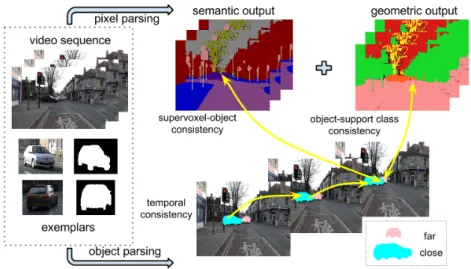
![Figure 2.6: Examples of video understanding with object-level cues. Generic object segmentation [162] is on the left and object-based video parsing [174] is on the right.](https://thumb-us.123doks.com/thumbv2/123dok_us/1286516.2672675/49.892.178.785.169.382/figure-examples-understanding-object-generic-object-segmentation-parsing.webp)