Efficient Reversible Data Hiding Techniques
Based on RDH Algorithm for Multimedia
Communication
M.P.NirmalaAssistant Professor, Dept. of ECE, APEC, Melmaruvathur, Tamilnadu.
Abstract - In the paper, we deal with the system that hides the data reversibly which is termed as reversible data hiding scheme. In this technique images will be authenticated and then the authenticate image is restored to their original from. This original form is achieved by removing the digital watermark and it replaces the image data that had been overwritten. The main aim of hiding is to maintain secret communication between two users. The U.S Army also uses this technique for authentication of reconnaissance images reversible technique. Because it has an advantages of high hiding capacity, high security, low complexity and good visual quality. Reversible technique is in the sense extraction of the original input image. Reversible data hiding finds many applications and widely used in the fields of medical imagery, military imagery and law forensics. Reversible data hiding is the best technique which provides more security for hiding information than the other techniques.
I.INTRODUCTION
In recent days the amount of digital images has been increased rapidly on the Internet. So there is a necessity for image security and it becomes increasingly important for many applications such as confidential transmission, video surveillance, military and medical applications. For example, the necessity of fast and secure diagnosis is vital in the medical world. Nowadays, the image transmission is a considered to be a daily routine and it is very important to find an efficient way to transmit such images over networks. In order to decrease the transmission time, we need to compress the data. Therefore this multimedia data’s are protected with the help of encryption or data hiding algorithms. Since few years, there was a problem exist to combine compression, encryption and data hiding in a single step. Two technologies have been developed for this purpose. The first technology is based on content protection through encryption. To encrypt binary images or gray level images there are several methods available. The second technology is based on the protection on data hiding, aimed at secretly- a message is embedded into the data. In most multimedia techniques data embedding modifies and it distort the host signal to insert additional information. This embedding distortion is considered to be small and it yet irreversible, i.e. in order to recover the original host signal it cannot be removed. The loss of host signal fidelity is not prohibitive in many applications as long as original and modified signals are perceptually equivalent.
However, some embedding distortion is considered to be admissible in a number of domains -such as military, legal and medical imaging although, permanent loss of signal fidelity is undesirable. This indicates the important of Reversible (Lossless) Data Embedding techniques. Like their lossy counterparts in these techniques, information bits is inserted by modifying the host signal, thus an embedding distortion is induced. Nevertheless, they also enable the removal of such distortions and the exact- lossless- restoration of the original host signal after extraction of embedded information.
Reversible data hiding is a technique, in which we can recover the original lossless cover after the extraction of embedded message. It means secret information is hided into innocent data. For hiding secret information digital images are ideal. An image is Cover image is said to be an image that contains a secret message. It is not possible to visually notice the difference of the cover image and the stego image at first. Here no hackers extract the hidden message illegally since the embedding itself draws no extra attention to the stego image. Second, encrypted image have to be constructed, so the image is partitioned and then the image is encrypted with help of encryption key. Third, the reliability of the message hiding method. Without a special extracting method and a proper secret key no one can extract the hidden message. Then, the maximum length of the secret message that can be hidden should be as long as possible. With the help of decryption key the datas are extracted from the encrypted image.
II.DATA HIDING
In this previous method, the original image is encrypted using a standard cipher with an encryption key. After producing the encrypted image, then it is handed over it to a data hider (e.g., a database manager). Then the data hider can embed some auxiliary data into the encrypted image, this encryption is done by losslessly vacating some room according to a hiding key. Then a receiver can extract
40 Techscripts
Vol. 2, Issue 6, June 2014
the embedded data with the data hiding key. Then original image is recovered from the encrypted version according to the encryption key. In encryption method 8-bit gray-scale images are generated. It is done by encrypting every bit- planes with a stream cipher. In this method encrypted image is segmentedinto a number of non-overlapping blocks. Each block is used to carry one additional bit. In each block pixels are divided pseudo-randomly into two sets S1,S2.
The pixels are divided according to a data hiding key. If the embedded additional bit is 0, then it flip the 3 LSBs of each encrypted pixel in S1, otherwise it fl i p the 3 encrypted LSBs of pixels in 2. Now the receiver flips all the three LSBs of pixels to form a new decrypted block in order to recover image and to get extraction of data. It is noted that original block is presumed to be much smoother than interfered block because of the spatial correlation in natural images, and embedded bit can be extracted correspondingly.
If the divided block is relatively small, then it will be difficult for bit extraction and image recovery. The extraction and recovery of blocks are performed in descending order according to the absolute smoothness difference between two candidate blocks. Then the recovered blocks are used to evaluate the smoothness of unrecovered blocks, which is referred to as side match.
At first the system is reservesd for enough space on original image and then image is converted into its encrypted version. The conversion is done with its encryption key. After the image is encrypted the data is hidden with data hiding key. At receiver side the image and data are extracted with the help of encryption key. It can achieve reversibility that is data extraction and image recovery without any error.
III. IMAGE RECOVERY / DATA EXTRACTION
The proposed scheme includes encryption of image, data embedding and data-extraction/image-recovery phases. In the proposed section with the help of e n c r y p t i o n key the original image is encrypted. Then by using data hiding key the additional data are embedded into the encrypted image. Now encrypted image contains additional data, let us consider that receiver has only the data-hiding key, he can extract the additional data though receiver, but it is not possible to know the content present in the image. If receiver has only the encryption key, he can decrypt the received data, but not possible to extract the embedded additional data The content owner produces an encrypted image that encrypts the original uncompressed image using an encryption key. Then, least significant bits (LSB) of the encrypted image are compressed with the help of data hider that uses data-hiding key to create a sparse space to accommodate the additional data. At the receiver side, the embedded data can be easily retrieved from the encrypted image containing additional data according to the data-hiding key. Since only the LSB is affected by data embedding, a decryption with the encryption key can result in an image similar to the original version. Fig. 2 shows the three cases at the receiver side. Therefore the data can be successfully extracted only when both of the encryption and data-hiding keys are used, the embedded additional and the original image can be perfectly recovered by exploiting the spatial correlation in natural image.
IV. IMPLEMENTATION DETAILS A. Image Encryption
We can compress the encrypted binary image in lossless manner. It can be done by finding the syndromes of low-density parity-check codes. If the excessively rough and fine information of coefficients generated from orthogonal transform are discarded then the encrypted gray image can be efficiently compressed. When having the compressed data, a receiver may reconstruct the principal content of original image by retrieving the values of coefficients. The owner produces an encrypted image with the help of encryption key. Thereby the original uncompressed image will be encrypted and then the least significant bits (LSB) of the encrypted image is compressed using a data-hiding key to create a sparse space to accommodate the additional data. At the receiver side, the data embedded is retrieved from the encrypted image containing additional data according to the data-hiding key.
Since the data embedding only affects the LSB, a decryption with the encryption key can result in an image similar to the original version. Encryption is a technique which is used to encode messages or information by which only the authorized person can read it. It can also be defined as that it prevents the data from hacker and doesn’t allow the hacker to read it. The message or information (referred to as plaintext) is encrypted by an encryption algorithm, and making it as unreadable cipher text. This is done by encryption key, which specifies how the message is to be encoded.
B. Data Embedding
Data embedding phase is a process in which the parameters are embedded as a small number
41 Techscripts
Vol. 2, Issue 6, June 2014
of encrypted pixels, and also it compresses the LSB of the other encrypted pixels. This compression is done in order to create a space for accommodating the additional data and the original data NP encrypted pixels are selected randomly with respect to data hiding key which will be used to carry the parameters for data hiding. NP is considered to be a small positive integer, for example NP=20.The other encrypted pixels are pseudo-randomly permuted and divided into number of groups, each of which contain L pixels. The data-hiding key determines the permutation. For each pixel-group, M least significant bits of the L pixels are collected, and denote them as B (k,1) , B (k,2) …… B(k,M*L) where k defines group index within [1,(N-Np)/L] and M be an positive integer less than 5. Matrix of G is generated by data hider sized (M*L – S) * M*L, which contains two parts. The left part is the identity matrix and the right part is pseudo-random binary matrix. For each group, which is product with the G matrix to form a matrix of size (M * L-S), which has sparse bits of size S, in which the data is embedded and pixels are arranged into the original form and original image is formed by permuting them.
There are two common domains of operation in lossless data embedding techniques. They are spatial and frequency. Spatial techniques are characterized by the embedding the messages into the least significant bits (LSBs) of image pixels, and in frequency methods it embeds the message after a certain transform is performed an d it also modifies the frequency coefficients of the cover image. Transform e m b e d d i n g methods is considered to be more robust than the spatial embedding schemes, which are susceptible to image-processing types of attacks. However higher capacity is provided by spatial data hiding techniques, which is defined to be a number of bits that can be embedded into the signal. It is noted that capacity is closely connected to the quality measure known as perceptibility. Perceptibility or fidelity shows whether the source cover is distorted by embedding information to a visually unacceptable level.
C. Image Decryption
When having an encrypted image containing embedded data, a receiver firstly generates ri,j,k according to the encryption key, and calculates the exclusive-or of the received data and ri,j,k to decrypt the image. We denote the decrypted bits as b1i,j,k . Clearly, the original five most significant bits (MSB) are retrieved correctly. For a certain pixel, if the embedded bit in the block including the pixel is zero and the pixel belongs to S1, or the embedded bit is 1 and the pixel belongs to S0 , the data-hiding does not affect any encrypted bits of the pixel. So, the three decrypted LSB must be same as the original LSB, implying that the decrypted gray value of the pixel is correct. On the other hand, if the embedded bit in the pixel’s block is 0 and the pixel belongs to S0, or the embedded bit is 1 and the pixel belongs to S1, the decrypted LSB. That means the three decrypted LSB must be different from the original LSB. In this case: b’i,j,k + bi,j,k = 1
On the other hand, if the embedded bit in the pixel’s block is 0 and the pixel belongs to S0, or the embedded bit is 1 and the pixel belongs to S1, the decrypted LSB.
D. Data Extraction
The receiver has both the data hiding, he may aim to extract the embedded data according to the data hiding key. The values of M, Land S, the original LSB of the Np selected encrypted pixels, and the (N-Np) * S/L - Np additional bits can be extracted from the encrypted image containing embedded data. By putting the Np LSB into their original positions, the encrypted data of the Np selected pixels are retrieved, and their original gray values can be correctly decrypted using the encryption keys. In the following, it will recover the original gray values of the other (N-Np) pixels. Consider the case that the receiver has the encryption key but does not know the data-hiding key. Clearly, he cannot obtain the values of parameters and cannot extract the embedded data. However, the original image content can be roughly recovered. The performance of a reversible data – embedding algorithm can be measured by the following.
1. Payload capacity limit: It is the maximal amount of information that can be embedded. 2. Visual quality: It is the visual quality on the embedded image.
3. Complexity: It is the algorithm complexity.
The motivation of reversible data embedding is distortion-free data embedding .Though imperceptible, embedding some data will inevitably change the original content. Even a very slight change in pixel values may not be desirable, especially in sensitive imagery, such as military data and medical data. In such a scenario, every bit of information is important. Any change will affect the intelligence of the image, and the access to the original, raw data is always required. From the application point of view, reversible data embedding can be used as an information carrier. Since the difference between the embedded image and original image is almost imperceptible from human eyes, reversible data embedding could be thought as a covert communication channel. By embedding its message authentication code, reversible data embedding provides a true self authentication scheme, without the use of metadata.In order to obtain a
42 Techscripts
Vol. 2, Issue 6, June 2014
deeper insight of the data hiding process in images, it is necessary to summarize the definitions of the following terms and notions:
a) Reversibility: Ability to extract both the original image and the watermark b) Perceptibility: Perceptual similarity between the original and the stego images; c) Payload: Number of encoded bits of a watermark without including the redundant
information;
d) Robustness: Ability to detect the watermark after the common signal processing operations; e) Capacity: Number of bits that can be embedded into the signal.
The performance of the data hiding methods can be measured by the payload capacity limit, visual quality and complexity, where the visual quality is the quality of the stego image after the embedding operation is done, and complexity is a number of mathematical operations, which describes the algorithm. Another classification criteria of data hiding schemes is the actual technique of data embedding, among which the most common are: compression, histogram shifting (HS) and difference expansion (DE). This thesis will provide thorough explanations in the next chapters of DE and HS techniques which achieve high embedding capacity preserving the imperceptibility of the signal.
V. SIMULATION RESULTS
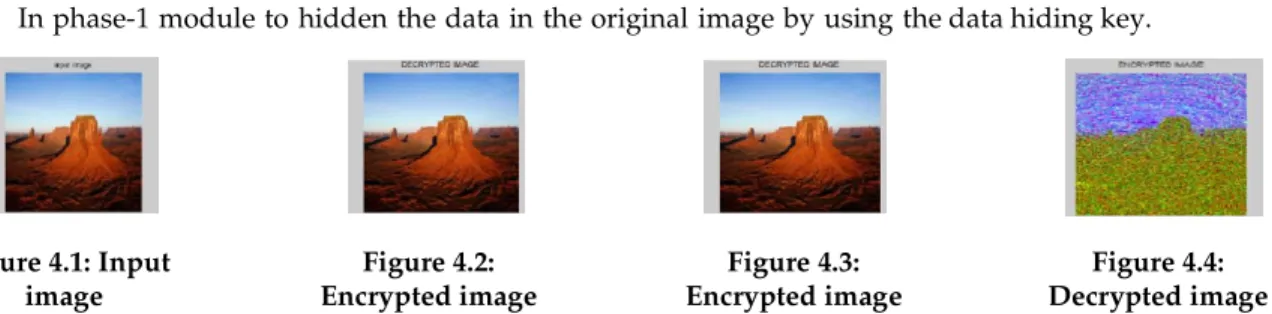
In phase-1 module to hidden the data in the original image by using the data hiding key. Figure 4.1: Input image Figure 4.2: Encrypted image Figure 4.3: Encrypted image Figure 4.4: Decrypted image
Figure 4.1 shows original image is to be reference and it is a static image, in which the sensed image is to be registered. The system first reserves enough space on original image and then convert the image into the encrypted image with using the encryption key. Figure 4.2 shows the encrypted image with reference to the original image .After the image is encrypted the data is hiding with the help of data hiding key. The embedding process in encrypted images is inherently reversible for the data hider only needs to accommodate data into spare space previous emptied out.
Figure 4.3 shows the decrypted image with reference of original image. At the receiver side the image and data are extracted with the help of decryption key. To manage and update personal information of images which are encrypted for protecting client’s privacy, an inferior database manager may only get access to the data hiding key and have to manipulate data in encrypted domain. The order of data extraction before image decryption guarantees.
Figure 4.4: With same encryption key and data hiding key
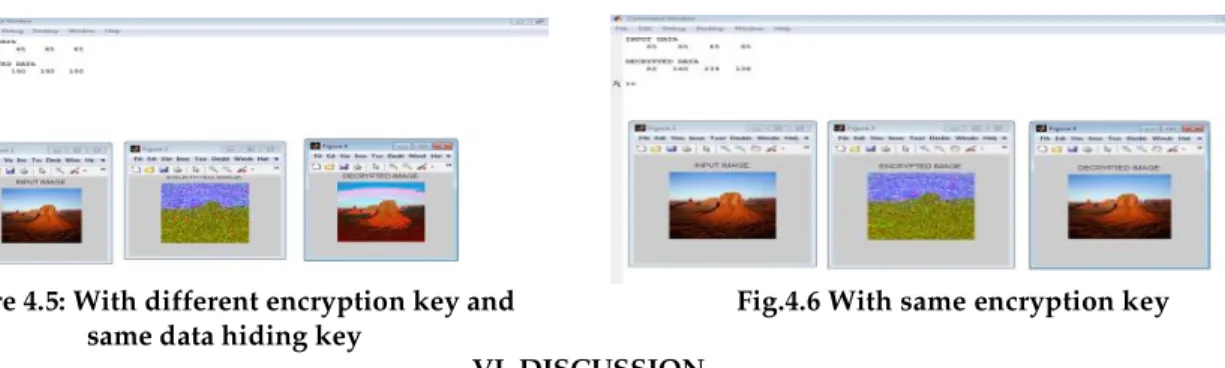
Figure 4.5: With diff encryption key
Figure 4.4 shows the image with same encryption key and data hiding key. In above figure the image is encrypted and decrypted also correctly and given datas will be proper. So with the same encryption key and data hiding key means the input image is decrypted correctly and also the given data will be appropriate.
Figure 4.5 shows the image with different encryption key and same data hiding key. In above figure the image is encrypted and decrypted image is not proper and given datas also wrong. So with the different encryption key and same data hiding key means the input image is not decrypted correctly and also the given data will not be appropriate.
Figure 4.6 shows the image with different encryption key and same data hiding key. In above figure the image is encrypted and decrypted image is also proper and given datas are wrong. So with the same encryption key and different data hiding key means the input image is decrypted correctly and also the
43 Techscripts
Vol. 2, Issue 6, June 2014
given data will not be appropriate.
Figure 4.5: With different encryption key and same data hiding key
Fig.4.6 With same encryption key VI. DISCUSSION
All the simulation have been carried out in the software tool MATLAB 2011a .These proposed method shows that the better output can be achieved compared to all other technique, which does not take much computational time as other, these seems to be the another advantage of this method. This has been illustrated by the comparison tabulation shown above and with the help of the other simulation result figure. Each image takes different number of iterations based on the amount of the noise present in it. Thus by using the proposed technique can greatly reduce the noise in short time. The computational complexity is also very low and reduced computational time.
VII. CONCLUSION
Reversible data hiding in encrypted images is a new topic drawing attention because of the privacy-preserving requirements from cloud data management. Thus the data hider can benefit from the extra space emptied out in previous stage to make data hiding process effort less. The advantage o f a l l t r a d i t i o n a l R D H t e c h n i q u e s f o r p l a i n i m a g e s a n d achieves excellent performance without loss of perfect secrecy. It can achieve real reversibility, separate data extraction and greatly improvement on the quality of marked decrypted images.
VIII.FUTURE WORK
To enhanced data hiding with maximum length and Compare the embedded r a t e w i t h i m a g e a n d v i d e o. The r e v e r s i b l e a l g o r i t h m ’ s processing speed becomes slow when payload is more to be embedded in the high capacity color image and Data embedding and extraction takes more time to complete the process. The future work is to enhance the processing speed, thereby reducing the amount of time.
REFERENCES
[1] T.KalkerandF.M.Willems,“Capacity bound sand code constructions for reversible data-hiding, ”in Proc.14th Int. Conf. Digital Signal Processing (DSP2002), 2002, pp. 71–76.
[2] W. Zhang, B. Chen, and N. Yu, “Capacity-approaching codes for reversible data hiding,” in Proc 13th Information Hiding (IH’2011), LNCS 6958, 2011, pp. 255–269, Springer-Verlag.
[3] W. Zhang, B. Chen, and N. Yu, “Improving various reversible data hiding schemes via optimal codes for binary covers,” IEEE Trans. Image Process., vol. 21, no. 6, pp. 2991–3003, Jun. 2012.
[4] J. Fridrich and M. Goljan, “Lossless data embedding for all image for- mats,” in Proc. SPIE Proc. Photonics West, Electronic Imaging, Security and Watermarking of Multimedia Contents, San Jose, CA, USA, Jan. 2002, vol. 4675, pp. 572–583.
[5] J. Tian, “Reversible data embedding using a difference expansion,” IEEE Trans. Circuits Syst. Video Technol., vol. 13, no. 8, pp. 890–896, Aug. 2003.
[6] Z. Ni, Y. Shi, N. Ansari, and S. Wei, “Reversible data hiding,” IEEE Trans. Circuits Syst. Video Technol., vol. 16, no. 3, pp. 354–362, March 2006
[7] D.M.Thodiand, J.J.Rodriguez,“Expansion embedding techniques for reversible watermarking,” IEEE Trans. Image Process., vol. 16, no. 3, pp.721–730, Mar. 2007.
[8] X. L. Li, B. Yang, and T. Y. Zeng, “Efficient reversible watermarking based on adaptive prediction-error expansion and pixel selection,” IEEE Trans. Image Process., vol. 20, no. 12, pp. 3524– 3533, Dec. 2011.
[9] P. Tsai, Y. C. Hu, and H. L. Yeh, “Reversible image hiding scheme using predictive coding and histogram shifting,” Signal Process., vol. 89, pp. 1129–1143, 2009.
[10]K. Hwang and D. Li, “Trusted cloud computing with secure resources and data coloring,” IEEE Internet Comput., vol. 14, no. 5, pp. 14–22, Sep - Oct. 2010.
44 Techscripts
Vol. 2, Issue 6, June 2014