ORANGE COUNTY
ARTICLE VI. RESOURCE PROTECTION STANDARDS 6.00.00. PURPOSE
The purpose of this regulation is to establish those resources or areas of a development site that must be protected from harmful effects of development. A developer should apply the provisions of this regulation to a proposed development site before any other development design work is done. Application of the provisions of this regulation will divide a proposed development site into areas that may be developed and areas that must generally be left free of development activity. The proposed development should then be designed to fit within the areas that may be developed.
6.01.00 INDEX TREE REMOVAL AND PROTECTION
The purpose of this section is to provide for the protection and replanting of tree canopy native to Flagler County; to provide incentives for developers, permittees, and land owners to preserve index trees; and to establish procedures, standards and enforcement provisions.
6.01.01. Definitions.
The definitions set forth herein are intended to be read para materia with those in Article III. In the case of a conflict, this section will prevail.
For the purposes of this section, the following words and phrases shall have the meaning set forth herein:
Agricultural: Land having an agricultural classification pursuant to Chap. 193.461, F.S. and used primarily for bona fide agricultural purposes as defined in Chap. 193.461(3)(b), F.S.
A1A Scenic Corridor : As defined by Ordinance 2001-26, as may be amended from time to time.
Building footprint : The portion of the lot, tract or parcel upon which buildings are to be placed.
Canopy: The overall area of a tree's foliage, the outer edge of which is the drip line. Developed property : One which has received a certificate of occupancy for the principal building or a majority of the buildings in a multi-structure complex.
Diameter at breast height (DBH) : The measurement of a tree's trunk diameter in inches measured roughly four and one-half (4 1/2) feet above ground. For multi-trunk trees it shall be the diameter of the individual trunks measured at 4 1/2 feet.
Drip line: The outermost edge of the foliage of a tree projected vertically to the ground. Encroachment: Any activity that has the effect of causing soil compaction, injury to lower limbs, grade change, contamination of soil or damage to the root system. Excluded from this definition are routine maintenance activities such as mowing or walking within the index tree's drip line.
Firewise communities : A program developed by the National Wildland/Urban Interface Fire Program administered by the Division of Forestry of the Florida Dept. of Agriculture and Consumer Services.
Index tree: An index tree is free of significant defects in structure or decay of a species listed in section 6.01.04 Index Tree List, and having a minimum caliper of six (6) inches DBH.
Land clearing : The removal of index trees, soil or mineral deposits or the placement of fill by any means with the intention of preparing real property for non-agricultural
development purposes. This definition does not include removal of other than index trees; dead or diseased trees of any species; removal of trees in accordance with Firewise Communities standards; underbrushing; or normal mowing or agricultural operations. Nonresidential: That development, or portion thereof, devoted to commercial, industrial, or institutional land use(s). This does not include agriculture or forestry or essential governmental services.
Nuisance Tree: Brazilian Pepper ( Schinus terebinthifolius ), Australian Pine ( Casuarina spp ), punk tree (melaleuca leucadendion) and Chinese tallow ( Sapium sebiferum ).
Protected tree: Refers to an index tree protected in the course of development and construction.
Prune: The removal of dead, dying, diseased, weak or objectionable branches in a manner consistent with the standards established in this code.
Replacement tree: A tree of a species listed in section 6.01.04 and having a minimum caliper as required herein.
Replacement tree (A1A Corridor only): A tree of a species listed in the Interim
Replacement Tree List for the A1A Scenic Corridor, having a minimum caliper of six (6) inches measured at four and one-half (4 1/2) feet above ground and having a minimum height of twelve (12) feet when planted.
Specimen or historic tree : A tree of unique growth, age, aesthetic or historic value and having been designated as such by resolution.
Submerged land : That portion of a parcel lying below the mean high water line of a tidal water body; the seasonal high water line of a fresh water body; or the design elevation of a man-made water body. The latter excludes dry retention areas.
Tree, index: See Index tree.
Tree relocation : To transplant an index tree from one location to another.
Tree removal : To permanently remove the trunk and/or root system of an index tree. Tree survey : A survey prepared by a Florida licensed land surveyor showing, in addition to all information required by Rule 61G-176, F.A.C. the location, dbh, and common name of all qualifying index trees within the area proposed for development. Non-index trees may be designated as "clumps" with the general location and predominant type shown.
Underbrushing : The removal of nuisance trees, understory and vegetation by means of bush hogging or hand clearing above grade only.
(Ord. No. 04-04, § 3, 2-16-04)
6.01.02. Requirements prior to land clearing.
(1) No person shall proceed with index tree removal or land clearing on any improved, vacant or unimproved land except in accordance with the procedures and standards of this section.
A. Contemporaneous with a building permit, infrastructure permit or application for special exception approval, the following information must be submitted:
1. A tree survey as defined herein. Jurisdictional wetland areas may be designated by their outer perimeter. When land clearing is not proposed on individual lots or parcels, but is a part of subdivision improvements, the tree survey for such purpose will extend
thirty-five (35) feet either direction of road rights-of-way and other affected areas, e.g. retention ponds, drainage easements, lift stations.
2. A legible site development plan drawn to one (1) inch equals twenty (20) feet scale or to the largest practicable scale indicating the following applicable items:
i. Location of all proposed structures, improvement and site uses, properly dimensioned and referenced to property lines, setback and yard requirements.
ii. Proposed site elevations, including any proposed fill or excavation. iii. Location of proposed or existing utility services, wells or septic systems. iv. The common name, size and location of all index trees on the site specifically designating the index trees to be retained, removed, relocated or replaced.
v. Typical location and construction of tree barricades.
vi. For all applications other than an individual single family building permit, tree information shall be summarized in legend or tabular form.
3. Landscaping plan.
4. Applications involving improvements to existing developed properties may be based on drawings showing only that portion of the site directly involved and adjacent
structures or portions thereof. In such cases, a tree survey is not required. A sketch showing the approximate location(s) of all existing index tree(s) with common and botanical name shall be provided instead.
5. Where index trees are not, because of past use and/or current conditions, reasonably presumed by the county to exist on a site, an affidavit duly executed by the property owner attesting to such condition may be substituted for a tree survey.
(2) Authorization to proceed. The development services department shall authorize land clearing through the issuance of the building or development permit. Land clearing is subject to site inspection by the county from application to one (1) year after completion of activity.
A. Criteria for land clearing. Land clearing will be authorized after the development services director or his/her designee determines that the following conditions, as applicable, exist:
1. The property has received site plan, special exception or preliminary plat approval pursuant to this Code, has received or applied for a building permit, or is an occupied residential or non-residential property.
2. A tree relocation or replacement plan meeting the requirements of this section is a condition precedent to land clearing.
3. The index tree is located in the building pad, swimming pool or deck, roadway pavement or vehicular use area, stormwater retention area, or a utility or drainage easement where a structure or improvement is to be placed.
4. The index tree is in danger of materially impairing the structural integrity of existing or proposed structures, materially interferes with utility service, or adversely affects sight distance triangles.
5. The index tree has one or more defects which, in the opinion of a certified arborist, will cause branch, stem or root failure.
6. No specimen or historic tree may be removed except by authorization of the board of county commissioners.
B. The authorization for land clearing shall expire contemporaneously with its associated permit.
6.01.03. Index tree protection/replacement requirements.
The individual property owner and/or landscape architect are provided flexibility of design but must preserve a minimum percentage of existing index tree canopy in a manner to support the long-term health and survival of protected trees. Existing trees are best protected within clusters of open space left undisturbed by grade changes, soil compaction, mechanical or chemical disturbance.
(1) The minimum number of index trees to be preserved upon any development site is equal to the percentages set forth below for different land uses. Index trees lying within designated conservation areas, jurisdictional wetlands and adjacent upland buffers must be preserved in their entirety. By way of example, a building lot contains an aggregate of one hundred (100) caliper inches of index trees and the minimum preservation equals forty (40) percent. This forty (40) inches of required index trees can be preserved as a single forty (40) inch DBH index tree; two (2) twenty (20) inch DBH trees; or any combination of qualifying preserved and/or replacement index trees totaling forty (40) caliper inches.
A. Single-family dwelling lots: Each single-family residential lot must preserve or replant at least forty (40) percent of the total pre-development caliper inches existing on the site. Preserved index trees may be substituted for tree planting required by the landscaping section of this Code.
B. Multi-family and mobile home park parcels: Each multi-family and mobile home park parcel must preserve or replant at least thirty-five (35) percent of the total pre-development caliper inches existing on the site. Preserved index trees may be substituted for tree planting required by the landscaping section of this Code. Replacement trees may be clustered within pervious areas of the site provided that at least five hundred (500) square feet of green space per tree is provided.
C. Non-residential parcels: Each non-residential parcel must preserve or replant at least twenty (20) percent of the total pre-development caliper inches existing on the site. Preserved index trees may be substituted for tree planting required by the landscaping section of this Code. Replacement trees may be clustered within pervious areas of the site provided that at least five hundred (500) square feet of green space per tree is provided. D. Where replacement trees are required to be planted in order to maintain the minimum number of caliper inches, they shall be from a species listed as an index tree, have a minimum caliper of two and one-half (2 1/2) inches measured six (6) inches above grade after planting and be Florida Grade #1 or better. Tree planting and maintenance
procedures for replacement trees shall follow the "Tree, Shrub and Other Woody Plant Maintenance Practices," on pruning, fertilization and support systems called the ANSI (American National Standards Institute) A300 Standard. Transplanting and establishment of trees shall follow those described inTypical Tree Bid Specifications for Florida, part 2 (shipping and handling) part 3 materials, and part 4 (execution) developed by the
University of Florida, the Florida Urban Forestry Council and the Florida Chapter of the International Society of Arboriculture.
E. A1A Scenic Corridor: The pallet of protected trees in the A1A Scenic Corridor is more inclusive than for the county as a whole. This expanded protection is designed to preserve the native ecosystems in the Corridor. A list of protected index trees established by Ordinance 2001-26 is available at the Planning and Zoning Dept. and incorporated into the Scenic Corridor Design Guidelines Handbook. The minimum number of index trees to be preserved upon any development site is calculated as set forth previously
within this section however, the list of protected trees is more expansive and the following percentages of aggregate caliper inches shall apply:
1. Nonresidential and multi-family parcels: Each nonresidential or multi-family parcel owner must preserve or replant at least fifty (50) percent of the total pre-development caliper inches existing on the site. Property owners are encouraged to use preserved index trees to satisfy perimeter and interior landscaping requirements.
2. Single-family parcels: Every single-family lot owner must preserve or replant at least forty (40) percent of the total pre-development caliper inches existing on the site.
3. Where trees must be replaced or planted to meet minimum preservation or landscape buffer requirements within the Scenic Corridor Overlay district, all plant material will consist of a tree species listed in the Scenic Corridor Index Tree List and that has a minimum caliper of four (4) inches measured at six (6) inches above ground and has a minimum height of twelve (12) feet when planted. The rootball shall have a ninety-five (95) gallon minimum container or equivalent rootball size. The minimum rootball size diameter shall be forty (40) inches or, if in a growbag, shall have a diameter of thirty (30) inches minimum. Sabal palms shall have a minimum twelve (12) feet of clear trunk. Plant materials shall conform to the standards for Florida No. 1 or better as given in "Grades and Standards for Nursery Plants," (current version) State of Florida Department of Agricultural and Consumer Services, or equal thereto that has been approved by the county agricultural extension agent. The preservation and use of native vegetation is highly encouraged. Plant materials selected shall be the best suited to withstand the soil and physical conditions of the site. Plant materials that are freeze and drought tolerant are preferred;
4. Replacement trees shall approximate the distribution of native vegetation Where a one to one (1:1) replacement is not practical as reasonably determined by the county administrator or his/her designee, the tree shall be replaced in multiples to yield a sum of equivalent calipers;
5. Whenever a protected tree is removed without legal authorization or in violation of this code, the owner shall replace such removed trees on a one to three (1:3) ratio. For example, if a twenty (20) inch caliper tree is illegally removed, it shall be replaced by a tree or trees equivalent to sixty (60) inches in caliper from the Interim Replacement Tree List or an equivalent tree species;
6. Be given sufficient room for optimum growth. If the county administrator or his/her designee reasonably determines that there is insufficient space on the site to plant the required replacement trees for optimum growth, then the owner may be directed to plant the trees in publicly owned areas of the A1A Scenic Corridor, or in privately owned strategically visible locations with the permission of the property owner.
7. Trees installed or retained within the A1A Scenic Corridor shall not be topped or severely pruned so as to appear stunted or "hat racked". Trees shall be pruned as needed to maintain health and form in such a way that retains or improves the natural form of the particular species; provided, topiary may be practiced upon suitable species if
professionally and consistently maintained. The branches of a tree extending over any public sidewalk shall be trimmed to at least the height of eight (8) feet above the sidewalk. The branches of a tree extending over the travel portion of any street used for vehicular traffic shall be trimmed to fifteen (15) feet above the street. All tree pruning shall be conducted according to the standards of the National Arborist Association Standards set forth in ANSI A300 (Part 1) Tree Pruning. All landscaping installed or
retained to meet the requirements of this section shall be maintained in a healthy and growing condition.
F. All replacement or relocated index trees must be maintained in a healthy and growing condition for a minimum of two (2) years from the date of the last certificate of
occupancy in the development. All trees that, in the opinion of the county, will not survive for this minimum time period will be replaced by the property owner. (Ord. No. 04-04, § 3, 2-16-04; Ord. No. 04-11, § 3, 8-16-04)
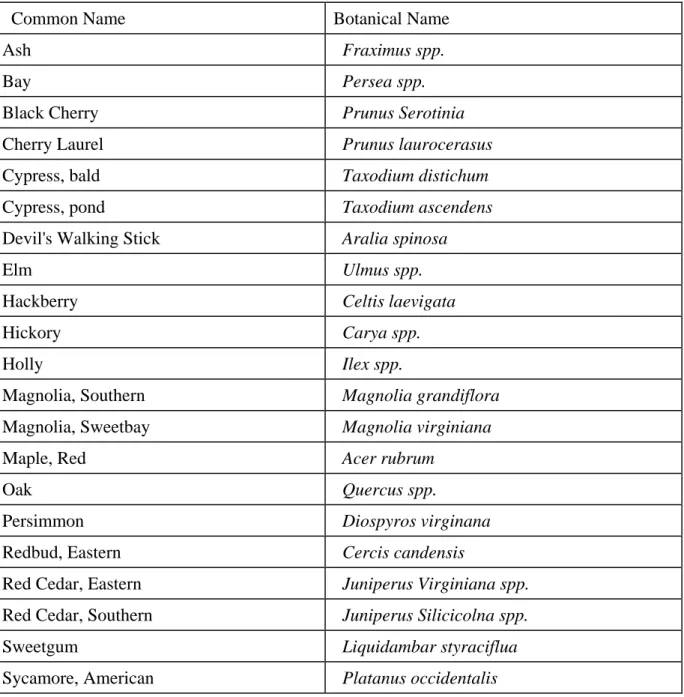
6.01.04. Index trees.
The following index trees having a caliper of six (6) inch DBH or greater are protected under the terms of this regulation and also constitute acceptable replacement trees subject to minimum size requirements:
TABLE INSET:
Common Name Botanical Name
Ash Fraximus spp.
Bay Persea spp.
Black Cherry Prunus Serotinia
Cherry Laurel Prunus laurocerasus Cypress, bald Taxodium distichum
Cypress, pond Taxodium ascendens
Devil's Walking Stick Aralia spinosa
Elm Ulmus spp.
Hackberry Celtis laevigata
Hickory Carya spp.
Holly Ilex spp.
Magnolia, Southern Magnolia grandiflora Magnolia, Sweetbay Magnolia virginiana
Maple, Red Acer rubrum
Oak Quercus spp.
Persimmon Diospyros virginana
Redbud, Eastern Cercis candensis
Red Cedar, Eastern Juniperus Virginiana spp. Red Cedar, Southern Juniperus Silicicolna spp.
Sweetgum Liquidambar styraciflua
Tupelo, Black Nyssa sylvatica
Tupelo, Swamp Nyssa aquatica
Yellow-Poplar(Tulip tree) Liriodendron tulipifera
County staff may accept other broadleaf hardwood trees as replacements upon a finding of suitability.
(Ord. No. 04-04, § 3, 2-16-04)
6.01.05. Tree protection during construction.
(1) Standards for tree protection during development. The following are minimum standards necessary to protect trees designated for preservation from damage during land clearing and development activities after the permit has been approved.
A. Protection of existing trees. Prior to any clearing of improved, vacant or unimproved land unless specifically exempted from this section, trees to be preserved shall be
identified, staked and clearly marked to prevent physical damage from heavy equipment and other activities incidental to development. Required barriers shall be subject to inspection for the duration of the activity.
1. Whenever there is any planned encroachment into the dripline of an index tree proposed for preservation, the applicant is recommended to secure the services of a licensed certified arborist. The certified arborist should prepare a written report indicating the chances for long term survival of the tree and best practices to be employed during and after construction. As an alternative, the county shall review the protection program for approval.
2. Root pruning. The roots of all trees to be protected shall be cleanly pruned at the edge of proposed land disturbance activity.
3. Barriers or barricades. The barriers or barricades shall be conspicuous enough and high enough to be seen easily by operators of trucks and other equipment. Immediately following the clearing of underbrush, barricades shall be installed and required to remain in place throughout the construction period. The minimum size of wood barrier fencing shall be two (2) inches by four (4) inches and the top of the barrier shall be a minimum of four (4) feet high. Another acceptable means of barricading trees is the use of orange plastic construction fence, four (4) feet high, and supported every eight (8) feet by rebar, driven into the ground. Fencing shall be securely attached to rebar by the use of nylon zip ties or twisted wire. Barricades must be taut and perpendicular to ground.
4. Other required protection of trees: The developer or permittee shall protect the trees designated for preservation in the approved permit from physical damage, chemical poisoning, excavation and grade changes to at least the following minimum standards: a. Utility and irrigation line trenches. Trenches shall be routed away from trees to an area outside the drip line to the maximum extent possible or directionally bored. b. Grade changes. If approved by the county, retaining walls or dry wells may be utilized to protect root systems from severe grade changes.
c. Development activities. No vehicle maintenance, storage of construction materials or debris, or cleaning of equipment shall take place within the barricaded area.
5. Pruning of trees and vegetation. Pruning of branches and roots of trees must be in compliance with the standards established by the American National Standards Institute (ANSI A-300).
a. The protected area shall be mulched and irrigated regularly according to seasonal needs.
b. The permittee shall protect tree root systems from damage due to noxious materials in solution caused by runoff, or spillage during mixing and placement of construction materials, or drainage from stored materials. Root systems shall also be protected from flooding, erosion or excessive wetting resulting from dewatering operations.
7. Trees damaged during construction. Tees damaged by construction must be repaired under the direction of a certified arborist in a manner acceptable to the county.
a. Immediate notification of county. Flagler County Development Services must be notified immediately after any damage to any tree by construction operations. b. Prompt repair. Such repairs as necessary shall be made promptly after damage occurs to prevent progressive deterioration of damaged trees.
c. Removal and replacement of damaged trees. The developer or permittee shall
remove trees which are determined by the county to be incapable of restoration to normal growth pattern. Such trees shall be subject to replacement under the provisions of this section.
(Ord. No. 04-04, § 3, 2-16-04) 6.01.06. Exemptions.
The following activities are specifically exempt from the procedures and standards of this section:
(1) Agricultural activities including harvesting of commercial timber. The latter must comply with the latest addition of "Silviculture Best Management Practices" published by the Florida Department of Agriculture and Consumer Services.
(2) Tree removal directly within a public or private road right-of-way for the installation of required subdivision improvements.
(3) Individual service connections and construction, installation of public utility lines provided, however, they comply with Section 6.01.05(4)(a); septic tanks, lines or drain fields; compacted fill within the limits of the approved building footprint.
(4) Emergency work to protect life, limb or property. This includes clearing that is in conformance with firewise community protection standards set forth by the division of forestry.
(5) Maintenance activity along road sides, under wires, around fire hydrants and similar instances.
(6) Damaged trees. Trees suffering major structural damage or destroyed by force majeure are exempt from this section as determined by the county.
(7) Licensed plant and tree nurseries. Plant and/or tree nurseries licensed pursuant to the Florida State Department of Agriculture and Consumer Services, Division of Plant Industry shall be exempt from the terms and provisions of this article in relation to those trees planted and growing on site for wholesale and/or retail sale purposes in the ordinary course of said licensee's business.
(8) A tree or trees required to be cut down, destroyed, removed or relocated or destructively damaged by a county, state or federal law, or by rules promulgated by a county, state or federal agency.
6.01.07. Enforcement.
(1) Generally. The development services director or his/her designee shall enforce the provisions of this section.
(2) Individual enforcement. Each violation of this section or any of its subsections is deemed a separate and distinct infraction of the land development code. Each index tree to be protected may be the subject of individual enforcement.
(3) Strict liability of owner. The owner of any property where a tree or trees have been cut down, destroyed, removed, relocated or destructively damaged shall be held strictly liable for a violation of this section unless it can be proven that the damage was caused by:
A. An act of God; B. An act of War;
C. Development activities on the property in compliance with an approved permit; or D. The owner alleges that the damage was caused by vandals or trespassers and the owner of the property has filed a police report for the incident and had taken reasonable security measures to prevent unauthorized access to the property.
(4) Stop-work order. The enforcement agency shall immediately issue an order to cease and desist any work being carried out in violation of this section or any permit conditions promulgated under this section. Upon notice of such violation, no further work shall take place until appropriate remedial action is instituted, as determined by the enforcement agency.
(5) Other enforcement. Nothing in this section shall prohibit the county from enforcing this section by other means.
(Ord. No. 04-04, § 3, 2-16-04) 6.01.08. Penalties.
(1) Fine and replacement. Each violation of this section shall be punishable in a court of competent jurisdiction by a fine of no more than five hundred dollars ($500.00) plus replacement of the trees removed from the site. The removal, relocation or destruction, including dripline encroachment, of each tree for which a permit is required in violation of this section shall constitute a separate offense under this section. If the violation is discovered subsequent to stump removal, a presumptive count of one (1) qualifying index tree per four thousand (4,000) square feet, or major portion thereof, shall be employed in the absence of specific evidence of the actual number of trees destroyed.
(2) Withholding of permits. Failure of any party to follow the procedures as required by this section shall constitute grounds for withholding site plan approval, building permits, occupancy permits or any other appropriate approvals necessary to continue development until remedial action is completed in accordance with this section.
(3) In addition to the above, each violation of this Ordinance may be prosecuted as provided by Section 125.69, Florida Statutes 2004, as may be amended, which currently provides as follows:
"Violations of this ordinance shall be prosecuted in the same manner as misdemeanors are prosecuted. Such violations shall be prosecuted in the name of the state in a court having jurisdiction of misdemeanors by the prosecuting attorney thereof and upon conviction shall be punished by a fine not to exceed $500 or by imprisonment in the county jail not to exceed 60 days or by both such fine and imprisonment."
(4) In the event of a violation, the penalties set forth in this Ordinance shall be
applicable to the offending property owner, tenant, any contractor clearing the owner's property or any other person operating on behalf of the owner.