EFFECTIVENESS OF PILOTAGE
Jouni Lappalainen
Vappu Kunnaala
Piia Nygren
Ulla Tapaninen
MERENKULKUALAN KOULUTUS- JA TUTKIMUSKESKUKSEN JULKAISUJA
PUBLICATIONS FROM THE CENTRE FOR MARITIME STUDIESUNIVERSITY OF TURKU
A 57
TURUN YLIOPISTON
MERENKULKUALAN KOULUTUS- JA TUTKIMUSKESKUKSEN JULKAISUJA PUBLIKATIONER AV SJÖFARTSBRANSCHENS UTBILDNINGS- OCH
FORSKNINGSCENTRAL VID ÅBO UNIVERSITET
PUBLICATIONS FROM THE CENTRE FOR MARITIME STUDIES UNIVERSITY OF TURKU A 57 2011
EFFECTIVENESS OF PILOTAGE
Jouni Lappalainen Vappu Kunnaala Piia Nygren Ulla Tapaninen Turku 2011JULKAISIJA / PUBLISHER: Turun yliopisto / University of Turku
MERENKULKUALAN KOULUTUS- JA TUTKIMUSKESKUS CENTRE FOR MARITIME STUDIES
Käyntiosoite / Visiting address: ICT-talo, Joukahaisenkatu 3-5 B, 4.krs, Turku
Postiosoite / Postal address: FI-20014 TURUN YLIOPISTO
Puh. / Tel. +358 (0)2 333 51 http://mkk.utu.fi Kopijyvä Oy Kouvola 2011 ISBN 978–951–29–4857–4 (nid.) ISBN 978–951–29–4858–1 (PDF) ISSN 1456–1816
FOREWORD
The economic perspective has dominated the Finnish discussion on pilotage in recent years. Less attention has been paid to the role of pilotage in maritime safety and traffic fluency. Pilotage is safety work and enables risk management in seafaring from both safety and the traffic flow standpoints. The economic perspectives of Finnish pilotage have been adequately explored in various earlier surveys, but the basic task itself has not been extensively studied. Without an independent study of the essence of pilotage, it is not possible to discuss the effects of the pilotage on increased safety and better flow of traffic. Finnpilot Pilotage Ltd (later Finnpilot) wants to encourage active dialogue on pilotage and its significance with all actors in the maritime field, and so Finnpilot con-sidered it very important to clarify the various factors that could be measured in pilo-tage.
The pilotage effectiveness study is the first step towards facilitating measurement based discussion of pilotage in Finland. In this study the whole pilotage process is described in more detail than ever before. The process description has enabled the identifying of measurable issues in different stages of the process. These meters will open the impor-tance of the pilot’s work to those not thoroughly familiarised with pilotage, thus aware-ness on the effect of the pilotage comes to a wider knowledge and at the same time greater understanding on what is paid for in a pilotage due.
Based on this study it can be concluded that pilotage has been studied little even glob-ally, and examples of measuring the effectiveness of pilotage are scarce around the world. It can, however, be shown that there are measureable issues in the pilotage, and through them it is possible to evaluate the effectiveness of the pilotage. This study pro-vides an excellent foundation for Finnpilot in developing our own work and I hope this is the start of a completely new way of approaching pilotage in Finland and internation-ally.
The pilotage effectiveness studies have been carried out by M.Sc. (Engineering) Piia Nygren, M.Sc. (Admin.) Vappu Kunnaala and M.Sc. (Agric.) Jouni Lappalainen, sup-ported by Professor Ulla Tapaninen. The research has been done at the Maritime Logis-tics Research department of the Centre for Maritime Studies of the University of Turku, which operates as part of the Maritime research centre "Merikotka" in Kotka.
The Finnpilot Pilotage Ltd and the Centre of Maritime Studies of the University of Turku give their best thanks to the research management team as well as to the pilots who participated in the interviews.
Helsinki, 14th October 2011 Kari Kosonen Pilotage Director Finnpilot Pilotage Ltd.
tion of the pilotage procedure, to design performance indicators based on this process description, to be used by Finnpilot, and to work out a preliminary plan for the imple-mentation of the indicators within the Finnpilot organisation.
The theoretical aspects of pilotage as well as the guidelines and standards used were determined through a literature review. Based on the literature review, a process flow model with the following phases was created: the planning of pilotage, the start of pilo-tage, the act of pilopilo-tage, the end of pilotage and the closing of pilotage.
The model based on the literature review was tested through interviews and observation of pilotage. At the same time an e-mail survey directed at foreign pilotage organisations, which included a questionnaire concerning their standards and management systems, operations procedures, measurement tools and their attitude to the passage planning, was conducted. The main issues in the observations and interviews were the passage plan and the bridge team co-operation. The phases of the pilotage process model emerged in both the pilotage activities and the interviews whereas bridge team co-operation was relatively marginal. Most of the pilotage organisations, who responded to the query, also use some standard-based management system. All organisations who answered the survey use some sort of a pilotage process model. According to the query, the main measuring tools for pilotage are statistical information concerning pilotage and the organisations, the customer feedback surveys, and financial results. Attitudes to-wards passage planning were mostly positive among the organisations.
A workshop with pilotage experts was arranged where the process model constructed on the basis of the literature review was tuned to match practical pilotage. In the workshop it was determined that certain phases and the corresponding tasks, through which pilo-tage can be described as a process, were identifiable in all pilopilo-tage. The result of the workshop was a complemented process model, which separates incoming and outgoing traffic, as well as the fairway pilotage and harbour pilotage from each other. Addition-ally indicators divided according to the data gathering method were defined. Data con-cerning safety and traffic flow is gathered in the form of customer feedback. The pilot's own perceptions of the pilotage process are gathered through self-assessment. The measurement data which is connected to the phases of the pilotage process is generated e.g. by gathering statistics of the success of the pilot dispatches, the accuracy of the pi-lotage and the incidents that occurred during the pipi-lotage, near misses, deviations and accidents. The measurement data is collected via the PilotWeb at the closing of the pilo-tage.
A separate project and a project group with pilots also participating will be established for the deployment of the performance indicators. The phases of the project are: the definition phase, the implementation phase and the deployment phase. The purpose of the definition phase is to prepare questions for ship commanders concerning the cus-tomer feedback questionnaire and also to work out the self-assessment queries and the queries concerning the process indicators.
TABLE OF CONTENTS
1 INTRODUCTION ... 7
1.1 Changes in Pilotage in the 2000s ... 7
1.2 Objectives of the Study ... 8
1.3 Research Methodology and Study Structure ... 8
2 LITERATURE RESERACH ... 10
2.1 Scientific Studies ... 10
2.2 Instructions, Standards and Management Systems Concerning Pilotage ... 11
2.3 Good Pilotage Practice and the Pilotage Process ... 14
2.3.1 Passage Plan ... 14
2.3.2 The Bridge Cooperation ... 16
2.3.3 Use of Modern Navigation Technology ... 17
2.3.4 Pilotage Process ... 18
2.4 Summary ... 19
3 E-MAIL SURVEY ... 20
3.1 Survey Background ... 20
3.2 Management Systems in Use ... 21
3.3 Answers Concerning Passage Plans ... 23
3.4 Responses Concerning Standard Processes ... 25
3.5 Summary ... 27
4 INTERVIEWS AND OBSERVATIONS ... 28
4.1 Phases of Pilotage ... 28
4.1.1 Start of Pilotage ... 28
4.1.2 Act of Pilotage ... 29
4.1.3 End of Pilotage ... 29
4.2 Good Pilotage Practice ... 30
4.2.1 Bridge Cooperation ... 30
4.2.2 Passage Plan ... 31
4.2.3 Use of Modern Navigation Technology ... 32
4.3 The Role of the Pilot ... 32
4.4 Summary ... 32
5 PILOTAGE PROCESS ... 34
5.1 Planning of Pilotage ... 34
5.2 Transit to Ship and Boarding ... 35
5.3 Start of Pilotage ... 36
5.4 Act of Pilotage ... 38
5.5 End of Pilotage ... 39
5.6 Closing of Pilotage ... 39
5.7 Primary Stages of the Pilotage ... 40
6.2.1 Background ... 45
6.2.2 Indicators Related to Customer Feedback ... 45
6.2.3 The Indicators Based on Self-assessment ... 46
6.2.4 The Indicators Based on the Stages of the Pilotage Process ... 47
6.2.5 Indicators Related to Wellbeing at Work ... 49
6.3 Usability of the Indicators ... 49
7 SUMMARY ... 52
7.1 Creating the Process Description ... 52
7.2 Designing the Indicators ... 52
7.3 Initialization ... 54
1 INTRODUCTION
Finland's coastal waters are shallow and broken, which is why carrying on ship traffic is challenging. On the other hand in our country there statistically happen less ship traffic accidents than in the rest of the world. Effective and functional pilotage plays a key role in avoiding accidents. At this time there are no pilotage effectiveness indicators other than the number of accidents and the pilot's arrival on time on board.
The purpose of this study is to create a basis for measuring the effectiveness of the pilo-tage by describing the pilopilo-tage procedures as a process and to design individual indica-tors by using the process model, literature and pilotage organisations of other countries.
1.1 Changes in Pilotage in the 2000s
The Finland’s pilotage organisation has been subject to significant changes during the 2000s.
2004 was the first year of the Public Pilotage Enterprise (Luotsausliikelaitos) as an in-dependent company. The pilotage services were until then produced according to the law by the Finnish Maritime Administration (FMA) (Asetus Merenkulkulaitoksesta (1249/1997), § 1.1). The rights and responsibilities belonging to the FMA were trans-ferred to Luotsausliikelaitos to the extent it was expressly agreed (Laki Luotsausliike-laitoksesta (938/2003) § 6.1), and FMA took the role of the authority responsible of the pilotage procedures. The change into a separate, independent state-owned enterprise was justified by increased service production efficiency and transparency, and by differ-entiating commercial activities from administrative tasks (HE 38/2003 vp).The negative opinion of the European Union Commission against the Finnish state-owned business enterprise system eventually led to the situation that Luotsausliikelaitos was incorpo-rated 1.1.2011 including (HE 130/2010 vp; Laki Luotsausliikelaitoksen muuttamisesta osakeyhtiöksi (1008/2010)).
A private company began to offer competing pilotage services in Rauma in August 2007.The beginning of competition started a process of legal actions, which led to changes in the pilotage law. The amended provision expressed explicitly, that pilotage shall not be offered or carried on by any other instance than the pilotage company ex-pressed in the Pilotage Act (Pilotage Act (940/2003) amendment (1050/2010) 4.1. §). In addition to large revolutions Finnpilot went in the 2000s also through minor changes:
• During 2006 a separate pilot dispatching service and a pilotage ERP system (Pi-lotWeb) were built, and they were taken into use in early 2007 (Finnpilot, 2007). With these reforms Luotsausliikelaitos took over the entire pilotage process (Finnpilot, 2006).
• Since July 1st 2011 it has been possible to pass the line pilot degree and get the pilotage exemption certificate in Finnish and Swedish and also in the English language.
• In the spring of 2007, the renovation of the operational areas was started. The operative unit was divided into seven pilotage regions and for every region there were established a task for a regional supervisor (Finnpilot, 2007). For further development of the pilotage services the regions were re-arranged in the autumn of 2009 by decreasing the amount of regions to six. The changes focused on the pilotage regions on the Gulf of Bothnia (Finnpilot, 2009).
• The recession of the late 2000s was reflected on the amount of pilotage tasks and on the operating profit in 2008 (Finnpilot, 2008). The next year the reces-sion hit even harder, traffic volumes decreased and the year was unprofitable for Luotsausliikelaitos. Thus personnel reductions and layoffs were necessary (Finnpilot, 2009).
Despite the great changes in the pilotage organisation and its model, the actual pilotage activity has stayed quite unchanged in the 2000s. Incorporation did not alter the activity significantly, and the changes were mainly administrative. Likewise, the ensuring of a monopoly position did not change the past practice, but it nevertheless confirmed the position of the pilotage company as the sole provider of pilotage services, so that new ambiguity of situations would not arise.
1.2 Objectives of the Study
The objectives of the ‘Effectiveness of pilotage’ project were to develop a description of the pilotage process flow, and design by using the process description indicators for Finnpilot to monitor the effectiveness of the pilotage, and to work out a preliminary plan of implementing the measuring set in the Finnpilot organisation.
1.3 Research Methodology and Study Structure
The study was carried out in four stages. The first stage was a literature research where pilotage was examined against the former surveys. By investigating the literature, it was determined how pilotage is described in the theory point of view, what kind of guide-lines and standards are used for pilotage, and what kind of impact pilotage has on mari-time safety and how this effectiveness has previously been measured. In the study of literature a model was created for describing the pilotage process. As sources for litera-ture study pilotage organisation of other countries were used, as well as associations of the pilotage branches, IMO’s documents and scientific literature and reports concerning the pilotage.
In the second stage of the study the model was tested by interviews and through obser-vations of pilotage activities. As a backbone for the interviews a preliminary process
description was used alongside the sc. ‘good pilotage practices’. At the same time with the interviews and observations an email query was made directed to the foreign pilo-tage organisations, aimed to find out the process descriptions and indicators they used and their attitudes to passage planning.
A workshop with experts was carried out in the third stage of the study, in which the process model was adapted to the current situation of practical acts of pilotage. In addi-tion, the workshop came up with ideas for indicators based on the process model. In the fourth stage the results were documented and an implementing plan of the indica-tor set was worked out for the Finnpilot organisation.
2 LITERATURE RESERACH
Literature research was designed to investigate how the pilotage is described in the lit-erature as well as what kind of guidelines and standards are used in pilotage. The aim of the literature study was to create a model for describing the pilotage process. This chap-ter discusses previous studies concerning pilotage, standards and recommendations.
2.1 Scientific Studies
The literature research carried out in the first stage of the study showed that pilotage has not been researched much neither in Finland nor abroad. The most important studies are related to such marine accidents, where the pilot has been on board the accident ship. In these studies such common factors, which had at least contributed in the accident (Nor-ros et al. 2006; Nuutinen & Nor(Nor-ros, 2009; Filor, 2008; Drouin, 2008; Drouin & Robin, 2009) were found. These factors or deficiencies were:
1. At the time of the act of pilotage no proper passage plan was used or it was only in the pilot’s head (Norros et al. 2006; Drouin & Robin, 2009).
2. Communication between the commander and the pilot was inadequate (Norros et al.2006; Drouin & Robin, 2009).
3. Pilotage was carried out without using modern navigation technology in the best possible way (Norros et al., 2006).
According to Drouin & Robin (2009), a passage plan is missing in most of the acts of pilotage. Even when the pilot has a passage plan, it is not discussed with the vessel's bridge staff, or it is considered not being worth following. In many cases, the pilot had not followed the passage plan, and accordingly the officers had not intervened, or no-ticed a deviation from the passage plan (Drouin & Robin, 2009). Due to the lack of a passage plan the ship's bridge crew would not in practice have had a proper opportunity to monitor the act of pilotage (Norros et al., 2006).
Drouin and Robin (2009) describe the traditional way of pilotage as “one-man-show", where the pilot is working alone, giving the ship's helmsman steering commands, which are based on a memory-based passage plan residing in the pilot’s head. It is also typical that the pilot does not indicate his/her intentions in advance so that, for example, the commander of the vessel could assess the appropriateness of the steering commands. A passive personal role of the ship's bridge crew is also included in the traditional pilotage practice where they were not aware of the passage plan and the pilot's intentions and therefore do little to try to ensure the safe navigation of the vessel (Drouin & Robin, 2009). Norros et al. (2006) call this a pilot-centred individual performance, which in the traditional pilotage practice also means that each of the pilot has distinctive ways to carry out the act of pilotage and each pilot has his/her own plans for the passage (also Drouin & Robin, 2009).
Both Filor (2008) and Drouin & Robin (2009) consider problematic for the pilots and as well for ship officers that the above-described systemic deficiencies have in connection with the event of investigated accidents lead to e.g. pilots been placed to criminal liabil-ity. Drouin and Robin (2009) see the pilots and ship officers as victims of the tradi-tional/current pilotage practice/system, when they have been accused in case of an acci-dent. In their opinion especially the legal praxis in the United States has gone in the wrong direction in the criminalization of seafarers. In addition Drouin and Robin (2009) see that the traditional pilotage practice unreasonably burdens the pilots when they have to bear the majority of the workload and the actual responsibility for the safe navigation of the vessel.
The following changes lie under the above-described systemic problems: the size of the vessels has grown, the technology has become more complex, and the traffic volumes have increased. Due to these changes better organized and more consistent methods are required from seafaring in general and especially from the pilotage. Team work is needed in pilotage, because a single person is no longer able to control the more com-plicated entirety. Human errors have also no space anymore as the ship speeds have increased, and the fairways gotten narrower in relation to the growth of the vessels. That is why better anticipation of various situations is needed, which requires the bridge staff monitoring more closely the procedures carried out by others (Marine Board of the Na-tional Research Council, 1994).
Previous studies have shown that the traditional pilot-centred pilotage with its by heart learned passage plans no longer serves the needs of today as the traffic volumes and vessel sizes increase. However, the need for pilots or the quality of their work has not been questioned. Pilotage is still seen essential to ensure the safety of seafaring on chal-lenging fairways. Studies have shown that having a pilot on board reduces the risk of an accident. It is considered a problem that the prevailing shipping practices do not ade-quately support the pilot’s work. According to the studies, pilotage should take more advantage of passage plans made in advance, better co-operation with the bridge and modern navigation instruments (Norros et al., 2006).
2.2 Instructions, Standards and Management Systems Concerning Pilotage
The literature survey brought out a number of literary sources related to the operational requirements and skills required from the pilots. The Marine Board of the National Re-search Council (1994) has described extensively the pilotage procedures, contents of the pilot’s tasks, and how pilotage operations should be developed in the United States. International organisations (IMO, and EMPA) have issued recommendations and re-quirements which should be taken into account and met in pilotage (e.g. the IMO, 2004, Empa, 1998, IALA, 2007). In addition EMPA (1997) has defined at a general level the requirements for the pilot’s skills and training.
Finland has not worked out neither specific, detailed and promissory instructions for the pilots nor standards-like recommendations. In Finland, the pilotage is legislated by law (Pilotage Act 940/2003 and amendment 1050/2010) and decree (Government Decree on
Pilotage 246/2011). The Pilotage Act determines e.g. what pilotage means, compulsory pilotage and exemptions and the pilot’s responsibilities and the moment the act of pilo-tage starts and ends. Pilopilo-tage Decree specifies e.g. the compulsory pilopilo-tage and the re-quirements for granting a pilot license. Of the contents of the acts of pilotage the Act and the Degree does not tell much of anything.
At a national level, the most accurate descriptions set out for the operational require-ments of the pilotage activities and for contents of training as a pilot were found from British sources. Britain has drawn up a national standard concerning the pilot’s opera-tions, and a training program based on this standard: the National Occupational Stan-dard for Marine Pilots, NOS (Port Skills and Safety, 2000a) and the Syllabus for Marine Pilot Training (Port Skills and Safety, 2000b).
The ISPO standard i.e. an international standard for pilot organisations (International Standard for Maritime Pilot Organizations) was developed in collaboration between the Dutch pilots, Lloyds Register and EMPA (the European Maritime Pilots Association) (ISPO, 2010). According to ISPO the pilotage organisation shall create a management system that includes safety and quality management as well as the necessary processes to implement them, the accident situation procedures, communication procedures, draw-ing up the accident and deviation reports, the procedures concerndraw-ing the pilots' qualifi-cations and certification and the procedures for the evaluation and measuring of the op-erations. These procedures, their descriptions and connections between the procedures must be documented in the organisation's safety and quality manual (ISPO, 2009). Quality management systems complying with the ISO 9000 are not designed specifi-cally for pilotage organisations. Thus, it is not as detailed as for example the ISPO. ISO 9000 quality management systems represent an international view of good quality man-agement practices. ISO 9000 consists of standards and guidelines related to the quality management system, and of standards which support and are in connection with the system. ISO 9001:2008 is the standard that defines the general requirements for a qual-ity management system. ISO 9001 is suitable for all organisations, regardless of their line of activities, size or position either as a private or public organisation. The organi-sation may receive a certificate of compliance. Certification is not mandatory (ISO, 2011). According to ISO 9001 the main requirement is that the organisation defines, documents, implements and maintains a quality management system. The organisation shall also continue to improve the efficiency of the system as required by the standard (ISO 9001:2008).
IMO i.e. the International Maritime Organisation has announced a resolution A.960 (23) (Recommendations on Training and Certification and the Operational Procedures for Maritime Pilots Other Than Deep-Sea Pilots) (IMO, 2004), which provides recommen-dations to the pilots' training and qualifications. The underlying idea is that the pilots have an important role in ensuring maritime safety and marine environmental protec-tion. Resolution of the IMO gives instructions e.g. on how the pilotage authorities should assess the qualification of the pilots and what the pilots should demonstrate to obtain a license for pilotage. The resolution also provides recommendations for opera-tional processes in pilotage. The IMO has also adopted a resolution A.893 (21) for
guidance concerning voyage planning (IMO, 2000). According to it the passage plan is necessary for all vessels, and it must cover the whole passage from berth to berth, in-cluding the areas where pilotage is compulsory. Although the resolution has not been directly targeted to the pilots, its instructions can be taken into account when the pilo-tage passage plan is made. So IMO in its decision suggests that the instructions for mak-ing a passage plan shall be notified, e.g. especially by the pilots.
The ISM (International Management Code for the Safe Operation of Ships and for Pol-lution Prevention) code i.e. the international safety management code was created to set the standard for ship safety and marine pollution prevention. The ISM Code requires that companies define for themselves their own safety and environmental protection policy. Companies need to create operational models that ensure safe working on board, protection of the environment and operational models for reporting accidents, dangerous occurrences and deviations, to identify, describe emergency situations and respond to them, and to enable the internal audits and administrative inspections (ISM, 2002). Self assessment is a continuous improvement process, which is typically used as part of the organisation's overall quality management (TQM, Total Quality Management) or as an independent strategic management tool (Tari, 2008). Self assessment is designed to identify the organisation's current state, which gives the basis for defining the strengths and objects of the development (Keto & Malinen, 2007). The self assessment method-ologies have been widely taken into use in industry, service business, and also in the public administration (Tari, 2008). Also there has been published quite a lot of scientific studies about the self assessment (Samuelsson & Nilsson, 2002; Costa & Lorente, 2011). In the maritime branch, the self-assessment has been applied mainly in the tanker shipping companies. The TMSA (Tanker Management and Self Assessment) guidelines written out by the international oil companies’ marine forum are used in more than 1,200 tanker shipping companies (OCIMF, 2010).
Generally, as the context for the self assessment, the quality criteria based on the TQM-philosophy is used, such as the EFQM Excellence Model (EFQM, European Foundation for Quality Management) or the U.S. National Quality Award (Malcolm Baldrige Na-tional Quality Award). Some companies have developed their own specialized self-assessment criteria (Samuelsson & Nilsson, 2002). In according to the EFQM Excel-lence Model (EFQM), an excellent organisation is managed through structured and stra-tegically aligned processes (EFQM, 2011a). The EFQM Model is divided into nine ar-eas of assessment. The first five of these, namely, leadership, human resources, strategy, partnerships and resources, and processes reflect what the organisation is for and how it operates. The following four evaluation areas, i.e. personnel results, customer results, society results and performance results describe the results the organisation has achieved (EFQM, 2011b). The EFQM Model is neither a norm nor a standard and is therefore not a direct indication of what the organisation should do. There are, however, a number of recognition systems based on the EFQM Model, which provide valuable feedback about the organisation's activities and enable benchmarking with other organi-sations (EFQM, 2011c).
2.3 Good Pilotage Practice and the Pilotage Process
Previous studies and the research of the pilotage standards and recommendations brought up the cornerstones of a good pilotage practice which consists of: a passage plan, the bridge co-operation and the use of modern navigation technology.
2.3.1 Passage Plan
The ground of the act of pilotage is based on a passage plan (Marine Board and the Na-tional Research Council, 1994; Drouin, 2008). A passage plan devised in advance is to anticipate the phases of pilotage so that unwanted incidents do not occur (Drouin, 2008; Drouin & Robin, 2009).
At the international level, the regulations of using a passage plan are included in the IMO STCW convention inspected in 1995 (Norros et al., 2006). The passage plan is required so that the vessel must have a plan for an itinerary for the sea voyage from the port of departure to the port of arrival. In according to Norros et al. (2006), new in the 1995 STCW Convention was the requirements to describe the passage plan details, such as the turning points of the passage and the shallow water areas. The STCW-95 came into force in Finland in 1997 as Decree 54. According to Norros et al. (2006), the STCW-95 does not provide a direct practical guideline to draw up a passage plan. Ac-cording to the criteria described in the recommendation, the seafarer should be able to compose a reliable passage based on radar-based navigation and ROT steering to carry out the act of pilotage. STCW, according to Norros et al., is a crucial step forward com-pared to previous regulations. However, IMO Resolution (IMO, 2000) contains more detailed instructions for a passage plan devised on board.
In the pilotage point of view, however, must be noted that the STCW-95 and the IMO Resolution (IMO, 2000) concerning the contents of the passage plan seem to require a passage plan specifically from the ship's crew, but not directly from the pilot (Port Phil-lip Sea Pilot, 2011a). Instead, the EMPA (1998) sees that it is specifically the pilot's responsibility to prepare a passage plan suitable for local conditions. Similarly, the Fin-nish Pilotage Act assumes that the pilot is responsible for devising and presenting a pas-sage plan on-board. According to the Pilotage Act, the pilot must present to the com-mander of the piloted vessel a passage plan based on real-time map material, and also other necessary information concerning the safe passage for the ship, and monitor such operations of steering and handling of the vessel related to maritime traffic safety, and environmental protection. This requirement of the passage plan was added to the Pilo-tage Act in 2010 (Amendment 645/2010 to the PiloPilo-tage Act).
Although both the international regulations and in Finland the Pilotage Act require a passage plan there has not been devised adequate instructions to draw up a passage plan. Norros et al. (2006) consider this very problematic. According to them the responsibil-ity for planning the passage has been delegated from top down. Norros et al. believe that the instruction given is hampered by fear, that the responsibility is transferred to those who gave the instructions. Also Drouin and Robin (2009) consider the situation
prob-lematic, in particular in the pilots' point of view, who in the current situation will have to bear an unfair share of personal responsibility for the content of the passage plans. The British national standard for the pilot's activities include a more detailed description of the requirements concerning the passage planning (Port Skills and Safety, 2000a). The British Standard describes precisely the responsibilities of the pilot of making the passage plan. Also, according to the ISPO standard, the pilotage organisation has to make a passage plan. The plan should be discussed between the commander and the pilot after the pilot has gotten aboard, and before the navigation starts and all changes should be agreed upon with the pilot and the bridge crew (ISPO, 2009).
According to Drouin and Robin (2009), the importance of the passage plan cannot be overstated. Without a proper passage plan there can be no consensus between the pilot and the bridge staff and the latter has no opportunity to call into question any of the pi-lot's erroneous instructions and react to potential hazards. Without a proper passage plan the responsibilities and roles between the pilot and the bridge staff are not defined and applied in the way they were meant to.
According to Drouin and Robin (2009), the responsibility of devising the passage plan for the act of pilotage belongs to the organisation carrying out the pilotage activities and to the pilotage authority. The organisation carrying out pilotage activities should publish official passage plans for such areas where pilotage is compulsory. Passage plans must be made available to the ship commanders to facilitate monitoring of the pilotage and the pilot’s activities. The standard passage is planned with taken into consideration that every act of pilotage is unique and requires paying attention to the weather conditions as well as to the characteristics of the vessel and the fairway. Despite this, the standard passage plans offer a safe starting point for planning the pilotage in the form of the sc. best practice. Passage plans should be comprehensive but not, however, too compli-cated, so that all parties are able to adopt the plan quickly enough. Similarly, there must be a possibility to make changes to the passage plans flexibly (Drouin & Robin, 2009). The Australian pilotage companies Port Phillip Sea Pilot, Brisbane Marine Pilots Pty Ltd and Fremantle Pilots have developed in their own use quality systems, which are based on pre-prepared and from the Internet downloadable passage plans (Filor, 2008). From the pilotage companies and the ports point of view the pre-prepared and standard passage plans reduce significantly the potential risk of a maritime accident in their areas of operation and responsibility (Port Phillip Sea Pilot, 2011a).
The significance and benefits of the passage plans are multilateral in relation to success-ful pilotage tasks. With the help of the passage plan the pilots and the staff of the bridge have a possibility to create a common mental model, with which it is easier to predict the activities and procedures of both parties (Port Phillip Sea Pilot, 2011a; also Drouin & Robin, 2009). A passage plan facilitates communication with the pilot and the bridge staff and also reduces potential misunderstandings, which can derive from language problems or cultural differences (Port Phillip Sea Pilot, 2011a).Port Phillip Sea Pilots emphasises, however, that the passages defined in the passage plan are ideal passages and that is possible that these ideal passages plans must be overruled if the
circum-stances so require. If a situation requires a deviation from the passage plan, the pilot must discuss the expected change of the passage plan and the sequences of the change with the ship’s commander (Port Phillip Sea Pilot, 2011b).
2.3.2 The Bridge Cooperation
In addition to the passage plan, a basic prerequisite for a successful act of pilotage is an efficient communication and information exchange between the pilot, the commander and the bridge staff, which in practice means a functional bridge co-operation. Accord-ing to the IMO’s resolution the pilot and the commander must exchange, in the begin-ning of the pilotage, necessary information about the navigation, local circumstances and regulations and the ship’s features. According to the IMO’s resolution the exchange of information and the communication must during the entire period of the act of pilo-tage be continuous and uninterrupted. The exchange of information and communication are equally the responsibility of the pilot and the ship's bridge crew (IMO, 2004).
EMPA’s (1998) philosophy considering the co-operation during the act of pilotage is based on the pilot’s initiative to provide necessary information for the ship's safe navi-gation. EMPA's "best-practice" defines precisely that the exchange of information is the responsibility of the pilot. On the other hand EMPA’s (1997; Charter on Pilotage, chap-ter 1.8) charchap-ter on pilotage describes the relations of the pilot, the commander and the bridge personnel as follows: the pilot, the commander and the watch keeping officer, must work together to navigate the ship safely through the most dangerous sea crossing legs. At this point, the EMPA (1998) makes the commander responsible for giving the necessary information to the pilot about the characteristics of the ship and the cargo. The Finnish Pilotage Act determines the bridge co-operation concerning the pilot so, that the pilot must in the start of pilotage present the passage plan and the necessary information and instructions for ensuring safe navigation of the ship (Amendment 645/2010 to the Pilotage Act).
The IMO (2004) Resolution stipulates that an organisation operating in the pilotage branch shall establish specific procedures for information exchange and practices re-lated to it, so that the current regulations and the best practices for each of the pilotage areas are taken into consideration in the standard procedures.
The importance of a well-functioning co-operation on the bridge is, that by coordination and communication means the plans and intentions are made clear, so that one party is able to ensure enough in advance that the operations of the other are appropriate and safe (Norros & Hukki, 1998).
According to Drouin & Robin (2009), the effective bridge co-operation should be based on the standard passage plans. Before the beginning of the act pilotage the passage plan should be informed and the pilot and the ship's bridge crew should achieve consensus on the passage plan to be used. During the pilotage procedure the bridge co-operation is concretised in following the passage plan and in monitoring the operations based on the
passage plan (Drouin & Robin, 2009). As an example of functional bridge co-operation based on the passage plan Drouin (2008) uses the standard procedures (Standard Oper-ating Procedures, SOP) contained in the quality system of an Australian company Aus-tralian Brisbane Maritime Pilots. Bridge co-operation starts when the pilot after board-ing the ship asks to see the ship's itinerary, which is compared with the pilot’s standard passage plan. The act of pilotage is started only when the standard passage plan and the ship's itinerary are adapted (Take over the con). During the act of pilotage the pilot must inform in advance the passage changes ahead, and the watch keeping officer must con-firm (OOW Concon-firmation), all the manoeuvring commands given by the pilot before they are actually carried out. For example, the course changes are reported and con-firmed seven cable lengths prior to the turning point (Drouin, 2008).
The NOS standard in the UK, which includes the requirements for the pilots' activities, gives guidelines for the bridge co-operation in its several main chapters. The fourth main chapter of the standard deals specifically the co-operation between the pilot and the bridge crew. According to the main chapter the co-operation includes the necessary exchange of information, the bridge team, skills evaluation and the pilot’s duty to inte-grate as part of the bridge team. In addition, the bridge co-operation is emphasized dur-ing problems and hazardous incidents, when the pilot's role and responsibility is to as-sist the commander to resolve the situation. For this purpose the organisation carrying on pilotage should in advance prepare contingency plans for typical situations on each pilotage area (Port Skills and Safety, 2000a).
2.3.3 Use of Modern Navigation Technology
According to Norros et al. (2006), the way of pilotage should renew itself into such a combination of navigation and collaboration, where technology is exploited in the navi-gation-, coordination- and communication tasks. Also Drouin (2008) sees the modern navigation technology necessary for the implementation of a new way of pilotage. Ac-cording to him, for the making of the passage plans and exchanging and modifying the information they contain, modern navigation technology is needed - like the electronic chart systems (ECDIS), which includes in addition to the chart data also information about the planned passage in full detail. According to Drouin, by using the ECDIS sys-tems the pilot’s passage plan and the ship's own passage plan can be compared with each other, and if necessary, the ship's passage plan can be easily modified as required by the situation. Thus the modern navigation systems would provide the technical plat-form for the use of the passage plans and through that a way to a more effective bridge co-operation. Norros et al. (2006) have stated the following: "the offering of the techni-cally oriented way of navigation in developing a new way of pilotage would be that it could open up more opportunities for co-operation and shared decision-making,
be-cause the object of the operations is objectified into tools and plans."
Norros et al. (2006) define the integrated navigation as a bridge technology, in which the navigation equipment forms one entity, where the system itself monitors the func-tioning of the subsystems e.g. by informing on the accuracy of the position determina-tion. Integration also connects the bridge work as a comprehensive navigation and
steer-ing activity. Navigation devices are organised into an integral part of the bridge co-operation. The use of an integrated navigation system in pilotage requires according to Norros et al. (2006) that the organisation carrying out pilotage has standardised passage plans, so that there has been set uniform traffic rules and ways of trafficking for the fairways. By using integrated navigation the passage plans and requirements of the au-thorities for the fairways can be represented. When the way of sailing on the fairway has been explicitly agreed upon, the technology can support the pilotage, so that the sailing lines and curves have been programmed the same way in all the ships operating in the fairway.
Norros et al. (2006) study found that the integrated bridge would create a good founda-tion for the development of the pilotage, so that it could meet the current pilotage re-quirements. By using technology it is possible to create better opportunities for a more detailed planning, to anticipate the situations and to monitor the pilot’s work.
According to Norros et al. (2006) since the bridge equipment renewal is slow, should resources also be allocated to the development of technologies carried by the pilots. Also Drouin (2008) sees that portable pilot workstations could benefit especially those vessels which do not yet have integrated navigation systems. In Canada, Pacific Pilo-tage Authority (2009) has decided to equip all pilots with Portable Piloting Units (PPU).
2.3.4 Pilotage Process
By applying process thinking, pilotage can be described as a chain of actions that incor-porates predictions and preparations, the ending of pilotage and retrospective evaluation in addition to the actual act of pilotage.
Pilotage legislation only gives a crude definition of the phases of pilotage. According to pilotage legislation, pilotage begins when the ship takes off and in case of arriving ships ends after mooring. Otherwise pilotage begins after the pilot has boarded and begun the act of pilotage and ends after the pilot has handed over the pilotage to another pilot or completed the pilotage (Pilotage Act 940/2003).
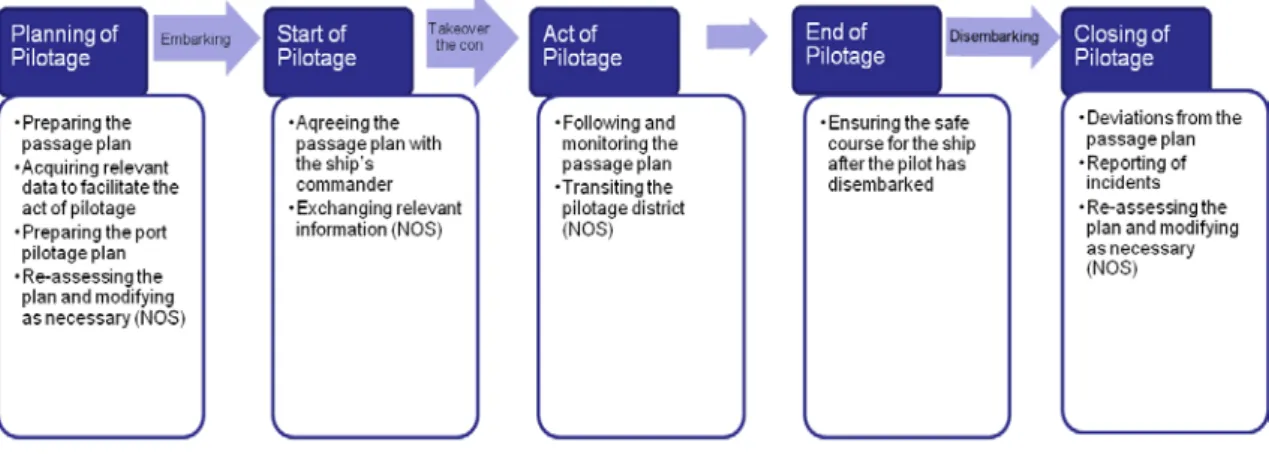
In the list below, the pilotage process is described based mainly on the British NOS standard (Port Skills and Safety, 2000a). It is possible to identify the following steps in pilotage (see also Figure 2.1):
1. Planning an act of pilotage 2. Embarking
3. Take over the con (“Handshake”)
4. Act of pilotage (Transiting the pilotage district) 5. End of pilotage
6. Disembarking 7. Closing of pilotage
Figure 2.1. Preliminary pilotage process chart
The passage plan is present in all the phases of the pilotage process. The pilotage proc-ess model is determined by the passage plan. The process phases are described based on the passage plan by determining the operations upon the passage plan or by how the passage plan is used during different phases of the process. In terms of the process model a passage plan provides the necessary platform for the exchange of information at different stages of the process and as the process progresses. Process-related informa-tion exchange is based on the informainforma-tion provided by the passage plan, or is directed towards adapting the passage plan to meet the needs of each pilotage. The passage plan is a practical work instruction for the pilot as well as for the bridge staff to facilitate successful pilotage. The different roles involved in the process are also determined by the passage plan. The roles determine who is responsible for which task during different phases of the process.
2.4 Summary
Based on the literature review, it can be concluded that pilotage has had little study, both in Finland and abroad. The most important studies are related to marine accidents where the pilot has been on board during an accident. The results and conclusions of the previous studies were very similar. Both the Finnish and the foreign studies saw that the traditional individual-centred pilotage with its rote learned passage plans no longer serve modern needs as traffic volume and ship size keep increasing. (eg. Marine Board & National Research Council, 1998; Norros et al., 2006; Drouin & Robin, 2009). The common conclusion is also that pilotage should be based on, and it should take better advantage of pre-prepared passage plans, more efficient cooperation between the pilot and the bridge staff, and modern navigation instruments as a basis for better bridge co-operation. Additionally different standards and recommendations facilitated the outlin-ing of a preliminary pilotage process model that describes pilotage in phases startoutlin-ing with planning and finishing with closing. The process model constructed based on lit-erature review was utilised as a basis for the interviews and observations. Litlit-erature review was also used as a basis for an e-mail survey directed at foreign pilotage organi-sations.
3 E-MAIL SURVEY 3.1 Survey Background
In an e-mail survey conducted in connection with the study, foreign pilotage organisa-tions were questioned on their operation. The organisaorganisa-tions were questioned on their standards and management systems, standard operating procedures, measurement tools and their attitudes towards the use of passage plans.
During July 2011 the survey was sent to 54 pilotage organisations in Australia, Canada, and in western and northern Europe. Also included were all the ISPO members. In all 13 responses from eight different countries were received. Responding pilotage organi-sations ranged from small one person businesses to large organiorgani-sations and from gov-ernment managed to private enterprises. Following is a list of responding pilotage or-ganisations sorted by country:
1. Denmark: Danish Pilot Service PS, DanPilot, Limfjordpilot ApS 2. Norway: Kystverket
3. Canada: The Fraser River Pilots, The British Columbia Coast Pilots Ltd 4. Germany: Lotsenbrüderschaft Elbe, Hafenlotsenbrüderschaft Hamburg 5. Australia: Brisbane Marine Pilots Pty Ltd
6. Belgium: Brabo Havenloodsen en Bootlieden cvba, Loodswezen 7. Bulgaria: Varna Pilot Station Ltd
8. Scotland: Association of Forth Pilots. The participants were asked the following questions:
1. Does your organisation use or comply any international standards or
manage-ment systems, such as ISPO (International Standard for maritime Pilot Organi-sations) or ISO 9000 and ISO 14000?
2. What kind of special indicators or measurements your organisation uses to
monitor the quality, safety and environmental efficiency of the pilotage process? Please, give some examples of the indicators or measurements, target values and achieved values; measuring periods and how do you gather the data re-quired for the measurement.
3. Does your organisation apply some sort of standard operating procedures and
how are these procedures generated?
4. What is your organisation’s view on passage planning? Has your organisation
prepared standard passage plans? If so, how are these passage plans utilised during pilotage?
The following subchapters deal with the organisations' answers to the first and to the last two questions. Firstly the standards and management systems used by the organisa-tions are listed. Secondly the respondents’ views on passage plans are viewed. Lastly
the standard operating procedures are contemplated. The answers of the foreign pilotage organisations concerning measurements used are dealt with later on in chapter 6.
3.2 Management Systems in Use
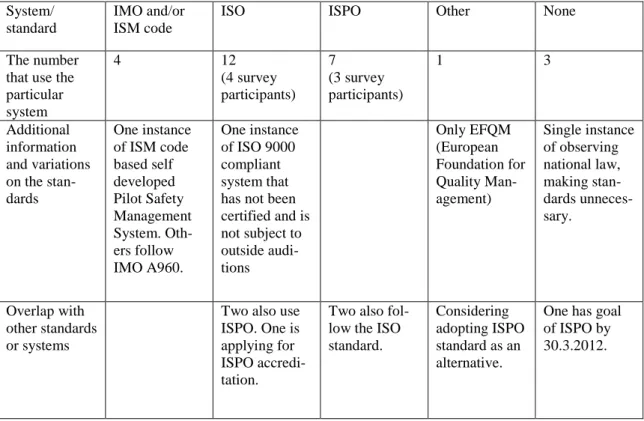
The following table (table 3.1) is a breakdown of different standards and management systems in use by the various pilotage organisations. The information in the table is gathered from organisations that took part in the survey, and from organisations to which the survey was sent but did not take part and had the information available on their websites. In all the study went through information from 60 pilotage organisations.
Table 3.1. Management standards in use by pilotage organisations
System/ standard
IMO and/or ISM code
ISO ISPO Other None
The number that use the particular system 4 12 (4 survey participants) 7 (3 survey participants) 1 3 Additional information and variations on the stan-dards One instance of ISM code based self developed Pilot Safety Management System. Oth-ers follow IMO A960. One instance of ISO 9000 compliant system that has not been certified and is not subject to outside audi-tions Only EFQM (European Foundation for Quality Man-agement) Single instance of observing national law, making stan-dards unneces-sary. Overlap with other standards or systems
Two also use ISPO. One is applying for ISPO accredi-tation.
Two also fol-low the ISO standard.
Considering adopting ISPO standard as an alternative.
One has goal of ISPO by 30.3.2012.
ISPO members among the respondents are the Association of Forth Pilots, Scotland and Brabo Havenloodsen en Bootlieden cvba, Belgium that also uses ISO 9001 and Varna Pilot Station Ltd, Bulgaria that also uses ISO 9001 and has the goal of ISO 14001. In the view of Varna Pilot Station Ltd the ISPO should adopt some of the key elements of the ISO 14001 environmental management system and not just concentrate on the qual-ity management. Two of the respondents (Australian Brisbane Marine Pilots Pty Ltd and the Danish DanPilot) are aiming for an ISPO accreditation within a few years. The ISPO website shows that other ISPO members are Trinidad & Tobago Pilots’ Associa-tion and Region Amsterdam-IJmond Loodswezen, Region Nord Loodswezen and Re-gion Rotterdam-Rijnmond from the Netherlands.
The following participant pilotage organisations use ISO 9001: Varna Pilot Station Ltd that also uses ISPO, Brabo Havenloodsen en Bootlieden cvba that also uses ISPO and Brisbane Marine Pilots Pty Ltd that also uses ISO 14001, AS/NZ 4801 and is applying for ISPO accreditation in 2011. The Norwegian Kystverket uses its own, the ISO 9000 compliant quality management system, which has not been certified and is not assessed by external audits. ISO 9000 compliant systems are in use in many other pilotage or-ganisations. The following pilotage organisations mention the standards they use on their website. Riga harbour, Latvia uses ISO 9001. The Estonian Eesti Loots AS uses ISO 9001. The Australian Port Phillip Sea Pilots uses ISO 9001, ISO 14001 and OHSAS 15001, Fremantle Pilots uses ISO 9002, Australian Reef Pilots Pty Ltd uses ISO 9002 and Torres Pilots uses ISO 9001. Polish Unipil Ltd in Gdynia uses ISO 9001. The Dutch Loodswezen Scheldemonden uses ISO 9001.
Only one participating organisation, the Danish Pilot Service PS used a self developed pilot safety management system based on the ISM code. Their aim is to reach the stan-dards in use by the maritime sector they service.
Three of the participating organisations declared the use of IMO resolution A960 (23) compliant system. These three organisations were the German Lotsenbrüdershaft Elbe and the Canadian The Fraser River Pilots and The British Columbia Coast Pilots Ltd. In its response the latter considered the IMO resolution the only internationally recog-nized guideline, the IMO to be the only valid forum for pilotage management discussion on an international level, and the IMO the only international organisation with the nec-essary authority and know-how to set standards. According to them A.960 (23) is a re-sult of years of deliberation by all the actors in the maritime sector. The resolution in-structs governments and pilotage officials on the most important elements of pilotage management. According to The British Columbia Coast Pilots Ltd ISPO is a commer-cial product that conflicts both with this IMO resolution and with the basic principles of safe navigation. According to them, this basic principle is that that safe navigation is best ensured by regulated non-competitive pilotage practiced by independent profes-sionals. Because of this, Canadian pilots do not support ISPO adoption. According to The British Columbia Coast Pilots Ltd ISO standards are followed in some Canadian pilotage organisations but that those standards have no practical involvement in pilotage or pilotage management in Canada.
Belgium's Loodswezen uses the EFQM Excellence Model as a tool to evaluate and de-velop their operation but is considering adopting ISPO.
Three participants use no management system. Danish Limfjordpilot ApS justified this by being a one person operation. German Hafenlotsenbrüdershaft Hamburg explained that the national regulations already guide and bind them to a sufficient degree. Addi-tionally, their documentation and operation is evaluated regularly. Danish DanPilot also has no management system but they aim to fulfil ISPO requirements by 30.3.2012.
3.3 Answers Concerning Passage Plans
Australian Brisbane Marine Pilots Pty Ltd wrote the following on passage plans:”In our view designing a passage plan is critical. The plan is agreed upon between the pilot and the bridge staff and this enables joint monitoring of the pilotage. Without a preliminary passage plan, efficient monitoring cannot exist and the pilotage is more susceptible to errors and their consequences. Our organisation makes use of standard passage plans that all pilot must use. Standard passage plans contain standard courses in certain ar-eas, ship and navigation information, bridge staff responsibilities during pilotage and berth instructions. The plan is reviewed on board together with the ship's commander and bridge staff, adjusted when necessary and jointly approved. The bridge staff keeps the plan during pilotage to aid in monitoring. The passage plan can be used to clarify local traffic and planned velocities or to just generally clarify the situation. The passage plan is appended with information provided by the pilot, like anchorages and distances, that are available on paper and electronically. The pilot uses these to aid steering plan-ning and communication with the bridge staff.”
The Belgian Loodswezen encourages pilots to use passage plans during training. They are given PPUs (Portable Pilot Unit), so that passage plans are easy to form. The PPUs also have some default passage plans.
In Brabo Havenloodsen en Bootlieden cvba creating passage plans is included in the statutes given to pilots and are used to provide piloted ships with all the necessary in-formation. The information concerns passage, among other things, and also includes practices in potential problem situations (changes in the plans or technical difficulties on the ship, for example).
According to Danish pilot service PS passage plans are a good pilotage aid. They espe-cially use passage plans on ships with deeper draft. The passage plan is used as an in-formation sharing aid between the pilot and the ship's commander. The ship's com-mander is informed of the courses, speeds, weather reports, towboat count, mooring count, depth limits and other information in the passage plan.
DanPilot’s ISPO standard compliant system, although it has not yet been certified, in-cludes passage planning. All of the organisations pilots follow the same passage points during pilotage. These standard passage plans and their selection vary with ship size. In the Association of Forth Pilots pilotage passage plan is based on the ship’s harbour to harbour passage plan. Necessary modifications are made during the information ex-change between the pilot and the commander.
According to The Fraser River Pilots in their organisation’s pilotage area a passage plan cannot be made entirely in advance and so it cannot be delivered to the ship beforehand. The pilots in the area create an outline for a passage plan in advance and then adapt the plan to the current situation while on the bridge.
As a pilotage area Hamburg harbour is characterised by short distances and a large amount of manoeuvring. According to Hafenlotsenbrüderschaft Hamburg the passage plan is explained verbally to the ship's commander, after which it is respected. The plan is based on standard manoeuvres, traffic situation and the harbour traffic rules. Their organisation does not support the adoption of electronic or written passage plans.
In Norway passage plans are used in practice on most fairways. These plans have not been published or officially approved and they are discussed by the pilot after boarding. However Norway’s Kystverket has begun trials where passage plans are sent to the ships in advance (before the pilot). This may become standard procedure but requires further testing.
In Limfjordpilot ApS, a one man business, passage plans are essential to pilotage but should, according to the respondent, only be used within reason. After boarding the pi-lot discusses the planned passage with the commander. In the organisations area the task is mainly just to follow premade channel passages. This is told to the ship's commander in the pre-pilotage communication.
Varna Pilot Station Ltd writes the following on the use of passage plans:”None of our passage plans are final. Our passage plans don't necessarily get the pilot's ap-proval. Designing a good, comprehensive and user friendly passage plan is diffi-cult. Passage plans should be general, simple and easy to adjust. Otherwise the plan could face resistance from both the pilots and the ships. The practice in Varna Pilot Station Ltd has been to present written passage plans to the bridge staff. Due to nega-tive feedback we have changed our practices so that information (like passage plans) is only shared if the time and place allows. All paperwork is filled out only after the pilot and the bridge staff thinks it safe. Even if the pilot only shares information orally, it is not considered to be breaking the rules or inadequate. In other words, the pilot presents the passage plan on the bridge orally or when the situation allows for in written form.”
Canadian The British Columbia Coast Pilots Ltd writes the following on the use of pas-sage plans:”The idea that passage plans would be standardised and sent to ships in advance (before the pilot) and then discussed between the pilot and the ship's com-mander has been topical for many years. The views of Canadian pilots mirror IMO in this matter: During the creation of the IMO A.960 (23) resolution, the concept of stan-dardised passage plans and its potential was widely debated. In every step the idea was rejected as unpractical and unwise. Unlike in normal marine traffic, navigation in pilo-tage areas is in constant flux and demands flexibility, local knowledge and experi-ence. Passage selection, velocity and the exact navigation manoeuvres depend on con-stantly changing conditions, such as traffic, weather, water level, currents and towboat availability. This information is often unavailable before the pilot boards the ship. Designing standard passage plans for widespread use is wrong because it is based on the assumption that pilotage always follows the same passages. Standardised pas-sage plans have practically no value and can, in fact, compromise the safety of naviga-tion because they create a working environment that promotes unsafe inflexibility and reluctance to adapt to changing circumstances. The correct place and time to discuss and reach an understanding on the passage is on the bridge between the pilot and the
ship's commander as the pilot boards and then continuously during the passage. This is also described in IMO A.960 (23) Pilots have sometimes tried to provide additional information to interested ship, such as information on local pilotage regulations and local pilotage (maps, brochures) This is only done rarely and carefully on a case by case basis keeping in mind the aforementioned risks.”
3.4 Responses Concerning Standard Processes
Australian Brisbane Marine Pilots Pty Ltd writes the following on standard operating procedures:”Our organisation has created standard operating procedures to cover all the critical stages of pilotage and also the management side, such as pilot dispatching, resource management and financial processes. Examples of defined procedures and their content are ship meeting and passing, situations with limited visibility, communi-cation with towboats, the reporting of risk situations and events, fatigue, qualificommuni-cation and training systems and pilot transit processes. These processes are supplemented by standards guidelines, checklists and methods for each phase. The harbour master regu-lates some actions, like the use of towboats and restrictions to ships passing each other or velocity in harbour's own process guidelines. Procedures and their components are altered, when necessary. This could be due to pilot or staff initiative, a risk situation or an abnormal event or it could be an answer to changes in operating regulations or re-quirements. The procedure system and its components are also evaluated regularly.”On its website Brisbane Marine Pilots Pty Ltd tells more of its own standard operating pro-cedures. The goal of their standard operating procedures is minimizing risks. The stan-dard operating procedures they use are constantly evaluated and improved. Reporting risk situations, workplace inspections and internal and external audits are all part of the continuous improvement of standard operating procedures (Brisbane Marine Pilots, 2011).
Belgium’s Loodswezen’s goal is to develop processes to include all functions related to pilotage. At the moment they have reached approximately 60% of their goal.
The Danish Pilot Service PS also uses standard procedures. These procedures are devel-oped, monitored and removed from use if they turn out to be wrong and unusable in cooperation with the pilots within the organisation. Danish Pilot Service PS also works with third parties such as harbour officials, oil refineries and other pilotage organisa-tions. Some procedures are mandatory for the organisation but for the most part they get to influence their development.
DanPilot aims to join ISPO and determining standard procedures is a part of ISPO. Even today they utilise standard procedures that are used in pilotage and which have mainly been developed in the field of logistics. Additionally, the pilotage authorities have set many standards for providers of pilotage services.
The response of Association of Forth Pilots to the question on standard procedures was that they use standard procedures agreed upon with harbour officials and they are in-cluded in the organisations safety and quality management manual. They also sent their
own written pilotage process model. In the model pilotage is divided into five phases, pre-boarding, boarding the vessel, pilot/master exchange of information, conducting the pilotage act, and finally completing the pilotage act and departing the vessel. Concern-ing the act of pilotage phase, the process model states that the agreed procedures must be maintained during the act of pilotage and any changes must be jointly agreed upon. The pilot must also ensure adequate bridge composition during pilotage. The pilot should not be required to act helmsman during the passage but if the pilot is steering then he must ensure that he is capable of simultaneously handling his main duties of navigation. The ship's commander must be on the bridge at the start of pilotage, so that the pilot can negotiate with him on, e.g., the passage plan. The ship's commander must be reachable during pilotage.
The Fraser River Pilots follows Canadian pilotage legislation and the pilotage author-ity’s (Pacific Pilotage Authority) regulations. The organisation creates its own internal guidelines that are unique and made for that organisations pilotage area.
Hafenlotsenbrüdershaft Hamburg uses Börtordnung i.e rules of sequences of the pilots and services given to ships. These rules help in avoiding exhaustion and enable equal workload, free-time and treatment for all pilots in the organisation.
In Norway (Kystverket) standard procedures have been developed and implemented by the employed experts. Before implementation the procedures had to have been approved by management. Standard procedures have been integrated as a part of the quality man-agement system.
For the Danish Limfjordpilot ApS the standard operating procedure is as follows:”After boarding the ship we present the ship master with a written pre-pilotage information package. The package contains a simple passage plan, information on local regulations and on prevailing tides and currents.”
Varna Pilot Station Ltd has implemented all of the processes according to national and local (port) pilotage regulations. The organisation also takes into account the require-ments of two existing international standards the ISPO and ISO 9001.
The British Columbia Coast Pilots Ltd discussed Canada's pilotage regulation system in their response. Canada's good safety and efficiency statistics are a result of an overarch-ing system based on national pilotage legislation and regulations derived from it. The purpose of this system is to ensure that maritime traffic in areas with mandatory pilo-tage serve the public interest. To achieve this, the pilopilo-tage system is organised to allow pilots the use of their own expert judgement without being subject to economic pres-sures. At the same time, the system takes into consideration that all pilotage is individ-ual and local, is based on local knowledge and takes into account the local sea area variations which can be very relevant. Due to this the demands and practices set by the system vary from one area to another. For example, the requirements for receiving a pilot licence vary according to the pilotage area.
3.5 Summary
Most of the participating pilotage organisations use a standard based quality or safety management system. Some have based their operating model on the ISM code. Four respondent organisations use an ISO 9001 standard based system. Three respondents base their system on the ISPO standard developed in collaboration by pilotage organisa-tions.
Attitudes towards passage plans among the participating pilotage organisations were mostly positive. Ready-made passage plans are considered useful tools and guidelines when performing pilotage. Only one respondent did not consider ready-made passage plans useful and held that, due to their inflexibility, the use of passage plans could even be dangerous. In some ways, respondents’ attitudes towards passage plans can be con-sidered somewhat cautious and responses stressed that a ready-made plan shouldn't be trusted too far because conditions can change forcing a review of the passage plan. Based on the questionnaire pilotage organisations present their passage plans in various ways. Some use a written or electronic passage plan (PPU) and some express passage choices orally on the bridge. Passage plan presentation can also vary depending on the situation, e.g., in a busy situation the plan is presented orally and the written plan is ex-amined after the situation has calmed down. From the responses it is possible to con-clude that a passage plan and agreeing upon it is considered an important element of bridge cooperation. A ready-made passage plan can also aid the creation of communica-tion links.
An e-mail survey directed at pilotage organisations and a systematic review of pilotage organisation websites show that process thinking is starting to get a foothold within pi-lotage organisations. As a summary of the responses it is possible to note that all pilo-tage organisations participating in the survey use operating procedures of some kind. Some of the operating procedures are developed by the organisations themselves and some are derived from standards, management systems and national regulations. The procedures are not necessarily written down. A standard procedure could be an unwrit-ten operational model or routine used during the act of pilotage.
4 INTERVIEWS AND OBSERVATIONS
This chapter presents the results of the interviews and observations. Observations were carried out during 6 passages in June and July 2011. The passages were carried out on Lake Saimaa, Kotka, Hamina, in the Archipelago Sea and in Helsinki. The majority of pilot interviews were also conducted in connection with these passages. Three separate pilot interviews were conducted. The preliminary pilotage process model based on the literature review was used as a framework for the interviews and observations. The main issues in the interviews and observations were the passage plan and the coopera-tion between the pilot and the commander and other bridge staff.
Chapter 4.1 describes how the different phases of the pilotage process were visible dur-ing passages and interviews. Chapter 4.2 describes how the characteristics of good pilo-tage were visible during passages and interviews. Chapter 4.3 deals with the role of the pilot in ensuring safety and fluent marine traffic flow.
4.1 Phases of Pilotage 4.1.1 Start of Pilotage
The start of pilotage precedes the act of pilotage. During the starting phase the pilot and the ship's commander exchanged information. After the start of pilotage came a transi-tion to the act of pilotage. The transitransi-tion was clearest on cruise ships, where the pilot taking over was clearly stated out loud. On other ships the transition was communicated more through the gestures and expressions of the pilot and the commander.
The passage plan was never gone through before the commencement of the act of pilo-tage. According to the pilots, this was due to the fact that all the piloted ships had passed through these passages before and the passages were familiar to them. The start phase, i.e., the handshake ceremony was very short and to the point on all ships except on the cruise ship. Typically as the pilot arrived on the bridge the ship's commander greeted the pilot and shook the pilot’s hand. If necessary, possible passage changes were discussed briefly. The ship's properties, control devices or navigation equipment were not presented to the pilot.
On the cruise ship the handshake ceremony was more thorough. The pilot arrived on the bridge, where the commander received him. The commander relayed course and veloc-ity and stated that the pilot had been on board before, and so a separate presentation of the ship’s properties was not carried out. The first mate asked the pilot: "Are you happy?" the pilot answered that he was. Then the officer shouted:”Pilot has the con!”
The commander and other officers echoed this. The pilot then began to give instructions on course and velocity.
Based on the interviews, the aforementioned short version is the common way to begin pilotage. According to pilots the longer handshake ceremony used on cruise ships can be too long. There's no time for long ceremonies when pilotage should already