The Impact of Interest Rate Spread on the Performance of
Nigerian Banking Industry
Obidike, Paul C.1 Ejeh Grace C2. Ugwuegbe. S. Ugochukwu3
1. Dept. of Accountancy, Bus-Admin & Entrepreneurial Studies, Federal University Ndufu-Alike Ikwo, Ebonyi State.
2. Department of Banking and finance, Enugu State University of Science and Technology 3. Dept. of Banking and Finance, Caritas University, Emene, Enugu State Abstract
This study examined the impact of interest rate spread on the performance of Nigerian banking industry for the period of 1986-2012. The study used OLS method of estimation to analyze the data generated from CBN statistical Bulletin and World Bank online data base. Testing for the properties of time-series, ADF test indicates that all the variables are integrated of same order I(1). The Co-integration test reviles that there exists a long-run relationship among the variables under consideration. The result shows that interest rate spread, negatively and significantly impact on bank performance in the long-run. Exchange rate and GDP was found to be positively and significantly affecting bank performance in Nigeria at the long-run. The result of the ECM indicates that 23.37 percent of the disequilibrium in the model will be corrected annually. Moreover at the short-run interest rate spread also negatively but insignificantly affect bank performance in Nigeria. Government should improve the macroeconomic environment by striving to develop the level of infrastructural facility in the country as well as reducing the level of insecurity in the country by cubing the menace of the Boko-Haram sect and that of Militancy in Nigeria. Therefore banks should not rely only on interest income if they must continue in business. Key Words: Interest Rate Spread, Bank Performance, Exchange Rate, Gross Domestic Product (GDP)
1.0 INTRODUCTION
The price which borrowers pay for the use of money they borrow from a lender/financial institution is known as Interest rate. In other words it is a fee paid on borrowed assets (Crowley, 2007). Interest rate is a macroeconomic variable that banking industry uses for effective resource allocation in an economy. This however is made possible through the intermediation role played by these financial intermediaries in the economy
The Central Bank of Nigeria regulates the activities of these intermediaries in Nigeria with a view to achieving sets of monetary policy targets. One of the ways they do this is by setting a Monetary Policy Rate (MPR) which is the minimum rate in which Deposit Money Banks (DMBs) otherwise known as commercial banks lend to their costumers. It is also the rate at which DMBs borrow from the Central bank of Nigeria.
However, the difference between MPR and the maximum lending rate by the Deposit Money Banks is called Interest Rate Spread (IRS). On the other hand interest rate spread can also be measured as the difference between bank deposit rate and that of lending rate. And so, for the purpose of this work, we will be viewing interest rate spread as the difference between deposit rate and that of lending rate. Interest rate spread is a measure of profitability between the cost of short term borrowing and the return on long term lending.
Financial institutions are established to provide financial services with a view to make profit. The survival and sustainability of any profit oriented business depends on the level of profit they make. Banks however, as financial institutions provide financial services to their clients with a view to make profit. Banks lend to their customers as part of the intermediation role they play in an economy and in return, charge an interest rate for the use of money borrowed. Meanwhile, Ngugi (2001) noted that charging of interest on the use of money borrowed is important because the effect of time may erode the value of the amount of money borrowed and so, interest rate which is a price paid for the use of borrowed assets reflects the market information regarding expected change in the purchasing power of money or future inflation. Financial institutions facilitate mobilization of savings, diversification and pooling of risk as well as allocation of resources. Since the receipt for deposit are not always synchronized with that of loan, intermediaries like bank incur certain cost (Ngugi 2001). In view of this,
banks charge a fee for the intermediation services offered under uncertainty, and set the interest rate level for both deposit and loan.
According to Rhyne (2002), the difference between the gross cost of borrowing and the net return on lending defines the intermediation cost (information cost, transaction cost, administration cost, default cost, and operational cost). However the rate at which each bank charges for the borrowed assets depends on the level of risk they are ready to shoulder. Meanwhile risk-averse banks operate with small interest spread due to the level of risk they are ready to undertake. This however is due to the fact that risk aversion raises the banks optimal interest rate and reduces the amount of credit supply.
Emmanuelle (2003) asserts that actual spread which incorporates the pure spread is in addition influenced by macroeconomic variables including monetary and fiscal policy activities. Another factor that affects banks interest spread is the market structure in which the banks operate. According to Ng’etich and Wanjau (2011) who noted that depending on the market structure and risk management, the banking industry is assumed to maximize either the expected utility of profit or the expected profit. They also assert that depending on the assumed market structure the interest rate spread component varies. For instance, assuming a deposit rate and market power in the loan market, the interest rate spread is traced using the variation in loan rate. But with market power in both markets, the interest rate spread is defined as the difference between the lending rate and the deposit rate.
According to Chand (2002), and ADB (2001), who conducted an independent study identified several reasons that are responsible for high interest rate spread, these include among other things, lack of adequate competition, scale diseconomies due to small size of the market, high fixed and operating cost, high transportation cost, increased communication cost, existence of regulatory controls and perceived market risk.
In this study we are set to determine the effect of interest rate spread on the performance of the Nigerian banking industries. In other to achieve this, we will be looking at the aggregate performance of all the commercial banks in Nigeria for the period of 1982-2012. This period was considered appropriate because it was the period when interest rate was liberalized in Nigeria and so will give a good picture of the effect of interest spread on the Nigerian banking industry. Also reasonable banking reforms are assumed to have taken place in Nigeria within this period.
However, this work is structured as follows: after this brief introduction, section 2 looked at the review of related literature, section 3 considers the methodology that were adopted for this study, while section 4 takes a look at data analysis and interpretation. And finally, section 5 summarized the findings and made necessary policy recommendations.
2.0 LITERATURE REVIEW
A good number of researchers have conducted volume of studies with respect to the determinants of interest rate spread both within and outside Nigerian (Randall, 1998; Brock and Rojas-Suárez, 2000; Chirwa and Mlachila, 2004; Gelos, 2006; Crowley, 2007; Abiodun and Tennant 2008) but none of these have actually taken a look at the contribution that interest spread has on the performance of banking industry. Most of these studies have examined the determinants of interest rate spread with a view to identify factors responsible for high interest spread. An independent study by Chand, (2002) and that of Asian Development Bank, (2001), have listed the several reasons for high interest rate spread in Asia. These are lack of adequate competition, scale diseconomies due to small size of markets, high fixed and operating costs, high transportation costs of funds due to expensive telecommunications, existence of regulatory controls and perceived market risks. They further state that the factors mentioned above lead to high intermediation costs, which result in high spread. Specifically, these studies have identified one of the most obvious costs, which is associated with the ability to enforce debt contracts. Small borrowers with no property rights have no collateral to offer. As such, they are perceived as high-risk borrowers. Because of high transaction costs involved, such borrowers are charged punitive rates of interest. On the same note, Chand (2002) singles out issues of governance. The later encompasses maintenance of law and order and provision of basic transport and social infrastructure, all impinging on security, a lack of which has been found to be a cause for high transaction costs resulting in large intermediation costs. When there is high intermediation cost, reflected in the high interest rate spread, the borrower may be unable to repay his/her loan owing to the cost of such borrowings (Chand, 2002).
Abiodun and Tennant (2008) in their study analyzed the determinants of spreads between banks’ deposit and lending rates in SSA countries from market and macroeconomic view points, using a dynamic panel data estimation technique. Using annual data covering 33 countries, the results obtained from the study suggest that different markets and macroeconomic policy variables play significant roles in explaining variations in IRS in the region. Among others, the paper show that the extent of government crowding out in the banking sector, public sector deficits, discount rate, inflationary level, level of money supply, reserve requirement, level of economic development, and population size are important determinants of interest rate spreads in SSA countries. However bank specific factors, Industry/market specific factors and macroeconomic variables have been identified as factors contributing to high interest rate spread. Demirguc-Kunt et. al, (1998), Moore et. al, (2000) and Sologoub (2006) argued that the major drivers of interest rate spreads are the bank specific factors such as; the bank size, bank ownership, the loan portfolio, capital adequacy, overhead and operating cost, and shares of liquid and fixed assets. In fact, Beck et.al, (2006) agree with this and further stressed that interest rate spreads in Uganda are mainly driven by the bank size, as well as overhead costs and sectoral compositions of loans. Looking at the industry/market specific factors, Samuel et. al, (2006) indicate that an oligopolistic market structure results in higher spreads. This is in line with Hannan et.al, (1993) and Barajas et al, 1999, who found out that industry concentration is positively linked to higher spreads. Brock and Franken (2003) noted that Macroeconomic factors have been shown to explain significant variation in commercial bank interest rate spreads..’ Chirwa and Mlachila (2004) concur and assert that macroeconomic instability and the policy environment have important impacts on the pricing behaviour of commercial banks. They note that the macroeconomic variables typically thought to be determinants of interest rate spreads include inflation, growth of output, and money market real interest rates. Brock and Franken (2002) include interest rate uncertainty and exchange rate volatility, and Randall (1998) also includes the share of commercial bank public sector loans, in her list of determinants of spreads in the Caribbean. Randall’s inclusion is similar to the additional variables suggested by stakeholders in Jamaica, as Tennant (2006) showed that macro-policy variables, such as public sector domestic borrowing, discount rates and Treasury Bill rates, are commonly perceived to impact on commercial bank spreads. Additional macro-policy variables included by Crowley (2007) in his study of English-speaking African countries are broad money growth, and the fiscal balance. The macroeconomic variables which have been empirically shown to increase interest rate spreads include: high and variable inflation and real interest rates (Demirguc-Kunt and Huizinga, 1998); interest rate uncertainty - proxied by inter-bank interest rate volatility (Brock and Franken, 2002); broad money growth (Crowley, 2007); increased fiscal deficits (Crowley, 2007); and a high share of commercial bank public sector loans (Randall, 1998). Ikhide (2008) in his study showed that industry specific and macroeconomic variables rather than balance sheet (Bank) factors account for wide bank spreads and hence the high cost of financial intermediation which may have curtailed access to bank credit.
Van Leuvensteijn, Kok-Sørensen, Bikker and van Rixtel (2006) in their study analyzed the impact of loan market competition on the interest rates applied by euro area banks to loans and deposits during the 1994-2004 periods, using a novel measure of competition called the Boone indicator. They find evidence that stronger competition implies significantly lower bank spreads for most loan market products, in line with expectations. Their result also implies that stronger competition causes both lower bank interest rates and a stronger pass through of changes in market interest rates. This clear evidence was presented by their error correction model (ECM) of bank rates. Further, where loan market competition is stronger, they observedlarger bank spreads (or: lower bank interest rates) on current account andtime deposits. Lower time deposits rates are confirmed by the ECM estimates. However, the competitive pressure is heavier in the loan market than in the deposit markets, so that banks under competition compensate for their reduction in loan market income by lowering their deposit rates. They went further to observe also that bank interest rates in more competitive markets respond more strongly and (for short-term loans to enterprises) more rapidly to changes in market interest rates.
Ngugi(2001) analyzing interest rate in Kenya found a widening interest rate spread following interest rate liberalization characterized by high implicit costs with tight monetary policy achieved through increased reserve and cash ratios and declining non-performing assets. Maudos and Fernández de Guevara (2004) show that an increase in banks’ market power (i.e. a reduction in competitive pressure) results in higher net interest margins. In addition, Corvoisier and Gropp (2002) explain the difference between bank retail interest rates and money market rates by bank’s product-specific concentration indices. They find that in concentrated markets, retail lending rates are substantially higher, while deposits rates are lower.
Demirguc-Kunt and Huizinga (1997), the interest spread fluctuates, reflecting the substitution between debt and equity financing. As the equity market expands, offering competitive returns, banks increase their deposit rates
to compete for funds from the public. The expanded market also reduces the risk absorbed by the banking sector and banks charge competitive lower lending rates, reducing the interest rate margin. The interest rate spread derives solely fron central bank variables (including the discount window loans, reserve requirement and interest on liquid assets on deposit with the central bank), while under a monopolistic (or oligopolistic) structure the interest rate spread is in addition affected by elasticities of demand for credit and deposits. He also found that there was more market power in the credit market than the deposit market. In addition, considering monetary policy, Elkayam (1996) found that an increase in money supply under elastic demand reduces the spread more in a monopolistic than in a competitive market. Demirguc-Kunt and Huizinga (1997) found that better contract enforcement, efficiency of the legal system and lack of corruption are associated with lower realized interest margins. This is because of the reduced risk premium attached to the bank lending rate.
Ng’etich and Wanjau (2011) in their study took a different approach by looking at the impact of interest rate spread on the level of Non Performing Assets in commercial banks in Kenya. Their study adopted a descriptive research design on a sample of all commercial banks in Kenya operating by 2008 which are 43 in number. They used questionnaires to collect data from primary data sources and secondary data, were collected from Bank Supervision Report, to augment the primary data findings. Their study used both quantitative and qualitative techniques in data analysis to determine the relationship between the interest rate spread and loan non-performance. They concluded that interest rate spread affect performing assets in banks as it increases the cost of loans charged on the borrowers, regulations on interest rates have far reaching effects on assets non-performance, for such regulations determine the interest rate spread in banks and also help mitigate moral hazards incidental to NPAs. Credit risk management technique remotely affects the value of a bank’s interest rates spread as interest rates are benchmarked against the associated non-performing assets and non-performing assets is attributable to high cost of loans
According to Barajas and Salazar (1998), one must note that there is a possible tradeoff involved when analyzing spread. While a high level is generally indicative of in-efficiency, excessive risk-taking, or lack of competition within the banking sector, it is also true that high spread can contribute to high bank earnings which, if channeled into the capital base of the system, may promote safety and stability in the system. This is particularly relevant in the case of developing countries, where the existence of an implicit government bailout commitment has frequently led to a moral hazard situation in the financial system. It is not entirely clear which is preferable from a social stand point, a banking system with low spreads (consequently) low capital which may require government-funded bailout or a system with high spread and high capital base that may not require a bailout. This also can be viewed as an issue of bank franchise value, which has been shown to be a key factor limiting moral hazard and excessive risk-taking (Caprio and Summers, 1993; Hellman, Murdock and stiglitz, 1998). To the extent that high spreads arising from market power reflect a high franchise value, the likelihood of a bank crisis may be smaller than in the case of a competitive system with lower spread.
Studies in this area in Nigeria has been very scanty, Muhammad (2012) in his study identified the determinants of cost of financial intermediation (CFI) in some selected quoted banks in Nigeria to include financial intermediation (IMED), operating expenses (OE) and Loan loss provision (LLP). These factors according to him tops priority in understanding the variations in commercial banks’ cost of financial intermediation weather measured using narrow or broad interest rate spread definitions.
Olajide (2012) in his study x-rays and re-investigates the Nigerian financial sector which assumes interest rates to be a combination of a domestic rate in autarky and the uncovered interest parity rate in a completely open economy. He identified Inflation rate, returns on foreign assets, and poor infrastructure as factors that determines interest rate spread in Nigeria.
It is important to note that despite series of studies conducted in this study area only a few have looked at the contribution of interest spread to the performance of the banking industries. Ng’etich and Wanjau (2011) adopted a descriptive research design in determining the impact of interest rate spread on the performance of Kenyans Banking industry. They concluded that interest rate spread affects the performance of Kenyans banking industry. Wensheng, Lai, Leung and Shu (2003) in their study look at the impact of interest rate shock on the performance of Hong-Kong banking industry. In spite of these studies, none has looked at the impact of interest spread on the growth of Nigerian economy. This is the gap that this study seeks to fill.
3.0 METHODOLOGY
• Bank Performance: there are different ways one can explain bank performance, one of which is to look at the profit and loss account of different banks that make up the sector, this approach can be classified as microeconomic approach. On the other hand one can look at bank performance by considering the aggregate bank total assets and liability statement in an economy this however, can be regarded as macroeconomic approach to bank performance. In this study we will be looking at the macroeconomic performance of the Nigerian banking sector. To do this however, we will be taking the aggregate commercial bank total assets as a proxy for bank performance. Implying that increase in banks total assets will mean improved performance. Therefore, we will like to see how interest rate spread has contributed to improved performance in the Nigerian banking sector.
• Interest Rate Spread: this is the variation between Nigerian deposit rate and that of their lending rate. In most cases it is considered to equals the different between Central Bank Monetary Policy Rate and the actual rate at which commercial banks otherwise known as Deposit Money Banks lends to their customers. Meanwhile for this study we will be looking at interest rate spread as the different between bank deposit rate and that of their lending rate. Several factors have been identified to be responsible for the variation in these rates which include bank specific factors, industry/market specific factors as well as macroeconomic factors.
• Gross Domestic product: this is the aggregate output generated by different sectors of an economy. This is most often used as a proxy for economic growth. This variable will be adopted to see how growth in the economy will affect the performance of the banking industry. This variable however will be used as a control variable in the model that will analyze the relationship between interest rate spread and bank performance in Nigeria.
• Exchange Rate: this is the rate in which naira changes with other currencies in the world market. Over the years Nigeria have adopted a number of measures with a view to determine the rate at which naira exchange to other currencies but for the sake of this study we will be looking at the impact of aggregate exchange rate on the performance of the Nigerian banking industry. The choice of this variable is based on the fact that when exchange rate changes it will exert a far reaching affect on the performance of banking industry, hence the need to control with the variable.
3.1 MODEL SPECIFICATION
For the purpose of this work, OLS method of estimation will be adopted on a multiple regression equation to analyze the effect of interest rate spread on the performance of banking industry in Nigeria. The study will cover 1986-2012 periods, which represents the period of interest rate liberalization in Nigeria.
BP = f(IRS, EXR, GDP) ………..(1) BP = α0 + α1IRS + α2EXR + α3GDP + Ut…………(2) Where:
BP = Bank Performance proxied by aggregate bank assets. IRS = Interest Rate Spread
EXR = Exchange Rate
GDP = Gross Domestic Product
Theoretically, the coefficient of the independent variable will take the following apriori expectations. IRS>0, EXR<0, GDP>0
Meanwhile to improve the linearity of the model and to avoid heteroskedasticity, we will introduce natural log in the above model.
Log(BP) = α0 + α1logIRS + α2log(EXR) + α3log(GDP) + Ut………(3)
After estimating equation 3, and the result shows that the value of R2 is greater than the value of Durbin-Watson statistics it means that the model is a spurious regression. And so, we can only continue with de model if the variables are integrated of same order I(1), as well as the existence of co-integration between the variables. When all this are in place, it also means that the residual of the variables are stationary at level. It is only when this happens that we can conclude that the model is no longer spurious and therefore, we go on with the estimation of the model. Meanwhile if there exist a long-run relationship between the variables under consideration, equation 3 becomes a long-run equation.
3.2 CO-INTEGRATION EQUATION
The second step is the testing of the presence or otherwise of co integration between the series of the same order of integration through forming a co integration equation. The basic idea behind co integration is that if, in the long-run, two or more series move closely together, even though the series themselves are trended, the difference between them is constant. It is possible to regard these series as defining a long-run equilibrium relationship, as the difference between them is stationary (Hall and Henry, 1989). A lack of co integration suggests that such variables have no long-run relationship: in principal they can wander arbitrarily far away from each other (Dickey et. al., 1991). If the variables are non-stationary at level form and integrated of the same order, this implies evidence of co-integration in the model. The co-integration equation is stated in equation 6 as:
……….(5)
Where
……….(6)
is the linear combination of the non co integrated vectors,
X is a vector of the non co integration variables. The individual influence of the co integrated variables can only be separated with an error correction mechanism through an error correction model as shown below.
3.3 THE ERROR CORRECTION MODEL EQUATION
After the testing of the Co integration relationship, If the two variables are co-integrated, an Error Correction term (ECT) is required to be included (Granger, 1988).
………(7)
Where
-
l
ecm
is the error correction mechanism,-
l
is the magnitude of error corrected each period specified in its a priori form so as to restore ηmZt to equilibrium. Where Zt represents the explanatory variables (IRS, EXR and GDP). It is important to note here that this ECM model is a short-run model.Also the optimum lag length was determined using the multivariate versions of information criteria of Akaike’s Information Criteria (AIC) and Schwarz’s Bayesian Information Criteria (SBIC).
TABLE 4.1 ADF AT LEVEL
Variables ADF t-stat 1% critical value 5% critical value 10% critical value Result lag D(LOG(BP)) -1.140719 -3.7343 -2.9907 -2.6348 Non-Stationary 2 D(EXR) -0.461087 -3.7204 -2.9850 -2.6318 Non-Stationary 1 D(LOG(GDP)) -2.147175 -3.7204 -2.9850 -2.6318 Non-Stationary 1 D(INTRS) -2.604253 -3.7204 -2.9850 -2.6318 Non-Stationary 2
Source: Researchers E-view result
From table 4.1 above it can be seen that the variables are non-stationary or unit root at level. This is because the ADF test statistics is less than the critical values both at 1%, 5% and 10% level of significance.
4.0 DATA ANALYSIS
The analysis started with testing for the properties of time-series data with a view to determine the order of integration using ADF test.
TABLE 4.2 ADF AT 1ST DIFFERENCE Variables ADF t-stat 1%
critical value 5% critical value 10% critical value Level of integration Result lag
D(LOG(BP)) -5.409587 -3.7343 -2.9907 -2.6348 I(1) Stationary 2
D(EXR) -3.276541 -3.7343 -2.9907 -2.6348 I(1) Stationary 1
D(LOG(GDP)) -3.176048 -3.7343 -2.9907 -2.6348 I(1) Stationary 1
D(INTRS) -3.938225 -3.7497 -2.9969 -2.6381 I(1) Stationary 2
Source: Researchers E-view result
From table 4.2 above the result of ADF test indicates that the variables used in the model are all stationary at first difference. Meaning that they are integrated at order one I(1). This conclusion was drawn based on the fact that the ADF test statistics is greater than their respective critical values both at 5% and 10% level of significant. Meanwhile because the variables are integrated of same order I(1) we ran the co-integration model.
TABLE 4.3 CO INTEGRATION RESULT Hypothesized No.
of CE(s)
Likelihood Ratio 5 Percent Critical Value 1 Percent Critical Value Eigenvalue None ** 90.07465 47.21 54.46 0.858776 At most 1 ** 41.13939 29.68 35.65 0.586432 At most 2 * 19.06605 15.41 20.04 0.520941 At most 3 0.667742 3.76 6.65 0.026356
Source: Researchers E-view result
The result of the co-integration test showed that there exists co-integration among the variables in the model. It indicates at most 3 co-integrating equation in the model. This however implies that there is a long-run relationship between the variables under consideration. Having established a co-integration between the variables, we therefore run the ECM
TABLE 4. 4 ERROR CORRECTION MODEL
Variable Coefficient Std. Error t-Statistic Prob.
C 0.206669 0.041837 4.939892 0.0001
D(ITRS) -0.022881 0.011496 -1.990423 0.0597
D(EXR) 0.002224 0.001589 1.399149 0.1764
D(LOG(GDP)) 0.111565 0.134658 0.828504 0.4167
ECM(-1) -0.233737 0.104904 -2.228104 0.0369
After estimating the ECM model, the shortrun coefficient of Interest Rate Spread D(ITRS) is negative ( -0.022881) and statistically insignificant at 5% level of significant. Meaning that in the short-run interest rate spread is negatively and insignificantly related to bank performance in Nigeria. The short-run coefficient of both exchange rate and GDP indicates a positive and insignificant relationship with bank performance in Nigeria. The coefficient of ECM is negative (-0.233737) and statistically significant as desired. The result of the Error Correction Model reviles that about 23.37 percent of the disequilibrium in the short-run will be corrected in the lung-run. That is to say that on annual basis 23.37 percent of the disequilibrium in the model will be corrected.
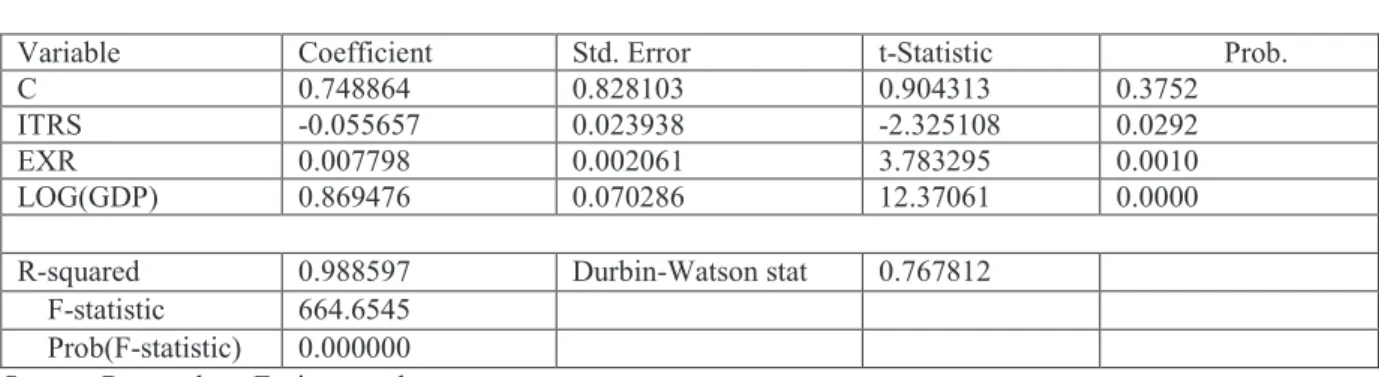
TABLE 4.5 THE RESULT OF LONG-RUN REGRESSION MODEL
Variable Coefficient Std. Error t-Statistic Prob.
C 0.748864 0.828103 0.904313 0.3752
ITRS -0.055657 0.023938 -2.325108 0.0292
EXR 0.007798 0.002061 3.783295 0.0010
LOG(GDP) 0.869476 0.070286 12.37061 0.0000
R-squared 0.988597 Durbin-Watson stat 0.767812
F-statistic 664.6545 Prob(F-statistic) 0.000000 Source: Researchers E-view result
From the longrun regression result as shown in table 4.5 above, the coefficient of interest rate spread (ITRS) is -0.055657, with a probability value of 0.029, which is less than 0.05. This however means that interest rate spread is negatively and significantly related to bank performance in Nigeria for the period under consideration. The coefficients of exchange rate and GDP are 0.007798 and 0.869476 with the probability values of 0.0010 and 0.0000 respectively which are less than 0.05. Implying that, there is a positive and significant relationship between exchange rate, GDP and bank performance in Nigeria for the period under study. The value of R2 is 0.988597 which is very high, meaning that the line of best fit is highly fitted. It also means that 98.86% variation in Bank Performance is explained by a variation in interest rate spread, exchange rate and GDP. The value of F-stat is 664.6545 with a prob(F-stst) of 0.00000 which is less than 0.05 means that the overall regression is statistically significant at 5% level of significance. This however means that interest rate spread, exchange rate and GDP taking together impact on the level of bank performance in Nigeria.
5.0 CONCLUSIONS
This study looked at the impact of interest rate spread on bank performance in Nigeria, and reviled that interest rate spread negatively and insignificantly impact on bank performance in Nigeria. In other words, an increase in interest rate spread will result to a decrease in bank performance. This is so because what drives the level of interest spread in Nigeria are more of macroeconomic factors that are inimical to bank performance. Meaning that banks don’t just increase interest rate spread with a view to make profit, as such increase will inversely affect their level of profit. This is contrary to the argument of Barajas and Salazar (1998) who noted that high interest rate spread can contribute to high bank earnings which, if channeled into the capital base of the system, may promote safety and stability in the system. And so, if Nigeria banks will benefit from increased interest spread, so as to promote safety and stability in the financial system, all the macroeconomic variables (Poor infrastructural development, high level of corruption, insecurity especially that of Boko-Haram sect and Militancy in the Niger Delta, as well as moral decadence) that causes high spread must be addressed to the later. Therefore government should endeavor to provide an enabling environment for effective banking activities in Nigeria.
REFERENCES
Adolfo Barajas, Roberto Steriner, and N. S. (1998). Interest Spread in Banking: Costs financial Taxation, Market Power, and Loan Quality in the Colombian Case. IMF Working Paper, 110(August), 1–46.
Afzal, A., & Advisors, D. (2011). Interest Rate Spreads , Loan Diversification and Market Discipline in Pakistan ’ s Commercial Banking Sector.
Boldbaatar, D. (2006). Measurement and Implication of Commercial Bank’s interest rate spread in Selected SEACEN Countries. SEACEN Research and Training Center, 19(June), 1–72.
Bassett, W. F., Zakrajˇ, E., & Driscoll, J. C. (2010). Identifying the Macroeconomic Effects of Bank Lending
Supply Shocks. European Central Bank, 1–25.
Castro, G., & Santos, C. (2010). Bank Interest Rates and Loan Determinants. Economic Bulletin Banco de Portugal, (1), 65–86.
Chirwa, montfort mlachila and ephraim w. (2002). financial reforms and interest rate spread in the commercial banking system in malawi. IMF Working Paper, 6(january), 2–30.
Chun, S. E., & Kim, H. (2012). The Impact of Strengthened Basel III Banking Regulation on Lending Spreads :
Comparisons across Countries and Business Models.
Crowley, J. (2007). Interest Rate Spreads in English-Speaking African Countries. IMF Working Paper, 07(101). Folawewo, A. O. (2008). Determinants of Interest Rate Spreads in Sub-Saharan African Countries: A Dynamic
Panel Analysis. A paper presented fot the 13th Annual AESC 9-11 july Republic of South Africa, 9–11. Gertler, M., Hubbard, R. G., & Kashyap, A. (1991). Interest Rate Spreads, Credit Constraints, and Investment
Fluctuations: An Empirical Investigation. National Bureau of Economic Research Working Paper Series, No. 3495(January), 11–32.
Gropp, R., & Lichtenberger, J. (2007). The Dynamics Of Bank Spreads and Financial Structure. European Central bank, 714(January), 1–54.
Hanweck, G. (2005). The Sensitivity of Bank Net Interest Margins and Profitability to Credit , Interest-Rate , and Term-Structure Shocks Across Bank Product Specializations The Sensitivity of Bank Net Interest Margins and Profitability to Credit , Interest-Rate , and Term-Structure Shocks Across Bank Product Specializations.
Haruna, M. A. (2012). Determinants of Cost of Financial Intermediation in Nigeria’s Pre- Consolidated Banking Sector. Interenational Journal of Advanced Research in managment and Social science, 1(2), 180–194. Ikhide, S. (2009). Banking Spread and Financial Market Access in Botswana and South Africa. FinMark Trust. Introduction, I. (2009). An Analysis of Interest Rate Spread in the Banking Sector in Bangladesh. The
Bangladesh Development Studies, XXXII(4), 1–34.
Length, F. (2011). The effects of interest rate spread on the level of non-performing assets : A case of
commercial banks in. international Journal of Business and Public Management, 1(April), 58–65.
Leuvensteijn, M Van, & Bikker, J. A. (2008). Impact of Bank Competition on the Interest Rate Pass-through in the Euro Area. DNB W o r k i n g P a p e r, (171), 1–34.
Masashi, I. (2006). impact of rising interest rates on bank spreads. Lakyara, 07(April), 4.
Nampewo, D. (2013). What Drives Interest Rate Spreads in Uganda ’ s Banking Sector ? International Journal of
Economics and Finance, 5(1), 76–85. doi:10.5539/ijef.v5n1p76
Ngugi, R. W. (2001). An empirical analysis of interest rate spread in Kenya By. AERC Research Paper Nairobi, 106(May), 1–52.
Randall, R. (1998). Interest Rate in the Eastern Caribbean. IMF Working Paper, 59(April), 1–39.
Rasheed, O. A. (2010). Interest Rates Determination in Nigeria: An Econometric X-ray international Research Journal of Finance and Economics, 47, 42-53.
Perez, P. (2011). Determinants of Interest Rate Spread in Belize. International Economic Review, 2(1), 1–46. Personal, M., Archive, R., & Guevara, F. De. (2009). Factors Explaining the Interest Margin in the Banking
Sector of the European Union. Munich Personal RePEc Archive, 15(15252), 1–28.
Schildbach, J. (2012). Low interest rates pressuring US bank margins. Research Briefing Global financial markets, 2(may), 11–13.
.Sharam, T. K. J. and R. (n.d.). Why is Interest Rate Spread High in Fiji? result from a Preliminary Study. Fiji Institute of Applied Studies, 1(1), 76–106.
Van Leuvensteijn, Michiel C. K., Bikker, J. a, & Van Rixtel, A. a R. J. M. (2007). Impact of bank competition on the interest rate pass-through in the euro area. Applied Economics, 45(885),1359–1380.
Wensheng peng, kitty L. and C. shu. (2003). The Impact of Interest Rate Shocks on the Performance of the Banking Sector Profitability of the Banking Sector Rate Changes on the Net. Hong Kong Monetary Authority Bulletin, (June), 20–27.