Knowledge Management and Innovation in Service
Companies –
Case studies from Tourism, Software and Mining
Technologies
STUDY FOR THE
DEPARTMENT OF INDUSTRY, TOURISM &
RESOURCES
by
Dr Lyndal Thorburn
(February 2005)
ISBN 0 9751826 2 5 Authorship
This report was written by Dr Lyndal Thorburn of Innovation Dynamics Pty Ltd (ACN 109 316 949) PO Box 7066 Canberra Business Centre ACT 2610 Australia,
www.innovationdynamics.com.au
Disclaimer
This report has been published as a source of information and the authors have made every effort to ensure that material within is accurate and up to date. However, readers should make independent inquiries before entering into any commitment based on material published here. Innovation Dynamics disclaims liability for any loss readers may suffer as a result of relying on information in this document.
Acknowledgements
The author would like to acknowledge the assistance of Mr Siddarth Rallapalli in preparation of this report and in coordinating many aspects of the case studies. Thanks are also due to the eighteen CEOs and senior staff of case study firms who gave freely of their time and contributed to the report.
CONTENTS
EXECUTIVE SUMMARY ...6
INTRODUCTION ...9
THEORETICAL FRAMEWORK...9
INNOVATION...9
KNOWLEDGE MANAGEMENT AND KISA...10
METHODOLOGY...11
DEFINITIONS...13
VALIDITY OF COMPARISONS...15
TOURISM CASE STUDIES ...16
TOURISM INDUSTRY IN AUSTRALIA...16
MARKET ACCESS...16
INNOVATION IN TOURISM CASE STUDIES...17
USE OF EXTERNAL KNOWLEDGE-INTENSIVE SERVICES...18
ROLE OF R&DINSTITUTIONS...20
ROLE OF INDUSTRY ASSOCIATIONS...20
ROLE OF INFORMAL NETWORKS...20
ROLE OF GOVERNMENT...21
LEARNING BY FIRMS...21
MARKETING...21
CUSTOMER FEEDBACK...22
QUALITY SYSTEMS,CUSTOMER SERVICE AND INTELLECTUAL PROPERTY...22
STAFF...23
KNOWLEDGE MANAGEMENT AND DECISION-MAKING...23
IT CASE STUDIES ...24
ITINDUSTRY IN AUSTRALIA...24
MARKET ACCESS...24
INNOVATION IN CASE STUDY FIRMS...25
USE OF EXTERNAL KNOWLEDGE-INTENSIVE SERVICES...26
ROLE OF R&DINSTITUTIONS...27
ROLE OF INDUSTRY ASSOCIATIONS...28
ROLE OF INFORMAL NETWORKS...28
ROLE OF GOVERNMENT...28
LEARNING BY FIRMS...29
CUSTOMER FEEDBACK...29
QUALITY SYSTEMS,CUSTOMER SERVICE AND INTELLECTUAL PROPERTY...30
STAFF...30
KNOWLEDGE MANAGEMENT...30
MINING TECHNOLOGY CASE STUDIES ...32
MINING INDUSTRY IN AUSTRALIA...32
INNOVATION IN MINING CASE STUDIES...32
USE OF EXTERNAL KNOWLEDGE-INTENSIVE SERVICES...34
ROLE OF R&DINSTITUTIONS...35
ROLE OF INDUSTRY ASSOCIATIONS...35
ROLE OF INFORMAL NETWORKS...35
ROLE OF GOVERNMENT...35
LEARNING BY FIRMS...36
MARKETING...36
CUSTOMER FEEDBACK...36
QUALITY SYSTEMS,CUSTOMER SERVICE AND INTELLECTUAL PROPERTY...36
STAFF...36
KNOWLEDGE MANAGEMENT AND DECISION-MAKING...36
COMPARISON OF IT, TOURISM AND MINING TECHNOLOGY CASE STUDIES.37 INNOVATION STYLES AND SOURCES FOR IDEAS...37
BOARD/ADVISORY BOARDS...37
R&D ...38
CUSTOMER FEEDBACK SYSTEMS...38
USE OF STAFF FOR INNOVATION...39
ROLE OF MANAGEMENT...39
DEVELOPING NEW SERVICES AND BUSINESS IDEAS...39
FINDING SERVICE PROVIDERS...41
MANAGING CHANGE WITHIN THE FIRM...42
CONCLUSIONS ...42
ATTACHMENT A – INTERVIEW GUIDE...43
ATTACHMENT B – CASE STUDIES...47
Tourism Firms ...48
The Australian Outback Travel Group ...48
Banrock Station ...53
Binna Burra Mountain Lodge ...58
Goana Air Safaris ...64
Skyrail Pty Ltd ...69
Information Technology Firms...81
Callista Software Services Pty Ltd...81
GecOz Pty Ltd ...87
Hatrix Pty Ltd...92
Maxamine Pty Ltd...97
Prophecy International ...101
YourAmigo...105
Mining technology Firms...110
Advitech Pty Ltd...110
Ausenco Limited ...116
Lakefield Oretest Pty Ltd ...121
RSG Global Pty Ltd ...126
Runge Limited ...131
Executive Summary
This project was commissioned by the Department of Industry, Tourism and Resources as part of a larger project for the Organisation for Economic Co-operation and Development (OECD). The aim of the project was to examine the role of knowledge-intensive service activities in innovation, by obtaining qualitative data on innovation in the tourism, software and mining technology industries. More specifically, the project focuses on the decision-making processes which lead the case study firms to outsource some components of their innovation to knowledge-intensive service providers.
Eighteen case studies were completed (six tourism firms, six software and six mining technology firms). Participants were drawn from most States and Territories and from regional and metropolitan areas. Firms ranged in size and age. In general, IT firms chosen for case studies were the youngest and smallest in the sample, with tourism firms second and the mining technology firms the oldest and largest.
In this report, the case studies illustrate use of external and internal services to support incremental innovation. Only a small amount of turnover is spent on knowledge-intensive services, however they can play an important role in introducing innovations into the firm. Across the tourism and IT sectors, smaller firms are more likely to use more tailored services. It was generally observed that, while most tourism and IT firms embraced innovation to improve internal processes, mining technology firms innovated to add value to both internal processes and to the services the offered to their clients.
During interviews it became obvious that companies were outsourcing services for different reasons. We developed the following framework to describe the different drivers for outsourcing:
• Compliance, where firms use external service providers to ensure that they comply with regulatory or taxation regimes. These services are most likely to be provided by accountants, lawyers and quality management auditors.
• Routine, where firms purchase standardised services for routine matters. These may include some types of market research (e.g. purchase of reports on markets), legal services (review of standard contracts), sales (relationships with ITOs or resellers), IT (maintenance of computer systems and networks) and accreditation (quality assessors for ISO accreditation).
• Tailored, where the service was modified to suit the needs of the client. For example, tailored surveys of customers, one-off design of new equipment or installations and legal advice on specialised contracts.
Innovation
The tourism and software firms interviewed for this study all demonstrated the importance of the initial concept (e.g. an idea, a location) developed by the company as the key “radical innovation”. Most of these firms were the first business of their kind in Australia. The mining technology firms, in contrast, were quite diversified and had built up a business around providing a range of services to mining industry clients, many moving into product development in response to opportunities. For these firms, the main innovations centred on service scope and and the product/service mix, rather than internal company operations.
Tourism firms relied on a stable core product (often based on the assets of a particular location) as the cornerstone to their success. However the firms modify
their products and services in response to changing customer demands, other external influences and management drive.
IT firms were more likely to actively modify and grow their products, in response to changing market opportunities and changes in technologies. The IT firms were also often heavily focused on international markets, so they had to take a more global view of their competitors and strive to distinguish themselves at the global level. Mining technology firms relied on a range of services that had been developed over time and perhaps enhanced by being formalised into products such as software. Their drive to modify their service was based more on changes in market opportunities and technologies which enhanced their service delivery. Mining technology firms were mainly focussed on national customers and had variable experiences of exporting.
Across all the three sectors, customer feedback about products and services played an important role in driving some aspects of innovation within the firm. Management of the firms, however, also had a major part in determining which changes to make in response to customer feedback and other environmental pressures.
Differences between case studies in the three sectors were also apparent. IT firms were more likely to use an Advisory Board to seek external information and to enhance their personal networks and also relied on their technical staff for input on technical issues. Tourism firms also made some use of personal networks but these operated at a national rather than international level. Mining technology firms used their technical staff as the main gatekeepers plus word of mouth contact with clients in relation to obtaining information from outside the firm.
The participating tourism firms did not perform formal R&D and were not likely to have any formal relationships with R&D institutions. In contrast, IT firms were more likely to be associated with an R&D institution with four of the six case study firms having been either spun off from or having founder associations with R&D institutions. R&D played a very critical role in the mining technology firms. Most of the mining technology firms did their own R&D but few had formal relationships with R&D institutions because of competition with these institutions for clients.
The role of staff in innovation amongst tourism firms was limited. This was likely to be result from the large numbers of casual staff with only basic training and usually only working for the firm for a short period of time. Management teams were more likely to be responsible for scanning the outside environment, generating ideas and implementing them. In contrast, IT and mining technology firms had higher proportions of permanent, tertiary-qualified staff who were expected to use their professional networks and remain aware of new technology trends to obtain information from outside the firm and therefore play a greater role in innovation within the firm.
Use of Knowledge-Intensive Services
Within the participating firms across the three sectors, the amount spent on external knowledge-intensive services was low. The value obtained from the services was, however, often significant in the development of the company. Reasons for using outsourced services cited by the case study firms commonly centred on the need to obtain special expertise or to have someone external to the firm provide a service for reasons of compliance or for objectivity.
IT firms were more likely to outsource business planning, capital raising and operations than were tourism firms. Tourism firms were more likely to outsource advice on R&D, product development, establishing offices overseas, accreditation,
training and establishment of IT networks. Mining technology firms, on the whole, outsourced very little – mainly HR and IT networking services. They relied on informal technical networks and their own internal skills more than firms in the other two sub-sectors. Project management was the only knowledge-intensive service that was not outsourced by any of the participating case study firms.
Participating firms in IT and tourism used knowledge-intensive services to make changes within their firms. IT firms were more likely than tourism firms to use knowledge-intensive services to acquire knowledge and skills and had to ensure they had systems in place to capture the knowledge and skills they gain. Tourism firms appeared to use the knowledge-intensive services to implement capital expenditure decisions and to develop facilities. Mining technology firms tended to use knowledge-intensive services to acquire expertise in areas that are not already available in-house. These mainly included legal, accounting/financial and recruitment services. Conclusions
These case studies have illustrated a range of use of external services by a small selection of IT, tourism and mining technology firms in Australia. Although only a small amount of turnover by value may be expended on these services, they can be essential to the firm’s ability to introduce innovations. The most significant finding for the group as a whole was the link between small size and greater use of tailored services.
Introduction
This report forms part of a project being led by Australia for the Organisation for Economic Co-operation and Development (OECD). The OECD decided to examine innovation in services, and the role of knowledge-intensive service activities (KISA) in innovation, because of the rising importance of the services sector and the lack of information about services in policy analysis and practice.1
In 2002, Australia agreed to co-lead a project to gain a better understanding of the role of KISA in companies. The other participants in this project were Korea, Finland, Ireland, Japan, Spain, New Zealand, and Norway. Researchers in these countries have completed quantitative and qualitative surveys in one or more of the following sectors – tourism, software, mining technologies and health. To date, these have been published as the following reports2:
• Knowledge-Intensive Service Activities – Facilitating Innovation in the Software
Industry – Final report of the KISA-SWC Finland Project
• KISA in Korea’s Innovation System
• KISA and Innovation in the Norwegian Software Industry
• KISA in the New Zealand Software Industry
• KISA and Innovation in Public Home based Services to Elderly in Norway
Many of the studies undertaken by the partner countries for this project have examined the bundling of knowledge-intensive services with outputs – for example the production and integration of service activities by firms in combination with manufactured outputs or as stand-alone services.3 The Australian study, however, examined the role of KISA as inputs to innovation – that is, the role of outsourced services in development of new innovations by the case study firms. Software (IT), tourism and mining technologies were chosen because of the Australian government’s interests in these sectors as contributors to exports and Australia as a whole.
The Australian component of this project has been completed in two stages. The first stage comprised a quantitative survey of the software and tourism industries in Australia, conducted by the University of Western Sydney. The second stage is reported here, in the form of 18 case studies of tourism, software and mining technology firms. The aim of this component of the study was to obtain qualitative data on innovation firms in order to illustrate the role and impact of knowledge-intensive service activities on firms, considering their effects on capability-building within firms in different industry sectors and the comment on the complementary nature of publicly and privately provided services.
Theoretical Framework
InnovationInnovation is usually defined as the introduction of new products and services onto the market. This is an essentially “black box” approach whereby innovation is measured by the variation in outputs from the firm. While it is useful in terms of
1
Miles, Ian (2002): RTD Policy Implications for Practice of Innovation in Services Sectors and
the Role of Business Services in Innovation Note for benchmarking group, PREST, University
of Manchester, UK 2
All can be downloaded from
http://www.oecd.org/document/43/0,2340,en_2649_34273_15709675_1_1_1_1,00.html 3
firm comparisons it does little to explain how firms manage themselves internally to achieve change and ensure that it is sustainable.
Governments seeking to support and encourage innovation by firms need to have an understanding of what happens inside – in particular, how the firm organises itself to obtain ideas, and put these into practice in a way that adds to its bottom line. Any changes are likely to be gradual, or incremental. A deeper understanding of how and why these changes occur in innovative firms will provide a better understanding of the basis of innovation and how governments can encourage and support it.
A useful framework for this analysis has been developed by Koberg4, drawing on earlier work by Herbig:
“… procedural (management-determined innovations in rules and procedures); personnel-related (innovations in selection and training policies, and in human resource management practices); process (new methods of production or manufacturing); and structural (modifications to equipment and facilities and new ways in which work units are structured).”
Koberg et al. (2003: 24), following Herbig (1994)
This definition breaks away from the usual focus of the innovation literature on minor changes in outputs (products or services). Koberg’s definition provides a framework for categorising those internal processes within firms that lead to the changed products or services as perceived by the consumer. Koberg’s review of the differences between these two types of innovation highlights four key components of incremental innovation — changes to manufacturing or production processes, changes in personnel management, changes in company procedures and structures, and changes in equipment, facilities and work units.
While Koberg’s published model is limited to manufacturing, we extended it to encompass new service offerings in a study completed in 20035. The current study has also relied on this framework in the context of change within firms, but has added new considerations of the role of knowledge-intensive services in the economy. Australia has moved from being a mining-agricultural economy to a strong service focus, with about 70.2% of GDP now drawn from service industries.6 Bundling of services with manufacturing outputs has also been an important source of innovation and growth in Australia.7
These activities have been used to structure the interview guide and focus the discussion during the case study interviews.
Knowledge Management and KISA
The OECD has recently issued a discussion paper on knowledge management, describing it as how organisations track, measure, share and make use of intangible
4
Koberg, C., Detiennde, D. & Heppard, K. (2003): An empirical test of environmental,
organisational, and process factors affecting incremental and radical innovation. Journal of
High Technology Management Research 14:21-45. 5
Thorburn, LJ and Langdale, J (2003): Embracing Change - Case Studies on How Australian
Firms Use Incremental Innovation to Support Growth, Department of Industry Tourism and
Resources, Canberra. 6
CIA World Factbook 2004. http://www.cia.gov/cia/publications/factbook/ 7
AEGIS (2002): Selling Solutions - Emerging Patterns of Product-Service Linkage in the
Australian Economy, Australian Expert Group on Industry Studies and Australian Business
assets, and manage knowledge.8 The four main components of a knowledge management system described in that paper are knowledge sharing culture, incentives to retain employees, alliances for knowledge acquisition and a written knowledge management policy.
Other studies assume that knowledge management is a function of IT and software – these focus on the ways in which firms manage and use information about customers to focus their customer interactions.
The focus of this study, however, is on the decision to use service providers external to the firm for knowledge-intensive services, versus the drivers or capacities that enable the firm to provide these services in-house, and the way that firms use information when they acquire it from outside the organisation. The research base for this approach is derived from studies asserting that the rise in vertical integration and the vertical division of labour in the mid 1900’s was replaced by:
a) a social division of labour as specialist service providers arose in regions and clusters of economic activity – for example flexible specialisation of the Third Italy craft districts;9 or
b) a technical division of labour where firms provide inputs to systems integrators, as in the large IT or manufacturing districts10 and in the construction industry. In this case, however, it is not the clustering of firms which arises from these changes in industry structure. Instead, the project is focussing on the decision-making process which leads them to choose outsourced service providers.
Methodology
The project conducted eighteen case studies – six of tourism firms, six of software firms and six mining technology firms. Interviews were conducted in late 2004 and early 2005 and each interview followed an agreed interview guide that was cleared with the Department of Industry Tourism and Resources (DITR) prior to the first interview (Attachment A). This interview guide was developed following a review of the methodologies and issues covered by studies in partner countries and uses some questions common to these studies. It was framed to gather data around innovative activity within the business, focusing on the generation and utilisation of knowledge, but collecting a range of information about subjects. The Australian interview guide was also structured to allow for the particular circumstances of Australian firms and the Australian R&D support system.
Names of potential tourism firms were provided by the Tourism Division of DITR and were also sourced from internet searches of firms which had won awards for tourism innovation. Some names were also supplied by Green Globe 21, an industry group which accredits tourism firms against criteria related to sustainability and ecological impact. This list of firms was discussed with the Department and a shortlist of six firms was agreed, chosen to give a broad representation of the following characteristics:
• type of tourism business (accommodation, tourism attraction or travel management);
8
The Significance of Knowledge Management in the Business Sector, OECD Observer July 2004
9
Piore, MJ and Sabel CF (1984): The Second Industrial Divide - Possibilities for Prosperity, Harper Collins
10
For example, Florida R and Kenney M (1990): High Tech Restructuring in the USA and
• type of innovation (new product or service, management innovation, training and staff innovation or use of equipment). This typology follows that of Koberg et al, and gives a broader dimension to the concept of innovation as it applies to firms;
• size (small, medium, large); and
• age (range).
The tourism firms selected are listed in Table 1. Location was not used as a selection factor.
Table 1: Characteristics of Tourism Case Study Firms
Name Location Type of Firm11 Size12 Age
(Yrs) Australian Outback Travel
Group
Victoria Tour operator Large 17
Banrock Station South
Australia
Cafes and restaurants
Small 10 Binna Burra Mountain Lodge Queensland Accommodation Medium 71 Goana Air Safaris Queensland Tour operator Small 10
Skyrail Queensland Other transport Medium 9
Tjapukai Aboriginal Cultural Park
Queensland Entertainment Services
Medium 17
Names of potential software firms were suggested by the Department of Communications, IT and the Arts and were also identified through internet searches of firms which had won awards for software innovation. As with the tourism firms, a shortlist of six firms was agreed. These firms were selected according to the following criteria:
• representative of a range of target markets (in these cases, markets were education, health, business services, environment and planning);
• type of innovation as above (new product or service, management innovation, training and staff innovation or facilities);
• size (small, medium, large); and
• age (range).
In general, IT firms chosen for case studies were slightly younger and smaller than tourism firms (Table 2).
11
Following classification in Table 3.1 in Bureau of Tourism Research (1998): Tourism
Business in Australia – Occasional Paper 34
12
In keeping with definitions used by the Bureau of Tourism Resources, micro businesses have four or fewer employees, small businesses have between 5 and 19 employees and medium to large businesses have 20 or more employees.
Table 2: Characteristics of IT Case Study Firms
Name Location Market Size Age
(Yrs)
Callista Victoria Education Large 5
Gecoz Northern Territory Environment and planning Small 3 Hatrix Australian Capital Territory Health Small 3 Maxamine South Australia
Business services Medium 5 Prophecy
International
South Australia
Business services Medium 24 YourAmigo South
Australia
Business services Medium 5
Names of potential mining technology firms were suggested by the Department of Industry Tourism and Resources and were also located by internet searching of firms that had won awards for export, customer and employee service as well as innovation.
A shortlist of 6 firms was agreed (Table 3).
Table 3 : Characteristics of Mining Technology Case Study Firms
Name Location Type of Firm Size Age
(Yrs)
Ausenco Limited Queensland Engineering and project management services
Large 13
RSG Global Pty Ltd Western Australia Mineral exploration and resource consulting 4 SoftRock Solutions Pty Ltd Western Australia
Computer Services Small 15
Runge Limited Queensland Technical Services and Scientific Research
Large 23
Lakefield Oretest Pty Ltd Western Australia Technical Services and Scientific Research Large 11
Advitech Pty Ltd NSW Technical Services and Scientific Research
18
Each firm was approached first by telephone by the consultants, and then formally by a letter sent by DITR. Interviews were conducted face-to-face with the Chief Executive Officer or member of senior management from the companies. Each interview was written up as a case study (Attachment B) and was cleared by the company prior to inclusion in this report.
Definitions
The focus of the interview was on knowledge-intensive services, defined as follows in the context of the project:
• Business Planning
• Legal services
• Accounting and Financial Services
• Capital Raising Services
• Technology awareness (interpreted as technologies potentially of use to the firm)
• Technology trends (interpreted as emerging technologies which may displace the firm’s current framework or base technology platform)
• Formal research and development
• Market research (including formal customer surveys as well as broad market analysis)
• Product development
• Project management
• Operations
• Marketing (including advertising)
• Sales (for IT firms this included distributors and for tourism firms this included inbound tourism operators and those selling on commission)
• Export strategy
• Establishing overseas offices
• Performance Benchmarking
• IT/Networking setup or operations
• Staff Recruitment
• Quality Accreditation
• Compliance with Standards
• Staff Training
Although the list above are all “knowledge-intensive”, during interviews difference in the type of service delivery were identified. The remainder of this report uses the following definitions for the three types of service level:
• Compliance, where firms use external service providers to ensure that they comply with regulatory or taxation regimes – in Australia, this usually relates to:
• Accountants’ completion of annual company tax returns and Business Activity Statements related to the Goods and Services Tax;
• advice from lawyers regarding corporate governance and the corporations law; and
• auditing and accreditation of quality management systems by quality consultants.
• Routine, where standardised services are purchased for routine matters – these included some types of market research (e.g. purchase of reports on markets), legal services (review of standard contracts), sales (relationships with ITOs or resellers), IT (maintenance of computer systems and networks) and accreditation (quality assessors for ISO accreditation).
• Tailored, where the service was modified to suit the needs of the client. For example, tailored surveys of customers, design of new equipment or installations that are one-off in nature and legal advice on specialised contracts.
Validity of Comparisons
This project sought six case studies each of IT firms, six of tourism firms and six of mining technology firms. The similarities and differences in these firms’ use of knowledge-intensive services were analysed. Comparisons of the three groups have been attempted but a number of confounding factors mean that it is not possible to be definitive about the reasons for observed similarities and differences between the groups. These factors include:
• Sample size – a sample of six case study firms from each sector is insufficient to draw valid comparisons at the sector level.
• Age – tourism case study firms were aged 22.3 yrs on average compared to 7.8 years for IT firms and 14 for mining technology firms. However the spread of ages within the groups means that they are not significantly different.13
• Size – tourism case study firms were had 58 staff on average compared to 36 staff for IT firms and 105 for mining technology firms. As above, the groups are not significantly different.14
Location – tourism case study firms were more likely to be in regional cities or more remote locations whereas all but one IT firm was in a capital city. Most of the mining technology firms were located in either Queensland or Western Australia, close to the head offices of their major customers. The comparisons at the end of this report need to be read in this context.
13
T-test of the samples returns a P value of 21% which is not significant 14
Tourism Case Studies
Tourism Industry in AustraliaAccording to the Bureau of Tourism Research, a tourism company is one that sells goods or services to tourists. As at 1998, there were over 60,000 tourism businesses in Australia, of which around 35,000 (58%) were micro businesses (<5 staff) and a further 19,500 were small businesses (5-19 staff).
During 2002-03, Australia’s tourism industry accounts for about 4.2% of GDP, or about the same amount as the agricultural industries. Inbound tourism is a significant contributor to Australia’s balance of trade and accounted for about 11.2% of export earnings in 2002-03 (higher than the export value of Australia’s coal, iron, steel and non-ferrous metal sectors).15
Tourism is often a major contributor to rural and regional economies. Of the total tourism businesses active in 1998, 42% were in regional areas16 of Australia.
The tourism case studies were chosen to give a broad overview of different types of tourism businesses. Because of the importance of inbound tourism to Australia’s tourism industry, selection of case studies favoured these target groups – four were targeting inbound tourists and two focused on the domestic market.
In 2003, Australia’s inbound tourism market of over 4 million tourists was dominated by New Zealand (839,100 visitors), the UK (672,800) and Japan (627,700).17 People from non-English speaking countries account for 60% of inbound tourists.
Market Access
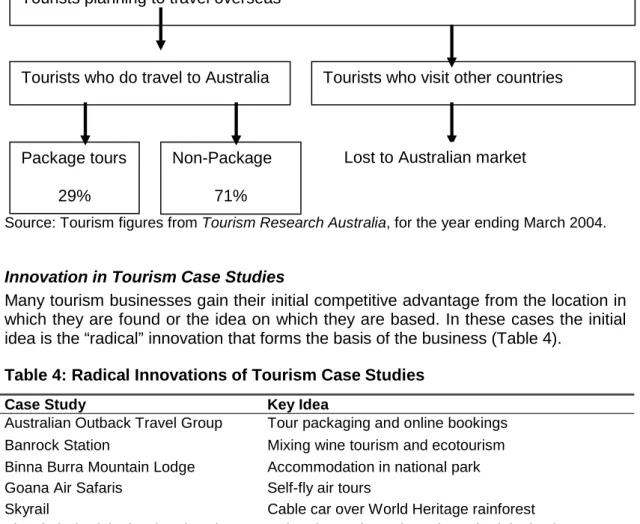
The challenge for any company that is targeting inbound tourists is to reach their target customers at the time that they are planning their itinerary. A significant proportion of Australia’s inbound tourists come on package holidays that are arranged well in advance by Outbound Tourism Operators (OTOs) in their home country. These people may make decisions to visit particular attractions well in advance of their visit. The system is described in Figure 1.
15
ABS Tourism Data, provided by DITR 16
i.e. outside the State capital cities and the Gold Coast 17
Figure 1:
Source: Tourism figures from Tourism Research Australia, for the year ending March 2004.
Innovation in Tourism Case Studies
Many tourism businesses gain their initial competitive advantage from the location in which they are found or the idea on which they are based. In these cases the initial idea is the “radical” innovation that forms the basis of the business (Table 4).
Table 4: Radical Innovations of Tourism Case Studies
Case Study Key Idea
Australian Outback Travel Group Tour packaging and online bookings Banrock Station Mixing wine tourism and ecotourism Binna Burra Mountain Lodge Accommodation in national park Goana Air Safaris Self-fly air tours
Skyrail Cable car over World Heritage rainforest Tjapukai Aboriginal Cultural Park Cultural experience based on Aboriginal culture Source: Case Studies
These six case studies all demonstrated the importance of the initial concept and most were the first business of their kind in Australia (Binna Burra, e.g. commenced in 1933, and was one of the first eco-accommodation tourism businesses in Australia). Tjapukai has changed the most since its beginnings – its original concept was an Aboriginal dance troupe and it has since expanded into an Aboriginal cultural park offering a range of experiences with the dance troupe still being the central attraction.
In a sense the absence of radical change in their core product is also the cornerstone of these firms’ success. Tjapukai is in the Guinness Book of Records for the longest running (unchanged) theatrical performance in Australia; Binna Burra’s basic concept has been unchanged since its first set of wooden cabins was built (and indeed, the site is World Heritage listed and these cabins cannot be altered architecturally under the World Heritage guidelines). Even in the younger firms, the basic tenet has remained the same.
Nevertheless these firms are still innovators in the way they have changed their products and services, sometimes subtly, in response to changing customer demands and other external influences. Most of the firms provide a mix of products and services that exemplify the value-added nature of many tourism offerings:
Tourists planning to travel overseas
Tourists who do travel to Australia Tourists who visit other countries
Lost to Australian market Package tours
29%
Non-Package 71%
• Banrock, Binna Burra and Skyrail provide ranger-guided walks and other ways to experience nature to visitors to their facilities.
• Goana tour guides accompany guests on their trips around Australia.
• Tjapukai opens its facilities at night as well as during the day.
• AOT Group offers tourists package tours as well as the ability to mix and match individual accommodation purchases and has moved into sports and entertainment packages.
The case studies highlight incremental change in all of the four areas identified by Koberg et al (Table 5).
Table 5: Incremental Innovation in Tourism Case Studies
Name Product/ service Procedural Personnel related Structural Australian Outback Travel Group Sports and entertainment packages, sale of online content Pilot testing of paperless office Staff suggestion system linked with management meetings Use of XML for online content; IT Division in company Banrock Station Feral proof fence and mammal reintroduction Expectation of input from professional staff Build capacity of all staff including casuals Restructuring management as company grows; Wetlands construction Binna Burra Mountain Lodge Playground and games design; CD of virtual walks
Role of Board Success kit, induction program and environment awareness
Eco-friendly water and asset management
Goana Air Safaris
Revised tour book and on-ground itineraries Role of tour directors in customer feedback Appointment of IT staff member Upgrading GPS in aircraft Skyrail Cable Car New guided interpretive walks New firm specialising in attraction management Structured training for all staff Retrofitting of cableway Tjapukai Aboriginal Cultural Park Tjapukai at Night
Quality circle for managing response to customer feedback Mystery shopper for quality feedback Departments formed as company has grown Source: Case Studies
Use of External Knowledge-Intensive Services
Use of external knowledge-intensive services varied widely between the case study firms (Table 6). Firms outsourced from 26% - 75% of the knowledge-intensive services on the list provided during the interview. There was a large range of percentages of external services considered of high importance (meaning that there was no equivalent skill inside the firm), ranging from 0% to 57% of the external services. Of the services outsourced, the range of services that were tailored for the firm was 0% - 85%.
In many cases, firms would have preferred to use in-house service providers but their small size meant that they could not justify recruiting a specialist. Some recognised the value of an external service provider who was at the cutting edge of their field and could provide high level on-off project support when required – the view was that if such people were employed full time within a firm they would lose their edge and would find the work insufficiently challenging.
Table 6: Use of External Services by Tourism Case Studies
AOT Group
Banrock Binna Burra
Goana Skyrail Tjapukai
Planning
Legal routine routine TAILORED TAILORED COMPLIANCE Acctg/Financial routine compliance TAILORED COMPLIANCE Compliance
Capital Raising N/A N/A N/A
Tech awareness tailored tailored Tailored
Tech trends tailored
Formal R&D routine N/A N/A N/A tailored N/A
Market research TAILORED tailored Routine
Product devt tailored tailored
Project manag't TAILORED
Operations
Marketing routine TAILORED tailored Tailored
Sales routine routine ROUTINE Tailored
Export strategy N/A N/A tailored Routine
Establishing o/s offices
tailored N/A N/A N/A TAILORED N/A
Benchmarking TAILORED
IT/Networking routine TAILORED ROUTINE TAILORED
Recruitment routine
Accreditation routine routine tailored compliance Routine
Standards tailored tailored
Training routine tailored tailored tailored tailored Tailored Total Outsourced 7 6 8 7 15 10 % Outsourced 33% 31% 47% 41% 75% 52% Of these: % High 0% 33% 0% 57% 40% 20% % tailored 14% 83% 0% 85% 73% 50%
Notes: Words in CAPITALS indicate outsourcing was of high importance; words in lower case indicate outsourcing of medium importance; blanks indicate no outsourcing. N/A indicates not relevant to that firm
Nevertheless, in all but two firms, tailored knowledge-intensive services were reported in at least half the outsourced services. In many cases, these services were
brought in to implement particular strategic plans developed by the company but not able to be implemented by employees. Examples of such practices include:
• Banrock’s external engineering works and interpretive signage for nature trails.
• Tjapukai’s IT system and translation of brochures into 8 other languages.
• Skyrail’s construction works and interpretive material for interpretive stations.
• Binna Burra’s playground and games design.
In these cases the client may not need to acquire the skills (tacit knowledge) used by the service provider because the consultant is either providing the skill to create a physical installation that remains behind, or leaves a report or text which embodies their knowledge in a way that the client can use.
In other cases, however, there is a need for the tacit knowledge to be transferred. This is most evident in training where the service provider aims to transfer enough information for the staff to use the skills gained in-house. This is achieved by both verbal transfer of information (during training courses) and written transfer (through course notes and manuals). Some firms, such as Goana, had formed close relationships with selected service providers and these people contributed to the firm in the same manner as someone on staff.
There are cases where knowledge could be transferred from service providers to client firms, but is not. This might be because the skill offered by the service provider cannot be transferred without a great deal of cost or effort (e.g. Tjapukai’s use of a specialist Japanese marketing firm).
Role of R&D Institutions
Only one firm had formal links with R&D institutions – Skyrail was working with both the Co-operative Research Centre for Tourism and CSIRO to help develop interpretive signage and deal with longer term issues relating to ecotourism. Banrock had commissioned a private sector naturalist for its interpretive signage.
Role of Industry Associations
Broadly speaking the role of industry associations in innovation is minor in the case study firms. Most belong to associations that will help them lobby government on regulatory issues and also belong to associations that will bring them closer to customers. Neither of these types of associations contribute significantly to innovation but do contribute to marketing to Free and Independent Travellers as they are heavily linked into the tourism industry itself and may be mediated through government – for example Tropical Tourism North Queensland is run by the Queensland State Government, and the Riverland Tourism Association is run by the South Australian Government.
Role of Informal Networks
All tourism case study firms were involved in local networks of tourism industry operators. While these provided important links through to customers and alerted them of trends in visitor numbers, they provided little in relation to innovation.
The important innovation networks reached outside the local area in which the firm operated. These networks were national or international, rather than local, and were often of like-minded business people running companies within the industry. Companies such as Tjapukai and AOT Group had networks at a national level. Entering (and winning) national award competitions often provided access to new networks and raised the status of the firm so that others paid attention.
Boards sometimes offered access to these networks. For example Binna Burra’s Board has links to non-tourism organisations which are a source of ideas. The same is true for Skyrail (a group of companies involved in a range of ventures) and Banrock (owned by Hardy Wines). Goana has developed similar networks by attending annual trade shows in the US.
Role of Government
These firms do not do formal R&D and hence cannot access the majority of government programs. Firms have not used COMET18 which, while it provides support for business planning, market research and training, is focused on commercialisation of technologies not services.
Many tourism firms have obtained support from State Departments, which are keen to support firms that are growing or exporting. Some of these firms have also accessed Austrade services. In the main, however, these services are aimed at identifying customers rather than supporting innovation.
There is some use government-produced tourism statistics but those that do find that they are not either timely enough or specific enough to support business decision-making.
Various Government regulations can have a major impact on innovation. Goana made a commercial decision not to introduce a new product into the market because of the expected time required for government approval and the resulting impact on costs. Firms must also comply with environment protection regulations operating in all jurisdictions. Several firms (for example Banrock, Skyrail and Binna Burra) have extra standing in the sector for exceeding the minimum requirements.
Learning by Firms Marketing
A number of companies therefore place a large amount of effort into marketing to ITOs. This was particularly the case for Tjapukai and Skyrail, both of which attracted more than three quarters of their customers from overseas. These medium to large companies used their own staff to visit ITOs in Australia and the outbound tourism operators in key markets (who compile packages for tourists intending to visit Australia) and provide them with promotional material. Binna Burra, a smaller company which still has a significant overseas-based international clientele, relies on the annual Inbound Tourism Operators conferences, organised by Tourism Australia, to meet the ITOs and provide them with information (and perhaps encourage them to visit to see for themselves). ATO Group relies largely on its website and its dominant position in content development to ensure that it reaches potential customers.
Goana Air Safaris also has a large proportion of its clients from overseas. It, however, is targeting people who already have pilots’ licences and this means that ITOs are not an effective mechanism for marketing. Instead, it markets direct through newsletters relevant to its clients (aircraft owners magazines and nature magazines) in key countries.
These marketing strategies have been developed over time and are largely supported in-house. Firms will outsource the production of marketing and interpretive material in languages other than English (Tjapukai) or containing technical information (Banrock and Skyrail re nature interpretation). Tjapukai has also decided retain a specialist Japanese marketing company to promote its offering
18
to inbound Japanese tourists, as this market is highly specialised and the company does not have the resources to recruit its own Japanese market specialist. AOT Group has made a strategic decision not to target the Japanese market because of the level of specialisation required.
Customer Feedback
All case study firms had processes in place to obtain feedback from customers. In some cases this was formal (for example visitors’ books and information on registration forms) but most firms also had ways to capture informal comments – often through staff having casual conversations with guests. All firms also had processes in place to use this feedback to make incremental changes to their product and service offerings. This feedback also told firms when not to make changes (this was particularly notable at Binna Burra whose clientele values the consistency of service and experience delivered over many years).
Quality Systems, Customer Service and Intellectual Property
All firms had quality systems or standard procedures in place for example:
• Skyrail is certified to ISO9001, an international quality standard for business.
• Skyrail and Binna Burra are Green Globe 21 certified.
• Tjapukai runs a quality circle.
• Banrock complies with Hazard Analysis Critical Control Point, and internationally recognised food safety certification system.
• Goana complies with the Civil Aviation Safety Authority’s risk and quality management systems.
• AOT Group has standard operating systems that have evolved over time.
Most firms had developed their own standard operating procedures, drawing on past experience and the requirements of the various standards to which they wanted to comply. These systems were recognised as a valuable part of firms’ capacity to service clients, manage risk and ensure that customers received an experience of a high standard.
Some, notably Tjapukai and Skyrail, also recognised that these standard operating procedures formed a component of the firm’s intellectual property. AOT Group had also recognised that its content database (lists of accommodation and details of features and prices) was valuable and had diversified its business by providing this content to other tourism companies. These three firms recognised that they could sell their expertise to others and were actively expanding their business by capitalising on this body of knowledge. Skyrail in particular has a strategy to prevent loss of knowhow by only bidding for projects where it can also enter into a long term contract for operations so that the knowledge remains in-house.
While tourism firms were aware of the value of their trademark, few also recognised the value of their standard operating procedures. There is potential for firms to use this tacit knowledge to deliver consulting or operational services to others – of particular interest when it is difficult to replicate the other key component of attractiveness, location. Some case study firms reported that government agencies were encouraging them to give away their tacit knowledge by giving presentations to visiting delegations (often to people from overseas). This needs to be discouraged.
Staff
Many tourism firms rely on staff employed as casuals. These may also have relatively low educational qualifications and may not stay with a company for very long. In several case study firms it was only the management staff who had specified roles in obtaining feedback from customers and suggesting change. Two firms, Tjapukai and Banrock, had made changes to their internal systems to try to encourage lower level staff to participate more actively in contributing to change and incremental improvements.
Knowledge Management and Decision-making
The reasons for outsourcing services varied and included:
• The need to access particular skills not available in-house on a one-off basis (for example Binna Burra commissioned a playground designer to develop a children’s play area and activities).
• The need to access complementary skills on a longer term basis (for example in awareness of new technologies).
• The need to obtain greater objectivity (for example customer service assessment and accreditation/quality auditing).
• The need to ensure staff viewed the service provider as an expert (e.g. training services).
In most cases the case study firms retained the knowledge imparted by the service provider in the form of a design or construction (e.g. Banrock’s wetland engineering works) or a report or record (e.g. Tjapukai’s foreign-language brochures). Where it was important for staff to absorb the learning then external service providers provided notes or trained staff direct, or there were feedback systems in place (e.g. the quality circles in Tjapukai).
Most firms said that they would prefer to employ staff in some of these jobs but they could not justify the expenditure in a small firm when the need for the service fluctuated and they wanted to obtain people who had a knowledge of the wider industry and best practice (which may be difficult to maintain once someone was working full time for a single company).
IT Case Studies
IT Industry in AustraliaThe Australian IT industry comprises businesses delivering information services, communication services, information and communications equipment and content. In 2001 there were over 25,000 businesses in this sector in Australia, of which 73% were in information services (this includes development and sale of software). Just under 100,000 people, or 36% of the total industry, were employed in the information services firms in Australia in 2001.19 The domestic market totals AU$61.5 billion. Businesses in the IT industry are small, with over 95% employing less than 20 staff. Information services businesses are mostly smaller than average – in this sub-sector, 97% of firms employ less than 20 staff and only 0.4$ employ more than 100 people. The IT industry in Australia is highly skilled, with over 40% of employees in computing and technical positions. Most jobs are in capital cities.
Unlike in the tourism industry, Australia runs a net deficit in its balance of trade in relation to IT. The industry is dominated by overseas-owned firms. Further, domestic production as a share of total production in information services has fallen in the last five years. The Australian Computer Society’s most recent report asserts that there appears to have been a significant decline in the competitiveness of domestically produced packages software, ICT hardware and information services.
There is limited data available on innovation in the ICT industries in general and information services in particular. Most reports equate innovation with R&D. R&D intensity stands at about 3.3% per annum across the industry as a whole, with information services being the largest and fastest growing sub-sector. Other data suggest that there has been a shift in the capital intensity of ICT-related R&D. The main centres for computer software and services R&D are NSW and Victoria.
Market Access
Companies that sell software traditionally use distributors, termed “resellers”, to reach a wide market. This is particularly so if the firms are aiming to sell product in international markets. This was the case for four firms – YourAmigo, Hatrix, Maxamine and Prophecy. All these firms had relationships with resellers who acted on their behalf. As these resellers supplied services to the case study firms, they have been included in discussion of KISA later in this section. Gecoz is currently only selling to organisations in Australia and its service requires a large amount of tailoring so it is working directly with customers. The same is true of Callista, whose market is focused on Australia’s higher education institutions. The others have developed mechanisms to interact directly with customers even though their direct line of sale is to a reseller and this is discussed later in this section.
19
Houghton, J (2003): Australian ICT Industries Update 2003, Australian Computer Society, Canberra
Table 7: Reseller Arrangements for IT Case Studies
Case Study Market Reseller Arrangements
Callista Australian Higher Education Institutions
Direct to customer Gecoz Australian government
agencies and local councils
Direct to customer, and industry partnerships Hatrix Australian and New
Zealand hospitals
With partners who sell other hospital management software
Maxamine Other businesses Tier 1 partners include Dell and EDS; other Tier 2 partners
Prophecy Major utilities and large companies
Through partners who sell other utilities and back office software
YourAmigo Other businesses Through a Certified Integration Partner Program with firms which can integrate YourAmigo software into business offerings Source: Case Studies
Innovation in Case Study Firms
The six IT case studies also demonstrated the importance of the initial concept developed by the company as the key “radical innovation” (Table 8Four are also heavily focused on international markets – YourAmigo and Maxamine on the US, Prophecy on Asia and Hatrix on New Zealand. This means that the firms take a global view of their competitors and strive to distinguish themselves at the global level.
Table 8: Radical Innovations of IT Case Studies
Case Study Key Idea
Callista Student enrolment management software for tertiary institutions Gecoz Salinity maps from radar data
Hatrix Software to reduce adverse drug events
Maxamine Analysing websites so all content is visible to search engines Prophecy Software combining logistics, billing and back office management Your Amigo Internet search engine software using novel architecture
Source: Case Studies
In addition to providing software, these firms offer value added services to their clients:
• Callista and Hatrix tailor some of their software to their clients.
• Gecoz provides mapping and consulting services.
• YourAmigo and Maxamine both train customers and provide customer support.
• Prophecy has offices in its customers countries for local support.
All the firms were able to demonstrate some changes in each of the four categories identified by Koberg et al (Table 9
Table 9 Incremental Innovation in IT Case Studies
Name Product/ service Procedural Personnel
related
Structural
Callista Development of support systems for remote region clients
Project lead staff for scanning environment Developing creativity of IT staff Restructuring of company into teams Gecoz Development of methods for producing inundation maps Develop on-line investor-ready documentation Company director training Access to new sources of data through alliance
Hatrix Extension of main product to XML
Quality management ISO9001
Hire in staff with new skills for OTJ training
Move to handheld PC technology Maxamine Extension of basic
product to search engine strategies
Internal departmental plans and targets
Adaptation of training for US and Australian staff
Advisory Board
Prophecy New billing product for utilities Corporate governance systems to comply with changes in listed company rules Move staff through product development teams; mentoring Product advisory team co-ordinates input to management Your Amigo Extension of product to automatic search and alert Customer account managers Training technicians in sales Advisory Board
Source: Case Studies
Use of External Knowledge-Intensive Services
Use of external knowledge-intensive services varied from 19% to 45% of the KISA list discussed with the IT case studies (Table 10There was a large range of percentages of external services considered of high importance (meaning that there was no equivalent skill inside the firm), ranging from 14% to 75% of the external services. Of the services outsourced, the range of services that were tailored for the firm was 13% -100%. This was particularly related to legal advice (which includes advice on patenting and intellectual property) and capital raising (important when entering US markets or seeking venture capital investment in Australia or overseas). Several of the case study firms demonstrated strong use of their Board in planning, legal, financial advice, capital raising and general environmental scanning. These firms were also highly likely to have sought external assistance for business planning and tailored legal services, accounting and technology awareness services. Few IT firms outsourced aspects of technology scanning, product development or project management as their technical staff in-house were used for these functions. Many IT firms had long term relationships with their service providers.
Table 10: Use of External Services by IT Case Studies
Callista Gecoz Hatrix Maxamine Prophecy Your
Amigo
Planning tailored TAILORED tailored
Legal TAILORED tailored TAILORED routine TAILORED Acctg/Financial routine TAILORED COMPLIANCE TAILORED routine Capital Raising tailored TAILORED TAILORED TAILORED Tech awareness routine TAILORED
Tech trends routine Formal R&D
Market research TAILORED tailored TAILORED
Product devt
Project manag't
Operations tailored routine
Marketing routine tailored
Sales routine TAILORED Tailored TAILORED
Export strategy tailored
Establishing o/s offices
N/A
Benchmarking ROUTINE
IT/Networking TAILORED tailored
Recruitment tailored tailored
Accreditation tailored
Standards N/A
Training TAILORED compliance TAILORED Total Outsourced 8 7 7 9 6 4 % Outsourced 38% 35% 33% 45% 28% 19% Of those: % High 25% 25% 14% 67% 33% 75% % Tailored 13% 71% 71% 89% 66% 100%
Notes: Words in CAPITALS indicate outsourcing was of high importance; words in lower case indicate outsourcing of medium importance; blanks indicate no outsourcing. N/A indicates not relevant to that firm
Role of R&D Institutions
All IT case study firms expected their professional staff to keep abreast of technical developments and all but Prophecy had in-house R&D programs. They often obtained this information from external sources (trade magazines, conferences) but the role was played by staff rather than external advisers.
Three of the IT firms’ founders (for Maxamine, YourAmigo and Gecoz) had moved directly from employment with Australian R&D institutions to their new firms and two firms (YourAmigo and Callista) had spun out of research institutions.
• Callista had spun out of Deakin University after the software had been developed by a university working group comprising Deakin and three other institutions;
• YourAmigo’s founders had licensed the software from the university but had rewritten the original code to ensure that it was able to be technically supported;
• Gecoz’s founders had developed ideas for the product while in the university but the product itself was developed by the company;
• Maxamine’s founder had applied logic learned while working on artificial intelligence at the university to a new area of website management.
Few of these had continuing formal relationships with these institutions but they did maintain informal networks, which were used to keep up with trends. However all R&D was undertaken in-house. Universities’ main function was as a source of technical staff. Keeping R&D, and hence intellectual property, within the firm was also a key issue.
Two firms, Hatrix and Prophecy, did not have any contact with research institutions. Hatrix was concerned about expectations that IP arising from research funded at a university would have to be shared, and Prophecy had not considered forming relationships with R&D institutions because it did all its R&D in-house.
Role of Industry Associations
Of the six IT companies interviewed only a two were active in industry associations, although most were members of the key national association, the Australian Information Industries Association. Gecoz is a founding member of the Spatial Sciences Institute which has been formed to promote standards development and best practice in what is a relatively new field. Prophecy has also joined a new water industry body, relevant to its customers, in its home State. These associations did not provide any particular inputs in relation to innovation although industry newsletters did give some leads in relation to emerging technological trends.
Role of Informal Networks
Maxamine, YourAmigo and Callista all rely on extensive personal networks of the founders for innovation inputs. In Maxamine and YourAmigo these networks are formalised in an Advisory Board structure (however these boards don’t meet together). Callista’s current CEO has wide personal networks outside the education sector and uses these to bring in ideas from outside the organisation. Hatrix relies on attending industry conferences and trade shows for some informal networks and ideas.
Role of Government
IT firms in general were very aware of the range of services and grant programs offered by the Australian Government. One had been granted funds under COMET and several others had successfully received R&D START grants.20 Two firms had been involved in Government-sponsored incubator programs – Gecoz had been
20
The R&D START grant program provides up to several million dollars funding for R&D projects, with the company being required to match Government funding. The program is competitive and firms must be able to demonstrate that they have the matching funding when they apply for the grant. www.ausindustry.gov.au
funded by the building on IT strengths incubator in Darwin and Your Amigo was funded by the Playford Centre, an incubator in Adelaide. Maxamine had not received startup government support but did have private investors. Three case study firms also used Austrade at varying levels:
• Maxamine was selected to participate in the 2002 Austrade Euro High Tech Tour.
• Gecoz was supported by Austrade market assessment in China (and also received State funding for a mission to Singapore).
• Hatrix is a member of the Austrade Tradestart program.
There is no doubt that the funding provided through these programs helped to kick start these companies. Gecoz, in particular, spoke highly of the COMET program, which provided significant support to directors who had little business experience. Gecoz also reported that the firm’s business plan, developed by an adviser and with the COMET funding, it provided an independent, arms length assessment of the business opportunity and helped to convince investors that the firm had prospects. Learning by Firms
Marketing
All IT firms marketed themselves heavily through their website, as well as through the various channel partners/resellers. They all had sophisticated website strategies and were heavy users of the internet. Callista had used a brand consultant to reposition itself in the market but all others had developed their own strategies. Two firms (Callista, Maxamine) purchased pre-packaged market reports from firms which specialise in this area. YourAmigo had been offered pre-packaged research but had decided not to purchase it, and now believes that such reports are of little use.
For those who export (Prophecy, Maxamine, YourAmigo and Hatrix), marketing is heavily focused on those overseas. All except Hatrix had also established overseas offices to support this process. They had often sought advice from patent attorneys, accountants and lawyers in these markets prior to establishing their offices or subsidiaries. Maxamine also contracted a specialist US market analyst who played an important role in environmental scanning.
Customer feedback
As noted above, four case study firms relied on resellers so there is an intermediary between the firm and its eventual end customer. These firms had developed a range of methods to obtain feedback from their eventual end customer without potential “filtering” by the reseller. These enabled them to read market needs, as well as get direct feedback from their distributors. Callista had also established customer feedback groups to address key issues of software development.
Table 11: Customer Feedback Methods for Case Study Firms
Case Study Main Customer Feedback Method
Callista Customer working groups Gecoz Direct feedback from customers
Hatrix Direct feedback from customers through installation and delivery Maxamine Embeds staff in Tier 1 partner firms; provides customer support from
Australia & the US as part of its 24x7 coverage Prophecy Own offices to support customers in-country Your Amigo Customer account managers
Source: Case Studies
Quality Systems, Customer Service and Intellectual Property
Firms were very aware of the importance of intellectual property and three (Maxamine, Gecoz and Your Amigo) had protected their intellectual property by patenting in Australia, the US and elsewhere. All others, however, protected their IP by ensuring the source code stayed in-house and used trademark and copyright to keep their intellectual property from being stolen.
All firms had quality systems or standard procedures in place. For example:
• Maxamine has formal processes for sales management and written procedures for roll-out of the sales management systems;
• Hatrix is ISO9001 certified, primarily because its hospital customers require this;
• Gecoz’s investors appointed a business manager who set up key business systems which are now followed; and
• Prophecy has standard operating procedures covering development methodologies, technical processes and checklists.
Staff
Staff contribute significantly to innovation and environmental scanning, primarily because they are more likely to be tertiary-qualified and hence will have their own professional networks. This usually related to information on technology awareness and technology trends, both of which were important to these firms in fast-moving markets. Callista had the most formal of these arrangements, with technical staff assigned to scan the environment for potential improvements to support customer management and product rollout.
Knowledge Management
The main reasons IT firms outsourced services were:
• The need to access particular skills not available in-house (e.g. both Maxamine and YourAmigo had sough advice from patents attorneys to support patenting and Gecoz had outsourced market research to identify and analyse its market when it was first established).
• The need to access complementary skills on a longer-term basis (e.g. the use of channel partners in US markets).
• The need to obtain greater objectivity (e.g. software productivity assessment and accreditation/quality auditing).
Firms expected external service providers to provide reports and other written materials in order to retain knowledge gained. Where the relationship was longer term (e.g. with channel partners) then interaction with these service providers had been formalised and meetings were held to share information and ideas with the firm’s management.