NBER WORKING PAPER SERIES
GLOBAL CURRENCY HEDGING John Y. Campbell
Karine Serfaty-de Medeiros Luis M. Viceira Working Paper 13088
http://www.nber.org/papers/w13088
NATIONAL BUREAU OF ECONOMIC RESEARCH 1050 Massachusetts Avenue
Cambridge, MA 02138 May 2007
Viceira acknowledges the financial support of the Division of Research of the Harvard Business School. We are grateful to Roderick Molenaar, Sam Thompson, Tuomo Vuolteenaho, and seminar participants at Brandeis University, Boston University, the University of Illinois at Urbana-Champaign, and Harvard University for comments and suggestions. The views expressed herein are those of the author(s) and do not necessarily reflect the views of the National Bureau of Economic Research.
© 2007 by John Y. Campbell, Karine Serfaty-de Medeiros, and Luis M. Viceira. All rights reserved. Short sections of text, not to exceed two paragraphs, may be quoted without explicit permission provided
Global Currency Hedging
John Y. Campbell, Karine Serfaty-de Medeiros, and Luis M. Viceira NBER Working Paper No. 13088
May 2007, Revised January 2009
JEL No. F3,F31,G11,G12,G15
ABSTRACT
Over the period 1975 to 2005, the US dollar (particularly in relation to the Canadian dollar) and the euro and Swiss franc (particularly in the second half of the period) have moved against world equity markets. Thus these currencies should be attractive to risk-minimizing global equity investors despite their low average returns. The risk-minimizing currency strategy for a global bond investor is close to a full currency hedge, with a modest long position in the US dollar. There is little evidence that risk-minimizing investors should adjust their currency positions in response to movements in interest differentials.
John Y. Campbell Morton L. and Carole S.
Olshan Professor of Economics Department of Economics Harvard University Littauer Center 213 Cambridge, MA 02138 and NBER [email protected] Karine Serfaty-de Medeiros Department of Economics Littauer Center Harvard University Cambridge, MA 02138 [email protected] Luis M. Viceira
George E. Bates Professor Harvard Business School Baker Library 367 Boston, MA 02163 and NBER
What role should foreign currency play in a diversi…ed investment portfolio? In practice, many investors appear reluctant to hold foreign currency directly, perhaps because they see currency as an investment with high volatility and low average re-turn. At the same time, many investors hold indirect positions in foreign currency when they buy foreign equities or bonds without hedging the currency exposure im-plied by the foreign asset holding. Such investors receive the foreign-currency excess return on their foreign assets, plus the return on foreign currency.
In this paper we consider an investor with an exogenous portfolio of equities or bonds and ask how the investor can use foreign currency to manage the risk of the portfolio. We assume that the investor’s domestic money market is riskless in real terms, and use mean-variance analysis to …nd the foreign currency positions that minimize the risk of the total portfolio. We consider seven major developed-market currencies, the dollar, euro, Japanese yen, Swiss franc, pound sterling, Canadian dollar and Australian dollar, over the period 1975 to 2005. Any of these can be the investor’s domestic currency or can be available as a foreign currency. We assume a one-quarter investment horizon, but obtain similar results for horizons ranging from one month to one year.
for-eign currencies by Glen and Jorion (1993), our implementation and empirical results are novel in several respects. Following Glen and Jorion, we start by considering an equity investor who chooses …xed currency weights to minimize the unconditional variance of her portfolio. Such an investor wishes to hold currencies that are nega-tively correlated with equities. Our …rst novel result is that our seven currencies fall along a spectrum. At one extreme, the Australian dollar and the Canadian dollar are positively correlated with local-currency returns on equity markets around the world, including their own domestic markets. At the other extreme, the euro and the Swiss franc are negatively correlated with world stock returns and their own domestic stock returns. The Japanese yen, the British pound, and the US dollar fall in the middle, with the yen and the pound more similar to the Australian and Canadian dollars, and the US dollar more similar to the euro and the Swiss franc.
When we consider currencies in pairs, we …nd that risk-minimizing equity investors should short those currencies that are more positively correlated with equity returns and should hold long positions in those currencies that are more negatively correlated with returns. When we consider all seven currencies as a group, we …nd that optimal currency positions tend to be long the US dollar, the Swiss franc, and the euro, and short the other currencies. A long position in the US-Canadian exchange rate is a particularly e¤ective hedge against equity risk.
We obtain a second novel result when we consider the risk-minimization problem of global bond investors rather than global equity investors. We …nd that most currency returns are almost uncorrelated with bond returns and thus risk-minimizing bond investors should avoid holding currencies; that is, they should fully currency-hedge their international bond positions. This is consistent with common practice of institutional investors, although global bond mutual funds are available with or without currency hedging. The US dollar is an exception to the general pattern in that it tends to appreciate when bond prices fall, that is when interest rates rise, around the world. This generates a modest demand for US dollars by risk-minimizing bond investors.
In capital market equilibrium, one might expect that average currency returns would re‡ect the risk characteristics of currencies. Speci…cally, if reserve currencies are attractive to risk-minimizing global equity investors, these currencies might o¤er lower returns in equilibrium. We analyze the historical average returns on currency pairs and obtain a third novel result, that high-beta pairs have delivered higher aver-age returns. However the historical reward for taking equity beta risk in currencies has been quite modest, and much smaller than the historical average excess return on a global stock index.
Another way to …nd a risk-return relation in foreign currencies is to condition upon currency characteristics that are known to predict currency returns, and to ask whether these characteristics predict currency risks. Following an extensive literature on the predictive power of interest di¤erentials for currency returns, we use deviations of interest di¤erentials from their time-series averages as conditioning variables, imposing that they have the same e¤ects on currency covariances regardless of the particular currency pair under consideration. Our fourth novel result is that increases in interest rates have only modest e¤ects on currency-equity covariances. Over the full sample period, and particularly the …rst half of the sample, increases in interest di¤erentials are, if anything, associated with decreases in these covariances. This implies that risk-minimizing equity investors should tilt their portfolios towards currencies that have temporarily high interest rates, amplifying the speculative “carry trade” demands for such currencies rather than o¤setting them.
The organization of the paper is as follows. Section I sets the stage by brie‡y reviewing the related literature. Section II describes our data and conducts prelimi-nary statistical analysis of stock, bond, and currency returns. Section III lays out the analytical framework we use for our empirical analysis and presents unconditionally optimal currency hedges for equity portfolios, while Section IV reports the analogous results for bond portfolios. Section V discusses the relation between unconditional
risks of currencies and their unconditional average returns. Section VI introduces the possibility of conditional hedging, varying currency positions in response to inter-est di¤erentials. Section VII quanti…es the risk reductions that are achievable with an unconditional or conditional currency hedging strategy, and discusses the e¤ects of currency hedging on the Sharpe ratios of equity and bond portfolios. Section VIII concludes. The Internet Appendix presents analytical details and additional empirical results.1
I. Literature Review
The academic …nance literature has explored a number of reasons why investors might want to hold foreign currency. These can be divided into risk management demands, resulting from covariances of foreign currency with the state variables that determine investors’marginal utility, and speculative demands, resulting from positive expected excess returns on foreign currency over domestic safe assets.2
One type of risk management demand arises if there is no domestic asset that is riskless in real terms, for example because only nominal bills are available and there is uncertainty about the rate of in‡ation. In this case, the minimum-variance portfolio may contain foreign currency (Adler and Dumas 1983). This e¤ect can be substantial in countries with extremely volatile in‡ation, such as some emerging markets, but is
quite small in developed countries over short time intervals. Campbell, Viceira, and White (2003) show that it can be more important for investors with long time horizons, because nominal bills subject investors to ‡uctuations in real interest rates, while nominal bonds subject them to in‡ation uncertainty which is relatively more important at longer horizons. If domestic in‡ation-indexed bonds are available, however, they are riskless in real terms if held to maturity and thus drive out foreign currency from the minimum-variance portfolio.
Another type of risk management demand for foreign currency arises if an in-vestor holds other assets for speculative reasons, and foreign currency is correlated with those assets. For example, an investor may wish to hold a globally diversi…ed equity portfolio. If the foreign-currency excess return on foreign equities is negatively correlated with the return on the foreign currency (as would be the case, for example, if stocks are real assets and the shocks to foreign currency are primarily related to foreign in‡ation), then an investor holding foreign equities can reduce portfolio risk by holding a long position in foreign currency. This type of risk management currency demand is the subject of this paper.
Many international investors think not about the foreign currency positions they would like to hold, but about the currency hedging strategy they should follow.3
An unhedged position in international equity, for example, corresponds to a long position in foreign currency equal to the equity holding, while a fully hedged position corresponds to a net zero position in foreign currency. When currencies and equities are uncorrelated, risk management demands for foreign currencies are zero, implying that in the absence of speculative demands, full hedging is optimal (Solnik 1974). Empirically, Perold and Schulman (1988) …nd that US investors can reduce volatility by fully hedging the currency exposure implicit in internationally diversi…ed equity and bond portfolios.
We derive optimal hedging strategies for global equity and bond investors. Like Glen and Jorion (1993), we …nd that optimal currency hedging substantially reduces risk for equity investors. The bene…ts of optimal hedging are large even in countries like Canada where full hedging is actually riskier than no hedging at all. We report results for quarterly returns, but these results are robust to variation in the investment horizon between one month and one year. Froot (1993) studies the dollar and the pound over a longer sample period and …nds that risk-minimizing foreign currency positions increase with the investment horizon, implying that long-horizon equity investors should not hedge their currency risk. We do not …nd this horizon e¤ect in our post-1975 dataset.
Speculative currency demands require that investors perceive positive expected excess returns on foreign currencies. A unique feature of currencies is that investors in every country can simultaneously perceive positive expected excess returns on foreign currencies over their own domestic currencies. That is, a US investor can perceive a positive expected excess return on euros over dollars, while a European investor can at the same time perceive a positive expected excess return on dollars over euros. This possibility arises from Jensen’s inequality and is known as the Siegel paradox (Siegel 1972). It can explain symmetric speculative demand for foreign currency by investors based in all countries.
In practice, however, the speculative currency demand generated by this e¤ect is quite modest. If currency movements are lognormally distributed and the expected excesslog return on foreign currency over domestic currency is zero (a condition that can be satis…ed for all currency pairs simultaneously), then the expected excesssimple return on foreign currency is one-half the variance of the foreign currency return. With a foreign currency standard deviation of about 10% per year, the expected excess foreign currency return is 50 basis points and the corresponding Sharpe ratio is only 0.05. A Sharpe ratio this small generates little demand from investors with typical levels of risk aversion.
A more important source of speculative currency demand arises from expected excess returns on particular currencies, as opposed to all currencies simultaneously. Although unconditional average excess returns on currencies are close to zero, there is evidence that conditional expected excess returns on currencies undergo short-term ‡uctuations which constitute the basis for active currency strategies. Most obviously, the literature on the forward premium puzzle (Hansen and Hodrick 1980, Fama 1984, Hodrick 1987, Engel 1996) shows that currencies with high short-term interest rates deliver high returns on average. The currency carry trade, which exploits this phe-nomenon by holding high-rate currencies and shorting low-rate currencies, was ex-tremely pro…table in and beyond our sample period until 2008 (Burnside et al. 2007, Brunnermeier, Nagel, and Pedersen 2008).
It is natural to ask whether the carry trade has risk characteristics that o¤set its pro…tability. Farhi and Gabaix (2008) argue that high-rate currencies are exposed to the risk of rare economic disasters, while Lustig and Verdelhan (2007) …nd that high-rate currencies, in a sample that includes emerging-market currencies, have higher sensitivity to US consumption growth. We use sensitivity to world stock returns as a measure of risk, and …nd that developed-market currencies with high unconditional average interest rates do have somewhat higher betas with the world stock market, but that there is no tendency for a currency whose interest rate is temporarily high to
have a temporarily higher beta. Over our full sample period and in the …rst half of the sample, currency betas even have a weak tendency to decline when interest rates increase. Thus risk considerations might deter equity investors from implementing an unconditional form of the carry trade, but a conditional form of the trade, that invests in currencies with temporarily high interest rates, should be attractive even to risk-averse equity investors.
II. Data and Summary Statistics
Our empirical analysis uses stock return data from Morgan Stanley Capital Inter-national, and data on exchange rates, short-term interest rates, and long-term bond yields from the International Financial Statistics database published by the Inter-national Monetary Fund.4 We calculate log bond returns from yields on long-term bonds using the approximation suggested in Campbell, Lo and MacKinlay (1997).5
These data series are available at a monthly frequency, and we report results for sev-eral di¤erent investment horizons in the appendix, but our basic analysis assumes a one-quarter horizon and therefore runs monthly regressions of overlapping quarterly excess returns. We report results for seven developed economies: Australia, Canada, Euroland, Japan, Switzerland, the UK and the US. The sample period starts in 1975:7, the earliest date for which we have data available for all variables and for all
seven markets, and ends in 2005:12.
We de…ne “Euroland” as a value-weighted stock basket that includes Germany, France, Italy, and the Netherlands. These are the countries in the euro zone for which we have the longest record of stock total returns, interest rates, and exchange rates. For simplicity, we will refer to the Euroland stock portfolio as a “country” stock portfolio when describing our empirical results, even though this is not literally correct. With regard to currencies, prior to 1999 we refer to a basket of currencies from those countries, with weights given by their relative stock market capitalization, as the “euro”.
Of course, our de…nition of Euroland implies some look-ahead bias, since in 1975 it would not have been obvious whether a European monetary union would occur, and which countries from the region would have been part of that union. However, one can reasonably argue that these countries would have been candidates, and that from the perspective of today’s investors, it probably makes sense to consider these markets as a single market. We have also conducted our analysis including only Germany in Euroland, and using the deutschemark to proxy for the euro before 1999; this procedure gives very similar results.
term nominal interest rates, log stock and bond returns in excess of their local short-term interest rates, changes in log exchange rates with respect to the US dollar, and log currency excess returns with respect to the dollar. The means of log excess returns (geometric averages) are adjusted for Jensen’s Inequality by adding one half their variance to convert them into mean simple excess returns (arithmetic averages).
Annualized average nominal short-term interest rates di¤er across countries. They are lowest for Switzerland and Japan, and highest for Australia, Canada, and the UK.6
Short-term rates exhibit very low annualized volatility, under 2% for all countries.
Average changes in exchange rates with respect to the US dollar over this period are negative for the Australian dollar, close to zero for the Canadian dollar, the British pound, and the euro, and positive for the Swiss franc and the yen, re‡ecting an appreciation of these currencies with respect to the US dollar over this period. Exchange rate volatility relative to the dollar is in the range 10-13% for all currencies except the Canadian dollar, which moves closely with the US dollar giving a bilateral volatility of only 5.4%.
Excess returns to currencies are small on average and exhibit annual volatility similar to that of exchange rates, a result of the stability of short-term interest rates. Using the usual formula for the mean of a serially uncorrelated random variable, it is
easy to verify that unconditional mean excess returns on currencies are insigni…cantly di¤erent from zero.
Table II reports full-sample quarterly correlations of foreign-currency excess re-turns (Panel A), and fully currency-hedged excess rere-turns on stocks (Panel B) and bonds (Panel C). For simplicity, we report in Panel A the average correlation of each currency pair across all possible base currencies in our set, giving results for individual base currencies in the appendix. Panel A shows that all currency returns are positively cross-correlated. Currency correlations are large— almost all correla-tion coe¢ cients are above 30%— but they are far from perfect, implying that there is signi…cant cross-sectional variation in the dynamics of exchange rates.
Four correlations stand out as unusually large. The Canadian dollar exhibits a very high correlation with the US dollar (89%) and also with the Australian dollar (70%). The high correlation of the Canadian dollar with both the US dollar and the Australian dollar re‡ects the dual role of the Canadian economy as a resource-dependent economy that is simultaneously highly integrated with the US. Similarly, the euro is highly correlated with the Swiss franc (89%) and to a lesser extent the British pound (68%), re‡ecting the integration of European economies. Importantly, these correlations are high not only on average, but also individually, regardless of
the base currency used to measure them.
The correlation coe¢ cients between stock market returns shown in Panel B are all between 40% and 70%, with two important exceptions. The Canadian stock market is highly correlated with the US stock market (75%), and the Swiss stock market is highly correlated with the Euroland stock market (80%). The Canadian stock market also exhibits a relatively large correlation of 66% with the Australian stock market. These correlations demonstrate again the dual role of the Canadian economy and the integration of the Swiss economy with the European economy.
While signi…cant, the stock market correlations are still small enough to suggest the presence of substantial bene…ts of international diversi…cation in this sample pe-riod. Not surprisingly, the Japanese stock market exhibits the lowest cross-sectional correlation with all other markets. This is a re‡ection of the prolonged period of low or negative stock market returns in Japan during the 1990’s, at a time when most other markets delivered large positive returns.
Long-term bond market correlations are generally somewhat smaller than stock market correlations. Panel C in Table III shows that, with some important exceptions, these correlations are all in the range of 30-60%. The exceptions are the Euroland bond market, which is highly correlated with both the Swiss bond market (65%)
and the US bond market (62%), and the Canadian bond market, which is highly correlated with the US bond market (79%). Overall, these results imply that there are meaningful bene…ts to international diversi…cation in bond market investing.
III. Unconditional Currency Risk Management for Equity Investors
A. Estimating Unconditional Currency Demands
Our empirical analysis is based on the estimation of risk-minimizing currency de-mands for a set of stock and bond portfolios and currencies. We begin by establishing some notation. We use Rc;t+1 to denote the gross return in currency c from holding
country c assets from the beginning to the end of period t+ 1, and !c;t to denote
the weight of those assets at time tin the investor’s portfolio. Sc;t+1 denotes the spot
exchange rate in units of domestic currency per unit of foreign currencycat the end of periodt+ 1, andIc;t denotes the nominal short-term nominal interest rate on bills
denominated in currency c.
By convention, we index the domestic country by c = 1 or d and the n foreign countries by c= 2; :::; n+ 1. Of course, the domestic exchange rate is constant over time and equal to 1: S1;t+1 = 1for all t: For convenience, throughout this section we
set the domestic country to be the US, and hence refer to the domestic investor as a US investor, and to the domestic currency as the dollar. We also use small caps to
denote log (or continuously compounded) returns, exchange rates, and interest rates. That is,rc;t+1 = log(Rc;t+1), sc;t+1 = log(Sc;t+1), and ic;t= log(1 +Ic;t)
An investor holding an arbitrary portfolio of domestic and foreign assets can alter the currency exposure of her portfolio by overlaying a zero investment portfolio of domestic and foreign bills or, equivalently, by entering into an appropriate number of forward currency contracts. This is intuitive. Since the investor is already fully invested in other assets, she can alter the currency exposure implied by those assets only by borrowing— or equivalently, by shorting bonds— in some currencies, and using the proceeds to buy bonds denominated in other currencies.
For convenience we work with net currency exposures relative to full currency hedging, which we denote by c;t, instead of currency hedging demands. Of course,
there is direct correspondence between them: c;t= 0 corresponds to a fully hedged currency position, in which the investor does not hold any exposure to currency c. A positive value of c;t means that the investor holds exposure to currency c, or
equivalently that the investor does not fully hedge the currency exposure implicit in her stock position in country c. When c;t = !c;t, the portfolio is completely
unhedged.
port-folio excess return over the domestic interest rate is approximately equal to rhp;t+1 i1;t =10!t(rt+1 it) + 0t st+1+it idt + 1 2 h t; (1)
where!tis the(n+ 1 n+ 1)diagonal matrix of portfolio weights,rt+1 is the vector
of log nominal asset returns in local currencies, t is the vector of net currency
exposures, st+1 is the vector of the changes in log spot exchange rates, it is the
vector of log short-term nominal interest rates, idt = log (1 +I1;t)1, and 1 is a vector
of ones. All the vectors have dimension (n+ 1 1).
Equation (1) provides an intuitive decomposition of the portfolio excess return. The …rst term represents the excess return on a fully hedged portfolio which has no exposure to currency risk. The second term involves only the vector of excess returns on currencies, st+1+it idt, and thus represents pure currency exposure, given by
t. The third term is a Jensen’s Inequality correction given in the appendix.
Since t represents the weights in a zero investment portfolio of domestic and
foreign bills, we must have that 0t1=0, or that the domestic currency exposure 1;t is automatically determined once we determine the vector of foreign currency
demands, which we denote by et= 2;t; :::; n+1;t
0
:
con-ditional global variance of the log excess return on the hedged portfolio is equal to eRM;t= Vart fst+1+eit eidt 1h Covt 10!t(rt+1 it); fst+1+eit eidt i ; (2) where we have added the subscriptRM to emphasize that equation (2) describes risk management currency demands. In the rest of the paper we will refer to this risk management component of currency demand simply as optimal currency demand or currency exposure.
Equation (2) writes eRM;tas a vector of multiple regression coe¢ cients of portfolio stock returns on currency returns. If stock returns and exchange rates are uncorre-lated, the risk management currency demand is zero. In this case holding currency exposure adds volatility to the investor’s portfolio and, unless this volatility is com-pensated, the investor is better o¤ holding no currency exposure at all or, equivalently, fully hedging her portfolio. If stock returns and exchange rates are positively cor-related, the foreign currency tends to depreciate when the stock market falls. Thus the investor can reduce portfolio return volatility by over-hedging, that is, by short-ing foreign currency in excess of what would be required to fully hedge the currency exposure implicit in her stock portfolio. Conversely, a negative correlation between stock returns and exchange rates implies that the foreign currency appreciates when
the stock market falls. Then the investor can reduce portfolio return volatility by under-hedging, that is, by holding foreign currency.
A useful property of the optimal currency demands in (2), proven in the appendix, is that for a given stock portfolio, they are invariant to changes in the base currency, provided that a riskless real asset is available in each base currency and that the set of available currencies (which always includes an investor’s own domestic currency) does not change. If we restrict the set of available currencies to a pair, for example the US dollar and the euro, this means that residents of both the US and Germany will have the same optimal demands for dollars and euros corresponding to a given equity portfolio. Residents of a third country, however, have another domestic currency available to them and so they will not necessarily have the same demands for dollars and euros even if they hold the same equity portfolio. If we allow a larger set of available currencies, then residents of all the countries in the set will have the same vector of optimal currency demands for a given equity portfolio.
In this section and the next we present estimation results which are based on an unconditional version of equation (2). The unconditional version of our model follows immediately from the conditional version by simply assuming constant risk premia and constant second moments of returns. We relax this assumption in section VI,
which examines conditional hedging policies where the covariances of portfolio returns with currency excess returns vary over time as a function of interest rate di¤erentials.
Equation (2) with constant second moments implies that we can compute opti-mal currency exposures by regressing portfolio excess returns 10!
t(rt+1 it) onto a
constant and the vector of currency excess returns fst+1 eidt +eit, and switching the
sign of the slopes. In our empirical analysis we consider several practically relevant cases. First, we consider an investor who is fully invested in a domestic stock portfolio and optimally decides how much exposure to a single currency c to hold in order to minimize total portfolio return volatility. The optimal currency demand is the nega-tive of the slope coe¢ cient in a regression of the domestic excess stock return onto a constant and the excess return on currencyc.
Second, we consider an investor who is fully invested in a domestic stock portfolio, but who uses the whole range of available currencies to minimize total portfolio return volatility. In that case the vector of optimal currency demands is given by the negative of the slopes of a multiple regression of the excess stock return on the domestic market onto a constant and the vector of currency excess returns.
Third, we consider a case where the investor holds an equally weighted global equity portfolio, using the whole vector of available currencies to minimize total
port-folio return volatility. Finally, in the appendix we also consider value weighted and home biased global equity portfolios.
B. Single-Country Stock Portfolios
We start our empirical analysis by examining the case of an investor who is fully invested in a single-country equity portfolio and is considering whether exposure to other currencies would help reduce the volatility of her quarterly portfolio return.
Table III reports optimal currency exposures for the case in which the investor is considering one currency at time (Panel A), and that in which she is considering mul-tiple currencies simultaneously (Panel B). In both panels, the reference stock market is reported at the left of each row, while the currency under consideration is reported at the top of each column. In all tables we report Newey-West heteroskedasticity and autocorrelation consistent standard errors in parentheses below each optimal currency exposure. Following standard convention, we mark with one, two, or three stars co-e¢ cients for which we reject the null of zero at a 10%, 5%, and 1% signi…cance level, respectively.
Panel A in Table III considers an investor who is deciding how much to hedge of the currency exposure implicit in an investment in a speci…c national stock market, in isolation from other investments and currencies this investor might hold. To facilitate
interpretation, it is useful to discuss an example in detail. The …rst non-empty cell in the …rst column of the table, which corresponds to the Australian stock market and the euro, has a value of 0.39. This means that a risk-minimizing Euroland investor who is fully invested in the Australian stock market and has access to the Australian dollar and the euro should buy a portfolio of euro-denominated bills worth 1.39 euros per euro invested in the Australian stock market, …nancing this long position with a short position in Australian bills— i.e., by borrowing Australian dollars. That is, the investor should over-hedge the Australian dollar exposure implicit in her Australian stock market investment, and hold a net long 39% exposure to the euro.
Panel A of Table III shows that optimal demands for foreign currency are large, positive and statistically signi…cant for two stock markets (rows of the table), those of Australia and Canada. Investors in the Australian and Canadian stock markets are keen to hold foreign currency, regardless of the particular currency under consid-eration, because the Australian and Canadian dollars tend to depreciate against all currencies when their stock markets fall; thus any foreign currency serves as a hedge against ‡uctuations in these stock markets. The long positions in euros, Swiss francs, or US dollars are particularly large and statistically signi…cant.
hold economically and statistically large short positions in all currencies, implying that the Swiss franc tends to appreciate against all currencies when the Swiss stock market falls. Results are similar for the Euroland stock market, except that this market is hedged by a long position in the Swiss franc. The Japanese and UK stock markets generate large positive demands for the Swiss franc and the euro, and negative or small positive demands for all other currencies. The British stock market generates signi…cant negative demands for the Australian dollar and the Canadian dollar.
The last row of this panel describes individual optimal currency demands for a portfolio fully invested in US stocks. Most of these demands are economically small and statistically insigni…cant, but there are two important exceptions to this pattern. The …rst exception is a modest positive demand for the Swiss franc, which tends to appreciate when the US stock market falls. The euro generates a similar demand, though it is statistically signi…cant only at the 10% signi…cance level. The second exception is a large negative demand for the Canadian dollar, re‡ecting the fact that the Canadian dollar tends to depreciate when the US stock market falls.
Panel B of Table III reports optimal currency demands for single-country stock portfolios considering all currencies simultaneously. That is, each row of Panel B reports the unconditional version of (2) when rt+1 is unidimensional and equal to the
stock market shown on the leftmost column. Note that the the numbers in each row must add up to zero, since the domestic currency exposure must o¤set the vector of foreign currency demands.
When single-country stock market investors consider investing in all currencies simultaneously, they almost always choose positive exposures to the US dollar, the euro and the Swiss franc, and negative exposures to the Australian dollar, Canadian dollar, British pound, and Japanese yen. Relative to panel A, the optimal currency demands are generally larger and statistically more signi…cant for the US dollar, and less statistically signi…cant for the euro and the Swiss franc. This re‡ects two features of the multiple-currency analysis. First, a position that is long the US dollar and short the Canadian dollar is a highly e¤ective hedge against stock market declines. Thus allowing investors to use both North American currencies increases the risk management demand for the US dollar. Second, the euro and Swiss franc are both good hedges but they are highly correlated; thus the demand for each currency is less precisely estimated when investors are allowed to take positions in both currencies. In this sense the euro and the Swiss franc are substitutes for one another.
C. Global Equity Portfolios
country stock market, and use currencies to hedge the risk of that stock market. In this section we consider risk-minimizing investors with internationally diversi…ed stock portfolios.
We focus our analysis on investors who are equally invested in the seven stock markets included in our analysis: Euroland, Australia, Canada, Japan, Switzerland, the UK, and the US. We have already noted that, in the multiple-currency case, opti-mal currency demands generated by a given global portfolio are the same regardless of the currency base. Accordingly, we only need to report one set of currency demands, which add up to zero as in panel B of Table III.
Panel A of Table IV considers the case in which investors have access to all seven currencies from the countries included in the equally-weighted stock portfolio. Panel B considers a case in which investors do not have close currency substitutes available for investment. Speci…cally, Panel B excludes Canada and Switzerland from the analysis because the Canadian stock market is highly correlated with the US stock market, and the Canadian dollar is also highly correlated with the US dollar; similarly, there is a very high positive correlation between the Swiss stock market and the Euroland market, and between the Swiss franc and the euro. Comparison of the results in panel A and panel B clari…es the roles of the Canadian dollar and the US dollar, and
the euro and the Swiss franc, in investors’portfolios. Both panels report estimates of optimal currency demands based …rst on our full sample, and then on two subperiods, 1975 to 1989 (Subperiod I) and 1990 to 2004 (Subperiod II). We discuss subperiod results in part D of this section.
The optimal currency portfolio in Panel A has a large, statistically signi…cant exposure of 40% to the US dollar, and an even larger negative exposure of -61% to the Canadian dollar. These two positions are not independent of each other: Panel B shows that, once we exclude the Canadian dollar from the menu of currencies available to the investor, the optimal exposure to the US dollar becomes small and statistically insigni…cant. Just as in the previous analysis of single-country stock portfolios, a position that is long the US dollar and short the Canadian dollar helps investors hedge against global stock market movements. The 3-month annualized return on this position, driven by the movements of the bilateral US/Canadian exchange rate, is plotted in Figure 1 together with the 3-month annualized excess return on the equally weighted, fully currency-hedged global equity index. The …gure clearly shows the tendency of the US dollar to appreciate relative to the Canadian dollar in periods of stock market weakness.
and the Swiss franc. These exposures are not economically very large individually, and statistically signi…cant only at a 10% level. This lack of individual economic and statistical signi…cance is because the euro and the Swiss franc are close substitutes. Panel B shows that when the Swiss franc is excluded from the menu of currencies, the demand for the other currency in the pair, the euro, increases dramatically to 56% and is statistically signi…cant at the 1% level. Figure 2 plots the 3-month annualized return of the euro against an equally weighted basket of other currencies, together with the currency-hedged excess global equity return.
In addition to the optimal negative exposure to the Canadian dollar already dis-cussed, the optimal exposures to the Australian dollar, the Japanese yen, and the British pound are also negative. These short positions are small and statistically insigni…cant for the pound, but larger and statistically signi…cant for the yen. The Australian dollar short position is small if the Canadian dollar is included in the set of currencies, but becomes larger and statistically signi…cant in panel B when the Cana-dian dollar is excluded. These two currencies, which are unusually highly correlated with one another, are substitutes in investors’currency portfolios.
Once again, it is useful to review the exact meaning of the numbers we report. The numbers shown in Table IV are optimal currency exposures. If it is optimal for
all investors to fully hedge the currency exposure implicit in their stock portfolios or, equivalently, to hold no currency exposure, the optimal currency demands shown in Table IV should be equal to zero everywhere. To obtain optimal currency hedging de-mands from optimal currency exposures, we need only compute the di¤erence between portfolio weights— which in this case are 14.3% for each country stock market— and the optimal currency exposure corresponding to that country.
The results in Panel A imply that, say, a risk-minimizing Euroland investor holding our equally-weighted seven-country equity portfolio would invest 99 euro cents in currencies for each euro invested in the stock portfolio. These 99 euro cents would be invested in US Treasury bills worth 40 euro cents, Euroland (say, German) bills worth 32 euro cents, and Swiss bills worth 27 euro cents. These purchases would be …nanced with proceeds from borrowing Australian dollars (11 euro cents per euro invested in the stock portfolio), Canadian dollars (61 cents), yen (17 cents) and British pounds (10 cents). Note that the similarity of the 99 euro cents invested in long and short currency positions to the 100 euro cents invested in equities is merely an arbitrary feature of this particular example, not a general property of the optimal hedging strategy.
investor would underhedge her exposure to the US dollar and the Swiss franc, and overhedge her exposure to the Australian dollar, the Canadian dollar, the yen and the British pound. More precisely, this Euroland investor would not only leave unhedged the 14 euro cent exposures to the US dollar and the Swiss franc implied by each euro of the stock portfolio, she would also enter into forward contracts to buy US dollars worth 26 euro cents and Swiss francs worth 13 euro cents. She would simultaneously enter into forward contracts to sell Australian dollars, Canadian dollars, yen and British pounds worth, respectively, 25, 75, 31, and 24 euro cents per euro invested in the stock portfolio.
We show in the appendix that the results of Table IV are robust to reasonable variations in speci…cation. Varying the investment horizon between 1 and 3 months has little impact on the results, although at horizons of 6 or 12 months a long position in the Swiss franc drives out both the bilateral US/Canadian position and the euro in the optimal currency portfolio, and a short position in the Japanese yen becomes large and statistically signi…cant. Results for a value-weighted global equity portfolio are qualitatively and quantitatively similar to those for the equally-weighted portfolio. This derives from the fact that, with the exception of the US stock market, no single stock market dominates the market capitalization of the overall portfolio.7 Results
the domestic stock market and 25% invested in a value-weighted world portfolio that excludes this market.
In summary, the risk-minimizing strategy for a global equity investor involves long exposure to the US dollar and the euro (or a combination of the euro and the Swiss franc), a large short position in the Canadian dollar, and smaller short positions in all other major currencies. That is, investors in global equities want to underhedge their exposure to the dollar, the euro, and the Swiss franc, and overhedge their exposure to the other currencies. This strategy minimizes the volatility of overall portfolio returns, because the euro, Swiss franc, and US dollar tend to appreciate when international stock markets decline.
D. Stability Across Subperiods
The sample period for which we have estimated optimal currency exposures in-cludes an early period of global high in‡ation and interest rates, with exceptional performance of the Japanese stock market relative to other stock markets, followed by another subperiod of global lower in‡ation and interest rates, with extremely poor performance of the Japanese stock market. The second subperiod also saw the re-uni…cation of Germany and the creation of the euro as a common European currency. It is reasonable to examine if the results we have shown for the full sample hold
across these two markedly di¤erent subperiods, so we divide our sample period into the periods 1975 to 1989 and 1990 to 2005.
The bottom two rows in each panel of Table IV report subsample results for an investor holding an equally-weighted global stock portfolio, and using the vector of available currencies to manage risk. The results are generally familiar, with long positions for the US dollar, Swiss franc, and euro, and short positions for other currencies. It is striking, however, that US dollar positions tend to fall between the …rst subperiod and the second, while the sum of euro and Swiss franc positions (in Panel A) or the euro position (in Panel B) strongly increase. The time-series plot in Figure 2 also shows that the euro began to move more consistently against world stock markets in the second subsample.
In summary, an important change occurred between the periods 1975 to 1989 and 1990 to 2005: The Swiss franc and the euro became much more competitive with the US dollar as desirable currencies for risk-minimizing global equity investors. This change is not an artefact of our use of a composite currency to proxy for the euro in the period before the creation of a common European currency, because we obtain similar results when we use the deutschemark as our euro proxy. Rather, it is likely to re‡ect the fact that the euro has found growing acceptance as a reserve currency
for international investors.
IV. Unconditional Currency Risk Management for Bond Investors
We now consider the risk-minimizing currency exposures implied by an equally-weighted global bond portfolio. Table V, whose structure is identical to Table IV, reports optimal currency exposures at a one-quarter horizon in the multiple currency case for our full sample period and for the subperiods 1975 to 1989 and 1990 to 2005.
Risk-minimizing currency demands for internationally diversi…ed bond market in-vestors are generally very small and not statistically signi…cant. The US dollar is an exception. The optimal demand for the US dollar is positive and statistically signi…cant, regardless of whether the dollar is the only currency available for invest-ment, or just one of many. But these dollar exposures are economically small. They are largest in the …rst subperiod, and almost zero in the second subperiod. Here again we see evidence of a decline over time in the attractiveness of the US dollar for risk-minimizing global investors.
We have also considered single-country bond portfolios. This is relevant to many investors, since “home bond bias”is even more prevalent among investors than “home equity bias”, and in most countries relatively few mutual funds o¤er international bonds. The results are shown in the appendix. We …nd modest positive demands
for the US dollar, consistent with the results in Table V. We also …nd that an investor holding UK bonds will hold all foreign currencies, re‡ecting the fact that the British pound tends to depreciate when the British bond market declines.
Overall, our results imply that international bond investors should fully hedge the currency exposure implicit in their bond portfolios, with possibly a small long bias towards the US dollar. Interestingly, full currency hedging is more common among international bond mutual funds than among international equity funds, and is also frequently practiced by US institutions investing in international bonds.
V. Unconditional Currency Risk and Return
In section III we showed that currencies systematically di¤er in their comovements with global stock markets. Excess returns on reserve currencies— the US dollar, the euro, and the Swiss franc— covary negatively with global stock market returns, while excess returns on other currencies— particularly those of commodity-dependent Aus-tralia and Canada— covary positively. These correlations generate positive risk man-agement demands for reserve currencies, and negative risk manman-agement demands for other currencies.
However, in equilibrium investors must be willing to hold all currencies (Black 1990). This suggests that average excess returns on currencies might adjust to
gen-erate speculative currency demands that o¤set the risk management demands we have identi…ed. In global capital market equilibrium, investors may be willing to receive lower compensation for holding US dollar, euro, and Swiss franc denominated bills because of the hedging properties of these currencies, while they may demand higher compensation for holding bills denominated in other currencies. In fact, we saw in Table I that the US and Switzerland have had the lowest currency returns in our sample, and together with Euroland have had the lowest interest rates with the exception of Japan. If this is a systematic phenomenon, it suggests that a country bene…ts from having a reserve currency not only because international demand for its monetary base generates seigniorage revenue, but also because international demand for its Treasury bills reduces the interest cost of …nancing the government debt.8
We now explore the equilibrium consequences of risk management demand for currencies by looking at the relation between currencies’average excess returns and their betas with a global stock index. We consider all possible non-redundant pairs (or exchange rates) in our cross section of currencies, and treat each one as a long-short portfolio of bills. For example, the excess return on the Canadian dollar with respect to the US dollar is the return on a portfolio long Canadian bills and short US Treasury bills.
For each of these portfolios, we compute the average log currency excess return and its beta with respect to the currency-hedged excess return on a value-weighted global stock portfolio, and we plot all these mean returns and betas together in a single …gure.9 To simplify our plot, we choose the ordering of the pairs so that their
betas are all positive.
Figure 3 shows the mean-beta diagram based on our full sample. This …gure plots full-sample annualized average excess currency returns on the vertical axis, and currency betas in the horizontal axis. The points marked with triangles refer to long-short currency portfolios with euro-denominated bills on the short side of the portfolio. The square corresponds to the portfolio long Canadian dollars and short US dollars, and the circles correspond to all other non-redundant currency pairs.
The …gure also plots a regression line of currency excess returns on currency betas, with the intercept restricted to equal zero. We can interpret this line as the security market line generated from a global CAPM using currencies as assets. The slope of this line is 3.2%, and the R2 is reasonably large at 48%; adding a free intercept
has little e¤ect on these estimates. The slope of the security market line re‡ects the equilibrium world market premium implied by currency returns. At 3.2% per annum, this premium is smaller than the ex-post average excess return on world stock markets
over this period, which Table I shows is about 7%. However, this estimate is close to the ex-ante equity risk premium that others have estimated from US equity returns over a longer period in which the ex-post equity premium has also been very large (Fama and French, 2002).
The point in the …gure that lies furthest to the right corresponds to the portfolio long Canadian dollars and short US dollars. We have shown that a position long US dollars and short Canadian dollars is a particularly e¤ective hedge against ‡uctuations in global equity markets. Conversely, a portfolio long Canadian dollars and short US dollars is particularly risky, because it is highly positively correlated with global stock markets. Figure 3 shows that this is the portfolio with the largest full-sample beta, above 0.6. It provides investors with an average positive return of about 1.2% per annum (see Table I) which, though positive, is located below the …tted security market line and is well below the average return on other portfolios with lower betas.
We have shown that portfolios which are long euro-denominated bills also help investors attenuate ‡uctuations in global stock portfolios, because the euro tends to covary negatively with global equity returns. Conversely, portfolios which are short euros and long other currencies are positively correlated with global equities. These are the points corresponding to the euro pairs shown in Figure 6. As expected, these
portfolios all exhibit positive betas. While their average excess returns exhibit a positive relation with betas, they tend to lie below the …tted security market line.
Overall, we do see di¤erences in average realized currency returns that correlate with currency risks. However, these average return di¤erences are quite modest, particularly in the case of the US dollar and the euro. Also, it is important to keep in mind that sample average currency returns are noisy estimates of true mean currency returns. None of the currencies in our sample have excess returns relative to the US dollar that are signi…cantly di¤erent from zero at the 5% signi…cance level.
Figure 4 repeats the exercise shown in Figure 3, except that it treats all currency pairs in each of the subperiods we considered in section III.D (1975 to 1989 and 1990 to 2005) as separate assets. Consistent with the results of section III.D, portfolios which are short the euro tend to be signi…cantly riskier in the second subsample, re‡ecting the increasing tendency of the euro to move as a reserve currency. Also consistent with our earlier results, the portfolio which is long the Canadian dollar and short the US dollar is somewhat less risky in the second subperiod. In general, currency pairs show a much wider dispersion in betas in the second subperiod. The security market lines have modest positive slopes in both subperiods, but of course the precision of mean currency return estimates is even lower in the subperiods than
in the full sample.
VI. Conditional Currency Risk Management
In previous sections of this paper we have estimated unconditional risk manage-ment demands for currencies, and have found that reserve currencies tend to have positive risk management demands and low average returns.
Along with these cross-sectional patterns, there could also be systematic variation in currency risks over time. It is well known that interest di¤erentials predict ex-cess returns on currencies, even controlling for cross-currency di¤erences in average returns. Contrary to the predictions of the uncovered interest parity hypothesis, currencies whose short-term interest rates are higher than normal tend to appreciate relative to currencies whose short-term interest rates are lower than normal. This behavior contributes to the pro…ts of the currency carry trade, which takes long positions in high-interest-rate currencies and short positions in low-interest-rate cur-rencies. Some of these pro…ts come from long-run di¤erences in average currency returns and interest rates, of the sort summarized in Table I, but carry trade pro…ts also result from time-variation in currency returns along with interest di¤erentials.
It is natural to ask if this conditional component of the carry trade is attractive to risk-minimizing investors, or if such investors should avoid currencies with temporarily
high interest di¤erentials. To explore this question, we consider a conditional model for risk management currency demand which depends linearly on interest di¤erentials: eRM;t= e0 it idt + e1 it idt it idt (3)
where it idt is the unconditional expectation of the vector of interest di¤erentials,
e0 = ( 0;2; :::; 0;n+1)0, e
1 = ( 1;2; :::; 1;n+1)0, and is the element-by-element
prod-uct operator. Thus eRM;0 it idt represents the vector of average risk management
demands, and eRM;1 the vector of sensitivities of those demands to movements in interest di¤erentials over time.
Using (2), we can estimate currency risk management demands (3) by estimating the simple regression
10!t(rt+1 it) = 0 n+1 X c=2 0;c( st+1 idt +ic;t) ic;t i1;t n+1 X c=2 1;c( st+1 idt +ic;t) ic;t i1;t ic;t i1;t +"t+1;(4)
where the left hand side variable is the excess return on a fully hedged portfolio. We are primarily interested in estimating the vector of slopes e1 = ( 1;2; :::; 1;n+1)0 and
testing whether they are zero. Note that when they are zero, the regression model (4) recovers exactly the unconditional risk management demands that we estimated in sections III and IV.
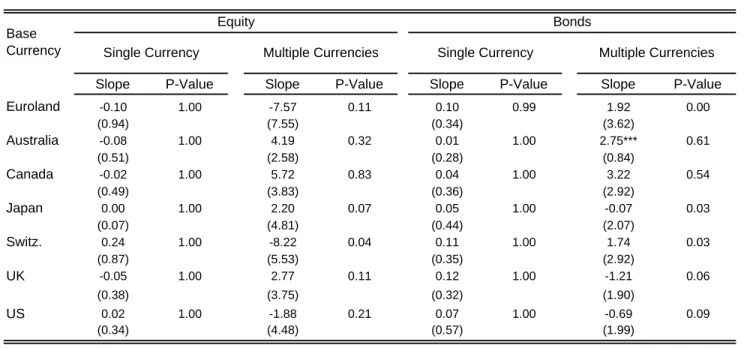
We estimate two sets of conditional risk management currency demands, and re-port the results in Table VI. First, we consider the case where only one single foreign currency is available for investment, in addition to the domestic or base currency; second, we consider the case where all currencies are available for investment simul-taneously. Table VI reports results for both a global equity portfolio and a global bond portfolio.
To increase the power of our tests, we estimate (4) imposing the constraint that all slopes are equal, i.e., that e1 = 11. Table VI reports the constrained estimate of
the slope 1 for each base currency, its Newey-West standard error, and the p-value
of the null hypothesis that this slope is the same across all currencies. We omit from the table the estimated average risk management demands eRM;0 it idt, because
they are very similar both economically and statistically to the unconditional risk management demands reported in sections III and IV. It is important to note here that the coe¢ cients 0;c and 1;c in model (3) are not invariant to the base currency
of the investor, even in the multiple currency case.10 Accordingly, we report results
for each possible base currency in the rows of the table.
The left panel of Table VI shows results for the equally-weighted global equity portfolio. In the single-foreign-currency case, we …nd almost no evidence that risk
management currency demands vary with interest di¤erentials. The estimated slopes are all positive, but they are close to zero and imprecisely estimated. In the multiple-foreign-currency case we …nd positive and statistically signi…cant coe¢ cients whenever the base currency is a reserve currency— the euro, the Swiss franc, or the US dollar. The slopes are insigni…cantly di¤erent from zero for other base currencies.11
These results imply that the currency carry trade is attractive not only to currency speculators, but also to risk-minimizing equity investors, provided that their base currency is a reserve currency and that they can also hold …xed positions in foreign currencies that are unrelated to interest di¤erentials. The time-series pattern shown in Table VI, that increases in a currency’s interest rate improve its risk characteristics, contradicts the cross-sectional pattern illustrated in Figures 6 and 7, that normally high-rate currencies have poor risk characteristics.
Although this is a striking result, it is important not to exaggerate its signi…cance. It applies only when the base currency is a reserve currency, and even in these cases the e¤ect is modest. The reserve-currency slope coe¢ cients reported in Table VI are in the range 4 to 6, which imply standard deviations of foreign currency weights of about 4-6%, given that the standard deviations of interest di¤erentials are about 1%.12 Such
demands reported in Table IV. Also, the appendix shows that within subsamples, the reserve-currency slope coe¢ cients are positive and signi…cant only in the second of our two subsamples, and only for euroland and Switzerland.
The right panel of Table VI looks at the risk-management properties of the carry trade from the point of view of a global bond market investor. None of the slope coe¢ cients are statistically signi…cant except for an Australian bond investor trading in multiple currencies, who …nds that increasing interest rates make foreign currencies riskier.
To better relate the time-series evidence to our earlier cross-sectional …ndings, we have also estimated our unconditional risk management currency demands adding an additional synthetic currency to the base set of currencies. Following Lustig and Verdelhan (2007), this synthetic currency is a zero-investment portfolio of currencies which at the start of every month in our sample period goes long an equally weighted portfolio of the three currencies with the largest nominal short-term interest rates, and short an equally weighted portfolio with the currencies with the smallest nominal short-term interest rates. Thus its returns mimic one of the most popular implemen-tations of the currency carry trade.
gener-ates a positive and statistically signi…cant risk management demand for the synthetic currency when all other currencies are available for investment, but a negative and signi…cant risk management demand when only the synthetic currency is available. When risk-minimizing equity investors can hold …xed long positions in reserve cur-rencies and short positions in commodity-dependent curcur-rencies, they are willing to hold an additional position in the synthetic carry-trade portfolio, but this portfolio is unattractive in isolation because on average it tends to short reserve currencies and hold commodity-dependent currencies. This …nding reproduces the contrast be-tween the cross-sectional pattern illustrated in Figure 6 and the time-series evidence reported in Table VI.13
Table VI uses nominal interest di¤erentials, the usual basis for the carry trade, as conditioning information. It is also possible to condition on lagged ex post real interest di¤erentials. When we do this, in the appendix, we …nd only one case where a risk-minimizing investor would want to condition currency demand on real interest di¤erentials, and this case (a UK equity investor with access to multiple currencies) again has the demand for each currency increasing in its interest di¤erential.
In conclusion, we …nd relatively weak evidence that interest di¤erentials provide important conditioning information for currency risk management. When we allow
risk-minimizing positions in our seven currencies to move with interest di¤erentials, we …nd statistically signi…cant time-variation only when the base currency is the euro, Swiss franc, or US dollar. This time-variation is quite small relative to the uncondi-tional average currency demands we estimated earlier. Interestingly, it increases the demand for currencies with temporarily high interest rates, amplifying the speculative demand rather than o¤setting it. We obtain similar results when we add a synthetic carry-trade currency to our unconditional analysis.
VII. Risk Reduction from Currency Hedging
We have argued that …xed positions in foreign currencies, possibly with some additional time-variation in currency positions in response to changing interest dif-ferentials, can reduce portfolio risks for global equity and bond investors. But how large are the feasible risk reductions?
Table VII reports the portfolio standard deviations that investors can achieve by combining their global stock and bond portfolios with risk-minimizing currency exposures. For each base currency, we report the annualized standard deviations of quarterly returns given several alternative currency hedging strategies. The …rst three columns report volatilities for unhedged, half hedged, and fully hedged portfo-lios. Half hedging is a compromise strategy that is popular with some institutional
investors. Next we report the volatilities of various types of optimally hedged port-folios. The baseline case adopts …xed, unconditionally optimal currency positions, as in sections III and IV. We compare this with constrained conditional hedging in the manner of Table VI. The volatilities are independent of the base currency for the cases with full or unconditionally optimal hedging, but not for the cases with no hedging, half hedging, or constrained conditionally optimal hedging. The right hand part of the table reports F-statistics and p-values to test the statistical signi…cance of the risk reductions achieved by unconditionally optimal currency hedging in relation to full hedging and zero hedging, and by constrained conditional hedging in relation to unconditionally optimal hedging.
Full sample results, in Table VII, show that the bene…t of full currency hedging depends sensitively on an investor’s base currency. It is particularly large for Eu-roland and Swiss investors, because these investors have a risk-reducing base currency so they gain by hedging back to that currency and out of foreign currencies. The volatility reduction from full currency hedging is particularly small for Australian and Canadian investors, because the home currency for these investors is risky in the sense that it is positively correlated with their equity positions. In fact, full currency hedging actually increases risk for a Canadian investor.
Optimal hedging, of course, reduces risk for all investors, including Australians and Canadians. The important point is that the bene…t of optimal hedging is sub-stantial, both economically and statistically. The big gain comes from adopting an unconditionally optimal currency hedging strategy with …xed currency positions. Relative to full hedging, this strategy reduces the standard deviation of an equally-weighted global equity portfolio by 135 basis points. This di¤erence is statistically highly signi…cant, with p-values that are well below 1%.
There is only a small additional reduction from conditional currency hedging that responds to time-varying interest di¤erentials. The largest additional risk reductions come for Swiss investors (11 basis points, signi…cant at the 2% level) and Euroland and US investors (6 basis points each, signi…cant at around the 6% level). Unconditional hedging with a synthetic carry-trade currency delivers a comparably modest risk reduction of 8 basis points relative to unconditionally optimal currency hedging.
The gains from currency hedging are also substantial for global bond investors, but in this case almost all the gains can be achieved by full currency hedging. Table VII shows that relative to full hedging, unconditionally optimal currency hedging reduces the standard deviation of an equally-weighted global bond portfolio by only 19 basis points. This di¤erence is statistically signi…cant at almost the 1% level. As in
the equity case, the additional bene…ts of conditional currency hedging are extremely small.
In the appendix we report subperiod results. The main di¤erence between the …rst and the second subperiod is that the bene…t of unconditionally optimal hedging for equity investors, relative to a simple policy of full hedging, increases from 62 basis points in the …rst subperiod to 267 basis points in the second. The bene…t of unconditionally optimal hedging for bond investors is much smaller and relatively stable across subperiods, and the additional bene…ts of conditional hedging are always modest for both equity and bond investors.
The optimal currency hedging policies that we have estimated allow global equity and bond investors to achieve economically and statistically signi…cant reductions in portfolio return volatility. A question of practical importance is whether these volatility reductions come at the cost of lower expected return per unit of portfolio risk. To examine this question we have computed the realized Sharpe ratios of global equity and bond portfolios under the same currency hedging policies considered in Table VII. The results are reported and discussed in detail in the appendix.
Overall, the Sharpe ratios on currency strategies depend sensitively on the aver-age returns realized on di¤erent base currencies. On averaver-age across base currencies,
Sharpe ratios are higher for fully and unconditionally optimally hedged portfolios than for unhedged portfolios, and higher again for conditionally optimally hedged portfolios. The increases in Sharpe ratios are particularly large for US, Euroland, and Swiss equity investors implementing constrained conditional hedging strategies. These are the base currencies for which we found the strongest e¤ect of interest dif-ferentials on equity investors’currency hedging demands in Table VI. These results should be interpreted with caution because they are calculated using sample average currency returns, which are noisy estimates of true mean currency returns. Even over the full sample, there is no currency whose average excess log return, relative to the US dollar, is signi…cantly di¤erent from zero at the 5% level.
VIII. Conclusion
In this paper we have studied the correlations of foreign exchange rates with stock and bond returns over the period 1975 to 2005 and have drawn out the implications for risk management by international equity and bond investors. We have found that many currencies— in particular the Australian dollar, Canadian dollar, Japanese yen, and British pound— are positively correlated with world stock markets. The euro, the Swiss franc, and the bilateral US-Canadian exchange rate, however, are negatively correlated with the world equity market. These patterns imply that international
equity investors can minimize their equity risk by taking short positions in the Aus-tralian and Canadian dollars, Japanese yen, and British pound, and long positions in the US dollar, euro, and Swiss franc. For risk-minimizing US equity investors, the implication is that the currency exposures of international equity portfolios should be at least fully hedged, and probably overhedged, with the exception of the euro and Swiss franc which should be partially hedged.
These results are robust to variation in the investment horizon between one month and one year. We obtain similar results when we consider the 1970’s and 1980’s in one subsample and the 1990’s and 2000’s in another, except that risk-minimizing equity investors should hold more euros and Swiss francs in the later period and slightly fewer dollars. Over the full sample period the optimal currency hedging strategy reduces the standard deviation of a global equity portfolio by 135 basis points relative to a strategy of fully hedging all currency risk, and by over 250 basis points (for a US investor) relative to a strategy of leaving currency risk unhedged.
We have found that bond investors’risk management demands for currencies are small or zero, regardless of the investors’ home country, and regardless of whether they hold only domestic bonds or an international bond portfolio. These optimal zero currency demands re‡ect correlations close to zero between bond excess returns and
currency excess returns. The only exception is a weak negative correlation of bond returns with excess returns on the dollar relative to other currencies. This correlation implies a small positive allocation to the dollar by most bond investors. Our results thus provide support for the practice prevalent among international bond investors to fully hedge the currency exposures implicit in their international bond holdings.
Campbell, Viceira, and White (2003) show that long-term investors interested in minimizing real interest rate risk using international portfolios of bills— or equiva-lently, currency exposures— also have large demands for bills denominated in euros and US dollars, because these two currencies have had relatively stable interest rates. Their results suggest that these two currencies are attractive stores of value for inter-national money market investors. Our results add to this evidence, by showing that the US dollar and the euro tend to appreciate when international stock markets fall. This negative correlation generates demands for US dollar and euro denominated bills as a way to reduce the volatility of international stock portfolios. In other words, the US dollar and the euro are attractive stores of value for international equity investors.
One might expect that in equilibrium, those currencies that are attractive for risk management purposes would o¤er lower average returns. Indeed, there is a positive relation between average currency returns in our sample and the betas of