Programming Language Trends in
Open Source Development:
An Evaluation Using Data from
All Production Phase SourceForge Projects
Daniel P. Delorey
Brigham Young University TMCB 2230 Provo, UT 84602
[email protected]
Charles D. Knutson
Brigham Young UniversityTMCB 2214 Provo, UT 84602
[email protected]
C. Giraud-Carrier
Brigham Young UniversityTMCB 3326 Provo, UT 84602
[email protected]
ABSTRACT
In this work, we analyze data collected from the CVS repos-itories of 9,997 Open Source projects hosted on SourceForge in an effort to understand trends in programming language usage in the Open Source community between 2000 and 2005. The trends we consider include: 1) the relative popu-larity of the ten most popular programming languages over time, 2) the use of multiple programming languages by indi-vidual programmers and by indiindi-vidual projects, and 3) the programming languages most often used in combination.
Categories and Subject Descriptors
D.2.8 [Software Engineering]: Metrics—Performance Mea-sures, Process Metrics, Product Metrics
Keywords
Software Engineering, Metrics, Data Mining, Software Repos-itories, Programming Language Popularity
1.
INTRODUCTION
Few subjects are debated with as much passion among soft-ware developers as the relative merits of programming lan-guages. Conventional wisdom is that programmers tend to rely on one or two languages almost exclusively and are of-ten averse to learning new languages until a clear advantage is recognized.
An aversion to switching programming languages is under-standable in light of the purpose of a programming language. Programming languages are tools that allow programmers to translate their thoughts into commands a computer can ex-ecute. The noted linguist Edward Sapir long ago concluded that, “Language and our thought grooves are inextricably interrelated, are, in a sense, one and the same.” [7] It is rea-sonable to expect that this conclusion holds true not only
for natural language like those studied by Sapir, but for pro-gramming languages as well.
A tendency to hesitate in adopting new programming lan-guages, however, may stifle creativity as the limited features of an out-dated language prevent developers from conceiv-ing of novel solutions. To quote a well-worn cliche,“When all you have is a hammer, everything looks like a nail.” Nielson [5] has demonstrated that developers hesitate to use multi-paradigm features even after migrating to a new language opting instead to program as if they were using their old language.
In this paper, we use data gathered from the CVS reposito-ries of Open Source projects hosted on SourceForge to eval-uate trends in programming language usage among Open Source developers. Specifically, we investigate: 1) changes in the distributions of projects, authors, files, and lines of code across the ten most popular programming languages used in the SourceForge community between 2000 and 2005, 2) changes in the number of programming languages used in in-dividual projects and by inin-dividual developers over the same time period, and 3) the most commonly used combinations of programming languages used in individual projects and by individual developers.
2.
RELATED WORK
While anecdotal evidence and opinions about the relative popularity of particular programming languages abound both on the Internet and in print, much of it is published in the form of blog postings and trade magazine editorials. Even those authors whose work is published in scholarly venues tend to write as proponents of their favorite programming language or paradigm. Goth [3], for example, extols the virtues of Java and defends its position as the current most widely used programming language in commercial develop-ment. Paulson [6], on the other hand, emphasizes the gains in market share that are being made by dynamic program-ming languages.
Many authors, both academic and otherwise, who have writ-ten about programming language popularity, including the two mentioned above, cite the TIOBE Programming Com-munity Index [8] to support their position. The TIOBE Software Company compiles this list of popular
program-ming languages based mainly on search engine keyword fre-quency calculated from Google, MSN, and Yahoo. For a more detailed description of their methodology, we direct the reader to the TIOBE website [8]. For our purposes, the salient bits of information about the TIOBE index are that it is an indirect, proprietary metric and the data set used to calculate the metric is only available willing to pay the $1500 fee.
In contrast to the TIOBE Index, the methods we use to calculate programming language popularity are direct mea-surements extracted from the version control repositories of Open Source projects hosted on SourceForge and our data set is publicly available without a fee.
3.
DESCRIPTION OF OUR DATA
Our data were gathered from the SourceForge Research Ar-chive (SFRA) [4] and the CVS repositories Open Source projects hosted on SourceForge. We usedcvs2mysql and SFRA+ to collect the data. cvs2mysqlgathers data from
CVS repositories and writes them to SQL scripts for im-port into a MySQL 5.0 database. The data collected by
cvs2mysqlare the name of the file, the location of the file in the repository, the type and state of the file, as well as the author, date, number of lines added and removed, and the author’s message for each revision to the file. SFRA+
provides an improved interface to the SFRA which allows the user to not only more efficiently query the SFRA data-base but to export result sets to SQL scripts that can be imported into a MySQL 5.0 database. By combining the
cvs2mysql data and the SFRA+ data into a single data-base we are able to perform more comprehensive analyses. These tools and the methods we used to collect the data are described further in [2].
In all we used data from 9,997 projects and 23,838 authors comprising records of more that 7.5 million individual files and more than 25 million distinct changes to those files in this analysis. In particular, we used: 1) the author, date, and lines added fields of thecvs revisiontable produced by cvs2mysql, 2) file type data calculated from the file extensions of the files in the cvs file table produced by
cvs2mysql, 3) the project creation date field of thegroups
table from the SFRA, and 4) the user creation date field of theuserstable from the SFRA.
4.
LANGUAGE POPULARITY
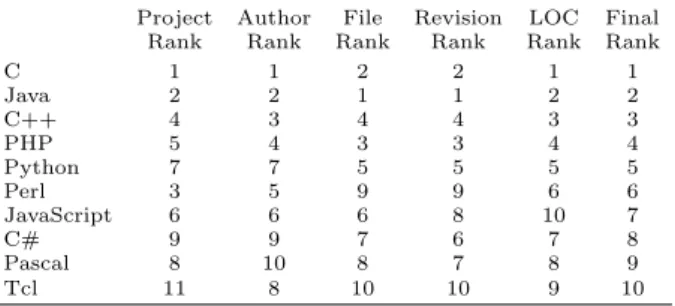
We have previously used our data set to investigate the effects of programming languages on annual programmer lines-of-code productivity. [1] As part of that research we determined the ten most popular programming languages in the seven year history of SourceForge by ranking the lan-guages by number of project, the number of authors, the number of files, the number of revisions, and the number of lines of code and then taking the average ranking as shown in Table 1.
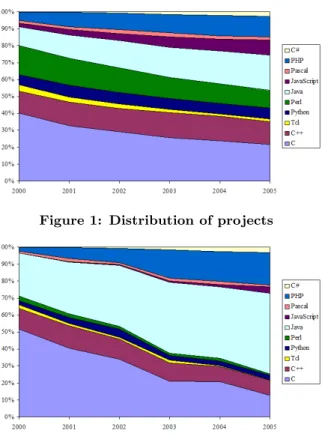
While the ordering shown in Table 1 gives the all-time pop-ularity rankings for the programming languages listed, it is reasonable to question whether the rankings have remained constant as older programming languages have fallen out of use and newer programming languages have been developed. Figures 1, 2, 3, and 4 show the changes in the distributions
Table 1: Top ten programming languages on Source-Forge by popularity rankings
Project Author File Revision LOC Final Rank Rank Rank Rank Rank Rank
C 1 1 2 2 1 1 Java 2 2 1 1 2 2 C++ 4 3 4 4 3 3 PHP 5 4 3 3 4 4 Python 7 7 5 5 5 5 Perl 3 5 9 9 6 6 JavaScript 6 6 6 8 10 7 C# 9 9 7 6 7 8 Pascal 8 10 8 7 8 9 Tcl 11 8 10 10 9 10
of projects, authors, files, and lines of code across the ten programming languages in Table 1 between 2000 and 2005. The values on the y-axis of each graph range from 0% to 100% and the height of each language’s vein in the graph above a specific year tick on the x-axis gives the percent-age of that graph’s metric belonging to the programming langauge for the year.
Many interesting trends in language popularity can be ob-served in these figures. For example, there is a strong sim-ilarity between Figure 1 and Figure 2 which confirms ob-servations made in our previous work [2] of an approximate one-to-one correspondence between projects and authors for the majority of SourceForge projects. We also observe that the percentage shares of some languages, particularly C++, Python, and Pascal, have remained approximately constant, while others, such as Java, PHP, and JavaScript are increas-ing, and still others, including C, Perl, and Tcl, are decreas-ing.
Figures 3 and 4 provide interesting langauge contrasts. For instance, the percentage of files written in C is decreasing at a much faster rate than the number of lines of code written in C, while the opposite is true for Java. This indicates that Java source files tend to contain fewer lines of code than C source files, an observation that seems reasonable given the restrictions Java places on the contents of individual files. In addition, we can see that Perl, Python, and Tcl have much smaller percentages of the files and the lines of code than they do of the projects and authors. This may reinforce the claims of adherents of these languages that their high levels of abstraction allow developers to achieve comparable levels of functionality in far fewer lines of code or it may indicate that these are niche languages which are not used at the core of large systems but rather at the peripheries.
5.
MULTIPLE LANGUAGES
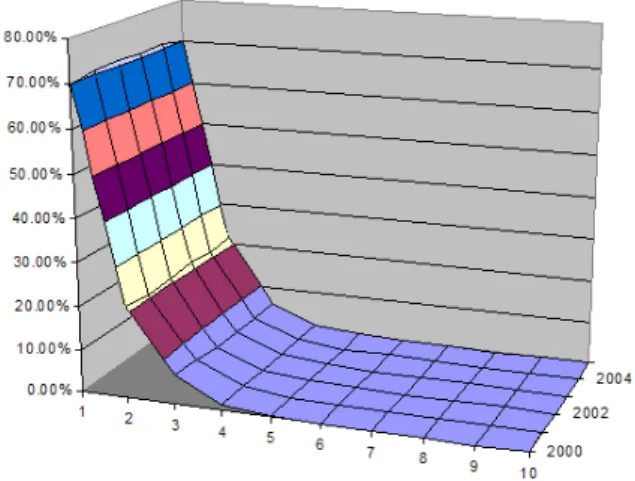
The proliferation of programming languages shown in the figures in Section 4 begs the question of who is using the new programming languages. Possible answers to this ques-tion are: 1) authors are beginning to use more languages over time, 2) new authors entering the community are using the newer languages while existing authors continue to use the older languages, or 3) existing authors are migrating to the new languages while new authors are moving into the community to take their places using the older languages. To investigate this question, we chart the distributions of programming languages used per author and per project. Figures 5 and 6 show the percentage of projects and au-thors using between one and ten of the languages listed in
Figure 1: Distribution of projects Figure 2: Distribution of authors
Figure 3: Distribution of files Figure 4: Distribution of lines of code
Table 1 between 2000 and 2005.
If it were the case that more authors were beginning to use multiple languages over time, we would expect to see a flattening of the surfaces in these graphs along the z-axis. However, the distributions in these figures are remarkably consistent with just over 65% of projects and just over 70% of authors using only a single language every year. This provides evidence that either the newer languages are be-ing used by new authors enterbe-ing the community or that existing authors are migrating to new languages and being replaced by new users entering the community and using the older languages at a comparable rate.
We do, however, see from the figures that there are signifi-cant portions of authors and projects that use two and three languages per year (approximately 25% and 10% for authors and 20% and 12% for projects). Comparing the surfaces in Figures 5 and 6 we can see that while there are slightly higher percentages of authors using one and three languages than there are projects using one and three languages, there is a slightly higher percentage of projects using two lan-guages than there are authors using two lanlan-guages. We do not expect, however, that these differences are significant.
6.
LANGUAGE PROFILES
The fact that substantial portions of the authors and projects are using two or three languages as shown in Section 5 leads us to wonder if there are certain language profiles, that is combinations of programming languages that are commonly used. Certainly, anyone familiar with software develpment is aware that there are some languages that complement each other well while there are others that do not. However, our
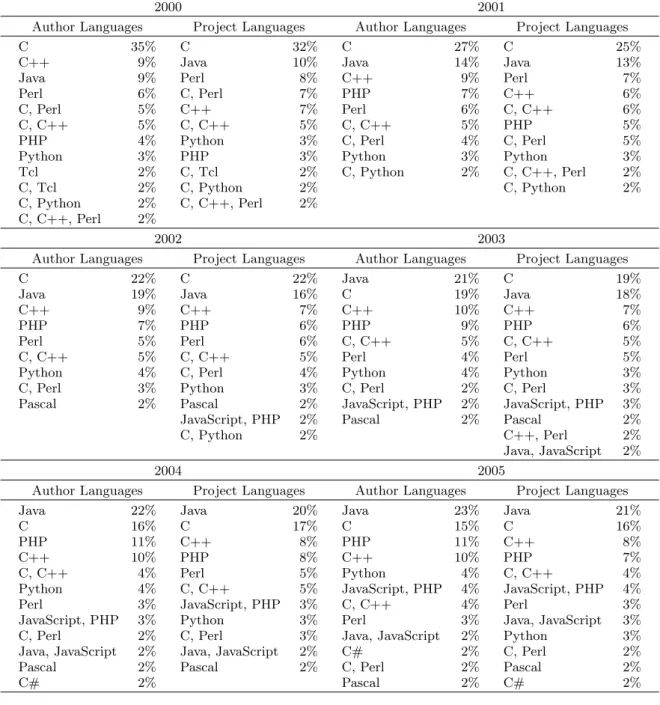
goal here is to empirically investigate not only what lan-guage profiles are in use, but how commonly they are used together compared alone. To investigate this question, Table 2 lists the most common programming language profiles for authors and projects by year along with the percentage of authors and projects that used each profile. In the interest of space and readability, all profiles that represent less than 2% of the authors or projects for a given year are excluded from the table.
As we expect based on the figures in Section 5 it is most common for programmers to use a single language. In fact, the top three most common profiles for each year between 2000 and 2005 are single language profiles. However, as the number of languages in use in the community increases we see a clear narrowing of the gap between the top profile and its nearest competitors. Through 2002, the most commonly used programming language for authors and projects is C. However, in 2003, Java becomes the most commonly used language for authors; and, in 2004, Java becomes the most commonly used language for projects.
The most common two-language profiles are C/Perl, C/C++, and JavaScript/PHP. Both the C/Perl and the C/C++ sug-gest extensions of an old but powerful imperative language to incorporate additional features not supported by the core language. C/Tcl and C/Python were also popular prior to 2003, but seem to have fallen out of use since, apparently for different reasons. It appears from the table that Python has continued to be used, but it is now used primarily on its own; while TCL has fallen out of general use among the projects in our study. The JavaScript/PHP profile is common in web development where PHP is used to provide
function-Table 2: Most common langauge profiles by year for authors and projects
2000 2001
Author Languages Project Languages Author Languages Project Languages
C 35% C 32% C 27% C 25%
C++ 9% Java 10% Java 14% Java 13%
Java 9% Perl 8% C++ 9% Perl 7%
Perl 6% C, Perl 7% PHP 7% C++ 6%
C, Perl 5% C++ 7% Perl 6% C, C++ 6%
C, C++ 5% C, C++ 5% C, C++ 5% PHP 5%
PHP 4% Python 3% C, Perl 4% C, Perl 5%
Python 3% PHP 3% Python 3% Python 3%
Tcl 2% C, Tcl 2% C, Python 2% C, C++, Perl 2%
C, Tcl 2% C, Python 2% C, Python 2%
C, Python 2% C, C++, Perl 2%
C, C++, Perl 2%
2002 2003
Author Languages Project Languages Author Languages Project Languages
C 22% C 22% Java 21% C 19%
Java 19% Java 16% C 19% Java 18%
C++ 9% C++ 7% C++ 10% C++ 7%
PHP 7% PHP 6% PHP 9% PHP 6%
Perl 5% Perl 6% C, C++ 5% C, C++ 5%
C, C++ 5% C, C++ 5% Perl 4% Perl 5%
Python 4% C, Perl 4% Python 4% Python 3%
C, Perl 3% Python 3% C, Perl 2% C, Perl 3%
Pascal 2% Pascal 2% JavaScript, PHP 2% JavaScript, PHP 3%
JavaScript, PHP 2% Pascal 2% Pascal 2%
C, Python 2% C++, Perl 2%
Java, JavaScript 2%
2004 2005
Author Languages Project Languages Author Languages Project Languages
Java 22% Java 20% Java 23% Java 21%
C 16% C 17% C 15% C 16%
PHP 11% C++ 8% PHP 11% C++ 8%
C++ 10% PHP 8% C++ 10% PHP 7%
C, C++ 4% Perl 5% Python 4% C, C++ 4%
Python 4% C, C++ 5% JavaScript, PHP 4% JavaScript, PHP 4%
Perl 3% JavaScript, PHP 3% C, C++ 4% Perl 3%
JavaScript, PHP 3% Python 3% Perl 3% Java, JavaScript 3%
C, Perl 2% C, Perl 3% Java, JavaScript 2% Python 3%
Java, JavaScript 2% Java, JavaScript 2% C# 2% C, Perl 2%
Pascal 2% Pascal 2% C, Perl 2% Pascal 2%
Figure 5: Languages per project by year Figure 6: Languages per author by year
ality and JavaScript handles the presentation. In addition, Java/JavaScript has become some what popular in recent years. This profile represents another form of web develop-ment where Java Server Pages (JSP) provide functionality instead of PHP.
The only three-language profile evident in the table is C/ C++/Perl which is a hybrid of the C/Perl and C/C++ two-language profiles. Another three-language profile which represented just under 2% of the authors and also just un-der 2% of the projects and does not appear in the table is JavaScript/PHP/Perl which is an extension of the Java-Script/PHP two-language profile.
7.
CONCLUSIONS
In this paper we have investigated the trends in program-ming language use since 2000 among the Open Source projects hosted on SourceForge. While our sample size is substantial, consisting of data gathered from almost 10,000 projects, it is important to remember that this is an observational study. As such, generalization to the larger population of all Open Source projects is not necessarily appropriate. However, these results can be used to suggest additional studies to investigate further the patterns we have observed here and to provide compelling evidence of generalizable trends in the absence of additional contradictory results.
In observing the trends in language popularity over time, we have seen that the web development languages, like Java, JavaScript, and PHP are increasing in popularity; the script-ing languages, like Python, Perl, and Tcl, are remainscript-ing small but consistent in their popularity; and the traditional desktop development languages, C and C++ are declining in popularity.
Our investigation of the use of multiple programming lan-guages by individual authors and in individual projects re-vealed that the percentages of authors and projects using one, two, and three languages remained approximately con-stant from 2000 to 2005 with a little over two thirds using one langauge, a little under a quarter using two languages, and roughly one tenth using three languages.
Further evaluating the most common language profiles we found that the three most popular profiles each year were single language profiles. We also found that the common two-language profiles were web development profiles, like JavaScript/PHP and Java/JavaScript, and classical language extension profiles, like C/C++ and C/Perl.
Each of these results suggests additional studies. For ex-ample, would these results hold if we studied Open Source projects hosted on another systems, such as RubyForge or Tigris, or if we studied commercial or governmental soft-ware development organizations? Also, what new language profiles are beginning to evolve and is it possible to predict which languages will be or ought to be used in combination?
8.
REFERENCES
[1] D. Delorey, C. Knutson, and S. Chun. Do programming languages affect productivity? a case study using data from open source projects. InProceedings of the First International Workshop on Emergin Trends in FLOSS Research and Development, May 21, 2007.
[2] D. Delorey, C. Knutson, and A. MacLean. A comprehensive evaluation of production phases
sourceforge projects: A case study using cvs2mysql and the sourceforge research archive, 2007.
[3] G. Goth. News: Not in the script–news of java’s demise is premature.IEEE Distributed Systems Online, 7(2):4, 2006.
[4] G. Madey. Sourceforge research data archive. http://www.nd.edu/˜oss/Data/data.html, 2005.
[5] S. J. Nielson and C. D. Knutson. Design dysphasia and the pattern maintenance cycle.Information and Software Technology, 48(8):660–675, 2006/8.
[6] L. Paulson. Developers Shift to Dynamic Programming Languages.Computer, 40(2):12–15, 2007.
[7] E. Sapir.Language: An Introduction to the Study of Speech. Harcourt, Brace, New York, 1921.
[8] T. Software. Tiobe programming community index. http://www.tiobe.com/tpci.htm, 2007.