Hospital Guide to Reducing
Medicaid Readmissions
Table of Contents
Introduction to the Tools ... 1
Tool 1: Readmission Data Analysis... 5
Tool 2: Readmission Review ... 6
Tool 3: Data Analysis Synthesis Tool ... 9
Tool 4: Hospital Inventory Tool ... 13
Tool 5: Cross-Continuum Team Inventory Tool ... 14
Tool 6: Conditions of Participation Checklist Tool ... 16
Tool 7: Portfolio Design ... 17
Tool 8: Readmission Reduction Impact and Financial Analysis Tool ... 20
Tool 9: Readmission Risk ... 22
Tool 10: Whole-Person Assessment ... 24
Tool 11: Discharge Information Checklist ... 28
Tool 12: Forming a Cross-Continuum Team ... 29
Hospital Guide to Reducing Medicaid
Readmissions
Introduction to the Tools
This package of tools accompanies the Hospital Guide to Reducing Medicaid Readmissions, which offers indepth information about the unique factors driving Medicaid readmissions and a step-by-step process for designing a locally relevant portfolio of strategies to reduce Medicaid readmissions. Some of the tools are adaptations of best-practice approaches to make them more relevant to the Medicaid population; many tools were newly developed through this project. This introduction offers an overview of the tools available in the package by briefly describing what they contain, who should use them, and how much time they take to use.
Tools in Section 1: Know Your Data
Knowing where to start in reducing Medicaid readmissions, including whether your team needs to adapt or expand your efforts to best serve Medicaid patients, requires you to understand your hospital’s current readmission patterns. These tools will assist you in collecting quantitative and qualitative data on your hospital patients and interpreting those data.
Section 1 Tools Description Staff Time Required
Tool 1
Data Analysis Tool This tool is a 10-point analysis of data to facilitate a compare and contrast view of readmissions by payer to identify differences between Medicare, Medicaid, commercial, and all-payer rates.
Data analyst, business analyst, staff able to run administrative data
4-6 hours
Tool 2 Readmission Review Tool
Adapted from the STAAR* approach, this one-page interview guide prompts clinical or quality staff to elicit the patient, caregiver, and provider perspective about the causes of readmissions. Quality improvement, nursing, case management staff 30 minutes/ review; 10-20 interviews suggested to start Tool 3 Data Analysis Synthesis Tool
This template is used to create a narrative to describe the results from the quantitative data and readmission interviews.
Quality improvement
staff 2 hours*
Tools in Section 2: Inventory Readmission Reduction Efforts
Before planning how to address Medicaid readmissions, it helps to understand what is currently being done to improve care transitions, increase patient education, and reduce readmissions, as well as other interrelated improvement efforts across a complex organization. The tools in Section 2 will help you take inventory of your hospital’s readmission reduction efforts across departments, assess your current discharge process, and inventory the resources and supports your community partners offer that can help reduce avoidable readmissions. By gathering all this information in one place, your team can evaluate how well these efforts align with your Medicaid patients’ needs, what redundancies can be streamlined, and what gaps still need to be addressed.
Section 2 Tools Description Staff Time Required
Tool 4
Hospital Inventory Tool
This tool prompts a comprehensive inventory of readmission reduction activity across departments, service lines, and units within the hospital.
Quality improvement, readmission reduction team members 2-4 hours Tool 5 Cross-Continuum Team Inventory Tool
This tool prompts a comprehensive inventory of community-based providers and agencies that provide services helpful in the postdischarge settings. Quality improvement leadership, cross-continuum team 4-5 hours Tool 6 Conditions of Participation Checklist Tool
This one-page tool, adapted from the CMS Conditions of Participation surveyor guidance, prompts
consideration of whether a set of standardized improvements are being provided to all patients, regardless of “risk.”
Quality improvement, nursing, case
management staff
2 hours
Tools in Section 3: Develop a Portfolio of Strategies
Section 3 of the guide walks through the process of developing a portfolio of strategies to reduce Medicaid readmissions, including how to specify your objective and aims, select the most effective set of strategies, and quantify the expected impact of those strategies. The tools in Section 3 assist with designing a portfolio, as well as calculating the financial and clinical impact of your readmission reduction strategies.
Section 3 Tools Description Staff Time Required
Tool 7
Portfolio Design Tool
This tool prompts readmission reduction teams to expand readmission reduction efforts to include action in at least three broad domains: improve standard care for Medicaid patients, collaborate with partners, and provide enhanced services for high-risk patients.
Readmission reduction champion, readmission team
Section 3 Tools Description Staff Time Required Tool 8 Readmission Reduction Impact and Financial Analysis Tool
This Excel sheet helps you model the impact of the strategies in your hospital’s readmission reduction portfolio. It prompts teams to quantify which patients will be served by each strategy, what their baseline readmission rate is, and what the projected readmission reduction will be. It also helps estimate the avoided utilization (payer cost) due to each of the strategies, accounts for the investment cost of the intervention (in tools, staff, time), and calculates net “savings” (to payers).
Quality improvement leadership, business analyst
2-4 hours
Tools in Section 4: Improve Hospital-Based Transitional Care Processes for
Medicaid Patients
There are many best practice recommendations from such packages as BOOST, STAAR, and RED.i
Section 4 of the guide discusses how to adapt these best practices to best serve Medicaid patients’ needs. This section offers three new tools pertinent to Medicaid readmissions: a readmission risk tool, a whole-person assessment tool that takes into account social determinants of health, and a checklist of information that should be communicated between providers, based on the Centers for Medicare & Medicaid Services (CMS) Conditions of Participation.
Section 4 Tools Description Staff Time Required
Tool 9
Readmission Risk Tool
This tool is an educational and awareness-building tool for frontline staff, cross-continuum teams, and quality improvement leadership to quickly review the many factors that lead to risk of readmission. It highlights the fact that narrow targeting strategies will miss most readmission risks. Hospitalists, nursing, case management, cross-continuum teams Quick review and discussion at meeting; post in workrooms Tool 10 Whole-Person Assessment Tool
This tool provides a checklist to prompt frontline staff to identify and address basic needs.
Frontline staff in the hospital, including social workers, case managers, etc. 20 minutes to assess; conduct at least 24 hours before discharge for sufficient time to act on information and make referrals Tool11 Discharge Information Checklist
This tool, adapted from the CMS Conditions of Participation, provides a checklist of information that needs to be provided to patients and their receiving providers at the time of transition.
Quality improvement, nursing, case
managers, hospitalists
N/A; tool used for informing how to convene this team of variable size
Tools in Section 5: Collaborate With Cross-Setting Partners
Forming partnerships with “receiving” providers—clinical and social—not only helps ensure that the clinical and transitional care hospitals provide is more likely to succeed in the posthospital setting, but also extends and deepens the resources and services available to patients. The tools in Section 5 provide a template for identifying community resources and offer concrete assistance with assembling and developing a cross-continuum team.
Section 5 Tools Description Staff Time Required
Tool 12 Cross-Continuum Team How To Tool
This tool explains the benefits and process of building a cross-continuum team and offers a template and sample workplan for inviting partners to join.
Quality improvement leadership, cross-continuum team
N/A; tool used for informing how to convene this team of variable size Tool 13 Community Resource Guide Tool
This tool is modeled on a community resource guide developed by a community-based Medicaid care management agency. It prompts the hospital readmission reduction team to identify specific contacts at community agencies to facilitate efficient referrals to services.
Hospital readmission team, cross-continuum team
10 hours
Section 6: Provide Enhanced Services for High-Risk Patients
This section of the guide does not offer any tools, but it does offer many examples of current best practices in addressing the most high-risk patients with enhanced services. Refer to the guide itself for examples of different types of enhanced services and guidance on how these services are financed.
Tool 1: Readmission Data Analysis
Use the most recent 12 months of data available, calendar or fiscal year. Identify readmissions as any return to the inpatient setting for any reason within 30 days of discharge from the inpatient setting. This analysis is for nonobstetric, nonpediatric, adult medical/surgical/behavioral health patients. Exclude discharges that are coded as deaths or transfers to another acute care hospital.
Data Element Medicare Medicaid Self-Pay PayerAll
1. Total number of discharges alive (exclude transfers, deceased, <18yrs, obstetric)
2. Total number of individual patients 3. Total number of 30-day readmissions 4. Overall readmission rate (#3/#1) 5. Discharge disposition (from #1): a. Home (no home health) (#, %) b. Home with home health (#, %) c. Skilled nursing facility (#, %)
6. Average number of days between discharge and readmission for all readmissions, days 0-30 (or #, % of readmissions within 0-6, 7-14, 15-30 days, respectively)
7. Top 10 discharge diagnoses resulting in readmission (based on index DRG) a. List top 10 diagnoses
b. Report number of readmissions per diagnosis c. Report readmission rate per diagnosis (readmissions for diagnosis/discharges for diagnosis)
8. Top 10 readmission discharge diagnoses (based on readmission discharge DRG)
a. List top 10 diagnoses
b. Report number of readmissions per diagnosis c. Report % of all readmissions accounted for by each top 10 readmission diagnosis
9. Proportion of top 10 readmission diagnoses as a percentage of all readmissions (sum of readmissions in top 10/total readmissions)
10. High-utilizing population (H.U.)
a. Number of people hospitalized three or more times in past 12 months (H.U.)
b. Number of hospitalizations among H.U. c. Discharge disposition of H.U. (home, home
health, skilled nursing facility)
Tool 2: Readmission Review
Ask your patients, their caregivers, and providers “why?”
While it is important to have a good understanding of your organization’s quantitative readmission data, these data do not help you understand the kinds of barriers patients, families, and providers face during the posthospital transitional care period or the circumstances leading patients to return to the hospital soon after discharge. Adapting from a popular approach from the Institute for Healthcare Improvement’s State Action on Avoidable Rehospitalizations (STAAR) Initiative (www.ihi.org/ staar), we recommend your readmission team conduct 5-10 “readmission interviews.”
Important note: These reviews are designed to elicit the “story behind the story”: going well beyond chief complaint, discharge diagnosis, or other clinical parameters to understand the
communication, coordination, or other logistical barriers experienced in the days after discharge that resulted in a readmission.
Some teams may be concerned that patient interviews will be time consuming. You can address time constraints by using a simple framing script at the beginning of the interview (see next page). Readmission teams uniformly report that these reviews yield valuable information that would otherwise be difficult to obtain from charts or data.
While we provide a script, the most important principle of conducting these interviews is to give patients, family members, and providers an opportunity to provide detail about why they/their loved one/their patient had to return to the hospital. This critical information can help prevent further readmissions. The scripts include prompts designed to elicit the stories from the individuals. The readmissions review has three main parts:
■ Brief chart review of the first admission and the readmission. ■ Patient/family caregiver interview.
■ Provider interview.
Drawing on an innovation to the readmission interview developed by Feigenbaum and colleagues at Kaiser Permanente, we recommend capturing all the reasons patients, caregivers, and/or providers cite that factored into the readmission event. As Feigenbaum and team discovered, an average of 9 factors spanning the domains of hospital-care, predischarge preparation, the discharge process, and posthospital period contributed to each potentially preventable readmission they reviewed.
Implementation tip: these interviews should take no more than 40 minutes each. It is often easiest to find one or two patients currently in your care who were recently readmitted and interview them. Remember to call the relevant cross-continuum partners (physician, home health nurse, discharging physician, community-based case worker, mental health provider, etc.) to get their perspective.
Section 1: Brief chart review (10-15 minutes)
Elicit the following basic information: ■ Date of first admission
■ Date of first discharge
■ Active medical issues during first hospitalization ■ Discharge disposition
■ Comments on first transitional care plan (i.e., whether teaching/written instructions given/ referrals made/ appointments scheduled)
■ Date of readmission
■ Number of days between discharge and readmission
■ Site of care readmitted from (home, skilled nursing facility, etc.) ■ Readmission chief complaint, as recorded in the chart
■ Active medical issues during the second hospitalization ■ Discharge disposition (if they are no longer in the hospital)
■ Comments on documented transitional care plan (was anything done differently?)
Section 2: Patient/family caregiver interview (10-15 minutes)
(Suggested script: “We are working to improve the discharge process and noticed that you have been in the hospital twice recently. I’d like to ask you for about 10 minutes of your time to give us some feedback about what happened between the time you were discharged and the time you returned to the hospital. This will help us understand what we might be able to do better for you and what we might be able to do better for our patients in general. Would that be o.k. with you?”)
■ What brought you to the hospital the first time? [insert reference to date of first hospitalization]
■ Did you think the doctors, nurses, and other staff helped you get ready to leave the hospital? ■ Did you understand what the plan was for your care when you left the hospital?
■ Did you receive information about whom to call if you had questions or problems? ■ Tell me about anything that was unclear or confusing for you when you left the hospital. ■ I see you went to (discharge disposition). How did it go once you got there?
■ Did any new symptoms or issues come up after you were discharged?
■ Did you see a doctor, nurse, or other provider after you were discharged? Who? ■ Why do you think you needed to come back to the hospital?
■ Was there anything that could have been done differently [so you didn’t develop that symptom or issue]?
Section 3: Provider interview (3-5 minutes)
(Suggested script: We are working to improve care transitions and reduce avoidable readmissions. One of your patients was recently readmitted to our hospital and we’d like to ask for your thoughts on how we can improve our transitional care processes. It will take no more than 5 minutes of your time.)
■ Did you know [insert patient name] was admitted on (first hospital date)? ■ Did you know the patient was discharged to (setting) on (date)?
■ Did our hospital contact you at all about the admission or discharge plan? If so, describe the interaction or information you received.
■ Did the patient contact you after discharge with questions or issues, or for followup? ■ Did you have contact with the patient after discharge? If so, were there points of confusion
about the plan, symptoms, or other issues we should be aware of? ■ Why do you think the patient ended up being readmitted?
■ Do you think there was anything that could have been done for this patient or others like him/ her (socially or clinically) to prevent readmissions?
Tool 3: Data Analysis Synthesis Tool
[Hospital Name] Readmission Analysis
General SummaryFrom [month, year] to [month, year], there were [#] total adult, nonobstetric discharges from [Hospital Name], excluding those who were discharged deceased or transferred to another acute care hospital. Of this total, there were [#] Medicare discharges (% of total), [#] Medicaid discharges (% of total), [#] commercial discharges (% of total), and [#] uninsured/self-pay discharges (% of total).
There were [#] 30-day readmissions. This yields an all-payer, all-0cause 30-day readmission rate for [Hospital Name] of #%. The Medicaid readmission rate is #%, the Medicare readmission rate is #%, and the uninsured readmission rate is #%. Note, the [payer, likely Medicaid] population has the highest 30-day readmission rate of all payer-defined subgroups. Of all of the readmissions at Hospital Name, #% (n=#) were Medicaid readmissions; #% (n=#) were Medicare readmissions; and #% (n=#) readmissions were among uninsured patients.
Table 1. Adult (nonobstetric) discharges and readmissions by Medicare and Medicaid
Payer
#
Discharges Discharges)% (#/Total Readmissions# 30-Day Readmissions)% (#/Total
Readmission Rate (#Readm/ #Discharges) All patients 100 100 Medicare Medicaid (adult, nonobstetric)
Number of days between discharge and readmission
Of all readmissions, % (n=#) of all readmissions occurred within 4 days of discharge; and #% (n=#) occurred within 10 days of discharge. This suggests [enter observation about the timing of posthospital followup and services].
Discharge disposition
# (%) of Medicaid patients were discharged to home; # (%) were discharged to home health care, and # (%) were discharged to SNF. In contrast, # (%) of Medicare patients were discharged to home, # (%) were discharged to home health care, and # (%) were discharged to SNF.
Table 2. Distribution of discharge disposition by Medicare and Medicaid
Measure Medicare Medicaid
Discharge to home Discharge to home health Discharge to skilled nursing facility
Top diagnoses associated with readmissions
The diagnoses associated with the highest numbers of readmissions include: Diagnosis 1 (#), Diagnosis 2 (#); Diagnosis 3 (#); Diagnosis 4 (#); … and Diagnosis 10 (#). Together, the top 10 diagnoses account for a total of # readmissions, #% of total readmissions. The top 10 readmission diagnoses by payer are listed below. Notable similarities include [list similar diagnoses here]; notable differences include [list differences here]. Chronic conditions, such as [heart failure, heart disease, diabetes, list] make up (#) on this list. Acute conditions, such as [sepsis, urinary tract infection, gastroenteritis, list] make up (#) on this list. Complications make up (#) on this list. There are (#) behavioral health-related diagnoses.
Table 3. Top discharge diagnoses resulting in readmission
Medicare Medicaid 1. 1. 2. 2. 3. 3. 4. 4. 5. 5. 6. 6. 7. 7. 8. 8. 9. 9. 10. 10.
The top 10 diagnoses leading to readmissions accounted for (x%) of all Medicare readmissions and (y%) of all Medicaid readmissions. This suggests that [a small percentage of all readmissions are identified by relying only on primary diagnoses].
High-utilizing population
There were # people hospitalized three or more times at our hospital in the past 12 months. These # people used # hospitalizations, which is an average of # per person. There were # readmissions, yielding a readmission rate of #%. Among the high-utilizing population, #% were discharged to home without services, #% were discharged to home health, and #% were discharged to a skilled nursing facility. [Make observation about diagnoses, whether similar or different than overall readmission population].
Table 4: High utilizers
# People # Hospitalizations
People hospitalized 3 times People hospitalized 4 times People hospitalized 5 times People hospitalized 6 times People hospitalized 7 times Continue until max
Total Total # people Total# hospitalizations
Average hospitalizations/person (# hospitalizations/# people)
Readmission interview findings
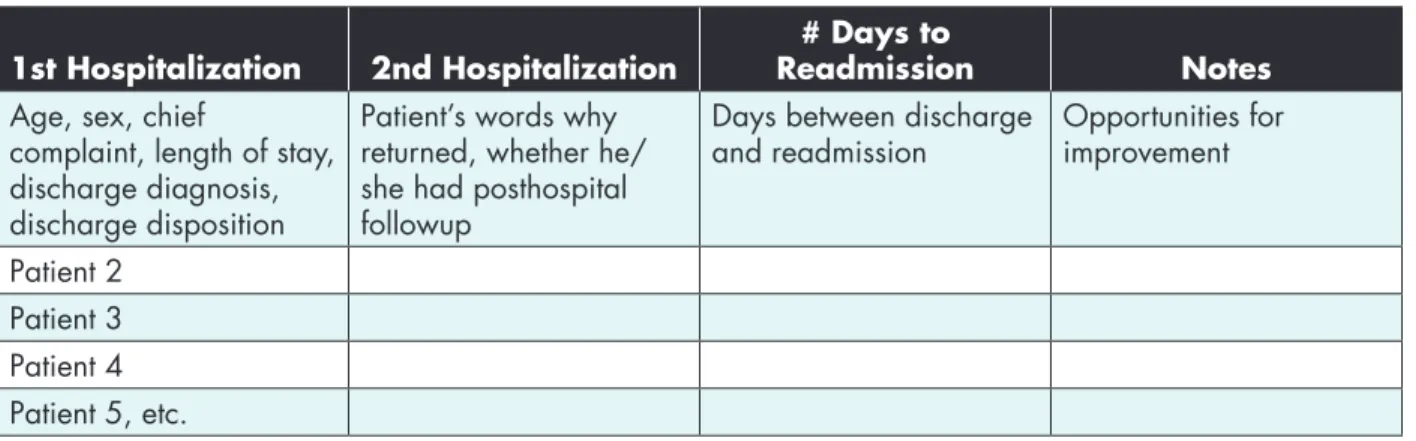
To supplement the insights derived from data analyses, we interviewed # recently readmitted Medicaid patients. The table provides a summary of the patients’ readmission circumstances. Table 5. Summary of readmission interviews
1st Hospitalization 2nd Hospitalization Readmission# Days to Notes Age, sex, chief
complaint, length of stay, discharge diagnosis, discharge disposition
Patient’s words why returned, whether he/ she had posthospital followup
Days between discharge
and readmission Opportunities for improvement Patient 2
Patient 3 Patient 4 Patient 5, etc.
Summary of patient perspectives about being readmitted:
[Summarize what patients said about why they returned to the hospital, whether it is disappointing/ reassuring to them, whether this represents “good” care or not, whether they felt rushed, confused, had questions after discharge, whether their doctor told them to return, etc.]
Analysis of patients’ perspectives about being readmitted: What do the patient comments suggest about:
■ The discharge process, including timing and perceived readiness? ■ The educational or written materials?
■ Whether “whole-person” needs are being identified?
■ Whether referrals for supports and followup are being made before discharge? ■ Whether there is any collaboration with postacute or community providers?
■ Whether patients view readmissions as “bad” or “o.k.”? What does that suggest for our efforts to educate patients, caregivers, and the public about effective transitions in care?
Summary of family/caregiver perspectives about being readmitted:
[Summarize the family/caregiver perspectives about returning to the hospital. You may note that often family/caregivers are more able/willing to offer criticism.]
Analysis of family/caregiver perspectives about being readmitted: [What did you learn from this feedback that can inform improvement activities?] Summary of providers’ perspectives about readmitted patients:
[Summarize what providers said about readmitted patients, including whether the provider knew the patient had been readmitted, whether the provider had any insights about what could have avoided a readmission, and whether the provider had any suggestions for general improvement.]
Analysis of provider feedback:
What does the provider feedback suggest about:
■ Whether providers know when their patient is readmitted? ■ Whether providers view readmissions as potentially preventable? ■ Whether provider education or engagement is warranted?
Tool 4: Hospital Inventory Tool
It is likely that several complementary readmission‐reduction activities are underway at your hospital. As you embark on an effort to adapt and expand your readmission reduction efforts to the Medicaid population, it is helpful to inventory all the existing efforts at your hospital, across departments and service lines and among independent investigators (if applicable). An updated inventory of readmission reduction efforts may identify opportunities to align with or extend your Medicaid-specific efforts with other related efforts within your institution. This may help your team gain efficiency, obtain buy-in, and reduce redundancy or confusion among staff and patients.
Department/Service Line Initiative/Improvement Point Person Executive Team (CEO, CFO, etc.)
Case Management Quality Nursing Social Work Hospital Medicine Emergency Department Medical Specialties (Cardio, Neuro, etc.)
Psychiatry
Surgical Services (Ortho, General, Cardiothoracic, etc.) Palliative Care
Pharmacy/Pharmacists
Patient Family Advisory Councils Finance, Managed Care/ Contracting
Informatics, IT
Research/Grants/Special Projects Volunteer Services
Tool 5: Cross-Continuum Team Inventory Tool
Forming and using a cross-continuum team is essential to meeting the innumerable posthospital needs of your diverse patient population. Partnering with postacute and community-based providers and agencies is a key part of optimizing the transition out of the hospital and into the next setting of care. Many hospitals have initiated cross-continuum teams composed primarily of postacute partners; additional partners will be needed to best meet the posthospital needs of adult Medicaid patients. Use this tool to identify which cross-continuum partners you currently engage in readmission reduction efforts and to identify additional partners to engage. As you complete this tool, capture services available and obtain a contact name.
Cross-Setting Provider or Agency Ongoing ServicesPosthospital or Point Person/ Email/Phone Adult day health
Adult protective services Agencies on aging
Aging and disability resource centers Behavioral health providers, crisis teams Behavioral health carve-out providers
Community health centers, federally qualified health center
Community based social workers Community corrections system Economic/financial counseling High-volume Medicaid medical homes High-volume Medicaid pharmacies Housing advocates and homeless services Legal aid
Medicaid agency (state) contact Medicaid managed care organizations Substance abuse treatment providers Skilled nursing facilities
Home health agencies Hospice
Pain clinic
Physician practices Public health nurses
Long-term acute care hospitals
Cross-Setting Provider or Agency Ongoing ServicesPosthospital or Point Person/ Email/Phone Inpatient rehabilitation facilities
Assisted living facilities Housing with services Faith-based organizations Transportation
Durable medical equipment
Pharmacists with bedside delivery, services Congestive heart failure clinic
Other Other Other
Tool 6: Conditions of Participation Checklist Tool*
Do you… Details
❏Have written procedures for
transitional care planning that apply to all inpatients?
• Do you identify patients in need of transitional care planning early during the hospitalization?
• Do you identify which staff are responsible for carrying out the evaluation to identify patients likely to need transitional care planning?
❏Use an evidence-based
method for SCREENING patients for transitional care planning needs?
• If you do not develop a transitional care plan for every inpatient, do you screen all inpatients to determine which ones are high risk for adverse consequences, including readmission, if there is no adequate transitional care planning?
❏Provide a transitional care
planning EVALUATION upon request by the patient, or patient’s family/informal caregiver(s), or the patient’s physician?
• Does the evaluation address: (1) the likelihood of a patient needing posthospital services and the availability of the services; (2) the likelihood of a patient’s capacity for self-care or being cared for in the environment from which he or she entered the hospital; and (3) coordination with insurers and other payers to ensure resources prescribed are approved and available?
• Is the evaluation completed early—prior to discharge—to allow services to be arranged?
❏Engage the patient and
the patient’s caregiver(s) in creating the discharge plan?
• Do you discuss the evaluation and customized discharge plan with the patient?
• Do you discuss the results of the evaluation, i.e., the need for and availability of posthospital care, with the patient and/or caregiver?
❏Know the capabilities of
postacute and community providers, including support services?
• Are you knowledgeable about the specific care capabilities of long-term care facilities and community-based services, including home health, behavioral health, transitional care, and housing, and social supports particularly relevant to the Medicaid population?
❏Arrange for posthospital
services prior to discharge and effectively communicate with “receiving” providers?
• Do you not just refer—but arrange for—followup appointments? • Do you nor just refer—but arrange for—durable medical equipment to
be secured?
• Do you not just refer—but arrange for—posthospital services and supports?
• Do you communicate—allowing for questions and clarification—with receiving providers?
❏Routinely reassess patients for
their transitional care needs? • Do you have in place a routine reassessment of all patients or a process for triggering a reassessment of the patient’s transitional care
needs when significant changes in the patient’s condition or available supports occur?
❏Teach patients and their
families self-care skills using the teach-back technique?
• Is the education and training provided to the patient or patient’s caregiver(s) tailored to the patient?
• Is teach-back used to confirm understanding of medication, appointments, self-management tasks, and other followup activities?
❏Analyze and trend
readmission data and look for root causes?
• Do you reassess the effectiveness of your discharge planning process on an ongoing basis? Does it include a review of discharge plans to ensure that they are responsive to discharge needs?
• Do you track readmissions to your own hospital on an ongoing basis (i.e., at least quarterly) and identify opportunities for continual improvement?*
Tool 7: Portfolio Design
Drawing on the information gathered from your data analyses, readmission interviews, and hospital‐ specific and communitywide inventory of readmission reduction efforts, categorize the current individual actions into strategic themes (drivers of reducing Medicaid readmissions). The diagram below displays one approach to categorizing these different strategic themes. More information on the readmission reduction efforts in each strategic theme can be found in the guide (Sections 4, 5, and 6 correspond to the categories illustrated below).
Develop a Portfolio of Strategies
Improve Hospital-Based Transitional Care Processes for Medicaid Patients
Flag discharge <30d in chart ED-based efforts to treat & return Broaden view of readmission risks; assess “whole-person” needs Develop transitional care plans that consider needs over 30 days Ask patient & support persons what help they need; share with them their needs/risk assessment
Use teach-back, target the appropriate “learner” Customize information
Arrange for posthospital followup Use a checklist for all patients
Use ADT notifications with medical and behavioral health providers Ask community providers what they need and who they want to receive it Collaborate to arrange timely followup
Perform “warm” handoffs and opportunity for clarification Form a cross-continuum team that can access resources your staff are unaware of
Constantly refresh your awareness of social and behavioral health resources
Broaden partners to include Medicaid health plans and their care managers Identify community partners with social work and behavioral health competencies
Segment “high risk”—varying types of service & levels of intensity Strategy for high utilizers Strategy for navigating care Strategy for accessing resources Strategy for self-management Strategy for frailty/medically complex
Strategy for end-of-life trajectory Strategy for recurrent stable symptoms, etc., individual care plans
Collaborate With Cross-Setting Partners
Provide Enhanced Services for High-Risk Patients
Instructions
Use the table that follows to prompt a consideration of which readmission practices are in place at your hospital, including which are standard care for all patients versus just care for patients identified as high risk of readmission. Identify which practices should be added to expand your hospital’s strategy.
Readmission reduction effort Implemented Need To Add
Improve Hospital-Based T
ransitional Care Processes for
Medicaid Patients
Flag patients who were recently discharged <30d in chart/electronic medical record Work in the emergency department to treat and avoid readmission
Broaden view of readmission risks; assess “whole‐person” needs
Develop transitional care plans that consider needs over 30 days
Ask patients and caregivers why they returned, if readmitted
Ask patients and caregivers what help they need
Use teach-back; target the appropriate “learner”
Customize information, and share information about readmission risk Arrange posthospital followup
Use a checklist to reliably deliver complete transitional care for all patients
Collaborate W
ith Cross-Setting Par
tners
Use admission, discharge, and transfer notifications with medical and behavioral health providers
Ask community providers what information they need to assume care of patient Collaborate with community providers to arrange timely followup
Perform “warm” handoffs, providing an opportunity for clarification
Form a cross-continuum team that can collaborate on care across settings Update staff awareness of social and behavioral health services and supports Broaden partners to include Medicaid health plans and their care managers Identify community partners with social work and behavioral health competencies
Readmission reduction effort Implemented Need To Add
Provide Enhanced Ser
vices for High-Risk Patients
Segment “high-risk” patient needs—varying types of service and levels of intensity Provide enhanced multidisciplinary care team for high utilizers
Provide short-term social work-based transitional care to reduce barriers to navigating and connecting to existing resources in the community
Connect Medicaid managed care patients to care management services
Connect behavioral health patients to integrated care managers
Provide urgent care to populations with recurrent exacerbations (e.g. sickle cell, COPD)
Increase appropriate referral to palliative care and hospice
Develop cross-provider, cross setting individual care plans
ool
BASIC DA TA Total Medicare Medicaid Source of DataNumber of (non-OB, adult) discharges, past year (#)
5,000
2,000
750
Input your data
Number of (non-OB, adult) readmissions, past year (#)
625
360
150
Input your data
(non-OB, adult) readmission rate (calculation)
12.5%
18.0%
20.0%
Calculate: B/A
A
verage cost (reimbursement) per (non--OB, adult) admission ($)
$8,500
$10,000
$6,500
your data
Total cost of readmissions, past year (calculation)
$5,312,500
$3,600,000
$975,000
Calculate: BxD
ACT OF READMISSION REDUCTION STRA
TEGIE(S)
ove Standard Hospital Based Care for All
Target population strategy 1 will ser
ve (#)
ALL
ALL
ALL
Based on your strategy
Number of admissions strategy 1 will ser
ve (#)
5,000
2,000
750
Input your data
Readmission rate among target population (%)
12.5%
18.0%
20.0%
Input your data
Readmissions among target population (calculation)
625
360
150
Calculate: HxI
Estimated impact of strategy 1 in reducing readmissions (%)
10%
10%
10%
Based on your estimation
Number of readmissions aver
ted (calculation)
63
36
15
Calculate: JxK
Estimated savings of strategy 1 ($, calculation)
$531,250
$360,000
$97,500
Calculate: LxD
vice suppor
t for high utilizers
Target population strategy 2 will ser
ve (#
250
175
75
Based on your strategy
Number of admissions strategy 2 will ser
ve (#)
850
490
360
Input your data
Readmission rate among target population (%)
30%
30%
30%
Input your data
Readmissions among target population (#, calculation)
255
147
108
Calculate: OxP
Estimated impact of strategy 2 in reducing readmissions (%)
30%
30%
30%
Based on your estimation
Number of readmissions aver
ted (calculation)
77
44
32
Calculate: QxR
Estimated savings strategy 2 ($, calculation)
$650,250 $441,000 $210,600 Calculate: SxD continued Page 1 of 2
BASIC DA TA Total Medicare Medicaid Source of Data AL STRA TEGY IMP ACT
Total estimated readmissions avoided of strategies 1 + 2 (calculation)
139
80
47
Calculate: L+S
Readmission rate after strategies 1+2 implemented (calculation)
9.7%
14.0%
13.7%
Calculate: (B-U)/A
Total estimated savings of strategies 1+2
$1,181,500
$801,000
$308,100
Calculate: M+T
TEGIES
Estimated cost of implementing strategy 1
$100,000
$50,000
$50,000
Based on your budget
Estimated cost of implementing strategy 2
$200,000
$140,000
$60,000
Based on your budget
Total cost of implementing strategies 1+2
$300,000
$190,000
$110,000
Calculate: X+Y
VINGS & READMISSION REDUCTION
Net savings (to payers)
$881,500
$611,000
$198,100
Calculate: W
-Z
Total readmission reduction
22%
22%
32%
Calculate: U/B
Tool 9: Readmission Risk
The following is a list of factors that can lead a patient to be at risk of readmission. You can use this checklist as a teaching tool to raise awareness among clinicians and staff, as well as with patients and families. Based on your readmission interviews or hospital and community-specific readmission analyses, you may add factors that are prevalent among your patient population. Do not use this checklist to “score” readmission risk: these are all individual risks or needs that should be addressed or mitigated as part of a plan to minimize readmission risk. When patients are viewed from this lens, staff may start to see that most patients are at risk of readmission.
Demographic
❏ Medicaid adult 18-64 ❏ Medicare fee for service ❏ Single
❏ Zip Code (e.g., “hot spot,” close to hospital, rural, urban, etc.) ❏ Lack regular source of care
❏ Prior ED visits and/or hospitalization in past month ❏ Race, ethnicity, and language
Functional
❏ Frailty
❏ Limitations in ADLs (activities of daily living)
❏ Limitations in IADLs (instrumental activities of daily living) ❏ Cognitive impairment/poor executive function
❏ Poor literacy ❏ Poor numeracy ❏ Poor health literacy ❏ Low self-efficacy
❏ Discharge to skilled nursing facility, regardless of diagnoses ❏ Discharge to home health care, regardless of diagnoses
Clinical
❏ Dementia ❏ Delirium
❏ Behavioral health diagnoses ❏ Active substance use
❏ Chronic condition ❏ Acute illness ❏ New diagnosis ❏ New medication ❏ High-risk medication ❏ Complex conditions ❏ Numerous conditions ❏ Numerous medications ❏ Recurrent, known symptoms ❏ End-of-life trajectory
Social
❏ Unaddressed goals of care preferences ❏ Lack social support
❏ Low income
❏ Homeless or marginally housed ❏ Lack reliable transportation ❏ Newly insured
❏ Do not have a history of seeking care in ambulatory setting/primary care provider ❏ Environmental or occupational triggers
Tool 10: Whole-Person Assessment
Readmissions rarely result from a singular breakdown in the transition of care and posthospital supports. A team at Kaiser Permanente in Northern California reviewed more than 500 adult readmissions (all payer, all ages) from across 18 of their hospitals. Using the readmission interview technique from the State Action on Avoidable Rehospitalizations (STAAR) Initiative (modified in this guide), they interviewed 234 primary care providers, 111 specialists, 166 hospitalists, 14 skilled nursing facility physicians, and 390 patients and caregivers. Among 250 readmissions they deemed to be potentially avoidable, there were an average of 9 factors that contributed to each readmission and 1,867 total factors. About two-thirds of the issues were related to the hospital transition process, and three-quarters were related to posthospital care and needs.1
The message from this person‐centered view of readmissions is that no single issue defines
readmission risk. Take a “whole‐person” view of transitional care and ongoing care needs to better identify not only risk of readmission, but also the transitional care services and supports needed to address diverse but interrelated needs. This approach will be particularly well suited for adult Medicaid patients but is borne of experience on an all‐ages population and has broad applicability. As is evident by the numerous domains on this assessment, this assessment becomes an invaluable tool for cross-setting and ongoing patient care plan development for all the patients’ current and future providers. Best practice is to share this assessment with “receiving” providers in the community. As your cross-continuum team gains experience with whole‐person, cross‐setting assessment, you may be able to gain efficiencies when patients return to the hospital and this
comprehensive view of their needs has already been completed and is shared with the inpatient team from the outpatient setting.
2Feigenbaum P, Neuwirth E, Trowbridge L, et al. Factors contributing to all-cause 30-day readmissions: a structured
Whole-Person Assessment
Use these questions as prompts to uncover patient’s individual challenges in accessing posthospital care or to uncover nonclinical issues that require attention to prevent avoidable hospitalizations in the future. Use the improvement motto “see a problem, fix a problem” when inquiring about these broad needs. This assessment can uncover needs for social work referrals and collaboration with social services or care navigators.
Domain
Access to Ambulatory Care ❏ No regular source of care
❏ Difficulty with transportation to medical care
❏ Work/family responsibilities that interfere with appointments ❏ Regular use of emergency room for care
Access to Behavioral Health Care
❏ History of behavioral health services ❏ Concern about emotional or mental health ❏ Alcohol or drugs affecting health and wellness ❏ Prescription medications affecting function
Functional Status
❏ Functional limitations
❏ Cognitive limitations, including executive function ❏ Low self-activation or self-efficacy
Unstable/Inadequate Housing
❏ Lack of stable housing ❏ Lack of heat or cooling
❏ Environmental hazards affecting health (mold, etc.) ❏ Lack of safety and security within or outside the home Financial Insecurity
❏ Difficulty paying for basic survival needs (shelter, food) ❏ Difficulty paying medical-related costs (copays, supplies)
Food Insecurity / access
❏ Lacks access to adequate amounts of food
❏ Lacks access to nutritious or medically appropriate diet Social Connection/Isolation
❏ Lives alone
❏ Lacks friends/family/connections to help posthospital
Legal Issues
❏ Barriers to access, coverage, benefits, specialty evaluations or testing, medications, utilities, stable housing
❏ Recent or repeated incarceration or detention Language or Literacy Issues
❏ Low literacy, low numeracy
❏ Low health literacy—diagnoses, medications, care plan ❏ Low or no ability to speak English
Referrals and Resources
This list represents possible interventions you may identify for a patient. Refer to the Resource Guide Tool (Tool 12) for assistance in populating this list. Modify it to meet the most common needs for your patient population.
Clinical Interventions
❏ Develop individualized care plan, shared with emergency department, primary care provider, behavioral health, others.
❏ Convene multidisciplinary, cross-setting partners to develop plan. ❏ Proactively establish patient with a new primary care provider, if needed. ❏ Make medical appointments.
❏ Inform patients about evening hours, and encourage patients to “call us first.” Managed Care Organization-Based Interventions
❏ Contact MCO-based care manager.
❏ Contact Medicaid agency integrated care program. ❏ Contact MCO agency to provide “wraparound services.” Behavioral Health Interventions
❏ Arrange psychiatry consult to evaluate for undiagnosed mental health issues. ❏ Refer to social work.
❏ Refer to community behavioral health services.
❏ Call established community-based behavioral health provider.
❏ Establish patient with a specific behavioral health provider, if needed. ❏ Make the behavioral health appointment.
❏ Contact Medicaid behavioral health carve-out provider.
❏ Offer or link to health navigator, community health worker services.
Supports and Services
❏ Ask pharmacist to recommend lowest cost regimen. ❏ Refer to transitional housing.
❏ Refer for nutrition counseling. ❏ Refer to food programs.
❏ Refer to county health department.
❏ Refer to community/faith-based or volunteer services. ❏ Refer to Medical Legal Partnership.
Tool 11: Discharge Information Checklist*
Hospitals must provide the following... Details per the CMS Conditions of Participation
❏ 1. A brief reason for hospitalization and
principal diagnosis • Many patients do not know why they were in the hospital.
❏ 2. A brief description of hospital course of
treatment
• Many patients do not know what was done for them in the hospital.
❏ 3. The patient’s condition at discharge • Include cognitive function.
• Include functional status. • Include social support structure.
❏ 4. A medication list • Identify changes made during the patient’s
hospitalization.
• Include prescription, over-the-counter, and herbal supplements.
Note: An actual list of medications needs to be
included, not just a referral to an electronic list in the medical record.
❏ 5. A list of allergies • Food allergies
• Drug allergies • Drug intolerances
❏ 6. Pending test results • When the results are expected
• How to obtain the test results
❏ 7. A copy of the patient’s advance directive • Applicable when the patient is being
transferred to another facility
❏ 8. A brief description of care instructions • Customized instructions for self-care
• Consistent with the training provided to patient and caregiver
❏ 9. A list of all followup appointments scheduled
prior to discharge
• This list should include whom the appointment is with, date, and time.
*Developed based on May 17, 2013, Centers for Medicare & Medicaid Services updated interpretive guidelines for hospital discharge planning.
Tool 12: Forming a Cross-Continuum Team
By definition, a transition involves a “sending” (referring) and “receiving” (accepting) provider. Remember that the best transition out of your setting is only as good as the reception into the next setting of care.
Forming a cross-continuum team has several concrete and practical benefits. Some of the immediate benefits include:
■ Declare to your referral partners your organization’s readmission reduction goals; ■ Describe the range of efforts your organization is implementing to reduce readmissions; ■ Understand what your cross-setting referral partners are doing to reduce readmissions; ■ Understand what information your receivers need to facilitate a safe and stable transition into
their setting to avoid a readmission;
■ Form and strengthen multidisciplinary relationships among providers who share the care of common patients (putting a face to a name); and
■ Identify partners that will help your hospital achieve quality, satisfaction, and/or cost goals. Forming a cross-continuum team does not need to represent a major new strategic business decision. Cross-continuum teams start with the providers with whom you commonly share high-risk patients. Acknowledge that not all possible partners are at the table, and allow the group to expand naturally over time. Once you start hosting cross-continuum team meetings, other providers will want to be included.
An example email/letter of invitation for new members of your cross-continuum team is on the following page. Keep it simple, and send the emails today. Use Tool 5, the Cross-Continuum Inventory Tool, to identify providers and agencies to invite. As you expand your readmission reduction efforts to include adult Medicaid patients, consider reaching out to the following:
■ Medicaid managed care organizations ■ Medicaid behavioral health carve-out plans
■ Medicaid agencies, especially in a fee-for-service market
■ Behavioral health providers, community mental health, crisis teams ■ Substance abuse treatment providers
■ Home health agencies that serve high-volume Medicaid and/or behavioral health patients ■ Physician practices that serve high-volume Medicaid patients, including community health
centers
■ Social service agencies, including those that provide social work services
■ Elder service agencies, including those identified as aging and disability resource centers ■ Pharmacies that provide bedside delivery and/or medication counseling services
■ Adult day health programs
Community Partnership Meeting
[Your Organization Here] Readmission Reduction Project
Dear Colleagues,[Your Organization] invites you to join us at the launch of our first cross-continuum team meeting to improve care transitions and reduce avoidable readmissions on [Date] from xx-xx at [location]. [Your Organization] is committed to high-quality, safe care, including at times of transition between care settings. [Your Organization] has embraced the priorities of the national Partnership for Patients and has recently made reducing avoidable readmissions through improving care a top quality initiative. Our aim is to reduce readmissions by [x%] over the next 12 months.
We know that our success depends on strong partnerships with you, the providers with whom we share the care of patients in the greater [your city/county name] community.
To that end, we are hosting an open “cross-continuum” meeting among hospitals, skilled nursing facilities, home health agencies, aging and social service providers, assisted living facilities, primary care practices, pharmacies, and other interested stakeholders. We hope to foster an active and highly
productive community-based coalition of providers working in alignment toward a common goal of
safe transitions in care for our shared patients.
Please join us. We will be [serving lunch] during a working meeting. Please come for all or part of the meeting. If you are not available, we would welcome a colleague from your organization.
We look forward to working together toward the improved care of our patients in [your community]. Please do not hesitate to contact me with any questions.
Kind regards,
Example Cross-Continuum Team Workplan
Collaborating with cross-continuum providers is a specific and action-oriented strategy to improve transitions in care. Productive cross-continuum collaboration requires fostering a team culture of engagement, commitment to shared goals, transparency, and shared learning.
If you are convening—or reinvigorating—a cross-continuum team, the first several meetings are appropriately spent in introducing individuals and learning about providers’ efforts to improve transitions (through direct service delivery, facilitating access to services, financing services,
accessing data, mobilizing existing resources, etc.). Experience suggests that a trusting, collaborative environment of open feedback, shared problem solving, and improvement can be established within the first two or three regular meetings of a cross-continuum team.
Establishing a shared action agenda is essential for engaging sustained participation in cross-continuum team efforts and for converting good intentions into demonstrable improvements in transitions between settings and providers. There are numerous potential actions for a cross-continuum team; the specifics are determined by your local partnerships, your high-risk populations of interest, and the strengths of the change agents you have convened. Your cross-continuum team can—and should—make improvements in several domains in parallel process, such as improving cross-setting handoffs, developing efficient referral pathways for community-based services, and reviewing and sharing readmission data across organizations.
Below is an example cross-continuum team workplan, which organizes numerous specific actions into a smaller number of priority domains of focus. Assigning responsibility for leading, coordinating, or reporting at future meetings engages a diverse membership in coproducing the agenda and
work of this team. The last page of this tool is an example from the field of a cross-continuum team agenda and minutes.
Domain Action ResponsiblePerson(s) Date Due
Causes of
Readmissions Overview of recent papers or presentations about readmissions Quarterly
Discuss recently readmitted patient to
identify opportunities for improvement Every meeting Discuss hospital-specific readmission
trending data Every meeting
Community Resources and Capabilities
All skilled nursing facilities complete INTERACT “Nursing Home
Capabilities” Checklist
Within a month All providers fill out their part of the
“cross-continuum team inventory” By next meeting Group education on topic:
• Adult Day Health
• X ,Y,Z Community Services
Rapid-fire presentations at Q2 meeting Timely Communication and Improved Handoffs
“Receiving providers” create a list of
information that is frequently missing By next meeting Hospital and primary care provider
workgroup meet to discuss “executive summary” or “one-liner” options for real-time notification of issues at time of transition
6-week task force to report back on [date]
Timely Referrals to Community Services
Task force on identifying how to refer hospitalized patients to the following on an urgent basis:
• Meals
• Transportation • Transitional housing • Behavioral health services
6-week task force to report back on [date]
XXX Regional Medical Center
Home Health, SNF, and Hospital Leaders Meeting Minutes Date: Time: Location:
Facilitator: Note Taker: Timekeeper:
Attendees: List names and organizations of all present.
Domain Topic Discussion Leader Notes Assignments
Welcome/
Introductions Host XX welcomed everyone.
Community
Resources [Specific Agency] XX provided an overview of the community transition of care team roles
and responsibilities for the [target] population. She discussed how the medication reconciliation process is a main focus of the transition of care team. The group discussed opportunities to strengthen relationships to improve transitions of care.
Health Information Exchange
HIE update –
Home Health XX reported that she has been working with XX and XX to get connected with
[the local HIE]. They are waiting on a quote for needed equipment to do this. XX reported physician practices that are partnered with XX are also connecting with the local HIE. She stated that 28 practices in the community are connecting with the local HIE.
XX will call the vendor to assist with getting the needed quote Readmission Data – Trending and Insights Readmission Data and Case Reviews by Facility/
Group Each facility and agency reported
on their case review of the May readmissions (see attachments). Overall findings revealed that many patients are readmitted from SNF facilities due to family members insisting residents are sent to hospital when their condition changes. The group discussed possible ways to talk with families to help them understand options for residents versus immediately sending to hospital. XX also discussed the possibility of using Telehealth communication systems in SNF’s
Improved
Handoffs Home Health Electronic
Orders and Medication Reconciliation Form to SNF’s
XX reported she will set‐up a meeting with Dr. XX and Hospital IT staff to discuss ways to get an electronic signature on the Home Health orders and to streamline the medication reconciliation forms with appropriate MD signatures.
XX and Dr. XX will report at next meeting
Tool 13: Community Resource Guide
The first step to using community resources to address patients’ social and behavioral health needs is to identify community agencies and other organizations that can help meet those needs. Many hospitals perceive that there are limited or no community resources available, without ever having made a concerted effort to look for these resources. This tool will help you populate a resource guide to quickly and efficiently connect patients to the services they need.
Starting on the next page is a template to fill in the information about your community resources. This resource guide will be especially helpful to the discharge coordinators, community health workers, patient advocates, volunteers, or other people who will help patients address their basic needs. Once completed, an abbreviated version of the most common referrals/resources used can be added to the Whole-Person Assessment Tool.
To populate this resource guide, draw from the following information sources:
1. Your cross-continuum team partners. A highly useful function of your cross-continuum team is to ask them to help populate an inventory of community-based services that can meet the clinical and nonclinical needs of Medicaid patients after hospitalization. Their knowledge and experience with these services will help in creating efficient linkages to care from the hospital.
2. Key contacts at Medicaid health plans. Representatives from Medicaid health plans should be invited to the cross-continuum team meetings, but depending on geography, they may not be able to attend in person as the local service providers can. A clinical/quality leader at the hospital (e.g., director of quality) should identify a key contact at each Medicaid health plan who can update and clarify the types of supports and services the plan can provide and for which types of patients. Most important, the hospital and each plan should develop a clinical (not just utilization review) point of contact to facilitate time-sensitive discussions about posthospital supports and services to reduce readmissions.
3. Your hospital social workers. Social workers are trained to understand the comprehensive landscape of social services in a community. Over time, hospital-based social workers may benefit from inservices or networking with community-based colleagues to refresh connections and understanding of available programs and resources, as this is a continuously changing landscape in any community.
4. A search engine. Conducting an online search for community resources in your area can be a quick way to find potential partners and their contact information. This can be a useful research method in addition to what the social workers and cross-continuum team partners are aware of.
5. 2-1-1. Most of the United States has access to 2-1-1, a telephone hotline that specializes in health and human services information and referral. This can also be a useful supplemental method of research for hard-to-find community resources.
Resource Guide for [Hospital Name]
Health ClinicsName/Contact Person Phone Number Address Assistance Offered
[Community Clinic A] [555-555-5555] [123 Street, City] [Mental Health Center B] [555-555-5555] [123 Street, City] [Health Department C] [555-555-5555] [123 Street, City] [Sickle Cell Foundation D] [555-555-5555] [123 Street, City] [AIDS Health Center E] [555-555-5555] [123 Street, City] [Community Dental Clinic F] [555-555-5555] [123 Street, City] [Dental School G] [555-555-5555] [123 Street, City] Substance Abuse Treatment
Name/Contact Person Phone Number Address Assistance Offered
[Alcoholics Anonymous A] [555-555-5555] [123 Street, City] [Narcotics Anonymous B] [555-555-5555] [123 Street, City] [Methadone Clinic C] [555-555-5555] [123 Street, City] [Recovery Home D] [555-555-5555] [123 Street, City] Housing and Rent Assistance
Name/Contact Person Phone Number Address Assistance Offered
[Religious Organization A] [555-555-5555] [123 Street, City] [Housing Authority B] [555-555-5555] [123 Street, City] [Community Agency C] [555-555-5555] [123 Street, City] [Women and Children’s
Services D] [555-555-5555] [123 Street, City] [Temporary Shelter E] [555-555-5555] [123 Street, City]
Financial Assistance
Name/Contact Person Phone Number Address Assistance Offered
[Community Assistance
Program A] [555-555-5555] [123 Street, City] [Charity B] [555-555-5555] [123 Street, City] [Religious Organization C] [555-555-5555] [123 Street, City] [Salvation Army D] [555-555-5555] [123 Street, City] [Employment Office E] [555-555-5555] [123 Street, City] [Career Center F] [555-555-5555] [123 Street, City] Food Assistance
Name/Contact Person Phone Number Address Assistance Offered
[Community Assistance
Program A] [555-555-5555] [123 Street, City] [Charity B] [555-555-5555] [123 Street, City] [Meals on Wheels C] [555-555-5555] [123 Street, City] [Salvation Army D] [555-555-5555] [123 Street, City] [Religious Organization E] [555-555-5555] [123 Street, City] [Career Center F] [555-555-5555] [123 Street, City] Nonemergent Transportation Assistance
Name/Contact Person Phone Number Address Assistance Offered [Cab Company A] [555-555-5555] [123 Street, City]
[VA Clinic B] [555-555-5555] [123 Street, City] [Community Agency C] [555-555-5555] [123 Street, City]
Nonmedical Home Care Agencies
Name/Contact Person Phone Number Address Assistance Offered [Home Care Agency A] [555-555-5555] [123 Street, City]
[Community Agency B] [555-555-5555] [123 Street, City] Legal Assistance
Name/Contact Person Phone Number Address Assistance Offered [Medical Legal Partnership
A] [555-555-5555] [123 Street, City] [Company B] [555-555-5555] [123 Street, City] [Community Agency C] [555-555-5555] [123 Street, City] Children’s Services
Name/Contact Person Phone Number Address Assistance Offered [Immunization Agency A] [555-555-5555] [123 Street, City]
[Religious Organization B] [555-555-5555] [123 Street, City] [Parenting Assistance Group C] [555-555-5555] [Early Development Services D] [555-555-5555] [Community Daycare Services E] [555-555-5555] [Children’s Insurance Program F] [555-555-5555]
[YMCA/YWCA G] [555-555-5555] [123 Street, City] Medicaid Assistance
Name/Contact Person Phone Number Address Assistance Offered [Medicaid Customer