Procedia Computer Science 17 ( 2013 ) 173 – 180
1877-0509 © 2013 The Authors. Published by Elsevier B.V.
Selection and peer-review under responsibility of the organizers of the 2013 International Conference on Information Technology and Quantitative Management
doi: 10.1016/j.procs.2013.05.024
Information Technology and Quantitative Management (ITQM2013)
Application of Multi-Objective Genetic Algorithm to Quotation
of Global Garment Companies
Shiue-Shiun Li, Rong-Chang Chen*, Ying-Hua Chen, Mei-Hui Wu, Kuan-Hsuan
Leng, Hsin-Yu Wang
Department of Distribution Management, National Taichung University of Science and Technology Abstract
It is very important for companies in enhancing competitive advantages to reach quick response quote demands from customers, especially in the global competitive markets. The process of quoting is difficult and complex. The quote mechanism provided by this study could be separate into two parts. In the first part, when sellers get order demands and send demands to the operation office by Internet, users can reject unsuitable factories quickly for some important orders bas
After the interview with senior managers, there are two major
. For analyzing multi-objective planning problems, this study used Multi-Objective Genetic Algorithm (MOGA) to be the analytic tool. Based on the results, the mechanism can assist users to find some non-inferior solutions in only seconds. In addition, the results are quite comparable to those by Brute-Force Search. Therefore, this also explains that the results in this study process good predictive ability.
© 2013 The Authors. Published by Elsevier B.V.
Selection and/or peer-review under responsibility of the organizers of the 2013 International Conference on Computational Science
Keywords: Multi-Objectives; Genetic Algorithm; Quote Mechanism; Garment Industry
1. Introduction
Global Competition has influenced every industry. Companies have to face the problem for making decisions with effectiveness and efficient. In Taiwan, the great majority of companies rely on exportation and they always confront to quote within a short time. Companies might lose their customers and the market share if they cannot quote for quick response [1]. In this paper, we tried to develop a quoting mechanism for garment companies to make correct pricing decisions with complex influencing factors, and used real manufacturing
* Corresponding author. Tel.: 886-4-22196759; fax: 886-4-22196161.
E-mail address:[email protected].
© 2013 The Authors. Published by Elsevier B.V.
Selection and peer-review under responsibility of the organizers of the 2013 International Conference on Information Technology and Quantitative Management
Open access under CC BY-NC-ND license.
data from a famous clothing manufacturer for practical value. By research results, proprietors and senior managers could make quotation decisions efficiently.
There are two characteristics of garment industry [2]. The first one is Short Life Cycle . Styles of clothes are always changed and depend on different seasons and customer demands. Not only low prices could be accepted by customers but quickly offering the new style clothes also play an important role in the market. Thus, it is really important to shorten the time for manufacture and transportation. Second, clothing manufacture is a high labor intensive industry. Labor cost is the most serious problem for each industry in recently years. Selling prices of most clothes cannot be made too high so how to control manufacturing cost has become a more and more critical issue to clothing manufacturers. Quotation mechanism depends on production plan. In the past, senior managers are used to make decisions by own experiences and limited information. It is hard to make correct quotations within a short time and lots of influencing factors (including material purchasing, transportation cost and lead time, different countries manufacturing facilities and capacities, and et al.).
In this study, we considered two objectives Make span
usually impacted to each other. For example, manufacturers could get low labor cost and material cost in some remote countries, but transportation time and distances from factories to customers would become more than producing nearby. The past research [3-4] usually used mathematical methods to solve multi-objectives. It is hard to get noninferior solutions with lots of orders and complex influencing factors in the polynomial time. For solving these complex problems, Chen et al. [5-6] had proposed some original approaches to let senior managers make decisions efficiently. Rather than past research, the aim of this paper is to develop a quotation mechanism by using Decision Support System (DSS) and Multi-Objective Genetic Algorithm (MOGA) for visual output and analysis tools.
The paper is arranged as follows. Section 2 would review the past research including quotation methods of garment industry and multi-objective genetic algorithm. By literatures review, we could define the problem clearly and get the suitable method to solve problems with complex factors. Thus, the quotation mechanism would be described in Section 3. Minimum total cost (including material purchasing cost, labor cost, and transportation cost) was defined by mathematical methods and encoded for systematical analysis. Section 4 presents the experimental results and we could find and discuss the meaning from results. In Section 5, peroration the findings would be shown and these findings could be presented by real quotation policies.
2.Literature Review
In this section, we would like to introduce briefly the quotation process of clothing manufacture. The quotation mechanism could be developed based on literatures collocation. After that, literatures of Multi-Objective Genetic Algorithm would be surveyed and known how it works.
2.1. The quoting process
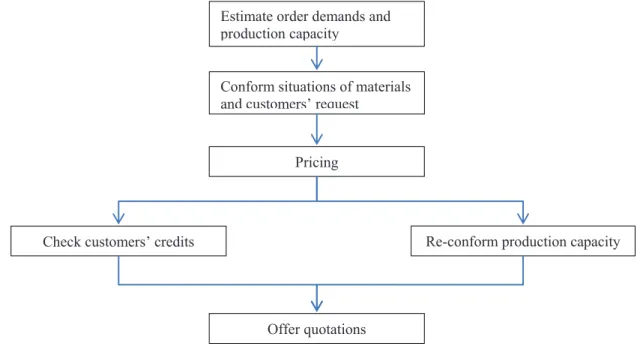
The traditional quoting process of clothing manufacture always spent much time on decision making. When orders received, senior managers have to select appropriate original places, facilities, and other influencing factors. As Fig 1 shows, the quotation process could be divided into 5 major parts [7].
In the first stage, managers have to conform to customers demands of styles and quantity, and these demands will be limited by capacities of each factory. Managers should make sure of that material could be prepared and customers requests (including original places, delivery days, and et al.) could be satisfied in the stage 2. After that, pricing is the most important and complex stage in the whole process. Customers might change suppliers if prices get too high; on the other hand, cost might cause manufacturers loss if prices get to low. There are three details of the quotation process as follows.
Make basic prices. The basic price is made from production cost and reasonable profit.
Estimate additional expenses and appropriate discount. Some charges like duty or transportation cost should be added to the basic price. For huge volumes of trade or long-term cooperation, discounts always are used in price negotiation.
Consider the extra cost. In the global industry, different customers demands usually raise up manufacture s cost. For example, customers might designate raw materials and the materials might be far to factories. In the last two stages, senior managers will check the credits of customers and re-conform conditions of facilities. When above stages were finished, quotations would be offered to customers.
Fig. 1. Flow chart of the quotation process 2.2. Multi-objective genetic algorithm
Multi-objective planning is a mathematic method to make decisions and allow more than one objective existing. The purpose of multi-objective planning is to assist decision makers in designing strategies based on limited resources and clashed objectives. There are three advantages in the method of multi-objective planning [8]. First, each objective has own measurement unit. Different measurement units can be existed in the same planning. Second, personal experiences and subjective viewpoints are allowed to be put in the equation. Third, senior managers can think about trade-off among different objectives. There objectives have an alternative relationship, even these objectives are conflict.
Genetic algorithm was presented in 1975 by Dr. Holland [9]. It simulates evolution and finds optimal solutions by gene reproduction, crossover, and mutation. Scholars could set individual objectives for different problems and measure results by fitness functions. The difference between traditional genetic algorithm and multi-objective genetic algorithm is setting of fitness function. Multi-objective genetic algorithm was present by Schaffer in 1985 [10]. If there were k objectives, original populations would be divided into k
subpopulations. Each objective had own fitness function and weights so that every fitness function could evolve with interference from other goals. Most of multi-genetic algorithm researches usually used weight
Estimate order demands and production capacity
Conform situations of materials and customers request
Pricing
Check customers credits Re-conform production capacity
method to calculate complex problems and find feasible solutions [11-12]. However, some scholars thought that better genes should get more chances to be propagated. Based on results of these researches, the ideas had been conform by many experiments [13-18]. This method was called Elitist Strategy . Thus, we used multi-objective genetic algorithm combined with elite policy and weight method to be analytic tools in this study.b
3. Quotation Mechanism and Experimental Methodology
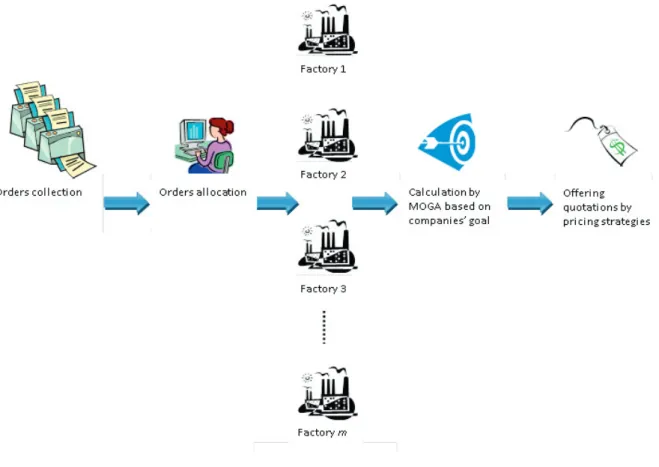
The quotation mechanism is presented as follows. By interview with clothing manufacturers and integration literatures, there are some rules and sequence might be discovered. When sellers get orders, they have to send demands to the operation center. The center would consider requests from each order and measure factories conditions and situations. Calculation by multi-objective genetic algorithm will be executed immediately when all of conditions had be estimated. After that, senior managers make final prices for quotations by pricing strategy and production cost.
Fig. 2. The process of quotation mechanism
Therefore, it is important to find the minimum production cost and offer products as fast as possible. In this case, we got two objectives. One is minimum production cost; the other is the minimum make span. First, we had considered the parameters for calculation. The parameter was defined as follows.
idenotes the ithorder,i= 1 ton,nmeans the total number of orders.
Di denotes the volumes of ith order (the unit is pieces).
Ui denotes the delivery days of ith order (the unit is day).
pci denotes the penalty cost for delay delivery of ith order (the unit is NTD per day).
cij denotes the raw material cost of ith order in jth factory (the unit is NTD per pcs).
lij denotes the labor cost of ith order in jth factory (the unit is NTD per day).
tcij denotes the transportation cost of ith order in jth factory (the unit is NTD per pcs).
pj denotes the capacities in jth factory (the unit is pcs per day).
xij denotes the volumes of ith order in jth factory.
yij denotes ith order was allocated in jth factory, it is a binary variable.
Ti denotes the delay days of ith order.
The objective of minimum production cost was formulated as equation 1, and the minimum make span was formulated as equation 2. n i i i m j n i ij j ij ij ij ij n i i i m j n i ij ij j ij ij ij ij ij T pc tc p l c y x T pc x tc p x l x c y z Min 1 1 1 1 1 1 1 (1) m j n i j ij p x z Min 1 1 2 (2)
These equations were subject to
j all p x j n i1 ij (3) j i all x D m j n i ij m j n i i , 1 1 1 1 (4) i all y m i ij 1 (5) j i all yij 0or1 , (7)
4.Results and Discussions
As front section, there are trade-offs between the minimum production cost and the minimum make span. In this section, we would introduce input data and parameters for systemic calculates. We used Brute-Force Algorithm to test and verify the results from the decision support system. The quotation system is developed by Microsoft Visual C++, and CPU is Intel Pentium M 1.5GHz.
4.1. Input data
These data was collected by real investigating with clothing manufacturers. In this case, the manufacturer has 5 prime factories and 4 products that each product could be divided into 2 types. Factories have been allocated in the United State, China, Vietnam, and Taiwan. Take Table 1 for example; there are 10 orders and each order has individual characteristics. Because of 8 materials of clothes, factories also have own costs for every needs as Table 2 shows (there are two factories in Taiwan). Each factory has individual capacity (Taiwan A is 7,000 pcs/day; Taiwan B is 7,000 pcs/day; China is 10,000 pcs/day); United State is 10,000; and Vietnam is 16,667 pcs/day).
Table 1. An example of orders information
Order Number Product Number Quantity (pcs) Delay Cost (NTD/day) Delivery Days Delivery to
1 7 13500 10000 1 Asia 2 5 28800 20000 5 Europe 3 5 30000 50000 2 Australia 4 6 23100 38500 2 Asia 5 2 13500 22500 3 Asia 6 6 20100 33500 2 Central America 7 1 16800 28000 4 America 8 3 7500 12500 1 Asia 9 2 10500 17500 5 America 10 1 19800 33000 3 Asia
Table 2. Cost of factories
Factory
Material Cost (NTD/PCS) Labor
Cost (NTD/ PCS)
Transportation Cost (NTD/PCS)
1 2 3 4 5 6 7 8 Europe Asia America Australia Central America Taiwan A 110 275 150 375 120 300 130 325 85837 15 10 20 15 20 Taiwan B 130 325 150 375 120 300 130 325 85837 15 10 20 15 20 China 80 200 130 325 120 300 110 275 13562 10 8 20 13 18 U.S. 150 375 200 500 160 400 170 425 336074 20 20 5 18 15 Vietnam 90 225 130 325 100 250 110 275 7294 10 10 20 12 20 4.2. Parameters of MOGA and experimental results
Numbers of generation and population, mutation rate and crossover rate are four major parts for using genetic algorithm. Different data distribution might use distinct parameters. For example, it is easy to get local optimal solution if mutation rate has been set too low. On the contrary, the system cannot get convergence with wrong mutation rates. Therefore, it is necessary to decide parameters for calculation of multi-objective genetic algorithm. By experimenting in many times, using parameters as Table 3 could get feasible solutions efficiently. We tried three kinds of crossover rates because there is no absolute if crossover rate gets higher or lower. Hence, using these three kinds of crossover rates could make our research become more complete.
Table 3. Parameters of MOGA Parameter Number Generation 500 Population 200 Mutation rate 0.01 Crossover rate 1.0, 0.8, 0.5
In this study, we used above parameters to solve the problem for 10 times, and we could see the results as follows. Brute-force algorithm spent more times to get solutions, and MOGA actually can feasible solutions near the optimal solution. As Table 4 shows, crossover rate was decided by compared by brute-force algorithm.
Table 4. Calculating results in different crossover rates Crossover
Rate
Brute-Force Algorithm Multi-Objective Genetic Algorithm
Cost Calculating Time (sec.) Average Cost Optimal Cost Average Accuracy Calculating Times (sec.) 1.0 34,965,772 246 34,975,772 34,965,772 99.97% 6.79 ~ 8.61
0.8 34,965,772 246 34,975,772 34,965,772 99.97% 5.95 ~ 7.23 0.5 34,965,772 246 34,965,772 34,965,772 100.00% 3.51 ~ 4.53
Minimum make span is 19 ~ 25 days calculated by brute-force algorithm, and it is the same as results from multi-objective genetic algorithm. Although brute-force algorithm could find the optimal solution, but it also spends too much time to find solutions out. We used 9 ~ 13 pieces of orders to analysis the time that brute-force algorithm needs. The calculating time had increased acutely from 22.14 seconds to 502,955 seconds. Thus, brute-force algorithm cannot be used in the real problems because there are always more than 20 pieces of orders. In the end, we used 10, 20, 30, 40, and 50 pieces of orders to simulate. The result is presented in Table 5. From results, multi-objective genetic algorithm could be confirmed in handling large numbers of orders stably in the finite time.
Table 5. Calculating results from different numbers of orders by MOGA
Numbers of Orders Calculating Time (sec.) Average Production Cost Minimum Production Coefficient of Variation
10 8.6 35,278,011 35,276,761 0.01% 20 16.0 64,047,550 63,195,965 0.64% 30 25.1 11,8431,186 11,7659,016 0.47% 40 32.5 157,178,092 155,427,340 0.56% 50 41.7 198,145,524 195,857,500 0.54% 5.Conclusion
In traditional quote process, senior managers usually use Cost-Plus Pricing or Competition-Driven Pricing to offer quotations. Difficulty of making decisions with complex influencing factors has impacted industry s profits. Thus, the aim of this paper is to develop a quotation mechanism by using real data from a famous garment industry in Taiwan. The results of this study show that decision support system combined with multi-objective genetic algorithm could get noninferior solutions efficiently. There two goals, minimum total production cost and the minimum make span, are estimated to be alternatives for senior managers. The conclusions are arranged as follows:
The concepts could be used in real clothing manufacture and others industry.
Besides the experiences and subjectivness, decision makers might consider more influencing factors and make prices objectively.
The analysis tools in this paper are verified by Brute-Force Algorithm, and results show that quotation method we proposed has high accuracy near the optimal solution.
There are too many influencing factors that cannot be used in quote processes. In this study, we used some major factors including raw material cost , transportation cost , and penalty cost for delay delivery to calculate production cost and make spans. Results of this study played a pioneer role for the quotation mechanism. More influencing factors or other algorithms also could be considered in future research, and the mechanism would be more valuable to assist senior managers to make quotations.
Acknowledgements
The authors wish to express their appreciation to Chih-Chiang Lin for his help during the course of writing this paper. This work was supported by the National Science Council under grant number 101-2221-E-025-013.
References
[1] Veeramani, D., Joshi, P. 1997. Methodologies for Rapid and Effective Response to Requests for Quotation (RFQs). IIE Transactions 29, p. 825-838.
[2] Carr, H., Latham, B. 1994. The Technology of Clothing Manufacture. Blackwell Scientific Publication LTd.;
[3] Steuer, R.E. 1976. Multiple Objective Linear Programming with Interval Criterion Weights. Management Science 23, p. 305-316. [4] Nagar, A., Heragu, S.S., Haddock, J. 1995. A Branch-and-Bound Approach for a Two-Machine Flowshop Scheduling Problem. The
Journal of the Operational Research Society 466, p. 721-734.
[5] Chen, R.C., Lin, C.C., Li, S.S. 2006. An Automatic Decision Support System Based on Genetic Algorithm for Global Apparel Manufacturing. International Journal of Soft Computing 1, p. 17-21.
[6] Li, S.S., Chen, R.C., Lin, C.C. 2006. A Genetic Algorithm-Based Decision Support System for Allocating International Apparel Demand. WSEAS Transaction on Information Science and Applications 3, p. 544-549.
[7] Taylor, D.A. 2003. . Addison-Wesley.
[8] Gao, Z., Tang, L. 2003. A Multi-Objective Model for Purchasing of Bulk Raw Materials of a Large-Scale Integrated Steel Plant. International Journal of Production Economics 83, p. 325-334.
[9] Holland, J. 1975. Adaptation in Natural and Artificial Systems. University of Michigan Press, Ann Arbor, Michigan.
[10] Schaffer, J.D. 1985. Multiple Objective Optimization with Vector Evaluated Genetic Algorithms. The 1st International Conference on Genetic Algorithms, p. 93-100.
[11] Murata, T., Ishibuchi, H. 1995. MOGA: Multi-Objective Genetic Algorithms. Evolutionary Computation, 1995., IEEE International Conference on 1, p. 289-294.
[12] Tamaki, H., Nishino, E., Abe, S. 1999. A Genetic Algorithm Approach to Multi-Objective Scheduling Problems with Earliness and Tardiness Penalties. Proceedings of the 1999 Congress on Evolutionary Computation 1, p. 46-52.
[13] Goldberg, D.E. 1989. Genetic Algorithms in Search, Optimization, and Machine Learning. Mass: Addison, Wesley.
[14] Horn, J., Nafpliotis, N. 1993. Multiobjective Optimization Using the Niched Pareto Genetic Algorithm. Report 93005, University of Illinois at Urbana-Champain, Urbana, Illinois, USA.
[15] Fonseca, C.M., Fleming, P.J. 1993. Genetic Algorithms for Multiobjective Optimization: Formulation, Discussion and Generalization. Proceedings of the 5th International Conference on Genetic Algorithms, p. 416-423.
[16] Murata, T., Ishibuchi, H., Tanaka, H. 1996. Genetic Algorithms for Flowshop Scheduling Problems. Computers and Industrial Engineering 304, p. 1061-1071.
[17] Cochran, J.K., Horng, S.M., Fowler, J.W. 2003. A Multi-Population Genetic Algorithm to Solve Multi-Objective Scheduling Problems for Parallel Machines. Computers and Operations Research 30, p. 1087-1102.
[18] Yamachi, H., Tsujimura, Y., Kambayashi, Y., Yamamoto, H. 2006. Multi-objective Genetic Algorithm for Solving N-version Program Design Problem. Reliability Engineering and System Safety 91, p. 1083-1094.