Showstoppers for Continuous
Delivery in Small Scale Projects
Jakob Svemar
MASTER’S THESIS | LUND UNIVERSITY 2016
Department of Computer Science
Faculty of Engineering LTH
ISSN 1650-2884 LU-CS-EX 2016-01
Showstoppers for Continuous Delivery
in Small Scale Projects
Jakob Svemar
December 22, 2015
Master’s thesis work carried out at Softhouse Consulting Öresund AB.
Supervisors: Lars Bendix, [email protected] Fredrik Stål, [email protected] Examiner: Ulf Askelund, [email protected]
Abstract
Small scale projects outsourced to consultants provide their own difficulties when compared to more standard software development. Some of these prob-lems are a lack of infrastructure and customers inexperienced with software development.
This thesis is looking at the possibility of implementing continuous deliv-ery in such an environment. The concrete problems are small projects with very little room for experimentation. But also the inexperience in automated testing which is essential for efficient regression testing. This led this thesis in two directions.
The first one is how can you create a situation where continuous delivery could be beneficial, where developers prefer writing automated test cases in-stead of performing Ad Hoc manual testing during development and relying
on a larger testing phase towards the end, much like what is done in water-fall development. The solution is to perform more deliveries to the customer throughout the project, with the customer having the responsibility of provid-ing feedback on these deliveries. For the developers to embrace automated testing, a shift in focus is needed, from functional testing through the GUI to smaller unit and integration tests that will be easier to write and maintain.
The other direction is addressing the fact that there is very little to con-tinuously deliver during early stages of development, which could essentially make up half the project length. But also that there are several small projects each year. Making configuration management a support function for projects allows for standardisation and sharing the cost between all the projects.
Keywords: Continuous Delivery, Continuous Integration, Agile development,
Acknowledgements
First of all, I would like to thank both the academic supervisor, Lars Bendix, and the company supervisor, Fredrik Stål, for ongoing support throughout this process. Without their feedback and assistance it would not have been possible to complete this thesis.
Secondly I would also like to thank everyone at Softhouse for providing the necessary information and making me feel welcome at their company. It is their participation that has allowed this thesis to be completed.
Thirdly, I thank the examiner, Ulf Askelund, for showing interest and taking the time to review this thesis.
Contents
1 Introduction 9 2 Background 11 2.1 Context . . . 11 2.2 Research Method . . . 12 2.3 Relevant Information . . . 13 2.3.1 Target Audience . . . 13 2.3.2 Continuous Integration . . . 13 2.3.3 Continuous Delivery . . . 13 3 Analysis 15 3.1 Interviews . . . 16 3.2 Perceived Problems . . . 183.3 Finding the Real Problems . . . 19
3.3.1 P.P1We do not know when we are done testing . . . 20
3.3.2 P.P2We find bugs too late in the development cycle . . . 20
3.3.3 P.P3None or little regression testing . . . 20
3.3.4 P.P4 Acceptance testing (by customer) finds bugs which should have been caught by the team earlier . . . 21
3.3.5 P.P5 Unstructured testing/inefficient testing, reliance on manual exploratory testing . . . 21
3.3.6 P.P6 Loss of knowledge and lack of time hinders automation of different parts of the process . . . 22
3.3.7 P.P7Lack of documentation of test cases makes it very unclear of what is actually tested for each version . . . 22
3.3.8 P.P8Long feedback cycles . . . 22
3.3.9 P.P9Using Continuous Delivery antipatterns . . . 23
3.4 Digging Deeper . . . 24
3.4.1 Root causes . . . 24
CONTENTS
3.5.1 Bug report frequency . . . 26
3.5.2 Bug durations . . . 27
3.5.3 Automating Acceptance Testing . . . 28
3.6 Survey . . . 30
3.7 Solution Requirements . . . 30
4 Design 33 4.1 Improving Development . . . 33
4.1.1 More and smaller releases . . . 34
4.1.2 Test ranking . . . 34
4.1.3 Code coverage . . . 35
4.1.4 Refocus project test flow . . . 36
4.1.5 Redesign acceptance tests . . . 37
4.1.6 Standardised commit comment . . . 38
4.1.7 Summary . . . 38
4.2 Making Continuous Delivery Viable . . . 39
4.2.1 Every team manage their own Continuous Delivery . . . 39
4.2.2 Dedicated Continuous Delivery team . . . 40
4.2.3 Dedicated Continuous Delivery support . . . 40
4.2.4 Summary . . . 41
5 Discussion 43 5.1 Evaluating the results . . . 43
5.2 Lessons learned . . . 44
5.2.1 The root cause analysis . . . 44
5.2.2 Designing solutions . . . 45
5.3 Related Work . . . 45
5.3.1 Continuous Delivery: Reliable software releases through build, test and deployment automation[3] . . . 46
5.3.2 Agile Testing: A practical guide for testers and agile teams[5] . . 46
5.3.3 Container-based Continuous Delivery for Clusters[13] . . . 47
5.3.4 Continuous Delivery? Easy! Just Change Everything (well, maybe it is not that easy)[14] . . . 48
5.3.5 Enabling Agile Testing Through Continuous Integration[15] . . . 48
5.4 Future Work . . . 49
5.4.1 Dedicated testers . . . 49
5.5 Difficulties with Mobile Testing . . . 50
6 Conclusion 51
Bibliography 53
A Interview Questions 55
CONTENTS
Chapter 1
Introduction
The way software is developed can vary greatly, and different settings create different con-ditions. Softhouse is a consultant firm that provides a range of services. One of which is in-house development. Their largest team consisting of nine developers, a scrum mas-ter and a project manager, is working on ticket solutions for public transportation. This spans several different customers, generally communal or governmental companies, and it has been the main focus during this thesis. Each application is unique but uses similar solutions. This has created a situation where projects run in very short time frames with limited budgets. Projects are won based on tender offers with three main components, a suggestion for the solution, a price and a duration the project will take. This means projects are set up in a traditional manner and shares a lot of similarities with the waterfall model. As trust builds between customers and consultants, more agile approaches have been possible, especially during development.
The purpose of this thesis has been to look at the current development practice, identify bottlenecks for continuous delivery and figure out changes that could help remove them. Solutions are focused on automating testing to reduce the duration of feedback cycles during development. This is a corner stone for continuous delivery to function.
As a side note to the question of what can be done to improve the development, an important question throughout the thesis have been if automated testing and continuous delivery is viable in this limited scale, or if it simply costs too much to be worth it. This thesis explores ways that can help distribute both costs and benefits to all projects.
1. Introduction
R.Q1How could increased traceability help highlight if a story is tested sufficiently?
R.Q2 Could a story focused test selection method be useful during development?
R.Q3How do we link stories and tasks with test cases? R.Q4What CM support is needed for this to be a feasible so-lution?
R.Q5What level of automation is needed for developers to em-brace this functionality?
From discussions in the beginning of the work it became clear that the research ques-tions were not representative for the real problem area and would be difficult to investigate. Two perceived problems were defined and together with my desire to explore the benefits and possibilities of implementing continuous delivery formed the basis for this master thesis. The problem statements were:
• How do we know when we are done testing? • We find bugs too late in the development cycle.
The first question may seem to have a simple answer, when all bugs are fixed. Or rather, when the software is stable enough as software rarely is completely bug free. For every change in the code, software could have become unstable creating the need to reverify that the code works as expected.
Finding the point where the software is stable enough becomes difficult when relying on manual exploratory testing. It takes a lot of time and is prone to human error. The end results is that it is difficult to measure not only if enough testing has been done, but rather what testing has been done.
Another side effect of manual testing is that regression testing is reduced to a bare min-imum. A previously implemented feature may remain untested through several iterations of software. But the team operates on an assumption that the software is in a constant "expected to work" state, only when a bug is found is this assumption changed.
The second statement is closely related to the first one. Bugs are found when testing is done. If the majority of testing is done at the end of a project, the majority of bugs will be found at the end of the project.
The scope is limited to the in-house development at Softhouse and specifically the team creating ticket solutions have been the focus. The project analysed comprises of two mobile applications, one for iOS and one for android. It also includes a back-end server with a browser interface. Other teams and developers have also influenced the findings, but on a much smaller scale. Target audience is developers in similar situation where small projects are common and automated testing is scarce.
Chapter 2
Background
As described in the Introduction, the goal with the thesis was to identify bottlenecks that slow down development and to investigate how and if continuous delivery would be suit-able for a specific context.
This chapter will start out describing this context more clearly. Next it will describe the research method that was used to obtain the results and finally will give some relevant information for the reader, like who is the target audience for this thesis and defining what continuous delivery is.
2.1
Context
The context for this thesis is slightly different than for more common development. In this case, common development is defined as companies developing their own product which they then provide for their customers and maintain continuously over a longer period of time.
In contrast, these projects are developed by a consultant firm on behalf of a customer who will then provide it for their customers. They are generally short projects with around five scrum sprints, around ten weeks of development, and around ten developers. Adding to this, development has to combine agile methodology and more traditional waterfall development due to the fact that to even get the project, large parts of the project is planned before even winning the bid over other consultant firms.
As a personal observation, this appears to be a more and more common way of de-veloping small applications, especially for companies that are not experienced in software development. The challenges with this is to maintain an agile practise when everything around the project very much remains rigid with fixed deadlines and budgets.
2. Background
2.2
Research Method
This thesis have been mainly a theoretical one with the main focus on the root cause analy-sis. It has been important to gather relevant information from both developers and project leaders and to gather facts that corroborate the claims made.
At the start of the thesis interviews were carried out with developers to find out how the current development was done, and what they found was lacking. This was done to get a basis and find what the perceived problems were as a first step in the root cause analysis. As the first round in the analysis interviews were chosen to give a qualitative perspec-tive on development as opposed to a quantitaperspec-tive which could have been achieved by send-ing out a survey. This was done to allow for tailorsend-ing the interview to the interviewee, expanding on topics that were found to be particular interesting by the developer. A vo-cal answer was also thought to give more elaborate answers in general and thus provide a better basis for the thesis. An added bonus was the fact that it allowed me, the student, to introduce the thesis work and myself to the employees. Something that would not have happened if a survey was answered via a web formulary. A survey could also have been largely ignored, resulting in the need for interviews anyway.
As many questions arose from the initial interviews, a lot of informal discussion were intended to be used throughout the thesis to follow up on questions that might rise. This posed a problem later on as these discussion were not really documented to the extend they should, which made referencing some claims difficult.
After the interviews the results were analysed and the perceived problems found. Then an iterative process was started to find the real problems and ultimately the root causes. This iterative process was supported by comparing findings to other research and literature, to find common ground.
Once the problems were defined a quantitative process to gather evidence of their ex-istence was selected. A quantitative process was chosen here because the intention was to gather statistics. The greater the sample size the more likely the results are accurate. This was done by processing a lot of data gathered from the target project.
First of all the acceptance tests were analysed, to determine if they were possible to automate, or if their design could be changed to make it easier to automate.
Bug reports were analysed to prove that bugs indeed were found towards the end of the project. Which confirmed that development relied on a waterfall approach to testing.
Bug reports that were submitted during development were also analysed to determine how long a bug existed. This was done to find out if the current development suffered from long lead times and whether or not bug fixing was a priority compared to new feature development.
To make sure the solutions stay on topic a set of requirements were created. Finally solutions were designed with a focus on improving iterative release capabilities. The so-lution suggestions were not evaluated due to a lack of time and are intended to highlight areas that are most important to address if the team decides to move towards continuous delivery.
2.3 Relevant Information
2.3
Relevant Information
To aid the reader of this thesis, this section will describe the target audience for this thesis, and describe the definition of continuous integration and delivery that is used. The reason for these definitions are simple, to avoid readers making their own interpretation of what it might entail.
2.3.1
Target Audience
The intended target audience for this thesis are people that can relate to the title. They are working in small scale projects and are looking to make a transition from traditional development methods like waterfall towards continuous delivery.
The thesis aims to keep the discussion at a level where people who has studied com-puter science or has worked with software development.
2.3.2
Continuous Integration
The first one to define continuous integration was Martin Fowler, the definition used in this thesis will be the one he uses[1].
In a short explanation, continuous integration means that developers update and merge their code with the main branch as often as possible, at least ones a day. This helps de-velopers to stay up to date with everyone’s changes making the process of merging easier. Continuous integration also include that the code is compiled and tested to verify that it is actually working. By keeping the software in constant working order ensures a stable product and makes releases go more smoothly.
The main thought behind continuous integration is that by merging code often you re-duce the risk of breaking the code, and if the code is broken, will make finding the bug easier. It also helps reduce issues like double maintenance which is caused by having developers work on their own branches[2]. By merging often differences between main branches and developer branches are kept at a minimum. A huge part of continuous in-tegration is automating the repetitive steps, in this case building and testing the software. Without automation steps will be skipped or even the entire process of integration will be postponed due to the time it takes to make them.
2.3.3
Continuous Delivery
Continuous delivery is a continuation of continuous integration. Where integration aims to keep the code in working order, and to make development easier, continuous delivery aims to make releases easier by making them smaller and more frequent. The purpose of this is to be able to get more end user feedback but also to make the product more commercially competitive.
Again, just as with continuous integration, automation is the key. By making steps automatic you save time but can also ensure that they are done. Automation also increases the reliability that they are done correctly, provided they were done correctly the first time.
2. Background
The definition for continuous delivery is taken from the book Continuous Delivery[3] written by Jez Humble and David Farley. In short it means that every commit should be a potential release candidate. This is achieved by creating a deployment pipeline and automating as many of the steps as possible. In an ideal world a change would go through an automatic build process, integration testing, and acceptance testing and finally be ready to be deployed with a push of a button.
Chapter 3
Analysis
As the main part of this thesis, the root cause analysis took a large part of the time and effort. The analysis was done in three steps, defined as perceived problems, real problems and root causes. Several methods to investigate were used as mentioned in 2.2. The goal with the analysis was to create an extensive picture of the development practices used, what problems existed that would prevent continuous delivery and finally figure out potential root causes. During the initial discussions, two perceived problems (P.Px) were already located.
P.P1We do not know when we are done testing P.P2We find bugs too late in the development cycle
The first step was performing interviews with developers and figure out how they worked and what issues they thought might exist in addition to the first two perceived problems. This resulted in a list of perceived problems which would be the stepping stone to uncover the real problems (R.Px).
The second step was digging into the perceived problems, figuring out if there were underlying issues and essentially asking "Why is this a problem?" or "Where does this problem come from?". As these real problems where mainly derived from theoretical rea-soning, based on gut feelings, and follow up discussions with project members, it became essential to find some hard facts to confirm the statements.
Once facts where gathered and problems had reasonable proof that they exist, the in-vestigation to find underlying root causes began.
Finally, to be able to create relevant solution proposals, a set of requirements were created. The purpose with these were to keep focus and to some extent narrow the scope of the thesis.
3. Analysis
3.1
Interviews
Apart from the initial discussions to formulate of the problem statement, the interviews were the first step in gathering information regarding the current development practises. They were conducted on a face to face basis with a questionnaire prepared to guide the discussion. The intention with the questionnaire was to keep the discussion on topic, but allowing the interviewee to elaborate on topics he or she found interesting. The goal with the interviews were to provide the basis for the root cause analysis in the form of a collec-tion of perceived problems.
In appendix A the questions for the interviews are listed. The people interviewed were working on a few different projects. The main focus was the project dubbed as "Ticket solution", the second target project were working on "Charging stations". Aside from this, one interview was conducted outside of specific projects and one with someone working as a consultant on a customer led project. The idea behind interviewing these other peo-ple was to see if the situation was similar on all projects located in-house, and how they compared to projects lead by the customer, essentially acting as some sort of baseline.
The main difference between the in-house development and the consultant working on external projects were the formal rules for development. For the external project the developer had the responsibility to develop unit tests, while integration, gui and acceptance testing was performed by dedicated testers. In contrast, in-house testing was carried out by developers in a format of their choosing. It is however worth mentioning that the scale of projects compared vary, in-house development is focused on small projects with defined end dates while the external projects run for a much larger time span.
The first question, "What is the state of the delivery process in your current project" were designed to get a picture for how a story moves through the development process, where potential bottlenecks may occur. The biggest obstacle was the testing. Both in-house projects relied a lot on manual exploratory testing. In the case of the ticket appli-cation, some automated testing was done on the server side while the mobile application was only tested manually. The charging station application was a little better with the use of some unit testing. But again, most testing was done manually. To make time for testing, testing sessions have been introduced. Ideally done twice a week,the team gathered and used the product with the goal to test new features. Developers did however admit that it was not always enforced, and that a reluctance to be "the bad guy" that forces the rest of the team to start testing existed. This lead to the third perceived problem, that no or little regression testing existed.
P.P3None or little regression testing
At the end of a project there is an acceptance test phase. The second question, "How are acceptance testing performed?" addressed this part of the development cycle. In the charging station project this was done by the customer, while in the ticket solution project both developers and customer were involved. It was estimated that acceptance testing took 80 man hours, e.g. two people one week to perform. As the testing is manual, very little regression testing is done at this point. Acceptance tests were run by developers and any bugs found were fixed. After this the customer took over acceptance testing, and used the same acceptance tests to verify the product. Their acceptance testing was performed in
3.1 Interviews
an production environment, or as close as possible. Customers still found bugs or had remarks regarding design and basic texts that were shown in the application. As far as real bugs go, this creates two possibilities, either the production environment is different, or the customers testing is more thorough. The fourth perceived problem was formalised.
P.P4Acceptance testing (by customer) finds bugs which should have been caught by the team earlier
Questions three to five were intended to show what traceability that existed between stories, tasks and tests. These questions were directly related to the research questions mentioned in the introduction. Stories and tasks were linked, but it did not result in any particular insight. Due to the focus on manual exploratory testing, very few test cases were created at all during development and hence, no traceability was possible. The heavy focus on manual testing makes regression testing increasingly tedious as the project grows and more and more features are added. There was also not a clear picture of what should be tested and it was up to the developer to define the parameters for the testing, this means that it is easy to forget to test some part of the implementation, and especially miss regression related testing. The fifth perceived problem was located.
P.P5Unstructured testing/inefficient testing, reliance on man-ual exploratory testing
As the lack of automation became obvious, the question "Why is the testing not auto-mated?" was added more officially as interviews tended to go in that direction. It was used to try and find the reason to why manual testing was preferred. There were a few reasons for it. The first one was rooted in the fact that automated testing lacks the human touch, it can only evaluate a specific variable, and loses the full picture. This is closely related to the second reason, if you still have to perform manual testing to be sure everything is working as intended, why waste time implementing automated testing too?
The third reason is related to the difficulty of automating testing. As the developers perceived themselves as inexperienced with it, it simply took too much time to get started. This originates from the desire to continually produce something for the customer, creating test suites is something the customer gets no direct value from, hence, spending time on it results in slower progress, at least initially.
Previous attempts to automate testing, especially GUI testing, had been done by in-dividuals, but never really caught on, and when the specific developer left the team the knowledge was lost. This creates the sixth perceived problem.
P.P6 Loss of knowledge and lack of time hinders automation of different parts of the process
The seventh question, "Have you been in projects with very long testing cycles?" did not yield any particular results, developers in the ticket solution project felt that testing during development was quick, which could be an indication on lack of regression testing. It also mentioned that the use of testing hours to verify a feature or bug fix could add up to two or three days in lead times.
3. Analysis
give the interviewee a chance to bring up anything that might have been missed during the interview or emphasise something they felt should change. It resulted in developers mentioning some simple tools that could help and recognitions of problems in the current development. A summary of the results can be presented in four short bullets.
• Introduce code coverage. • LessAd HocTesting.
• Build servers, to encourage automated tests.
• Automated gui testing requires too much work that the customer does not see. These suggestions from the developers were taken into consideration when different solutions were considered. These suggestions show that there is an interest from the de-velopers to improve, and could further indicate that they feel pressured by time constraints to actively improve their practises.
3.2
Perceived Problems
During the initial discussions the first two perceived problems were stated and when in-terviews were completed, six perceived problems were discovered. Additionally, some hypothesis of my own had been created, which were based on observations and discus-sions with different employees and the thesis supervisor at the company.
P.P7Lack of documentation of test cases makes it very unclear of what is actually tested for each version
P.P8Long feedback cycles
P.P7 came from the interviews where it became clear that testing was done in anAd Hocway. It also ties in with the original problem statement and P.P1. WithAd Hoctesting
the only thing that remains after a test run is the fact that the developer think he or she is done. In contrast to an automated test suite where there is a log, for instance Jenkins which clearly states that a build passed and what test cases were run. Further discussions revealed that once a feature is added to the main repository, it becomes very unclear whether or not that feature is covered during regression testing. Agile development talks a lot about reducing the job of documentation, but not the need for it. Instead writing automated test cases provides the necessary documentation that otherwise has to be handled manually.
P.P8 came from discussions with my supervisor at the company. Feedback is essential in agile development, it is even mentioned as a fundamental value in the Extreme Program-ming methodology[4]. The sooner feedback can be received the better. As mentioned in the Continuous Delivery book[3][p. 61], initial feedback on a commit should come in less then five, or at most ten minutes. But also feedback between customer and developer is important, even if it is difficult to reduce these lead times to mere minutes. Early approval from the customer can reduce the impact of what a change request could have on develop-ment as other stories should not yet be based on what the customer wants to change.
3.3 Finding the Real Problems
With many of the perceived problems relating to testing, it started to become obvious that one of the bigger issues involved the way quality assurance was done. But looking at the suggestions from the interviews and referencing the continuous delivery book, a number of antipatterns was noticed[3][p. 7]. Especially the use of manual releases was discovered. With manual releases, work is not only slowed down, but it increases the risk for making mistakes due to repetitive tasks. It is very unlikely that a computer makes a mistake during the release process if an automated script exists and have been tested. These antipatterns creates the final perceived problem.
P.P9Using Continuous Delivery antipatterns
The total result were nine perceived problems that should be further investigated to try and identify the real problems that caused these symptoms.
P.P1We do not know when we are done testing P.P2We find bugs too late in the development cycle P.P3None or little regression testing
P.P4Acceptance testing (by customer) finds bugs which should have been caught by the team earlier
P.P5Unstructured testing/inefficient testing, reliance on man-ual exploratory testing
P.P6 Loss of knowledge and lack of time hinders automation of different parts of the process
P.P7Lack of documentation of test cases makes it very unclear of what is actually tested for each version
P.P8Long feedback cycles
P.P9Using Continuous Delivery antipatterns
3.3
Finding the Real Problems
Once the interviews and the analysis of the interviews was done and had been summarised to nine perceived problems it was time to start the root cause analysis. The first step was to go over each perceived problem and figure out why it was seen as a problem, and if there were any underlying problems that might have caused it. Once the real problems had been discovered it became necessary to narrow down the problems to their specific root causes. The solutions in chapter 4 will focus on addressing the underlying root causes and not the symptoms noticed as perceived problems.
As this part of the analysis is done mainly from a theoretical stand point, the need to back up the statements with facts becomes relevant. Section 3.5 presents data gathered from the ticket solution project with the intention to prove that problems exist.
3. Analysis
3.3.1
P.P1 We do not know when we are done
test-ing
A very simple way of knowing when you are done testing is when you know there are no more bugs in the code. However being 100 percent sure is not a realistic goal. Instead, compromises have to be done and some kind of definition of working has to be done. This is where testing comes in, by designing test cases, either on unit, integration or acceptance level, these test cases define what the code is expected to do. Looking at the P.P1and in the context of the ticket solution project. It is not possible to know when testing is done until two things occur. First, test cases designed to test the implemented feature need to exist, and secondly, these test cases need to pass. The perceived problem of not knowing when testing is done can be traced to a real problem (R.Px) of not defining what should and what should not work for a story to be completed.
R.P1Acceptance tests not developed in conjunction with fea-tures/stories
3.3.2
P.P2 We find bugs too late in the development
cycle
Bugs are found when the software is tested. If bugs are mainly found at the end of the project, the testing during development is most likely not good enough. It could have to do with issues like development environment being different from runtime environment, but since the interviews revealed that acceptance test cases are not written until late in the project, the biggest issue is most likely that testing is not prioritised until later stages of development.
R.P2Testing is not a priority until closer to release
3.3.3
P.P3 None or little regression testing
When asking the question "Why is there no regression testing?", the only apparent answer is because it is too time consuming or boring. It is not a feasible solution to spend hours to test an application each commit. As the application grows, so does the amount of re-gression testing needed. When relying on manual exploratory testing, some rere-gression is indeed covered, but since it leaves no trace that the application is actually tested it can be considered unreliable, especially if it is the only type of testing.
R.P3 Manual test selection and execution is the only quality assurance
3.3 Finding the Real Problems
3.3.4
P.P4 Acceptance testing (by customer) finds
bugs which should have been caught by the
team earlier
Having customers find bugs involves two problems. The first one is that the quality assur-ance process is not good enough and the second is that the customers expectations were not the same as the developers. The first one is directly related to how the testing process is performed, bothR.P1andR.P3are related to this.
The second one, that they expected something else, their idea of a feature differs from what the developers thought the customer wanted becomes a problem if this is discovered late in the development process. But if they are found early, they become prime examples of why agile development is advantageous in comparison to traditional waterfall develop-ment. When the customers verification process is mainly located in the end of the project, changes, whether they are bugs or design choices, could become more costly. More specif-ically the question "is a story actually done if the customer has not approved of it yet?" can be asked. Again this ties in withR.P1but more specifically it raises the problem that stories are not actually done until the customers acceptance testing is completed. Instead they are left in some kind of "Hopefully done" state.
R.P4Stories are not completely done until end of development
3.3.5
P.P5 Unstructured testing/inefficient testing,
reliance on manual exploratory testing
It is common for a human to forget something, especially if it is a task that is to be per-formed several times over and over. When the testing is perper-formedAd Hoc, mistakes are
bound to happen. Combining this with continuous delivery, or even continuous integra-tion raises a problem, "Do not check in on a broken build" [3][p.66]. But how do you know if the build is broken or not? The answer is simple, you test the build! Every change should be tested to verify that previous functionality have not been broken, and that the new functionality is working as intended. Without testing with clear results, continuous integration becomes unreliable. And consequently, the software is not always kept in a working order, ready for delivery.
R.P5 Lacking continuous integration environment to imple-ment continuous delivery
3. Analysis
3.3.6
P.P6 Loss of knowledge and lack of time
hin-ders automation of different parts of the
pro-cess
Setting up automated testing, build servers, or even to learn how to write good test cases takes time. The main advantage of automated test cases are that once they are done they can run often and cheaply. When automated testing takes a full projects time to be set up, the question "Will this bring any benefit" rises. The most apparent answer is no, the current project most likely will not benefit. At least not enough to compensate the cost to implement it. The next project however may.
When isolated attempts to improve testing fail before their effects can be properly anal-ysed, improvement will never happen. There need to be time to explore new options and it needs to be embraced on a larger scale. The real problem is similar to the perceived prob-lem, lack of time, and/or resources hinders the implementation of continuous delivery.
R.P6 No prioritisation to implement continuous delivery within a project
3.3.7
P.P7 Lack of documentation of test cases
ma-kes it very unclear of what is actually tested
for each version
Lack of documentation can be perceived to save time in the short term. But not knowing for a fact that features work as intended makes future testing more difficult, resulting in more work towards the end of the project. The problem with documentation is that it has to be done in one way or an other. Performing manual acceptance testing for each commit is simply not an acceptable solution, this has lead to a reliance on exploratory testing.
In the end, the problem of not knowing what is tested culminates in the fact that ac-ceptance testing in the end of the project takes around 80 hours to perform, which makes continuous delivery virtually impossible.
R.P7Acceptance test is 80 hours of manual labour and manual testing forms the foundation for all testing
3.3.8
P.P8 Long feedback cycles
There are several different stages of feedback, the initial feedback on a commit, feedback that the complete story is working as intended and finally that the customer agrees with the developers interpretation of the story. The real problems that cover these points have already been listed, manual testing delays feedback (R.P3). It is not possible to perform a sufficient amount of testing in five to ten minutes.
3.3 Finding the Real Problems
Not having the customer validate stories until the end of the project (R.P4) results in changes that should have happened early may not be requested until very late in the project. Finally, by not designing acceptance tests in conjunction with development (R.P1) the customers job to validate the implementation before the final release is made more difficult.
3.3.9
P.P9 Using Continuous Delivery antipatterns
Releasing often means repeating tasks. And repeatable tasks should be automated [3][p.25]. Automating processes takes time and knowledge, and commitment to achieve it (R.P6).
3. Analysis
3.4
Digging Deeper
Looking back at the real problems discovered, some of them look quite similar. Several problems are focused on testing happening in the end of the project. These areR.P1, R.P2, R.P4. Instead of treating each problem as a separated issue it might be better to look at them as all connected to the same problem. Seeing testing as the last step in development is commonly referred to as the waterfall model [5][p.13]. Having the ambition to have a working product in the early iterations of a product, and adding new functionality as time goes seem to conflict with this. As such these real problems could be combined to one new and bigger problem.
R.P8Mixing agile code development with waterfall testing
Another thing noticed during the analysis of the perceived problems and what the un-derlying real problems could be, were the focus on manual testing (R.P3).
When looking at how manual testing could be removed the answer is automate it. And to do that R.P6, lack of prioritisation of improving development becomes relevant. An-other way of looking at it is the fact that automated GUI testing is generally perceived as expensive and difficult to maintain. This was even brought up during the interviews and raised the question, "Why automate the most difficult type of testing?". The final real problem is discovered.
R.P9Testing is focused on functional gui testing
Gathering all the real problems gives the following list. As they have been gathered through mainly theoretical reasoning and some follow up discussions one more step before finding root causes is necessary. The problems existence need to be confirmed by looking at actual data from the projects.
R.P3 Manual test selection and execution is the only quality assurance
R.P5 Lacking continuous integration environment to imple-ment continuous delivery
R.P6 No prioritisation to implement continuous delivery within a project
R.P7Acceptance test is 80 hours of manual labour and manual testing forms the foundation for all testing
R.P8Mixing agile code development with waterfall testing R.P9Testing is focused on functional gui testing
3.4.1
Root causes
Once the real problems had been theorised from the perceived problems it was time to find the root causes (R.Cx). These causes define the underlying problem and the idea behind identifying them is to, if using a medical metaphor, to treat the cause of the illness and not the symptom.
3.4 Digging Deeper
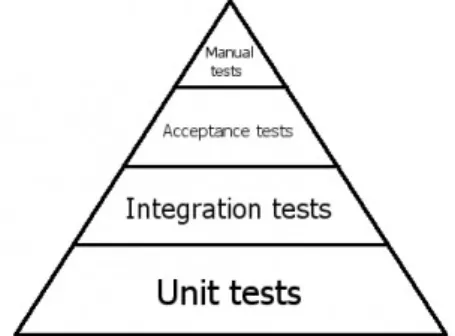
The root cause analysis resulted in three causes, two were related to the way quality assurance was done and one that was related to the commitment of improving development. Looking at the agile testing triangle in figure 3.1 shows a basis in unit and integration testing with a top of acceptance and finally manual testing. In contrast, testing in the ticket solution project is centred around manual functional GUI testing (R.P9andR.P3), and attempts to automate have focused on automating those tests instead of building a foundation with unit and integration tests which are generally considered cheaper to run and maintain.
Figure 3.1: The testing triangle illustrates a recommended divi-sion of focus for different types of tests.
Additionally the majority of testing have been postponed to the end of projects (R.P8) This indicates that the developers do not see the advantage of continuously evaluate the software through automated unit and integration testing, something that could be consid-ered a corner stone in agile development[5][p.25] as well as continuous integration and delivery [3][p.11].
Finally, not seeing the advantage of automated testing could provide an explanation why they are not focusing on implementing continuous integration (R.P5).
R.C1Developers do not see an advantage with automating unit and integration testing
With the heavy focus on manual testing, acceptance testing has become a procedure that takes a lot of time, and is often pushed to the end of the project (R.P7), as the process of performing acceptance testing is too time consuming to be done over and over. This results in the waterfall based testing approach mentioned asR.P8.
It is noticeable that testing occurs when it is time for a release, the importance to pro-vide working software is clearly understood by the developers. However the current release format and the general dislike for testing has led to testing being used more as a way of confirming that the software works and not as a way to receive feedback. Verification where for instance automated testing gives a clear answer, and validation, where the cus-tomer confirms that expectations have been met are valuable throughout development and not just in the end.
R.C2Quality assurance is tied to releases
3. Analysis
to focus on improving the development practise because the value is often not seen until later projects, which makes it difficult to add the cost to a project that will not benefit from it. This is directly related to the specific context of developing at a consultant firm where every project has a different customer.
This results in three root causes that will be the target when designing a solution. R.C1Developers do not see an advantage with automating unit
and integration testing
R.C2Quality assurance is tied to releases
R.C3Improving development practices are not prioritised
3.5
Gathering Facts
As a lot of the root cause analysis was based on interviews with developers there was a lot of theorising. To make sure that the problems actually exist some proof is necessary. To support the claims in this report about perceived and real problems as well as root causes, bug reports from developers, acceptance test reports from the customer and project plans were analysed. The actual acceptance test cases were also analysed to look at the possibility of automating them.
3.5.1
Bug report frequency
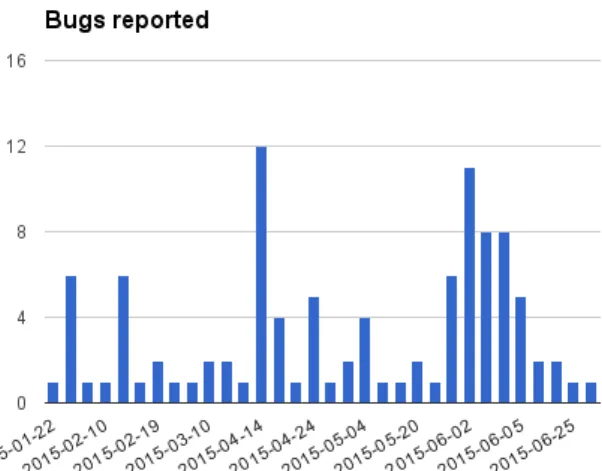
To confirm the assertion that bugs are found late in development an analysis of all bug reports in the ticket solution project was done. Apart from a surge in bug reports in the middle of the project, over 40% of all bugs were reported after the product went to customer acceptance testing on june, 1st. The histogram of all bugs can be seen in figure 3.2. The surge in the middle of the figure represent the first time the user interface was integrated with the other services and manual testing became simpler. It is worth to note that not all of these reports are bugs, it includes misunderstandings, duplicates and spelling mistakes. Another possible reason for the the uneven distribution is that small bugs discovered by developers may be fixed without ever being reported.
Out of the data from the customer acceptance testing, the data in table 3.1 was gathered. Out of all the reports from the customers, 64% appeared to be bugs with clearly faulty behaviour. Out of those actual bugs, 64% were reproducible and as they did not appear to be related to differences in development and production environment, should have been caught by the developers before the customer began their acceptance testing. These bug reports reinforce the conclusion that bugs are found late in development and the focus on manual testing has led to a waterfall approach to testing (R.P8).
Not testing early could lead to a couple of different problems. The first one is the fact that the product may be faulty. This in turn may cause future functionalities to be based on faulty code, but it may also make developers less inclined to release software to customers. The high amount of superficial changes (23%) like rephrasing texts indicate that there is a lack of customer feedback during the sprints before release.
3.5 Gathering Facts
Figure 3.2: All bugs reported during the ticket solution project
Actual bugs 64%
Percentage of actual bugs the developers should have detected 64% Spelling mistakes or rephrasing sentences 23%
Table 3.1:This table summarises the analysis of the bugs submit-ted by the customer in the ticket solution project.
The second problem could be with the actual testing. Designing acceptance test cases at the end of the project could decrease the quality of the test cases, and make testers rely more on exploratory testing to actually find bugs. This is an inefficient way of testing, but also adds a stress element to developers by creating the uncertainty of not knowing when there is enough testing[6].
3.5.2
Bug durations
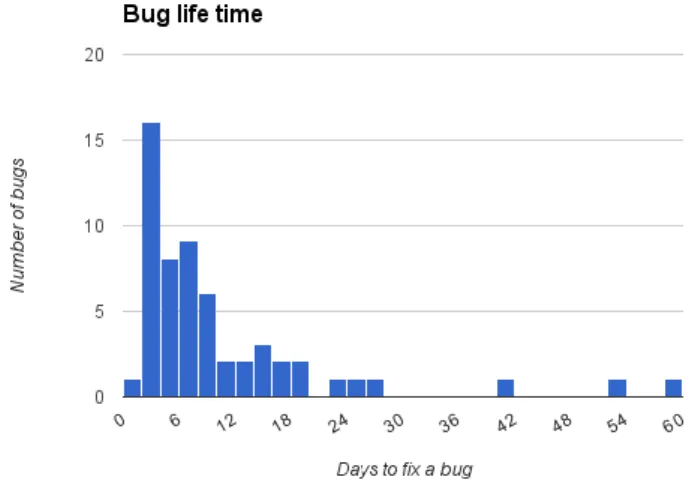
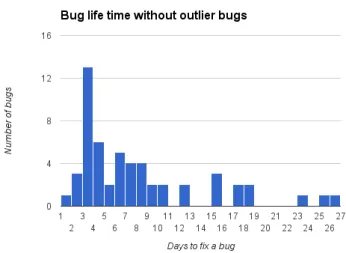
The last data gathered about bug reports were the time it took to fix them after they were discovered. In figure 3.3 all bugs reported are displayed. They show that most bugs are fixed in less then 12 days, but also that there are bugs that can live for upwards of 60 work days. In figure 3.4 the three extreme bugs are removed to provide a better view of the general life of bugs. It shows that few bugs are fixed within three days and most are fixed within ten days.
Average days for a bugfix 10 Average days without outliers 8
Table 3.2: This table shows the average days for a bug to be fixed in the ticket solution project.
3. Analysis
It is very difficult to gauge the difficulty of fixing a bug, but with averages of close to two working weeks indicates that feedback cycles are rather slow or that bug fixing is not prioritised. As a comparison, the lead times for a story in the current project (not the same as the bug data was collected from) are very similar, they are added during a sprint and are not really considered done until the end of the sprint which gives a rough estimate of eight to ten working days. It is important to note that any real definition of done can not be achieved until a story is acceptance tested which happen at the end of the project.
When gathering this data, attempts to track bugs through the commit comments were made to make some kind of measurement of the complexity of bugs and confirm if the long lead times were related to the difficulty of fixing bugs or rather the priority of fixing and approving them. Due to rather bad commit comments these efforts yielded no particular results. One possible reason for the long durations could be the use of testing hours. A fixed bug could be considered broken for an additional two days, more if a testing hour is skipped or postponed, before it gets crossed off. Further more, the time a bug may live could be increased by the fact that bugs are discovered in chunks, as seen in figure 3.2.
Figure 3.3: Display the frequency of bugs that live for X days.
3.5.3
Automating Acceptance Testing
As acceptance testing in the ticket solution project were a rather time consuming endeav-ourer that could take around 80 hours of manual work (R.P7), it becomes one of the big bottlenecks for implementing continuous delivery.
An analysis of what acceptance tests that can be automated and what they actually test were intended to give a picture of whether or not it is useful to implement automated testing at different levels like unit, integration or GUI. The results of this analysis can be seen in table 3.3. It quickly became apparent that unit test cases generally could be seen as too small to be able to cover acceptance tests. This is not saying that they do not provide usefulness, only that they are less useful at the acceptance testing level.
A large chunk of the acceptance test cases are centred around testing a specific feature (33,6%). For instance "Buy a ticket". While the acceptance test starts with navigating through different views and ends with a visual verification that the ticket is received and
3.5 Gathering Facts
Figure 3.4: Display the frequency of bugs that live for X days without three bugs that had abnormal long life.
that it remains after the application is rebooted. The core functionality of actually receiving a ticket could be tested without the graphical user interface. Verifying that a ticket is displayed correctly on the client phone would then have to be a separate acceptance test that needs to be run manually or automatically, but less often.
The evaluation of automating acceptance tests through the GUI is based on discussions with developers regarding what can and what can not be done within reasonable expecta-tions. One issue that was noticed during this evaluation were that the application needs to perform in a specific way when it is offline and it needs to be protected against manipu-lations of the internal clock. While these features can be checked automatically, they still add another layer of complexity to already difficult automation tasks, especially the clock manipulation appears to be rather difficult to automate. A preliminary analysis indicate that 50,4% the acceptance tests could be accomplished through automated testing. If of-fline mode and clock manipulation proves to be simpler then expected, this number could go up an additional 12%.
Finally, just below 40% of all acceptance tests seems more or less impossible to auto-mate, or simply to unreliable for them to give any beneficial results.
Functional tests without GUI 33,6%
Automated through GUI 62,4%
Automated through GUI without clock/flight mode manipulation 50,4%
Purely manual tests 37,6%
Table 3.3: This table contains estimates on the amount of accep-tance tests that can be automated.
3. Analysis
3.6
Survey
Towards the end of the thesis project, a short survey was sent out to both in-house and consultants working on customer sites to gauge their perceived knowledge about testing and SCM. Questions can be seen in appendix B. The goal with the survey was to con-firm a hunch that development in-house is less organised and does not set aside time to experiment with, for instance automated testing.
Participation in the survey was quite limited, only six in-house developers and six developers on customer sites as well as three scrum masters or agile coaches. This meant that the results are very unreliable and could not be used for much more then a basis for further investigation. The one outstanding result from the survey was that in-house developers in general felt less secure with dealing with SCM and test related tasks. This could indicate that project schedules do not include enough time to learn, or setting up working continuous delivery flows but teams are still expected to solve it themselves, which is summarised inR.P6.
3.7
Solution Requirements
With root causes formulated and facts gathered to strengthen the claims it was time to cre-ate some suggestions for solutions. To better do that a set of requirements were crecre-ated to help focus the solution into the desired direction. As the root cause analysis revealed problems with testing, and indicates that there are issues with continuous integration fo-cus will be put on improving that aspect of the delivery pipeline. Another aspect of the delivery pipeline, which in this report will be considered out of scope is automated deploy-ment. There simply were not time to do both. That said, having an automated deployment pipeline would probably be beneficial, especially down the line if more frequent releases gets implemented.
The first requirement is focused on increasing the communication between develop-ers and customdevelop-ers. The customer should be getting frequent updates of the software and the developers should get frequent feedback on their implementations. Feedback is a cor-ner stone in agile development and continuous delivery is an ideal setting where frequent communication is intended.
Req: Increase feedback between developers and customers.
To have the confidence to release often to customer the quality needs to be ensured. This means testing is required for every release at the least, ideally it should be for every commit. This gives the second requirement, that evaluation of the software should be possible continuously.
Req: Allow for a continuous evaluation of the software
To be able to further improve development, analysing data is an important part in dis-covering where bottlenecks exist. As mentioned in 3.5.2, it was difficult to track bugfixes due to bad commit comments. This made the analysis of why bug lives had high mean
3.7 Solution Requirements
values close to impossible. The third requirement is that any solution suggestion that is implemented should be easy to evaluate for future reference.
Req: The solution should be easy to evaluate
As the context for development is a bit different then from more conventional produc-tion companies, the need for preserving knowledge between different projects is increased. Further more the scale of projects can create situations where teams frequently change. Most importantly is probably that changes may not benefit the project they are first imple-mented in. Changes that directly benefit the current project are much easier to "sell" to a customer. This creates the final requirement that the solution need to focus on preserving knowledge from one project to another.
Req: Focus on improvements that are not unique for one project
This results in four requirements that are meant to guide the solutions towards the desired goal of a more iterative release process and start taking steps towards continuous delivery.
Chapter 4
Design
With the root causes defined in 3.4.1 and the scope limited with the help of requirements in 3.7 the work to address the problems began. As the root causes hint at two different problems, quality assurance and the ongoing process of improvement, so will the solutions be divided into two main parts. Epics if you will.
The first one is related to R.C1and R.C2and will focus on a more iterative process with smaller and more frequent releases. What solutions work the best in combination and whether or not it suits the current situation. In short it provides some suggestions to start moving towards continuous delivery.
The second part deals withR.C3and the costs of implementing these delivery pipelines. Providing reasoning for questions like "What setup is the most beneficial?" and "Could it be worth it?" are the goal.
4.1
Improving Development
As mentioned in the introduction to this chapter, the first part of the solutions focused on solving R.C1and R.C2. As the design process started it became apparent that some further analysis was needed. The question "Why do the developers not see an advantage with automated testing?" was asked.
The always present problem of lack of experience is recognised, not being confident to write good tests would definitely reduce willingness to write these tests. When looking at waterfall development, there are several stages where specialists perform different tasks, requirements engineering, development, testing. With agile development these lines all blur and developers need to adopt these other roles as well.
The main part of the problem most likely stems from that the current development pro-cess does not take advantage of being able to release often. If a release does not give good feedback to developers the reason for a release, from a developer perspective, becomes pointless. This was confirmed by looking at project plans for different ticket solution
4. Design
projects. Even though each sprint ends with a demonstration, the customer was not re-quired to actively give feedback on implementations. In short, developers only made one real release, and testing is used to ensure that the release was working.
To address this issue, this part of the solution is focused on increasing the frequency of releases but also make a release more valuable in terms of feedback to the developers.
4.1.1
More and smaller releases
The first step towards continuous delivery is to increase the frequency of releases. At the very least each sprint should be regarded as a release which is delivered to the customer, but not necessarily pushed to production. To achieve continuous delivery every story should be a potential candidate for release. This is probably not a sensible solution today due to the heavy load of manual acceptance testing, but every story should be stable enough to be considered a release candidate ready for manual acceptance testing, the final stage before a product goes into production. To achieve this, and to be able to take advantage of smaller releases, several of the other suggestions to improve development are focused around testing, and mainly automating parts of the testing to reduce the load of manual testing to make releases quicker, and benefit more from more releases.
As stated before, a release candidate does not have to go into production, but it should be sent to a customer and stories that are considered done need to get final approval from the customer. For this to work there needs to be a customer on the other end ready to receive a release, something that needs to be detailed in the project plans and agreed between customer and developer.
A good starting point would be to end every sprint with a release, where the customer is obligated to sign off on the specific stories implemented that sprint. This is relevant for both agile development but also fixed price projects, if the customer changes his or her mind later on they need to perform a change request.
To feel confident enough to release something to the customer, testing is needed. With more frequent releases, test runs needs to increase too. This is where automation comes in, it does not matter how many releases exist if steps are automated. With a foundation of automated tests, manual exploratory testing can be focused on areas that are affected by the new changes. Leaving other areas reasonably tested by automatic tests. A sensible place to start would be to automate unit and integration testing, and then acceptance testing. Down the line automating the release pipeline would help a great deal too, but that is something that is considered out of scope for this thesis.
4.1.2
Test ranking
With manual testing being as prevalent as it is, some way to reduce amount of testing required at different stages of development is necessary. Less testing means lower quality, and it becomes more important to choose relevant test cases that could catch defects in the new changes. As mentioned before, an estimation for acceptance testing is around 80 hours of manual work. This quickly becomes unsustainable if any form of increase in releases is attempted.
One solution is to not run all acceptance tests all the time, but rather to perform a basic test selection to try to identify relevant test cases. This is of course a risky approach, not
4.1 Improving Development
testing brings uncertainty. It relies on the assumption that recent changes have not broken past functionalities, preferably this assumption can be strengthened by having some lower level tests automated.
A simple way of categorise test cases is shown in table 4.1, the next step is to define what constitutes a rank one and what constitutes a rank four.
There is always the ever present issue of security, for the ticket solution project making sure that payments are done correctly would be considered extremely important.
Another very important acceptance test is to make sure that normal user behaviour works. Again, buying a ticket, but not just confirming that the payment goes through, but that the user can actually buy the ticket, receive and activate it, and that it is displayed correctly.
A less important function could be related to real time updates to traffic delays. Defi-nitely a nice feature, but in the grand scheme of things less important.
Finally, test cases that are the least important to run could be test cases for analytical functions, a bug in displaying mean values of tickets sold is not a show stopper.
run very often (1) run often (2)
run every now and then (3) run only at big releases (4)
Table 4.1:A simple way of categorising test cases
Having a list of the most important test cases has an additional benefit, they are prime candidates to automate, after all, doing a repetitive task is one of the best reasons for automating something. It could even be worth it to automate GUI testing for those.
These selection examples are focused on an constant importance of test cases. This is not always true, relevance of test cases increase and decrease depending on where a change occurred. This relates to one of the research questions posed in the beginning of this thesis, but due to an extended root cause analysis was not fully investigated. It remains clear that some adaptation of the test suite based on the actual changes is advantageous, and a good starting point would be to run test cases directly related to the current story and stories directly related to it.
As a final conclusion for test ranking, if manual testing remains as an important part some sort of selection criteria is necessary to reduce the test load but still make sure the application is working. It is also necessary to have the testing structured and documented to know what is working and how to test a specific feature. This is also necessary if test ranking is to be implemented, and test ranking gives the added benefit of indicating what test cases should be automated.
Test selection is one way to reduce test load, a better solution is to automate it and keep the complete coverage. In the real world some sort of combination would most likely be the most effective one.
4.1.3
Code coverage
A requested feature to help with test design has been code coverage. During the process for investigating the value with code coverage two research papers were reviewed. There
4. Design
are some advantages, as mentioned in an research paper by Stefan Berner et al[7].
One of these advantages were detecting new defects, mainly those not related to "blue skies", or as this thesis calls it, normal flow. Code coverage helps with this by highlighting the fact that error handling code is not accessed during testing.
The second interesting advantage was the complete opposite, by measuring code cov-erage a reduction in test cases testing the same code occurred. This is great when dealing with a changing code base, and keeps changes to the test code base to a minimum.
The paper goes on to list lessons learned. There were a lot of positive results, but one thing that stood out as very relevant for this thesis and the situation in the ticket solution project. It was their word of caution, "Do not introduce coverage analysis and visualization tools in projects without a reasonably usable automated test suite.".
During the interviews it was discovered that the server part of the system had some automated testing. This was mainly to test the normal flow of the program, but it means that the server could be ready to take advantage of code coverage, but the mobile applications are not.
The second paper[8] appears a bit more negative, it raises the issue of developers trust-ing the coverage too much. This is somethtrust-ing that is addressed in the first paper as well, it is important to be clear with what the coverage is supposed to help with, just using it to achieve code coverage is not an effective testing method.
As a final recommendation, do not implement test coverage until an automated test suite is in place. Use it to find areas of the code that are untested and finally, remember that 100% test coverage does not equal a well tested product.
4.1.4
Refocus project test flow
As shown in the testing triangle in figure 3.1, agile development relies on a foundation of easy to execute automated test cases to give developers quick feedback that their code is working as expected. While these test cases does not guarantee that the product as a whole will work, it increases the likelihood that two working components will work together as opposed to two untested components will work together. This contradicts the way testing is done in the ticket solution project where focus on automated testing is very low, especially on the mobile application side of the implementation.
Advantages with unit tests is that it gives confirmation that the core functionality work before manual testing begin. Simply put, it is pointless to manually test a product that is broken on a basic level. As the design pattern model-view-controller is being used, adopting automated unit and integration testing on the model should be fairly easy and a great starting point for automated testing. A logical next step would be to automate tests for the controller while leaving the viewer to last due to the inherent difficulty in automatically testing graphical user interfaces.
It could also be good to adopt test driven development (TDD), both for unit and inte-gration testing, but maybe even when creating acceptance tests, even if it is on an abstract level. In an research paper based on development at IBM[9] the effects of TDD are sum-marised with generally positive results. One of the most interesting points was the point about defect rate. "With TDD, unit testing actually happens" coupled with a 50% im-provement rate in functional defects detected. One of the most claimed positive effects from TDD is usually better design. This is only addressed in passing, no conclusive