Analyzing Web Service based Business Processes
Axel MartensHumboldt-Universit¨at zu Berlin Department of Computer Sciece Berlin (Adlershof), Germany [email protected]
IBM T. J. Watson Research Center Component Systems Group
Hawthorne (NY), USA [email protected] Abstract. This paper is concerned with the application of Web services to distributed, cross-organizational business processes. In this scenario, it is crucial to answer the following questions: Do two Web services fit together in a way such that the composed system is deadlock-free? – the question ofcompatibility. Can one Web service be replaced by an-other while the remaining components stay untouched? – the question of equivalence. Can we reason about the soundness of one given Web service without considering the actual environment it will by used in?
This paper defines the notion ofusability– an intuitive and locally prov-able soundness criterion for a given Web services. Based on this notion, this paper demonstrates how the other questions could be answered. The presented method is based on Petri nets, because this formalism is widely used for modeling and analyzing business processes. Due to the existing Petri net semantics for BPEL4WS – a language that is in the very act of becoming the industrial standard for Web service based business pro-cesses – the results are directly applicable to real world examples.
Keywords Business Process Modeling, Web Service, BPEL4WS, Tool based Verification, Petri nets
1
Introduction
Over the past years, the Internet has evolved from just a communication media into a platform for B2B integration. Emerging technologies and industrial stan-dards in the field of Web services enable a much faster and easier cooperation of distributed partners. This paper is concerned with the application of Web services to distributed, cross-organizational business processes.
The scenario AWeb service[1] is a self-describing, self-contained modular
ap-plication that can be published, located, and invoked over a network, e. g. the Internet. A Web service performs an encapsulated function and can be accessed via a standardized interface. In this paper, each local sub-process of each par-ticipating company is realized through one Web service. The composition of all Web services of all participating companies realizes the global business process. Instead ofone new specific technology, the Web service approach provides a stack of closely related technologies [4] to cover heterogeneity and distribution underneath a homogenous concept of components and composition. Among other
things, the language BPEL4WS [2] belongs to this stack. Due to this layered architecture, the presented analysis method can be focussed on the Web service’s BPELprocess model without losing generality or practical relevance.
The goal The Web service technologies define a technical framework to
imple-ment distributed business processes while a minimum of syntactic consistency is guaranteed. But as this paper will show, there is a need for more advanced analysis, and there exist effective methods that are able to support the develop-ment of Web services and Web service based business processes according to the Service oriented architecture (SOA [9]).
The service oriented architecture describes three roles: Theservice provider implements the Web service and publishes its description (the Web service model) to one or more repositories for potential users to locate. For him, it is crucial to determine errors and weaknesses of his service prior to publication. Hence, this paper presents the notion usability – a locally provable soundness criterion for a given Web service – that prevents publication of erroneous services. Theservice requestoris searching for a Web service that he could bind to his own components. For him, it is crucial to determine whether or not a given Web service does interact properly with his components. Hence, this paper defines the criterion ofsemantic compatibility and provides its verification.
Finally, theservice broker manages a repository and allows the service re-questor to find an adequate service. According to thequery-by-exampleapproach, he compares the actual Web service model (published by provider) with an ab-stract Web service model submitted by the requestor. Beside other use cases, the presentedequivalencecriterion provides a basis for the necessarymatchmaking.
The method Many of the Web services technologies are still in the
standard-ization process, and therefore some specifications will likely be changed several times until a consistent status is reached. Hence, the presented method refrains from the actual syntax of any proposed Web service modeling languages. Instead, it applies a generic formalism ofPetri nets[16] to addresses the core problems of distributed business processes. This formal method is widely used for mod-eling and analyzing business processes and Web services [21,5,6]. Applying the rich theory of distributed systems, the presented method is able to define and verifyusability,compatibilityandequivalenceof Web services. Moreover, the pre-sented results can easily be adopted to almost any concrete modeling language (e. g.WS-CDL[7],OWL-S[25] orYAWL[23]). In particular, there exists already a Petri net semantics for BPEL4WS [18] – a language that is in the very act of becoming the industrial standard for modeling Web service based business processes. Hence, the method is directly applicable to real world examples.
The remaining paper is structured as follows: Section 2 gives a short intro-duction to Petri nets and describes the structure and composition of workflow modules– the formal model of a Web Sevice. Section 3, discusses and defines the notion ofusabilityby help of examples, and derives the properties of compatibil-ity andequivalence. Section 4 establishes the core section of this paper: Applied
p2 p3 p4 p5 p6 p7 p8 p0 p1 Module Route Planning Itinerary Means of Travel Selection Get Itinerary Collect Information Rough Planning Detailed Planning Send Schedule Change Plan Provide Facilities Route Planning q2 q0 q1 Choose Facilities Await Facilities Module Default Itinerary Route Planning s2 s0 s1 Receive Schedule Send Itinerary Module Customer
Fig. 1.Modeling with Petri nets
to an example, the verification algorithm is presented. Finally, Section 5 summa-rizes the results and discusses their correlation to other published approaches.
2
Modeling
TheBusiness Process Execution Language for Web Services BPEL4WS[2] pro-vides a syntax to describe Web service process models. But, its semantics so far is defined only by English prose or encoded into middleware components, more ore less accurately. To verify properties like properties compatibility or equivalence of two models a formal semantics of all its concepts is needed. The presented method is based on a Petri net semantics [18]. Petri nets are a well established method for modeling and analyzing (cross-organizational) business processes [20,21,8]. They possess an intuitive graphical representation as well as an algebraic foundation, and therefore Petri nets allow an effective analysis. Other recent research projects apply Petri nets to Web Services [6,15], too.
In contrast to the mentioned Petri net semantics, the current approach ab-stracts from data aspects. This is an usual procedure in the field of computer aided verification. On the one hand, a model without data has the disadvan-tage of less precision (i. e. a more general behavior), but on the other hand, this enables analysis methods yielding important results that are not applicable to models with full expressive power of arbitrary data objects. The mapping of a BPELprocess model into an analyzable Petri net is explained in [13].
2.1 Modeling with Petri nets
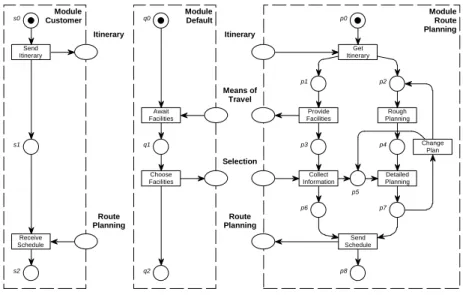
Figure 1 shows Petri net models of three Web service: A route planning service, a services that acts as mediator and a customer’s service. These examples will
be used to demonstrate the modeling method, and to visualize composition and compatibility of Web services. But first, some basic Petri net notions have to be introduced:
Petri nets APetri net N= (P, T, F) consists of a set oftransitions T(boxes),
a set ofplaces P(ellipses), and aflow relation F (arcs) [16]. A transition repre-sents a dynamic element, i. e. an activity of a business process (e. g.Get Itinerary). A place represents a static element, i. e. the causality between activities or a message channel (e. g.Itinerary). Themarking (i. e. state) of a Petri net is repre-sented by blacktokens distributed over the places (see placesp0, q0ands0). A transitiont is enabled if on each placep,(p, t)∈Fthere is at least one token. If an enabled transitiont fires,t removes one token from each placep1,(p1, t)∈F
and produces one token on each placep2,(t, p2)∈F. Based on thisfiring rule, it
is possible to reason about the behavior of a Petri net in term offiring sequences, reachable states and/orconcurrent runs (cf. [17]).
Workflow modules A stateful Web service defines an internal process (i. e.
activities building its internal structure), and an interface to communicate with other Web services. Hence, the Petri net model of such a Web service consists of aworkflow net – a special Petri net that has two distinguished places (α, ω ∈P) to denote the begin and the end of a process [21] – supplemented by a set of interface places – each of them representing one directed message channel. Such a model is calledworkflow module.
Definition 1 (Module). A finite Petri net M = (P, T, F) is called workflow
module(or just module) if the following conditions hold:
(i) The set of places is divided into three disjoint sets: internal places PN, input placesPI and output places PO.
(ii) The flow relation is divided into internal flowFN ⊆(PN×T)∪(T×PN) and communication flow FC⊆(PI×T)∪(T×PO).
(iii) The net PM = (PN, T, FN)is a workflow net.
(iv) No transitions is connected both to an input place and an output place. Within a workflow moduleM, the workflow net PM is called theinternal pro-cess of M and the tuple I(M) = (PI, PO) is called its interface. Lets have a closer look on the module Route Planning shown in Figure 1. The internal pro-cess is triggered by an incoming Itinerary. Then the control flow splits into two concurrent threads. On the left side, an available Means of travelare offered to the customer and the service awaits hisSelection. Meanwhile, on the right side, a
Rough Planningmay happen. The Detailed Planningrequires information from the
customer. Finally, the service sends aRoute Planningto the customer.
2.2 Composing Workflow modules
A distributed business process is realized by the composition of a set of Web ser-vices. The following section defines the pairwise composition of workflow mod-ules. Because this yields another workflow module, composition of more than two modules is realized by recurrent application of pairwise composition.
p2 p3 p4 p5 p6 p7 p8 p0 p1 Module Default Planning q2 q0 q1 Init Final Itinerary Means of Travel Selection Route Planning
(a) A composed Web service model
s2 s0 s1 p2 p3 p4 p5 p6 p7 p8 p0 p1 Module Planning Process q2 q0 q1 Init Final Itinerary Means of Travel Selection Route Planning Module Planning Process
(b) A composed business process model Fig. 2.Composition of workflow modules
Compatibility Figure 1 shows the moduleDefaultin the middle. The purpose
of this service is to unburden the customer from making a selection: The module consumes the message on available Means of travel and returns a default Selec-tion. Intuitively, it looks like the modules Default and Route Planning could be composed. Formally, we will define the property of syntactic compatibility as a precondition for composition of two modules.
Definition 2 (Syntactic compatibility). Two workflow modules are called
syntactically compatibleif both internal processes are disjoint, and each common place is an output place of one module and an input place of the other.
Referring to previous definition, the modulesDefaultandRoute Planningare syn-tactically compatible. Nevertheless, this is not a sufficient criterion for proper interaction between two partners. Lets consider a workflow module of an online shop and a workflow module of a customer: The customer sends the payment after he has received the ordered product, whereas the online shop waits for pay-ment before sending the product. Both modules have a syntactically compatible interface, but the resulting distributed process leads to a deadlock. To avoid such errors, Section 3.2 will define the property ofsemantic compatibility.
Composition As the example has shown, two syntactically compatible modules
do not need to have a completely matching interface. They might even have a completely disjoint interface. When two modules are composed, the common places are merged and the dangling input and output places become the new interface. To achieve a syntactically correct workflow module, it is necessary to add new components for initialization and termination.
Definition 3 (Composed system).LetA= (Pa, Ta, Fa)andB= (Pb, Tb, Fb) be two syntactically compatible modules. Let αs, ωs ∈/ (Pa∪Pb) two new places andtα, tω ∈/ (Ta∪Tb)twonewtransitions. Thecomposed systemΠ=A⊕B is given by(Ps, Ts, Fs), such that:Ps=Pa∪Pb∪ {αs, ωs},Ts=Ta∪Tb∪ {tα, tω} andFs=Fa∪Fb∪ {(αs, tα),(tα, αa),(tα, αb),(ωa, tω),(ωb, tω),(tω, ωs)}.
If the composed system contains more than one components for initialization and termination, the corresponding elements are merged.
It can be easily proven that the composition of two syntactically compatible workflow modules always yield a workflow module, too. This is because of the additional components for initialization and termination. If more than two mod-ules are composed, it is important to guarantee associativity of pairwise com-position (i. e. (A⊕B)⊕C = A⊕(B⊕C)). Hence, if there are already such syntactic components, they are merged while composition (cf. Figure 2(b)). In Figure 2(a), the workflow module Default Planning is shown – the model of the composed Web service Route Planning⊕Default. This service offers a simpler in-terface to the customer: He only has to submit theItinerary to obtain the Route
Planninginformation. To use this service, it is not relevant for a customer wether
or not the actual service was deployed at once or was formed by composition.
Environment The composition of two workflow modules A and B yields a
model of a distributed business process, if both sets of interface places completely match, i. e. the composed systemΠ=A⊕Bhas an empty interface. With other words,Π is also a workflow net. In that case, moduleAis called anenvironment of moduleB – obviously, this notion is symmetric.
The moduleCustomershown in Figure 1 is an environment of the (composed) moduleDefault Planningand vice versa. Figure 2(b) shows the resulting workflow net. While composing both modules, the existing and the new added components for initialization and termination are merged, as already mentioned.
Given a workflow module and its environment, it is possible to reason about the soundness of the composed process model. This notion is an established quality criterion for workflow nets [21]. Basically, it requires each initiated process to reach eventually a proper final state. Additionally, each transition should be relevant, i. e. there should be at least one firing sequence of the process in which this transition participates. Although the second requirement was reasonable if a business process was modeled from scratch, in the Web service approach, a process arises from composition of several predefined components. Due to this, a workflow net is acceptable even if not all functionality of each specific component is used in that system. Hence, a slightly alleviated criterion is used in this paper.
Definition 4 (Weak soundness).A workflow net(P, T, F)with the final place
ω∈P is called weak soundif the following conditions hold:
(i) For each reachable markingmholds: the final marking[ω]is reachable. (ii) For each reachable marking mwith m≥[ω]holds: m= [ω].
The weak soundness of the module Planning Process shown in Figure 2(b) can be easily proven. Because of that, intuitively, the modules Default Planning and
C1 ?t ?t !v T1 ?e !t ?v !e VISA eCash Ticket p0 p2 p1 VISA eCash Ticket q0 q2 q1 q3
(a) An usable ticket service
C2 ?t !v T2 ?e !t ?v !e VISA eCash Ticket p0 p3 p1 VISA eCash Ticket q0 q1 q2 !t p2
(b) A non usable ticket service Fig. 3.Usability of workflow modules
Customer seem to be semantically compatible. In Section 3.1, the core notion of
usability will be discuss and precisely defined. Based on this notion, definition ofsemantic compatibility can be derived that meets this intuition.
3
Properties
This section discusses the property of usability – the proposed soundness cri-terion for workflow modules – and derives the definitions of compatibility and equivalence. Obviously, the purpose of a Web service is to be bound to other com-ponents such that a proper realization of a distributed business process arises. Hence, the purpose of a workflow module is to be composed with an environ-ment such that the resulting workflow net is at least weak sound. But, for a given module there might exist infinitely many possible environments. The question is: How many of these environments have to match to call the given moduleusable?
3.1 Usability
An example of a ticket service and a customer is used to address the question above. Figure 3(a) shows a workflow module C1representing the customer and a module T1, which models the ticket service. The ticket service initiates the communication by sending aTicketand waits for payment (eitherVISAoreCash). By receiving theTicket, the customer solves an internal conflict and determines the kind of payment. The composed systemC1⊕T1is weak sound, and therefore it seems reasonable to call these two modules semantically compatible. Is this enough to call both modulesusable, as well?
Figure 3(b) shows two slightly modified workflow modulesC2 and T2. The ticket service solves an internal conflict and sends theTicket. Thereafter, module
T2is either in statep1waiting foreCashonly, or in statep2waiting forVISAonly. The customer receives the Ticket and has the choice between the two kinds of payment. But, he does not know the internal state of the ticket service module. Hence, he might choose the “wrong” payment, and the composed systemC2⊕T2
Obviously, these two modules arenot semantically compatible. To locate the modeling error, lets consider the other two possible combinations: The system
C2⊕T1is also weak sound, whereas the systemC1⊕T2may reach a deadlock, too. Hence, there are two compatible environments for module T1and no com-patible environment for module T2. By help of the developed analysis method (cf. Section 4), it can be proven that there can’t be any environment that forms a weak sound composed system together with module T2. This is because of a severe error in module T2: An internal decision is made and not communicated properly to the environment. This type of errors is known in the literature as thenon local choice problem[3]. Consequently, the moduleT2isnot usable.
For both modulesC1andC2, there is one compatible environment (T1) and one incompatible environment (T2). One might think of calling a moduleusable ifall possible environments form a weak sound composed system together with that module. In that case, both modulesC1andC2would benotusable – because of the environment T2. However, this definition is unfair: the error within the module T2 should not determine the quality of moduleC1. Moreover, for each given module it is possible to construct amalicious environment(cf. [12]). Hence, this paper proposes a more appropriate definition of usability:
Definition 5 (Usability). Let M be a workflow module. An environment U
utilizes module M if the composed system Π =M ⊕U is weak sound. Module M is called usableif there exists at least one environment U that utilizesM. Thus, the modulesC1,C2andT1are called usable. Section 4 presents the algo-rithm to decide usability of a workflow module by creating an utilizing environ-ment (if possible). A further discussion on usability can be found in [11].
3.2 Compatibility
In the previous section, the notion ofsemantic compatibility has already be men-tioned. Now, a definition of this notion shall be derived. There are two cases: If a workflow module and its environment are given, obviously, they are semantically compatible if the composed system is weak sound. But, if there are two arbitrary modules (e. g. modulesDefaultandRoute Planningshown in Figure 1), a different definition is required. Obviously, two modules are not compatible in case the composed system has an error, i. e. the resulting module is not usable. Hence, this paper proposes the following definition.
Definition 6 (Semantic compatibility).Two syntactically compatible
work-flow modulesAandB are called semantically compatibleif the composed system A⊕B is usable.
Thus, the modulesDefaultandRoute Planningare semantically compatible. More-over, this definition also cover the composition of a module and its environment: Because the composition of those two modules yields workflow module with an empty interface (cf. Figure 2(b)), it is easy to find an utilizing environment – with an empty interface, too. Consequently, each weak sound composed sys-tem is usable. Hence, the modulesDefault PlanningandCustomerare semantically compatible. More details on compatibility can be found in [10].
3.3 Equivalence
There are many use cases, where it is crucial to decide whether two Web services behave similar, i. e. their models are equivalent. Beside the already mentioned problem of discovery (cf. Section 1), the problem arises if a Web service – being already part of a global business process – needs to be replaced, e. g. because of efficiency. Of course, all other participating components should stay untouched. Intuitively, two Web services are equivalent if in acomparable situationone Web servicebehaves likethe other and vice versa. Concerned with various formal methods, there are countless approaches published dealing with the comparison of behavior in terms of simulation or equivalence. This variety results from dif-ferent interpretations of the terms “comparable situation” and “behave like” ([24] gives a substantial overview on equivalence notions). But, none of them seems to fit exactly to this field of application: The purpose of a Web service is to be used by an environment. Hence, an adequate notion of simulation or equivalence, first of all, should be derived semantically from the field of application.
Definition 7 (Simulation/Equivalence). A workflow module Asimulates a
workflow module B if each utilizing environment of module B is an utilizing environment of module A, too. Two workflow modules A and and B are called equivalent, if module Asimulates moduleB and module B simulates moduleA. This definition exactly meets the requirement of the cross-organizational business process scenario: Lets consider a workflow moduleM and an utilizing environ-mentE. For each moduleM0simulatingM and for each moduleE0simulatingE holds:E0is an utilizing environment ofM0and vice versa. This property follows directly from Definition 7.
In this approach, the verification of equivalence is based on a formal simu-lation resimu-lation between the communication graphs of both workflow modules – the explicit representation of the module’s externally visible behavior, explain in the following section. Because of limited space a detailed discussion is omitted here, but some results are presented: The workflow modules C1and C2(shown in Figure 3) can be proven equivalent, whereas e. g. classical bisimulation does not yield this result. In contrast, the workflow modulesT1andT2are proven to be not equivalent, whereas referred totrace equivalence those modules can’t be distinguished. These examples, the comparison of selected notions of equivalence and the precise definition of the verification algorithm can be found in [13].
4
Analysis
The usability of a workflow module is defined through the existence of an uti-lizing environment. Hence, the definition does not describe how to disprove the usability of a given Web service. This section provides a different approach: First, an adequate representation of the Web service’s external behavior is derived – called thecommunication graph. Second, the usable behavior of the Web service is determined – called the u-graph. Finally, the usability of a given workflow module and the algorithmic constructing its usability graph are related within the core theorem, such that usability can be decided effectively.
Ticket VISA eCash [ ] Ticket eCash [ ] VISA [ ] Ticket VISA eCash [ ] Ticket eCash [ ] VISA [ ] VISA [ ] eCash [ ] [ q0 ] [ q3 ] [ p0 ] [ p1 ] [ p2 ] C(C1) [ q0 ] [ q3 ] v0 v1 h1 C(T1) C(T2) v0 v1 h1 [ p0 ] [ p1 ] [ p2 ] [ p3 ] [ p2, e ] [ p1, v ] [ p3 ] [ p3, v ] [ p3, e ] C(T2) v3 v4 h3 h4 v1 v2 h1 h2 v0 h5 h3 v1 v2 h1 h2 v0
Fig. 4.Communication and usability graphs
4.1 Reflecting the behavior
A workflow module is a reactive system, it consumes messages from the environ-ment and produces answers depending on its internal state. Problems may arise because an environment has noexplicit information on the internal state of the module. But each environment can derive some information by considering the communication towards the module. Hence, an environment has some implicit information. We reflect exactly that kind of information within a data structure – called the communication graph (abbr.c-graph).
Definition 8 (Communication graph/c-graph). A communication graph
((V, H, E), m)is a directed, strongly connected, labeled, bipartite graph such that:
– The graph has two kinds of nodes:visible nodesV and hidden nodesH.
– Each edgee∈E connects two nodes of different kinds.
– The graph has a definite root nodev0∈V, each leaf is a visible node, too.
– The labelingm maps each visible node to a set of states of the corresponding Petri net, and each edge to a bag of messages.
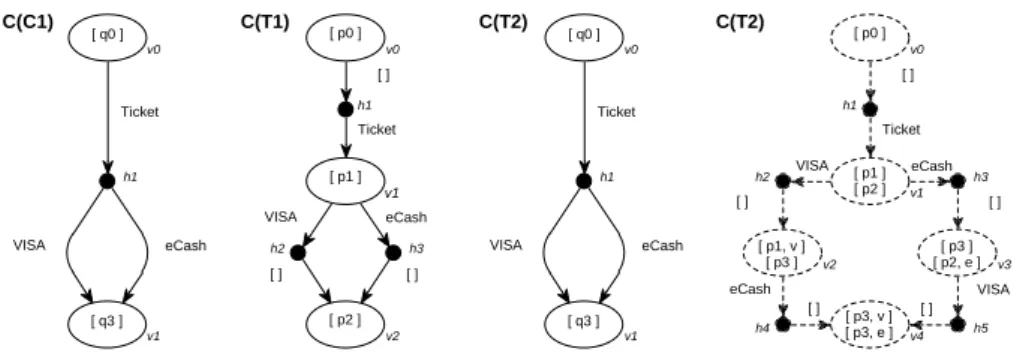
Figure 4 presents the c-graphs of those workflow modules shown in Figure 3; Section 4.2 will explain why one graph is drawn with dashed lines. Lets have a closer look on the graphC(C1). The root nodev0is labeled with the initial state of the module [q0]1.
Each edge, starting at a visible node, is labeled with a bag of messages sent by the environment – calledinput. In the initial state, the module C1is able to consume only the messageTicket. Each edge, starting at a hidden node, is labeled with a bag of messages sent by the module – calledoutput. In the example, the customer replies to theTicketby paying either withVISAor witheCash. An edge may be labeled with an empty bag as well, denoted by [ ]. Each path from the root to a leaf represents a complete communication sequence between the module an an environment. In general, a visible node may be labeled with more than one 1 The actual labeling of the nodev0 is{[q0]}– the singleton containing the state [q0]. For reasons of simplicity, we omit these extra braces as well as the brackets around the bags of messages.
state (e. g.v1inC(T2)), and an edge may be labeled with more than on message (not present in the chosen examples). The c-graph of a given workflow module is well defined, and it can be calculated based on the following notions:
Activated input: Referring to a given state, an activated input is a bag of input messages that are consumed by the module along a firing sequence, whereas no output message was produced and the firing sequence ends either in the module’s final state or in a state that enables a transition that can produce an output message. The functioninpyields the set of activated inputs.
Successor state: Referring to a given state, a successor state is a maximal reach-able state w. r. t. one possible behavior (i. e. oneconcurred run[17]) of the mod-ule. The functionnxt yields the set of successor states.
Possible output: Referring to a given state, a possible output is the bag of output message that was produced while reaching one successor state. The functionout yields the set of possible outputs.
Communication step: A four-tuple (z, i, o, z0) is called communication step if z, z0 are states of a module,i is an input ando is an output, and (z0+o) is a successor state of (z+i).S(M) denotes the set of all communication steps.
The c-graph of a workflow module may contain cycles. That doesn’t affect the presented analysis method as long as the graph is finite. But, workflow modules with an infinite c-graph always contain an severe modeling error. The precise, mathematical definition of all notions mentioned above, a discussion on the complexity of the algorithm and possible optimizations, and the problem of infinite graphs is discussed in [12]. Applying these notions, we are now able to present the construction of the c-graph. The algorithm starts with the root node v0 labeled with the initial state:
1. For each state within the label of vk calculate the set of activated inputs:
S
z∈m(vk)inp(z).
2. For each activated inputi within this set:
(a) Add a hidden nodeh, add a new edge (vk, h) with the labeli.
(b) For each state within the label ofvkcalculate the set of possible outputs:
S
z∈m(vk)out(z+i).
(c) For each possible outputo within this set:
i. Add a visible nodevk+1, add a new edge (h, vk+1) with the labelo.
ii. For each state z ∈ m(vk) and for each communication step (z, i, o, z0)∈ S(M) addz0 to the label ofv
k+1.
iii. If there exists a visible nodevsuch thatm(vk+1) =m(v) then merge
v andvk+1. Otherwise, goto step 1 with nodevk+1.
The c-graph of a workflow module contains the maximal information an environ-ment can derive. The environenviron-ment always sends only those messages the module is able to consume (in at least one of the possible reached states), but enough to achieve an answer or to terminate the process in a proper state. By considering all reachable successor states (and all possible outputs), the choices within the module are not restricted.
4.2 Analyzing the behavior
In general, the c-graph may have several leaf nodes. But in each c-graph, there is at most one leaf node that is labeled with the defined final state of the workflow module. All other leaf nodes contain at least one state, where there are messages left or which is a deadlock state of the module (e. g.v4in C(T2)). Consequently, if an environment was communicating with the module according to the labels along the path towards such a leaf node, this environment would not be an utilizing environment. The elimination of all such erroneous sequences yields a (possibly empty) subgraph that can be regarded as directions for using the module – called theusability graph (abbr.u-graph). of that module.
Definition 9 (Usability graph/u-graph).A finite, non-empty subgraph U of
the c-graph C is called usability graphif the following conditions hold:
– U contains the root node of C and only that leaf node of C, which is labeled with the defined final state of the workflow module.
– For each hidden node of C that is in U, all outgoing edges are in U, as well.
– Each node within U lies on a path between the root and the defined leaf node. An u-graph arises by removing only those edges (and succeeding nodes) that start at a visible node. Hence, it restricts the behavior of an utilizing environment (some inputs are removed), but it does not restrict the behavior of the module (alloutput are still available). In that sense, an u-graph of a workflow module describes ainstruction manual for a possible environment.
In Figure 4, those parts of the c-graphs that does not belong to any u-graph are drawn with dashed lines. The graph C(T2) does not contain any u-graphs. Hence, this module is not usable. Referring to modules C1 and C2, the whole c-graph is their only graph. But in general, a c-graph may contain several u-graphs. The whole graph C(T1) is an u-graph, and removing the hidden node h2 (or h3, resp.) yields another u-graph, i. e. this ticket module can be used as well by a customer who exclusively pays with eCash (or VISA, resp.). To find the maximal u-graph, the algorithm walks backwards through the c-graph, and removes nodes according to Definition 9.
4.3 Theorem of usability
An u-graph U of a module M can easily be transformed into an environment of the M: Each node of the graph becomes a place, each edge starting at a visible node becomes a sending transition, and each remaining edge becomes a receiving transition of the environment. The resulting module is called the constructed environment, denoted by Γ(U). Based on the restrictions ofU, it is easy to prove that the composed workflow module M⊕Γ(U) does not contain any deadlock. IfM⊕Γ(U) also does not contain any livelock (i. e. the composed module always can terminate), the constructed environmentΓ(U) is an utilizing environment of M. The following theorem formulates the correlation between the usability of a workflow module and the existence of an u-graph:
Theorem 1 (Usability).Let M be a workflow module and let C be the c-graph of M. The module M is usable, if and only if C contains at least one u-graph U and the composed systemM ⊕Γ(U)always can terminate.
The entire proof can be found in [12]. The following paragraph sketches its idea.Implication: As already mentioned, it can be proven easily thatM⊕Γ(U) does not contain any deadlock. Hence, if the composed system terminates, it must have reached the desired final state, otherwise it would have reached a deadlock. Thus,Γ(U) is an utilizing environment ofM. In case M is an acyclic module, termination is granted, and the theorem only requires the existence of an u-graph.Revers implication: If the moduleM is usable, there is at least one utilizing environmentE. Based on this property it is possible to project the all reachable states of the composed system M ⊕E to the c-graph of M (without sticking to one specific environment). This yields a subgraphC0⊆C, which can be proven to meet the requirements of Definition 9. Hence,Γ(C0) is an utilizing environment ofM.
The theorem on usability makes it possible to decide usability in many cases: An acyclic workflow module has a finite c-graph. Thus, we can search for an u-graph and decide usability. The most cyclic modules have a finite c-graph, too. Even if an usable cyclic module has an infinite c-graph, there exists a finite u-graph. Applying breadth-first-search, this graph will be found after finite time.
5
Summary
In this paper, a framework for modeling and analyzing Web service based busi-ness processes by help of Petri nets was presented [12]. Each Web service has an interface and an internal process structure. Hence, a Web service is modeled in terms of a workflow module – a workflow net with a set of interface places. Based on this formalism, the notion of usability was defined – an intuitive and locally provable soundness criterion for workflow modules. On top of usability, the questions compatibility and equivalence could be precisely addressed, and there are effective algorithms to verify all these properties. Due to the available Petri net semantic of BPEL4WS [18], the method is directly applicable to real world examples.
Of course, the current work was inspired by many other approaches, dealing with the problems of cross-organizational workflow and Web services. Some ap-proaches also use Petri nets [20,6] and/or specify the global interaction by help of Message Sequence Charts (MSC) [22,8]. But, none of them presents such a focussed view on a components externally visible behavior as the communica-tion graph does. Due to this representation, the comparison of behavior is more adequate w. r. t. the field of application than traces [24] or automaton [26].
All presented algorithms are implemented within the prototypeWombat4ws
[27]. Currently, the work is focussed on improving the algorithms’ efficiency by the application of partial order reduction techniques [19]. Moreover, up to a certain degree the integration of data aspects into the formalism is planned. Es-pecially the dependencies between the content of incoming message and internal
decisions made by the process are the focussed target. Applying technologies of static program analysis (e. g.slicing[14]), it seems possible, to achieve a higher level of precision in mapping a given process model into a Petri net, without loosing the possibility of efficient analysis.
References
1. Gustavo Alonso, Fabio Casati, Harumi Kuno, and Vijay Machiraju. Web Services. Springer-Verlag, December 2002.
2. Andrews, Curbera, Dholakia, Goland, Klein, Leymann, Liu, Roller, Smith, Thatte, Trickovic, and Weerawarana. BPEL4WS – Business Process Execution Language for Web Services. OASIS, Standard proposal, Version 1.1, July 2002.
3. H. Ben-Abdallah and S. Leue. Syntactic detection of process divergence and non-local choice in message sequence charts. LNCS 1217. Springer Verlag, 1997. 4. Karl Gottschalk. Web Services architecture overview. IBM developerWorks,
Whitepaper, September 2000. http://ibm.com/developerWorks.
5. Paul W.P.J. Grefen and Samuil Angelov. Three-Level Process Specification for Dynamic Service Outsourcing. LNCS 2472. Springer-Verlag, 2003.
6. Rachid Hamadi and Boualem Benatallah.A Petri Net based Model for Web Service Composition. InProc. of ADC 2003. Australian Computer Society, Inc., 2003. 7. Kavantzas, Burdett, Ritzinger, and Lafon.Web Services Choreography Description
Language. W3C Working Draft, Version 1.0, October 2004.
8. E. Kindler, A. Martens, and W. Reisig.Inter-operability of Workshop Applications – Local Criteria for Global Soundness. LNCS 1806. Springer-Verlag, 2000. 9. Heather Kreger. WSCA – Web Services Conceptual Architecture. IBM Software
Group, Whitepaper, 2001. http://ibm.com/webservices/pdf/WSCA.pdf.
10. Axel Martens. On compatibility of web services. Petri Net Newsletter, 65:12–20, October 2003.
11. Axel Martens.On Usability of Web Services.In Calero, Diaz, and Piattini, editors, Proc. of Intl. Conference Workshop WQW 2003, Rome, Italy, December 2003. 12. Axel Martens. Verteilte Gesch¨aftsprozesse – Modellierung und Verifikation mit
Hilfe von Web Services. PhD thesis, WiKu-Verlag Stuttgart, 2004.
13. Axel Martens. Simulation and equivalence between bpel process models. InProc. of Intl. Conference DASD’05, San Diego, California, April 2005.
14. Flemming Nielson, Hanne R. Nielson, and Chris Hankin. Principles of Program Analysis. Springer-Verlag, 1999.
15. Alexander Norta. Web Supported Enactment of Petri-Net Based Workflows with XRL/flower. LNCS 3099. Springer-Verlag, June 2004.
16. W. Reisig. Petri Nets. Springer-Verlag, 1985.
17. W. Reisig. Elements of Distributed Algorithms – Modeling and Analysis with Petri Nets. Springer-Verlag, 1998.
18. K. Schmidt and Ch. Stahl. A Petri net semantic for BPEL. In Ekkart Kindler, editor,Proc. of 11th Workshop AWPN. Paderborn University, October 2004. 19. Karsten Schmidt. Explicit State Space Verification. Postdoctoral thesis,
Hum-boldt-Universit¨at zu Berlin, 2002.
20. W. M. P. van der Aalst. Modeling and Analyzing Interorganizational Workflows. InProc. of CSD’98. IEEE Computer Society Press, 1998.
21. W. M. P. van der Aalst. The Application of Petri Nets to Workflow Management. Journal of Circuits, Systems and Computers, 8(1):21–66, 1998.
22. W. M. P. van der Aalst. Interorganizational Workflows – An Approach based on MSC and Petri Nets. Systems Analysis - Modelling - Simulation, 34(3), 1999. 23. W.M.P. van der Aalst and A.H.M. ter Hofstede. Yawl: Yet another workflow
lan-guage. Qut technical report, fit-tr-2003-04, Queensland University of Technology, Brisbane, Australia, 2003.
24. Rob J. van Glabbeek. The Linear Time - Branching Time Spectrum. In Baeten and Klop, editors,Proceedings CONCUR 90, LNCS 458. Springer-Verlag, 1990. 25. Web-Ontology Working Group.Ontology Web Language for Web Services.OWL-S
1.1, November 2004.
26. A. Wombacher, P. Fankhauser, B. Mahleko, and E. Neuhold. Matchmaking for Business Processes. InProc. of EEE-04. IEEE Computer Society, 2004.
27. Wombat4ws.Workflow Modeling and Business Analysis Toolkit for Web Services. hompage,http://www.informatik.hu-berlin.de/top/wombat/.