c
h
a
p
t
e
r
Vectors
3.1 Coordinate Systems
3.2 Vector and Scalar Quantities
3.3 Some Properties of Vectors
3.4 Components of a Vector and Unit Vectors
C h a p t e r O u t l i n e
When this honeybee gets back to its hive, it will tell the other bees how to re-turn to the food it has found. By moving in a special, very precisely defined pat-tern, the bee conveys to other workers the information they need to find a flower bed. Bees communicate by “speaking in vectors.” What does the bee have to tell the other bees in order to specify where the flower bed is located relative to the hive? (E. Webber/Visuals Unlimited)
3.1 Coordinate Systems 59
e often need to work with physical quantities that have both numerical and
directional properties. As noted in Section 2.1, quantities of this nature are
represented by vectors. This chapter is primarily concerned with vector
alge-bra and with some general properties of vector quantities. We discuss the addition
and subtraction of vector quantities, together with some common applications to
physical situations.
Vector quantities are used throughout this text, and it is therefore imperative
that you master both their graphical and their algebraic properties.
COORDINATE SYSTEMS
Many aspects of physics deal in some form or other with locations in space. In
Chapter 2, for example, we saw that the mathematical description of an object’s
motion requires a method for describing the object’s position at various times.
This description is accomplished with the use of coordinates, and in Chapter 2 we
used the cartesian coordinate system, in which horizontal and vertical axes
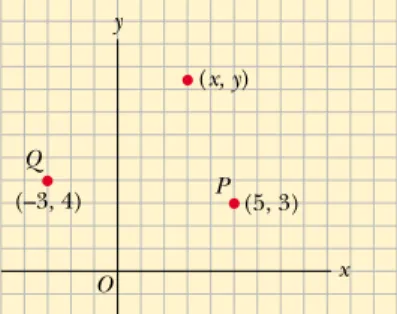
inter-sect at a point taken to be the origin (Fig. 3.1). Cartesian coordinates are also
called rectangular coordinates.
Sometimes it is more convenient to represent a point in a plane by its plane
po-lar coordinates
(r,
), as shown in Figure 3.2a. In this polar coordinate system, r
is the
distance from the origin to the point having cartesian coordinates (x, y), and
is
the angle between r
and a fixed axis. This fixed axis is usually the positive x
axis,
and
is usually measured counterclockwise from it. From the right triangle in
Fig-ure 3.2b, we find that sin
y/r
and that cos
x/r. (A review of trigonometric
functions is given in Appendix B.4.) Therefore, starting with the plane polar
coor-dinates of any point, we can obtain the cartesian coorcoor-dinates, using the equations
(3.1)
(3.2)
Furthermore, the definitions of trigonometry tell us that
(3.3)
(3.4)
These four expressions relating the coordinates (x, y) to the coordinates (r,
)
apply only when
is defined, as shown in Figure 3.2a — in other words, when
posi-tive
is an angle measured counterclockwise
from the positive x
axis. (Some scientific
calculators perform conversions between cartesian and polar coordinates based on
these standard conventions.) If the reference axis for the polar angle
is chosen
to be one other than the positive x
axis or if the sense of increasing
is chosen
dif-ferently, then the expressions relating the two sets of coordinates will change.
Would the honeybee at the beginning of the chapter use cartesian or polar coordinates when specifying the location of the flower? Why? What is the honeybee using as an origin of coordinates?
Quick Quiz 3.1
r
√
x
2y
2tan
y
x
y
r sin
x
r cos
3.1
W
2.2 Q P (–3, 4) (5, 3) (x, y) y x O O (x, y) y x r θ (a) θ (b) x r y sin θ = yr cos θ =xr tan θ = xy θ θ θFigure 3.1
Designation of points in a cartesian coordinate system. Every point is labeled with coordi-nates (x, y).Figure 3.2
(a) The plane polar coordinates of a point are repre-sented by the distance rand the an-gle , where is measured counter-clockwise from the positive xaxis. (b) The right triangle used to re-late (x, y) to (r, ).You may want to read Talking Apes and Dancing Bees(1997) by Betsy Wyckoff.
VECTOR AND SCALAR QUANTITIES
As noted in Chapter 2, some physical quantities are scalar quantities whereas
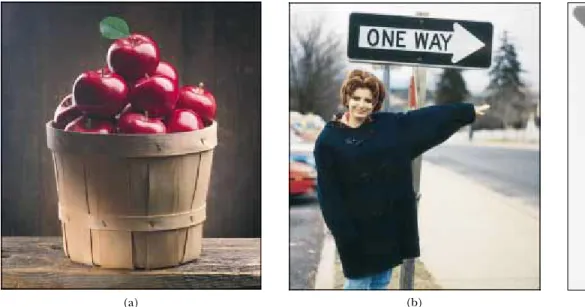
oth-ers are vector quantities. When you want to know the temperature outside so that
you will know how to dress, the only information you need is a number and the
unit “degrees C” or “degrees F.” Temperature is therefore an example of a
scalar
quantity,
which is defined as a quantity that is completely specified by a number
and appropriate units. That is,
3.2
Polar Coordinates
E
XAMPLE
3.1
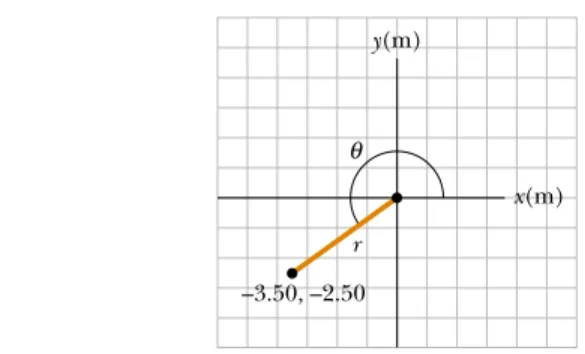
The cartesian coordinates of a point in the xy plane are (x, y)(3.50, 2.50) m, as shown in Figure 3.3. Find the polar coordinates of this point.
A scalar quantity is specified by a single value with an appropriate unit and has
no direction.
A vector quantity has both magnitude and direction.
Solution
Note that you must use the signs of xand yto find that the point lies in the third quadrant of the coordinate system. That is, 216° and not 35.5°.
216° tan y x 2.50 m 3.50 m 0.714 4.30 m r
√
x2y2√
(3.50 m)2(2.50 m)2Other examples of scalar quantities are volume, mass, and time intervals. The
rules of ordinary arithmetic are used to manipulate scalar quantities.
If you are getting ready to pilot a small plane and need to know the wind
ve-locity, you must know both the speed of the wind and its direction. Because
direc-tion is part of the informadirec-tion it gives, velocity is a
vector quantity,
which is
de-fined as a physical quantity that is completely specified by a number and
appropriate units plus a direction. That is,
2.3
Figure 3.4
As a particle moves from 훽to 훾along an arbitrary path represented by the broken line, its displacement is a vector quantity shown by the arrow drawn from 훽to 훾.Figure 3.3
Finding polar coordinates when cartesian coordinates are given. x(m) y(m) –3.50, –2.50 θ rAnother example of a vector quantity is displacement, as you know from
Chap-ter 2. Suppose a particle moves from some point
훽
to some point
훾
along a
straight path, as shown in Figure 3.4. We represent this displacement by drawing
an arrow from
훽
to
훾
, with the tip of the arrow pointing away from the starting
point. The direction of the arrowhead represents the direction of the
displace-ment, and the length of the arrow represents the magnitude of the displacement.
If the particle travels along some other path from
훽
to
훾
, such as the broken line
in Figure 3.4, its displacement is still the arrow drawn from
훽
to
훾
.
훽
3.3 Some Properties of Vectors 61
In this text, we use a boldface letter, such as A, to represent a vector quantity.
Another common method for vector notation that you should be aware of is the
use of an arrow over a letter, such as
The magnitude of the vector A
is written
either A
or
The magnitude of a vector has physical units, such as meters for
displacement or meters per second for velocity.
SOME PROPERTIES OF VECTORS
Equality of Two Vectors
For many purposes, two vectors
A
and
B
may be defined to be equal if they have
the same magnitude and point in the same direction. That is,
A
B
only if A
B
and
if
A
and
B
point in the same direction along parallel lines. For example, all
the vectors in Figure 3.5 are equal even though they have different starting points.
This property allows us to move a vector to a position parallel to itself in a diagram
without affecting the vector.
Adding Vectors
The rules for adding vectors are conveniently described by geometric methods. To
add vector B
to vector A, first draw vector A, with its magnitude represented by a
convenient scale, on graph paper and then draw vector B
to the same scale with its
tail starting from the tip of
A
, as shown in Figure 3.6. The
resultant vector
R
A
B
is the vector drawn from the tail of
A
to the tip of
B
. This procedure is
known as the triangle method of addition.
For example, if you walked 3.0 m toward the east and then 4.0 m toward the
north, as shown in Figure 3.7, you would find yourself 5.0 m from where you
3.3
兩
A
兩
.
A
:.
Figure 3.5
These four vectors are equal because they have equal lengths and point in the same di-rection.Figure 3.6
When vector Bis added to vector A, the resultant R is the vector that runs from the tail of Ato the tip of B.(a) The number of apples in the basket is one example of a scalar quantity. Can you think of other examples? (Superstock)(b) Jennifer pointing to the right. A vector quantity is one that must be specified by both magnitude and direction. (Photo by Ray Serway)(c) An anemometer is a de-vice meteorologists use in weather forecasting. The cups spin around and reveal the magnitude of the wind velocity. The pointer indicates the direction. (Courtesy of Peet Bros.Company, 1308 Doris Avenue, Ocean, NJ 07712) O y x B A R = A + B 2.4 (a) (b) (c)
started, measured at an angle of 53° north of east. Your total displacement is the
vector sum of the individual displacements.
A geometric construction can also be used to add more than two vectors. This
is shown in Figure 3.8 for the case of four vectors. The resultant vector
R
A
B
C
D
is the vector that completes the polygon. In other words,
R is the
vector drawn from the tail of the first vector to the tip of the last vector.
An alternative graphical procedure for adding two vectors, known as the
par-allelogram rule of addition,
is shown in Figure 3.9a. In this construction, the
tails of the two vectors
A
and
B
are joined together and the resultant vector
R
is
the diagonal of a parallelogram formed with
A
and
B
as two of its four sides.
When two vectors are added, the sum is independent of the order of the
addi-tion. (This fact may seem trivial, but as you will see in Chapter 11, the order is
im-portant when vectors are multiplied). This can be seen from the geometric
con-struction in Figure 3.9b and is known as the commutative law of addition:
(3.5)
When three or more vectors are added, their sum is independent of the way in
which the individual vectors are grouped together. A geometric proof of this rule
A
B
B
A
4.0 m 3.0 m |R| = (3.0 m) 2 + (4.0 m) 2 = 5.0 m( )
4.0 3.0 θ = tan–1 θ = 53° A B C D R = A + B + C + DFigure 3.7
Vector addition. Walk-ing first 3.0 m due east and then 4.0 m due north leaves you 5.0 m from your starting point.兩R兩
Figure 3.8
Geometric con-struction for summing four vec-tors. The resultant vectorRis by definition the one that completes the polygon.Figure 3.9
(a) In this construc-tion, the resultant Ris the diagonal of a parallelogram having sides A and B. (b) This construction shows that ABBA— in other words, that vector addition is com-mutative. Commutative Law A B A B R = B + A (b) A B R = A + B (a) Commutative law3.3 Some Properties of Vectors 63
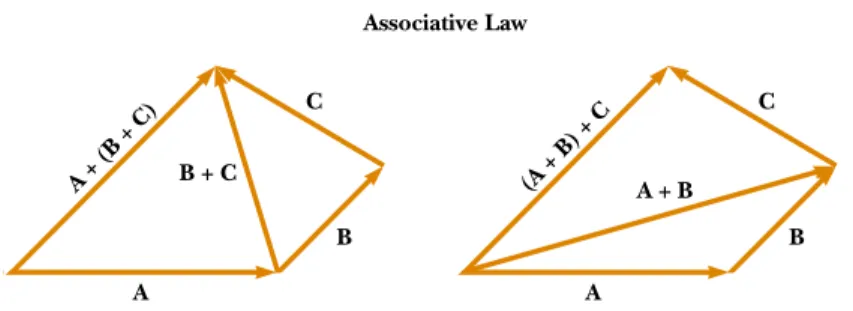
for three vectors is given in Figure 3.10. This is called the associative law of
addi-tion:
(3.6)
In summary, a vector quantity has both magnitude and direction and also
obeys the laws of vector addition
as described in Figures 3.6 to 3.10. When two
or more vectors are added together, all
of them must
have the same units. It would
be meaningless to add a velocity vector (for example, 60 km/h to the east) to a
dis-placement vector (for example, 200 km to the north) because they represent
dif-ferent physical quantities. The same rule also applies to scalars. For example, it
would be meaningless to add time intervals to temperatures.
Negative of a Vector
The negative of the vector A
is defined as the vector that when added to A
gives
zero for the vector sum. That is, A
(
A)
0. The vectors A
and
A
have the
same magnitude but point in opposite directions.
Subtracting Vectors
The operation of vector subtraction makes use of the definition of the negative of
a vector. We define the operation
A
B
as vector
B
added to vector A:
A
B
A
(
B)
(3.7)
The geometric construction for subtracting two vectors in this way is illustrated in
Figure 3.11a.
Another way of looking at vector subtraction is to note that the difference
A
B
between two vectors A
and B
is what you have to add to the second vector
to obtain the first. In this case, the vector A
B
points from the tip of the second
vector to the tip of the first, as Figure 3.11b shows.
A
(
B
C
)
(
A
B
)
C
Figure 3.10
Geometric construc-tions for verifying the associative law of addition.Figure 3.11
(a) This construc-tion shows how to subtract vector B from vector A. The vector Bis equal in magnitude to vector Band points in the opposite direction. To subtract Bfrom A, apply the rule of vector addition to the combination of Aand B: Draw Aalong some convenient axis, place the tail ofBat the tip of A, and Cis the dif-ference AB. (b) A second way of looking at vector subtraction. The difference vector CABis the vector that we must add to Bto obtain A. Associative law A B B + C C A + (B + C) A B A + B C (A + B) + C Associative Law C = A – B A B C = A – B A – B B Vector Subtraction (a) (b)
Multiplying a Vector by a Scalar
If vector
A
is multiplied by a positive scalar quantity
m, then the product
mA
is
a vector that has the same direction as
A
and magnitude
mA. If vector
A
is
multiplied by a negative scalar quantity
m, then the product
mA
is directed
op-posite
A. For example, the vector 5A
is five times as long as
A
and points in the
same direction as A; the vector
A
is one-third the length of A
and points in the
direction opposite A.
If vector Bis added to vector A, under what condition does the resultant vector ABhave magnitude AB? Under what conditions is the resultant vector equal to zero?
COMPONENTS OF A VECTOR AND UNIT VECTORS
The geometric method of adding vectors is not recommended whenever great
ac-curacy is required or in three-dimensional problems. In this section, we describe a
method of adding vectors that makes use of the projections
of vectors along
coordi-nate axes. These projections are called the components
of the vector. Any vector
can be completely described by its components.
Consider a vector A
lying in the xy
plane and making an arbitrary angle
with
the positive
x
axis, as shown in Figure 3.13. This vector can be expressed as the
3.4
Quick Quiz 3.2
1 3 2.5A Vacation Trip
E
XAMPLE
3.2
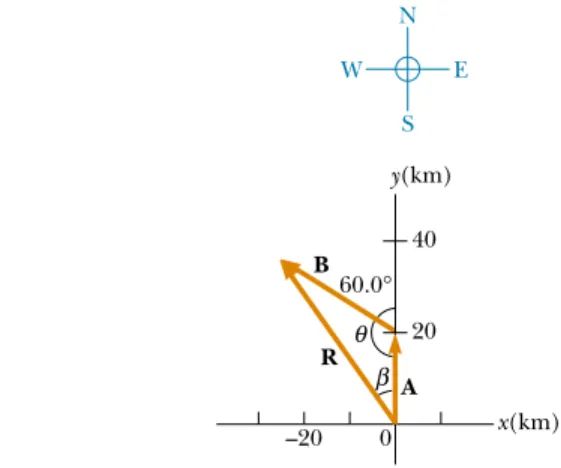
ing out a calculation, you should sketch the vectors to check your results.) The displacement R is the resultant when the two individual displacements Aand Bare added.
To solve the problem algebraically, we note that the magni-tude of Rcan be obtained from the law of cosines as applied to the triangle (see Appendix B.4). With 180°60° 120° and cos , we find that
The direction of R measured from the northerly direction can be obtained from the law of sines (Appendix B.4):
The resultant displacement of the car is 48.2 km in a direc-tion 38.9° west of north. This result matches what we found graphically. 38.9° sin B R sin 35.0 km 48.2 km sin 120°0.629 sin B sin R 48.2 km R
√
A2B22AB cos R2A2B22AB A car travels 20.0 km due north and then 35.0 km in adirec-tion 60.0° west of north, as shown in Figure 3.12. Find the magnitude and direction of the car’s resultant displacement.
Solution
In this example, we show two ways to find the re-sultant of two vectors. We can solve the problem geometri-cally, using graph paper and a protractor, as shown in Figure 3.12. (In fact, even when you know you are going to be√
(20.0 km)2(35.0 km)22(20.0 km)(35.0 km)cos 120°Figure 3.13
Any vector Alying in the xyplane can be represented by a vector Axlying along the xaxis and by a vector Aylying along the yaxis, where AAxAy.
Figure 3.12
Graphical method for finding the resultant displace-ment vector RAB. y(km) 40 B 20 60.0° R A x(km) 0 –20 β θ N S W E y x A O Ay Ax θ3.4 Components of a Vector and Unit Vectors 65
sum of two other vectors
A
xand A
y. From Figure 3.13, we see that the three
vec-tors form a right triangle and that A
A
xA
y. (If you cannot see why this
equal-ity holds, go back to Figure 3.9 and review the parallelogram rule.) We shall often
refer to the “components of a vector
A,” written A
xand A
y(without the boldface
notation). The component A
xrepresents the projection of A
along the x
axis, and
the component
A
yrepresents the projection of
A
along the y
axis. These
compo-nents can be positive or negative. The component A
xis positive if A
xpoints in the
positive
x
direction and is negative if
A
xpoints in the negative
x
direction. The
same is true for the component A
y.
From Figure 3.13 and the definition of sine and cosine, we see that cos
A
x/A
and that sin
A
y/A. Hence, the components of A
are
(3.8)
(3.9)
These components form two sides of a right triangle with a hypotenuse of length
A. Thus, it follows that the magnitude and direction of A
are related to its
compo-nents through the expressions
(3.10)
(3.11)
Note that the signs of the components
A
xand
A
ydepend on the angle
.
For example, if
120°, then A
xis negative and
A
yis positive. If
225°, then
both
A
xand A
yare negative. Figure 3.14 summarizes the signs of the components
when A
lies in the various quadrants.
When solving problems, you can specify a vector A
either with its components
A
xand A
yor with its magnitude and direction A
and
.
Can the component of a vector ever be greater than the magnitude of the vector?
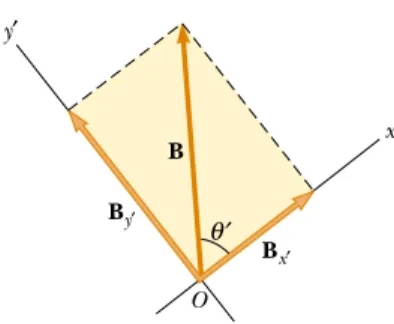
Suppose you are working a physics problem that requires resolving a vector
into its components. In many applications it is convenient to express the
compo-nents in a coordinate system having axes that are not horizontal and vertical but are
still perpendicular to each other. If you choose reference axes or an angle other
than the axes and angle shown in Figure 3.13, the components must be modified
accordingly. Suppose a vector B
makes an angle
with the x
axis defined in
Fig-ure 3.15. The components of
B
along the x
and y
axes are
B
xB
cos
and
B
yB
sin
, as specified by Equations 3.8 and 3.9. The magnitude and direction
of
B
are obtained from expressions equivalent to Equations 3.10 and 3.11. Thus,
we can express the components of a vector in any
coordinate system that is
conve-nient for a particular situation.
Unit Vectors
Vector quantities often are expressed in terms of unit vectors.
A unit vector is a
dimensionless vector having a magnitude of exactly 1.
Unit vectors are used
to specify a given direction and have no other physical significance. They are used
solely as a convenience in describing a direction in space. We shall use the symbols
Quick Quiz 3.3
tan
1冢
A
yA
x冣
A
√
A
x2A
y2A
yA sin
A
xA cos
Figure 3.14
The signs of the components of a vector Adepend on the quadrant in which the vec-tor is located.Components of the vector A
Magnitude of A
Direction of A
Figure 3.15
The component vec-tors of Bin a coordinate system that is tilted. y x Ax negative Ay positive Ax negative Ay negative Ax positive Ay positive Ax positive Ay negative x′ y′ B By′ Bx′ O θ′i, j, and k
to represent unit vectors pointing in the positive
x, y, and z
directions,
respectively. The unit vectors i, j, and k
form a set of mutually perpendicular
vec-tors in a right-handed coordinate system, as shown in Figure 3.16a. The magnitude
of each unit vector equals 1; that is,
Consider a vector A
lying in the xy
plane, as shown in Figure 3.16b. The
prod-uct of the component A
xand the unit vector i
is the vector A
xi, which lies on the x
axis and has magnitude
(The vector A
xi
is an alternative representation of
vector A
x.) Likewise, A
yj
is a vector of magnitude
lying on the y
axis. (Again,
vector A
yj
is an alternative representation of vector A
y.) Thus, the unit – vector
no-tation for the vector A
is
(3.12)
For example, consider a point lying in the
xy
plane and having cartesian
coordi-nates (x, y), as in Figure 3.17. The point can be specified by the position vector r,
which in unit – vector form is given by
(3.13)
This notation tells us that the components of r
are the lengths x
and y.
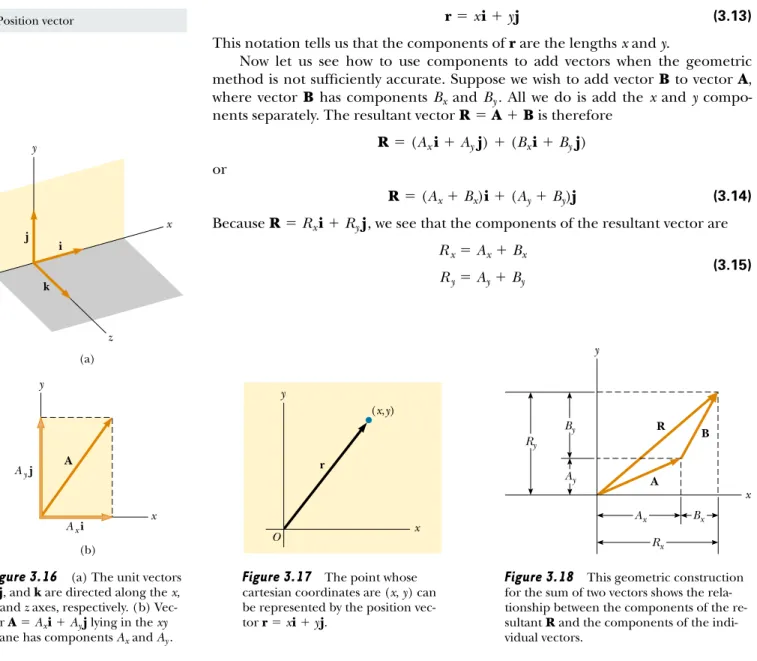
Now let us see how to use components to add vectors when the geometric
method is not sufficiently accurate. Suppose we wish to add vector B
to vector A,
where vector
B
has components
B
xand
B
y. All we do is add the
x
and
y
compo-nents separately. The resultant vector R
A
B
is therefore
or
(3.14)
Because R
R
xi
R
yj, we see that the components of the resultant vector are
(3.15)
R
yA
yB
yR
xA
xB
xR
(A
xB
x)i
(A
yB
y)j
R
(A
xi
A
yj)
(B
xi
B
yj)
r
xi
yj
A
A
xi
A
yj
兩
A
y兩
兩
A
x兩
.
兩
i
兩
兩
j
兩
兩
k
兩
1.
Position vectorFigure 3.18
This geometric construction for the sum of two vectors shows the rela-tionship between the components of the re-sultant Rand the components of the indi-vidual vectors.Figure 3.17
The point whose cartesian coordinates are (x, y) can be represented by the position vec-tor rxiyj.Figure 3.16
(a) The unit vectors i, j, and kare directed along the x,y, and zaxes, respectively. (b) Vec-tor AAxiAyjlying in the xy plane has components Axand Ay.
x y j i k z (a) y x (b) A Axi Ayj y x O r (x,y) y R B A x Bx Ay Ax Rx By Ry
3.4 Components of a Vector and Unit Vectors 67
Problem-Solving Hints
Adding Vectors
When you need to add two or more vectors, use this step-by-step procedure:
•
Select a coordinate system that is convenient. (Try to reduce the number of
components you need to find by choosing axes that line up with as many
vectors as possible.)
•
Draw a labeled sketch of the vectors described in the problem.
•
Find the x
and y
components of all vectors and the resultant components
(the algebraic sum of the components) in the x
and y
directions.
•
If necessary, use the Pythagorean theorem to find the magnitude of the
re-sultant vector and select a suitable trigonometric function to find the angle
that the resultant vector makes with the x
axis.
We obtain the magnitude of R
and the angle it makes with the x
axis from its
com-ponents, using the relationships
(3.16)
(3.17)
We can check this addition by components with a geometric construction, as
shown in Figure 3.18. Remember that you must note the signs
of the components
when using either the algebraic or the geometric method.
At times, we need to consider situations involving motion in three
compo-nent directions. The extension of our methods to three-dimensional vectors is
straightforward. If A
and B
both have x, y, and z
components, we express them in
the form
(3.18)
(3.19)
The sum of A
and B
is
(3.20)
Note that Equation 3.20 differs from Equation 3.14: in Equation 3.20, the resultant
vector also has a z component
If one component of a vector is not zero, can the magnitude of the vector be zero? Explain.
If AB0, what can you say about the components of the two vectors?
Quick Quiz 3.5
Quick Quiz 3.4
R
zA
zB
z.
R
(A
xB
x)i
(A
yB
y)j
(A
zB
z)k
B
B
xi
B
yj
B
zk
A
A
xi
A
yj
A
zk
tan
R
yR
xA
yB
yA
xB
xR
√
R
x2R
y2√
(A
xB
x)
2(A
yB
y)
2QuickLab
Write an expression for the vector de-scribing the displacement of a fly that moves from one corner of the floor of the room that you are in to the op-posite corner of the room, near the ceiling.
Taking a Hike
E
XAMPLE
3.5
A hiker begins a trip by first walking 25.0 km southeast from her car. She stops and sets up her tent for the night. On the sec-ond day, she walks 40.0 km in a direction 60.0° north of east, at which point she discovers a forest ranger’s tower. (a) Deter-mine the components of the hiker’s displacement for each day.
Solution
If we denote the displacement vectors on the first and second days by Aand B, respectively, and use the car as the origin of coordinates, we obtain the vectors shown in Figure 3.19. Displacement Ahas a magnitude of 25.0 km and is directed 45.0° below the positive xaxis. From Equations 3.8 and 3.9, its components are17.7 km
AyA sin(45.0°) (25.0 km)(0.707)
17.7 km
AxA cos(45.0°)(25.0 km)(0.707)
The Sum of Two Vectors
E
XAMPLE
3.3
The magnitude of Ris given by Equation 3.16:
We can find the direction of Rfrom Equation 3.17:
Your calculator likely gives the answer 27° for tan1(0.50). This answer is correct if we interpret it to mean 27° clockwise from the xaxis. Our standard form has been to quote the angles measured counterclockwise from the xaxis, and that angle for this vector is 333°.
tan Ry Rx 2.0 m 4.0 m 0.50 4.5 m R
√
Rx2Ry2√
(4.0 m)2(2.0 m)2√
20 m Find the sum of two vectors Aand Blying in the xyplane andgiven by
Solution
Comparing this expression for Awith the gen-eral expression we see that andthat Likewise, and We
obtain the resultant vector R, using Equation 3.14:
or Rx4.0 m
Ry 2.0 m (4.0i2.0j) m RAB(2.02.0)i m(2.04.0)j m By 4.0 m. Bx2.0 m Ay2.0 m. Ax2.0 m AAxiAyj,
A(2.0i2.0j) m
and
B(2.0i4.0j) m
The Resultant Displacement
E
XAMPLE
3.4
mathematical calculation keeps track of this motion along the three perpendicular axes:
The resultant displacement has components cm, cm, and cm. Its magnitude is
40 cm
√
(25 cm)2(31 cm)2(7.0 cm)2 R√
Rx2Ry2Rz2 Rz7.0 Ry31 Rx25 (25i31j7.0k) cm (125.00)k cm (152313)i cm(301415)j cm Rd1d2d3A particle undergoes three consecutive displacements: d1 (15i30j12k) cm, d2(23i14j5.0k) cm, and d3(13i15j) cm. Find the components of the resultant displacement and its magnitude.
Solution
Rather than looking at a sketch on flat paper, vi-sualize the problem as follows: Start with your fingertip at the front left corner of your horizontal desktop. Move your fin-gertip 15 cm to the right, then 30 cm toward the far side of the desk, then 12 cm vertically upward, then 23 cm to the right, then 14 cm horizontally toward the front edge of the desk, then 5.0 cm vertically toward the desk, then 13 cm to the left, and (finally!) 15 cm toward the back of the desk. TheFigure 3.19
The total displacement of the hiker is the vector RAB. E N S W y(km) x(km) 60.0° B 45.0°20 30 40 50 Tower R Car0 20 10 –10 –20 Tent A3.4 Components of a Vector and Unit Vectors 69
Let’s Fly Away!
E
XAMPLE
3.6
Displacement b, whose magnitude is 153 km, has the compo-nents
Finally, displacement c, whose magnitude is 195 km, has the components
Therefore, the components of the position vector Rfrom the starting point to city C are
In unit – vector notation, That
is, the airplane can reach city C from the starting point by first traveling 95.3 km due west and then by traveling 232 km due north.
Exercise
Find the magnitude and direction of R.Answer
251 km, 22.3° west of north.R(95.3i232j) km. 232 km Ryaybycy87.5 km144 km0 95.3 km Rxaxbxcx152 km52.3 km195 km cyc sin(180°)0 cxc cos(180°)(195 km)(1) 195 km byb sin(110°)(153 km)(0.940)144 km bxb cos(110°)(153 km)(0.342) 52.3 km A commuter airplane takes the route shown in Figure 3.20.
First, it flies from the origin of the coordinate system shown to city A, located 175 km in a direction 30.0° north of east. Next, it flies 153 km 20.0° west of north to city B. Finally, it flies 195 km due west to city C. Find the location of city C rel-ative to the origin.
Solution
It is convenient to choose the coordinate system shown in Figure 3.20, where the xaxis points to the east and the yaxis points to the north. Let us denote the three consec-utive displacements by the vectors a, b, and c. Displacement a has a magnitude of 175 km and the componentsaya sin(30.0°)(175 km)(0.500)87.5 km
axa cos(30.0°)(175 km)(0.866)152 km
In unit – vector form, we can write the total displacement as
Exercise
Determine the magnitude and direction of the to-tal displacement.Answer
41.3 km, 24.1° north of east from the car. R(37.7i16.9j) km16.9 km
RyAyBy 17.7 km34.6 km
37.7 km
RxAxBx17.7 km20.0 km The negative value of Ayindicates that the hiker walks in the
negative ydirection on the first day. The signs of Ax and Ay also are evident from Figure 3.19.
The second displacement Bhas a magnitude of 40.0 km and is 60.0° north of east. Its components are
(b) Determine the components of the hiker’s resultant displacement R for the trip. Find an expression for R in terms of unit vectors.
Solution
The resultant displacement for the trip RA B has components given by Equation 3.15:34.6 km
ByB sin 60.0°(40.0 km)(0.866)
20.0 km
BxB cos 60.0°(40.0 km)(0.500)
Figure 3.20
The airplane starts at the origin, flies first to city A, then to city B, and finally to city C.E N S W B A 50 100 150 200 y(km) 150 250 200 100 50 110° 20.0° 30.0° c b a R C x(km)
S
UMMARY
Scalar quantities
are those that have only magnitude and no associated
direc-tion.
Vector quantities
have both magnitude and direction and obey the laws of
vector addition.
We can add two vectors A
and B
graphically, using either the triangle method
or the parallelogram rule. In the triangle method (Fig. 3.21a), the resultant vector
R
A
B
runs from the tail of A
to the tip of B. In the parallelogram method
(Fig. 3.21b), R
is the diagonal of a parallelogram having A
and B
as two of its sides.
You should be able to add or subtract vectors, using these graphical methods.
The x
component A
xof the vector A
is equal to the projection of A
along the x
axis of a coordinate system, as shown in Figure 3.22, where
A
xA
cos
. The
y
component
A
yof A
is the projection of A
along the y
axis, where A
yA
sin
. Be
sure you can determine which trigonometric functions you should use in all
situa-tions, especially when
is defined as something other than the counterclockwise
angle from the positive x
axis.
If a vector A
has an x
component
A
xand a y
component A
y, the vector can be
expressed in unit – vector form as A
A
xi
A
yj. In this notation, i
is a unit vector
pointing in the positive x
direction, and j
is a unit vector pointing in the positive y
direction. Because i
and j
are unit vectors,
We can find the resultant of two or more vectors by resolving all vectors into
their
x
and y
components, adding their resultant x
and y
components, and then
using the Pythagorean theorem to find the magnitude of the resultant vector. We
can find the angle that the resultant vector makes with respect to the x
axis by
us-ing a suitable trigonometric function.
兩
i
兩
兩
j
兩
1.
Q
UESTIONS
Bis zero, what can you conclude about these two vectors?
6. Can the magnitude of a vector have a negative value? Ex-plain.
7. Which of the following are vectors and which are not: force, temperature, volume, ratings of a television show, height, velocity, age?
8. Under what circumstances would a nonzero vector lying in the xyplane ever have components that are equal in mag-nitude?
9. Is it possible to add a vector quantity to a scalar quantity? Explain.
1. Two vectors have unequal magnitudes. Can their sum be zero? Explain.
2. Can the magnitude of a particle’s displacement be greater than the distance traveled? Explain.
3. The magnitudes of two vectors Aand Bare A5 units and B2 units. Find the largest and smallest values possi-ble for the resultant vector RAB.
4. Vector Alies in the xyplane. For what orientations of vec-tor Awill both of its components be negative? For what orientations will its components have opposite signs?
5. If the component of vector Aalong the direction of vector
Figure 3.22
The addition of the two vectors Axand Aygives vectorA.Note that AxAxiand AyAyj,
where Axand Ayare the componentsof
vector A.
Figure 3.21
(a) Vector addition by the triangle method. (b) Vector addition by the parallelogram rule. R = A + B (a) (b) A B R A B R y x A O Ay Ax θProblems 71
P
ROBLEMS
ative xaxis. Using graphical methods, find (a) the vec-tor sum ABand (b) the vector difference AB.
12. A force F1of magnitude 6.00 units acts at the origin in a direction 30.0° above the positive xaxis. A second force F2of magnitude 5.00 units acts at the origin in the di-rection of the positive yaxis. Find graphically the mag-nitude and direction of the resultant force F1+F2. 13. A person walks along a circular path of radius 5.00 m. If
the person walks around one half of the circle, find (a) the magnitude of the displacement vector and (b) how far the person walked. (c) What is the magni-tude of the displacement if the person walks all the way around the circle?
14. A dog searching for a bone walks 3.50 m south, then 8.20 m at an angle 30.0° north of east, and finally 15.0 m west. Using graphical techniques, find the dog’s resultant displacement vector.
15. Each of the displacement vectors Aand Bshown in Fig-ure P3.15 has a magnitude of 3.00 m. Find graphically (a) AB, (b) AB, (c) BA, (d) A2B. Report all angles counterclockwise from the positive xaxis.
Section 3.1
Coordinate Systems1. The polar coordinates of a point are r5.50 m and 240°. What are the cartesian coordinates of this point?
2. Two points in the xyplane have cartesian coordinates (2.00, 4.00) m and (3.00, 3.00) m. Determine (a) the distance between these points and (b) their po-lar coordinates.
3. If the cartesian coordinates of a point are given by (2, y) and its polar coordinates are (r, 30°), determine yand r.
4. Two points in a plane have polar coordinates (2.50 m, 30.0°) and (3.80 m, 120.0°). Determine (a) the carte-sian coordinates of these points and (b) the distance between them.
5. A fly lands on one wall of a room. The lower left-hand corner of the wall is selected as the origin of a two-dimensional cartesian coordinate system. If the fly is lo-cated at the point having coordinates (2.00, 1.00) m, (a) how far is it from the corner of the room? (b) what is its location in polar coordinates?
6. If the polar coordinates of the point (x, y) are (r, ), determine the polar coordinates for the points (a) (x, y), (b) (2x, 2y), and (c) (3x, 3y).
Section 3.2
Vector and Scalar QuantitiesSection 3.3
Some Properties of Vectors7. An airplane flies 200 km due west from city A to city B and then 300 km in the direction 30.0° north of west from city B to city C. (a) In straight-line distance, how far is city C from city A? (b) Relative to city A, in what direction is city C?
8. A pedestrian moves 6.00 km east and then 13.0 km north. Using the graphical method, find the magnitude and direction of the resultant displacement vector.
9. A surveyor measures the distance across a straight river by the following method: Starting directly across from a tree on the opposite bank, she walks 100 m along the riverbank to establish a baseline. Then she sights across to the tree. The angle from her baseline to the tree is 35.0°. How wide is the river?
10. A plane flies from base camp to lake A, a distance of 280 km at a direction 20.0° north of east. After drop-ping off supplies, it flies to lake B, which is 190 km and 30.0° west of north from lake A. Graphically determine the distance and direction from lake B to the base camp.
11. Vector Ahas a magnitude of 8.00 units and makes an angle of 45.0° with the positive xaxis. Vector Balso has a magnitude of 8.00 units and is directed along the
neg-1, 2, 3= straightforward, intermediate, challenging = full solution available in the Student Solutions Manual and Study Guide
WEB= solution posted at http://www.saunderscollege.com/physics/ = Computer useful in solving problem = Interactive Physics = paired numerical/symbolic problems
Figure P3.15
Problems 15 and 39.y B 3.00 m A 3.00 m 30.0° O x
16. Arbitrarily define the “instantaneous vector height” of a person as the displacement vector from the point halfway between the feet to the top of the head. Make an order-of-magnitude estimate of the total vector height of all the people in a city of population 100 000 (a) at 10 a.m. on a Tuesday and (b) at 5 a.m. on a Satur-day. Explain your reasoning.
17. A roller coaster moves 200 ft horizontally and then rises 135 ft at an angle of 30.0° above the horizontal. It then travels 135 ft at an angle of 40.0° downward. What is its displacement from its starting point? Use graphical techniques.
18. The driver of a car drives 3.00 km north, 2.00 km north-east (45.0° north-east of north), 4.00 km west, and then
WEB
WEB
3.00 km southeast (45.0° east of south). Where does he end up relative to his starting point? Work out your an-swer graphically. Check by using components. (The car is not near the North Pole or the South Pole.)
19. Fox Mulder is trapped in a maze. To find his way out, he walks 10.0 m, makes a 90.0° right turn, walks 5.00 m, makes another 90.0° right turn, and walks 7.00 m. What is his displacement from his initial position?
Section 3.4
Components of a Vector and Unit Vectors20. Find the horizontal and vertical components of the 100-m displacement of a superhero who flies from the top of a tall building following the path shown in Figure P3.20.
lying in an east – west vertical plane. The robot then moves the object upward along a second arc that forms one quarter of a circle having a radius of 3.70 cm and lying in a north – south vertical plane. Find (a) the mag-nitude of the total displacement of the object and (b) the angle the total displacement makes with the vertical.
24. Vector Bhas x, y, and zcomponents of 4.00, 6.00, and 3.00 units, respectively. Calculate the magnitude of B and the angles that Bmakes with the coordinate axes.
25. A vector has an xcomponent of 25.0 units and a y
component of 40.0 units. Find the magnitude and di-rection of this vector.
26. A map suggests that Atlanta is 730 mi in a direction 5.00° north of east from Dallas. The same map shows that Chicago is 560 mi in a direction 21.0° west of north from Atlanta. Assuming that the Earth is flat, use this in-formation to find the displacement from Dallas to Chicago.
27. A displacement vector lying in the xyplane has a magni-tude of 50.0 m and is directed at an angle of 120° to the positive xaxis. Find the xand ycomponents of this vec-tor and express the vecvec-tor in unit – vecvec-tor notation.
28. If A2.00i6.00jand B3.00i2.00j, (a) sketch the vector sum CABand the vector difference
DAB. (b) Find solutions for Cand D, first in
terms of unit vectors and then in terms of polar coordi-nates, with angles measured with respect to the xaxis.
29. Find the magnitude and direction of the resultant of three displacements having xand ycomponents (3.00, 2.00) m, (5.00, 3.00) m, and (6.00, 1.00) m.
30. Vector Ahas xand ycomponents of 8.70 cm and 15.0 cm, respectively; vector Bhas xand ycomponents of 13.2 cm and 6.60 cm, respectively. If AB 3C0, what are the components of C?
31. Consider two vectors A3i2jand B i4j. Calculate (a) AB, (b) AB, (c)
(d) (e) the directions of ABand AB.
32. A boy runs 3.00 blocks north, 4.00 blocks northeast, and 5.00 blocks west. Determine the length and direction of the displacement vector that goes from the starting point to his final position.
33. Obtain expressions in component form for the position vectors having polar coordinates (a) 12.8 m, 150°; (b) 3.30 cm, 60.0°; (c) 22.0 in., 215°.
34. Consider the displacement vectors A(3i3j) m, B(i4j) m, and C(2i5j) m. Use the com-ponent method to determine (a) the magnitude and di-rection of the vector DABCand (b) the mag-nitude and direction of E ABC.
35. A particle undergoes the following consecutive displace-ments: 3.50 m south, 8.20 m northeast, and 15.0 m west. What is the resultant displacement?
36. In a game of American football, a quarterback takes the ball from the line of scrimmage, runs backward for 10.0 yards, and then sideways parallel to the line of scrim-mage for 15.0 yards. At this point, he throws a forward
兩AB兩, 兩AB兩,
Figure P3.23
Figure P3.20
100 m x y 30.0°21. A person walks 25.0° north of east for 3.10 km. How far would she have to walk due north and due east to arrive at the same location?
22. While exploring a cave, a spelunker starts at the en-trance and moves the following distances: She goes 75.0 m north, 250 m east, 125 m at an angle 30.0° north of east, and 150 m south. Find the resultant displace-ment from the cave entrance.
23. In the assembly operation illustrated in Figure P3.23, a robot first lifts an object upward along an arc that forms one quarter of a circle having a radius of 4.80 cm and
Problems 73
Figure P3.37
38. A novice golfer on the green takes three strokes to sink the ball. The successive displacements are 4.00 m to the north, 2.00 m northeast, and 1.00 m 30.0° west of south. Starting at the same initial point, an expert golfer could make the hole in what single displacement?
39. Find the xand ycomponents of the vectors Aand B shown in Figure P3.15; then derive an expression for the resultant vector ABin unit – vector notation. 40. You are standing on the ground at the origin of a
coor-dinate system. An airplane flies over you with constant velocity parallel to the xaxis and at a constant height of 7.60103m. At t0, the airplane is directly above you, so that the vector from you to it is given by P0 (7.60103m)j. At t30.0 s, the position vector lead-ing from you to the airplane is P30(8.04103m)i (7.60103m)j. Determine the magnitude and orienta-tion of the airplane’s posiorienta-tion vector at t45.0 s.
41. A particle undergoes two displacements. The first has a magnitude of 150 cm and makes an angle of 120° with the positive xaxis. The resultantdisplacement has a mag-nitude of 140 cm and is directed at an angle of 35.0° to the positive xaxis. Find the magnitude and direction of the second displacement.
pass 50.0 yards straight downfield perpendicular to the line of scrimmage. What is the magnitude of the foot-ball’s resultant displacement?
37. The helicopter view in Figure P3.37 shows two people pulling on a stubborn mule. Find (a) the single force that is equivalent to the two forces shown and (b) the force that a third person would have to exert on the mule to make the resultant force equal to zero. The forces are measured in units of newtons.
42. Vectors Aand Bhave equal magnitudes of 5.00. If the sum of Aand Bis the vector 6.00j, determine the angle between Aand B.
43. The vector Ahas x, y, and zcomponents of 8.00, 12.0, and 4.00 units, respectively. (a) Write a vector expres-sion for Ain unit – vector notation. (b) Obtain a unit – vector expression for a vector Bone-fourth the length of Apointing in the same direction as A. (c) Ob-tain a unit – vector expression for a vector Cthree times the length of Apointing in the direction opposite the direction of A.
44. Instructions for finding a buried treasure include the following: Go 75.0 paces at 240°, turn to 135° and walk 125 paces, then travel 100 paces at 160°. The angles are measured counterclockwise from an axis pointing to the east, the xdirection. Determine the resultant dis-placement from the starting point.
45. Given the displacement vectors A(3i4j4k) m and B(2i3j7k) m, find the magnitudes of the vectors (a) CABand (b) D2AB, also ex-pressing each in terms of its x, y, and zcomponents. 46. A radar station locates a sinking ship at range 17.3 km
and bearing 136° clockwise from north. From the same station a rescue plane is at horizontal range 19.6 km, 153° clockwise from north, with elevation 2.20 km. (a) Write the vector displacement from plane to ship, letting irepresent east, jnorth, and kup. (b) How far apart are the plane and ship?
47. As it passes over Grand Bahama Island, the eye of a hur-ricane is moving in a direction 60.0° north of west with a speed of 41.0 km/h. Three hours later, the course of the hurricane suddenly shifts due north and its speed slows to 25.0 km/h. How far from Grand Bahama is the eye 4.50 h after it passes over the island?
48. (a) Vector Ehas magnitude 17.0 cm and is directed 27.0° counterclockwise from the xaxis. Express it in unit – vector notation. (b) Vector Fhas magnitude 17.0 cm and is directed 27.0° counterclockwise from the yaxis. Express it in unit – vector notation. (c) Vector Ghas magnitude 17.0 cm and is directed 27.0° clockwise from the yaxis. Express it in unit – vector notation.
49. Vector Ahas a negative xcomponent 3.00 units in length and a positive ycomponent 2.00 units in length. (a) Determine an expression for Ain unit – vector nota-tion. (b) Determine the magnitude and direction of A. (c) What vector B, when added to vector A, gives a re-sultant vector with no xcomponent and a negative y
component 4.00 units in length?
50. An airplane starting from airport A flies 300 km east, then 350 km at 30.0° west of north, and then 150 km north to arrive finally at airport B. (a) The next day, an-other plane flies directly from airport A to airport B in a straight line. In what direction should the pilot travel in this direct flight? (b) How far will the pilot travel in this direct flight? Assume there is no wind during these flights. y x 75.0˚ 60.0˚ F2 = 80.0 N F1 = 120 N
51. Three vectors are oriented as shown in Figure P3.51,
where units, units, and
units. Find (a) the xand ycomponents of the resultant vector (expressed in unit – vector notation) and (b) the magnitude and direction of the resultant vector.
兩C兩30.0
兩B兩40.0 兩A兩20.0
origin to the location of the object. Suppose that for a certain object the position vector is a function of time, given by P4i3j2tj, where Pis in meters and tis in seconds. Evaluate dP/dt. What does this derivative represent about the object?
59. A jet airliner, moving initially at 300 mi/h to the east, suddenly enters a region where the wind is blowing at 100 mi/h in a direction 30.0° north of east. What are the new speed and direction of the aircraft relative to the ground?
60. A pirate has buried his treasure on an island with five trees located at the following points: A(30.0 m, 20.0 m), B(60.0 m, 80.0 m), C(10.0 m, 10.0 m), D(40.0 m, 30.0 m), and E(70.0 m, 60.0 m). All points are measured relative to some origin, as in Fig-ure P3.60. Instructions on the map tell you to start at A and move toward B, but to cover only one-half the dis-tance between A and B. Then, move toward C, covering one-third the distance between your current location and C. Next, move toward D, covering one-fourth the distance between where you are and D. Finally, move to-ward E, covering one-fifth the distance between you and E, stop, and dig. (a) What are the coordinates of the point where the pirate’s treasure is buried? (b)
Re-Figure P3.60
Figure P3.57
Figure P3.51
B 45.0° 45.0° A C O x y52. If A(6.00i8.00j) units, B(8.00i3.00j) units, and C(26.0i19.0j) units, determine aand b
such that aAbBC0.
ADDITIONAL PROBLEMS
53. Two vectors Aand Bhave precisely equal magnitudes. For the magnitude of ABto be 100 times greater than the magnitude of AB, what must be the angle between them?
54. Two vectors Aand Bhave precisely equal magnitudes. For the magnitude of ABto be greater than the magnitude of ABby the factor n, what must be the angle between them?
55. A vector is given by R2.00i1.00j3.00k. Find (a) the magnitudes of the x, y, and zcomponents, (b) the magnitude of R, and (c) the angles between R and the x, y, and zaxes.
56. Find the sum of these four vector forces: 12.0 N to the right at 35.0° above the horizontal, 31.0 N to the left at 55.0° above the horizontal, 8.40 N to the left at 35.0° low the horizontal, and 24.0 N to the right at 55.0° be-low the horizontal. (Hint:Make a drawing of this situa-tion and select the best axes for xand yso that you have the least number of components. Then add the vectors, using the component method.)
57. A person going for a walk follows the path shown in Fig-ure P3.57. The total trip consists of four straight-line paths. At the end of the walk, what is the person’s resul-tant displacement measured from the starting point? 58. In general, the instantaneous position of an object is specified by its position vector Pleading from a fixed
End x y 200 m 60° 30° 150 m 300 m 100 m Start E y x A B C D WEB
Answers to Quick Quizzes 75
A
NSWERS TO
Q
UICK
Q
UIZZES
longer than either side. Problem 61 extends this concept to three dimensions.
3.4 No. The magnitude of a vector Ais equal to
Therefore, if any component is non-zero, Acannot be zero. This generalization of the Pythag-orean theorem is left for you to prove in Problem 61.
3.5 The fact that AB0 tells you that A B. There-fore, the components of the two vectors must have oppo-site signs and equal magnitudes:
and
A
zB
z.
A
yB
y,
A
xB
x,
√
Ax2Ay2Az2.3.1 The honeybee needs to communicate to the other honey-bees how far it is to the flower and in what direction they must fly. This is exactly the kind of information that polar coordinates convey, as long as the origin of the coordi-nates is the beehive.
3.2 The resultant has magnitude ABwhen vector Ais ori-ented in the same direction as vector B. The resultant vector is AB0 when vector Ais oriented in the di-rection opposite vector Band AB.
3.3 No. In two dimensions, a vector and its components form a right triangle. The vector is the hypotenuse and must be
Figure P3.63
Figure P3.61
arrange the order of the trees, (for instance, B(30.0 m, 20.0 m), A(60.0 m, 80.0 m), E(10.0 m, 10.0 m), C(40.0 m, 30.0 m), and D(70.0 m, 60.0 m), and re-peat the calculation to show that the answer does not depend on the order of the trees.
61. A rectangular parallelepiped has dimensions a, b, and c, as in Figure P3.61. (a) Obtain a vector expression for the face diagonal vector R1. What is the magnitude of this vector? (b) Obtain a vector expression for the body diagonal vector R2. Note that R1, ck, and R2make a right triangle, and prove that the magnitude of R2is
√
a2b2c2.62. A point lying in the xyplane and having coordinates (x, y) can be described by the position vector given by
rxiyj. (a) Show that the displacement vector for a
particle moving from (x1, y1) to (x2, y2) is given by d(x2x1)i(y2y1)j. (b) Plot the position vec-tors r1and r2and the displacement vector d, and verify by the graphical method that dr2r1.
63. A point Pis described by the coordinates (x, y) with re-spect to the normal cartesian coordinate system shown in Figure P3.63. Show that (x, y), the coordinates of this point in the rotated coordinate system, are related to (x, y) and the rotation angle by the expressions
y x sin y cos x x cos y sin y c b z a x O R2 R1 α x y x′ y′ O P