Some pages of this thesis may have been removed for copyright restrictions.
If you have discovered material in Aston Research Explorer which is unlawful e.g. breaches
copyright, (either yours or that of a third party) or any other law, including but not limited to
those relating to patent, trademark, confidentiality, data protection, obscenity, defamation,
libel, then please read our Takedown policy and contact the service immediately
SYSTEMATIC FINANCIAL RESOURCES ALLOCATION PROCESSES: A Model for Critical Resources Mobilization and Deployment for Nigerian Universities
By
LUKE NWAOKEONU ONUOHA
A thesis submitted in partial fulfilment of the requirements for the degree of Doctor of Business Administration
ASTON UNIVERSITY September, 2014
©Luke Nwaokeonu Onuoha, 2014 asserts his moral right to be identified as the author of this thesis.
This copy of the thesis has been supplied on condition that anyone who consults it is understood to recognise that its copyright rests with its author and that no quotation from
the thesis and no information derived from it may be published without appropriate permission or acknowledgement.
Aston University
SYSTEMATIC FINANCIAL RESOURCES ALLOCATION PROCESSES: A Model for Critical Resources Mobilization and Deployment for Nigerian Universities
LUKE NWAOKEONU ONUOHA Doctor of Business Administration
(2014)
Abstract
Purpose – The purpose of this research is to study the perceived impact of some factors
on the resources allocation processes of the Nigerian universities and to suggest a framework that will help practitioners and academics to understand and improve such processes.
Design/methodology/approach – The study adopted the interpretive qualitative
approach aimed at an ‘in-depth’ understanding of the resource allocation experiences of key university personnel and their perceived impact of the contextual factors affecting such processes. The analysis of individual narratives from each university established the conditions and factors impacting the resources allocation processes within each institution.
Findings – The resources allocation process issues in the Nigerian universities may be
categorised into people (core and peripheral units’ challenge, and politics and power); process (resources allocation processes); and resources (critical financial shortage and resources dependence response). The study also provides insight that resourcing efficiency in Nigerian universities appears strongly constrained by the rivalry among the resource managers. The efficient resources allocation process (ERAP) model is proposed to
resolve the identified resourcing deficiencies.
Research limitations/implications – The research is not focused to provide
generalizable observations but ‘in-depth’ perceived factors and their impact on the resources allocation processes in Nigerian universities. The study is limited to the internal resources allocation issues within the universities and excludes the external funding factors. The resource managers’ responses to the identified factors may affect their internal resourcing efficiency. Further research using more empirical samples is required to obtain more widespread results and the implications for all universities.
Originality/value – This study contributes a fresh literature framework to resources
allocation processes focusing at ‘people’, ‘process’ and ‘resources’. Also a middle range theory triangulation is developed in relation to better understanding of resourcing process management. The study will be of interest to university managers and policy makers.
Key Words - core and peripheral units, resources dependence, rivalry, theoretical triangulation, resourcing efficiency, critical financial shortage.
Dedication
I would like to dedicate this thesis to the memory of my late parents, Mabel and Charles Onuoha Ajaghi who first planted the seed of higher goals in my heart as a child.
Acknowledgments
I wish to acknowledge a number of people who stood by me throughout my research and thesis writing. I would like to thank my supervisors Prof. Helen Higson and Dr. Melina Manochin, and Programme Co-ordinator, Ranjit Judge for their invaluable help, guidance, and patience. I would also like to thank the Babcock University administration led by Prof J.A. Kayode Makinde for financial and moral support without which I could not have embarked on this tall academic journey. I would equally like to thank my office manager Chigozie Unegbu (Mrs) and technical assistants Ekenwa Isiguzoro, Mayowa Olalere, Joy Franklin (Mrs) and Emmanuel Anokwuru for their invaluable support. Also, I would like to thank my friends in the UK who were of immense support in cash and kind: Jackie and Ngozi Efuribe, Emeka Nwaogwugwu, Iyke and Thessy Ikegwuonu, Lisa and Idorenyi Etokakpan, Chidinma and Austin Nwankpa, Chinwe and Nnamdi Efuribe, Obinna Onuoha, and a host of others. Finally, I would like to thank my wife, Uloma and children, Ngozi, Jachi, Akachi and Chimzurum who gave me their loving support and understanding throughout this work.
Table of Contents
Abstract 2
Dedication 3
Acknowledgments 4
CHAPTER ONE –BACKGROUND AND CONTEXT OF THE STUDY 10
1.0 Introduction 10
1.1 Statement of the Problem 12
1.2 Background of the Study 13
1.2.1 Economic and Political Background 13
1.2.2 Socio-Cultural Background 20
1.2.3 World Ranking and General Performance Rating of
Nigerian Universities 24
1.3 Major Assumptions 32
1.4 Research Objectives 32
1.5 Scope of the Study 33
1.6 Research Questions 33
1.7 Contribution to knowledge, theory and practice 34
1.8 Chapter summary 35
CHAPTER TWO – LITERATURE REVIEW AND THEORETICAL
FRAMEWORK 37
2.0 Introduction 37
2.1 Context and Background of the Study 38
2.1.1 Traditional Funding Sources 39
2.1.2 The Inadequate Funding Syndrome 50
2.1.3 Higher Education Funding Policies and Equity 55 2.1.4 Costs Measurement, Allocation and Budgetary Efficiency 59
2.1.5 Funding Policy Reforms 63
2.1.6 Governance 64
2.1.6.1 General definition of governance 65
2.1.6.2 Corporate Governance 67
2.1.6.3 Universities’ governance processes and attributes 70 2.1.6.4 Relationship between governance and resources
allocation processes 77
2.1.6.5 Attributes and Impact of the good or bad governance 78
2.1.6.6 Limitations to Effective Governance 79
2.1.7 Private and Public Universities 80
2.1.7.1 Ownership and Funding 81
2.1.7.2 Governance Dynamics 83
2.1.7.3 Competition for Faculty and Students 85
2.1.8 Summary of literature review 88
2.2 Theoretical Framework 89
2.2.1 Resource Allocation Processes (RAP) Model 91 2.2.1.1 Characteristics of Resource Allocation Processes 92
2.2.1.2 RAP Model and Revisions 93
2.2.2 The African Political Economy (APE) Model 94
2.2.3 The Resource Dependence Theory (RDT) 96
2.2.5 Summary of the selected theories/models 103
2.3. Triangulation of the relevant theories 104
2.4 Link Between the Selected Theories & Research Questions 108
2.5 Chapter Summary 111
CHAPTER THREE - RESEARCH DESIGN AND METHODOLOGY 113
3.0 Introduction 113
3.1 Aims and Objectives 113
3.2 Research paradigm 114 3.2.1 Positivism 115 3.2.2 Interpretivism 115 3.2.3 Pragmatism 116 3.3 Research methodology 117 3.3.1 Quantitative approach 117 3.3.2 Qualitative approach 118
3.3.3 Mixed methods approach 121
3.4 Research Design 123
3.5 The Settings 123
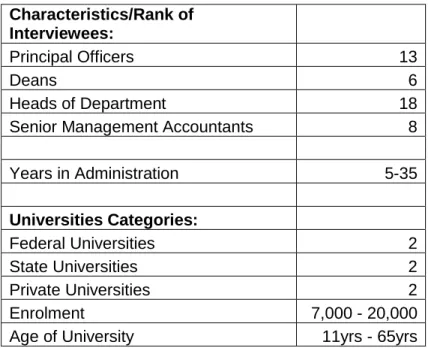
3.5.1 Characteristics of the participants 127
3.6 The theoretical framework 127
3.7 Qualitative Data Collection Approach 128
3.7.1 Data collection methods and participants 128
3.7.1.1 Pilot studies 129
3.7.1.2 Interviews 130
3.7.1.2.1 Face-to-face interviews 132
3.7.1.2.2 Telephone interviews 133
3.7.2 Data analysis procedures 133
3.7.3 How to achieve trustworthiness 140
3.7.3.1 Credibility 141
3.7.3.2 Transferability 141
3.7.3.3 Dependability 142
3.7.3.4 Confirmability 142
3.8 Ethical Consideration 143
3.9 Limitations of data collection and analysis methods 144
3.10 Chapter Summary 146
CHAPTER FOUR - FINDINGS AND ANALYSIS 147
4.0 Introduction 147
4.1 Characteristics of the participants and categorization
of the findings 148
4.1.1 Characteristics of the participants 148
4.1.2 Categorization of the findings 155
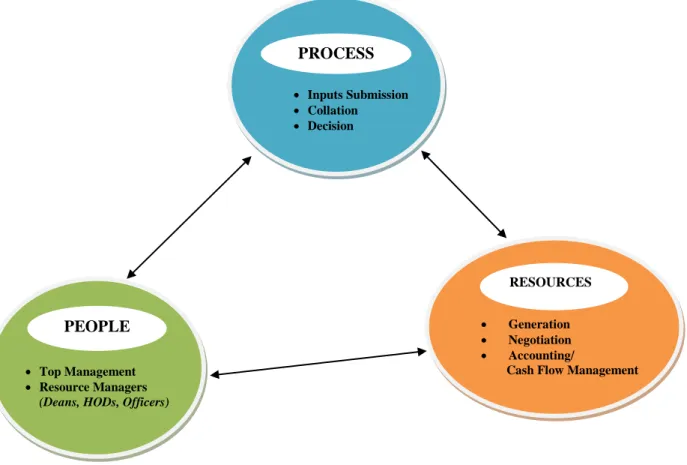
4.2 The resources allocation process milieu 160
4.2.1 People 160
4.2.2 Process 164
4.2.3 Resources 166
4.3 The factors influencing the resources allocation processes
4.3.1 Theme 1: People 171
4.3.1.1 Core and peripheral units’ challenge 171
4.3.1.1.1 The attributes of core and peripheral units 172 4.3.1.1.2 Core and peripheral divide as a function of philosophy, funding
dynamics and autonomy 176
4.3.1.2 Culture, Politics and power 181
4.3.1.2.1 Culture as Relative Determinant of Resource Allocation Direction 182 4.3.1.2.2 Internal politics as a pervasive phenomenon 184 4.3.1.2.3 Politics and power as controversial
resource allocation determinant 188
4.3.2 Theme 2: Process 193
4.3.2.1 Resource allocation processes (RAP) 193
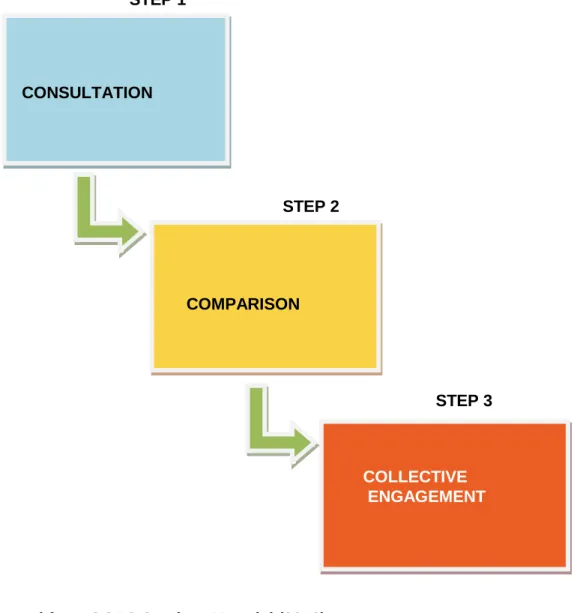
4.3.2.1.1 Internal resources allocation processes 194 4.3.2.1.2 Autonomy as an important driver for RAP success 200 4.3.2.1.3 Funding dynamics as an important consideration for success of RAP 201 4.3.2.1.4 Consultation, Comparison and Collective Engagement as key to RAP
Success 205
4.3.2.1.5 IGR sharing formula as indicator of the success of RAP 210
4.3.3 Theme 3: Resources 214
4.3.3.1 Shortage of critical financial resources 215
4.3.3.1.1 Extent of Impact of critical financial shortage on governance 216 4.3.3.1.2 The extent of impact of critical financial shortage on staff morale 219 4.3.3.1.3 The impact of critical financial shortage on teaching and
research 224
4.3.3.2 Critical resources dependence response 231 4.3.3.2.1 Critical reality of resources dependence 231 4.3.3.2.2 Impact of dependence resources on basic operations 232 4.3.3.2.3 Determinants of critical resources dependence response ability 235
4.3.3.2.4 Strategic response to resource gaps 238
4.3.3.2.5 Perceived benefits of successful resources dependence response 240
4.4 Other interesting qualitative data 244
4.5 Insight Gained 245
4.6 Chapter Summary 245
CHAPTER FIVE - DISCUSSION 248
5.0 Introduction 248
5.1 Summary of the findings 248
5.2 Discussion of the specific findings 252
5.2.1 Theme 1: People 257
5.2.1.1 Core and Peripheral Units’ Challenge 257
5.2.1.2 Culture, Power and politics 259
5.2.2. Theme 2: Process 260
5.2.2.1 Resources Allocation Processes 260
5.2.3 Theme 3: Resources 261
5.2.3.1 Critical Financial Shortage 261
5.2.3.2 Resources Dependence Response 261
5.3 Implications of the findings to practice 262
5.3.1 Implications of core and peripheral units’ challenge 262 5.3.2 Implications of culture politics and power 265 5.3.3 Implications of resources allocation processes 267
5.3.4 Implications of critical financial shortage 271 5.3.5 Implications of resources dependence response 273 5.4 Efficient Resources Allocation Process (ERAP) Model 276
5.4.1 People 277
5.4.2 Process 278
5.4.3 Resources 279
5.5. Features of the proposed ERAP Model 282
5.5.1 Consultations 282
5.5.2 Comparisons 284
5.5.3 Collective Engagement 285
5.5.4 Control and Monitoring 288
5.6 How the ERAP model works 290
5.7 Chapter Summary 294
CHAPTER SIX – SUMMARY, CONCLUSIONS AND
RECOMMENDATIONS 298
6.0 Introduction 298
6.1 Purpose of the study 298
6.2 Overview of the methodology 299
6.3 Major findings 300
6.4 Limitations of the study 304
6.5 Evaluation of the findings and method of data collection 305
6.6 Contribution of the study 307
6.7 Recommendations for practice 308
6.8 Recommendations for further study 311
References 314
Appendices:
A. Statistics of accredited universities in Nigeria 333
B. Semi-Structured Questions 334
C. Sample of interview narratives 336
D. Sample of story elements analysis using McAdams’
Analytical Method 340
E. Transformed interview analysis table 341
List of Tables
Table 1.1: Foreign Trade of Nigeria 1990 - 2007 (N' billion) 14 Table 1.2: Nigeria’s Private and short term debt 1980-2001 16 Table 1.3: Federal Universities Funding from 1990 – 2004 18 Table 1.4: Report of Corruption Perpetrated by Nigerian Governors
during the Fourth Republic (1999 -2005). 22 Table 1.5: Abridged Report of the Ranking of Nigeria's Topmost
Universities - 2007 & 2013 25 Table 3.1: Characteristics of the participants and others 127
List of Figures
Figure 2.1: Triangulation of the four selected theories 102 Figure 2.2: Link between the research questions and the relevant
Theoretical framework 109
Figure 3.1: Nigerian Universities Conventional Governance Structure 126 Figure 3.2: The Process of Data Analysis (Creswell, 2002: 257) 135 Figure 3.3: Constant Comparative method
(Maykut and Morehouse, 1994: 135) 136 Figure 4.1: Resource Allocation Communication Steps 152 Figure 4.2: Resources Problems Resolution Portfolio 159 Figure 4.3: Universities’ Resources Allocation Process Milieu 163 Figure 4.4. Link Between the Themes and the Research Questions 170 Figure 5.1: Efficient Resources Allocation Process (ERAP) Model 281
CHAPTER ONE – BACKGROUND AND CONTEXT OF THE STUDY
1.0 Introduction
There has been a phenomenal growth in the number of universities in Nigeria in the last
22 years (Okojie, 2009; Ijaduola and Agbajeola, 2010; Oduoza, 2010). Before 1999
there were only two categories of tertiary educational institutions in the country
comprising of 32: federal 19 and state 13 universities. But the Federal Government’s approval of three private universities on May 19, 1999 ushered in a brand new frontier
on the landscape of higher education governance in the country (Okojie, 2009; Babalola,
Sodipe and Babalola, 2012). Between 1999 and now (2014) the number of universities
in the country has grown to 126 with the federal universities accounting for 32, state 35,
and private ownership 59 (Appendix A). Statutorily, the Federal Government is the main
financier of the federal universities; the state universities are funded by the state
governments and the private proprietors found and fund the private universities (Okojie,
2009; Ijaduola, et al, 2010).
The proliferation of universities, in the face of the country’s increasing debt burden and political instability, has brought along with it critical resource shortages (Asechemie,
1999; Udoh, 2001; Emevan, 2005; Fagbemi, 2006; Ijaduola, 2009; Sodipo, 2010). Faced
with perennially worsening economic situation, the Federal Government has consistently
reduced annual budgetary allocation to the education sector (Appendix 2). In the light of
the above, the Federal Government has continually failed to meet the 26% budgetary
allocation to education as stipulated by UNESCO1 (Hallack, 1990; Sodipo, 2010;
Olaniyan, 2003; Ekong, 2004; Akpe, 2006; Ajayi and Ekundayo, 2006). Other available
literature laments the perennial lack of transparency in the system of management of
higher education in Nigeria (Oduleye, 1995; Odebiyi and Aina, 2002; Adora, Agba and
Olajide, 2010).
The key challenge confronting all higher education managers in Nigeria today is how to
resolve the critical financial resources shortage through creativity (Akingboye, 2001;
Ijaduola, et al, 2008; Okojie, 2009; Adeniyi and Olawale, 2010) and efficient engagement
of the available resources. Creativity here refers to the ability of the universities’ managements to seek sustainable funding from other alternative sources outside of
government (Obasi and Eboh, 2002; Ijaduola, et al, 2008; Okojie, 2009; Ahmad, et al.,
2012). Available literature shows that private universities are currently leading on
alternative sourcing of funds (Johnstone, 1998; AAU, 2004; Rui, 2013). There are
evidences of investments in commercial activities such as hospitality business,
consultancy, and bookshop/supermarkets with the aim of raising some funds (AAU,
2001; 2004; Rui, 2013). The reason for this may be associated with their founding on
commercial orientation which thrives on competition and distinction (AAU, 2001; 2004;
Rui, 2013; Yusuf, 2010).
The study of systematic financial resources allocation processes in Nigerian universities
is of research importance because of two reasons. Firstly, the study is of practical
significance to universities’ managers and higher education policy makers (Angluin and Scapens, 2000; Shattock, 2002; Scott, 2012) as matters of resource management could
touch every facet of the universities’ business. Secondly, the topic evokes an important reflection on the existing literature on resource allocation processes and may engender
Aina, 1999; Hufty, 2011; Resurreccion, 2012; Scott, 2012). The outcome of the study
may lead to renewed emphasis on resourcing efficiency in the higher education sector.
These reasons inform the decision to use the topic in an academic research context
study.
Four basic questions may be asked in connection with the topic. One: how, and what
exactly, does the study of resource allocation processes contribute to the scientific field?
Two: how could the allocation processes affect resources management efficiency and
bring about desired resources allocation processes and practice change? Three: what is
the impact of culture on the resource allocation processes? And four: how could the
resources allocation theories identified in the study support or fail to support resource
management efficiency in order to bring about quality in governance and improved
resources commitment? To resolve these questions will call for definitions and detailed
investigation through case studies, interviews, theoretical analysis and a careful analysis
of the research findings.
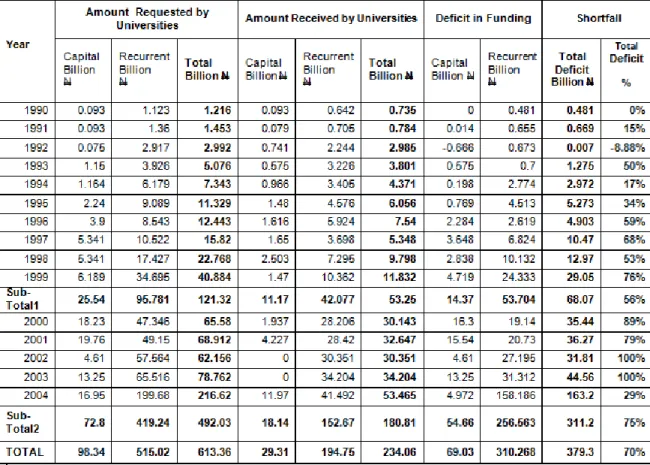
1.1 Statement of the Problem
Universities in Nigeria are in financial crises (Odebiyi and Aina, 1999; Aina, 2002; Ajayi
and Ekundayo, 2006). Every public university depends on government grants for a
greater part of their annual operating and capital budgets. But the declining economic
fortune of the government has led to serious cuts in the annual allocation to the
educational sector with the resultant negative impact on available critical resources (see
Table 1.3). Between 1990 and 1999, table 1.3 shows that the Federal Government
provided only 44% of the N25.543 billion (£101.2m) and N95.781 billion (£382.1m)
situation became worse in the period between 2000 and 2004 with total shortfall trailing
by 70%. Consequently, different authors attribute nearly every poor performance in the
public universities to inadequate funding (Odebiyi and Aina, 1999; Aina, 2002; Obasi and
Eboh, 2002; Ijaduola, et al, 2008). But how much of the financial problems in the
universities are caused by inefficient resources allocation processes rather than
inadequate funding per se is yet to be resolved. The aim of this study is to investigate
how the Nigerian universities allocate financial resources in the face of the increasing
critical shortages. The challenge of the research, therefore, is to suggest the strategies
and steps that would entrench a sustainable culture of efficiency in the management of
the universities’ financial resources.
1.2 Background of the Study
Detailed background of the study is examined from the perspectives of economic and
political background, socio-cultural background and world ranking and general
performance.
1.2.1 Economic and Political Background
The economic and political environments in Nigeria, as is common with some other
African countries, have deteriorated greatly in the last five decades (Dariye, 1999; Aina,
2002; Ebegbulem, 2012). Today, some experts attribute the nation’s major problems to poor leadership and corruption (Dariye, 1999; Aina, 2002; Ebegbulem, 2012). These
authors have further associated to poor leadership and corruption heightened ethnic
sensitivity, tribal fragmentation, and mismanagement of the country’s resources (Dariye, 1999; Odebiyi, et al, 1999; Aina, 2002; Ebegbulem, 2012). According to the authors, the
Olukayode, 2010) have led to low accountability, transparency and productivity in nearly
all facets of socio-economic activities (Oyejide, 2008; Odebiyi, et al, 1999; Aina, 2002;
Ebegbulem, 2012). Nwazue (2002) and Oyejide (2008) observe that the economy, too,
has performed woefully as a result. From the early years of huge contribution from
agriculture as the major foreign revenue earner for the country, to the present day
excessive reliance on oil as the revenue source, the Nigerian national economy has
equally witnessed woeful performance. Table1.1 shows the Foreign Trade statistics of
Nigeria’s oil and non oil sectors between 1990 and 2007. Table 1.1: Foreign Trade of Nigeria 1990 - 2007 (N' million)
Source: Central Bank of Nigeria Statistical Bulletin, 2005 and 2007 Issues, Abuja
Table 1.1 shows that Nigeria depended excessively on oil as the foreign revenue
earner between 1990 and 2007. While the balance of trade on oil grew steadily from
N100,553.40 million in 1990 to N6,958,831.20 million by 2007, the non oil sector
1990 to negative N377,120.40 in 1996. The performance improved slightly between
1997 and 1999 going down from negative N649,650.80 million to negative
N631,361.00 million before rising again in 2000. From that point (2000) the negative
balance of trade rose steadily from N739,381.80 million to N3,520,804.70 million in
2007. This analysis shows the kind of volatilities that the country’s economy has faced in the past years.
In all these, the economic development of the country has indeed received the greatest
negative impact of the corrupt and ineffective leadership discussed by Nwazue (2002),
Oyedije (2008), and Ebegbulem (2012). The authors observe that the presence of bad
management of the national assets may be evident from the state of dilapidation of
most public infrastructure. They further relate their observations to the poor condition of
the nation’s roads, the ports, the railway and other public utilities such as electricity, water, etc., throughout the country. This researcher further notes that the railway
system ceased operation in the last 15 years and has remained non-functional since.
All the major roads across the country have fallen into disrepair so much that it now
takes double the time to cover certain distances. In many cities, electricity and water
supplies go off for days and months. Olubomehin (2003: 97) restates the bad condition
of the Nigerian roads and observes that “government has not been able to carry out its responsibilities not only in the transport sector but also in the other sectors.” Some scholars argue that a situation of failed state currently exists in Nigeria (Odebiyi, et al.,
1999; Nwazue, 2002; Aina, 2002). Whether this view is right or wrong does not appear
to be helped by the low physical infrastructure development throughout the country.
Dariye (1999), Nwazue (2002), Oyejide (2008), Olawole, et al (2010) and Ebegbulem
achieve expected results due to endemic corruption, and poor management (Balogun,
2002). Other authors note the destructive consequences of tribal hostilities which
disrupt national productivity (Olawole and Olukayode, 2010; Ehiabhi and Ehinmore,
2011; Ehioghae, 2012).
Table 1.2: Nigeria's Public, Private and Short-term Debt, 1980 – 2001
Source: World Bank, and Global Development Finance (2003)
The conclusion of the various authors is that the handling of the national business has
left much to be desired. Areas of concern to the authors include planning without reliable
statistics, corruption through the inflation of contract prices, pervasive bribery and debt
burden. Table 1.2 shows growth in Nigeria’s foreign debt between 1980 and 2001. From 60% in 1980 the Long Term external debt rose to 95% of the Total Debt stock in 1990.
The rate of growth slacked steadily between 1995 (83%) and 1999 (78%). It, however,
went up again to 96% by 2000 and 95% by 2001. Some authors (Nwazue, 2002;
Adebesin 2005; Oyejide, 2008; Olawole and Olukayode, 2010; Ebegbulem, 2012;
report to naivety, greed and poor managerial skill of the country’s leadership.
There have also been reported problems in the management of the country’s universities (Odebiyi, et al., 1999; Aina, 2002; Adeniji, 2008; Adeline, 2012; Ebegbulem, 2012).
Although table 1.3 throws light on the level of funding shortage the federal universities in
Nigeria faced between 1990 and 2004 (being as high as 70% for capital and operating
expenditures together), Odebiyi, et al.(1999); Aina (2002); AAU (2004); Adeniji (2008),
and Ebegbulem (2012) suggest that lack of qualified academic personnel and poor
infrastructure have impacted far negatively on the management and performance of the
universities. Furthermore, Dariye (1999) also asserts that the endemic problem of
ethnicity masked in the ‘federal character policy’ of the Federal Government has attributed to the appointment of the wrong and unqualified persons into positions of
leadership of certain departments. The consequence of the wrong appointments
manifests in what Ebegbulem (2012), Okike (2007) and;Dariye, (1999) describe as
leadership naivety and weak governance.
Funding shortage has been suggested as the major negative hindrance for universities’ growth (Johnstone, 1998; Odebiyi, et al., 1999; Aina, 2002; Wangenge-Ouma, 2008;
Adeniji, 2008; Ebegbulem, 2012). From table 1.3, as previously stated, it may be
inferred that the Federal Government underfunded the federal universities by 56% for
both recurrent and capital requests between 1990 and 1999. In fact, the gap got even
worse between 2000 and 2004 rising up to 60% and 70% for recurrent and capital
Table 1.3: Federal Universities Funding from 1990 - 2004
Source: Adapted from National Universities Commission Reports 1990-2004, Abuja
Odebiyi, et al (1999), Aina (2002), Ekundayo, et al (2006), among others, observe that
there are evidences of infrastructural decay and abandoned projects occasioned by lack
of funds, bad internal planning, and poor maintenance culture in many universities.
Ekundayo and Ajayi (2009); Ijaduola (2009), and Sodipo (2010) agree that inadequate
funding by the government has affected the quality of teaching and research; and led to
lack of consumables in the science laboratories.
The non-availability of sufficient empirical data (Johnstone, 1998; AAU, 2004) on how
of financial resources management. The proposed research, therefore, draws impetus
from the need to generate fresh empirical evidence to determine how to achieve
financial resources allocation efficiency in the universities through systematic internal
processes. The relevance of such study may be attributed to the fact that the public
universities are prone to collateral consequences in the form of continual decline of
budgetary allocations from the government during times of economic and political
difficulties (Ajayi, et al, 2006; Oyeneye, 2006; Tandberg, 2008; Olowononi, 2010). Table
1.3 further shows consistent shortfalls in the Federal Government funding of both capital
and recurrent expenditure requests of the federal universities between 1990 and 2004.
From 15% gap in 1991 to 76% by 1999, the gap rose to 100% 2002 and 2003
respectively.
The 1999 introduction of private universities into the higher educational landscape in
Nigeria brings in other dimensions to the discourse (Sodipo, 2010; Udoh, 2001;
Fagbemi, 2006; Ijaduola, 2009; Ehioghae, 2012; Onuoha, 2012a). Different authors
(Ijaduola, 2009; Okojie, 2009; Ehioghae, 2012) refer to the unwillingness of the federal
and state governments to grant any form of direct financial support to the private
universities. Okojie (2009) observes that some private universities’ managements, as a result, have had to invent other novel ways of forging ahead, some in the degree of
creativeness and efficiency in their methods of carrying on business. These include
openness and transparency (AAU 2004; Kass, 2005); rigorousness in assigning funds to
activities (Gallego, Garcia, and Rodriguez, 2009); aggressive market orientation and
innovation (Johnstone, 1998; AAU, 2004; Rui, 2013); fundraising and discrete
As in the case of the public universities discussed above, the researcher suggests that
private universities would also have to seek resources allocation processes that could
bring about purposeful planning and desired growth in an arrangement of shared
governance (Whitchurch, 2012; Scott, 2012; Stensaker and Vabo, 2013). This makes
the study of the resources allocation processes in the institutions beneficial, not only to
the private universities’ managers, but also for higher education planners in general (Liefner, 2003).
In summary, the major focus of the proposed study will centre on whether the limited
financial resources available to each university could be efficiently and optimally
engaged through systematic allocation processes. The study will be carried out through
focused interviews with purposively selected managers of the sample universities and
critical analysis of the research findings.
1.2.2 Socio-Cultural Background
Nigeria is a multi-cultural and socially diverse country with over 250 distinct ethnic
groups who speak about 510 languages (Ahiauzu, 1984; Oxford Business Group, 2012).
Some experts posit that the socio-cultural practices of organizations in multi-ethnic
environments tilt towards reflection of the cultural norms of the local communities where
the institutions are located (Lee and Bowen, 1971; Adigun, 1999; Benner and Glaister,
2009; Ahmad, Farley and Naidoo, 2012; Rifaat, 2012; Oke, 2012). Nevertheless, some
other experts posit that universities have their own cultures which differentiate them from
the general communities of which they are a part (Adedimeji (2013). Adedimeji refers to
the attitudinal and professional issues which gives a university its academic culture. He
the academia (Adedimeji, 2013). From these patterns of belief and behaviour, the
universities come to cultivate their own set of cultures separate from those of the
societies surrounding them. Ghosh (2001) finds this to be true in South Africa. His
conclusion is that despite the managers’ identification with their own ethnic group, there is a common national culture which operates at the managerial level.
The first point of view might partially explain the general thinking that the universities in
the different regions of Nigeria have leniency towards the different cultural, religious and
value system of their host communities (Lee and Bowen, 1971; Adigun, 1999; Akanbi,
2012; Ahmad, Farley and Naidoo, 2012; Smith, 2013). Therefore, going by this premise,
it would be expected that universities in the north may be influenced by the Islamic
culture of the place; while those in the east and west might be influenced by the heavy
Christian culture in those two regions. A contrary view, however, is expressed in a study
by Adefila (2004) as cited by Olawole and Olukayode (2010) that gender disparity,
religious inclination and educational attainment have no significant effect on people’s perception of the causes of fraud. This may help to explain why, despite the high
measure of ethnic and cultural identities exuded by political and social leaders across
the country, the negative factor of corruption and ineptitude remains a common reality in
the administration of public institutions (Nwazue, 2002; Oyejide, 2008; Johnstone, 2008;
Olawole and Olukayode, 2010; Adebisi, 2013). Olawole and Olukayode (2010) have a
record of evidence of corrupt acts since 1999 to include case of the first speaker of the
House of Representatives who lied about his age and certificates; the case of the
members of the Upper Chamber of the National Assembly who arrogated to themselves
a special furniture allowance of N3.5million (about £13,700) each; the case of Sani
among others. Furthermore, table 1.4 illustrates the extent to which the Governors of
Table 1.4: Report of Corruption Perpetrated by Nigerian Governors during the Fourth Republic (1999 -2005).
table 1.4 aids the conclusion that there has been pervasive corruption in all the states of
the federation which involves people in high positions (Nwazue 2002; Ebegbulem, 2012;
Adebisi, 2013).
On the burden of ethnicity, Akanbi (2012:17) captures the situation succinctly: "I saw
there was a lot of tribalism in Nigeria, a lot of discrimination, a lot of ethnic problems, a
lot of religious discrimination. That was not the type of environment in which I was
brought up!” Akanbi’s outcry stems from several media reports of persons who are not allowed employment in public offices outside their states of origin and the cases of
religious and ethnic motivated conflicts at several locations within the country.
Akanbi’s concerns mirror the observation of several other individuals across the country.
Olaolu (2002:57) holds a contrary view that the government (or anyone in power), in the
execution of its programme, does not single out for preferential treatment, certain
persons, families, or classes of people. Olaolu’s position, however, may fail the test of universal acknowledgement given the overwhelming media reports of widespread
discrimination and corruption (see table 1.4) in many states. The corrupt tendencies
often interfere with resources allocation on market oriented terms as proposed by
Lombardi, et al., 2002; Oyedije, 2008; and Rui, 2013; and may hamper the society’s chance to experience economic development (Nwazue, 2002; Ebegbulem, 2012; Hong,
2012). Thomas (1998), on another note, points out that organizational culture can modify
the values of an employee. There may be a serious concern, therefore, that the general
situation in the country at large could influence the integrity of the management of the
universities as well, since the leadership of the universities are part and parcel of the
In the typical Nigerian culture (Oxford Business Group, 2012; Rifaat, 2012), it is
normative not to argue with the King. The researcher thinks that this value system, if
juxtaposed in the ivory towers, could mean that the actions of the vice chancellors might
be beyond their subordinates’ questioning. That, accordingly, could persuade subordinates to invent grounds of allegiance to flow with the incumbent vice chancellors
and not question their decisions and actions or even demand corrections to leadership
mistakes. It logically follows that where the leadership is ineffective, the system fails to
achieve set goals and sustainable development is hampered (Nwazue 2002;
Ebegbulem, 2012; Ahmad, Farley and Naidoo (2012). Thomas and Schonken (1998),
Sruwig (2002) and Mufune (2003), however, decry the many shortcomings in research
on the African culture-managerial tendencies and Mufune (2003) proposes further
clarification of previous inconclusive results in the area. Mufune’s view deviates from that of Ghosh (2001:136) who posits that despite the managers’ identification with their own ethnic group, “a common national culture persists at the managerial level”.
An important question at this stage is: to what extent do cultural and social norms and
location impact the resource management processes efficiency of the Nigerian
universities? This study will attempt to show to what extent culture among other factors
affect the resource allocation processes in the universities studied.
1.2.3 World Ranking and General Performance Rating of Nigerian Universities
The continuous dismal (see Table 1.5) showing of the Nigerian universities on the world
ranking of institutions of higher learning draws important focus on the study of the
appears among the first 5,000 top universities in the world in 2007. Also, the table
shows that in 2007, the best Nigerian University came 44th on the ranking of Africa’s best universities. This, however, has improved slightly in the 2013 ranking with the Obafemi
University appearing 8th in Africa and 1113 in the ranking of world’s best universities (http://webometrics.info/en/previous_editions. Downloaded 26/09/13). Similar
adjustments are also seen for University of Ibadan, Benin and Lagos. Auchi Polytechnic
also gave the universities a shock by cruising to the second place in Nigeria and 23rd in
the African ranking. Commenting on the earlier ranking results, Jones-Esan (2007),
laments over the poor rating of the Nigerian universities in 2007. Jones-Esan bemoaned
the fact that several universities based in south Africa, as well as other African countries
that are not as endowed as Nigeria in financial and human resources like Zimbabwe,
Botswana, Reunion, Senegal, Sudan, Burkina Faso, Namibia and even Rwanda and
Somalia are ranked ahead of Nigeria.
Table 1.5: Abridged Report of the Ranking of Nigeria's Topmost Universities - 2007 & 2013
Nigerian Universities among African top 100 Nigerian African World
Ranking Ranking Ranking
2007
Obafemi Awolowo University, Ile-Ife 1 44 5834
University of Ibadan 2 65 6908
University of Benin 3 79 7318
University of Lagos 4 96 7601
2013
Obafemi Awolowo University, Ile-Ife 1 8 1113
Auchi Polytechnic 2 23 2106
University of Ibadan 3 24 2109
University of Benin 4 25 2148
University of Lagos 5 31 2640
Sources: Jones-Esan, 2007 & Webometrics, July 2013
help the institutions to attain an improved ranking in the world stage is worth exploring.
The present study, however, may not produce all the answers to help achieve complete
repositioning of the universities for the top world stage fame. Nonetheless, it would be
appropriate to identify some best practices that would produce the enabling environment
for excellence.
Two competing international systems of ranking world universities exist (Negash, 2010).
These are the Shanghai Jiao Tong University’s academic ranking of world universities (http:ed.sjtu.edu.cn/ranking.htm) with focus on research in science, engineering,
medicine and clinical sciences. Criteria used by the ranking are alumni of the institution
winning Nobel Prize (20%); citation frequency (20%); publication in Nature and Science
(20%); citation in Science and Social Science Indices (20%); and weighted size of
institution (10%).
The second ranking system is the Times Higher Education Supplement
(http:www.timeshighereducation.co.uk/hybrid.asp?typecode=144). Using a different set
of criteria, it assigns for peer review 50% (comprised of opinion survey from academics,
40% and survey from global recruiters, 10%); research citation impact, 20%;
faculty-student ratio (proxy for teaching quality), 20%; percentage of international faculty, 5%
and percentage of international students, 5%.
In both ranking systems, one could infer that the tests focus on identifying the unique
attributes of each university and placing weighted values on them to separate the best
from the rest through orderly ranking. From the weights employed by the two ranking
factors such as good governance (Lombardi, et al., 2002; Negash, 2008; Scott 2009;
Hufty, 2011), which in itself some authors associate with several attributes, namely:
composition of the board of trustees, autonomy of the board and council, recruitment of
the best managers, application of best practices in decision processes and
programming, democracy, vision and mission of top leadership, transparency among
others (Angluin and Scapens, 2000; AAU, 2004; Wale, 2010; Hufty, 2011; Rui, 2013;
Onuoha, 2013; 2012; Oghojafor, et al., 2012; Sinha and Sinha, 2007; Lombardi, et al.,
2002). Aina (2002), Tandberg (2008); and Soomro, et al (2012) proffer others as the
quality of the university’s faculty and personnel; depth, diversity and delivery of quality programmes/course offerings; stability of academic calendar; diversity and collegiality.
But Soomro, et al, (2012) restate the eight challenges in higher education espoused by
UNESCO (2009) as rising demand and mystification; diversification of providers and
method; private provisions; distance education; cross-border higher education; quality
assurance; teacher education; and academic profession. The authors went further to cite
Bunoti (2011) who identified factors which influence challenges in higher education as
“economic factors, political factors, quality of students and faculty, administrative factors, academic factors, etc.” (Soomro, et al, 2012:150).
Some experts have also identified academic culture as an important feature of
successful universities (Bartel, 2003; Shen and Tian, 2012; Adedimeji, 2013). Available
literature suggests that academic or university culture is associated to a number of
intellectual behavioural dynamics such as engagement in academic research (Bartel,
2003; Adedimeji, 2013); academic outlooks, academic spirits, academic ethics and
to live in the context of its name, the “activities on campus must focus on teaching and scientific research on the basis of specialized knowledge, which is the main feature
distinctive from other subcultures in society” (Shen and Tian, 2012: 62).
Adedimeji (2013) observes that the academic culture resonates around attitudinal and
professional issues. On the other hand, OCED’s (2004) adds that the university has now become a complex, demanding, competitive business requiring corporate
governance practices. In the words of Adedimeji (2013:2) “attitudinal issues concern patterns of beliefs and behaviour that characterise members of the academia.” Among these Adedimeji (2013) citing Oloyede (2010) lists critical thinking, neutrality (objectivity),
evidence-based conclusions; depth (comprehensiveness) in examination of issues from
all sides; judiciousness in human and financial resources handling; pride, meaning
self-respect and contentment; lowliness and virtuousness, referring to “ethics of moral excellence, integrity and uprightness” (Adedimeji, 2013: 2). Other attributes listed for attitudinal inclusion are expectation that academics should be well informed, ready to
collaborate, post a collegial spirit as they are critical, accurate and open (Adedimeji,
2013). On professional dimensions of academic culture the author identifies mentorship,
academic freedom, tenure; and institutional autonomy as the focus. He then concludes
that although academic culture is universal, different universities have various core
values or aspects of culture that they treasure the most (Adedimeji, 2013). Other authors
suggest that if higher institutions are going to survive and thrive during the more difficult
times, they would have to embrace evidence-based culture in their decision-making and
policy formation (Bok, 2006; Ikenberry, 2011)
emerging countries, could do well incorporating the key criteria for ranking of world
universities in their modus operandi, following either the Shanghai Jiao Tong University’s academic ranking factors or the Times Higher Education Supplement. Finally, Negash
(2008) conclusively suggests that universities should allocate resources to activities
identified in the rating process in order to improve their ranking. Johnstone (1998)
recommends cost sharing, differentiation, private sector initiatives and loosening
governmental regulations as further ways of achieving reforms that can enhance the
quality of the universities. Other experts (Santoro and Chakrabarti, 1999; Obasi and
Eboh, 2002; Bevc and Ursic, 2008; de Castro Lobo, et al., 2010; Smith, 2013) agree with
Johnstone’s (1998) views.
The new direction appears to be encouraging universities across the world to embrace
reforms, to reposition for competition, to embark on commercial partnerships with
industry, to innovate (Johnstone, 1998; AAU, 2004; Scott, 2012) and to seek
internationalization (Bartel, 2002). In addition Wooldridge (2011) found three general
concepts of leadership which may be relevant to the new challenges facing, not only the
UK higher education, but also several other universities across the globe. These
challenges Wooldridge (2011) sums up as: 1) agility – being able to accommodate new business models, new technologies and new opportunity relationships; 2) distinctiveness
- fashioning a shared unique positioning, alone or as a unique member of an opportunity
network; and 3) alignment – adopting a shared governance which accommodates a mix of top-down institutional goals and the traditional bottom-up collegial culture. Shattock
(2002) asserts that collegiality is a fundamental management style characteristic of the
top ten UK universities. It would seem safe, at this stage, therefore, to conclude that the
globally (Bartel, 2003; Soomro and Ahmad, 2012; Scott, 2012) in an environment of
shared-governance (2012; Scott, 2012; Stensaker and Vabo, 2013; Whitchurch and
Harvey, 2013).
In summary, the study would show how efficient financial resources allocation processes
could influence the rating of the universities (Jarzabkowski, 2002; Negash, 2008).
Accordingly, based on the discussion so far, the researcher thinks that there is need for
detailed research to obtain empirical data on how systematic resources allocation
processes can benefit not only the Nigerian universities and stakeholders, but also all
higher education managers world-wide. The outcome of the research will be of immense
value for planning and repositioning the six institutions used in the study for better
performance assessment and ranking.
There may, however, be barriers to effective application of the research outcomes due to
differences in culture, habits, and routine (Broad, et al, 2007; Shen and Tian, 2012;
Soomro, 2012). Shen and Tian (2012: 64), for instance, affirm that universities stick to
their missions and resist “fickleness of seeking quick success and instant benefits.”. This resistance would result in delays in the application of new innovations. Also,
Adedimeji (2013) concludes that even though academic culture, for instance, is
universal, many universities hold dear to their respective core values and some aspects
of culture. He cites the King’s College of the University of London’s pre-sessional ‘An Introduction to Academic Culture’ course and the University of Ilorin academic culture which emphasizes ‘character and learning’. The authors attribute the response of the universities to issues to their orientation to mission, core values and cultural orientations.
Other constraints may be associated with location, regulation, and propriety (Shattock,
2002; Shen and Tian, 2012; Smith, 2013). Smith (2013: 27) admits that each university
is driven by norms that vary to some extent. According to Smith, while it may be said that
all universities share same priorities for teaching, research and service, the way they
seek to fulfil these functions differ from one university to another. Also, Roger (2009:
524) presents the argument that “very significant errors and weaknesses occur in the importation of models of strategy in the stress on strategic planning rather than strategic
processes and in the insensitivity of universities’ planning to the underlying strategy process of the typical university.” AAU (2004: 2) highlights the problem of definition as one that could create problems in the interpretation of research findings in higher
education. The paper further admits that there “is a wide range of conditions, experiences and interests underlying the process of change and non change in African
higher education systems and institution, which roughly fall into systems and institutions
under duress, advantaged ones and relatively advantaged ones.” This suggests that for the study to be universally applicable, certain level of definitions have to be resolved in
each typical institution. Shattock (2002: 242) adds the challenge of governance
variations, insisting that “how we view the role of the academic community in university governance raises interesting questions of comparison with other professional
communities”. Shattock (2002), notes that the pattern of governance has a bearing on leadership and performance of typical universities. It would be reasonable to conclude
that the kind of governorship practiced in an institution may have tremendous impact on
the response of each relevant university to the 6+research outcomes and for higher
education .
resource managers from purposively selected Nigerian universities representing the
three major categories of universities (federal, state and private) in the country, and
theoretical analysis.
1.3 Major Assumptions
The proposed study is premised on the following important assumptions:
(a) That the systematic resources allocation and deployment mechanisms adopted by
other successful organizations and universities elsewhere in the world can be applied by
the Nigerian universities (Johnstone, 1998; Angluin and Scapens, 1999; AAU, 2004).
(b) That stakeholders of the universities and financiers would be favourably disposed to
commit more funds given evidence of judicious utilization of the resources previously
committed (Pfeffer, and Salancik, 1974; Johnstone, 1998; Rui, 2013).
(c) That each university is at liberty to adopt whatever transparent innovative resource
process strategy and best practices it deems judicious (Angluin and Scapens, 2000; Liu,
2007; .Scott, 2012)
1.4 Research Objectives
The general objective of this research is to ascertain the financial resources allocation
processes imperative for an efficient management of the universities in Nigeria. The
specific objectives of the study include:
1) To identify and critically assess the existing financial resources allocation
strategies employed by the Nigerian universities;
2) To determine the perception of universities’ managers on the degree of association between funding and culture, governance quality, staff morale, and
3) To construct a suggested model of resource allocation processes that could
instil efficiency in the deployment of critical resources in the six Nigerian
universities in the study; and
4) To recommend a practice change to the six universities.
1.5 Scope of the Study
This study focuses on six universities located in Nigeria’s South-west geo-political zone. The samples include two universities from each of the federal,
state and private categories. The study is limited to internal resource allocation
processes within the universities, and excludes activities at the national level between
the federal government and the individual universities, although it is obviously influenced
and informed by this. This means that the study centres on the internal managerial
issues concerning financial resources processes within the control of each university’s management. The study will focus on the internal management of universities’ financial resources, identifying what processes are followed and how commitments are decided;
what does not work and why; and how the funding issues impact on governance, staff
morale, teaching and research, and capital development. Although the study
concentrates on a limited number of universities in Nigeria, the findings may be of
interest to universities’ managers and policy makers in handling issues that are identical with this study.
1.6 Research Questions
The research questions bellow will drive the investigations and provide the basis for
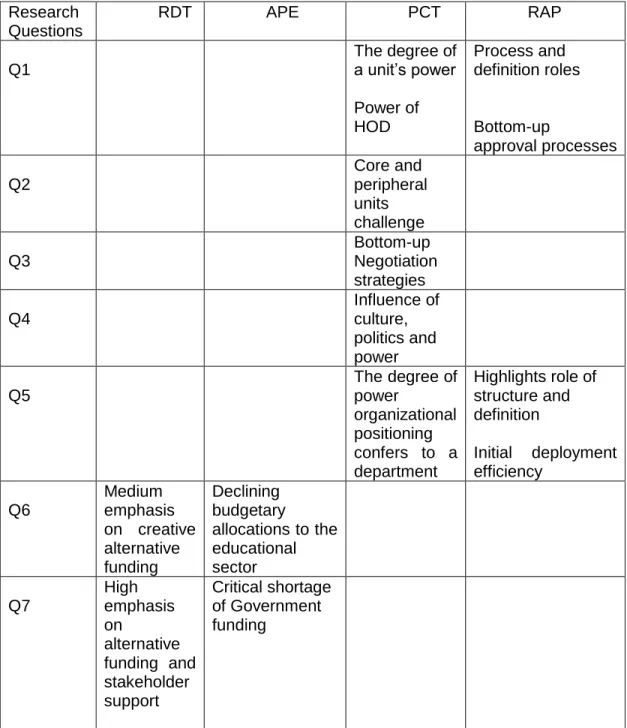
determining how to achieve efficiency in the resources allocation processes in the
theories and the research questions is summarized, showing aspects of the contribution
of the different paradigms in answering the research questions. The research questions
are:
1) What factors affect the resource allocations granted a unit from the internal
resources of the university?
2) How does the allocation of resources differ between core and peripheral units
of the focal university?
3) What negotiation strategies do department heads leverage on in order to win
more (if any) share of the available resources?
4) To what extent do culture, politics and power affect how much a department
gets from the available resources?
5) What resource allocation processes are currently practiced by the universities
and to what extent do they reflect equity and good practices?
6) To what extent does shortage of critical financial resources impact on
governance, staff morale, teaching and research in the universities?
7) To what extent and how do the institutions respond to declining critical resource
dependence support?
1.7 Contribution to knowledge, theory and practice
This study makes important contribution to knowledge, theory and practice. Firstly, the
study contributes a fresh understanding of the resources allocation process milieu as
revolving around ‘people’, ‘process’ and ‘resources’. Through the people, process and resources analyses, the factors influencing the resources allocation process
phenomenon are identified and how the resourcing problems can be resolved are
Secondly, the study presents the resources management literature in a different way that
gives fresh light on the systematic resolution of financial resources allocation processes
and deployment. The study provides a new conceptual framework to the existing
theories on higher education resources management focusing at the resolution of
governance quality and resources commitment problems guided by the Laughlin’s (1995) middle range thinking theory.
Thirdly, the study proposes resolution of the resourcing problems through the adoption
of the efficient resources allocation process (ERAP) model. The ERAP model is an
optimality engagement protocol for the universities’ resource managers aimed at the achievement of resources allocation process goals in an effective and efficient manner.
The ERAP model proposes to invoke practice change that could lead to improved staff
motivation, more collective decision-making and greater productivity in the Nigerian
universities.
1.8 Chapter Summary
This chapter has presented the introduction of the study giving the comprehensive
economic, social and contextual backgrounds of the research. The chapter provided the
statement of the problem and the aim of the study as to investigate how the Nigerian
universities allocate financial resources in the face of the increasing critical financial
shortages. The chapter also indicated that the challenge of the research would be to
suggest the strategies and steps that would entrench a sustainable culture of efficiency
in the management of the universities’ financial resources. The general objective of the research was stated as to ascertain the financial resources allocation processes
imperative for an efficient management of the universities in Nigeria. The scope of the
study was clearly indicated as limited to the internal managerial issues concerning
financial resources processes within the control of each university’s management and not to include the external resourcing problems between government and the
universities.
The remaining part of the study has been arranged in chapters logically to facilitate the
investigation of the general and specific objectives of the research. The chapters are as
follows: Chapter 2: Literature Review and Theoretical Framework; Chapter 3: Research
Design and Methodology; Chapter 4: Findings and Analysis; Chapter 5: Discussion; and
Chapter 6: Summary, Conclusion and Recommendations. Other sections are the
CHAPTER TWO – LITERATURE REVIEW AND THEORETICAL FRAMEWORK
2.0 Introduction
The following literature review is structured in two parts, namely: Context and
Background of the Study and the relevant Theoretical Framework. The subsections
under the Context and Background of the study include Traditional Funding Sources; the
Inadequate Funding Syndrome; Higher Education Funding Policy and Equity; Costs
Measurement, Allocation and Budgetary Efficiency; Policy Reforms; Governance, and
Private and Public Universities.
The Theoretical Framework will present a critical review of a number of theoretical
paradigms believed to assist in the understanding of the phenomena under research.
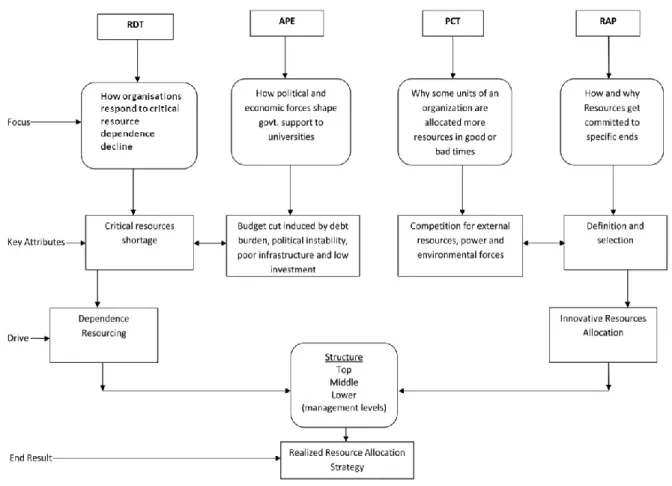
These are: Resource Allocation Process (RAP) Model (Bower and Gilbert, 2007), African
Political Economy (APE) Model (Aina, 2002), Resource Dependence Theory (RDT)
(Pfeffer and Salancik, 2003) and Power and Centrality Theory (PCT) (Hackman, 1985).
The researcher here does not make any claim of these presenting an exhaustive list of
all the concepts in accounting research field. Relying on hindsight, however, the
researcher believes these paradigms may be of important theoretical relevance to the
understanding of resource management issues in organizations and by adaptation, of
universities. The review notes on each of the paradigms (see later) confirms that aspects
of the paradigms contribute to the understanding of the financial management research
field. Although other relevant paradigms exist, limiting the list to the above four only
conforms to Laughlin’s (1995: 65) proposition that “all empirical research is partial and incomplete and that theoretical and methodological choices are inevitably made whether
by Corbin and Strauss’ (2008) recommendation of ‘a substantial degree of saturation’. The above two references suggest that it would not be expedient to seek an exhaustive
list of theories and methodologies in one piece of study. One way or another, the
researcher would have to exercise a degree of ontological and epistemological leniency
in choosing the theories and methodologies for the planned study. This researcher,
therefore, proposes that the four paradigms here should be seen to have met the tests in
Laughlin (1995) and Corbin and Strauss (2008) and should be seen to provide
substantial insight towards the understanding and prediction of resources allocation
process issues in the universities, and this study will show why.
2.1 Context and Background of the Study
There are several contrasting accounts of proliferation of universities and increasing
economic and managerial deficiencies in Africa (Sodipo, 2010; Udoh, 2001; Asecheme,
1999). Several authors attribute the economic woes to the increasing debt burden and
political instability of the host nations (Sodipo, 2010; Udoh, 2001; Asecheme, 1999;
Emevan, 2005; Fagbemi, 2006; Ijaduola, 2009). In Nigeria, reports show that the Federal
Government has continually failed to meet the 26% budgetary allocation to education as
stipulated by UNESCO (Hallack, 1990; Sodipo, 2010; Olaniyan, 2003; Ekong, 2004;
Akpe, 2006; Ajayi and Ekundayo, 2006). There is a long list of other issues considering
governance, transparency and performance reported against universities. For instance,
some notable authors claim there is perennial lack of transparency in the system of
management of higher education in Nigeria (Adora, Agba and Olajide, 2010; Oduleye,
1995; Odebiyi and Aina, 2002). Yet others point at politics and managerial inefficiency
(AAU, 2004; Liu, 2007; Wangenge-Ouma and Cloete, 2008 Odebiyi and Aina, 2002).
The next section will focus on the sources of funding available to all three categories of
universities as established from existing literature.
2.1.1 Traditional Funding Sources
This section presents a review of existing literature on the traditional funding sources
available to all universities.
Financing of higher education in Nigeria or elsewhere in the world is critically challenged
by economic and political constraints (Aina, 2002; Atuahene, 2008; Wangenge-Ouma
and Cloete, 2008; Nkrumah-Young, K., Huisman, J., and Powell, P., 2008). Adams
(1977:86) is in agreement with this view stressing that “individual institutions are squeezed by escalating costs and lagging revenues” while “administrators are tormented by ‘financial stringency’…” The Federal Government grant constitutes the major source of funding available to the federal universities (Aina, 2002; Adeniyi, 2008;
Okojie, 2009).
According to the authors, the last 30 years have witnessed a huge decline in
infrastructural development and a high level of poverty in several African countries. This
is associated with steady decline in budgetary allocation to the educational sector,
which, in turn, leads to many dire consequences: emigration of skilled academic
personnel to the developed economies; decline in quality of teaching and research; and
more frequent agitations among staff and students for improved welfare packages (Aina,
2002; Atuahene, 2008; Wangenge-Ouma and Cloete, 2008). Adams (1977) admits that
considered as a luxury, is very negatively affected.
Aina’s (2002) research highlights the Nigerian irony where the national higher education policy disallows collection of tuition fees in the federal universities, even as at the same
time government is unable adequately to fund the institutions (see Table 1.3).
Triangulating primary and secondary data, Aina’s research is focused on the biggest three federal universities situated in the south-west zone of Nigeria. His finding is that
although both the policy makers and the citizens agree that the government alone
cannot fund higher education, the political will to change practice in favour of fees
collection is absent. It is doubtful, however, whether Aina’s research concentration on only three institutions in the south-west to the exclusion of the well over 28 others in the
north and south-south geo-political areas of the country could be seen as adequate. His
sample size, therefore, appears to be too small. His reliance on only qualitative
responses for assessment of adequacy of funding a university could encourage
subjective answers which may lack the rigor to support far reaching conclusions. Above
all, Aina’s (2002) appears to be a lonely voice. It will, therefore, make good sense to find out what other researchers in Nigeria think of this topic. This gap calls for further
empirical research on the subject.
Resource mobilization and value creation is central to university and all public sector
management (Parker and Gould, 2000). Okojie (2009) contends that the challenge has
been to find the necessary resources to support the massive growth of university
education that occurred between 1948 and today. Okojie admits that the inability to
realize funding expectations has raised concerns about quality of university education.