Managing global virtual teams
Johanna Saarinen
Johanna Saarinen
Managing global virtual teams
A alt o U niv er sit y
This thesis addresses managerial work in
global virtual teams. It gives voice to the managers
themselves with the aim of enhancing our under-
standing of what the work of virtual managers
is all about. The findings of the thesis show that
virtuality alters the nature of cross-cultural
managerial work. Virtual contexts limit and
narrow the latitude of managers to do their job,
to which conflicting expectations pose constant
challenges and lead to feelings of inadequacy. This
research brings new insight to the understanding
of the managerial work, management practices,
and emotions of global virtual team managers.
The findings call for new leadership competences
such as virtual communication and recruitment
skills for the managers of global virtual teams.
DOCTORAL
Aalto University publication series
DOCTORAL DISSERTATIONS184/2016
Managing global virtual teams
Johanna Saarinen
Aalto University School of Business
Main dissertation advisor
Professor Janne Tienari, Aalto University, Finland
Co-dissertation advisor
Professor Rebecca Piekkari, Aalto University, Finland
Opponent
Dr. Peter Zettinig, Turku University, Finland
Aalto University publication series
DOCTORAL DISSERTATIONS184/2016 © Johanna Saarinen ISBN 978-952-60-7012-4 (printed) ISBN 978-952-60-7013-1 (pdf) ISSN-L 1799-4934 ISSN 1799-4934 (printed) ISSN 1799-4942 (pdf) http://urn.fi/URN:ISBN:978-952-60-7013-1 Images: Cover: Roope Kiviranta
Unigrafia Oy Helsinki
Abstract
Aalto University, P.O. Box 11000, FI-00076 Aalto www.aalto.fiAuthor
Johanna Saarinen
Name of the doctoral dissertation
Managing global virtual teams
Publisher School of Business
Unit Department of Management Studies
Series Aalto University publication series DOCTORAL DISSERTATIONS 184/2016
Field of research Organization and Management Date of the defence 7 October 2016
Language English
Monograph Article dissertation Essay dissertation Abstract
Advances in technology-enabled communication and a constant search for economic advantage have led global organizations to rely on virtual collaboration. Together with rapid changes in working life, virtuality has also altered the context for leadership and has had a significant impact on the work of managers. This study addresses managerial work in global virtual teams. In my study, I give voice to the managers themselves with the aim of enhancing our understanding of what the work of virtual managers is all about. The current scholarly literature on global virtual teams has examined virtual work mainly from the perspective of global teams. My study complements the extant literature by explicitly and uniquely focusing on managers' own experiences and their talk about making sense of their work.
On the basis of an analysis of how the managers of a Finland-based multinational corporation talk about their work, I argue that virtuality alters the nature of cross-cultural managerial work. Managers of global virtual teams cannot achieve the quality of managerial work they seek; the reality of a hectic pace, multiple stakeholder demands, and virtual communication with people from different nationalities, cultures, and languages hinder achievement of their personal leadership goals. Virtual contexts limit and narrow the latitude of managers to do their job. Consequently, conflicting expectations create pressure on them and lead to feelings of inadequacy.
In addition to an introductory essay, this thesis contains a series of four essays that elucidate different aspects of the work of global virtual team managers. The first essay explores the attempts of managers to exert influence in a virtual context. The second essay aims to understand the dynamics of trust and commitment in virtual teams and shows that relationships of trust and commitment are challenged in a virtual context. The third essay explores cross-cultural encounters and suggests that the reality of virtual work limits the opportunities of managers to communicate and take close personal interest in their employees and that these challenges lead managers to engage in task-oriented managerial activities. The fourth essay examines the emotions of managers in attempting to meet all the expectations they face and to cope with the various demands of a global virtual environment. They felt that they could not do enough and described emotions of inadequacy and guilt in their work.
This research brings new insight to the understanding of the managerial work, management practices, and emotions of global virtual team managers. My study shows that virtuality changes the nature of cross-cultural management, to which conflicting expectations pose constant challenges. My findings call for new leadership competences such as virtual communication and recruitment skills for the managers of global virtual teams.
Keywords global virtual teams, managerial work
ISBN (printed) 978-952-60-7012-4 ISBN (pdf) 978-952-60-7013-1
ISSN-L 1799-4934 ISSN (printed) 1799-4934 ISSN (pdf) 1799-4942
To my parents, who have always encouraged me to explore the world and pursue my dreams
Acknowledgements
Nicht, was wir erleben, sondern wie wir empfinden, was wir erleben, macht unser Schicksal aus.
-Marie Freifrau von Ebner-Eschenbach
During my long career in global companies, I have travelled to a number of countries and worked with my colleagues all over the world. When listening to their stories, I saw and experienced how the work of global managers is changing rapidly. I wanted to give a voice to the managers themselves and write down their stories, and this is how my dissertation was born. Today, when my research project is almost completed, I feel relived but also a bit wistful. It has been truly an exciting journey and I have learned more than I ever imagined. For that, I owe thanks to many people, and I want to express my gratitude to them for sharing this journey with me.
First and foremost, I want to thank my supervisor Professor Janne Tienari, for his continuous guidance and support in my project. He believed in my topic and my work from the very early stages to the very end, and continuously encouraged me, also in moments of desperation. He always found time to meet me; I am particularly grateful for our monthly meetings at “Proffa” when he commented on my texts. He never gave me ready-made solutions but encouraged me to think, improve, and rewrite, and especially to
find my own voice as a researcher. I am extremely grateful for his support, which has carried me throughout this project. Thank you Janne!
It has been an absolute privilege to work with Professor Rebecca Piekkari, my other supervisor, an outstanding scholar and a wonderful person, in which demands and warmth are combined in a unique way. She taught me to write, but also to strive for the best. No matter what the time, place, or situation, she was there with her extraordinary and strong support, offering new articles to read, books to borrow, people to connect with, and comments on my text. I don’t know how she does it (and when she sleeps). I am particularly grateful to her for reading this manuscript and providing sharp comments on it. I have been lucky to be in the hands of my two supervisors: two extremely talented researchers.
In the beginning of my research project I met Dr. Niina Nurmi, who worked on global virtual teams in Stanford University. I had numerous discussions with her and wrote about “virtual influence” with her. She taught me how to do research and how to collect and code data and she gave me valuable feedback in many stages of my studies. Her energetic, positive, and fresh way of working taught me a lot, about both virtual teams and life as a researcher.
My warmest thanks to Professor Minna Halme, my dear friend, with whom I have shared many experiences since our master studies, and who has listened patiently to me over the years in all the joys and sorrows of life. The morning teas in her “Aurinkohuone” have given me energy, as well as her gentle but dynamic advice. Time flew in our endless discussions about formal and informal topics. Thank you Minna for being there, for laughing with me and at me, and also for believing in this project of mine.
As one of the most experienced researchers on virtual work, Professor Matti Vartiainen shared his experiences on virtual, distributed teams, and the valuable work of his research team. Thank you for commenting on my texts, for interesting discussions, and for the support you gave me. I also want to thank Dr. Travis Maynard of Colorado State University for his valuable comments in the final stages of my study.
My visit to Vaasa and meeting Dr. Niina Koivunen gave me important new ideas for my work, particularly to focus on managerial work. Thank you Niina, for all this guidance, warmth and friendship. I am also very grateful to wonderful Carol Kiriakos and Esa Saarinen for teaching me the C15 writing method. Except for a two-week “study break”, I wrote my entire dissertation while working full time, learning to write with discipline and manage my time effectively. I wrote my dissertation mainly in the mornings between 6 and 8 am before starting my working day in the office. I also learned to focus on writing if I had only 15 minutes time while waiting for the next plane to Düsseldorf. In addition, Carol taught me the concept and practice of free
writing, which was an important antidote to my tendency to be excessively self-critical.
This dissertation would not have been possible without the managers with whom I had long discussions and who gave me time from their busy life and full calendars. I want to express my deep gratitude to all the interviewees who participated in my study. I was positively surprised by their interest, openness, and trust in me in sharing their views and experiences. I also want to thank Heikki Peltola, an extraordinary man who helped me particularly when I was standing at a crossroads.
As being somewhat an outsider in the Academia, I am thankful to all my PhD colleagues who shared their experiences, particularly Virpi Outila and J-P Kevätsalo. In addition, thanks to the wonderful “PhD ladies” Raija, Riitta, Paula, Ling, Agnieszka, and Annastiina this research journey has also been fun and good food. My special thanks go to Raija Salomaa, for coaching, support and long evenings in Tuusula and at Lake Päijänne.
I couldn’t have completed my project without Tuija Raitanen, my friend, neighbor, and “personal trainer,” who took me on walks and runs even when I had numerous excuses for doing something else. She has literally gone beside me all the time, and taken me into the woods for exercise and fresh air. Thank you Tuija, and also the other Numppi women for this!
Writing a doctoral dissertation has been a long and often lonesome effort. This process, as well as my life, would have been much drearier without the wonderful friends with which I have been blessed. I wish to thank Kaisa, Tapsa, Mirkku, Pise, Holger, Jyrki, Sari, Tuula, Markku, Sirkku, Anssi, Inka and many others for your continued love and support, not only during this dissertation process but throughout my life’s journey. Thank you also Tarja, Lauri, Alisa, Harri, Anne and Eero for unforgettable sailing trips and support during this process. Discussions in the wonderful Book&wine club and Johdannaiset have also taken me away from work- and research-related thoughts. Special thanks to Katariina and Pihla for reviewing the references for my thesis.
My deepest thanks go to my parents, who gave me the courage to spread my wings and have always been interested in and supportive of everything I have undertaken in my life. Thank you for giving me a home where reading and learning was a valued part of life. Warm and huge thanks to my sister Riikka, for being there, for understanding all my new projects, and for supporting me always.
And last, my biggest thanks go to Jani, Katariina and Anna, who provided unconditional backstage support throughout my dissertation process. Thank you Jani for “keeping my head cool” through all those ups and downs. Thank you for your honest and direct feedback, being the driver while I read
and wrote on all holidays and trips, and for being my loyal IT support. Thank you my dear daughters for being in my life; you are the most precious part of it and always will be. Thank you for giving me a chance to walk on my own roads.
The road goes ever on and on Down from the door where it began. Now far ahead the Road has gone, And I must follow, if I can, Pursuing it with eager feet, Until it joins some larger way Where many paths and errands meet. And whither then? I cannot say.”
- J.R.R. Tolkien, The Fellowship of the Ring
Tuusula, August 2016 Johanna Saarinen
Contents
Part I ...7
1. Introduction ... 9
1.1 Managing global virtual teams in the new world of work ... 9
1.2 My choice for the research topic ...10
1.3 Research gap ... 11
1.4 Purpose of the study and the research question ... 13
1.5 Key contributions of the study ... 14
1.6 Limitations of the study ... 16
1.7 Implications for the practice of managerial work in global virtual teams ... 18
1.8 Avenues for future research ... 19
1.9 Structure of the thesis ... 20
2. Managerial work in global virtual teams ... 23
2.1 Defining the core concepts ... 23
2.2 Opportunities and challenges in virtual work ... 25
2.3 Leadership in virtual teams ... 28
2.4 Managerial competences and success factors in global virtual teams ... 31
2.5 Managers’ own experiences in managing global virtual teams ... 34
3. Research design, data and methods ... 37
3.1 The ontological and epistemological commitments of the study ... 37
3.2 Methodological foundations of the research and the research strategy: a qualitative interview study ... 39
3.3 My choice for the research topic ... 41
3.4 Selection of the research site ... 43
3.5 Data sources ... 46
3.5.1 Personal interviews ... 47
3.5.3 Company documents ... 55
3.6 Data production ... 56
3.6.1 Coding ... 56
3.6.2 Iterative research approach: rotating chain ... 60
3.7 Quality assessment of the study ... 61
3.7.1 Quality of the research process ... 63
3.7.2 Quality of the research findings (outcome validity issues) ...66
4. Key findings...69
4.1 Essay 1: Crossing thresholds for influence in global virtual teams ...69
4.2 Essay 2: Dynamics of trust and commitment in global virtual teams ... 70
4.3 Essay 3: Management is back. Cross-cultural encounters in virtual teams ... 71
4.4 Essay 4: Living with inadequacy and guilt: the emotions of managers in global virtual teams ... 73
4.5 Conclusions of the study... 74
References ... 77
Appendix I ... 97
Appendix II ... 98
Part II ... 98
5. Essays ... 101
5.1 Crossing thresholds for influence in global virtual teams ... 101
5.1.1 Introduction ... 101
5.1.2 Influence in managing virtual teams ... 103
5.1.3 Method ... 108
5.1.4 Findings ... 111
5.1.4.1. Influence attempts in formal practices ... 111
5.1.4.2. Influence attempts in informal practices ...117
5.1.4.3. Influence attempts in ad hoc practices ... 122
5.1.4.4. Summary of the findings and conclusions ... 126
References ... 131
5.2 Dynamics of trust and commitment in global virtual teams ... 135
5.2.1 Introduction ... 135
5.2.2 Earlier literature on trust and commitment in global virtual teams ... 137
5.2.2.1. Global virtual teams ... 137
5.2.2.3. Commitment in global virtual teams ... 140
5.2.2.4. Summary of the earlier literature and the research gap...143
5.2.3 Method ... 144
5.2.4 Findings ... 146
5.2.4.1. Strategic goals of the company: walking on a tightrope ... 146
5.2.4.2. Managerial practices: creating a sense of connectivity ... 150
5.2.4.3. Cultural challenges: when there is no word for no ... 153
5.2.5 Conclusions ... 157
References ... 161
5.3 Management is back! Cross-cultural encounters in virtual teams ... 167
5.3.1 Introduction ... 167
5.3.2 Recent trends in leadership research ... 168
5.3.3 Leadership in global virtual teams ... 169
5.3.4 Findings ... 170
5.3.5 Conclusions ... 177
References ... 179
5.4 Living with inadequacy and guilt: the emotions of managers in global virtual teams ... 181
5.4.1 Introduction ... 181
5.4.2 Emotions in global virtual teams ...182
5.4.3 Method ... 186
5.4.4 Findings ... 188
5.4.4.1. Expectations for the managers ... 189
5.4.4.2. Coping: means to organizing work and cope in the daily life ... 194
5.4.4.3. Emotions of inadequacy and guilt ... 196
5.4.5 Conclusions and practical implications of the study ... 199
List of Figures and Tables
Figures
Figure 1. Thesis structure
Figure 2. Ontological and epistemological commitments of this study
Figure 3. Data sources and their timing during the research process
Figure 4. The emerging themes in data collection
Figure 5. Interplay between theory and data generation (interviews)
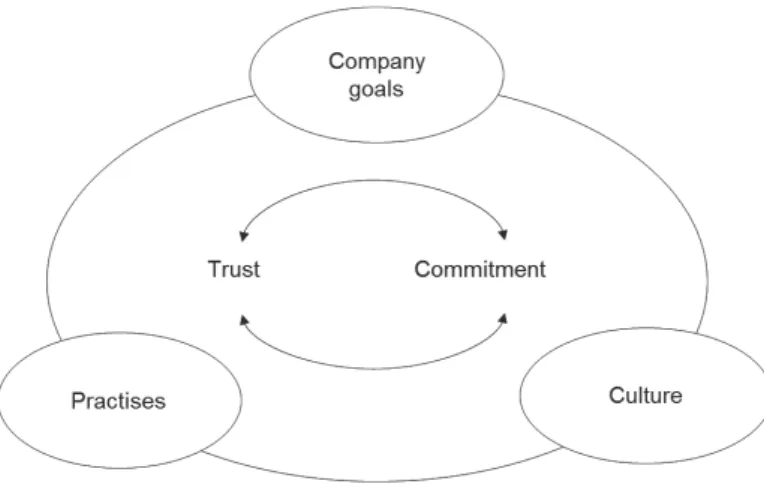
Figure 6. A dynamic model of the relationship between trust and
commitment
Figure 7. Dynamics between expectations, coping and emotions of
inadequacy and guilt
Tables
Table 1. Research question and summary of the essays in this dissertation
Table 2. Demographics of the interview participants
Table 3. Summary of different types of observations
Table 4. Summary of quality assessment for the study (adapted from
Andersen and Skaates, 2004), and actions taken in the assessment
Table 5. Influence tactics (according to Yukl, 2010)
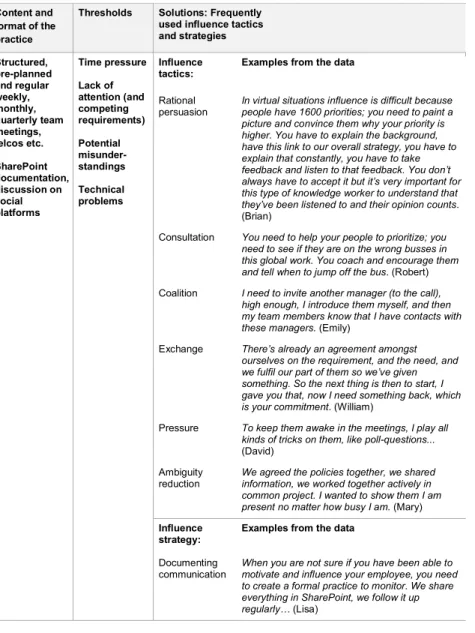
Table 6. Influence thresholds and managers’ solutions in formal practices
Table 7. Influence thresholds and managers’ solutions in informal
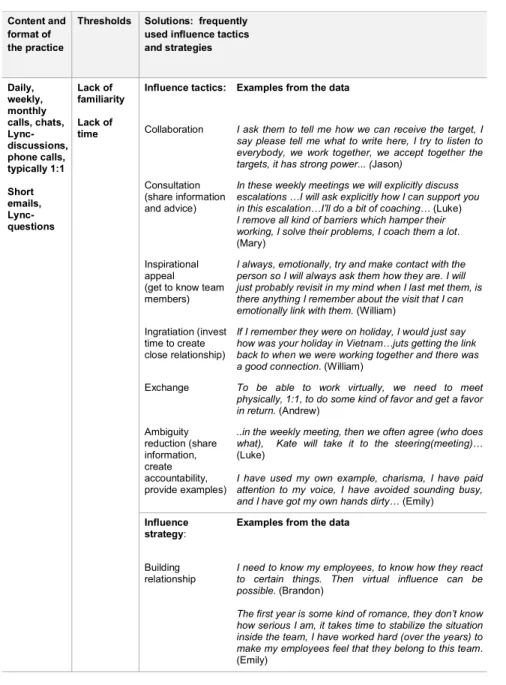
practices
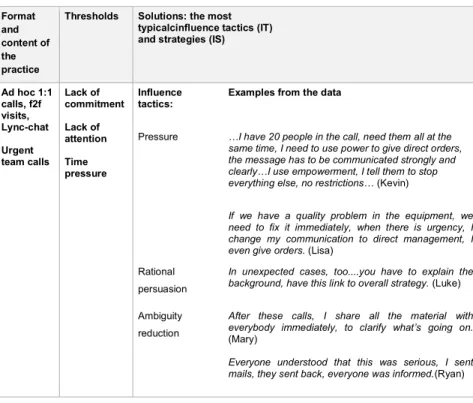
Table 8. Influence thresholds and managers’ solutions in ad hoc practices
List of Appendices
Appendix 1. Main guiding interview questions
Appendix 2. List of influence tactics and strategies observed and used in this study (according to Yukl, 2010 and Wadsworth and Blanchard, 2015)
7
9
1. Introduction
1.1 Managing global virtual teams in the new world of work
Advances in technology-enabled communication and a constant search for economic advantage have led organizations worldwide to rely on a geographically distributed workforce and increase virtual work. While enabling collaboration across distance, communication technology has also altered the context for leadership. Effective management of global virtual teams is important in today’s competitive global economy. Such teams include members who collaborate across boundaries of distance, time, nationality, and organizations, and offer the best functional expertise from around the world. Virtual teams have become commonplace and are on the rise; while not long ago it was calculated that around half of the workforce was collaborating virtually, it is now projected that within a few years more than 1.3 billion people will be working virtually (e.g. Johns and Gratton, 2013). Furthermore, according to a recent survey, 80% of American employees reported working always or frequently in dispersed, virtual teams (Ferrazzi, 2014), and another survey suggests that approximately 70% of multinational organizations worldwide use virtual teams (SHRM survey 2012).
As global work becomes more complex (Wildman and Griffith, 2015), teams in virtual environments keep evolving and changing. Current teams are more widely dispersed and people typically work in multiple teams and organizations simultaneously (e.g. Jonsen et al., 2012; Mathieu et al., 2008; Maynard et al., 2012; O’Leary et al., 2011). In addition, the new generations of “digital natives,” who view technology as the norm in both their personal and professional lives, are becoming more influential in the workplace (e.g. Chafkin, 2010; De Paoli, 2015; Gratton, 2011; Maynard et al., 2012). These and other changes will have an impact on the work of managers.
This dissertation stems from a desire to better understand managerial work in global virtual teams. Virtual collaboration has brought various opportunities and benefits for managers and organizations; it allows, for instance, tapping into geographical distributed resource pools, offers cost reductions and flexibility, and permits use of the lean structures (Gibson and Cohen, 2003) crucial for adapting to the needs of customers. However, virtual collaboration creates a number of challenges for managers and organizations, and researchers have become increasingly interested in how virtual teams work and how virtuality affects work. Consequently, research on virtual work
has increased rapidly in recent years (see e.g. Au and Marks, 2012; DasGupta, 2011; Gilson et al., 2014; Hertel et al., 2005; Mockaitis et al., 2012; Powell et al., 2004; Zander et al., 2012). The rich body of research on virtual work testifies to the interest in and importance of this research field, and has yielded multiple and sometimes mixed findings, for example whether virtual teams perform better or worse than co-located teams or whether shared leadership makes virtual teams more or less successful (e.g. Hoch and Kozlowski, 2014).
On the basis of existing research, we know that electronic, virtual communication is inferior to face-to-face communication (Purvanova and Bono, 2009) and that leadership in virtual environments is different and more difficult than in co-located environments (e.g. Avolio et al., 2014; Golden and Fromen, 2011; Kerber and Buono, 2004). However, despite a rapidly increasing number of studies on virtual teams, there is general agreement that we do not adequately understand how the management of people is affected by technology and virtuality (e.g. Golden and Fromen, 2011; Kahai et al., 2012; Purvanova and Bono, 2009; Zigurs, 2003). Moreover, very few of the earlier studies have provided in-depth knowledge on what managers who work in virtual teams actually do.
This study addresses many of the gaps in research on global virtual teams. An increasing volume of virtual work in all organizations, accelerated development in virtual technologies, and rapid changes in working life have had a significant impact on managerial work. I chose managerial work in global virtual teams as the focus of this study with the aim of gaining a better understanding of what virtual managers work is all about. I sought to do this by exploring what managers say about their managerial work and how they make sense of their work. In my study, I gave voice to the managers themselves, and tried to listen and understand from their talk, what their work in global virtual teams is like, and whether virtuality adds new responsibilities and challenges.
1.2 My choice for the research topic
“Yesterday, I woke up at 5.30 am as every day, checked the emails and took a couple of calls from my Chinese employees. I then sent the material for today’s meeting to my team members, ten people in seven countries. At 8 am I drove to my office, started with budget calls, had a number of Lync meetings during the day, sitting with my headset on. At 3 pm an urgent call from Italy broke the routines, a big issue with the local project implementation. In the afternoon I prepared the steering meeting for the following day, had one weekly one-to-one with one of my employees, checked the numbers with him, another call to Italy at 6 pm with Pernilla, things looked better. Then one Lync meeting with my American employee when he woke up, and the last meeting in my car when driving home. Finally, I parked my car in my home yard, trying to leave everything behind at that moment, it’s one of the rules I have done to myself.” - Alex, Delivery process owner, August 10, 2014.
11 The above quotation is an example of the daily work of a manager in a global company. It resembles my own work in various positions in the multinational companies in which I have been employed during my long career. When working in those organizations, I became particularly interested in managerial work, which my colleagues often talked about, and which I also experienced. In our daily discussions, the managers shared their various experiences and feelings regarding work with their virtual employees. It was fascinating to work in a global environment with endless opportunities for learning, meaningful tasks, and rich diversity. However, the managers, myself included, also faced numerous challenges and problems in working with people whom we could not see or feel. It was not easy to replace physical presence with virtual presence. I discovered that in building and managing virtual work in organizations, managers play a key role. Managers are expected to carry out various tasks and responsibilities and to take care of people: to make the global teams work. Over the years, my interest in managerial work with global virtual teams grew deeper and stronger, and I wanted to learn more about it; this dissertation arose from that interest and my desire to study managerial work in global virtual teams.
1.3 Research gap
According to Gilson and her colleagues (2015), who reviewed the emerging virtual team literature in the past 10 years, the research field continues to be rich and has come far in a very short period of time (see also e.g. Scott and Wildman, 2015). During the past decade, we have gained comprehensive knowledge about virtual leadership, its challenges and opportunities, and put together a picture of what successful virtual leadership looks like. However, despite the growing prevalence of the research (see reviews in e.g. Das Gupta, 2011; Gilson et al., 2014; Hertel et al., 2005), there are still significant gaps in the field. According to Al-Ani (et al., 2011, 225), “the practice field has far outpaced what we know about how leadership and technology will affect each other”. Moreover, although the ability to lead people virtually is no longer an option but a requirement for success, it seems that the virtual forms of organizing work are surfacing more quickly than scholars are able to study them; research on virtual team leadership is lagging behind (Al-Ani et al., 2011; Hill and Bartol, 2015; Kahai et al., 2012; Kelley and Kelloway, 2012; Malhotra et al., 2007; Zander et al., 2012). Similarly, Kahai (et al., 2007) argue that research on leadership in global virtual teams has not kept pace with the growth of virtual work and is an area in which practice is ahead of research (Jonsen et al., 2012). Moreover, Hinds (et al., 2011) state that management literature remains remarkably unhelpful in answering questions about what happens when people across nations and cultures work closely together. In this dissertation I have identified and filled some of the gaps in research on virtual work.
The majority of the earlier virtual team studies have taken the perspective of teams and team members and focused on subjects such as communication between team members (e.g. Daim et al., 2012; Joshi et al., 2009; Maznevski and Chudoba, 2000), and trust between team members (e.g. Chen et al., 2011; Edwards and Sridhar 2005; Jarvenpaa and Leidner, 1999; Symons and Stenzel, 2007; Symons, 2003). Previous studies have offered guidelines (e.g. Hunsaker and Hunsaker, 2008; Lojeski, 2010; Zofi, 2014), success factors (e.g. Verburg et al., 2013), and recommendations (e.g. Jonsen et al., 2012; Malhotra et al., 2008; Nemiro et al., 2008) to virtual teams and team managers, but we have not adequately listened to the managers themselves and how they talk about their work. This study aims at focusing on managers’ talk and therefore tries to fill the gap in the current research in which the managerial perspective is inadequate.
Moreover, regarding the research design and the empirical focus, earlier virtual team research has predominantly occurred in experimental laboratory settings (see Gilson et al., 2015). These studies have mainly used student teams as research data (e.g. Glikson and Erez, 2013; Kahai et al., 2007; Kayworth and Leidner; 2002; Mockaitis et al., 2012; Rains, 2005), and although they have provided much knowledge about virtual teams, not all of it can be applied in business settings. Thus, it is imperative to collect additional data outside the university setting.
Additionally, the majority of virtual team studies are still conducted in temporary teams or project teams (e.g. Crisp and Jarvenpaa, 2012; Iorio and Taylor, 2015; Lee-Kelley and Sankey, 2008; Verburg et al., 2013). In earlier research, a typical virtual team was characterized by a temporary life span and interim membership (Avolio et al., 2001; Bell and Kozlowski, 2002), and some scholars still see virtual teams as temporary arrangements (e.g. Kahai et al., 2007). A great deal of virtual work does occur in project teams, but the reality in many current organizations is that virtual teams are established and built to be more or less permanent. Although the team compositions may change with team members coming and going, the teams usually operate together for a long time, mostly on a permanent basis and in rather similar settings for years (e.g. Avolio et al., 2014). This has a relevant impact on the work of virtual team managers and the challenges faced by them, as the manager and the team members must plan their work for the long term.
Further, the focus of virtual team studies has often been on expert groups such as software developers, information technology professionals, consulting, research and development (e.g. Cramton and Webber, 2005; Edwards and Sridhar, 2005; Giuffrida and Dittrich, 2015; Siebdrat et al., 2009). Although these teams use virtual collaboration a lot and are certainly competent with technological devices, it is important to learn more about “mixed” or “normal” business teams, including professionals in marketing, finance, human resources, and engineering, and how they work in a virtual context. By studying “mixed” teams, we get a much broader picture of
13 managerial work in the multiple roles of organizations. According to many current studies, research examining cross-organizational virtual teams is still limited (Gibson et al., 2014; Gilson et al., 2015).
Finally, the majority of the virtual work research during the past two decades has used quantitative methods (e.g. Crisp and Jarvenpaa, 2012; Golden and Veiga, 2008; Joshi et al., 2009; Luther and Bruckmann, 2010; Sarker et al., 2011). According to the most recent reviews (e.g. Gilson et al., 2015), there are now a number of qualitative case studies (18%), but to understand the complexity of the new organizations there is a need for deeper understanding of how organizations and people operate in a fast-changing environment. Hence we need qualitative data, i.e. in-depth case studies, interview studies, and ethnographic studies to zoom deeper into virtual teams and to listen to how actors talk about their work and make sense of it. As quantitative methods may not be able to zoom into the inner life of individual managers or get a grip on their work, qualitative methods become relevant for deepening our understanding of sense-making by managers.
1.4 Purpose of the study and the research question
The purpose of this study is to explain how managers make sense of their work and how they describe and give meaning to it and thereby contributes to the existing literature on global virtual teams. These teams are permanent rather than temporary and consist of functional specialists from various units. As stated in the previous section, the current scholarly literature on global virtual teams has examined virtual work mainly from the perspective of global teams, and for example described their challenges, opportunities, leadership requirements and success factors.
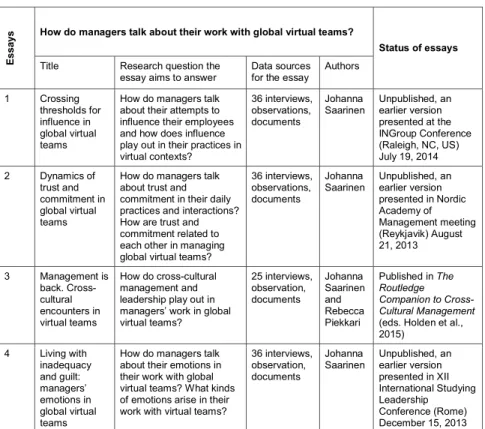
The primary research question is: how do managers talk about their work with global virtual teams? The primary research question is followed by sub-questions in each essay, presented in part II. Table 1 summarizes the essays of this dissertation, including the main research question and the sub-questions.
Table 1.Research question and summary of the essays in this dissertation
E
ssays
How do managers talk about their work with global virtual teams?
Status of essays Title Research question the
essay aims to answer
Data sources for the essay
Authors 1 Crossing thresholds for influence in global virtual teams
How do managers talk about their attempts to influence their employees and how does influence play out in their practices in virtual contexts?
36 interviews, observations, documents
Johanna
Saarinen Unpublished, an earlier version presented at the INGroup Conference (Raleigh, NC, US) July 19, 2014 2 Dynamics of trust and commitment in global virtual teams
How do managers talk about trust and commitment in their daily practices and interactions? How are trust and commitment related to each other in managing global virtual teams?
36 interviews, observations, documents Johanna Saarinen Unpublished, an earlier version presented in Nordic Academy of Management meeting (Reykjavik) August 21, 2013 3 Management is back. Cross-cultural encounters in virtual teams How do cross-cultural management and leadership play out in
managers’ work in global
virtual teams? 25 interviews, observation, documents Johanna Saarinen and Rebecca Piekkari Published in The Routledge Companion to Cross-Cultural Management (eds. Holden et al., 2015) 4 Living with inadequacy and guilt: managers’ emotions in global virtual teams
How do managers talk about their emotions in their work with global virtual teams? What kinds of emotions arise in their work with virtual teams?
36 interviews, observation, documents
Johanna
Saarinen Unpublished, an earlier version presented in XII International Studying Leadership Conference (Rome) December 15, 2013
1.5 Key contributions of the study
This section presents the key contributions of my study. Although each essay makes its own distinct contribution to the current theoretical understanding, they all share a common underlying theme and contribute to increase knowledge of the managerial work of global virtual teams. The overall aim of this dissertation is to enhance our understanding of managerial work in global virtual teams. My study complements the extant literature by explicitly and uniquely focusing on managers’ own experiences and their talk about making sense of their work.
First, managerial work in multinational organizations has changed radically because work has become more global and more virtual. Although virtuality offers numerous opportunities for organizations and managers, such as cost savings and an opportunity to make use of global knowledge, virtual contexts restrict managerial work in global organizations. These restrictions, such as the inability to meet employees at frequent intervals, make it difficult for managers to operate as they might wish. According to the findings of my study, managers of global teams cannot achieve the quality of managerial work they seek; virtuality “narrows” their scope to operate. New technology to serve global organizations and their people, including very sophisticated software
15 and hardware, has developed fast. These new technologies offer all kinds of advanced tools for managers, for instance social platforms, virtual walls, and video screens to help them in collaboration with their employees and colleagues. But despite all these possibilities, managers are of the opinion that no technology can replace face-to-face contact with their employees.
The existing literature on global virtual teams highlights the complexity of virtual work and various managerial challenges (e.g. Gilson et al., 2015; Hambley et al., 2007; Jonsen et al., 2012; Kahai et al., 2007; Kelley and Kelloway, 2012), the opportunities it can offer for virtual team members (e.g. Nurmi and Hinds, 2016), and the unique skills needed to overcome the complexity of virtual work (e.g. Hertel and Orlikowski, 2014; Kayworth and Leidner, 2002; Verburg et al., 2013). My results support these findings, but also shed new light on the experiences of managers in their work and how they see the limitations of virtuality as additional challenges in a virtual context. For example, managers said that their opportunities to transfer energy, to create team spirit, and to engage team members were clearly narrowed in a virtual context. Moreover, current literature highlights the importance of knowing the team members in virtual environment (e.g. Bergiel et al., 2008; Hinds, 2016; Hinds and Cramton, 2015; Martins et al., 2004; Powell et al, 2004). My findings show that although the core teams are typically rather permanent in global organizations, their compositions may change quickly, new members come and go, many people work in multiple teams simultaneously, and face-to-face meetings take place rarely, all of which make it difficult for managers to learn to know their people and hence pose challenge to their managerial work.
Secondly, this thesis contributes to the literature on the managerial work of global virtual teams by highlighting the feelings of managers. The managers felt inadequate; their employees expected more personal support and care from them and they tried themselves to be more “people-oriented”. However, in virtual environments, the managers drifted into task-oriented work and were consequently disappointed in themselves. In addition, the multiple expectations of company and employees, the feeling of being between a rock and a hard place, made them feel inadequate, frustrated, and guilty.
Current research on global virtual teams discusses the emotions in virtual work (e.g. Ayoko et al., 2012; Eligio et al., 2012; Pitts et al., 2012; Purvanova and Bono, 2009; Wilson et al., 2006), but fails to recognize the emotions of virtual managers. In global virtual work with multicultural big teams and a multitude of expectations, a sense of inadequacy is often present. Managers’ strict sense of duty and their high ambitions and aspirations to do their work as well as possible add to the burden. Despite valuable discussion on the well-being of global managers (see e.g. Maynard et al., 2012; Nurmi, 2011; Powell et al., 2004), existing literature does not recognize the emotions of managers when they try to cope with long days, stress, time zones, and work-life balance. According to my findings, inadequacy was most typically
experienced by middle managers who faced expectations from many directions and had not yet learned to handle the pressure of global work. However, the picture given by the research participants of my study was not only negative. Most managers also emphasized the many positive elements in their work, such as exciting tasks, the richness of cultural differences, extensive opportunities to learn global work and develop various skills, and in addition to negative emotions, they derived joy and satisfaction from their managerial work.
Thirdly, despite feelings of inadequacy and guilt, the managers of my study were constantly looking for ways to improve their work. They tried and tested better solutions for managing their work, supporting their employees better, and surviving the heavy work load. They persistently and innovatively searched for different ways to cope, such as practices, processes and structures for their work and personal life. They learned to protect themselves and created coping strategies. They eventually found a way to meet these challenges and this helped them live with their feelings of inadequacy and guilt.
Earlier studies have highlighted the importance of work processes and practices in virtual work (e.g. Klitmoller and Lauring, 2013; Piccoli et al., 2004; Verburg et al., 2013; Watson-Manheim et al, 2013). These structures and work processes may help virtual team managers to organize their work and monitor team performance. In addition, practices are known to help managers cope with stress (Nurmi, 2011) and lessen the burden of global work (e.g. Zander and Butler, 2010). The managers in my study also used practices to protect themselves from long working days, working across times zones, and feelings of inadequacy and guilt. They became problem-solvers who were constantly able to improve work with their teams.
1.6 Limitations of the study
This study is subject to the following limitations. First, the rich body of research on global virtual teams includes many streams of literature and one main focus has been on comparing the differences between virtual and face-to-face (co-located, traditional) work. In my study, the aim is not to compare the work of managers in these two contexts or to assess how face-to-face work and virtual work differ, but to focus on how managers describe and talk about their work. Secondly, existing research has indicated and assessed how virtual teams can be successful and what factors lead to high-performance team outcomes (e.g. Zander and Butler, 2010). These performance outcomes of global virtual teams are outside the focus of this study unless the managers discuss them in their descriptions. Similarly, I have not intended to conduct a normative study by trying to identify what kind of managerial work is successful or how global virtual teams should be managed.
17 Thirdly, I have intentionally focused on the managerial perspective in my study. This means that I did not address interaction among subordinates (employees) or team members, but managerial work from the perspective of managers. Further, my aim is not to cover all areas of managerial work in global virtual teams, but only those which emerged in the data (e.g. how managers talk about their work in a virtual context).
I use the concepts of leadership and management, as well as leaders and managers interchangeably in my thesis (see Section 2.1.). The literature on global virtual teams predominantly uses the term virtual leadership and discusses, for example, the leadership styles that succeed in virtual environments. I did not study leadership behavior or styles, but managers’ experiences of their work, and leadership and management are interchangeable as concepts. However, Essay 3, which discusses “hard management” and distinguishes between people leadership and task management, is an exception. Further, when talking about managerial work, I did not address leadership styles or state which leadership mode, for example single team leadership or shared leadership (e.g. Zander and Butler, 2010), is better. In my data, shared leadership, currently one of the emerging themes in the literature on global virtual teams (e.g. Hoch and Kozlowski, 2014), was seldom used in the organizations where the managers worked. Hence it is not one of the focal themes of global virtual work in my study.
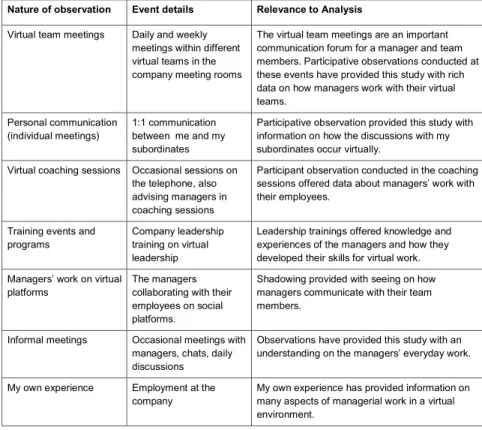
Methodologically, the present study is qualitative interview research and its results are not supposed to be generalizable or transferrable to other data and contexts. The priority was instead to produce a rich description of the phenomenon in its contexts, shedding more light on managerial work in global virtual teams by giving voice to the managers themselves. However, to understand managerial work even better, I could also have interviewed employees. Although I spoke with them frequently, their talk is not included in the research data. However, most of the research participants also worked as employees, and reflected on their experiences in work as subordinates in global virtual teams. The interview method also set certain limitations (see Macdonald and Hellgren, 2004). Compared with observations, for example, interview data do not occur naturally, but are “manufactured” in a certain sense. Some interviewees may also engage in impression management or pursue hidden agendas. In addition to interviews, I followed numerous virtual meetings and chat discussion on social platforms, Intensive observation data with video or voice recording could have offered a richer picture of what was happening in the managerial work. However, I primarily drew on interview data rather than on other data sources such as videos.
Finally, the research participants of my study represent one company in a certain kind of industry. Hence the special features of this company and its managers set boundary conditions to the findings of the study. The main part of the data consists of interviews of Finland based managers, the company having its headquarters’ in Finland. Majority, i.e. 62% of the research
participants are male and have engineering as their professional and educational background. This makes the data set relatively homogenous, although the positions and business organizations of the research participants vary a lot. I have not paid particular attention to the differences of male and female managers and how they talk about their work. In addition, the company has strong global processes and structures, which guide managers’ work and company expectations.
1.7 Implications for the practice of managerial work in global
virtual teams
The practical relevance of this study stems from the understanding of managerial work in global virtual teams that it provides. The findings of my dissertation have several managerial implications for the managers of global virtual organizations. Learning from managers’ experience can help organizations to support virtual managers and develop training programs for them. Research indicates that only a small number of organizations have offered training programs to prepare virtual team managers (e.g. Rosen et al., 2006). According to many current studies (e.g. Jonsen et al., 2012), virtual teams can reach maximum effectiveness with appropriate support from the organization and support for virtual managers can lead to better results. Even when available, such support and training are provided too late; most managers in my study also said they had learned their work through trial and error. Also, business schools and universities should focus more on developing the critical competencies needed to lead global teams from a distance. Hence, I would argue that there is a great need to increase training and develop skills for operating in a virtual environment. My dissertation provides abundant material and insights on such training for managers in global companies.
Global companies need people with excellent and specific skills for global work, e.g. strong communication skills. It would be beneficial in the selection of managers for companies to carefully define what competences are needed for managing global teams and to use this knowledge in the recruitment process and assessment. In addition, assignment of managerial responsibilities in an early stage could provide important training for meeting the demands of managerial work in a virtual environment.
For managing global virtual teams, certain organizational practices may facilitate the work of managers with teams. First, to avoid virtual work overload, organizations should be able to reduce the number of virtual meetings and evaluate the importance of different kinds of meetings. Part of the communication can be managed by sharing information in written form, for example at connection sites or SharePoint. Teams should also pay attention to the length and content of virtual meetings. Sometimes longer meetings make sense if they allow more time for informal discussions and help in building the personal relationships needed to get to know team members and
19 build trust with them. In addition, sharing proper meeting guidelines improves the quality of work: for example, how to prepare for virtual meetings (e.g. to make an agenda and study the background material), how to behave in virtual meetings (e.g. to give all participants equal opportunities to talk,), what channels (e.g. chats and question spaces) are available, who facilitates the meetings, and how to use different collaboration technologies. Although technology develops continuously, the connections will still fail in too many virtual meetings and create frustration and time loss. It is also important to review regularly who can contribute to the meetings and whose participation is unessential.
Organizational practices can also support managers in building relationships with their employees. For example, opportunities to meet face-to-face regularly enable managers to learn to know their team members better and exert an influence on them more effectively. With tight and limited travel budgets this is sometimes difficult for many managers. Investing in site visits is important and helps managers to build interpersonal closeness with team members (see also Hinds, 2016). Moreover, building relationships takes time, and it would therefore be important not to alter team compositions unnecessarily. In many organizations, managers and team members change positions and teams very often, and although this may be good for career development and learning, it sometimes hinders team building and the efforts of managers to influence team members or build trust.
It is also important for organizations to support virtual managers by providing reasonable team sizes, good role models, and sustainable expectations. Companies can consider whether their expectations are reasonable and accept that managers may also need additional support. Support in handling demands and in striking a balance between their personal and professional lives will certainly facilitate managerial work. Mentoring can be actively utilized in supporting managers. Mentoring programs in which more experienced people guide managers also provide an opportunity for managers to handle their emotions in a safe environment. Similarly, in peer coaching programs colleagues can share their best practices and support their peers in virtual work. These activities also focus leadership culture more on the abilities of managers to support and help them learn. Managing virtual teams should not be “hard management,” but focus on supporting employees, giving them adequate feedback and coaching them.
1.8 Avenues for future research
With the benefits of ever accelerating and exponential technological development, virtual work will continue to increase and change in all organizations; virtual teams are said to be one of the fastest-changing facets of managing (e.g. Jonsen et al., 2012). With the increased bandwidth and new, advanced software applications available, communication with technology will
become increasingly versatile, and storing and accessing information, for instance, will be easier and cheaper. The next generation of virtual team workers, who may see virtual work as the only way to work, will be able to utilize this technology effectively. These digital natives are used to creating relationships via technology and learn to lead organizations of 200 people (e.g. in “Warcraft” -games) at the age of 12. With increased comfort and acceptance of technology, they will take virtual work as the norm and many of the present challenges associated with virtual work may be overstated in the near future (see also De Paoli, 2015; Gilson et al., 2014). This will also open new avenues for virtual team research. For example, it will be interesting to see how younger generations challenge the managerial practices in virtual world.
This study provides opportunities for examining managerial work in global virtual teams in future studies. The future of the workplace will mean more work and less place (see Ediriweera, 2016), given the impact of new technologies, an uncertain economy, and the demands of a new generation of employees. These trends provide freedom and flexibility, but also greater expectations. This will necessarily impact managerial work and the workload and well-being of managers. In the face of these demands, balancing between their life quality and work may become a great challenge. In addition, virtual communication can be emotionally charged (Cheshin et al., 2012). The findings of my study suggest that managerial work in global virtual teams today is demanding, intensive, and consuming with long working days. These features are unlikely to change in the future. Hence future studies could focus on the affects, emotions, and time management of virtual teams and members to discover how adoption of newer technologies, for instance, can benefit the well-being and quality of life managers.
As time moves forward, technology will move fast and will have an ever greater effect on the way we process information, interact, and collaborate with each other. In future studies it will interesting to explore how to use technology without losing the beauty of personal relationships, sensitivity, and the interaction that makes us human. Virtual workforces will have to adapt to rapid business cycles, constant turbulence, rapid skill obsolescence, and real-time communication everywhere. It will be interesting to explore how these changes and increasing complexity will formulate managerial work in global virtual teams.
1.9 Structure of the thesis
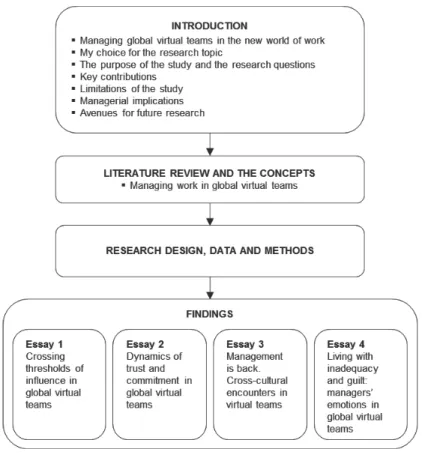
The structure of this essay-based thesis is presented in figure 1 below. The dissertation contains two parts (I and II). Part I of the study is composed of four chapters. The introduction (Chapter 1) provides an overview introducing the research questions. It also concludes the key contributions of the study, summarizes the practical implications, and suggests avenues for future research. After the introduction, Chapter 2 presents the essential concepts and
21 theoretical lenses of the study. This positioning chapter reviews how the existing literature has studied management in global virtual teams. Moreover, it aims to focus on the work of individual) managers, their tasks, competences, and challenges. Chapter 3 presents the methodological considerations and epistemological and ontological commitments of the study, as well as the background for choosing the research site. The quality of the study is assessed at the end of the chapter. Chapter 4 reviews the key findings of the original essays. Finally, Part II (Chapter 5) of the study is composed of four essays. Figure 1 presents the structure of the thesis.
23
2. Managerial work in global virtual
teams
2.1 Defining the core concepts
Virtual teams are defined as groups of employees, who collaborate primarily through electronic means, i.e. communications technology, and are dispersed by geography and time (e.g. Aubert and Kelsey, 2003; Bell and Kozlowski, 2002; Jarvenpaa and Leidner, 1999; Kirkman et al., 2002). The current conceptualization focuses on the geographical separation between team members and on their reliance on information and communication technology (Chudoba et al., 2005; Gibson and Gibbs, 2006; Gilson et al., 2015). Such technology can include text-based communication and audio media. Text-based communication can include emails and share points which are primarily used for knowledge sharing, updating, and documentation purposes. Audio media can include telephone calls (for fast interaction), online meetings (e.g. Lync and Skype which are mainly used internally), chatting (for asking simple questions and getting immediate answers), video conferencing, social networking, social platforms, discussion boards and virtual walls. Technology produces ever more advanced, cost-effective, and sophisticated groupware and ensures that virtual world environments are nowadays available to more people than ever before.
To define virtual teams, some researchers emphasize the nature of remote work versus co-location and use the term “remote teams” (e.g. Kelley and Kellogan, 2012), while others consider the (geographical) distribution of team members relevant and prefer using the concepts “distributed teams” (e.g. Hill and Bartol, 2015; Hinds and Cramton, 2014) or “dispersed teams” (e.g. Klitmøller et al., 2015). Most scholars use virtual, distributed, and dispersed teams almost as synonyms (e.g. Al-Ani et al., 2011), whereas some make a clear distinction between the concepts (e.g. Bosch-Sijtsema et al., 2011). In my study, I will use the concept virtual team to mean teams that work primarily virtually (through technology) and include members who are distributed in different locations (and countries). More specifically, I will use the term global virtual team to refer to the global work typical of multinational organizations.
Global virtual teams (commonly abbreviated as GVTs) work across time and space as well as organizational and cultural boundaries. They are generally defined as groups of people who (1) work together using communications
technology, (2) are distributed across space, (3) are responsible for a joint outcome, (4) work on a strategic or technically advanced task, and (5) are multifunctional and/or multicultural (e.g. Chudoba et al., 2005; Gibson and Cohen, 2003; Gibson and Gibbs, 2006; Zander et al., 2012). Managers who lead global virtual teams need to ensure that the best individuals are available for a given task, such as developing new products and processes and running projects, have access to the same information, and can complete tasks quickly from their locations (i.e. home countries), typically close to the customers (see Daim et al., 2012; Jarvenpaa et al., 1998; Maynard et al., 2012; Maznevski and Chudoba, 2000). The typical size of these teams is 5-10 members, who work daily together to share information, define goals, follow-up team’s progress and support each other. In addition, members of global virtual teams are likely to represent different specialist functions and to have multiple reporting lines, i.e. work in a matrix organization. Moreover, some scholars (e.g. De Paoli, 2015; Siebdrat, 2009) also use the term “hybrid teams”. These teams are dispersed on some level, temporally separated, or configurationally uneven. In my study, I use the concept “global virtual team”, although part of the teams may be hybrid, i.e. some team members work virtually and others are co-located.
One dimension common to all existing virtuality constructs is the degree of dependence on electronic communication among team members (Chudoba et al., 2005; Gibson et al., 2014; Gibson and Gibbs, 2006; Gilson et al., 2009). Virtuality in an organizational context is the use of virtual space to facilitate interaction relating to organizational activities. The attribute “virtual” designates distributed work that is predominantly based on electronic information and communication tools (e.g. Gibson and Gibbs, 2006; Hertel et al., 2005). Shekhar (2006) provides a model for virtuality that accommodates the major manifestations of virtuality in an organization. They can manifest themselves in different ways, such as telework, e-learning, virtual teams, outsourcing or off-shoring, virtual communities, virtual linkages, electronic market places, and technology-facilitated business activities. The virtual organization has been defined as an environment in which workers are electronically connected but not physically. Virtual work or virtualized work (Johns and Gratton, 2013) can be differentiated depending on the number of persons involved, the degree of interaction between them, the outcomes, and the degree of virtuality of the team (e.g. Chudoba and Watson-Manheim, 2005; Griffith and Nealy, 2001).
Previous research uses different, although similar concepts when discussing leadership in virtual teams, depending on the origin and the perspective of the virtual work. While the most commonly used term is virtual leadership, some scholars also refer to virtual management, although they are in fact referring to the same phenomenon. Avolio et al. (2001 and 2014) speak about e-leadership and define it as a social influence process embedded in both proximal and distal contexts mediated by advanced information technology (see also Annunzio, 2001; DasGupta, 2011; Zaccaro and Bader,
25 2003). D-leadership (distance leadership) refers to the distance between individuals and team members (Fischer and Fischer, 2000) and distributed leadership (e.g. Hill and Bartol, 2015; Verburg et al., 2013) refers to managing employees who are distributed to different locations. Moreover, some scholars refer to mobile management or remote management or remote leadership (e.g. Kelley and Kelloway, 2012), and argue that relationships are differentially related to the context in which they occur: proximal versus remote. In this study, management and leadership of virtual teams are used interchangeably. The basic concepts of virtual leadership or virtual management (as well as those of virtual manager and virtual leader) also seem to be typically used in the existing literature “at random” or interchangeably, without emphasizing a difference between leadership and management. However, we may generally understand leadership as more people-oriented and management as more task-oriented. Finally, by managerial work in this study, I mean work carried out by people in any supervisory, managerial, or leadership position at all levels of the organization. In this study, managers manage global virtual teams of various sizes and various compositions, working mostly virtually with their employees.
2.2 Opportunities and challenges in virtual work
Much has been written about how virtual work and virtual teams differ from face-to-face, co-located, traditional, or conventional teams (e.g. Fiol and O’Connor, 2005; Gibson and Cohen, 2003; Kirkman et al., 2002) and in this section I will describe the opportunities and challenges associated with virtual work and virtual teams.
Virtual collaboration provides obvious opportunities and advantages for organizations that can use teams to ensure that the best individuals are available for a given task and can work in different locations to be closer to the customers. Thus electronic communication provides managers and team members with a range of new opportunities to access relevant expertise and gain the flexibility needed to work (e.g. Hill et al., 1998) and to develop and utilize effective communication techniques (e.g. Gibson et al., 2014), and further, with the ability to communicate instantly with employees, customers, and suppliers, the capability to use talent wherever it exists, and thus scope for better knowledge management (e.g. DasGupta, 2011). The need to exploit local expertise when necessary and responsiveness to the local market and customers’ needs have been identified as generic and important benefits of virtual work. In addition, virtual teams tend to incorporate increased heterogeneity and higher levels of structural and demographic diversity than collocated teams, and this diversity can be highly beneficial (Siebdrat, 2009).
Virtual work is also associated with potential benefits related to economy and efficiency such as reduced travel or savings in travel costs and real estate. Real estate cost savings, which can provide cost reductions of up to 60% in
virtual work (Thompson and Caputo, 2009), are associated with employees working outside offices. Moreover, virtual work offers environmental sustainability associated with for example commuting costs and travel. Further, virtual collaboration may offer long-term benefits through improved scores on human capital metrics such as increased employee performance, team member satisfaction (Henderson, 2008; Wilson et al., 2013), and employee productivity. These may result in improved recruitment, organizational attraction, corporate sustainability, and retention (see Thompson and Caputo, 2009). For example, virtual work may help retain valuable employees when personal circumstances dictate physical location. According to recent studies, particularly young employees, “Gen Y’ers” and “Millennials” are known for their expectations regarding the work-life balance, flexibility, and independence afforded by virtual work (see e.g. Myers and Sadaghiani, 2010; Tapscott, 2008; Thompson and Caputo, 2009).
Virtual teams can also perform better than co-located teams. It is too simplistic to claim that virtual collaboration is always less effective (e.g. Montoya et al., 2009; Staples and Zhao, 2006). Visual anonymity, for example, can be advantageous for some team members; electronic communication provides time to digest information (Jonsen et al., 2012) and team members who in face-to-face interaction are shy about expressing their opinions may have more courage in virtual encounters. Findings on effectiveness and use of languages are among the new positive implications for virtual organizations. For example, Klitmoller and Lauring (2016) explored inclusive language use in virtual work and demonstrate that distance can be positive. In their study they demonstrate a positive association between workplace mobility and perception of openness to language diversity. Another recent study by Nordbäck and Small (2015) pointed to the benefits of shared leadership in virtual teams, suggesting that task and team design can help global virtual teams overcome some of the barriers to shared leadership. Moreover, in their study of global workers, Nurmi and Hinds (2016) found elements unique to global work that may transform challenges into opportunities, i.e. learning possibilities, a sense of task significance, and experienced meaningfulness. They reported how global workers found their work interesting because of cultural and task diversity and considered the opportunities for professional learning very important for them.
Despite the numerous abovementioned opportunities and benefits, virtual work poses several challenges to the work of virtual managers and virtual teams. Differences in time, location, culture or combinations of these factors provide substantial obstacles to global virtual teams (e.g. Hinds et al., 2011; Kirkmann et al., 2013; Klitmoller and Lauring, 2013; Mockaitis et al., 2012). Electronic communication uses “leaner” media, which may be problematic because so much of the meaning in communication is derived from the non-verbal aspects that are typically absent in virtual communication (e.g. Gibson et al., 2014). When social and non-verbal cues are generally missing, the ability to observe the behaviors of other team members during
27 communication is weakened. Although non-verbal cues can be available to a certain extent in some technologies (e.g. video conferencing), several studies point out that due to a lack of visual and auditory cues misunderstandings and misinterpretations are common in virtual communication (e.g. Daim et al., 2012; Zimmermann et al., 2008), and the complexity of collaborating with global team members is not exaggerated (Miloslavic et al., 2015).
In global work, different cultural backgrounds pose opportunities and challenges to virtual teams (e.g. Lacarenza et al., 2015; Meyer, 2015; Sarker at el., 2011). Although cultural diversity and richness provide an interesting and exciting work environment for virtual team members, most empirical research associates cultural diversity with negative experiences (e.g. Au and Marks, 2012; Gibson and Gibbs, 2006; Stahl et al., 2010). For example, communication and coordination difficulties have been reported as typical challenges (e.g. Maznevski and Chudoba, 2000; Zander et al., 2013) in virtual work. Cultural differences at the surface level may cause misunderstandings and difficulties in various ways, but according to Zander (et al., 2013, 229), “it is the deep-level invisible and unspoken cultural aspects with the taken-for-granted assumptions, often unrecognized by the individuals themselves, which cause the more serious problems.” Moreover, leadership preferences, attitudes, and ideals differ across national borders and cultural boundaries, and also leadership behaviors and expectations have been strongly related to national culture (Zander et al., 2013). Cultural differences may also produce language issues (e.g. Brannen et al., 2014; Hinds et al., 2014; Klitmoller and Lauring, 2013; Neeley et al., 2012; Tenzer et al., 2013). According to Snyder (2003), “even when employees have good language skills, they naturally interpret written and verbal communication through the filter of their own culture.” Silence, for example, is very easily misinterpreted and misunderstood; it does not necessarily mean either a lack of concentration on the topic at hand, or the contrary, an intensive effort to listen and think (De Paoli, 2015).
Virtual work often means physical distance from employees and colleagues and may create a lack of familiarity between the team members and the manager, who seldom meet each other and learn to know each other more slowly than in face-to-face teams. Virolainen (2011), for example, found that a virtual working environment decreases informal personal communication; discussion is mainly work-related and this affects social relationships between co-workers. Similarly, Elron and Vigoda-Gadot (2006) found that limited familiarity with virtual team members was associated with the possibilities of managers to exert an influence. Related to familiarity, a sense of belonging may decrease in virtual work; it may be more difficult to belong to a team when team members rarely meet. Isolation and loneliness have also been identified as typical drawbacks in virtual work (e.g. Avolio et al., 2014; Coope and Kurland, 2002; Jarman, 2005; Mulki and Jaramillo, 2011; Rogers, 2011). In addition, a number of recent studies (e.g. Hinds and Cramton, 2014;