AN INVESTIGATION INTO CHALLENGES FACED BY COMMUNITY-BASED INTERVENTIONS FOR ORPHANS AND VULNERABLE
CHILDRENINMUTARE,ZIMBABWE.
By
MANDLANGWENYA
Submitted in accordance with the requirements
for the degree of
MASTEROF ARTS
in the subject
SOCIAL BEHAVIOUR STUDIES IN HIV/AIDS
at the
UNIVERSITY OF SOUTH AFRICA
SUPERVISOR: MS S E KOEN
i
DECLARATION
I declare that: AN INVESTIGATION INTO CHALLENGES FACED BY COMMUNITY-BASED INTERVENTIONS FOR OVCs IN MUTARE, ZIMBABWE is my own work. All the sources used in this research and quoted are acknowledged by means of complete references.
Name: Mandla Ngwenya Student Number: 41745795
27/02/2015
--- ---
ii
DEDICATION
Dedicated to my family and to all who care and support Orphans and Vulnerable Children.
iii
ACKNOWLEDGEMENTS
I would want to acknowledge the following people for impacting in my walk of writing this dissertation:
I would like to thank and acknowledge my Supervisor, Ms SE Koen for dedicating her time to guide me throughout the writing process of my dissertation.
I want to express my profound gratitude to my husband Emmanuel, my children Loice, Panganai, Kudakwashe and Charlene for bearing with me during my late hours of dissertation writing.
My sincere thanks to all the caregivers who took part in this study. Thank you for accommodating me in your busy schedules and creating time for me.
I am grateful to UNISA for giving me the opportunity to complete my course by granting me a bursary. Thank you for funding my studies.
iv
SUMMARY
This research was designed to explore the challenges faced by community-based interventions for orphans and vulnerable children in Mutare, Zimbabwe. This study employed qualitative case study method which focused on the two community-based organisations, FACT and Simukai. Cross-case data analysis relating to research questions was done using transcriptions organised by themes and sub-themes from focus group discussions with volunteers, in-depth interviews with caregivers and staff from both CBOs. Findings show that communities are committed to the care and support of OVCs by offering their voluntary services. Despite volunteer/caregivers’ commitment to care and support OVCs, some challenges noted by caregivers were: caregiver fatigue, lack of material resources for OVCs during visits and lack of interest in young people taking up voluntary work. Simukai and FACT interventions were found to be mainly education, psychosocial support, medical assistance, project management, capacity building and financing of self help projects for OVCs and their families.
Key words: Orphans and vulnerable children, community intervention, caregivers, volunteers, HIV and AIDS, care and support
v
TABLE OF CONTENTS
DECLARATION ... ....i DEDICATION...ii ACKNOWLEDGEMENTS ... iii SUMMARY ... iv TABLE OF CONTENTS ... v APPENDICES... viii LIST OF TABLES ... ix LIST OF ACRONYMS ... xCHAPTER 1: SITUATING THE RESEARCH PROBLEM ... 1
1.1 INTRODUCTION ... 1
1.2 THE RESEARCH PROBLEM ... 2
1.2.1 Background to the research problem ... 2
1.2.2 Problem statement ... 4
1.2.3 Focus of the study ... 10
1.3 OBJECTIVES OF THE STUDY ... 10
1.4 RESEARCH QUESTIONS ... 11
1.5 RATIONALE FOR THE STUDY ... 11
1.6 THE RESEARCH SETTING ... 14
1.7 RESEARCH DESIGN AND METHODOLOGY ... 15
1.8 THEORETICAL FRAMEWORK ... 16
1.9 DEFINITION OF KEY TERMS ... 17
1.9.1 Orphans and vulnerable children ... 17
1.9.2 Community-based interventions ... 18 1.9.3 Community-based organisations ... 18 1.9.4 Challenges ... 18 1.9.5 Volunteers ... 18 1.9.6 Community ... 19 1.9.7 Stakeholders ... 19 1.9.8 Beneficiaries ... 19 1.9.9 Collective efficacy ... 19 1.10 CHAPTER OUTLINE ... 20 1.11 CONCLUSION ... 21
CHAPTER 2: LITERATURE REVIEW...22
2.1 INTRODUCTION ... 22
2.2 THE HIV AND AIDS EPIDEMIC ... 24
2.2.1 Nature of the HIV and AIDS epidemics in Africa ... 24
2.2.2 Nature of the HIV and AIDS epidemics in Zimbabwe ... 28
2.3 SITUATION AND PLIGHT OF OVCS ... 31
2.3.1 Situation and plight of OVCs in Africa ... 31
2.3.2 Situation and plight of OVCs in Zimbabwe ... 33
2.4 POLICY DOCUMENTS THAT GUIDE THE RESPONSE TO THE PLIGHT OF OVCS IN ZIMBABWE ... 38
2.4.1 Zimbabwe National Action Plan (ZNAP) for OVCs ... 38
vi
2.4.3 Medical Treatment Orders (MTO) ... 41
2.4.4 OVCs Birth Registrations ... 42
2.4.5 Zimbabwean National HIV and AIDS Strategic Plan (ZNHASP 2011 -2015)... ... ...43
2.4.6 Zimbabwean National Action Plan (NAP for OVC) ... 44
2.4.7 Children’s Protection and Adoption Act of 1999 ... 45
2.4.8 Non-Governmental Organisations (NGO) Bill on OVC Programmes ... 47
2.5 COMMUNITY-BASED INTERVENTIONS FOR OVCS ... 49
2.5.1 Family AIDS Caring Trust (FACT) brief history ... 55
2.5.2 Simukai Child Protection Programme brief history ... 57
2.6 CHALLENGES FACED BY COMMUNITY-BASED INTERVENTIONS FOR OVCs ... 58
2.6.1 Situating challenges faced by community-based interventions for OVCs .. 58
2.6.2 Resources ... 60
2.7 SUSTAINABILITY OF COMMUNITY-BASED INTERVENTIONS ... 63
2.8 THEORETICAL FRAMEWORK ... 65
2.8.1 Introduction ... 65
2.8.2 Collective efficacy theory ... 65
2.9 CONCLUSION ... 71
CHAPTER 3: RESEARCH METHODOLOGY ... 73
3.1 INTRODUCTION ... 73
3.2 RESEARCH DESIGN ... 73
3.3 SAMPLING PROCEDURES AND SIZE... 76
3.4 DATA SOURCES ... 78
3.5 DATA COLLECTION METHODS ... 79
3.5.1 In-depth Interviews with OVC volunteers/caregivers and CBOs staff ... 79
3.5.2 Focus group discussions with OVC the two CBOs’ care givers/volunteers ... 81
3.5.3 Research journal ... 83
3.6 DATA ANALYSIS AND INTERPRETATION ... 83
3.7 VALIDITY AND RELIABILITY ... 85
3.8 ETHICAL CONSIDERATIONS ... 86 3.8.1 Informed consent ... 86 3.8.2 Confidentiality ... 87 3.8.3 Debriefing... 88 3.9 PILOT STUDY ... 88 3.1 CONCLUSION ... 88
CHAPTER 4: DATA PRESENTATION ... 89
4.1 INTRODUCTION ... 89
4.2 FACT ... 90
4.2.1 Biographical characteristics of FACT research participants ... 90
4.2.2 The Aims of FACT ... 92
4.2.3 The origins of FACT OVC intervention ... 93
4.2.4 Organisational structure ... 94
4.2.5 Reasons for Becoming Involved In Ovc Care and Support Interventions .. 95
vii
4.2.7 Effectiveness of FACT OVC interventions ... 107
4.2.8 Factors influencing sustainability of FACT interventions ... 110
4.2.9 Challenges associated with OVC community-based interventions ... 114
4.3 SIMUKAI ... 119
4.3.1 Demographic Characteristics of Simukai Key Informants and Focus Group Discussion Participants ... 119
4.3.2 The aims of Simukai ... 121
4.3.3 The origins of Simukai ... 121
4.3.4 Simukai as an Organisation ... 122
4.3.5 Reasons for becoming involved in OVC interventions ... 122
4.3.6 Types of Simukai OVCs interventions ... 126
4.3.7 Effectiveness of OVC interventions ... 135
4.3.8 Factors influencing sustainability of interventions ... 141
4.3.9 Challenges associated with OVC community-based interventions ... 144
4.4 COMPARISON BETWEEN FACT AND SIMUKAI ... 149
4.4.1 Similarities in OVC interventions ... 149
4.4.2 Differences ... 152
4.4.3 Applying the theory of collective efficacy ... 154
4.5 CONCLUSION ... 157
CHAPTER 5: CONCLUSION, RECOMMENDATION AND ... LIMITATIONS ... 158
5.1 INTRODUCTION ... 158
5.1.1 Research question 1: What caused FACT and Simukai to Intervene in the OVC crisis? ... 159
5.1.2 Research question 2: What types of interventions are being offered by FACT and Simukai? ... 160
5.1.3 Research question 3: What are factors influencing effectiveness of OVC interventions? ... 165
5.1.4 Research question 4: What are the factors influencing sustainability of OVC interventions for FACT and Simukai? ... 170
5.1.5 Research question 5: What are the challenges experienced by both CBOs and their volunteer caregivers? ... 172
5.2 LIMITATIONS OF THE STUDY ... 174
5.3 RECOMMENDATIONS FOR FURTHER RESEARCH ... 175
5.4 RECOMMENDATIONS FOR POLICY DEVELOPMENT AND IMPLEMENTATION ... 175
LIST OF SOURCES ... 178
viii
APPENDICES
APPENDIX A: Introductory letter requesting permission to carry out research ... 192 APPENDIX B: Informed Consent Form ... 193 APPENDIX C: Focus group discussion guide for caregivers ... 195 APPENDIX D: In-depth interview guide for the key informants CBO staff ... 197 APPENDIX E: In-depth Interview guide for community volunteers ... 200
ix
LIST OF TABLES
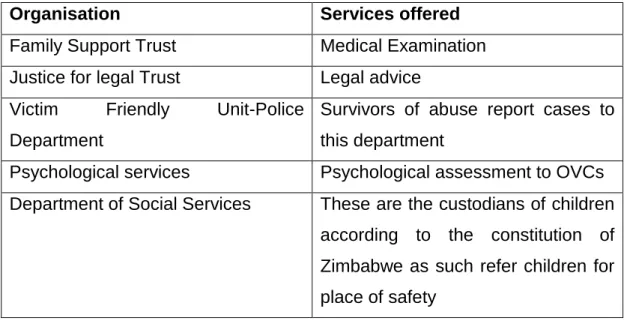
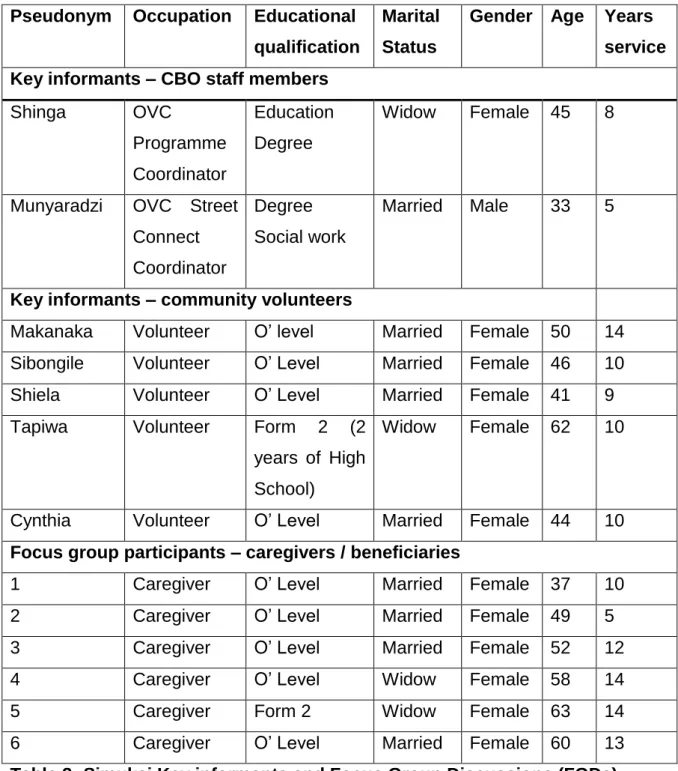
Table 1: Simukai service collaborating organisations: Source: Simukai Annual Report 2011 ... 58 Table 2: FACT participants key informants’ and FGD participants’ biographic characteristics ... 91 Table 3: Simukai Key informants and Focus Group Discussions (FGDs)
x
LIST OF ACRONYMS
AIDS Acquired Immune Deficiency Syndrome ARVs Anti-Retroviral Drugs
BEAM Basic Education Assistance Module
BRTI Biomedical Research and Training Institution CBO Community-Based Organisation
COPE Community-based Orphans for Protection and Empowerment
FACT Family AIDS Caring Trust FGD Focus group discussion FBO Faith Based Organisation
FOCUS Families, Orphans and Children under Stress
HIV Human Immunodeficiency Virus
MMC Medical Male Circumcision
MoPLSW Ministry of Public Service, Labour and Social Welfare MTO Medical Treatment Order
NAC Zimbabwe National AIDS Council NGO Non-Governmental Organisations NOCP National Orphan Care Policy
OVC Orphans and Other Vulnerable Children
OI Opportunistic Infections
PMTCT Parent Mother to child transmission
RAAAP Rapid Country Assessment, Analysis and Action Plan SAFAIDS Southern Africa HIV and AIDS Information Dissemination
Service
SC-US Save the Children Federation of the United States SCN-Z Save the Children Norway-Zimbabwe
STRIVE Support to Replicable, Innovative Village/Community- Level Efforts for Vulnerable Children
UNAIDS United Nations Programme on HIV and AIDS UNAIDS United Nations Programme on HIV and AIDS UNGASS United Nations General Assembly Special Session
xi
UNICEF United Nations Children’s Fund
U.S. PEPFAR United States President’s Emergency Plan for AIDS Relief
WHO World Health Organisation
ZDHS Zimbabwe Demography and Health Survey ZNAP Zimbabwe National Action Plan
ZNASP Zimbabwe National HIV and AIDS Strategic Plan ZIMSTAT Zimbabwe National Statistic Agency
CHAPTER 1: SITUATING THE RESEARCH PROBLEM
1.1 INTRODUCTION
Zimbabwe is one of the countries in sub-Saharan Africa that has experienced an increase in the number of orphans and vulnerable children (OVCs) as a result of the impact of HIV and AIDS and has had its own challenges in responding to the OVCs crisis. The growing number of OVCs has led to the emergence of community-based responses to address the needs of OVCs and as a result, challenges have also emerged as these communities come together to provide care and support for the OVCs.
This study investigates challenges faced by community-based interventions for orphans and vulnerable children in Mutare, Zimbabwe. The investigation uses the case study method in order to explore, describe and understand the challenges faced by two community-based organisations, namely the Family AIDS Caring Trust (FACT) and Simukai. The collective efficacy theoretical framework will be used to guide this study and to assist the researcher to come to an understanding of the collective social efforts to improve the lives of OVC in Mutare, and the challenges associated with these collective efforts.
This first chapter presents a general background to the study, states the research problem which generated the researcher’s interest in undertaking the study, outlines the research objectives and the research questions of the study, explains the rationale for the study, briefly highlights the research setting, research design and methodology and theoretical framework and provides definitions of key terms used in this study.
2 1.2 THE RESEARCH PROBLEM
1.2.1 Background to the research problem
Zimbabwe is one of the countries with the largest numbers of orphaned children in Africa as a result of the AIDS epidemic. UNAIDS (2012:42) posits that Zimbabwe is one of the countries in the world hardest hit by HIV and AIDS epidemics. The impact of these epidemics is seen most dramatically in the number of children orphaned by AIDS. The Global AIDS Report for Zimbabwe (2012:34) estimates that averages of 30% of all children in Zimbabwe are orphaned and that 40% of all children are vulnerable mainly due to AIDS. The Zimbabwe Country Report (2014:52) states that according to the National HIV Estimates in 2010 there were more than 1.4 million orphans in Zimbabwe and that one million of these children are orphaned by AIDS-related deaths. This highlights the need for an urgent response to provide care and protection for this vulnerable group.
High HIV prevalence in Zimbabwe has led to decreasing life expectancy causing the number of OVC to grow to unprecedented levels. SAFAIDS (2010:12) estimated that the percentage of all orphaned children living in Zimbabwe rose to 34% by end of 2010 compared to the 30% in 2005. SAFAIDS (2010:5) further indicates that by 2008, there were 1.4 million OVCs in Zimbabwe with some of the children also infected with HIV. The Zimbabwe National AIDS Council (NAC) (2013:41) which is the HIV and AIDS national governing body estimates that by end of 2011, there were about 1.6 million orphans in Zimbabwe.
In 1999 the government of Zimbabwe introduced a mandatory 3% AIDS Levy to all payee and corporate taxes. NAC manages the 3% AIDS Levy to help fund the national response to the HIV, AIDS and OVCs crisis. However, due to the socio-economic hardships that Zimbabwe has been experiencing for the past ten years, the AIDS Levy has not been sufficient for the government to meet the plight of OVCs.
3
The government of Zimbabwe recognised the problem of mass orphanhood as one of its most serious development challenges. In 1999 Zimbabwe’s Cabinet Ministers adopted a National Orphan Care Policy (NOCP) which established a partnership between government ministries, the community, faith-based organisations, traditional institutions and non-governmental organisations. This policy emphasised that communities are best positioned to determine the vulnerability of children and their families. Community members therefore have an obligation to render all necessary support needed by the OVCs in order to help them live a better life. The NOCP further contend that norms and values of any community are best passed on to the next generation by community members themselves because failure to do so will have negative consequences as well as spill-over effects that impact not only on OVCs but on the community and the nation at large.
Such negative impacts could manifest in the increased number of OVCs on the streets, some turning to prostitution, further perpetuating the HIV and AIDS pandemic. Others may engage in criminal activities because they lacked parental guidance due to death or staying with very sick parents. The Zimbabwean Department of Social Welfare was tasked to lead the coordination, implementation, monitoring and information-sharing activities concerning the rights of OVCs and the referral services provided by different organisations which have been approved by the government at national and sub-national levels (UNICEF, 2010:58).
In 2005, the government of Zimbabwe launched a National Action Plan (NAP) with the aim to reach out to all orphans and vulnerable children in Zimbabwe. The NAP is now a legal document in Zimbabwe and is used to strengthen community-based support as an indirect means in assisting OVCs to have access to basic shelter, food, clothes, health facilities, birth registration and education. Zimbabwe has three key national policies supporting children: the National AIDS Policy (1999), the Zimbabwe National Orphan Care Policy (1999) and the National Action Plan for orphans and vulnerable children (2005).
4
The overall goals of these policies are to ensure that OVCs receive the basic services mentioned above, either through community interventions or the local government which is represented by the Department of Social Welfare or NGOs. It is against this backdrop of an OVC crisis that community initiatives of collective caring and support for OVCs emerged (NAC 2011:48).
1.2.2 Problem statement
In Zimbabwe, the number of OVCs by 2013 was estimated to be at 1.6 million (NAC 2014:36). This rising number of OVCs coupled with inter-related social, cultural, political and economic forces has resulted in families and communities being over-stretched with regard to their coping capabilities to care for and support OVCs. There are disturbing trends of poverty among the Zimbabwean communities due to persistent droughts, shortage of foreign currency and political and economic forces which have in recent times incapacitated families, communities and government in giving care and support to OVCs. Zimbabwe’s relations with the international community, especially developed countries, has largely been strained due to some political policies and sanctions. These sanctions have resulted in the country failing to access funding from the international community necessary for purchasing ARVs to reduce morbidity and mortality in both parents and OVCs. The family, being the primary socialisation agent and a safety-net for the care and support of the underprivileged, including orphans and vulnerable children, no longer performs its functions due to above mentioned trends (USAID/Nigeria, 2010).
UNAIDS/Zimbabwe (2014:13) posits that Zimbabwe has an estimated 152,000 children under the age of 15 who are living with HIV and this makes them vulnerable. For example, these children may be discriminated against at schools, experience lack of appropriate care and access to ARVs as there is shortage of ARVs in the country as a result of decreasing external funding. The follow-up edition of the United Nations General Assembly Report (UNGASS 2010: 26) states that of the 1.6 million children made
5
vulnerable by HIV and AIDS epidemic, only 0, 3% are cared for in institutions, with 97% being cared for by their extended families and communities (Zimbabwe Global AIDS Report, 2012:39).
Communities have been in the forefront with regard to the responses to the OVC crisis and community-based initiatives lie at the centre of Zimbabwe’s attempts to provide holistic services to OVCs. Family Health International (FHI 2006:10) define “community” as a group of people with shared interests, a common fate, social and political history, ethnicity and a sense of purpose or vision and cultural affinity. The NAP (2004:15) defines “orphans” as children aged 0 to 18 years whose parents have died and “other vulnerable children” as children who are subjected to a wide range of social and economic difficulties and whose rights such as right to shelter, education, food and treatment are threatened.
The presence of children orphaned due to AIDS-related deaths in Zimbabwe has resulted in the customary networks of care and support, such as the extended family, breaking down (Rusakaniko, Chikwasha, Bradley & Mishra 2010:7). Some of Zimbabwean African families believed in living together as extended families where a child could be cared for and supported by other family members outside their nuclear family. The kinship relations in Zimbabwe are mainly observed through marriages or the blood lineage connections of grandparents. The care and support of the extended family’s children was done even when the parents of the child were alive and well, therefore, in the event of the death of one or both parent(s) of the child, the child’s welfare would easily be taken care of by the remaining extended family members (Rusakaniko et. al. 2010:13). However, as earlier discussed, socio-economic and political challenges facing Zimbabwe currently, have left family groups weakened, resulting in extended families carrying out fewer traditional functions and becoming smaller and more unstable, weakening the cultural values of families (Masuka, Banda & Mabvurira (2012: 54).
6
The extended family, as a traditional social security system in Zimbabwe, has been weakened because parents, aunts and uncles are dying of AIDS. Extended families are also under severe strain as a result of migration in search of jobs, demographic changes and families now preferring to live together as nuclear families rather than extended families due to economic hardships. These family cultural values were the backbone in maintaining extended families knitted together and as a way of passing family values from one generation to the other. Consequently, the disruption in family values may result in orphans and vulnerable children becoming involved with deviant peer groups that can endanger successful transition into mainstream adulthood.
In Zimbabwe, traditional values are still maintained in most rural areas and this has helped extended family safety-nets to remain preserved by having OVCs absorbed within extended families. In responding to the OVC crisis in Zimbabwe and preserving the families through networks, the traditional leadership has revived the traditional safety-net concept called “Zhunderamambo/Isiphala se Nkosi.” This is a traditional system in which chiefs or head of villages reserve a piece of land for community use (BRTI: 2008:15). All families under the jurisdiction of the chief contribute labour to till the land and tend the produce from the plot. The produce is kept by the chief and then distributed to families in need of food and to OVCs. However, the urbanised extended family safety-nets in Zimbabwe have been weakened by the economic meltdown. In urban areas like Mutare city, there are no plots for communities to till the land and produce food for OVCs, compared to their counterparts in rural communities.
Urban communities rely mostly on hard currency to purchase food and other necessities which is difficult as the financial strain is exacerbated by the unemployment rate in Zimbabwe which by year 2013 stood at 80% according to the report by (Poverty Reduction Forum Trust, 2013.18). As
7
stated above, the economic challenges facing the country and the AIDS epidemic have led to the erosion of of traditional safety-nets.
This study is being carried out in an urban environment were extended family safety-nets have failed to absorb the OVCs, resulting in communities taking initiatives in providing care and support to the OVCs within their communities. Community organisations such as FACT and Simukai evolved in order to compensate for the breaking down of traditional supportive networks for OVCs.
However, community safety-nets are also being weakened by the growing impact of AIDS epidemic and the ever rising numbers of OVCs. Lack of resources in Zimbabwe has hampered the implementation of community-based interventions as families are already stretched in their own homes financially and materially to look after their own children as a result of the economic destabilisation that has characterised the country. Access to financial resources has also been a challenge in Zimbabwe due to a hyper-inflationary environment and the use of multi-foreign currencies has resulted in high costs of projects operations. Most communities therefore, need assistance from either the government or non-governmental organisations (NGOs) with regard to funding in order to obtain, among others, training on how to coordinate their activities in terms of the interventions being implemented in their communities.
Biomedical Research Training Institute (BRTI 2008:18) and the Ministry of Health carried out a situational analysis of services and support systems for OVCs within the communities. BRTI (2008) study found that living conditions for OVCs were generally poor; food was cited as the main need of OVCs, as well as educational assistance. The study highlighted that most communities were willing to support the OVCs among them. However, their activities were not well coordinated, which resulted in some OVCs double dipping while others had received nothing. Information on the number of OVCs within each community was not available and this information gap resulted
8
in OVCs being deprived of care and support. The study further revealed that there was need for local schools and community members to share their OVC registers as some OVCs were registered only within their communities while others were recorded in both school and community registers.
The coordination of information sharing about the number of OVCs within a greater community, inclusive of schools, was found to be effective for the benefit of all OVCs. The coordination of care and support services for OVCs was also found to be critical in that communities could share different skills among themselves, for example counselling skills and business and marketing skills, all of which, if well coordinated, could benefit the OVCs. The sharing of best practices in the care and support of OVCs could also help other communities who are facing challenges in providing care and support as they learn from others on alternative ways which have been tried and tested by others (Southern Africa HIV and AIDS Information Dissermination Service, (SAFAIDS 2010:25).
Sampson, Raudenbush & Earls (2006: 112) invented the notion of “collective efficacy”. Sampson describes collective efficacy as a resource that is activated in crucial times as was seen in the United States when communities were bound together to control disorderly and criminal behaviours in their communities. They hypothesised that when people in a neighbourhood trusted and supported one another, they had a basis of working together to control disorderly, criminal behaviours and solving identified problems within their communities. This construct of collective efficacy implied that when disruptive conduct arose, as is the case with large numbers of OVCs in the urban communities of Zimbabwe people in the neighbourhood could act in an “effective” way to solve these problems if they had the necessary level of cohesiveness. In some studies carried out by Sampson et. al. (2006), the construct of collective efficacy was linked to reduced violence in communities.
9
While many studies have found that the presence of collective efficacy in communities leads to low levels of crimes, other studies have found that there are certain community characteristics that must be present for collective efficacy to develop (Spradlin 2006:12). Fagen (2005:89) further asserts that the model of collective efficacy argues that when communities have common goals, values and beliefs they tend to experience high level of collective efficacy and in turn low levels of street crimes. Sampson et. al. (2006) used “trust and cohesion” in their study on crime and found that communities characterised by a uniformity of values also displayed a high degree of social control. They concluded that cohesion directly leads to intervention. Consequently the researcher was interested during this study to uncover and explore community characteristics present in the city of Mutare, Zimbabwe that could have facilitated the development of collective efficacy in terms of the care and support of OVCs.
Mutare city is located in an urban setting of Manicaland province and comprises of diverse groups of people from different parts of Zimbabwe with different religions and traditions. Foreign people from countries like Mozambique, Malawi and Democratic Republic of Congo also form part of the dwellers in this city, further bringing in a wider diversity of traditions, norms and values which are foreign to the Zimbabwean community. This diverse urban set-up is in far contrast to the rural areas in Zimbabwe where village, family and kinship structures are patrilineal in nature, tracing descent through the father and grandfather, and where community members live under the guardianship of a chief who is the custodian of that community’s traditional norms and values. Spradlin’s (2006) study on tolerance of diversity, collective efficacy, and criminal victimisation on a college campus in Virginia had a similar set-up to that of Mutare city, Zimbabwe in that in a college campus there are diverse groups of people with different traditions, norms and values. With such diversity of people on the campus, Spradlin’s (2006:34) study found that the presence of collective efficacy in the neighbourhood leads to low levels of crime and an increased
10
quality of life for residents only if an individual feels a sense of belonging with the group.
Tolerance of diversity leads to a sense of belonging, this belonging further leads to cohesion (which includes value similarity) and this cohesion leads to collective efficacy. The researcher was interested during this study to also explore how cohesion developed in an ethnically heterogeneous community like Mutare city and how this impacted on addressing the challenges faced by community-based interventions in the care and support of OVCs.
1.2.3 Focus of the study
The study focuses on two community-based interventions that support orphans and vulnerable children in Zimbabwe, namely the Family AIDS Caring Trust (FACT) and Simukai and in particular, on the challenges experienced by these two community-based interventions.
1.3 OBJECTIVES OF THE STUDY
This study primarily aims at exploring and describing the challenges faced by two community-based interventions for OVCs, namely FACT and Simukai.
The specific objectives of the study were to:
1. Explore FACT and Simukai’s reasons for becoming involved in OVC community-based intervention.
2. Describe types of care and support interventions provided for OVC by FACT and Simukai in the City of Mutare.
3. Describe the factors that influence the effectiveness of OVC Interventions provided by FACT and Simukai.
4. Explore factors influencing sustainability of OVC interventions Provided by FACT and Simukai..
5. Identify the challenges faced by OVC community-based interventions provided by FACT and Simukai.
11 1.4 RESEARCH QUESTIONS
The researcher was guided by the following research questions:
1. What caused the community-based organisations in Mutare city to intervene in the OVC crisis?
2. What OVC interventions are being provided by the two CBOs, FACT and Simukai?
3. What are the factors influencing effectiveness of service delivery to OVCs?
4. What are the factors influencing the sustainability of the two CBOs?
5. What are the challenges faced by OVC community-based interventions?
1.5 RATIONALE FOR THE STUDY
UNAIDS (2011:26) posits that the traditional extended family and other support systems have been overwhelmed by the extent of the OVCs crisis in Zimbabwe. There has been a decline in support services for OVCs due to the impact of hyper-inflation on national budgets and the impact of social, cultural, political and economic forces in Zimbabwe, thus further burdening those caring for OVCs. Due to urbanisation and the AIDS epidemic, traditional community structures for child care and support have been decimated resulting in social problems such as the street children phenomenon. Most of Zimbabwe cities, Mutare city included have seen a rise in children living on the streets as shelter is one of the challenges faced by OVCs. There was an unprecedented economic downturn in Zimbabwe as the international community slapped the country with sanctions as a result of the government’s land reform programme.
In 2005 the Zimbabwean government embarked on a violent land reform programme which resulted in most of the white commercial farms being seized. This resulted in a shortage of food, especially in grain reserves.
12
The subsequent closure of industries, further exacerbated poverty, which in turn increased the social and economic marginalisation of the already disadvantaged OVCs.
Schenk, Michaelis, Sapiano, Brown & Weiss (2010:333) states that community-based interventions for OVCs are interventions providing the care of children within their own communities which requires community engagement, commitment and initiative in programme implementation. In Zimbabwe, such community-based initiatives have been realised through supplementary feeding schemes for OVCs, agriculture programmes and the provision of school uniforms and fees. Such good community initiatives have been well documented and researched by other researchers (SAfAIDS, 2010:27).
The researcher’s interest in investigating the challenges faced by community-based interventions for OVCs began in 2004 while the researcher was attached to a church programme that provided psycho-social support to OVCs in the community. The researcher was working as a volunteer on this programme. It was during this time that the researcher became aware of some of the challenges that community-based interventions for OVCs face. The community members, especially women through their church structures, organised themselves and formed a community-based organisation which identified OVCs first within their church and later expanded to identify OVCs within their household locations.
This community-based organisation mobilised resources like food, clothes and school uniforms which were later distributed to the OVCs. The gap created by the state as a result of a lack of social service delivery for OVCs due to economic meltdown was then filled by the communities. Many studies have been carried out in Zimbabwe and other African countries on the positive impact that community organisation have had in response to the plight of OVCs (Masuka, Banda & Mabvurira, 2012:60), yet not much has been documented or researched on the challenges these communities face as they volunteer to help OVCs in their communities. The researcher was
13
therefore interested in investigating the challenges faced by community-based interventions for OVCs through the theoretical lenses of the collective efficacy theory.
This study was undertaken to help identify relevant community challenges that may not have been highlighted in other community-based research in relation to community-based organisations’ initiatives in the care and support to OVCs within their communities. This research may also help refine community-based interventions and thus could contribute to fostering the continuity and sustainability of these community-based interventions. The findings of this study might also be used to improve community-based interventions for OVCs through shared knowledge on best practices in community-based interventions for OVCs care and support. Not much research has been done in relation to the challenges faced by community-based interventions for OVCs that focus on people working collectively and believing in their collective capabilities to address the problems faced by OVCs.
The identified community-based organisations’ challenges could be forwarded to relevant authorities such as policy makers and local authorities and could be incorporated in policies that address community-based OVCs care and support initiatives. Community organisations could also be given information about other community-based organisations’ best practices for the OVC care and support by the researcher through the dissemination of study results to the community. This study could further assist community members to identify their strengths and weaknesses in their operations as a collective and find possible solutions to strengthen this aspect.
The successes of the two organisations being studied, FACT and Simukai, could be highlighted too, so that other community-based initiatives may build upon the successes experienced by FACT and Simukai. The study may provide recommendations to policy makers and other stakeholders based on the data collected with regards to challenges faced by the two
14
community-based organisations being studied. The significance of this study therefore could lie in recognising that as much as communities have responded positively to the plight of OVCs, there are challenges associated with collective action.
1.6 THE RESEARCH SETTING
Zimbabwe is a land locked country, with a population of approximately 12.7 million according to the 2012 National Census (Central Statistic Office Census 2012). Zimbabwe is located in southern Africa, between the Zambezi and Limpopo rivers, bordered by South Africa to the south, Botswana to the west, Zambia to the north and Mozambique to the east.
There are ten administrative provinces in Zimbabwe which are Bulawayo, Matabeleland South, Matabeleland North, Midlands, Mashonaland West, Mashonaland Central, Masvingo, Mashonaland East, Harare, and Manicaland. Mutare city is situated in the central mountainous province of Manicaland, on the eastern borders of Zimbabwe and is 263 km from Harare, the capital city. This study will be done in Mutare city. Mutare city has an urban population of 188 243, inclusive of children from the last census conducted in 2012 (ZIMSTAT, 2012). The population in Mutare city is predominantly Shona speakers.
The Biomedical Research and Training Institution (BRTI, 2008) posits that no surveys have been conducted in Mutare city to determine the exact number of OVCs and as a result, there is no centralised database for OVCs in Mutare city. Community-based organisations, NGOs, support groups and the local government working with OVCs in Mutare city all have their own individual registers or numbers of OVCs they are assisting. The researcher collected and analysed data on challenges faced by the two community-based organisations being studied with regards to the care and support services provided to the OVCs.
The two community-based organisations’ interventions being studied, FACT and Simukai are both operating in the high-density suburbs of Mutare.
15
Simukai is operating from Sakubva, a high density suburb, being the oldest suburb in Mutare city, the Dream House and Garikay/Hlalanikuhle suburbs. FACT operates mostly in Sakubva and other less densely populated suburbs such as Chikanga and Dangamvura in Mutare city.
1.7 RESEARCH DESIGN AND METHODOLOGY
The methodological approach employed in this study is principally based on qualitative methods of enquiry, and specifically the case study design. Creswell (2007:40) asserts that “We conduct qualitative research because a problem or issue needs to be explored. This exploration is needed, in turn, because of a need to study a group or population, identify variables that can be measured, or hear silenced voices.” Qualitative research enables the researcher to gain a detailed understanding of the contexts or settings in which participants in a study address a problem or issue, for example in this study, the way in which participants attempt to address the challenges faced in the care of OVCs. The researcher chose a qualitative approach for this study in order to explore challenges faced by community-based organisations interventions for OVCs in Mutare, Zimbabwe. In-depth face-to-face interviews, among others, were used to explore and describe challenges experienced by these two community-based organisations.
Yin (2009:240) postulates that the case study method is relevant when there is a unique social phenomenon which requires an extensive and “in-depth” description within its real life context. The researcher chose to use the case study method to gain an in-depth understanding of the challenges faced by the two selected community organisations. Multiple sources of information such as in-depth individual interviews, observations and focus group discussions (FGDs), were used. Methodological triangulation helped the researcher search for converging findings from different sources on challenges faced by the two community-based organisations who provides care and support to OVCs. Yin (2009:358) posits that cross-case analysis is a research method that facilitates the comparison of commonalities and differences in the events, activities and processes that are the units of analysis in case studies. A cross-case analysis was employed by the
16
researcher to examine the similarities and differences between FACT and Simukai with regard to the challenges they are facing in the care and support of OVCs.
The two community-based organisations (CBO) were purposively chosen because in the city of Mutare, Zimbabwe, they were among the first CBOs to take lead in responding to the plight of OVCs using community resources for their care and support. The two CBOs also have some documentation on the work they have carried out regarding community-based interventions for OVCs in Mutare city.
For the purpose of this study, key informant interviews will be carried out with staff and community members from each CBO to get an in-depth understanding of the challenges faced in the care and support of OVCs in Mutare city. Focus group discussions consisting of six caregivers each from FACT and Simukai were also conducted to gather information about challenges faced by community-based organisations from the perspective of caregivers as the latter are the providers of OVC services.
1.8 THEORETICAL FRAMEWORK
In this sub-section the theoretical assumptions employed as the frame of reference for this study are reviewed. Sullivan (2006) contends that the key role of theories is to tell the story of why something occurred and also to help us organise data gathered through research into a meaningful whole. It is against this backdrop that this study employs the theory of collective efficacy to explain community-based interventions in response to the plight of OVCs.
Sampson et. al. (2006:112) invented the notion of “collective efficacy”. Sampson et. al. (2006:114) hypothesised that when people in a neighbourhood trusted and supported one another, they choose to form groups to control disorderly and criminal behaviour. This notion of collective efficacy purports that when disruptive conduct arises, people in the
17
neighbourhoods have the cohesiveness to act in an “effective” way to solve their problems. Collective efficacy is therefore, a resource that is activated in crucial situations. The first application of this concept was implemented when communities wanted to contain crime in their neighbourhoods.
The theory of collective efficacy argues that people do not live their lives in social isolation and that many of the challenges and difficulties they face reflect group problems requiring sustained collective effort to produce any significant change (Bandura 1986:449). Could the above mentioned statement be true in the case of the urban setting of Mutare city? In this instance the community, faced with an unprecedented increase in and the plight of OVCs, decided to have one common goal of pulling their resources together to provide care and support to the OVCs. This study, through the theoretical lenses of collective efficacy explore and describe some of the challenges faced by community-based organisations such as FACT and Simukai in providing care and support to OVCs.
1.9 DEFINITION OF KEY TERMS 1.9.1 Orphans and vulnerable children
For the purposes of this study, the UNAIDS and the Zimbabwe National Action Plan’s (2004:11) definitions for “orphans” and vulnerable children will be used. They both define an “orphan” as a child less than 18 years of age whose parents have died. There are three categories of orphanhood, a child who has lost a mother is referred to as a maternal orphan, one who lost a father, a paternal orphan while a child who has lost both parents is referred to as a double orphan.“Vulnerable” children are defined according to the Zimbabwe National Action Plan (2004:11) as children subjected to a wide range of social and economic difficulties and whose rights are threatened for example, the rights to shelter, food, birth registration, education and treatment.
18 1.9.2 Community-based interventions
In this study, “community-based interventions” refer to programmes designed by community members in response to the problems faced by orphans and vulnerable children in their community (World Bank 2006:80).
1.9.3 Community-based organisations
Community-based organisations are grassroots associations established by the inhabitants of a particular community to address community needs (BRTI 2008:141). Community-based organisations for the purpose of this study will also be referred to as non-profit associations established with the major objective of improving the lives of the needy, the marginalised and underprivileged OVCs.
1.9.4 Challenges
“Challenges” according to the Zimbabwe National Action Plan (2004:15) refers to difficulties and obstacles in implementing interventions. The researcher explored and described the challenges faced by community-based interventions in the City of Mutare, Zimbabwe. This helped to bring to light the difficulties these organisations experience in the provision of care and support to OVCs.
1.9.5 Volunteers
Community-based interventions are carried out by volunteers. In this study, “volunteers” are those people in the community who offer their services freely and without pressure or coercion in caring for and providing support to OVCs. The services offered are for humanitarian and charitable causes where there is no expectation of compensation. (USAID Zimbabwe 2006:28).
19 1.9.6 Community
“Community” in this study refers to a group of people with shared interests, a shared social history and ethnicity, a sense of purpose or vision and cultural affinity (FHI 2006:10). For these communities to succeed in their attempts to assist and care for and support OVCs, communities need other stakeholders to help them.
1.9.7 Stakeholders
“Stakeholders” are partners who have a buy-in for the services provided by CBOs to the OVCs and offer support to enable the CBOs to meet the needs of OVCs (FHI 2006:10). For this study, stakeholders are considered as those individuals, government departments, groups or organisations that take responsibility and interest in assisting the OVCs through community-based organisations.
1.9.8 Beneficiaries
OVCs are the beneficiaries of the services offered by the community. “Beneficiaries” are therefore defined as orphans and vulnerable children receiving services provided by the community (Zimbabwe National Action Plan 2004:15).
1.9.9 Collective efficacy
Sampson et. al. (2006:114) defines “collective efficacy” as a linkage of mutual trust among community members and willingness to intervene on social issues affecting their community. This will be the working definition for this study to bring insight and understanding regarding the challenges faced by community-based interventions for OVCs in Mutare city.
20 1.10 CHAPTER OUTLINE
This dissertation comprises of five chapters. Chapter one introduces the research problem that was being investigated in this study. It highlights the research problem, provides a background to the study and outlines the problem statement. The chapter further spells out the focus of the study, indicates the objectives of the study, provides the research questions and states the rationale of the study. The research setting is outlined together with the research design and methodology. Definition of keys terms used in the study is also provided in this chapter.
Chapter two provides a detailed review of the relevant literature pertaining to challenges faced by community-based interventions for OVCs. It also addresses debates surrounding community-based interventions for OVCs using the theoretical lenses of the collective efficacy approach. It further identifies the findings of and common themes that run through previous studies.
Chapter three focuses on the discussion of the research methods employed in order to generate the empirical data for this study. A qualitative approach using a case study method was used to study the two CBOs, FACT and Simukai. This chapter outlines the philosophical underpinnings of qualitative research and gives a rationale for the adoption of a qualitative methodology and the use of the case study method. The chapter also outlines the use of in-depth, face-to-face interviews, focus group discussion and observations as methods to generate qualitative data.
Chapter four: The researcher presented and interpreted the findings of this qualitative study in this chapter. The data was analysed manually according to themes that emerged. The interpretation and presentation of the findings focused mainly on the examination of findings as they pertain to the five main research questions of the study as well as theoretical considerations as proposed by the collective efficacy theory discussed in chapter 2.
21
Chapter five discusses the implications and contributions of this study for policy makers, researchers and other interested parties that advocates for community-based interventions as an effective way of responding to the plight of OVCs. The concluding chapter reflects on what the study has achieved. Further research questions are identified on the basis of the findings of this study and recommendations made in light of the study’s findings. This chapter also summarises the findings by stating its main conclusions and highlights the limitations of the study.
1.11 CONCLUSION
This first chapter presented a general background to the study, stated the research problem which generated the researcher’s interest in undertaking the study, outlined the research objectives and research questions of the study, explained the rationale for the study, briefly highlighted the research setting, research design and methodology and the theoretical framework then provided definitions of key terms used in this study.
22 CHAPTER 2: LITERATURE REVIEW
2.1 INTRODUCTION
Zimbabwe has experienced a steep increase in the HIV prevalence rate from 1999 up to 2012, but the country still has a generalised HIV epidemic of 13.1% (UNAIDS, Zimbabwe Country Report (2014:52). HIV prevalence in Zimbabwe was estimated to be 29% in 1999, then declined to 23.7% in 2001, further declined to 18.4% in 2005 and continued to decline to 13.1% in 2012 (Global AIDS Response Report 2014:39, Republic of Zimbabwe). The generalised HIV epidemic in the country remains a concern for the nation as HIV prevalence still stands at double digits of 13.1% (UNAIDS, 2011:21). The WHO (2011:32) defines a “generalised epidemic” as one where most new infections are through heterosexual sex contact in the general population with an adult HIV prevalence among the general adult population at more than 1%. Surveys that were conducted by Imperial College in Manicaland, Zimbabwe show significant behaviour change in partner reduction among adults and deferred sexual inception among the youth (WHO 2011:156). These sexual behaviour changes have played a major role in reducing HIV prevalence in Zimbabwe. Since early 2000, Zimbabwe endured political and economic hardships, severe droughts, budget deficits and hyperinflation which rocked the nation up to 2009.
The socio-economic hardships had a domino-effect on most Zimbabweans who had multiple sexual partners as resources and income became scarce and people could not afford supporting multiple partners (BRTI, 2008:142). Extensive education and information sharing on HIV and AIDS by the government, communities, non-governmental organizations (NGOs) and the international community also facilitated the behaviour change as people responded to information on HIV and AIDS-related deaths (BRTI, 2008:145). As the hyperinflation soured, the government of Zimbabwe was at the same time isolated by international community as a result of its controversial land redistribution policies and practices. This further crippled
23
the government’s ability to provide resources for the care and support of OVCs.
When the government failed to provide care and support for OVCs, the communities took initiatives to support the OVCs, using their meagre resources. However, Zimbabwe’s HIV and AIDS epidemics coupled with poverty, economic meltdown and persistent drought, have had severe impacts on communities who have taken initiatives to care and support OVCs.
UNICEF (2010:2) posit that OVCs are subjected to a wide range of social and economic difficulties, psychosocial distress, stigma, grief, discrimination, isolation and economic deprivation, loss of educational opportunities, burdensome domestic responsibilities and fear of their own future. Due to these difficulties faced by OVCs, communities have responded to their plight by initiating support for OVCs through community-based organisations (CBOs).
Although HIV prevalence is declining in Zimbabwe, OVC prevalence and incidence continue to increase (Fraser, Ruark, Gorgens, James, Milanzi, Colvin, Ibbeston, Mpofu & Nzima, (2011:48). The scourge of HIV and AIDS has destroyed the family fabric which has been a means of providing safety nets and shielding OVCs (Fraser et. al. 2011:50). The extended families and the community upheld the concept of “Unhu/Ubuntu” embedded in the African culture of caring for each other within families and communities. The nuclear family and extended families set-up have been greatly affected by HIV and AIDS. Masuka et. al. (2012:60) posit that the extended family culture of caring has begun to disintegrate and the safety net provided by these extended families to OVCs is undergoing tremendous social and economic change that has a direct impact on the care and support for OVCs. For example, in Zimbabwe, during the economic meltdown from 2000 up until 2009, there has been break-up of extended families, especially with regard to the productive members as they migrated to other countries in search of employment and better living conditions, leaving the elderly
24
without much strength to work and produce resources for the care and support of OVC.
As a result of these migrations and the rise in cost of living, family ties have also been stretched hence the rise in community-based initiatives. The OVC crisis has awakened the need for alternative solutions to the problems of OVCs. These new alternatives gave prominence to the growth of CBOs and their interventions (Rusakaniko, et. al. 2010:10). The HIV and AIDS epidemics and the reduction in the caring capacity of the government for OVCs became a major concern for the communities to provide care and support to OVCs (USAID, STRIVE Project 2008:38). Omwa & Titeca (2011:31) suggested that there is need to conduct studies that assess the viability and capacity of community members to support OVC as this would better inform policy debates on how much assistance should be directed to the communities by government and NGOs. This study investigated the challenges faced by community-based interventions in Mutare city, Zimbabwe to further inform policy debates as suggested by Omwa & Titeca (2011:32).
2.2 THE HIV AND AIDS EPIDEMIC
2.2.1 Nature of the HIV and AIDS epidemics in Africa
The HIV and AIDS epidemics remain one of the most serious health challenges globally and regionally according to the UNAIDS Global HIV and AIDS Report (2012:36). HIV and AIDS has affected the socio-economic status of people across the African continent, with sub-Saharan Africa bearing the biggest share of the global burden (UNAIDS, WHO, UNICEF Global HIV and AIDS Report 2014). Of the global 34 million people living with HIV in 2013, 23.5 million adults and children are from sub-Saharan Africa (UNAIDS, 2012:36). The sub-Saharan Africa region continues to bear the burden of HIV and AIDS worldwide. The above statistics indicates the intensity of the HIV burden in sub-Saharan African countries. HIV and AIDS prevalence vary between countries and regions within Africa,for example the Southern Africa sub-region continues to experience the most severe HIV
25
epidemics in the world with 34% of all people living with HIV globally in 2013 residing in ten countries in Southern Africa (UNAIDS 2014:19).
However, there have been smaller proportions in the populations living with HIV and AIDS in the Western and Central Africa where the adult HIV prevalence was estimated to be 2% or less (Global HIV and AIDS Report 2012). Since 2001, the UNAIDS (2012) indicates that the number of newly infected people in North Africa has increased by more than 35% from 29 000 to 46 000 from 2001 to 2012. Sub-Saharan Africa remains severely affected with nearly 1 in every 20 adults living with HIV and accounting for 69% of people living with HIV worldwide by 2012. UNAIDS (2012:35) further suggests that, the epidemics in eastern Africa began declining by year 2005 and have since stabilised in many eastern countries. In 2011, 1.7 million people died from AIDS-related causes worldwide yet sub-Saharan African accounted for 70% of all the people dying from AIDS in 2011 (WHO, 2012). North Africa experienced significant increases in mortality (Global HIV and AIDS Report 2011), while sub-Saharan Africa experienced decline of 32% from 2005 to 2011 of people dying from AIDS-related causes. This alarming percentage of AIDS-related deaths shows the magnitude of the OVC burden the sub-Saharan region has. UNAIDS (2012:36) postulate that since 1995 antiretroviral therapy has saved 9 million life-years in sub-Saharan Africa and this has increased employment prospects among individuals receiving antiretroviral therapy thus subverting further increase of OVCs.
Between 2001 and 2014, most African head of states have been actively involved in the quest to reduce new HIV infections by being signatories to the global HIV and AIDS Declarations for example, UNGASS Declaration which member states committed to mitigate the epidemic impact on children by implementing national strategies to support OVC.
Zimbabwe currently has an operational national OVC plan. The Zimbabwean OVC national plan ensures that OVCs are able to access education, food, health services, birth registration and protection from abuse
26
and exploitation (BRTI, 2008:141). Southern Africa in particular, where HIV and AIDS accounted for 80% of all people who died from AIDS in 2013 have experienced a downturn in AIDS-related mortality in recent years (UNAIDS, 2014).
This downturn is attributed to favourable changes in risky sexual behaviours, increases in condom use and uptake of voluntary medical male circumcision which was recommended by WHO and UNAIDS in 2007 (Global HIV and AIDS Report 2012).
The question asked by many researchers is why the Southern African region is burdened by HIV and AIDS more than any other part of the world? Research has been carried out by both independent researchers and government ministries of health to find out the drivers of the epidemics. According to the Republic of South Africa Global Report (2012:30), Malawi, Zambia, Botswana, Zimbabwe, Mozambique, Lesotho and Swaziland all have similar drivers of the epidemic as indicated in their Global HIV and AIDS Reports (2012). All the above mentioned countries shared the same drivers of the epidemic. For example, from surveys and surveillance conducted in these countries, drivers of the epidemic were identified as intergenerational sex, multiple concurrent partners, and a low level of condom use, excessive use of alcohol and low rates of male circumcision. Malawi also cited discordance in long-term couples where condoms are not being used, late initiation of HIV treatment, transactional sex related to income and other social and material benefits, gender inequalities, including harmful cultural practices such as cultural/sexual initiation practices that often expose young girls to HIV, and stigma and discrimination.
Intergenerational sex was found to be driven by subsistence needs and materialism, owing to unequal power dynamics in relationships, causing exacerbated vulnerability for young girls who may not have the skills and power to negotiate for condom use (Global HIV and AIDS Report 2012). Research suggests that concurrent sexual partnerships – sexual relationships that overlap in time – are common in South Africa. South
27
Africa’s HIV and AIDS epidemic remains the largest in the world with an estimated 5.6 million people living with HIV in 2013 (UNAIDS 2014:19:).
The epidemics in Botswana, Namibia and Zambia declined especially among women between 2004 and 2008. Mozambique, Lesotho and Swaziland also seem to follow suit in HIV prevalence decline, however, in all these countries, the proportion of the population living with HIV remains exceedingly high (UNAIDS, 2014:20). The Southern Africa sub-region continues to experience the most severe HIV epidemics in the world according to the UNAIDS (2012:51) Report.
Most of the HIV transmission in sub-Saharan Africa is through heterosexual contact and mother-to-child transmission during pregnancy, at birth and through breastfeeding (UNAIDS 2012:18). This indicates the need for behaviour change in the affected populations’ sexual behaviours for HIV incidence to decline and to be realised towards the proposed zero new HIV infections (Zimbabwe Country Report, 2014). Governments in the different country reports for 2014 (UNAIDS, 2014:49) were urged to scale up ART supplies to all health institutions and human resources for health workers so that the PMTCT programme could be accessed by most mothers, even in the remotest parts of the country, to save the lives of children and also to ensure zero new HIV infections in the case of unborn children (UNAIDS, 2014:30).
The Southern African countries’ Global HIV and AIDS Reports (2012) also show similar trends in percentages of urban to rurals’15 - 49 years rate of infection by 2012. Zambia, for example, had the highest percentage of adults aged 15 to 49 years infected with HIV at 23.1% in urban areas to 10.8% in rural areas (Zambia Country Report, 2012) , Malawi 17% in urban areas and 9% rural (Malawi Country Report, 2012), Botswana 19.1% urban and 17.1% rural (Botswana AIDS Impact Survey III, 2008), Zimbabwe’s HIV prevalence was found to be modestly higher also in urban areas than in rural areas with a 14.7% and 15% rate respectively (ZIMSTAT, 2011:239).
28
2.2.2 Nature of the HIV and AIDS epidemics in Zimbabwe
Zimbabwe is a land locked country which is located in the Southern African region, the current epicentre of the global AIDS pandemic. UNAIDS (2014) reported that in 2013, about 81% of all people living with HIV resided in sub-Saharan Africa region, Zimbabwe being part of that region (UNAIDS, 2014:49). The USAID, PEPFAR study (2012:42) found that HIV and AIDS spread faster in conditions of poverty, powerlessness and social instability. Zimbabwe has endured economic and political hardships since year 2000 up to 2009 when the inclusive global political agreement was formed between the three main political parties: MDC-T, ZANU PF and MDC-N. The political agreement of 2009 was disbanded in July 2013 when the ruling party ZANU PF won the national elections with the majority votes. The next general elections will be held in 2018.
The Zimbabwean dollar was also discarded in 2009 due to hyperinflation and multi-currency was introduced in order to alleviate poverty and revive the economy. The introduction of multi-currencies helped Zimbabweans to be able to import food and medicines and shops were filled. During the hyperinflationary period all shops ran out of food supplies and industries closed. The rate of unemployment was alarming and people could go for days without food (USAID, 2008:38).
From the Zimbabwe (Central Statistic Office Census 2012) it is estimated that Zimbabwe has a population of 12.7 million. Of the 12.7 million people, an estimated 1.400,00 adults and children were living with HIV and AIDS in 2014 and an estimated 597,293 adults and children were in urgent need of antiretroviral therapy by end of 2011 (UNAIDS, 2014). HIV and AIDS are also prevalent among children in Zimbabwe. Duri, Babill & Muller (2013:18) suggests that mother to child transmission (MTCT) of HIV is a huge problem in Zimbabwe, which has become the major cause of infant and child mortality by 2013 it was the most significant (90%) source of HIV infection in children below the age of 15 years. As of 2014, it is estimated that about
29
190 000 children between the ages 0 – 14 were living with HIV and AIDS of which 3.4% of children aged 10 years are long-term survivors following MTCT (NAC, 2014)
UNAIDS (2014:29) suggests that in 2013 sub-Saharan Africa experienced a decline in HIV prevalence due to, among other factors, sexual behaviour change, reduction in multiple sexual partners and the uptake of condom use. Zimbabwe is the first country in Southern Africa to record a significant, sustained decline in the national prevalence of HIV infection among adults, which fell from 29% in 1997 to 16% in 2007 and to 13.1% in 2012 (UNAIDS 2012). The National AIDS Council (NAC, 2014) further indicates that Zimbabwe had an HIV and AIDS decrease of new infections from 1.18% in 2012 to 1.05% in 2013 (NAC, 2014). The Zimbabwe Demography and Health Survey (ZDHS 2012:199) ascribed the decline in HIV prevalence and Incidence to change in sexual behaviour, in particular a drop in the number of sexual partners, increased condom use and mortality.
The ZDHS (2012:205) further indicates that the mode of HIV transmission in Zimbabwe remains predominantly sexually driven and sexual transmission accounts for over 90% of new infections. According to the Modes of
Transmission study conducted by ZDHS (2012:213), the majority of new
infections occur in the 20-29 age groups. This is the reproductive age group which has been found to be vulnerable due to unemployment as the nation is coming out of sanctions and a hyperinflationary environment which hindered economic growth. NAC (2014) postulate that Zimbabwe continues to be one of the countries in the world with a high HIV infection rate, with about 1.4 million people in Zimbabwe estimated to be living with HIV and AIDS by 2013 and over 905, 368 people who are in need of ART in 2014 (NAC 2014). Opportunistic Infections and Antiretroviral Therapy (OI/ART) was introduced by MoHCW in 2004. 60% of all ART patients in 2013 were reported to be females and males were found to be coming late for ART initiation as they came for the services when they were too sick (NAC 2014).